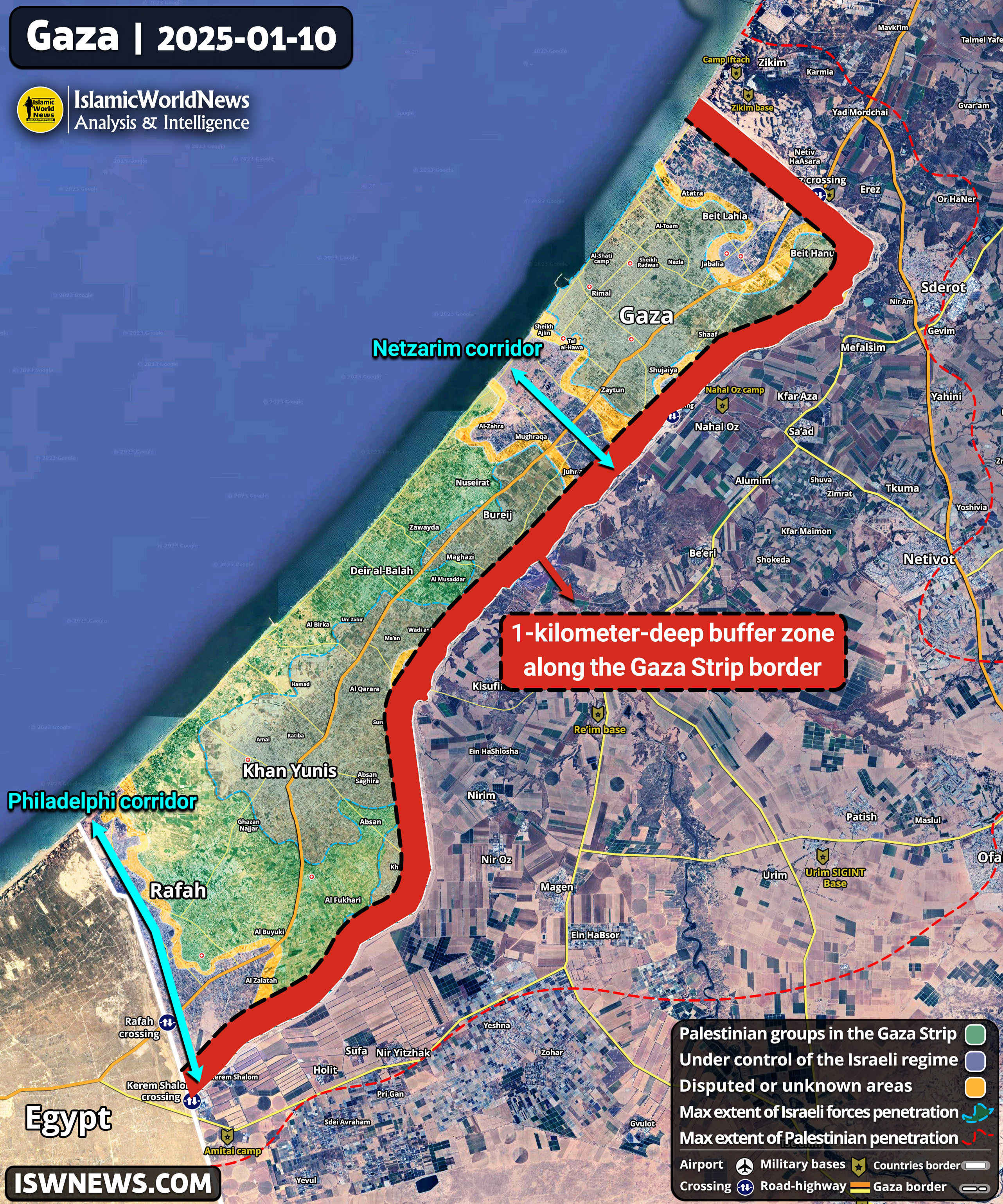
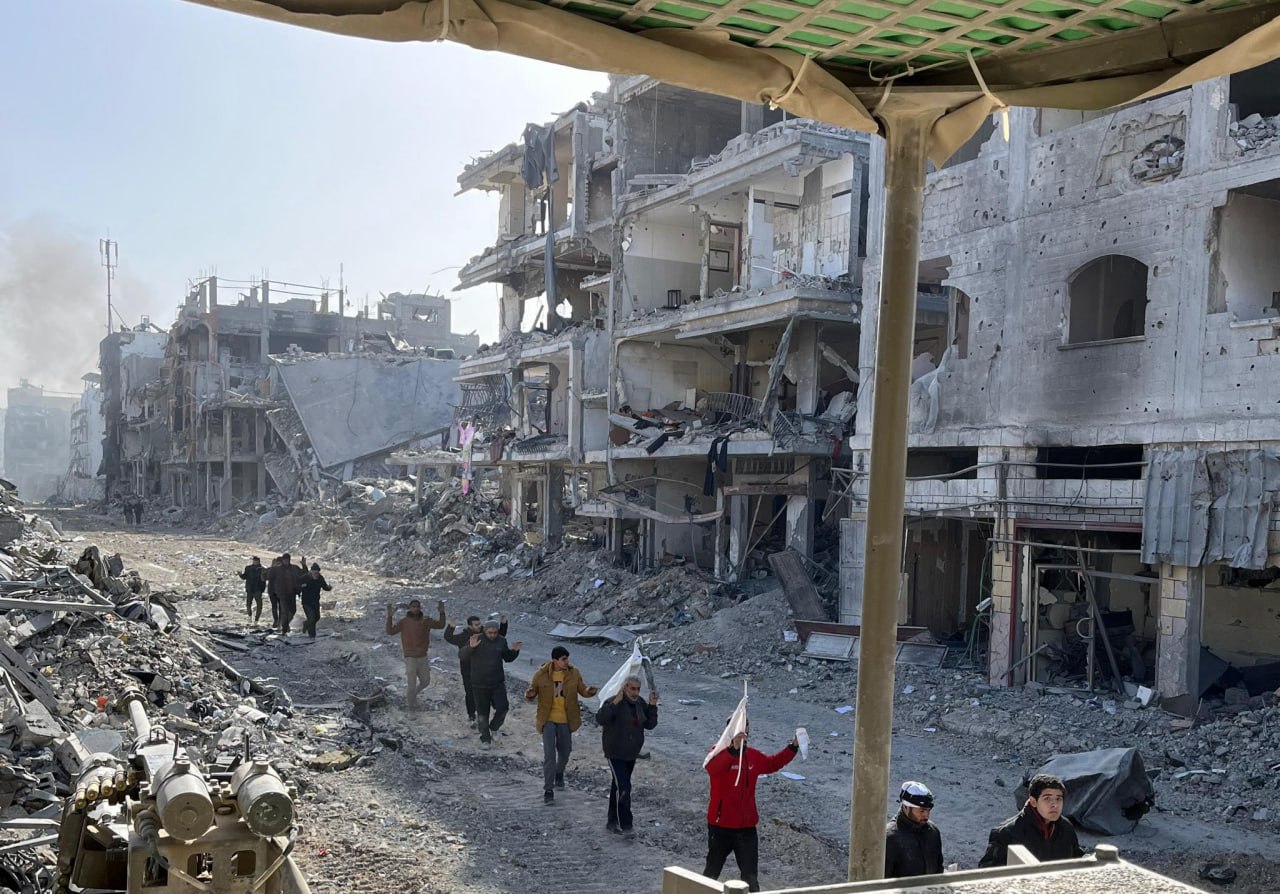
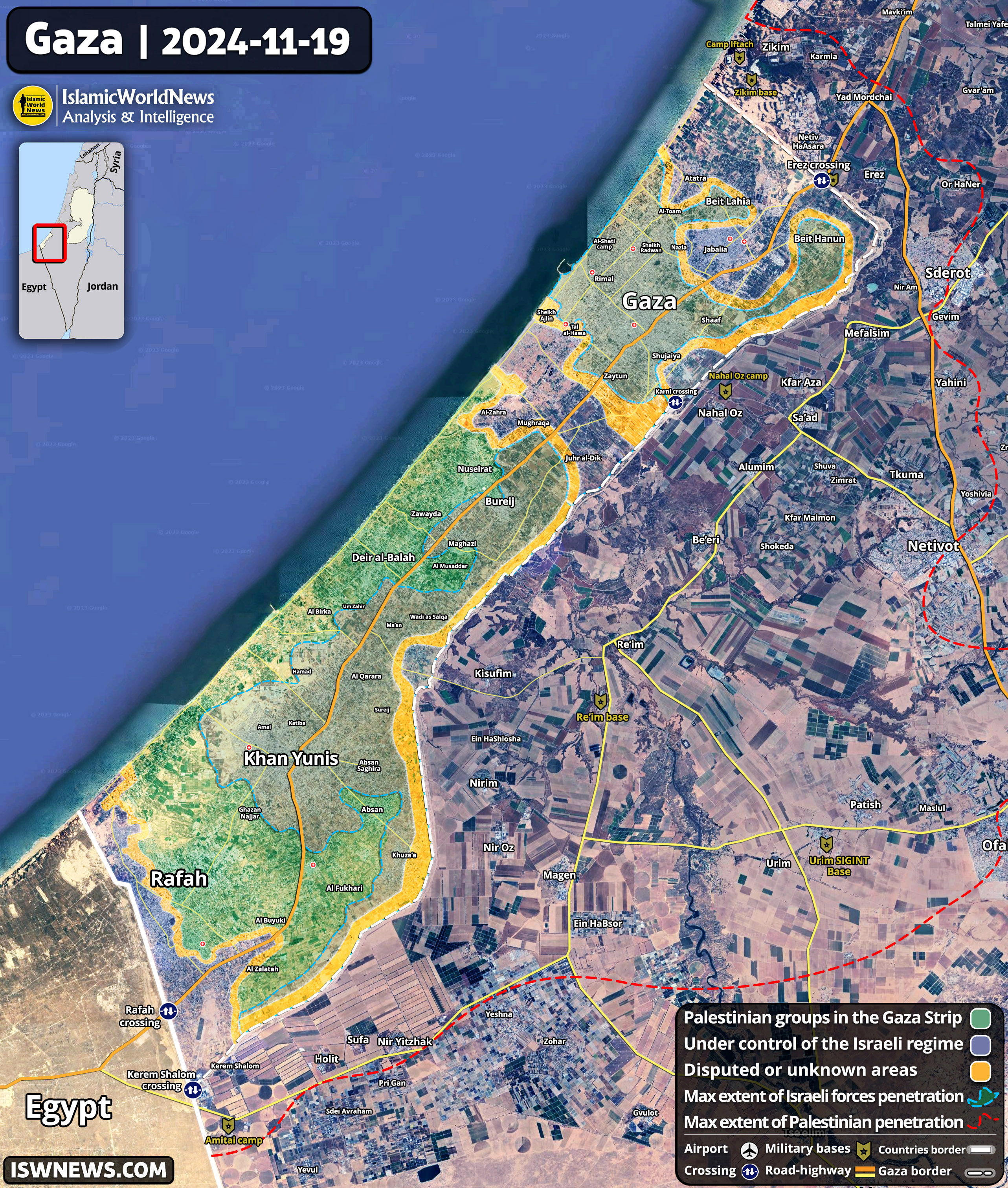
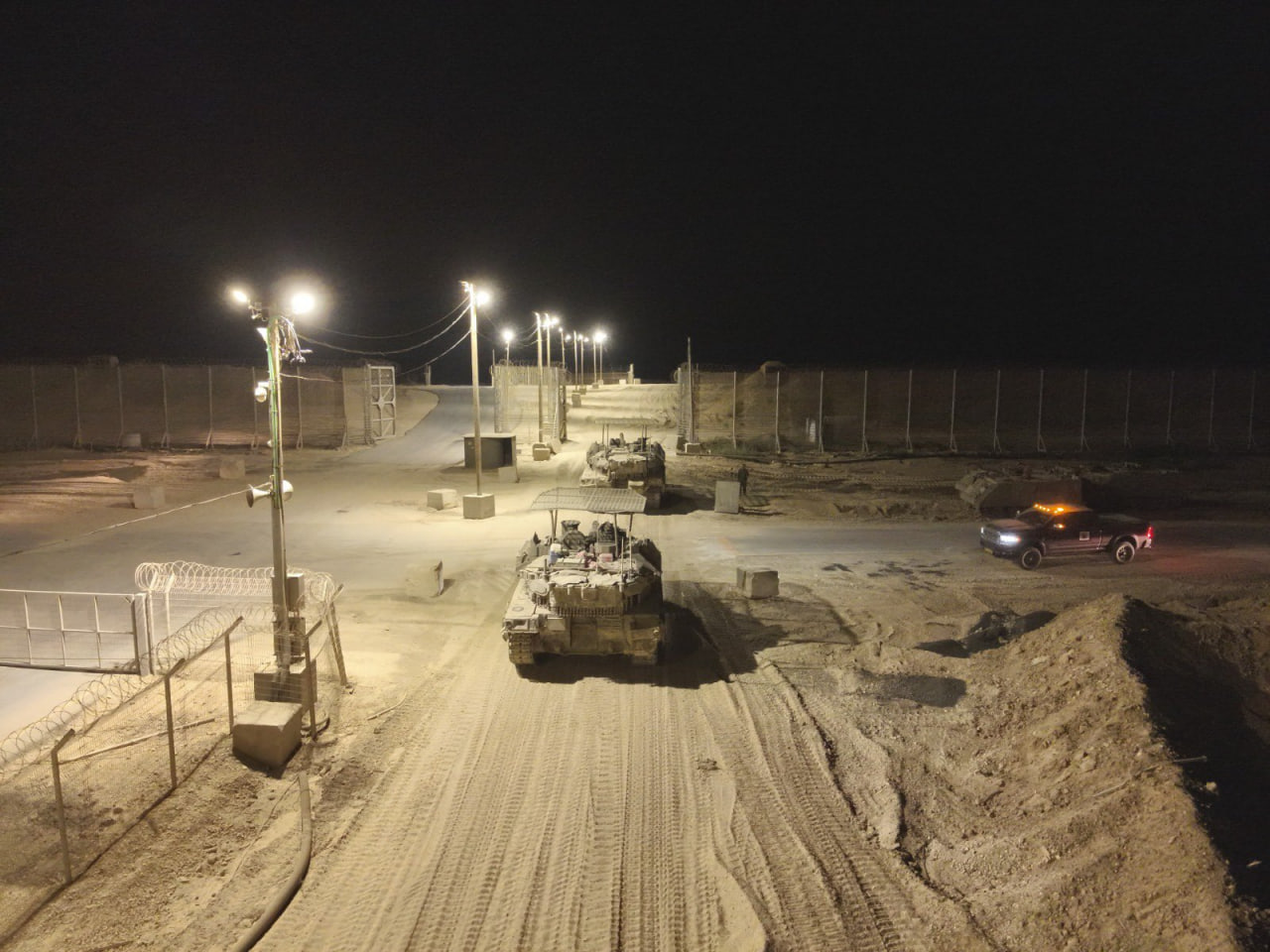
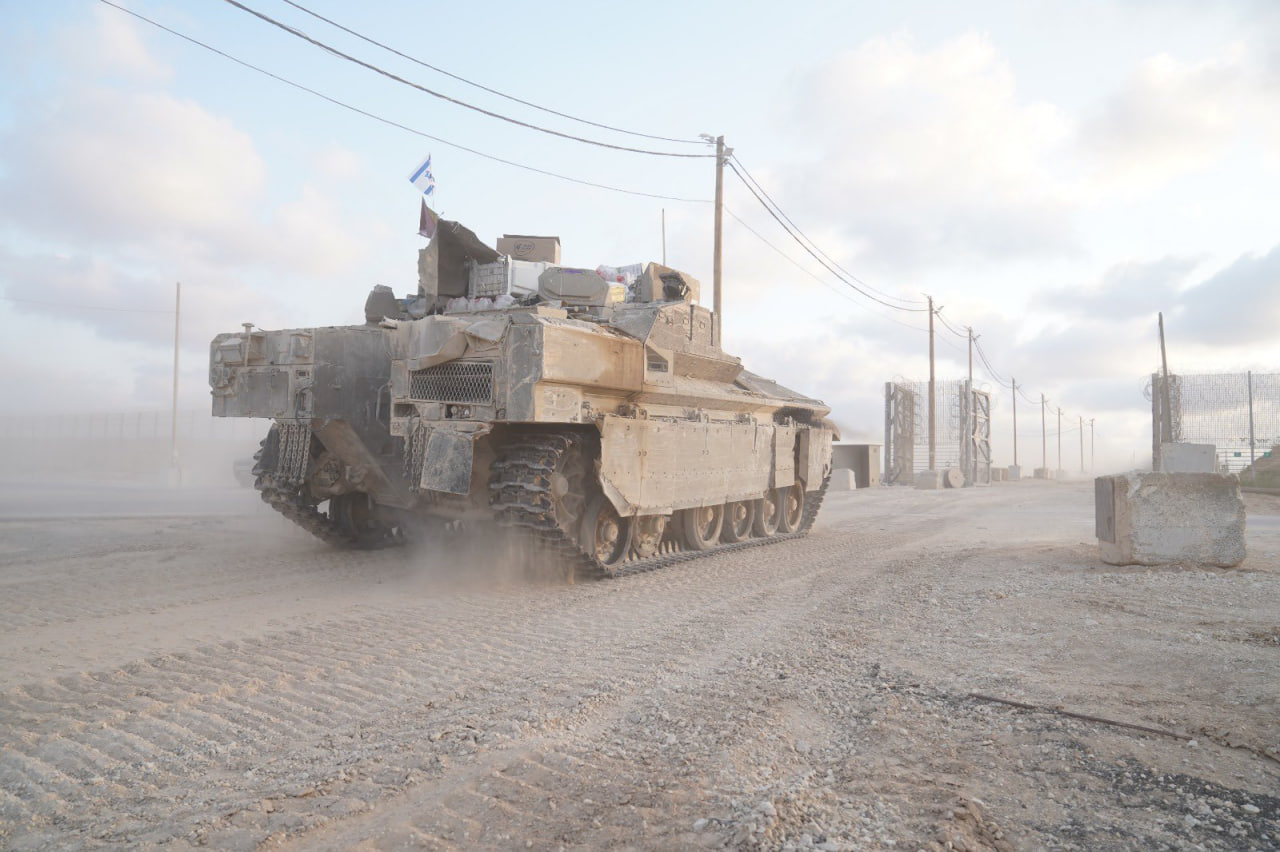
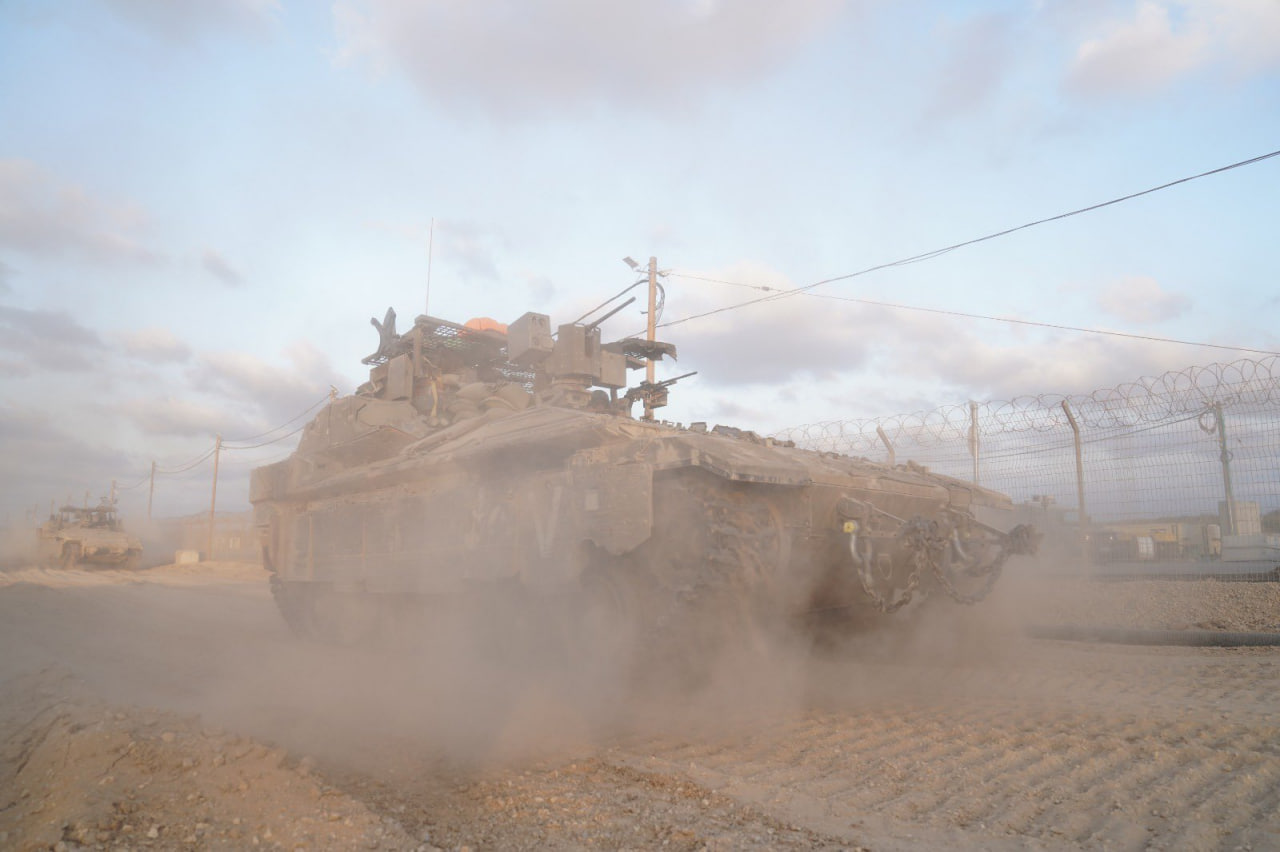
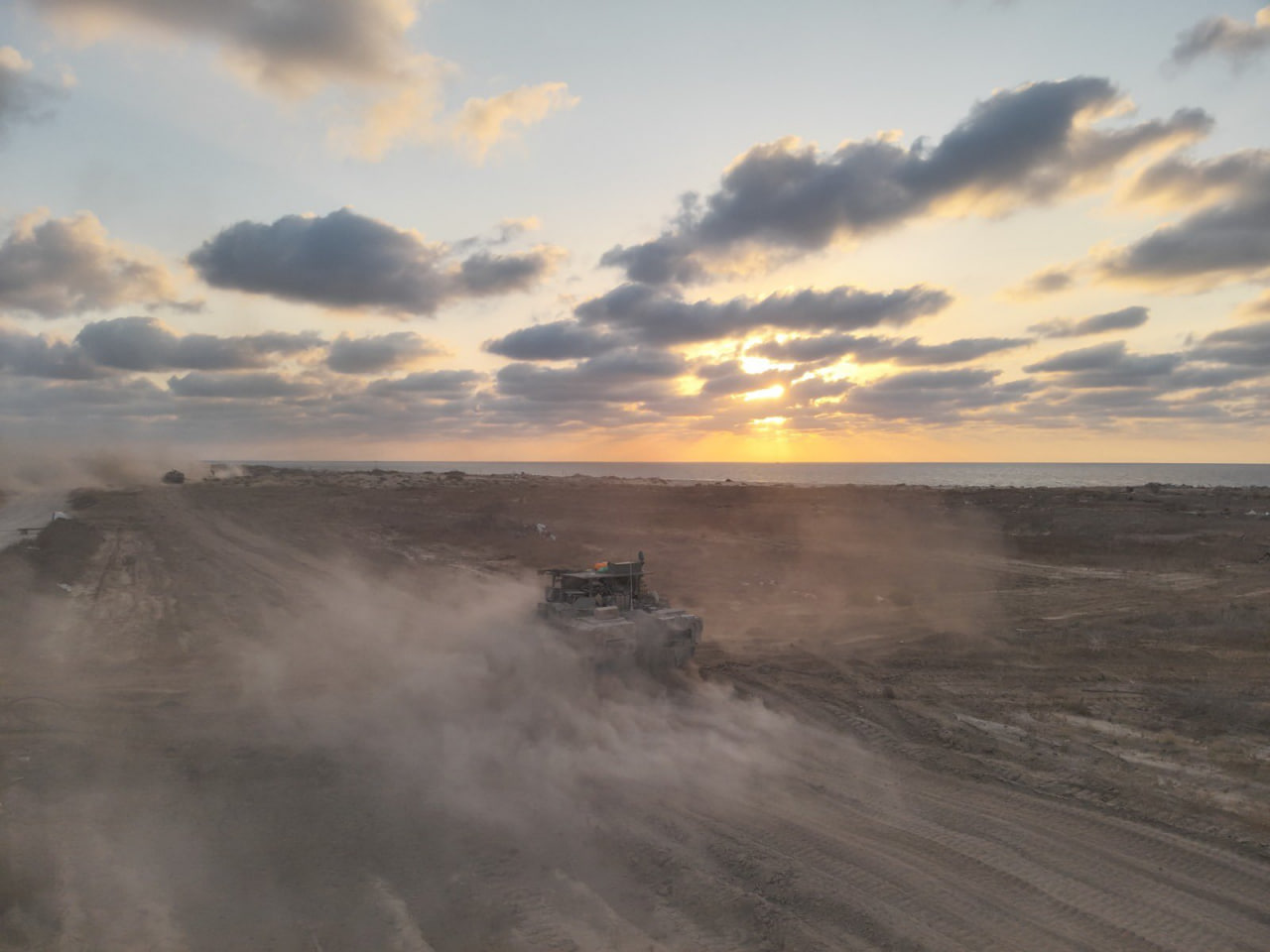
The buffer zone covers an area of 58 square kilometers, accounting for 16 percent of the total Gaza Strip area. In this zone, at least 4,100 buildings have been completely destroyed. Previously, the buffer zone depth was 300 meters, but the Israeli army increased it to around 1 kilometer in recent months.
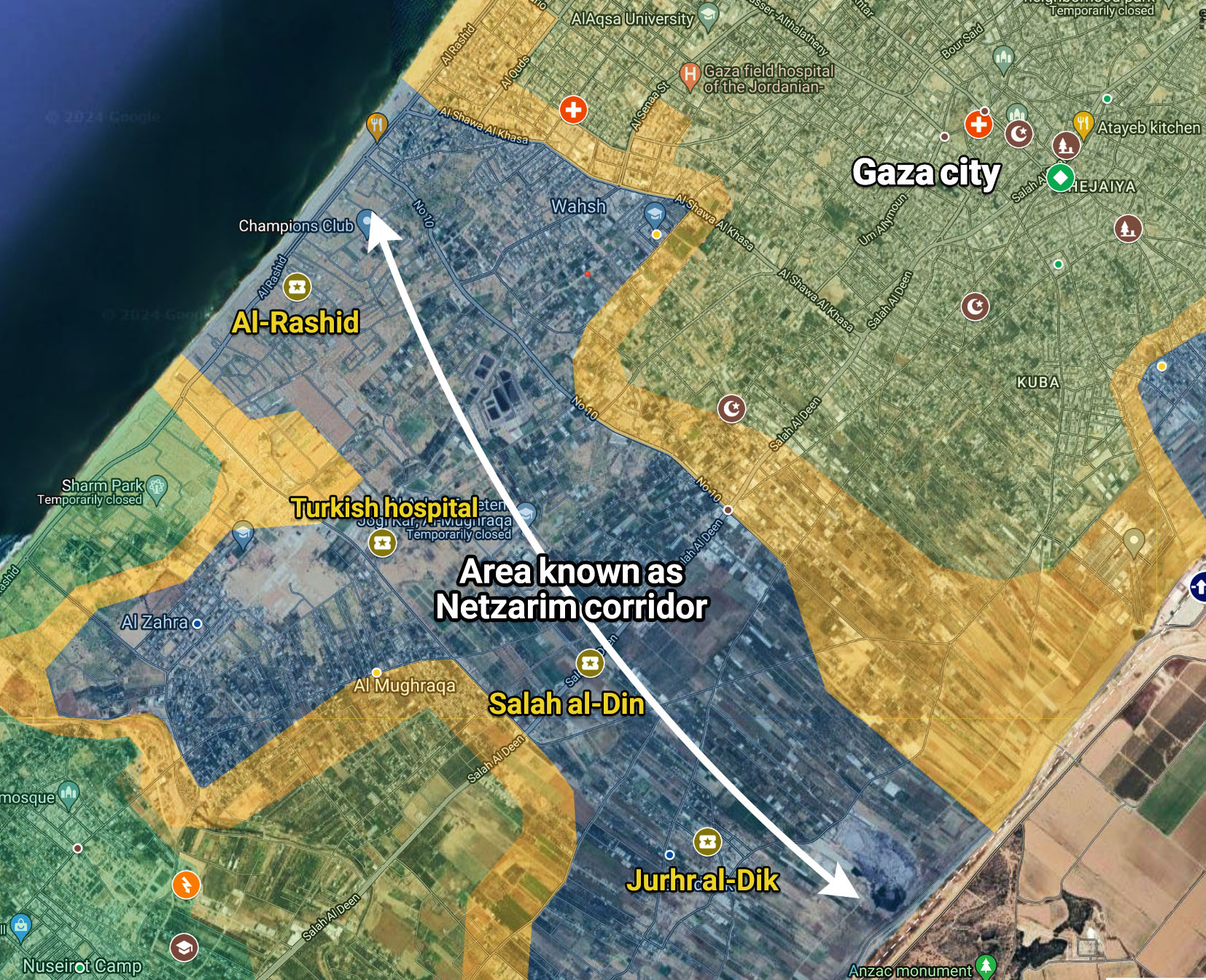
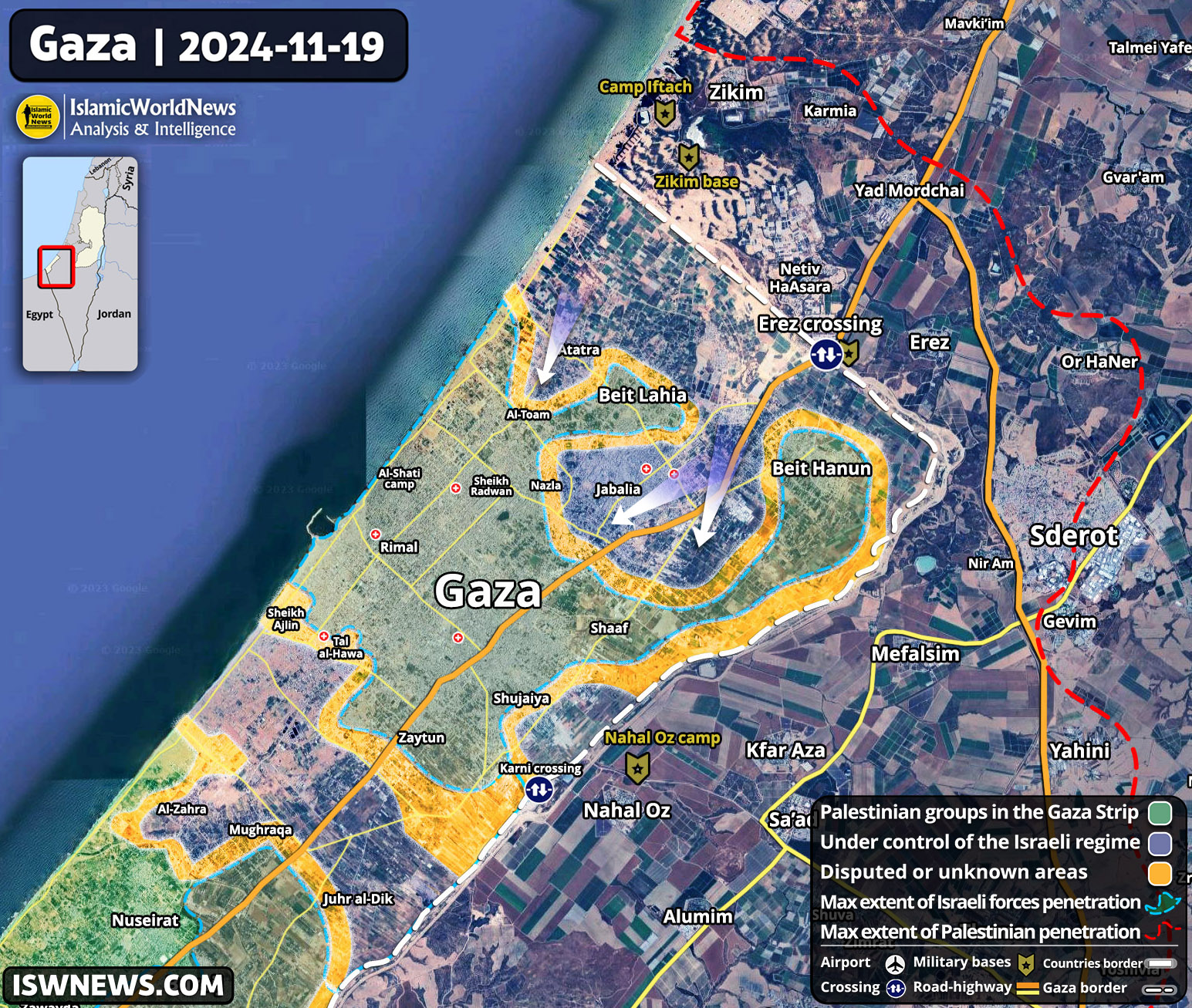
Additionally, in the Netzarim axis in central Gaza Strip, an area of 49 square kilometers, or 13.5 percent of the Gaza Strip, has been occupied by the Israeli army, with residential buildings completely destroyed. The Netzarim axis was established during the Israeli army’s ground operations to cut off land connections between Gaza City and southern Gaza Strip. The Zionist regime has established four bases in this axis to consolidate its positions and enhance its presence and influence.
The so-called Netzarim corridor and four Israeli army bases on this axis
Here’s a rephrased version:
In the Philadelphia axis south of Rafah in the southern Gaza Strip, the Israeli army has occupied 12 square kilometers, equivalent to 3 percent of the total Gaza Strip area. To maintain a permanent presence, the Israeli military has destroyed at least 6,932 buildings in this zone.
Consequently, approximately 32.5 percent of the Gaza Strip is currently destroyed and occupied by the Israeli military. These areas are permanently occupied by Israeli forces, with troops stationed there constantly. In other areas of the Gaza Strip, the presence of Zionist forces manifests through short-term, temporary operations and raids.
The buffer zone on the border between the Gaza Strip and the occupied territories on the Netzarim and Philadelphi axis
The extensive and total destruction of buildings in these areas has made it impossible for the Palestinian refugees to return.
In recent months, the Israeli army has laid the groundwork for the permanent occupation of parts of Gaza and the creation of buffer zones by conducting several military operations in the north, center, and south of the Gaza Strip. According to Israeli claims, these buffer zones and the continuous presence of Israeli soldiers aim to tighten the siege on Gaza’s resistance forces and, in turn, reduce attacks on Israeli settlements around Gaza.
However, recent actions by resistance fighters indicate that the presence of Israeli soldiers has not completely halted their attacks. Despite the buffer zones and the continuous raids by Israeli soldiers in various parts of the Gaza Strip, rocket attacks by resistance groups persist.
The establishment of buffer zones and the complete withdrawal of Israeli soldiers from Gaza have long been contentious issues in negotiations between Hamas and the Israeli regime. Recently, there has been speculation about the possible withdrawal of Israeli forces from the Netzarim and Philadelphi axes as part of an initial ceasefire agreement, but this has not yet been confirmed, and negotiations are still ongoing without specific conclusions.
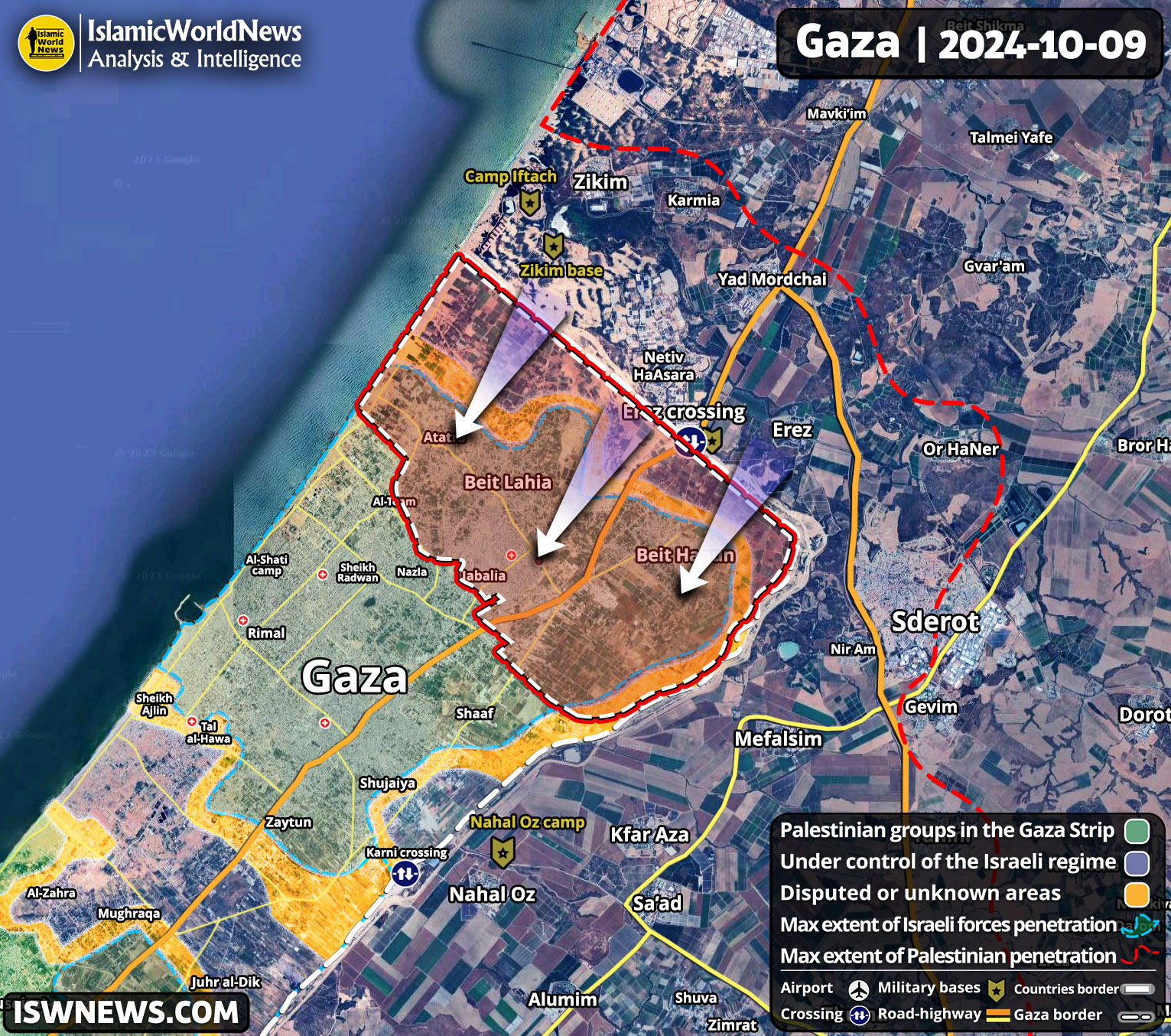
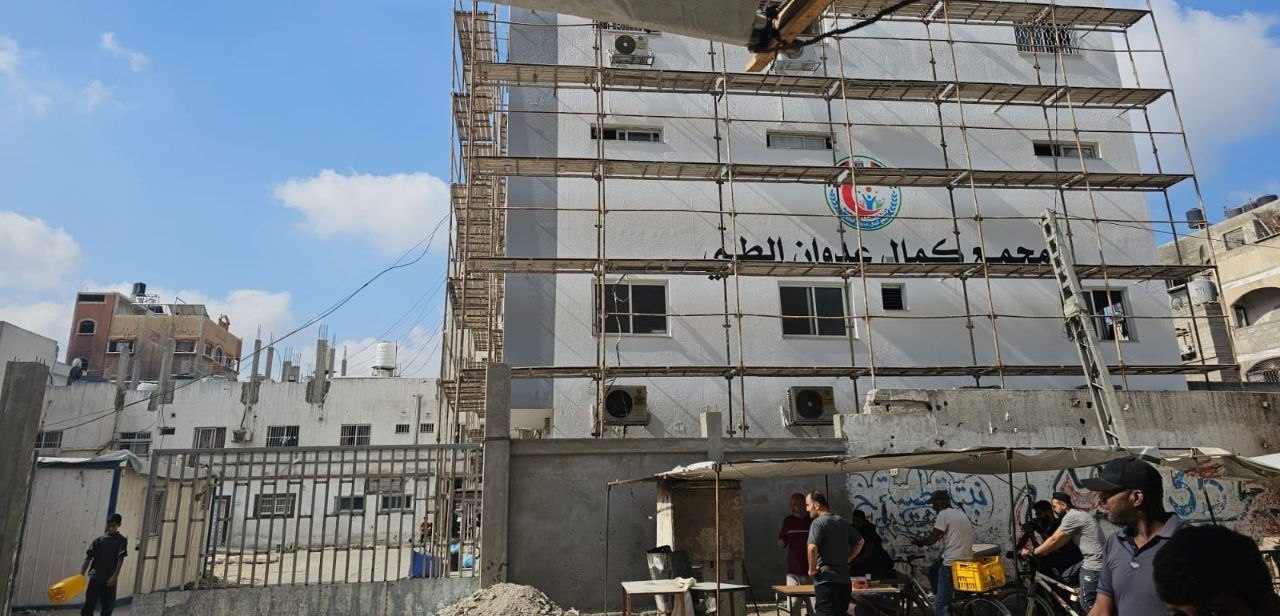
The Israeli army launched an operation in the Jabalia area, in the northern Gaza Strip on October 9. According to Hebrew sources, the fighting in Jabalia has been intense and challenging. The advance of Israeli forces has been difficult and costly due to the fierce resistance from the resistance fighters. Recently, the Israeli forces have concentrated their efforts around Kamal Adwan Hospital in Jabalia.
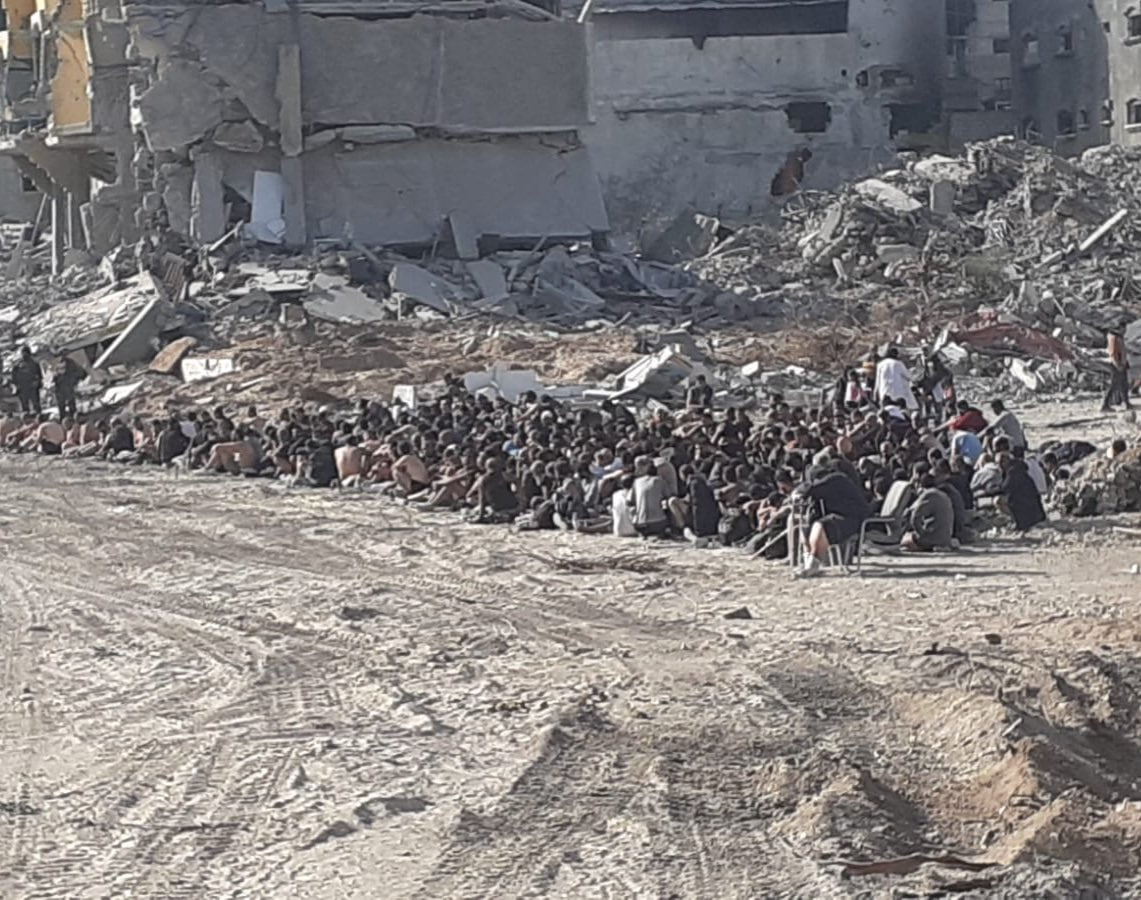
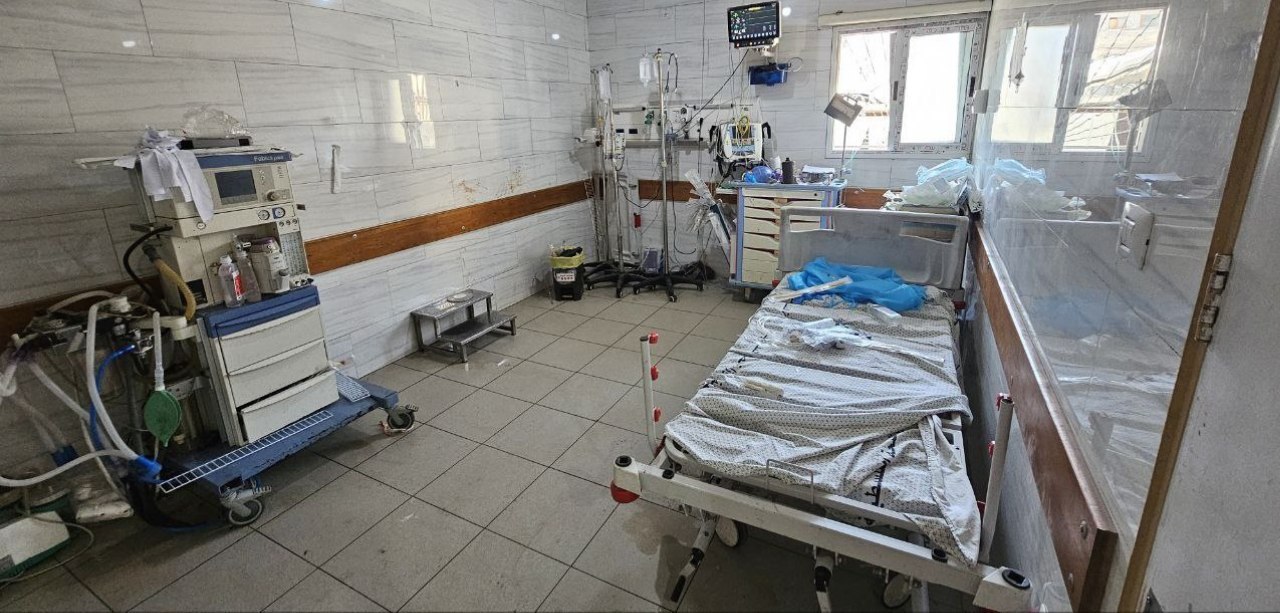
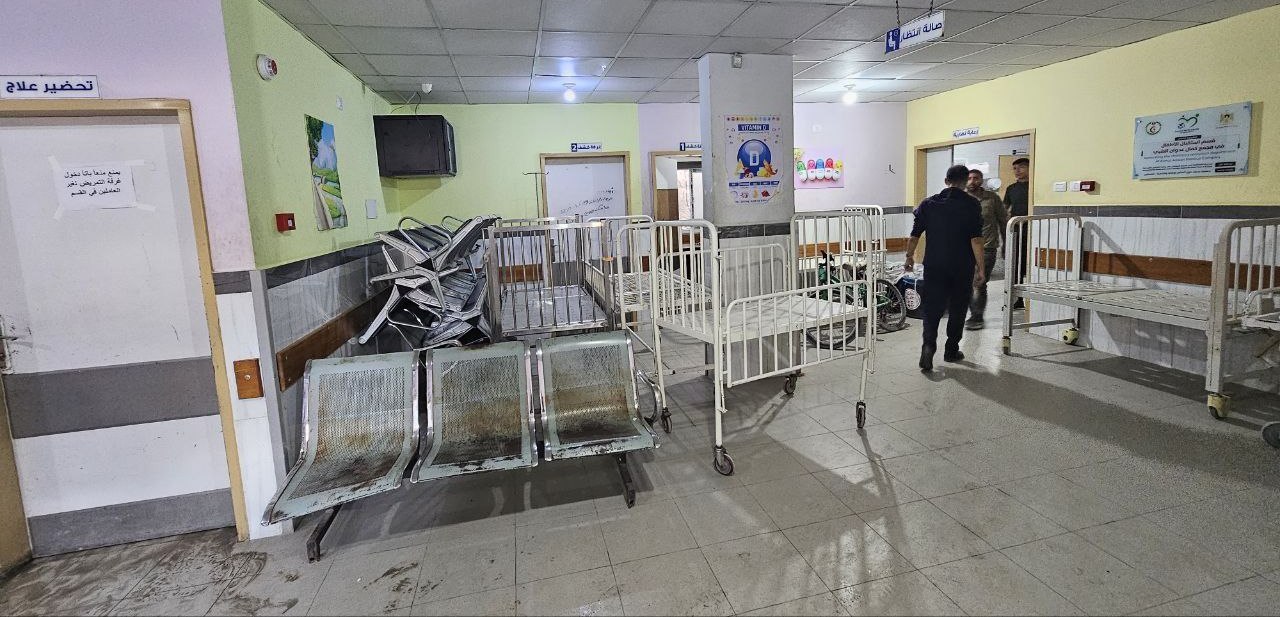
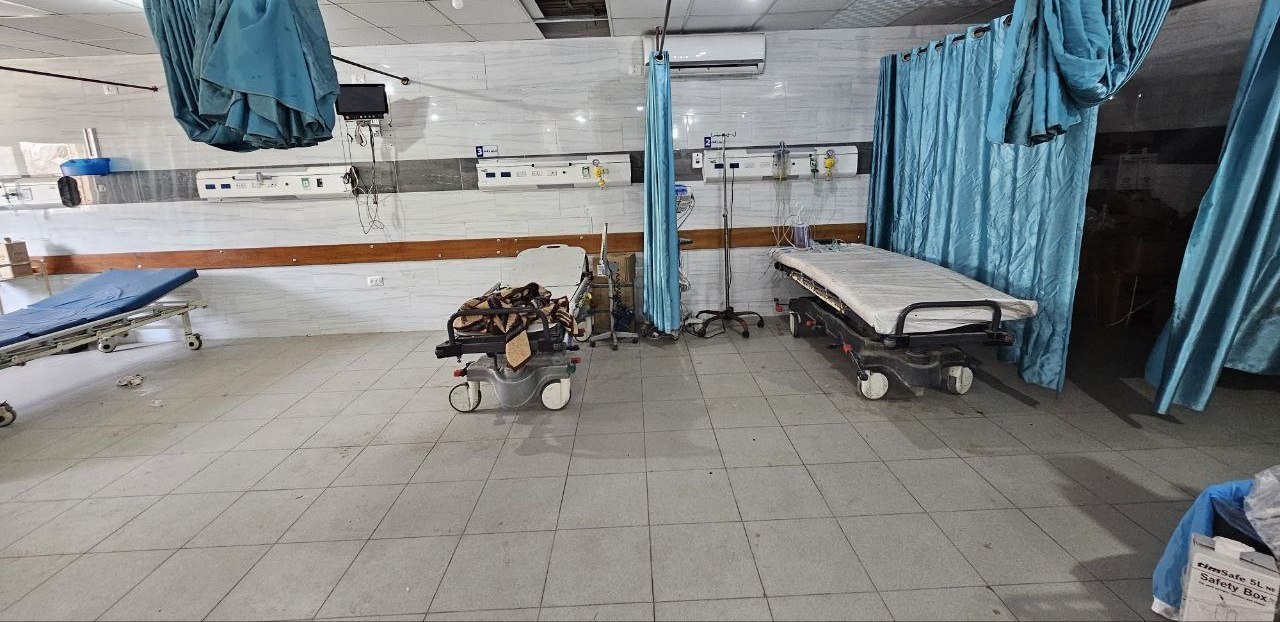
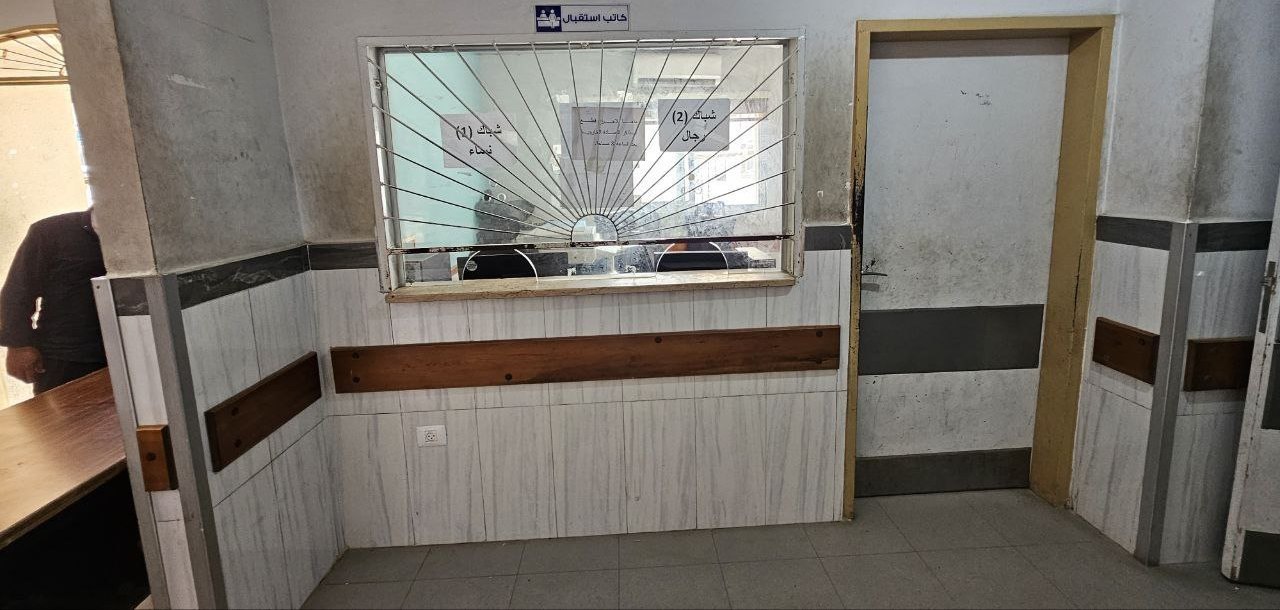
On Friday morning, December 27, the 401st Brigade of the Israeli army entered the Kamal Adwan Hospital compound and surrounded the medical center. Shortly after, Israeli soldiers demanded the hospital be evacuated, leading to at least 940 Palestinians, including around 600 civilians and 95 patients and medical staff, leaving the premises.
It’s important to note that over the past year, Israeli forces have raided this hospital multiple times, attempting to destroy, arrest, and kill during each raid.
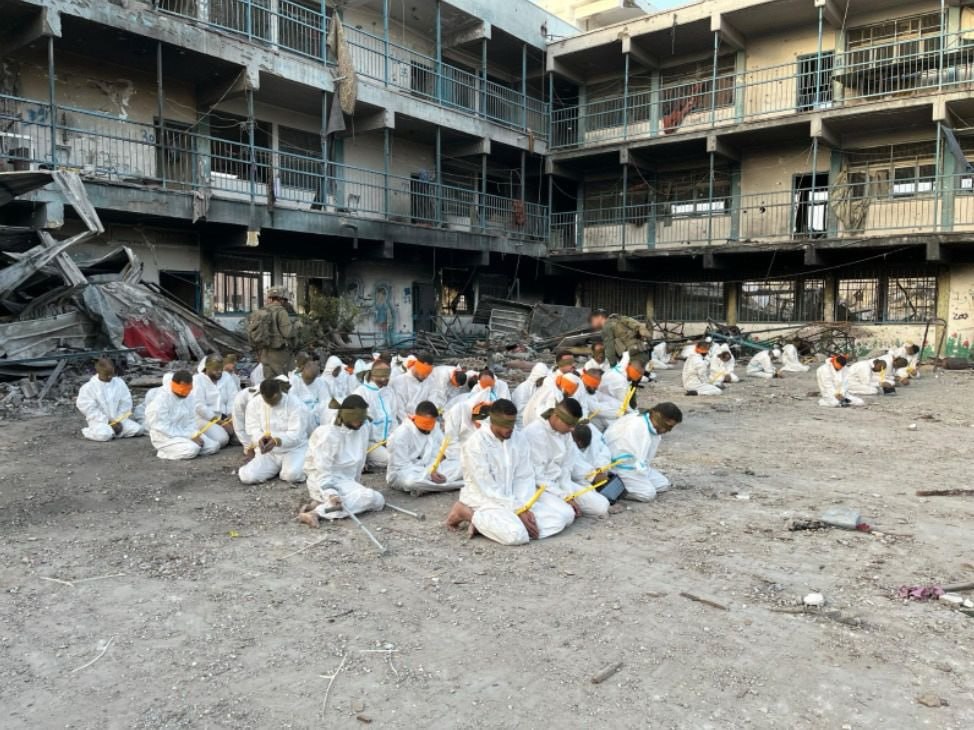
The Israeli military has arrested 240 individuals, including Dr. Hossam Abu Safiya, head of Kamal Adwan Hospital for alleged ties to resistance groups. Israel claims among those arrested are Hamas and Islamic Jihad commanders along with 15 fighters involved in the October 7 operation.
Click to view full size
The Israeli army has described the operation at Kamal Adwan Hospital as one of the largest arrest missions in the Gaza Strip. By releasing the alleged images of weapons and ammunition found in and around the hospital, they aim to accuse resistance groups of using medical centers as a cover for their military activities. This tactic has been employed by the Israeli army multiple times to undermine the Palestinian resistance and justify their crimes against medical centers and civilians.
The Israeli army claims that Kamal Adwan Hospital was “the last Hamas stronghold in the Jabalia area!” With the conclusion of the operation at the hospital, the military operation in the northern Gaza Strip is expected to soon come to an end.
A segment from the Israeli army’s operation in the Jabalia area.
Since the beginning of October and the start of the operation in Jabalia, the Israeli army has reportedly suffered approximately 40 casualties.
Given these high numbers, Hebrew media seems to be maneuvering on the possible conclusion of the military operation at Kamal Adwan Hospital and preparing public opinion for an end to the operation in the Jabalia area.
The Israeli authorities are aware that completely eliminating resistance cells in the Gaza Strip is unattainable. The ongoing presence of resistance fighters and the continued rocket attacks on occupied territories—despite extensive military operations in various regions of the strip—support this assertion.
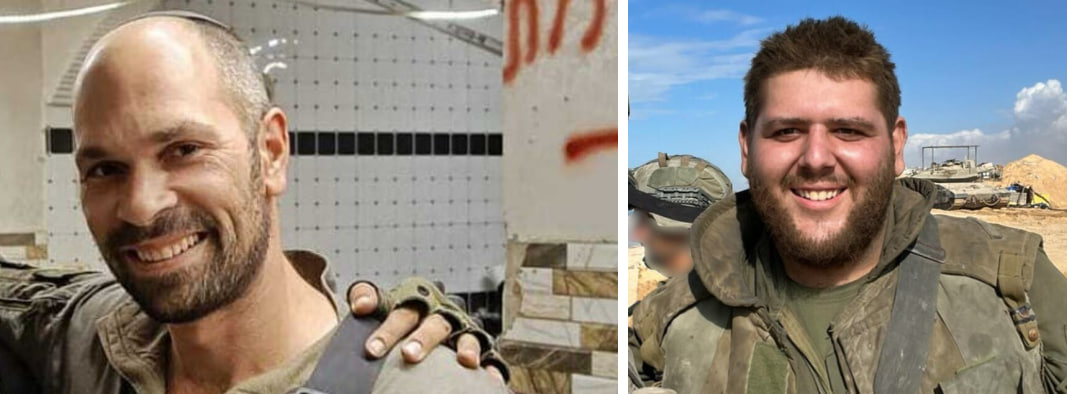
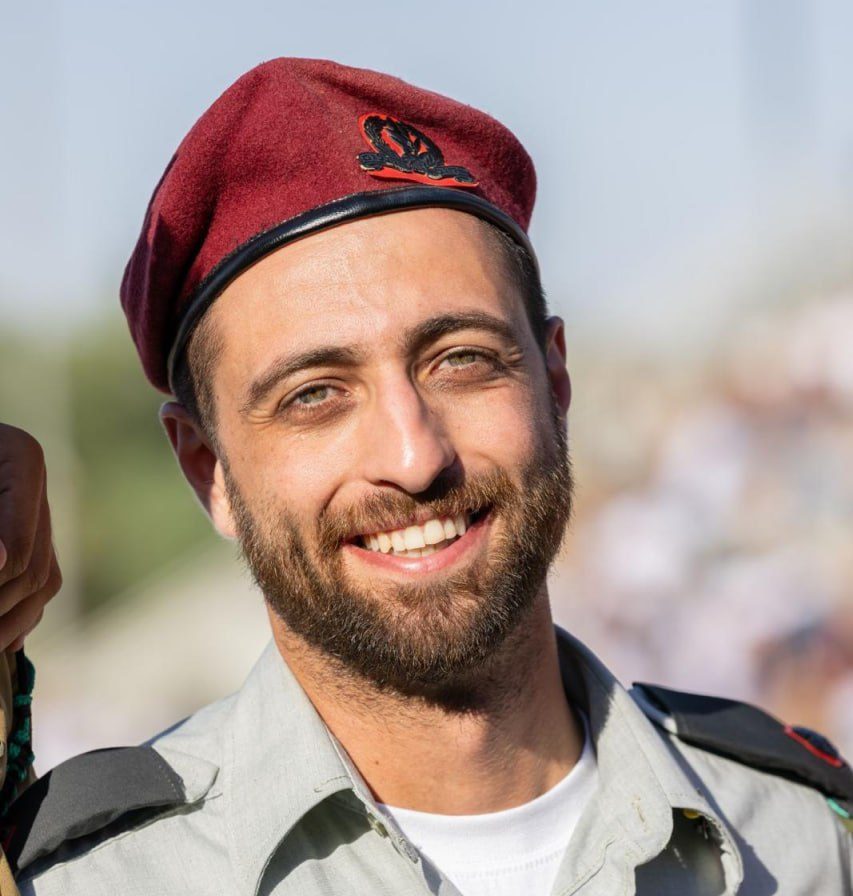
Amit Levy from the 551st Brigade was killed in the central Gaza Strip, and Staff Sgt. Yuval Shoham from the 401st Armored Brigade’s 9th Battalion was killed in northern Gaza.
Additionally, a soldier from the Givati Brigade’s Tzabar Battalion was seriously injured in Beit Hanoun in northern Gaza.
The IWN investigations indicate that the number of alleged Israeli deaths since the start of the ground attack on the Gaza Strip has increased to 397.
The total number of “military” deaths, according to the Israeli regime’s claims, since the beginning of the war has reached 824.
In another separate incident, a tank commander with the 401st Armored Brigade’s 9th Battalion was also seriously injured by sniper fire in northern Gaza.
It should be noted that since the beginning of December, 16 Zionist soldiers and settlers have been killed in the occupied territories.
The IWN investigations indicate that the number of alleged Israeli deaths since the start of the ground attack on the Gaza Strip has increased to 395. The total number of “military” deaths, according to the Israeli regime’s claims, since the beginning of the war has reached 822.
This brings the number of martyrs in the PA attack on the Jenin camp to seven.
For the past three weeks, the Palestinian Authority, in coordination with the Zionist regime, has launched a military operation to suppress resistance groups in the West Bank.
The US government, in coordination with the Zionist regime, supports the PA’s operations in the West Bank by providing military assistance.
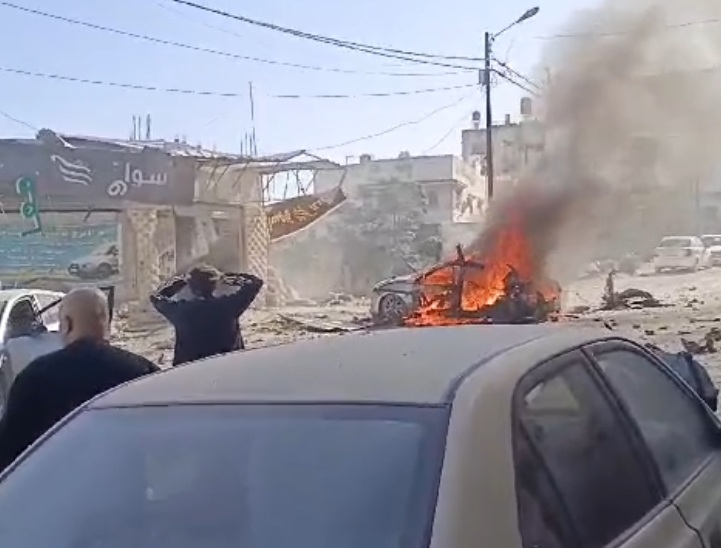
In the Gaza Strip, the Israeli army attacked two refugee settlement centers in the Al-Tuffah neighborhood in eastern Gaza, resulting in the deaths of at least 15 Palestinians. Furthermore, 17 more people were murdered in two other strikes in the Gaza Strip, bringing the total number of martyrs in the past 24 hours to 32.
The total number of deaths from the occupation regime’s military aggression on the Gaza Strip has reached 45,129, with more than 107,338 others injured.
The Israeli regime’s troops, supported by artillery and under heavy air attacks, have begun their advances towards some areas in northern Gaza and in the first step of the operation occupied Kamal Adwan Hospital and its surrounding areas.
The Israeli army has Gradually expanded the scope of its military operations and dispatched its forces to the southern and eastern areas of the city of Jabalia. Advancing in the mentioned fronts, Israeli military forces have exploded and completely destroyed Palestinian homes with the aim of forcibly relocating them to the central and southern Gaza Strip. After the presence of Israeli troops in the south and east of Jabalia, the Israeli regime’s army focused on the western and northwestern areas of Jabalia.
Videos released by the Izz al-Din Al-Qassam Brigades, the military wing of the Palestinian resistance movement Hamas, show that clashes are currently taking place around Al-Saftawi Square and Al-Bahr Street in eastern Jabalia.
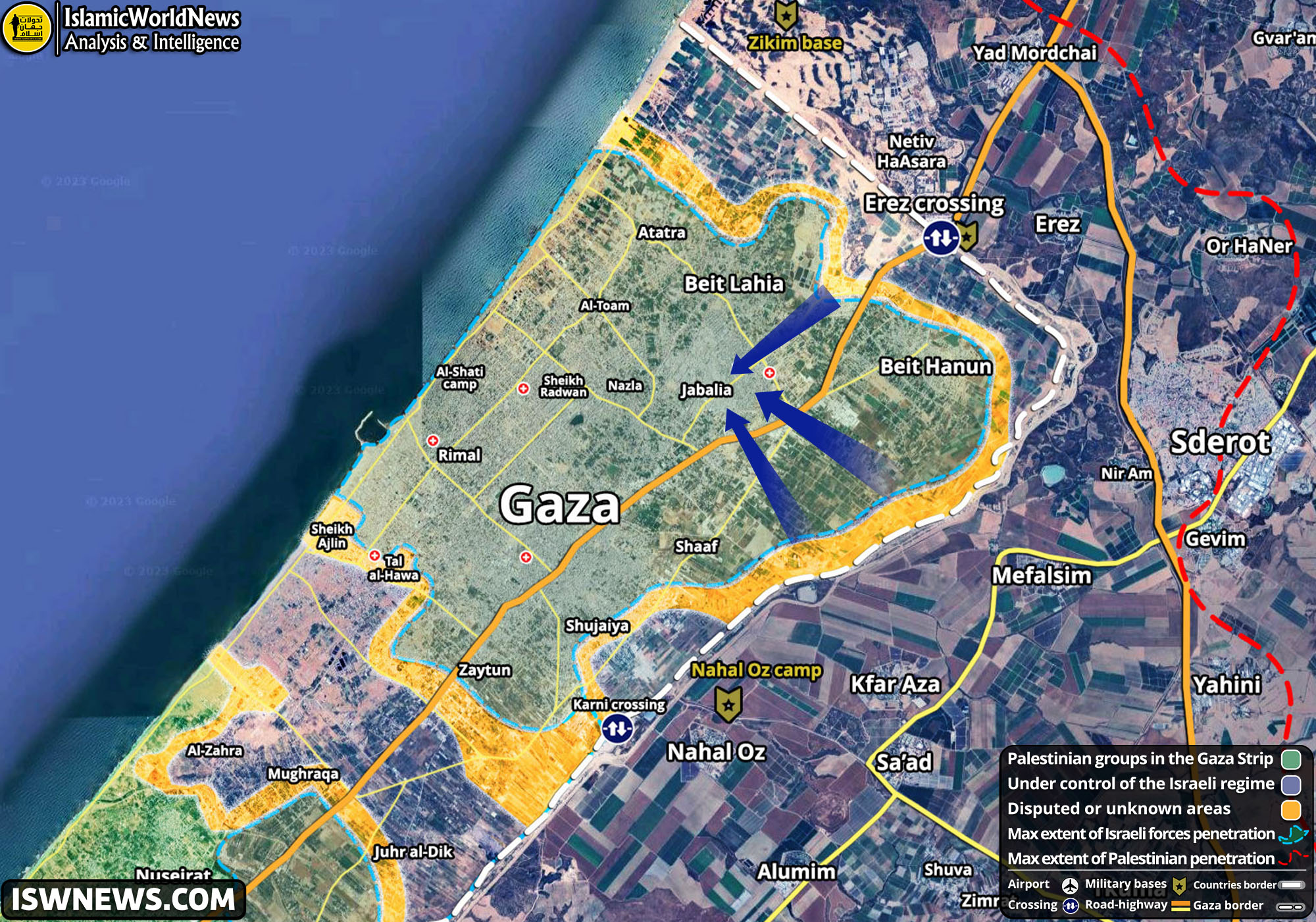
Latest military situation in the northern Gaza Strip – click to view full size
In recent days, Al-Qassam fighters targeted several Israeli army personnel, bulldozers, and tanks in the western fronts of Jabalia. Videos of some of these operations have also been released.
In the Beit Lahia front, clashes continue in the eastern and northern fronts. Over the past four days, Al-Qassam forces have targeted at least 11 Israeli troops, 2 Merkava tanks, one armored personnel carrier, and one bulldozer of the Israeli regime’s army in the outskirts of Beit Lahia. The Israeli military is trying to clear the path for ground forces to advance in this front through heavy air attacks.
Following the recent military operations in northern Gaza, it seems that the Israeli regime’s army intends to expand the so-called buffer zone at the Gaza border to the middle of Gaza City. Previously, this buffer zone was located several kilometers from the Gaza border. The expansion of the buffer zone into the depth of the Gaza Strip effectively facilitates its permanent occupation by the regime’s forces.
The Israeli regime’s army has launched a large-scale invasion of the Gaza Strip since the evening of October 27, 2023. Since the onset of the Israeli operations in Gaza, 43,922 Palestinians have been martyred and 103,898 others have been injured. On the other hand, the number of casualties reported by the Israeli regime since the initiation of the ground assault on the Gaza Strip has reached 379 military personnel.
Latest military situation in the Gaza Strip – click to view full size
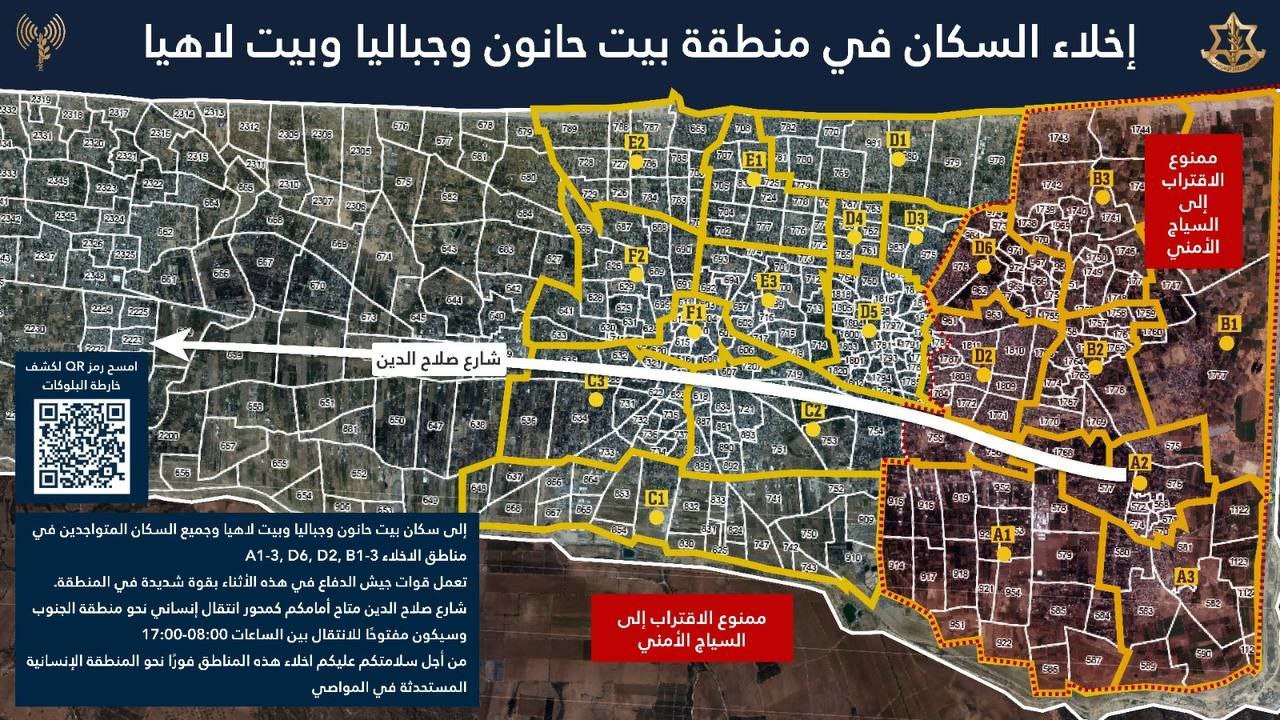
According to the statement, residents of Beit Hanoun, Beit Lahia, and Jabalia cities have been asked to leave these areas and move towards the southern regions of the Gaza Strip. The mentioned areas are expected to witness air and ground attacks by the 62nd Infantry Brigade of the occupying regime.
The spokesperson for the Israeli military announced three days ago that the 162nd Infantry Brigade would head to the city of Jabalia after accomplishing its mission in the city of Rafah and would kick off military operations in this area.
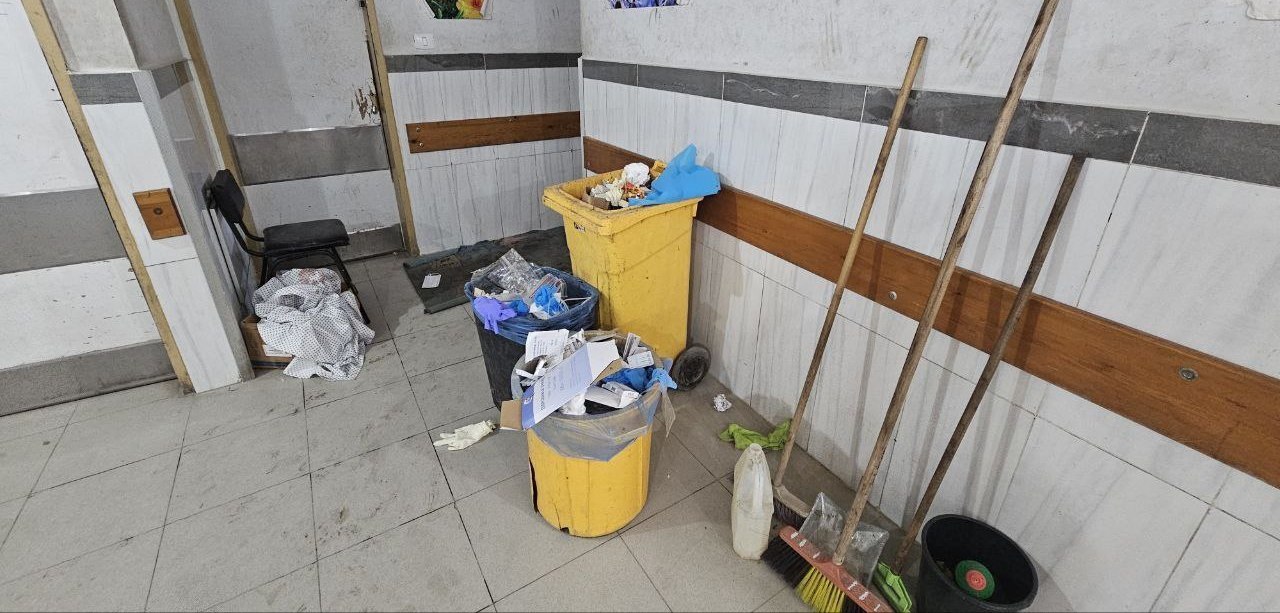
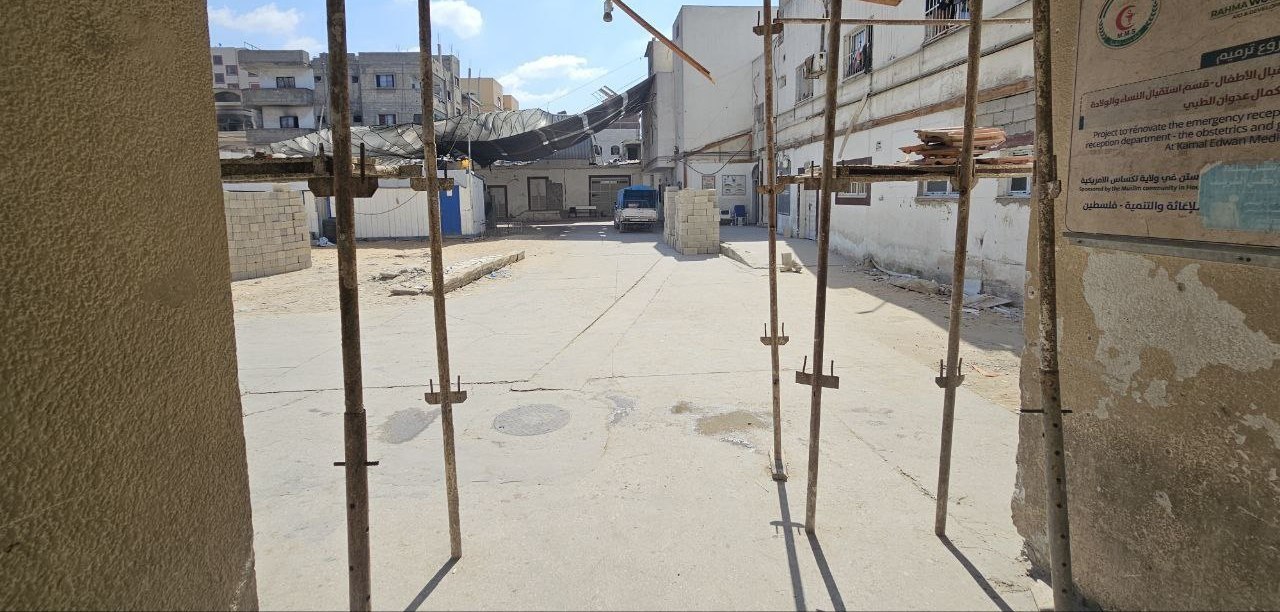
In addition, evacuation orders have been issued for Kamal Adwan, Indonesian, and Al-Awda hospitals as well. Doctors and medical staff at these health centers are forced to leave the area; otherwise, there is a risk that they may experience the massacre, which had taken place at Al-Shifa hospital by the Israeli regime’s forces.
Suspension of Kamal Adwan Hospital
The latest information on the battlefield indicate that the Israeli army has completely blocked the Abu Sharakh intersection; therefore, the occupying forces have completed the siege of the Jabalia camp, and the only exit route for civilians has been closed.
The areas of Al Difa’a Al Madani (Civil Defense), Al-Tawam, and Bir al-Najjah are also under air and artillery strikes by the Israeli military, and dozens of Palestinians’ homes have been targeted in recent hours. Moreover, neighborhoods and areas to the east, north, and west of the Jabalia camp have been reported to be under heavy artillery attacks.
The warning announcement released by
Following the onset of the Israeli ground assault in southern Lebanon, this is the fourth time that the Tel Aviv regime has issued a statement and conducted military operations in the Gaza Strip. This move indicates that despite the battle in southern Lebanon, the regime’s focus has not shifted from the Gaza Strip; rather, it is trying to exit as quickly as possible from the quagmire of the prolonged confrontation it is engaged in Gaza.
The recent attacks on the northern Gaza Strip may be the first major step towards breaking this deadlock that the Israeli regime is still facing in the besieged area. It appears that the Israeli army plans to expand the so-called buffer zone at the Gaza border to halfway into the middle of the city of Gaza. Earlier, that buffer zone was located a few kilometers from the Gaza border with the occupied territories of Palestine. The expansion of the zone into the depths of the Gaza Strip is expected to effectively pave the way for the permanent occupation of the strip by the Tel Aviv regime.
A spokesman for the Israeli military stated that the 162nd Division of the regime’s army (Ha-Plada, also known as the Steel Formation) moved to Jabalia after completing its mission in Rafah city and initiated military operations aimed at destroying the infrastructure of the Palestinian resistance in that area.
According to the Israeli military, the 401st and 460th Brigades of the 162nd Division are currently engaged in confrontations against resistance groups in the Jabalia city.
Ground operations in Jabalia kicked off just hours after intense aerial and artillery attacks by the Israeli regime’s military on that region.
Israel’s 162nd Division in Jabalia
It is worth mentioning that the 162nd Division left the axis of Rafah city after five months and transferred responsibility for that area to the Gaza Division of the Israeli army.
The Israeli army’s ground incursions in Jabalia take place after multiple previous attacks on the area, in which the regime claimed to have completely demolished the infrastructure of the Palestinian resistance there.
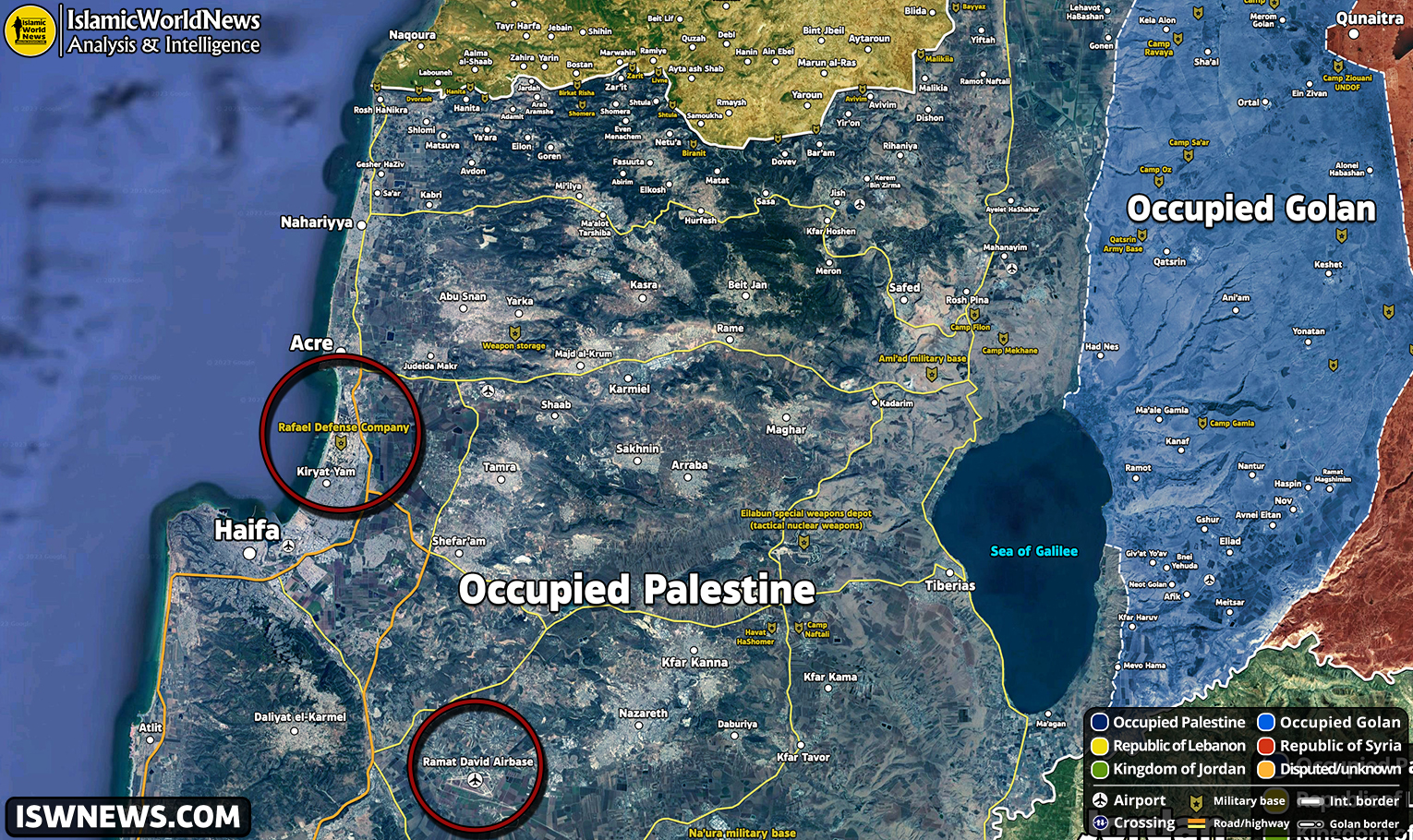
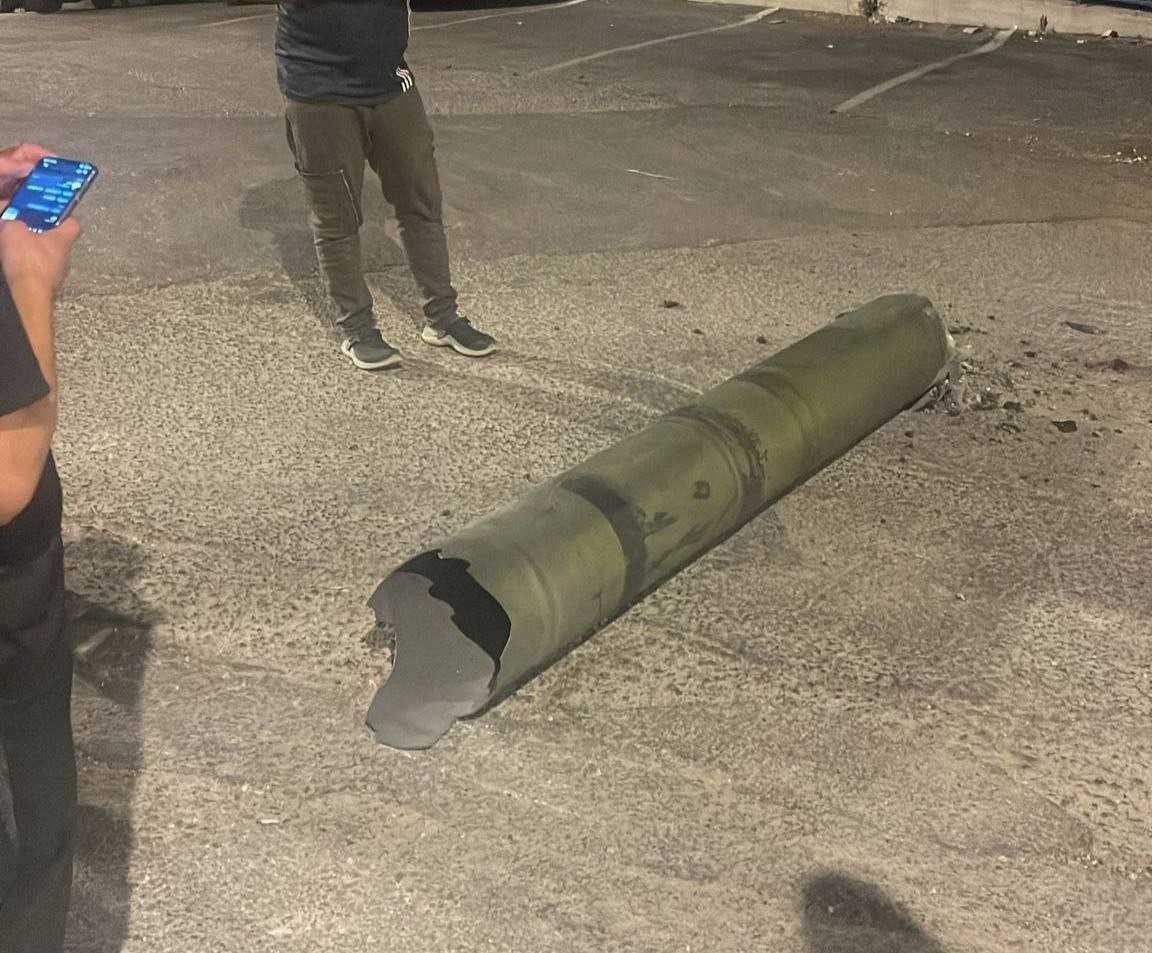
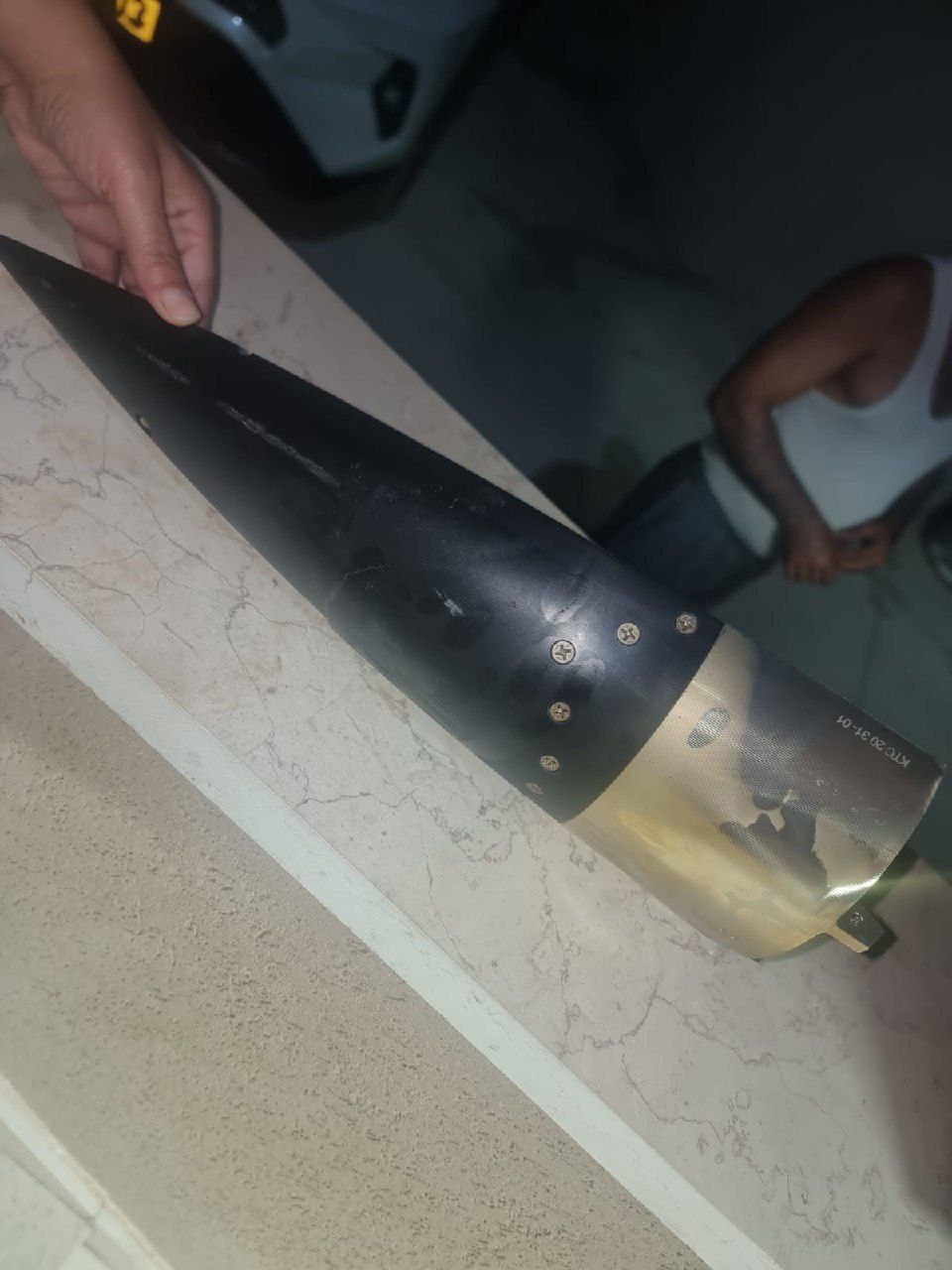
According to Hezbollah’s fresh statements, the first two rocket attacks were carried out on Tuesday morning in response to the repeated Israeli air raids on various regions of Lebanon. During these assaults, the Ramat David base and airport were attacked by Hezbollah with dozens of Fadi-1 and Fadi-2 rockets.
The Fadi-1 and Fadi-2 rockets are being utilized for the first time since the onset of the confrontations, and the launch of such rockets is likely to have taken place from one of the underground facilities at Imad underground missile base. The Fadi-1 rocket is a 220 mm artillery rocket, which is manufactured by Syria, and also known as the Khyber M220 class. Fadi-2 rocket, also named Khyber M302, was featured in the video unveiling of the Imad 4 underground facility in Lebanon.
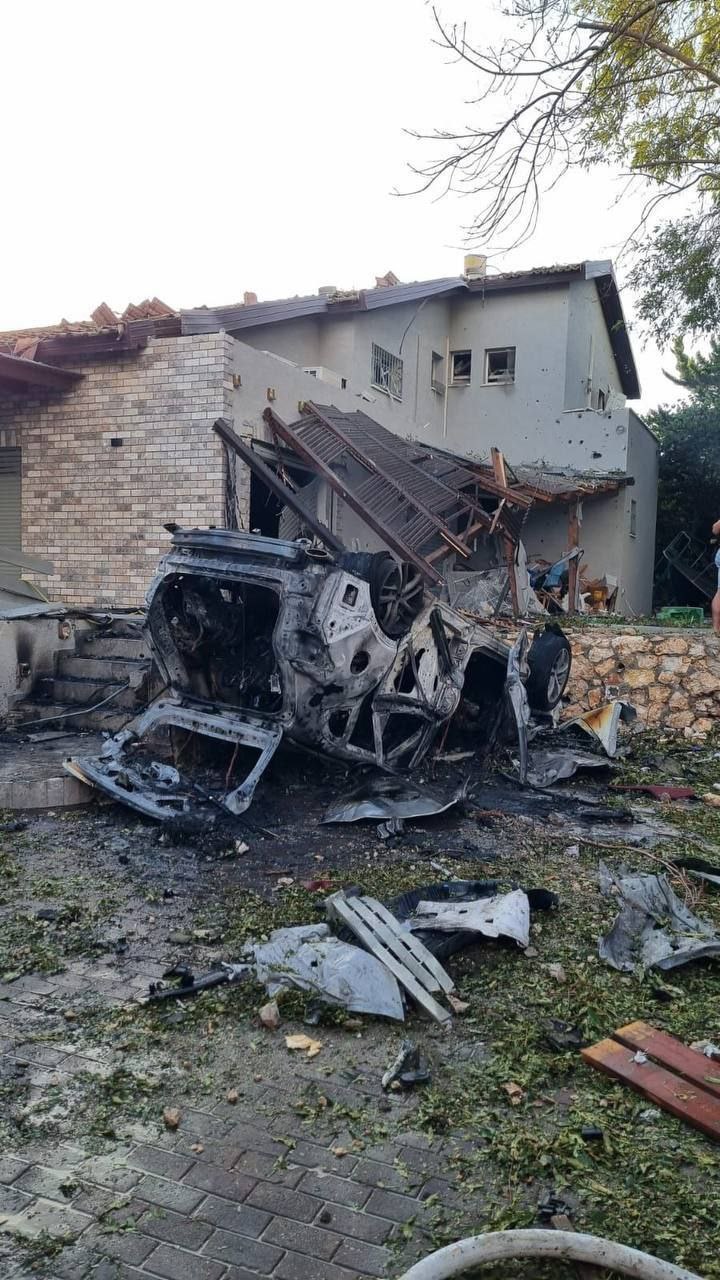
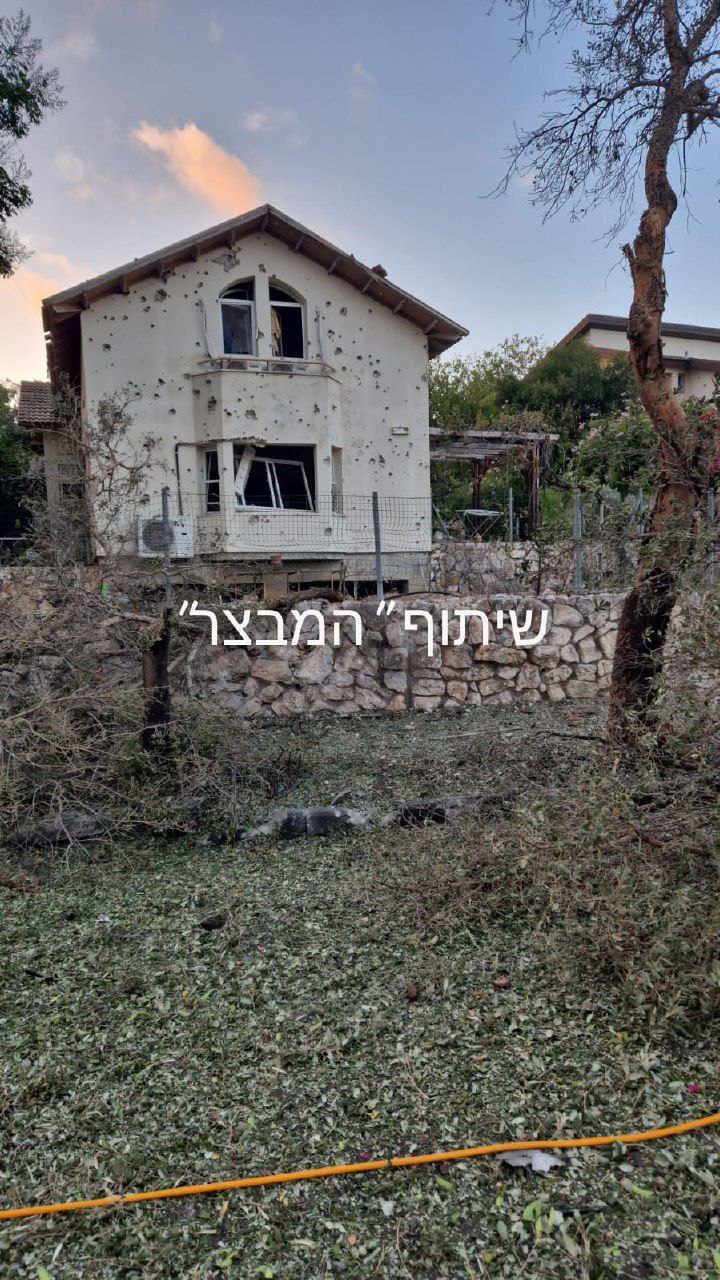
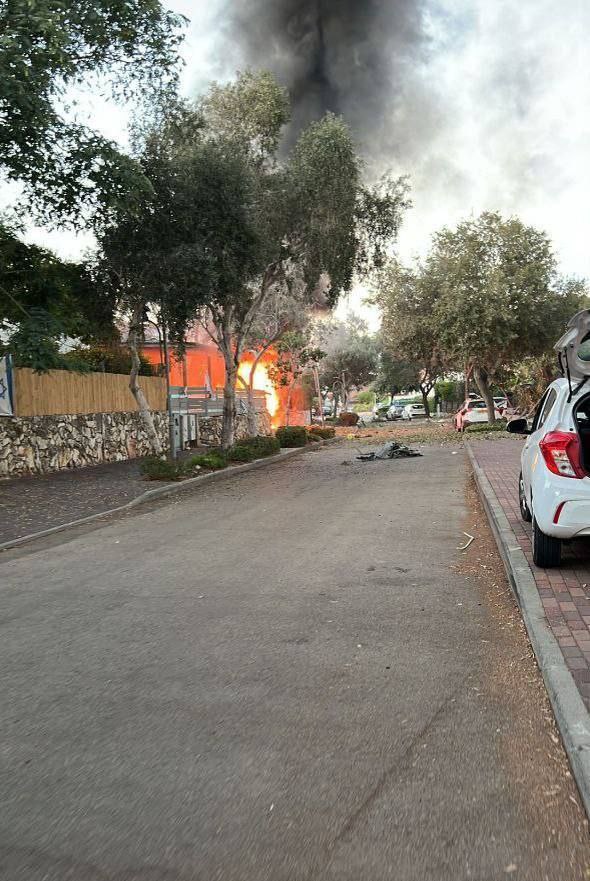
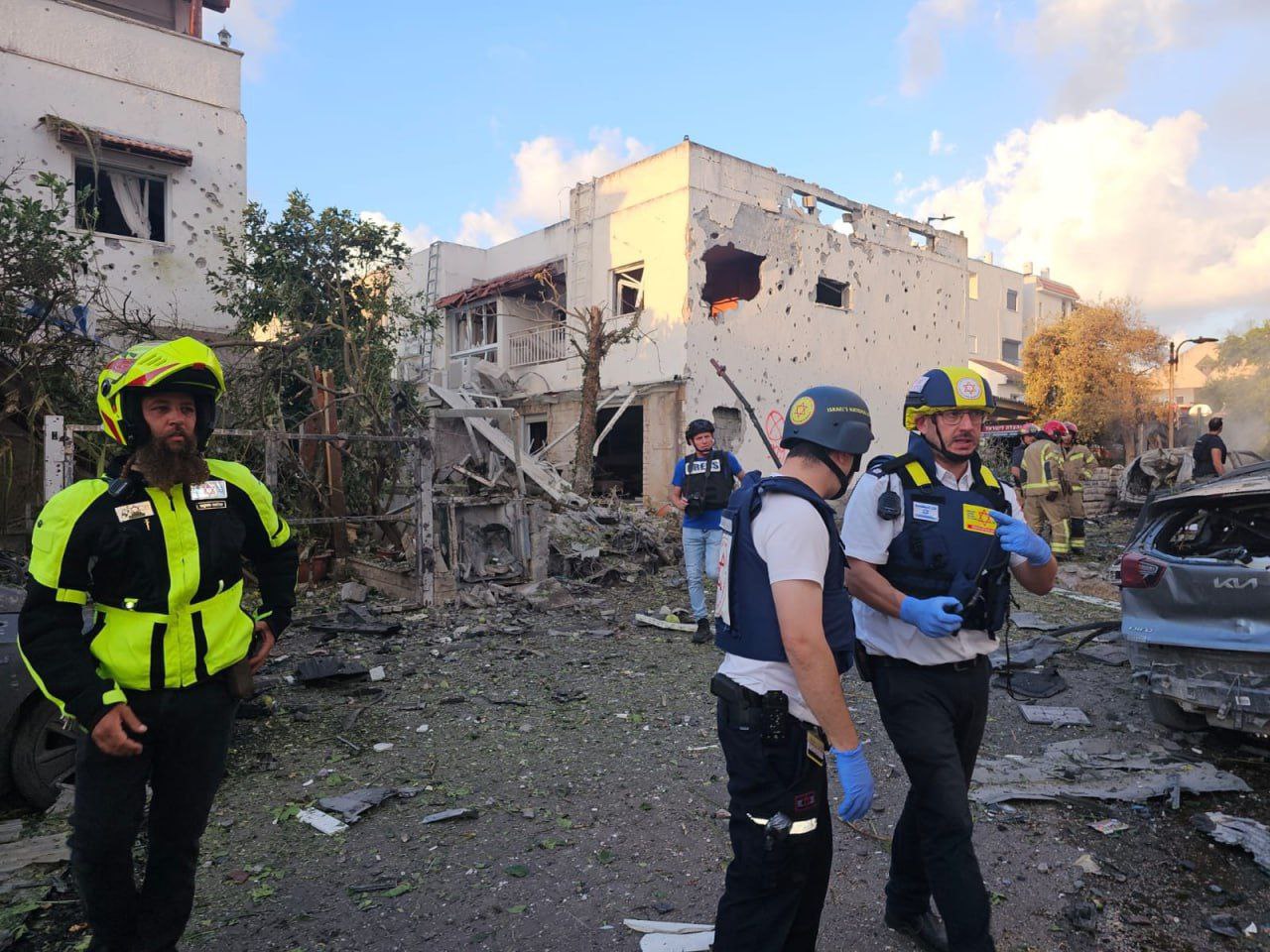
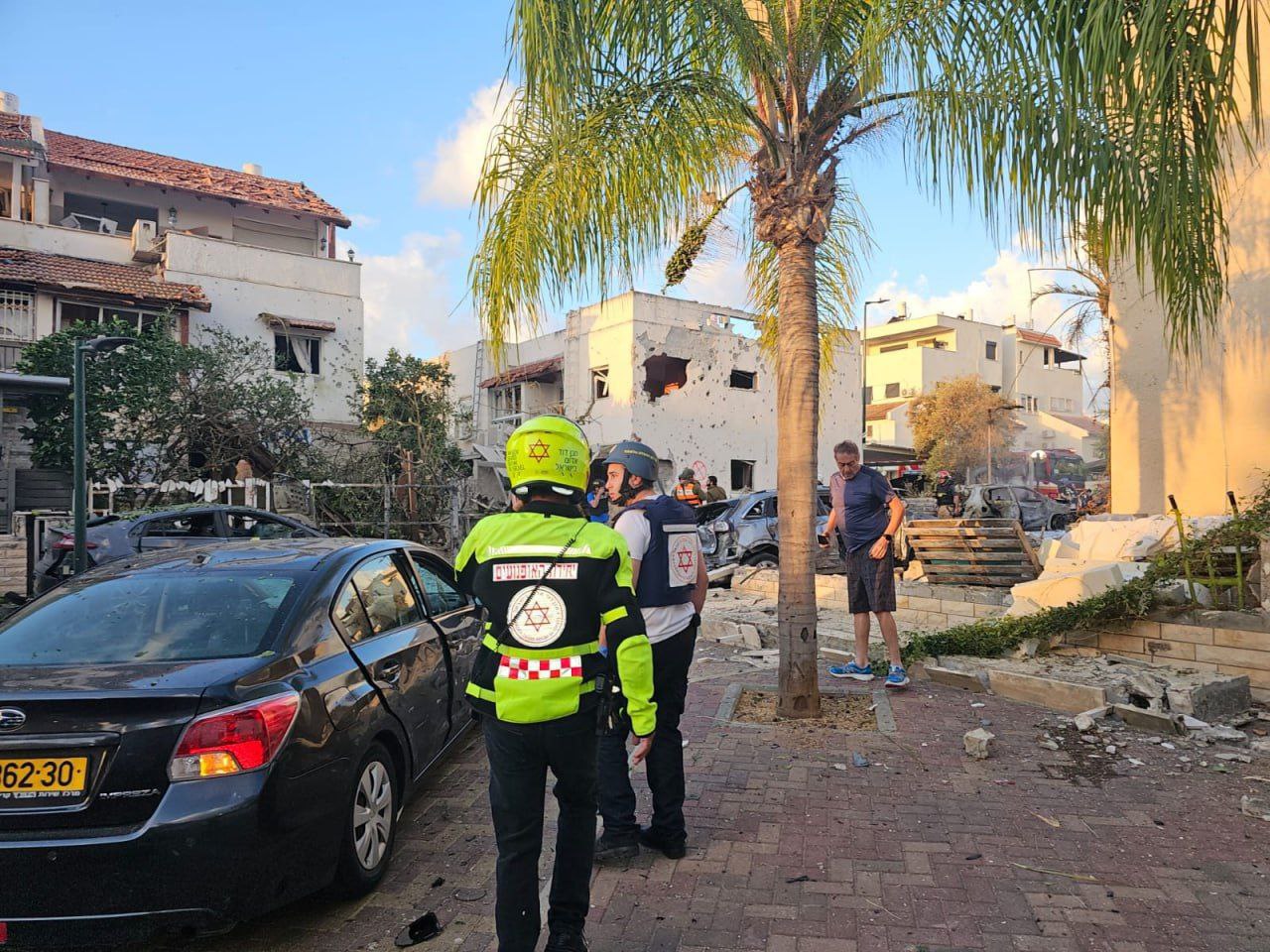
According to reports published by Israeli media outlets, 13 Zionist settlers were injured as a result of Hezbollah’s rocket attacks and the settlers escaped to shelters. One of the injured is reported to be in critical condition. In addition, 12 residential buildings and dozens of cars were demolished or damaged. Moreover, the Israeli army’s Arabic-spoking spokesman Avichai Edrei announced that Hezbollah had fired more than 115 rockets into the northern Israeli-occupied areas of Palestine.
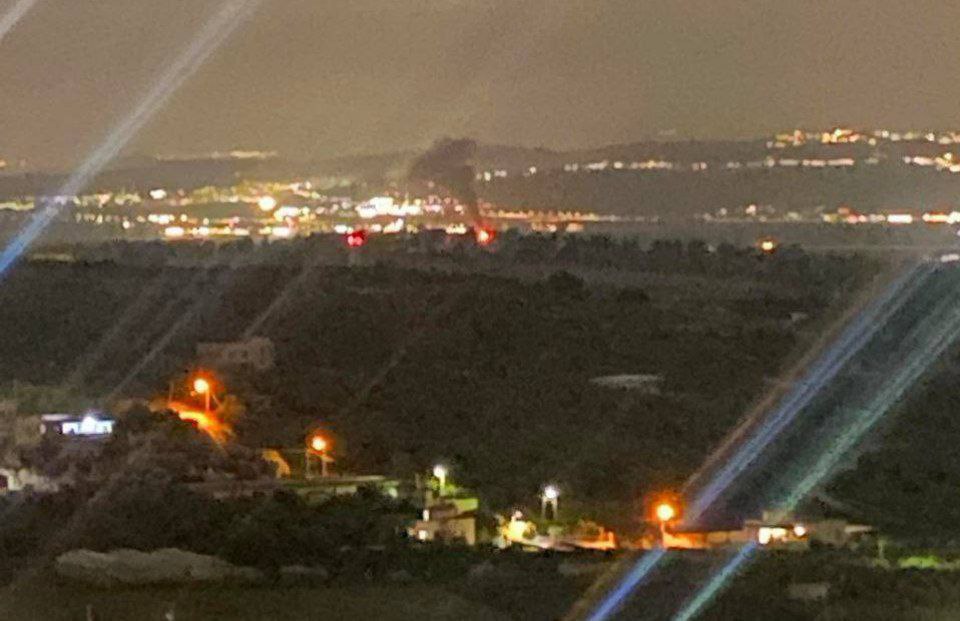
Initial images of Hezbollah’s rocket attack on Ramat David Air Base
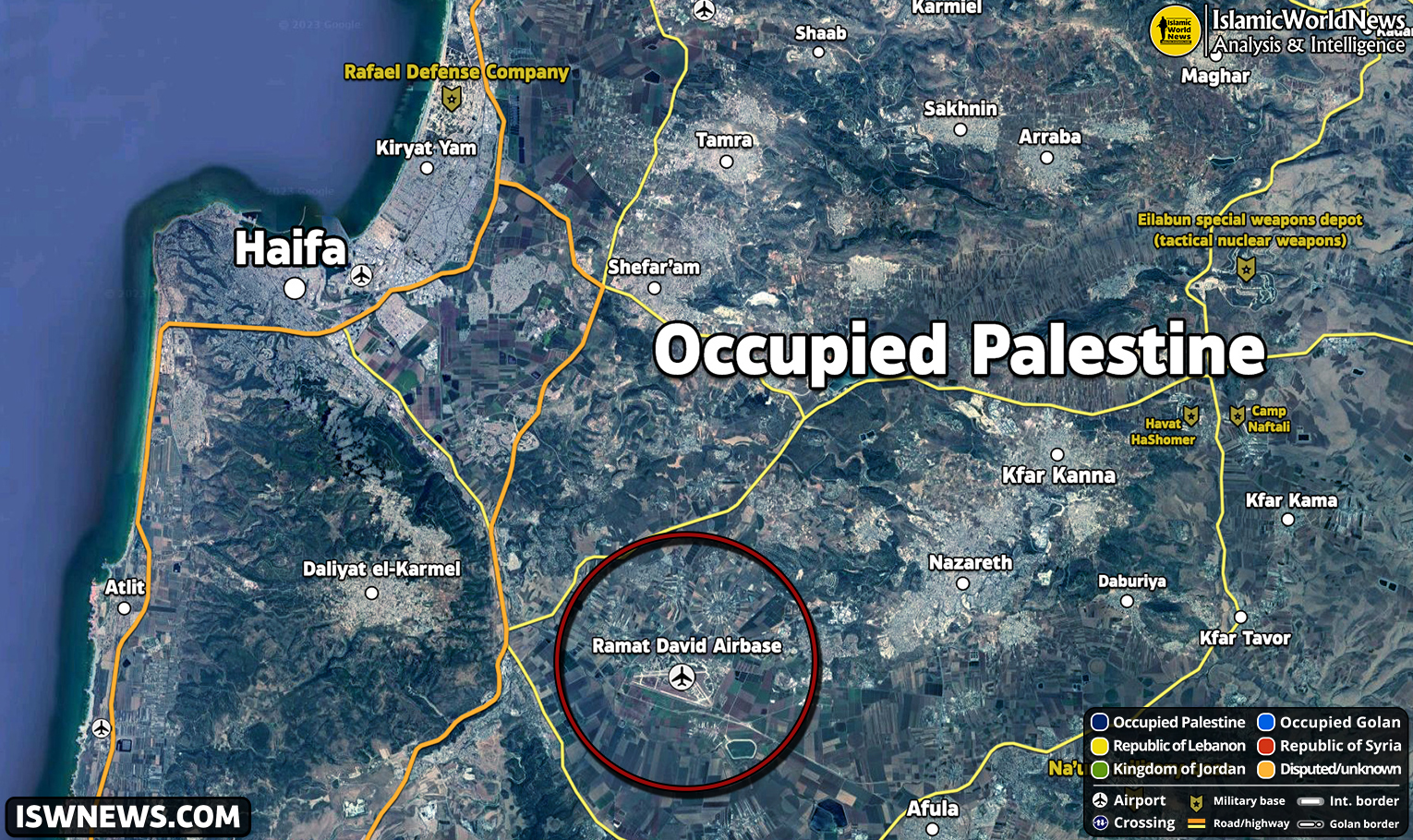
The Ramat David Air Base is the main Israeli Air Force base in the northern region of occupied Palestine, which is situated 46 kilometers from Lebanese border areas. The air base includes three runway and is home to several F-16 fighter squadrons, the IAI Heron class drones and combat helicopters. The Ramat David base is the main pillar of the Israeli army’s bases, which is used to carry out attacks on Lebanon.
Ramat David air base in the outskirts of Haifa
It should be mentioned that on July 2024, the Lebanese resistance movement’s Hudhud (hoopoe) drone succeeded in infiltrating northern occupied Palestine, flew over the Ramat David Air Base, and returned to Lebanon safely after carrying out reconnaissance operation and filming of maintenance facilities, hangars, fuel and ammunition storage tanks, and the Boeing Apache helicopters.
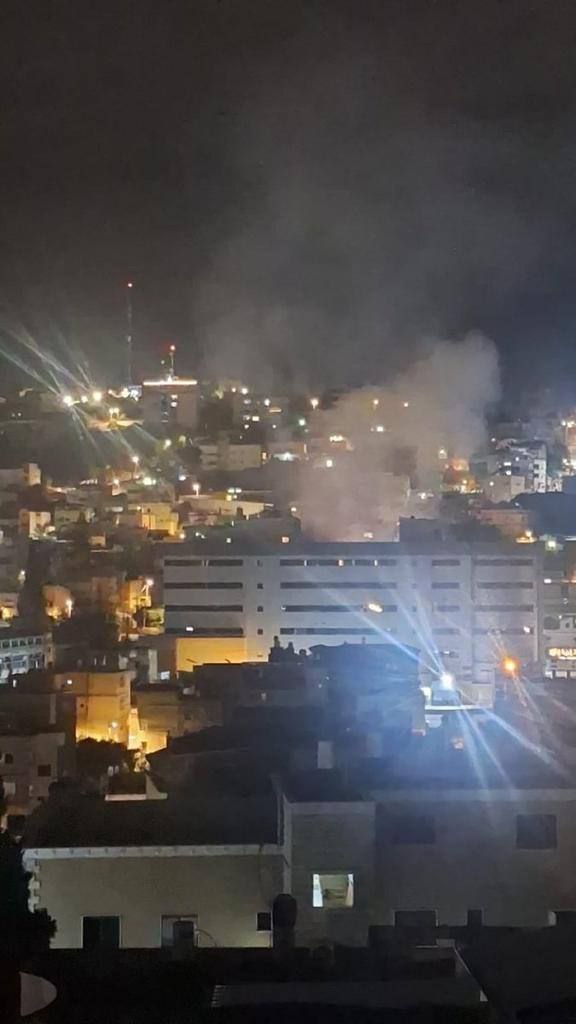
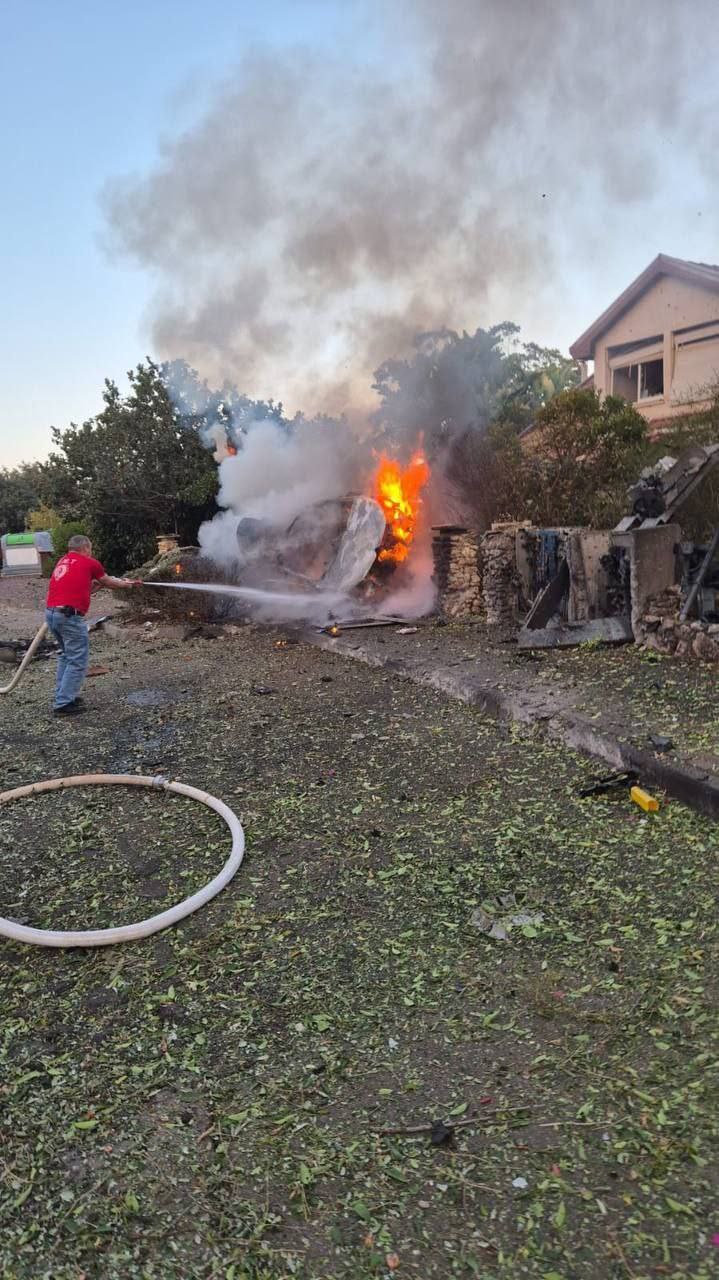
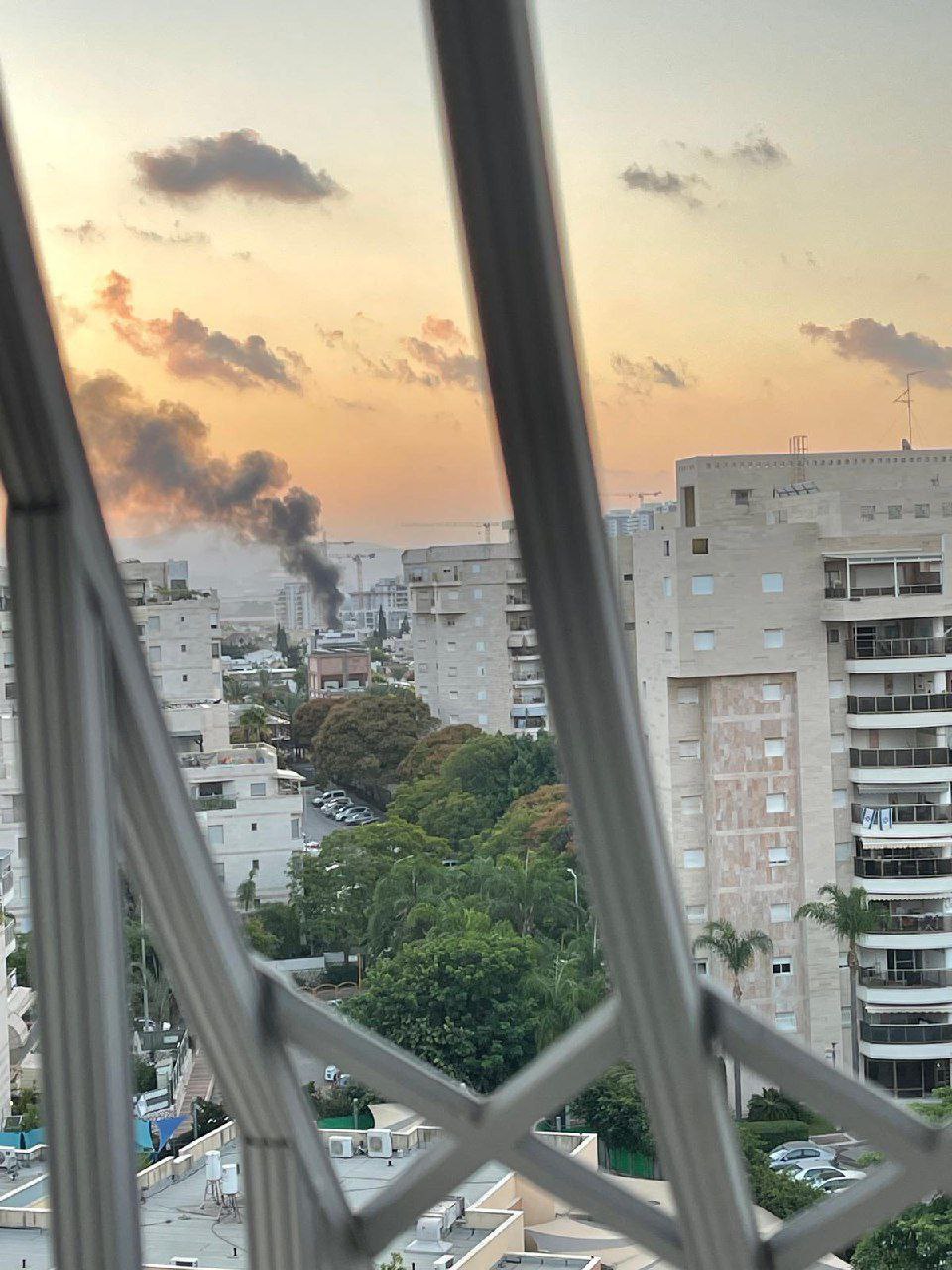
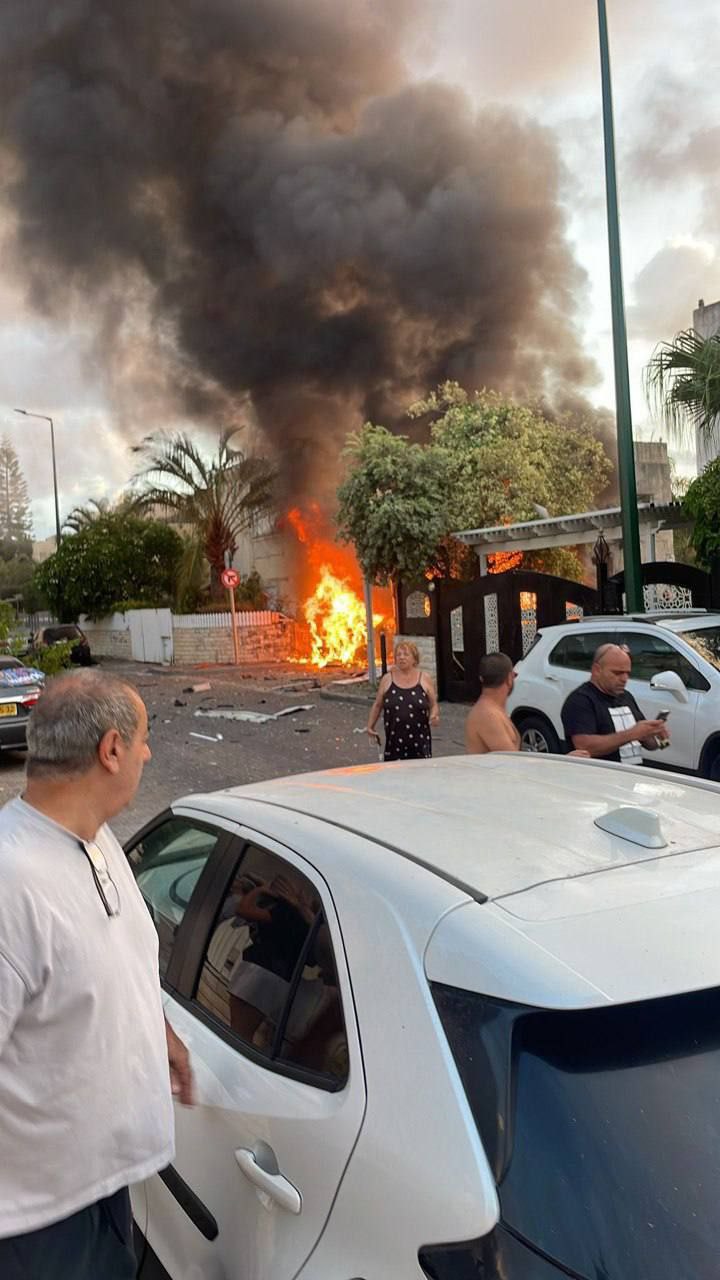
Israeli air Defense systems confronting Hezbollah rockets in the outskirts of Haifa city.The fall of Hezbollah rockets or Israeli air defense missiles has caused fire and destruction in the town of Al-Nasra and other occupied areas.Hezbollah’s rockets hit or fell in the occupied territoriesZionist settlers flee to shelters after Hezbollah rocket attack
In the third operation, which was carried out as part of Hezbollah’s initial response to the brutal crime of the Israeli enemy in various regions of Lebanon on September 17 and 18 (the explosion of pagers and other communication devices), the Rafael military industrial facility, situated in north of Haifa, was attacked with Fadi-1 and Fadi-2 rockets and Katyusha rockets.
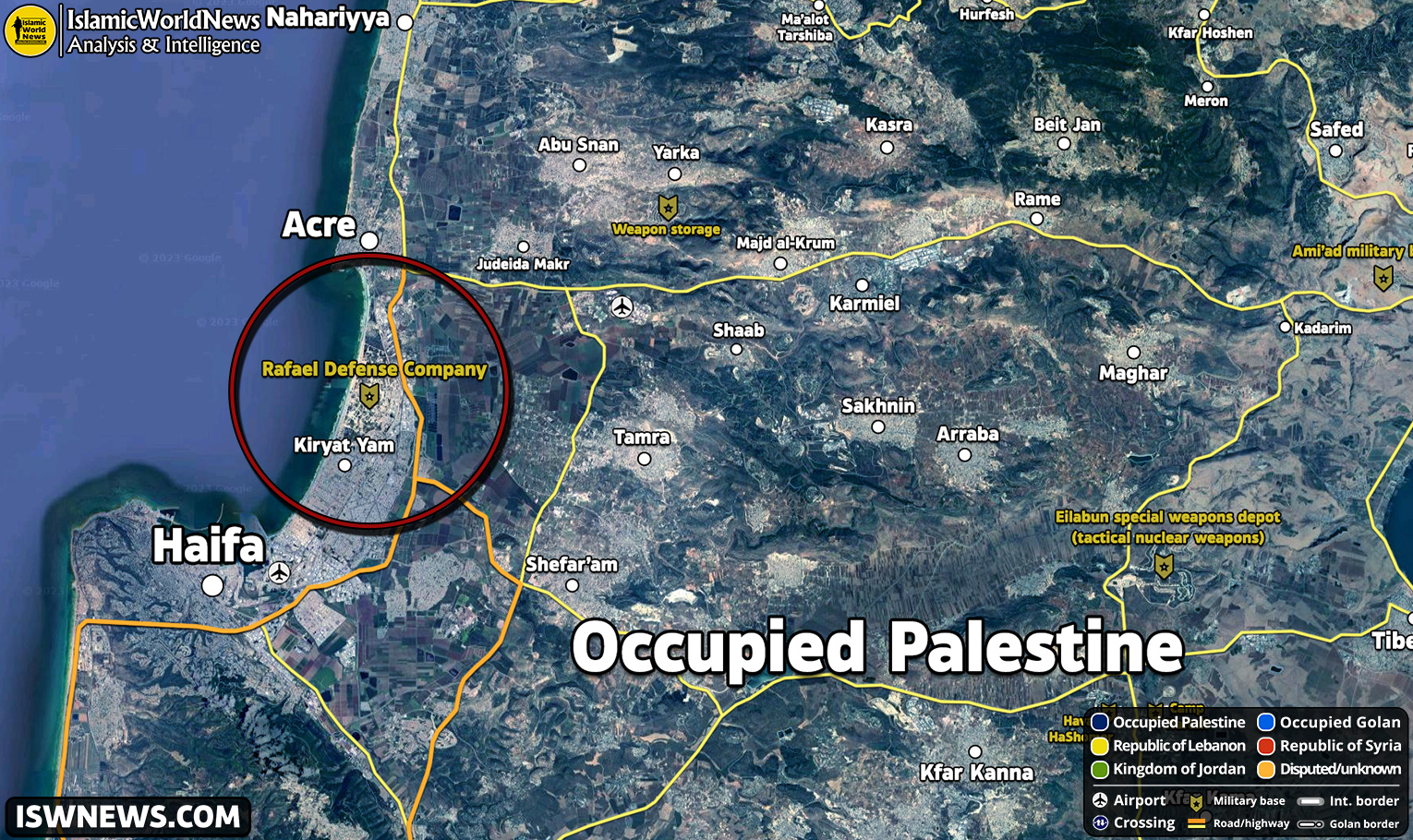
The Rafael Advanced Defense Systems Ltd. is a specialized manufacturer of electronic devices and equipment and is located in the north of the city of Haifa.
Rafael company in the suburbs of Haifa
Hezbollah’s today attacks on the city of Haifa have forced at least 300,000 residents of the Israeli-occupied territories to escape. Various pictures and footages of fires and heavy smoke in the cities of Nazareth, Tamra as well as other towns around Haifa also indicate that, contrary to the Israeli regime’s claims, the great number of Hezbollah rocket attacks have caused a lot of damage and destruction to the occupied territories. As the scale of Hezbollah’s strikes expands, the internal pressure on Israeli Prime Minister Benjamin Netanyahu’s cabinet and the wave of migration from the north to the center of occupied Palestine will surge. Perhaps if such attacks had been carried out in previous rounds of escalations between Hezbollah and the Tel Aviv regime, Israel may not be able to escalate tensions and embark on such heinous terrorist attacks against the Lebanese people.
Today’s military operation is Hezbollah’s first large-scale rocket assault and its second military incursion deep into Israeli army’s positions following the drone strikes on the Glilot base and the Ein Shemer Airfield in the center of occupied Palestine. With this new attack, Hezbollah increased the range of its rocket strikes to a distance of 50 kilometers from Lebanon’s southern border. In a speech commemorating the martyrs of the second Israeli terrorist attack in Lebanon’s capital city Beirut, which led to the martyrdom of senior Hezbollah commander Fuad Shukr, Hezbollah’s Secretary-General Sayyed Hassan Nasrallah warned that the Lebanese resistance movement possesses the ability to carry out rocket attacks in all areas of the Israeli-occupied territories from Kiryat Shmona to Eilat, which could increase the number of displaced Israeli settlers to two million.
Hezbollah’s retaliatory operations on the southern Lebanon and northern Palestinian fronts kicked off on October 8 last year in order to actively support the Palestinian people and resistance groups in the Gaza Strip. During the operation, the Lebanese resistance movement used rockets, drones, anti-armor ammunition and artillery to pound numerous positions of the Israeli regime’s army in the northern areas of occupied Palestine as well as the Israeli-occupied Golan Heights of Syria more than 10 times on a daily basis. It is worth mentioning that 485 Lebanese resistance commanders and fighters have been martyred as a result of the Israeli regime’s strikes.
Hezbollah rocket attack on Ramat David base and Rafael companySeveral Hezbollah rockets hit Tamra town.Fires and smoke in occupied settlements following repeated rocket attacks by Hezbollah Fires and smoke in occupied settlements following repeated rocket attacks by Hezbollah Fires and smoke in occupied settlements following repeated rocket attacks by Hezbollah Fires and smoke in occupied settlements following repeated rocket attacks by HezbollahVideoFires and smoke in occupied settlements following repeated rocket attacks by Hezbollah
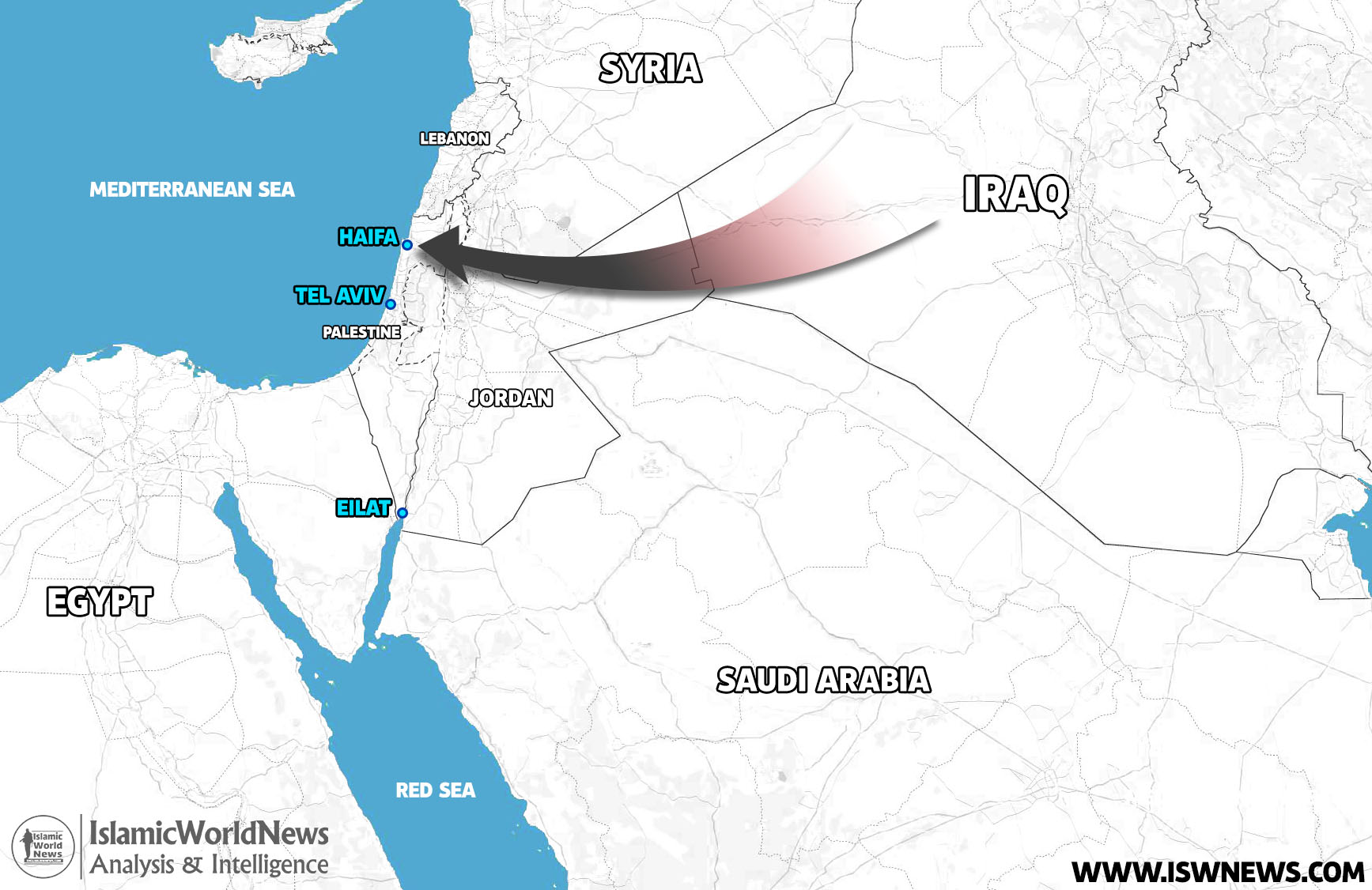
The IRI statement said: “To help and support the people of Gaza and in response to the crimes committed by the usurping regime against Palestinian civilians, including women, children, and the elderly, the fighters of the Iraqi Islamic Resistance attacked Haifa with a suicide drone. The Islamic Resistance emphasizes that the operation to destroy the enemy’s bastions will continue at an increasing pace.”
This is the 144th attack of the Iraqi resistance against the positions of the Israeli regime after the onset of the genocidal war on Gaza.
The Islamic Resistance in Iraq carried out tens of attacks on the Israeli-occupied territories as of April 25, 2024.
The Iraqi resistance group along with other resistance movements in Lebanon and Yemen have called for the end of Israeli aggression against the Gaza Strip and the delivery of aid into the besieged area.
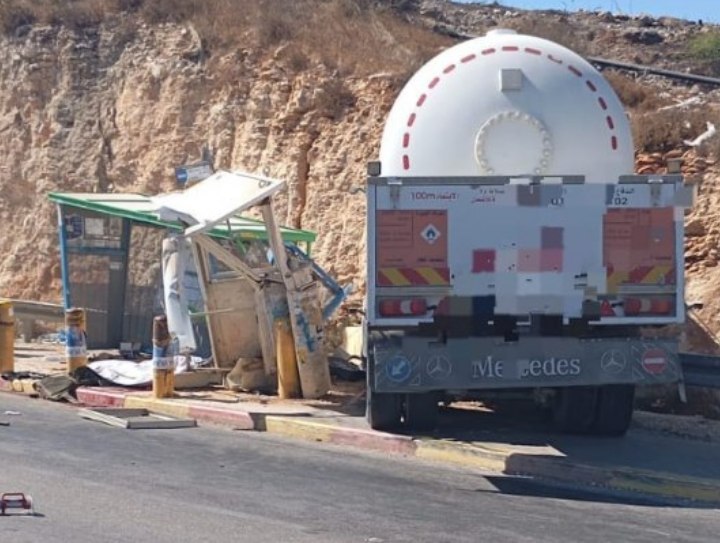
Hayel Issa Abdel Jabbar Dhaifallah, A 58-year-old Palestinian tanker driver from the Rafat town of Ramallah, rammed into the Israeli army outpost in the Giv’at Assaf at high speed and ran over the Israeli troops. As a result of this retaliatory operation, one Israeli trooper was killed and another was injured.
Minutes after the incident, local sources reported the martyrdom of the Palestinian attacker, but the Israeli regime’s Channel 14 TV reported that the executor of the operation was not martyred but was injured and taken to a hospital in al-Quds.
The moment truck rammed into an Israeli army outpost in the Giv’at Assaf at high speed and ran over the Israeli soldiers
The Palestinian resistance movement Hamas congratulated the heroic operation near Ramallah, underlining that today’s operation was a natural response to the atrocities committed by the Israeli enemy in the Gaza Strip and the West Bank.
It is worth noting that three Israeli occupiers were killed as a result of an armed operation by a Jordanian driver at the Al-Karameh border crossing, located in the border between Jordan and Israeli-occupied territories on September 8.