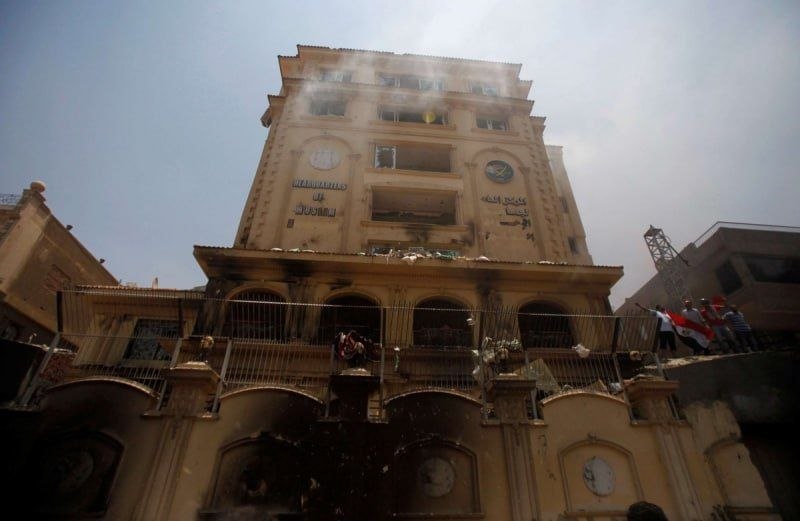
The process of banning the Muslim Brotherhood began following the ouster of former Egyptian President Mohamed Morsi in 2013. Now, with the judicial ruling becoming final, broader restrictions will be imposed on the group.
Under the ruling, assets and properties belonging to the Muslim Brotherhood will be transferred to the state, while members of the group will face restrictions on political activities, participation in elections, and holding government positions. The Egyptian government also intends to use the ruling to pursue Brotherhood members abroad and identify and freeze their assets.
The report also points to internal divisions within the Muslim Brotherhood between factions based in London and Istanbul, arguing that the new ruling could further weaken the group’s financial resources and organizational structure. Meanwhile, the Brotherhood’s branches abroad have described the move as politically motivated, arguing that the Egyptian government has closed off any possibility of reconciliation or the group’s return to political life.
According to reports from Israeli media outlets, some Egyptian army soldiers at the Rafah border crossing opened fire at Israeli military personnel.
The Israeli military also responded by firing warning shots towards the Egyptians.
In the initial local media reports, it was mentioned that the confrontation came to an end following the intervention of border officials from both sides.
The Israeli newspaper Yedioth Ahronoth reported that during the confrontation between Israeli and Egyptian military personnel at this border crossing, two Egyptian soldiers were injured, one of them succumbed to the injuries.
Some Israeli media outlets have also reported that the regime’s soldiers were also wounded, but the exact details of their casualties are not yet available.
According to the independent English-language Egyptian newspaper, Daily News Egypt, unnamed sources stated that Egyptian soldiers were “affected” by the Rafah massacre that occurred on Sunday, when an Israeli bombing led to the killing of 45 Palestinians at a displacement camp.
The Rafah border crossing has been seized by Israeli military forces since May 7 as the regime’s forces expanded ground invasion of Gaza into the southern city.
Osama Hamdan, one of top officials of Hamas, said in an interview with Al-Arabiya news channel that the new round of negotiations will be held in Cairo today and tomorrow, and we hope for a desirable outcome for the Palestinian people.
Exact details of this round of negotiations have not been disclosed so far, but Arab media outlets speculate based on statements made by US officials that this round of negotiations is of great importance and there is a possibility of reaching an agreement in Cairo.
On Saturday, US media outlets, citing a senior official of President Joe Biden administration, claimed that the authorities of the Israeli regime have accepted the terms of a new proposed agreement, including a six-week ceasefire in the Gaza Strip, along with a prisoner swap and providing humanitarian aid to the Palestinians living in Gaza, and that they are waiting for a response from Hamas officials.
Previous rounds of ceasefire negotiations between the Israeli regime and Hamas, which were mediated by Egypt and the United States, did not reach a conclusion due to differences over the duration of the ceasefire and the number of prisoners who should be released.
Hamas demands a complete cessation of the war, a complete retreat of the Israeli regime’s army from the Gaza Strip, and the return of refugees to their homes in the besieged area, while the Israeli army considers these terms to be contrary to its objectives and the acceptance of their defeat in the face of Palestinian resistance.
Satellite images indicate that Egypt is preparing to temporarily accommodate Palestinians in the Sinai Peninsula. It is said that many Palestinians will be evacuated from Gaza and transferred to this area simultaneously with the start of the Israeli army’s ground operation in Rafah city.
Satellite images of Rafah border areas
This action by Egypt comes as Abdel Fattah el-Sisi, the President of Egypt, emphasized a few months ago in a joint press conference with Olaf Scholz, the German Chancellor: What is happening in Gaza now is an attempt to forcibly relocate civilians to Egypt. We strongly oppose relocating Palestinians to Egypt.
After the publication of such news stories, the government in Cairo once again denied the accuracy of this issue. In this regard, the Minister of War of the Israeli regime Yoav Gallant also stated that Israel does not intend to send Palestinians to Egypt as part of the evacuation process in the city of Rafah. However, the reasons for Egypt’s movements and increased actions in the Sinai desert remain unclear and suspicious.
It is worth mentioning that the Rafah city is witnessing a gathering of more than 1.5 million Palestinian refugees. These refugees have been transferred from Khan Younis to Rafah; moreover, in recent weeks, there have been many conflicting reports about the Israeli regime’s plot to forcibly relocate them outside Palestinian territories (to Egypt).
The renewed trip comes as William Burns, the head of the Central Intelligence Agency (CIA), had traveled to Egypt’s capital Cairo last week on November 7 to meet and talk with Egyptian President Abdel Fattah el-Sisi.
According to senior Egyptian officials, during this meeting, the CIA chief had suggested to the Egyptian president that he can take charge of the security situation in the Gaza Strip until the Palestinian self-governing bodies are prepared to assume this responsibility.
However, Sisi opposed any involvement in the developments in the Gaza Strip and emphasized that his government pursues relationship with Hamas in a bid to prevent the escalation of insecurity in the region.
Considering the support of the US administration and military for Israeli atrocities and their attempt to prevent the approval of United Nations Security Council resolutions for a ceasefire in the Gaza Strip as well as the delivery of humanitarian aid to the besieged area, it seems that the issue of “ceasefire” has become their tool for the complete release of detainees held by Palestinian resistance groups, as well as for advancing their desirable plans for the Gaza Strip.
The Egyptian authorities’ refusal to intervene in the developments in the Gaza Strip, as well as the proposing of a prisoner swap between Palestinian prisoners and Israeli detainees presented by Palestinian resistance movement, have caused several obstacles in the way of striking a deal and implementing ceasefire in this region.
According to this agreement, 400 people who have foreign passports and 80 people who are seriously injured will leave the Gaza Strip and go to Egypt.
It should be noted that this agreement has nothing to do with other issues, such as the exchange of prisoners or a humanitarian ceasefire, etc. in the Gaza Strip.
Video: The first group of foreigners and dual-citizen Palestinians crossing the Rafah crossing in the south of the Gaza Strip.
Following this threat, Egyptian trucks carrying fuel and food refused to enter and deliver cargo to Gaza and returned.
It is worth mentioning that in the last 24 hours, the Zionist regime has bombed the Rafah crossing 3 times. These bombings are carried out to prevent breaking the siege of Gaza.
At the same time as this important event, the US announced sending the first part of its military aid to Israel.
Official information about the casualties and damages of this attack has not been released yet, but the Ministry of Foreign Affairs of the Israeli regime has confirmed the death of two Israeli tourists in Egypt as a result of gunfire.
Channel 13 of Israeli television also confirmed in a report that an Egyptian police officer stopped a bus carrying Israeli tourists in the city of Alexandria and killed six people and injured eight others.
At the same time as this news story was released, the Hebrew-language news website Serojim reported that the Israeli regime had turned to Egypt to stop Hamas’ attacks on occupied Palestinian territories and asked this country to negotiate with the Palestinian resistance movement.
Israeli sources reported on June 3 that an army patrol of the regime was attacked near the Egyptian border and a number of Israeli troopers were seriously injured. While a Hebrew newspaper called Hadashot published different news story, reporting that a soldier was killed in the conflict.
The Israeli regime’s army also declared the exchange of fire between its soldiers and armed militias near the Nitzana Border Crossing on the border with Egypt, adding that a number of military personnel were wounded in the armed incident.
Two out of the several injured troopers were transferred to Soroka Medical Center in Beersheba or Beer Sheva, the largest city in the Negev desert.
Initially, the IDF said that two soldiers manning a guard post between Mount Sagi and Mount Harif in the Negev desert were shot and killed by a gunman who managed to infiltrate into Israel from Egypt. The military didn’t identify the two slain soldiers, a male and a female.
The IDF later said that there was a further exchange of fire in the same area, which resulted in the suspected gunman and another soldier being killed. The identity of the third slain soldier was not revealed.
IDF spokesman Rear Admiral Daniel Hagari told reporters that the male soldier and female soldier were found dead by an officer in their post after they did not answer calls on the radio in the early morning. Later in the afternoon, clashes broke out near the post, as Israeli troops were carrying out searches for the suspected attacker.
Based on the Israeli army’s claim, the most recent incident, which occurred on the border with Egypt, is related to security issues and it does not have anything to do with criminal affairs.
Moreover, the Israeli regime’s army has dispatched a large number of military support forces to the clash area.
Later, the IDF revealed that the gunman was an Egyptian policeman.
The alleged image of Egyptian soldier
The Egyptian army also announced in a statement: “Today (Saturday), one of the Egyptian security forces pursued drug smugglers in the border areas, after which he crossed the border security barriers and exchanged fire with the Israeli border guard forces. During this conflict, three Israeli soldiers were killed and several others were wounded, and this (Egyptian) security force also died.”
It’s worth mentioning that Egypt and Israel signed a peace treaty in 1979, ending decades of war. Since then, the security situation along their joint border has been stable.
According to the images that have been released of these fighters in Komsomolsk-on-Amur, their serial numbers are 9210-9211-9212-9213-9214. According to the deal that was signed by worth of 2 billion dollars between Russia and Egypt in 2019, the Egyptian air force will receive 20 Sukhoi-35 jet fighters from Russia. After this agreement, the US as usual, threatened the Egypt that if it buys fighters from Russia, it may impose sanction on this country.
Of course, the Egyptian army has so much of experiences in buying various and extensive military equipment from different countries around the world, that this issue has caused a lot of criticism against this country. Many believe that this issue will face the Egyptian army with problems in technical supporting of war gears in the long time.
Regarding Egypt, mentioning this point is worthy that this country is the largest recipient of foreign aids from the US, after Israel. The US has provided billions of dollars in economic and military fields to Egypt, in recent years. However, Egypt is ignoring the US threats regarding the buying of fighters from Russia; perhaps an important part of Egypt’s behavior goes back to this fact that this country plays a role as a safety valve for the Israeli regime, and Egypt by knowing this issue, is clearly extorting money from the US!
YOUR SUPPORT IS CRITICAL TO KEEP ISWNews ALIVE!
I’d like to thank readers for their confidence and support. Thanks to your support we can continue to perform our duty on reporting the important events in the region. So If you like our contents, please don’t feel embarrassed to contribute and help our project, for as little as 1 Dollar. Your contribution, however small, will help ensure our project continuity. Thank you.
The decision, taken today in a closed-door session of the Egyptian parliament, was made in response to the recent threats of war in Libya for Egypt. The decision came after Egyptian President Abdel Fattah al-Sisi described the city of Sirte as one of his red lines in a statement threatening Turkey and the Tripoli-based government, calling the attack on Sirte as an attack on Egypt.
Earlier, the Libyan parliament in Benghazi (a supporter of the Libyan National Army and General Haftar) called for Egyptian military intervention in Libya.
“This exercise is taking place on the western strategic border, given the severe and rapid changes the region is going through,” said a statement from the Egypt military.
Earlier, Egyptian President Abdel Fattah Al-Sisi said that Egypt had the right to enter Libya to protect its borders, and in a serious warning to Turkey, described the city of Sirte and al-Jufra as Egypt’s red line, and that Turkish forces must not cross!