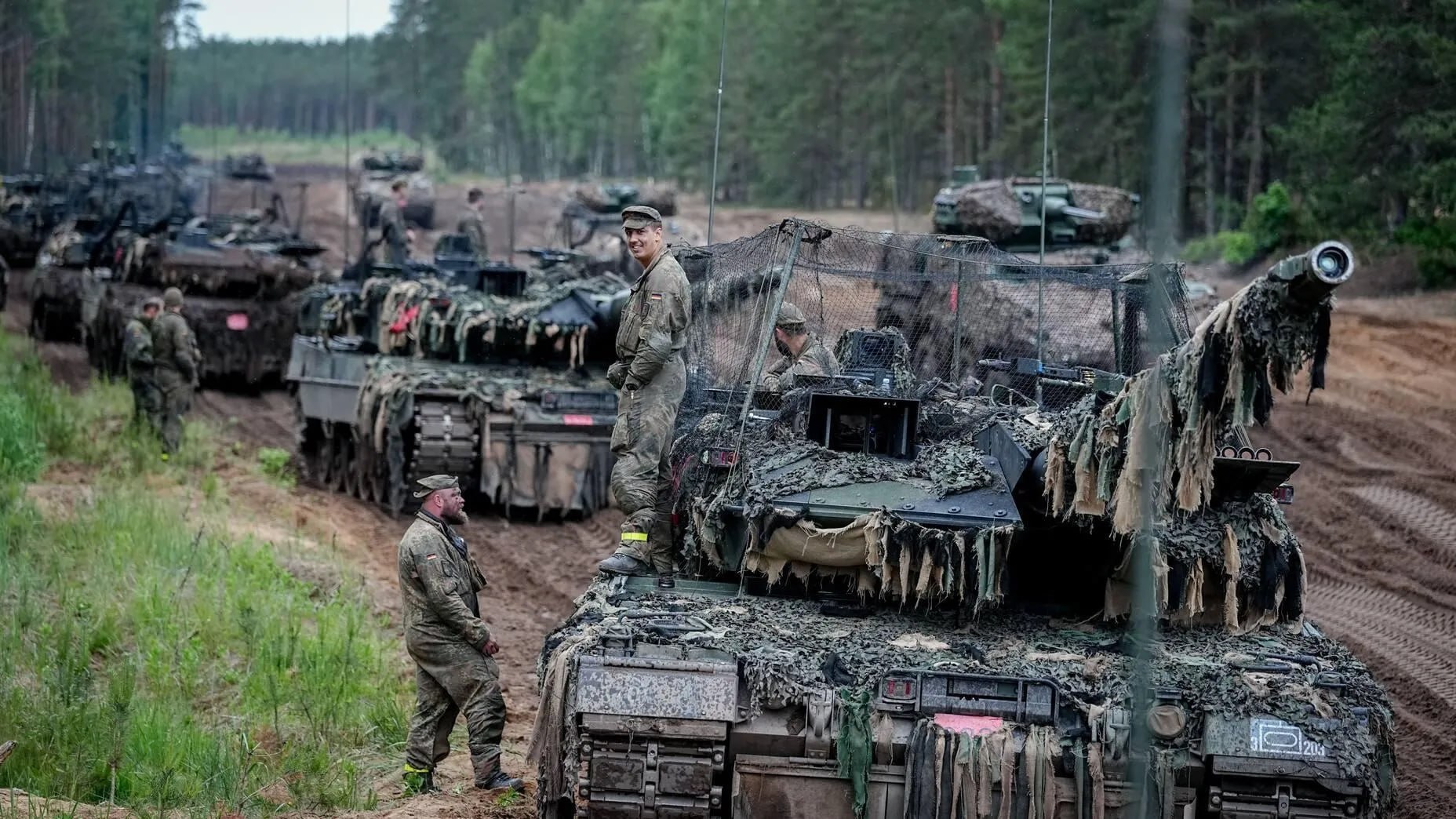
Six of these new battalions will be organized for territorial defence within Germany, while the other two will join the country’s permanently stationed brigade in Lithuania.
The six territorial defence battalions will come under the Territorial Defence Command and will be tasked with protecting critical infrastructure, military facilities, ports, airports, transport hubs, and communication routes.
The other two battalions will consist of an armoured artillery battalion and a support battalion, both of which will join Germany’s 45th Armoured Brigade in Lithuania.
The 45th Armoured Brigade is Germany’s first combat formation established with a permanent deployment mission outside German territory. Including its support units, the brigade is expected to have approximately 5,000 personnel.
In a potential large-scale conflict in Eastern Europe, German territory could become one of NATO’s main routes for transporting troops and military equipment to the alliance’s eastern flank. Under such circumstances, protecting bridges, railway lines, fuel depots, ports, and military facilities would take on particular operational importance.
He added that the European Union is confused in its understanding of Iran’s domestic developments and, from a strategic standpoint, has lost its geopolitical weight in the region.
Araghchi also referred to the role of Germany, saying it has effectively handed over its regional policy to Israel, and emphasized that Iran’s regional allies (i.e. Arab countries) play a more effective role than the European troika.
Airbus Defence and Space CEO Michael Schoellhorn said negotiations, led by BAE Systems on behalf of the Eurofighter consortium, are progressing well and could conclude soon.
The deal, valued at several billions of euros, would significantly modernize Türkiye’s air force and mark its entry into the “Eurofighter club,” joining users such as the UK, Germany, Italy, Spain, and several Persian Gulf states.
The agreement is seen as a step toward long-term defense cooperation between Türkiye and European partners, amid a broader push by the new German government to expand Europe’s defense capabilities and reduce reliance on the U.S. for security.
According to the company’s official statement, this corridor is an appropriate emergency solution due to the turbulent conditions in the Red Sea and the Bab al-Mandab Strait. In this land corridor, commercial ships unload their cargo at the port of Jebel Ali in the United Arab Emirates and the ports of Dammam and al-Jubail in Saudi Arabia, and Hapag-Lloyd’s trailers and trucks transport the cargo to the port of Jeddah in western Saudi Arabia, where the goods are handed over to other ships for further transit towards the Suez Canal.
It’s worth mentioning that due to the armed operations by Yemeni forces in the Red Sea, Hapag-Lloyd’s cooperation with Israeli companies was hindered, leading to the suspension of the passage of the German company’s ships through this route on January 15.
As a result of this plan by Hapag-Lloyd AG, which is the largest German shipping company, Israel’s comprehensive program to neutralize Yemeni military operations in the Arabian Sea and the Red Sea is expected to be implemented; so, they would be able to partly alleviate the need for Israeli ships as well as Israel-linked vessels to pass through the Bab al-Mandab Strait and the Red Sea.
The project of establishing a land corridor from the Persian Gulf to the Israeli-occupied ports and the Red Sea led by the Israeli company TRAKnet is currently underway with the cooperation of certain Arab countries, especially the United Arab Emirates and Saudi Arabia. Potential reactions from resistance groups in the Arabian Peninsula and their possible drone and roadside bombing operations against logistics convoys in these corridors are among the threats to this project.
Over the past 300 days, the United States and European countries have sent dozens of military, financial and economic aid packages to prevent Ukraine from falling under Russia’s control, but these aids have not resulted in any specific results for the Ukrainian government and they are still under the fire of Russia’s heavy attacks. Now, one of the solutions proposed by senior Ukrainian generals to change the balance of the war is to obtain at least 300 battle tanks.
Recently, this proposal has been approved by the United States and most European countries, and the Americans have announced that they will send 31 Abrams tanks to Ukraine in the coming months to encourage the Europeans to send more of their tanks to Ukraine.
German Chancellor Olaf Scholz, after avoiding sending advanced German weapons to Ukraine for some time, finally on January 25, while announcing his agreement to issue a license to send Leopard tanks from other countries to Ukraine, announced that this country will provide Ukraine with 14 Leopard tanks in the first phase. This German decision has paved the way for other countries, including Poland, Canada, Norway, etc. Therefore, the supply of Leopard tanks to Ukraine has started by sending four Leopard 2 tanks from Halifax airport in Canada on February 5.
Canada sends Leopard tanks to Ukraine
In this regard, the UK has also announced the transfer of 14 Challenger 2 battle tanks (the main tank of its army), self-propelled artillery and thousands of rounds of ammunition to Ukraine, and other European countries have also announced the preparation of similar measures.
The Leopard 2 tank is one of the effective weapons made by Germany, and in the past years, 3,000 units of it were sold to Austria, Canada, Chile, Denmark, Finland, Greece, Holland, Norway, Poland, Portugal, Singapore, Switzerland, Sweden, Spain and Turkey. Therefore, its equipment and ammunition are available to the Ukrainians, and it is a more suitable option than the Abrams tank, which has a smaller number in Europe.
Western analysts believe that sending 300 battle tanks to Ukraine in the current situation is not possible and cannot completely change the outcome of the war, however, it may temporarily affect the course of the war and prolong the resistance of Ukrainians against Russia for a while. The southern and eastern regions of Ukraine are often composed of flat and hilly terrain, and the Ukrainian army needs a lot of tanks to carry out offensive operations and recapture these areas. Of course, the goal of the Westerners in sending these weapons is to prevent the defeat of Ukraine and the erosion of the war. The higher the cost and losses of Russia in this war, the weaker their eastern rival will be.
On Friday (January 28th), the German parliament, known as the Bundestag, approved by 553 votes to 110 against the proposal of the federal government to extend the mission of the German army in Iraq until October 2022. Accordingly, the German army will continue to participate in anti-ISIS missions in Iraq for nine months.
The German parliament said in a statement that Germany’s cooperation and presence is only to strengthen and rebuild the Iraqi army and provide related support services as part of NATO’s missions and the International Coalition against ISIS in Iraq.
The German government believes that the efforts of various parties to implement structural reforms in the Iraqi military institutions as well as the integration of the forces of the Hashad al-Shaabi organization in the Iraqi security structures with the aim of effective and direct control of its forces by the Iraqi government should be supported! These words of the German government show that the Westerners are seeking the dissolution of the Hashad al-Shaabi organization and will certainly implement plans to strike at the organization in the near future.
It is noteworthy that the estimated budget for the plan to extend the presence of German forces in Iraq from February 1 to October 30 is about 73 million euros!
This came at a time when Iraqi Prime Minister Mustafa al-Kadhimi had announced at the end of 2021 that the US (international) coalition’s combat mission in Iraq had ended and that the withdrawal of all foreign troops from Iraq had begun. He also said in a speech that in the near future we will all see the withdrawal of US coalition forces from Iraq within the framework of the recent strategic agreement with the US, and from now on the US coalition will play an advisory role.
Therefore, with the extension of the German army mission in Iraq, al-Kadhimi’s words and promises did not come true!