Iran - Islamic World News

Tuesday 30 June 2026 - 10:15

From Classical Confrontation to Geoeconomic Deadlock; Dissecting the Second Phase of the Iran-U.S. War

Recent developments in West Asia signal a transition from traditional confrontations to multi-layered rivalries unfolding across strategic energy chokepoints, where straits such as Hormuz and Bab al-Mandab have become focal arenas for the projection of power and pressure. Within this framework, the scenario of a U.S.-led naval blockade of Iran—employed as a tool for maximum pressure—alongside the possibility of a return to direct conflict between the two sides, has reinforced the prospect of escalating tensions. At the same time, Europe’s growing skepticism toward Washington’s unilateral approaches has cast uncertainty over the future of NATO cohesion. On another level, the involvement of Tehran-aligned actors such as the Houthis (Ansarallah) in Bab al-Mandab has highlighted the potential for expanding the maritime theater of competition and enabling Iran to leverage this asset indirectly. Taken together, these developments indicate that regional maritime security is increasingly becoming the primary arena for redefining the balance of power. Accordingly, this study aims to assess the feasibility, consequences, and sustainability of these scenarios, while elucidating their impact on the regional balance of power and the international security order.

Saturday 27 June 2026 - 10:56

Maven in the Iran War

The Ramadan War demonstrated that artificial intelligence and systems like “Maven” have been moved to the center of U.S. military operations, aggregating field data to dramatically accelerate targeting and decision-making. At the same time, Silicon Valley’s role in modern warfare has become more prominent, with parts of the military’s intelligence and operational infrastructure being outsourced to technology companies. This transformation, alongside increased efficiency, has raised questions about targeting accuracy, civilian casualties, and the dependence of national security on private-sector actors.

Wednesday 17 June 2026 - 09:48

US Aircraft Flights Around Iran; A Sign of Distrust in the MoU or Preparation for Resuming War?

While Tehran and Washington have reached a preliminary memorandum of understanding after months of tension, and this understanding is set to be officially signed on Friday, June 19, 2026, US military movements around Iran suggest that the region has still not moved beyond the stage of a fragile ceasefire. The daily monitoring of US Army reconnaissance, refueling, and transport aircraft over the Persian Gulf, the Sea of Oman, and near the Strait of Hormuz reinforces the question of whether Washington, alongside the diplomatic path, is maintaining or even increasing its field readiness for subsequent scenarios.

Sunday 14 June 2026 - 10:12

GCC in Turmoil Over the Strait of Hormuz

The Ramadan War exposed and deepened hidden rifts within the Gulf Cooperation Council — to the extent that Oman and Qatar focused on de-escalation and mediation, the UAE and Bahrain on intensifying pressure against Iran, while Saudi Arabia and Kuwait concentrated on a strategy of insulation and risk management. The persistence of these divergences could weaken the Council’s strategic cohesion and push its members toward different security and political coalitions. As a result, the GCC is becoming less of a cohesive security bloc and more of a collection of actors with varying perceptions of threat and regional interests.

Sunday 14 June 2026 - 09:47

The Confrontational Geometry of the Zionists with the Resistance

The Ramadan War demonstrated that despite intense military pressure, the Axis of Resistance has transitioned from a centralized model to a more flexible, multi-layered network, and has managed to preserve its deterrence by distributing capacity among various actors. The simultaneous activation of the Lebanese, Iraqi, and Yemeni fronts, while increasing pressure on the Zionist regime, also reflected a strategy of “controlled escalation” and avoidance of an all-out regional war. In the post-war period, the future of the Axis of Resistance will oscillate between three paths: rebuilding and strengthening its networked structure, continuing a semi-coordinated crisis management mode, or gradual erosion and diminished operational cohesion. However, current trends suggest that maintaining a networked structure and multi-front deterrence remains the most likely path forward.

Wednesday 10 June 2026 - 22:31

Iran’s Retaliatory Strikes on US Bases in the Region, June 10

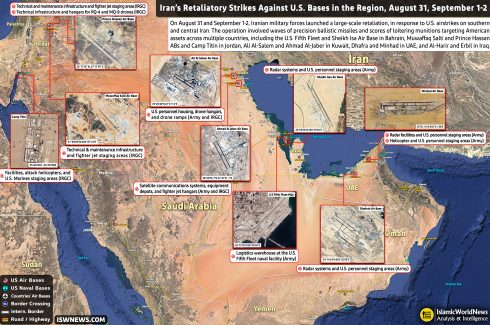
On the morning of June 10, the Iranian Armed Forces, in response to U.S. aerial aggression against southern Iran, struck four American bases across the region with at least 20 ballistic missiles, including Qadr, Emad, and Kheibar Shekan types.

Friday 15 May 2026 - 22:36

Naval Operation to Control the Strait of Hormuz – Vessels Targeted by Iran from the Start of the War until May 15, 2026

In response to the US-Israeli attacks against Iran on February 28, 2026, Iran’s armed forces closed the Strait of Hormuz and took control of traffic through it. As part of implementing new regulations and management of the strait, Iran has warned all vessels that henceforth all transit through the strait will be conducted in coordination with Iran. Vessels are required to comply with the new rules, and any violation or unauthorised passage through the Strait of Hormuz will result in the vessels being struck and the offending ships seized.

Thursday 26 February 2026 - 23:30

Sharp Warning from Kata’ib Hezbollah of Iraq to Washington!

Kata’ib Hezbollah, in a strongly worded statement, warned of the consequences of any hostile action by the United States and any cooperation by the Kurdistan Region with it, declaring that the group’s fighters are prepared to enter a prolonged war of attrition.

Most Popular