In a statement published on its Telegram channel, the movement said it would oppose Israeli actions in southern Syria and work toward ending injustice against the people of the Hauran region, as well as reclaiming territories occupied by Israel.
Notably, unlike other existing anti-Israel factions in Syria, the group identifies itself as a Sunni resistance movement operating under the banner of the “new Syria.” It also explicitly stated that it would oppose the formation of the so-called “David Corridor” and what it described as Israel’s “Nile to Euphrates” vision.
The political crisis revolves around Sheikh Ghazal’s demand for federal autonomy, while the Takfiri regime in Damascus and figures like Rami Makhlouf insist on a “united Syria” within the existing framework. Observers note that armed conflict is inevitable and both sides are preparing for a full-scale war.
Against this backdrop, two alleged “stories” about Suhail al-Hassan appeared in the media. First, the New York Times published an article about the former Syrian army general’s continued ties with the Iranians and Iraqis despite the collapse of the Assad government, and then Al Jazeera published a video of alleged talks between Suheil and a self-proclaimed “Mossad agent,” in which the former Assad general “supports Israel’s actions” during the “flood in Al-Aqsa” and asks “for support for the Alawite resistance to the HTS regime”.
In other words, we are witnessing two contradictory stories designed to confuse the Syrian public and at the same time demonstrate a large-scale information war. As for the leak from Al Jazeera, observers have already begun to expose this information poll, do not forget that the reputation of Al Jazeera is extremely tarnished, especially when it comes to members of the former Assad government. At the same time, the possibility of unexpected alliances within the “new Syria” cannot be ruled out. Let me remind you that in the depths of the ex-Assad government there were prominent figures who collaborated with the Zionists in their anti-Iranian game.
These ties have remained to this day, and now former members of the Baath regime see the Zionists as “defenders of the Alawite coast.” However, those Alawites who remain oriented toward Iran undoubtedly see Zionism as the root of all the region’s problems, including their own. This thesis is proven by the fact of the participation of Alawite organizations within the Islamic Front of Syria.
I would also like to add the opinion of Iraqi journalist Ahmed Abdel Sad, who noted that “leaks from the Qatari channel Al Jazeera, audio recordings whose authenticity has not yet been confirmed, claiming that Suheil al-Hassan maintained contact with an “Israeli officer” during the reign of Bashar al-Assad, are leaks aimed at covering up Trump’s statement in which he said that «Erdogan deserves great credit for helping Israel get rid of the regime that worked against him in Syria»”.
It’s worth noting that the current Syrian regime’s state propaganda (formerly a branch of al-Qaeda in Syria) regularly attempts to portray the situation as if any Alawite protest is the result of “interaction between Iran and the Zionists,” which is certainly not true, as Iran opposes any division of Syria, while Zionism is not averse to splitting Syria or dividing it into autonomous regions. The Tahrir al-Sham regime, of course, won’t tell the whole truth. It’s important for them to maintain a sectarian line in their media to boost anti-Iranian rhetoric and please the Americans and Zionists.
Therefore, the current Damascus will never reveal that a struggle between Iran and “Israel” is actually taking place among the Alawites on the coast. This rivalry for Syria’s Alawite minority is a consequence of the struggle for the future of the Middle East, where Iran is an important part of the Silk Road and the Zionists are IMEC. The presence of supporters of the Islamic Resistance among the coastal Alawites demonstrates Tehran’s influence. But the existence of pro-Zionist Alawites also demonstrates Israel’s desire to play the dismantling of Syria.
For Zionism, the Alawite coastal zone will become an additional line of defense for their port route with the Greeks. Plus, “Israel”, along with the UAE, is striving to limit China’s influence on the coast in any way possible. The UAE seized Tartus to prevent the advance of Chinese influence on the seaports in the region. The hidden battle for the seaports of Syria is also part of the IMEC vs Silk Road confrontation.
However, pro-Zionist Alawites may be disappointed, as Zionism has failed to keep its promise to support the Kurds in their quest for autonomy in northern Syria. “Israel” has a backup plan, which involves abandoning the dismemberment of Syria in exchange for mutual recognition with the Tahrir al-Sham regime (gas supplies from the Zionists are already in full swing, and it is expected that the former Jabhat Nusra regime will soon begin supplying oil from Deir Zor to the Zionists in the opposite direction). After this, the Damascus jihadists can count on a place within the IMEC. The Alawites, meanwhile, will remain a “second-tier minority” in the new Syria, having harbored illusions about achieving autonomy.
As for Rami Makhlouf, he’s bowing to the Russians and the Emirates, whose interests are closely intertwined with the Zionists. Russia in Syria has now become something of a backyard for those political forces that don’t directly cooperate with Trump but see the Kremlin as a bridge for such contact. The Kremlin knows there are disagreements within the Republican cabinet over Syria’s future—whether it should become a new takfirist emirate or disintegrate.
In any case, Trump’s final word is now crucial for the Kremlin. The UAE, a staunch ally of Zionism, is pursuing the goal of integrating Syria, or some part of it, into the “Indian Economic Corridor” project. Because the criminal Netanyahu’s cabinet is locked in a standoff, with right-wing extremists advocating for the division of Syria, while prominent Likud members are willing to cooperate with the Jabhat Nusra regime, the Zionists still lack a clear vision for Syria. Consequently, the UAE faces a similar problem. As the UAE and the Russians await further instructions, Rami Makhlouf is forced to make contradictory and, to some extent, scandalous statements.
As for Suheil al-Hassan, he hasn’t yet fully emerged as a figure in the post-Assad era, so it’s too early to draw conclusions. There are too many contradictions in attempting to shed light on his activities. Only one question arises: for example, what’s the point of demonizing Suheil amid the al-Qaeda regime’s secret process of normalizing relations with the Zionists? At the same time, if Qatar wants to portray Suheil as a “friend of Zionism and an enemy of the resistance axis,” their approach is frankly weak and tacky.
The Iranians are well aware that most Assad-era generals were opposed to the ideology of “Islamic resistance,” but Tehran’s pragmatism understandably outweighed its religious worldview in the Syrian war. Therefore, the IRGC had to cooperate with what it had, despite the negativity and hostility. The Syrian case is neither the first nor likely the last in the IRGC’s history.
During the meeting, the head of the American delegation claimed to have an “understanding of the real condition of the media” and called for identifying the sector’s practical needs so that training and development initiatives could be designed accordingly.The organization IREX is an institution whose primary objective is expanding U.S. influence worldwide. The United States pursues this agenda under the cover of exchanging researchers, teachers, students, and ideas in targeted countries.
The transfer of part of the military equipment from Al-Shaddadi base, which had begun earlier, is expected to continue until February 10. These movements, along with the burning of the bases, are part of Washington’s strategy to reduce its presence in the region and prevent these facilities from being reused.
Analysis of satellite images and field reports from early 2025 indicates a shift in US force deployment from dispersal to concentration along the eastern axis. Deir Ezzor bases, once serving as contact points for local threats, have seen reduced activity and the withdrawal of equipment recently. The evacuation of some facilities at CONOCO, Al-Omar, and Green Village initially suggested a potential withdrawal, but later developments suggest otherwise. Current data reveals that Washington is adopting a strategy of “reducing presence and increasing infrastructure depth.” Recent weeks have seen the transfer of equipment, new construction, and convoy movements across multiple eastern bases, indicating a strategic reorganization rather than a withdrawal, effectively shifting the focus of US presence in Syria.
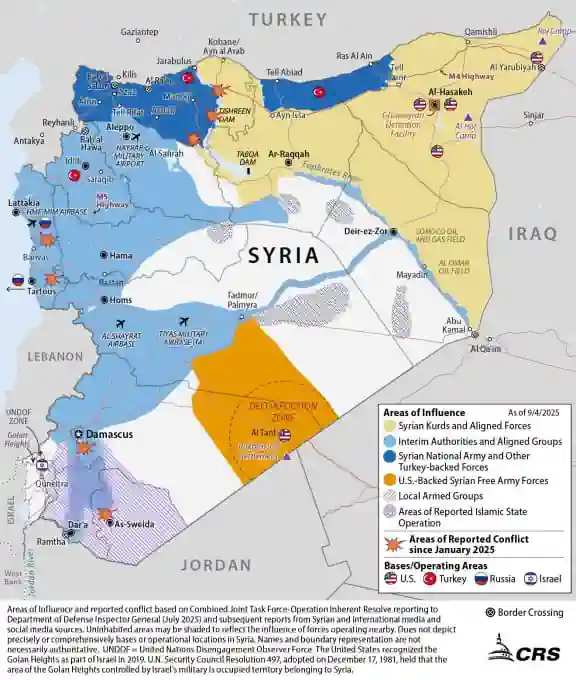
Conceptual Framework After 2025, the US military presence in Syria has shifted to a new phase that diverges significantly from earlier patterns. Instead of focusing on “territorial dominance” through large bases and extensive field operations, the current strategy emphasizes positional-functional control. In this approach, bases serve not just as military locations but as strategic instruments for blocking geopolitical bottlenecks and influencing the region’s geoeconomic network.In this context, the significance of bases is determined by their role within power chains and strategic routes rather than their size. For example, Qasrak base as a logistical gateway east of the Euphrates and a command post for northeastern Syria, while Al-Tanf is pivotal in disrupting Iran’s land corridor to the Mediterranean. These bases serve as “geopolitical levers,” demonstrating a shift from tactical presence to targeted influence engineering. Each base now functions as a tool for managing regional relations and maintaining strategic balances.
The map in the US Congressional Report shows the deployment of US military bases in Syria and areas under its control in 2025, with an emphasis on key points in northeastern Syria and strategic borders. Source: US Congressional Report (CRS 2025) – Syria: Transition and U.S. Policy
Based on US Congressional reports and Tom Barrack’s speech at the Doha Forum, Syria has shifted from being merely a ongoing crisis to becoming a strategic platform for shaping a new regional order in the Arab East. This shift suggests that the US intends to maintain a presence in Syria to influence emerging power dynamics. Rather than sticking to a purely security-focused approach, the US is redefining its global role as a key actor in the region’s geopolitical and security landscape. This military reorientation represents not only a tactical change but also a move toward establishing a new power framework in West Asia.
The New Map of US Military Presence The US military presence in Syria has shifted from direct control to managing strategic locations. These bases now serve not just military purposes but act as points within a broader geopolitical network shaping regional dynamics. This section examines three active bases and their contribution to extending US influence in Syria.
Inactive Bases In 2025, the United States shifted its military focus to strategic and geopolitical areas by closing several key bases in Syria. Bases like Al-Omar and CONOCO, primarily used for energy and surveillance, were transferred to SDF forces. Additionally, Tal Baydar and Wazir bases, closed due to their poor locations and diminished Turkish sensitivities, became part of the new US strategy targeting crucial geopolitical hubs. These actions indicate that the US now aims not only to secure oil resources but also to control strategic positions to influence Syria’s future political and security landscape.
US geopolitical logic The US presence in Syria, particularly in the northeastern regions, has experienced notable changes driven by security concerns and regional geopolitics, reflecting efforts to shape a new regional order. These changes not only involve scaling back military footprint in certain areas but also show a reinterpretation of America’s role in Syria and the wider region. Strategic American bases in Syria serve as tools of geopolitical influence, impacting the regional power dynamics in Arab East and West Asia. The motivations and geopolitical reasoning behind this realignment of US bases and its presence in Syria are discussed below.
Containing Iran and controlling the land corridor One of the primary objectives of the United States in Syria is to restrict Iranian influence. The strategic Al-Tanf base, situated at the Syria-Jordan-Iraq border triangle, is seen as crucial to U.S. interests. Since the start of the U.S. presence in Syria, Al-Tanf has been instrumental in blocking Iran’s land corridor and continues to serve this purpose. The goal of maintaining Al-Tanf is to prevent Iran from establishing a land link from Tehran to Beirut, thereby stopping Iran from entering Lebanon and expanding its regional influence. The U.S. presence here acts as a chokepoint for Iran, playing an essential role for the Western alliance and the Zionist regime, especially in hindering Iran’s coordination with resistance forces in Iraq, Syria, and Lebanon.
Maintaining leverage in Syria’s political future Another objective of the United States in restructuring bases and trimming its military footprint is to utilize the remaining bases as leverage in the Syrian political arena. The 2025 US Congressional Report notes that the US has transformed its military presence into a bargaining tool in political negotiations following the fall of the Assad regime. While justified as efforts against ISIS, this presence primarily aims to be involved in Syria’s reconstruction and to shape its future political and security frameworks in alignment with Washington’s interests. Key bases like Qasr and al-Shaddadi, which serve as strategic contacts with local forces and Syrian Kurds, provide the US with significant influence in post-Assad negotiations.
Managing the relationship with Turkey Another strategic move for the United States in Syria involves managing its complex relationship with Turkey. By withdrawing from sensitive areas in northern Syria, such as Tal Baydar, the U.S. has lessened Turkey’s sensitivities and improved its security position. Meanwhile, reports emerged in late 2024 and early 2025 about the establishment of a base in Ain al-Arab, which were consistently denied by both American and Turkish sources. Regardless, the U.S. goal of rebuilding the base near the Turkish border can be seen as a deterrent against Türkiye, allowing Washington to influence Turkish policies in northern Syria.
Presence in the future geoeconomic corridors Among American politicians, Syria is considered a key element in the evolving landscape of the Arab East. At the Doha Forum, Tom Barrack mentioned that the United States is leveraging Syria as a platform to forge a new geopolitical and economic framework. Linking Syria with Lebanon, the Zionist regime, Turkey, and Jordan could influence trade, energy, and transit pathways. These nations, which serve as vital economic and commercial hubs in the region, can be strategically connected through key locations like Qasrak, Al-Shaddadi, and Al-Tanf. This allows the U.S. not only to utilize these networks now but also to steer and reshape them in the future.
Turning Syria into a scene for containing Russia After the collapse of the old order, the United States sees a chance to restore its influence in the Eastern Mediterranean and Syria. The Syrian bases serve to contain Iranian influence and oppose Russian expansion in the area. By keeping a military presence and enhancing key strategic locations in Syria, the U.S. can better negotiate with Moscow and act as a deterrent to Russian ambitions.
Conclusion Since 2025, the U.S. has significantly restructured its military presence in Syria, emphasizing key bases in strategic locations. These adjustments aim to curb Iranian influence, especially by severing the Tehran-Beirut land corridor and limiting the resistance axis’s maneuvering capabilities. Bases such as Qasrak, Al-Shaddadi, and Al-Tanf now function as tools for overseeing energy resources, trade routes, and shaping policies in Syria and among regional actors like Turkey. Beyond oil, the U.S. seeks to play a decisive role in Syria’s political landscape and regional power dynamics, using these bases to counter Russian influence. These strategic adjustments enable the U.S. to stay a dominant player, safeguarding its security and shaping a new economic and political order around Syria.
The Syrian delegation will be led by Foreign Minister Asaad al-Shaibani, while a newly appointed Israeli negotiating team will participate on the other side. This marks the fifth round of talks between the two parties, but the first after a nearly two-month pause caused by deep disagreements and the resignation of Ron Dermer, Israel’s chief negotiator.
The main goal of these negotiations is to achieve a security agreement that includes the demilitarization of southern Syria and Israel’s withdrawal from areas it occupied following the collapse of Bashar al-Assad’s regime. This renewed effort is being driven directly by the U.S. government. Reports indicate that President Donald Trump is the key figure behind the resumption of talks, with Washington pushing both sides toward an agreement that would secure border stability and potentially pave the way for future normalization of relations. Tom Barrack, the U.S. special envoy for Syrian affairs, is expected to act as mediator.
The resumption of negotiations follows Trump’s direct request to Benjamin Netanyahu during their late December 2025 meeting. Trump emphasized the need to continue talks to reach a swift agreement, while Netanyahu agreed but insisted on maintaining Israel’s red lines.
At the same time, Khaled al-Ahmad, advisor to Syria’s transitional president, arrived in Beirut to meet with Tarek Mitri. According to informed sources, the purpose of this meeting is to resolve outstanding issues, including the status of detainees and convicts, and to strengthen bilateral cooperation. Finding solutions for unresolved cases—particularly those involving Syrian detainees and convicts and Damascus’s request for their extradition—is on the agenda.
In this context, Lebanese parliamentary and security sources strongly denied social media reports claiming the presence of Brigadier General Suhail al-Hassan or the establishment of military bases by former Syrian regime forces in the Akkar region, describing them as exaggerated and false. Lebanese security authorities also stated that many of the officers in question, including deputies of Maher al-Assad, are currently residing in Moscow, while others are wanted by Interpol for crimes against civilians. Strict orders have reportedly been issued to Lebanese security agencies to prevent any activities by former Syrian regime forces in Lebanon that could threaten Syria’s security.
Local sources also stated that movement in Tartus province has been banned by al‑Joulani’s forces until 7 a.m. Monday. These developments have heightened concerns over rising tensions and insecurity in Alawite‑majority areas of Syria.
This allegation follows a report months earlier in Israel’s Yedioth Ahronoth, which stated that the UAE had begun mediating between al‑Joulani’s administration, Israel, and the U.S. The reported aim was to push Damascus into confrontation with Hezbollah in exchange for recognition of al‑Joulani’s legitimacy and extensive economic and military aid.
If accurate, these reports suggest Syria has become a battleground for Arab rivalries, where tools such as support for local factions, political mediation, and ties with external powers are deployed. The continuation of this dynamic could not only complicate Damascus’s path to consolidation but also cast greater uncertainty over Syria’s political and security future.
Sources close to the Syrian government report that the SDF has expressed initial readiness to withdraw from Raqqa and Deir ez‑Zor, though some commanders remain unwilling to retreat from the contested areas.
The presence of ISIS detainees in SDF‑controlled territories is cited as the main obstacle to progress in the negotiations.
Details of the talks will not be made public, as discussions are being held behind closed doors. Given the unresolved challenges, the negotiations are expected to continue until January 4.
Witnesses say the attackers used live ammunition and melee weapons, with many of the wounded rushed to medical centers. Local sources warn that tensions are escalating and the security situation remains unstable.
Clashes between Alawite protesters and al‑Joulani’s forces have spread sporadically across Hama, Homs, Tartus, and Latakia provinces. Armored vehicles have been deployed in central Latakia to contain gatherings.
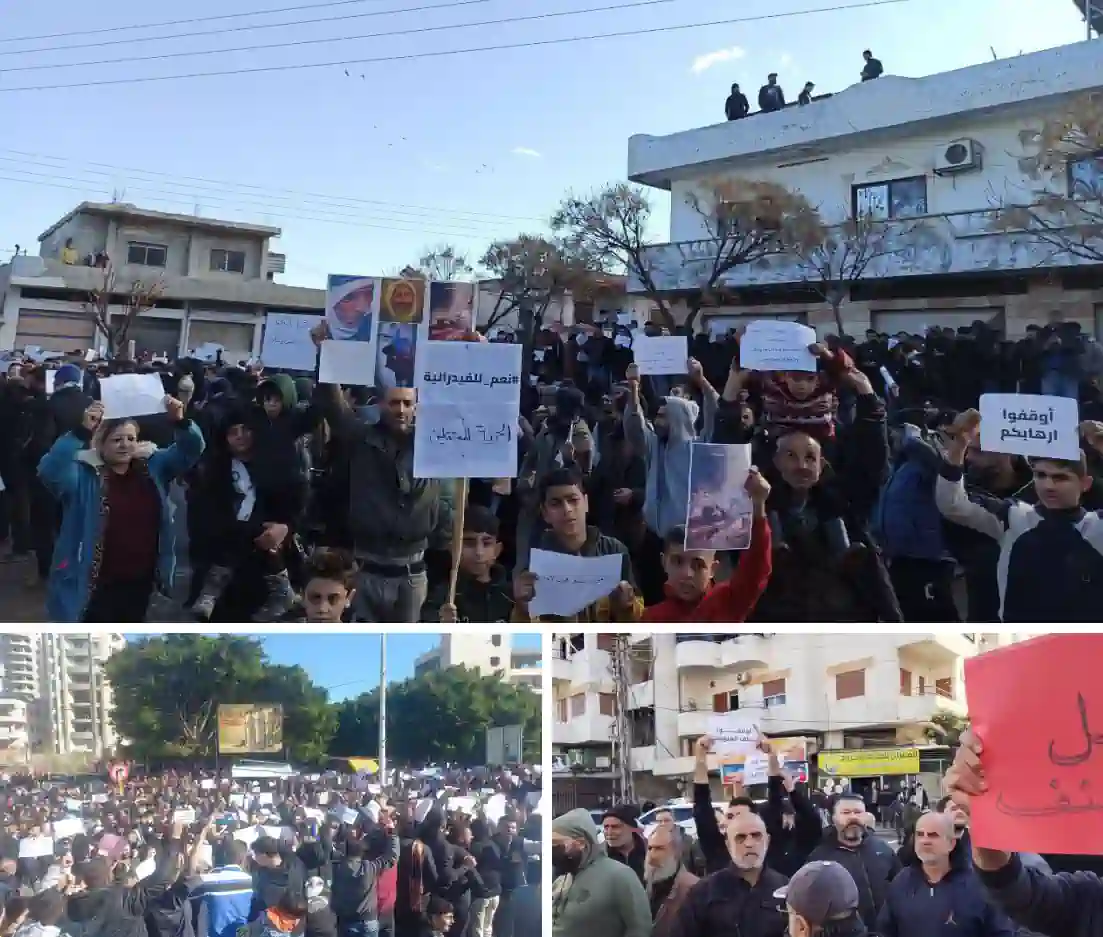
The protests began yesterday following a call by Sheikh Ghazal, with demonstrators denouncing repression, discrimination, and denial of civil rights. Rallies were held in Jableh and al‑Qardaha (Latakia), al‑Daliyeh and Salhab (Hama), Tartus, Safita, Banias, and al‑Sheikh Badr (Tartus). While protesters declared the gatherings peaceful, footage shows violent clashes and assaults by al‑Joulani’s forces.
Sheikh Ghazal stressed that what is happening now amounts to an organized genocide against the Alawites, carried out openly before the eyes of the world. He clarified that the Alawites are not seeking “civil war,” but rather demand political federalism within Syria.
In response to this call, residents of Jableh and al‑Qardaha (Latakia province), al‑Daliyeh and Salhab (Hama province), Tartus, Safita, Banias, and al‑Sheikh Badr (Tartus province) took to the streets. Videos circulating on social media show that security forces of the al‑Joulani government opened fire on protesters in some areas, injuring several people who were later transferred to Tishreen Hospital in Latakia.