Category: Armenia

  • Iran Leader Meets With Tajik President, Armenian Prime Minister

    Iran Leader Meets With Tajik President, Armenian Prime Minister

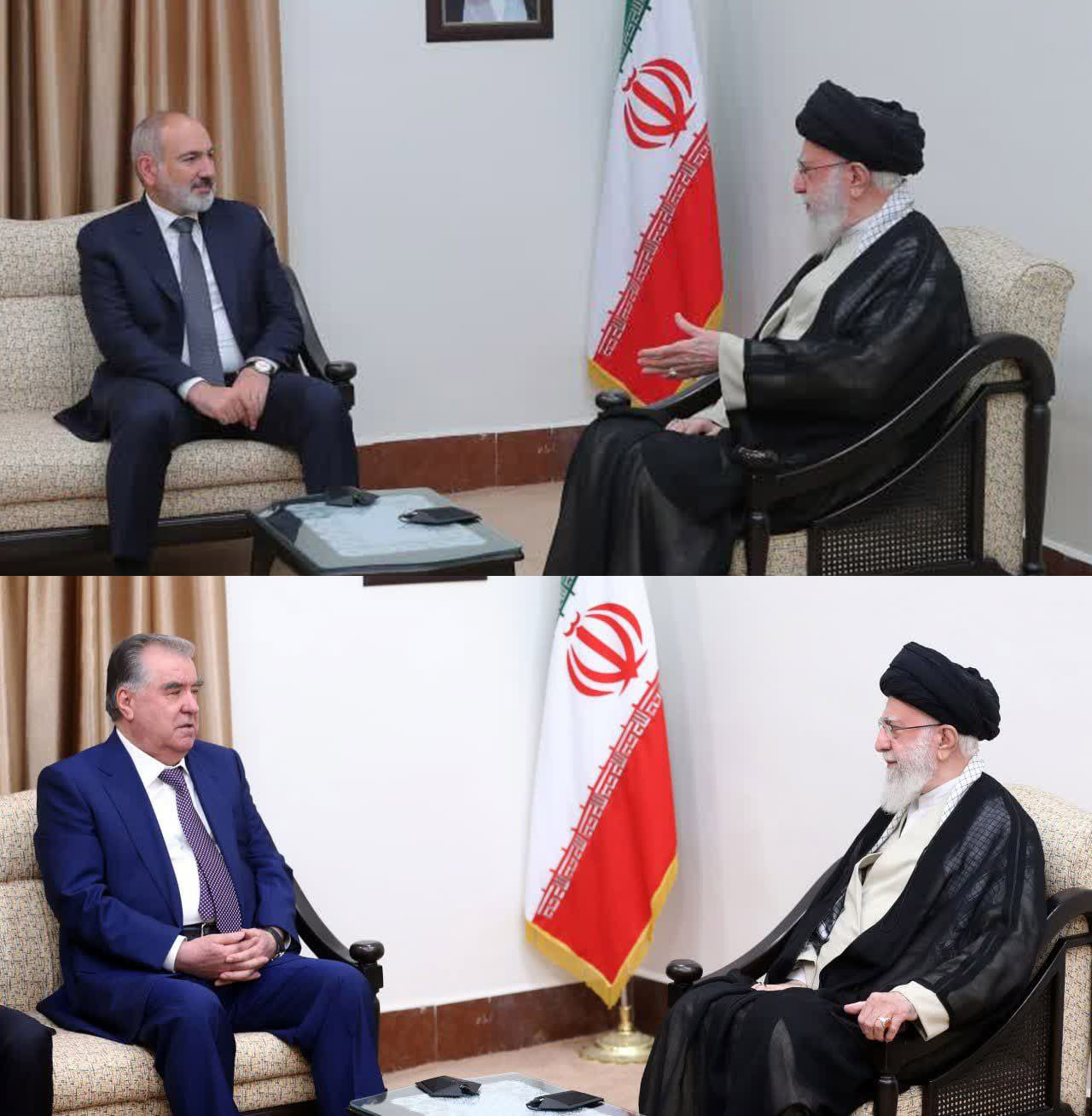
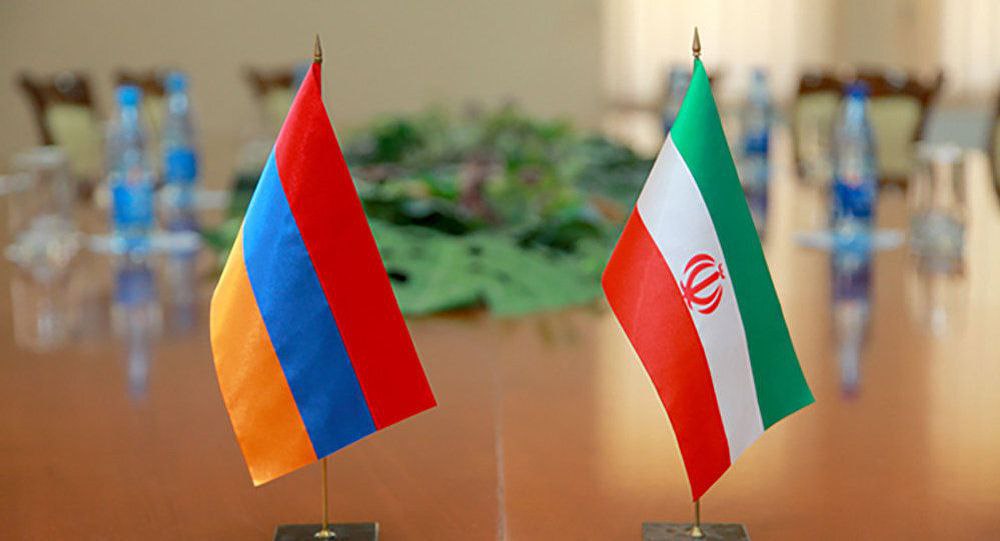
    In a meeting on Tuesday with Armenian Prime Minister Nikol Pashinyan and his accompanying delegation, the Supreme Leader of the Islamic Revolution emphasized that the Islamic Republic of Iran’s definitive and consistent policy is to expand relations with its neighbors, especially Armenia.

    Imam Khamenei also called for the development of relations and cooperation between the two countries based on defined interests of both nations and regardless of the policies of other states.
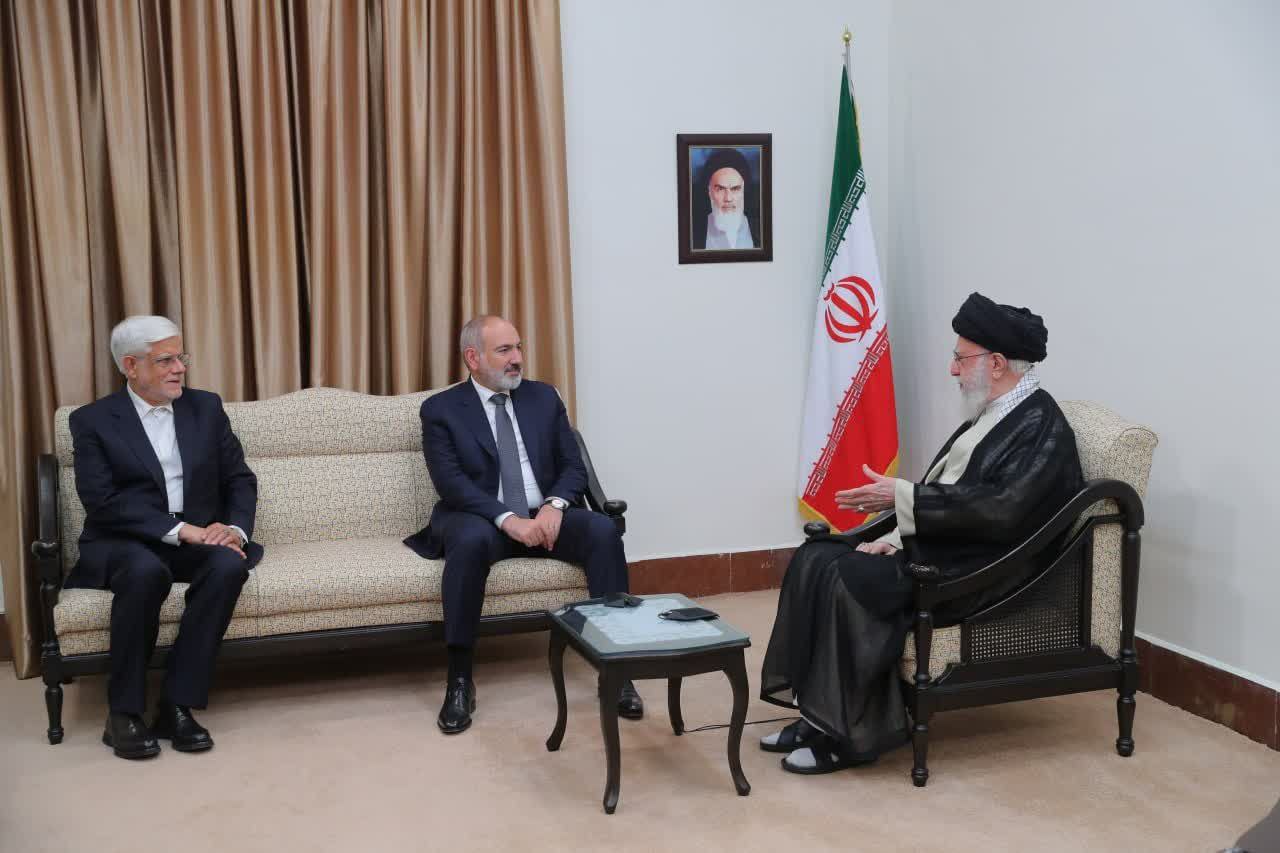
    Armenian Prime Minister Nikol Pashinyan met with Supreme Leader of the Islamic Revolution

    The Leader of the Islamic Revolution went on to say that the Islamic Republic of Iran considers the Zangezur corridor – a concept for a transport corridor which, if implemented, would give Azerbaijan unimpeded access to Nakhchivan Autonomous Republic – to be to the detriment of Armenia; therefore, Iran continues to stand by this position.

    Foreigners should not place restrictions on the relations of countries with their neighbors, the Leader stated, arguing that what ensures the security and well-being of countries is reliance on themselves and their close allies, and the actions of some states who come from far away and interfere in the affairs of other nations are to their detriment.

    The Armenian Prime Minister, for his part, emphasized that he has repeatedly stated that he does not accept any extra-regional route within his country, describing the relations between the Islamic Republic of Iran and the Republic of Armenia as strategic. The Armenian premier also expressed satisfaction with the expansion and diversification of ties with Iran, underscoring that he gives importance to the continuation of this process.

    In another meeting on Tuesday morning, Imam Khamenei received Tajik President Emomali Rahmon and his accompanying delegation.
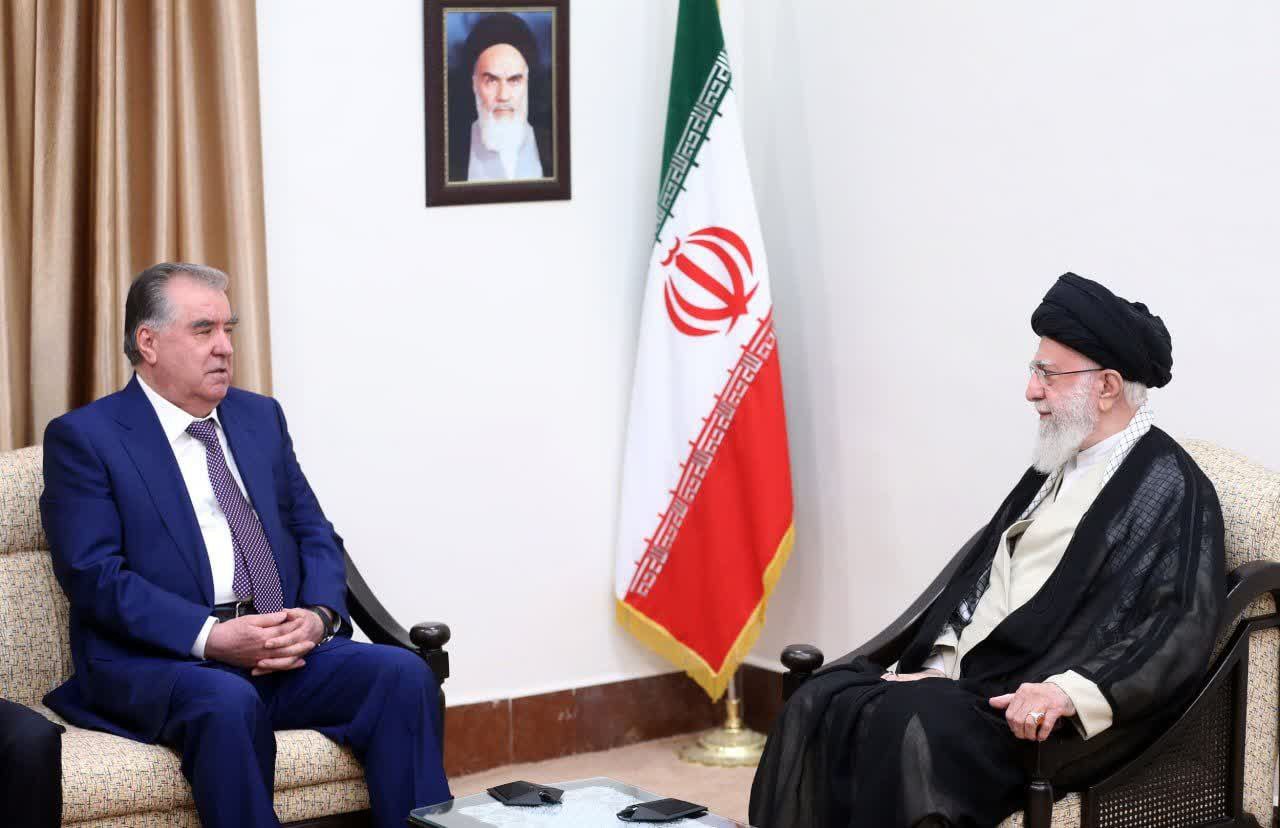
    Tajikistan President Emomali Rahmon met with Supreme Leader of the Islamic Revolution

    The Supreme Leader said that Iran’s main policy and priority is to expand relations with the countries of the region, especially states with the same language and common culture, history and religion.

    Ayatollah Khamenei further emphasized: The Islamic Republic of Iran is ready to cooperate sincerely with Tajikistan in various fields, as in the past.

    The Leader of the Islamic Revolution also called the official visits by authorities of the two nations a basis for the expansion of cooperation and said: The Persian language is one of the important commonalities between Iran, Tajikistan and Afghanistan, and more cooperation should be made to preserve and expand this language and prevent some attempts to isolate the shared language.

    The Leader of the Islamic Revolution also noted: There are some opponents who disagree the expansion of relations between Iran and Tajikistan; thus, there must be a plan to confront them.

    The President of Tajikistan, for his turn, said: As you said a few years ago, the two countries are linked and we want to expand relations and use the experiences and advances of the Islamic Republic of Iran in the fields of science, health and industry.

    The top officials of Armenia and Tajikistan along with their accompanying delegations arrived in Tehran on Tuesday morning in order to take part in the inauguration ceremony of Masoud Pezeshkian, the ninth President of the Islamic Republic of Iran, on Tuesday (July 30) at the Iranian parliament. More than 70 foreign delegations and 600 domestic and foreign journalists attended the inauguration ceremony at 6 p.m. local time.
  • Ministry Of Defense Of Armenia Denies Arms Purchase From Iran

    Ministry Of Defense Of Armenia Denies Arms Purchase From Iran

    The pro-Zionist TV network Iran International recently claimed in a report that Iran and Armenia have signed a secret arms contract worth $500 million, according to which a variety of suicide, reconnaissance, and combat drones such as the Shahed-136, Shahed-129, Mohajer-6, as well as the defense systems such as the Khordad-3, Majid, Khordad-15, and so on, will be exported to Armenia.

    To elaborate this news, it should be noted that the figure of $500 million for the purchase of weapons by Armenia is a large figure and is not small in the size and economic capacity of this country.

    Moreover, Armenia’s geographical location and conditions are not suitable for the mentioned weapons, especially defense systems, and from this phony information, it can be understood that agents of the Iran International TV network in conjunction with the Pan-Turkism media outlets in Turkiye and Azerbaijan Republic have propagated false or incomplete reporting mission.

  • Armenia Returns 4 Occupied Villages To Azerbaijan

    Armenia Returns 4 Occupied Villages To Azerbaijan

    The eighth meeting of the state commission on the delimitation of the borders of the Republic of Azerbaijan and the Republic of Armenia was held on April 19 with the participation of Deputy Prime Minister of the Republic of Azerbaijan Shahin Mustafayev and Deputy Prime Minister of Armenia Mher Grigoryan.

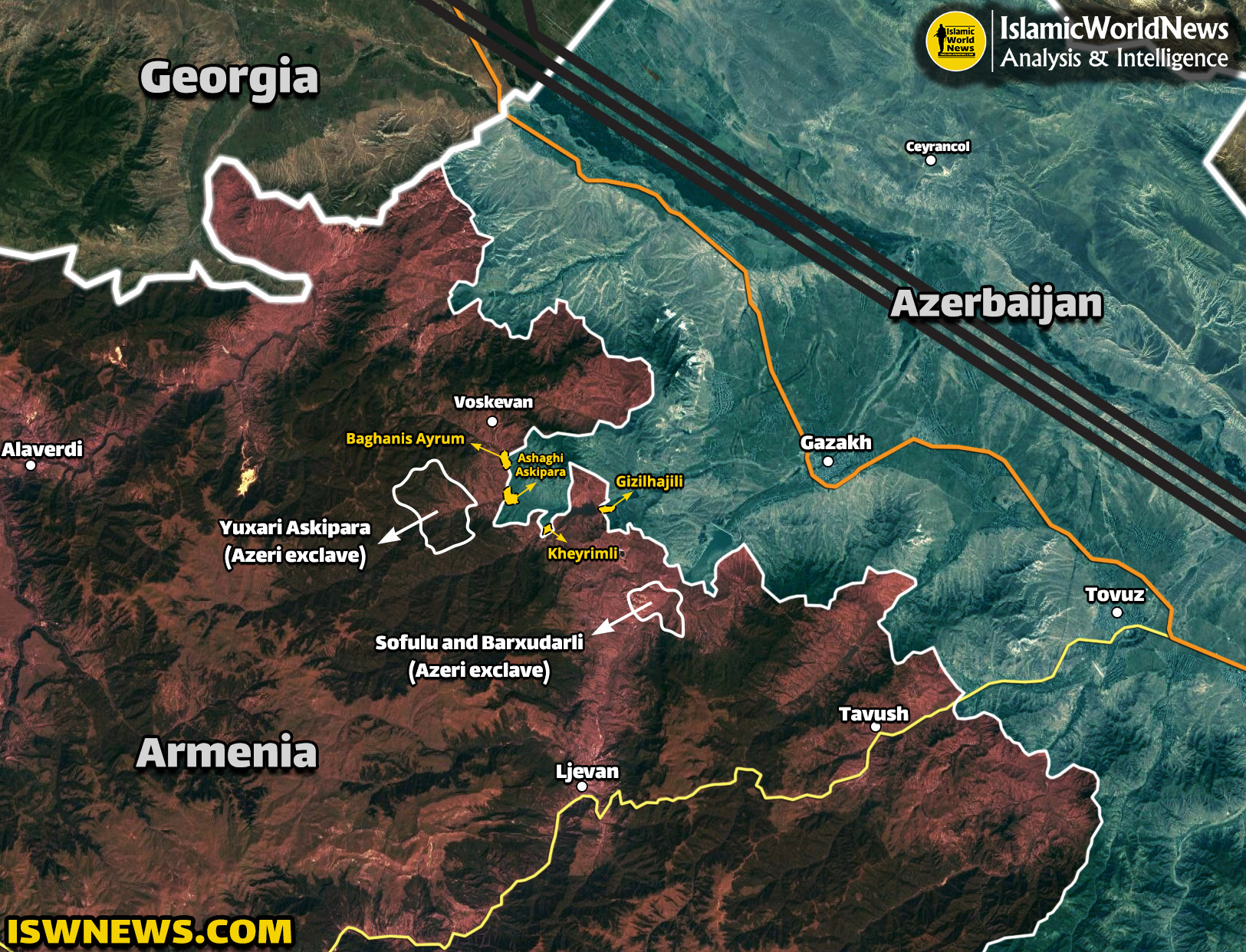
    According to the agreements reached at this meeting, the four border villages of Baghanis Ayrum, Ashagi Askipara, Kheyrimli and Gizilhajili, which had been occupied by the Republic of Armenia since the early 1990s, were returned to the Republic of Azerbaijan.

    Also, as a result of the agreements reached at this meeting, the two countries agreed on the process of adjusting the border coordinates based on geodetic measurements.

    It should be noted that due to the remaining problems in the borders of the Soviet era in this region, some villages were located on the border between the two Soviet Socialist Republics of Azerbaijan and Armenia, and after the collapse of the Soviet Union and the independence of the Republic of Azerbaijan and the Republic of Armenia, this issue became a source of the constant tensions between the two countries.

    During the First Karabakh War and the invasion of parts of the region by Armenian forces, some of these villages also came under Armenian occupation. Now, after the liberation of the Karabakh region by the Republic of Azerbaijan, the situation of these villages and the borders of the two countries will be addressed and resolved by the border demarcation commissions.

    On the other hand, after this agreement, various groups of people in the Republic of Armenia took to the streets in the border areas, including Tavush, to protest against this issue by blocking roads. The protesters believe that Armenian Prime Minister Nikol Pashinyan is handing over Armenian territory to the Baku government.

    Four border villages of Baghanis Ayrum, Ashagi Askipara, Kheyrimli and Gizilhajili (yellow color) on the border of the Republic of Azerbaijan and Armenia – click to view in full size
  • Armenia-Azerbaijan Peace Process Talks In Tehran After 31 Years!

    Armenia-Azerbaijan Peace Process Talks In Tehran After 31 Years!

    The Caucasus region was known as an area under the influence of Iran and the Ottoman Empire centuries ago, to them the Russian Empire was added about two centuries ago; so, it can be claimed that the developments in the Caucasus region over the past two centuries have been a function of the developments of the Iran, Ottoman, and Russian triangle. However, the establishment of Soviet reign heavily enhanced Russia’s foothold in the Caucasus region, and the policies of this state paved the way for separating the Caucasus region from Iran and Turkiye.

    But the collapse of the Soviet Union in the 1990s once again added importance to regional players such as Iran and Turkiye and forced these two countries to play a role in resolving conflicts that led to the First Nagorno-Karabakh War that took place from February 1988 to May 1994. The Islamic Republic of Iran turned into the first player in terms of resolving disputes between the two republics (Armenia and Azerbaijan) due to its strong communication channels with the two fledgling republics, and in this process, several ceasefire agreements were reached and prisoner swaps were carried out.

    But the most important achievement of the Iranian diplomatic mission was the issuance of the Tehran Communiqué also known as the Joint statement of the heads of state in Tehran, which is the joint communiqué mediated by then Iranian President Akbar Hashemi Rafsanjani and signed by the acting President of Azerbaijan Yagub Mammadov and President of Armenia Levon Ter-Petrossian on May 7, 1992. The communiqué gained the consent of the leaders of the two warring countries to begin negotiations in order to resolve disputes between Baku and Yerevan. A process that failed with the intervention of forces affiliated with extra-regional powers such as the United States and ultimately with the end of the First Nagorno-Karabakh War and the establishment of a ceasefire; thus, the Azerbaijan-Armenia disputes were entrusted to a group of representatives from Belarus, Germany, Italy, Sweden, Finland, and Turkiye, known as the Minsk Group. However, this group has not achieved any tangible result in its three decades of activity.

    The formation of a establishment known as the Republic of Artsakh or the Republic of Nagorno-Karabakh over the past three decades prevented officials of the two countries of Azerbaijan and Armenia from ignoring the issue of Nagorno-Karabakh region and focusing on resolving issues and disputes between the two nations; so, many of these issues were forgotten during this time. But with the outbreak of the Second Nagorno-Karabakh War and the return of this region to the territory of Azerbaijan, existing issues between the two countries, such as determination of border lines and the fate of transportation routes, as well as legal, judicial, and diplomatic systems, have become more serious, which paved the way for the direct negotiations between Baku and Yerevan in a more appropriate ground.

    However, the geopolitical situation in the Caucasus region makes it impossible to advance such actions without considering the interests and goals of traditional regional powers (Russia, Turkiye, and Iran); therefore, deciding on the framework and format of future talks will largely determine how negotiations will proceed and how will be their level of success. Russia, as the most influential state in the Caucasus region, was involved in the developments following the 2020 war, but recent political developments in Armenia show that there are signs of a rapid distance between Yerevan and Moscow. On the other hand, Russia’s policies in recent years have been strongly protested by Armenians to the point where Armenian officials announced their dissatisfaction with the progress of negotiations under the heavy influence of Russia and proposed a return to the European Union. However, Azerbaijan, which experienced bitter experiences with the intervention of extra-regional powers and remembers the neutral performance of the Minsk Group, did not agree with the proposal from Armenia, especially since EU officials have largely supported the Armenian side during recent developments and their role in such a framework could have increased Armenian bargaining power. The intervention of extra-regional powers could have turned the dispute into a new crisis, in addition to slowing down the process of resolving disputes; thus, both sides agreed to resolve issues within a regional framework and expressed their readiness to participate in the 3+3 format.

    A look at the field developments and political atmosphere of the region shows that the current conditions should be considered in continuing to the Tehran Communiqué in 1992, when both warring parties were in the most balanced point. The First Nagorno-Karabakh War had not yet begun in 1992 and its financial and human losses had not been incurred by both sides. Tens of thousands of Azerbaijani refugees (for 30 years) and Armenians (who left Nagorno-Karabakh in recent months) were still stationed in their homes. But now, after 31 years of these harmful events, Nagorno-Karabakh is empty of population and its fate is once again linked to the negotiations in Tehran!

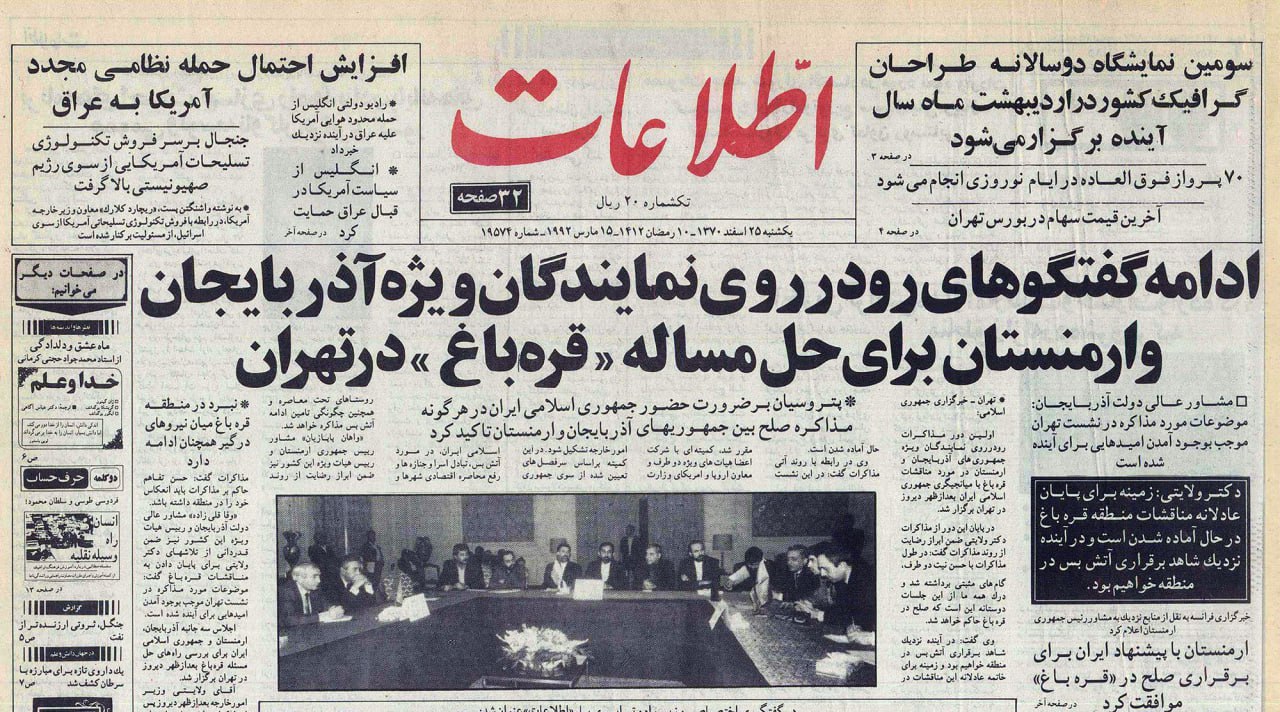
    Image: The front page of Iran’s Ettela’at newspaper 31 years ago, which discussed the topic of those days’ negotiations in Tehran and resolving the dispute between Azerbaijan and Armenia in Tehran.

  • Iran President Receives Envoys From Azerbaijan, Armenia

    Iran President Receives Envoys From Azerbaijan, Armenia

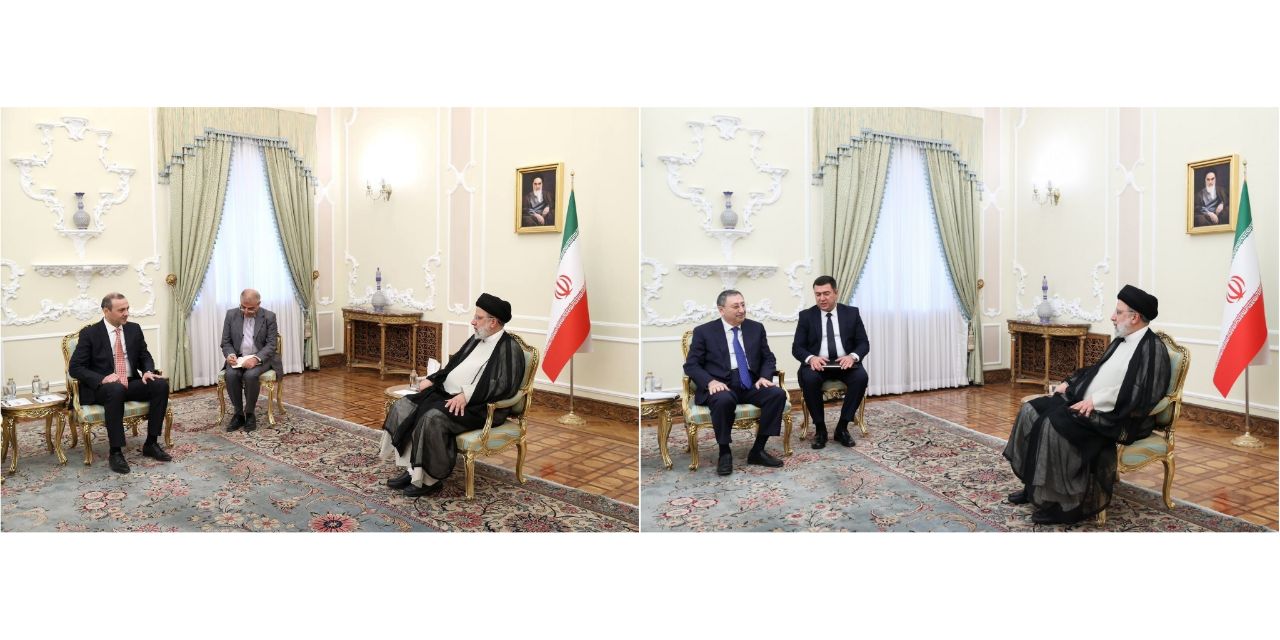
    ISWNews Analysis Group – President Raisi held talks with assistant of Azerbaijani President Ilham Aliyev in special affairs Khalaf Khalaf and secretary of the Security Council of Armenia Armen Grigoryan, when the president and the two representatives discussed developments in the Caucasus region.

    In the meetings, the Iranian president stressed the need to enhance relations between these northern neighbors and Iran with the aim of countering plots that aim to create divisions and disrupt the bilateral relations between Armenia and Azerbaijan.

    Raisi went on to say that the Islamic Republic of Iran, as a powerful neighbor of both Azerbaijan and Armenia, is fully prepared to help resolve the two countries’ disputes and problems.

    Emphasizing the importance of maintaining border lines and the existing geopolitical structure of the region, the president stated that Iran welcomes regional dialogues in the form of 3+3 or any other format that can contribute to resolving issues and opening up avenues for cooperation between Azerbaijan and Armenia.

    He further noted that the countries in the region have the capacity to resolve regional problems and that the engagement of foreign countries into the region, under any pretext, is not in the best interest of any of the regional states.

    Mohammad Jamshidi, the Iranian president’s deputy chief of staff for political affairs, said that in both meetings, the President emphasized that the Zangezur Corridor serves as a platform for NATO’s presence in the region and poses a threat to national security, which the Islamic Republic of Iran strongly opposes.

    Simultaneously with these meetings, Chief of Staff of the Armed Forces of Iran General Mohammad Bagheri announced the readiness to send observers to the borders of Armenia and the Republic of Azerbaijan.

  • Eagle Partner 2023; Joint Military Exercise Of Armenia And U.S.

    Eagle Partner 2023; Joint Military Exercise Of Armenia And U.S.

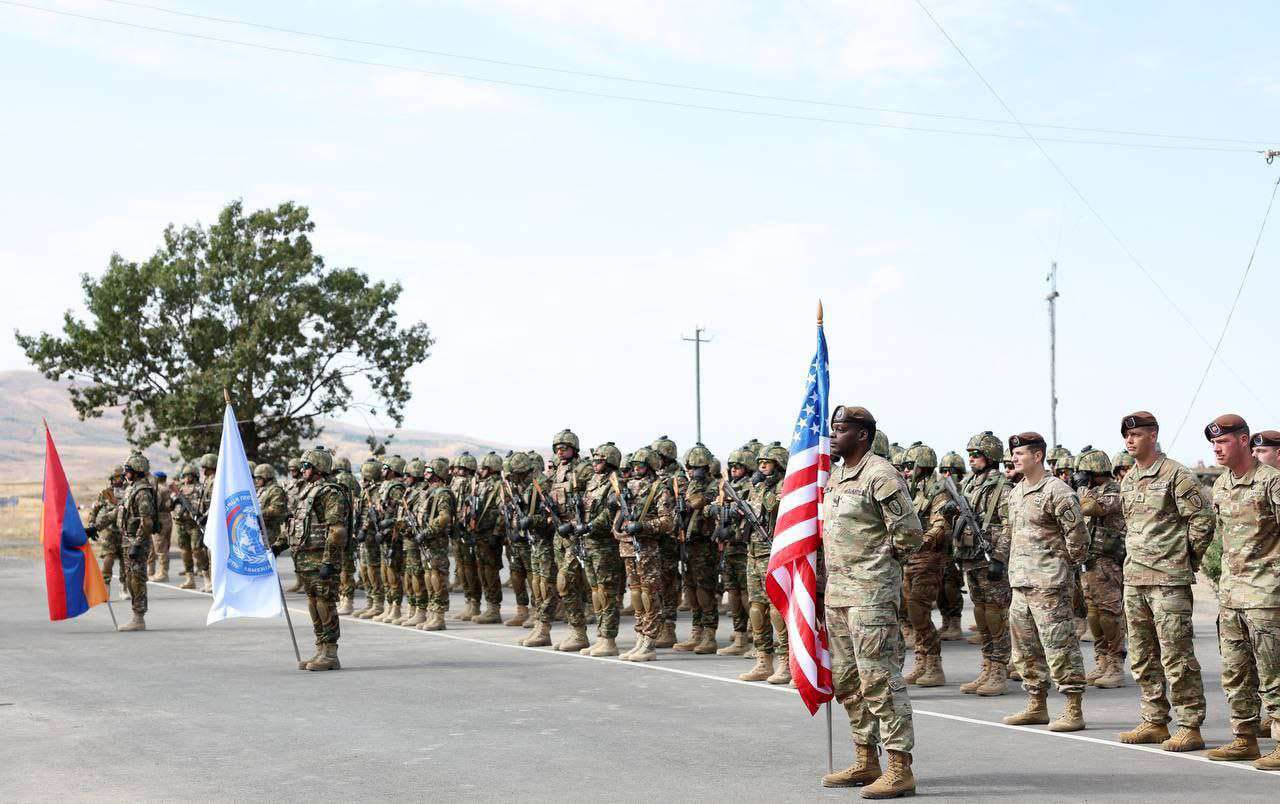
    The joint military exercise between Armenia and America, called Eagle Partner 2023, kicked off on September 11 near the Armenian capital city of Yerevan.

    The purpose of the military exercise is to increase the level of cooperation capabilities of the participating units in international peacekeeping missions and to increase the coordination of Armenian forces with NATO standards.

    The Kremlin warned that the military exercise has caused concern for Russia.

    Dmitry Peskov, a spokesman for the Kremlin, said: Of course, such a news story is particularly worrying in the current situation. Therefore, we will deeply analyze this news report and monitor the situation.

    Currently, groups of Russian peacekeepers are present in the disputed border areas between Republic of Armenia and the Republic of Azerbaijan.

    Since November 30, 2020, when a ceasefire was signed between Armenia and Azerbaijan, about 2,000 Russian forces have been deployed in the region in order to shoulder the responsibility for maintaining peace and tranquility.  

    However, the military exercise is being held amid increasing Armenian despair over Russia’s failure to guarantee and secure the establishment of a peace agreement and ceasefire in Karabakh region.

    Both the Republic of Azerbaijan and the Republic of Armenia are dissatisfied with the performance of Russian peacekeepers in Karabakh region, and it is feared that this trend will ultimately lead to foreigners entering the Caucasus region.

    With the rekindling of tensions with Baku, Armenians have expressed disappointment at Russia’s lack of military and political support.

    Furthermore, Armenia’s Prime Minister Nikol Pashinyan recently said that Moscow “cannot or does not want” to control and manage the Lachin corridor, which provides access from Nagorno-Karabakh to Armenia.  

    Pashinyan stated that Armenia’s historical security reliance on Russia was a “strategic mistake.”

    Some analysts believe that Russia, due to the war in Ukraine, has focused all its attention on Ukraine and therefore, Moscow lacks a clear plan and strategy in the Caucasus region.

    It seems that Russia may have become isolated on the international scene and it is losing its influence in its Soviet era backyard, namely the Caucasus region.

  • Armenian, Azerbaijani Border Guards Wounded In Exchange Of Fire At Karabakh Corridor (Video)

    Armenian, Azerbaijani Border Guards Wounded In Exchange Of Fire At Karabakh Corridor (Video)

    In a statement, Armenia’s National Security Service said that a group of Azerbaijani border guards had attempted to cross a bridge over the Hakari river, which marks the internationally-recognized border between the two countries, and hoist a flag on Armenian territory. The service added that the attempt had been thwarted.

    The bridge lies at the start of the Lachin corridor, the last remaining route linking Armenia with Nagorno-Karabakh, which is mainly inhabited by ethnic Armenians. The key corridor is policed by Russian peacekeepers.

    Footage that surfaced online showed Azerbaijani border guards coming under fire while attempting to hoist their flag. The border guards were accompanied by a number of Russian peacekeepers.

    After the Armenian attack, Azerbaijan closed the Lachin corridor, preventing Armenians from leaving or entering Nagorno-Karabakh.

    TASS cited Azerbaijan’s border service as saying one of its guards was wounded in the attack. Later, the Russian news agency quoted the Armenian border service as saying that one of its guards had been wounded during Azerbaijani shelling of a village close to the bridge.

    The Lachin corridor has been blocked to most traffic since December, after Azerbaijani civilians identifying themselves as environmental activists began a blockade.

    Tension remained high between Armenia and Azerbaijan after the Nagorno-Karabakh war of 2020. The deployment of Russian peacekeepers helped prevent any further escalation. However, the two countries are yet to reach a settlement and end the conflict.

    Source: SouthFront

  • From Controversy In weightlifting Event To Crisis In Armenia-Azerbaijan Borders

    From Controversy In weightlifting Event To Crisis In Armenia-Azerbaijan Borders

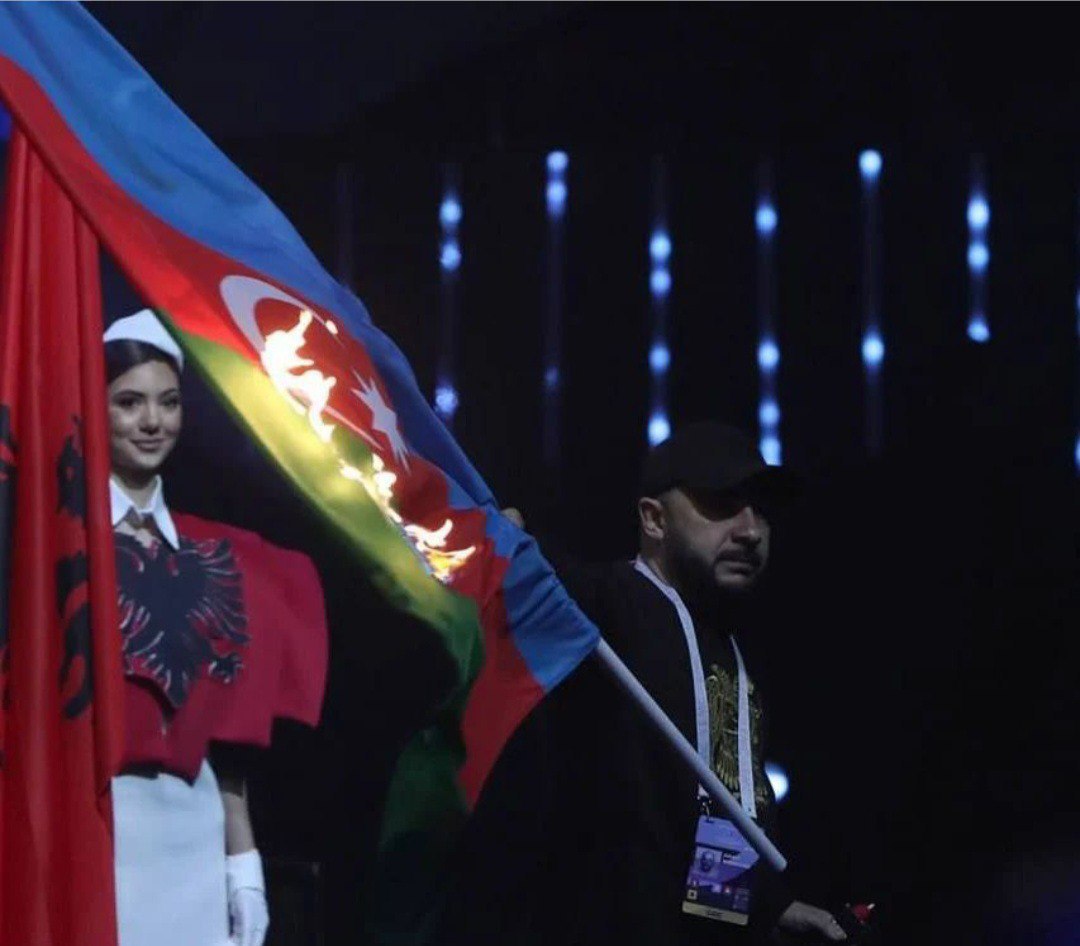
    Azerbaijan Republic’s flag burned!

    On April 14, the opening ceremony of the 2023 European Weightlifting Championship was held in Armenian capital city. In a part of the ceremony, famous Armenian designer Aram Nikolyan set fire to Azerbaijan’s flag on stage! The move was lauded by a group of the Armenian people…
    Following the incident, security forces arrested the designer, and Prime Minister of Armenia Nikol Pashinyan, who was present in the event, ordered Nikolyan’s dismissal.

    The flag of the Republic of Azerbaijan was set on fire at the opening ceremony of the European Weightlifting Championship in Yerevan

    Azerbaijani team’s return and prosecution

    Azerbaijan Republic took part in the 2023 European Weightlifting Championship with 12 weightlifters, but after the incident, Azerbaijani authorities called on the athletes to leave Yerevan to Baku. The interesting point is that the weightlifting team of Azerbaijan did not participate in the opening ceremony due to security issues.
    The Ministry of Foreign Affairs of Azerbaijan condemned the flag burning incident in Armenia, and the attorney general of Azerbaijan ordered filing a lawsuit at the international court. Some nationalist citizens gathered in capital Baku, hoisted their flag and chanted anti-Armenia slogans.

    Turkiye’s implicit support

    Among other events related to the issue, the support by a Turkish athlete from Azerbaijan Republic was interesting. Cansu Bektash dedicated his medal of this round of competitions to Azerbaijan’s team.

    Tension in borderline of Kalbajar-Gegharkunik

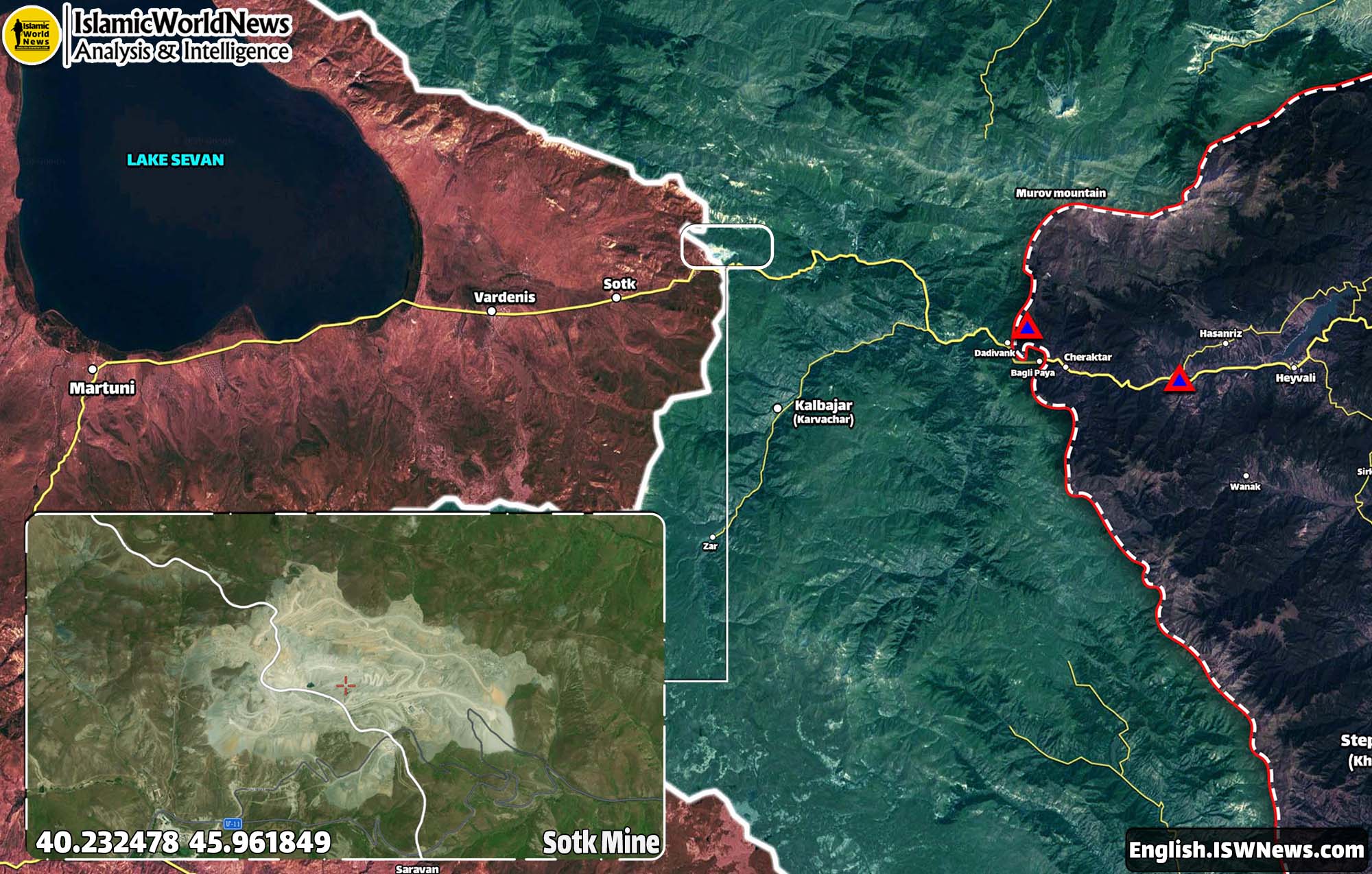
    Concurrent with tension in Yerevan, tension escalated in border areas between Armenia and Azerbaijan, and Azerbaijani forces fired at the Sotk gold mine in Gegharkunik, Armenia. The Sotk gold mine is located in the borderline between the two countries.
    Rosanna Grigoryan, representative of the GeoProMining Gold, said that the armed forces of Azerbaijan fired at the mine from 19 to 23 local time on Friday to Saturday morning. The mining company stopped its activity and staff were pulled out from the mine.

    Sotk gold mine in the borderline between the two countries

    The incidents happen in circumstances that the tension over arrest of Azerbaijan’s military forces in Armenian soil has not subsided; so, it seems that we should wait for more escalations. It can be said that the public opinion is being prepared for a war between the two nations.

  • Armenia, Azerbaijan Clash In Tegh-Zabukh Borderline

    Armenia, Azerbaijan Clash In Tegh-Zabukh Borderline

    In the afternoon of April 11, local sources in the Tegh Municipality of the Syunik Province in southern Armenia reported a clash between the Azerbaijani and Armenian military forces.

    According to the Ministry of Defence of the Republic of Azerbaijan, the struggle left three Azerbaijani soldiers dead and a few others injured. The Ministry of Defence of Armenia also declared that the confrontation left four Armenian soldiers dead and six others wounded.

    Azerbaijan claims that the clash erupted following a shooting by Armenian forces towards positions of the Azerbaijani soldiers on the way to Lachin Corridor. Then, the Azerbaijani army responded to the attack, which led to some casualties among the Armenian ranks.

    Now, the two sides have reached a consensus to halt the confrontation; so, there is not any more details of the battle ground in Tegh-Zabukh borderline. Zabukh is a village located in the Lachin District of Azerbaijan Republic.

    A weird and unrelated issue regarding to the incident is that some media outlets in Azerbaijan’s capital Baku claimed that Armenia utilized Iran-made drones in the mentioned confrontation, but Yerevan ruled out the fake news story, attributing the propaganda to media outlets affiliated to Azerbaijan’s President Ilham Aliyev. The unfounded accusation has been leveled in line with Baku’s Iranophobic policy and its strategy to pave the ground for potential clashes with Iran.

    It should be mentioned that Azerbaijan’s army held joint military drills along with the allies of the country in its border areas with Armenia.

    Baku resorted to anti-Tehran accusations in recent months, while the Islamic Republic has called on Azerbaijan and Armenia to abide by international borders and stop escalating tensions.

    Read more: Challenging Path Of Lachin Corridor!

  • Challenging Path Of Lachin Corridor!

    Challenging Path Of Lachin Corridor!

    A number of so-called environmental activists, who support Azerbaijan’s President Ilham Aliyev, stopped transit of Armenians in Shusha city towards the center of Nagorno-Karabakh (Artsakh) region.
    Azerbaijan’s armed forces, from March 25, have started advancing in some parts of northern corridor of Lachin and seized control of heights overlooking side roads from Lisagor (Turssu) village to Stepanakert (Khankendi) city, the center of Nagorno-Karabakh region. Therefore, residents of six villages of Lisagor (Turssu), Yeghtsahogh (Saribaba), Mets Shen (Buyuk Galadarasi), Hen Shen (Kichik Galadarasi), Kanach Tala (Goytala) and Tasy Verst that are Armenian settlements have been besieged, and the side roads, which are their last chance to maintain their connection with the center of the Nagorno-Karabakh have been blocked.

    Challenge of living in Line of Contact

    Radio Liberty of Armenia has prepared a report on regions that are near the Line of Contact and witnessing a hard situation following the closure of transportation ways. Lisagor in this region is the only residential area, where the Armenians have been resided in following the end of First Nagorno-Karabakh War from February 1988 to May 1994.

    Qajik Nasibyan, head of Lisagor council, told a reporter of the radio that the village with 73 Armenian people has been situated in vicinity of the Line of Contact after the end of the Second Nagorno-Karabakh War (September 27, 2020 – November 10, 2020). Their presence zone on the road is 8 to 10 kilometers near Shusha. Now, the village comes under the fire of the observation post of the Azerbaijan Republic’s army. The Azerbaijan armed forces plan to control the only remained road for their connection to Stepanakert; so, they took it.

    Artak Hakobyan, head of Saribaba council, explained the hardships of living under this condition, saying that aside from healthcare issues, other problems have happened. Students cannot commute to Stepanakert. The Azerbaijan army personnel have been deployed 500 meters away from the Saribaba village. The residents of the village can farm only near their houses. In August 2022, Azerbaijan Republic retook Lachin District, and the Azeri Army controlled heights around the village. Azerbaijanis have stolen 17 cows so far; so, if we neglect for only five minutes, our cattle would be stolen.

    Azerbaijan does not intend to retreat

    Siran Ayraptian, representative of the Armenian separatists of Artsakh, in an interview with Radio Liberty pointed to the inconclusive negotiations by Russian peacekeepers to urge Azerbaijan Republic to retreat from the heights overlooking Lisagor village, saying that Azerbaijan resorted to blocking the only transportation road in a bid to force the Armenian community there to stop their demand for independence. On one hand, the Azeri authorities speak of peace, and on the other hand, they resort to enforcing pressure in order to force us to do something else, but the performance would not bring positive result.

    Pro-Aliyev environmental activists present in Shusha sit-in accuse Armenian people of illegal excavation of mines in Karabakh and pollution in that mountainous region; therefore, they resort to the excuse to block the road even for routine traffic. The authorities in Azerbaijan Republic say that the side roads are being applied for delivery of arms and military equipment. Thus, all roads should be closed for residents of central parts of the mountainous Karabakh region!

    From checkpoint to border police station

    Azerbaijan Republic is saying that they should build a border police station in Lachin Corridor. The Azeri officials first announced that an checkpoint should be erected in Shusha city, but now they say the post should be constructed in the borderline between Azerbaijan and Armenia.

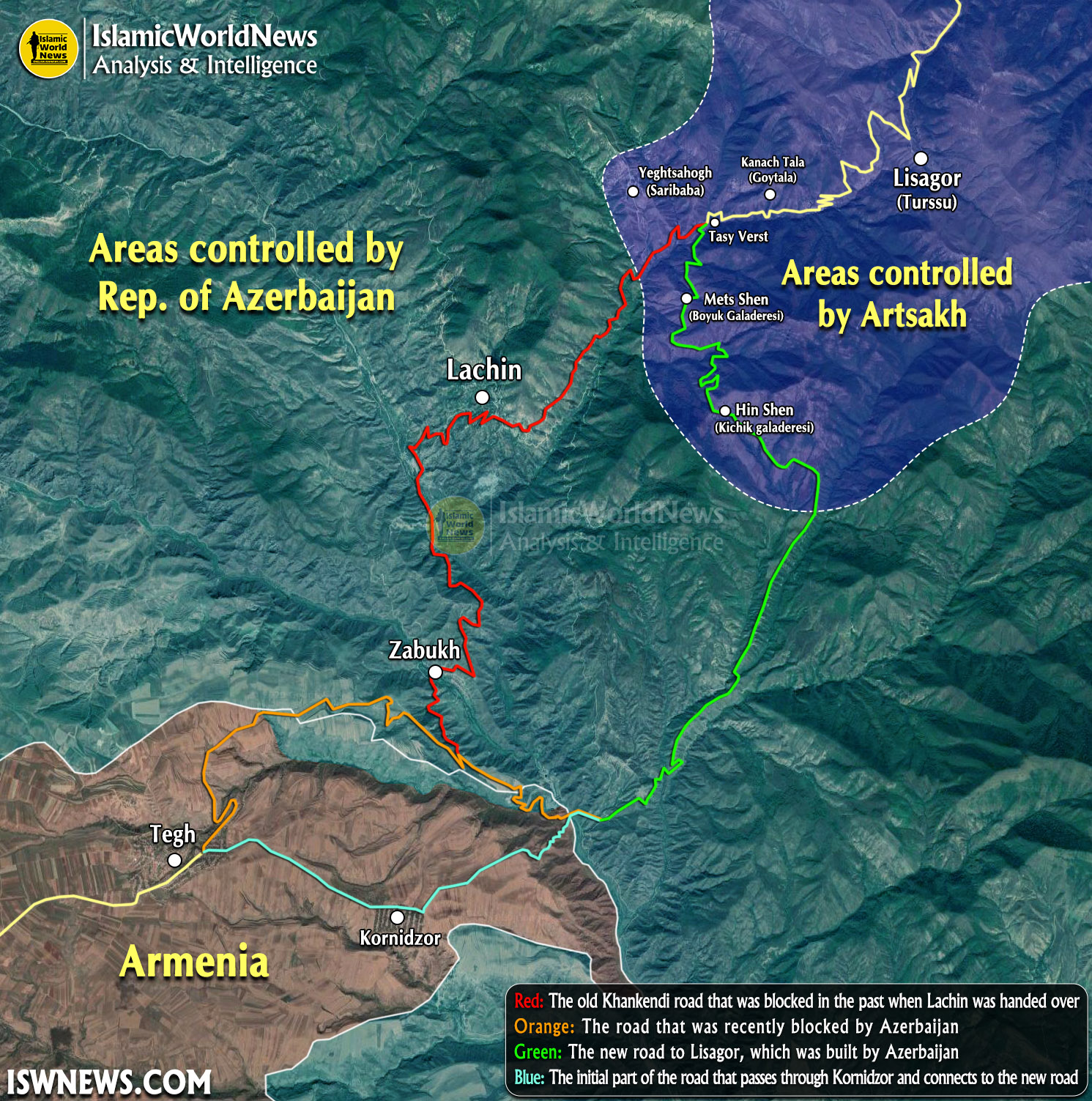
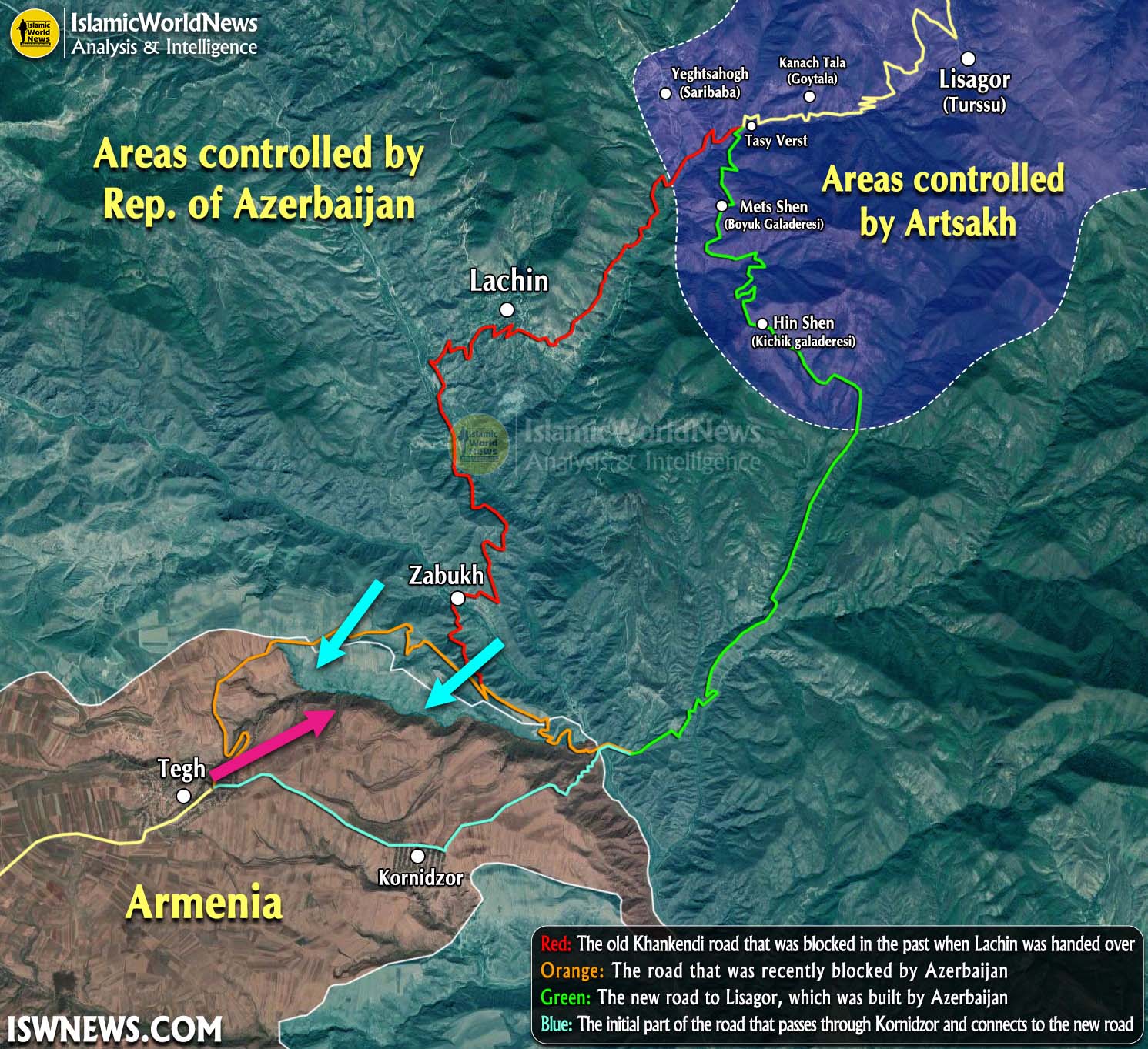
    It is worth mentioning that the Azerbaijan Army trespassed on Armenian soil, when they attempted to cut the old route of Tegh to Lachin Corridor, and they occupied hundreds of hectares of Armenian territories in east and northeast of Tegh. (Map below)

    Checkpoint is contrary to Moscow statement

    Russian foreign ministry spokesperson Maria Zakharova underlined the need for implementing provisions of the Nagorno-Karabakh ceasefire agreement, which is a tripartite statement signed by Russia, Azerbaijan and Armenia on November 9, 2020, saying that the establishment of a checkpoint is not among the provisions of the statement, but Moscow will observe the option.

    Challenges of new path of Lachin Corridor

    The Lachin Corridor links Armenians living in the Nagorno-Karabakh region to Armenia; so, the residents of the region can only meet their needs through this path.

    The developments of the Lachin Corridor are also of importance. According to the Nagorno-Karabakh ceasefire agreement, the old route from Tegh village should be closed from April 1, 2023 and a new path towards the south should be used, which has a boundary of five kilometers. Azerbaijan constructed parts of the road, which is under its control prior to the end of last year (2022), and it has blocked the old route totally.

    The substitute route, which passes across Kornidzor village in southern Tegh village, has not been completed yet by Armenia. 200 meters of the road near Kornidzor village is under construction; so, transport through the piece of road is hard. Armenia’s hesitance to construct the route seems to be a weird gesture!

    Detailed map of the new and old routes of the southern part of Lachine Corridor
  • Azerbaijan Once Again Blocked The Road To Stepanakert

    Azerbaijan Once Again Blocked The Road To Stepanakert

    According to the information that has reached to “Islamic World News“, a few hours ago, several units of Azerbaijan’s armed forces closed the Goris-Stepanakert (Khankendi) road in the border strip with Armenia, between Zabukh and Tegh areas.
    Currently, the number of military trucks of the Azerbaijan Armed Forces has increased to more than 10 trucks, and the preparation of barricades on the road between Armenia and Artsakh has begun.

    According to the agreement between the Russian Federation and Azerbaijan, the Armenian side will finish the construction of the new road from Armenia to Stepanakert by April 1st, and the old road will be under the control of Azerbaijan. Therefore, it is likely that the activity of Azerbaijan’s armed forces was related to this issue.

  • Azerbaijan Violated The Ceasefire Agreement In Karabakh! (Map)

    Azerbaijan Violated The Ceasefire Agreement In Karabakh! (Map)

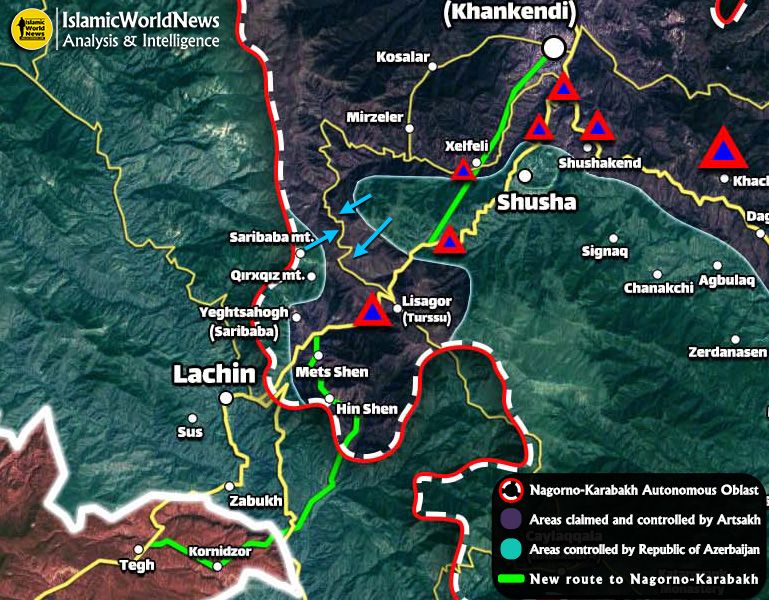
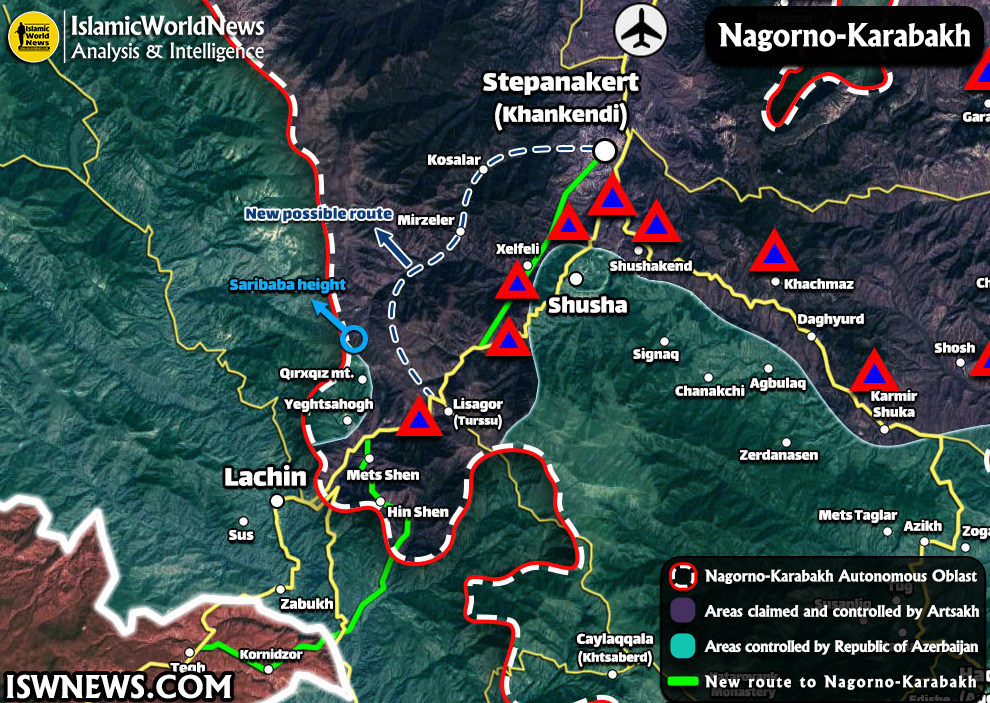
    On March 24, the Ministry of Defense of Azerbaijan published a statement announcing the illegal transfer of military equipment of Russian peacekeepers and Armenian forces in Nagorno-Karabakh on the Khankendi (Stepanakert)-Xelfeli-Turssu (Lisagor) route. The Republic of Azerbaijan called this a violation of the agreements by the Russian peacekeeping forces and their inability to perform their duties in relation to the implementation of the provisions of the tripartite declaration.

    According to the information provided by the Ministry of Defense of Azerbaijan, the Armenian engineering forces are building a new road in north of the Khankendi (Stepanakert)-Xelfeli-Turssu (Lisagor) road (the northern section of Lachin Corridor), which passes through the Khankendi-Kosalar-Mirzeler-Turssu route.

    Construction of new road in north of the northern road of Lachin Corridor by the Armenians of Karabakh

    Following these tensions, on March 25, Baku government forces violated the 2020 ceasefire agreement in Nagorno-Karabakh by crossing the contact lines of Nagorno-Karabakh in northern Lachin. Following this progress, the Ministry of Defense of the Republic of Azerbaijan published another statement and announced that it has taken the necessary measures to prevent the smuggling of weapons and ammunition to the Nagorno-Karabakh Autonomous Region through the northern road of the Lachin Corridor.

    According to the information obtained by the Islamic World News, after the blocking of the Khankendi road by the so-called environmental activists of Ilham Aliev near Shusha, the Armenian forces, with the support of Russia, began the construction of a new and alternative route in the north of the Khankendi-Xelfeli-Turssu road. The government of Baku knows very well that if this road is built and completed, practically all the efforts and achievements of the so-called environmental activists will be wasted; therefore, in order to take the initiative of the Nagorno-Karabakh entering/exiting route, they violated the ceasefire agreement and advanced in this direction.

    Read more: Artsakh State Pro-Russia Minister sacked; ICJ Orders Azerbaijan To Open Lachin Corridor

    After these events, the Ministry of Defense of Russia published a statement accusing Azerbaijan of violating clause 1 of the Nagorno-Karabakh ceasefire agreement. It is stated in this statement that the forces of the Republic of Azerbaijan have deployed engineering equipment in the Shusha region at an altitude of 2054.0 (2.9 km northeast of Saribaba mountain) after crossing the contact line. The statement emphasized the Azerbaijani side was informed about the necessity of complying with the provisions of the tripartite agreements of the heads of states, stopping the engineering and technical operations and withdrawing from the occupied positions.

    It seems that the purpose of the advances made and the occupation of this point by the government of Baku is to establish military points and increase fire control over the newly established Armenian route or routes in the Khankendi-Kosalar-Mirzeler-Trussu line.

    Click to view full size