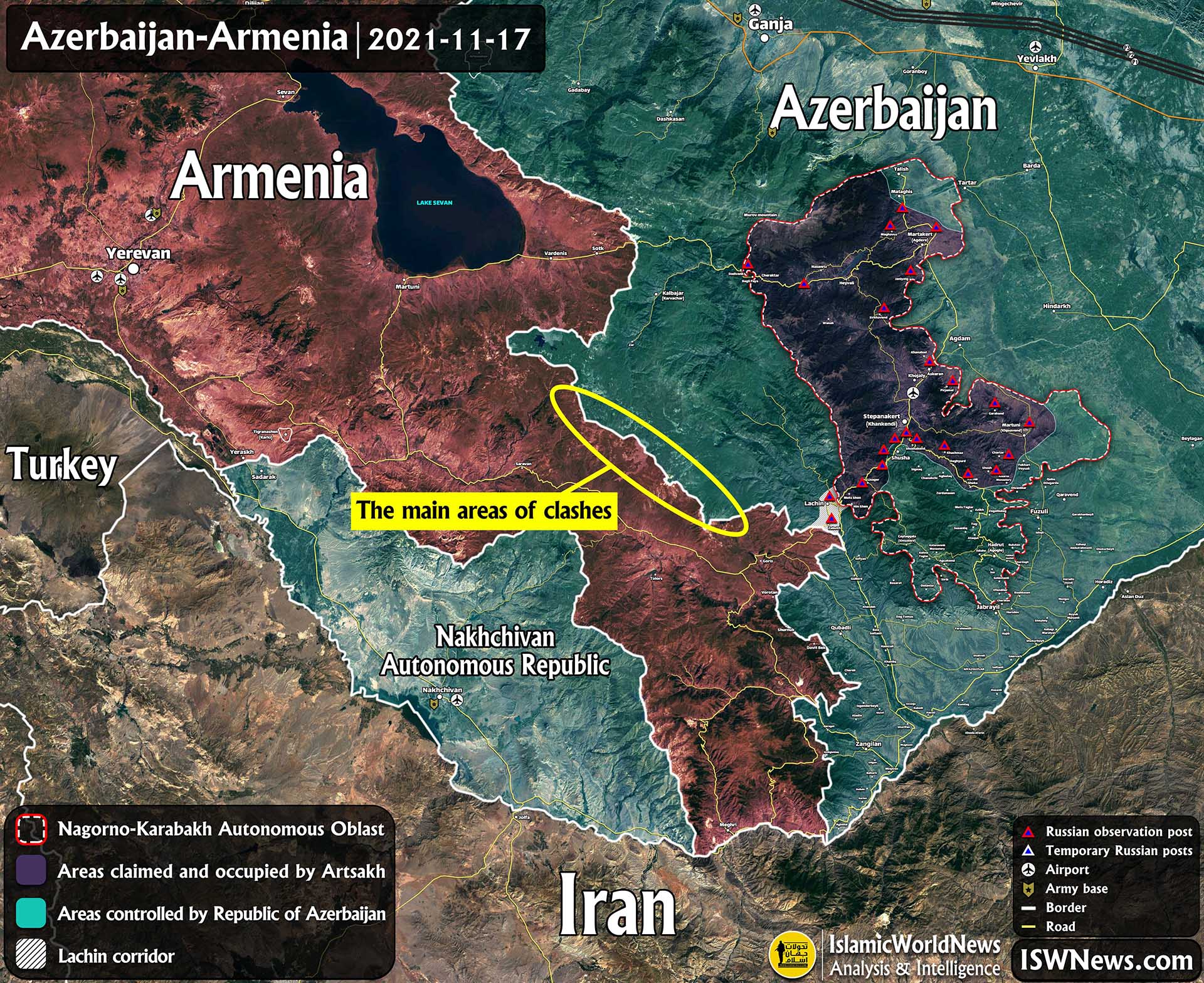
According to the map published by the Artsakh information headquarters, affiliated to the de facto Armenian government of Nagorno-Karabakh, four points have been identified as the main points of the attacks. Azerbaijani forces tried to advance from the north of this area near Suqovushan (Mataghis) to Tonashen (Tapakend) under the control of Armenians. The second conflict took place in the south of the region and the contact lines of the Karmir Shuka (Girmizi Bazar), the third point of tension in the northwest and 10 km from a monastery near Vank (Vangli). The fourth case of tension happened in the village of Yeghtsahogh (Sarybaba) near Shusha and the Lachin corridor.
The Azerbaijani forces managed to make a partial advance, which were finally surrounded by the Armenian forces, and after the arrival of the Russian peacekeepers, the Azerbaijani army was forced to retreat with the escort of Russian peacekeepers. The Ministry of Defense of Artsakh announced that one of its soldiers was wounded, but Azerbaijan has not released anything yet.
According to Azerbaijani sources on social media, Azerbaijani military convoys have been moving towards the Karabakh region from several directions, and an Armenian soldier has also been captured. This claim has not yet been confirmed or denied. News about the blocking of the Lachin Corridor and the conflict on the border of Armenia and Azerbaijan have also been rejected by all sides.
The Russian OTP network has broadcast images of the movement of Azerbaijani forces towards Nagorno-Karabakh. According to this network, this attack has been carried out by gathering infantry, armored units and drone and artillery support.
The Ministry of Defense of Russia confirmed the attack by the Azerbaijani forces and wrote: “The peacekeeping forces have contacted the Azerbaijani side and demanded an end to the conflict, and any change in the lines of contact between the two sides is unacceptable.”
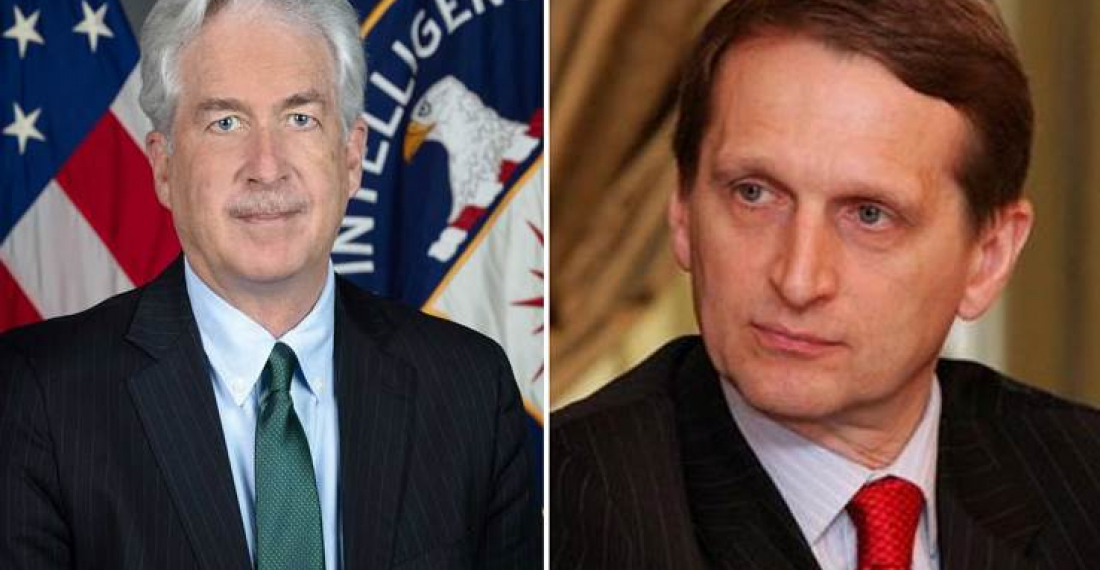
On July 15, William J. Burns, the head of the US Central Intelligence Agency (CIA), visited Armenia without prior notice. This news was published by the Russian Sputnik news agency. No information has been released about the details of Burns’s meetings with Prime Minister Nikol Pashinyan and high-ranking Armenian officials.
Russia’s concern about the presence of the CIA chief in Yerevan
Three days after the visit of the head of the American Central Intelligence Agency to Armenia, Sergey Naryshkin, the head of Russian Foreign Intelligence Service, visited Armenia. On Monday, July 18, Sergey Naryshkin held separate meetings with the Prime Minister and Armenian officials. The visit of the head of the Russian Foreign Intelligence Service to Yerevan, the capital of Armenia, is considered very important. The details of these meetings are not known. The media evaluates this meeting as Russia’s reaction and concern about the influence of US security serviced in Armenia.
Meeting of foreign ministers of Azerbaijan and Armenia
Ministers of Foreign Affairs of Azerbaijan, Jeyhun Bayramov and Ministers of Foreign Affairs of Armenia, Ararat Mirzoyan met and discussed with each other in Tbilisi, the capital of Georgia. A wide range of challenges of both sides have been discussed in this meeting. Demarcation, reopening of access routes from Azerbaijan to Nakhchivan, the date of withdrawal of the remaining Armenian army forces from Nagorno-Karabakh, the fate of Armenian prisoners of war in Azerbaijan and the fate of Armenians in this region were among the issues discussed by the two sides. The most important issue facing this negotiation is the Zangezur Corridor in the south of Armenia, which is the main demand of Azerbaijan from the Armenian side for the normalization of relations.
This is the first meeting of foreign ministers after the second Karabakh war. US Secretary of State Antony Blinken evaluated this meeting positively in a tweet, which shows how valuable the compromise between the two countries is for the US.
Announcing the date of withdrawal of the Armenian army from Nagorno-Karabakh
The Secretary of the Security Council of Armenia, Armen Grigoryan, has announced that the remaining forces of the Armenian army and the Armenian militia will leave the areas under their authority in Nagorno-Karabakh (Nagorno-Karabakh/Dagliq-Karabagh/Artsakh) by the end of September this year. The announcement of the withdrawal date of the Armenian army has worried the officials of the de facto Armenian government and the people of this region.
Great Return plan in Karabakh
On July 19, the government of Azerbaijan has started the resettlement of 58 refugees from the Karabakh war in Zangilan district, which borders Iran. The government of Azerbaijan has promised that 41 families of two villages in this region will return to their homes and has named this project the Great Return. The place of residence of the returnees is also the smart villages that Israeli companies have reconstructed.
Zangilan, with a population of about 30,000 people, borders Armenia and Iran and is located in the southwest of Nagorno-Karabakh. It is worth mentioning that this area was surrounded by the Armenian army and Armenian militia during the 1993 war after the support lines were completely cut off; Then, the Azeri defenders and the people survived for several months with the help of Iran. And finally after the collapse of the defensive positions, Azerbaijani civilians, militiamen and soldiers came into Iran with the support of the artillery of the Islamic Republic of Iran Army by crossing the Aras River.
Azerbaijan’s energy shock to Russia
Azerbaijan has signed its first energy contract with the European Union in the new year. Ms. Ursula von der Leyen, the German President of the European Commission, signed the gas contract during her visit to Baku, the capital of Azerbaijan. According to this agreement, Azerbaijan will increase gas exports to Europe to 20 billion cubic meters per year by 2027. The European Union will import 10 billion cubic meters of gas from Azerbaijan every year from 2020. Apart from this amount, Bulgaria is also a customer of one and a half billion cubic meters of Azerbaijan’s gas. The increase in Azerbaijan’s gas exports has sounded the alarm for the exports of the Russian Federation. Russia exports 60 billion cubic meters of gas to the European Union every year, and Azerbaijan’s action is considered to be the acquisition of a third of the Russians’ share in the European Union market.
Azerbaijan’s advance in the eastern part of Nagorno-Karabakh The information headquarters of the de facto government of Artsakh (Nagorno-Karabakh) has announced the capture of the village of Parux (Farux) by the Azerbaijani army. Vartan Mikaelian the village head of Parux, on Thursday, March 24 stated that the village was captured without shooting and clashes at 16:00 local time by the Azerbaijani army: “The village was evacuated and no one was injured. We are now in a nearby village in Khramort (Pirlar) and they have taken control of the Karaglukh heights. Russian peacekeepers are negotiating with them.”
Capturing Parux and Karaglukh by the Azerbaijan army – Click to view full size
Intensification of tensions in Karabakh According to Armenian sources, according to the November 10, 2020 agreement, the Armenian army must evacuate Karabakh. They were supposed to be replaced by the Russian peacekeepers, but the Azerbaijani forces advanced. Davit Ghahramanian, a photographer for the Artsakh Information Center, published a photo in which he claimed that Russian peacekeepers and Armenian militias had blocked Azerbaijani troops and prevented the occupation of the Karaglukh heights. Armenian Sputnik has published images of Russian peacekeepers carrying bulldozers to establish a military post in the Karaglukh highlands. Peacekeepers have called on both sides not to approach the post.
Deployment of Russian peacekeepers in the conflict zone
The Artsakh Information Office (Nagorno-Karabakh) has published images of the continued occupation of the village of Parux (Farux) and the presence of the Azerbaijani troops in the area.
On the evening of March 25, the Azerbaijani army began shelling Armenian forces in Khramort (Pirlar). At 2:00 pm local time, the Azerbaijani army targeted the Armenian positions in the area with light weapons and Bayraktar TB2 drones.
The Armenian side said that three contract soldiers of the Artsakh army named David Mirzoyan, Ishkhan Ohanian and Ararat Tusian were killed and 14 others were wounded.
The importance of these two villages is due to the height of Karaglukh and its firecontrol over the main road in the center of Karabakh and the cities of Asgeran and Stepanakert. Karaglukh is also 6 and 20 kilometers away from Asgeran and Stepanakert.
On March 26, people gathered in the city of Stepanakert and demanded the withdrawal of the Azerbaijani army, ensuring its security and reducing pressure.
The Azerbaijani Defense Ministry said in a statement, without elaborating on the incidents and any casualties: “Russian peacekeepers have released images of reconnaissance drones claiming that the Azerbaijani army has suffered casualties. Azerbaijani army units are stationed in their position and monitor the conditions of the operation.”
Shooting is also reported in Karmir Shuka (Girmizi Bazar) in Martuni (Khojavand) region.
The Russian Ministry of Defense also published a statement describing the ceasefire agreement violation by the Azerbaijan: “In violation of the provisions of the trilateral statement, the Azerbaijani military entered the Russian peacekeeper zone of responsibility on March 24 and 25. Azerbaijani military carried out four strikes against armed formations in Nagorno-Karabakh by Bayraktar TB-2 drones.
Russian Ministry of Defense statement regarding ceasefire violation
Karabakh gas was cut off again “The Azerbaijani government cut off the pipeline again on March 21 after repairing the damage to the gas pipeline in the area of Shusha-Zariflu,” Armenian Sputnik quoted Armenian human rights activist Gogam Stepanian as saying. The temperature in Nagorno-Karabakh has dropped to -5 Celsius on some days after heavy snowfall again, and the cold has created many problems for residents. However, the Azerigas stated that the natural gas supply to Stepanakert and other surrounding settlements will be restored on March 28.
Asking help from the Armenian all around the world On his Facebook page, Metaxe Hakobyan a representative of the Artsakh Justice Party, called the intensification of pressure from the Azerbaijani government and the Armenian government’s indifference to the fate of Armenians living in the Nagorno-Karabakh as a crime against humanity. He called on Armenians around the world to help prevent power outages and military strikes in Azerbaijan.
102nd anniversary of Armenian Massacre in Shushi The National Assembly of the Republic of Armenia and the National Assembly Artsakh on Tuesday, March 22, began the anniversary of the Shushi massacre with a minute of silence. Armenians also rallied in Stapanakret to condemn the Armenian genocide and demand the lifting of restrictions against them.
One minute of silence – Armenian parliament
Azerbaijan: Armenian army withdraws from Nagorno-Karabakh The Ministry of Defense of Azerbaijan publishes the news about Nagorno-Karabakh in a vague and delayed manner. Among them is the meeting of General Karim Valiyev, Chief of Staff of the Azerbaijani Army, with the Deputy Commander of the Land Forces of the Russian Federation, which took place on March 22 in Baku. The Ministry of Defense of Azerbaijan has announced that the meeting focused on the implementation of Russian peacekeeping operations in Nagorno-Karabakh and the implementation of Article 4 of the Tripartite Agreement of November 10, 2020 for the withdrawal of the remaining Armenian troops from Nagorno-Karabakh and other issues.
Azerbaijani Defense Minister visits to Pakistan The high-ranking military delegation of the Republic of Azerbaijan attended the parade of the National Day of the Islamic Republic of Pakistan in Islamabad on Wednesday, March 23. Azerbaijani Defense Minister General Zakir Hasanov was the special guest of the ceremony, and Azerbaijan flag was also displayed among the marching units.
Armenian Ministry of Defenseadmitted about its defeats The Armenian Ministry of Defense has been forced to admit and announce the occupation of part of Syunik province by the Azerbaijani army after media pressure and public opinion. According to the statement, the Azerbaijani army advanced 600 meters east of the province (southern Armenia and bordering Iran) last spring and built trenches. But due to the cold winter weather, they evacuated the positions and returned with the arrival of spring. So actually there is no new aggression in this regard. There is also a height between the village of Narkin Hand Syunik and the positions occupied by Azerbaijan does not pose a threat to the people. One week ago, the Armenian section of Sputnik quoted local people as saying that the Azerbaijan advances had been made, but the Armenian Ministry of Defense denied it.
Search for missing Azerbaijani soldiers The Ministry of Defense of Azerbaijan said after 20 days: “The search for two soldiers in Rayon Lachin continues.” According to the statement of the Ministry of Defense, on Friday, March 4, two soldiers named Asgar Mohammaduv Farid Oglu and Ferdowsi Abdullahuv Mayes Oglu lost their way and have not returned yet. This announcement has no further explanation. Rayon Lachin Azerbaijan is a part of the Karabakh region (Upper Nagorno-Karabakh), which borders Armenia and the Lachin corridor passes through it.
Gagam Stepanian, an Armenian citizen and human rights activist from Nagorno-Karabakh told Armenian Radio: On Thursday, December 2, Azerbaijani forces opened fire on Armenian civilians near the contact line near the Karmirshuka town. The shooting began at 10:30 a.m. local time and lasted for 15 minutes.
Karmirshuka is located in the south of the Nagorno-Karabakh region and near the contact lines between the Azerbaijani and Armenian government forces.
Also on Friday, December 2, the Azerbaijani border guards fired on an Armenian civilian in Martuni province in Rayon Khojavand.
Siran Sarkisian, a 65-year-old Armenian civilian living in the town of Chartar, was shot and killed while grazing livestock near a border post.
Azerbaijani sources have remained silent on the matter, but unofficial sources identify the dead man as an armed militant who had intended to sabotage.
The Foreign Ministry of the Artsakh (De facto) government condemned the actions and said in a statement: “The action of the Azerbaijani government against Armenian citizens is against international law and human rights, and Azerbaijan is openly violating all bilateral agreements so that the Armenian people forced to leave their homeland.”
Exchange of prisoners with map of minefields
According to the Sochi agreement, the governments of Azerbaijan and Armenia exchanged prisoners and minefield maps with the mediation of the Russian Federation.
On Saturday, December 4, the Azerbaijani government released 10 Armenian prisoners of war taken hostage in the border clashes of November 16, and handed them over to the Russian mediating delegation. The released prisoners are Narek Yerimian, Araik Araklian, Serjik Amirkhanian, Georg Akopian, Robert Nalbandian, Harut Sarkisian, Artem Manasian, Eric Autisian, Armen Tusian, Tigran Akopian and were airlifted from Azerbaijan to Armenia.
According to Azerbaijani news sources, the Azerbaijani government is receiving a map of a number of minefields in the evacuated areas in Karabakh.
The Azerbaijani government has released a wounded Armenian prisoner in order to fulfill the agreements and has evacuated part of its forces from Mount Mets Ishkhanasar in the Syunik province of Armenia.
According to the field evidence, on November 16, the Azerbaijani military, in violation of the peace agreement advanced on several border points in the Armenian province of Syunik, But in the aftermath of the aggression, they faced a strong response by the Armenian military.
The clashes between Azerbaijan and Armenia started at about 1 pm and ended with the mediation of Russia and the declaration of a ceasefire at 5:30 pm (local time). During these conflicts, two Armenian military points were occupied by Azerbaijan.
According to a statement from the Armenian Ministry of Defense, one Armenian soldier was killed, 13 captured and 24 others were missing during the clashes. Also, according to the information provided by the Azerbaijan Ministry of Defense, 7 Azerbaijani servicemen were killed and 10 others were wounded.
Following the clashes, the Iranian Foreign Ministry, the Russian Ministry of Defense and the United Nations issued messages calling for restraint on both sides and the de-escalation of the clashes. While emphasizing respect for international borders, the Iranian Foreign Ministry spokesman announced Iran’s readiness to help resolve the disputes between the Republic of Azerbaijan and Armenia peacefully. In this regard, the presidents of Iran and Russia during a telephone conversation stressed the need not to change the political geography of the Caucasus region.
Armenian Security Council Secretary Armen Grigoryan also called for Russia’s protection of Armenian territory under the 1997 agreement in an interview. Grigoryan went on to say that if the crisis is not resolved through Russia and the CSTO, they will ask for help from other international partners.
This afternoon, in order to reduce tensions between Azerbaijan and Armenia, Deputy Commander of the Southern Military District of the Russian Federation and Commander of the Russian Peacekeeping Forces in Nagorno-Karabakh, Lieutenant General Rustam Muradov, transferred the body of the Armenian soldier who was killed in November 16th battles from Baku to Yerevan.
In the autumn of 2020, the Republic of Azerbaijan launched a large-scale military operation with the full support of Turkey and the Israeli regime with the aim of full control over the Karabakh. In a 44-day period from September 27 to November 10, Azerbaijan has managed to control about 50 percent of the territory, including parts of the south (inside) of the Nagorno-Karabakh Autonomous Region, as well as the occupied territories around the Nagorno-Karabakh Autonomous Region. Subsequently, in accordance with the peace agreement reached between Azerbaijan and Armenia, the regions of Aqdam, Kalbajar and Lachin were handed over to the government of Azerbaijan.
The Peace Agreement consists of nine main clauses; However, the different interpretations of Azerbaijan and Armenia from the ninth paragraph of this agreement have prevented the achievement of a lasting peace. By exploiting this clause, the Baku government is also trying to fulfill its illegitimate demands, using this issue as a pretext to create an illegal corridor called the Zangezur Corridor or to occupy the Armenian province of Syunik.
Both sides media reported of heavy border conflicts on Wednesday 28 July. Two neighbors accuse each other of intensifying the tensions. The conflict enters the fifth day.
Armenia DM claims that three soldiers killed due to shooting and artillery shelling of Azerbaijan and four wounded. They also claim Azerbaijan army entered Armenia soil in two points in Gegharkunik province.
Azerbaijan DM issued a statement on Wednesday that Armenia shot on Azerbaijan positions using mortars and tanks. According to Azerbaijan DM two soldiers wounded by Armenia bullets.
Independent sources confirmed that Azerbaijan used guided artillery shells and Turkish built Bayraktar drones.
Most of the conflict occured near Vardenis town in Gegharkunik province of Armenia and near borer with Kalbajar province of Azerbaijan. Azerbaijan calls Vardenis town as Basarkeçər which is part of Azeri inhabited of Yeraz people.
It is noteworthy that in the last two years of Soviet time, Azeri inhabitants of the area were migrated to Azerbaijan due to racial segregation of Armenia in 1988.
According to the field information, the (Turkish) Bayraktar drones of the Azerbaijani army attacked several targets in the Yeraskh area of Ararat and on the border with Sadarak in Nakhchivan.
On the other hand, Armenian sources claim that they shot down an Azerbaijani drone invading their country.
It is worth mentioning that these tensions continue in the wake of yesterday’s clashes and exchange of fire on the border between Kalbajar and Gegharkunik.
The Azerbaijan Ministry of Defense has accused the Armenian side of starting a conflict on the evening of Friday, July 23, in the village of Bazaar Kichar in Kalbajar. According to Azerbaijani sources, an Azerbaijani soldier was shot dead by an Armenian sniper at 4 pm local time and the Azerbaijani army responded to the fire. Confirming the conflict, the Armenian Defense Ministry said the Armenia was not the initiator of the incident and that three Armenian soldiers were wounded by Azerbaijani artillery.
Rayon (district) Kalbajar is located in the neighborhood of Gegharkunik province of Armenia and was evacuated by Armenia during the Second Karabakh War and after the implementing of the ceasefire agreement. Determining the border in this mountainous and highlands is one of the challenges between the two countries. Armenia claims that Azerbaijan has crossed the border lines of the Gegharkunik region at two points and occupied part of the heights in this region. After the collapse of the former Soviet Union and the war between the two countries, the border between the two countries has not been demarcated and there are no border posts. The recent tensions are taking place while clashes are reported in other parts of the country.
It was an interesting meeting specially after a 44 days war, in which more than six thousand people killed in Karabakh and then Aliyev and Pashinyan met like two good boys with their boss Putin and listened to him.
Following this four hours meeting, three countries unveiled a joint statement to create a list of joint projects to open the borders. There are not much details regarding the new agreement but it is in the same direction as the previous Karabakh ceasefire agreement.
Pashinyan spokesperson said before the meeting that important projects already are being investigated and talked over, one of which is to permit Armenia to cross Nakhchivan and transit to Iran, as well as using the railroad built in USSR era which was used to connect Yerevan to the southern regions of Armenia.
According to this trilateral agreement, each country forms a committee of specialists led by the vice PMs to make a list of joint projects for the leaders of the countries.
Russian paper Kommersant released a railroad map of Caucasus two days ago, which was the same railroad built in USSR era and was closed since the first Karabakh war in 1990. It is going to be open with the new agreement.
Regarding opening this important railroad, which is one of the articles in Karabakh ceasefire agreement, we have mentioned in previous articles. Following Karabakh ceasefire agreement, some claimed the southern corridor means to cut Iran-Armenia border, which was wrong from the beginning.
This railroad will connect Armenia to Russia through Azerbaijan and will be used for transit to Iran as well. On the other hand Azerbaijan will connect to Nakhchivan area and Turkey through Armenia.
This new agreement will have huge impact on different aspects of Caucasus area and each side will get benefited. Although Putin said that the agreement will be useful for all the countries of Caucasus but obviously not on the same level.
Russia and Turkey undoubtedly will get the most of it. Russia restored its hegemony after a 30 years period of weak presence in the area and Turkey as a new player in the Karabakh, has greatly strengthened its foothold in the region and will strengthen its ties with Central Asian countries by connecting the Caspian Sea; Azerbaijan, while regaining its vast occupied territories in the south of Karabakh, was directly connected to the Nakhchivan region and of course to Turkey, and largely overcame the previous problems; Armenia will also benefit from direct connection to Russia and better connection to Iran, and by opening its western border with Turkey will benefit from trades with this country too. And finally, Iran, as the civilization and cultural owner of the Karabakh region, will have the least benefit from the events in Karabakh and the reopening of a new transit route; and Iran political and economic influence in the Karabakh region will be greatly reduced.
– According to the information provided by the Ministry of Defense of Azerbaijan, a group of Azerbaijani soldiers in the Hadrut region was attacked by a group of 6 Armenian forces. It is said that these forces were those who had not withdrawn from the area. The Azerbaijani Defense Ministry said that all Armenian forces were killed in the incident, and that one Azerbaijani soldier was killed and another was wounded. On the other hand, the Artsakh Ministry of Defense rejected Azerbaijan’s claim, stating that no military clashes had taken place between Armenian and Azeri forces in the past two days, and that Azerbaijan’s claim was false and propaganda.
– According to information of Russian Ministry of Defense, more than 300 hectares of Karabakh land and 120 km of roads are cleansed from mines and booby traps and 12000 explosive objects were found and destroyed.
– According to Russian Ministry of Defense, since the ceasefire in Karabakh around 44600 of Armenian inhabitants of Karabakh returned to their homes.
– Russian Foreign Minister Sergey Lavrov spoke by telephone with Armenian Foreign Minister Ara Ayvazyan about the Nagorno-Karabakh refugees and the implementation of the Nagorno-Karabakh ceasefire.
– The joint Turkish-Russian ceasefire monitoring center is expected to start working in January 2021 in the Agdam.
– The Ministry of Defense of Artsakh released the names of 47 other Armenian soldiers who lost their lives in the battles of Nagorno-Karabakh.
– The representatives of the Azerbaijani military entered the area between Vorotan and Shurnuk in south of Goris for demarcation of the border. Azerbaijani forces have asked the residents of the village of Vorotan to leave the Azerbaijani part of the village.
– The Secretary of the Security Council of Nagorno-Karabakh (Artsakh) Vitaly Balasanyan announced that together with Armenia and Russia, we will return the areas lost in the Karabakh war. “I want to assure my people that we will do this. There are victories and defeats during military operations. We did not lose, we did not kneel,” Balasanyan said. He added the Artsakh forces would operate in Nagorno-Karabakh under the control of the Nagorno-Karabakh Security Council.
– Azerbaijan Ministry of Defense released photos, names, surnames and information of 2823 Azerbaijani soldiers who were killed in Karabakh war.
– 4 Armenian and 2 Azerbaijani POWs have been exchanged between the two countries by Russian mediation, according to General Rustam Muradov, commander of the contingent of Russian peacekeepers in Karabakh.
– 3 Azerbaijani soldiers were reportedly injured by an anti-tank mine blast near Hadrut.
– In the map the military situation before and after Azerbaijan operation in Karabakh can be seen. Azerbaijan army liberated captured 50% of the lands in south of Karabakh in a period of 44 days from 27 September to 10 November. It was followed by a peace agreement between Azerbaijan and Armenia in which sovereignty of areas Aqdam, Kalbajar and Lachin were left to Azerbaijan government. Armenian forces control almost 55% of Nagorno-Karabakh Autonomous Oblast area.
– After the conflict between Azerbaijani and Armenian forces in Khtsaberd and Hin Taglar front, 73 Armenian troops are missing. However bodies of nine Armenians were found near Khtsaberd. It is not clear if they are part of the missing troops.
– Azerbaijani forces retreated from villages Mets Shen and Hin Shen after Russian peacekeeping forces intervention.
– According to information of Russian Ministry of Defense, more than 195 hectares of Karabakh land and 87 km of roads are cleansed from mines and booby traps. The number of bombs and arms neutralized reach 73,500.
– According to Russian Ministry of Defense, since the ceasefire in Karabakh around 41 thousand of Armenian inhabitants of Karabakh returned to their homes.
– Turkish army deployed 136 sappers to Azerbaijan. They will help Azerbaijan to cleanse and neutralize the mines and unexploded ammunition.
– Agkend village in south of Kapan in Rayun Zangilan was left to Azerbaijani forces. In the last few days Armenian forces resisted to retreat from the area but finally moved by Azerbaijan ultimatum.
– According to information provided by the Russian Ministry of Defense, since the beginning of the ceasefire agreement in Nagorno-Karabakh, a total of 37,707 Armenian residents of Nagorno-Karabakh have returned to Karabakh from Armenia.
– According to information provided by the Russian Ministry of Defense, more than 148,000 hectares of land in Karabakh and 31 kilometers of roads have been cleared of mines and booby traps. The total number of bombs and ammunition defused is 4760.
– The leaders of the OSCE Minsk Group met with the President of Azerbaijan Ilham Aliyev in Baku.
– Azerbaijani army forces violated the Karabakh ceasefire by attacking Armenian positions in Khtsaberd and Hin Taglar. Four members of the Azerbaijani army lost their lives and several others from two sides were wounded in the clashes. Azerbaijan took control of the village of Hin Taglar and the monastery of Katarovank, but with the intervention of Russia, the conflict has stopped for now.
– The Ministry of Health of Armenia announced the identification and determination of the status of 2996 bodies of Armenian forces. Thus far, the deaths of 3,000 Armenian troops in the Second Karabakh War have been officially confirmed.