Category: Africa

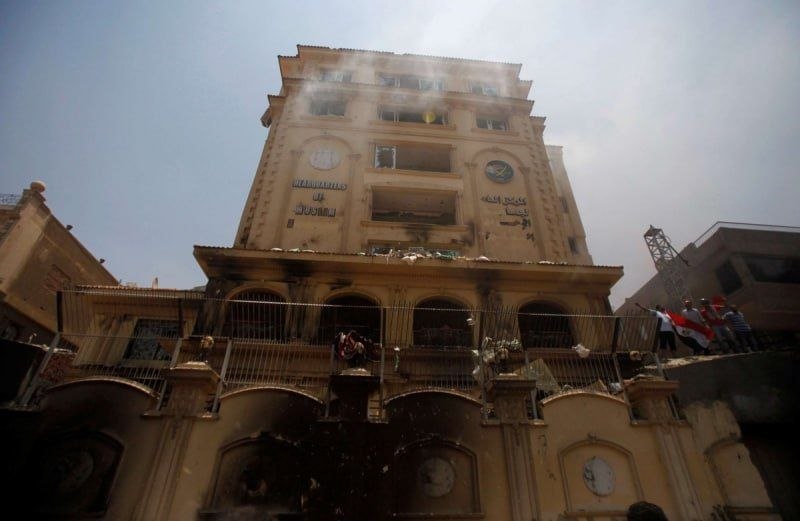
  • Egypt’s Final Court Ruling Effectively Ends Muslim Brotherhood’s Prospects of Political Return

    Egypt’s Final Court Ruling Effectively Ends Muslim Brotherhood’s Prospects of Political Return

    The process of banning the Muslim Brotherhood began following the ouster of former Egyptian President Mohamed Morsi in 2013. Now, with the judicial ruling becoming final, broader restrictions will be imposed on the group.

    Under the ruling, assets and properties belonging to the Muslim Brotherhood will be transferred to the state, while members of the group will face restrictions on political activities, participation in elections, and holding government positions. The Egyptian government also intends to use the ruling to pursue Brotherhood members abroad and identify and freeze their assets.

    The report also points to internal divisions within the Muslim Brotherhood between factions based in London and Istanbul, arguing that the new ruling could further weaken the group’s financial resources and organizational structure. Meanwhile, the Brotherhood’s branches abroad have described the move as politically motivated, arguing that the Egyptian government has closed off any possibility of reconciliation or the group’s return to political life.

  • Ansar Allah Leader Warns Somaliland Officials: Israeli Presence Will Be Treated as a Military Target

    Ansar Allah Leader Warns Somaliland Officials: Israeli Presence Will Be Treated as a Military Target

    Al‑Houthi stressed that the Islamic Ummah must respond to such actions, warning that negligence would allow Israeli plots to succeed.

    He further cautioned that any Israeli presence in Somalia constitutes a threat to Somalia itself, Yemen, and regional security. Accordingly, he declared that Israeli forces in Somaliland or Puntland would be considered legitimate military targets for Yemen’s armed forces.

    The message represents a direct and serious warning to both Somaliland authorities and Israel, signaling that in any future conflict, Israeli deployments in the region could become targets of Yemeni missile and drone strikes.

  • Grand Mufti of Libya: Pakistani weapons threaten the lives of civilians in Libya and Sudan

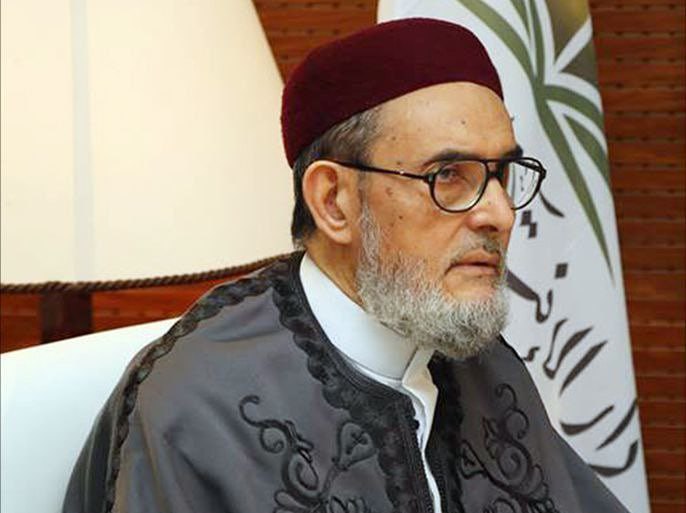
    Grand Mufti of Libya: Pakistani weapons threaten the lives of civilians in Libya and Sudan

    Al‑Ghariani stressed that Pakistan, as one of the largest Muslim nations, is fully aware these weapons will be used to kill civilians and fuel wars in Libya and Sudan. He urged Libya’s Government of National Unity (GNU) to summon Pakistan’s ambassador and reprimand him for violating the UN arms embargo and supplying weapons to Haftar.

    The Grand Mufti’s criticism comes as the deal could strengthen Pakistan’s position as a major player in the global arms market. At the same time, given Pakistan’s economic pressures and shortage of foreign currency, the agreement represents a significant source of revenue for Islamabad.

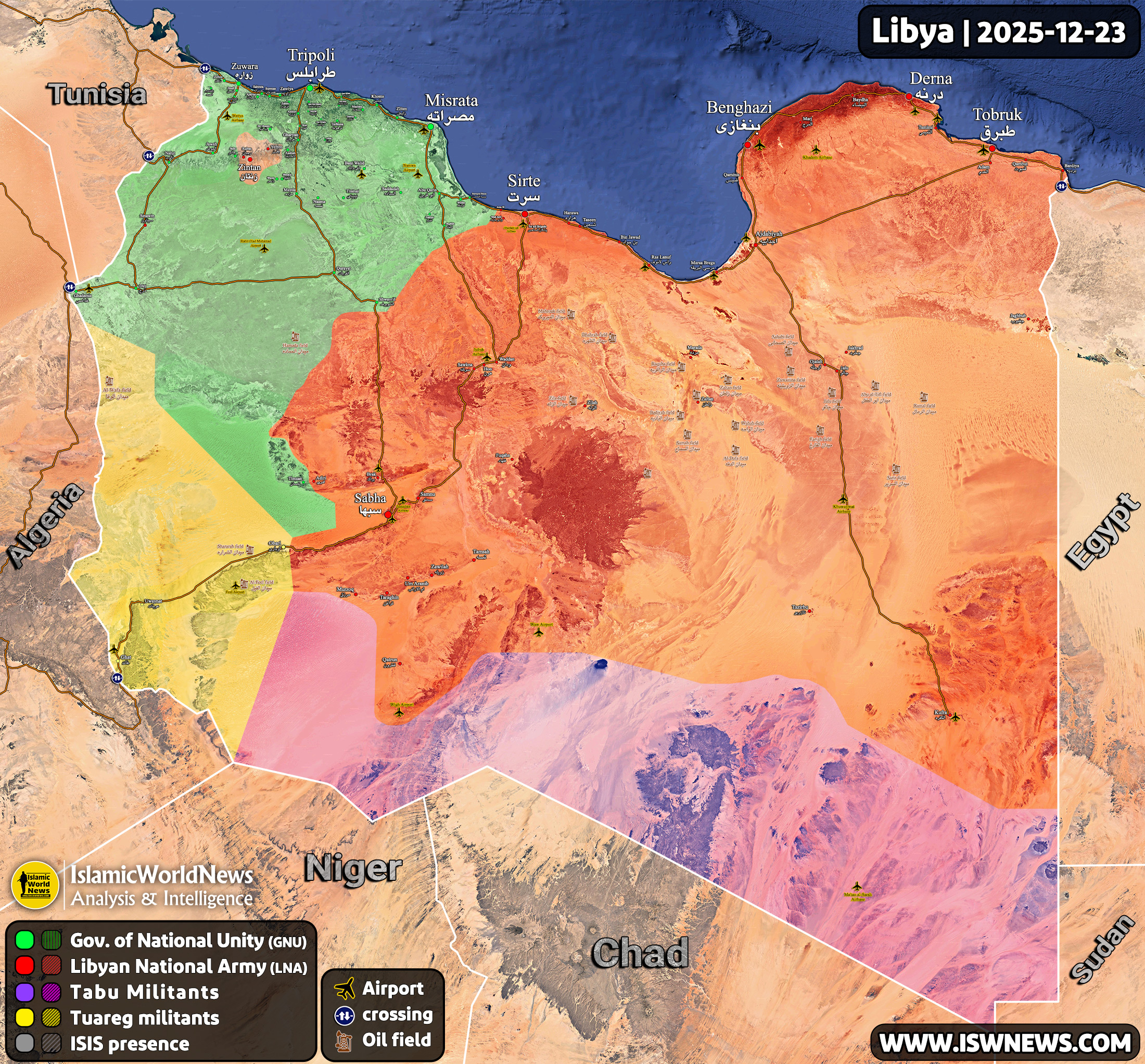
  • Map of the Latest Military Situation in Libya, December 23, 2025

    Map of the Latest Military Situation in Libya, December 23, 2025

    Prior to 2021, Tripoli’s authorities were known as the Government of National Accord (GNA). However, the Libyan House of Representatives dissolved the GNA to foster unity and counter the rival Tobruk‑based government. As a result, the GNU was established, with Mohamed al‑Menfi appointed as President of the Presidential Council and Abdel Hamid al‑Dbeibah as Prime Minister.

    Years after the fall of Muammar Gaddafi and the bloody clashes between the GNA and LNA, Libya remains mired in internal strife and fragmentation, with no clear outlook for its future.

    Military map of Libya as of December 23th – click to view full size image
  • Libyan Army Chief of Staff Dies in Air Crash

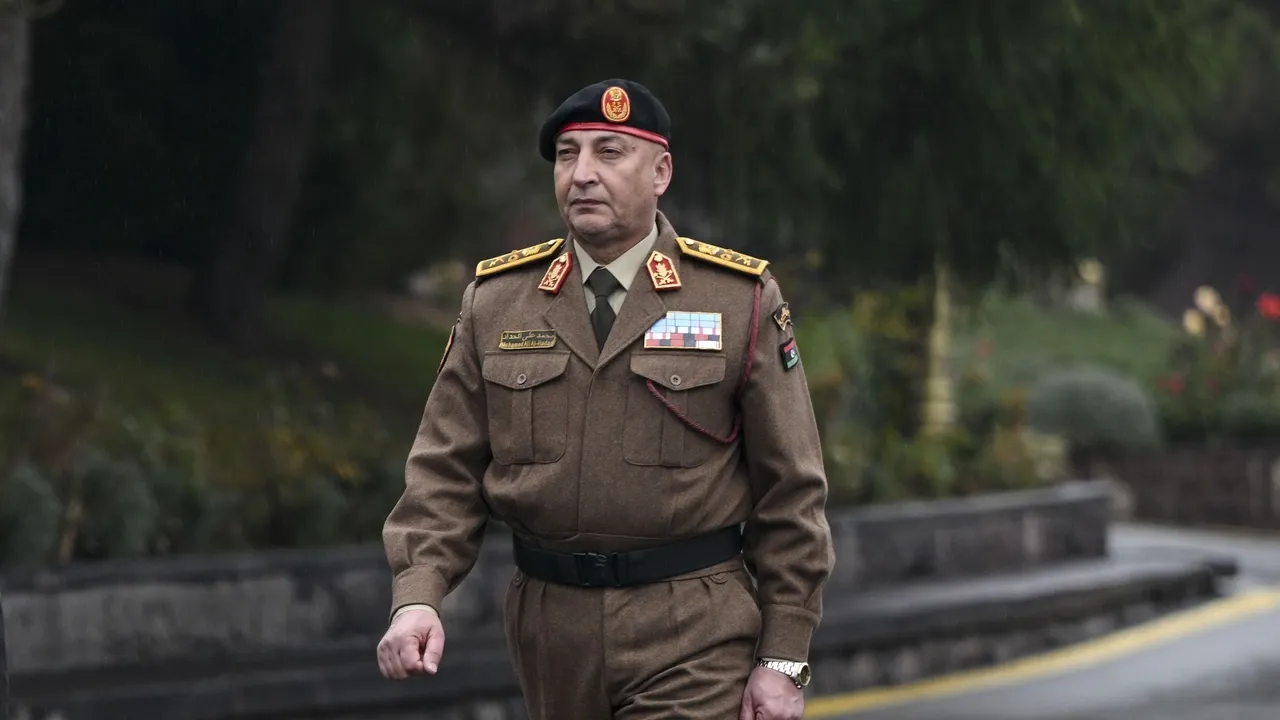
    Libyan Army Chief of Staff Dies in Air Crash

    The aircraft, carrying al‑Haddad and five senior officers from the Government of National Unity (GNU), went down while returning from high‑level meetings with Turkish officials, including Defense Minister Yasar Guler.

    According to reports, the plane disappeared from radar shortly after takeoff from Ankara’s Esenboğa Airport. Turkish rescue teams later located the wreckage south of the capital, confirming that all passengers had perished.

    The delegation had been in Ankara for talks on military cooperation, coinciding with Turkey’s parliamentary decision to extend its troop deployment in Libya for two more years. The loss of al‑Haddad and his top aides is seen as a major setback for the GNU, which relies heavily on Turkish support in its rivalry with Khalifa Haftar’s Libyan National Army (LNA) based in Tobruk.

    Prime Minister Abdel Hamid al‑Dbeibah declared three days of national mourning, calling the crash a “grave national loss.” Turkish authorities have launched a formal investigation into the incident, with early indications pointing to possible technical failure.

    It is important to note that Libya currently has two rival governments: one in the east, based in Tobruk and led by Khalifa Haftar under the banner of the Libyan National Army (LNA), supported by Egypt and the UAE; and another in the west, based in Tripoli and headed by Prime Minister Abdel Hamid al‑Dbeibah under the Government of National Unity (GNU), backed by Turkey.

    Latest military situation in Libya – click to view in full size
  • Is ISIS Preparing to Announce a “Wilayah of Sudan”?

    Is ISIS Preparing to Announce a “Wilayah of Sudan”?

    ISIS used the editorial of issue 519—titled “Sudan Between Islam and Nationalism”—to outline its ideological justification for involvement in Sudan. In this piece, the group portrays nationalism as the main obstacle to Islamic unity, labeling it a “satanic phenomenon” and a “remnant of ignorance.” ISIS claims that colonial powers promoted nationalism to distract Muslims from the suffering of fellow believers in other countries.

    The group further emphasizes religious loyalty over national identity, suggesting that Muslims bear direct responsibility for events in other Islamic nations. It rejects national sovereignty and borders, calling for their elimination through jihad. ISIS explicitly urges youth from Egypt and Libya to mobilize in support of “Sudanese brothers,” describing Sudan as a “ready battlefield” with “strategic impact across the region.”

    This is not the first time ISIS has addressed the Sudanese crisis. In issue 479 of Al-Naba, titled “The Forgotten Sudan,” the group called on Muslims worldwide to intervene, citing ongoing atrocities. In its analysis, ISIS characterizes the Sudanese conflict as a “pagan war” between “infidel factions,” branding both General Burhan’s and General Hemedti’s forces as “enemies of Islam.”

    Pro-ISIS users on social media have echoed this narrative, viewing the unrest in Sudan as an opportunity to establish a “Wilayah of Sudan” and expand the group’s operations. Some users have openly called on Muslim youth to join the “ranks of the mujahideen.” A user named “Al-Libi” wrote, “Military operations must begin immediately, and the Wilayah of Sudan must be declared.”

    These users describe the Sudanese government as a “tyrannical regime,” seeking to delegitimize its institutions. They label the warring factions as “apostates” and reject any form of compromise with them. Others, adopting a strategic tone, refer to Sudan as “the gateway to Africa,” stressing its geopolitical importance. A user named “Muslim” wrote, “Sudan is the key to ISIS’s expansion in the region, and we must seize this opportunity.”

    ISIS supporters also accuse the international community of double standards, claiming that Western powers only intervene when their interests are threatened.

    It appears that ISIS is exploiting Sudan’s instability to promote its extremist ideology and recruit fighters, particularly with an eye toward expanding its footprint in Africa. In recent years, the group has increased its presence across the continent, including the Lake Chad Basin (covering parts of Nigeria, Cameroon, Niger, and Chad), Puntland in northeastern Somalia, and northern Mozambique’s Cabo Delgado province. Additionally, eastern regions of the Democratic Republic of Congo—such as Beni, Lubero, and Ituri—as well as parts of the Sahel region in central Africa have become active zones for ISIS operations.

    Notably, pro-ISIS users—known as Munasirun—have circulated excerpts from these editorials in poster format under brands like Al-Adiyat and Hadm al-Aswar, further amplifying the group’s messaging around Sudan.

  • Latest Military Developments in Sudan (Map)

    Latest Military Developments in Sudan (Map)

    Sudan has once again returned to global headlines following intense and bloody clashes in Al-Fashir, the capital of North Darfur. While many have asked what’s happening in Sudan. The answer lies not in recent weeks but in the long-standing instability and unresolved crises that have plagued the country for years, occasionally erupting into headline news.

    In brief, Omar al-Bashir was ousted in April 2019 after 30 years in power during what were described as popular protests. The military took control and transferred authority to a transitional government led by Abdalla Hamdok. Two years later, in October 2021, the Sudanese Armed Forces (SAF) under Abdel Fattah al-Burhan and the Rapid Support Forces (RSF) led by Hemetti staged a coup against the transitional government and seized full control. Another two years later, in April 2023, tensions between Burhan and Hemetti escalated, leading Hemetti to rebel against Burhan and take control of parts of Sudan. Since then, sporadic clashes between SAF and RSF have continued across the country.

    For a deeper understanding of Sudan’s situation, read this article published two years ago: Understanding Warring Parties In Sudan; Reviewing Latest Field Situation (Map)

    On the ground, the latest battles center around Al-Fashir, the capital of North Darfur in southwestern Sudan, which was recently captured by RSF forces after months of siege. Al-Fashir was the last stronghold of the Sudanese Armed Forces (SAF) in Darfur. Over the past two years, RSF repeatedly attempted to seize the city but were repelled each time. The final takeover and the videos released from the scene point to a brutal massacre. It is estimated that at least 2,500 civilians were executed or killed by RSF fighters during the capture of Al-Fashir.

  • Libya Is Rushing To the Side of the Big Satan! Resettlement of Palestinian, and the Illusion of Solidarity

    Libya Is Rushing To the Side of the Big Satan! Resettlement of Palestinian, and the Illusion of Solidarity

    While Zionism has achieved nothing in their attempt to crush the Palestinian resistance, there is still talk of forced resettlement. According to sources from Libya, the country is allegedly going to accept hundreds of thousands of Palestinians in exchange for economic support from the United States.

    This behavior of the self-proclaimed government in Tripoli is not surprising, since it is worth remembering how those who call themselves “allies of Palestine” held Hamas members in their prisons for 7 years. This was a clear indication from the “Libyan Democrats” of their pro-Zionist tendencies.

    Another story happened a couple of years ago, when there was a scandal in connection with the meeting of the then foreign ministers of Libya and Israel. Therefore, the story of the resettlement of Palestinians from the Gaza Strip is absolutely unsurprising.

    To be fair, it is worth noting that on the opposite side of Libya, the Haftar dictatorship has been actively cooperating with the Zionists all this time, and of course there have been talks about the forced resettlement of Palestinians between the parties.

    Libya’s current problems are largely related to the confrontation between regional powers in the country, but the fact that there is no solidarity with the Palestinians cannot be denied. Back in 2013, the then head of Hamas, Khaled Mishaal, harbored illusions about the emergence of Libya as an alternative to Iran and Syria in terms of arms supplies to the Gaza Strip. The shahids Muhammad Deif, Ismail Haniyeh, Yahya Sinwar and many others have sharply spoken out against such a utopian idea. Today we see how deeply Mishaal was mistaken in his calculations. Not only was the Government of National Salvation not going to supply weapons to Hamas, they even organized the far-fetched arrest of members of the leading Palestinian resistance organization.

    Mishaal proceeded from the simple logic that the Libyan Muslim-Brotherhood (MB, Ikhwans), who were close to Hamas, could become an important ally of Palestine for ideological reasons, but why did the former head of Hamas decide that the Ikhwans in Libya had authority at all?

    Moreover, those who are commonly referred to as the main curators of the brotherhood in the person of the Turks and Qatar did not want to see the MB or another moderate Islamic political party at the helm in Tripoli. For example, I would like to point out the words of the late Iranian cleric Hadi Khosroshahi, who was in close contact with the Egyptian Brotherhood and was engaged in research on the international network of ikhwans. Khosroshahi noted that during his tour of the Arab Spring countries (Egypt, Libya, Tunisia), Erdogan insisted that Libya have a secular constitution.

    The conclusion is that the Qatari-Turkish alliance never wanted not only the liberation of Palestine, but also considered the Muslim-Brotherhood only as a temporary useful tool.

    As for some Hamas leaders, it turned out that those whom they saw as “strategic allies” turned out to be real enemies, because the proposal to resettle Palestinians in their country and arrest members of the Palestinian resistance are the best gifts to Zionism. Today we see that those who bet on an alliance with the axis of conformism in the person of Turkey and Qatar have completely lost and remained in the dustbin of history. While the supporters of the pro-Iranian line inside Hamas continue their glorious battle as part of the Axis of Resistance, but more importantly, the new generation of Palestinians will undoubtedly develop the line of the legendary tandem of martyrs Sinwar – Deif until the complete liberation of Palestine.

    As for the Libyans, to this day they do not have an organized pro-Palestinian organization that could help the Palestinians, not by word, but by deed. All pro-Palestinian activity in western Libya is limited to rallies and quotes from the Chief Mufti.
  • Haftar Forces Downed A Turkish Akıncı Drone In Libya

    Haftar Forces Downed A Turkish Akıncı Drone In Libya

    This drone is one of Turkey’s most advanced unmanned aerial vehicles and has recently been sold to the Libyan Government of National Accord (GNA) forces.

    The downed Akinci drone in Libya

    The cause of the drone’s downing is unknown, but smoke in the sky suggests it was hit by a missile fired by the Libyan National Army (LNA) forces led by General Haftar.

    Throughout the Libyan civil war, many Bayraktar TB2 drones have been downed. However, the Akinci’s destruction marks the first recorded instance of losing this type of wide-body drone in Libya.

  • Explosions Rock Israeli Intelligence Base Off Eritrea

    Explosions Rock Israeli Intelligence Base Off Eritrea

    The cause of these explosions has not yet been determined, but it is possible that the Israeli intelligence base was attacked by drones and missiles by the Yemeni Armed Forces.

    The Dahlak Islands are part of an archipelago off the coast of Eritrea that is uninhabited and the supervision of these islands was ceded to the Israeli regime by former Eritrean President Isaias Afwerki in the 1990s.

    Read more: Attack On Israeli Intelligence Base In Eritrea; An Israeli Officer Was Killed

    Afwerki took this step because of the tension he had with Yemen over the Hanish Islands and called on the Tel Aviv regime to support his government against possible Yemeni attacks on Eritrea.

    Since 2016, the Israeli regime has set up a large database on the Emba Soira Mountains, 135 kilometers south of the Eritrean capital Asmara. With 3,018 meters height, Mount Emba Soira is the highest mountain in Eritrea.

    The purpose of this base is to monitor the Red Sea and maritime traffic, and to have full control over the Bab al-Mandab Strait and intelligence control over the Yemeni coast.

    Undoubtedly, the role of this intelligence base during the recent tension between Israel and Yemen has become more prominent than before, and the recent actions of the Israeli special unit against Yemen are commanded and controlled from this base.

  • Deadly ISIS Attack Targets African Forces In Northeastern Nigeria

    Deadly ISIS Attack Targets African Forces In Northeastern Nigeria

    The Islamic State’s West Africa Province (ISWAP) has launched a deadly assault on the headquarters of African Union forces in northeastern Nigeria. The attack, which occurred on Sunday, May 26, left dozens of casualties in its wake.

    According to reports, ISWAP terrorists stormed the encampment near the village of Toumboma in the Borno state, with one of the group’s members, identified as Abu Fatima al-Ansari, detonating a suicide vehicle-borne explosive device among the African forces.

    The ISIS news sources claim that the attack resulted in the deaths and injuries of dozens of African soldiers, while also destroying or disabling four military vehicles. This latest strike comes amid a surge in ISWAP operations against the Nigerian army and its allies in the Borno state over the past 20 days.

    Just days before the Toumboma assault, ISIS terrorists had targeted the headquarters of the African Union’s anti-ISIS forces in the town of Doronária on May 18. After fierce clashes and a suicide attack, the group claimed to have killed or wounded more than 40 African forces in that earlier incident.

    The recent attacks highlight the challenges faced by the African Union and Nigerian forces in their efforts to maintain security and stability in the conflict-torn area.

  • Egyptian Soldier Killed In Border Clash With Israeli Military Forces

    Egyptian Soldier Killed In Border Clash With Israeli Military Forces

    According to reports from Israeli media outlets, some Egyptian army soldiers at the Rafah border crossing opened fire at Israeli military personnel.

    The Israeli military also responded by firing warning shots towards the Egyptians.

    In the initial local media reports, it was mentioned that the confrontation came to an end following the intervention of border officials from both sides.

    The Israeli newspaper Yedioth Ahronoth reported that during the confrontation between Israeli and Egyptian military personnel at this border crossing, two Egyptian soldiers were injured, one of them succumbed to the injuries.

    Some Israeli media outlets have also reported that the regime’s soldiers were also wounded, but the exact details of their casualties are not yet available.

    According to the independent English-language Egyptian newspaper, Daily News Egypt, unnamed sources stated that Egyptian soldiers were “affected” by the Rafah massacre that occurred on Sunday, when an Israeli bombing led to the killing of 45 Palestinians at a displacement camp.

    The Rafah border crossing has been seized by Israeli military forces since May 7 as the regime’s forces expanded ground invasion of Gaza into the southern city.