The current cabinet of Washington seeks to isolate the government of Bibi (nickname Netanyahu), accordingly, it was advantageous for the Democrats to show hidden contact between Libyans and Zionists in order to cause a crisis within Zionist diplomacy and thereby disrupt Netanyahu’s plans for “normalization”, if not with Libya, then with other conformist Muslim countries in general.
Version two. A provocation from Bibi.
The scandal with the Zionists coincided with renewed disagreements in the camp of the Tripoli militia and a meeting between Russian General Yevkurov and Haftar, where the Russian general assured the Libyan dictator that despite the elimination of Wagner, the Kremlin will continue to support Haftar. Therefore, a scenario is quite likely where, according to the plans of the terrorist Netanyahu, Libya will again flare up in a civil conflict, which will thereby create problems for Biden, who has concentrated all US foreign policy towards Ukraine. The chaos in Libya will disrupt the harmony between Eastern Europe and the United States, which means that the Ukrainian plan to liberate Crimea and settle the peninsula for resettlement for Zionists from occupied Palestine will drag on for decades, which is what the terrorist Bibi and his henchmen are trying to achieve.
By the way, the meeting between Mangush and Cohen was in Italy, where the local “right-wing government” openly supports the Zionists, in particular the cabinet of the terrorist Bibi. As a rule, the “right-wing” parties of Europe are mostly Trump supporters and definitely fans of right-wing Zionism, so they will continue to support Netanyahu’s actions with an anti-Biden bias.
Version three. The fight against Iranian influence.
A month before the meeting with the Zionists in Italy, Najla Mangush paid a visit to Tehran, where the parties discussed bilateral relations. There is an opinion that in addition to the economic sphere, the Iranians and Libyans are ready to open cooperation in the military direction, where the first step will be the supply of Iranian drones for Libyan revolutionaries. The fact is that Turkish Bayraktars have proven themselves well in Ukraine, and now the demand market has risen to a new level, Turkish drones are ready for delivery to rich countries in Asia and Europe, in turn, the countries of the Arab East that are in a state of civil war can no longer buy expensive Turkish UAVs, so they have to look for an alternative, which Iran is ready to become. Everyone agrees with this scenario, including Ankara. Tehran is completely satisfied with the Libyan direction, because from the very first days of the revolution against the dictatorship of Gaddafi, the Iranians provided assistance to the Libyan people, people close to the legendary Shahid Suleimani were involved in this direction. Today, given the increasing role of the Islamic Republic in the region, Tehran will only welcome the emergence of new allies, especially in the African direction.
For Iranians, cooperation with Libya is primarily ideological, money for drones is the third, and maybe the fifth reason. After all, we must understand that Iran still remains a symbol of the “Islamic Awakening” and the main side of the anti-Zionist front. Therefore, in addition to Islamic cooperation, one of the important conditions for Iran’s cooperation with the Muslim side is the fight against Zionism. This important nuance depresses the office of terrorist Bibi and his henchmen. Because in case of successful deals between Tehran and the Libyans, the Palestinian resistance in Gaza will have a new ally, this time in the Maghreb. Therefore, it would be reasonable to assume that the terrorist Netanyahu could have deliberately created a leak to the media about the meeting between Cohen and Mangush in Italy, so that a negative reaction against the government of Dbeib would follow, which, according to the Zionists, should develop into a political crisis inside Tripoli and the entire western part of the country. Another goal of the Zionists in the case of Mangush was an attempt to intimidate the Maghreb countries so that they would exclude for themselves the possibility of in-depth development of relations with Iran.
Time will tell what were the true motives of the meeting between the former Libyan Foreign Minister and the Zionists, but the Zionists failed to unleash chaos in the west of Libya, Hamas supported the Dbeibeh government, which means that all the main actors of the Ummah, in particular the Axis of Resistance, are well aware of the Zionists’ attempts to ignite the conflict in Libya with a new force.
According to this report, elements of the Jama’at Nasr al-Islam wal Muslimin (JNIM) detonated one of the suicide vehicles near the airport gate, another one near the Runway, and the third vehicle among the military gathering, while the fourth vehicle exploded among the Wagner Group’s forces on Friday (September 8, 2023).
Following these explosions, the JNIM militants engaged in clashes with both forces of the Malian army and Wagner Group for a day, resulting in the deaths of tens of Malian and Wagner forces, as well as the destruction of a significant part of the airport, an unknown number of airplanes, and dozens of vehicles.
The Malian government also issued a statement, confirming the explosion of two suicide vehicles in Gao city on Friday. According to the official government statement, in these attacks, 64 people, including 49 civilians and 15 military personnel, lost their lives.
In response to the heavy casualties from this crime, the government declared three days of national mourning. The Malian government also announced that in retaliation for the terrorists’ attack, government forces have killed 50 militants in a ground and air operation.
Images of Jama’at Nasr al-Islam wal Muslimin attacks on Gao
Also, on September 14 also the Az-Zallaqa Institution announced a mortar attack on Timbuktu airport.
This media also reported on Monday, September 11, a mortar attack on Timbuktu Airport in the center of Mali. This attack caused damages to the airport and suspended the flights.
Images of Jama’at Nasr al-Islam wal Muslimin attacks on Timbuktu airport
Az-Zallaqa also published a video of the wreckage of a Mi-8 helicopter allegedly belonging to the Wagner PMC or Malian Army, which was shot down by JNIM elements on September 8 in Segou district. According to Az-Zallaqa, several Wagner PMC forces were killed and wounded.
Wreckage of Mil-8 helicopter shot down by JNIM
According to Az-Zallaqa, elements of this group clashed with Wagner PMC forces the next day at the same spot and disabled another helicopter.
It should be noted that recently, local sources reported the siege of Timbuktu city by the JNIM terrorists. The attacks of Jama’at Nasr al-Islam wal Muslimin are increasing while the international forces present in Mali, known as MINUSMA, are withdrawing their forces from this country at the request of the Mali government.
The situation has given the National Council for the Safeguard of the Homeland (CNSP), which is the ruling military junta of Niger, as well as leaders of Burkina Faso and Mali, who have referred to the decisions of ECOWAS member states as bluff and Westerners’ dictates, an opportunity to ridicule the ECOWAS.
Despite the circumstances, some Western media reported on ECOWAS’ military preparations with the support of the United States and France; moreover, Niger’s military also mentioned a Western country’s involvement in inciting war against the African country in their own reports.
ECOWAS spokesperson Emos Lungu announced that the next meeting of the organization’s leaders will be held on Thursday (August 10) in Abuja, the capital of Nigeria.
It seems that until this meeting takes place, the ECOWAS delegation will once again travel to Niger’s capital city Niamey to negotiate with the CNSP leaders.
However, the CNSP has taken advantage of ECOWAS’ delay and appointed Ali Mahamane Lamine Zeine, an economist and former Minister of Finance, as Niger’s new Prime Minister. The council has also replaced the commander of the presidential guard, the inspector general of the Army, and the chief of staff to the president.
Negotiations between Jewish diplomat and Under Secretary of State for Political Affairs of the United States Victoria Nuland and Niger’s ruling military junta have also been unsuccessful, and in response to this failure, the US government has suspended its financial aid to Niger.
The CNSP has also issued a statement addressing the United States as saying that we don’t want your money; Use it to fund Victoria Nuland’s weight loss program.
Concurrent with the foreign threats against Niger’s ruling junta, senior military officials in the country requested assistance from the Wagner Group, a Russian state-funded private military company (PMC).
Algeria and Chad, who are Niger’s northern and eastern neighboring countries, have also announced that they do not agree with the military option against Niger and will try to find a political solution to the crisis.
The lack of support from Algeria and Chad weakens the military option against Niger and turns the northern borders of Nigeria and Benin into the only route open for ECOWAS to take military action against Niger.
On July 26, the presidential guard of Niger arrested President Mohamed Bazoum along with his family at the Presidential Palace in capital Niamey under the command of General Omar Tchiani. At the same time, another group of Niger’s military personnel led by Colonel Amadou Abdul Rahman announced the coup through a live TV program, when they officially declared the removal of President Bazoum.
Colonel Abdul Rahman also said in this statement that security and defense forces had been forced to carry out a coup due to the severity of the security circumstances as well as bad governance. The colonel asked foreign countries to refrain from any interference in Niger’s internal affairs.
Abdul Rahman also announced that government institutions were suspended, all borders of Niger were closed, and a military government was set up throughout the country. The Nigerien armed forces issued a statement signed by General Issa Abdou Sidikou, Chief of Staff of the Niger Army, expressing their support for the coup in order to prevent bloodshed and protect the lives of the President and his family as well as the security of the people of the country.
One day after the coup was announced in Niger, President Mohamed Bazoum swore in a message posted on social media to protect democratic achievements. His Foreign Minister, Hassoumi Massaoudou, also asked his supporters and democratic forces to stand up against the coup plotters.
The resistance of Bazoum and his government has led his supporters to launch protests in front of the Presidential Palace and demand the release of the President as well as an end to the coup. Niger’s military supporters also gathered in front of the National Assembly with the Russian flag in their hands and they chanted anti-French slogans. They also set fire to the headquarters of Niger’s Party for Democracy and Socialism (the ruling party) in Niamey, which was confronted by the police of the African country.
Coup d’état and the gathering of the people of Niger in the main squares of Niamey
The military, in their next step, formed the National Council for the Safeguard of the Homeland on July 28 and appointed General Omar Chiani, the commander of the Presidential Guard, as the leader of the council.
French President Emmanuel Macron described the coup in Niger as illegitimate and announced France’s readiness to work with regional organizations to sanction the coup leaders. European countries and the United States also expressed their support for President Bazoum and called for his release. The African Union issued a 15-day ultimatum to the National Council for the Safeguard of the Homeland to restore the previous government to power.
The military forces of Niger considered this ultimatum a declaration of war against Niger and declared their readiness to defend the African country. Along with the African Union, the Economic Community of West African States (ECOWAS) has strongly reacted to the coup in Niger and issued a joint statement on July 30 with the aim of suspending trade and financial transactions with Niger and imposing sanctions on the coup leaders. The 15-member group of ECOWAS has given one week for the release of President Bazoum as well as the restoration of the presidency, threatening to take all necessary measures, including military action, if the demands are not met. The latest news indicates that ECOWAS has approved an attack on Niger, and military invasion will kick off soon.
The position of the countries in favor (Mali and Burkina Faso) and against (ECOWAS members) of the coup in Niger
Along with the intensification of foreign threats against the military forces of Niger, two countries of Burkina Faso and Mali, in a joint statement on July 31, considered any foreign military intervention in Niger as a declaration of war against these two countries as well. It should be mentioned that the governments of these two neighboring countries were also dependent on France in the past and were under the influence of this European power, but they came out of French domination as a result of similar coups.
The Interim President of Guinea Mamady Doumbouya also announced that he would not participate in any action against Niger in a similar position to Mali and Burkina Faso. Algeria also opposed any foreign military intervention in Niger.
However, the most interesting position by the foreign states was the reactions from the Russian government and head of the private military company Wagner Yevgeny Prigozhin. The Russian Foreign Ministry called the interference in Niger’s affairs unfounded and described Russia’s position as the need for normalizing the situation and getting on the path of law. In contrast to this position, Prigozhin introduced himself as responsible for the coup in Niger on a Telegram channel attributed to the official channel of the Wagner group, and he called this action an attempt by the people of Niger to gain independence from colonialism.
In general, Niger is an important military and security partner of France in the West Africa region, and after the withdrawal of French troops from Mali, the Niamey base became the main French base in Africa. In addition, the CIA’s drone base is located in the northeastern part of the country. Niger has several high-quality uranium mines, and according to statistics, this African country, with a 5% share of global uranium production, is the seventh largest producer of this valuable material in the world, most of which is exported to France and Europe.
Moreover, part of the project to transfer Nigeria’s gas to Europe under the name of the Trans-Saharan Gas Pipeline (TSGP) passes through the neighboring country. The change of government in Niger with the support of the Wagner group or Russia will force the French to leave this African nation as the move was done in Mali and Burkina Faso in recent years. The military defeat of the Western powers in Afghanistan and the West Asia region, the war between Russia and Ukraine, economic problems, and son on have caused colonial powers to become passive against military and security movements such as recent coups in West Africa; so, they have no tools other than economic pressures and empty threats. In case of success of the Niger coup, we should expect the domino-like collapse of French plans in this region and their military withdrawal from Group of Five (G-5) nations.
ISWNews Analysis Group – A mysterious combat drone pounded the Al-Kharouba (Al-Khadim) air base, which is home to Wagner Group’s forces in eastern Libya on July 29.
The Al-Khrouba air base is located 105 kilometers southwest of Benghazi in the Libyan province of Al-Marj, where is under the control of the Libyan National Army under the command of General Khalifa Belqasim Haftar.
After General Haftar’s request for military assistance from Russia and the deployment of Wagner Group’s forces to Libya, the air base turned into one of the points where members of the Wagner group were stationed.
In addition to its own Russian forces, the private paramilitary company Wagner Group has also employed militants from Chad, Sudan, Niger and Syria, whose failed operations to occupy capital Tripoli and northwestern Libya were among their activities in the African country.
These Wagner forces are said to be active in securing and operating oil fields in eastern and southern Libya.
Al-Khadim (Al-Khoruba) air base in northeastern Libya – click to view full size
Somalia is a part of the land and identity of Greater Somalia, where people with Somali ethnicity live and almost geographically includes a large part of the Horn of Africa. The territories that make up Greater Somalia include the present-day country of Somalia, Djibouti, Ogaden (Western Somalia), which is now in Ethiopia’s possession, and the northeastern province of Kenya in southern Somalia today. British and Italian colonial rule over areas of the greater Somaliland eventually led to the separation of parts of this land and its annexation to other lands, including the non-Islamic lands of Ethiopia and Kenya, which can be considered the root of many problems in Somalia today.
An image of the territorial identity of Greater Somalia, which has separated from Somalia, such as Djibouti, Ogaden, and NFD, or is in the process of secession, such as the state of Somaliland.
As mentioned, the British and Italian colonial rule over parts of the greater Somali land eventually caused the separation of parts of this land. In the early years of the 20th century, Somalia was an Italian colony and was called “Italian Somaliland”. Italian Somaliland included the eastern, central and southern regions of Somalia. This land gained independence in 1960, but due to the Somali civil war at the end of the 20th century, it was divided into smaller regions.
Different Areas of Somalia
The territorial identity of Somalia has experienced several ups and downs over the past two decades and it has been divided into different regions during the colonialism. Nowadays, some parts of the territory are located in the current country of Somalia, while other parts have been given to other countries or they have turned into a new entity.
After the declaration of independence in 1960 and the events that led to civil war and other problems, Somalia has been officially divided into six federal states since 2016. These states are Somaliland, Puntland, Galmudug, Southwest, Hirshabelle and Jubaland. Also, the port area that includes the city of Mogadishu is considered as an independent state.
Among the mentioned states, the two states of Puntland and Somaliland have more importance and political-military background than other states, which we will explain below. Also, during the colonial period, the land of Somalia has been divided and fragmented, which we will also discuss.
A picture of the states of the federal country of Somalia
Somaliland State: The region is named Somaliland or British Somaliland, because it was dominated by Britain in the past. The territory is situated in northwest of Somalia and between Ethiopia, Djibouti and the Gulf of Aden. It could get rid of British domination in 1960. Five regions out of the 18 areas of Somalia are located in this part of the country, and its capital city is Hargeisa. Later since 1991, Somaliland was separated from the mainland of Somalia in practice. Somaliland has its own government, parliament, army and even passport from 2000. Separatists of Somaliland held a referendum in 2001 and actually announced separation from the central government in Somalia under the title of Somaliland or the Republic of Somaliland. Berbera is one of the most important cities of this region. The establishment and relative stability as well as the ability of its military forces in disarming different armed groups in Somaliland are the main differences of this part of Somalia in comparison to other parts.
Flag of Somaliland separatists
Puntland State: The territory is located in northeastern part of Somalia and encompasses 33 percent of the country. Its capital city is Bosaso. Puntland is considered as part of federal government of Somalia. Puntland’s parliament declared the autonomy of the region in 1998 and installed former colonel of the Somali National Army Abdullahi Yusuf Ahmed as the head of the Somali Salvation Democratic Front (SSDF). The autonomous state of Puntland possesses its special military and security forces, who are being called as Puntland Security Force (PSF). Puntland unlike the separatists of Somaliland is not seeking to be recognized as an independent country at international level, but it abides by the federal system and the unity among Somalians. It is worth mentioning that Puntland and the separatists of Somaliland are confronting to control two regions of Sanaag and Sool.
Flag of the Autonomous State of Puntland
Ogaden State: The region, which is known as Western Somalia was handed over to Ethiopia during the Italian colonialism prior to the World War II and developments following the war and the British colonialism in 1954; so, it is named as the fifth region or Ogaden state in Ethiopian administrative division. Most of the people in the region are Muslims and have Somalian roots. In 1977 and after the fall of Emperor Haile Selassie in Ethiopia, some armed groups affiliated to general Mohamed Siad Barre’s government in Somalia controlled most areas of the region, but Ethiopia could retake the region by the help of Cuba and the Soviet Union in 1978. At present, the region is part of the administrative division of Ethiopia under the name of a Somalian state, and it is considered as the second and largest state of Ethiopia after Oromia State.
Ogaden region in western Somalia
Southwest region: The region, which is also known as the Northern Frontier District (NFD), is part of Kenya nowadays and its capital city is Garissa. The region was handed over to Kenya in 1963 by the help of Britain, which in fact translates into occupation. Most of the people residing in the region are historically Somalian. During the negotiations for the independence of Kenya, Britain handed over the NFD to Kenyan nationalists despite the fact that an unofficial referendum showed that people of the region were very keen on joining to the newly-formed republic in Somalia. It is noteworthy that Harakat al-Shabaab al-Mujahideen, more commonly known as al-Shabaab, has a say in this region and it conducts military operations sometimes.
Southwest State or the so-called Northern Frontier Region (NFD)
Afar-Issa region: This part is known as French Somaliland, and as it is obvious from its name, it had been under France’s dominance during the French colonialism. Two tribes of Issa and Afar are the main habitats of this region. The area embarked on holding referendum two times in 1957 and 1967 with the aim of joining to the mainland that is Somalia. But the effort was ruled out each time. The Somalians are of the opinion that France by the help of opponents and by resorting to electoral fraud could change the results of the elections in both referendums. The third referendum was held in 1977, which was focused on gaining independence from the French colonialism, ending up in maximum victory of the residents of the region to establish a new country named the Republic of Djibouti.
French Somaliland or Afar-Issa region
The geography of distribution of extremist groups in Somalia
The geography of extremism in Somalia includes a diverse situation of groups, movements and periodic and non-periodic agreements, of course, “Al-Shabaab Al-Mujahideen Movement” has the upper hand among them; In such a way that the activities of other groups are overshadowed by al-Shabaab. In the following, we will examine the extremist Islamist movements based in Somalia:
Harakat al-Shabaab al-Mujahideen in Somalia
Harakat al-Shabaab al-Mujahideen briefly known as al-Shabaab is a Salafist jihadist group, who fights in Somalia on behalf of Al-Qaeda, and some of its forces and allied groups follow ISIS terrorist organization. The groups have their roots in the civil war in Somalia and the Islamic Courts Union, which was a legal and political organization formed to address the lawlessness that had gripped Somalia since the fall of the Siad Barre regime in 1991 during the Somali Civil War. The union had southern Somalia under its influence and later branched into different groups, and with the emergence of ISIS, some of these groups joined their alliance.
Al-Shabaab emerged in 2004, when the military wing of the Islamic Courts Union, which dominated Mogadishu, as well as their militants connected to Al-Qaeda quickly as a result of links between certain commanders of the international wing of the al-Shabaab group and the Al-Qaeda in East Africa. The connection continued until 2009. And in this year, al-Shabaab al-Mujahideen officially joined the Al-Qaeda.
Now, al-Shabaab is the most powerful Salafi-jihadist group in Somalia, whose operations are mostly focused on southern and central areas of the African country. Undeniably, al-Shabaab is active and carries out operations in Puntland in northern Somalia, in Somalian borderlines near Ethiopia as well as in northern Kenya.
First, Ahmed Abdi Godane, also known as Mukhtar Abu Zubair, led al-Shabaab; then, Ahmed Omar Abu Obeidah has been on charge of the leadership of the group since 2014, when Mukhtar Abu Zubair was killed in a drone attack by the United States in southern Somalia.
Islamic State in Somalia (Wilayah Somali)
The Islamic State in Somalia or Abnaa ul-Calipha was established under the leadership of Sheikh Abdulqadir Mumin in some mountainous areas of Puntland particularly in vicinity of Bosaso in 2015 by certain defected militants from al-Shabaab. The number of militants and operations of the Islamic State in Somalia is significantly less than al-Shabaab despite the fact that they conducted some operations against al-Shabaab. The Islamic State in Somalia carries out terrorist attacks in some cities, including Somalian capital city of Mogadishu, along with its operations in mountainous regions of Puntland.
Somalia’s state-owned news agencies have recently reported that the latest ISIS emir Abu al-Baraa al-Amani has been killed in the African country. However, his death has not been confirmed by the ISIS so far. Moreover, the image released by official sources of the Somalian government contradicted a story narrated by the ISIS.
Islamic Courts Union
The Islamic Courts Union was formed in 1991 following the collapse of the central government in Somalia. The union lasted only a few months until the onset of civil war in Somalia in the end of 1991. The group re-emerged in 1994 and its militants could dominate a town between Mogadishu and Bidawa in 2006. The group, whose first leader was Sheikh Sharif Sheikh Ahmed, has no more any activity or presence in Somalia nowadays.
Somali Islamic Party (Hizbul Islam)
The Hizbul Islam or Somali Islamic Party was made up of four Islamist groups, including the Islamic Courts Union (Asmara branch), Mu’askar Ras Kamboni (Ras Kamboni Brigade), Jabhatul Islamiya (Somali Islamic Front) and Muaskar Anole in 2009. This party emphasized the fight against Sheikh Sharif’s government (president from 2009 to 2012) and joined Shabab al-Mujahideen in 2010. Finally, in 2012, Hizubl Islam separated from Al-Shabab and expressed its readiness to talk with the Somali government. In 2013, Hizbul Islam formally renounced violence and announced in June 2014 that it would continue to operate in Somali politics as a political party and changed its name to Istiqlal.
Flag of Hizbul Islam
Ras Kamboni Brigade
Mu’askar Ras Kamboni or the Ras Kamboni Brigades is one of the oldest Islamist militant groups in Somalia, who was named after the coastal region of Ras Kamboni in the most southern area of the country. The group defected from the Somali Islamic Party (Hizbul Isalm) in 2010 and joined al-Shabaab.
It is worth mentioning that following the withdrawal of the group from the Somali Islamic Party and their joining to al-Shabaab, one of the senior commanders of the group named Sheikh Ahmad Muhammad Islam defected from the Ras Kamboni Brigades and created his own group called the Ras Kamboni Movement. Now, he is is the president of Jubaland State, and the Ras Kamboni Movement is allied with the central government and fights al-Shabaab.
Jabhatul Islamiya (Somali Islamic Front)
Jabhatul Islamiya (Somali Islamic Front) is the military wing of the al-Itesam salafist group, who defected from the Islamic Courts Union. The Islamic Front emerged in 2007 and joined the Somali Islamic Party in 2009.
Ahlu Sunna Waljama’a
Ahlu Sunna Waljama’a is an Islamist group, whose ideas have their roots in Sufism, also known as Tasawwuf. The group has been active in Somalia since 1991. The headquarters of the group is located in Dhusamareb city, the capital of Galmudug state, in central part of Somalia. The members of the group are generally moderate Islamists, who are against ideas of Salafi-jihadist groups such as al-Shabaab and other groups like the ISIS. The leaders of the Ahlu Sunna Waljama’a have announced that they aim to prevent indoctrination of Wahhabi sect as well as to maintain traditions of Sufism of the Sunni sect. The group cooperated in overthrowing the socialist-communist regime of Mohamed Siad Bari during the civil war in Somalia. Between 2008 and 2012, they fought extremist groups such as al-Shabaab during the transitional government of Somalia and then, along with the Federal Republic of Somalia.
In 2015, the Ahlu Sunna Waljama’a group and the national army of Somalia involved in bloody clashes in Guriel city following political disagreements in Galmudug state. However, the two sides reached consensus to stop violence after awhile and an agreement of peace was signed between leader of Ahlu Sunna Waljama’a group and defense minister of Somalia. In 2018, the Ahlu Sunna Waljama’a merged their military forces into administrative forces of the Galmudug state. In October 2021, the two sides engaged in a short confrontation, but it came to an end and the situation returned to the previous routine.
Flag of Ahlu Sunna Waljama’a
African Union Mission to Somalia
Following the escalation of tension in Somalia in 2007, the African Union dispatched military forces dubbed the African Union Mission to Somalia (AMISOM), including troops from Ethiopia, Djibouti, Uganda, Kenya, Burundi and Sierra Leone. The forces are still present in Somalia in order to assist the Somalian military forces in their fight against al-Shabaab extremists.
The African Union Mission, which was formed for the first time in 1963 with the initiative of Ethiopia, is fighting in Nigeria, Cameroon, Burkina Faso, Congo and some other countries against the ISIS and other extremist groups, but it is not capable to consolidate its victories and control all regions usurped by terrorists and armed groups. It is noteworthy that due to disagreements between the African Union and the European Union on the activities of AMISOM in Somalia, the EU has decreased its support for the African Union Mission to Somalia. In 2021, a decision was made to replace AMISOM with the African Union Transition Mission in Somalia (ATMIS) gradually.
The form of deployment and number of AMISOM forces in Somalia in 2015 statistics are as following: – Some 960 Djibouti’s forces in Galguduud and Hiran regions in central Somalia – Some 5432 Burundi’s forces in Middle Shabelle in central Somalia and coastal areas of the Indian Ocean – Some 4395 Ethiopian forces in Bakul, Bai and Gedu in southern Somalia and borders with Ethiopia. It is worth mentioning that Ethiopia had 1,000 forces in Kismayo in southern Lower Juba province of Somalia. – Some 6700 Ugandan forces in Mogadishu and Lower Shabelle in southern Somalia and coastal areas of the Indian Ocean – Some 3664 Kenyan forces in Lower Juba and Middle Juba provinces in southern Somalia and in borderlines with Kenya
Conclusion
As we see, Somalia faces diversion and disagreements in different social and political arenas. It seems that the nation-state process has not been formed properly in the historical country as a result of interventions by colonial powers in the contemporary history of the territory. And the issue caused different variables such as local and tribal variables as well as regional and international interactions turn Somalia into an inflammatory state forever; especially due to the reason that Somalia’s position in the Horn of Africa as well as its almost long beaches along with the Indian Ocean and the Red Sea, which are one of the most important waterways in world maritime, paved the way for being focused by regional and international powers openly and secretly. Therefore, Somalia has constantly experienced the scene of different internal confrontations.
Meanwhile, one of the newest clashes happened in almost calm territory of Somaliland. The region has always been more tranquil than Puntland state and the mainland of Somalia. Unrest in Laascaanood some 500 kilometers away from Hargeisa, capital city of Somaliland, initiated in 2022 following murder of a militant in Somaliland and turned into an armed conflict gradually. On February 6, 2023, armed clashes erupted between Somaliland militants and armed forces affiliated to the Somalian central government in the disputed area of Laascaanood, which left tens of people dead and wounded as well as thousands of others homeless.
Al-Shabaab, which has the upper hand among the militants in Somalia, has created numerous challenges for the central government in the African country. The Somalian government has recently invested in supporting tribes in order to mobilize them against the Harakat al-Shabaab al-Mujahideen, but there are conflicting news about the success or failure of these measures. ISIS also conducts operations in Somalia from time to time, which are in no way comparable to the quantity and quality of al-Shabaab’s operations.
Israeli sources reported on June 3 that an army patrol of the regime was attacked near the Egyptian border and a number of Israeli troopers were seriously injured. While a Hebrew newspaper called Hadashot published different news story, reporting that a soldier was killed in the conflict.
The Israeli regime’s army also declared the exchange of fire between its soldiers and armed militias near the Nitzana Border Crossing on the border with Egypt, adding that a number of military personnel were wounded in the armed incident.
Two out of the several injured troopers were transferred to Soroka Medical Center in Beersheba or Beer Sheva, the largest city in the Negev desert.
Initially, the IDF said that two soldiers manning a guard post between Mount Sagi and Mount Harif in the Negev desert were shot and killed by a gunman who managed to infiltrate into Israel from Egypt. The military didn’t identify the two slain soldiers, a male and a female.
The IDF later said that there was a further exchange of fire in the same area, which resulted in the suspected gunman and another soldier being killed. The identity of the third slain soldier was not revealed.
IDF spokesman Rear Admiral Daniel Hagari told reporters that the male soldier and female soldier were found dead by an officer in their post after they did not answer calls on the radio in the early morning. Later in the afternoon, clashes broke out near the post, as Israeli troops were carrying out searches for the suspected attacker.
Based on the Israeli army’s claim, the most recent incident, which occurred on the border with Egypt, is related to security issues and it does not have anything to do with criminal affairs.
Moreover, the Israeli regime’s army has dispatched a large number of military support forces to the clash area.
Later, the IDF revealed that the gunman was an Egyptian policeman.
The alleged image of Egyptian soldier
The Egyptian army also announced in a statement: “Today (Saturday), one of the Egyptian security forces pursued drug smugglers in the border areas, after which he crossed the border security barriers and exchanged fire with the Israeli border guard forces. During this conflict, three Israeli soldiers were killed and several others were wounded, and this (Egyptian) security force also died.”
It’s worth mentioning that Egypt and Israel signed a peace treaty in 1979, ending decades of war. Since then, the security situation along their joint border has been stable.
The military command of the Harakat al-Shabaab al-Mujahideen group issued a statement on Friday (May 26), declaring the raid by militants of the group on the Ugandan military forces’ ATMIS base on the outskirts of Buulo Mareer town in the Lower Shabelle region.
In accordance with the group’s claim, the attack took place in the morning of the day, which left more than 200 Ugandan troops dead. The Harakat al-Shabaab al-Mujahideen’s militants also demolished several tanks and military vehicles belonging to Ugandan forces and seized a large amount of ammunition from the ATMIS base. The militants of the Harakat Al-Shabaab al-Mujahideen also captured a number of Ugandan troops.
It is worth mentioning that following the intensification of confrontations in Somalia in 2007, the African Union dispatched a collection dubbed the African Union Mission to Somalia (AMISOM) forces, consisting of elite forces from six countries, including Ethiopia, Djibouti, Uganda, Kenya, Burundi and Sierra Leone, to be stationed in Somalia.
The AMISOM forces are still present in Somalia and they assist the Somalian government forces in their struggle against the Harakat al-Shabaab al-Mujahideen militants. As a result of differences between the African Union (AU) and the European Union (EU) over the AMISOM’s activities in Somalia, the European Union reduced its support for the mission of the African Union Mission to Somalia.
In 2021, it was determined that another organization dubbed the African Union Transition Mission in Somalia (ATMIS) would gradually replace the AMISOM in Somalia.
It should be mentioned that the Ugandan forces were previously part of the African Union Mission in Somalia (AMISOM) and are currently part of ATMIS the African Union Transition Mission in Somalia (ATMIS) with 6,700 personnel in capital Mogadishu and Lower Shabelle region in southern Somalia as well as on the Indian Ocean coastal areas.
Pictures from Al-Kataeb Institute, the media arm of Al-Shabaab Al-Mujahideen, of the attack on Ugandan forces
Harakat al-Shabaab al-Mujahideen, more commonly known as al-Shabaab, is a Salafi-jihadist military and political organization based in Somalia.
Abu Ubaidah, the emir of the so-called al-Mujahideen group, took part in the second consultative meeting on issues related to jihad in East Africa and addressed the participants about an hour.
Ahmed Umar Abu Ubaidah claimed that the military raids by the Somali government forces and its allies against what he called as the Islamic provinces would be defeated and made a speech about the recent plan of the Somali government to use tribes to confront the so-called Mujahideen group.
He went on to say that these forces do not have the potential to confront Al-Shabaab elements without air support with all their capabilities. He also spoke of the defeat of Danab Brigade, a highly trained Somali National Army commando force, in various confrontations.
It is worth mentioning that a while ago, the Al-Kata’ib Foundation published a trilingual footage of the al-Shabaab elements attacking Danab Brigade in the Gal’ad region.
The emir of al-Shabaab continued to point out to the damage inflicted upon the Somali armed forces and their allies as well as the spoils obtained from the forces, adding that the military operations by the government forces against the al-Shabaab elements are carried out with air support by the United States, Turkish, Kenyan and Ethiopian warplanes. Abu Ubaidah further referred to Ethiopia’s role in the war against the al-Shabaab elements and considered the Ethiopian forces’ attack on Somalia to be imminent.
Following the fall of the government of former President of Somalia Siad Barre in 1991, Umar Diriye also known as Ahmed Umar Abu Ubaidah, who was born in 1970, joined the Al-Ittihad Al-Islami (AIAI, or Unity of Islam), which is a militant Salafi group. In 2009, he was appointed by the group as the governor of Bay and Bakool districts. Umar Diriye turned into the leader of the group in September 2014 after the killing of Ahmed Abdi Godane, aka Mukhtar Abu al-Zubayr, the former emir of Harakat al-Shabaab al-Mujahideen.
It should be noted that al-Shabaab had not released any image of Umar Diriye until the killing of Mukhtar Abu al-Zubayr and after the incident they published pictures and videos of the new commander. Of course, the Harakat al-Shabaab al-Mujahideen has not yet released any clear image of its current leader.
The presence of Ahmed Umar Abu Ubaidah , the leader of al-Shabaab al-Mujahideen, in the gathering of Al-Shabaab
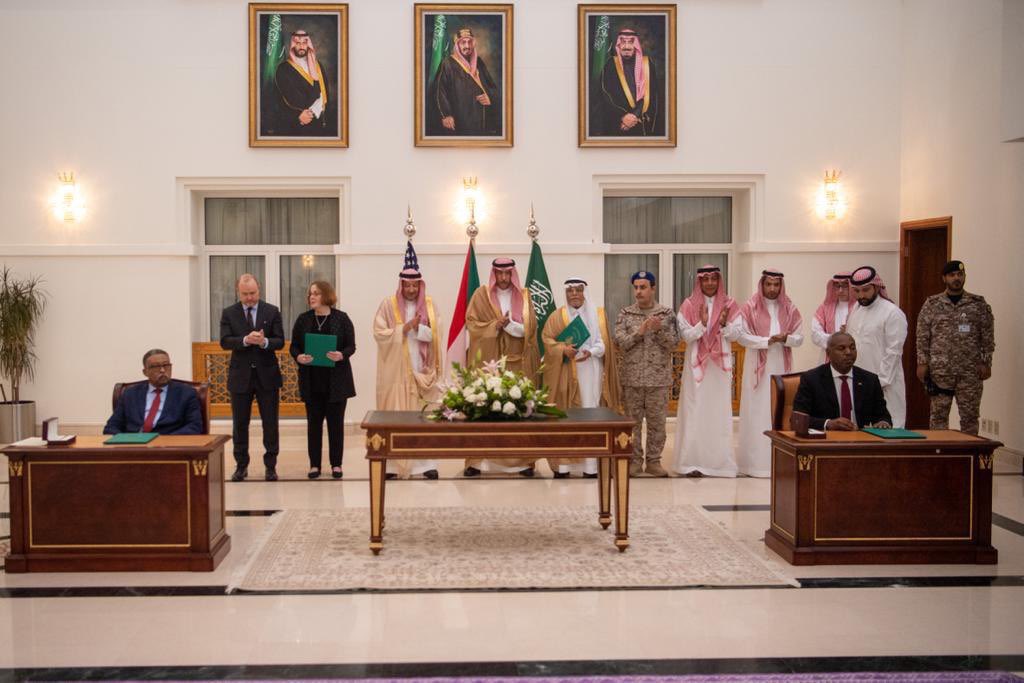
In accordance with a new statement from the United States and Saudi Arabia, following the ongoing talks in the Saudi Arabian city of Jeddah, Sudan’s new agreement concerning a ceasefire monitoring mechanism will be implemented within the next 48 hours from the time when the announcement was publicized.
Conforming to the US-Saudi brokered agreement, the Sudanese Armed Forces as well as the Rapid Support Forces paramilitary group will declare a ceasefire, which would be in place for seven days.
The Sudanese warring sides have also accepted to be committed to reopening humanitarian aid routes, respecting required distance from hospitals, stopping fighter jet bombings, artillery strikes and so on.
The truce has been announced while all previous efforts by the United States and Saudi Arabia to establish a ceasefire between the warring factions in Sudan had failed hours after their start.
Reports on the ground show that the clashes are still ongoing in Khartoum (the capital city of Sudan), Al-Junaynah (a city in West Darfur) and Nyala (the capital city of the state of South Darfur in the south-west of Sudan).
Sudan’s peace talks kicked off with the support of the United States and Saudi Arabia in the Saudi city of Jeddah on April 5.
Despite the joint statement by the US and the Saudi kingdom, the negotiations have not been successful in establishing a comprehensive ceasefire so far and the efforts have resulted in increased casualties and displacement of more civilians in Sudan.
Despite the fact that negotiations between delegations of the Sudanese army and the RSF paramilitary group have been ongoing in the Saudi Arabian city of Jeddah since May 6, some Western media have been citing certain American diplomats as saying for several days that the Sudanese warring parties will soon ink a ceasefire agreement. Conversely, the text of the Jeddah statement does not mention a comprehensive truce.
Given the history of such talks and internal agreements in Sudan, the appearance of this agreement seems to be also similar to their last year agreement, which led to the current dispute in the African nation. The fresh agreement is also expected to pave the way for the second phase of the negotiations, which will again be possible with the mediation by Saudi Arabia and the United States. In addition to the issue, the news stories on an accord in Jeddah indicate other important points:
1- No reconciliation has been made over the disputed issues; so, the new agreement is just a move to create optimism concerning the decline of the internal and external process of the crisis in Sudan.
2- The warring parties in the negotiations put forward their own conditions for the cessation of hostilities based on the viewpoint that each of the sides has the upper hand in the Sudanese developments; however, the US and Saudi mediators halted the discussions and called on the parties to conclude a ceasefire agreement and open safe corridors to allow the dispatch of humanitarian aid. That means the settlement of the dispute in Sudan is also subject to wishes of Saudi Arabia and the United States, while other foreign rivals such as the United Arab Emirates (UAE), Egypt and so on, who have a say in the Sudanese developments, have been sidelined.
What are the conditions of the Sudanese warring parties?
According to statements issued by the Sudanese army officials, the army’s conditions for the cessation of hostilities with the Rapid Support Forces and the opening of safe corridors to dispatch humanitarian aid are as follows:
1- The withdrawal of the Rapid Support Forces from central districts and government buildings of the capital city of Khartoum, including the Khartoum Electricity Distribution Department, the Aljaili Petroleum Refinery as well as residential areas
2- The clearing of trenches and the removal of fronts created during the recent clashes
3- The gathering of the Rapid Support Forces at an agreed military base on the outskirts of Khartoum, which is agreed upon by the Sudanese Armed Forces. The RSF paramilitary group must remain at the military base until a decision is made on their integration into the official armed forces.
The commanders of the RSF paramilitary group also proposed their own conditions:
1- The payment of salaries of the personnel of the Rapid Support Forces by the Sudanese Ministry of Finance
2- The suspension of military flights by the Sudanese Armed Forces as well as the deployment of foreign observers to monitor the cessation of hostilities
3- The assurances for a safe exit route for the commanders and personnel of the Rapid Support Forces from Khartoum to a predetermined destination
4- The authorization to assemble all paramilitary forces, military equipment from the positions of the Rapid Support Forces even in areas where they were stationed before the onset of the recent confrontations
5- The permission for the deployment of the Rapid Support Forces in all positions that they control at present and the provision of medical services to the RSF injured personnel at hospitals
What is the framework of the Jeddah statement?
The delegates of the Sudanese Armed Forces as well as the Rapid Support Forces issued a joint statement dubbed “Jeddah Statement” on May 12 after six days of negotiations in the presence of representatives from the United States and Saudi Arabia.
In the Jeddah Statement, the Sudanese warring parties agreed upon guaranteeing safety of lives and properties of civilians, protecting civilian facilities, creating safe humanitarian routes as well as preserving sovereignty and integrity of Sudan. International organizations are also expected to monitor the implementation of the warring sides’ commitments by the use of satellites, field reports and news stories come from social media networks.
The Jeddah Statement does not mention a comprehensive end of hostilities; however, the American authorities called it a first step toward reaching a ceasefire agreement.
In general, the statement or agreement is not sufficient and effective to pave the ground for resolving the current crisis in Sudan because of the lack of an all-inclusive truce and assessing the implementation of the parties’ conditions as well as the precise monitoring of the warring side’s commitments.
In 28 days of civil war in Sudan, more than 500 people lost their lives and 3,000 others were injured, while tens of thousands were also displaced and foreign countries evacuated their nationals and diplomats from the African country.
The mentioned issues along with Sudan’s economic and political woes indicate a looming crisis that will not be simply resolved even with the complete cessation of hostilities and the formation of an all-inclusive government.