Category: Syria

  • Tripartite Meeting in Damascus: Al-Jolani Meets SDF Commander and U.S. CENTCOM Commander

    Tripartite Meeting in Damascus: Al-Jolani Meets SDF Commander and U.S. CENTCOM Commander

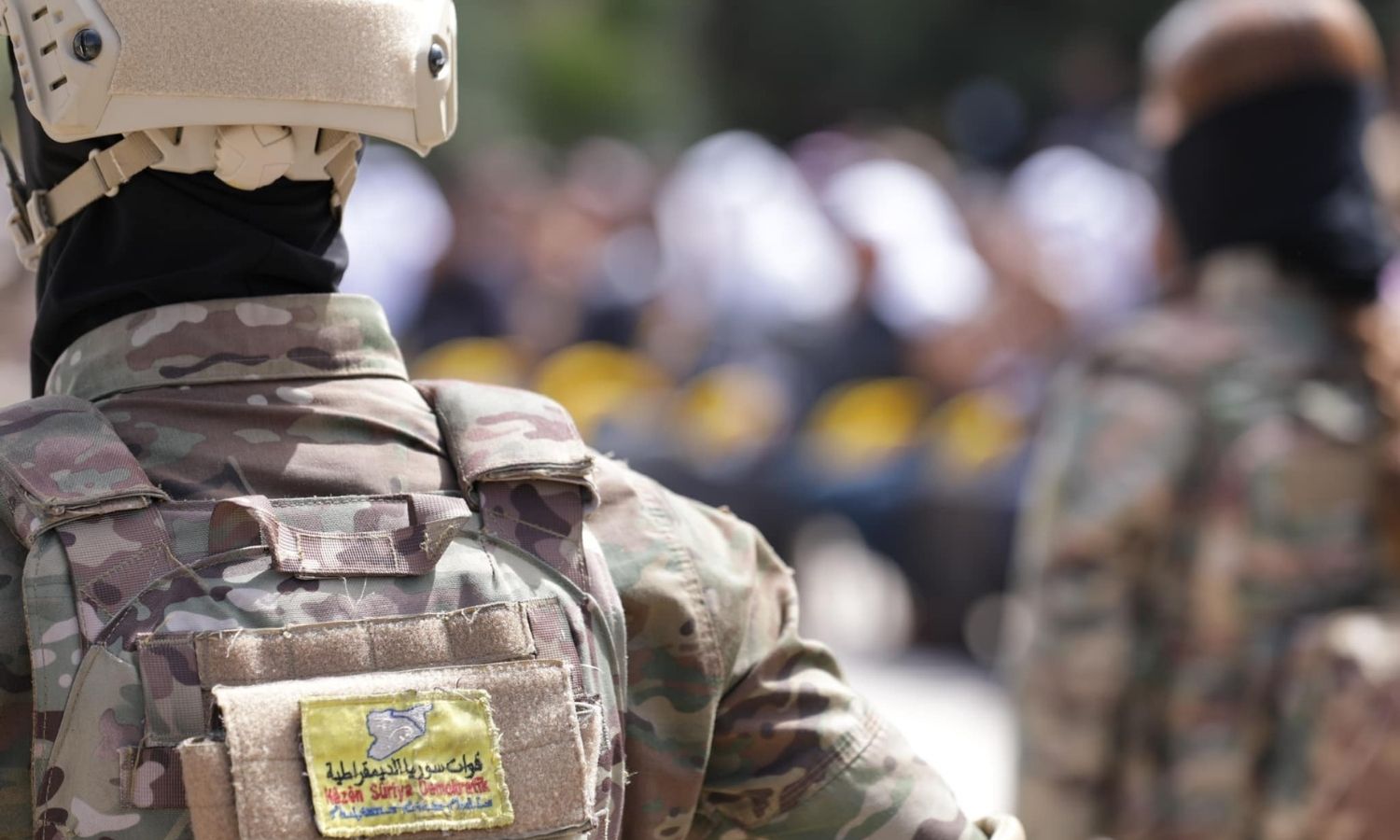
    A key focus of the meeting was the implementation framework of a recent agreement between al-Jolani’s administration and the Syrian Democratic Forces (SDF), with both sides emphasizing Syria’s territorial integrity and national sovereignty.

    Simultaneously, an SDF delegation led by Mazloum Abdi arrived in Damascus to discuss the political transition process and security challenges in northeastern Syria with senior Syrian officials.

    The concurrent presence of the U.S. envoy and the SDF commander in Damascus signals a coordinated push between Washington and Damascus toward a new political roadmap. This meeting is one of the few high-level meetings between the Syrian presidency, US representatives and the commanders of the Syrian Democratic Forces; this meeting could initiate a new phase of talks between the main actors in the Syrian crisis.

  • Aleppo on Edge: Ceasefire Pauses Armed Clashes

    Aleppo on Edge: Ceasefire Pauses Armed Clashes

    Earlier, the Syrian Army uncovered and destroyed a tunnel between Ashrafiyeh and al-Sabeel neighbourhood, suspected of being used for smuggling weapons or sabotage. In response, Syrian security forces set up checkpoints around the area to prevent further SDF infiltration.

    Read: Clashes Between Syrian Army and SDF in Eastern Aleppo

    Despite heightened security, SDF fighters disguised as civilians attacked government checkpoints, killing one and injuring three. The Syrian Army deployed reinforcements, and SDF retaliated with mortar strikes on parts of Aleppo.

    Sources close to the Jolani-led administration confirm that while fighting has stopped, tensions remain high. Damascus has conditioned talks on the full withdrawal of SDF forces from Ashrafiyeh and Sheikh Maqsoud, the handover of wanted individuals, and restoration of full government control.

    Unofficial reports suggest a possible U.S.-brokered meeting between Syrian officials and SDF representatives to explore integrating SDF units into Syria’s Ministry of Defense and transferring control of eastern Euphrates regions to the central government.

  • Clashes Between Syrian Army and SDF in Eastern Aleppo

    Clashes Between Syrian Army and SDF in Eastern Aleppo

    SDF media claimed residential areas were also shelled, accusing the Syrian Army of destabilizing northern and eastern Syria. In response, Syria’s Defense Ministry denied the allegations, stating it only targeted SDF positions in Hmimeh and Al-Qayta villages and exercised restraint.

    Clashes remain active around Deir Hafer and Tishrin Dam. Reports indicate SDF reinforcements from Hasakah and deployments by pro-Julani forces to contact zones in Aleppo.

    The recent escalation highlights fragile security in northern Syria. The March 10 agreement between Damascus and the SDF aimed to reduce tensions, but ongoing field developments suggest the deal lacks enforcement and trust mechanisms—raising fears that minor skirmishes could spiral into full-blown conflict.

  • Scorching Suwayda: Unraveling Sectarian Fragility in Post-Assad Syria

    Scorching Suwayda: Unraveling Sectarian Fragility in Post-Assad Syria

    This delicate balance is now under strain, especially in Syria’s Suwayda province, the heartland of the Druze. Recent clashes with Sunni Bedouin tribes and alleged Israeli interference have deepened mistrust toward Syria’s transitional government. As violence escalates, the Druze—committed to strict traditions and survival—find themselves at the crossroads of regional and international tensions.

    In recent months, Suwayda has seen a surge in violence, sparked by kidnappings and retaliatory attacks between Bedouin tribes and Druze militias. The Damascus-based government deployed forces to contain the unrest, but deep-seated distrust led to armed resistance from Druze fighters. Reports of massacres, looting, and arson—allegedly by pro-government groups like Ahrar al-Sharqiya and Ansar al-Tawhid—have further inflamed tensions. Social media posts and unverified accounts of military raids and civilian killings have raised fears of another sectarian catastrophe.

    Israeli tanks and airstrikes targeting Suwayda and Damascus added fuel to the fire. While Israeli officials claim to protect Druze minorities, many Syrian Druze remain skeptical of Tel Aviv’s intentions.

    Geopolitical Rivalry in Southern Syria

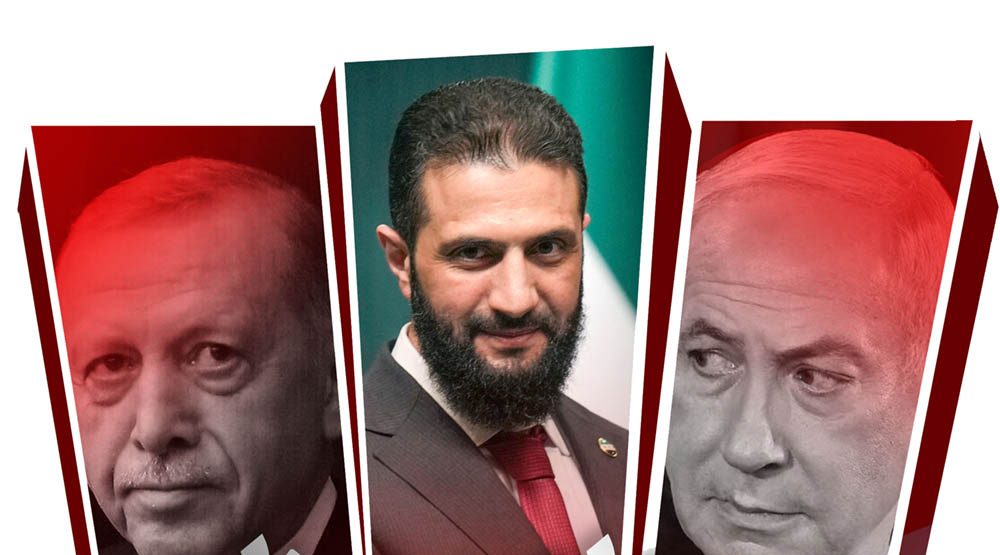
    Turkey and Israel are vying for control over trade routes linking southern Syria to Jordan and the Gulf. Turkey, aligned with Damascus, seeks to expand its influence southward and open new export corridors. Israel, meanwhile, exploits instability to counter Iranian presence and build ties with minorities like the Druze and Kurds. Despite secret talks in Baku to avoid military incidents, ongoing violence in Suwayda and Israeli strikes on Damascus reveal deeper rifts.

    Turkey, with limited military and political leverage, prefers diplomacy and U.S. pressure over direct confrontation, fearing that conflict could derail Syria’s reconstruction and harm its own interests.

    Israel’s Peripheral Doctrine and Arab Fragmentation

    Since its founding, Israel has pursued a “peripheral doctrine”—forging alliances with non-Arab regional powers and exploiting internal divisions in Arab states. Syria, as a populous neighbor with historic ties to Palestine, remains central to this strategy. By strengthening ties with Druze and Kurdish groups, Israel aims to fragment Syria from within. Prime Minister Netanyahu has openly outlined post-Assad goals: blocking Syrian government forces near Damascus, supporting Druze communities, and maintaining control over the Golan Heights.

    This strategy seeks to turn Syria into a failed, unstable state, minimizing threats to Israel. The use of sectarian divisions and minority alliances as tools of control has long been a hallmark of Israeli policy.

    Syria’s Response and Internal Challenges

    Under President Ahmad al-Shara, Syria’s new government has responded cautiously to Israeli aggression, condemning airstrikes and emphasizing territorial integrity. It seeks regional diplomacy—especially with Jordan and Arab states—to counter expansionist threats. However, avoiding direct confrontation may weaken its domestic legitimacy and allow Israel to deepen its influence.

    Effective resistance requires coordinated Arab and international efforts to prevent further collapse and regional instability.

    Expanding Israeli Ambitions

    Israel’s ambitions now extend beyond Syria, targeting the broader periphery—including Iran and Pakistan. Some neoconservative analysts advocate for exploiting ethnic and sectarian divides to destabilize Iran. The Abraham Accords, far from being mere peace deals, serve as instruments to cement Israel’s dominance in regional economics, security, and technology.

    This approach, however, risks backfiring. As Israel’s reach grows, so does regional opposition. Countries like Iran, Turkey, and Pakistan increasingly view Israel not just as a nuisance, but as a direct threat. Military actions in Gaza, Damascus, Beirut, Sanaa, and Tehran have galvanized regional solidarity against Israeli policies.

    History has shown that colonial empires rarely endure. Just as the people of this region once resisted crusaders and imperial powers, they now stand united against Israel’s expansionist doctrine.

    Sources:

    1. https://www.washingtonpost.com/world/2025/07/17/israel-syria-druze-attack/
    2. https://www.theguardian.com/world/2025/jul/18/more-violence-erupts-in-syrias-druze-heartland-as-tribal-groups-reinforce-local-bedouin
    3. https://www.nytimes.com/2025/07/18/world/middleeast/who-are-druse-syria-israel-clashes.html
    4. https://www.washingtoninstitute.org/policy-analysis/pursuing-israel-syria-detente-post-assad
    5. https://www.csis.org/analysis/violence-escalates-israel-intervenes-southern-syria
    6. https://www.middleeasteye.net/opinion/damascus-gaza-israels-doctrine-hegemony-fatal-flaw
    7. https://thecradle.co/articles/battle-in-suwayda-where-israel-and-turkiye-clash-over-syrias-trade-routes
    8. https://www.washingtonpost.com/world/2025/07/17/syria-israel-druze-border/
    9. https://apnews.com/article/druze-syria-religious-sect-2c989a5397c5e04474cef7bd9a37c40b?__cf_chl_rt_tk=5JchtEfIcPtDTbrCoJapZ91RhXRsgmmgiDMqNZE6R4U-1752921424-1.0.1.1-UDWYIzUovSA6IHVMilefEYYS5rD3BmPUa5VuAWNhesw
    10. https://www.middleeasteye.net/news/turkey-doesnt-have-many-options-against-israel-syria
    11. https://thecradle.co/articles/syrian-druze-confront-new-attacks-after-sharaa-declares-suwayda-ceasefire
  • Syrian Defense Delegation Visits Russian Military Facilities in Moscow

    Syrian Defense Delegation Visits Russian Military Facilities in Moscow

    Senior Syrian commanders—including heads of air defense, artillery, and armored units—held joint meetings with Russian counterparts to discuss training, operational experience, and combat readiness.

    The visit highlights the strategic military dimension of Syria-Russia relations, beyond politics. With key Russian bases in Syria like Hmeimim and Tartus, Moscow aims to secure its long-term presence by offering military support and specialized training to Syrian forces.

  • Druze Protest in Sweida Demands Separation from Syrian Government

    Druze Protest in Sweida Demands Separation from Syrian Government

    This development comes amid reports that Sweida has become a focal point in recent negotiations between Damascus and Tel Aviv. Back in August 2025, prominent Druze leader Hikmat al-Hijri issued a statement advocating for the creation of an independent Druze region in southern Syria. Following his call, several armed Druze factions set aside internal disputes and formed a “National Guard” under his leadership.

    The explicit demand for separation signals a rising tide of self-rule sentiment in Sweida. Its inclusion in Syria-Israel talks underscores the province’s strategic importance, suggesting that security concerns there are not merely domestic but carry regional implications. Israeli officials are reportedly leveraging the Druze issue as a pressure point against Damascus.

  • Israel–Syria Talks Collapse Over Sovereignty Dispute

    Israel–Syria Talks Collapse Over Sovereignty Dispute

    This isn’t the first time Israel has made such a request. During earlier talks in Paris, Tel Aviv also pushed for the corridor, which Syria firmly opposed. According to Israel Hayom, deep divisions remain over issues like Israeli control of Mount Hermon and the Golan Heights, as well as security guarantees for the Druze minority allied with Israel.

    Previous rounds in Baku, Paris, and London had shown progress, with the U.S. even signaling that a de-escalation deal was within reach. However, the Sweida corridor dispute highlights the persistent strategic challenges facing any agreement.

    Suweida, home to a majority Druze population, holds significant security and social importance for Damascus. Accepting Israel’s proposal could undermine Syria’s political legitimacy. Even if the Sweida issue is set aside, core disagreements over the Golan and Mount Hermon remain major obstacles—issues too complex for short-term diplomacy to resolve.

  • The New Syrian Flag Raised Over the Damascus Embassy in Washington

    The New Syrian Flag Raised Over the Damascus Embassy in Washington

    In a formal ceremony, Syrian transitional government Foreign Minister Asaad Hassan al-Shaibani raised the national flag over the Syrian Embassy in Washington. In a brief speech, he described the moment as historic. The event was attended by members of the Syrian-American community.

    In a message posted on X (formerly Twitter), al-Shaibani wrote:
    “After decades of absence, today the flag of the Syrian Arab Republic proudly flies over our embassy in Washington. With pride and dignity, I represent a nation that stood firm and a homeland that never broke. Syria has returned.”

    It’s worth noting that during his visit to Washington, the Syrian Foreign Minister met with U.S. Deputy Secretary of State Christopher Landau, several members of Congress, and officials from the U.S. Treasury Department. The discussions focused on bilateral relations, expanding cooperation, and exploring the possibility of lifting sanctions imposed on Damascus.

  • Behind the Scenes of the Julani–Kalin Meeting: From the March 10 Agreement to Israel’s No-Fly Zone Proposal in Southern Syria

    Behind the Scenes of the Julani–Kalin Meeting: From the March 10 Agreement to Israel’s No-Fly Zone Proposal in Southern Syria

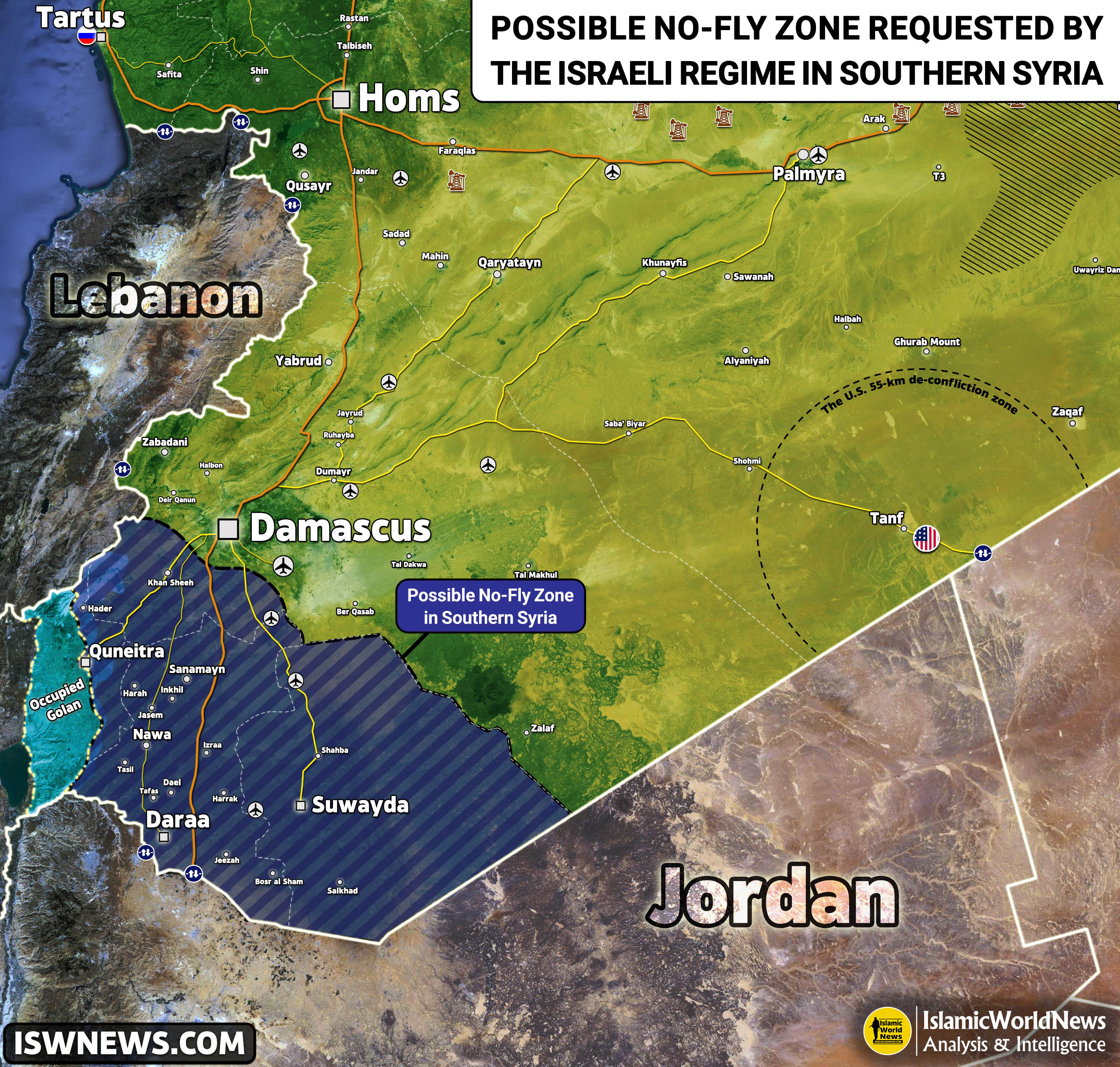
    According to Western sources, Israel has presented Damascus with a new security proposal. The plan includes establishing no-fly zones over parts of southern Syria while preserving an aerial corridor from Syria to Iran. This corridor is strategically vital for Tel Aviv, potentially allowing future airstrikes on Iranian targets. The proposed no-fly zone would cover Suwayda, Daraa, Quneitra, and parts of Damascus. In exchange, Israel would withdraw from some areas it recently occupied in southern Syria—but notably, it refuses to pull back from Mount Hermon.

    Meanwhile, Syria’s new government is expanding its diplomatic outreach, engaging with figures like Tom Barrack, Ayman Safadi, and representatives from Gulf Arab states. These interactions suggest Damascus is working to build a multilayered network of security and political alliances. The goal appears to be reducing international pressure while gaining flexibility in dealing with local forces (such as the SDF) and regional powers like Turkey and Israel. Al-Julani, at the helm of this effort, seems intent on balancing U.S.-Israeli demands with Turkey’s red lines.

    In the context of ongoing tensions between Iran and Israel, Tel Aviv’s proposal for Syrian no-fly zones is part of a broader strategy to secure a reliable aerial corridor toward Iran. The recent collapse of Bashar al-Assad’s regime and the destruction of much of Syria’s air defense systems have made Syrian airspace one of the least risky and most cost-effective routes for Israeli aircraft heading toward Iran’s western borders. Any agreement with Damascus could significantly enhance Israel’s operational capabilities against Iranian targets.

    Possible no-fly zone requested by the Israeli regime in southern Syria

    Another Israeli objective is to minimize the risk of direct confrontation with Turkish air forces. Turkey’s military presence in Syria—especially in air defense—has grown in recent months, increasing the chances of accidental clashes with Israeli jets. By negotiating a no-fly zone with Damascus, Israel aims to unilaterally manage Syrian airspace, impose its terms on both Ankara and Damascus, and reduce the likelihood of unintended military incidents.

    If implemented, this plan would have wide-ranging regional consequences, with Israel standing to gain the most. It would solidify a permanent aerial threat against Iran from the west, restrict Turkey’s operational freedom in Syrian skies, and place Damascus under Israeli dominance. Although the Syrian government may not favor the proposal, the current military realities in southern Syria are pressuring Damascus to accept it.

  • CENTCOM Commander Meets Syrian Officials in Damascus

    CENTCOM Commander Meets Syrian Officials in Damascus

    They discussed joint cooperation to enhance security and stability in Syria and the region, highlighting the importance of strengthening bilateral relations.

    This encounter reflects Syria’s interest in rebuilding ties with global powers and seeking agreements to lift sanctions and improve its economy. Strengthening communication with Washington may facilitate better international relations with Western countries.

  • Israeli Airstrikes Hit Syrian Defense Sites in Homs and Latakia (Video)

    Israeli Airstrikes Hit Syrian Defense Sites in Homs and Latakia (Video)

    Israeli fighter jets bombed the Syrian army’s air defense base south of Homs, reportedly aiming to destroy BUK-M1 missile systems and a radar installation.

    Following the Homs attack, Israeli aircraft also hit an ammunition depot linked to the al-Julani government in the Saqoubin area of Latakia, resulting in casualties among Syrian soldiers.

    Unconfirmed reports suggest additional Israeli airstrikes may have occurred near Palmyra and the outskirts of Damascus.

    Secondary explosions in the Saqoubin barracks in Latakia city after the Zionist attack that targeted it.
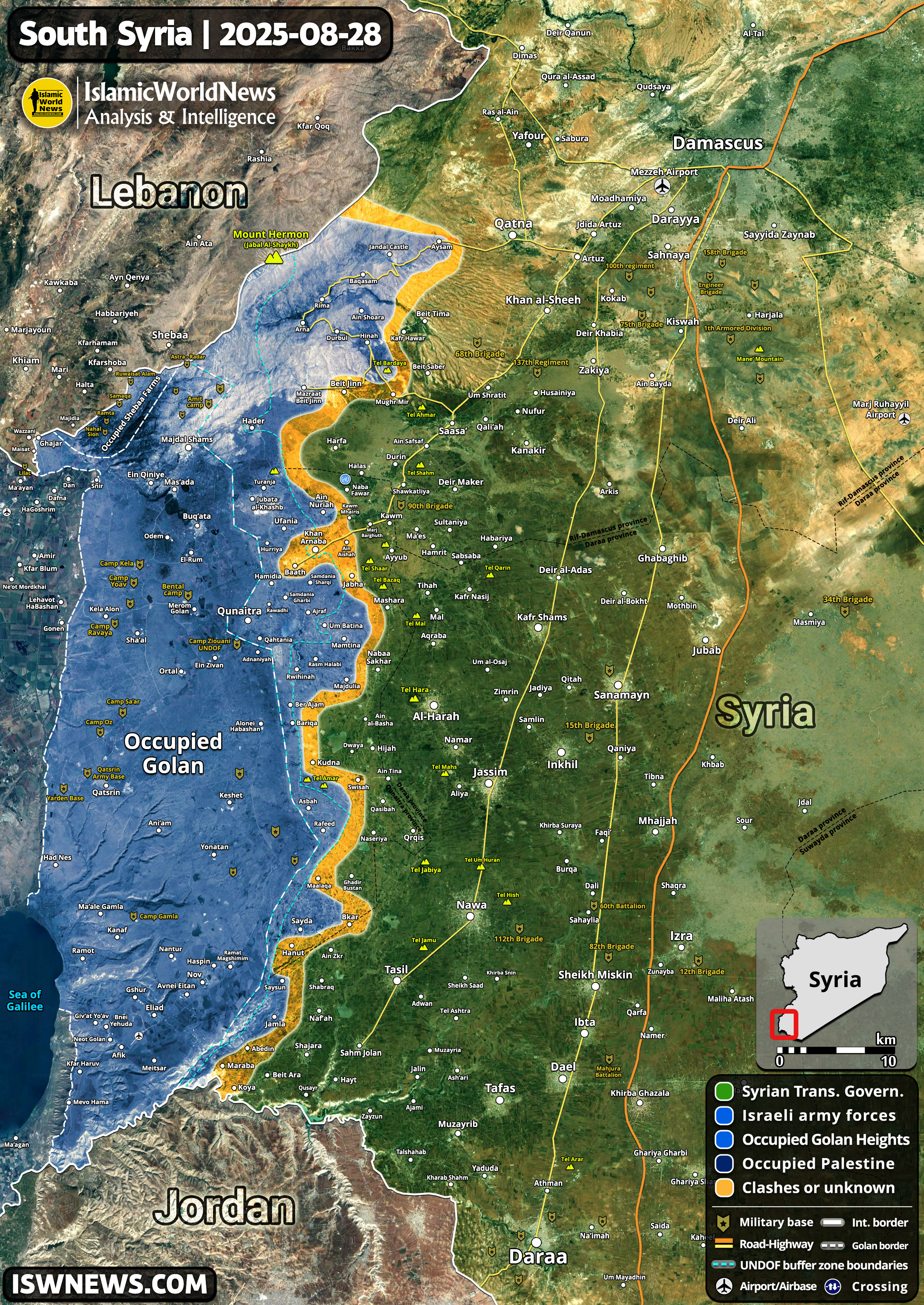
  • Latest Developments in Southern Syria – August 28, 2025 (Map)

    Latest Developments in Southern Syria – August 28, 2025 (Map)

    According to the latest data gathered by Islamic World News, the most recent Israeli military movements in southern Syria are as follows:

    • August 24: Five Israeli military vehicles entered the village of Bariqa in Quneitra province. Troops stationed themselves in front of the Public Security building and set up a temporary checkpoint, inspecting passing vehicles.
    • August 25: A convoy of 11 military vehicles and over 60 Israeli soldiers entered the Beit Jinn area in the Damascus countryside, detaining six local residents. Simultaneously, Israeli forces took control of Bat al-Warda hill on the slopes of Mount Hermon.
    • August 25: Israeli military activity intensified in the Al-Rafid area of Quneitra. After deploying on Al-Jamous hill, troops entered the village of Al-Hiran, while another group patrolled Ayn Zivan. The village of Ayn al-Abd also witnessed an Israeli raid.
    • August 26: An Israeli attack on a residential home in the village of Tarnajah, north of Quneitra, resulted in the death of a Syrian youth named Rami Ghanem.
    • August 27: Israeli forces entered the village of Western Samadaniyah in Quneitra province, conducted patrols, and then withdrew.
    • August 28: Israeli troops appeared at the Abu Ghara junction east of Al-Rafid and continued scattered patrols in Beit Jinn.

    The physical presence of Israeli forces on Syrian soil—regardless of its immediate outcomes—sends a clear regional message: Israel is willing to enter a new operational phase to prevent the establishment of intelligence or military infrastructure near its borders. These recent actions reflect Tel Aviv’s effort to solidify a security belt beyond the ceasefire lines.

    Moreover, field developments suggest that Tel Aviv aims to secure its desired geographic clauses in security agreements not through negotiation, but via direct military pressure. This strategy indicates Israel’s intent to impose its security equations on the Golan governance through a combination of iron and fire.