The Times of Israel wrote that strikes on Iran’s ballistic missile infrastructure had no decisive impact, and the damage was more limited than first announced. The report claimed Iran currently possesses around 2,000 heavy ballistic missiles, nearly the same number as before the conflict, showing its missile strength remains intact.
According to Al‑Monitor, Shlomi Binder, head of Israeli military intelligence (AMAN), conveyed this assessment in a meeting with U.S. Ambassador to the UN Mike Waltz. The outlet suggested Tel Aviv is once again urging Washington toward military action against Iran.
Presenting the limited damage as a narrative of “deterrence failure” appears to be a calculated media strategy by Israel. By emphasizing that Iran’s missile arsenal remains untouched, Tel Aviv seeks to replace earlier claims of military success with a storyline that justifies renewed military action.
The coordinated role of Hebrew media and the disclosure of intelligence meetings with U.S. officials highlight Israel’s effort to align Washington with its position. By portraying past strikes as ineffective and Iran’s missile threat as ongoing, Israel aims to push the U.S. toward viewing military options as unavoidable.
Overall, these media, security, and diplomatic maneuvers suggest Israel is preparing the ground for another military scenario—one that depends heavily on U.S. support, regional political dynamics, and Iran’s military‑social resilience.
A summary of the most important points is as follows:
The 12-Day War “The enemy’s primary goal was not merely to target military commanders — that was just a means. They believed that by assassinating military leaders and influential figures, unrest would erupt, especially in Tehran, where their agents would incite chaos and draw people into the streets to act against the Islamic Republic. Their ultimate aim was to destabilize the system, provoke street riots, mobilize factions, and uproot Islam from the country. This plan failed in its early stages. The unity and solidarity of the Iranian people during the 12-day war shattered the enemy’s hopes.”
Nuclear Energy and Negotiations with the U.S. “Under current circumstances — though things may change in 20 or 30 years — negotiating with the U.S. government does not serve our national interests. It brings no benefit and does not remove any harm. On the contrary, such negotiations today pose serious risks to the country, some of which may be irreversible. The American side has already predetermined the outcome: they want talks that end with Iran dismantling its nuclear activities and enrichment. That is not negotiation — it is dictation, it is imposition. Sitting down to negotiate with a party that insists the result must be exactly what they demand — is that really negotiation?!
We have not and will not surrender to pressure — not in this matter (uranium enrichment) nor in any other. The American side is adamant that Iran must abandon enrichment altogether. Previous administrations demanded we limit enrichment or not keep enriched material inside the country — which we also rejected. Now he [Trump] says there should be no enrichment at all. What does that mean? It means erasing a major national achievement — one that took immense effort, cost, and sacrifice. To abandon enrichment is to discard all that. Clearly, a proud nation like Iran will reject such demands outright.”
Israel’s extensive SIGINT and HUMINT networks, combined with advanced satellite and drone reconnaissance systems, enable real-time tracking of Iran’s military and nuclear movements. According to RAND, the fusion of communication intercepts, satellite imagery, and local human sources provides commanders with a level of clarity that allows for precise analysis and targeting.
The Israeli regime’s SIGINT network includes electronic listening stations in allied countries (such as Iraqi Kurdistan, Azerbaijan, and Gulf states) and signal-intercepting ships in international waters. These assets continuously monitor a wide range of radio, satellite, and phone communications in and around Iran. Using AI-powered data analytics, they identify and geolocate command-and-control nodes, extracting precise coordinates for targeted strikes.
Meanwhile, Mossad and Shin Bet’s HUMINT operations maintain deep infiltration into Iran’s academic and industrial sectors, activating a network of local informants who not only verify SIGINT data but also report hard-to-track details such as traffic patterns at strategic sites. These sources have been recruited and retained over the past decade through financial incentives, emigration support, and psychological operations.
A clear example of this integrated approach was Operation Narnia, in which at least 11 senior Iranian nuclear scientists were targeted in a single night. Official reports indicate targeting precision within 10 meters. The psychological impact not only disrupted Iran’s technical expertise but also fractured internal decision-making and coordination, with full recovery of Iran’s intelligence-operational capacity expected to take considerable time.
Air Power and Long-Range Weaponry
Israel’s F‑35I Adir fighter jets, combining stealth technology with onboard sensor networks, function as more than just aircraft—they serve as airborne command-and-control hubs. These jets are tasked with penetrating air defense networks and, using “Beast Mode,” can carry external weapons after disabling radar systems to increase bombing payloads. Data collected via electronic and infrared sensors is encrypted and transmitted to command centers, guiding F‑15I and F‑16I jets for simultaneous precision strikes.
This networked approach enables highly coordinated SEAD (Suppression of Enemy Air Defenses) and OCA (Offensive Counter-Air) missions. No previous operation against Iran has demonstrated such synchronization.
Additionally, Israel’s long-range offensive layer includes standoff weapons like air-launched Sparrow ballistic missiles and Spice guided bombs, extending operational reach by several hundred kilometers. Simultaneous launches from multiple directions saturate Iran’s S‑300 and S‑400 systems, and when combined with F‑35I support, enable the capture of strategic targets such as uranium enrichment facilities and air defense sites. High-altitude aerial refueling not only prolongs battlefield endurance but also allows for continuous air support loops. According to CSIS experts, this “multi-axis simultaneous operations” model significantly improves penetration into Iran’s defense zones compared to traditional pinpoint strikes.
Electronic and Cyber Warfare
Since Operation Rising Lion, Israel has integrated battlefield and cyber tactics to neutralize Iranian defenses before physical strikes commence.
In the first phase, electronic warfare units deploy systems like IAI’s Scorpius to target S‑300 and S‑400 radar signals, saturating multiple frequency bands and inducing “artificial sleep” in ground receivers. This multi-step process includes active jamming, injecting false data into control systems, and sudden disruptions—rendering even mobile defense stations unable to activate quickly.
Next, Mossad and Unit 8200 cyber teams infiltrate air defense management networks and data centers, issuing fake commands to deactivate radars or reposition antennas. As a result, when F‑35I jets or combat drones enter Iranian airspace, no effective alerts are triggered.
Simultaneously, large-scale cyberattacks target cross-border communication support networks. Internal servers are replaced, root account passwords are rotated, and encrypted traffic is intercepted using known vulnerabilities. The Washington Institute emphasizes that these intrusions are designed to disable logistical support systems and crisis command centers, preventing Iran from mounting a coordinated rapid response.
Ultimately, a hybrid network of cyber and electronic attacks, combined with drone-based cover operations inside Iran, enables the destruction or disabling of defense systems deep within Iranian territory without direct confrontation. This model, blending jamming, cyber infiltration, and stealth explosive drones, represents a new framework for long-range attacks unprecedented in the history of Israeli-Iranian conflict.
Support and Coordination with the United States
At the strategic level, Israel’s formal integration into the U.S. Central Command (USCENTCOM) and close cooperation with the Pentagon have granted its air and naval forces access to extensive logistical and intelligence resources. Following this integration, Israel’s F‑35I jets and other airborne units can refuel and rearm at joint U.S. bases in the region, including B‑52 facilities in Qatar and aircraft carriers in the Persian Gulf. Logistical support—spare parts and specialized personnel—is provided under joint supervision and through coordinated exercises, reducing operational costs by up to 30% and minimizing response time.
Israel’s role within CENTCOM’s unified command structure also facilitates missile and air defense alert sharing. By integrating the U.S. Shared Early Warning system with Israel’s Arrow system at a joint command center, any missile or drone launch in the region is rapidly detected and its coordinates shared with both nations’ commanders. Additionally, joint engineering and cybersecurity teams conduct regular drills to secure military networks and prepare for nuclear threats. This collaboration has created a secure and transparent logistical support system that complicates any offensive action with dual-layered challenges.
On the political-military front, regional affairs officers (FAOs) and joint representatives within CENTCOM have strengthened personal relationships and information exchange among senior commanders. These interactions—through regular visits by CENTCOM leadership to Tel Aviv and the presence of Israeli advisors at U.S. command centers—enable swift and frictionless strategic alignment. The result is a secure logistical and intelligence network that pushes Israel’s offensive-defensive capabilities to saturation levels, forcing adversaries into limited reactive positions.
Special Operations and Targeting Key Commanders
Elite units such as Sayeret Matkal and Shayetet 13 operate within a unified mission architecture, executing psychological and tactical strikes deep inside Iran before the main aerial bombardment begins. According to CSIS, these units use real-time intelligence from fusion centers in Tel Aviv and Washington to infiltrate target facilities via small insertion teams (Fast-Rope Insertion), install field sensors, and transmit precise coordinates to jets and drones for synchronized strikes.
Their methodology centers on “Deep Joint Strike” operations—simultaneous missile bombardment and infiltration teams supported by drones and electronic warfare. These teams identify and eliminate communication keywords and commander gathering points, crippling Iran’s high-level management and response capabilities both logistically and psychologically, making coordinated national reactions virtually impossible.
CSIS recommends continued use of this tactical combination, noting its long-term strategic effectiveness. Iran’s ability to rebuild special operations capacity is hindered by cultural and security complexities, and the psychological deterrence created may pave the way for future successful strikes.
In an interview with Israel’s Channel 12, Gallant criticized the Israeli intelligence agency Mossad’s earlier plans to counter Iran’s nuclear ambitions, calling them “ineffective and impractical.” He disclosed that the plans were officially scrapped in December 2024 after internal reviews concluded they lacked sufficient lethality, were too complex to execute, and failed to match the pace of Iran’s nuclear development.
To reassess Israel’s strategy, Gallant formed a “Red Team” led by former Defense Minister Shaul Mofaz and a group of retired military commanders. Their conclusion: a full rejection of Mossad’s approach. Gallant now advocates for a large-scale aerial campaign, stating, “Hundreds of aircraft must drop tens of thousands of bombs over Iran to establish air dominance.”
He also warned that any future strike must anticipate Hezbollah’s immediate involvement. However, Israel faces a critical ammunition shortage, exacerbated by the transfer of artillery shells to Ukraine.
Gallant outlined four key outcomes of the recent Israeli military operation against Iran:
Collapse of Iran’s regional network: Hezbollah, Hamas, and affiliated forces in Syria were severely weakened, dismantling infrastructure built over four decades.
Destruction of air defense systems: Iran’s missile shield was neutralized, with uncertain prospects for recovery.
Damage to missile capabilities: Explosive production centers, over 200 launchers, and a significant portion of Iran’s missile stockpile were destroyed.
Strikes on nuclear facilities: The Isfahan site was nearly obliterated, Natanz suffered major damage, and the U.S. targeted Fordow with bunker-busting bombs.
Gallant claimed that Israel’s deep intelligence penetration into Iran has unnerved Iranian officials and may be accelerating their pursuit of nuclear weapons. “We must remain on alert,” he said, “because the next round of war is coming.”
When asked about targeting Iran’s Supreme Leader, Gallant admitted that such an operation was attempted during the initial strike but failed. He suggested it should remain part of future plans, whether against the current leader or his successor.
He concluded with a warning to Tehran: “If Iran seeks revenge, it would be a grave mistake. We are now stronger, and they are weaker. The next round will be different—and we will have the upper hand.”
Despite the assertive tone, Gallant’s remarks also reflect an acknowledgment of Israel’s limited deterrence. His admission that Iran could rebuild its missile, air defense, and nuclear infrastructure points to the temporary nature of recent military gains. Analysts suggest this could escalate regional tensions and prompt Iran to expand its own deterrence strategies.
The former minister’s comments underscore a growing consensus in Tel Aviv: the conflict with Iran is far from over, and a second phase may be imminent.
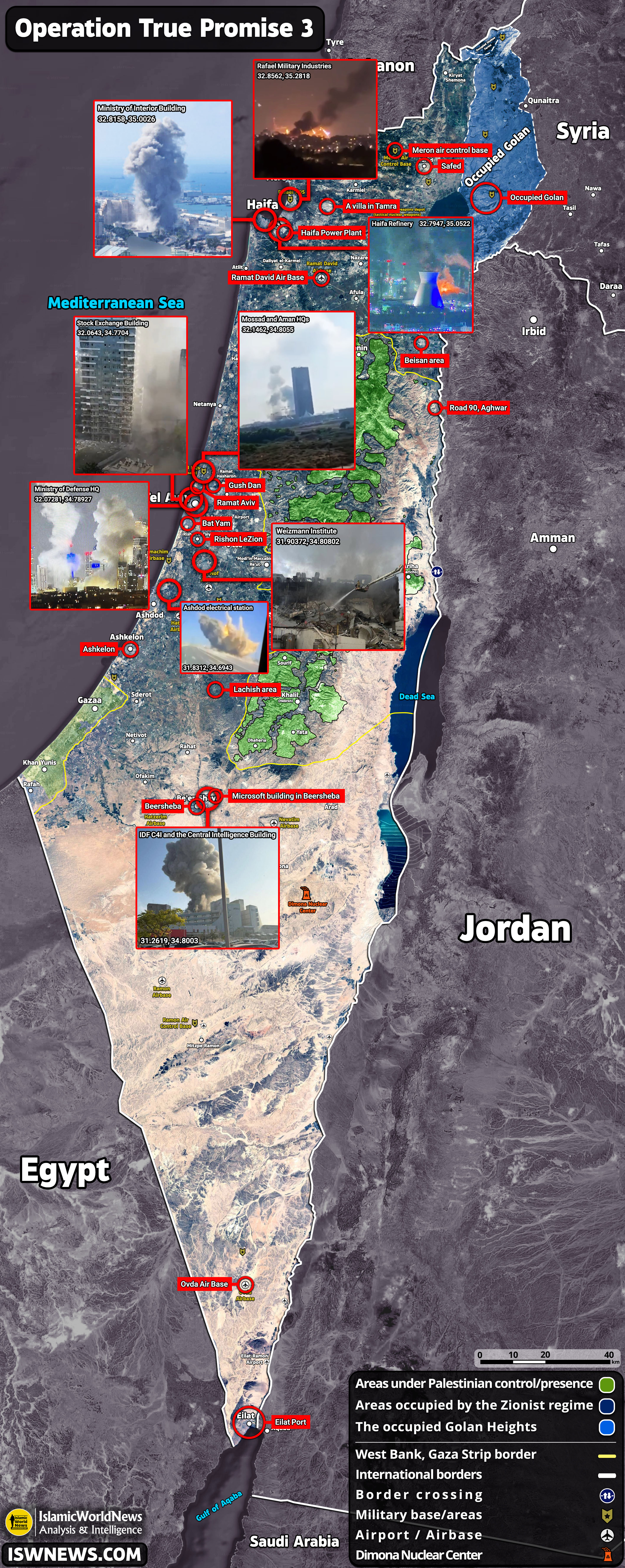
The Iranian armed forces launched the ‘Operation True Promise 3’ shortly after the Zionist regime’s aggression on Iran on June 13, And attacked Israeli positions across occupied Palestine. During the operation, Iranians utilized a variety of ballistic missiles, such as Emad, Qadr, Kheibar-Shekan, Sejjil, Hajj Qassem, Fattah-1 hypersonic missile, and Shahed-136 and 238 suicide drones, along with Arash-1 and 2 suicide drones. It also involved cruise missiles and other cyber and intelligence tools.
Areas that were targeted in Israel by Iranian missiles during ‘Operation True Promise 3″
This operation was conducted daily in multiple stages, targeting various Israeli military assets including military and intelligence centers, air bases, fuel production sites, energy supply facilities, defense infrastructure, military industrial complexes, command and control hubs, and operational support units.
Based on our investigations and gathered information, the Iranian armed forces have targeted and attacked the following locations during Operation True Promise 3.
– June 13 and 14; first and second days 1- Israeli Defense Ministry headquarters in Tel Aviv: 32.0728, 34.7892 2- Rishon Lezion: 31.9701, 34.7904
Iranian missile hits Israeli Defense Ministry headquarters in Tel AvivThe moment an Iranian hypersonic missile hit the Israeli Defense Ministry headquarters in Tel AvivThe moment an Iranian hypersonic missile hit the Israeli Defense Ministry headquarters in Tel Aviv – another angleThe moment at least 15 Iranian ballistic missiles hit Tel AvivThe moment an Iranian ballistic missile hit the Rishon LeZion area south of Tel AvivImages from the site of the Iranian ballistic missile strike on the Rishon Letzion area south of Tel Aviv
– June 15, Day 3 1- Haifa Refinery: 32.7947, 35.0522 2- A Villa in Tamra near Haifa 3- Eilat Port 4- Tel Aviv (various areas): Weizmann Institute in Rehovot area: 31.9037, 34.8080 Bat Yam area 5- Ramat David Air Base: 32.6680, 35.18174
Ramat David Air Base is the primary Israeli Air Force installation in northern the occupied Palestinian territory. Situated on the southeastern edge of Haifa, 46 kilometers from Lebanon, it features three runways. The base hosts multiple squadrons, including F-16 fighter jets, Heron drones, and attack helicopters. It has been a crucial part of Israel’s operations in Lebanon and was frequently targeted by Hezbollah rockets and drones during the recent conflict.
The moment an Iranian ballistic missile hit the city of HaifaFire breaks out at Haifa refinery after Iranian missiles hitIranian missile hits villa in Tamra town near HaifaTwo Iranian Shahed-238 drones hit the port of Eilat. This is the first officially recorded successful operation using this type of jet-powered suicide drone.Iranian missiles hit various areas in Tel Aviv, including the Bat Yam areaThe moment Iranian missiles hit points in Tel AvivIranian missiles hit and caused extensive damage to the Weizmann Institute of Science in the town of Rehovot, located in the southern suburbs of Tel Aviv.
– June 16, Day 4 1- Rafael Military Industries in Haifa: 32.8562, 35.2818 2- A snagogue in Lachish area 3- Haifa Power Plant: 32.7910, 35.06526 4- Tel Aviv, Gush Dan area, disruption of air defense systems and hit on Arrow 3 system
Iranian missile hits Rafael military industries in HaifaIranian missile hits synagogue in Lachish areaThe moment two Iranian missiles hit the Haifa power plant and a fire broke out in the area. As you can see, a large number of interceptor missiles were fired in the final stage, but they did nothing and out of the three missiles, two missiles hit the targets. These interceptors are the final stage and before that, the exo-atmospheric interceptors had also failed.A rare angle shot of the moment an Iranian missile hit a target in Haifa. The missile came straight at the cameraman. Fast and scary!Two Iranian missiles hit Tel AvivIranian missile strikes hit Tel Aviv, including the Bani Barak areaVideo showing the Israeli army’s Arrow 3 defense system malfunctioning amid a missile attack at dawn on the fourth day of the war. The IRGC stated it had disrupted Israel’s defense systems. In this footage, we observe the disruption described by the IRGC, along with an Israeli interceptor missile striking another launcher.
– June 17, Day 51 1- Disruption of Israel’s air defense systems and the downing of an interceptor missile in Tel Aviv 2- Aman military intelligence center and Mossad headquarters in Herzliya
The interceptor missile failed and returned and hit a point in Tel Aviv.Iranian missiles hit Mossad facilities in the Herzliya area of Tel Aviv. The cameraman also says in the video: “Wow… they even managed to hit Mossad!”Another video of Iran’s missile attack on the Mossad headquarters in Herzliya. In this video, at least three missiles hit the area around the headquarters and one missile hits the headquarters itself.On the fifth day of the war, during the IRGC missile attacks, the Aman logistics center in Herzliya, which is part of the Israeli Army’s military intelligence branch, was also targeted.
– June 18, Day 6 1- Disruption of Israel’s air defense systems and the fall of an interceptor missile in Tel Aviv for the third time. 2- Tel Aviv
In this video, the Israeli interceptor missile malfunctioned and crashed after launch, causing a fire in Tel Aviv. These malfunctions are likely accidentals, as Iranian jamming systems disrupt Israeli defenses.The moment two more missiles hit Tel AvivBreathtaking moments of Iranian missiles reaching Tel Aviv and Israeli interceptors firing. In this video, it is confirmed that 3 Iranian missiles hit.
– June 19, Day 7 1- Occupied Golan 2- Tel Aviv, a high-rise building near Stock Exchange Building in Ramat Gan: 32.0643, 34.7704 and Ministry of Defense facilities in Tel Aviv 3- Israeli army’s Command and Intelligence (IDF C4I) headquarters and the Intelligence HQ in the Gav-Yam Technology Park in Beersheba 4- Microsoft Building in Beersheba
The moment one of the Iranian army’s suicide drones (probably the Arash type) hit Israeli positions. The strikes captured by a surveillance camera in the occupied Golan.A video depicts two missiles, possibly Sejjil-type, striking Tel Aviv. The Israeli regime heavily censored news about the Iranian missile strikes on the seventh day of the war.Iranian missiles hit Tel Aviv, near stock exchange building in Ramat Gan areaThe moment an Iranian missile hit the IDF C4I HQ and the intelligence headquarters in the Gav-Yam Technology Park in the city of Beersheba. Iranian missile hits IDF C4I HQ and central intelligence HQs in Gav-Yam Technology Park in BeershebaAn Iranian missile hit the Microsoft building in Beersheba, with Israeli defenses failing to intercept it. The company has partnered with the Zionist regime on AI, drones, and cybersecurity services for the Israeli army.
– June 20, Day 8 1- Ministry of Interior Building in Haifa: 32.8159, 35.0027 2- Beersheba 3- Ashkelon 4- Radar system in the occupied Golan with suicide drone
An Iranian missile hits near the Interior Ministry in HaifaIranian missile hit BeershebaIranian missile hit BeershebaIranian missile hit AshkelonIranian suicide drone hits Israeli army radar system in occupied Golan Heights
– June 21, Day 9 1- Tel Aviv 2- Beisan area, drone attack 3- Occupied Golan, drone attack 4- Road 90, Aghwar area, Jordan Valley
The moment two Iranian missiles hit Tel AvivThe location of the Iranian suicide drone strikes in the occupied Golan Heights and Road 90 in the Aghwar area in eastern occupied Palestine.The site of the suicide drone strike in the Baysan area in occupied PalestineThe moment a Shahed-136 drone of the Iranian armed forces hit the Baysan area in northern occupied Palestine.
– June 22, Day 10 1- Haifa 2- Tel Aviv, Ramat Aviv
Iranian missile hits a target in Haifa portThe moment multiple Iranian missiles hit Tel AvivOne or more Iranian missiles hit the Ramat Aviv area of Tel Aviv, causing widespread destruction. According to Zionist media reports, the Iranian armed forces launched 22 missiles in one phase and five more missiles in a second phase towards the occupied territories.Images show widespread destruction at the site of an Iranian missile strike in Tel Aviv. Ramat Aviv, a residential area in northwest Tel Aviv founded by Zionists originally from Eastern Europe, was targeted, possibly due to the presence of security and military centers in the area.
– June 23, Day 11 1- Ashdod Power Plant: 31.8312, 34.6943 2- Ashkelon 3- Safed 4- Al-Udeid Air Base in Qatar: 25.1154, 51.3164
The moment a missile hit the Ashdod power plant, located along a road in the occupied territories towards Tel Aviv. According to the Israeli Energy Minister, 8,000 customers lost their electricity after the missile hit.This video appears to have been recorded by a Zionist settler, likely in Ashkelon. It shows the sound of several missiles hitting the occupied territories, with the Israeli commenting on the Iranian missile strikes, saying: “What is that sound? Wow, wow, wow.”Iranian missile hits the town of Safed in northern occupied PalestineAnother missile hit northern occupied PalestineIranian missile hits unspecified point in northern occupied Palestine
– June 24, Day 12 1- Beersheba city
The moment a missile hits a seven-story building in Beersheba.
The attack sites listed are based on image and video evidence of Iranian strikes in the occupied territories. Additionally, sites such as Ben Gurion Airport, Nevatim Air Base, Hatzerim Air Base, the Sail Tower in central Haifa hosting AI12 Labs, the Hadera Power Plant, Ovda Air Base in the southern Negev, the Kiryat Gat semiconductor industrial zone, and Meron Air Control Base in northern occupied Palestine have also been targeted by Iranian strikes, according to IRGC statements and other international media reports.
Some notable outcomes of Iran’s strikes on Israel:
Haifa Oil Refinery Shuts Down: The Haifa Oil Refinery has shut down following extensive damage from an Iranian missile attack on June 16, according to Yedioth Ahronoth. The Zionist economic newspaper Calcalist also reported that Sonol, one of Israel’s largest fuel companies, contacted its customers after damage to Bazan Company caused by Iranian missile strikes. They announced that, “Under these circumstances and due to the situation being out of our control, we are forced to reduce or cease fuel supplies to our customers.”
The destruction of the Weizmann Institute of Science and Technology: On June 15, Hajj Qasem tactical ballistic missiles struck the Weizmann Institute, causing extensive damage. The institute’s leader reported that the attack destroyed two research buildings and damaged 112 units, including 60 laboratories and 52 other structures. The head highlighted the institute’s difficulty in obtaining compensation and estimated the total damage at 2 billion shekels (approximately $590 million). Rebuilding is expected to take around five years.
The Weizmann Institute of Science is Israel’s leading and largest center for education and research in nuclear, military, and artificial intelligence fields. Founded 14 years before the Israeli regime in occupied Palestine, it trains students in physics, chemistry, electronics, and related disciplines at both master’s and doctoral levels. The institute has housed human data samples, biological databases, and trillions of bioinformatics records. Additionally, some alumni have contributed to the development of weapons for the Zionist military and are employed across its various scientific divisions.
Images showing the Weizmann Institute following an attack by Iranian tactical ballistic missiles.
Suspension of Maersk Shipping Company’s activities: Maersk, the largest international shipping company, announced that it will suspend all commercial transportation to the port of Haifa.
Suspension of flights at airports in occupied Palestine: Flights into and out of Ben Gurion Airport and other Israeli airports were completely suspended.
Ashdod power outage: Following an Iranian missile accurately hitting the Ashdod electrical station, the Israeli Minister of Energy announced that 8,000 customers have lost their electricity and Ashdod is experiencing a blackout.
Displacement of 18,000 settlers from the Bat Yam area: According to the Israeli economic-analytical newspaper Calcalist, the Iranian missile attack turned Bat Yam, one of Israel’s three most populous towns, into a ruined city akin to Gaza. About 18,000 residents have evacuated their homes due to damage and destruction. Of these, 12,000 have moved to hotels, while others are in rented apartments or temporary shelters. Additionally, four towns—Bat Yam, Tel Aviv, Rehovot, and Ramat Gan—are experiencing a severe housing shortage for displaced residents caused by the attacks. This destruction is expected to impact housing prices in the occupied territories over the medium term.
The residents of occupied Palestine experiencing the aftermath of the Iranian attacks; Zionists in the occupied territories sleeping in metro stations due to fear of Iranian missiles.
Moroccan soldiers killed in Iranian attack: A leaked document reports that two Moroccan soldiers killed when an Iranian missile struck Meron air control base in northern occupied Palestine. These casualties included a captain and a senior Moroccan commander who were there for joint exercises with Israeli forces. Additionally, another Moroccan soldier and officer were wounded and treated in Haifa. Notably, if Moroccans were killed in the attack, then Israeli casualties likely occurred as well. However, these Israeli losses are typically kept from the public view, as has often been the case.
Statistics and Israeli casualties from Iran’s Operation True Promise 3:
According to the latest reports from the Israeli media, the Israeli regime’s casualties include 33 deaths (including Arabs in northern Palestine) and 3238 injuries. Of the injured, 23 are reported to be in serious condition and 111 in moderate condition. It is important to note that these figures are based on information from media outlets and institutions linked to the Israeli regime, while the number of casualties in military and security zones remains concealed and censored, consistent with the regulations established by the regime’s army since the war’s outset.
International reactions to Israel’s aggression on Iran; Yemen’s military support and Pakistan’s political support for Iran:
Many countries worldwide and within the Islamic world, such as Russia, China, Pakistan, Yemen, Saudi Arabia, and Egypt, condemned Israel’s attack on Iran. Notably, Pakistan’s stance was more prominent in terms of broad political support, while Yemen offered significant political, social, and military backing. An emergency UN Security Council meeting on June 14 to discuss Israel’s assaults on Iran resulted in minimal action, with officials only expressing concern and urging Iran to exercise restraint. Western governments including the United States, France, Germany, England, and Canada also supported Israel.
A rally supporting Iran took place in Pakistan, where Defense Minister Khawaja Muhammad Asif expressed Pakistan’s stance. He stated: “Israel has targeted Yemen, Iran, and Palestine. If the Islamic world does not unite now, we all risk facing the same fate. Pakistan stands with Iran. Silence is no longer an option. The Organization of Islamic Cooperation should convene a meeting to develop a unified strategy. I urge all Islamic countries to immediately cut diplomatic ties with Israel.”
On June 15, the Yemeni Armed Forces announced they launched several Palestine 2 hypersonic ballistic missiles at different times, coordinating military operations with Iran and the IRGC targeting key Israeli sites in Tel Aviv region. Brigadier General Yahya Saree, spokesman for the Yemeni Armed Forces, stated: “The Yemeni Armed Forces salute the Islamic Republic of Iran, its nation, army, and leadership for bravely and determinedly confronting the brutal Zionist attack. Relying on God, they strike successive blows at its facilities, headquarters, and bases. While observing these developments, we proudly reaffirm our commitment to the people of Gaza and its loyal Mujahideen until the war and siege against Gaza end.”
According to the leader of Ansar Allah, the Yemeni army has continued its support for Palestine against the Zionist regime during Dhul-Hijjah (from May 28 to June 26). They reportedly utilized 25 ballistic missiles, hypersonic missiles, and suicide drones. Studies from Islamic World News indicate that Yemeni forces collaborated with Iranian forces on five occasions, launching a total of eight ballistic missiles and suicide drones targeting locations in Tel Aviv, Haifa, Beersheba, and Eilat. Additionally, they emphasized that in response to U.S. military strikes against Iran’s nuclear facilities, if the U.S. engages directly in the conflict with Iran, they will target all American ships in the Red Sea.
Yemeni people march in support of Iran
Conclusion: Iran’s Operation True Promise 3, which was a legitimate defense of Iran’s territory and airspace against widespread Israeli aggression, involved 22 waves of missile attacks and 10 stages of drone attacks that began on June 13 and lasted for 12 days. The positive effects of this operation inside and outside Iran led to the failure of the declared plan by Israeli regime leaders to destroy Iran’s nuclear program, change the political system of the Islamic Republic, and eliminate Iran’s military capabilities, especially its missile forces.
Zionist media and the military spokesperson for the regime claim that during the twelve-day war, the Iranian armed forces launched over 510 ballistic missiles, as well as more than 680 (with some reports claiming more than 1,000) suicide drones and cruise missiles towards the occupied territories. Israel also claims that only 55 of these missiles struck occupied Palestinian territory, while the rest were intercepted and destroyed by the air defenses.
However, this claim exaggerates the number of missiles, and the reported hits have been censored. The Israeli army’s statistics do not match the actual field conditions. Based on investigations by Islamic World News and visual evidence presented in this article, there are documented cases of 90 missile hits and 7 drone hits. Additionally, the Iranian armed forces reportedly launched around 300 to 350 missiles during Operation True Promise 3. Also, it should be noted, the exact count of drones and cruise missiles remains uncertain due to the lack of available visual documentation.
Undoubtedly, this figure is not definitive because of widespread censorship by the media and security institutions of the Zionist regime. The actual number of missiles hit is likely higher than the estimate provided. Overall, Operation True Promise 3 was a significant military effort with impactful results, prompting the leaders of the United States and Israel to agree to a temporary ceasefire.