Tag: Damascus

  • The Puzzle of Baghdad–Damascus Relations in the Al-Sudani–Al-Julani Duality

    The Puzzle of Baghdad–Damascus Relations in the Al-Sudani–Al-Julani Duality

    Security considerations

    1. Population Link Between Anbar and Deir ez-Zor

    The first point to consider is the deep demographic, familial, social, and cultural ties between residents of Iraq’s Anbar province and Syria’s Deir ez-Zor. Historically, the border towns of Al-Bukamal and Al-Qaim were one city until the Battle of Maysalun split them, forming the Iraq–Syria border. Over a century later, these ties remain strong. In Syria, the “Eastern dialect” differs significantly from the “Levantine dialect,” and Deir ez-Zor’s accent closely resembles Iraqi Arabic—so much so that it’s considered part of the Iraqi dialect family. Similarly, Iraq’s “Western dialect,” common in Anbar, is more similar to Deir ez-Zor’s speech than to Baghdad’s or northern Iraq’s.

    Moreover, there’s near consensus across Iraq that national security depends on stability in Anbar. The past 22 years (post-Saddam era) show that whenever Anbar is secure, Iraq enjoys relative calm; when unrest or terrorism hits Anbar, instability quickly spreads nationwide.

    These factors suggest that Deir ez-Zor can directly impact Iraq’s overall security, making it essential for Baghdad to pursue security cooperation with Damascus to prevent the province from becoming a source of threat.

    2. From the Syrian and Jazira Desert to Anbar and Lake Tharthar: A Terrorist Playground

    Another issue is the terrain and continued limited presence of ISIS militants in the region stretching from the Syrian desert to Lake Tharthar near Samarra. This area is characterized by desert landscapes, scattered villages, low population density, and cities built along main roads or the Euphrates River. These vast, empty deserts offer ideal conditions for terrorist activity. Managing such terrain requires unavoidable security coordination. Even during tensions, the Assad government and the SDF cooperated on this front, recognizing ISIS as a mutual threat.

    a) Shared Border Strip

    It’s worth noting that the Iraq–Syria border spans roughly 600 kilometers, yet the number of border towns is fewer than five. Except for a small section north of Rabia, the entire border is desert, with only the northern Sinjar area being mountainous. Near the Syrian border, these mountains flatten into plains and hills—meaning over 90% of the border is desert.

    3. Iraqi Residents in Syria and Vice Versa

    Another factor is the significant number of citizens from each country living in the other. Tens of thousands of Iraqis reside in Damascus’s Sayyidah Zaynab district, while hundreds of thousands of Syrians have entered Iraq over the past 15 years. This population holds undeniable strategic weight, compelling both governments to maintain a level of engagement.

    a) Intersection with Sectarianism and Civil War

    Notably, both Iraqi and Syrian communities abroad tend to follow the majority religion of their home country, making them religious minorities in their host nation. Most Iraqis in Syria are Twelver Shia living near the shrine of Sayyidah Zaynab, while most Syrians in Iraq are Sunni—heightening security sensitivities.

    This becomes more complex when considering that these communities are tied to each country’s civil war. Most Syrians in Iraq are war refugees who entered via Deir ez-Zor and settled in Anbar and beyond. Meanwhile, Iraqis in Sayyidah Zaynab are accused by neighboring districts like Babbila and Yalda of having fought alongside Assad’s forces during the war.

    4. Prisoners and the Three Issues of Judicial Cooperation, Prisoner Exchange, and Rehabilitation

    Another issue is the large number of Iraqi prisoners in Syria and Syrian prisoners in Iraq—mostly security offenders and ISIS members. Additionally, tens of thousands of their family members are undergoing rehabilitation in special camps, with the goal of reintegration into society. This situation calls for cooperation on three levels: judicial coordination, prisoner exchange, and rehabilitation of terrorist families.

    The Kurdish Issue

    The second factor prompting Baghdad to accelerate its outreach to Damascus is the “Kurdish issue” in both Iraq and Syria. On one hand, Damascus is dealing with the challenge of the Syrian Democratic Forces (SDF), and on the other, Baghdad faces ongoing competition with Erbil. This shared “single issue” encourages both Arab governments—Baghdad and Damascus—to engage with one another. Baghdad, due to security concerns, is compelled to cooperate with the SDF, but fears that strengthening the group could destabilize Syria and threaten Iraq’s territorial integrity. Therefore, Baghdad seeks to structure its relationship with the SDF through coordination with Damascus to minimize negative repercussions.

    At another level, Baghdad faces a complex triangle in its dealings with the SDF. This triangle consists of:

    • Local militias in Sinjar, which have deep ties to the SDF and maintain operational and organizational support within SDF-controlled territory. Additionally, the Patriotic Union of Kurdistan (PUK) and the security-military network in Sulaymaniyah province are closely linked to the SDF.
    • The second side of the triangle is the Kurdistan Democratic Party (KDP) and the Kurdistan Regional Government (KRG). Erbil maintains ideological and strategic rivalry with the SDF, viewing it as a PKK offshoot. Yet, in the Syrian context, it supports the SDF to present a united Kurdish front against Damascus.
    • The third side is Turkey. No country can shape its relationship with the SDF without considering Turkey’s position.

    This triangle forces Baghdad to accept engagement with the SDF as inevitable, while remaining cautious. In this context, cooperation with Damascus can help regulate Baghdad’s ties with the SDF and reduce its regional and international risks.

    Foreign Policy and Its Imperatives

    In analyzing Baghdad’s motivation to engage with Syria’s new government, foreign policy considerations—beyond security concerns—must be taken into account. Three overarching factors are relevant here:

    1. The United States

    The next factor is the role of the United States. Two specific issues push Baghdad and Damascus toward cooperation: the U.S. military presence and the repatriation of ISIS detainees and their families.

    a) U.S. Military Presence

    Regarding the U.S. military presence, CENTCOM forces have effectively linked eastern Syria and Iraq. Even in Baghdad–Washington negotiations over troop withdrawal from Iraq, the timeline for exiting Syria was part of the discussion. From Washington’s perspective, military presence in Iraq and eastern Syria is interdependent, and the two files cannot be separated.

    b) Repatriation of ISIS Detainees and Families

    On the issue of repatriating ISIS detainees and their families from camps like Al-Hol, Iraq—home to a large portion of these individuals—is compelled to cooperate. This makes coordination between Damascus and Baghdad essential for Iraq.

    2. Neutrality

    Since the tenure of Prime Minister Haider al-Abadi, Iraq’s foreign policy has been based on two principles:

    • Maintaining distance from all regional power blocs, ensuring Iraq is not categorized under any.
    • Maintaining good relations with all neighboring countries.

    This approach, known as “neutrality,” has guided Iraq’s foreign policy throughout the last decade of Bashar al-Assad’s rule and continues to do so.

    Currently, all regional countries except Iran recognize Al-Jolani’s government in Damascus. If Iraq refuses to do so, it risks being classified under Iran’s bloc and the Resistance Axis. Therefore, Baghdad is likely to recognize the new Syrian government de facto.

    3. Geopolitical Projects and Access to the Mediterranean

    Iraq’s geography offers a strategic opportunity to access the Mediterranean via Syria. Its most significant current project is the Development Road, connecting the port of Faw to the city of Fishkhabour and Turkey. Fishkhabour borders both Turkey and Iraq, allowing the Development Road to potentially open a direct route from Syria to the Persian Gulf.

    Historically, Iraq has pursued several geopolitically significant projects tied to Syria, such as the Tehran–Beirut/Lattakia corridor, which offered Iraq a valuable east–west transit route. Iraq also had an oil pipeline from Kirkuk to Baniyas. Additionally, the M4 highway could play a role in China’s Belt and Road Initiative.

    By leveraging these projects, Al-Sudani’s government can justify relations with Syria’s new leadership and even claim that future Syrian governments will become economically dependent on Iraq. This way, even if Al-Jolani’s administration doesn’t last, any future authority in Damascus would be less likely to act against Iraqi interests.

    Internal Political Dynamics of Iraq

    Previously, we outlined three foundational drivers behind Prime Minister Mohammed Shia’ Al-Sudani’s pursuit of cooperation with the Al-Jolani-led government in Damascus: security concerns, the Kurdish question, and foreign policy imperatives. In this section, we examine how Al-Sudani’s domestic political interests also motivate his push to establish or expand ties with Damascus.

    1. Building Leverage for Post-Election Politics and Distancing from the Coordination Framework

    Mohammed Shia’ Al-Sudani aims to distinguish himself from rivals within the Shia Coordination Framework ahead of Iraq’s elections. One key differentiator is his effort to cultivate strong relations with Arab Gulf states.

    This strategy also applies to Turkey. One reason the “Development Road” project tops Iraq’s geopolitical agenda is its potential to deepen partnerships with Turkey and attract investment from Doha and Abu Dhabi. Al-Sudani is focused on post-election dynamics, particularly the race among political factions to form the largest parliamentary bloc. He hopes that favorable ties with Gulf states and Turkey will prompt Sunni groups to support him over his Shia rivals.

    In essence, Al-Sudani seeks to build political and social capital outside the Shia Coordination Framework to leverage during both the popular vote and the parliamentary bloc formation stages. One of the political costs he may accept in return is the swift recognition of Abu Mohammad Al-Jolani’s government.

    2. Appealing to Iraq’s Shia Base Through Support for Syrian Shia

    Given the above, Al-Sudani must also address widespread concern and resentment among Iraqi Shia over Al-Jolani’s militant past. To win over this voter base, he needs compelling justifications.

    One attractive option is to frame the outreach as support for Syria’s Shia community. Damascus’s ruling faction welcomes this approach, as it helps neutralize potential Shia opposition, integrates this segment into the national fabric, and boosts religious tourism revenue. Meanwhile, Al-Sudani can present this as a success to Iraqi society—claiming he has reduced pressure on Syrian Shia and secured the safety of holy sites in Damascus and Aleppo.

    Conclusion

    In analyzing Baghdad–Damascus relations, four key factors must be considered: security concerns, the Kurdish issue, Iraq’s diplomatic posture, and the domestic political interests of the Iraqi Prime Minister. The intersection of these factors has pushed Al-Sudani toward formal engagement with the Al-Jolani government, despite strong internal opposition. However, his approach remains cautious—focused on minimal political interaction rather than full-scale bilateral expansion.

  • Verbal Agreement Between SDF and Damascus: New Steps Toward National Reconciliation

    Verbal Agreement Between SDF and Damascus: New Steps Toward National Reconciliation

    According to Abdi, these talks led to a verbal agreement on several sensitive issues, including a full ceasefire and the continuation of dialogue. Abdi emphasized that he held separate meetings with Syria’s defense minister and intelligence chief, reaching mutual understanding on certain topics.

    He also announced preliminary coordination regarding the integration of SDF forces into the Syrian army’s structure, noting that Damascus is interested in utilizing the SDF’s experience in security and military affairs. Accordingly, a military committee composed of representatives from the “Internal Security Forces” is expected to be dispatched to Damascus soon to discuss the details of this process.

    On the military front, Abdi revealed that the United States proposed forming a joint force between the SDF and the Syrian army to combat ISIS—a proposal welcomed by Syrian parties. He described this initiative as a unified national step against terrorism.

    Politically, discussions are underway to incorporate the terms of the “March 10 Agreement” into the draft of Syria’s new constitution. Abdi stressed that Raqqa, Deir ez-Zor, and Hasakah will be part of the country’s future governance framework, and withdrawal from these areas is a red line for the SDF.

    On the humanitarian side, he called on residents of Afrin, Ras al-Ayn, and Tal Abyad to prepare for returning to their homes, and emphasized the importance of implementing the April 1 agreement concerning the Sheikh Maqsoud and Ashrafieh neighborhoods in Aleppo.

    These negotiations may represent an initial step toward resolving the crisis between Damascus and the autonomous administration. The emphasis on a “Syrian-Syrian” solution without direct foreign military intervention reflects both sides’ desire to avoid a prolonged conflict. Integrating the SDF into the Syrian army could be a chance for national unity, but also poses practical challenges due to ideological, structural, and political differences between the two sides.

    Overall, recent developments signal the beginning of a new round of talks and a redefinition of the role of non-state actors within Syria’s political-military framework. While much remains before a final agreement is reached, the current verbal understandings could lay the groundwork for lasting peace in northern Syria—provided there is sufficient political will and enforceable guarantees.

  • CENTCOM Commander Meets Syrian Officials in Damascus

    CENTCOM Commander Meets Syrian Officials in Damascus

    They discussed joint cooperation to enhance security and stability in Syria and the region, highlighting the importance of strengthening bilateral relations.

    This encounter reflects Syria’s interest in rebuilding ties with global powers and seeking agreements to lift sanctions and improve its economy. Strengthening communication with Washington may facilitate better international relations with Western countries.

  • Israeli Army Advanced to within 11 Kilometers of Damascus!

    Israeli Army Advanced to within 11 Kilometers of Damascus!

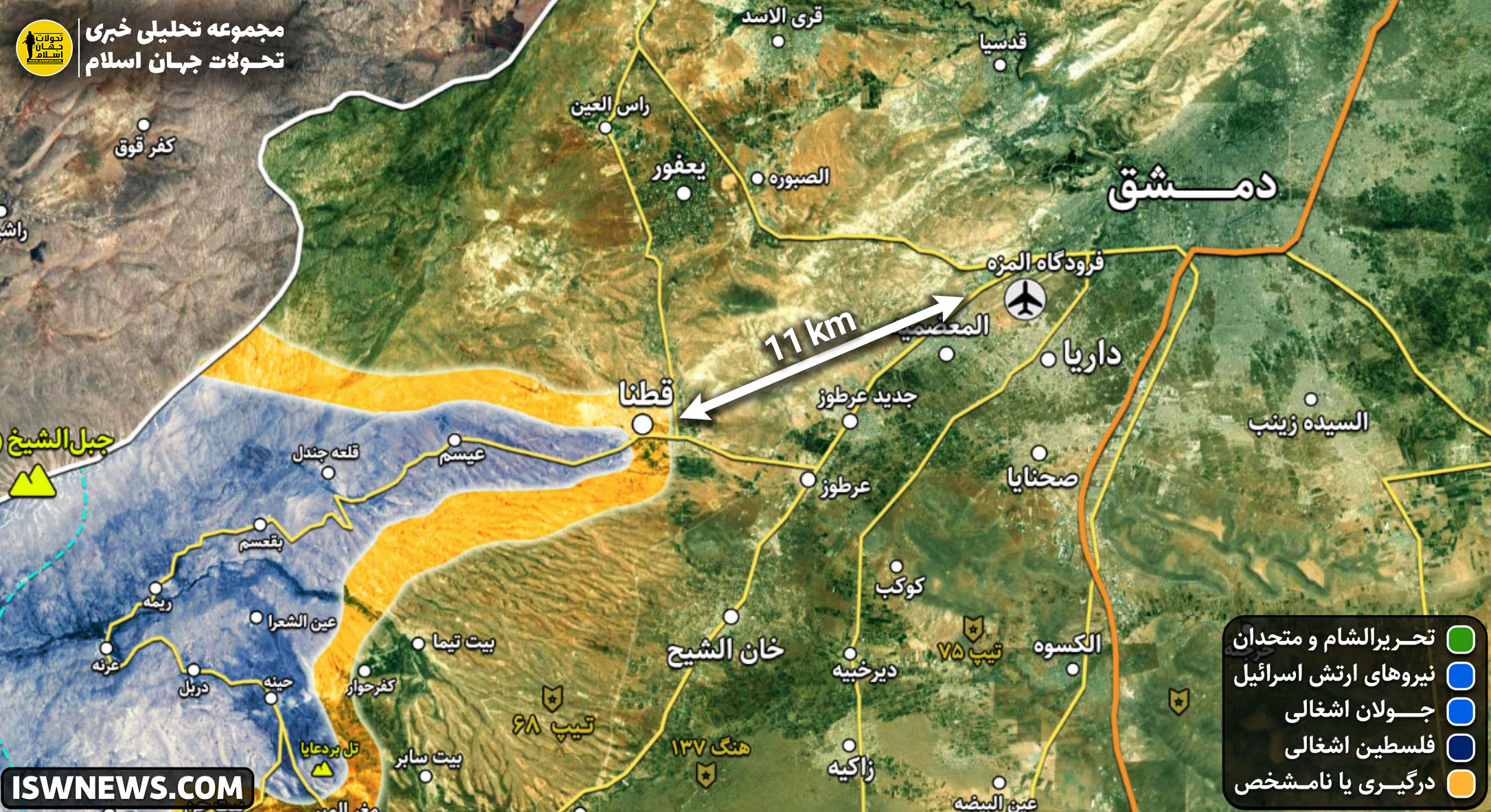
    According to videos that have emerged, an Israeli army convoy consisting of approximately 15 vehicles has reached the outskirts of Qatna.

    In addition to Qatna, Israeli forces have also entered the village of Al-Rafid in Quneitra province. This area has seen security operations and inspections conducted by the Israeli army in recent weeks.

    Despite calls from Syrians to confront the Israeli regime and the threats made by Julani militants, the forces of the new Syrian government have not taken any action to prevent or confront the Israeli army’s movements. The Israeli advance in southern Syria continues amidst the silence of the Julani government.

  • Israeli Warplanes Strike Palestinian Islamic Jihad in Damascus

    Israeli Warplanes Strike Palestinian Islamic Jihad in Damascus

    Israeli Defense Minister Yisrael Katz issued a renewed warning to the new Syrian president, Abu Muhammad al-Julani. Katz stated, “Wherever terrorist activity is organized against Israel, al-Julani will see our air force fighter jets flying overhead and attacking terrorist targets. We will not allow Syria to become a threat to Israel.”

    His comments suggest that Israel holds the Julani government accountable for any actions against Israeli interests in southern Syria. With these threats, Israel aims to compel the Syrian government to take stronger intelligence and security measures against Palestinian groups as well as remnants of the Syrian army.

    The Israeli army classified the attack as an intelligence operation, claiming it struck a command center of the Palestinian Islamic Jihad group. According to the military, this headquarters was responsible for commanding, planning, and directing activities against Israel.

    An Israeli security source told local media that the Islamic Jihad forces were involved in shaping and planning attacks on Israeli positions in southern Syria.

    The ongoing Israeli attacks in Syria indicate the strengthening of Israel’s intelligence and security network within the country. Despite the fall of Bashar al-Assad government, this network continues to operate, conducting intelligence operations against Palestinian groups and Syrian cells that support the resistance axis.

  • Russian Delegation Visits Damascus, Begins Ties with New Syrian Government

    Russian Delegation Visits Damascus, Begins Ties with New Syrian Government

    The delegation, led by Mikhail Bogdanov, Deputy Foreign Minister of Russia, and Alexander Lavrentiev, Putin’s special envoy for Syria, met with Abu Muhammad al-Julani, the leader of Hayat Tahrir al-Sham in Damascus on January 28.

    During the meeting, Al-Julani requested that the Russian delegation restore the lost trust by paying compensation and participating in the reconstruction of Syria.

    For many years, Russia has been considered a supporter and partner in the leadership of Syria during the Assad family’s rule. During the Syrian war, Russia, along with Iran, played a significant role in changing the battle’s equation in favor of the central government. Russian airstrikes were a key factor in the militants’ defeat, and Russian military support inflicted significant losses on the militants. It appears that the new Syrian government has come to terms with Russia’s past support for Bashar al-Assad and attacks on militants, recognizing Moscow’s international influence and role in addressing future challenges.

    Simultaneously with the presence of the high-ranking Russian delegation in Damascus, the Russian newspaper Tass, citing the Turkish newspaper Sabah, considered five possible scenarios for Syria’s future:

    • The creation of the Syrian Democratic Republic by a coalition of opposition parties with ideological differences.
    • The creation of the Islamic Republic of Syria by Hayat Tahrir al-Sham (formerly Jabhat al-Nusra) and other terrorist groups.
    • The creation of an anti-Shiite state under the support and control of the Zionist regime.
    • The creation of a federal Syrian republic with regional and state governments under US supervision.
    • The division and disintegration of Syria.

    Syria is currently facing numerous intra-group and ideological differences, as well as economic, social, and security problems. The new Syrian government has not reached an agreement with the Syrian Democratic Forces, and the areas under SDF control remain outside the Damascus government’s control. Areas in southern Syria are also occupied by the Israeli army, and no specific time for the Zionist withdrawal from these areas has been announced, putting Syria at risk of disintegration.

    While none of the above scenarios can be definitively predicted for Syria’s future, it is evident that Al-Julani is seeking to form a seemingly Islamic government with a strong presence of Tahrir al-Sham elements. This possibility has become stronger given recent appointments and actions.

  • Damascus Airport Resumes International Flights

    Damascus Airport Resumes International Flights

    Damascus Airport had been closed since December 8, following the fall of Bashar al-Assad’s government. This closure allowed for renovations and repairs to restore the airport’s operational capacity. The reconstruction aims to facilitate humanitarian aid, boost the economy, improve tourism, and enhance international relations.

    Today, an Ilyushin Il-76TD aircraft from Kazakhstan’s Sapsan Airline arrived at Damascus Airport from Riyadh, Saudi Arabia, carrying food and medical aid for the King Salman Humanitarian Aid and Relief Center.

    The flight schedule indicates significant activity, with outgoing flights to Amman, Abu Dhabi, Sharjah, Doha, and Baghdad, and incoming flights from Beirut, Doha, Sharjah, and Abu Dhabi. These flights are operating as planned on Tuesdays and Wednesdays.

  • Damascus and Riyadh Establish Official Ties; Syrian Transitional Government’s FM Visits Saudi Arabia

    Damascus and Riyadh Establish Official Ties; Syrian Transitional Government’s FM Visits Saudi Arabia

    The Syrian delegation was welcomed at Riyadh International Airport by Walid bin Abdulkarim Al-Khuraiji, Saudi Arabia’s deputy foreign minister.

    The interview of Abu Muhammad Al-Julani, the leader of Tahrir Al-Sham, with Saudi Arabia’s Al-Arabiya channel—his first with a foreign media outlet since the fall of Bashar al-Assad’s government—along with Asaad Al-Shaybani’s choice of Riyadh for his first foreign visit, highlights the level of relations between the new Syrian rulers and Saudi Arabia.

    After severing ties with the Syrian government in 2012, Saudi Arabia became a significant supporter of the militant groups in the Syrian war, providing financial and military support. The first official foreign trip by Al-Julani government officials to Saudi Arabia sends important signals to regional countries.

    Saudi Arabia, a strong opponent of the Muslim Brotherhood, designates the group as a terrorist organization. In contrast, Turkey has traditionally supported the Syrian Muslim Brotherhood and its associated militia factions. Al-Julani officials’ visit to Saudi Arabia indicates a strategic move to balance Turkey’s influence in Syria by increasing cooperation and bringing Saudi Arabia into the equation of the new Syria.

  • Important Meeting of Terrorist Group Leaders in Damascus

    Important Meeting of Terrorist Group Leaders in Damascus

    During this meeting, it was decided that the armed groups would disband and surrender their weapons to be incorporated into the structure of the Ministry of Defense of the Syrian transitional government.

    The control exerted by the militants of these groups over various regions of Syria, along with their ideological differences, presents significant challenges to the new Syrian government. Recognizing this, al-Julani has opted to dissolve the Syrian armed groups and assimilate them into the Syrian army to mitigate potential internal tensions and conflicts.

    This strategy has been somewhat effective in the southern and northern regions of Syria; however, it has not yet made progress concerning the Syrian Democratic Forces (SDF). Consequently, tensions and conflicts in areas like Manbij and Deir Ezzor continue to persist.

  • Israeli New Aggression On Syria; 9 Civilians Murdered (Video)

    Israeli New Aggression On Syria; 9 Civilians Murdered (Video)

    On November 10, the Israeli regime’s fighter jets targeted a building in the Sayyida Zaynab town near the Syrian capital Damascus.

    A Syrian military source reported that around 5:00 p.m. (local time) on Sunday, the Israeli regime targeted a residential building in the Sayyida Zaynab town near Damascus with an airstrike from the occupied Golan Heights. This air raid resulted in the martyrdom of seven civilians, injuries to 20 others, as well as material damages.

    On the other hand, local sources reported that as a result of the air strike by the Israeli regime’s army at the Sayyida Zaynab town near the Syrian capital city, at least nine people were martyred and 20 others were injured; considering the condition of the injured, there is a possibility that the death toll may rise.

    In recent years, the Israeli regime’s army has repeatedly targeted the positions of the Resistance Axis and the Syrian army with missile and air strikes.

    Following the onset of Operation Al-Aqsa Storm by the Palestinian resistance movement Hamas and Syria’s significant role in supporting the Resistance Axis, Israeli airstrikes against various regions in Syria, especially Damascus and Homs governorates, have increased.

    Most of the Israeli regime’s attacks in the past year have aimed at assassinating senior resistance commanders and destroying logistic centers and important ammunition depots. During these strikes, hundreds of resistance fighters and even Syrian civilians have been martyred and injured.

  • Sayyed Hassan Nasrallah’s Son-In-law Martyred In Israeli Airstrike On Damascus

    Sayyed Hassan Nasrallah’s Son-In-law Martyred In Israeli Airstrike On Damascus

    On October 2, Israeli fighter jets targeted a building in the Mezzeh municipality of Damascus. A Syrian military source declared that around 5:25 p.m. local time on Wednesday, the Israeli regime launched an air strike on the Mezzeh municipality from the regime’s occupied Golan Heights. The assault resulted in the martyrdom of three civilians, injuries to three others, as well as material damages.

    Studies indicate that the main target of the Israeli army’s attack on the building in the Mezzeh municipality was the assassination of Hezbollah fighters. Following the air raid, Hasan Jafar Qasir, son-in-law of Martyred Hezbollah Secretary General Sayyed Hassan Nasrallah, along with two others, was martyred, and three others were injured.

    On October 1, the Israeli army also claimed in a statement that Muhammad Jafar Qasir (Hasan Jafar Qasir’s brother), the commander of the unit transferring weapons from Iran to Lebanon (Hezbollah’s Unit 4400), was assassinated in Beirut alongside Zulfiqar Hanawi, the commander of Imam Hussein Brigade. The United States had set a $10 million reward in June 2022 for information on Muhammad Jafar Qasir.

    Bearing in mind claims from Hebrew media outlets regarding the activities of Muhammad and Hassan Jafar Qasir in financial, monetary, and arms supply exchanges for Hezbollah, the recent attacks by the Israeli regime indicate that the Tel Aviv regime is seeking significant blows to Hezbollah’s financial and arms supply network in Lebanon and Syria.

    It is also noteworthy that this is the third air strike by the Israeli military on Syria in the past three days. The regime’s fighter jets also targeted locations in the Daraa and As-Suwayda governorates the day before.

  • Israeli Airstrikes Targets Damascus

    Israeli Airstrikes Targets Damascus

    According to a Syrian military source, “at around 03:20 (local time) on Thursday, the Israeli regime targeted some areas in the suburbs of Damascus from the occupied Syrian Golan. The Syrian air defenses succeeded in destroying a number of missiles. This attack caused material damage.”

    No further details published by the official authorities regarding the airstrike, but according to some media reports, Israel allegedly attacked the cultural and media center of the Al-Nujaba movement in Damascus.