Tag: Gaza ceasefire

  • Gaza Ceasefire Agreement Takes Effect; Israeli Cabinet Officially Approves End of War

    Gaza Ceasefire Agreement Takes Effect; Israeli Cabinet Officially Approves End of War

    Under the terms of the deal, Israeli forces are required to withdraw from designated areas within 24 hours. In return, Palestinian resistance groups will begin releasing Israeli captives 72 hours after the withdrawal. Tel Aviv has also agreed to release a number of Palestinian detainees.

    A joint oversight committee—comprising representatives from the United States, Qatar, Egypt, Turkey, and other nations—will monitor the implementation of the agreement and mediate any disputes between the parties.

    According to released footage, the Israeli military has begun dismantling and evacuating several of its positions in the Gaza Strip. The Israeli army confirmed that the ceasefire officially came into effect at 12:00 p.m. local time.

    Israeli military has begun dismantling and evacuating several of its positions in the Gaza Strip
    Israeli military has begun dismantling and evacuating several of its positions in the Gaza Strip
  • How Will the Israeli Army Withdraw From the Gaza Strip? (Map)

    How Will the Israeli Army Withdraw From the Gaza Strip? (Map)

    Under the ceasefire agreement, the Israeli army will gradually withdraw from various areas of the Gaza Strip over the coming days and weeks, in stages.

    • Initial Withdrawal: Israeli forces left the southern areas of Beit Lahia and Jabalia yesterday, re-establishing the connection between northern Gaza and Gaza City. Displaced residents in the north are returning home.
    • Next Steps: On the seventh day of the agreement, Israeli forces will begin withdrawing from the Netzarim axis in central Gaza. They will initially move from Al-Rashid Street to Salah al-Din Street, and by the twenty-second day, will retreat to the buffer zone on the Gaza border, reopening travel routes for Palestinians.
    • Final Phase: On the 50th day, Israeli forces will fully withdraw from southern Gaza and the Philadelphi axis, redeploying to a 1-kilometer-deep buffer zone along the Gaza border.

    Avichay Adraee, the Arab spokesman for the Israeli army, released a map showing the locations of Israeli forces in Gaza. He noted that currently, movement from south to north Gaza is dangerous due to Israeli presence on the Netzarim axis. Starting next week, Palestinian civilians will be able to return to northern Gaza. Activities such as fishing, swimming, diving, and approaching buffer zones, the Rafah crossing, and the Philadelphia axis will remain prohibited.

    Click to view full size
  • Hamas, Islamic Jihad Respond To Ceasefire Proposal

    Hamas, Islamic Jihad Respond To Ceasefire Proposal

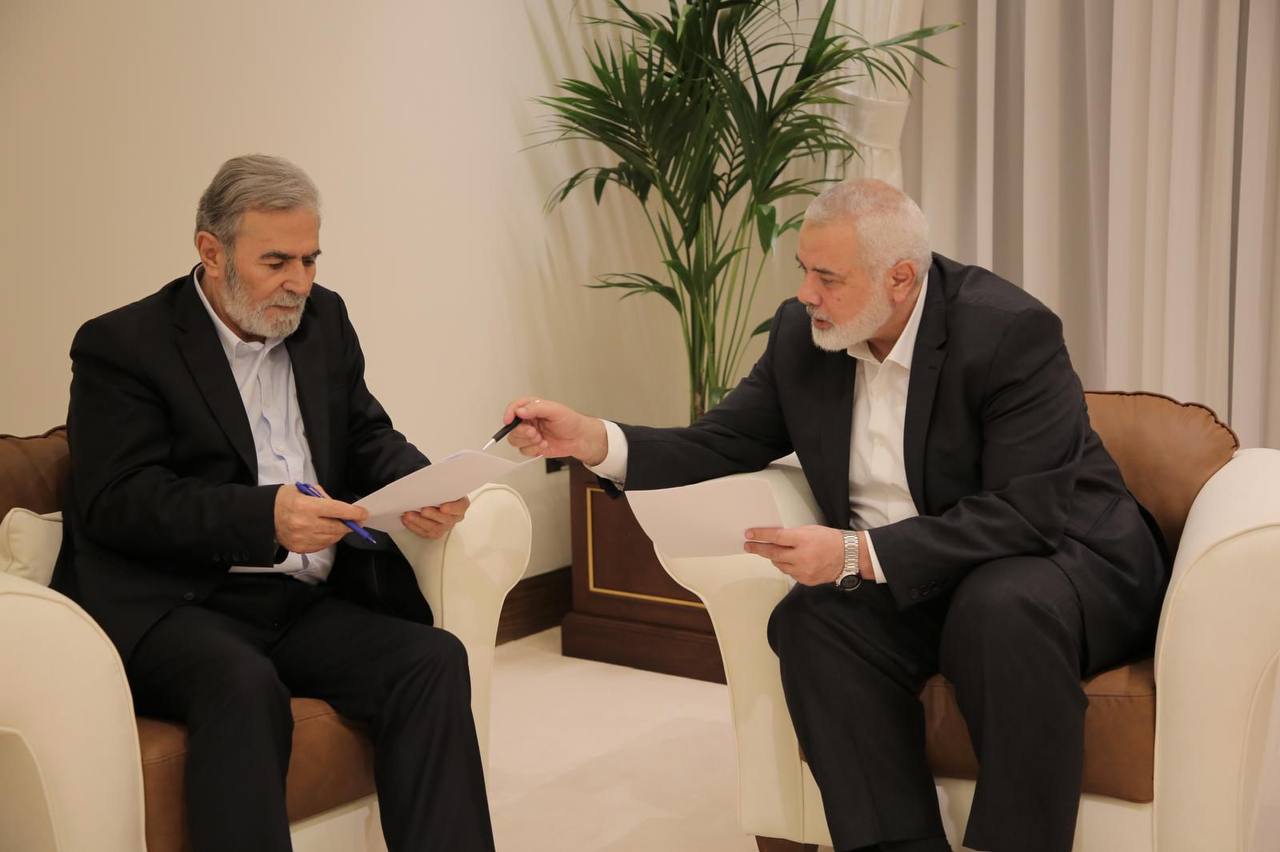
    Hamas and Islamic Jihad movements have announced in a statement that head of the Hamas political Bureau Ismail Haniyeh and Secretary-General of Islamic Jihad in Palestine Ziyad al-Nakhala delivered the response of the resistance groups to the proposed ceasefire and prisoner swap initiative in a meeting with the Qatari Prime Minister Sheikh Mohammed bin Abdulrahman bin Jassim Al Thani. They also delivered their response to Egypt.

    The statement emphasizes that the resistance groups considered the interests of the Palestinian people, the imperative necessity of a complete cessation of hostilities, and the full withdrawal of occupying forces from Gaza in the response to the proposal.

    The statement further asserts that a Palestinian delegation, relying on a sense of national responsibility, expresses readiness for positive engagement to achieve an agreement that would bring an end to the ongoing war.

    The two resistance movements said in a joint statement that they are ready to “deal positively to arrive at an agreement” and that their priority is to bring a “complete stop” to the regime’s assault on the besieged area.

    Senior Hamas official Osama Hamdan told Lebanon’s Al-Mayadeen television network that the group had “submitted some remarks on the proposal to the mediators.”

    A Hamas official also told Reuters that the response reaffirmed any agreement must end the Zionist aggression on Palestinian people, get the occupying forces out, reconstruct Gaza and achieve a serious prisoner swap deal.

    The foreign ministries of Qatar and Egypt said in a joint statement that they were examining Hamas’ response and that they would continue their mediation efforts along with the United States until an agreement is reached.

    White House National Security Spokesperson John Kirby said the US had also received and was evaluating the response.

    US Secretary of State Antony Blinken visits the region to pursue Washington’s plan and discuss Zionist officials.

  • Hamas Received The Draft Proposal Of Paris Talks

    Hamas Received The Draft Proposal Of Paris Talks

    Based on this draft, all military operations will be stopped for 40 days and for every Zionist prisoner in Gaza, 10 Palestinian prisoners will be exchanged. Hospitals and bakeries are being repaired in Gaza.

    According to Reuters, the proposed plans include:

    • Both parties stop their military operations completely.
    • Aerial reconnaissance operations over Gaza will stop for eight hours a day.
    •  All Israeli hostages, including women, children under 19 years of age, the elderly aged 50 years and above, and the sick, must be released in exchange for a specific number of Palestinian prisoners according to the numbers listed below.
    • In exchange for the 40 hostages listed under the humanitarian category, approximately 400 Palestinian prisoners will be released, according to the ratio of 10 prisoners to one hostage.
    • Gradual return of all displaced civilians – except men of military service age – to the northern Gaza Strip.
    •  After commencing the first phase, Israel will reposition its forces away from densely populated areas in the Gaza Strip.
    • Commitment to bring in 500 trucks per day of humanitarian aid.
    • Commitment to providing 200,000 tents and 60,000 caravans.
    • Allowing the rehabilitation of hospitals and bakeries in Gaza, including immediately allowing the entry of necessary equipment and providing shipments of fuel for these purposes, according to quantities to be agreed upon.
    • Israel agrees to the entry of heavy machinery and equipment to remove rubble and assist with other humanitarian purposes, with the provision of fuel shipments necessary for these purposes, according to quantities to be agreed upon, provided that they increase over time. Hamas pledges not to use these machines and equipment to threaten Israel.
    • It is understood that the arrangements agreed in the first phase will not apply to the second phase, which will be subject to subsequent separate negotiations.

    In this regard, the American media Axios announced that the Hamas movement is discouraged from the new proposals to reach a ceasefire agreement and the exchange of prisoners in the current battle, and there are still wide differences between them and the Zionist regime. There is no room for optimism and at the current stage, it is difficult to imagine an agreement between Israel and Hamas before Ramadan.

    It is worth mentioning that during the last four months, high-level talks were held between the American, Qatari and Israeli delegations to stop the war, but these meetings did not have any specific results; And so far, efforts to establish a ceasefire and exchange prisoners between Hamas and the Israeli regime have been unsuccessful.