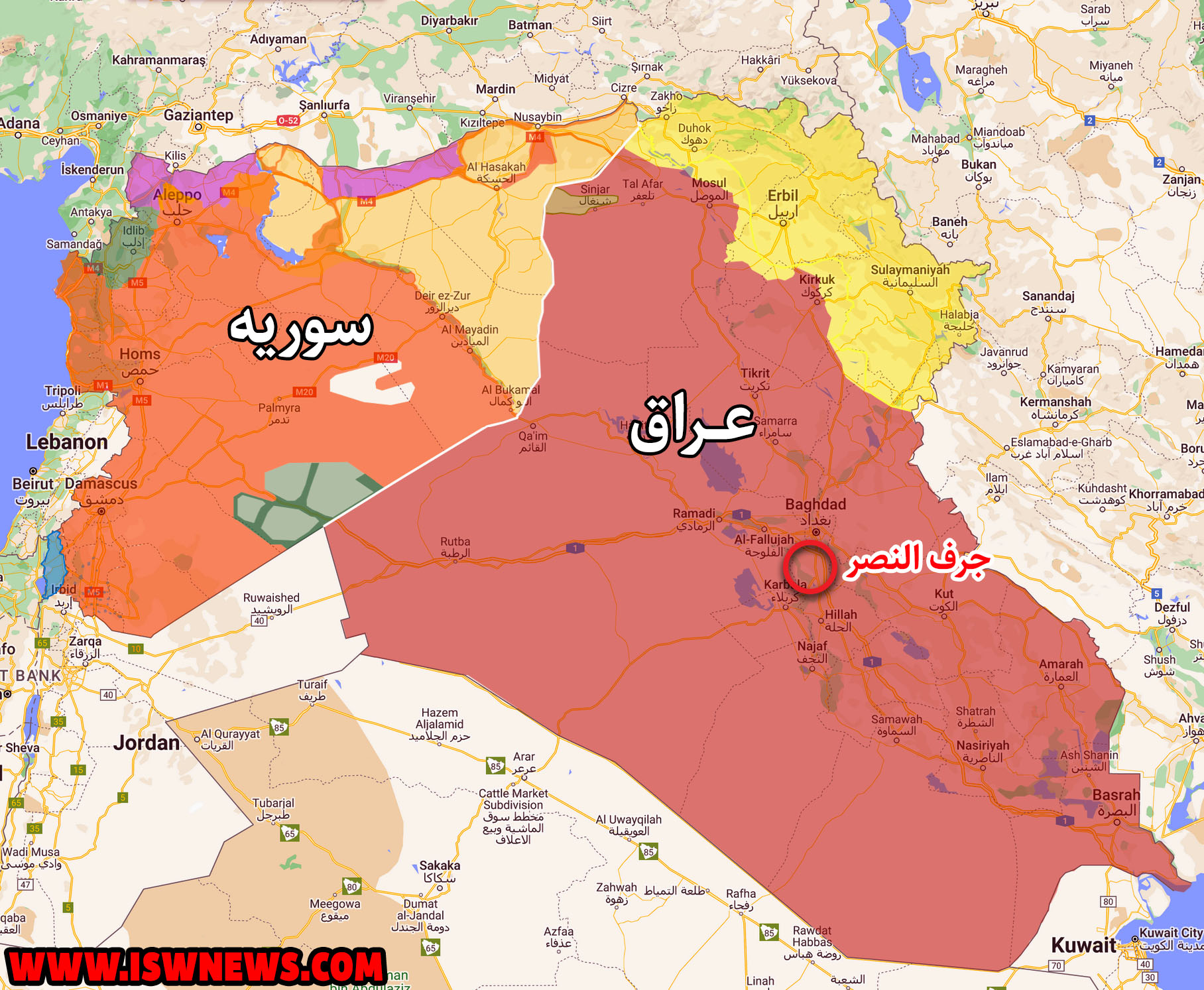
The Jurf al-Sakhr area, known as Jurf al-Nasr, in Babil governorate south of Baghdad, has once again become one of the key focal points of Iraq’s political and security developments in recent days. The area’s importance is not limited to its geographic location; the history of resistance forces’ presence there, its role in fighting the ISIS terrorist group, and long-standing disputes over security management and the return of displaced residents have made Jurf al-Nasr one of the sensitive areas in Iraq’s internal equations.
From the liberation of Jurf al-Nasr to the formation of a special security situation
Jurf al-Nasr fell to the ISIS terrorist group in 2014, as the group’s attacks expanded across Iraq. Subsequently, Iraqi army forces and resistance groups, including Kataib Hezbollah, succeeded in liberating the area through military operations.
After ISIS’s defeat, resistance forces remained in Jurf al-Nasr, and the area became one of their key security deployment points. More than a decade after its liberation, restrictions on civilian movement and delays in the return of a large number of displaced families remain among the area’s most important unresolved issues. As a result, Jurf al-Nasr gradually became more than a geographic area—it became a matter tied to the security balance, the central government’s authority and the role of resistance forces in Iraq’s defense structure.
Oil smuggling reports: the spark for a new round of tensions
The new round of developments dates back to early November 2026, when reports emerged about suspicious activity near oil pipelines in Jurf al-Nasr. Shafaq News published a report based on a 19-page technical and intelligence document and a review of satellite images, citing the observed movement of oil tankers, some metal equipment, small refining units and storage tanks at four locations in the area between 2021 and 2026.
Importantly, the technical report did not directly identify Kataib Hezbollah as the party responsible for the smuggling; nevertheless, some media outlets and government officials, pointing to the group’s security influence in the area, tried to link the issue to the presence of resistance forces.
In response, Kataib Hezbollah stated that the facilities in question are mainly used for fuel storage and for meeting logistical and military needs.
The Iraqi government steps in and forms an investigative committee
Following the publication of these reports, Iraqi Prime Minister Ali Falih al-Zaidi ordered the formation of a high committee to investigate the oil smuggling allegations. The committee, with representatives from security, intelligence and judicial bodies, the Ministry of Oil, the Federal Police and the Popular Mobilization Forces (Hashd al-Shaabi), was tasked with examining various aspects of the case.
Iraqi government spokesman Haider al-Aboudi later announced that committee members had visited six locations in Jurf al-Nasr and that, according to him, evidence of tampering with oil pipelines and attempts to conceal it had been found. He also reported the identification of two refineries, one tanker and several storage tanks.
A parliamentary committee was also formed to review the documents and intelligence reports. However, until the final report is published and legal responsibility is determined for the individuals or groups involved, the claims about oil smuggling still required judicial review and proof.
Dismissal of security officials and worsening disputes
As the case expanded, the Iraqi government announced the dismissal of nine security and administrative officials. A number of officials from security, police, and oil bodies, including some police officials in Babil governorate and parts of the Hashd al-Shaabi, were among those dismissed.
The resignation of Ali Turki al-Jamali, the governor of Babil, was also raised during these developments. He had previously questioned some reports about oil smuggling and said the facilities in question were used to supply fuel for security forces and Hashd al-Shaabi vehicles.
Threat of military intervention and concern over a confrontation with Kataib Hezbollah
As disputes grew, the Iraqi prime minister ordered government forces to prepare to enter Jurf al-Nasr and called on Kataib Hezbollah to evacuate the area.
This stance heightened concerns about a possible direct clash between government forces and one of Iraq’s most important resistance groups—a tension that could have broad consequences for the internal cohesion of the Hashd al-Shaabi and for relations among Iraq’s political and military currents.
The Iraqi government stressed the need for all armed formations to come under official command, while resistance forces viewed their presence in Jurf al-Nasr as part of the security arrangements that took shape after the war with ISIS.
General Qaani’s mediation and efforts to prevent internal conflict
At the height of the disputes, political and security efforts to prevent the crisis from turning into an armed confrontation intensified. According to the Lebanese newspaper Al-Akhbar, General Esmail Qaani, commander of the Quds Force of the Islamic Revolutionary Guard Corps, traveled to Baghdad during these developments and met and held talks with a number of Iraqi political and military figures.
The newspaper said General Qaani’s consultations aimed to prevent the dispute between the Iraqi government and Kataib Hezbollah from escalating and to reach a mechanism for managing the security situation in Jurf al-Nasr. Hadi al-Amiri, head of the Badr Organization, was also mentioned among the figures influential in the mediation process.
According to Al-Akhbar, the outcome of these consultations was an agreement to reorganize forces and redistribute security responsibilities—an agreement that prevented the disputes from turning into a large-scale internal conflict.
Agreement on reorganizing forces, without a full withdrawal of the resistance
Contrary to some speculation about a complete withdrawal of resistance forces from Jurf al-Nasr, the Al-Akhbar report stresses that the final agreement does not mean the end of Kataib Hezbollah’s presence in the area.
Under the agreement, the Federal Police, the Iraqi army, the Hashd al-Shaabi and the Energy Police are to operate within new security arrangements, with each unit’s responsibilities defined within a coordinated structure.
In this connection, Abu Talib al-Saidi, one of Kataib Hezbollah’s commanders, told Al-Akhbar that he rejected any description of these developments as a withdrawal or a confrontation with government forces. He described Iraq’s security forces as part of the national collective and as partners of the resistance forces in defending the country, and stressed that the repositioning of forces and the reorganization of units are aimed at preventing discord and clashes among Iraqi forces.
Opening of the command headquarters and the start of government force deployment
On November 20, the implementation of the new arrangements moved into its operational phase, with convoys of security forces moving from Baghdad toward Jurf al-Nasr. In this framework, the central control and command headquarters was opened in the area, and Major General Ahmed Hatem Hamid, commander of the headquarters, announced that the Federal Police would be responsible for commanding it.
At a press conference, he explained that the deployment of forces and the replacement of responsible units had begun that same day and would cover the entire Jurf al-Nasr area. The process is being carried out according to a set timetable and under the supervision of the central headquarters.
Sabah al-Numan, spokesman for the commander-in-chief of the Iraqi armed forces, also announced that the necessary authority to establish security and enforce the law in the area had been delegated to the central headquarters.
Meanwhile, Yasser al-Issawi, deputy chief of staff of the Hashd al-Shaabi, stressing that all units of the organization obey the orders of the commander-in-chief of the armed forces, announced the start of the operation to reorganize and redeploy forces.
Establishment of 12 security posts to protect oil pipelines
One of the important parts of the new security plan is strengthening the protection of oil infrastructure and petroleum product transmission routes. The Iraqi Energy Police command announced in a statement that 12 new security points had been established in Jurf al-Nasr to increase monitoring of pipelines and related facilities.
According to the statement, Energy Police forces have been deployed in the area under a protection plan, and the construction of a battalion headquarters is also on the agenda. A new road has also been built along the oil pipeline network to facilitate the movement of forces, increase field monitoring, and speed up response to possible incidents.
Major General Hamed al-Husseini, commander of the Iraqi Energy Police, also announced that his forces are responsible for protecting the roughly 100-kilometer pipeline network in Jurf al-Nasr. He reported the deployment of a Federal Police commando battalion in the area to protect the oil transmission lines.
The Iraqi prime minister’s message: Jurf al-Nasr as the starting point for the state’s monopoly on weapons
In the latest developments, Ali Falih al-Zaidi, Iraq’s prime minister and commander-in-chief of the armed forces, published a message addressed to the armed forces, especially the units deployed in Jurf al-Nasr.
Describing the developments in the area as an important stage in Iraq’s history, he stressed that Jurf al-Nasr can be the starting point for unifying the armed forces and extending the state’s authority across the entire country.
Al-Zaidi called on the forces deployed in the area to act with restraint and foresight, and made clear that their mission is not to fight one another, since all forces present in the area are children of the same land.
The Iraqi prime minister also stressed the need to move toward convergence and to draw forces in rather than exclude and sideline them, saying that all formations must operate within the framework of the armed forces, under a single command and in accordance with the law.
In another part of his message, he stated the government’s position on the monopoly on weapons explicitly, saying that no weapons should exist outside the state’s authority and that decisions on the country’s affairs must be made within the framework of Iraqi sovereignty.
Although the recent agreement prevented the disputes from turning into a direct conflict among Iraqi forces, it cannot be taken to mean a root-and-branch resolution of the Jurf al-Sakhr issue. The root of the crisis is assessed as going beyond the claims about oil smuggling and the protection of energy transmission lines. Jurf al-Sakhr had become a platform for applying political and security pressure on Kataib Hezbollah, with the ultimate aim of placing the group before two costly paths: entering into an internal confrontation with government forces, or facing external threats and attacks and ultimately accepting disarmament.
In this context, some circles close to the resistance speak of the role played by the US, the UAE and Saudi Arabia, along with the complicity of some Iraqi currents and figures, in shaping this pressure. However, the main issue at the strategic level is the dispute over the future of Iraq’s armed structure and the limits of the resistance groups’ authority. From this perspective, even if the Jurf al-Nasr crisis subsides, the dispute over the state’s monopoly on weapons, the command structure of the Hashd al-Shaabi, and the limits of powerful groups’ operational independence will remain. In other words, the recent agreement resembles more the management of an urgent crisis than a comprehensive agreement on the future of Iraq’s security structure.