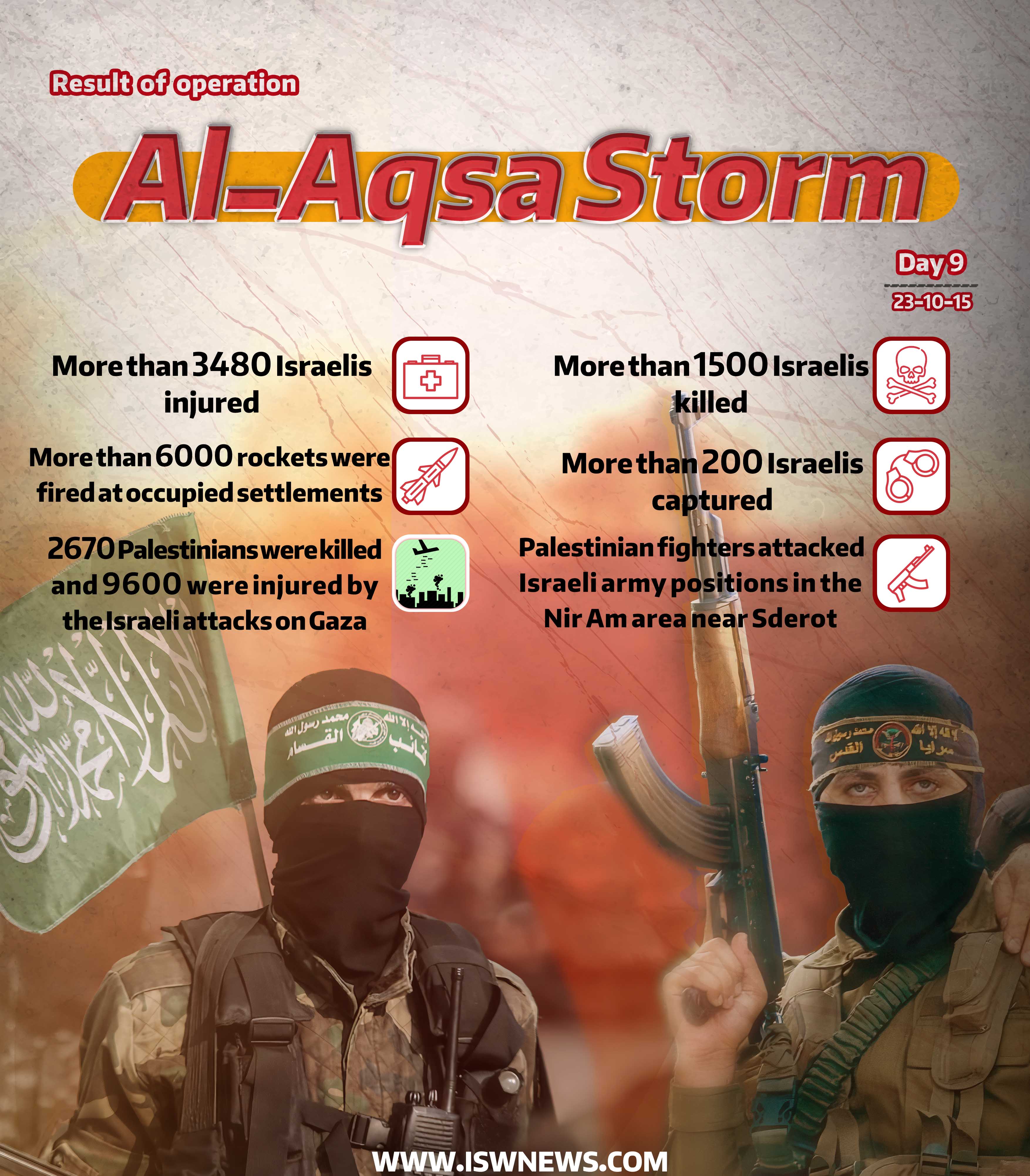
During the battles between the Palestinian resistance groups and the Israeli regime, so far, more than 1,500 Israelis were killed, more than 3,480 Israelis were wounded and at least 200 Israelis were captured by the Palestinian forces.
Palestinian resistance groups fired more than 6,000 rockets at the occupied territories.
Scattered clashes continued along all the front lines of the battle.
The Palestinian Ministry of Health in the Gaza Strip announced that more than 2,670 Palestinians were killed and more than 9,600 others were wounded since the start of the conflict.
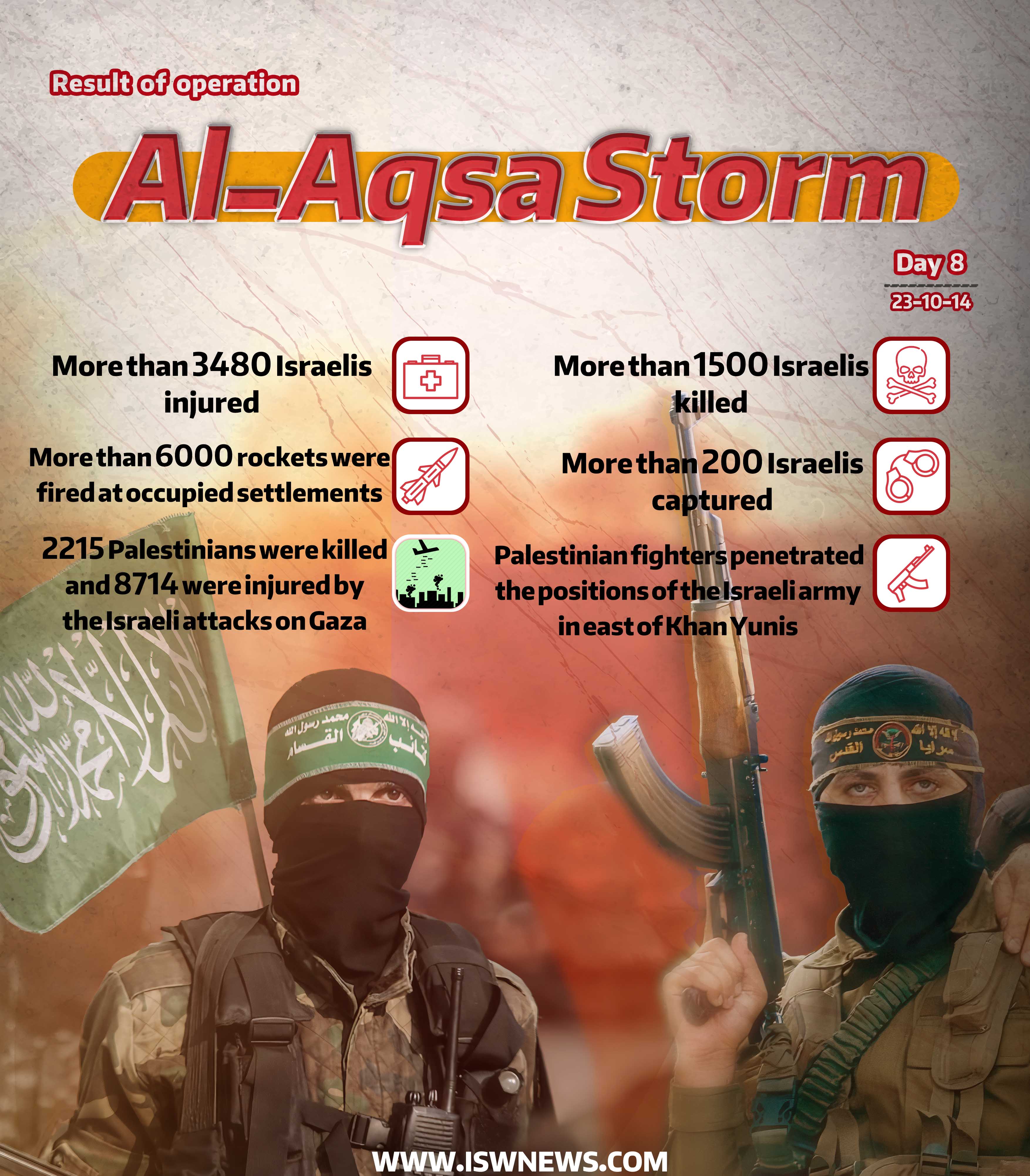
Palestinian resistance groups fired more than 6,000 rockets at the occupied territories.
Scattered clashes continued along all the front lines of the battle.
The Palestinian Ministry of Health in the Gaza Strip announced that more than 2,215 Palestinians were killed and more than 8,714 others were wounded since the start of the conflict.
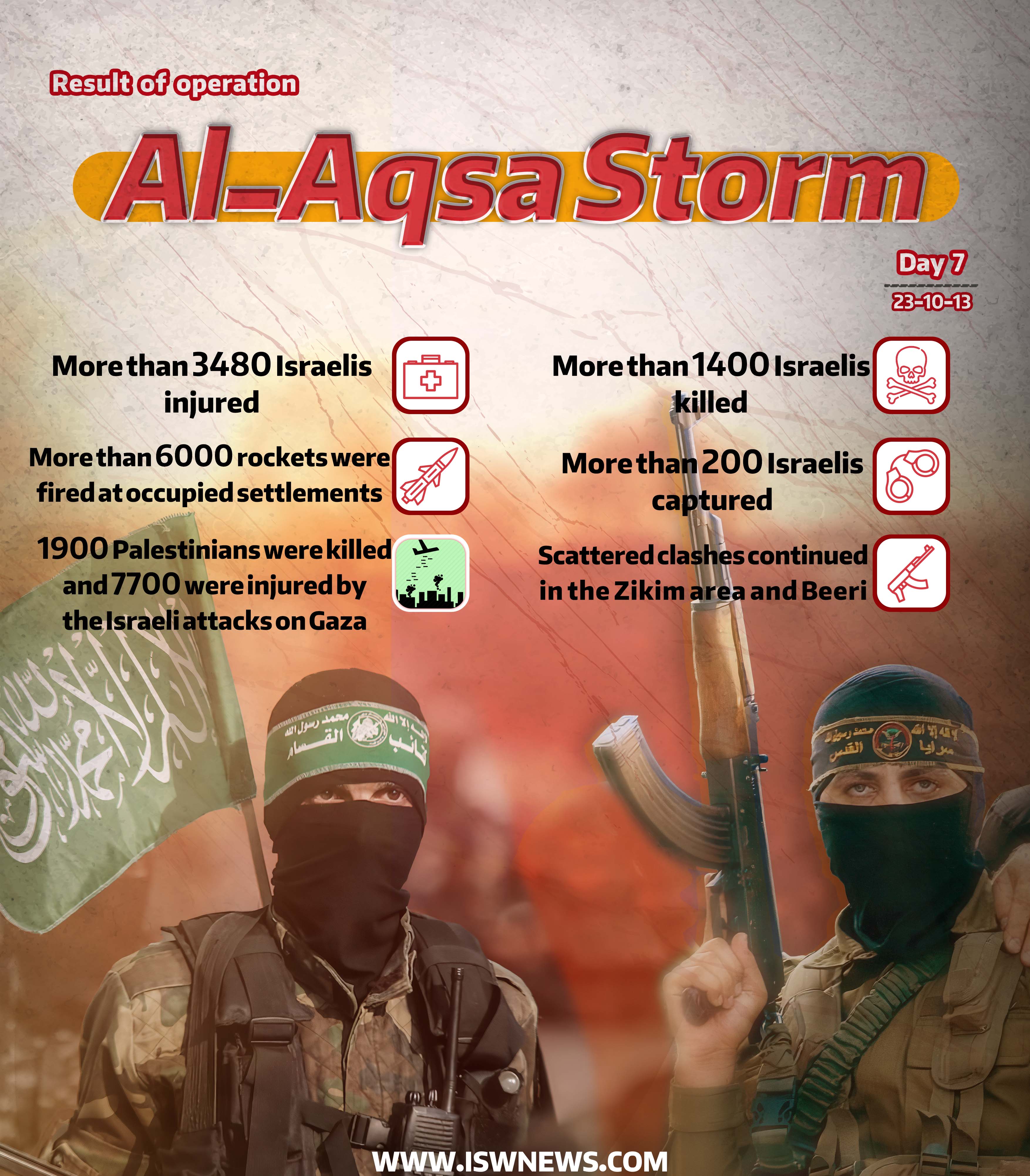
Palestinian resistance groups fired more than 6,000 rockets at the occupied territories.
Scattered clashes continued along all the front lines of the battle.
The Palestinian Ministry of Health in the Gaza Strip announced that more than 1,900 Palestinians were killed and more than 7,700 others were wounded since the start of the conflict.
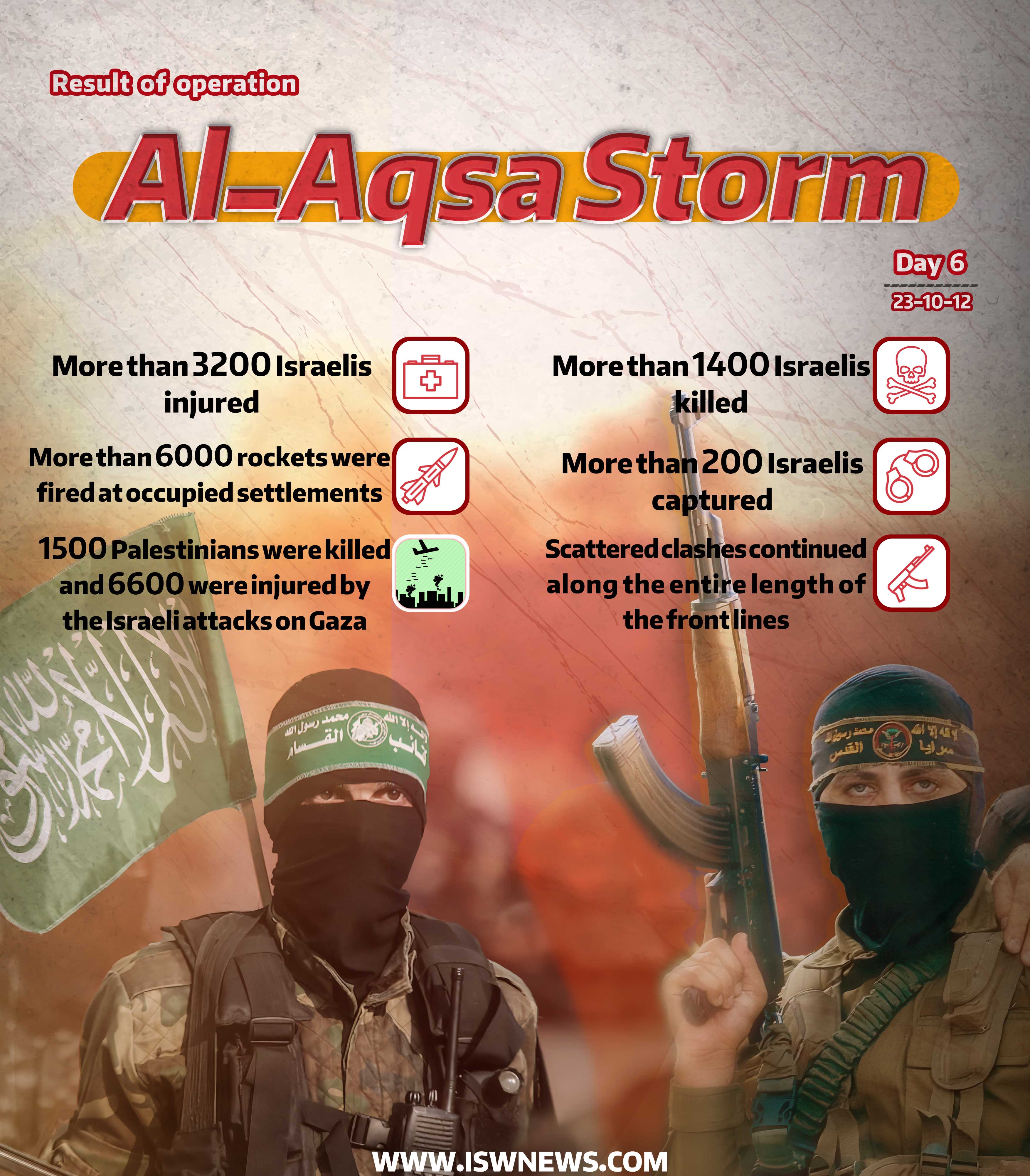
Palestinian resistance groups fired more than 6,000 rockets at the occupied territories.
Scattered clashes continued along all the front lines of the battle.
The Palestinian Ministry of Health in the Gaza Strip announced that 1,500 Palestinians were killed and 6,600 others were wounded since the start of the conflict.
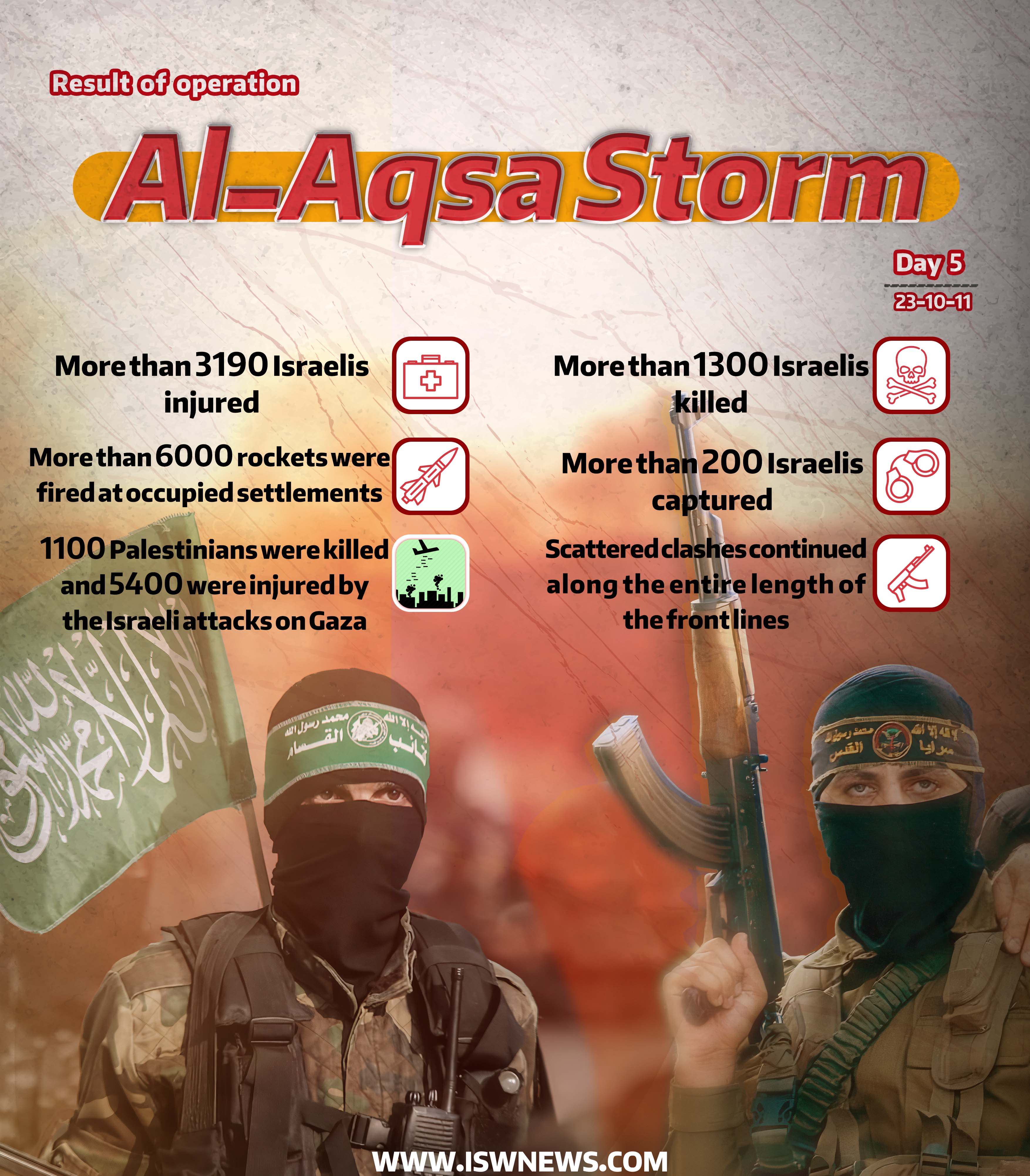
During the battles between the Palestinian resistance groups and the Israeli regime, so far, more than 1,300 Israelis were killed, more than 3,190 Israelis were wounded and at least 200 Israelis were captured by the Palestinian forces.
Palestinian resistance groups fired more than 6,000 rockets at the occupied territories.
Scattered clashes continued along all the front lines of the battle.
The Palestinian Ministry of Health in the Gaza Strip announced that 1,100 Palestinians were killed and 5,400 others were wounded since the start of the conflict.
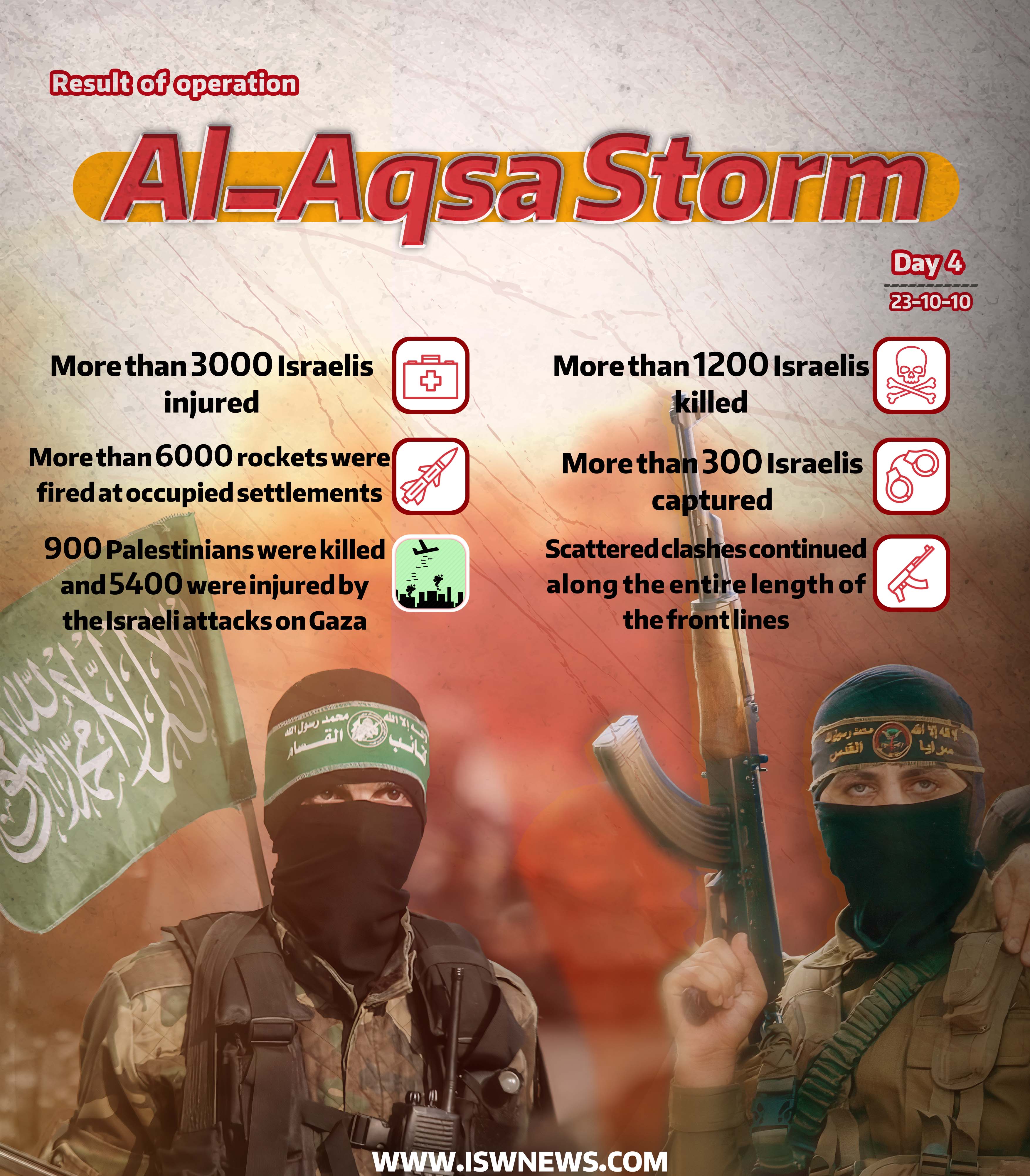
Palestinian resistance groups fired more than 6,000 rockets at the occupied territories.
Scattered clashes continued along all the front lines of the battle.
The Palestinian Ministry of Health in the Gaza Strip announced that 900 Palestinians were killed and 5,400 others were wounded since the start of the conflict.
Palestinian resistance groups fired more than 6,000 rockets at the occupied territories.
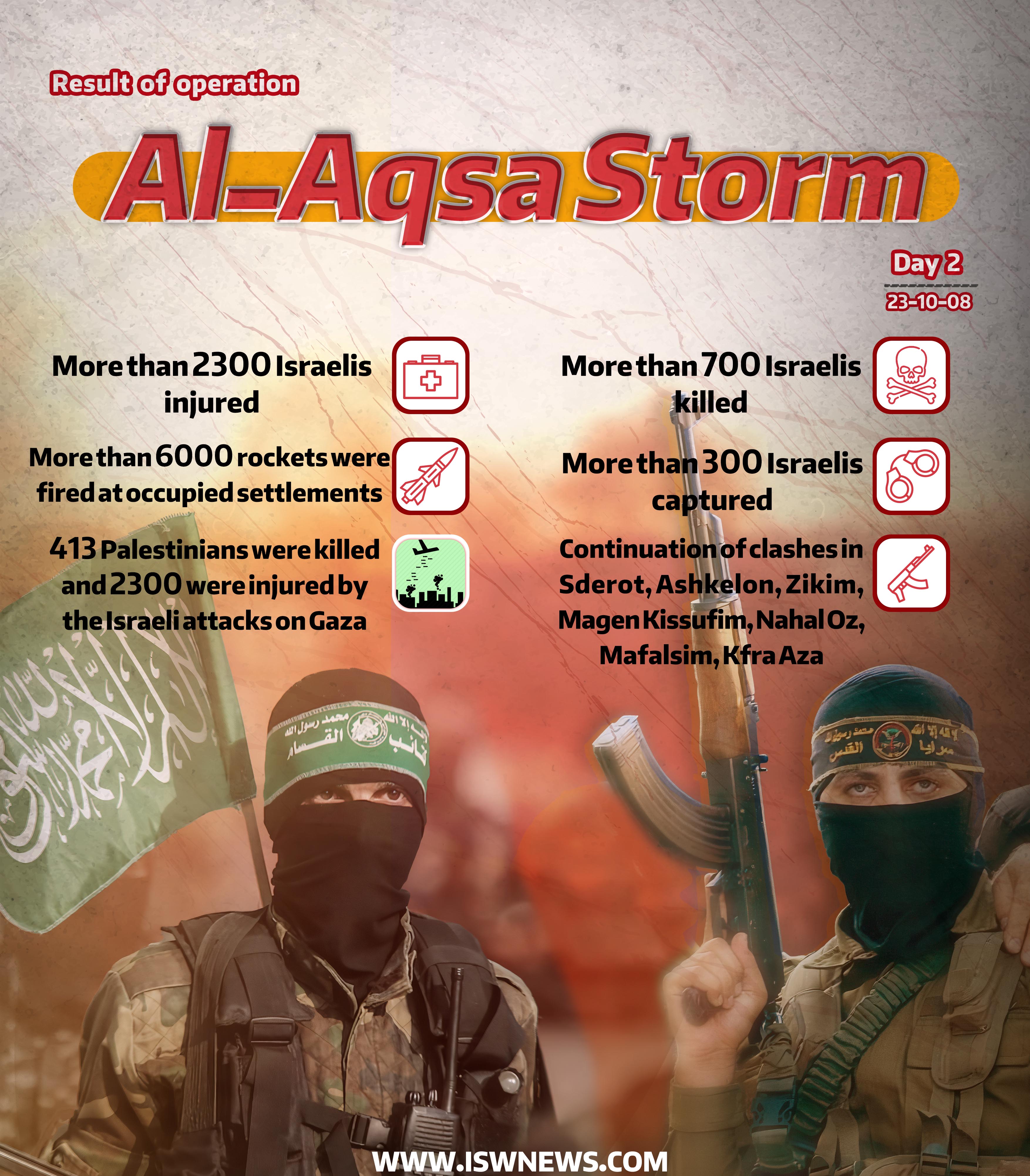
Clashes are ongoing in Sderot, the surrounding areas of Kissufim, Mefalsim, Kfar Aza, Nahal Oz, Kfar Aza and Magen. Abu Obaidah, the spokesperson of al-Qassam Brigades reported the infiltration of another group of Palestinian forces into the city of Ashkelon and Sderot and their armed conflict with the security forces and the Israeli army.
The Palestinian Ministry of Health in the Gaza Strip announced that 687 Palestinians were killed and 3,900 others were wounded since the start of Operation Al-Aqsa Storm and Israeli airstrikes on the Gaza Strip.
Palestinian resistance groups fired more than 6,000 rockets at the occupied territories.
Clashes are ongoing in Sderot, the surrounding areas of Kissufim, Mefalsim, Kfar Aza, Nahal Oz, Kfar Aza and Magen. Abu Obaidah, the spokesperson of al-Qassam Brigades reported the infiltration of another group of Palestinian forces into the city of Ashkelon and their armed conflict with the security forces and the Israeli army.
The Palestinian Ministry of Health in the Gaza Strip announced that 413 Palestinians, including 78 children and 41 women, were killed and 2,300 others were injured since the start of Operation Al-Aqsa Storm and Israeli airstrikes on the Gaza Strip.
Following the advancement of the Israeli army, Izz ad-Din Al-Qassam Brigades and Al-Quds Brigades sent some auxiliary forces to support their own fighters in Israeli settlements. Additionally, the rocket and artillery units of the resistance movement launched several attacks against Israeli positions and forces to support and cover their own forces.
Abu Obaida, spokesman for Al-Qassam Brigades, announced that the artillery units of the resistance movement provided support to the resistance fighters stationed near Sderot with more than 100 rocket launches.
On the other hand, in response to these attacks, Israeli military drones targeted military and non-military areas as well as border areas with occupied Palestinian territories in multiple assaults, resulting in several martyrs and injuries.
According to updated reports, the attacks by the Al-Qassam Brigades, the military wing of the Hamas movement, on Ashkelon have been halted, and the resistance fighters have now retreated from several battle fronts in Kissufim, Nahal Oz, and Zikim.
After the retreat, the rocket unit of the resistance movement targeted Israeli positions in these areas. Currently, clashes are ongoing in Sderot, the surrounding areas of Kissufim, Mefalsim, Kfar Aza, Nahal Oz and Magen, and according to Palestinian sources, several Israelis have been killed as a result of these clashes.
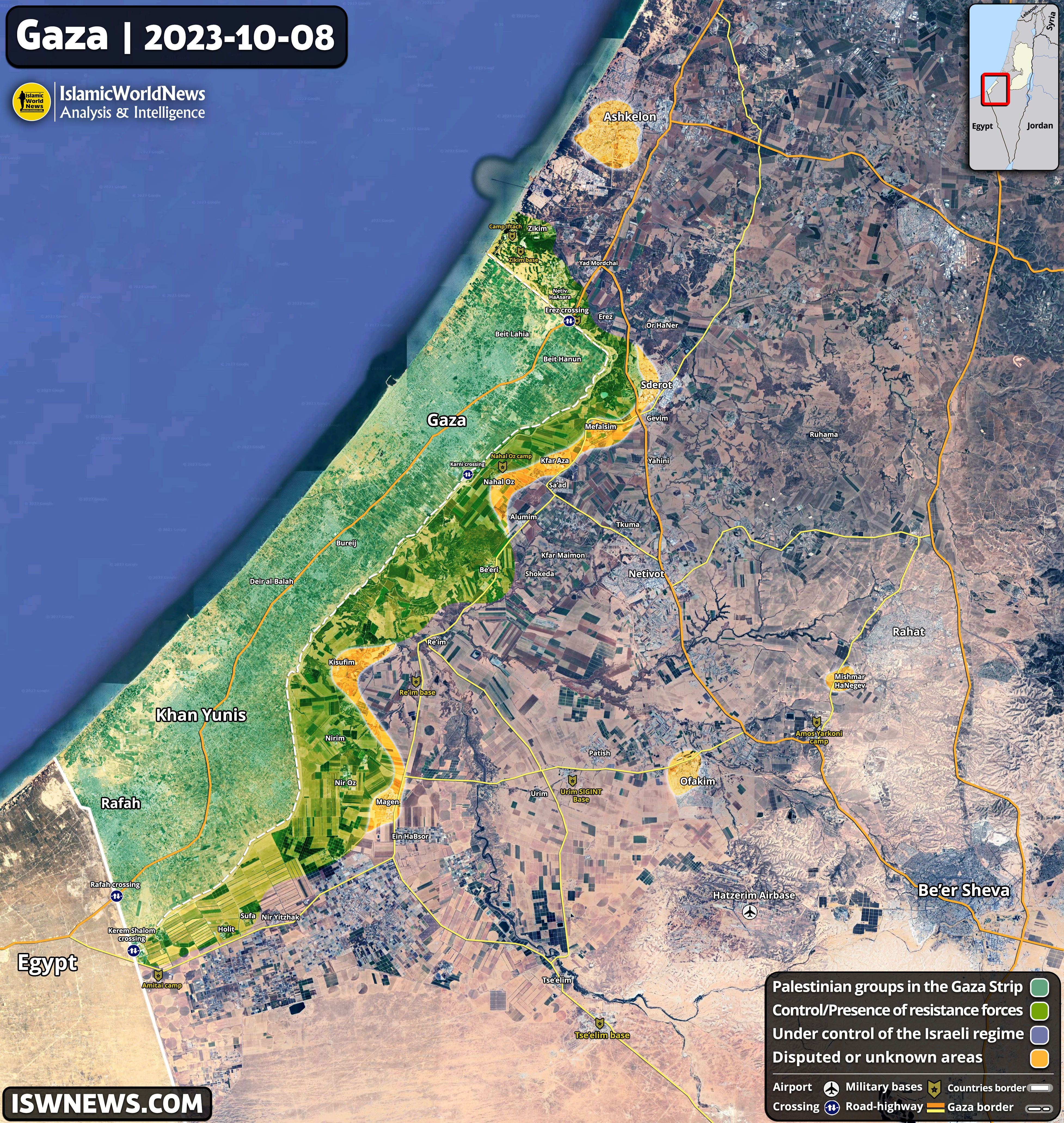
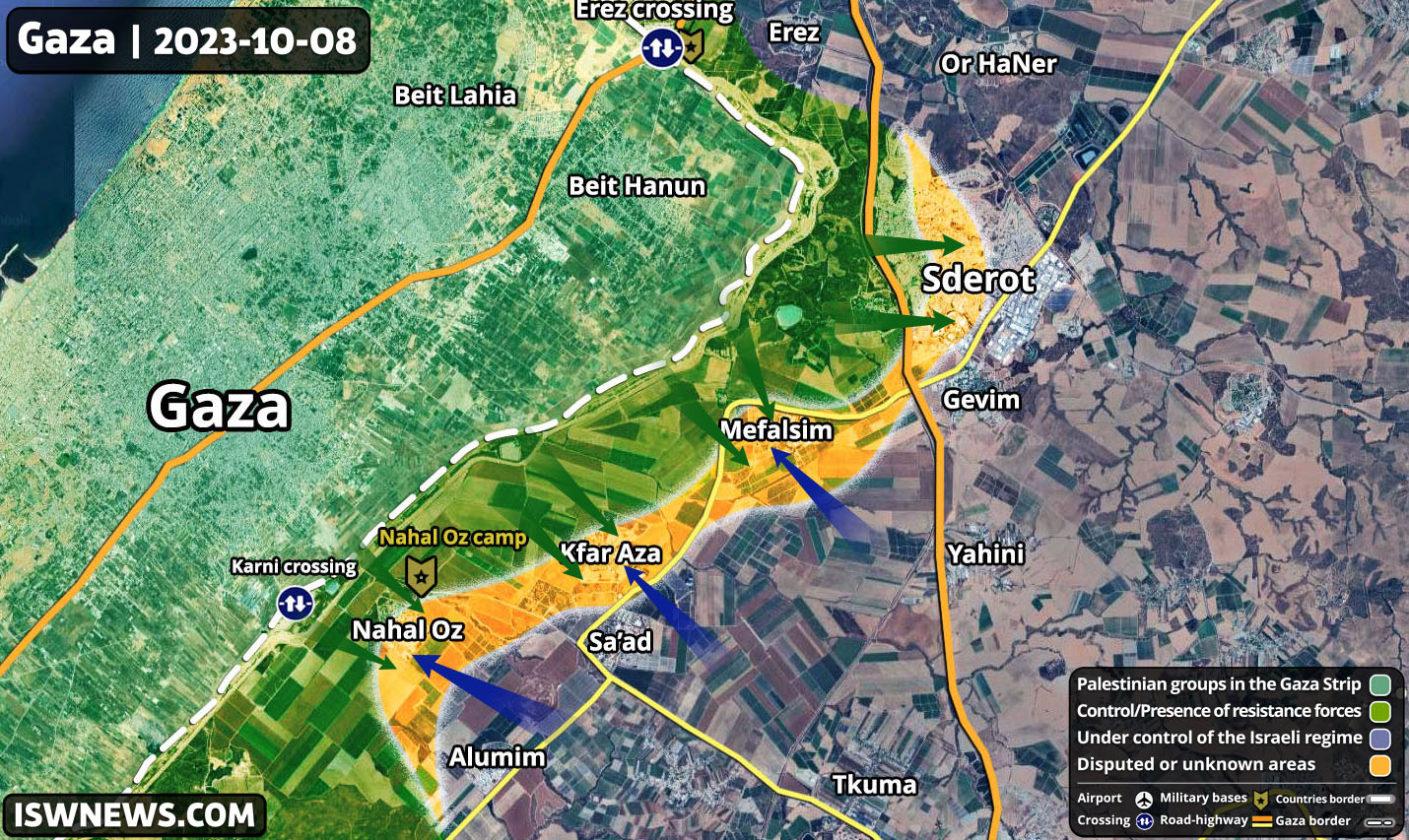
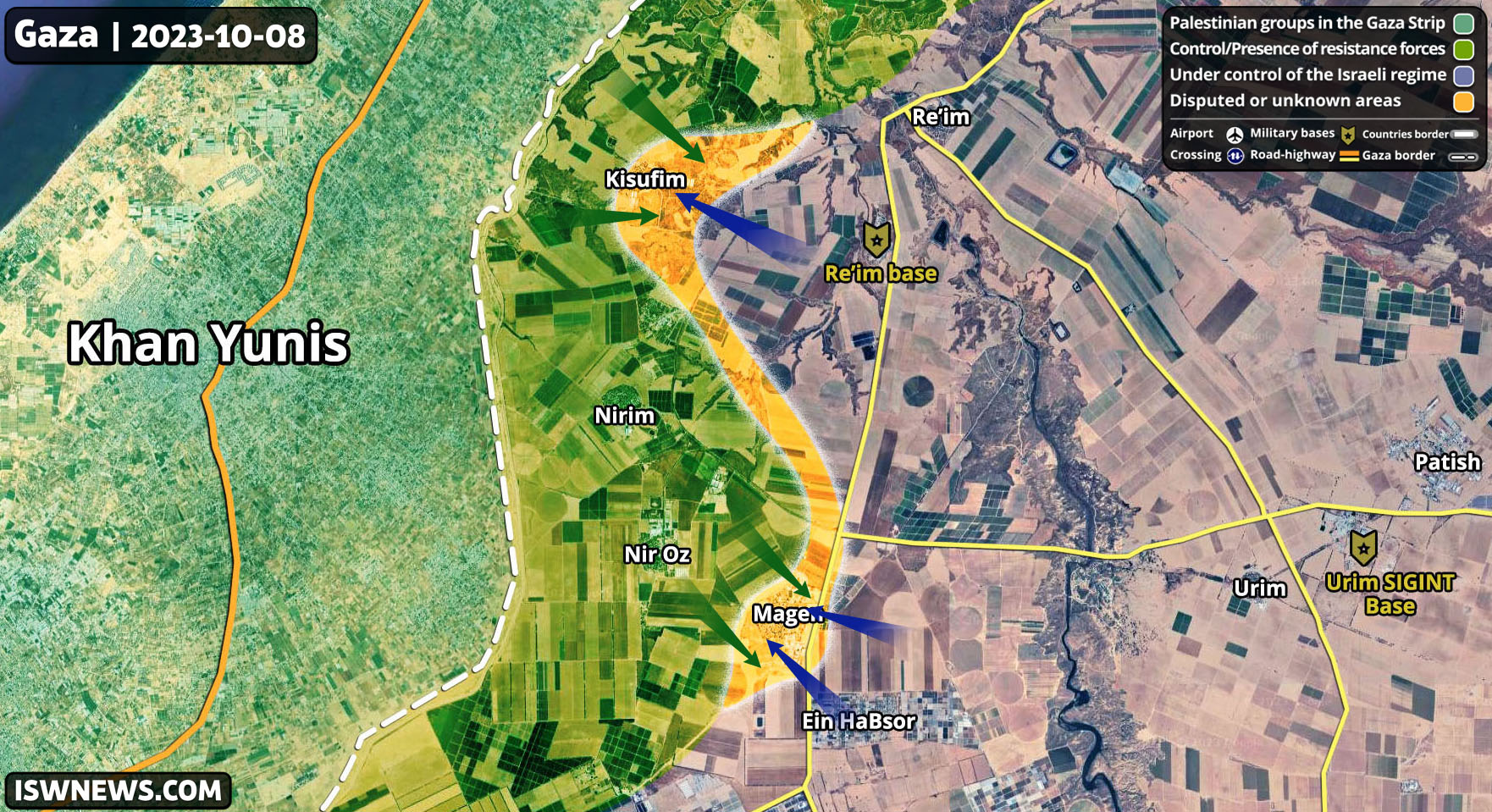
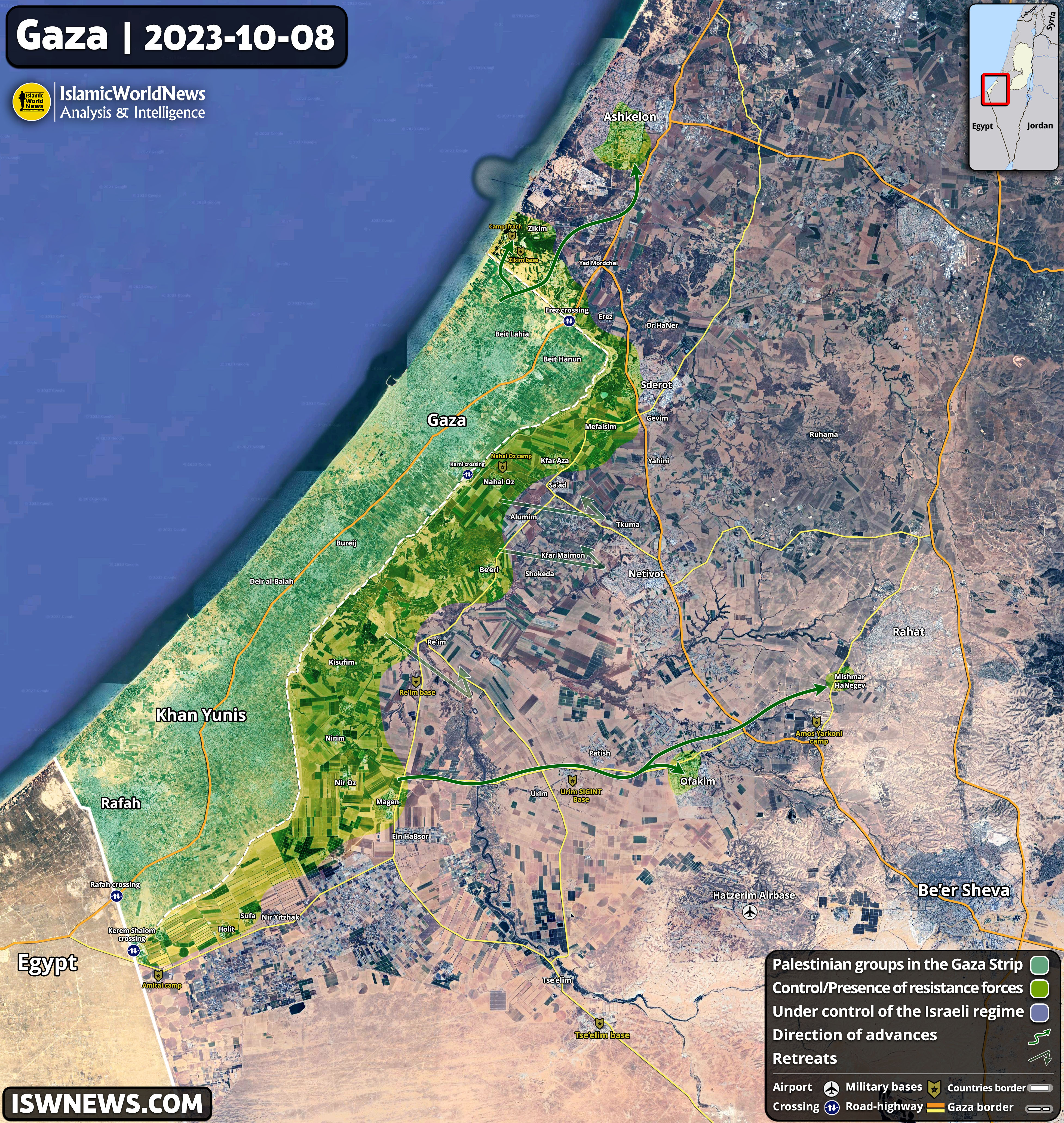
Direction of clashes in the settlements near the Gaza Strip – click to view full sizeDirection of clashes in the settlements near the Gaza Strip – click to view full sizeLatest military situation near the Gaza Strip – click to view full size
After the start of Operation Al-Aqsa Storm and the unexpected advances made by the resistance fighters deep into the occupied Palestinian territories, many areas around the Gaza Strip came under the control of the resistance fighters.
However, due to the counter-attacks by the Israeli regime’s army and following the de-escalation of clashes, the resistance fighters tactically retreated from some positions. Therefore, it is now possible to draw map of the battlefields and ongoing engagements with greater accuracy.
According to the latest available information, following the deadly attacks by the resistance fighters on the Re’im base and inflicting heavy damages on the Israeli regime’s army, the resistance fighters retreated from Re’im area and its military base.
Similarly, in the Netivot axis, the resistance fighters tactically retreated towards Kfar Aza and Nahal Oz following the Israeli army’s counter-attack.
However, despite some retreats, an unknown number of resistance fighters are still present in the areas of Ofakim, Mishmar HaNegev, and even in Ashkelon. Armed conflicts between the resistance fighters and the Israeli regime’s army continue in other battlefronts, including the city of Sderot, the surrounding areas of Zikim, Kfar Aza, Nahal Oz, Be’eri, and Magen.
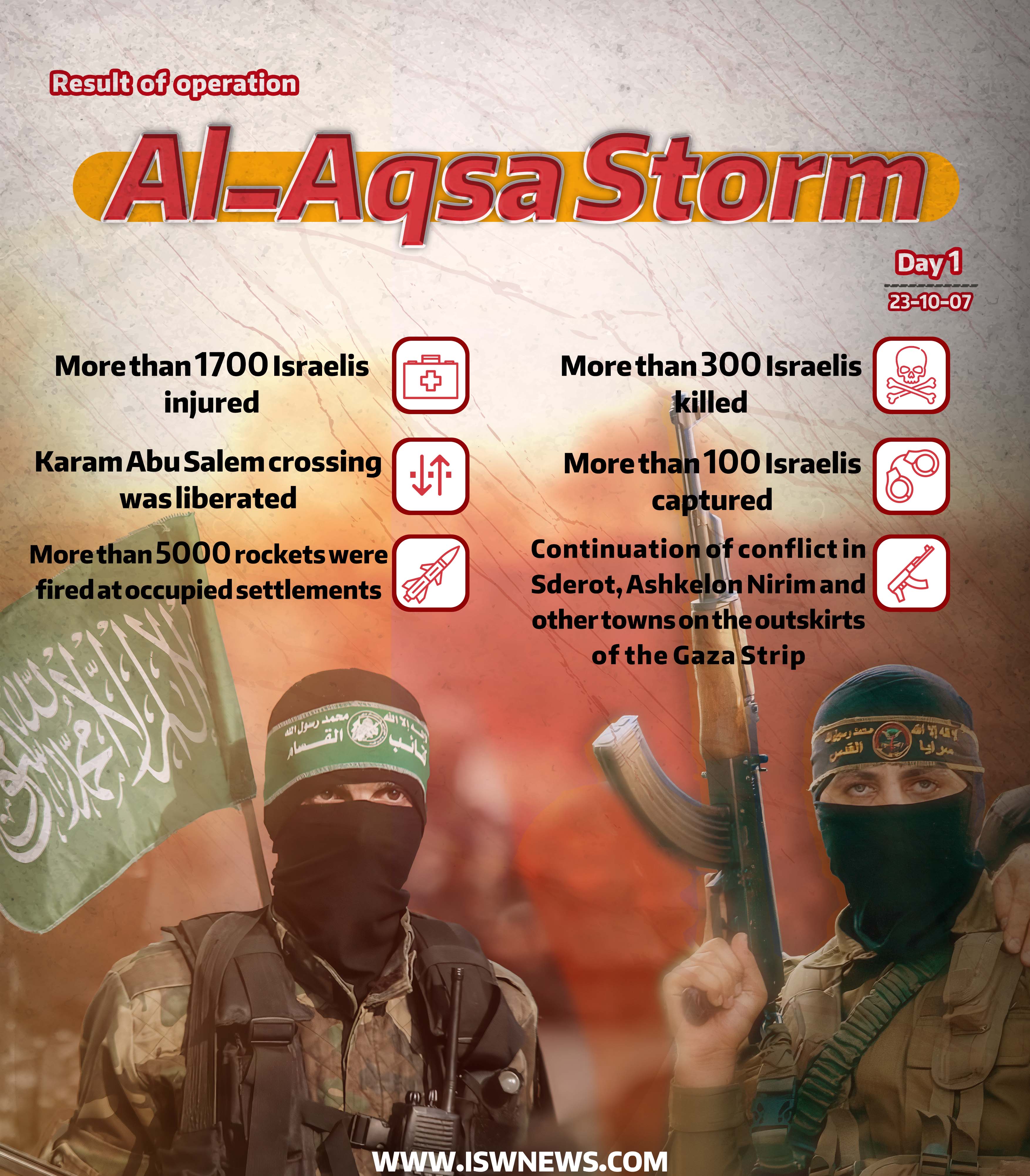
The resistance groups also freed the Karam Abu Salem (Kerem Shalom) border crossing in the south of the Gaza Strip from the occupation of the Zionist army.
Palestinian resistance groups fired more than 5,000 rockets at the occupied territories.
Currently, the clashes continue in the settlements of Sderot, Ashkelon, Nirim and other occupied settlements in the outskirts of the Gaza Strip. It should be noted that Al-Qassam Brigades, the military branch of Hamas, announced that it has attacked more than 50 bases of the Zionist regime’s army inside the occupied territories, and its fighters are still confronting the occupiers in 25 pints inside the occupied territories.
Abu Obaida, the spokesman for the Izz ad-Din al-Qassam Brigades, the military wing of Hamas movement, said in his first statement few hour after the launch of Operation Al-Aqsa Storm:
Our battle continues and the enemy does not know anything about its results.
The enemy will be shocked when he gets out of this confusing situation.
We ask our people in the West Bank and Quds to participate in the Al-Aqsa Storm operation and make the enemy, who is as weak as a spider’s web, more helpless.
Don’t let the occupiers have a chance to rejoice and celebrate in the religious festival of their advancement in the Al-Aqsa Mosque, which is the place of the ascension of the Prophet of Islam.
The enemy is in a dire situation and we ask our people in the occupied territories of 1948 to rise up against the enemy.