Tag: Raytheon

  • Military Knowledge: Tomahawk Cruise Missile – U.S. Army’s Strategic Long-Range Weapon

    Military Knowledge: Tomahawk Cruise Missile – U.S. Army’s Strategic Long-Range Weapon

    Design and Development History

    Development of the Tomahawk began in the 1970s under General Dynamics, with the goal of producing a sea-land cruise missile capable of penetrating deep into enemy territory. The first versions entered U.S. Navy service in the 1980s, and since then the missile has undergone multiple generations and block upgrades. Companies such as McDonnell Douglas, Hughes, and ultimately Raytheon took responsibility for its continued development and modernization. Over time, guidance technologies (TERCOM, DSMAC, GPS) and communication capabilities were added, enabling not only high accuracy but also in-flight target changes and loitering around designated areas. Newer versions like Block IV and V introduced network-centric features, two-way communication, and retargeting capabilities, significantly enhancing operational effectiveness. The Tomahawk’s role in conflicts such as Operation Desert Storm, the Balkan bombings, and later campaigns cemented its status as a symbol of U.S. naval strike power.

    As noted, Raytheon is the primary contractor for Tomahawk production, but manufacturing requires collaboration with dozens of suppliers and subcontractors across the United States and allied nations. The accompanying illustration highlights the key partners and suppliers involved in the missile’s production within the U.S.
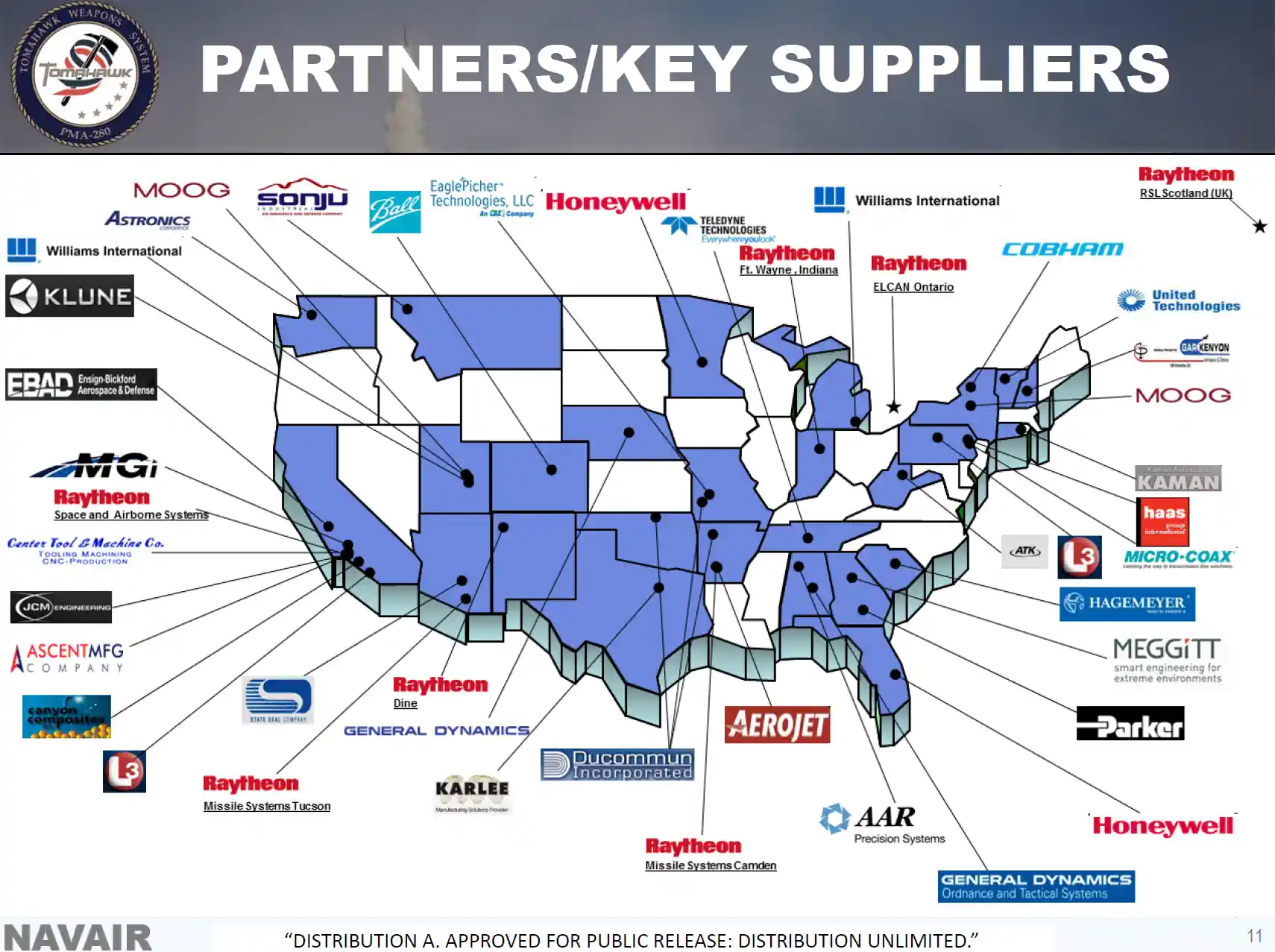
    Key partners and suppliers of Tomahawk missile components

    Dimensions and Aerodynamic Features of the Tomahawk Missile

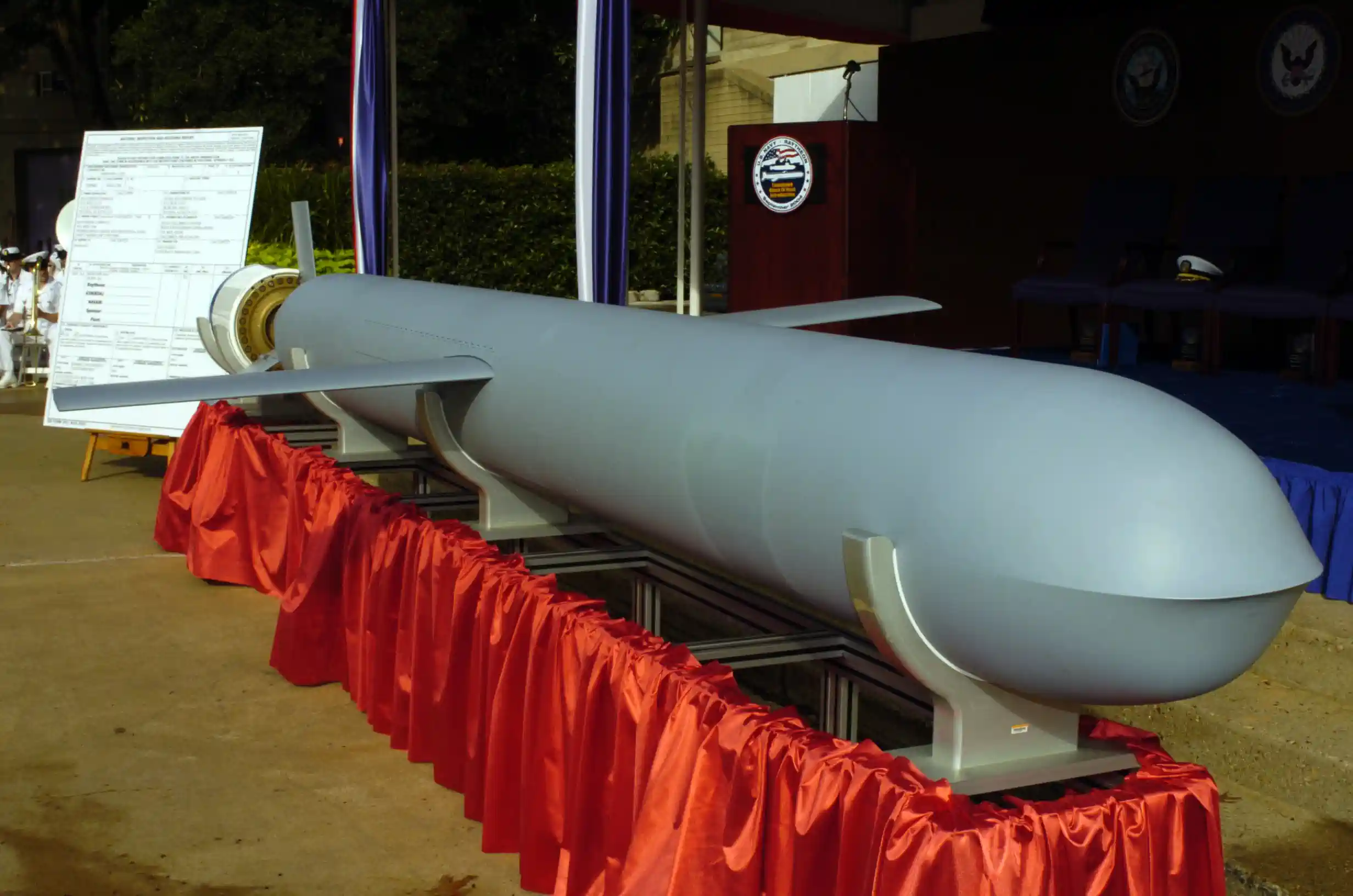
    The Tomahawk is a missile with a cylindrical body and foldable wings, designed for launch from vertical launch systems (VLS) or submarine torpedo tubes. The general dimensions of the Tomahawk cruise missile are reported as follows: length approximately 5.5 to 6.25 meters (depending on variant and booster), diameter about 52 centimeters, and launch weight in the range of 1,200–1,350 kilograms.
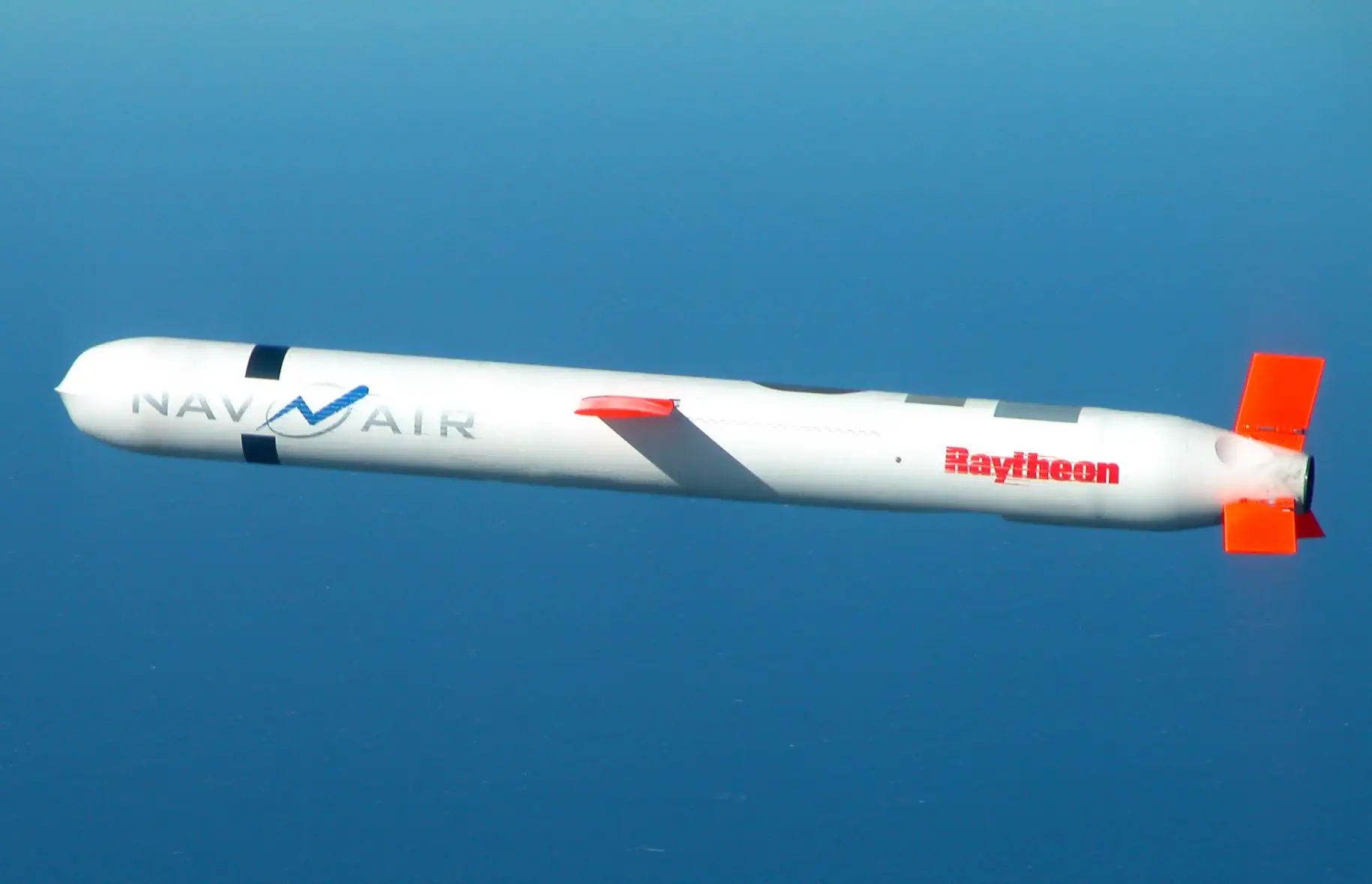
    Tomahawk Block IV cruise missile

    After exiting the launch tube, the missile’s wings unfold to provide the aerodynamic characteristics required for low-level flight. The Tomahawk’s body is constructed from lightweight yet durable alloys, optimized for low-altitude penetration and radar evasion. Its design enables it to remain undetected by radar systems while navigating complex flight paths to bypass enemy air defenses.

    Internal Components of the Tomahawk Missile

    In general, the Tomahawk consists of several main sections: the guidance and navigation system, the warhead, the fuel tank, the engine, and the booster. It should be noted that the placement of these components varies depending on the specific model of the missile.
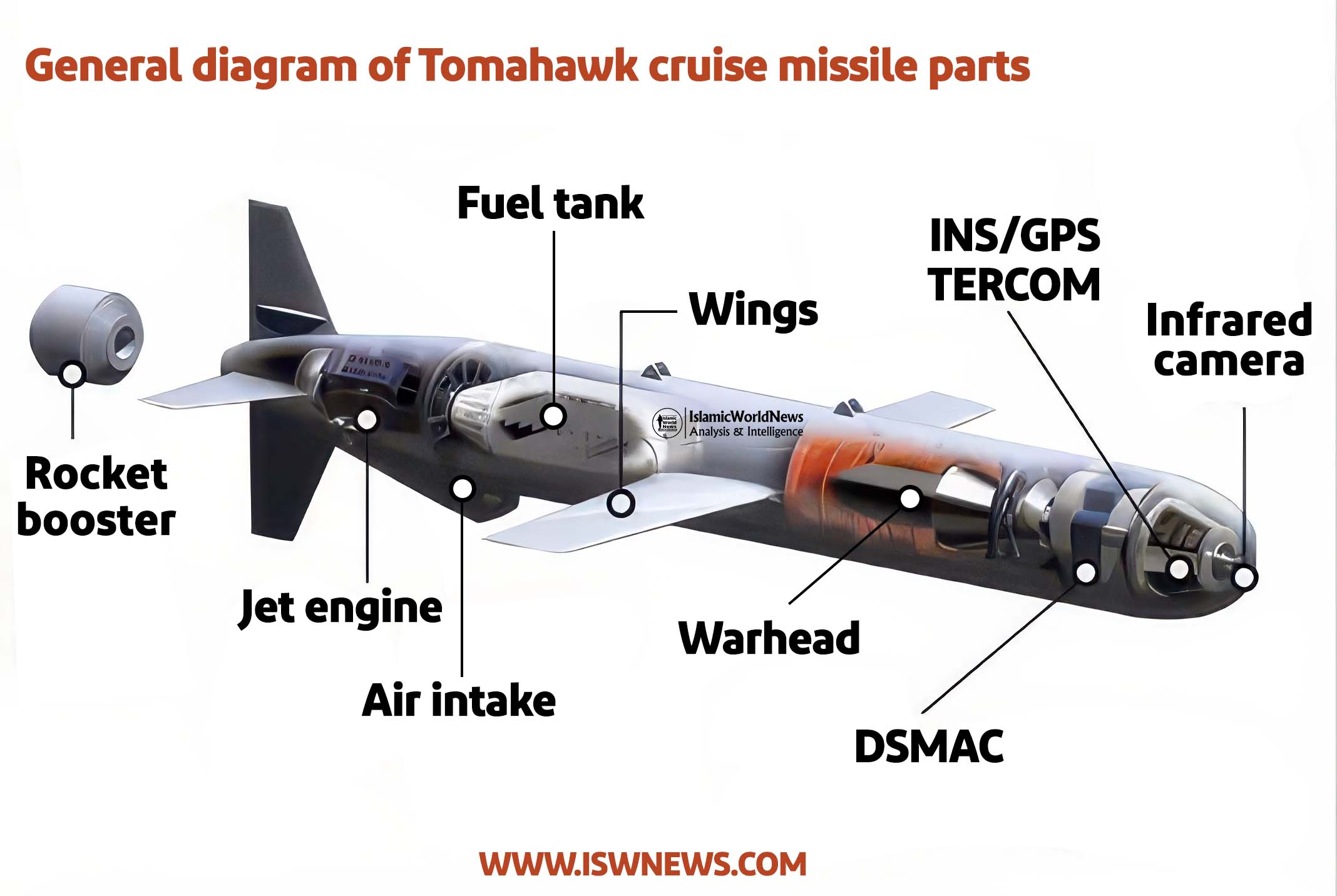
    General diagram of the main parts of the Tomahawk cruise missile

    – Guidance and Navigation System
    The Tomahawk missile employs a hybrid guidance system. Its navigation suite includes INS for initial navigation, GPS for enhanced positional accuracy along the route, and TERCOM and DSMAC for terrain and terminal guidance.

    TERCOM (Terrain Contour Matching) operates during the mid-course phase of flight. The missile stores preloaded TERCOM and DSMAC terrain maps in its memory and compares them with altimeter readings and inertial navigation data to detect and correct deviations. This method is particularly effective for low-level flight over uneven terrain and provides resilience against satellite interference such as GPS jamming.

    DSMAC (Digital Scene Matching Area Correlation) is used in the terminal phase for final target acquisition. A nose-mounted camera captures real-time imagery of the target area and compares it with stored reference images, enabling precise target location and final flight corrections. This technology significantly improves strike accuracy and allows for pinpoint targeting.
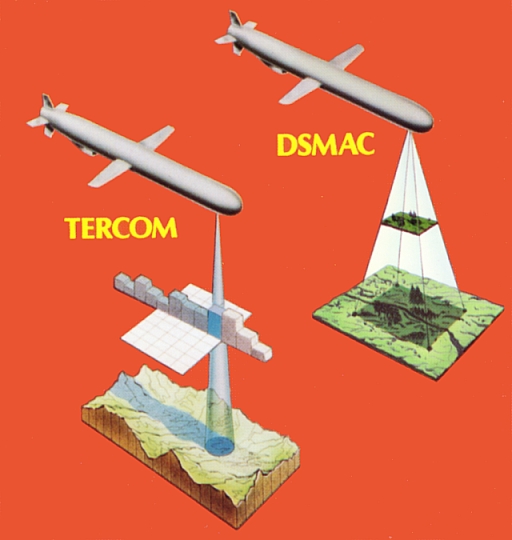
    TERCOM and DSMAC

    The Block IV and Block V variants of the Tomahawk are equipped with a two-way data link, enabling in-flight retargeting, transmission of imagery, and operator-directed course changes. This enhanced guidance suite allows the missile to achieve accuracy within just a few meters (low CEP) and significantly improves its ability to penetrate heavily defended airspace.

    – Warhead
    The warhead is located in the forward section of the missile. Most Tomahawk variants are equipped with a high-explosive warhead weighing around 310 kilograms, containing approximately 120 kilograms of PBXN-107 explosive material. This configuration is designed to destroy buildings, infrastructure, and other high-value targets. Certain versions have also been produced with specialized or anti-ship warheads tailored for specific missions.

    – Fuel Tank
    The fuel tank is positioned in the central body section and is engineered to provide the long range required for operations. The exact fuel capacity varies depending on the missile’s configuration and model.

    – Propulsion and Booster
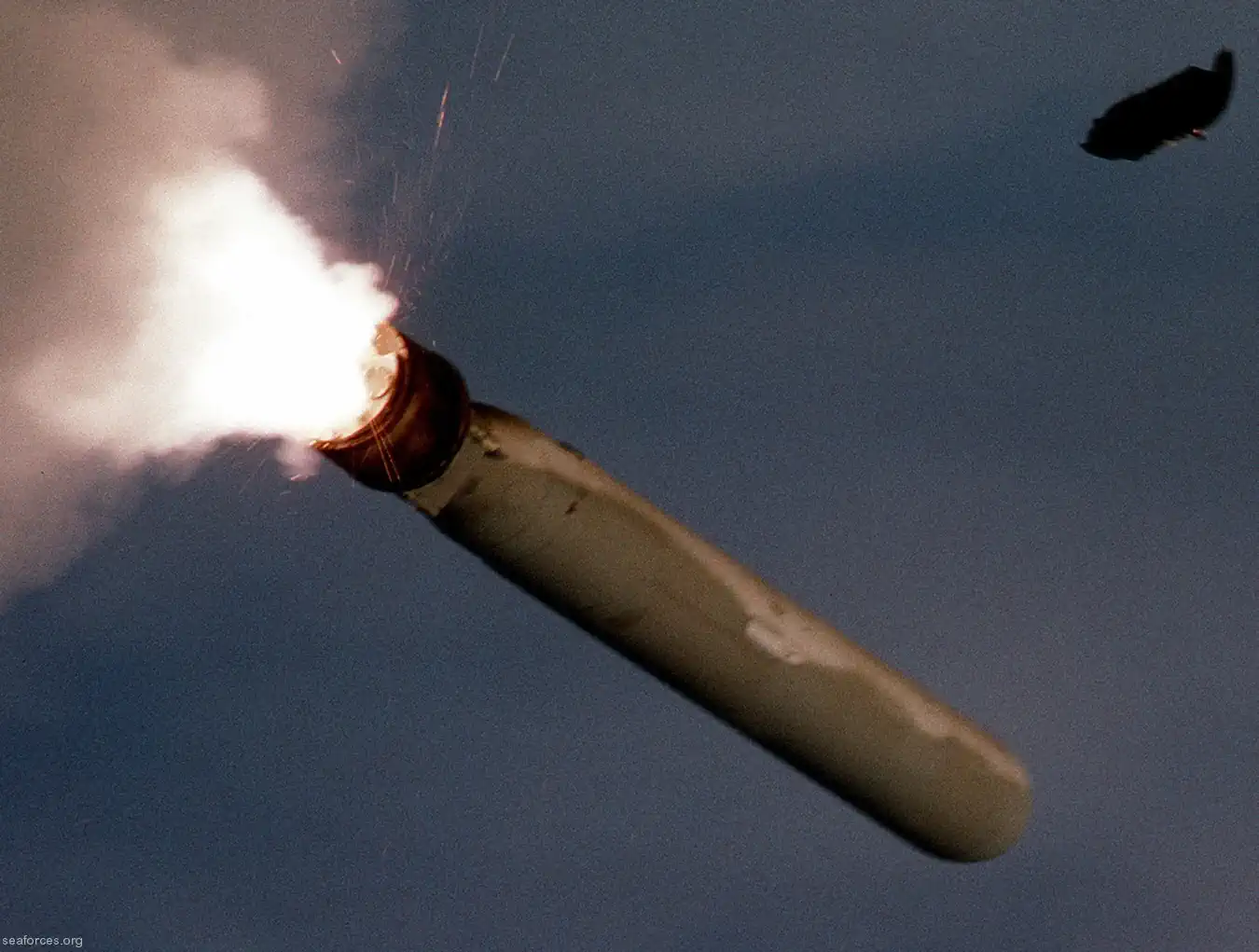
    For launch from surface platforms or submarines, the Tomahawk uses a solid-fuel booster that accelerates the missile to the speed necessary for its turbofan engine. Once the booster separates, the main engine takes over, managing thrust and fuel consumption. This design enables launches from confined submarine tubes or vertical launch systems (VLS) aboard warships. The Tomahawk’s flight is powered by a compact liquid-fuel turbofan engine, typically from the Williams F107 family or similar equivalents, providing speeds in the range of 880 to 920 kilometers per hour.

    Variants of the Tomahawk Missile

    To begin with, the Tomahawk missile is designated within the U.S. Armed Forces nomenclature system under the identifiers RGM-109, UGM-109, and BGM-109. The first letter in the code indicates the launch platform: RGM for surface-ship launch, UGM for submarine launch, and BGM-109 for ground-based launchers. The letter following the number (A, B, C, D, E) denotes the configuration and generation of the missile.

    BGM-109A TLAM-N (Block I): This was the first operational model of the Tomahawk, equipped with a nuclear warhead, and entered service in the 1980s. The TLAM-N carried the W80 warhead with variable yield (5 to 200 kilotons) and could be launched from surface ships using armored box launchers (now retired) as well as from submarines. Developed under Block I, it had a range of about 2,500 kilometers and was designed for strategic strikes during the Cold War. Following arms reduction treaties, this nuclear-armed variant was retired in the 1990s.

    On the missile’s designation: Initially, since the Tomahawk was being developed for multiple platforms—land, sea, and submarine—the general code BGM-109 was assigned, with the prefix “B” marking it as the first missile of this family. This designation remained in official records, even though the missile was never operationally deployed or launched from land-based systems.
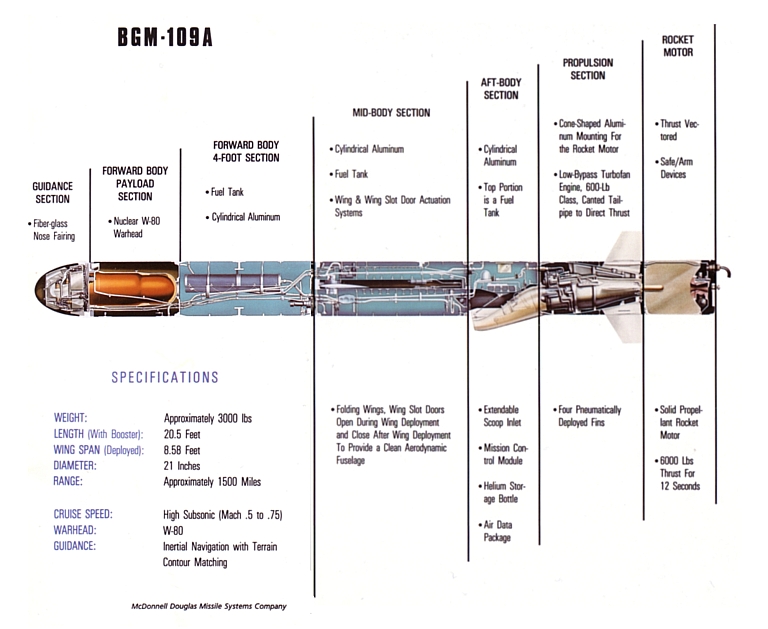
    BGM-109A TLAM-N missile parts diagram

    BGM-109G Gryphon: This variant was developed specifically for the U.S. Air Force and launched from mobile ground-based platforms. The Gryphon carried a W84 nuclear warhead and had a range of approximately 2,780 kilometers. It was deployed in Europe to strengthen deterrence against the Soviet Union. Following the signing of the INF Treaty in 1987, all medium-range ground-launched missiles, including the Gryphon, were retired from service.

    RGM/UGM-109B TASM (Block I) This Tomahawk variant, with a range of 460 kilometers, was designed for anti-ship missions and developed under Block I. The TASM utilized active radar guidance and was intended for long-range attacks against enemy vessels. With the introduction of more advanced anti-ship missiles such as the Harpoon and NSM, this model was retired in 1994 and converted into the TLAM-E Block IV version.
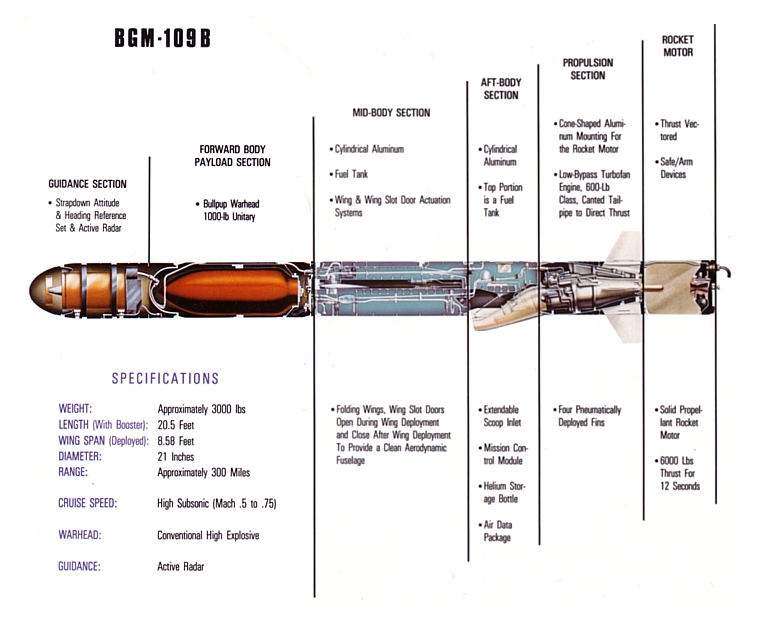
    RGM/UGM-109B TASM missile parts diagram

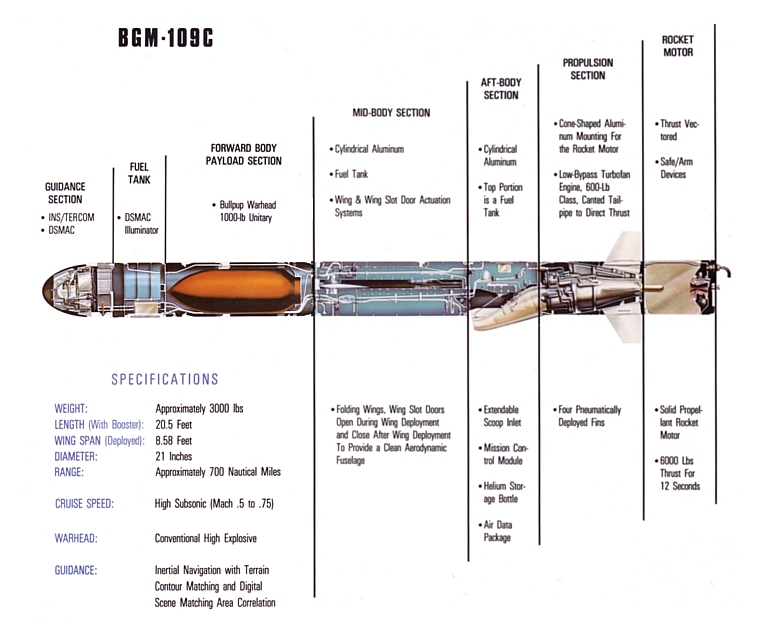
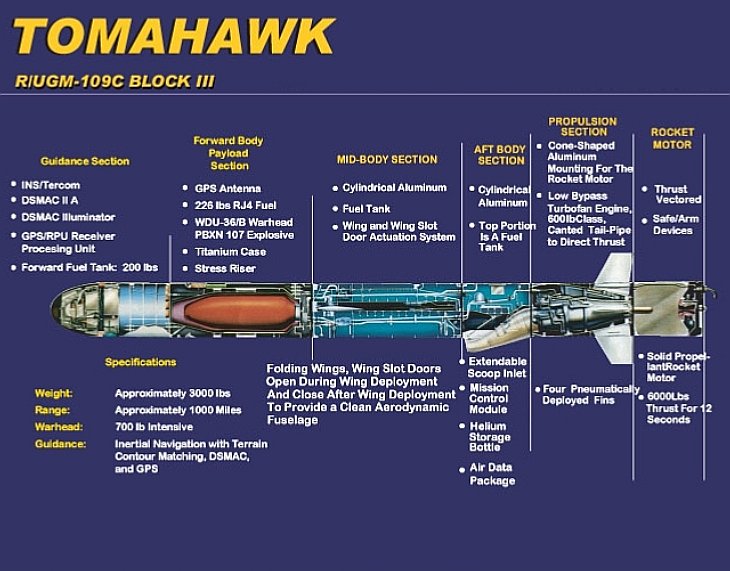
    RGM/UGM-109C TLAM-C (Block II and Block III): This variant was developed with a conventional warhead and enhanced navigation through the addition of TERCOM and DSMAC systems for greater accuracy. The TLAM-C initially carried the WDU-25/B warhead, weighing 450 kilograms and containing 171 kilograms of powerful explosives (Picratol and H-6 composite). Its operational range was about 1,300 kilometers.

    From 1993 onward, the WDU-25/B was replaced with the lighter WDU-36/B warhead, weighing 310 kilograms and containing 120 kilograms of PBXN-107 high explosive. The reduced warhead size allowed for a larger fuel tank, extending the maximum range to 1,700 kilometers. This upgraded version was designated TLAM-C Block III. It became one of the most widely used Tomahawk models in U.S. military operations in recent decades.
    RGM/UGM-109D TLAM-D (Block III): This model was developed under Block III and designed to carry a cluster warhead. The TLAM-D was equipped with 166 BLU-97/B submunitions, which were released at a designated altitude above the target. It was intended for strikes against wide-area targets such as airfields and military concentrations. The range of this version was reported to be around 1,300 kilometers. Cluster-armed Tomahawk missiles are no longer in service, as they were converted to unitary warhead configurations.
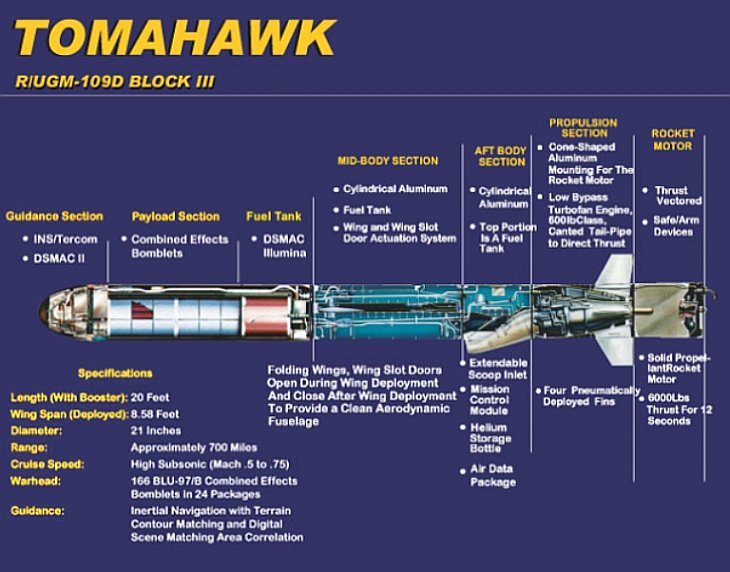
    BGM-109D TLAM-D missile parts diagram

    Block IV (RGM/UGM-109E / TLAM-E): Block IV marked a major milestone in the evolution of the Tomahawk. The TLAM-E is an upgraded version of the TLAM-C Block III and was introduced in 2004. TLAM-E Block IV missiles feature an improved turbofan engine that allows them to reduce fuel consumption during flight and adjust their speed as needed.
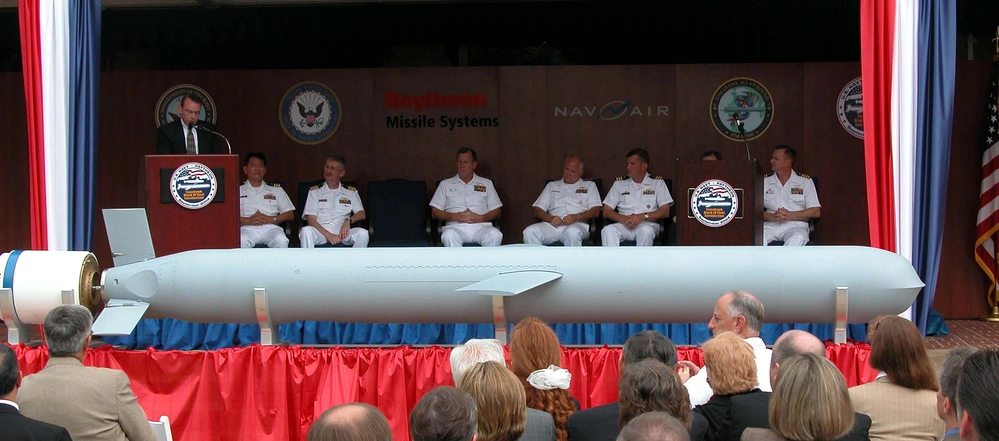
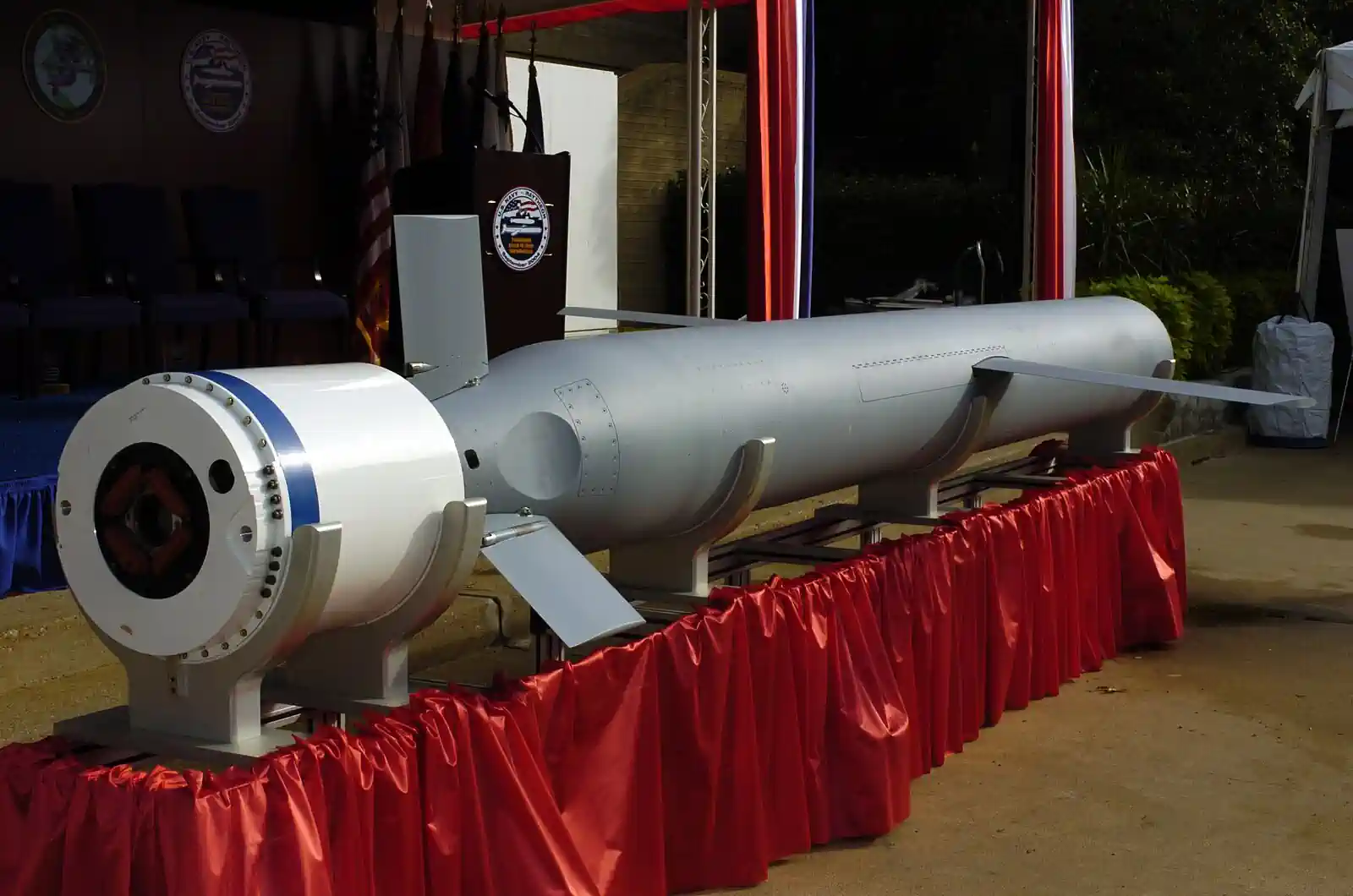
    This version is equipped with electro-optical sensors and a two-way satellite data link with the command center, enabling it to receive updated information during flight and redirect toward new targets. The electro-optical sensors can transmit imagery back to command via satellite, allowing real-time battle damage assessment, even moments before impact.

    Additionally, this variant has the ability to loiter over an area, return toward the launch region, and be retargeted as needed. With reduced production costs and enhanced operational flexibility, Block IV has become one of the most effective Tomahawk versions. Its reported range is approximately 1,600 kilometers.
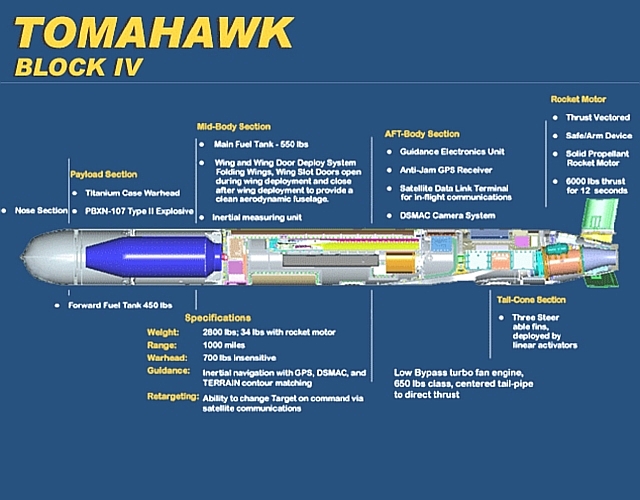
    BGM-109E TLAM-E Block IV missile parts diagram

    Block V: This block is the latest Tomahawk variant, developed in recent years and entering U.S. Navy service in 2021. The Block V (baseline) is an upgraded version of Block IV, featuring new communication systems, electronic warfare enhancements, improved accuracy, network-centric capabilities, and the ability to strike moving maritime targets such as ships.
    Block V is divided into two sub-models: Block Va (MST) which is the anti-ship variant with a range of 500–700 kilometers; and Block Vb (JMEWS) which is quipped with a penetrating warhead for land-attack missions and destruction of hardened targets. The range of this version is reported to be between 1,600 and 1,800 kilometers.
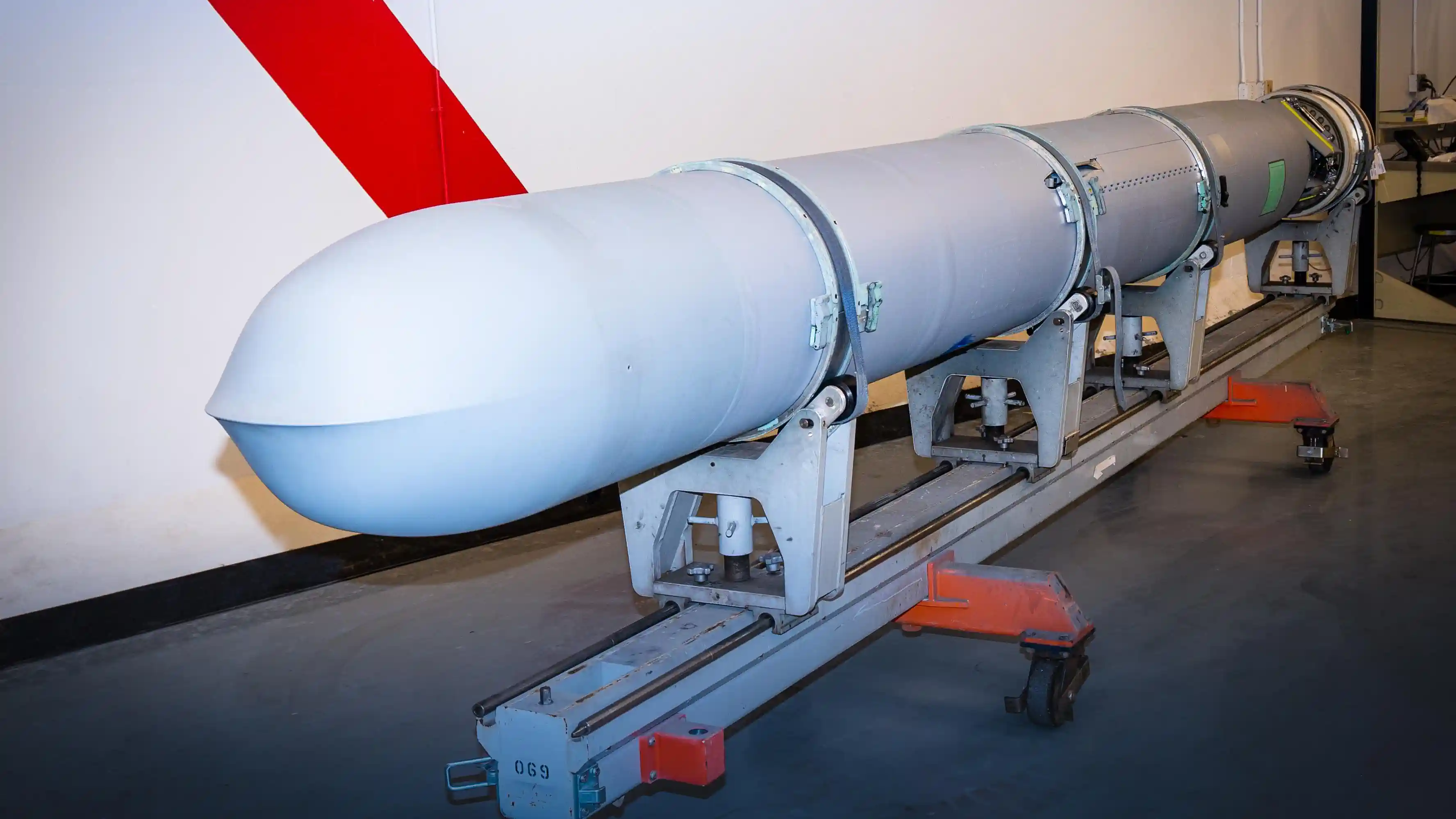
    A Block V Tomahawk missile on the Raytheon production line in Camden, Arkansas, in March 2021.

    In 2020, the spokesperson for the U.S. Navy’s Tomahawk program announced that all Block IV Tomahawks would be upgraded to the Block V standard, while the remaining Block III missiles would gradually be retired and decommissioned.

    In summary, the evolution of Tomahawk missiles is shown in the table below:
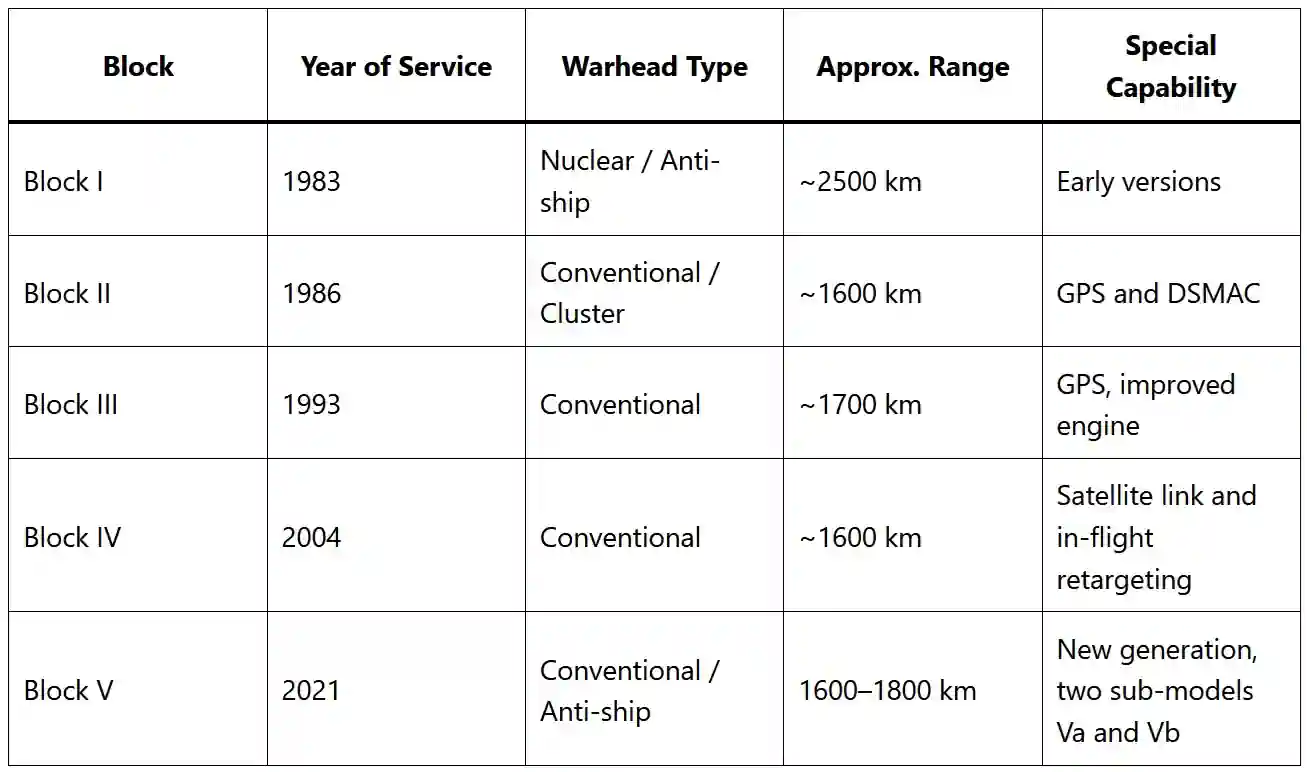
    Tomahawk Missile Launch Platforms

    The Tomahawk cruise missile is designed to be launched from multiple platforms. Below, the different launch systems for this missile are described in detail.

    – Naval Launchers
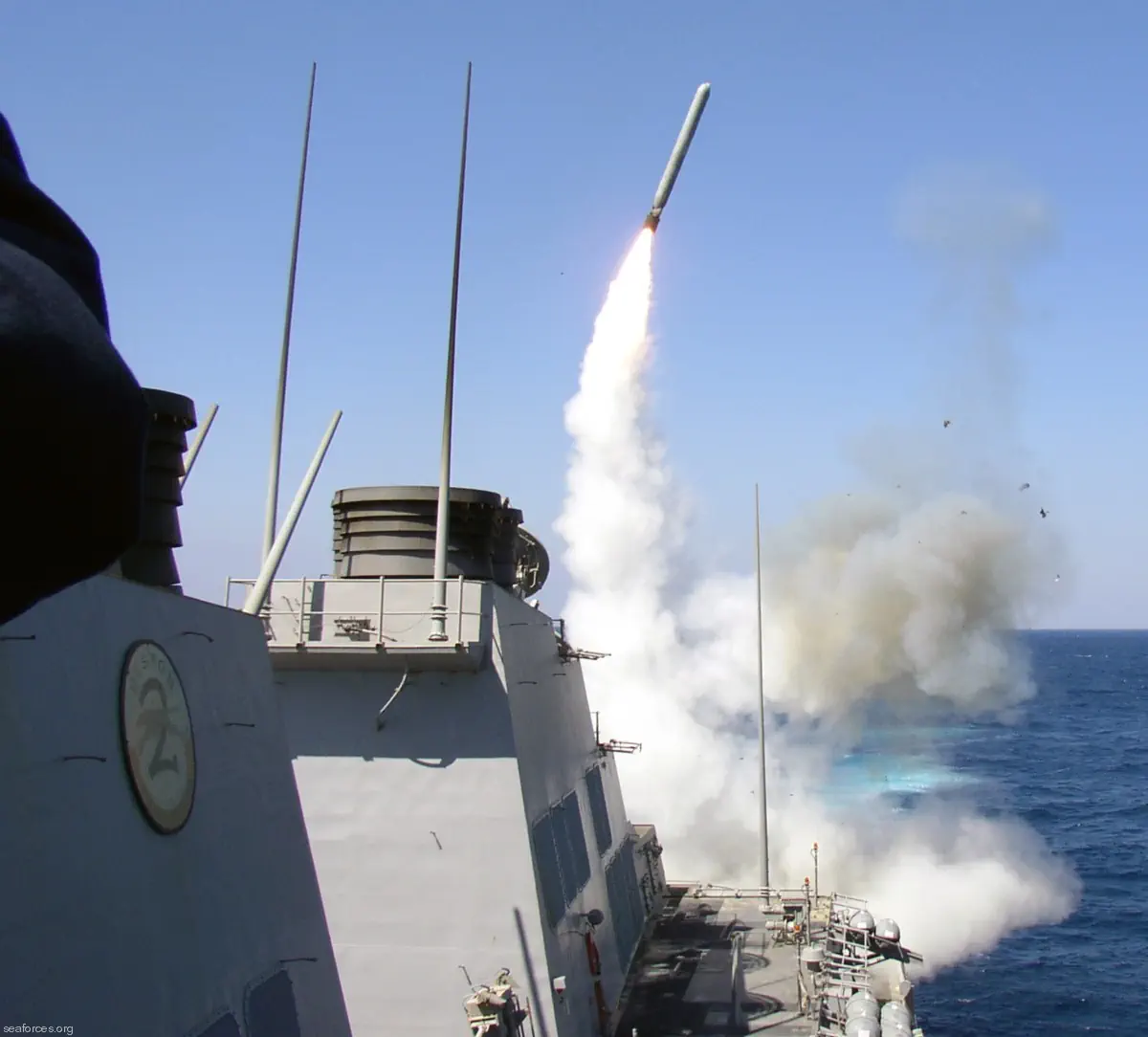
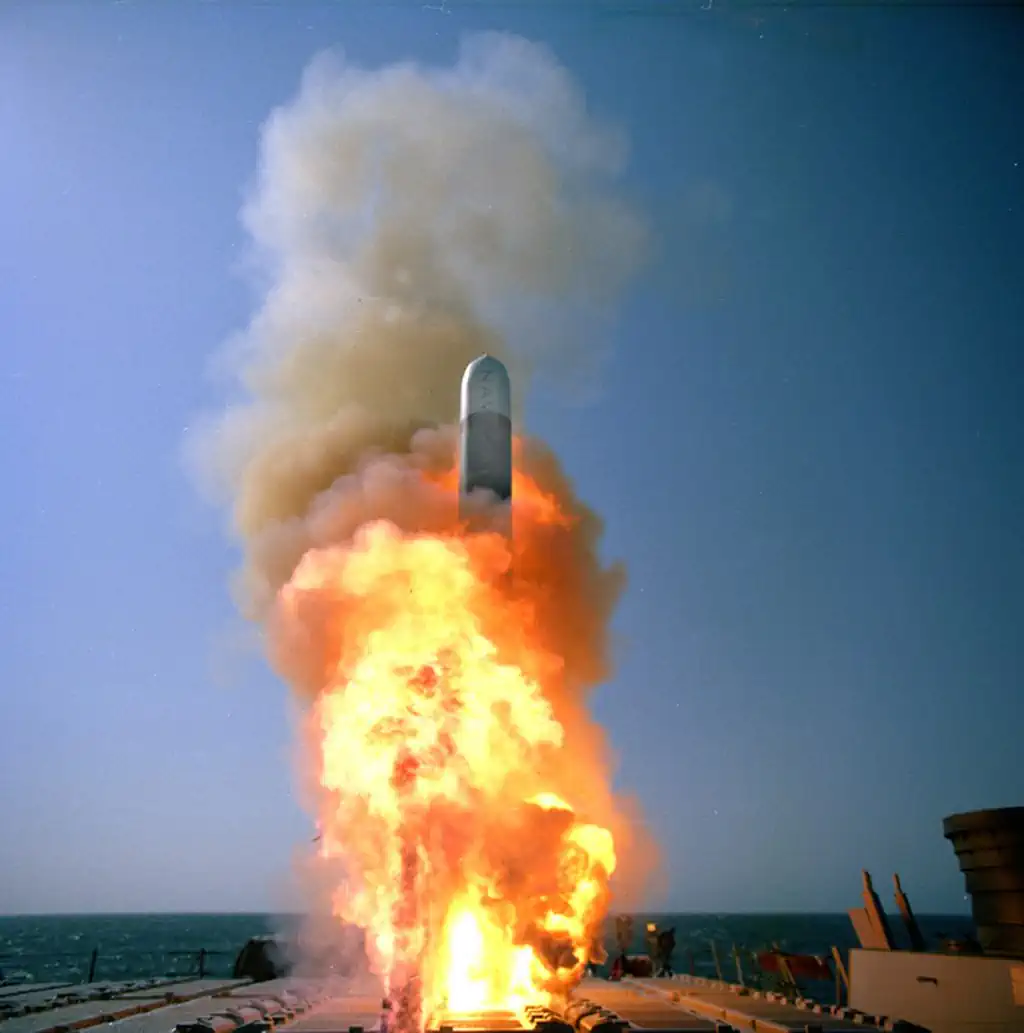
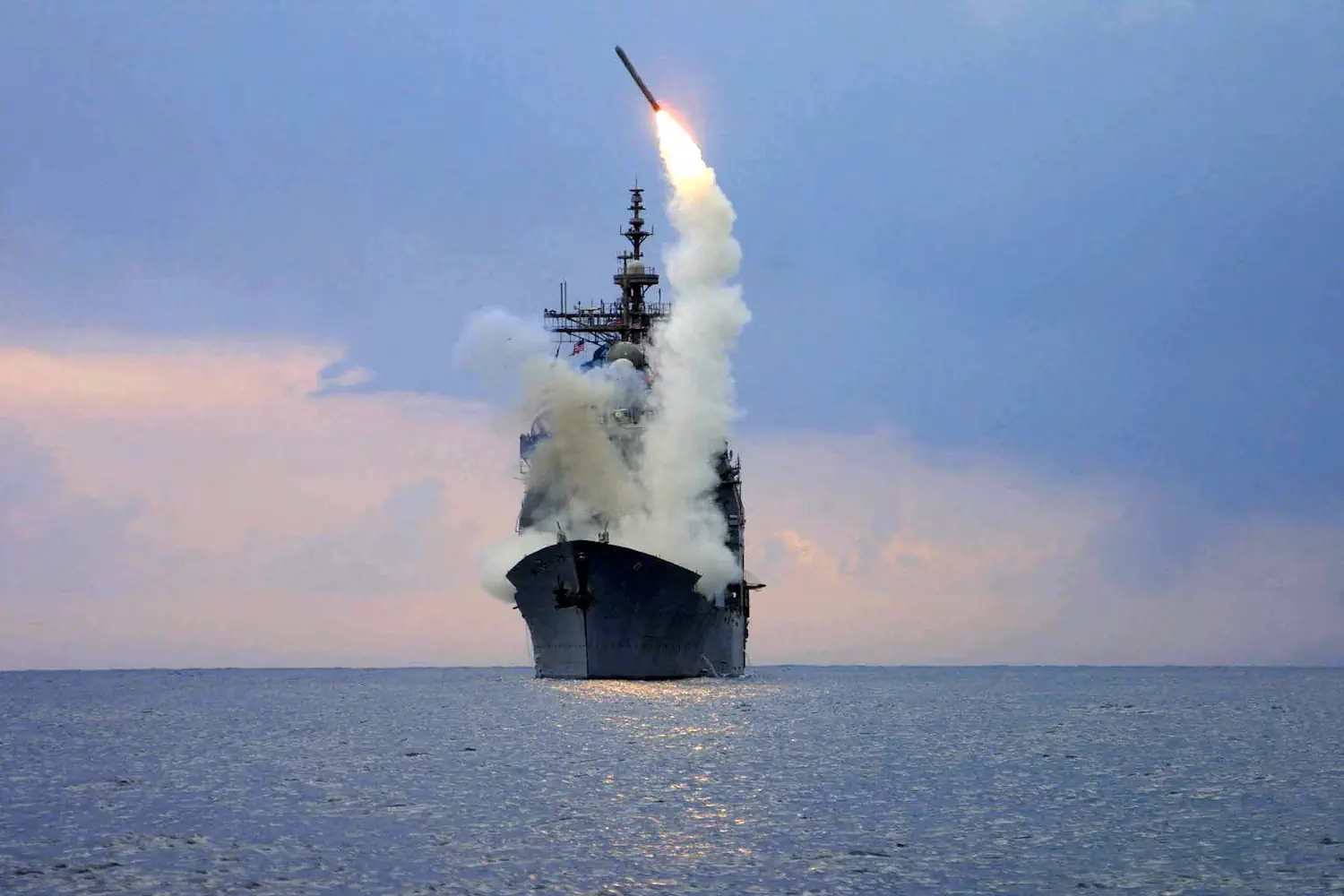
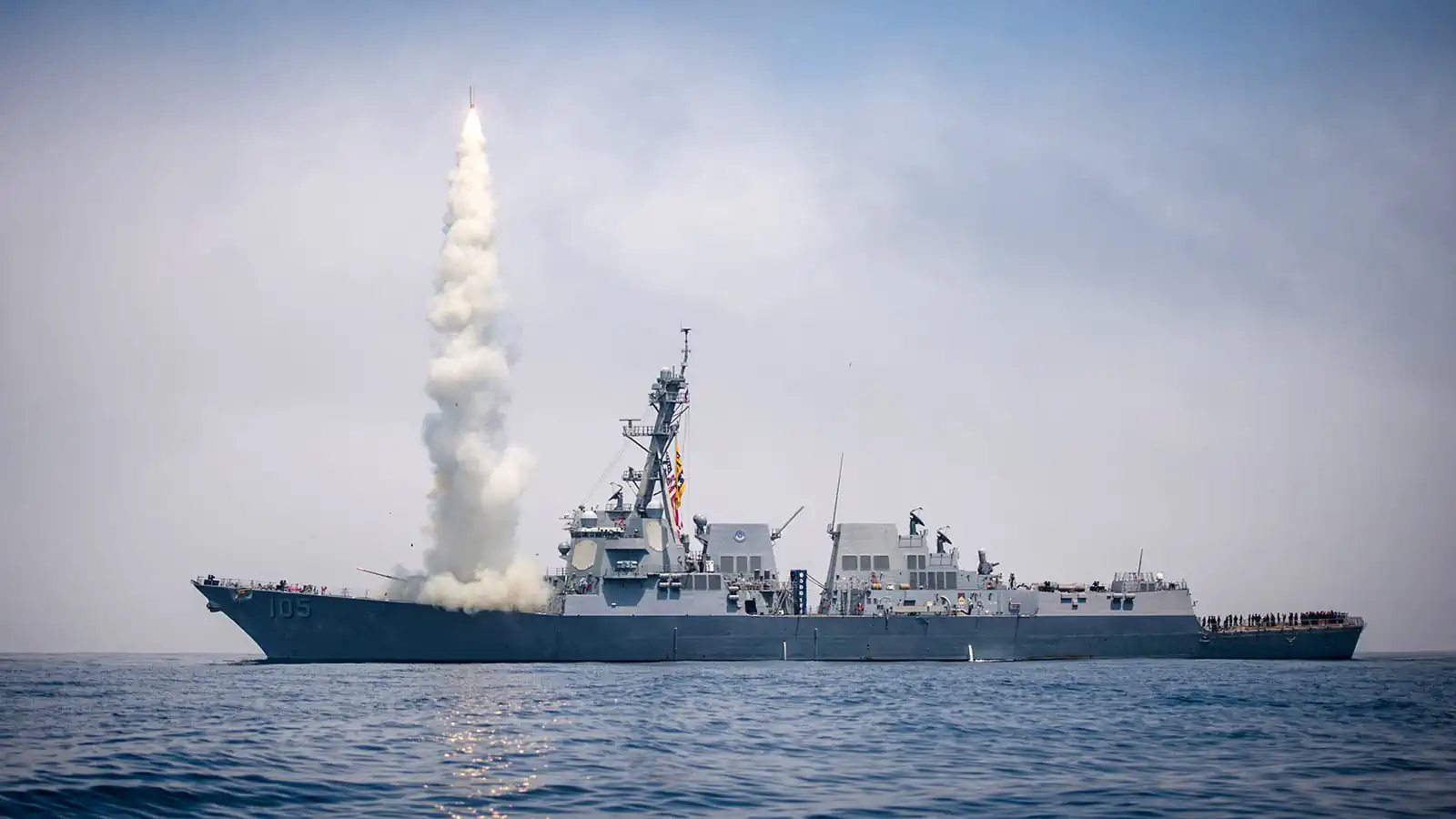
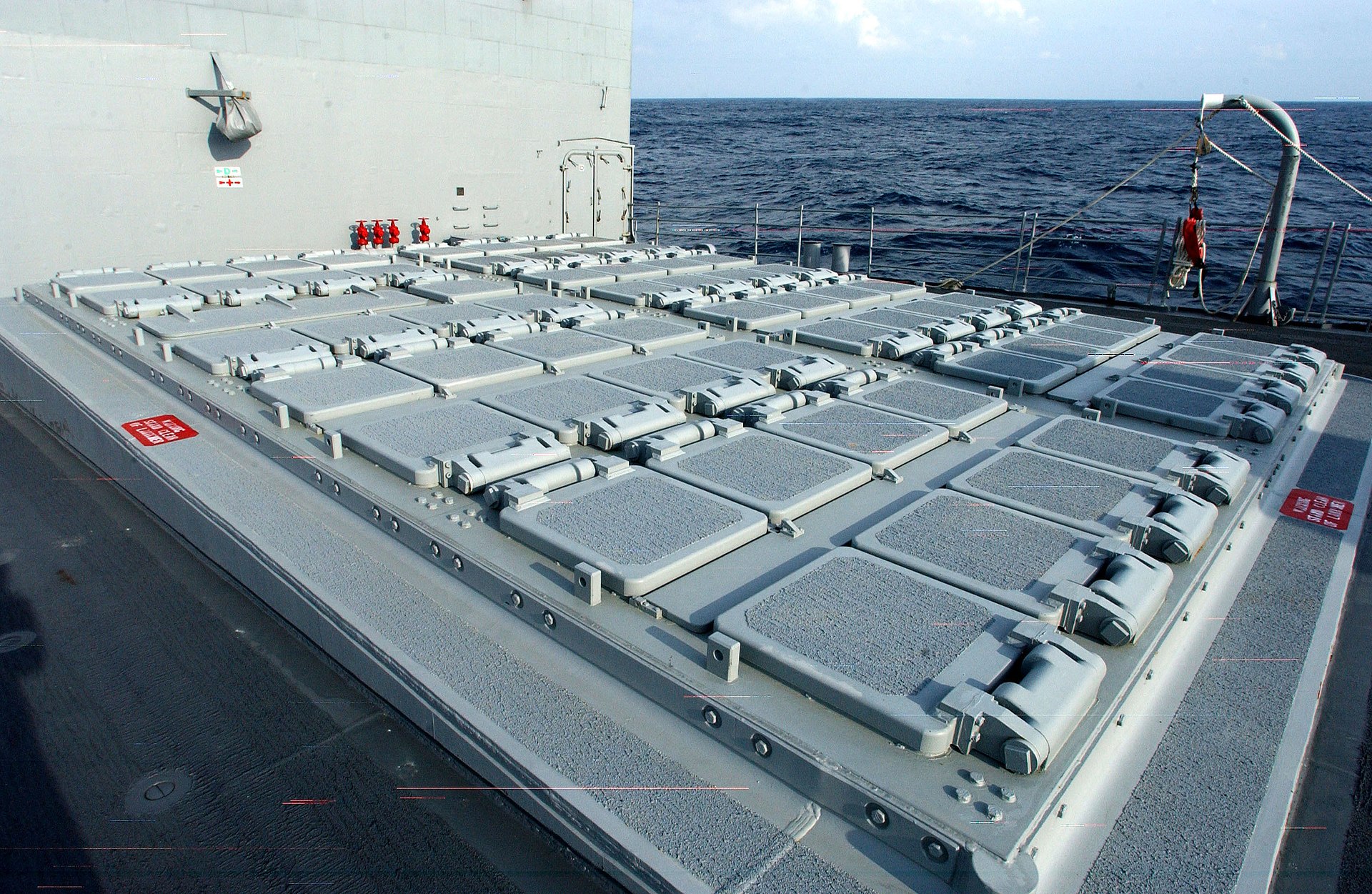
    Tomahawk missiles are widely launched from U.S. Navy surface warships such as Arleigh Burke-class destroyers and Ticonderoga-class cruisers. These vessels are equipped with the Vertical Launch System (VLS), which enables rapid missile firing. Each VLS cell can house a single Tomahawk missile. Due to their quick readiness and ability to fire multiple missiles simultaneously, these launchers play a critical role in offensive operations.
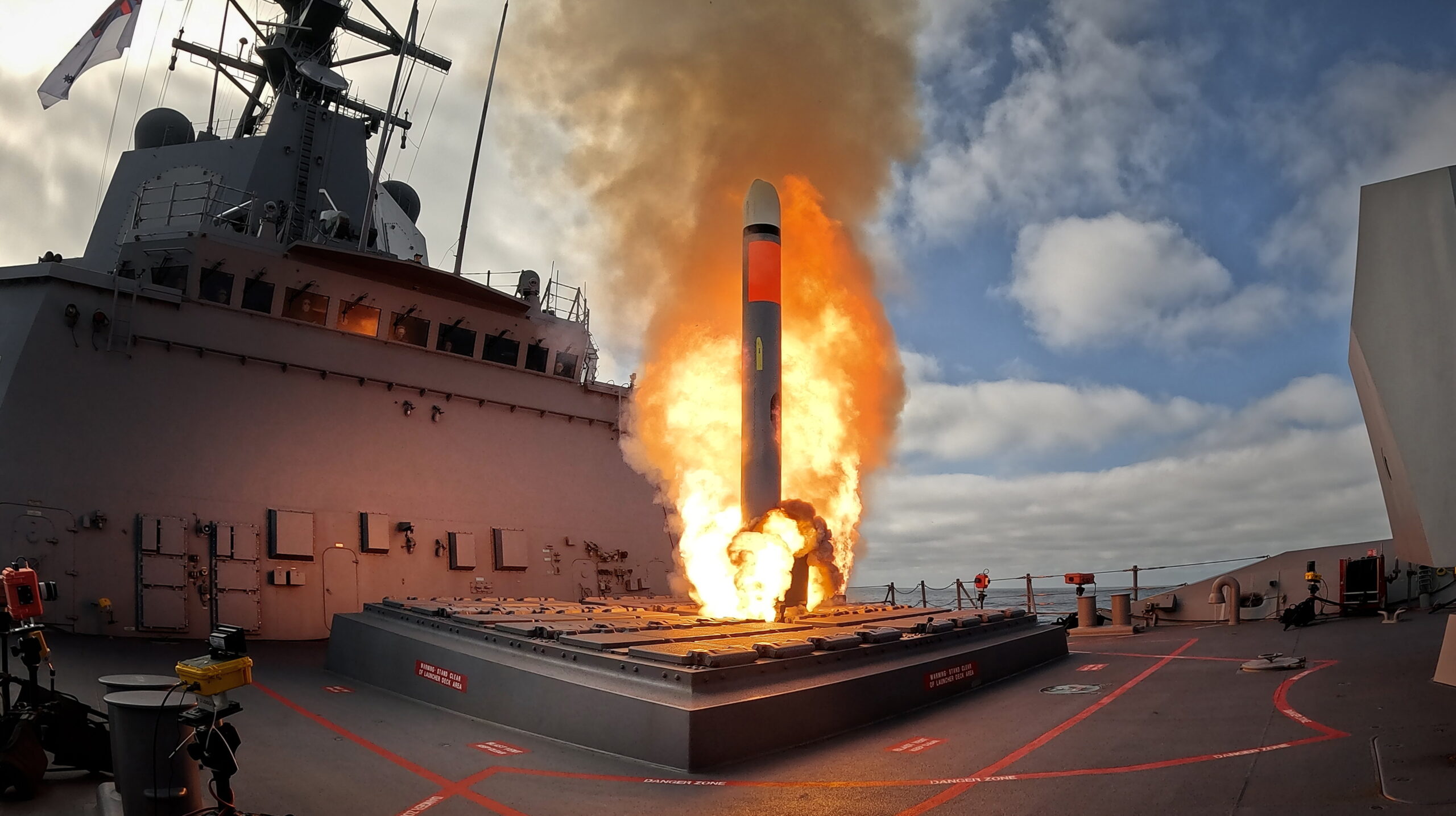
    Royal Australian Navy HMAS Brisbane fires a Tomahawk missile from a Mk-41 VLS launcher

    – Submarine Launchers
    Los Angeles-class, Virginia-class, and Ohio-class submarines are capable of launching Tomahawk missiles. In Ohio-class submarines, the missiles are fired through vertical launch systems integrated into the hull, while in Los Angeles-class and Virginia-class submarines, they are launched through torpedo tubes. Launching from submarines provides the advantages of stealth and surprise, enabling strikes from positions hidden from the enemy’s view.
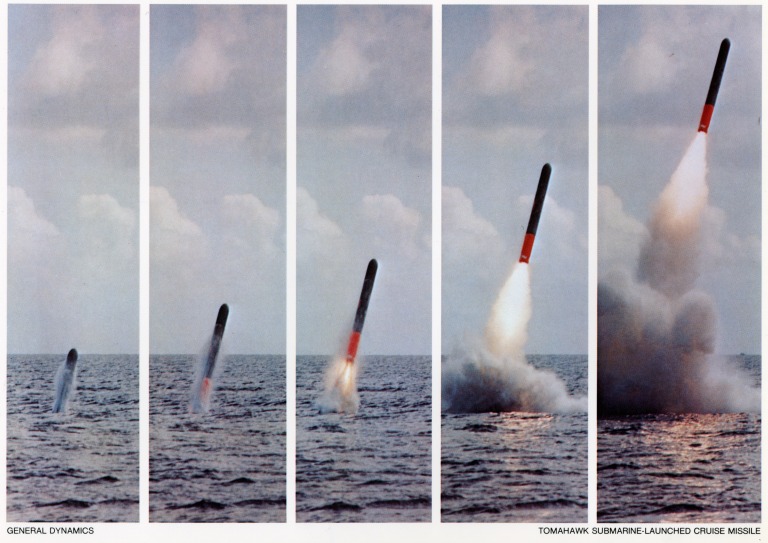
    Tomahawk missile fired from a submarine

    – Land-based Launchers
    During the Cold War, the land-based version of the Tomahawk, known as the BGM-109G Gryphon, was developed by the U.S. Air Force. This missile was launched from mobile ground-based Transporter Erector Launchers (TEL) and deployed in Europe. The Gryphon was equipped with a nuclear warhead and designed for strategic strikes against targets within Soviet territory. With the signing of the INF Treaty in 1987, this variant and its land-based launchers were retired from service.
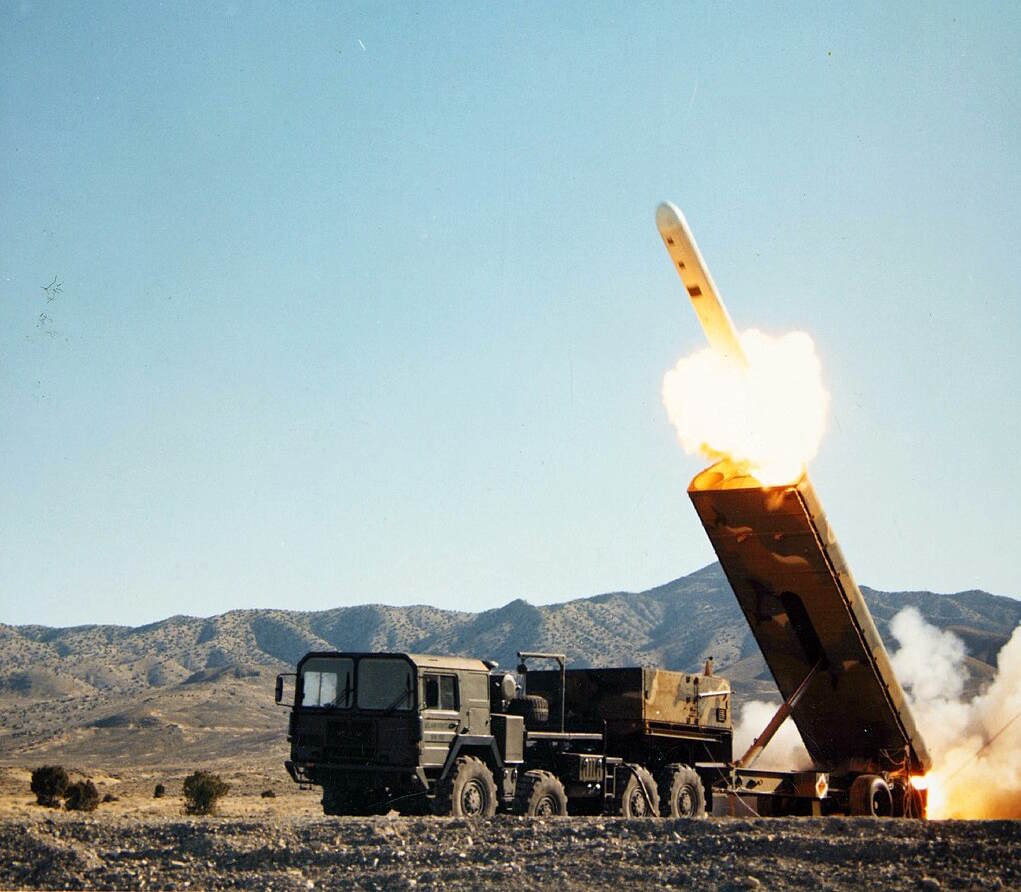
    BGM-109G Gryphon Tomahawk missile fired from a ground-based launcher

    Important Note on Tomahawk Launchers: Although the land-based version of the Tomahawk, the BGM-109G, was retired, naval Tomahawk missiles can still be prepared for launch using Mk-41 vertical launchers mounted on trailers. This approach effectively bypasses the restriction on ground-based deployment of the missile. The U.S. military addressed this issue through the Typhon project, also known as the “Strategic Mid-Range Fires System” (SMRF).

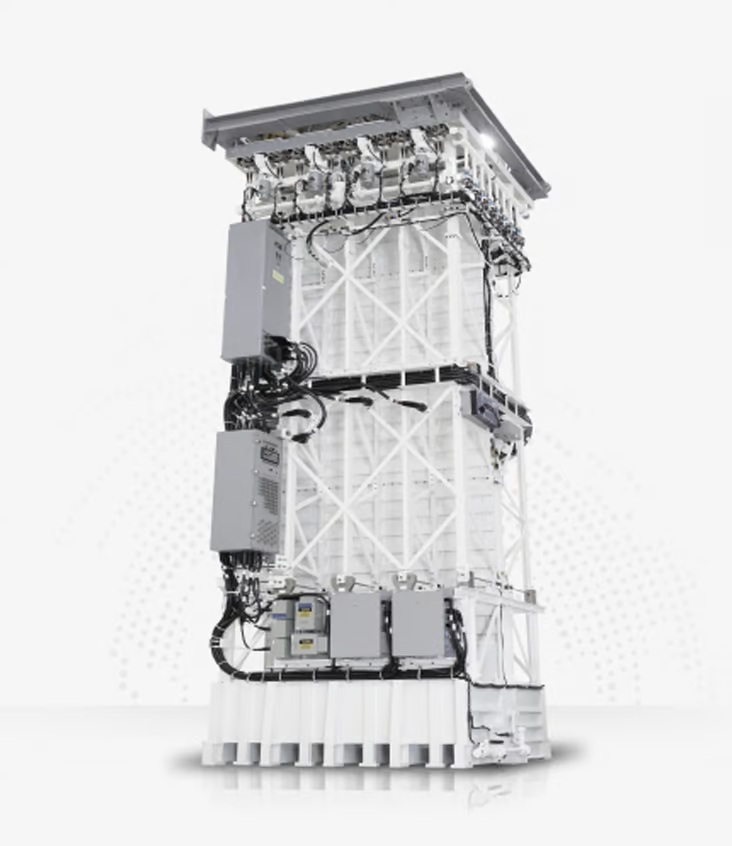
    Each Typhon missile system consists of four Mk-41 vertical launch boxes installed within a 12-meter ISO container. These launchers are capable of firing both SM-6 standard missiles and Tomahawk cruise missiles.
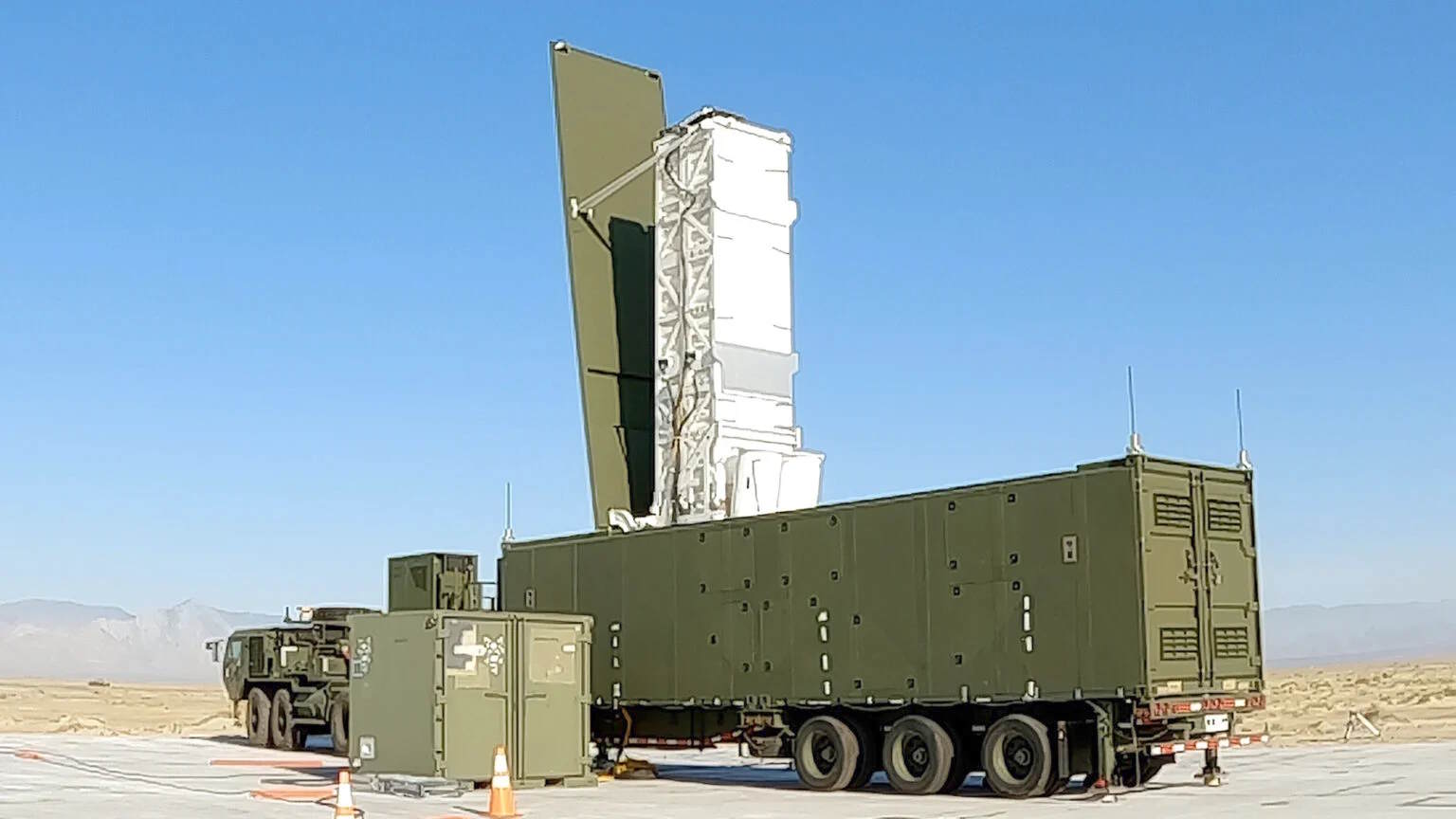
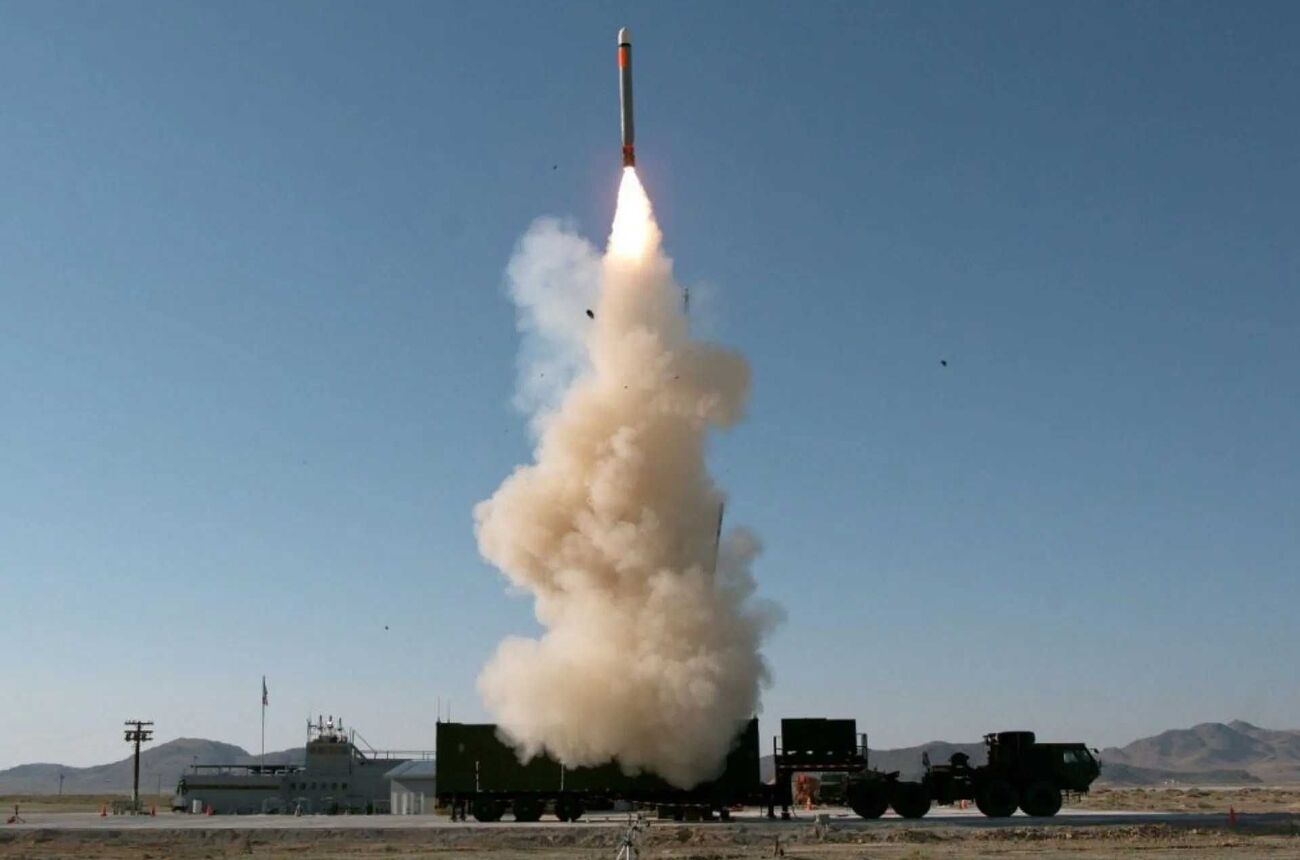
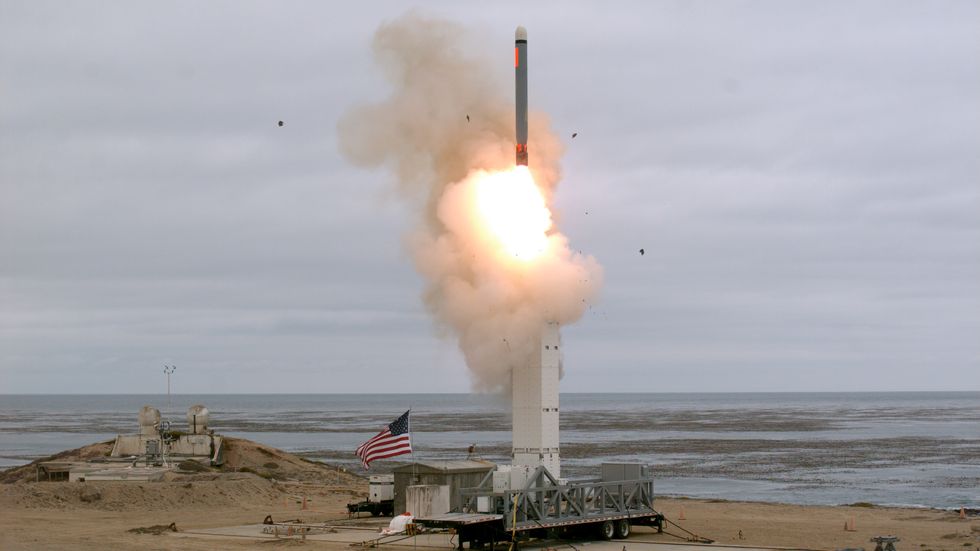
    Test firing a Tomahawk missile from an MK-41 VLS launcher in 2019

    Operational History of the Tomahawk Missile

    Since entering service in 1983, the Tomahawk cruise missile has played a key role in numerous military operations conducted by the United States and its allies.

    Persian Gulf War (1991): The first large-scale use of the Tomahawk occurred during Operation Desert Storm against Iraq. More than 288 missiles were launched from U.S. ships and submarines, striking targets such as command centers, air defense sites, and military facilities.

    Balkans (1995–1999): During NATO operations against Yugoslavia, Tomahawks were used to attack Serbian army positions, radar stations, and communication infrastructure. These strikes significantly weakened Belgrade’s military capabilities.

    Sudan and Afghanistan (1998): In response to the bombings of U.S. embassies in Kenya and Tanzania, the United States launched about 75 Tomahawks against the Al-Shifa pharmaceutical plant in Khartoum, Sudan—alleged to be involved in chemical weapons production—and against al-Qaeda training camps in Khost, Afghanistan.

    Afghanistan War (2001): At the start of Operation Enduring Freedom, more than 50 Tomahawks targeted al-Qaeda training camps, Taliban hideouts, and command centers in Afghanistan’s mountainous regions.

    Iraq War (2003): During Operation Iraqi Freedom, over 725 Tomahawks were fired. These strikes extensively targeted military infrastructure, command centers, and Saddam Hussein’s shelters. The use of Tomahawks in this war became a hallmark of “precision warfare.”

    Yemen (2010–2020): As part of the campaign against al-Qaeda in the Arabian Peninsula (AQAP), the United States employed Tomahawks to strike hideouts and training camps in the provinces of Shabwah, Ma’rib, and Hadhramaut.

    Libya (2011): In NATO’s operation to enforce a no-fly zone and support rebel forces, more than 112 Tomahawks were launched against Libyan air defense sites and command centers.

    Syria (2017 and 2018): The United States, citing alleged use of chemical weapons by the Syrian government, employed Tomahawks in two strikes. In 2017, 59 missiles targeted the Shayrat airbase, and in 2018, over 100 missiles struck research facilities in Damascus and Homs.

    Yemen (2025): Amid the Red Sea crisis and U.S. support for Israel, the United States and the United Kingdom launched more than 35 Tomahawks against Ansar Allah positions in Yemen.

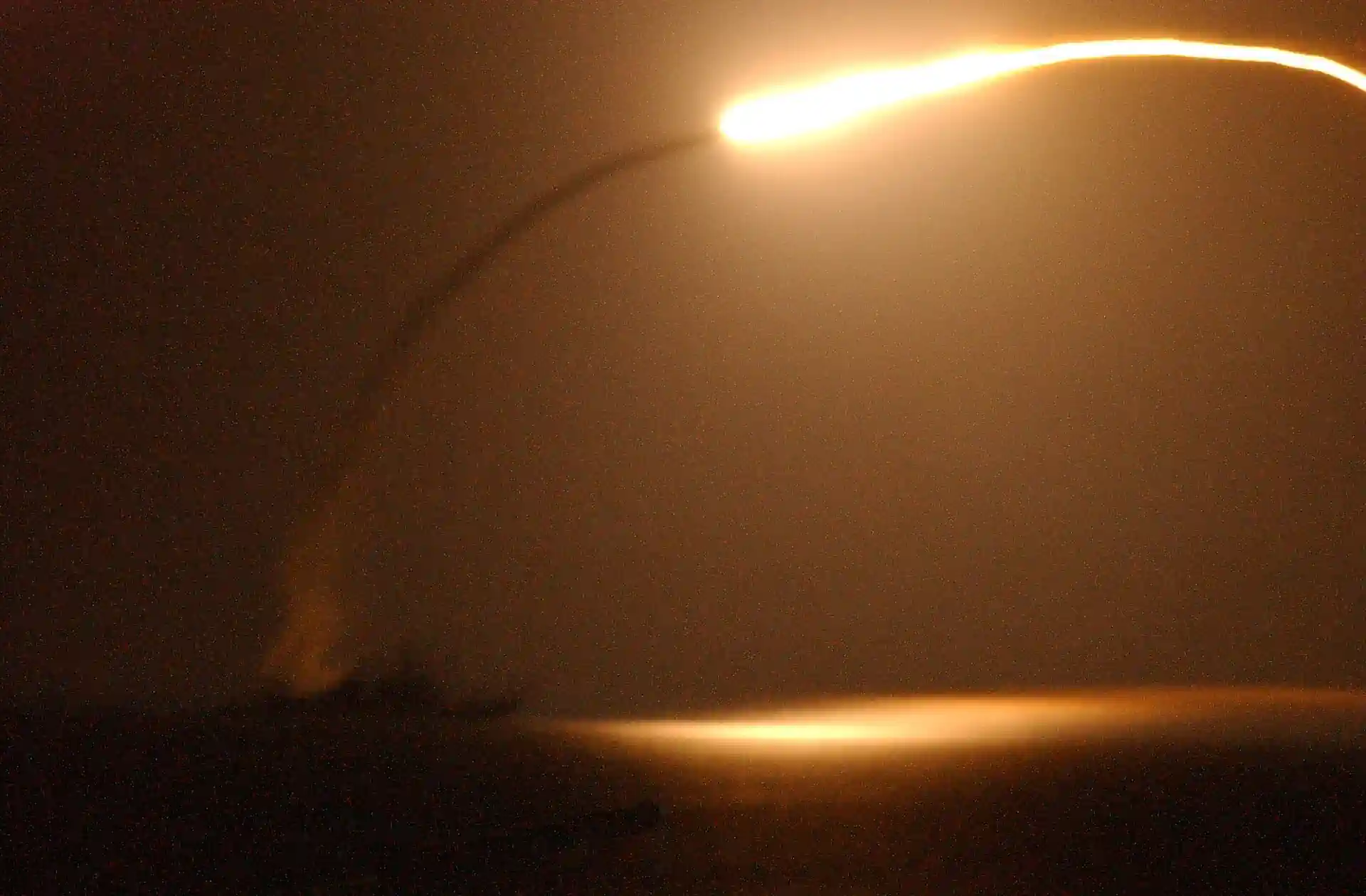
    Iran (2025): On June 22, 2025, the United States, in a joint operation with Israel, carried out a major strike on Iran’s nuclear facilities at Fordow, Natanz, and Isfahan. 30 Tomahawks were launched from a U.S. Navy Ohio-class submarine against Natanz and the Isfahan nuclear site.

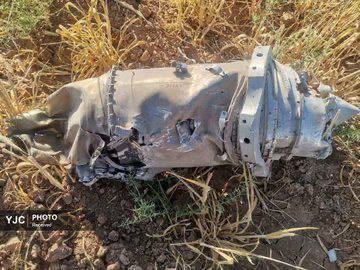
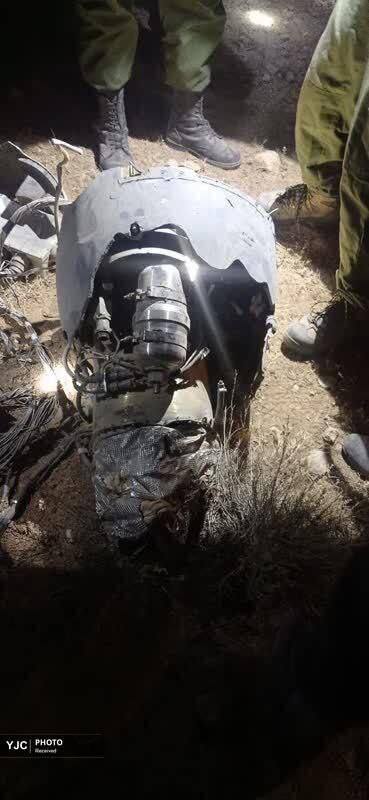
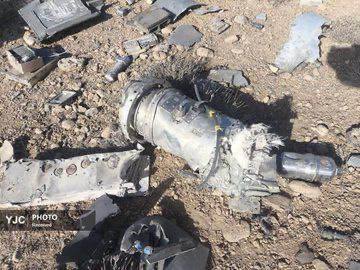
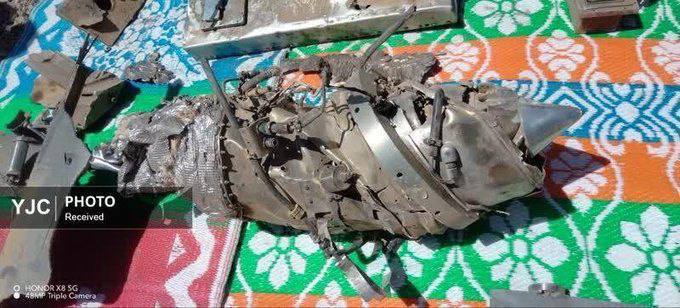
    Defensive Interceptions: In several of these operations, air defense systems successfully intercepted or diverted Tomahawk missiles. For example, during the 2025 U.S. strike on Iran, some missiles were shot down by Iranian defense systems. This was confirmed through images of Tomahawk wreckage recovered after the attacks.
    Export Market and Countries Operating the Tomahawk Missile

    The export market for the Tomahawk cruise missile is highly restricted and tightly controlled by the United States, as the weapon is considered a strategic asset. To date, only a few close U.S. allies have been able to acquire or place orders for the missile. The United Kingdom was the first and remains the only foreign country to operate the submarine-launched version of the Tomahawk, which it has employed in military operations. Australia and Japan have, in recent years, signed contracts to purchase Block V variants to enhance the offensive capabilities of their naval fleets. Poland and Canada have also expressed interest in acquiring the missile and have engaged in negotiations.

    In 2025, the Ukrainian government publicly requested Tomahawk cruise missiles from the United States to strengthen its offensive capability against strategic targets in Russian territory. The Pentagon approved the transfer of Tomahawks to Ukraine, but the final decision was left to the U.S. President.

    With an export price of approximately $4 million (export version) per missile and given the geopolitical sensitivities, Tomahawk exports remain limited to nations with close security ties to Washington.

    Final Summary
    With features such as long range, high accuracy, sea-launch capability, in-flight retargeting, and flexibility in carrying different warheads, the Tomahawk is one of the most effective long-range offensive weapons in the U.S. arsenal. Beyond its battlefield role, it plays a vital part in U.S. deterrence doctrine and military power projection. The development of new, network-enabled versions ensures the missile’s continued relevance in current conflicts and for decades to come.
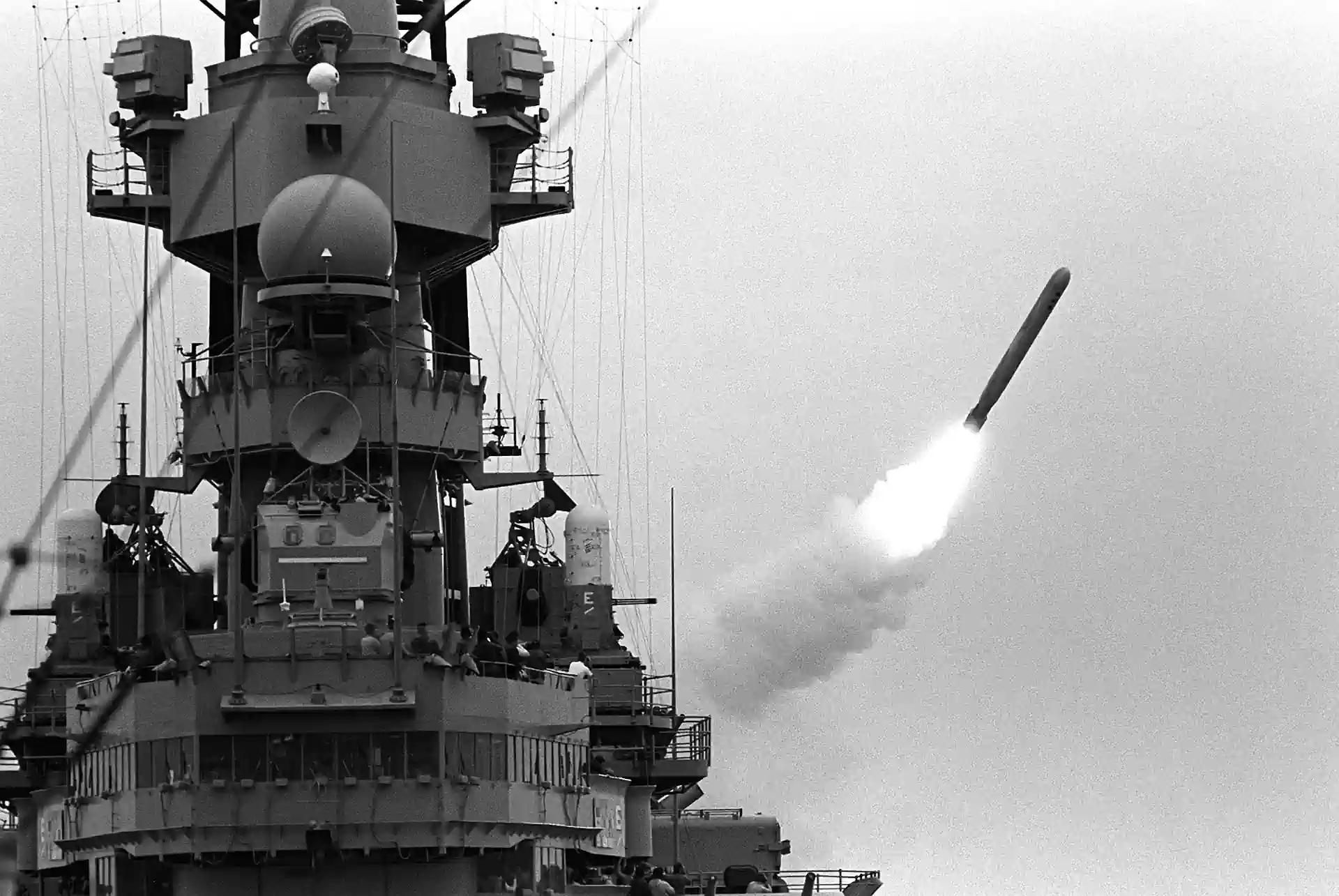
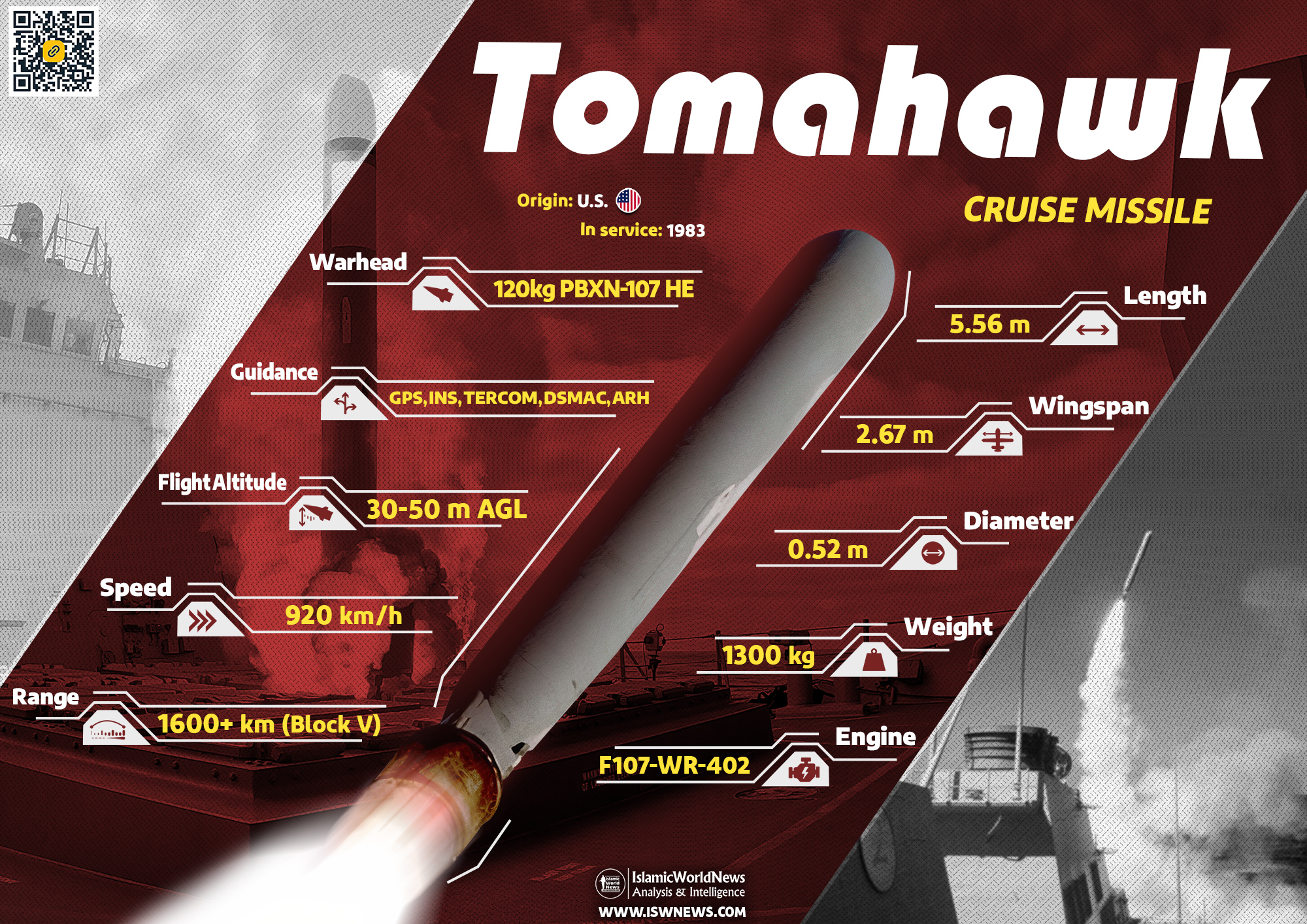
    Specifications of the Tomahawk Cruise Missile:

    Type: Long-range subsonic cruise missile
    Origin: United States
    Manufacturer: Raytheon
    Service Entry: 1983
    Length: 5.56 meters
    Wingspan: 2.67 meters
    Diameter: 0.52 meters
    Weight: 1,300 kilograms
    Engine: F107-WR-402 turbofan
    Range: 1,600 + kilometers (Block V)
    Flight Altitude: 30–50 meters AGL
    Speed: 920 km/h (Mach 0.74)
    Warhead: 120 kg PBXN-107 high explosive
    Guidance Systems: GPS, INS, TERCOM, DSMAC, ARH
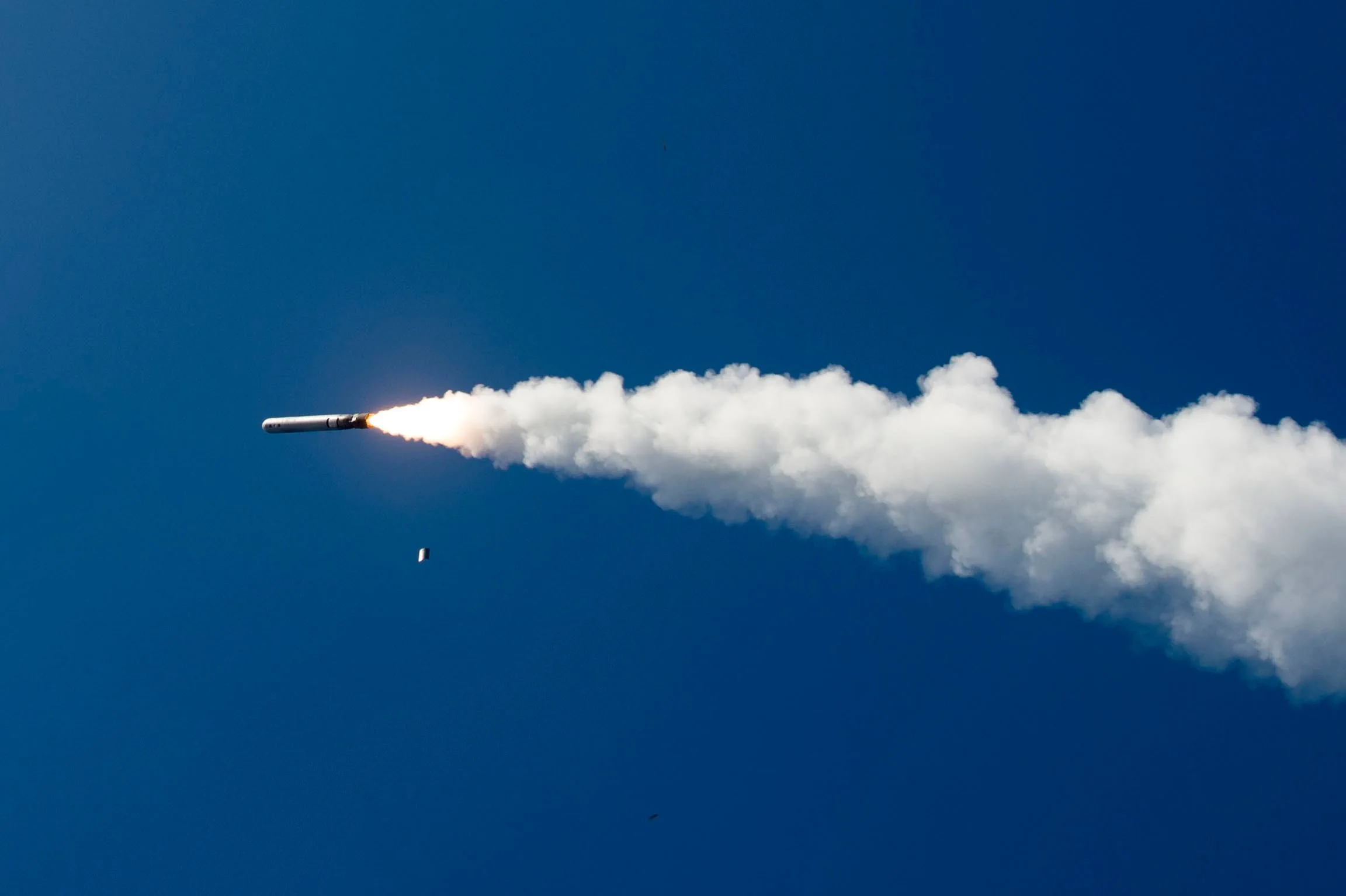
    Tomahawk cruise missile – Click to view full-size image

    Sources:
    Wikipedia – Tomahawk | Raytheon Missiles | Defense Industry Daily | CNN | BBC News | The Drive | GlobalSecurity.org | Jane’s Defence Weekly | Federation of American Scientists | Defense Express | Air Power Australia | Typhon missile system | U.S. Navy Fact File | NAVAIR Public Release

  • Military Knowledge: Raytheon Multi-Spectral Targeting Systems

    Military Knowledge: Raytheon Multi-Spectral Targeting Systems

    Introduction to Multi-Spectral Targeting Systems (MTS):

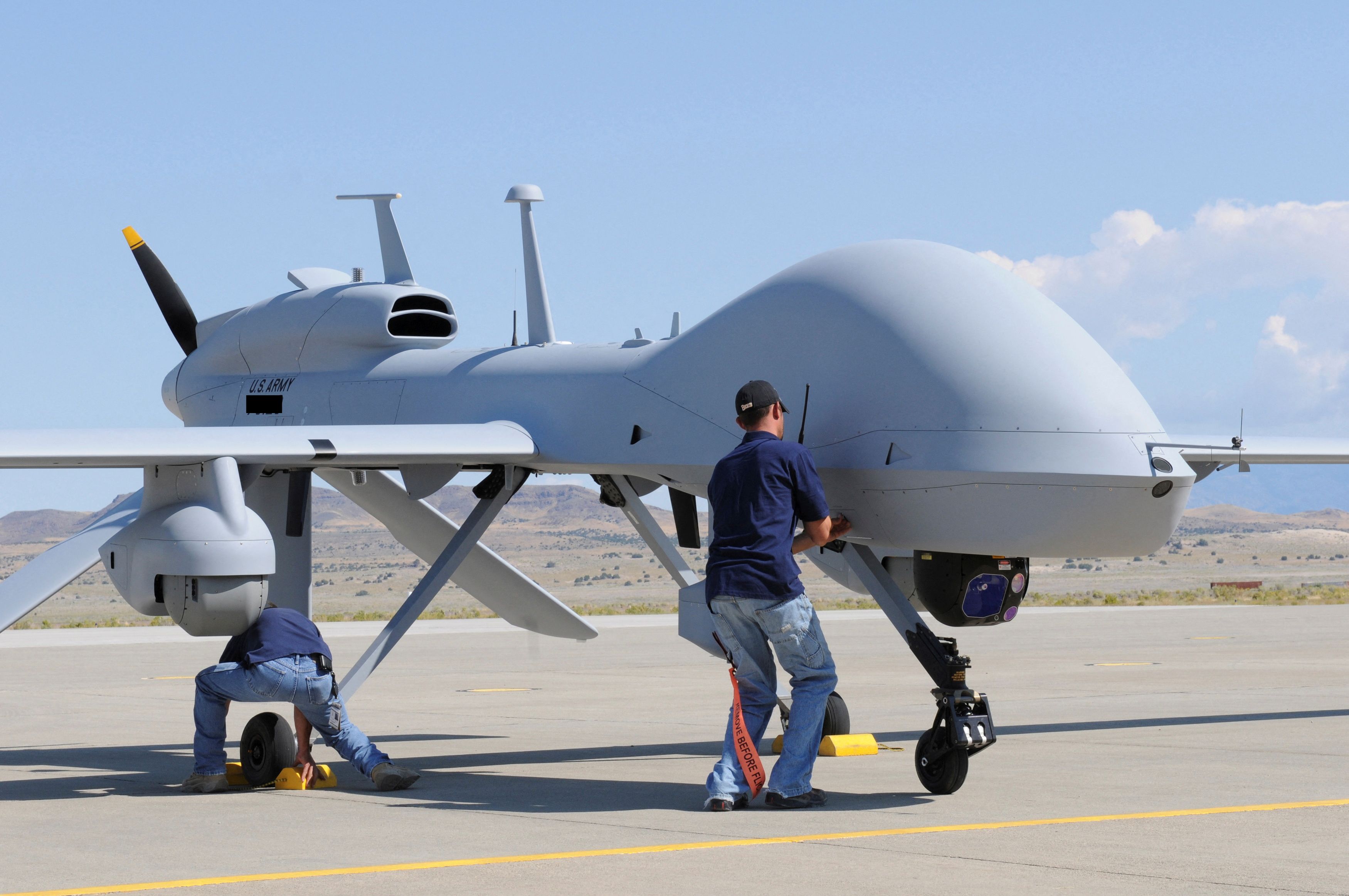
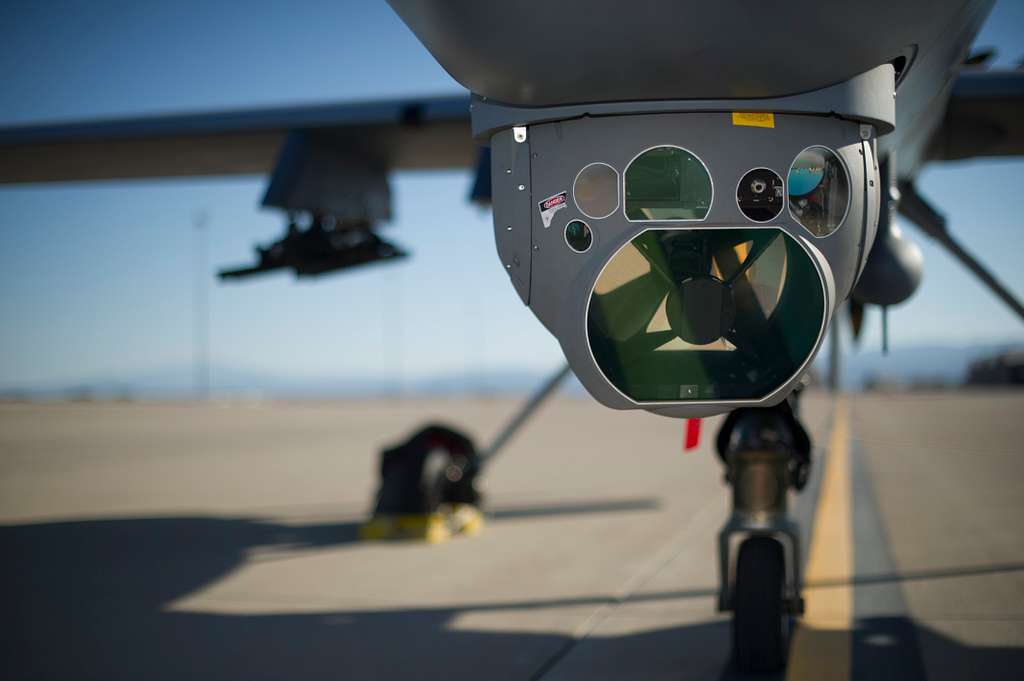
    Multi-Spectral Targeting Systems (MTS) are advanced sensors that operate by receiving and processing data across several electromagnetic spectrum bands. At the heart of these systems is the fusion of electro-optical (EO) technology in the visible and infrared (IR) ranges. This technology gained prominence with the expansion of long-range reconnaissance UAV usage, allowing military drones to take on roles traditionally reserved for manned reconnaissance aircraft.

    Unlike conventional imaging systems that are limited to a single spectral range, MTS combines images from multiple bands—including Long-Wave Infrared (LWIR: 8–12 µm), Mid-Wave Infrared (MWIR: 3–5 µm), Short-Wave Infrared (SWIR: 1–2.5 µm), and Near-Infrared (NIR: 0.7–1 µm)—making it effective not only in daylight and nighttime but also in challenging weather conditions like dust, smoke, and fog.

    Raytheon, now part of the RTX group, has secured a significant portion of the market for this technology by leveraging extensive operational experience and close collaboration with the U.S. armed forces. The MTS system family is one of Raytheon’s most distinguished achievements, developed in 44 different versions for use on 21 different platforms.

    In the following, the flagship models will be introduced in more detail.

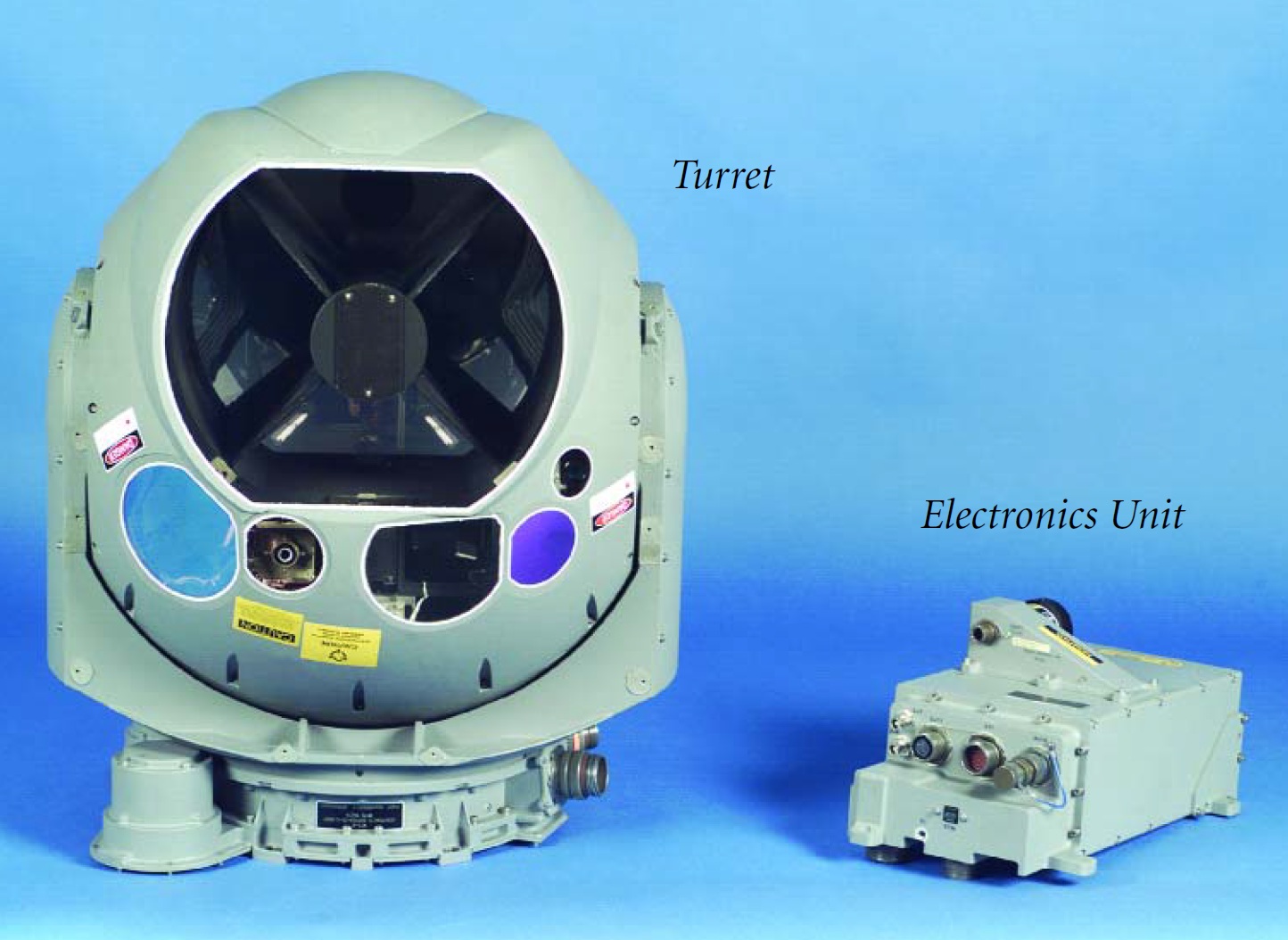
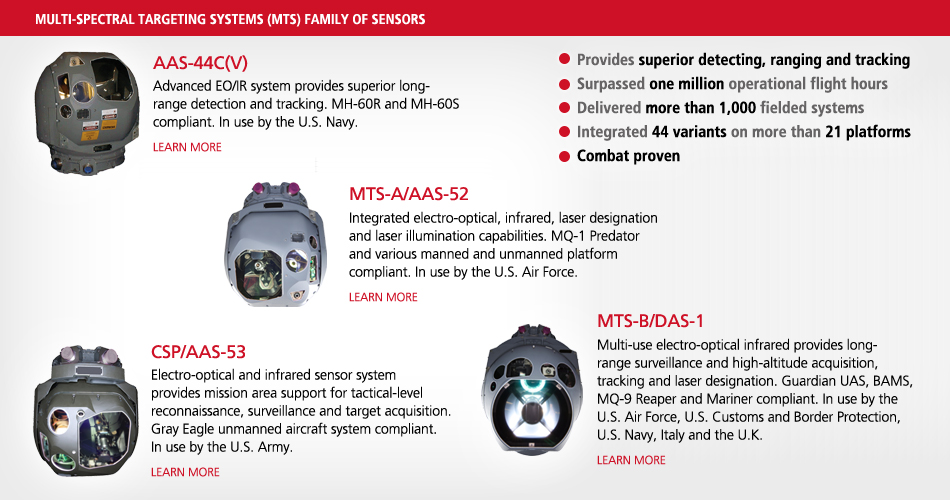
    MTS-A: Foundational Multi-Spectral Targeting System (AN/AAS-52 and AN/AAS-44C)

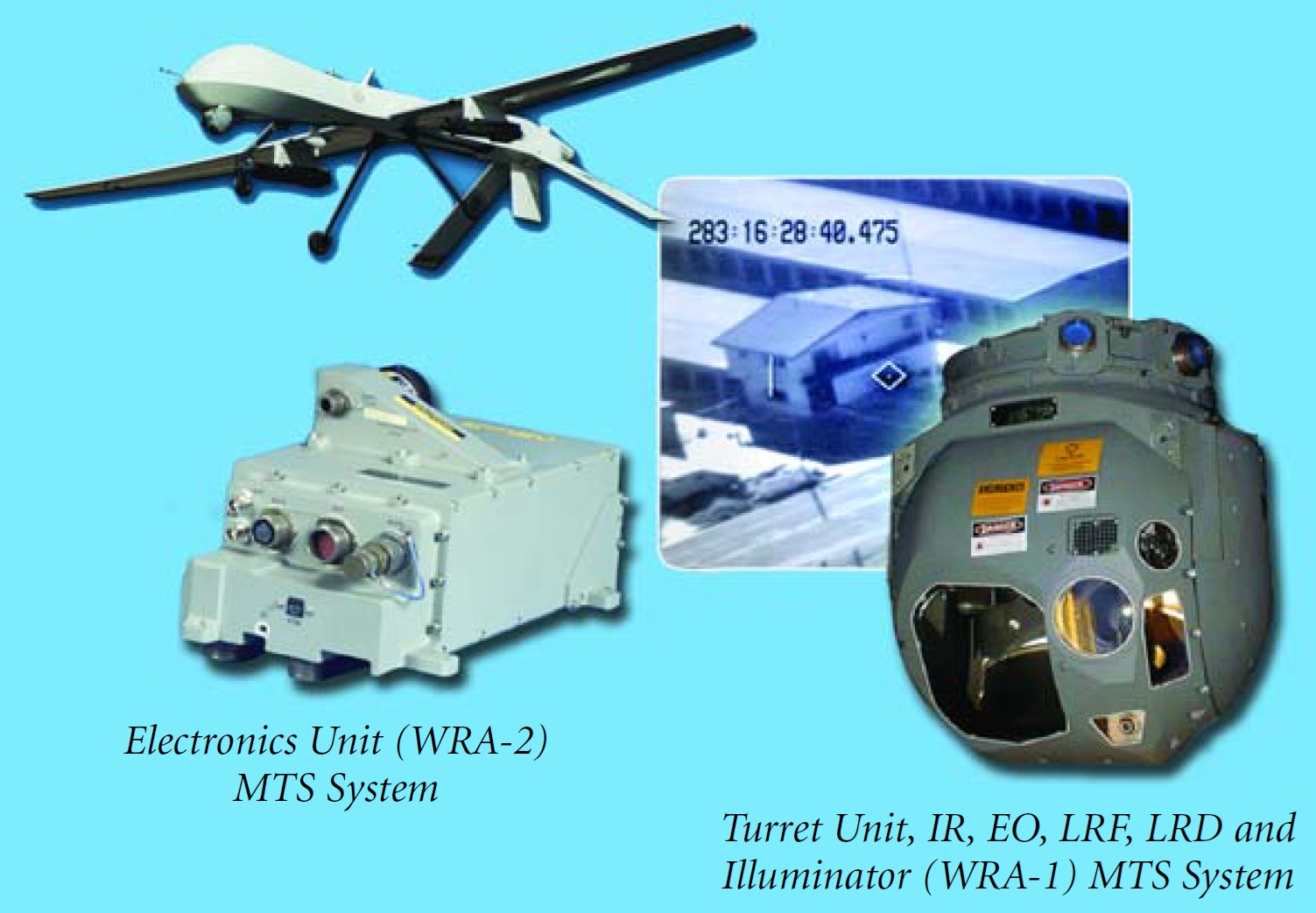
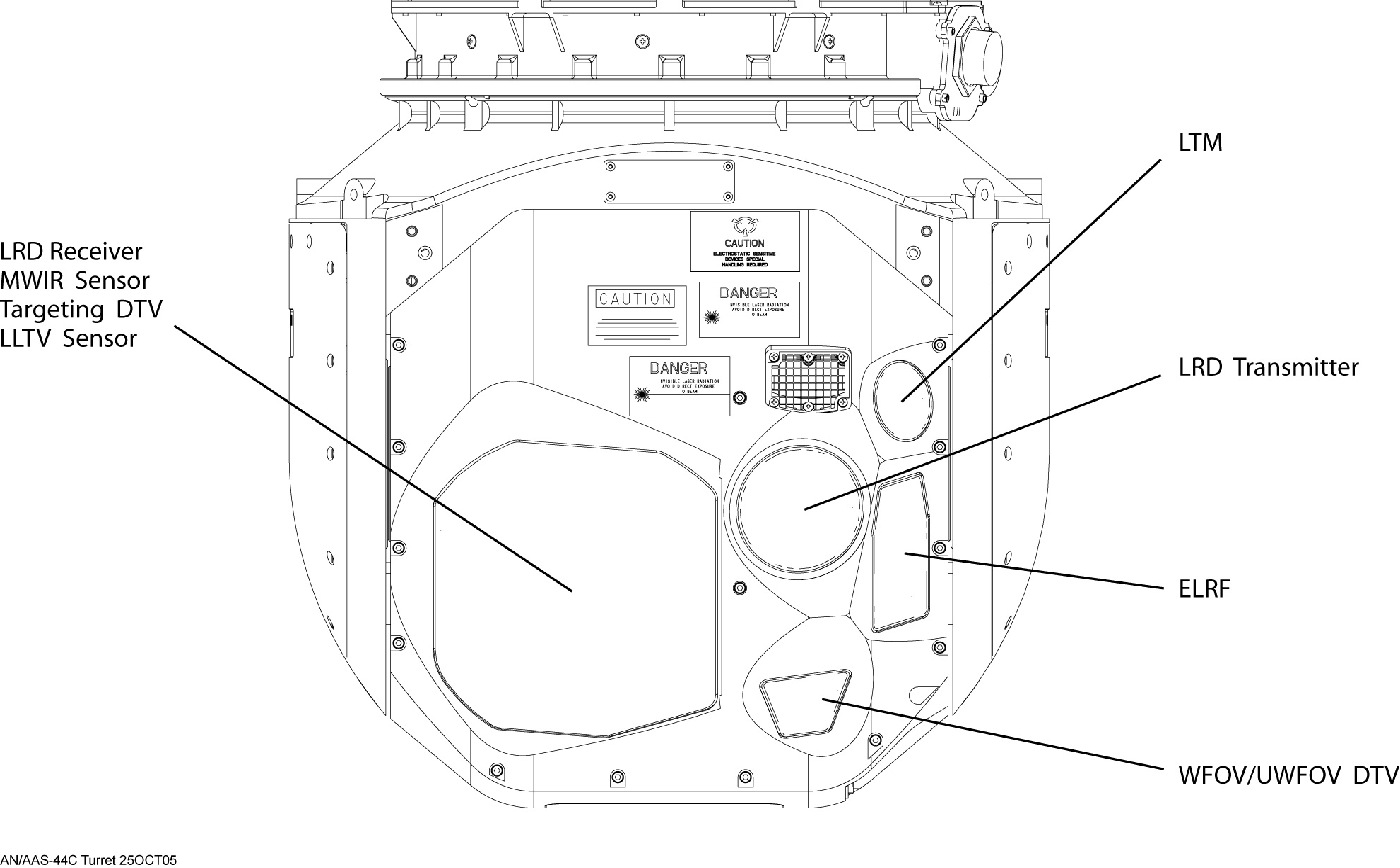
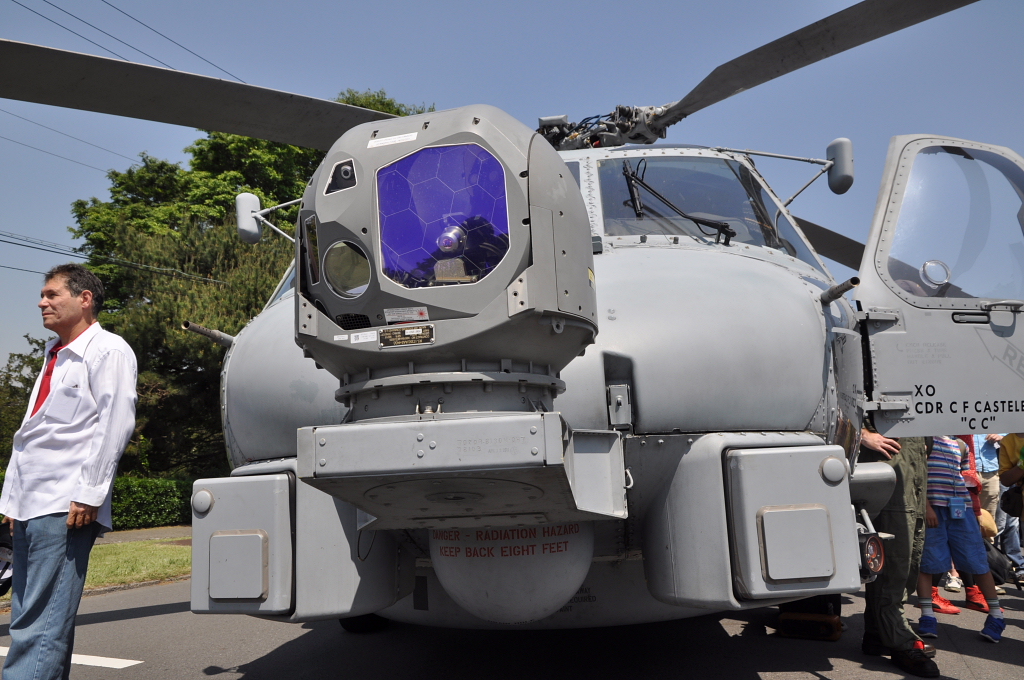
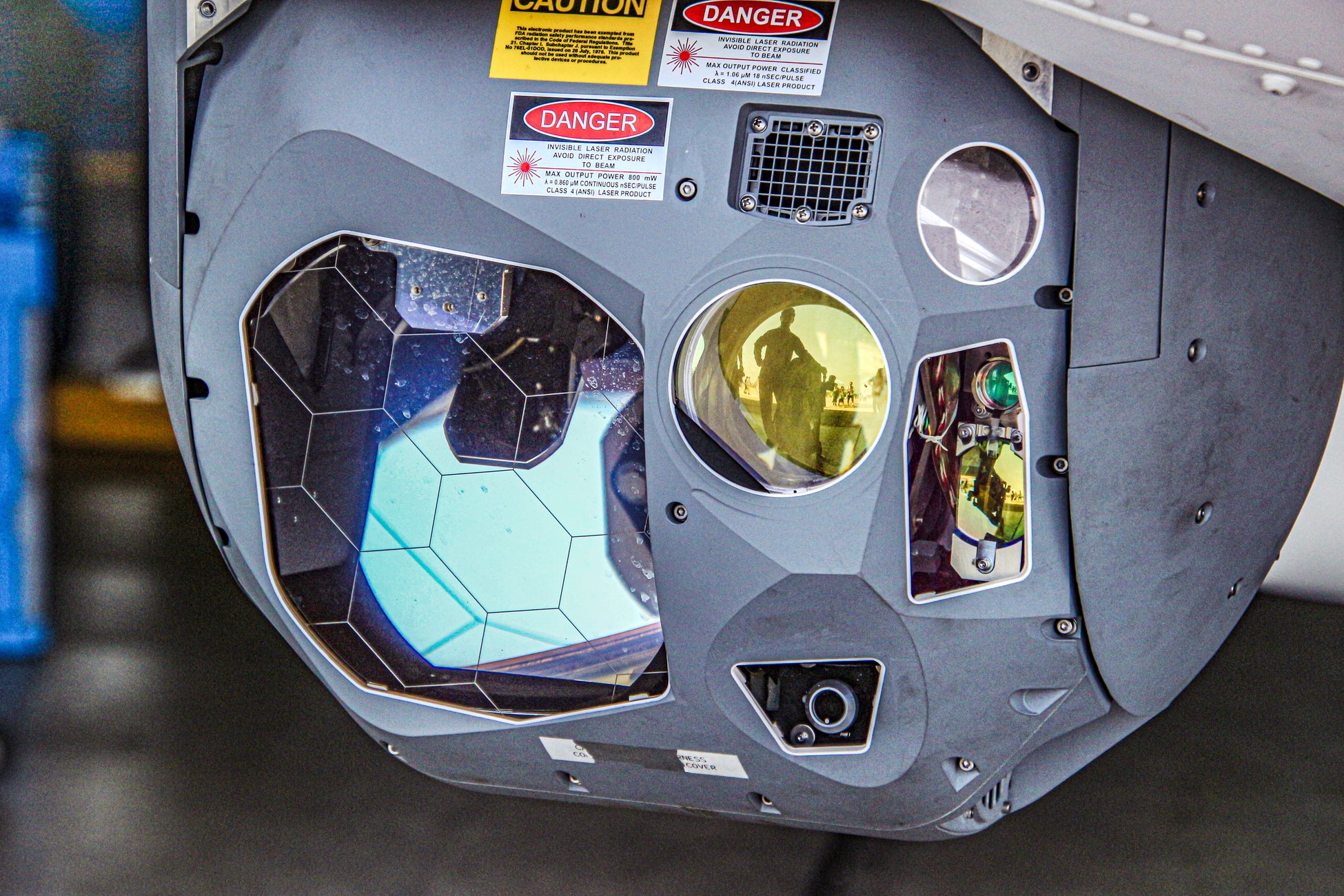
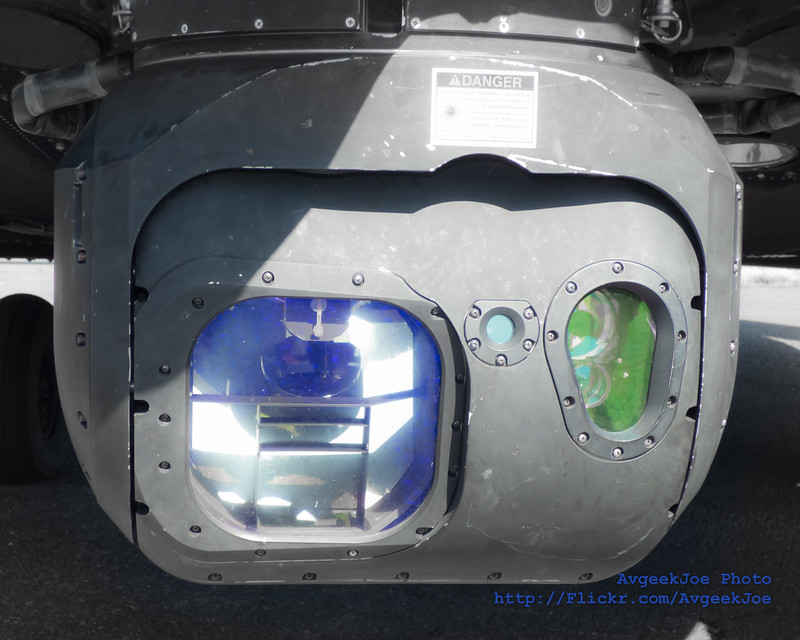
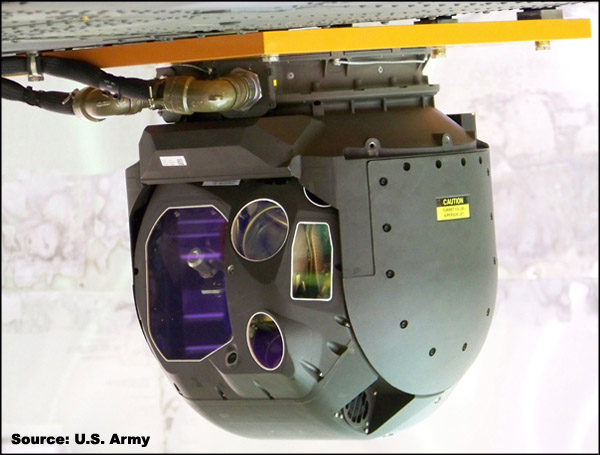
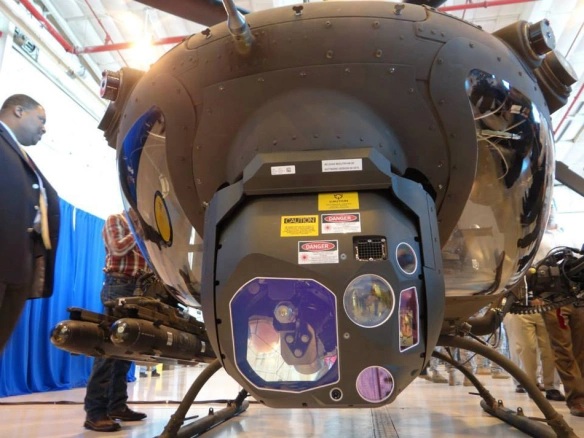
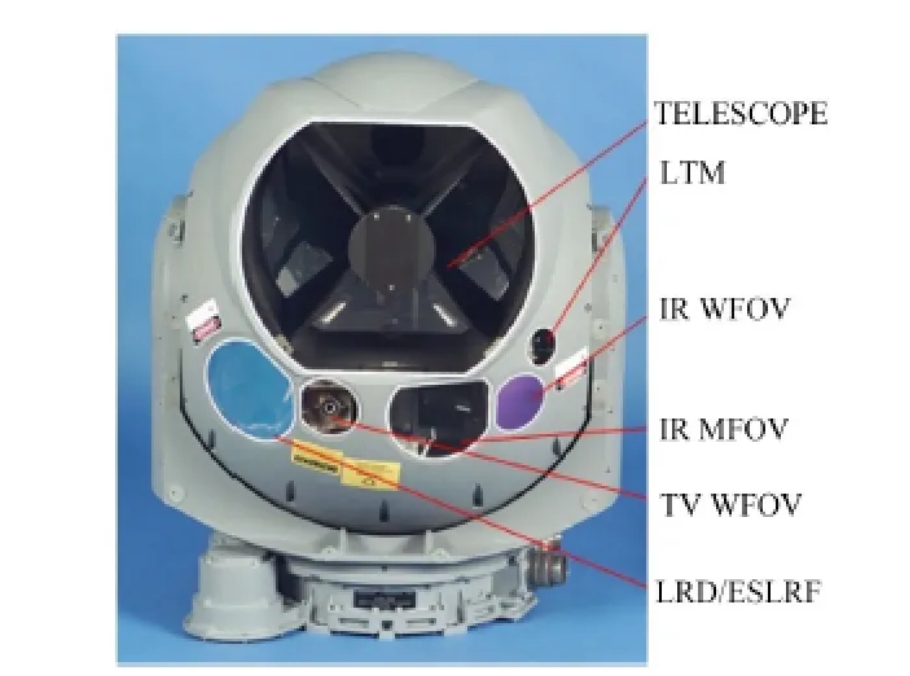
    The MTS-A model, known by designations AN/AAS-52 (used by the U.S. Air Force) and AN/AAS-44C(V) (used by the U.S. Navy), is considered one of the earliest members of Raytheon’s Multi-Spectral Targeting System family. This system integrates core electro-optical (EO) capabilities in the visible and infrared (IR) spectrum with laser range-finding, laser designation, and laser illumination functions.

    These features enable long-range surveillance and reconnaissance, target detection and identification, tracking of moving targets, precise distance measurement to targets, and most importantly, accurate laser designation for guiding various laser-guided munitions such as the AGM-114 Hellfire missile and other precision-guided weapons.

    Operational History of MTS-A

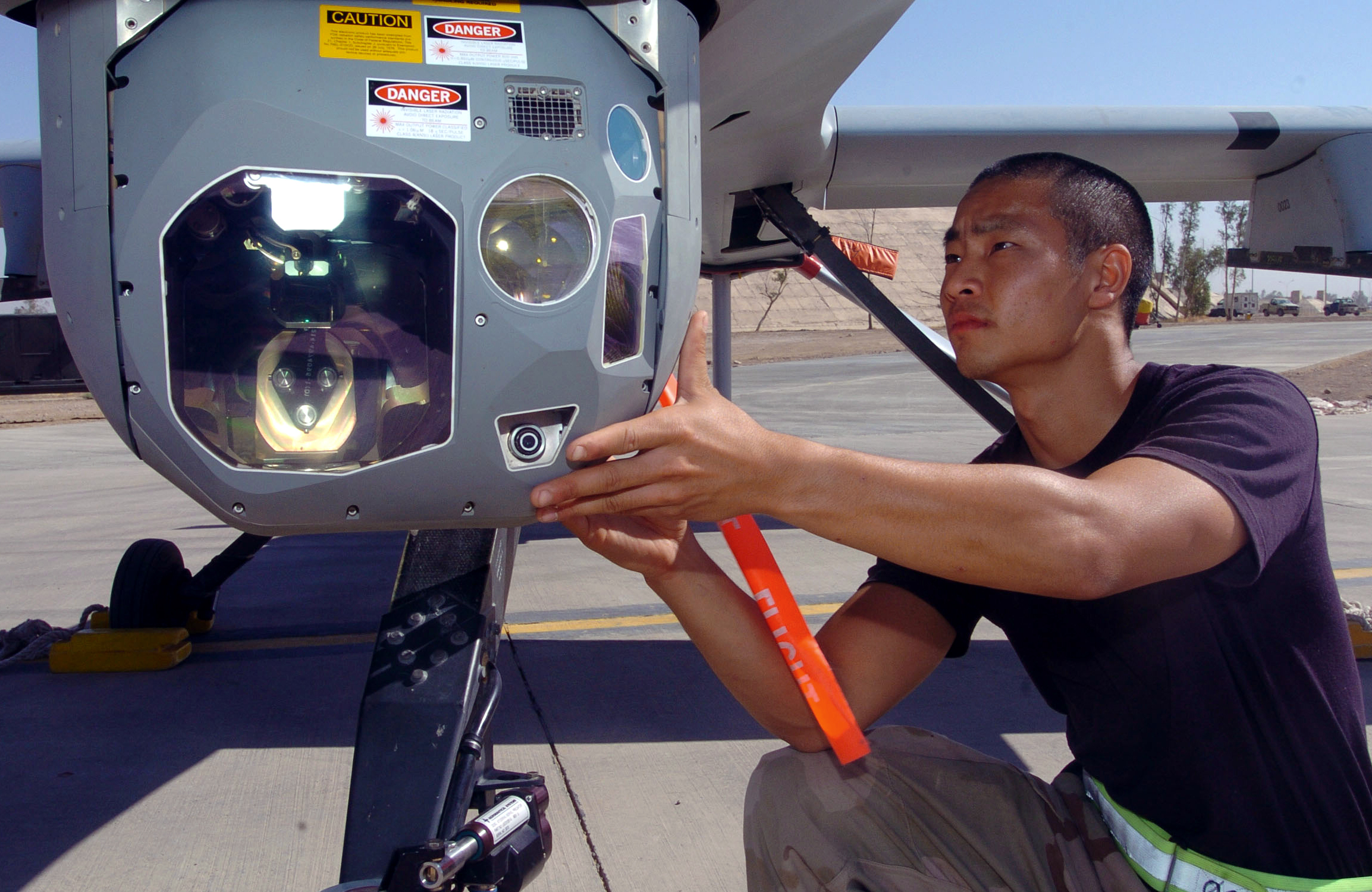
    MTS-A entered operational service in the late 1990s, with the AN/AAS-52 deployed on MQ-1 Predator UAVs by the U.S. Air Force during covert operations in Kosovo, and later in Afghanistan following the events of September 11. At the time, the U.S. Air Force was heavily focused on arming Predator drones with Hellfire missiles, and the MTS-A system played a pivotal role in enabling that capability.

    Beyond the Air Force, the U.S. Navy adopted MTS-A with the designation AN/AAS-44V on SH-60B and HH-60H helicopters, and the AN/AAS-44C variant on MH-60S and MH-60R helicopters.

    Raytheon also declared that the MTS-A system is suitable for installation on fixed-wing aircraft.

    Special Operations Variant: AN-ZSQ-2

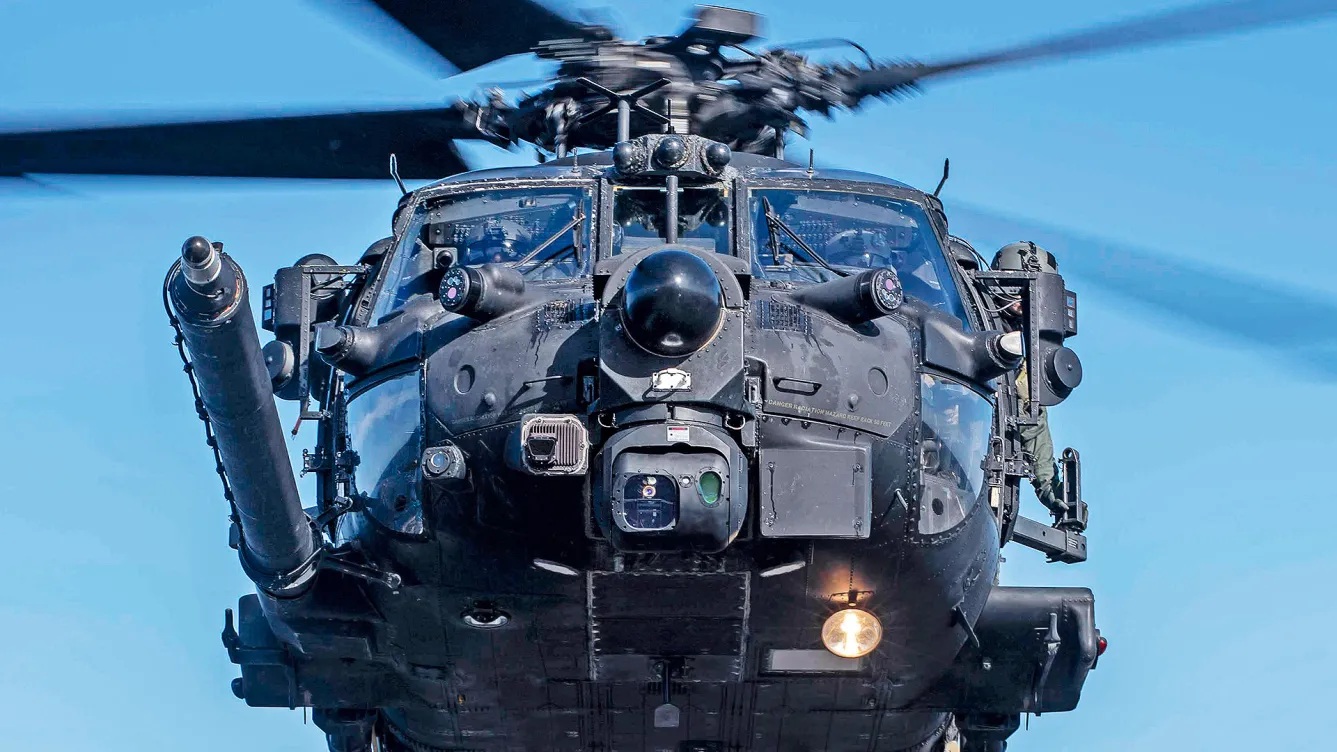
    The MH-47 and MH-60M helicopters used by the U.S. Army’s Special Operations Aviation Regiment (SOAR) are equipped with an evolved sensor variant based on MTS-A and MTS-B, designated AN-ZSQ-2, which is mounted on the aircraft’s nose.

    Technical Specifications of MTS-A:

    • Payload Weight:
      • Sensor Module: approx. 59 kg
      • Control & Processing Unit: 11.3 kg
    • Dimensions:
      • Sensor Module Diameter: 45.7 cm
      • Control & Processing Unit: 36.6 × 12.4 × 19.3 cm
    • Field of View (FOV):
      • Wide: 34 × 45° – battlefield overview
      • Semi-wide: 17 × 22° – focused regional scans
      • Medium: 5.7 × 7.6° – balance between scope and detail
      • Semi-narrow: 2.8 × 3.7° – targets at mid-range
      • Narrow: 1.2 × 1.6° – for tracking moving targets
      • Ultra-narrow IR: 0.6 × 0.8° – precise night targeting
      • Ultra-narrow TV: 0.21 × 0.27° – high-resolution daytime imagery
    • Stabilization: 6-axis gimbal mount

    AN/AAS-53 Common Sensor Payload (CSP)

    In November 2007, the United States Army selected Raytheon to provide the Common Sensor Payload (CSP) for use on a variety of manned and unmanned aircraft. The sensor is based on technologies used in the MTS-A system. The AN/AAS-53 CSP was initially intended for installation on the ARH-70A armed reconnaissance helicopter (which was later canceled) and for installation on the MQ-1C Grey Eagle multirole unmanned aerial vehicle.

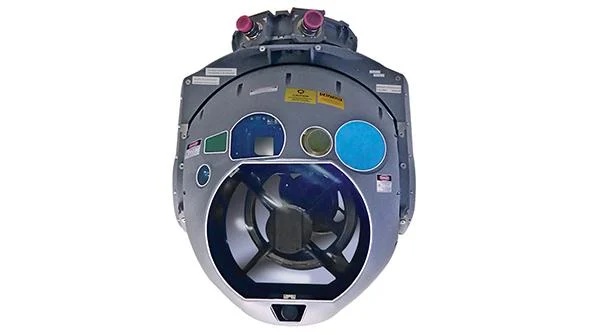
    MTS-B: Advanced System for High-Altitude, Long-Range Surveillance (AN/DAS-1)

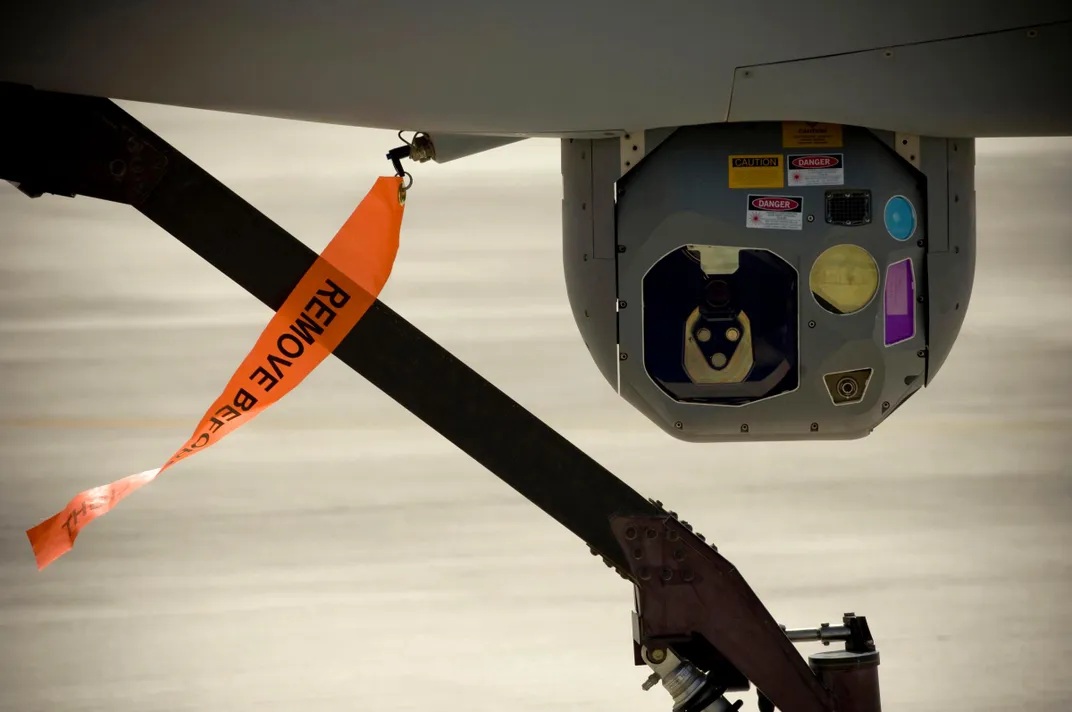
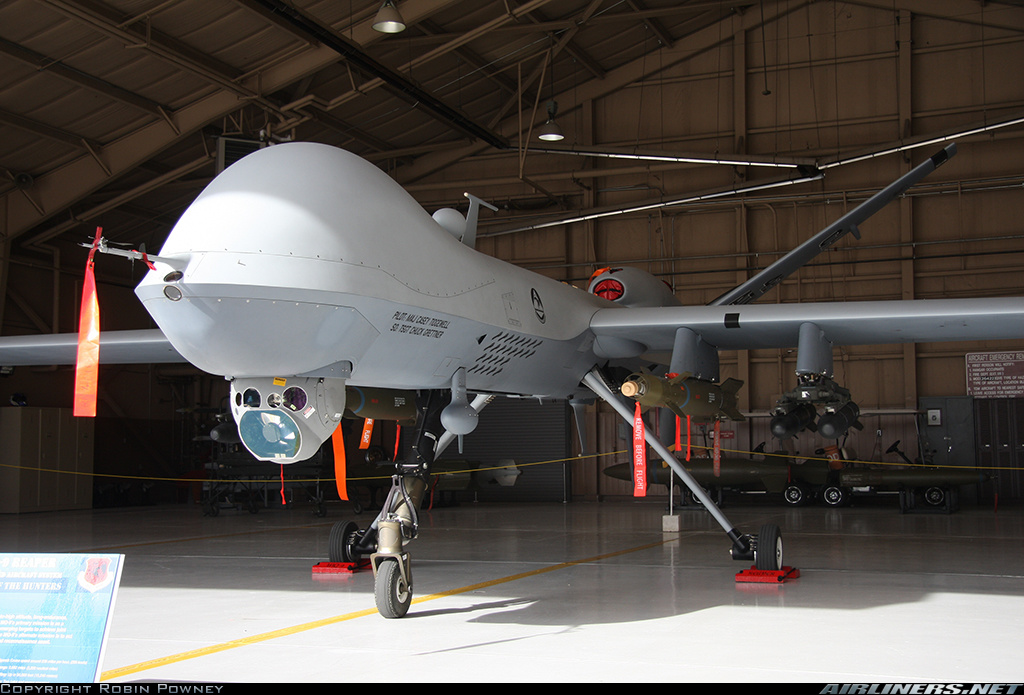
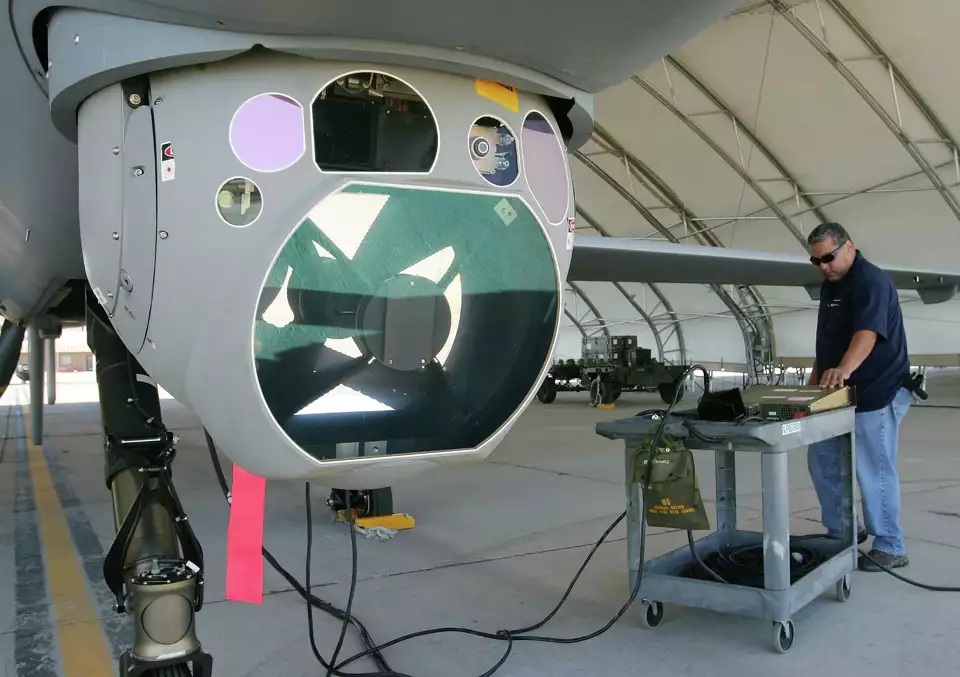
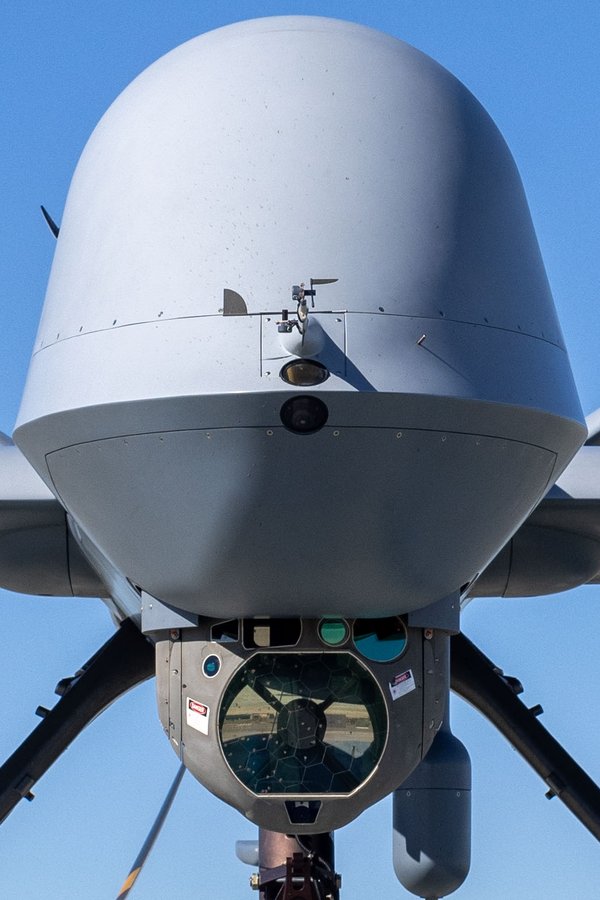
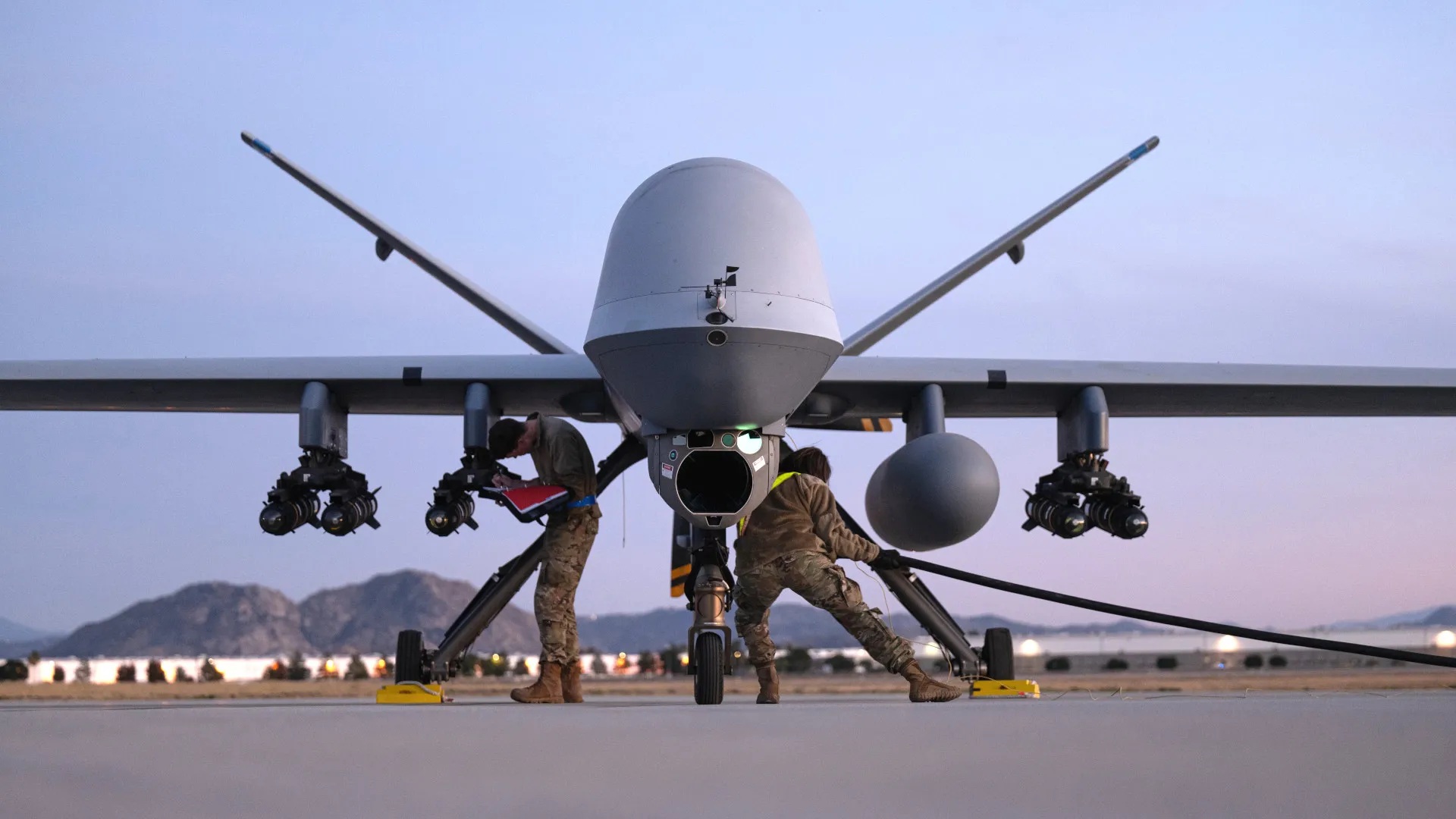
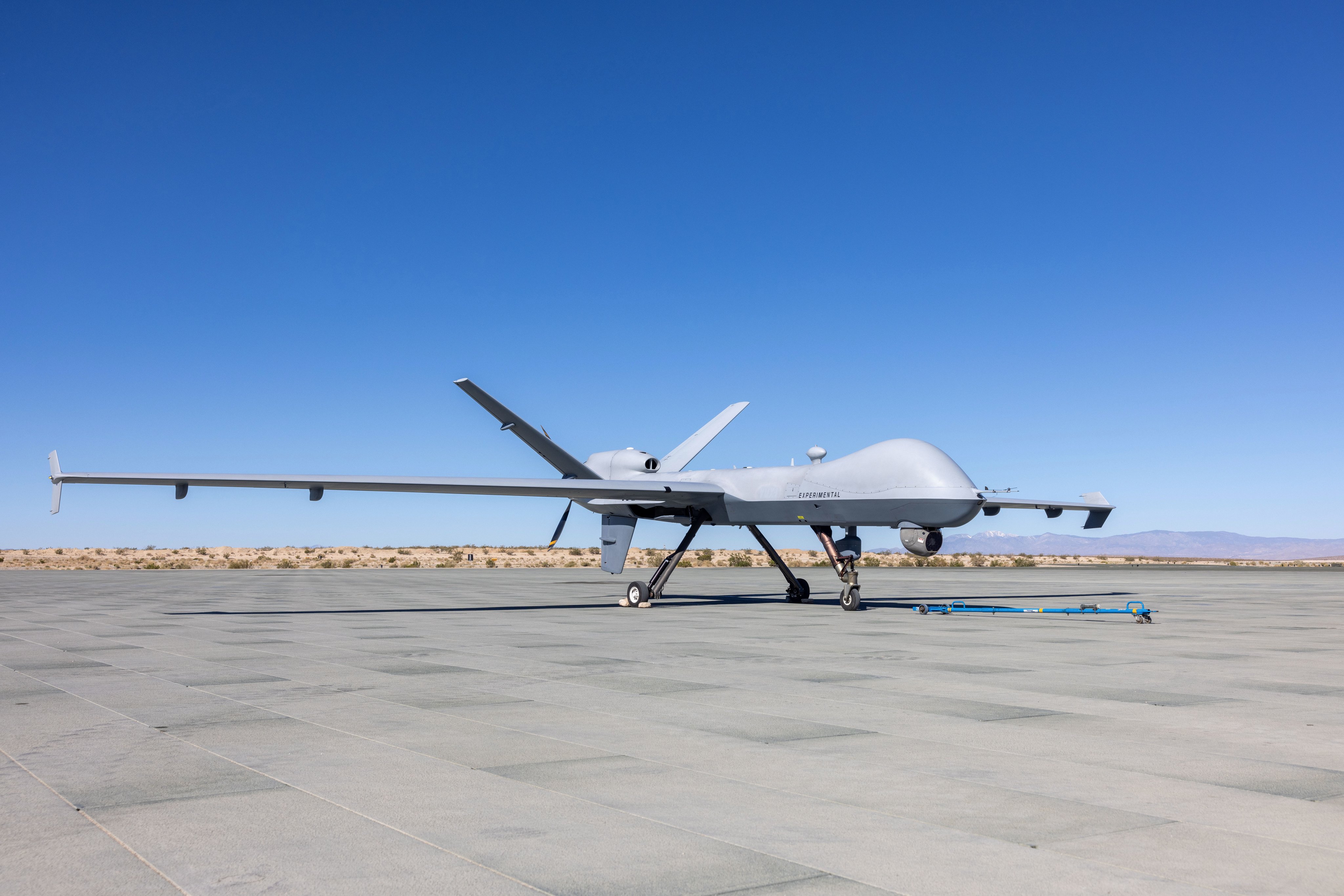
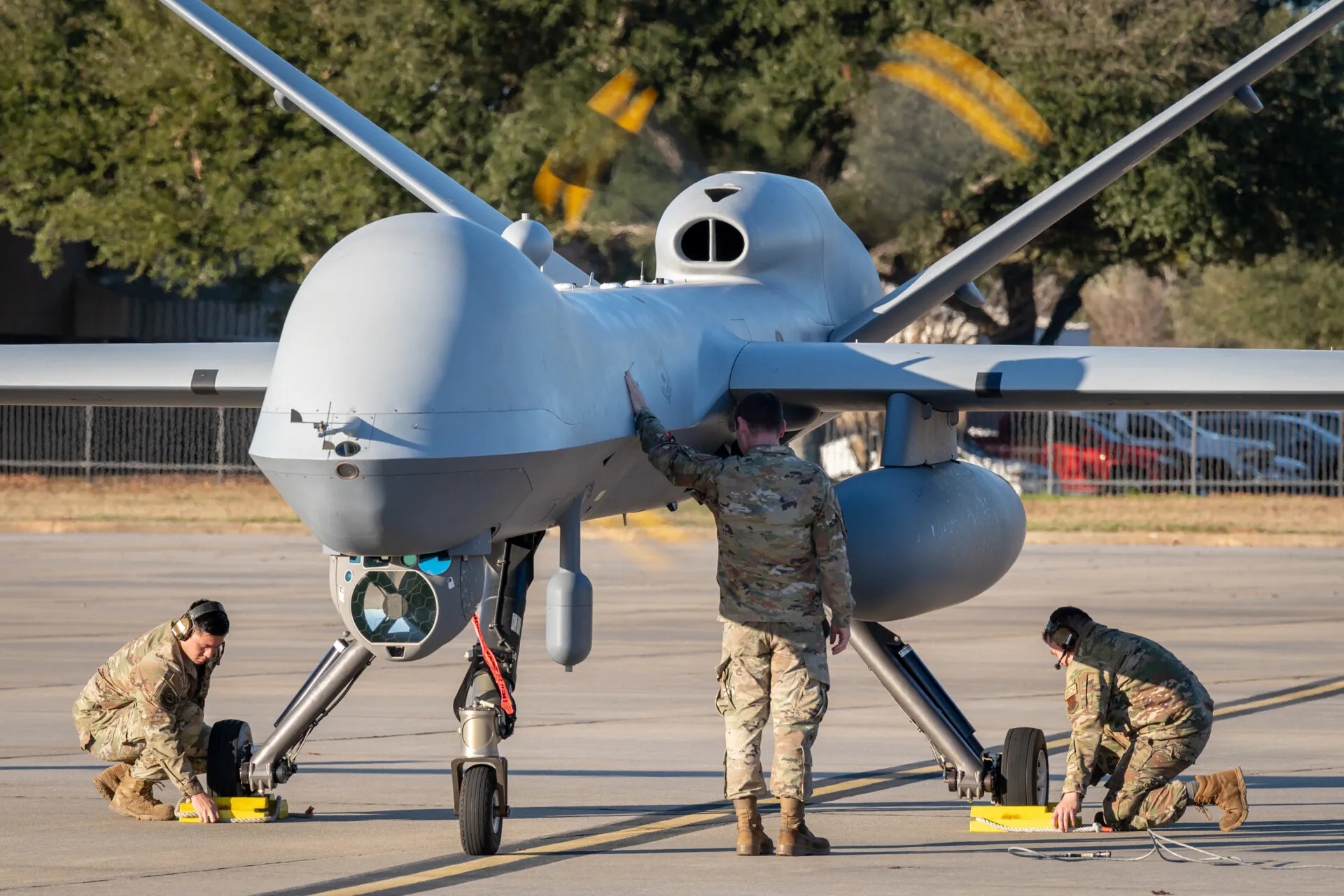
    The MTS-B system, designated AN/DAS-1, is an evolved version of the earlier MTS-A model, optimized specifically for high-altitude operational environments. It’s larger in size and tailored for long-endurance, high-flying platforms such as the MQ-9 Reaper (Predator B) UAV.

    Read more: Military Knowledge: MQ-9 Reaper Drone

    Capabilities and Applications

    MTS-B is a multi-functional system that incorporates electro-optical (EO) and infrared (IR) sensors along with laser detection, range-finding, and target tracking technologies. This system is capable of performing:

    • Long-range surveillance missions
    • Precision target acquisition
    • Continuous tracking of moving targets
    • Laser designation for air-to-ground munitions

    Besides the MQ-9 Reaper, the MTS-B system is also used on U.S. Navy’s MQ-4C Triton UAVs.

    Technical Specifications of MTS-B:

    • Payload Weight:
      • Sensor Module: 104 kg
      • Control & Processing Unit: 11.3 kg
    • Dimensions:
      • Sensor Module Diameter: 56 cm
      • Processing Unit: 36.6 × 12.4 × 19.3 cm
    • Field of View (FOV):
      • Wide: 34 × 45° – broad coverage for reconnaissance missions
      • Semi-wide: 17 × 22° – moderate area focus
      • Medium: 5.7 × 7.6° – balance between clarity and scope
      • Semi-narrow: 2.8 × 3.7° – mid-range target focus
      • Narrow: 0.47 × 0.63° – effective for target tracking
      • Ultra-narrow IR: 0.23 × 0.31° – sharp night-time imaging
      • Ultra-narrow TV: 0.08 × 0.11° – extremely high resolution
    • Digital Zoom: 2× and 4× magnification
    • Motion Range:
      • Azimuth (horizontal): 360° continuous rotation
      • Elevation (vertical): from +40° to –135°
    • Rotation Speed: Up to 2 radians/second in elevation axis
    • Auto-tracker Modes: Three types: centroid, regional, and selective
    • Data & Control Interface: MIL-STD-1553 data bus
    • Video Output Formats: RS-170 (525 lines), digital, and other formats
    • Power Requirement: 28V DC from aircraft supply

    MTS-D: Next-Generation Multi-Spectral Targeting System (AN/DAS-4)

    The AN/DAS-4, also known as MTS-D, is the latest and most sophisticated evolution in Raytheon’s family of multi-spectral targeting systems. This new generation was developed in 2016 under a $90 million contract with the U.S. Air Force, featuring significant upgrades—especially in fire control and target location accuracy. The system is deployed on platforms such as the MQ-9 Reaper UAV and the MQ-4C Triton long-range maritime surveillance UAV used by the U.S. Navy.

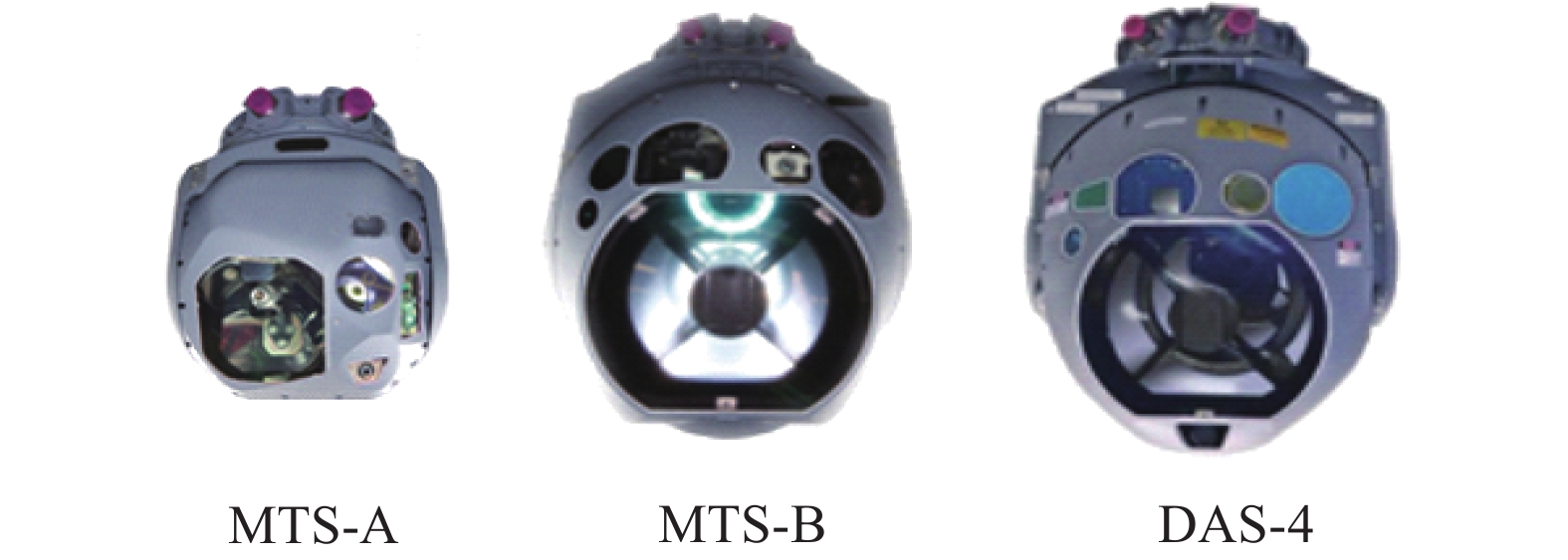
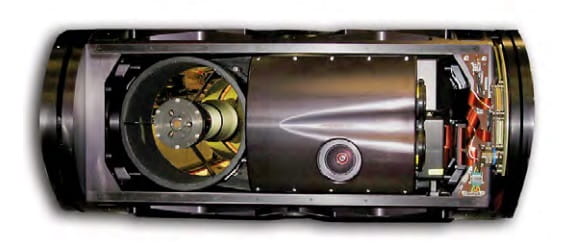
    MTS-A, MTS-B, MTS-D systems in one frame

    Core Advancements and Capabilities

    At the heart of MTS-D lies an advanced suite of electro-optical sensors that includes four high-resolution cameras capable of capturing imagery across five distinct spectral bands. This multi-spectral imaging capability allows for the breakdown of visuals into varying optical wavelengths, enabling the extraction of fine details and intelligence not discernible to the naked eye or single-band systems.

    Aboard the MQ-9 Reaper equipped with the AN/DAS-4, these capabilities enhance both situational awareness and precision engagement.

    Laser Targeting and Tracking Enhancements

    The AN/DAS-4 system is equipped with a three-color diode-pump laser designator/rangefinder, which provides highly accurate targeting data. It also supports Laser Spot Search and Track—a feature that allows the system to detect and lock onto targets designated by another source using laser markers. Automatic alignment between sensor and laser components ensures consistent targeting precision while minimizing the need for frequent manual calibration.

    MTS-D AN/DAS-4

    Intelligent Target Acquisition

    The system supports three target tracking modes and includes automatic target acquisition capabilities. Combined with the standard MTS features—such as multi-mode fields of view and digital zoom—these intelligent enhancements significantly streamline and speed up the processes of detection, locking, and tracking of both stationary and moving targets.

    The AN/DAS-4 system can provide precision laser tracking and designation for a wide range of laser-guided munitions used by U.S. and NATO armed forces, including missiles like Griffin and bombs such as the Paveway series.

    MS-110 & MS-177: Strategic-Level ISR Sensors

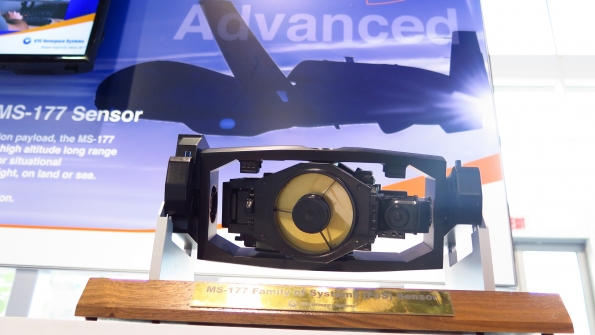
    These advanced members of Raytheon’s MTS family are built for intelligence, surveillance, and reconnaissance (ISR) missions, offering superior imaging capabilities at long ranges and high altitudes. Unlike MTS-A/B/D systems that are typically mounted on tactical UAVs and helicopters, MS-110 and MS-177 are designed for integration into larger fixed-wing aircraft.

    MS-110: Tactical Electro-Optical Imaging System

    • Developed to deliver long-range, high-resolution imagery using multiple spectral bands.
    • Often installed on aircraft such as the U-2 Dragon Lady or RQ-4 Global Hawk.
    • It uses improved optics and sensor resolution over previous systems for detailed reconnaissance missions.
    MS-110 sensor

    MS-177: Enhanced Long-Range Surveillance Sensor

    • A successor to MS-110, boasting even higher fidelity and more powerful imaging capabilities.
    • Can operate across multiple spectral bands, including visible, infrared, and short-wave infrared.
    • Provides automated target detection and classification, improving real-time battlefield awareness.
    • Compatible with various platforms including E-8 JSTARS, RQ-4 Global Hawk, and other long-endurance aircraft.
    • Supports modular payload architecture, allowing easy upgrades and adaptations for new missions.
    MS-177 sensor

    Sources:
    AN/DAS-4: Sharper Eyes for the Reaper | Multi-Spectral Targeting System (MTS) | Raytheon - RTX | MTS Brochure | PDF | Unmanned Aerial Vehicle | Surveillance - Scribd | MTS-B Multi-Spectral Targeting System | Raytheon Integrates and Tests SeaVue Radar and MTS Onboard Predator B | AIRBORNE IMAGING 2011 - Piloto Policial | Raytheon's Airborne FLIR Sensor Ball Systems | Multi-Spectral Targeting System (MTS) AN/AAS-52 | Raytheon unveils compact Multi-Spectral Targeting System | RTX to produce 9 AN/DAS-4 targeting systems for US Navy MQ-9Cs | Raytheon to produce multi-spectral targeting system for USAF | MQ-9 Reaper Armed Unmanned Aircraft System (UAS) | Global ISR Sensors and Software | Raytheon | Lockheed Martin Selects Raytheon to Deliver Next Generation F-35 Sensor | MH-60S Multi-Mission Combat Support Helicopter | Raytheon (RTX) Wins Deal for Multi-Spectral Targeting Systems | U.S. Navy, Northrop Grumman Near Delivery of Baseline Triton | AN/AAS-44

  • Military Knowledge: AEGIS Defence System; Standard Missiles

    Military Knowledge: AEGIS Defence System; Standard Missiles

    Overview of the AEGIS System:

    The Aegis Ballistic Missile Defense System (ABMD) is a component of the AEGIS comprehensive combat system. It is an integrated, sea-based defense system designed to protect US naval fleets from enemy aircraft and cruise missiles. The system employs various types of missiles, including the Standard-2 (SM-2), Standard-3 (SM-3), Standard-6 (SM-6), and Sea Sparrow, alongside Phalanx Close-In Weapon System to counter potential threats.

    Additionally, Aegis can launch Tomahawk land-attack cruise missiles. A specific subset of Aegis-equipped vessels operates in key regions, including the Mediterranean Sea, Red Sea, Black Sea, Western Pacific, and Persian Gulf, providing a defensive shield against potential ballistic missile attacks from countries such as Russia, China, North Korea, and Iran.

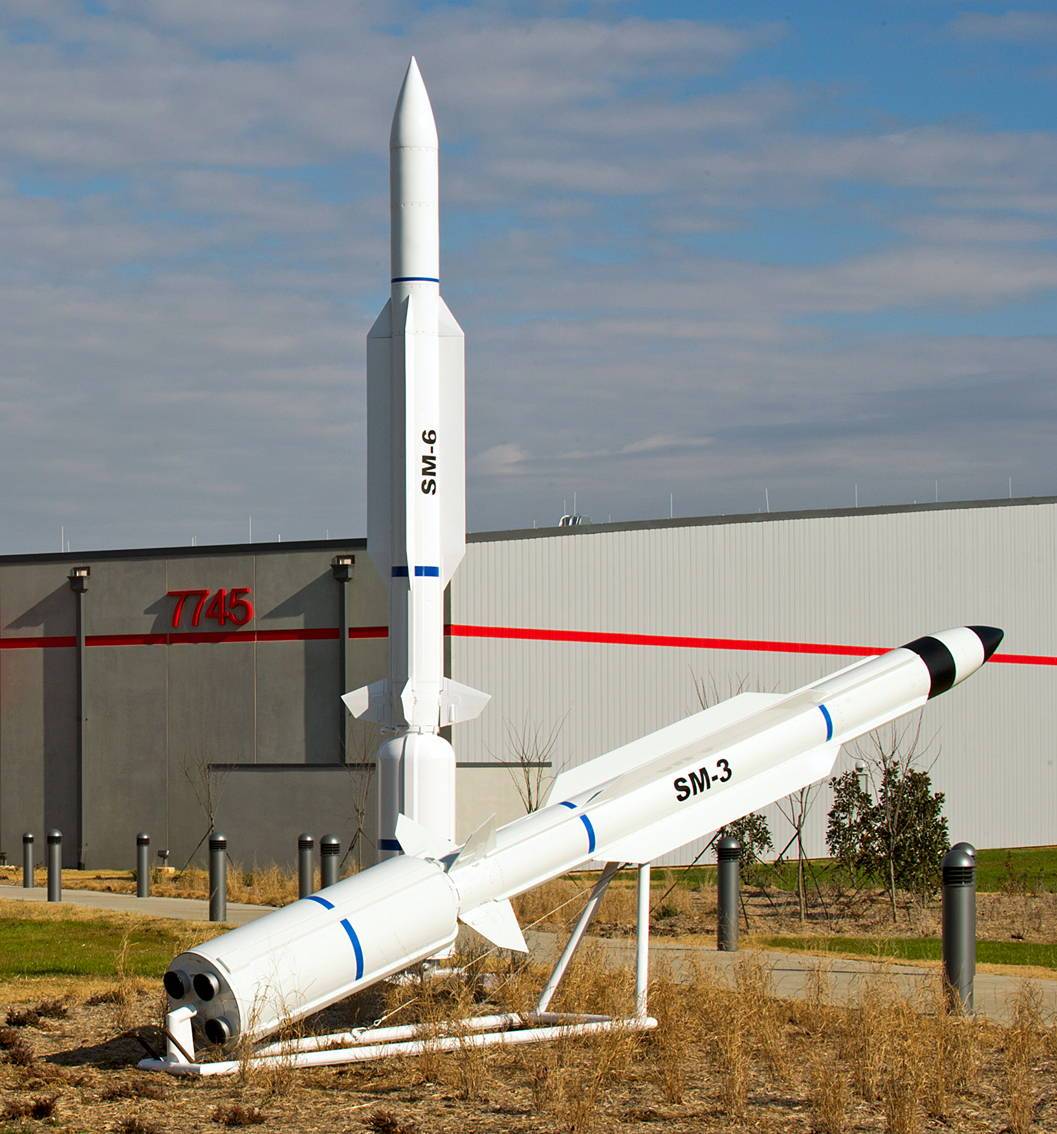
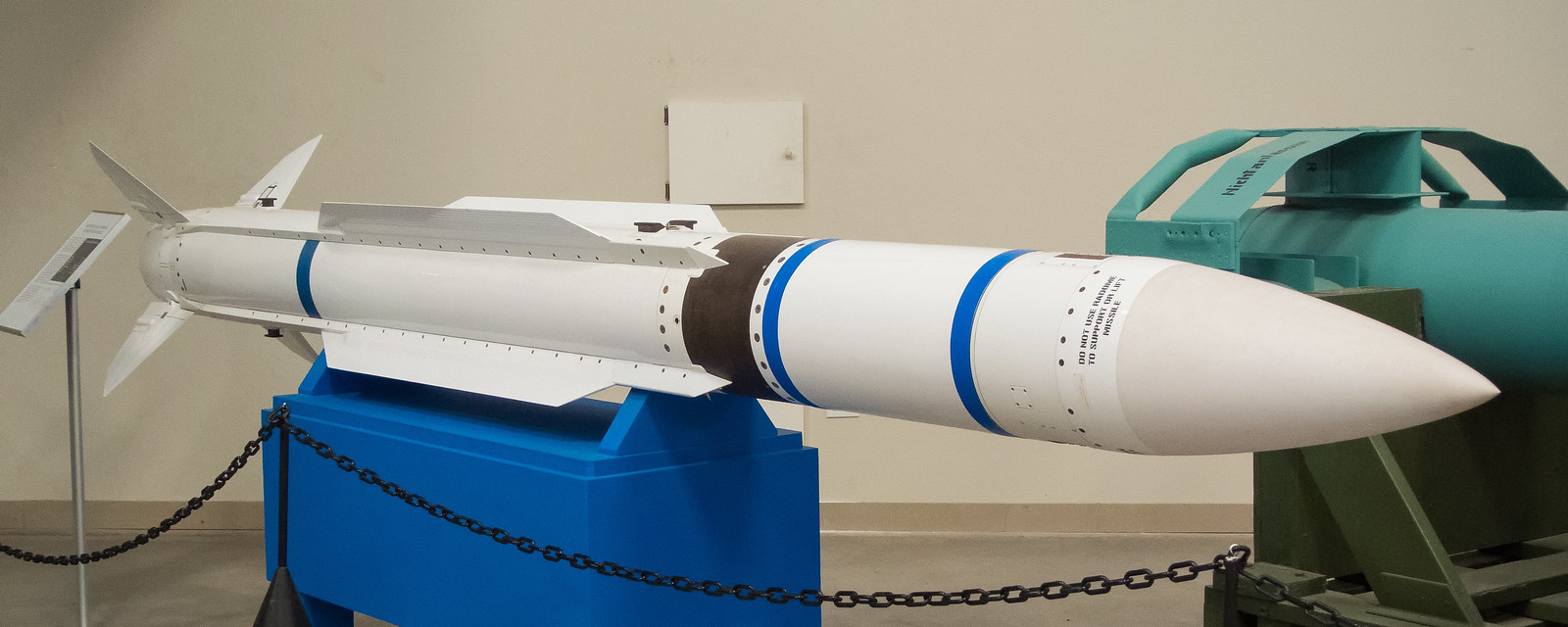
    SM-3 and SM-6 missile replicas

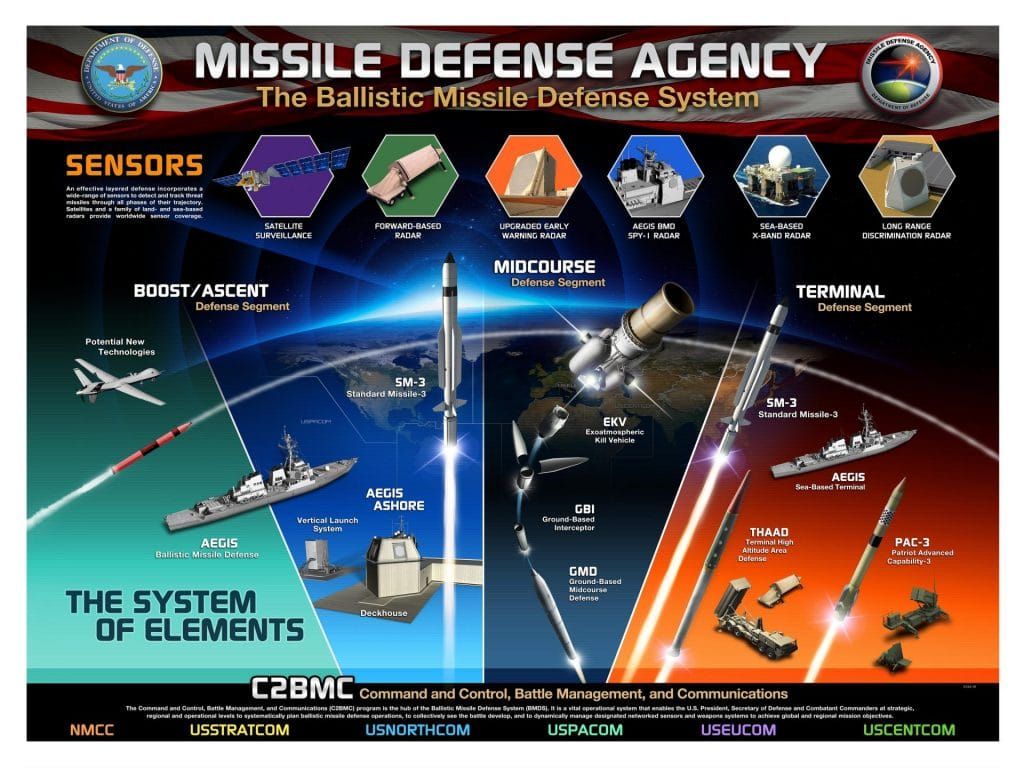
    The Aegis anti-ballistic system consists of three main components: sensors, interceptors, and a command and control system.

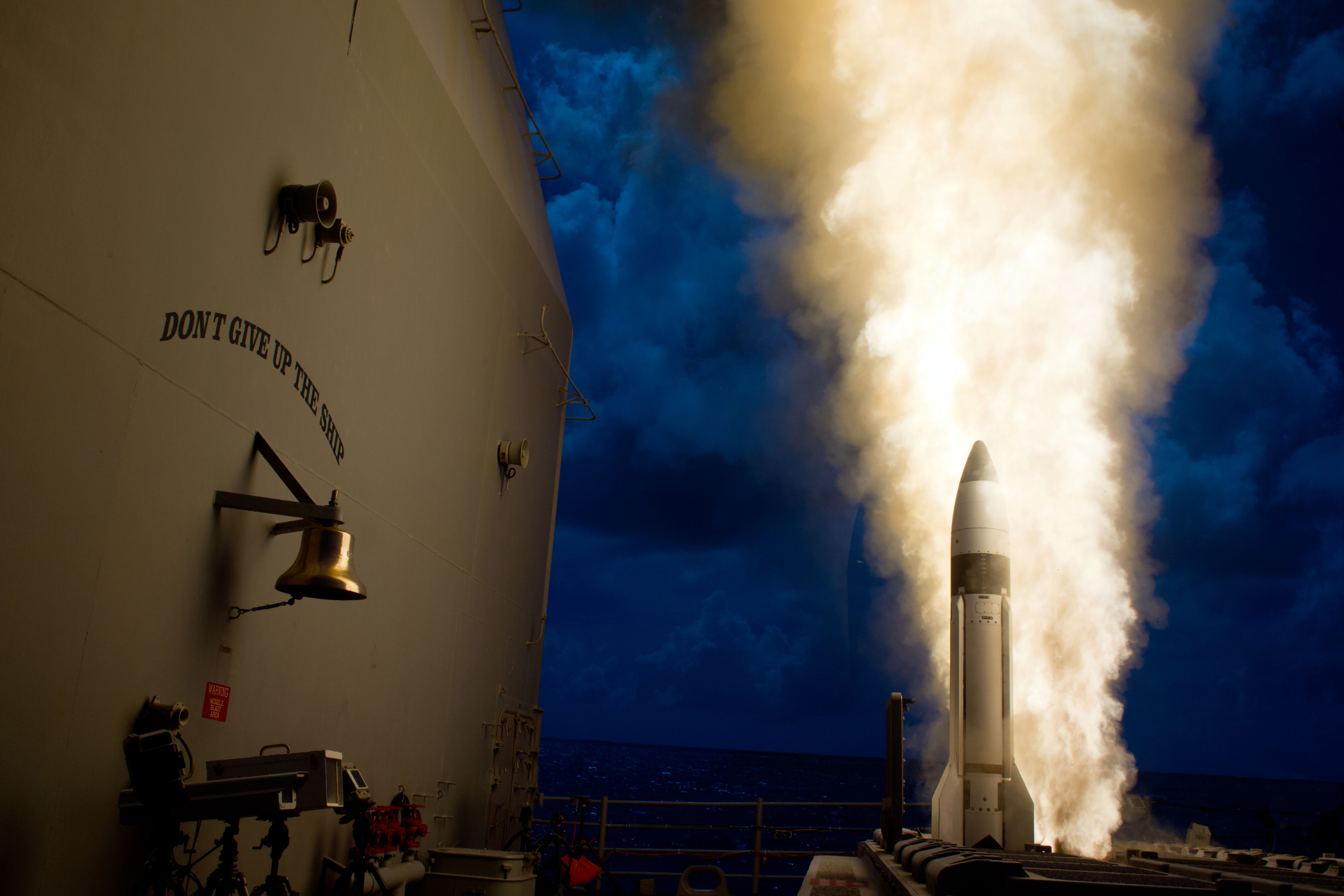
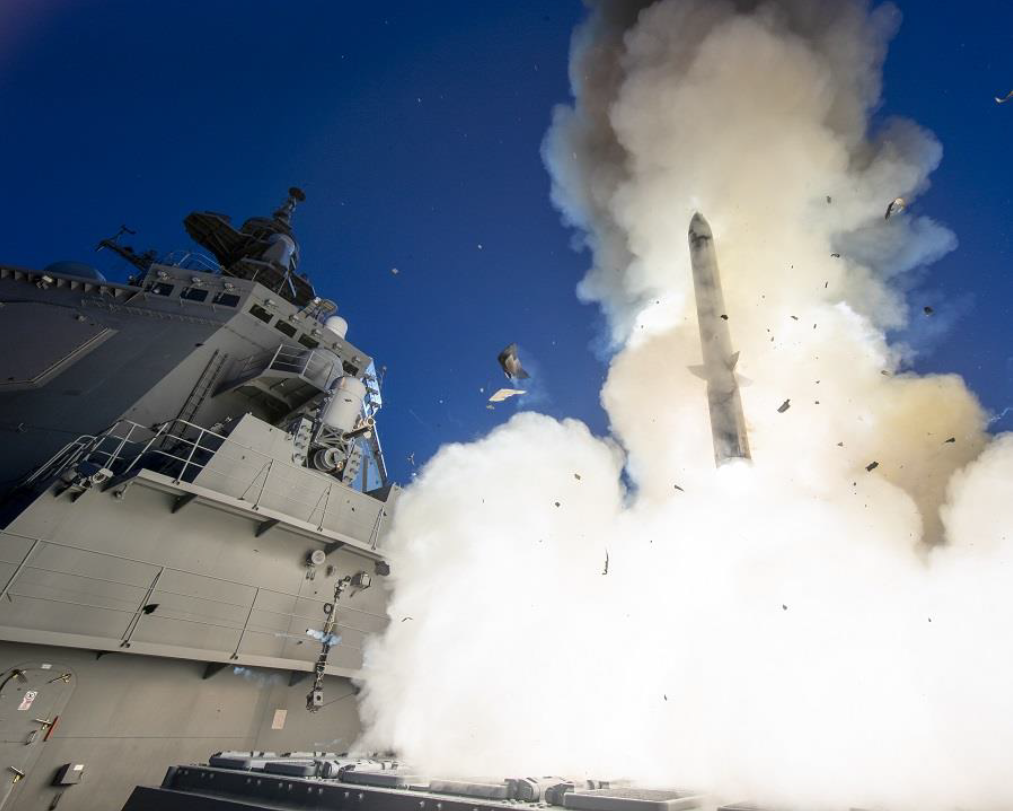
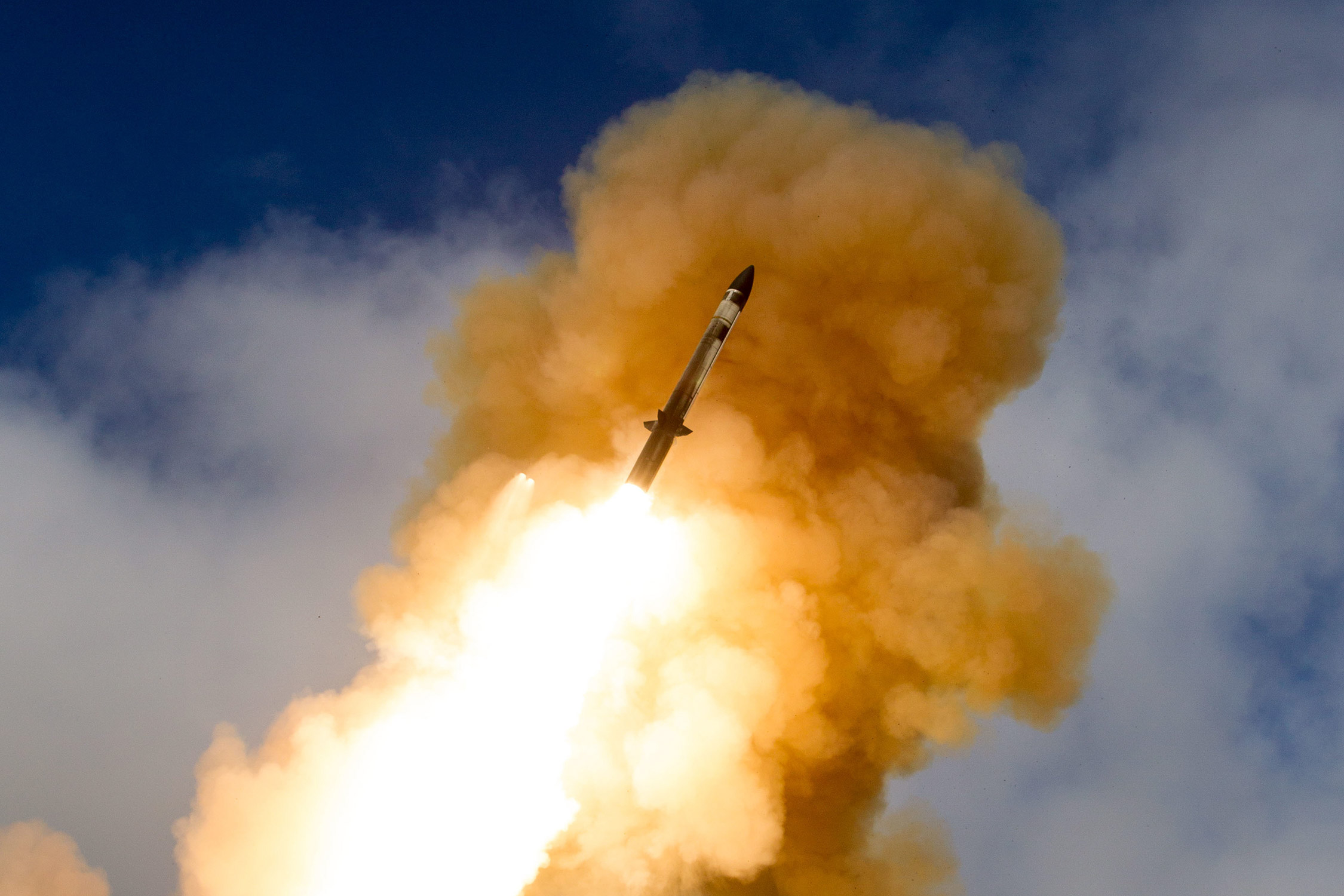
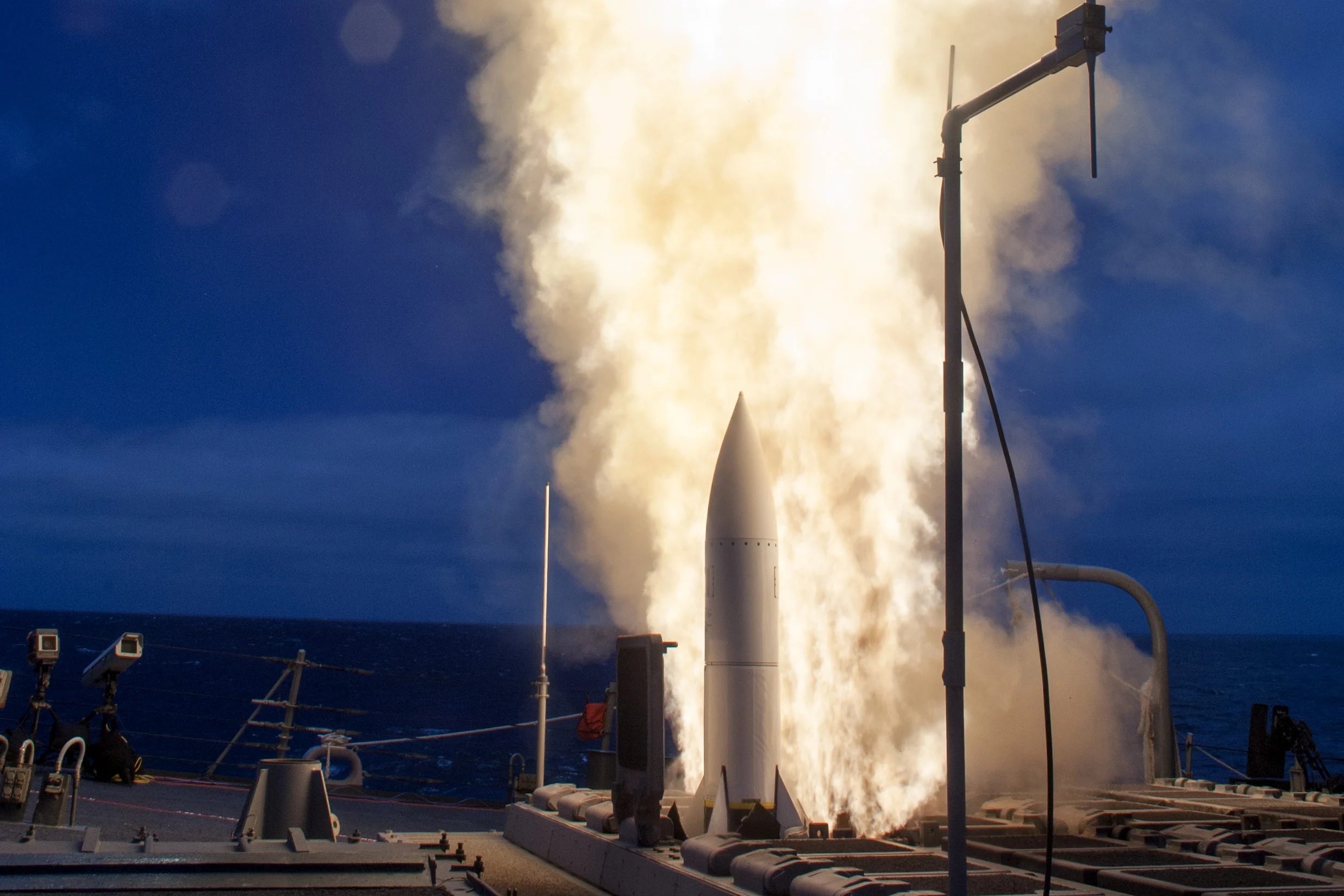
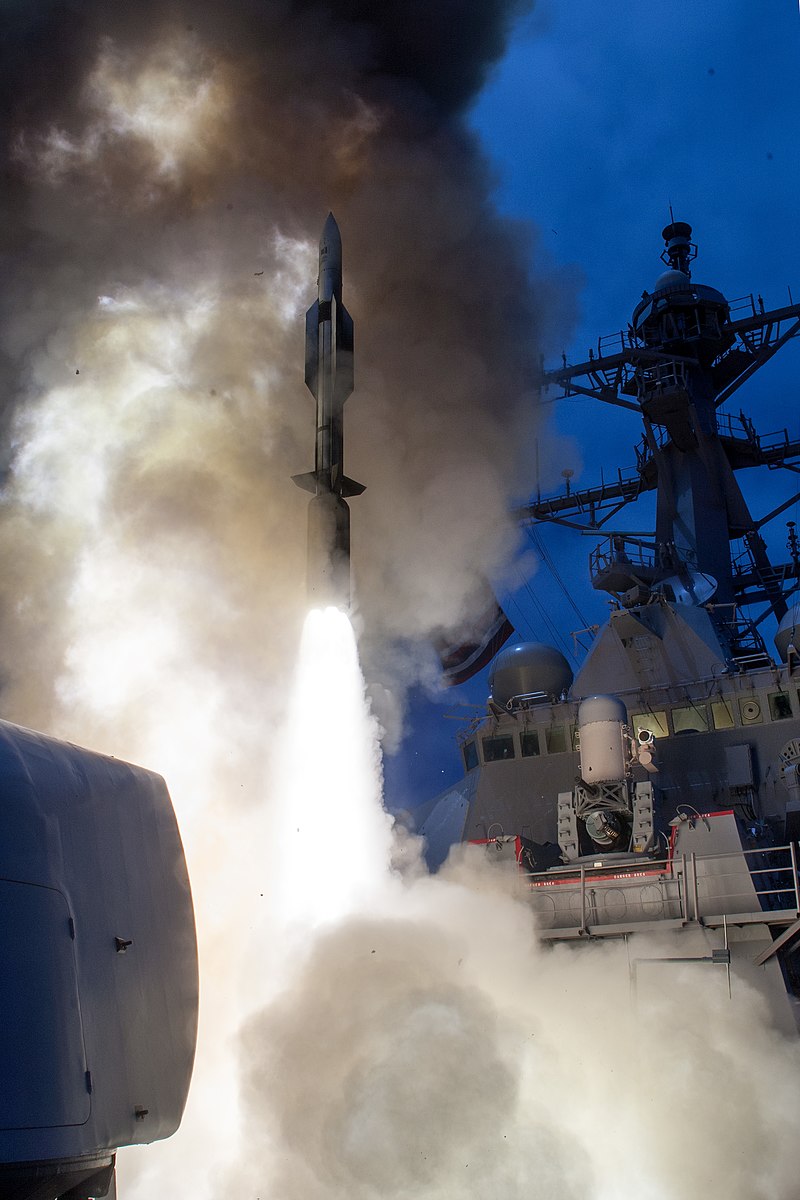
    The main interceptor missile of this system is the RIM-161 Standard Missile 3 (SM-3), which is designed in three versions: Block IA, IB, and IIA. Each version has been improved in range and performance capabilities compared to its predecessor. This missile employs a kinetic warhead to destroy ballistic missile warheads during the midcourse phase of flight, which occurs outside the Earth’s atmosphere. Additionally, the Aegis system utilizes intra-atmospheric missiles such as the SM-2 Block IV and SM-6, designed to intercept missiles in the terminal phase of flight. All of these interceptors are deployed through the Mark 41 Vertical Launch System (VLS).

    The primary sensor used in the Aegis system is the AN/SPY-1D radar, which operates in the S-band and provides nearly 360-degree coverage. As technology has advanced, newer Aegis platforms have been equipped with upgraded radars, such as the SPY-6 and SPY-7. Additionally, enhanced Aegis platforms can launch interceptor missiles based on data from long-range sensors, including the THAAD TPY-2 radar, which operates in the X-band.

    The anti-ballistic component of the Aegis system is managed by the Aegis comprehensive combat system, which has undergone upgrades over time through hardware and software enhancements known as “Baseline.” The latest version of this system, called Baseline 9, enables a ship to simultaneously conduct air defense and missile defense operations. Previous versions of the software could only support one of these two missions at a time, often requiring Aegis ships to operate in pairs—one ship managing air defense while the other focused on anti-ballistic defense.

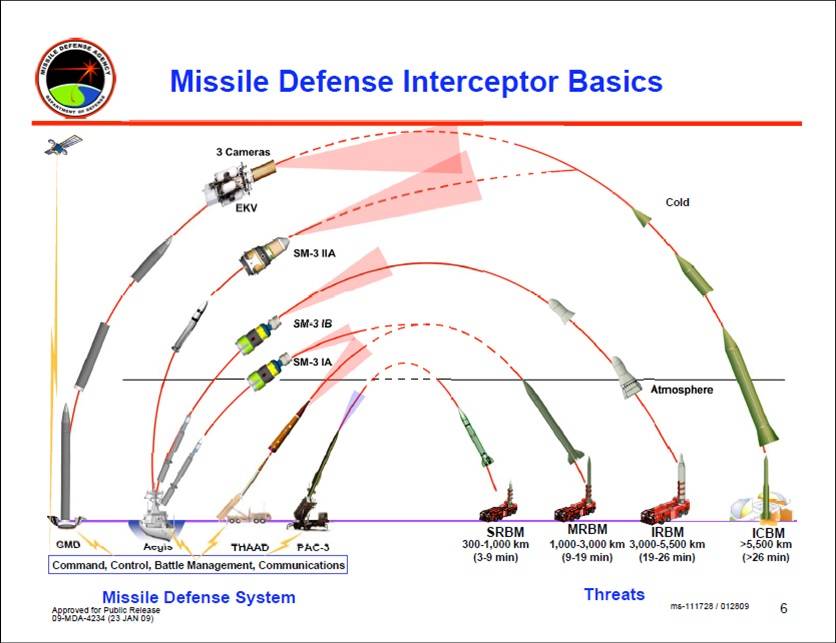
    An overview of how US missile defense systems intercept threats

    Background and history of the development of the Aegis system:

    The development of the Aegis system was initially driven by the increasing threat of Soviet anti-ship missiles in the 1960s. The sinking of the Israeli warship Eilat in 1967 by four Soviet-made Styx missiles highlighted the vulnerability of naval assets to new-generation weapons. In the aftermath of World War II, the United States aimed to strengthen its naval fleet, while the Soviet defense strategy relied on utilizing heavy cruise missiles, sometimes equipped with nuclear warheads, launched from smaller vessels or bombers and fighter jets. These missiles, flying at high speeds and close to the water’s surface, made detection and interception extremely difficult.

    The United States Navy recognized that existing radar technology was inadequate for tracking and effectively engaging multiple high-speed, near-surface missiles simultaneously. To address this critical gap, the Advanced Missile System (ASMS) program was initiated in 1964, marking the beginning of what would later become known as Aegis. In December 1969, the ASMS program was officially renamed “Aegis,” inspired by the shield of Zeus in Greek mythology.

    The Aegis program was later expanded to include the emerging threat of ballistic missiles. In the mid-1980s, the Aegis Anti-Ballistic Missile Defense System (Aegis BMD) program was launched as part of Ronald Reagan’s Strategic Defense Initiative (SDI), informally known as “Star Wars.” This program was developed as a defense measure against potential attacks from long-range ballistic missiles launched by the former Soviet Union.

    Initially, the Aegis BMD concept included a space-based railgun system. However, technological limitations prompted the exploration of alternative solutions, leading to the development of anti-ballistic missiles instead. The first successful interception test of the Aegis BMD system occurred in January 2002, marking a significant milestone in its evolution. The experiences gained from the first and second Persian Gulf Wars, alongside the growing proliferation of short- and intermediate-range ballistic missiles by countries like North Korea and Iran in the late 1990s and early 2000s, further emphasized the necessity for a robust sea-based ballistic missile defense capability like Aegis. This evolution transformed Aegis from a purely anti-ship system into one with a crucial anti-ballistic missile capability.

    Role of Aegis in the US Navy and the National Missile Defense Program:

    As mentioned earlier, the Aegis anti-ballistic system is part of the larger Aegis Combat System. Note that almost all US Navy warships and destroyers are considered Aegis vessels because they’re equipped with the Aegis combat system, which includes sensors, computers, software, displays, and weapon launchers. However, not all these vessels can engage ballistic targets or have received the Aegis BMD upgrade. This article will focus specifically on the Aegis anti-ballistic capabilities.

    Ticonderoga-class cruiser

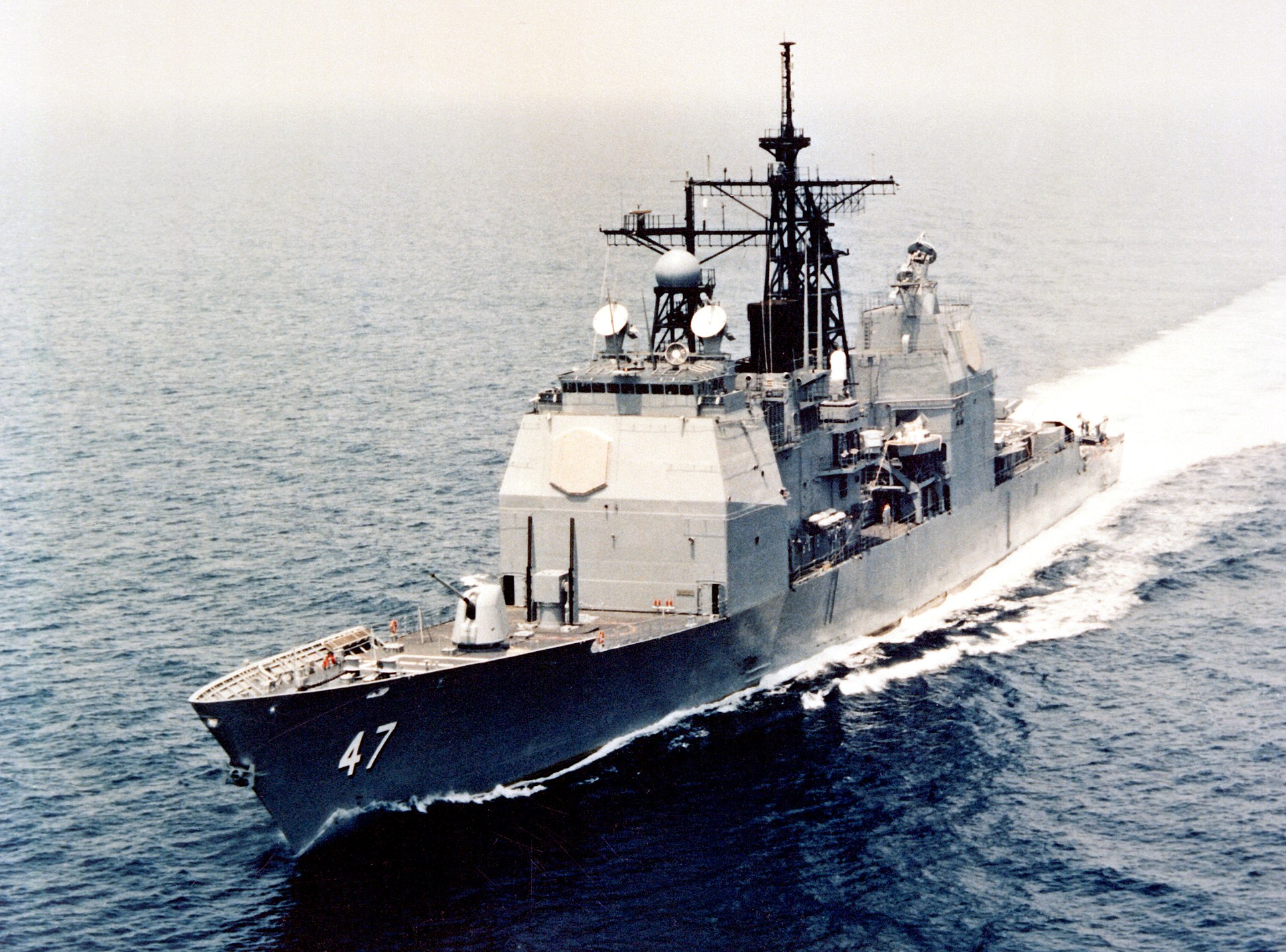
    • A total of 27 Ticonderoga-class ships were purchased between 1978 and 1988, and entered service between 1983 and 1994. The Navy retired the first five ships of the class, which were technically built to an older standard, by 2005. Retirement of the remaining 22 ships began in 2022 and has now reached nine, with at least five of the class reportedly upgraded to anti-ballistic capabilities.
    USS Ticonderoga (CG-47)

    Arleigh Burke-class destroyers

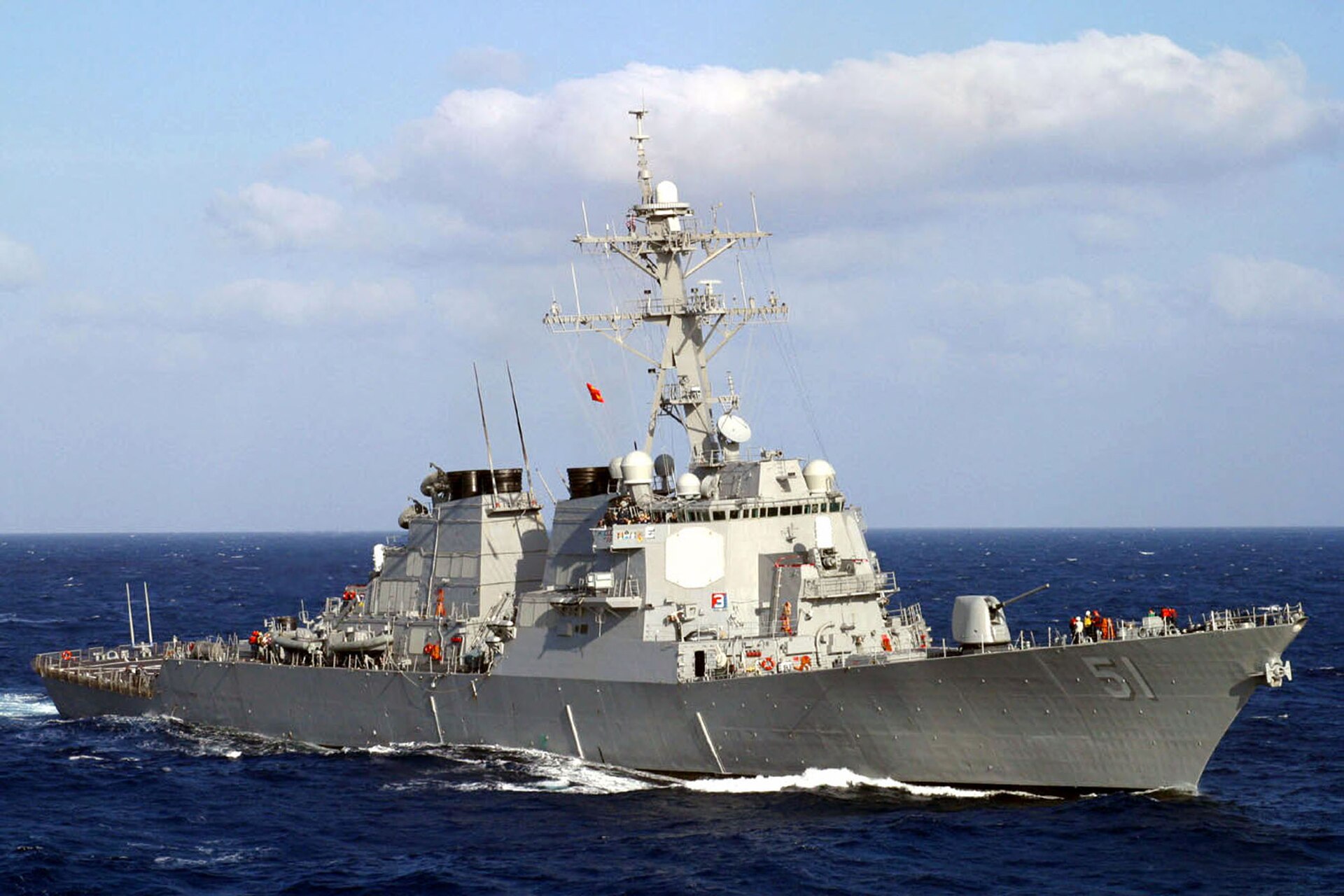
    • The U.S. Navy began purchasing the DDG-51 class in 1985, with a total of 94 ships expected to be purchased by 2024. The first destroyer of the class entered service in 1991, and a total of 74 ships will be operational by the end of 2023. Retirement of the older ships will begin in fiscal year 2028. The DDG-51 design has been updated many times over the years. The first 28 ships are known as Class I/II, the next 34 as Class IIA, and the next ships as Generation III. The third generation of the class will use the new SPY-6 radar instead of the older SPY-1. According to the Missile Defense Agency, by the end of fiscal year 2025, there will be a total of 56 ships of the class with anti-ballistic capabilities. By 2023, that number had increased to 49, increasing to 69 by fiscal year 2030.
    USS Arleigh Burke (DDG-51)

    The Aegis missile defense system is a key part of the U.S. and allied strategies to defend against ballistic missiles. It’s part of the U.S. National Ballistic Missile Defense System, mainly designed to protect against short- to intermediate-range ballistic missiles, which have a range of around 2,200 miles (3,500 km). However, recent upgrades have also given it the ability to counter intercontinental ballistic missiles, which can travel up to 6,200 miles (10,000 km). That’s why the system gets its own funding from the Department of Defense’s Missile Defense Agency.

    US Comprehensive Ballistic Missile Defense Program

    The Aegis system, led by the Missile Defense Agency, is integrated with other components of the Ballistic Missile Defense System (BMDS), such as THAAD and Patriot defense systems, through the Command, Control, Battle Management, and Communications (C2BMC) system. This integration enables a coordinated response to missile threats by utilizing the strengths of each system. As a result, Aegis can support other interceptors by providing long-range surveillance and radar data.

    In addition to the United States, the Aegis combat system is currently deployed by Australia, Canada, Japan, South Korea, Norway, and Spain, all of which share intelligence data.

    First Intercontinental Ballistic Missile Intercept Test by SM-3 Block IIA Missile in 2020 in Hawaiian Sea Area

    The video above shows a graphical representation of the first live test of an intercontinental ballistic missile (ICBM) interception. On November 17, 2020, a prototype ICBM was launched from the Ronald Reagan Ballistic Missile Defense Test Site on Kwajalein Atoll in the Marshall Islands, headed toward the Hawaiian Sea. In this test, a destroyer used remote engagement capabilities through the Command and Control Battle Management communications network, as part of a scenario to defend Hawaii. After getting tracking data from the system, the destroyer fired an SM-3 Block IIA missile that successfully hit the target.

    Review of the radar and satellite capabilities of the Aegis system:

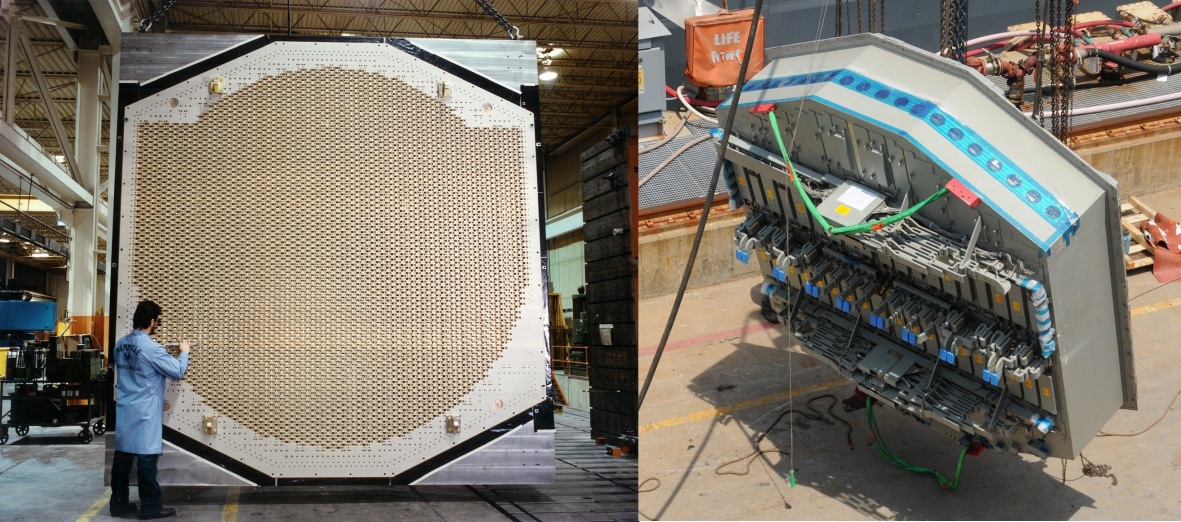
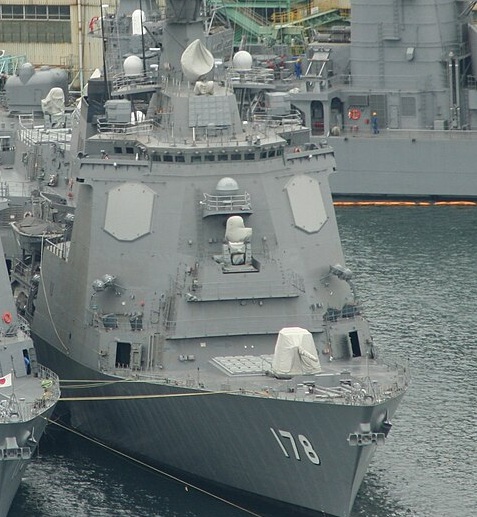
    The Aegis system uses a set of advanced radar systems to detect, track, and engage ballistic missile threats. The main fire control radar for Aegis, the AN/SPY-1, is a Lockheed Martin Advanced Passive Electronically Scanned Array (PESA) radar that operates in the S-band. This powerful radar has four array panels for 360-degree coverage and can search, track, and guide missiles at the same time. Although the official range of the radar is not publicly disclosed, its estimated range is between 310 and 370 kilometers, making it capable of detecting various ballistic, cruise, and air targets.

    AN/SPY-1 radar

    Originally, Aegis wasn’t built for anti-ballistic missions. Despite policymakers allocating funds to update the system, the SPY-1 radar is still a major weakness in the Aegis chain, limiting interception by standard missiles.

    AN/SPY1D(V) radar on the Japanese destroyer GS Ashigara, an Atago-class destroyer.

    SPY-1 radar gives interceptors enough accuracy to track targets up to about 370 km. This is enough for the Standard-2 missile, which has a range of around 160 km. However, it’s not enough for Standard-3 anti-ballistic missiles, especially the Block IA/B versions with a range of up to 700 km and the Block IIA with a range of up to 2500 km. The SPY-1 radar also has limitations for the Standard-6, which has an active seeker and can reach a range of about 460 km.

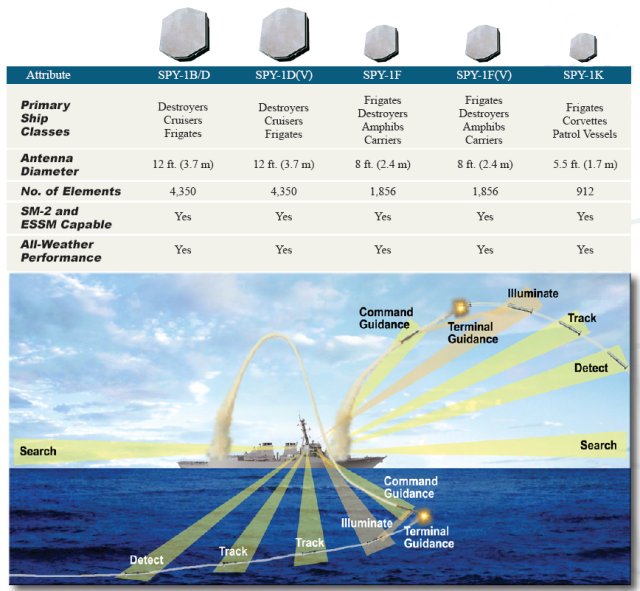
    Variants of AN/SPY-1 radar

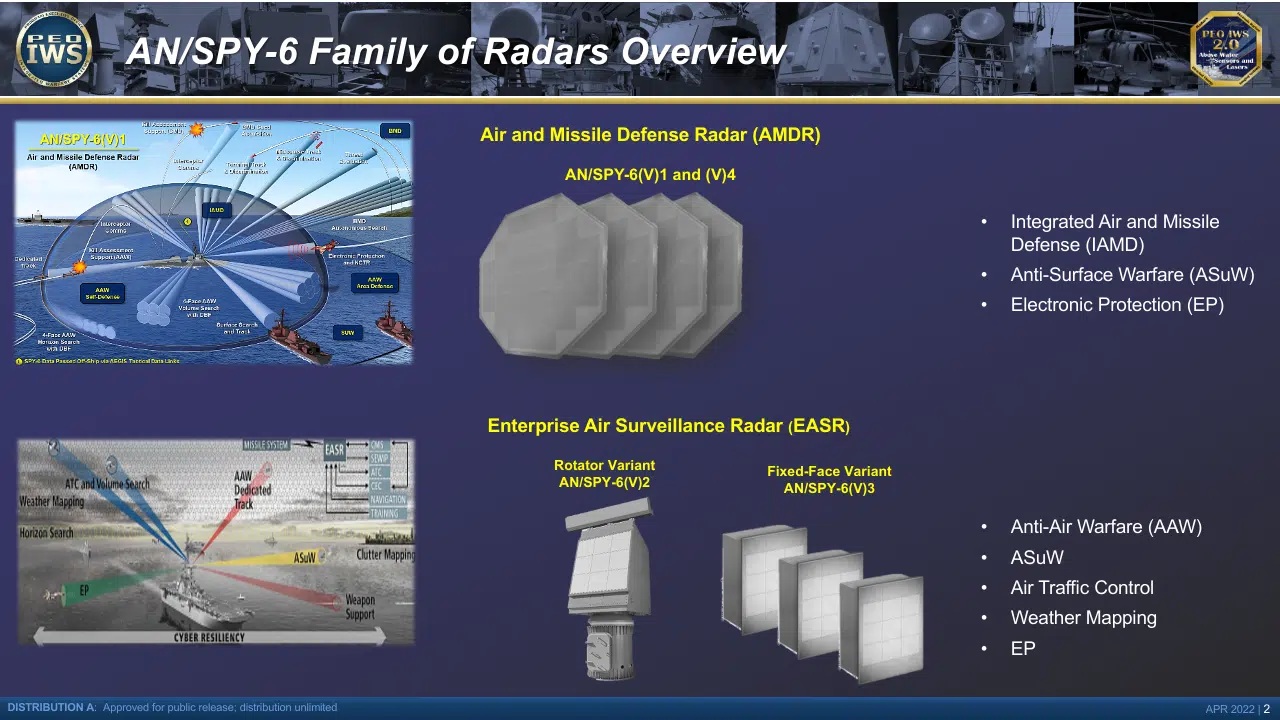
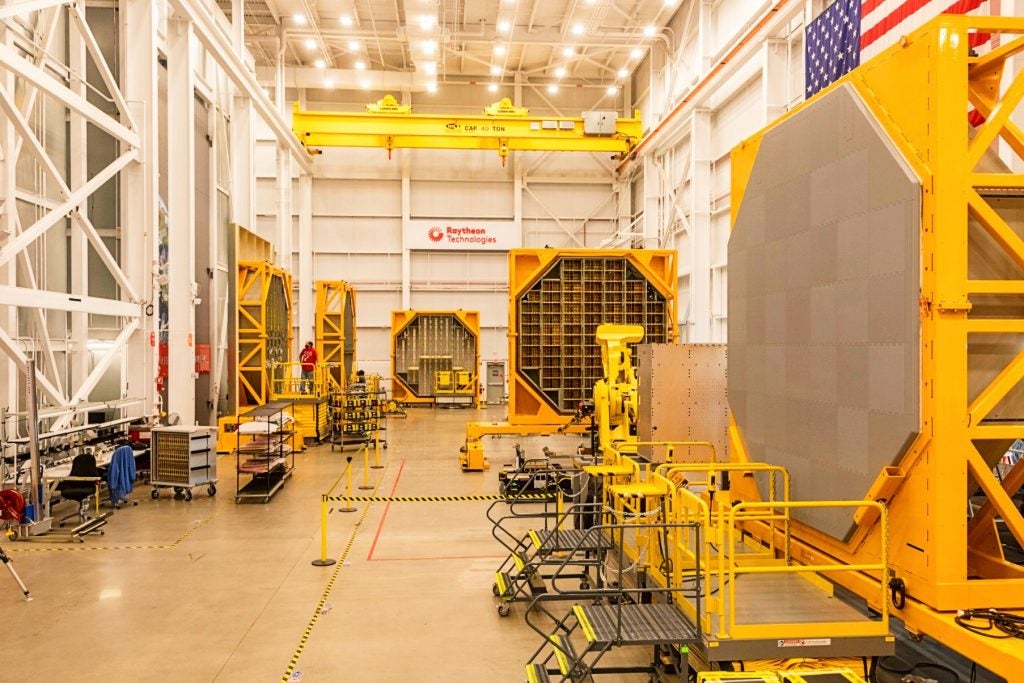
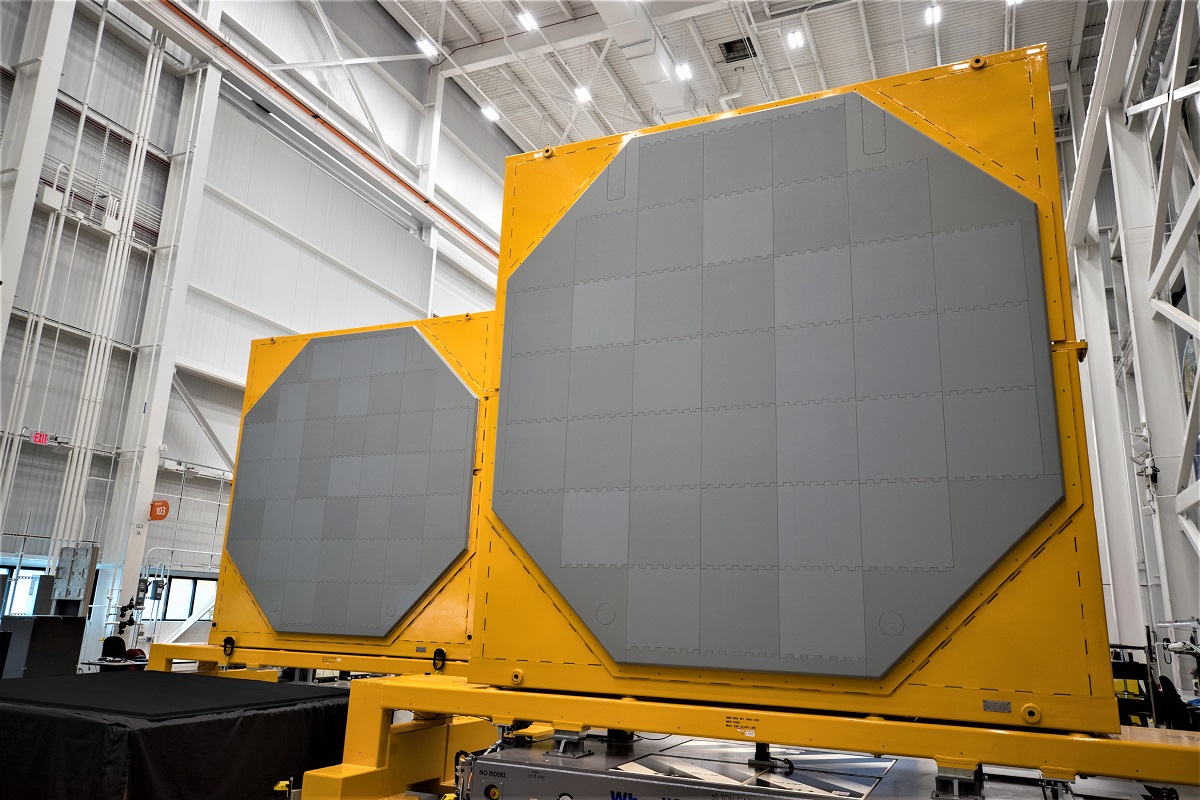
    Raytheon’s AN/SPY-6 radar, also referred to as AMDR, is the next generation of radar for Aegis. This active electronically scanned array (AESA) radar works in both S and X bands, providing significantly more advanced capabilities.

    Various AN/SPY-6 radar models

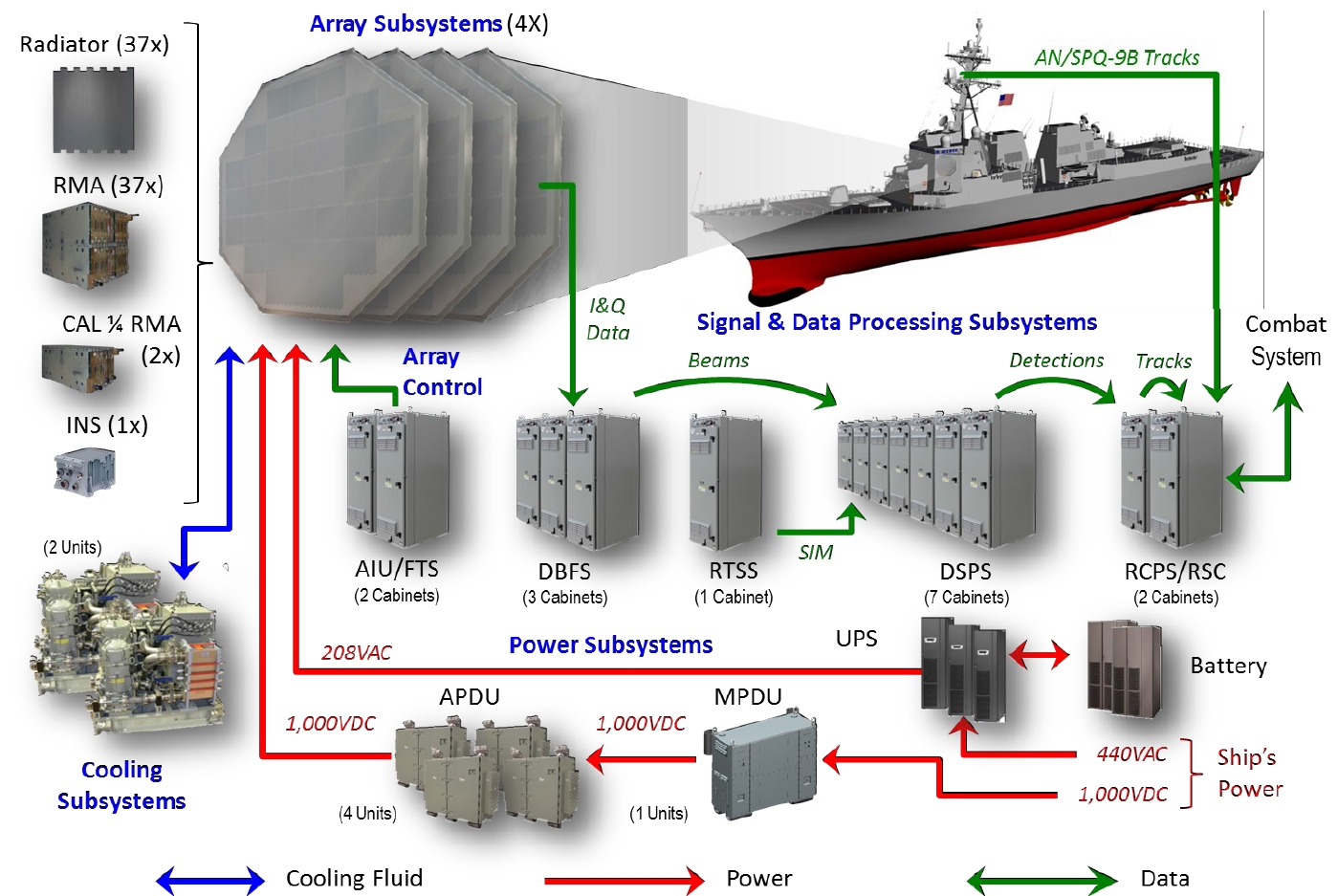
    The system comprises two main radars and a Radar Set Controller (RSC) that coordinates these sensors. The S-band radar is responsible for tasks such as searching for and tracking targets, accurately detecting ballistic missile warheads, and communicating with interceptor missiles. In contrast, the X-band radar is designed for near-horizon search, offering more accurate tracking and guidance for short- and medium-range missiles. This radar is reported to be 30 times more sensitive than the SPY-1, allowing it to handle 30 times more targets. Different versions of this radar, varying in dimensions, are used on various vessels, including the new generation of Arleigh Burke destroyers.

    AN/SPY-6 System Overview

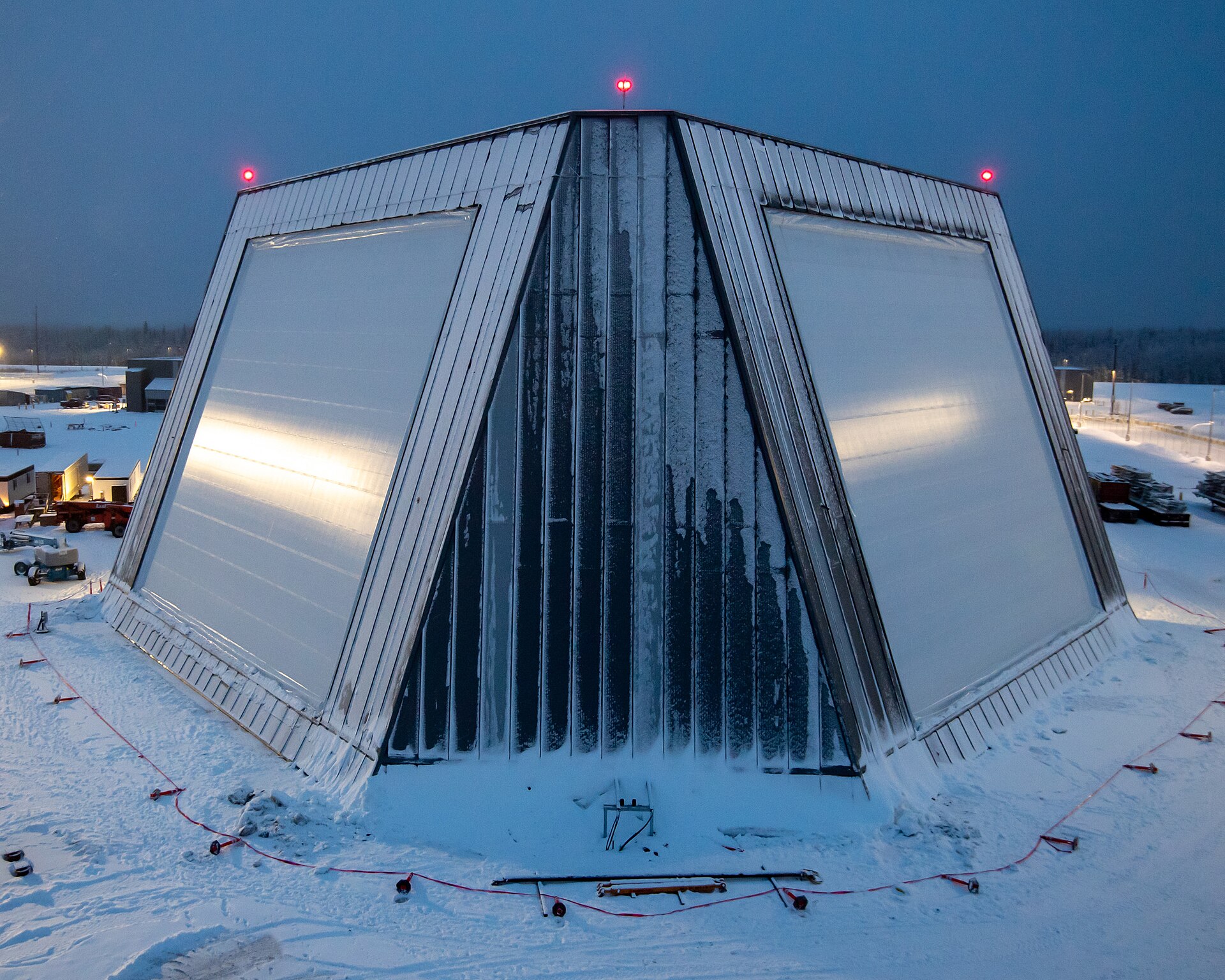
    The AN/SPY-7 radar, manufactured by Lockheed Martin, is another advanced radar being integrated into the Aegis system. This radar is currently installed on some Japanese ships equipped with the Aegis system (ASEV), as well as on the Spanish F-110 ships and the Canadian River-class ships. Additionally, the AN/SPY-7 radar is intended for land-based Aegis systems in the United States, specifically in Hawaii and Alaska, as well as in Japan, where it will be deployed in Yamaguchi and Akita. Overall, the AN/SPY-7 radar is expected to be used on more ships belonging to the United States and its allies in the future.

    AN/SPY-7 radar at Clear Space Force Station, Alaska

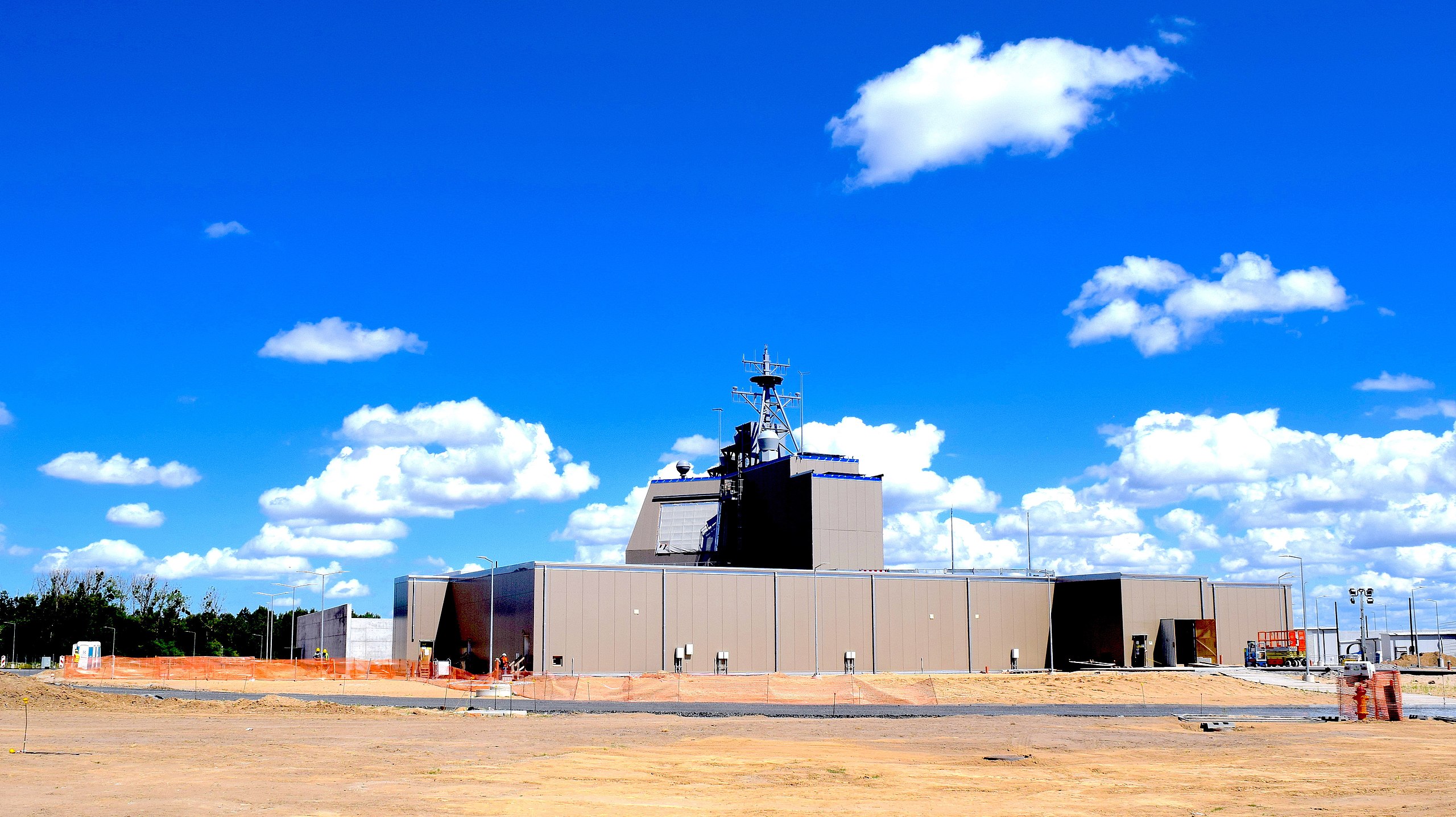
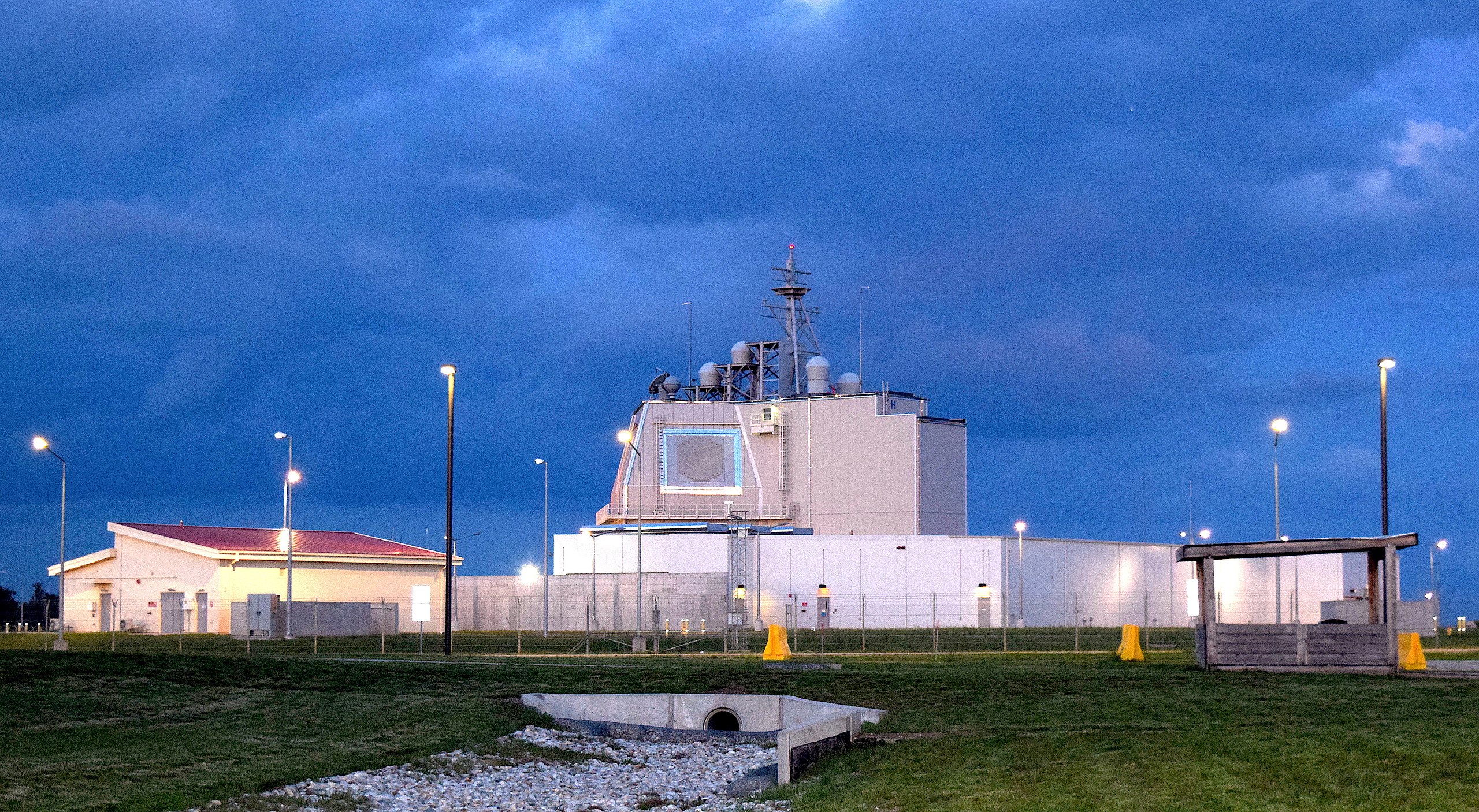
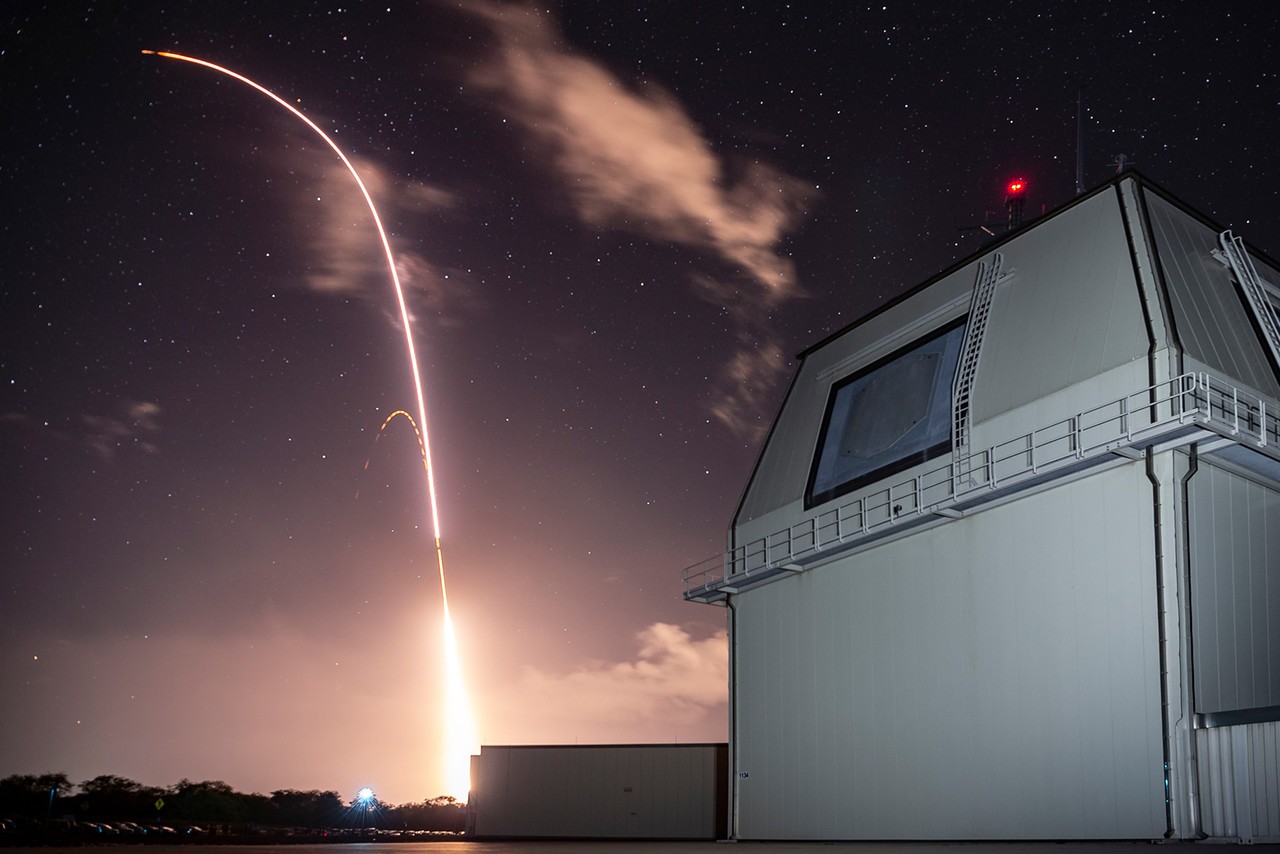
    The land-based version of Aegis is being developed under the name Aegis Ashore. This development began in 2014, with the first site opened in Romania in 2016 as part of the NATO missile defense network in Europe. A second site is scheduled to open in Poland in 2024. Additionally, Japan is developing its own land-based version of Aegis in the prefectures of Yamaguchi and Akita. The United States also has three other land-based Aegis systems located in Guam, Hawaii, and Alaska.

    Lockheed Martin’s video of the Aegis land-based prototype explaining that Aegis Ashore uses the same components used in Aegis-equipped destroyers.

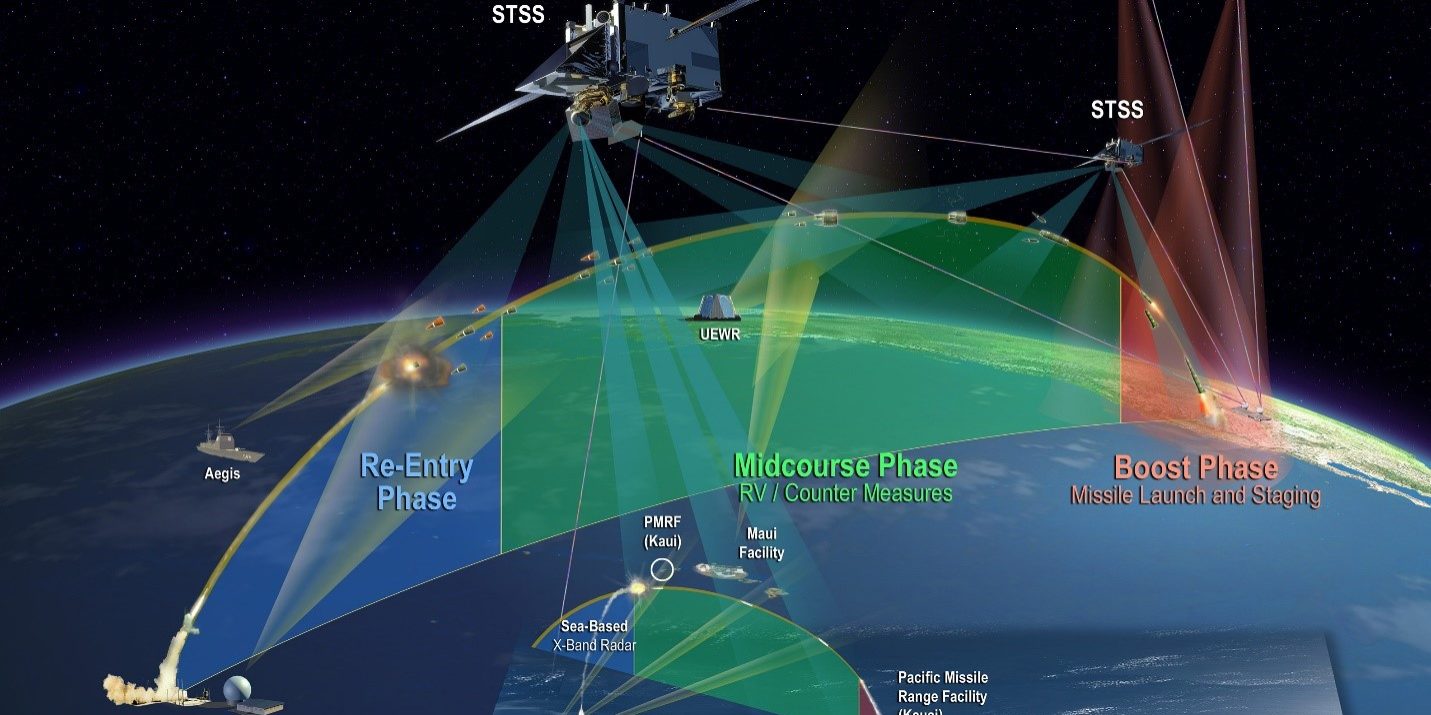
    Satellite networks serve as the backbone of the Aegis missile defense system, significantly enhancing its range, accuracy, and speed of response. A crucial component of this network is the Space Tracking and Surveillance System (STSS), which is designed to intercept ballistic missiles during all phases of their flight: from launch (boost phase) through the ascent (midcourse phase) and re-entry into the atmosphere. STSS satellites are capable of detecting and tracking a wide variety of missiles, including short-range, intermediate-range, and intercontinental missiles. The data collected by these satellites is transmitted to Aegis-equipped ships, enabling a critical capability known as Launch on Remote, which substantially extends the effective range of interception.

    Overview of the Space Tracking and Surveillance System (STSS) operation

    Along with STSS, the Defense Support Program (DSP) and Spaceborne Infrared System (SBIRS) also provide crucial early warning capabilities. By using infrared sensors, these systems pick up the thermal signatures of missile launches early on and transmit valuable data on position and velocity to Aegis and other parts of the US missile defense system.

    Review of AEGIS interceptor missiles:

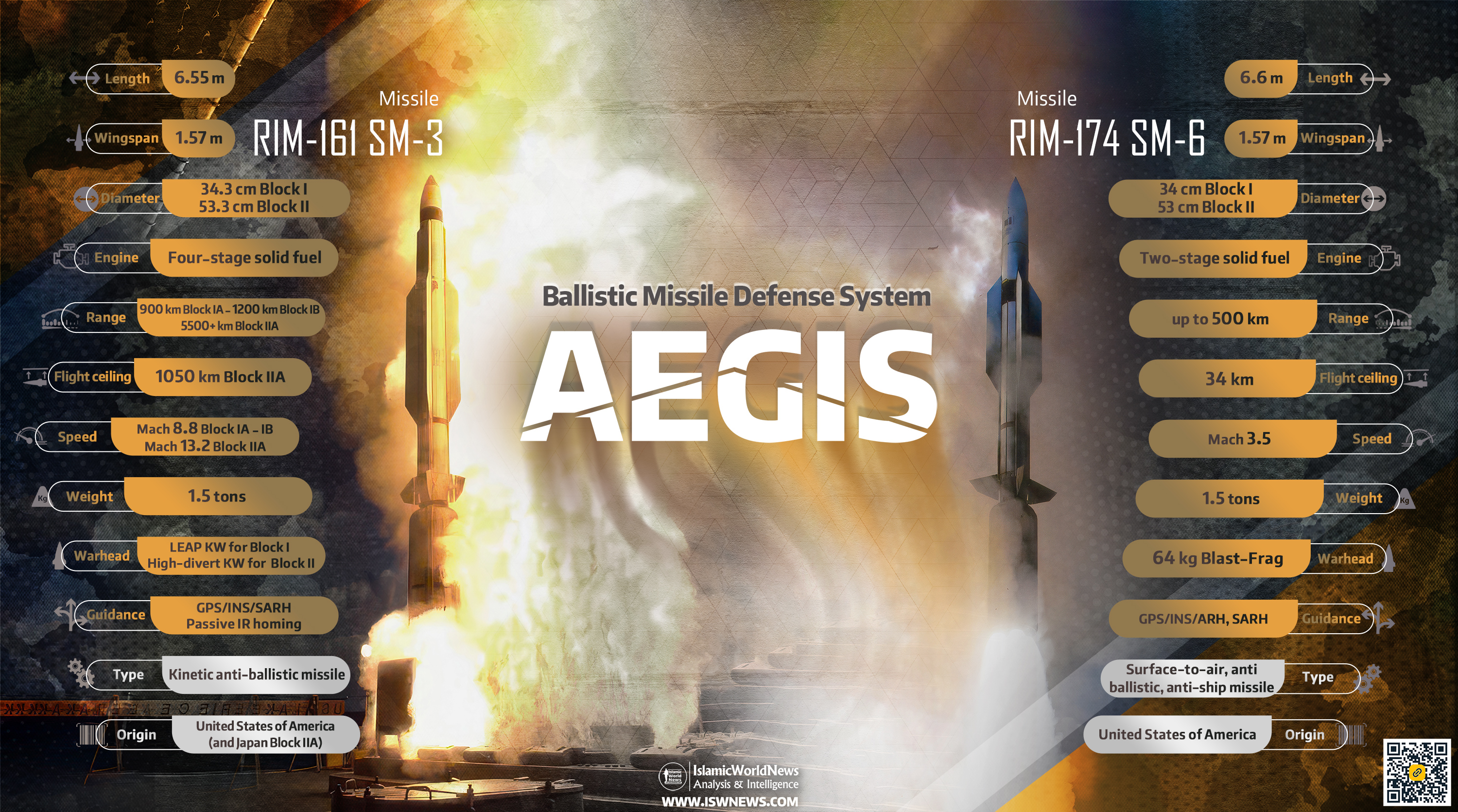
    AEGIS Missile Defense System – SM-3 and SM-6 missiles

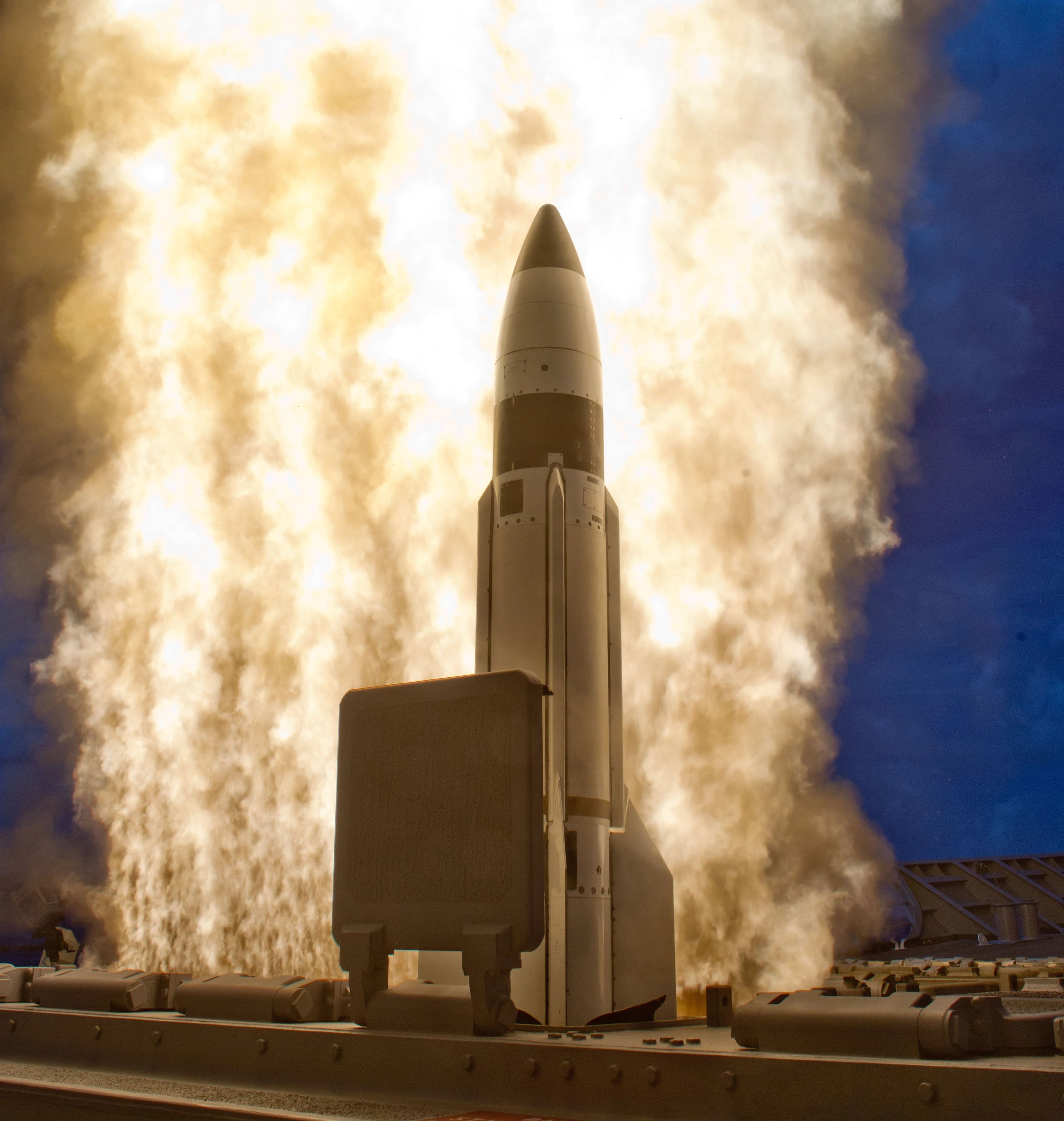
    RIM-161 SM-3 missile

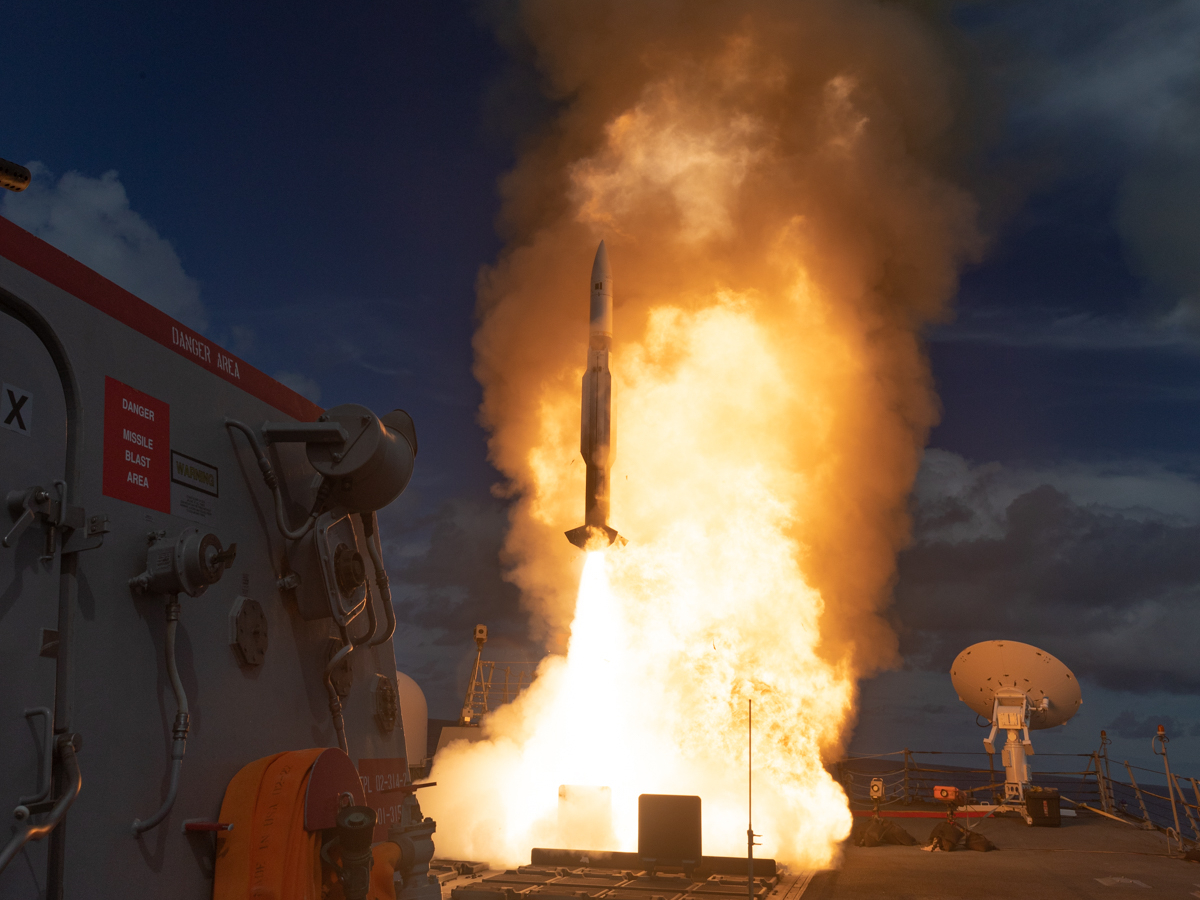
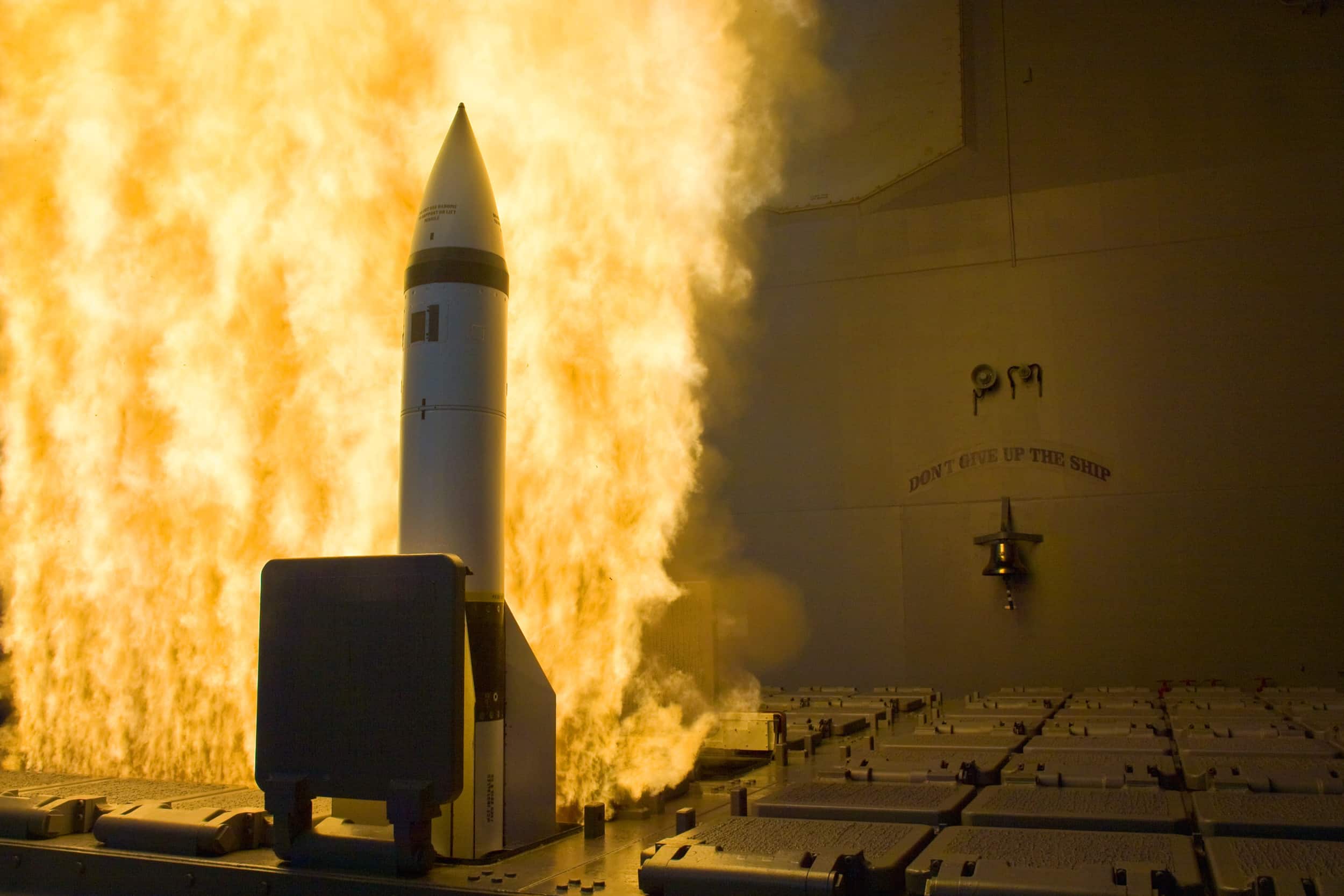
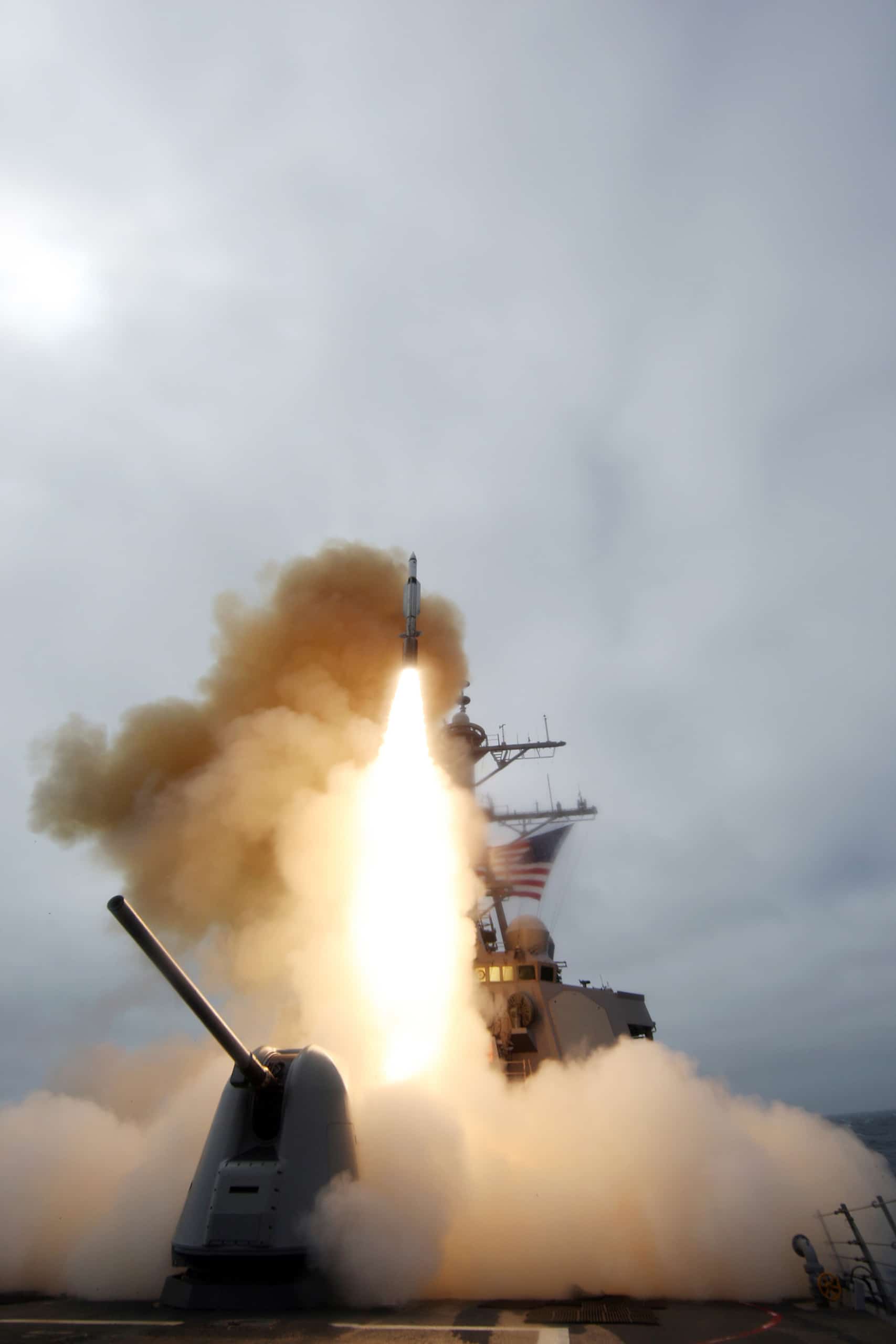
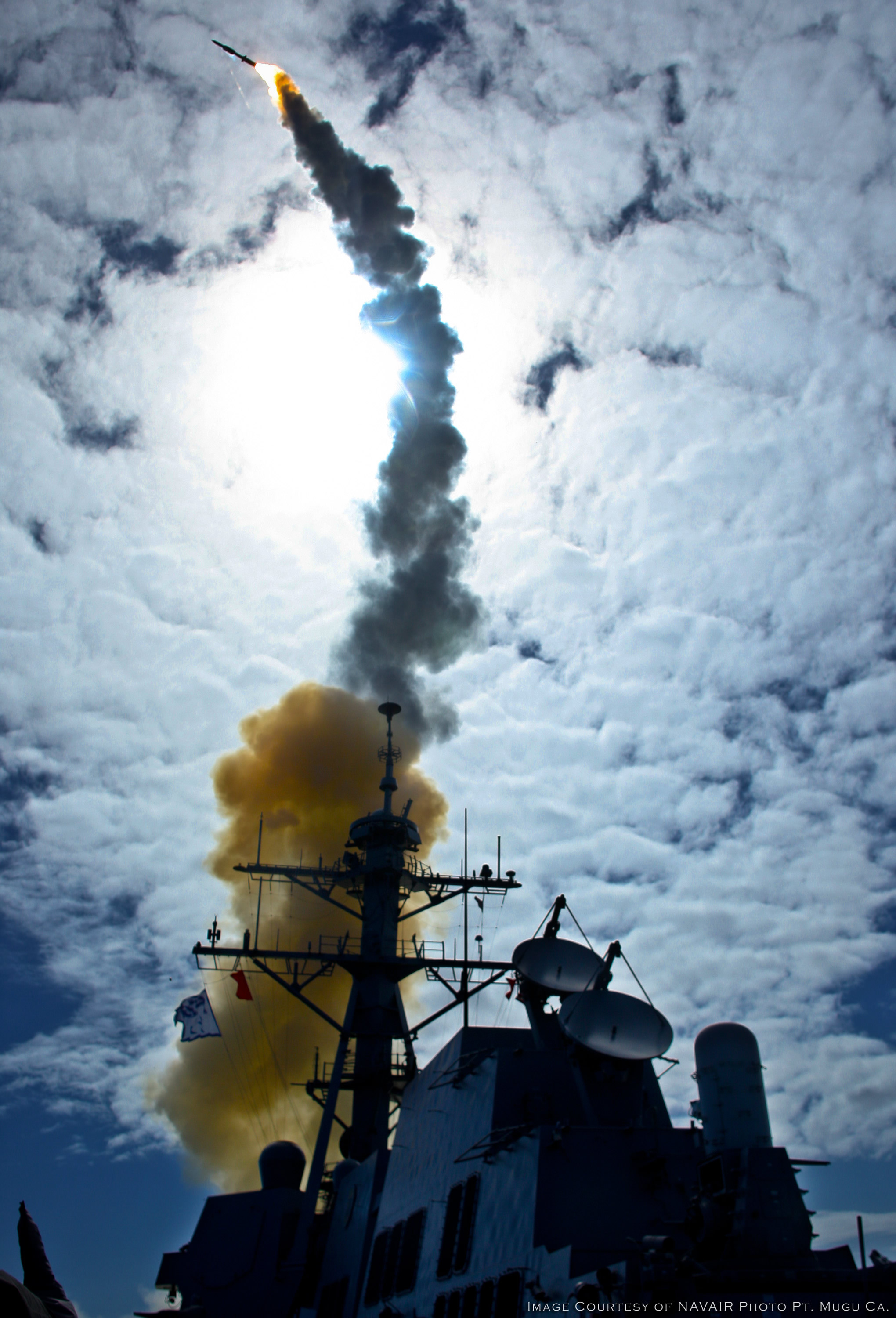
    The Standard Missile-3 (SM-3) is the main interceptor used in the Aegis system. The SM-3 program was developed as a variant of the Standard SM-2ER Block IV missile, known as NTW-TBMD. Initial testing took place from 1992 to 1995 as part of Project Terrier/LEAP. The first test flight of the RIM-161A SM-3 occurred in September 1999, and the program achieved its first successful intercept of a ballistic target in January 2002. The Standard Missile officially entered operational service in 2005. Its first combat deployment took place in April 2024, when U.S. Navy warships used the missile to intercept ballistic missiles fired by Iran toward Israel.

    The SM-3 missile closely resembles the Standard-2 but has two key differences: first, it employs a solid-fuel booster as a third stage, enabling greater range and altitude engagement; second, it uses a kinetic warhead instead of a conventional high-explosive warhead. The SM-3 family is specifically designed to intercept ballistic missiles outside the atmosphere, at altitudes above 100 km. Because ballistic missiles follow a parabolic flight path, they maintain a relatively constant speed after the boost phase and during the midcourse phase or reentry into the atmosphere, losing the ability to perform complex maneuvers. This characteristic allows anti-ballistic interceptors equipped with heat seekers to detect ballistic warheads and destroy them through direct collision.

    The different generations of the Standard-3 missile are as follows:

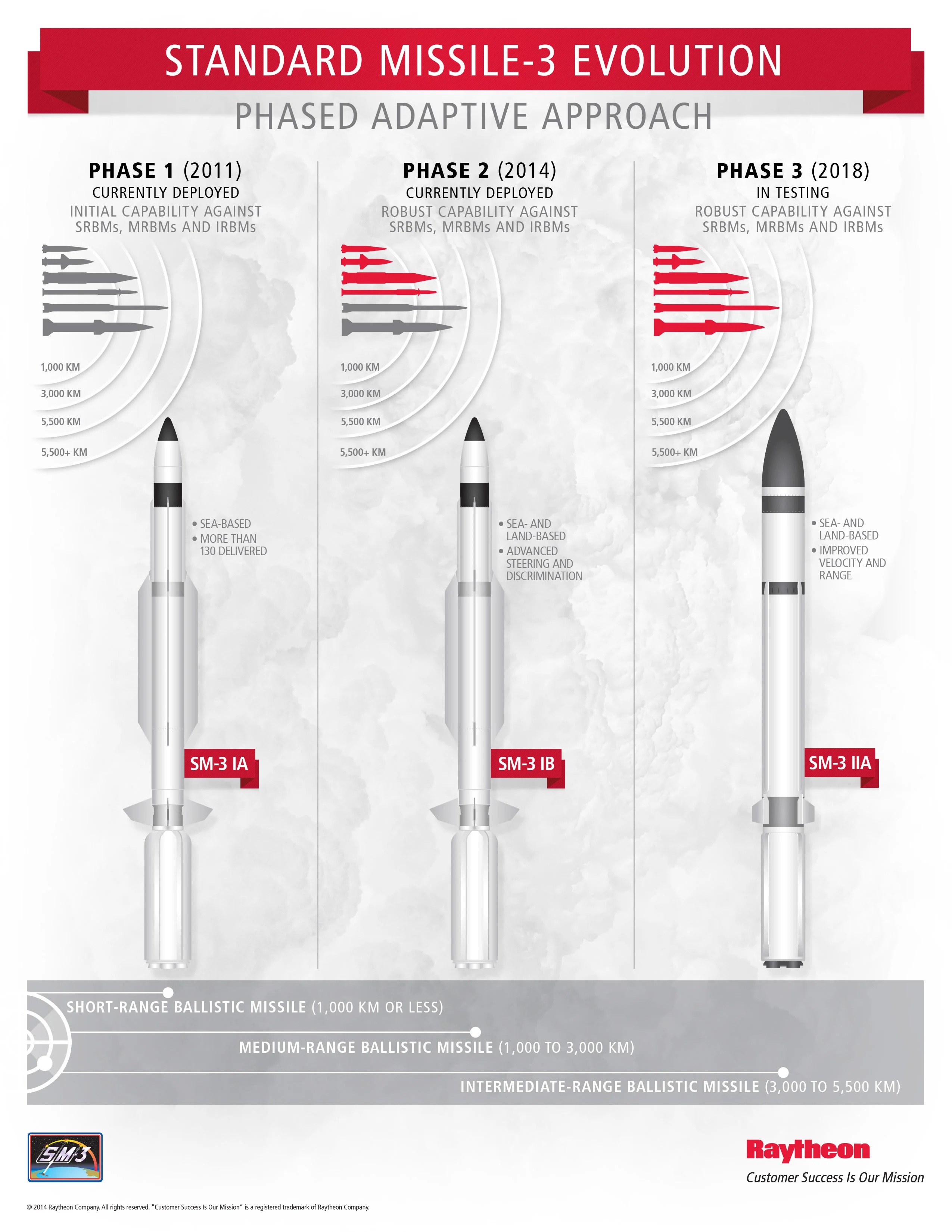
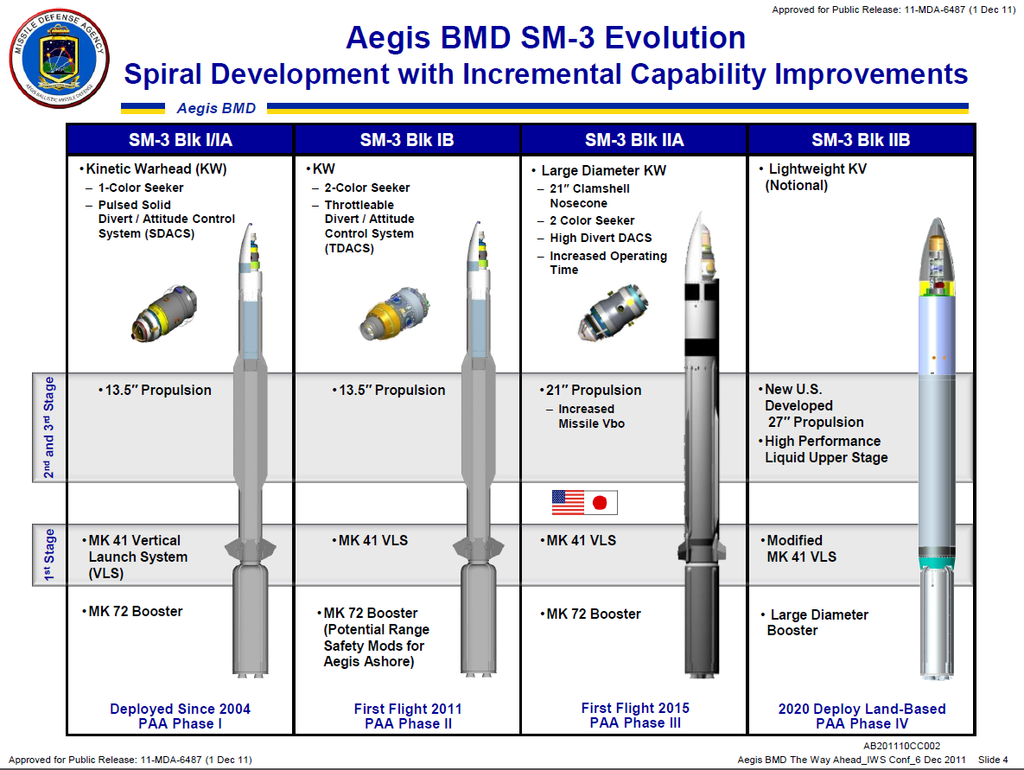
    • SM-3 Block IA: Following the prototype, this version was launched to boost reliability, ease of maintenance, and lower costs, marking the first model in this family to go into mass production.
    • SM-3 Block IB: Set to enter service in 2010, this missile featured a dual-spectral infrared seeker and a new space propulsion system in its warhead. These upgrades boosted the missile’s ability to counter maneuvering warheads, enabling it to defend against intermediate-range ballistic missiles and some medium-to-long-range missiles.
    • SM-3 Block II: For this version, we increased the fuselage diameter to 530 mm and scaled down the wings to boost speed and range. However, this model never made it into operational use.
    • SM-3 Block IIA: Co-developed by Raytheon and Mitsubishi Heavy Industries, this system boasted a larger warhead, improved maneuverability, and more advanced sensors. It can also intercept certain intercontinental ballistic missiles (ICBMs) and satellites, and went into service in 2015.

    In terms of operational performance, the Block IA and Block IB versions have an estimated range of between 900 and 1,200 kilometers. The more advanced Block IIA version significantly increases this range to around 2,500 kilometers and even exceeds 5,500 kilometers. Regarding engagement altitude, the Block IA and IB versions can intercept targets at altitudes of up to 500 kilometers, while the Block IIA can operate at altitudes between 900 and 1,050 kilometers, depending on the type of target. Additionally, the terminal speed of the Block IA and IB versions is approximately Mach 8.8, whereas the Block IIA can attain a speed equivalent to Mach 13.2.

    How the SM-3 interceptor missile works:

    When the Aegis missile defense system detects an incoming ballistic missile, an SM-3 interceptor missile is fired from one of the ships in the engagement zone. The Aerojet MK 72 solid-fuel rocket booster launches the SM-3 from the ship’s Mark 41 vertical launch system. Once launched, the missile communicates with the ship that fired it. After the booster burn is complete, the booster separates, and the Aerojet MK 104 solid-fuel rocket motor takes over propulsion while the missile is in the atmosphere. The rocket continues to receive mid-course guidance information from the launch vessel and is also assisted by GPS data.

    The ATK MK 136 solid-fuel third-stage rocket motor ignites after the second stage burns out, propelling the missile (if necessary) into the upper atmosphere and providing pulsed propulsion for the SM-3 until the final 30 seconds before interception.

    In the final, fourth stage, the third stage engine separates, and the Lightweight Extra-Atmospheric Projectile (LEAP) kinetic warhead begins to search for the target using targeting data from the launch vehicle. Aerojet’s Tunable Direction and Attitude Control System (TDACS) allows the warhead to maneuver in the final phase of engagement. The kinetic warhead’s sensors identify the target and attempt to locate the most vulnerable part of the target, guiding the warhead to that point. If the kinetic warhead successfully engages the target, it generates 130 megajoules of kinetic energy at the point of impact, equivalent to 31 kilograms of TNT, thereby neutralizing the target.

    The accompanying video illustrates the four stages, from launch to the moment of interception and destruction of the target.

    How the SM-3 interceptor missile works, from the moment it is launched to the moment it intercepts and destroys the target

    RIM-161 SM-3 missile specifications:

    Type: Kinetic anti ballistic missile
    Manufacturer: Raytheon and Aerojet (Block I) and Raytheon and Mitsubishi (Block IIA)
    Country of manufacture: USA and Japan
    Entered service: 2014 (Block IB)
    Length: 6.55 m
    Wingspan: 1.57 m
    Diameter:
    34.3 cm Block I
    53.3 cm Block II
    Engine: Four-stage solid fuel
    Range:
    900 km Block IA
    1200 km Block IB
    5500 + km Block IIA
    Ceiling: 1050 km Block IIA
    Speed:
    8.8 Mach Block IA – IB
    13.2 Mach Block IIA
    Weight: 1.5 tons
    Warhead: Light extra-atmospheric kinetic warhead for Block I and heavy for Block II
    Guidance: GPS/INS/SARH/Passive IR homing

    RIM-156 SM-2ER missile

    The Block IV (RIM-156A) was the first long-range missile in the Standard family, specifically designed for use with Mk 41 vertical launch systems. It features more advanced guidance and control systems than previous models. This version primarily serves as a final-stage interceptor, which means it intercepts and destroys ballistic missiles during the final phase of their flight within the Earth’s atmosphere. The missile has an estimated engagement range of 185 to 370 km and can reach a maximum engagement altitude of up to 33 km, with a top speed of approximately Mach 3.5.

    At the time of the Block IV’s development, older missiles like the RIM-67 could only be launched from inclined deck-mounted launchers due to their large size. These launchers were heavy and bulky, restricting their use to larger vessels such as cruisers. In contrast, the SM-2 Block IV’s compatibility with the Mk 41 Vertical Launch System enabled its deployment on Ticonderoga-class cruisers and Arleigh Burke-class destroyers. Development of the Block IV missile began in July 1987, with the first test conducted at White Sands Missile Range in 1990 and its inaugural sea trial occurring in 1994. Initial limited production of the missile was authorized in 1995.

    The RIM-156 was not an overall successful interceptor due to instability in the development program. As a result, the U.S. Navy funded modifications for 75 of the 100 RIM-156 missiles that were produced. Of these, five were used for testing, while about 70 modified SM-2 Block IVs remain in the Aegis fleet, providing temporary defense against anti-ship ballistic missiles. The experiences gained from producing the RIM-156 also contributed to the development of the Standard-3 and Standard-6 missile families.

    Additionally, it is important to note that the SM-2 missile is the same type that the U.S. military fired twice on July 3, 1988, at Iran Air Flight IR655, resulting in the tragic loss of all 290 passengers on board, including 66 children under the age of 13.

    SM-2ER Block IV missile specifications:

    Type: Surface-to-air and anti-ship missile
    Manufacturer: Raytheon
    Country of manufacture: United States
    Length: 6.55 m (with booster)
    Wingspan: 1.07 m
    Diameter: 34.3 cm
    Engine: Two-stage solid fuel
    Range: 370 km
    Ceiling: 24.4 km
    Speed: Mach 3.5
    Weight: 1.463 tons
    Warhead: 64 kg Blast-Frag
    Guidance: INS/SARH

    RIM-174 SM-6 missile

    The ERAM (Standard Extended Range Active Missile), also known as the Standard Missile 6 (SM-6), provides a wide range of multi-mission capabilities, including long-range air defense, terminal ballistic missile defense, and anti-surface attack. The development of the SM-6 addressed a significant gap in long-range air defense following the cancellation of the SM-2ER Block IVA project. Manufactured by Raytheon, the missile utilizes the airframe of the SM-2ER Block IV (RIM-156A) and features an active radar seeker derived from the AIM-120C AMRAAM air-to-air missile.

    The SM-6’s development began around 2005, with the first missile being delivered to the United States Navy in April 2011. It achieved initial operational capability in November 2013. In 2016, the SM-6 demonstrated its anti-surface warfare capability, and an air-launched version, the AIM-174B, is anticipated to be introduced in 2024.

    The primary purpose of the SM-6 is to counter long-range aerial threats, effectively engaging aircraft, fighters, cruise missiles, and drones at extended ranges. Additionally, the Block IA and IB versions of the missile possess anti-surface warfare capabilities, allowing them to target both surface ships and ground installations. The missile has an official range of 240 miles (approximately 240 km), but in practical scenarios, its range can exceed 250 miles (around 370 km) against ground or sea targets. The air-launched version, the AIM-174B, has an estimated range of 250 miles (approximately 400 km).

    The SM-6 can engage targets at altitudes of up to 25 miles (33 km) and at a maximum speed of Mach 3.5. To enable these capabilities, the missile is equipped with a 140-pound (64 kg) high-explosive warhead.

    RIM-174 SM-6 missile specifications:

    Type: Surface-to-air, anti-ballistic (terminal phase), and anti-ship missile
    Manufacturer: Raytheon
    Country of manufacture: United States
    Entered service: 2013
    Length: 6.6 m
    Wingspan: 1.57 m
    Diameter: 34 cm Block I
    53 cm Block II
    Engine: Two-stage solid fuel
    Range: Up to 500 km
    Ceiling: 34 km
    Speed: Mach 3.5
    Weight: 1.5 tons
    Warhead: 64 kg Blast-Frag
    Guidance: GPS/INS/ARH, SARH

    Overall, the Aegis system serves as the core of the U.S. anti-ballistic defense program, which has two primary objectives. First, it aims to protect the naval fleet and strike groups. Second, it enhances the overall anti-ballistic program by relaying supplementary data to other land-based defense systems. It’s important to note that the Aegis system was initially developed to counter the long-range missiles of North Korea, China, and Russia—countries that have greater access to the oceans and are geographically closer to the United States. Additionally, the technology behind this system has been specifically provided to allied nations neighboring China or Russia.

    sources:
    RIM-161 Standard Missile 3 , RIM-174 Standard ERAM, RIM-67 Standard, SM-3 Block IIA Missile Excels in First Ever, ICBM Intercept Test, aegis-weapon-system, modernization-program-meets-key-milestones
    mda-test-successfully-intercepts-ballistic-missile-target, Aegis, Aegis-Successfully-Engages-Medium-Range-Ballistic-Missile-Target, Aegis, Ten-years-of-aegis-ballistic-missile-defense-operations
    us-and-allied-ballistic-missile-defenses-asia-pacific-region, Ten-years-of-aegis-ballistic-missile-defense-operations
    leading-way-ballistic-missile-defense, Aegis-continuum-excellence
    apl-plays-pivotal-role-successful-ftx-23-missile-defense-test, The-ballistic-missile-threat-to-the-united-states, PDF1 – PDF2 – PDF3 – PDF4 – PDF5 – PDF6 – PDF8 – PDF9 – PDF10 – PDF11 – PDF12 PDF13 – PDF14 – PDF15

  • Military Knowledge: Javelin FGM-148 anti-tank missile

    Military Knowledge: Javelin FGM-148 anti-tank missile

    The gunner carries a reusable Command Launch Unit (CLU), which is the targeting component of the two-part system. The CLU has three views which are used to find, target, and fire the missile and may also be used separately from the missile as a portable thermal sight. Infantry are no longer required to stay in constant contact with armored personnel carriers and tanks with thermal sights.

    The CLU weighs 6.4 kg and uses passive infrared guidance to fix and track targets. The day sight is equipped with 4x magnification and the infrared-imaging night sight features 4x and 9x magnification.

    Both the gunner and the ammunition bearer carry the Launch Tube Assembly, a disposable tube that houses the missile and protects the missile from harsh environments. The tube has built-in electronics and a locking hinge system that makes attachment and detachment of the missile to and from the Command Launch Unit a quick and simple process.

    The Javelin measures roughly 1.2 m in length, 127 mm in diameter, and weighs 22.1 kg, with some minor differences depending on the variant. The missile carries a single 8.4 kg tandem-charge, high-explosive antitank (HEAT) warhead. This round utilizes an explosive shaped charge to create a stream of superplastically deformed metal formed from trumpet-shaped metallic liners. The result is a narrow high velocity particle stream that can penetrate armor. It has a qualified maximum range of 2,500, though the U.S. notes that it has “demonstrated performance to 4,000 meters in most operational conditions.”

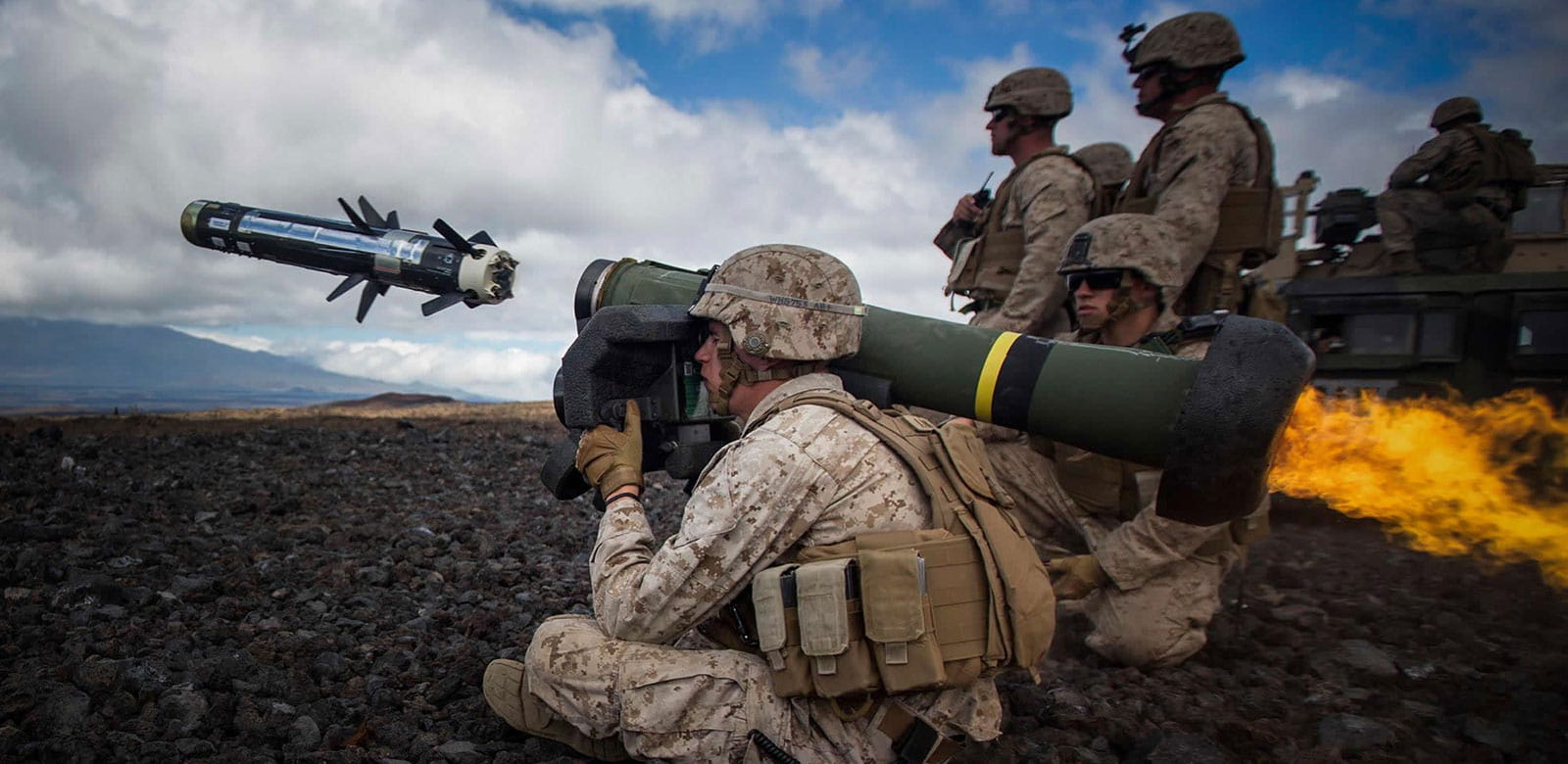
    The Javelin employs a soft launch mechanism. This means when an operator pulls the trigger, an initial low-g motor ejects the missile from the firing tube. Once it exits the firing tube, the missile then ignites its main flight motor to propel it toward its target. The Javelin’s soft launch mechanism prevents missile exhaust from hitting the operator, enables fires from inside confined spaces and buildings, lowers recoil for shoulder-launched fires, and minimizes launch smoke trails that indicate launch locations and invite counterfire.

    Operators can select to use the weapon in top attack mode or direct attack mode. Top attack mode is designed to target tanks; the missile flies upward to reach a peak altitude of 150 m before striking the tank’s more vulnerable roof. The direct attack mode is designed to engage fortified targets, bunkers, buildings, and helicopters. In this mode, the missile flies relatively straight to its target at a peak altitude of 50 m.

    Early versions of the Javelin had a range of 2000 meters, which was later increased to 2500 meters. Javelin has been used in more than 5000 conflicts in Afghanistan and Iraq. This system is supposed to remain in service until 2050. The United States has been buying Javelins at the rate of about 1,000 a year. The maximum production rate is 6,480 a year, though it would likely take a year or more to reach that level. The delivery time is 32 months; that is, once an order is placed, it will take 32 months before a missile is delivered.

    FGM-148 Javelin specifications:
    Length: 1.1 m
    Barrel length 1.2 m
    Diameter 142 mm
    Total system weight: 22.3 kg
    Warhead weight: 8.4 kg Tandem-charge HEAT
    Penetration rate: 800 mm RHA
    Effective range: 75 to 2500 m
    Target discovery range: 4000 m
    Guidance system: Infrared homing
    Origin: U.S.

    Source:
    FGM-148 Javelin
    Javelin
    Javelin Weapon System
    FGM-148 Javelin
    Will the United States Run Out of Javelins Before Russia Runs Out of Tanks?


  • Saudi Arabia and expensive Patriot systems!

    Saudi Arabia and expensive Patriot systems!

    The Patriot system is a medium-range air defense system capable of meeting aerodynamic and ballistic targets. Saudi Arabia is one of the main users of this system and in recent years has widely purchased patriot systems and its missiles.

    This system was designed and built by the American companies Raytheon and Lockheed Martin in the 70s and 90s. In addition to the US military, Saudi Arabia, Israel, Qatar, Kuwait, Egypt, Jordan, Germany, Greece, the Netherlands, Spain, Japan and Taiwan are also equipped with the system. Among these countries, Saudi Arabia is the second largest user of Patriot missile system after the United States.

    In the years after the Islamic Revolution of Iran, Saudi Arabia has sharply increased the level of its military rivalry with Iran. With the start of the Saudi coalition invasion of Yemen and Ansar Allah’s reciprocal attacks on Saudi territory, the Saudis’ dependence on the Patriot system has greatly increased. To the extent that the country has leased more patriot systems from the United States and Greece.

    The price of each Patriot missile is estimated at $ 1 to $ 6 million, depending on the type, and Saudi Arabia appears to have spent more than $ 10 billion to purchase Patriot missiles so far.

    Read more: Military Knowledge: Patriot Missile System

    Data from the Stockholm International Peace Research Institute (SIPRI) show that Saudi Arabia has purchased Patriot missiles in several stages.

    According to the statistics, it seems that Saudi Arabia has purchased more than 2,800 missiles for the Patriot systems

    Details of these purchases are as follows:
    1- In the years 1993-1995, 384 rounds of Patriot PAC-2 GEM missiles
    2- In the years 1997-1995, 781 rounds of PAC-2 GEM missiles
    3- In the years 1999-1998, a total of 629 PAC-2 GEM missiles
    4- In the years 2019-2017, 320 PAC-3 MSE missiles
    5- In the years 2020-2019, 130 PAC-3 MSE missiles
    6- An unknown number of Patriot PAC-3 missiles have been ordered by Saudi Arabia in 2018 and are being delivered.

    Examining other sources, such as database of US Defense Security Cooperation Agency, it appears that Saudi Arabia also ordered 600 Patriot PAC-3 missiles in 2015.

    Timothy Lenderking, the U.S. special envoy for Yemen, said at a forum on December 3 that the Ansar Allah have conducted about 375 cross-border attacks into Saudi Arabia in 2021. This statistic comes at a time when most of Saudi Arabia’s defensive confrontations with Ansar Allah have taken place through the Patriot defense systems. Thus, the Saudi Patriot missile arsenal will face problems in the not-too-distant future, and the supply of those missiles will cost another billion dollars for the country.

    Apart from this, the Patriot system has performed poorly in some Ansar Allah operations, such as Operation Second Deterrence Balance on September 14, 2019. In this attack, Buqayq and Khurais refineries were targeted by successful Ansar Allah drone and missile attacks, and Saudi oil exports were severely disrupted. The attack inflicted heavy losses on the country’s economy, and Western countries struggled to control rising oil price.

    In general, the Saudis Patriot systems needs billions of dollars financial support to continue to deal with Ansar Allah drones and missiles, and this has been hampered by Biden’s cold approach to the Saudis. Ansar Allah is now increasingly attacking Saudi coalition positions deep inside Saudi Arabia by increasing the accuracy of its drones and missiles, and Saudi Arabia is forced to buy more to counter such attacks; Because without sufficient stockpiles of Patriot missiles, Ansar Allah continued attacks could lead to serious damage to important and vital infrastructure of Saudi Arabia.

    Read more:
    Military Knowledge: MIM-103C PAC-2 missile
    Military Knowledge: MIM-104F PAC-3 MSE missile

  • Military Knowledge: MIM-104F PAC-3 MSE missile

    Military Knowledge: MIM-104F PAC-3 MSE missile

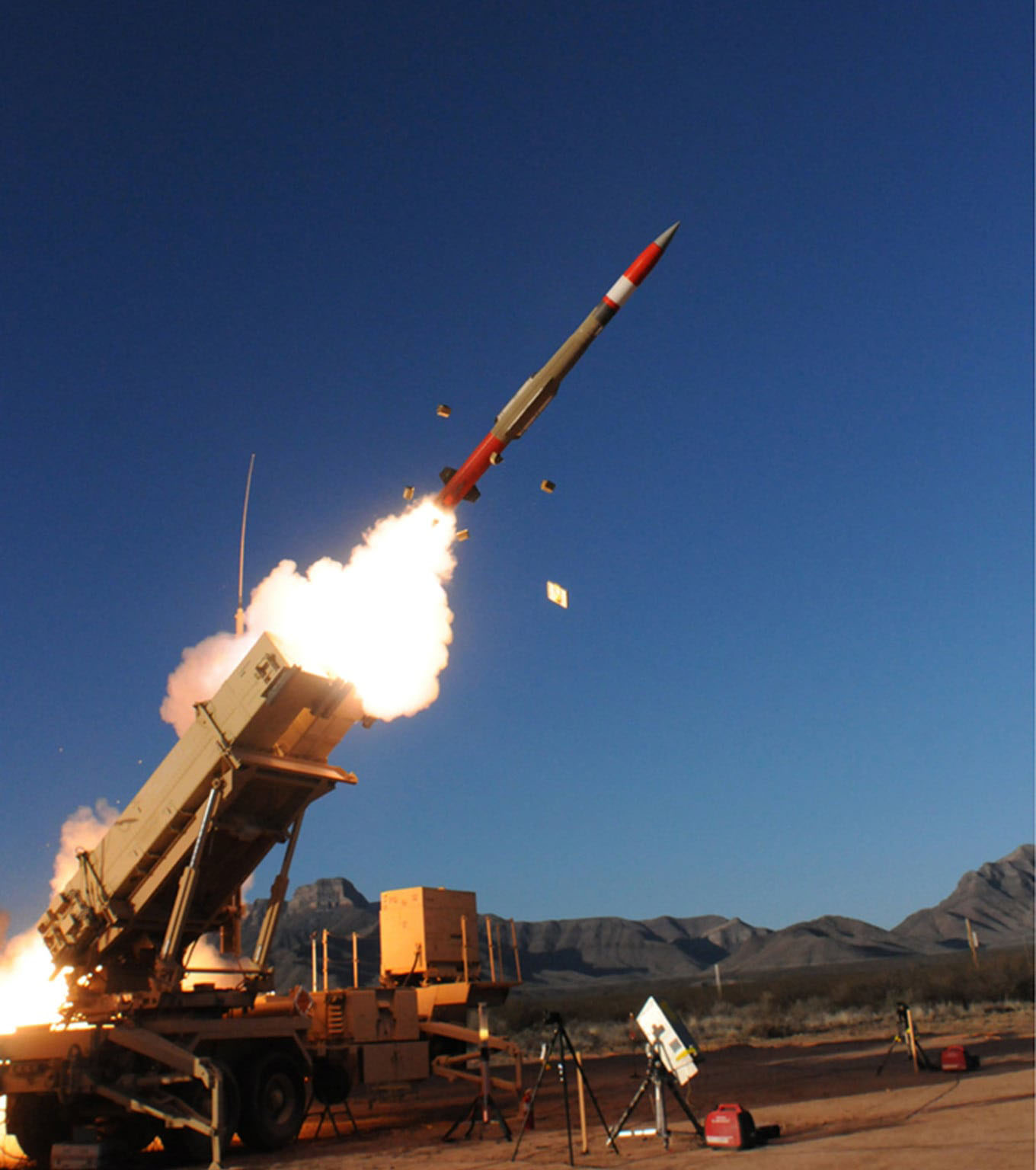
    The PAC-3 MSE missile with a length of 2.5 meters and a weight of 312 kg has a range of 40 km and a maximum altitude of 20 km, and due to its small size, it can install 16 of these missiles on the Patriot launcher.

    The seeker of this missile is based on active radar homing, which receive the target coordinates by AN/MPQ65 radar and the navigation is based on the missile’s own radar. This reduces the volume of calculations and removes the limit on the number of conflicting targets in the system at the same time.

    The radar of the PAC-3 has increased detection and tracking ranges. It also has improved discrimination abilities. The radar can discriminate whether or not the aircraft is manned, or which of multiple re-entering ballistic objects are carrying ordnance. Also the software of the PAC-3 ensures that ballistic missiles with chemical warheads or with early release submunitions are destroyed at a certain altitude.
    However, the use of active radar guidance has increased the cost of missile, with each PAC-3 MSE missile costing more than $ 9 million for US partners and about $ 5 million for the US military.

    The missile has a small High Explosive Fragmentation (HE-FRAG) warhead to enhance the kill probability, however it may be not enough for engaging with heavy aircraft targets such as warplanes and bombers. So for this reason, this missile is used in combination with the PAC-2 missile in the Patriot system.

    The target hunting mechanism in the PAC-3 missile is based on Hit-To-Kill. In this method, kinetic energy is the main factor in destroying the target, but in order to increase the destruction and self-destructive ability, there is also a small warhead of high explosive fragmentation type in this missile.
    MIM-104F PAC-3 missile specifications:
    Range: 40 km
    Maximum (engage) altitude: 20 km
    Missile length: 2.5 meters
    Missile weight: 320 kg
    Origin: USA

    Read more:
    Military Knowledge: Patriot Missile System
    Military Knowledge: MIM-103C PAC-2 missile

  • Military Knowledge: MIM-103C PAC-2 missile

    Military Knowledge: MIM-103C PAC-2 missile

    The target destruction mechanism in the PAC-2 missile is based on high-explosive blast/fragmentation warhead with a proximity fuse. This missile has the ability to intercept ballistic targets with a maximum speed of mach +4.

    The minimum altitude of the PAC-2 missile is about 2.5 km, which is useless against cruise missiles and drones flying at low altitudes. Given this weakness, Yemen’s Ansar Allah has focused on the use of drones and cruise missiles and has dealt repeated blows to the Saudi coalition in Yemen war.
    Missile guidance is based on the Track-via-missile method. Track-via-missile or TVM refers to a missile guidance technique which combines features of semi-active radar homing (SARH) and radio command guidance. This avoids the problems with terminal accuracy normally seen by command guided missiles, especially at long range.

    PAC-2 missile specifications:
    Range: +90 km
    Length: 5.8 m
    Diameter: 40 cm
    Missile weight: 900 kg
    Warhead weight: 90 kg
    Maximum (engage) altitude: 30 km
    Minimum (engage) altitude: 2.5 km
    Maximum speed (ballistic): Mach +4
    Max number of missiles on a launcher: 4 rounds
    Origin: USA

    Read more:
    Military Knowledge: Patriot Missile System
    Military Knowledge: MIM-104F PAC-3 MSE missile