Tag: Russian helicopter

  • Military Knowledge: Mi-28 Attack Helicopter

    Military Knowledge: Mi-28 Attack Helicopter

    Design and Development History

    Development of the Mi-28 began in 1972, when the Soviet Union decided to design a fully dedicated replacement for the aging Mi-24 Hind, aiming to significantly enhance anti-tank and close-support firepower. During the 1980s, the initial design was completed by the Mil Design Bureau under the leadership of Marat Tishchenko, and the first Mi-28 prototype made its maiden flight on 10 November 1982. However, competition with the Kamov Ka-50, financial difficulties following the collapse of the Soviet Union, and shifting defense priorities delayed large-scale production.

    The initial production variant, Mi-28A, was introduced in the 1990s, but it was the upgraded Mi-28N “Night Hunter”, featuring full night and all-weather capability, that officially entered service with the Russian Armed Forces in 2009. Subsequently, the more advanced Mi-28NM was developed, incorporating updated radar systems, improved engines, and modern avionics to enhance battlefield awareness, making it one of Russia’s most modern attack helicopters.

    General Characteristics of the Mi-28

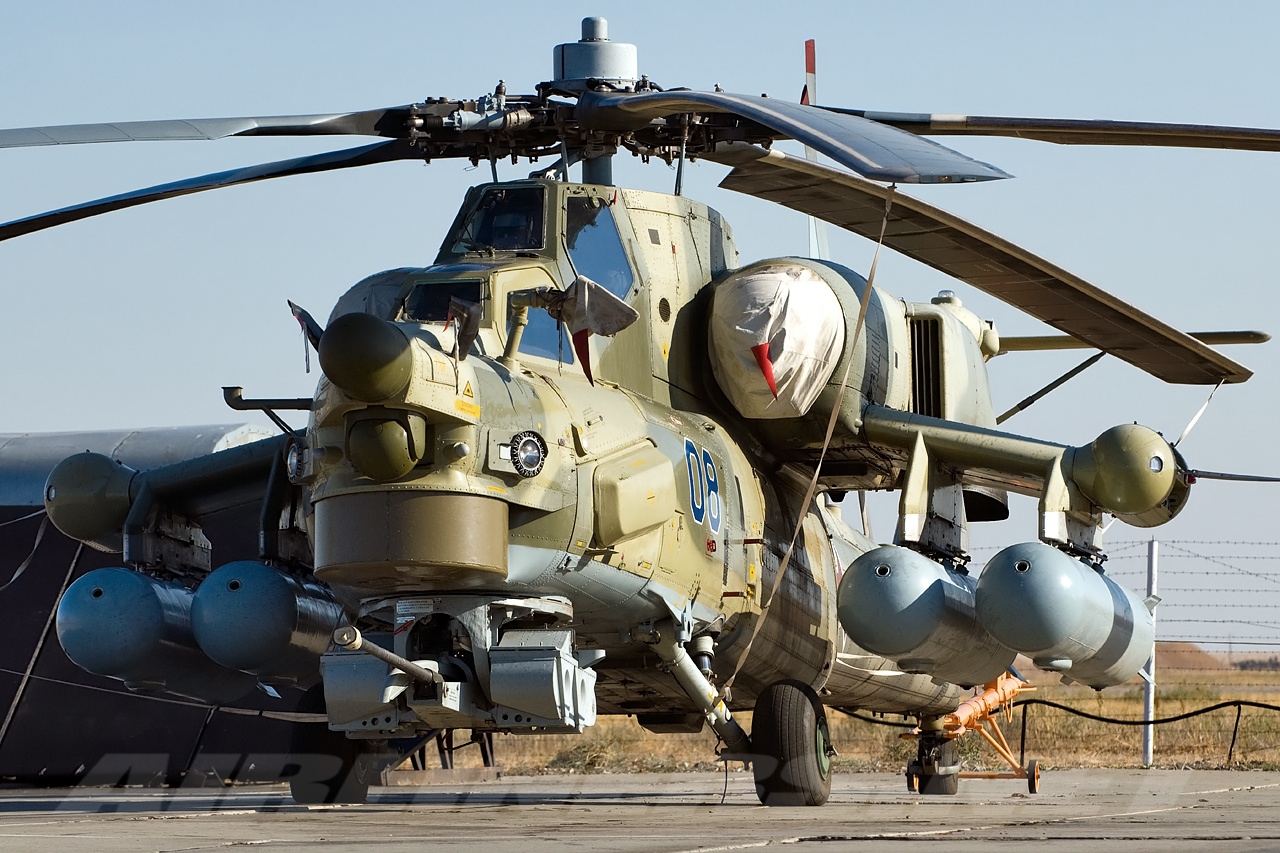
    The Mi-28 is a dedicated anti-armor attack helicopter designed to destroy tanks, armored vehicles, enemy units, and soft targets on the front lines. Unlike the Mi-24, it has no troop-carrying capability and is fully focused on combat missions. The aircraft has a two-person crew, with the pilot seated in the rear and the weapons systems officer in the front. Its twin turboshaft engines provide high maneuverability and adequate speed.

    The Mi-28 has a fuselage length of approximately 17.9 meters, a main rotor diameter of 17.2 meters, and a height of about 3.8 meters. While its aerodynamic layout is similar to other modern attack helicopters, greater emphasis has been placed on armor protection and the integration of advanced systems beneath the fuselage.

    The twin-engine configuration, main rotor system, and short wings on either side improve performance across various flight conditions, including low-altitude operations. The helicopter is equipped with three non-retractable landing gears. Both the landing gear and energy-absorbing seats are designed to protect the crew during low-altitude crash scenarios.

    Airframe Armor Protection

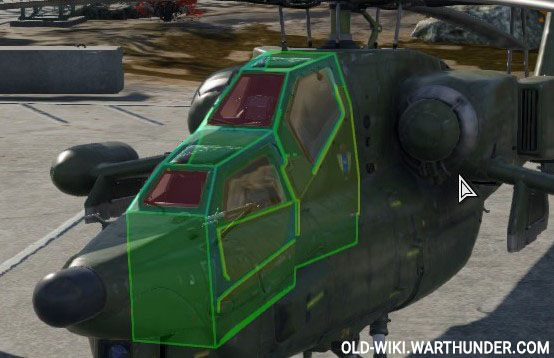
    One of the Mi-28’s most notable features is its heavy armor protection, capable of withstanding fire from NATO-standard 7.62 mm and 12.7 mm rounds, as well as 20 mm projectiles. The helicopter has a fully armored cockpit with bullet-resistant glass. The cockpit and critical airframe sections are engineered to protect the crew even during hard impacts—an aspect emphasized in earlier designs and further optimized in newer variants. Compared to the Mi-24, the Mi-28 has approximately 2.5 times lower thermal signature, enhancing its survivability on the battlefield.
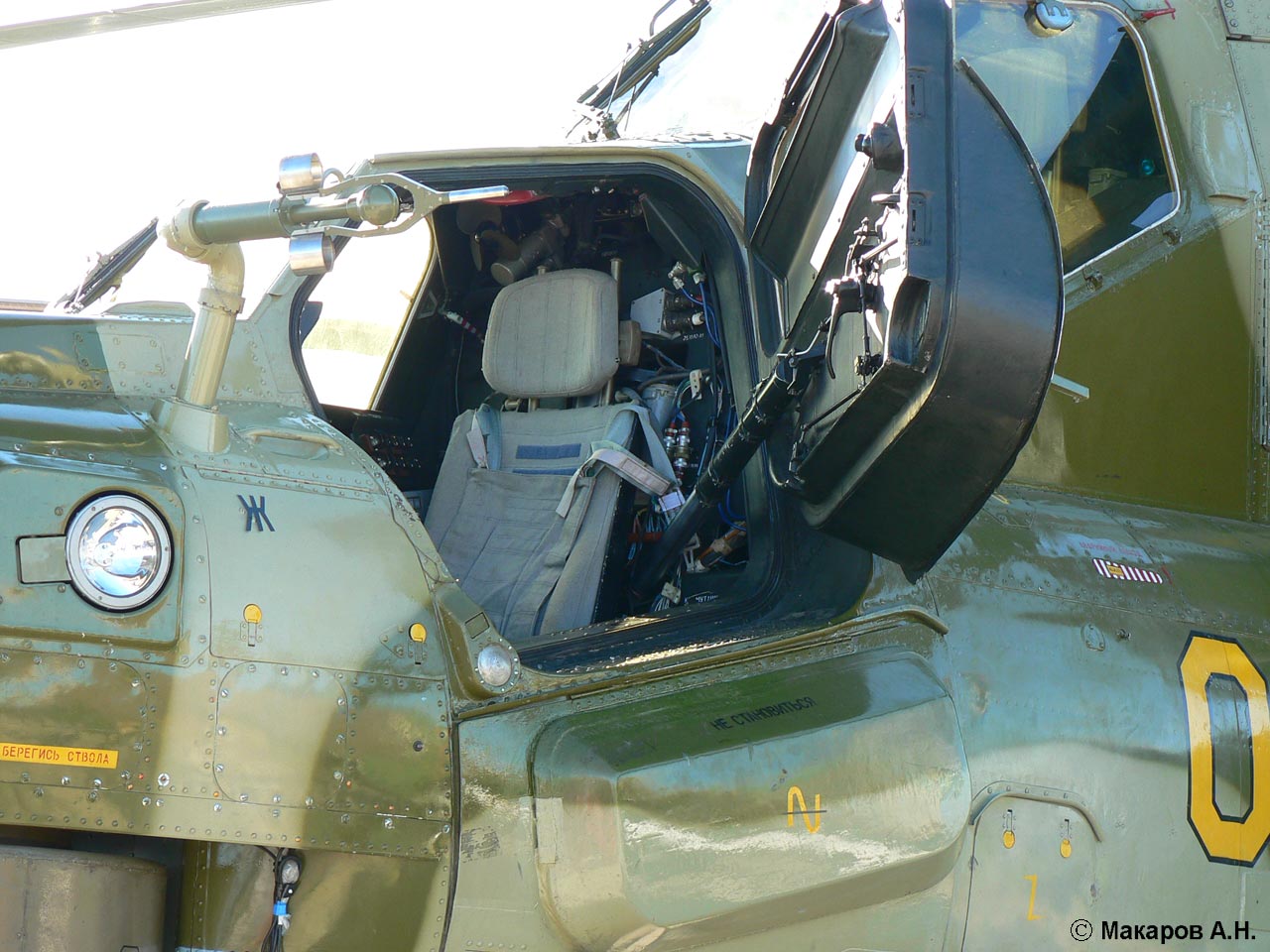
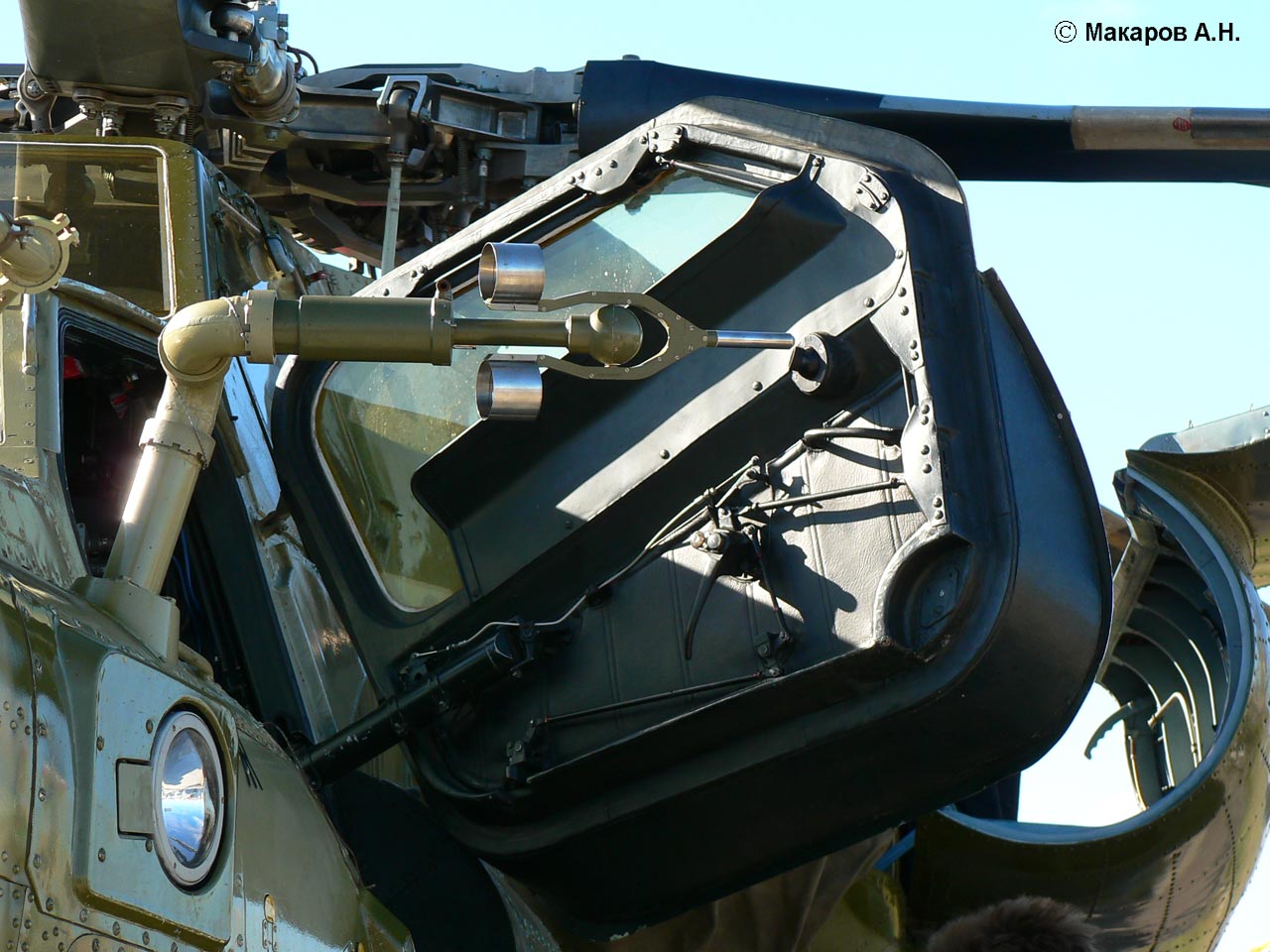
    The front and rear cockpits are also equipped with AK-2005 crash-resistant seats.
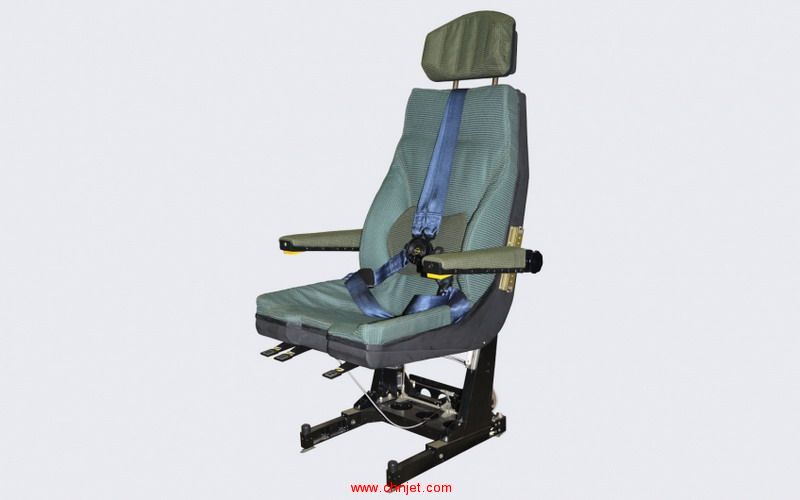
    AK-2005 crash-resistant seats

    Motors and rotors

    The Mi-28 helicopter is powered by two TV3-117VMA turboshaft engines, each producing about 2,200 horsepower, or by two VK-2500P turboshaft engines in the Mi-28NM variant, each delivering around 2,500 horsepower. These engines drive a five-blade main rotor and a four-blade tail rotor.

    This powerful engine setup and rotor configuration enable the helicopter to perform effectively at high speeds, medium altitudes, and in dense battlefield environments. The Mi-28 has a maximum speed of 324 km/h. It is also capable of flying rearward and sideways at speeds of up to 100 km/h, and can execute reverse turns at a rate of 45 degrees per second.

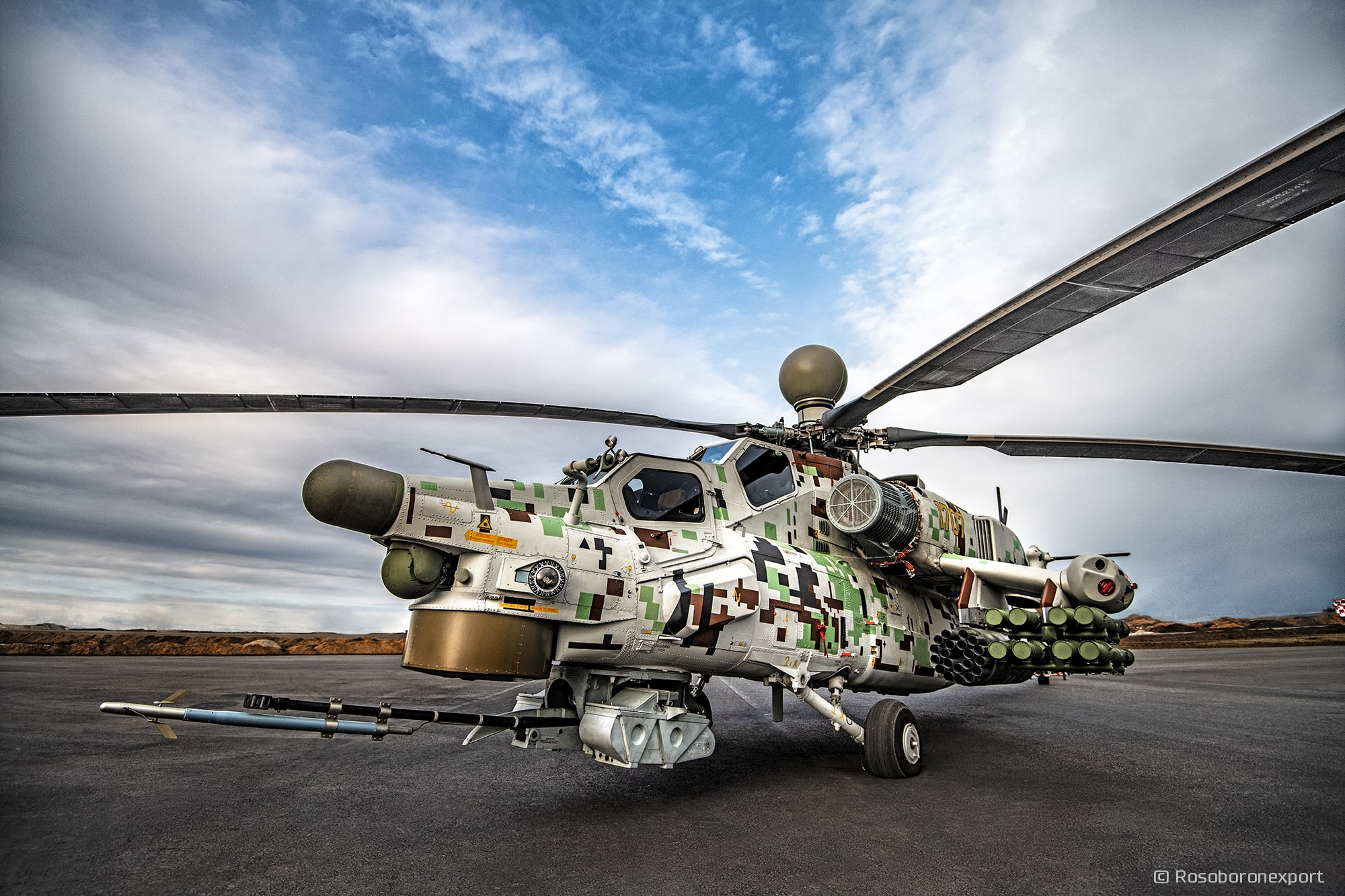
    In the export version of this helicopter, the Mi-28NE, the helicopter engines are equipped with air intakes protected against dust and sand. This multi-cyclone dust protection unit prepares the Mi-28 helicopter for operation in dry and desert climates. According to the manufacturer, this air intake provides an efficiency of 93%.
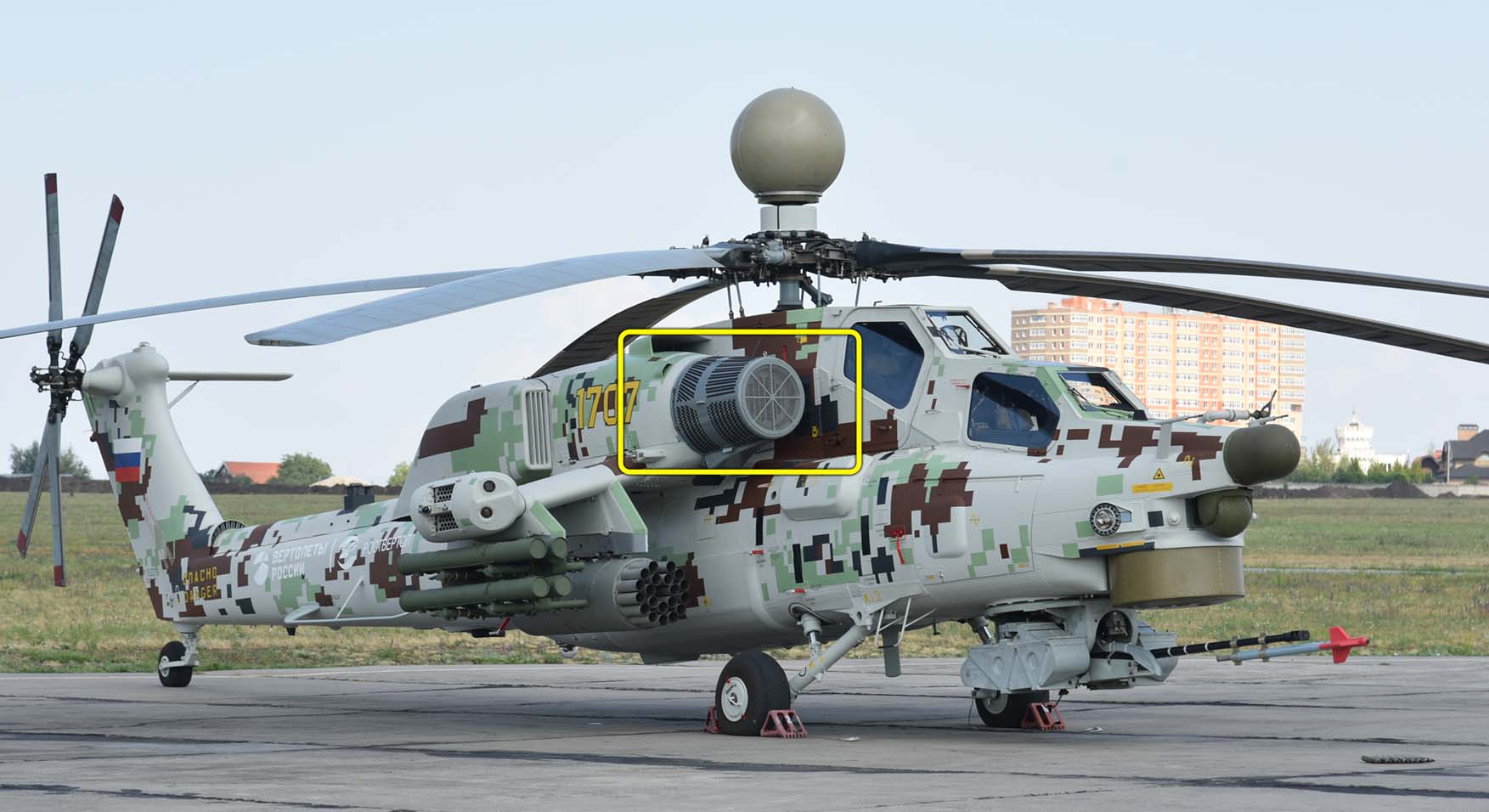
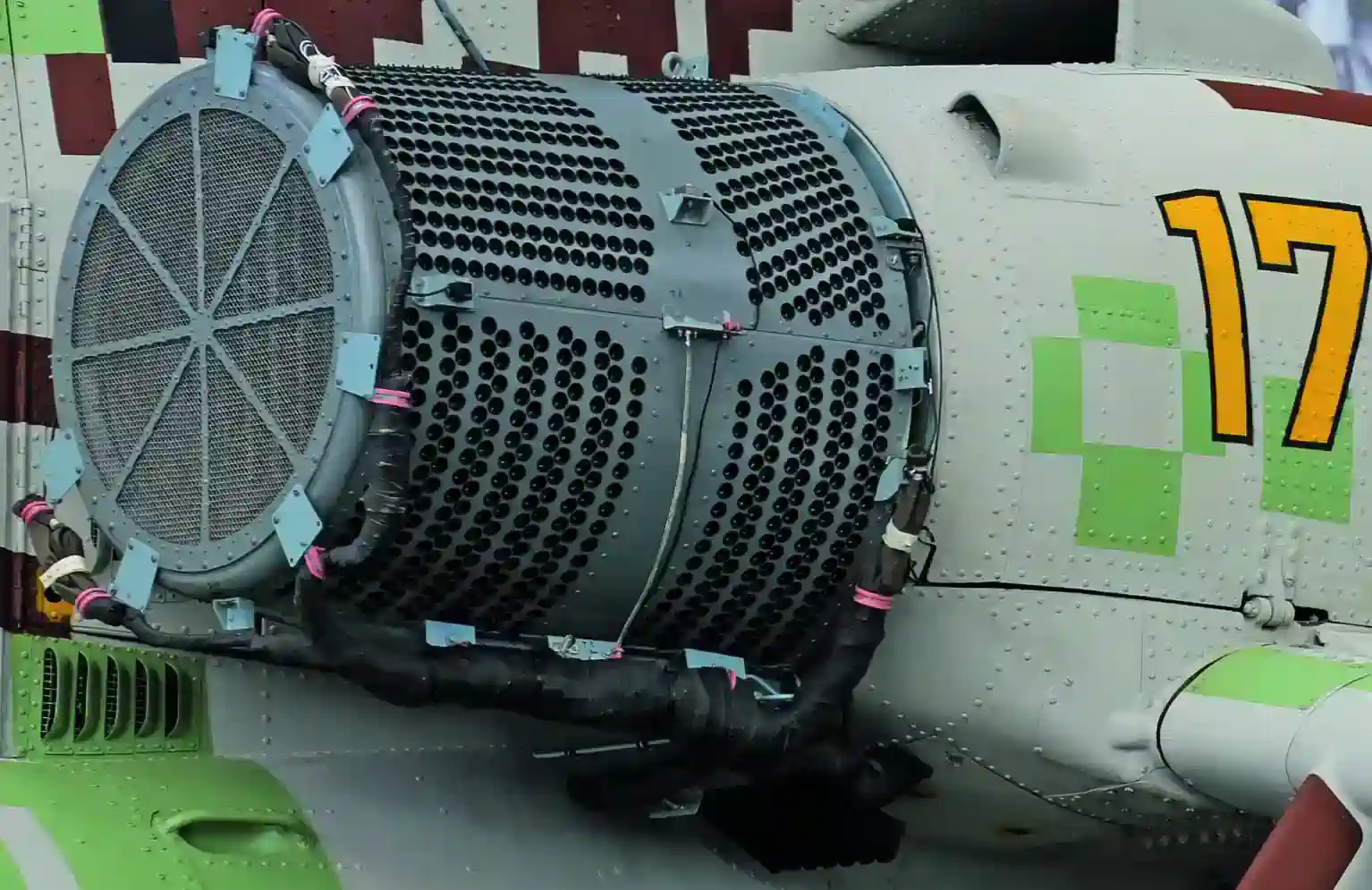
    Multi-cyclone dust protection unit for Mi-28NE helicopter
    Multi-cyclone dust protection unit for Mi-28NE helicopter/ Image: Alexander Mladenov

    Mi-28 Avionics and Navigation

    The Mi-28N helicopter is equipped with the integrated digital avionics suite BREO-28N. This system is built around a two-seat digital cockpit featuring multifunction displays, a central mission computer, and a hybrid inertial navigation system (INS) integrated with GLONASS/GPS, enabling night operations and full-time/all-weather capability.

    In the pilot’s cockpit, two MFI-10-6M LCD multifunction displays are installed, presenting flight and navigation data, airframe and engine parameters, weapons status, and target information. In addition, the pilot can use the ILS-28 head-up display (HUD) to aim direct-fire weapons. The gunner’s cockpit is also equipped with two similar color displays used for navigation and targeting.
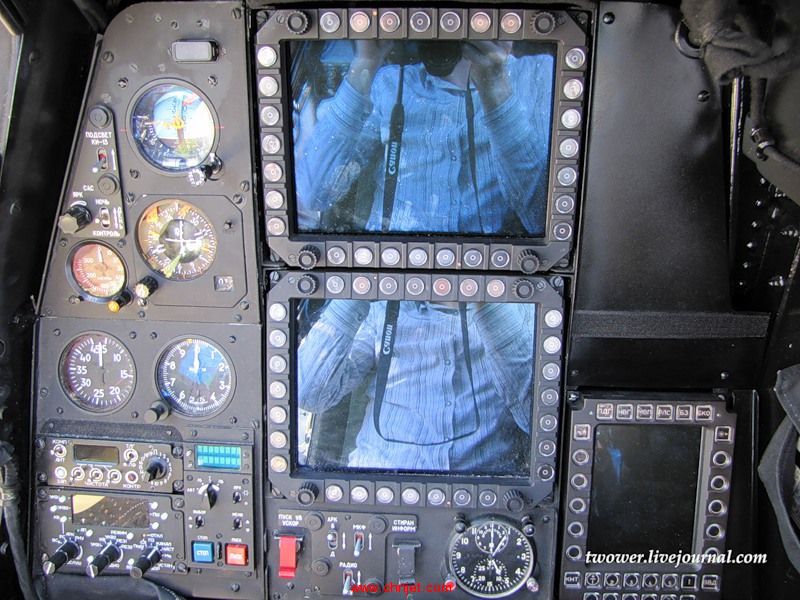
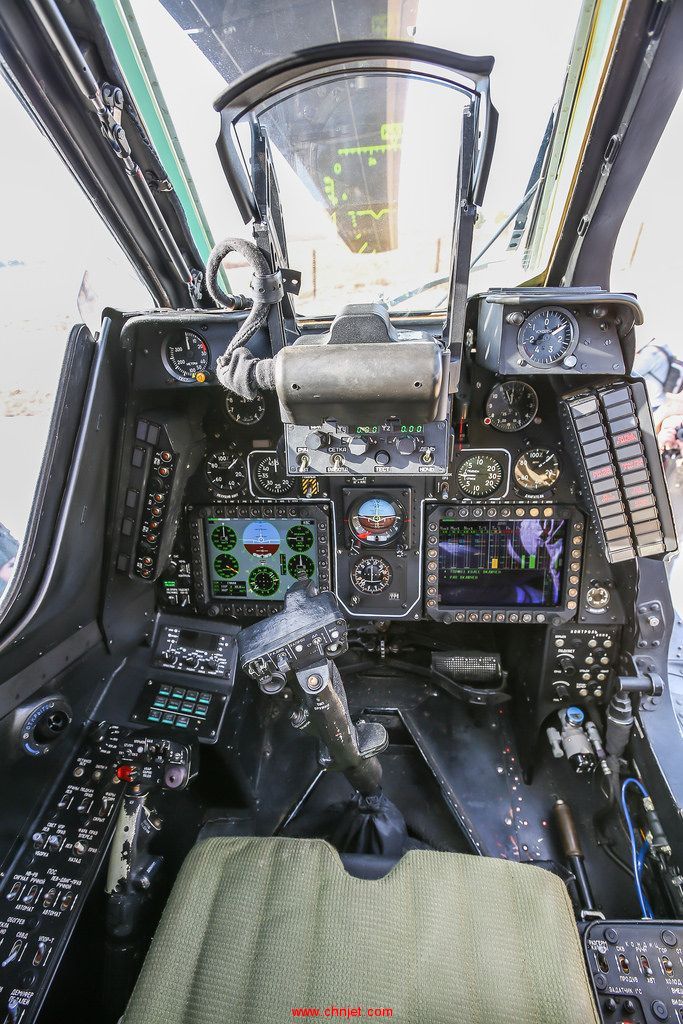
    The helicopter is fitted with a four-axis autopilot, a terrain awareness and warning system (TAWS), digital maps, secure radio communications, and a data link, allowing the crew to fly with high stability at very low altitudes and conduct tactical penetration missions. The core design focus is on enhancing situational awareness for both the pilot and weapons officer while reducing crew workload during complex missions—especially night and low-visibility operations.

    Electro-Optical Sensors of the Mi-28

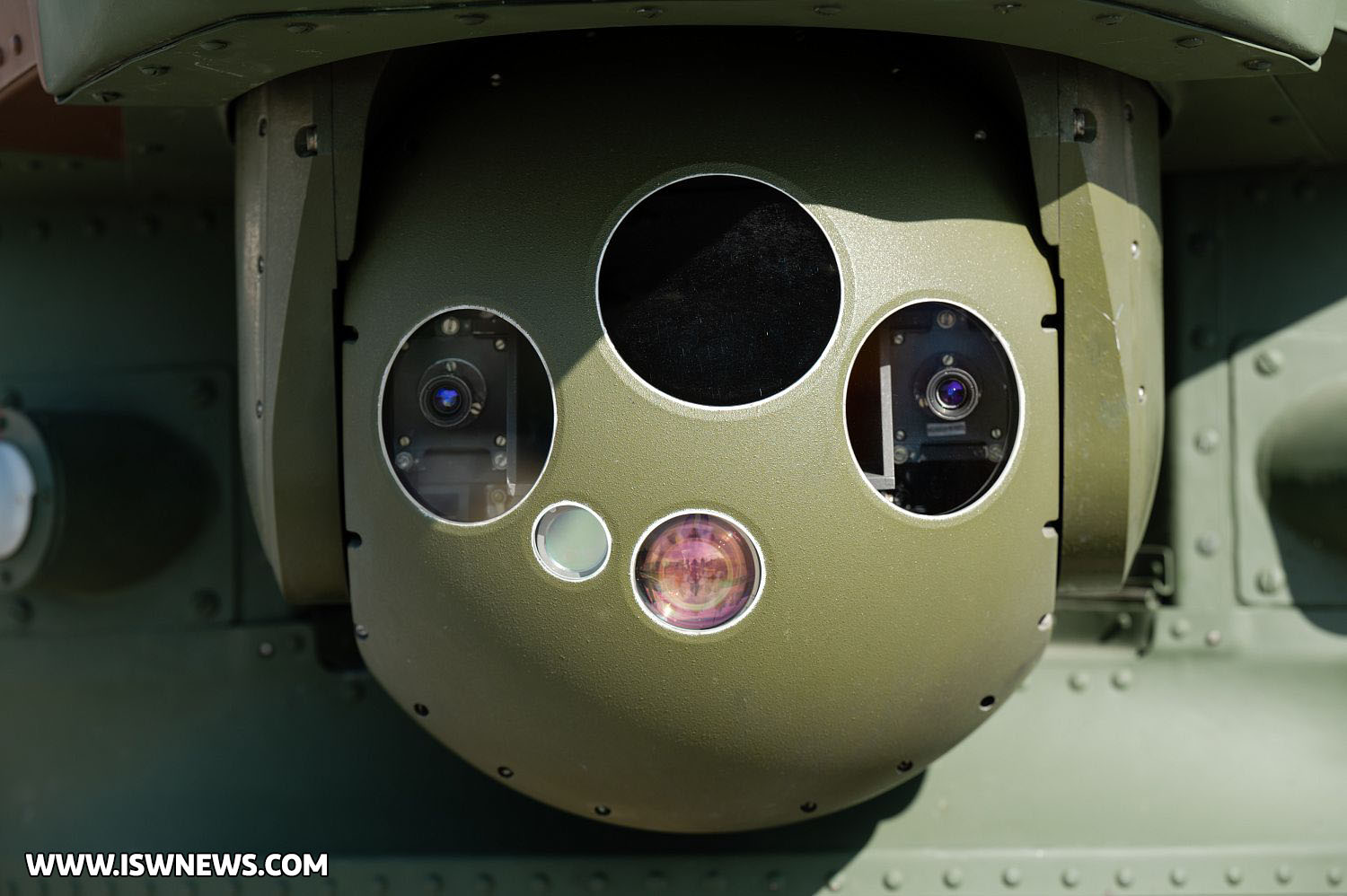
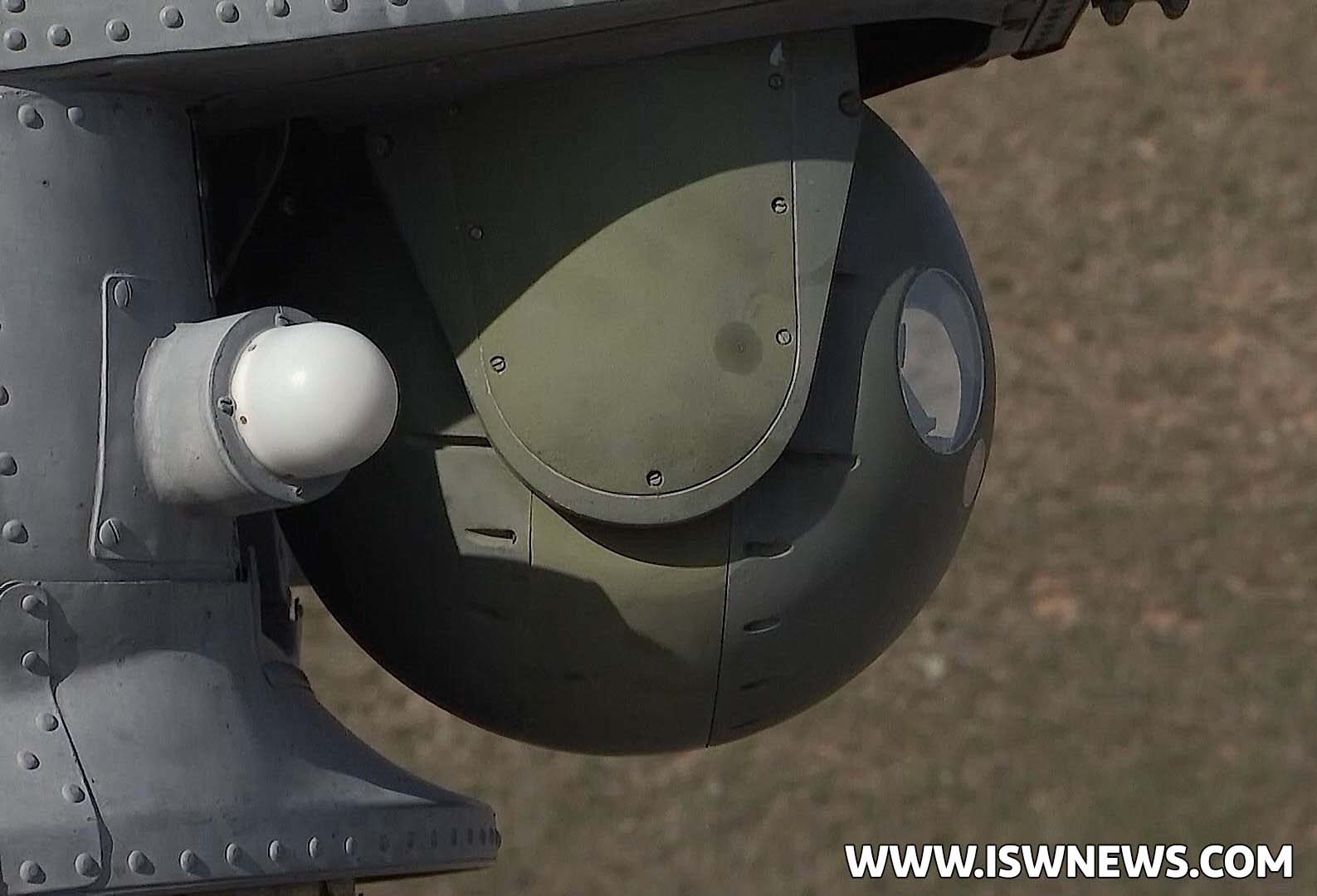
    Mounted in the nose of the Mi-28 is an electro-optical sensor suite comprising a daytime TV camera, a forward-looking infrared (FLIR) system for night vision, and a laser rangefinder/designator, enabling detection, tracking, and guidance of laser-guided weapons at ranges of several kilometers.
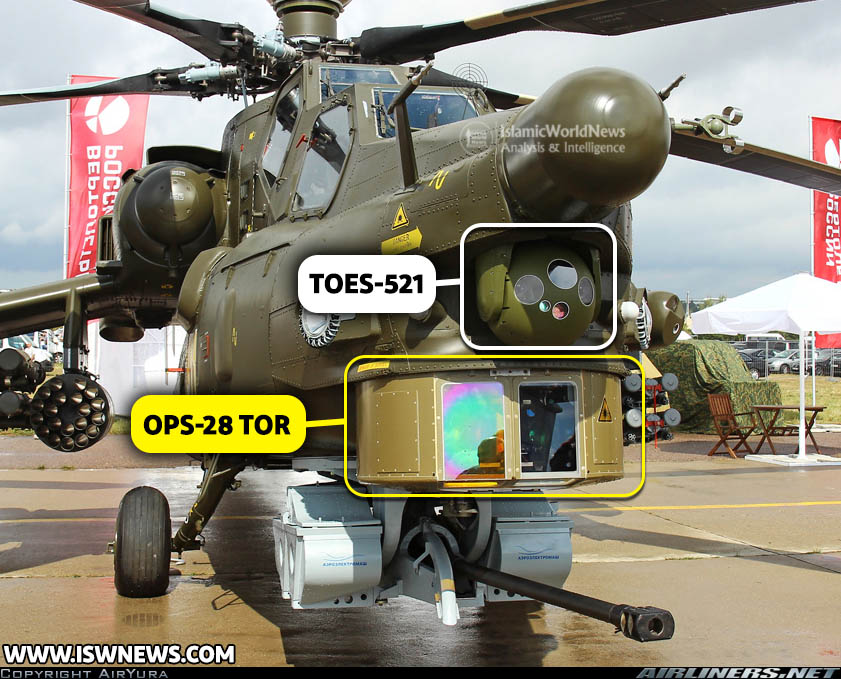
    Mi-28 (Mi-28N) electro-optical sensors

    The OPS-28 electro-optical system serves as the primary search and targeting sensor of the Mi-28. It includes a TV channel, an infrared FLIR channel, an LD-294 laser rangefinder, and a radio command data link. These three sensors are housed in a gyro-stabilized cylindrical rotating turret beneath the helicopter’s nose, providing a field of movement of 110 degrees to either side, 13 degrees upward, and 40 degrees downward. The system is manufactured by the Krasnogorsk Optical-Mechanical Plant (Zenith).

    The laser rangefinder, thermal imager, and TV camera are concealed behind two flat glass windows within the rotating turret. The thermal camera offers two fixed fields of view with 3× and 8× magnification, while the TV camera is capable of up to 20× optical zoom.
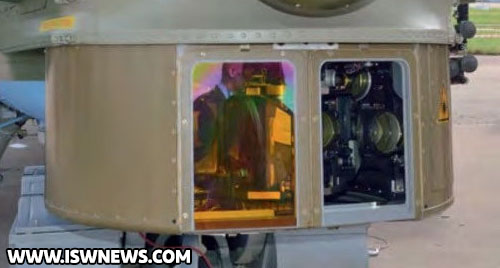
    OPS-28 Tor system

    When the battlefield is obscured by rain or smoke and direct visibility is reduced to less than 1.5 km, the OPS-28N thermal imager is still capable of guiding the 9M120 Ataka-V anti-tank missile toward targets at ranges of over 3 km. Under favorable visibility conditions, the system’s TV sensor can detect tanks at distances of up to 7 km, enabling missile engagements at ranges of around 5 km.

    In addition, the Mi-28N is equipped with a pilot-dedicated electro-optical surveillance system known as TOES-521, mounted beneath the nose. The Mi-28NM variant features a further upgraded electro-optical system designated SMS-550.
    Radar and Defensive Systems of the Mi-28

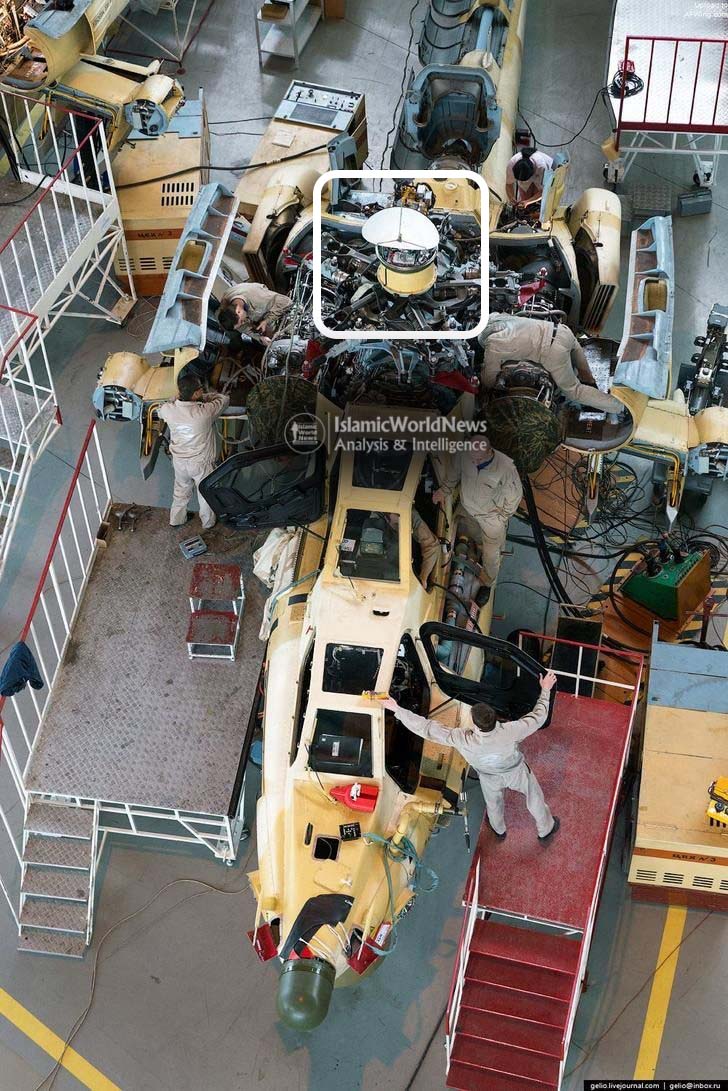
    In more advanced variants of the Mi-28—particularly the Mi-28NM—a N025 millimeter-wave radar produced by GRPZ is installed above the main rotor. This radar is used for terrain mapping, surface target detection, cueing and handing off targets to the electro-optical system, as well as weather monitoring and air-to-air tasks. In its N025M version, the radar operates in the Ka and X bands, while a third channel works in the L band for IFF (Identification Friend or Foe) purposes.

    It should be noted that, like the base N025, the N025M radar cannot directly assign targets to weapons; instead, it provides initial target coordinates to the OPS-28 electro-optical system.
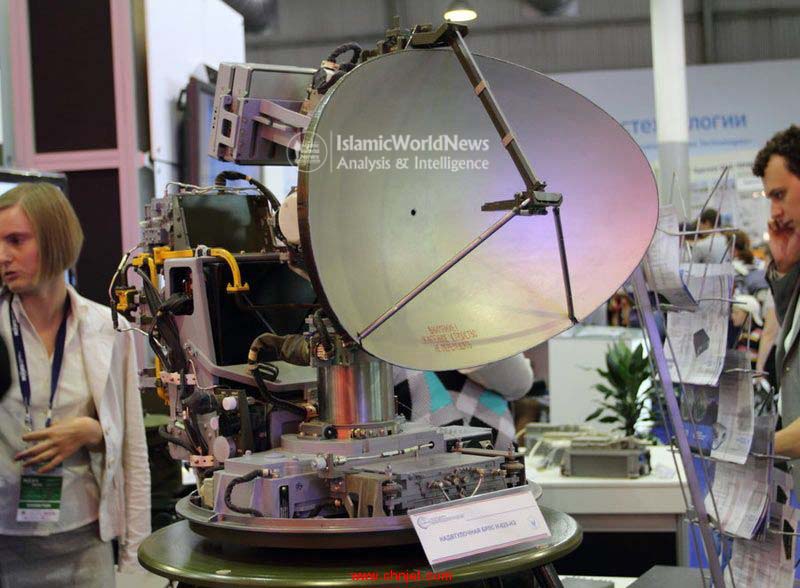
    In terrain-mapping mode, the radar can scan a 90-degree sector in front of the helicopter, mapping ground features and enabling the OPS-28 sensor to rapidly cue onto selected targets. In air-to-air mode, the N025 covers a 180-degree forward sector. The manufacturer claims a maximum detection range of 20 km against main battle tanks. The radar also includes a Moving Target Indicator (MTI) mode with a 20 km detection range against aerial targets.
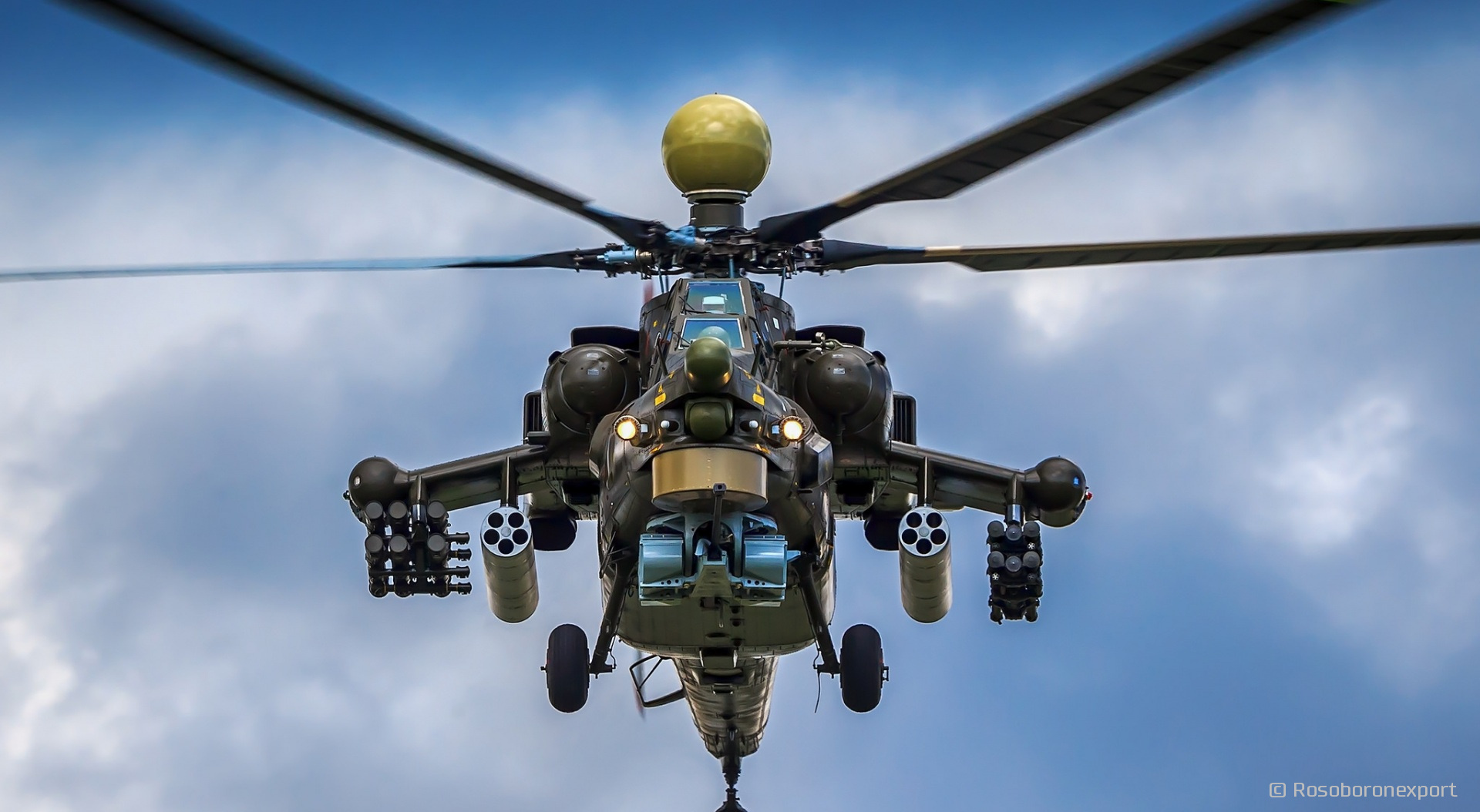
    Mi-28N helicopter equipped with the N025 radar mounted above the propellers

    On the Mi-28NM, an AS-BPLA data-link antenna is installed in the nose to guide the LMUR missile. The Lightweight Multirole Air-to-Surface Guided Missile (LMUR)—also known as Izdeliye 305 or Item 305—has a range of 14.5 km and is intended for engaging a wide variety of ground targets.

    The shape of the AS-BPLA guidance antenna mounted on the Mi-28NM indicates a ±90-degree field of view relative to the helicopter’s longitudinal axis, meaning the helicopter can maneuver within this envelope after missile launch.
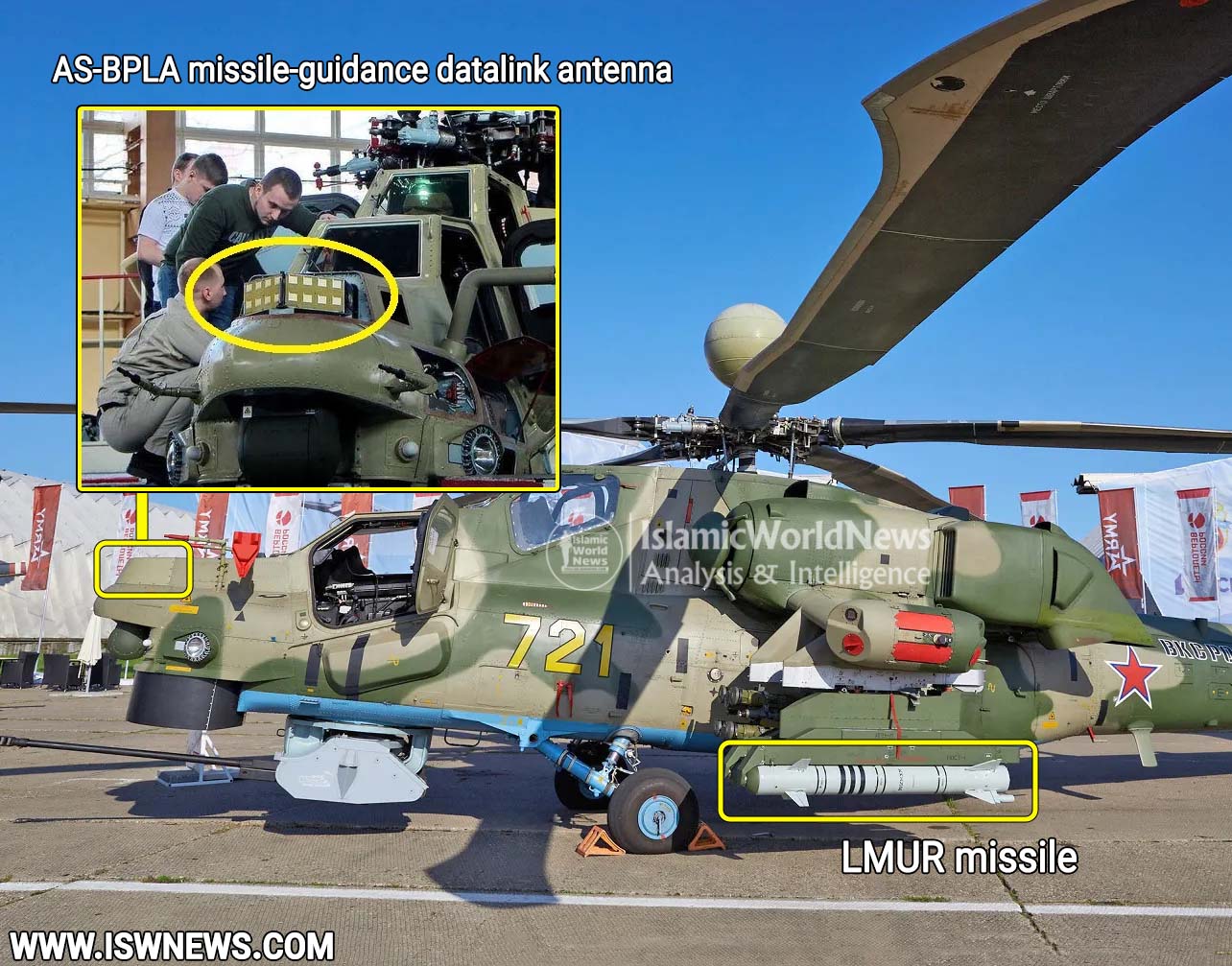
    AS-BPLA datalink antenna for LMUR missile guidance

    The Mi-28NM is also equipped with the L370V28 Vitebsk defensive suite. This integrated warning and countermeasure system includes the L150-28M radar warning receiver, L-140M laser warning receiver, L370-2 ultraviolet missile warning sensor, the L370V28-5L directional infrared countermeasure (DIRCM) laser system, and the UV-26 chaff and flare dispensers.
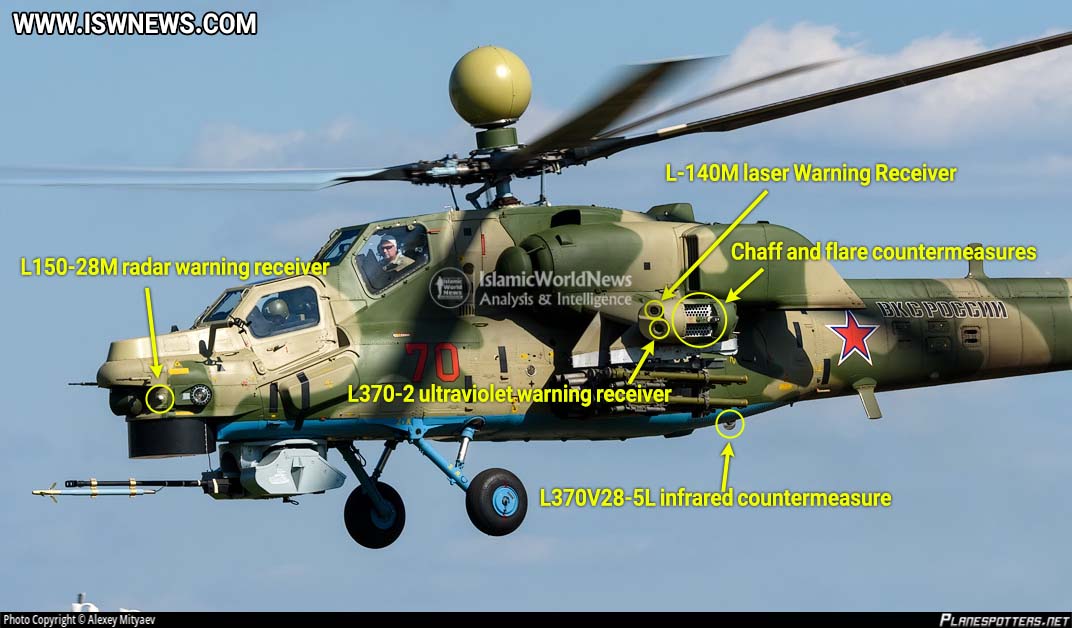
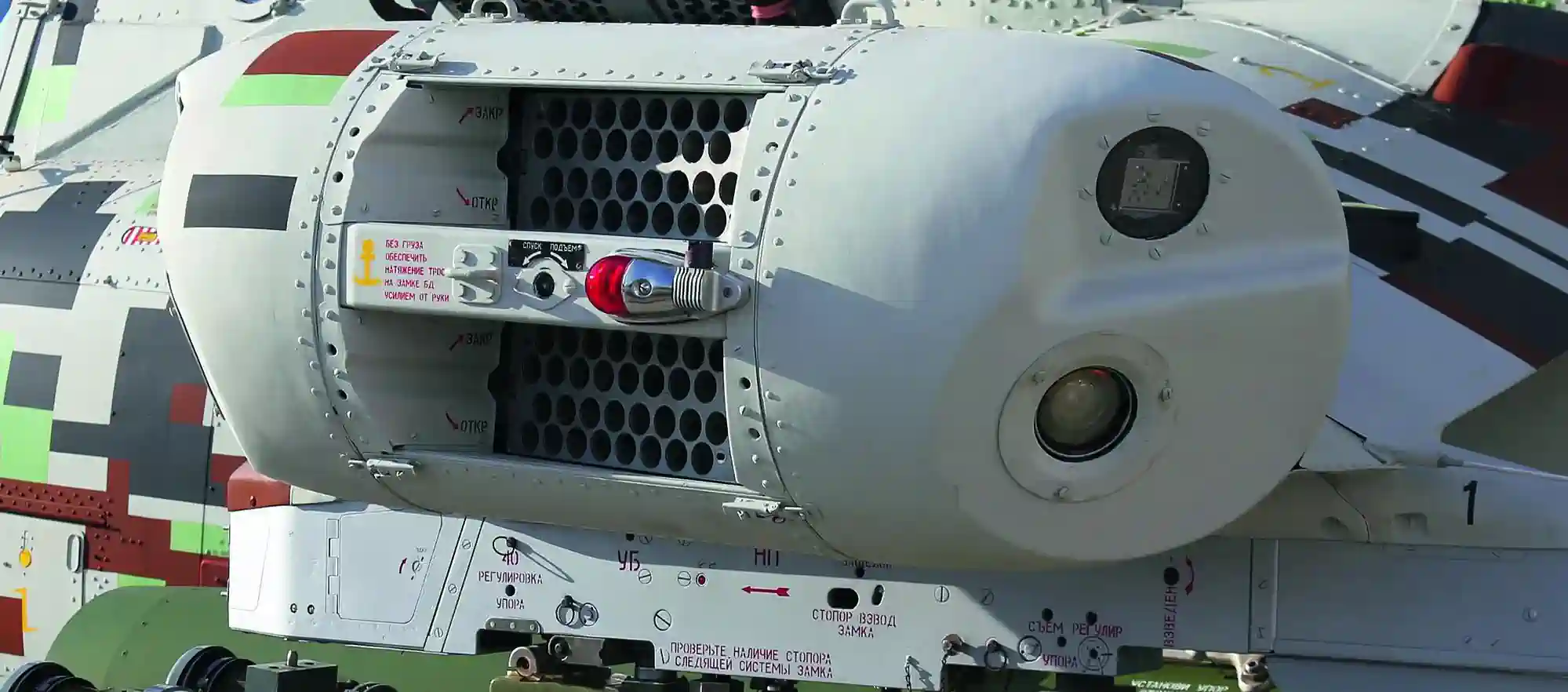
    Warning and countermeasure equipment in the Mi-28 NM version helicopter
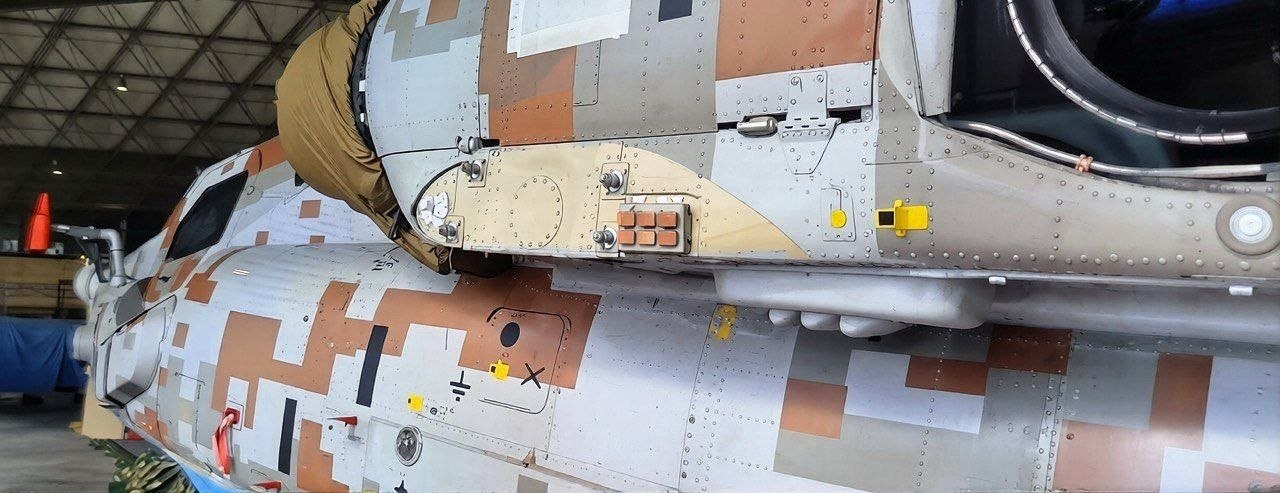
    UV-26 chaff and flare dispenser system and L-140 laser warning receiver (top) and L370-2 ultraviolet warning receiver (bottom) / Photo: Alexander Mladenov

    Armament of the Mi-28

    As a dedicated attack platform, the Mi-28 carries a diverse array of weapons, making it suitable for engaging a wide spectrum of ground targets and certain low-altitude aerial threats.
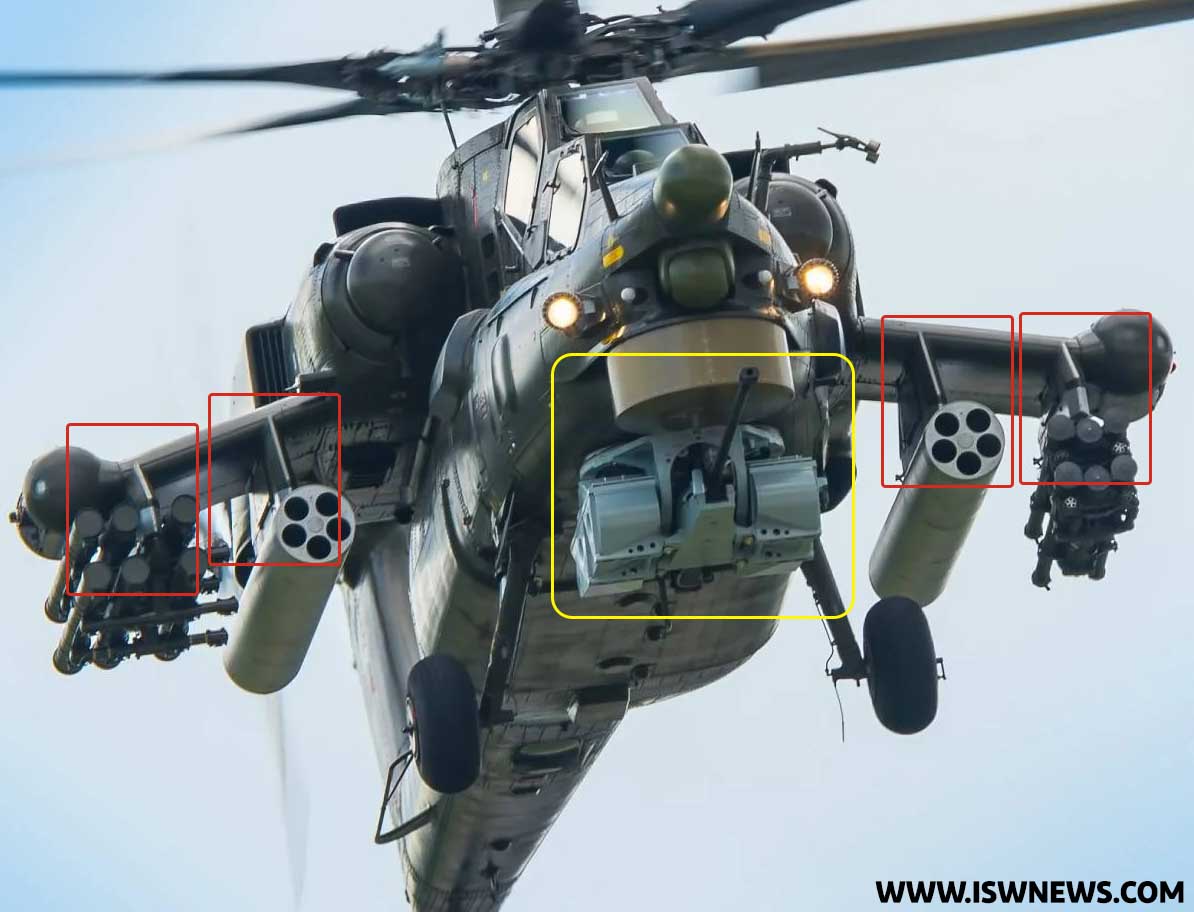
    Weapons hardpoints under the wings and a 30 mm cannon under the nose

    A 30 mm 2A42 automatic cannon is mounted under the nose, providing flexible traverse and precise aiming against light armored vehicles, infantry, and fortifications. The cannon is slaved to a helmet-mounted sighting system, allowing the weapon to follow the pilot’s line of sight.

    On the four underwing hardpoints mounted on the stub wings, various weapon packages can be installed, including 80 mm unguided rocket pods, anti-tank guided missiles such as Ataka and Vikhr, and, in some configurations, short-range air-to-air missiles for close-in self-defense.
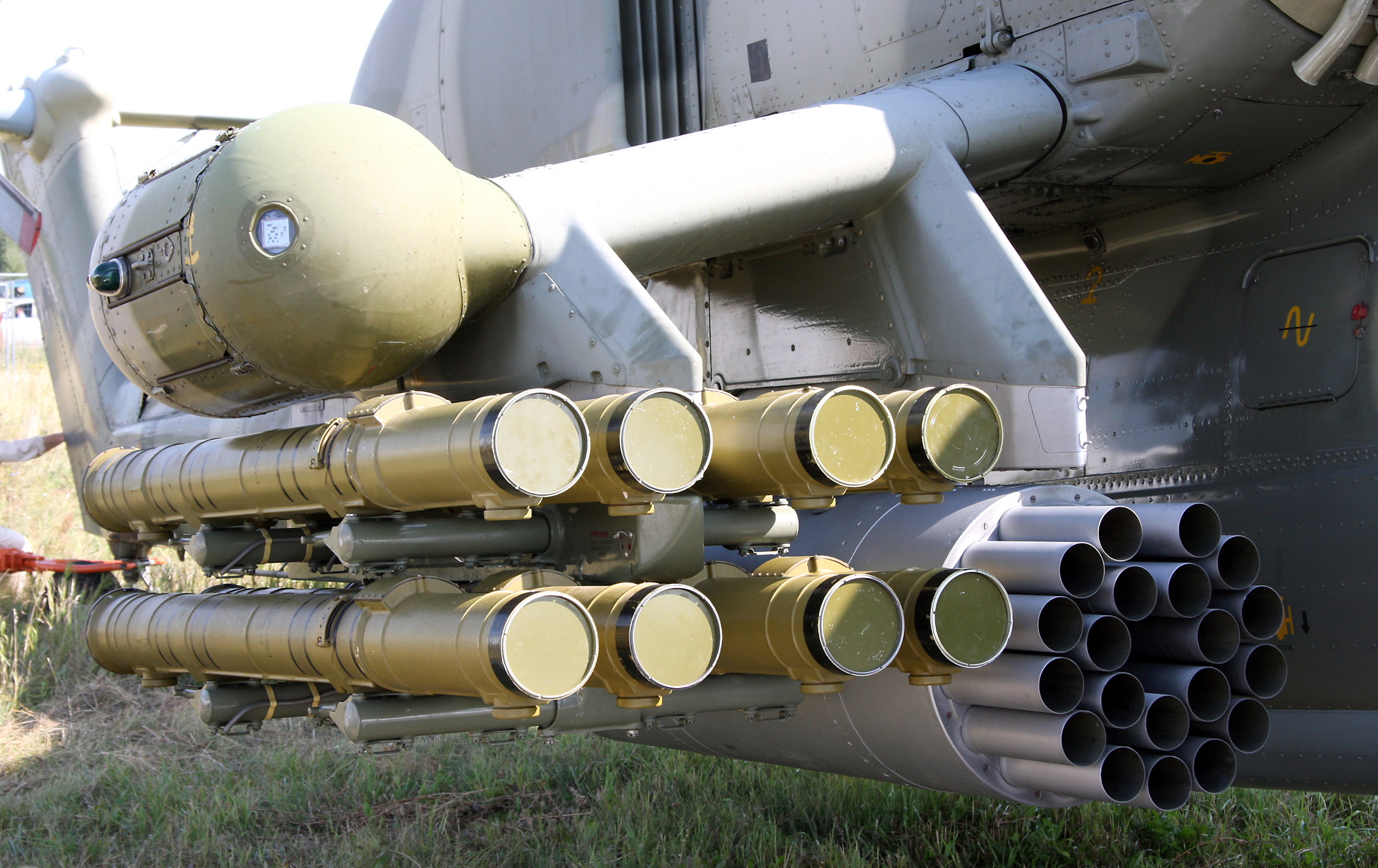
    Underwing hardpoints of the Mi-28

    This weapons diversity allows crews to tailor their loadout to mission requirements and strike an effective balance between accuracy, range, and destructive power, while the advanced targeting and electro-optical sensor systems further enhance combat effectiveness.

    Mi-28 Variants

    Mi-28A:
    The original baseline variant developed in the 1980s, primarily for testing purposes. It featured daytime vision systems, the 30 mm cannon, underwing weapon stations, and basic navigation and communication systems, but had limited night and adverse-weather combat capability. The Mi-28A served mainly as a testbed and developmental foundation and did not enter large-scale production.

    Mi-28N (Night Hunter):
    The most significant leap in the Mi-28 family. With the addition of a mast-mounted radar, thermal imaging systems, advanced electro-optical sensors, and inertial/satellite navigation, it gained full 24-hour operational capability. Digital avionics, improved survivability, and better integration of weapons systems made it the backbone of Russia’s attack helicopter fleet.

    Mi-28NE:
    The export derivative of the Mi-28N, with certain systems—especially communications and identification—reconfigured according to customer requirements. In terms of firepower, range, and survivability, it is broadly comparable to the Night Hunter and is adapted for operation in diverse environments, including hot, dusty, and high-altitude conditions.

    Mi-28NM:
    The most advanced member of the Mi-28 family. It incorporates minor airframe and rotor redesigns for improved performance, a new multimode radar, data-link connectivity for network-centric cooperation with UAVs and ground units, fully digital avionics, upgraded defensive systems, and more precise weapon options, including new guided missiles. The goal of this variant is to enhance survivability, crew situational awareness, and effectiveness in modern high-threat environments.

    Mi-28UB:
    A training variant that retains full combat capability. It features a dual-control cockpit allowing full instructor oversight, specialized training equipment, and enhanced safety features. Despite its training focus, the Mi-28UB can carry weapons and conduct real combat missions, making it a flexible asset for combined training and operational squadrons.
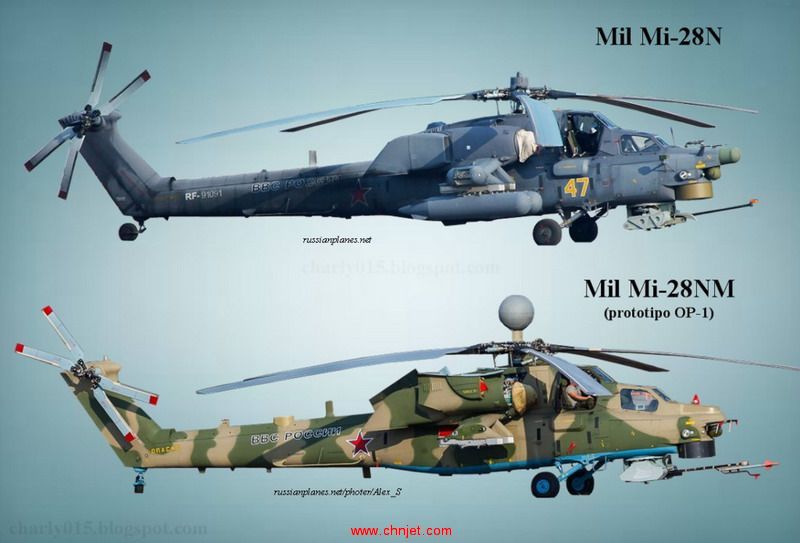
    The difference between the Mi-28N and Mi-28NM in terms of appearance. As is clear, there is very little difference in appearance between the two versions, with the biggest difference being in the nose configuration.

    Operators and Export Market

    The Mi-28 attack helicopter is primarily operated by the Russian Aerospace Forces as its main user. As of the end of 2024, more than 92 Mi-28N helicopters, around 19 Mi-28UB training variants, and at least 9 Mi-28NM helicopters were in service with the Russian Aerospace Forces. In addition, orders are in place for 98 more Mi-28NM and 12 Mi-28UB helicopters to be delivered by 2027. Overall, Russia operates the largest Mi-28 fleet in the world.

    Outside Russia, the Algerian Air Force operates approximately 42 Mi-28NE helicopters. Iraq fields around 17 Mi-28NE and 4 Mi-28UB aircraft, while the Ugandan Air Force has received at least 4 Mi-28NE, with an additional two helicopters on order.

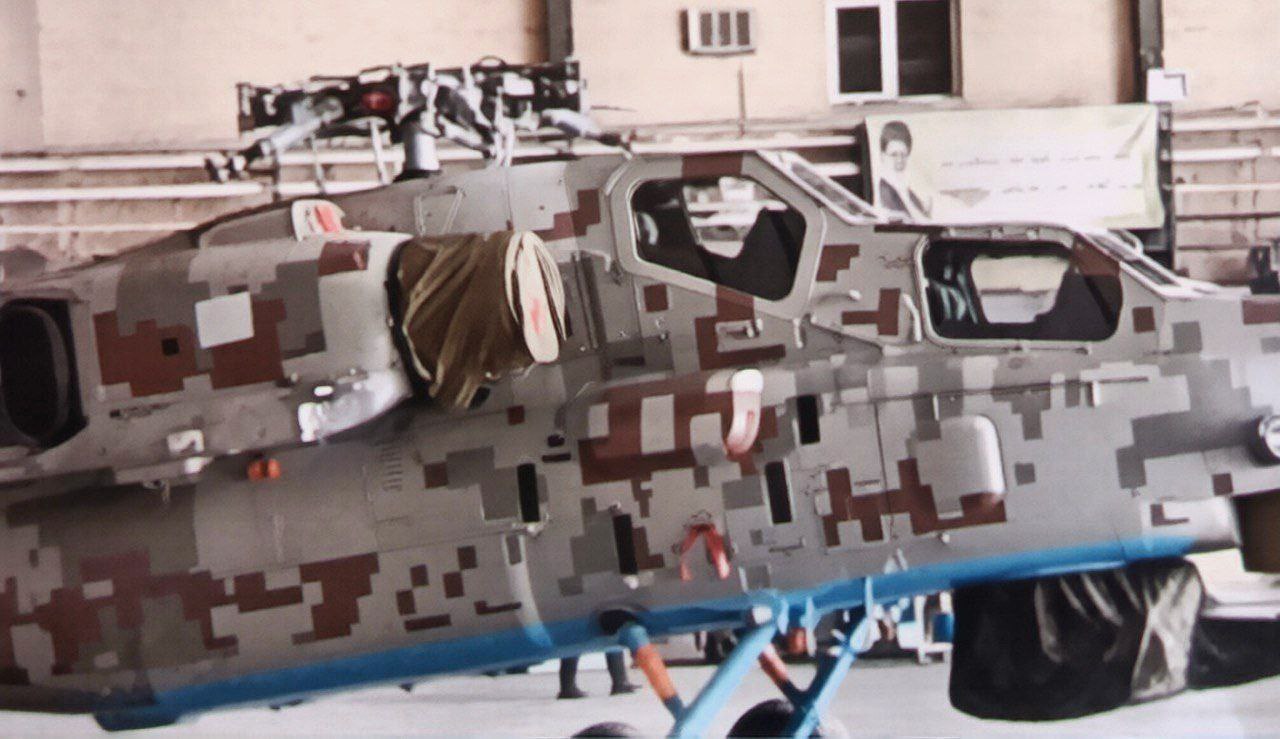
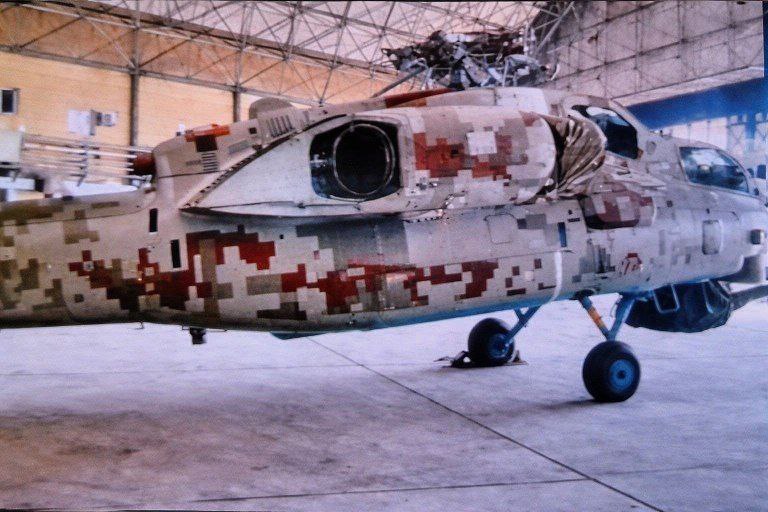
    It is also worth noting that in December 2023, Iran’s Deputy Minister of Defense and Armed Forces Logistics announced the finalization of a deal to purchase the Mi-28 attack helicopter. One year later, the appearance of unofficial images showing the helicopter inside a hangar in Iran confirmed its entry into the order of battle of Iran’s armed forces. The induction of the Mi-28 is expected to significantly help address existing gaps in Iran’s aging helicopter fleet and substantially enhance the country’s close air support capabilities.
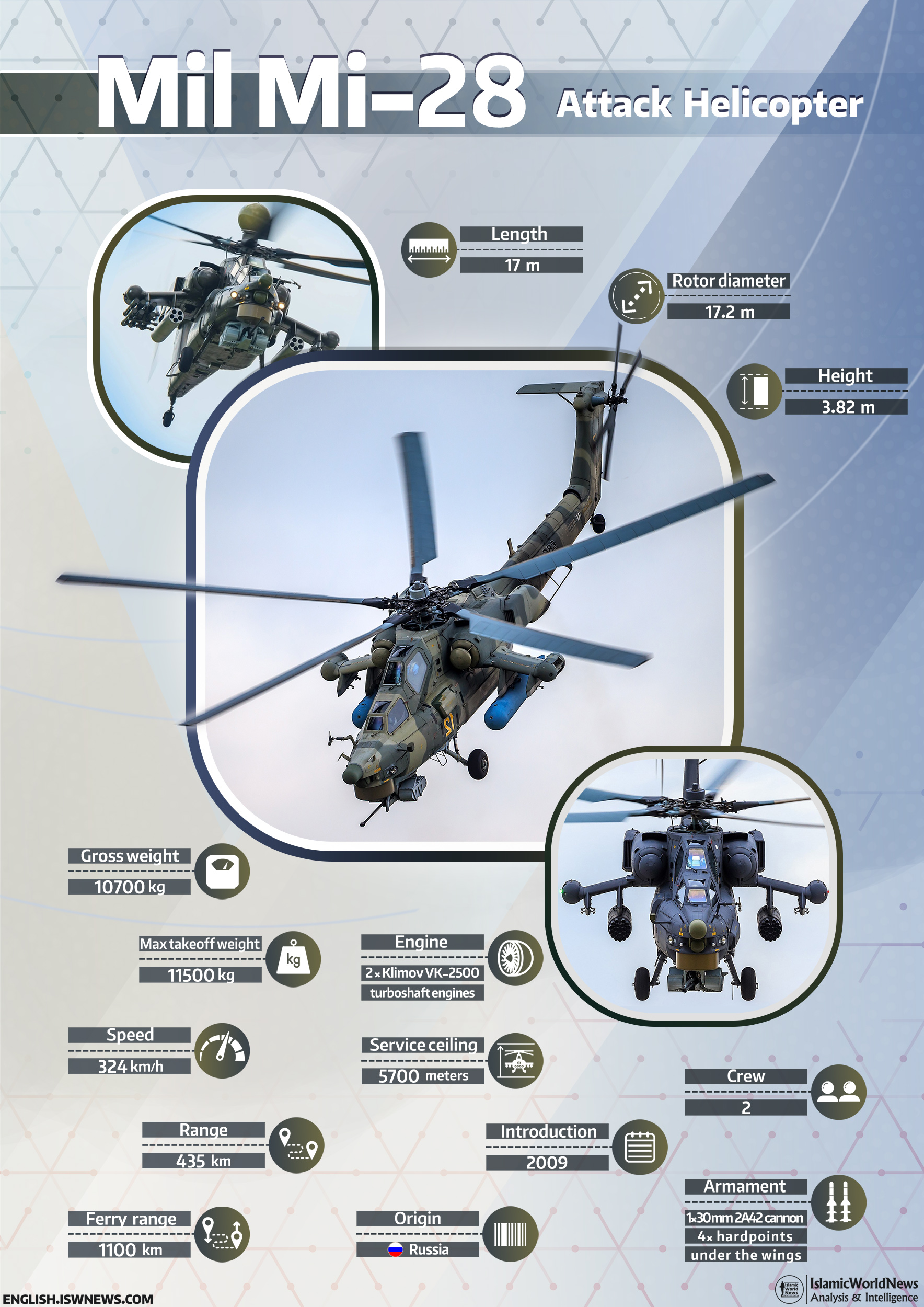
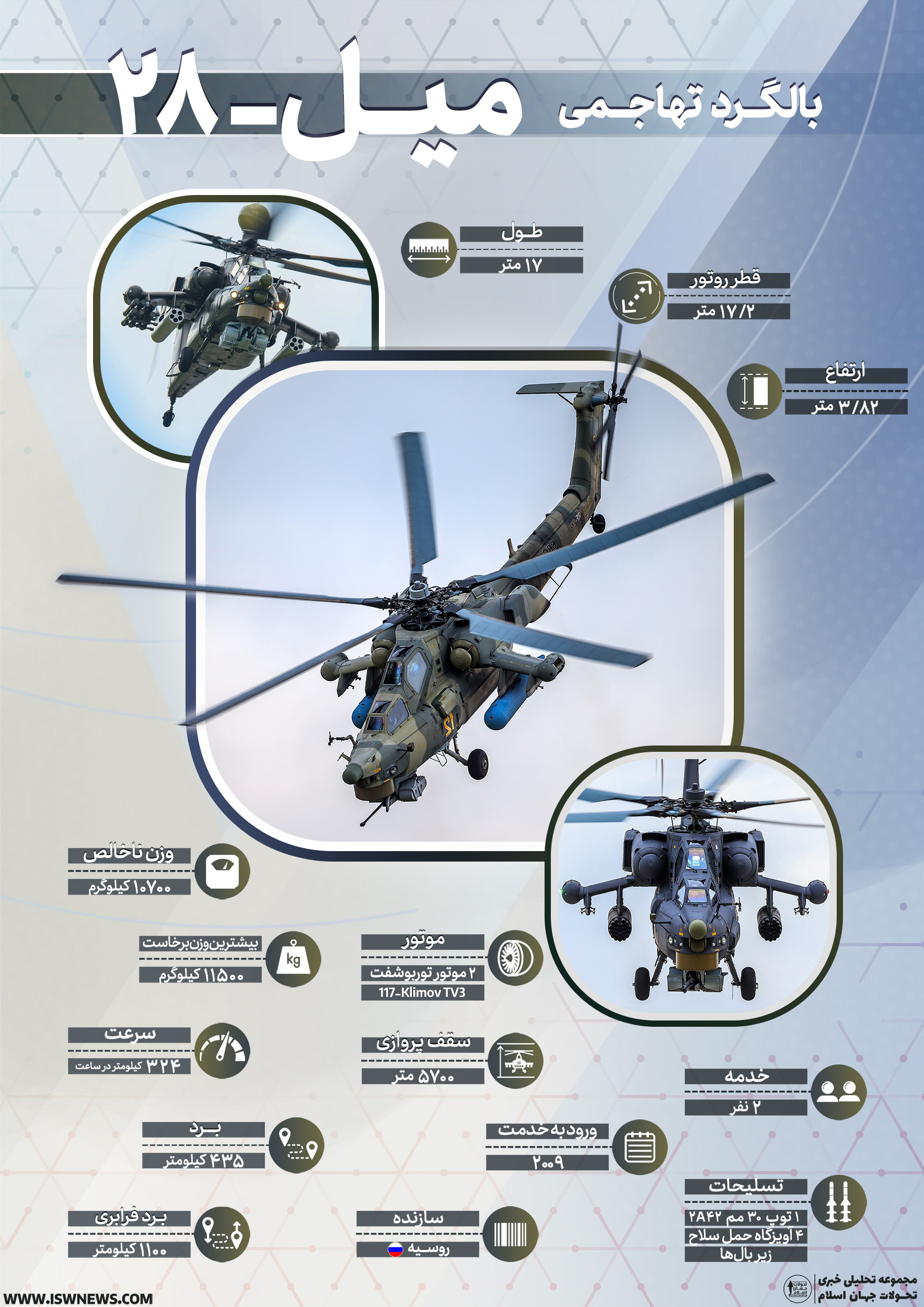
    Mi-28 helicopter specifications:

    Type: Attack helicopter
    Origin: Russia
    Manufacturer: Mil Moscow Helicopter Plant
    First flight: 1982
    Entered service: 2009
    Crew: 2
    Length: 17 m
    Wingspan: 4.88 m
    Height: 3.82 m
    Empty weight: 8590 kg
    Gross weight: 10700 kg
    Maximum takeoff weight: 11500 kg
    Engine: 2 Klimov TV3-117 turboshaft engines with a power of 2194 hp or 2 VK-2500P turboshaft engines (in the NM version) with a power of about 2500 hp
    Rotor diameter: 17.2 m
    Rotor area: 232.35 m2
    Maximum speed: 324 km / h
    Range: 435 km
    Combat range: 200 km
    Ferry range: 1100 km
    Flight endurance: 2 hours
    Service eiling: 5700 meters

    Armament:

    Gun: One 30 mm Shipunov 2A42 cannon in a nose turret, with 250 rounds (horizontal rotation of about ±110 degrees)

    Hardpoints: Two pylons under each short wing for mounting bombs, rockets, missiles and cannon pods. Main configurations include:

    • 16 Ataka-V anti-tank missiles with 40 S-8 rockets, or
    • 16 Ataka-V missiles with 10 S-13 rockets, or
    • 16 Ataka-V missiles with two 23 mm UPK-23-250 cannon pods (each pod with a GSh-23L cannon and 250 rounds)

    Other munitions that can be installed:

    • 9K121 Vikhr anti-tank missiles
    • 9M123 Khrizantema missiles (9M123VM version with ACLOS millimeter-wave radar fire control and guidance radar)
    • LMUR missile
    • Igla-V and Vympel R-73 air-to-air missiles
    • Two KMGU-2 mine-distributing pods
    • Unspecified variant of 9K333 Verba air-to-air missile

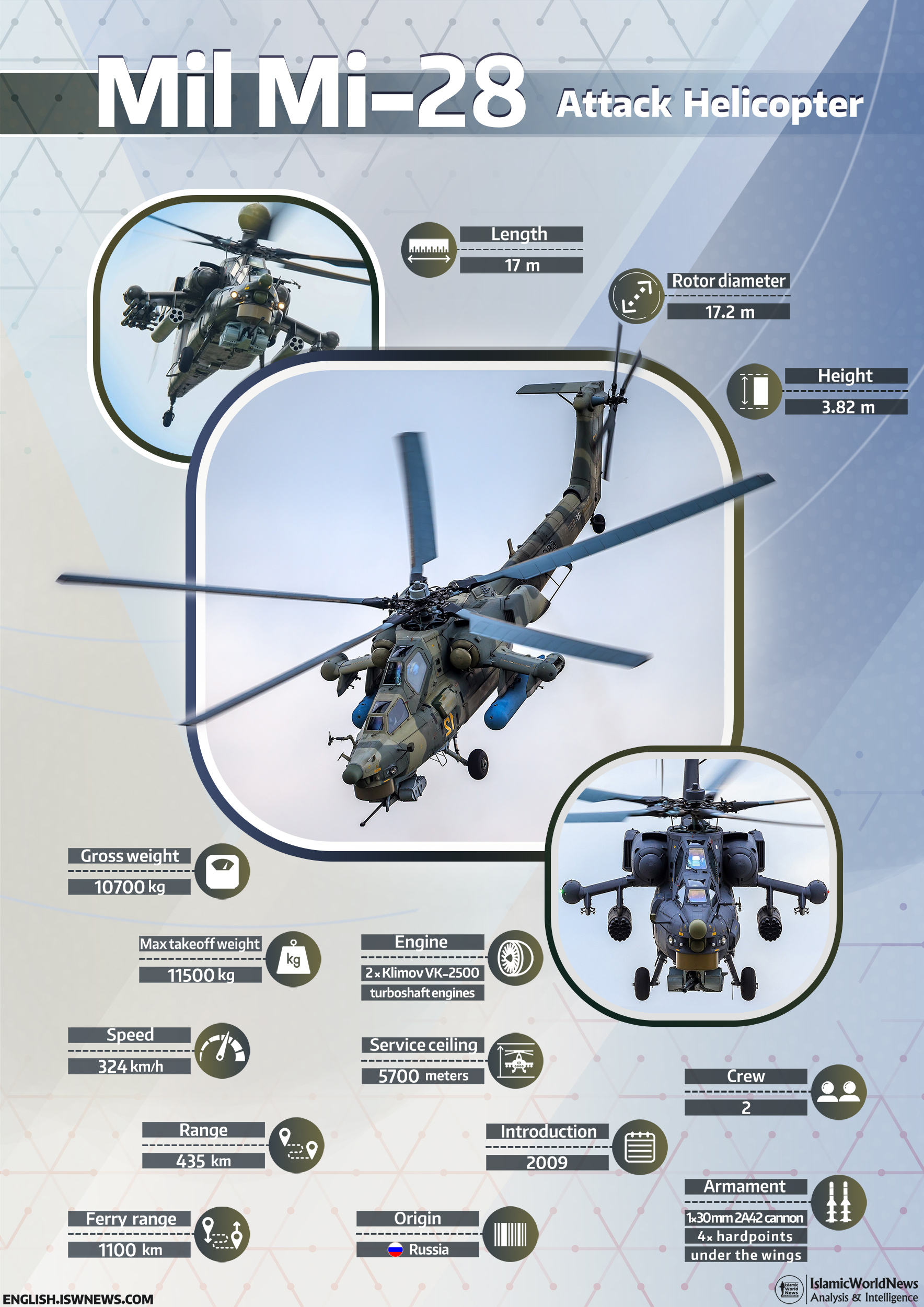
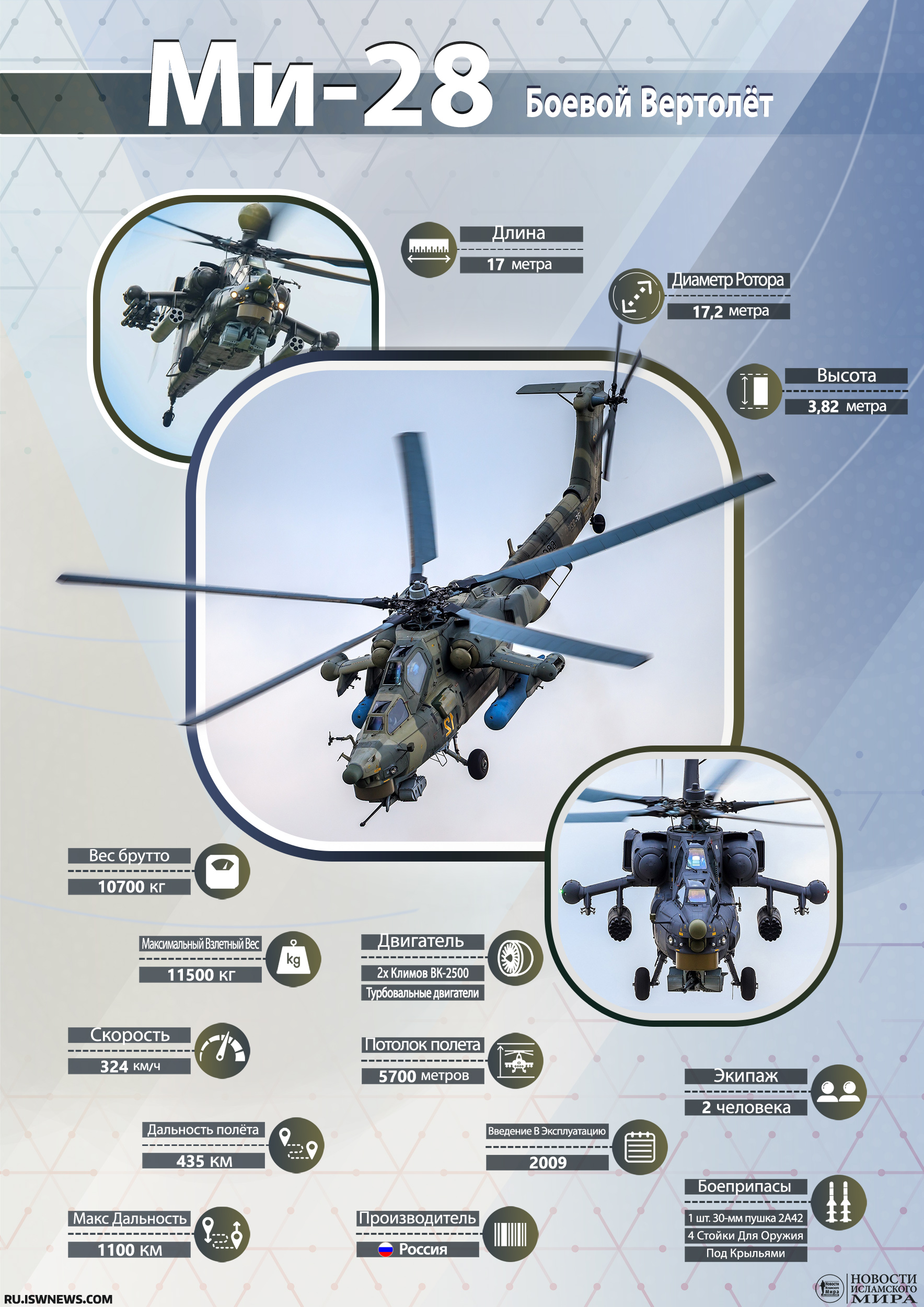
    Mi-28 combat helicopter posters in Persian, English and Russian:
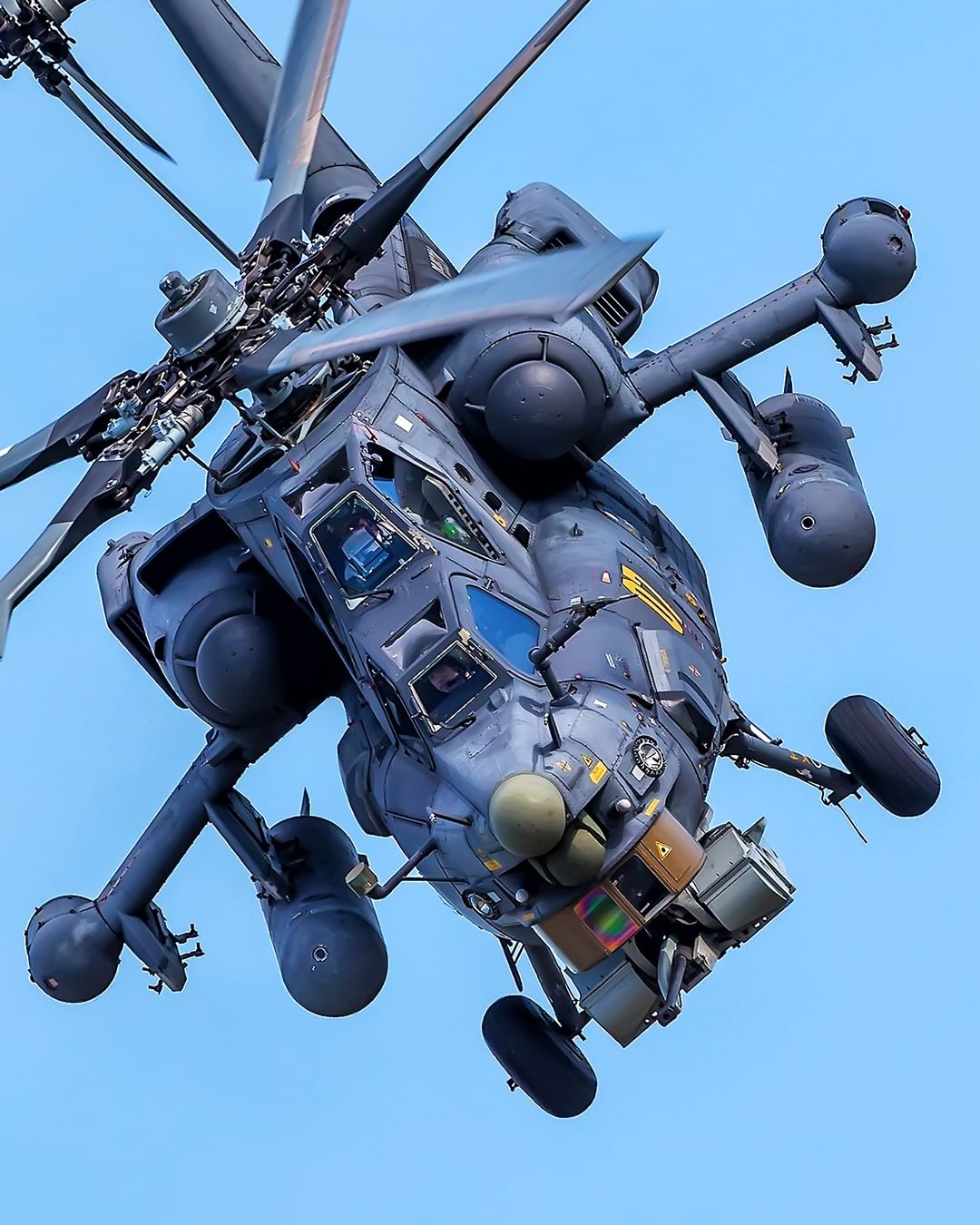
    More images of the Mi-28 combat helicopter:
    Sources:
    Mil_Mi-28 | mil-mi-28 | Mil_Mi-28 | mi-28-havoc | mil-mi-28a-n-havoc | mi-28 | Mi 28NE | Mil Mi-28 | Mi-28-havoc | Mil_Mi-28 | AirDejaVu | Russia’s Mi-28NM | Mi-28

  • Military Knowledge: Ka-52 Attack Helicopter

    Military Knowledge: Ka-52 Attack Helicopter

    The development of this helicopter started in 1996 and its first flight was successfully completed in June 1997. The serial production of Ka-52 began in 2008 at Progress Arsenyev Aviation plant in the Primorye region of Russia. In December 2010, the Russian Air Force’s 334th Tactical Deployment Centre in Torzhok received three Ka-52s. The twin-seat Ka-52 serves in the air force as a special mission helicopter.
    The Russian Air Force began fielding Ka-52 helicopters in April 2011. In the same year, Russia’s defence ministry signed a contract with the company to procure 140 Ka-52 helicopters. In February 2018, the Russia’s defence ministry expressed interest in procuring 114 upgraded versions of Ka-52 attack helicopters as part of the new State Armament Programme for 2018–2027.

    However, The limited production of this helicopter has caused only 127 units (each unit between 10 and 13 aircraft) of this helicopter to enter service in the Russian air fleet by 2020.

    The Ka-52 has a wider nose and an extended fuselage compared to the Ka-50, however, the commonality of the airframe, components and systems of the two variants is about 85%. The Ka-52 attack helicopter has a length of 15.8 meters, height of 4.93 meters and main rotor diameter of 14.5 meters. The maximum take-off weight of the Ka-52 is 12,200 kg.

    General view of Ka-52 helicopter – click to view in larger size

    The Ka-52 helicopter is capable of performing a wide range of missions, such as attacking armored and non-armored vehicles, attacking low-speed air targets, attacking enemy infantry in the front line and in the tactical depth of the enemy, providing fire support for the front line forces and etc. Ka-52 can also be used as a monitoring platform and air command post for a group of attack helicopters.

    The Ka-52 helicopter has unique capabilities in terms of maneuverability and agility and is known as one of the most maneuverable helicopters in the world. This high maneuverability is obtained from its coaxial rotors. Coaxial rotors or coax rotors are a pair of helicopter rotors mounted one above the other on concentric shafts, with the same axis of rotation, but turning in opposite directions (contra-rotating), which eliminates the vibration and rotation of the tail; so there is no need for rotors in the tail section.
    In general, one of the problems with any single set of rotor blades is the torque (rotational force) exerted on the helicopter fuselage in the direction opposite to the rotor blades. This torque causes the fuselage to rotate in the direction opposite to the rotor blades. In single rotor helicopters, the antitorque rotor or tail rotor counteracts the main rotor torque and controls the fuselage rotation. Coaxial rotors solve the problem of main rotor torque by turning each set of rotors in opposite directions.

    The use of coaxial system in Ka-50 and Ka-52 has significantly increased the stability and maneuverability of these helicopters; which is very necessary and important for an attack helicopter. High turn speed and fast change of position, performing military maneuvers such as flat turns in the direction of the target, side ways motions at high speeds, which is less seen in heavily armored aircraft, and deep glides of the high pitch angle of up to 30 degrees or 35 degrees are other capabilities of this highly maneuverable helicopter.

    Coaxial system in Ka-52 and significant increase of stability and maneuverability

    Kamov helicopters have been present in many wars and have shown very good survivability so far. In the Ukraine war, there are cases where the Ka-52 was hit by the enemy but was able to continue on its way, or in many cases where the helicopter was shot down, the helicopter pilots were saved. One of the reasons for the survival of this helicopter on the battlefield is the existence of the coaxial system, which was explained above about how it works. In conventional helicopters, the rotor in the tail section plays a role as a stabilizer, but it is highly vulnerable and in case of a hit, the balance of the helicopter will be lost. Removing the rotor in the tail section of Kamov helicopters and using an coaxial rotor has solved this problem, and if the tail section is damaged, the Kamov helicopter is still able to move. Another reason for Kamov’s survival is the possibility of flying with one engine. If one of the engines is targeted on the battlefield, Ka-52 is able to operate with other engine.

    Engine:

    The Ka-52 helicopter uses two Klimov VK-2500 turboshaft engines. It is worth noting that this engine is developed from the TV3-117 engine used on the Ka-50 helicopter. The VK-2500 engine has three different types, the first type has 2000 horsepower, the second type has 2200 horsepower, and the third type has 2400 horsepower. There is also another example of this engine known as VK-2500P and it has 2500 horsepower. The interesting thing about these engines is that they have an emergency power mode with a power of 2700 horsepower. This feature is used in case of failure of one of the engines and significantly improves flight safety in emergency situations.

    The main difference between the VK-2500 and VK-2500P/PS engine is the use of a modern automatic electronic control system of the FADEC type and anti-overheat protection. Thanks to the new design, the VK-2500P ensures more reliable operation of helicopters in areas with moderate climates and even high temperatures and in high mountains. The existence of two separate gearboxes to transfer the power of each engine is an important factor in the operation of the helicopter in critical conditions. This power transmission system, in addition to the power of 2700 horsepower, is an important factor in the survival and preservation of the lives of the pilots in case of loss of one of the engines. Also, the engines have a filter to prevent dust from entering the engine and have a fire extinguishing system.

    Cabin:

    The Ka-52 twin-seat cockpit accommodates two crew members in side-by-side arrangement. Both the crew members are seated on identical K-37-800M ejection seats. The helicopter has a modern bulletproof glass cockpit equipped with a head-up-display (HUD), four SMD 66 multifunction displays, helmet-mounted sight display, image intensifiers and a GPS receiver. The helicopter also integrates a PHAZOTRON cabin desk radio-locator and navigation and attack system for helicopters (NASH).

    The SAU-800 automatic control system, created by Radioelectronic Technologies’ facilities in Saratov, enables the Alligator to be piloted in manual, automated and automatic modes. The SAU-800 is integrated with the SIVPV-52 aerometric data recording and processing system developed by Radioelectronic Technologies’ Moscow-based company Aeropribor Voskhod. The SUO-806P weapons control complex for the Ka-52 has been designed and produced by Radioelectronic Technologies’ Kursk-based Aviaavtomatika company.

    SUO-806P weapon control system

    The helmet-mounted display was signed and delivered in a long-term contract with Ramenskoye Design Company (RDC) as part of the avionics equipment required for the Ka-52 attack helicopter and the Ka-52K advanced ship-based variant between 2013 and 2020.

    Ka-52 pilot’s helmet

    The cockpit of the Ka-52 helicopter is armored and provides good protection for the pilots. The armor of this section is a 3 hardlinered armor; the inner cockpit section made of a full single titanium alloy “bathtub” covering both pilots, followed by a middle liner of ceramic plates, which caused trouble first after a single shot they break apart and lost all its protective abilities, they avoided that by covering this ceramic plates with kevlar/aramid that was glued on tightened and the outer liner which gives the aerodynamic shape and is made of aluminium alloy with a part carbon in it.  Also, to further protect the cabin, in addition to the 44 mm bulletproof glass, two armored plates have been used in the side of the cabin next to the pilots.

    Ka-52 armor and protective armored plates

    The outer part of the cabin and the bottom of the fuel tanks are also made of aluminum and carbon alloy with a thickness of 20 mm. The total amount of armor that could be installed for each pilot of the Ka-50 helicopter is about 300 kg. For the Ka-52 helicopter, this number has been reduced to 150-200 kg per pilot. This is despite the fact that about 90 kg of armor is used for each pilot in the American Apache helicopter. Ka-52 armor is (at least theoretically) resistant to 23 mm bullets.

    Ka-52 body close-up – click to view in larger size

    The helicopter has four separate fuel tanks, three in the rear and one just behind the cockpit. All four fuel tanks are plated and separate from each other.

    Quadruple fuel tanks in Ka-52

    As mentioned, the Ka-52 has 85% of the same parts as the Ka-50. But in terms of appearance, it has a wider nose and in the cabin, two pilots sit next to each other. Both pilots are able to fully control the helicopter; Such an arrangement simplifies the operation of the helicopter during the battle. Also, there is no need for a dedicated training version for this helicopter and it is possible to use this helicopter as a training helicopter.

    Ejection seats and eject system:

    Another unique feature of this helicopter is being equipped with ejection seats. The Ka-52 helicopter, along with the Ka-50, are the only active helicopters in the world that have this capability.
    The Ka-52 CAS K-37-800M ejection seats consists of two parts, an armchair and a side part, designed to perform the functions of the pilot’s seat of the Ka-50 and Ka-52 helicopter and providing in combination with the ZSh-7VS helmet and oxygen equipment of the KCO-VK-LP safe emergency exit by bailout with the help of a towing rocket engine at an indicated flight speed from 90 to 350 km/h in the altitude range from 0 to 5000 m and reducing the loads acting on the pilot during an emergency landing using the energy-absorbing cushioning suspension of the chair.

    How the ejection seats work in Ka-52

    Radar:

    The Ka-52 helicopter is fitted with a mast-mounted radome nose mounted housing a Phazotron FH-01 Millimeter Wave Radar (MMW), known as the Arbalet radar with two antennas for aerial and ground targets. This radar is manufactured by Phazotron-NIIR, Russia’s largest developer of military and avionics radars.

    Arbalet radar on Ka-52 nose

    The Ka-52 radar is an Arbalet-52 dual-band pulse doppler radar weighing 140 kg, which allows the helicopter to effectively carry out combat missions at any time of day or night in all weather conditions, even in the presence of organized or natural electronic jamming. The maximum range of the Arbalet-52 radar is 37 km.
    In general, Ka-52 uses two radars, Arbalet-52 or Arbalet-M, which are more powerful versions of the Arbalet radar and use the Baguet series processor. In this radar, Ts181F processor is responsible for data processing and Baget-55-04.01 processor is responsible for signal processing.

    The air-to-surface capabilities of this radar include various mapping modes, mapping range up to 32 km, azimuth coverage of 120°, the ability to detect ground targets such as bridges at 25 km and tanks at 12 km, the ability to detect ground-based obstacles and terrain detection/avoidance- Electricity cables at 400 meters and the ground with a slope of 10 degrees at 1.5 km, the ability to detect moving target selection of ground and air targets, determination of priority of objects, missile approach warning, support/cueing of EO targeting systems, detection of dangerous weather conditions, nvigation systems update and correction, missile and rocket control, target type classification (in conjunction with IFF) and tracking of 20 targets simultaneously.

    The air-to-air capabilities of this radar include the azimuth coverage of 360° with elevation ±30°, the tracking limits with azimuth of ±60° with elevation±30°, the ability to detect hostile aircraft at a range of 15 km and a Stinger missile at a range of 5 km, the ability to engage with a variety of targets such as cruise and drones, the ability to track up to 20 targets.

    Observation and electro-optical system section:

    In terms of observation and electro-optical system, Ka-52 is equipped with GOES-451 optical system. The GOES-451 system is gyro-stabilized optronic station designed to provide detection, targeting and missile guidance for the Ka-52 attack helicopter. The GOES-451 sensor package includes visible and infrared cameras, laser rangefinder and laser designator.

    GOES-451 visible camera has a maximum range of 83.3 km, infrared range of 55.6 km, laser range finder with a range of 18.5 km and laser point designator with a range of 14.8 km.

    GOES-451 electro-optical system

    It should be noted that a version of the Ka-52 Katran (Marine version of the Ka-52) was displayed at the MAKS 2015 exhibition, which used the OES-52 (ECO-52) electro-optical system instead of the GOES-451 electro-optical system. Also, in 2016, another version of the Ka-52 was seen in the sky of Moscow, which was equipped with the OES-52 electro-optical system. It was later revealed that the OES-52 electro-optical system will be used for the Ka-52M helicopters, which are a more powerful and updated version of the Ka-52. Nevertheless, the possibility of installing this system on older and current Ka-52 versions is expected.
    Also, the export versions sold to Egypt, namely the Ka-52 Nile Crocodile (Ka-52E) are equipped with the OES-52 electro-optical system.

    The OES-52 system is functionally similar to the GOES-451 system. The OES-52 developed by Moscow-based NPK SPP and houses five sensors: a thermal imaging camera, TV camera, laser rangefinder/designator, laser beam riding for anti-tank guided missiles, as well as a laser spot tracker. However, the weight of this system is 177 kg, which is 43 kg lighter compared to the GOES-451 system, which is 220 kg.

    OES-52 electro-optical system on Ka-52 Katran in MAKS exhibition 2015
    Ka-52 equipped with OES-52 system in the sky of Moscow

    Protection system and electronic warfare:

    In terms of protection systems and electronic warfare, the Ka-52 is equipped with the President-S integrated protection system. The President-S system is made by KRET and Ekran Scientific Institute and includes a set of various countermeasures such as active IR and electronic jammers, radar warning receiver (RWR), laser detection system, IR missile approach warning sensor, etc. Next, we will introduce the President-S system components :

    Components of the President-S integrated protection system on the Ka-52

    – “L370-0 control unit” is a digital computer module which is responsible for managing the entire electronic warfare package, as it receives all data from the warning sensors deployed on the helicopter’s structure and says it is integrated, analyzed and presented to the pilot to take defensive countermeasures.

    – “L-136 MAK-UFM missile approach warning (MAWS) system” as its name suggests, is a system that detects and warns the approach of missiles fired at the helicopter. This system can detect shoulder-launched missiles such as the Stinger and Igla from a distance of 10 km, and air-to-air missiles launched from aircraft such as the Sidewinder and the R-73 from a distance of 30 km to 50 km.

    L-136 MAK-UFM warning system, two in the front and two in the back of the helicopter

    – “L-140 Otkilk laser warning receiver (LWR) system” is specialized in intercepting and monitoring laser beams emitted from distance measuring devices for anti-aircraft missile guidance systems, and provides integrated protection at an angle of 90° horizontally and 360° vertically.

    L-140 Otkilk system on the right wing tip and in the rear at the very end of the helicopter

    – “SPO-32 / L150 Pastel radar warning receiver (RWR) system” is a system that detects and receives radio waves emitted by enemy aircraft radar systems, and if a threat is detected, such as the presence of a fighter jet’s fire control radar or a missile launcher’s radar seeker, issues a warning about the existence of a threat. This system has a range equivalent to 222.2 km.

    The SPO-32 / L150 Pastel system on the left wingtip and lower end of the helicopter

    – “L370-3 radar jammer or electronic countermeasures (ECM) system” are systems installed inside the Kamov-52 helicopter and their task is to perform a wide range of jamming measures against surface-to-air, air-to-air missile search radars, etc. This system works in integration with the L150 Pastel system. The L150 Pastel system is responsible for intercepting radar waves and determining their source and the L370-3 jams them.

    – “L-370-5 Vitebsk directional infrared countermeasures (DIRCM) system” is a jamming system to protect the helicopter against anti-aircraft missiles. This system is installed under the belly of Ka-52 in both sides of the helicopter in a rotating turret. This system is responsible for jamming missile seekers operating in the ultraviolet and infrared ranges. The L-370-5 Vitebsk system shines laser beams on the missile’s thermal / electro-optical seekers to confuse it and mislead it away from the helicopter. This system is able to track missiles fired at the helicopter within a radius of several kilometers.

    L-370-5 Vitebsk infrared jamming system

    It should be noted that, based on the available evidence, in the new and updated version of the Ka-52, the Kamov Ka-52M, instead of the L-370-5 Vitebsk system, a more advanced system called the L418-5 DIRCM has been used. The possibility of installing this system on the older and current Kamov 52s is also not far from expected. Also, in the export versions sold to Egypt, i.e. Ka 52E, the L418-5 DIRCM system is used.

    Ka-52E exported and sold to Egypt, equipped with new L418-5 DIRCM sensor and new OES-52 optics.

    – In Ka-52, the UV-26 flare and chaff dispensers is used. This system is placed in two double positions at the wingtips of Ka-52, and each of them contains 32 pieces of chaff and flare.

    UV-26 flare and chaff dispensers in Ka-52

    Ka-52 armaments:

    In the armament section, the Ka-52 helicopter is equipped with a 30mm Shipunov 2A42 automatic cannon on the right side of its body. This cannon has low mobility and only moves up and down. The 30mm Shipunov 2A42 cannon is designed to shoot at lightly armored targets at a distance of 1500 meters, non-armored targets at a distance of 4000 meters, as well as low-flying subsonic aerial targets at a distance of 2000 meters. This cannon has the ability to operate in harsh conditions, such as the temperature range from +50 degrees to -50 degrees Celsius in rain, dust, frost and in a very dry environment. The firing speed of this cannon is 550 rounds per minute and its weight reaches 115 kg.

    Shipunov 2A42 30 mm automatic cannon

    Also, there are 6 external hardpoints under the two wings, which can be used to install different combinations of weapons up to the weight of 2,942 kg. There are also 2 dual slots on the wingtips for chaff and flare dispensers.

    6 external hardpoints under the two wings of Ka-52

    The Ka-52 has 3 hardpoints under each wing, which can carry an APU-6 rack along with an unguided rocket pod and an anti-tank missile on the third hardpoint and two UV-26s on the wingtip, each of which contains 32 pieces of chaff and flare. The APU-6 rack is actually a shelf for storing and firing 6 anti-tank missiles, which is designed to increase the carrying capacity of the Ka-52 helicopter.

    Also, to increase the range, Ka-52 is able to carry four external fuel tanks up to 500 liters in its hardpoints.

    External fuel tank for Ka-52

    The pods of unguided rockets on Kamov are two types of S-8 80mm rockets (S8/80mm) containing 20 rockets and S-13 122mm rockets (S13/122mm) containing 5 rockets, which can be installed one on each wing and a total of two of them are in addition to 6 anti-tank missiles on the APU-6 rack in each wing and a total of 12 anti-tank missiles. This combination gives a lot of power to the Ka-52 helicopter in suppressing armor and infantry on the battlefield.

    S-8 80mm rocket pod (S8/80mm) containing 20 rockets and S-13 122mm rocket pod (S13/122mm) containing 5 rockets
    B8V20A pod for 80mm S-8 rocket and B-13L pod for 122mm S-13 rocket

    It is also possible to install anti-tank missiles such as 9K121 Vikhr and 9M120 Ataka on APU-6 racks. The Vikhr missile can destroy targets at a distance of 10 to 12 km, and the Ataka missile provides the Ka-52 helicopter with an operational range of 400 meters to 6 km to target armored targets.

    Right: Vikhr missile – Left: Ataka missile

    A video from inside the Ka-52 cabin recorded during the operation of the Russian army to seize the Antonov (Gostomel) airport near the city of Kiev on February 24, 2022. In this video, the Ka-52 is flying low and providing fire support for Russian infantry and a Russian Mil-8 transport helicopter. The Ka-52 escapes from being hit by several rockets and is finally forced to make an emergency landing due to the impact of a missile.

    Video from inside the cabin of Kamov-52 during the capture of Antonov airport

    Introduction of other versions of Ka-52:

    Updated version of Ka-52: Ka-52M helicopter
    In recent years, the Russian Ministry of Defense announced the production of a new version of the Ka-52, which was finally known as the Ka-52M in 2018. Ka-52M is actually an updated version of Ka-52, which has undergone changes in terms of system and some equipment. According to the information of the Russian Ministry of Defense, 114 aircraft of this model are to be put into service, and according to the latest information, on January 4, 2023, the Russian army received 10 Ka-52M helicopters.

    The updated version of the Ka-52M helicopter is equipped with the GOES-451M electro-optical system with greater range and better performance. Also, the new OES-52 electro-optical system is used in the Ka-52M helicopter.
    The OES-52 system is functionally similar to the GOES-451 system. The OES-52 houses five sensors: a thermal imaging camera, TV camera, laser rangefinder/designator, laser beam riding for anti-tank guided missiles, as well as a laser spot tracker. However, the weight of this system is 177 kg, which is 43 kg lighter compared to the GOES-451 system, which is 220 kg.

    GOES-451M and OES-52 electro-optic system for Ka-52M

    Stronger undercarriage, improved cockpit ergonomics and better night vision goggles compatibility are other changes and updates to the Ka-52M.

    In terms of armament, the Ka-52M is equipped with Light Multipurpose Guided Surface-to-Air (LMUR) missiles. This missile, which is also known as Izdeliye 305 and Item 305, has a range of 14.5 kilometers and is used to destroy a wide range of ground targets.

    Izdeliye 305 (Item 305) multipurpose air-to-surface guided missile

    In the radar section, the Ka-52M is equipped with the V006 Rezets (cutter) active electronically scanned array (AESA) radar instead of the Arbalet-52 radar. This radar has a fixed 900×300 mm AESA antenna with 640 transceiver modules.
    This radar can detect a group of tanks from 45 km, a railway bridge from 100 km, and a destroyer-class warship from 150 km, according to the manufacturer. In the air-to-air mode, it can detect a fighter aircraft with a radar cross section of 3 sq m from up to 50 km head-on and a hovering helicopter from 20 km. The Rezets radar weighs 130 kg, 10 kg less than the current Ka-52’s FH01 radar and is air-cooled, with an air scoop for cooling seen on the helicopter’s nose fairing.

    V006 Rezets active electronically scanned array (AESA) radar

    In the field of countermeasures and electronic warfare, the Ka-52M President-S integrated protection system has undergone changes and its various components have been improved. In one of the most important components of this section, instead of the L-370-5 Vitebsk system, a more advanced system called L418-5 DIRCM has been used.

    New L418-5 DIRCM system for Ka-52M

    Finally, and perhaps the most important part of the helicopter’s upgrade, is the installation of new systems for the helicopter to adapt to work in the new battlefield command and control system.

    Naval version of Ka-52: Ka-52K Katran helicopter:
    The Ka-52K Katran helicopter is the naval version of the Ka-52 helicopter and is based on the Ka-52 Alligator; But the equipment and systems of this helicopter have been modified according to sea operations and its body is also covered with elastic anti-corrosion coating. Since this helicopter is designed for use on aircraft carriers and warships, its dimensions have become smaller and it has folding blades and wings to occupy less space in the hangar. The length of this helicopter is 13.8 meters and its wingspan is 6.3 meters. The reduction of the wing length in this helicopter has caused the weapon hardpoints to be reduced from 6 to 4.
    The rotor system of Ka-52K is equipped with elastic bearings between the blade and the mast to bear more weight.

    The Ka-52K helicopter is equipped with radio and satellite navigation equipment and provides the possibility of independent landing from the watchtower on the ship’s deck. The helicopter is also optimized with an air conditioning system to perform missions in the humid marine atmosphere. By equipping the KA-52K with advanced avionics systems and powerful weapons, it can be configured for different roles.

    Ka-52K helicopter is equipped with laser beam guidance system and Okhotnik video processing system developed by KRET. The Okhotnik system increases the range of detection and identification for the helicopter.

    Ka-52K helicopters are equipped with Arbalet radar system in early versions. In newer versions, this radar has been changed to active phased array radar. Russian defense contractor Radio-Electronic Technologies’ Active Phased Array (AESA) radar has been developed for the naval version of the Kamov 52 to replace the Arbalet radar. This radar gives the Ka-52K helicopter the ability to fire the Kh-35 anti-ship cruise missile and the Kh-38 missile. The detection range of this radar for large sea targets reaches 180 km.

    It should also be noted that this version, like the regular Ka-52 versions, will be known as the Ka-52KM when it receives new upgrades. The M suffix is used for versions that have received the latest updates.

    Pros and cons of Ka-52 helicopter:

    Pros:
    It’s a multipurpose helicopter and very fast, agile and flexible.
    It provides a good level of armor protection in the cockpit for the pilots.
    It has a wide range of countermeasures and electronic warfare.
    It has 6 hardpoints to carry a wide variety of ammunition.
    It has effective anti-tank capabilities with Vikhr and Ataka missiles.
    It has a very good electro-optical system and a strong weapon management system.
    Cons:
    Small area for locking on with Igla air-to-air missiles
    The firing arc and performance of the 30 mm gun is limited due to its placement on the right side of the helicopter.
    High angles of attack can result in fuel starvation to the engine

    Specifications of K-52 attack helicopter:
    Role: attack helicopter
    First flight: 25 June 1997
    Produced: since 2008
    Length: 15.8 meters
    Height: 4.93 meters
    Large wingspan: 7.8 meters
    Small wingspan: 2.6 meters
    Main rotor diameter: 2 x 14.5 meters
    Main rotor area: 330.3 square meters
    Crew: 2 people
    Empty weight: 7,700 kg
    Maximum take-off weight: 12,200 kg
    Engine: 2 Klimov VK-2500 turboshaft engines, 2,400 horsepower each.
    Internal fuel: 1,870 liters
    External fuel tank: up to 4 tanks and a total of 4,070 liters
    Maximum speed: 315 km/h
    Combat range: 460 km (with internal fuel tank)
    Maximum range: 1100 km (with external fuel tanks)
    Flight ceiling: 5,500 meters (18,000 feet)
    Rate of climb: 12 m/s

    Armament:
    30 mm Shipunov 2A42 cannon, it is possible to mount a 23 mm UPK-23-250 cannon pod (with 240 rounds) on the wings.
    Hardpoints: 6 under-wing hardpoints with capacity of 2,942 kg + 2 double slots at the wingtips for chaff and flare dispensers.

    It is possible to carry a combination of the following weapons:
    Rockets: S-8 80mm rocket pod containing 20 rockets and S-13 122mm rocket pod containing 5 rockets.
    Missiles: Using the APU-6 racks, allows the use of a variety of anti-tank missiles such as the 9K121 Vikhr and Ataka.
    Up to 12 laser guided missiles
    Two Kh-25 laser guided missiles
    In Ka-52K version, anti-ship missile kh-31 and kh-35
    R-73 air-to-air missile
    Bombs: up to 4 bombs weighing 250 kg or 2 bombs weighing 500 kg

    Click to view full size image

    More pictures of Ka-52 attack helicopter:

    “Ka-52 Attack Helicopter” posters in English, Russian, Arabic, Azeri and Kurdish:

    Sources:
    Kamov Ka-50
    Klimov VK-2500
    Npk-spp.ru
    Rostec.ru
    Te.legra.ph
    Cmano-db.com
    Naval technology
    Airforce technology
    Russian helicopters
    Ka-52KM: possible modernization of “Katran
    Thai Military and Asian Region
    Radar warning receiver
    Red Samovar
    Russian Ka-52 with new OES-52
    Egypt Defense Portal
    Russia – Egypt military contracts
    Russian-made Ka-52 in Egypt
    The KA-52 Gunship at Army 2019
    Russia’s Ka-52M to receive AESA radar
    KA 52 How Military Coaxial Helicopter Works
    Wiki.warthunder.com/Ka-52
    Coaxial rotors
    GOES-451