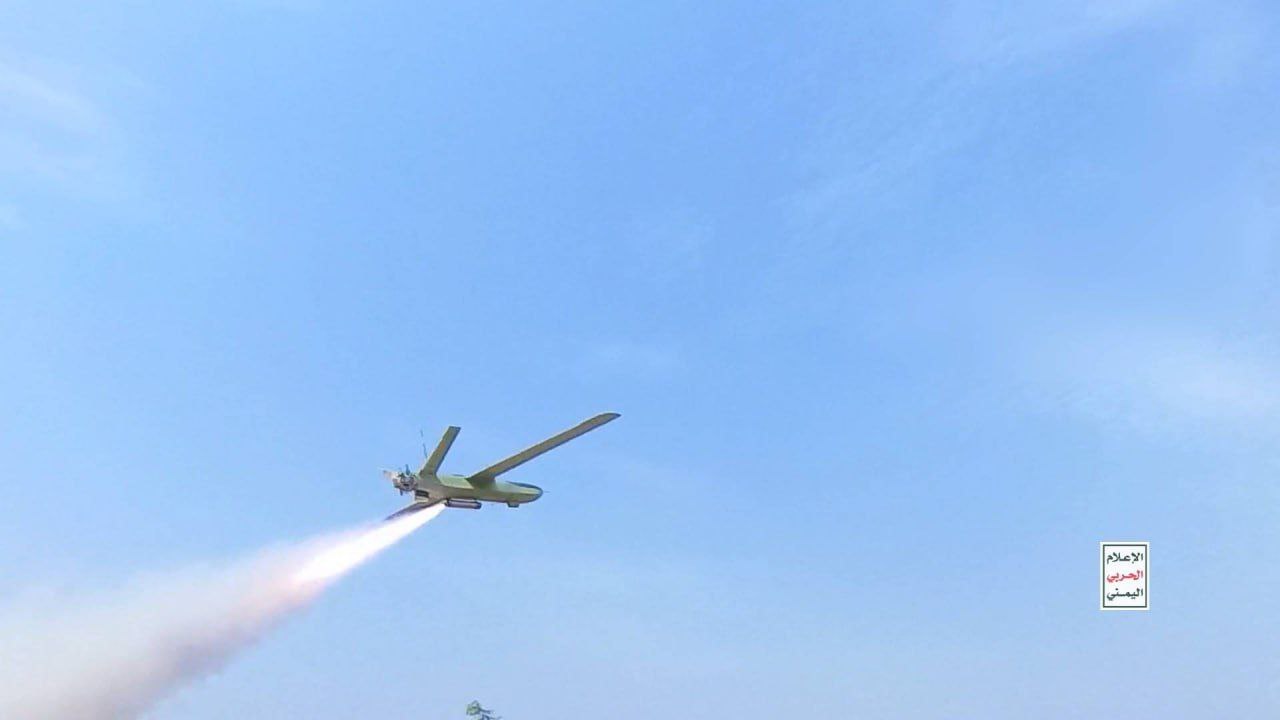
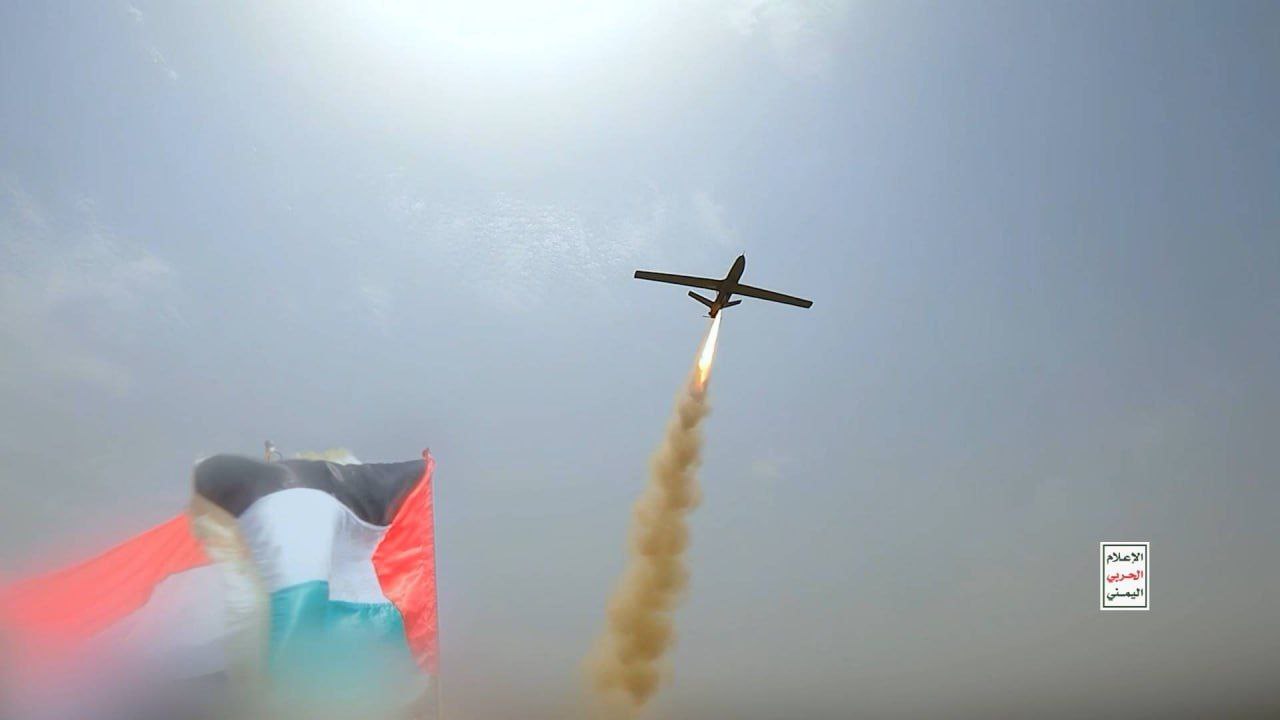
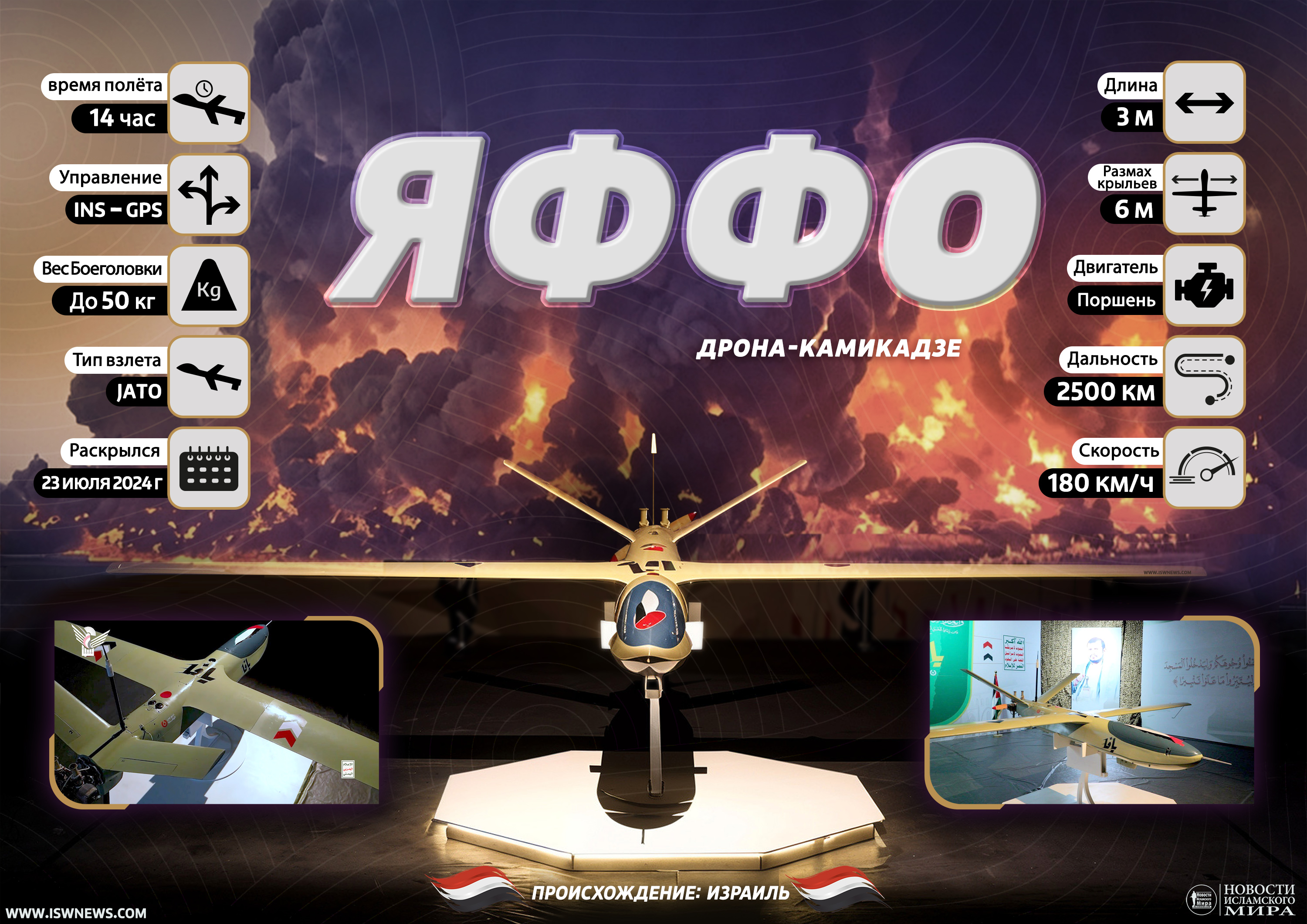
According to a statement from the Yemeni Armed Forces, the drone unit of the Yemeni army launched an assault early this morning, October 3, with several suicide drones of the Yafa class on a vital target in the city of Yafa (Tel Aviv), which is located in the heart of occupied Palestine.
According to spokesman for the Yemeni Armed Forces Brigadier General Yahya Saree, this aerial operation successfully achieved its objectives, and the drones reached their targets without the enemy being able to intercept or shoot them down.
The brigadier general further said that this operation is part of the fifth phase of the Battle of the Promised Conquest and the holy jihad in support of the Al-Aqsa Storm Operation. The Yemeni Armed Forces convey greetings to the heroic fighters on the fronts of the Gaza Strip and the West Bank, as well as in Lebanon and Iraq, confirming that they will continue their military strikes against the Israeli enemy until the end of the aggression against Palestine and Lebanon as well as the siege of the besieged strip.
Brigadier General Saree also referred to the anniversary of the blessed Al-Aqsa Storm Operation, and invited the peoples of all Arab and Islamic states to show their support for the people of Palestine and Lebanon in the coming days.
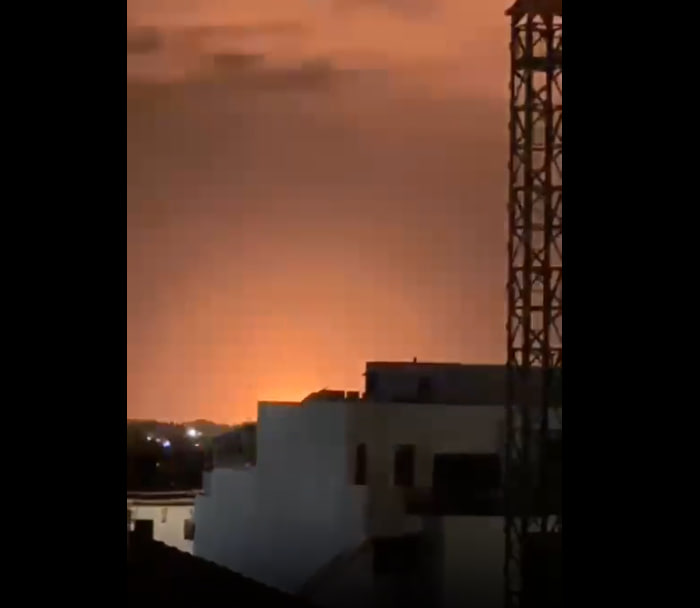
The moment a Yemeni drone exploded in the sky of Tel Aviv
The Israeli regime’s army pointed to the attack, claiming that Israeli fighter jets successfully intercepted a drone off the coast of the Gush Dan metropolitan area, adding that the sound of an explosion heard in the sky of this region was related to the interception.
The Yemeni forces’ recent attack marks the 31st aerial operation, which targeted the occupying regime’s positions in occupied Palestine using ballistic missiles, cruise missiles, and suicide drones.
The military operations of the Yemeni Armed Forces in support of the oppressed Palestinian people and resistance groups against the Israeli regime kicked off on October 19, 2023, in occupied Palestine and along the maritime route from the Gulf of Aden to the Red Sea. The retaliatory operations peaked with the seizure of the Israeli-affiliated ship Galaxy Leader as well as incessant missile, drone, and suicide drone attacks on over 150 vessels linked to the Israeli regime, leading to a halt in shipping for Israeli companies via the Red Sea.
It seems that the “need for greater range” of attack is a good explanation for the reason behind the manufacturing of Yafa drone, which is a UAV that has its roots in the Sammad class, and is considered as a big development in terms of range, compared to previous drones.
The first prototype of the Samad class drones was unveiled in 2018. Like Yaffa UAV, Samad had a long and flat wing design, which could reach a greater range, while it rises high in the air. The aircraft needs to fly at high altitudes in order to be able to reach a greater range in this flying method. The high flight altitude provides the enemy with the opportunity to detect the presence of the drone more quickly and its radars will be able to issue early warning.
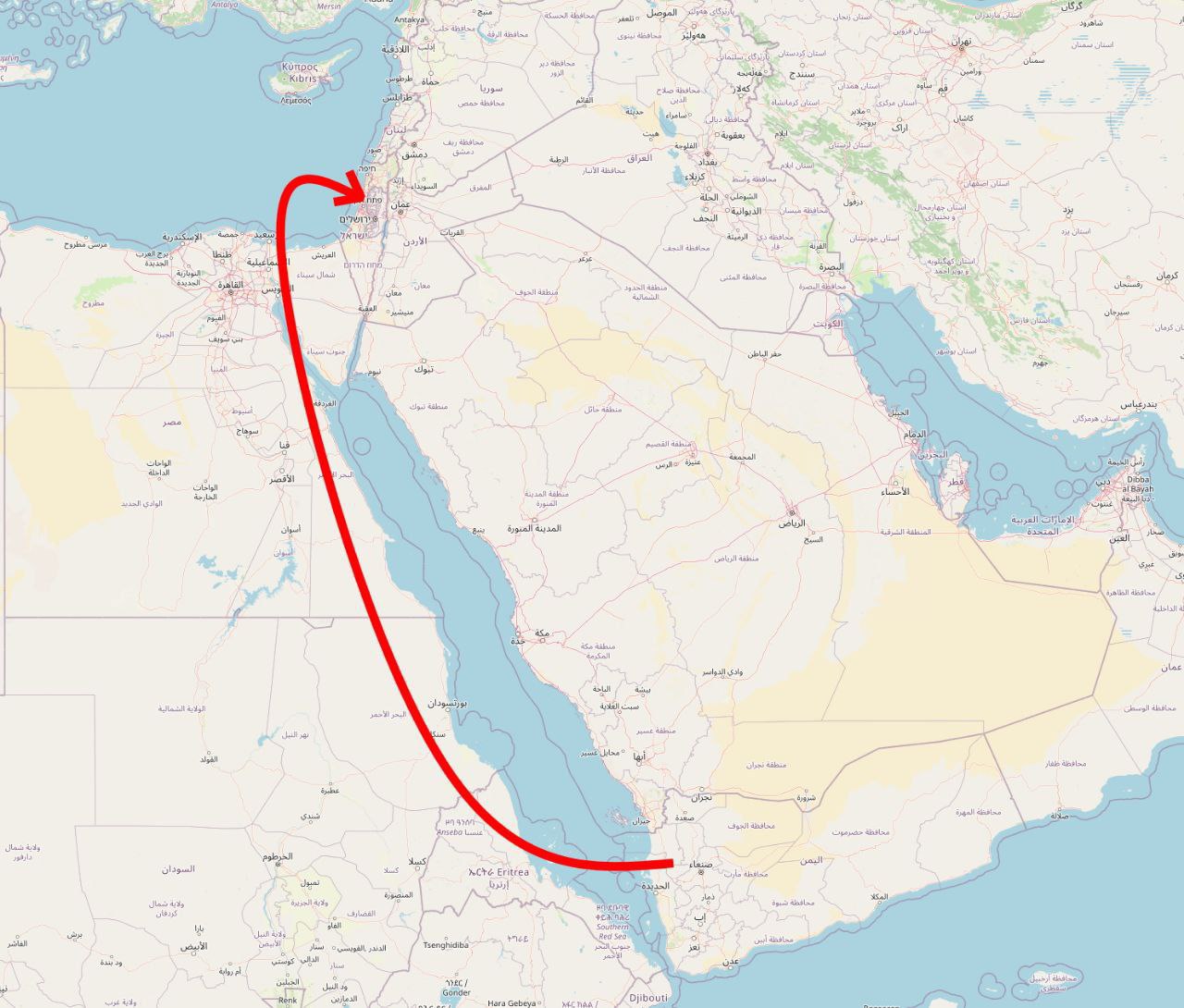
The possible path of the Yafa drone towards Tel Aviv
The path that the drone had flown, was effective in misleading the Israelis. The long route of the drone flight and its circumvention over the waters far from the Israeli-occupied territories may have played a role in confusing them.
One of the most vital segments of an aircraft is its propulsion system. In the Sammad drone, two German two-cylinder engines 3W-110i B2 with 10 horsepower have been utilized, and a Chinese two-cylinder DLE-170 engine with approximately 17 horsepower has been applied in the more advanced versions.
The state of affairs in Yemen and the sanctions imposed on the Arab country make the usage of accessible equipment a priority for the Yemeni army. The aforementioned engines have dual capabilities and are being utilized in civilian aerial industries and are easily accessible. Of course, the extensive usage of the German engine by the Axis of Resistance has forced Germany to adopt a more vigilant approach in this respect, and the Germans have attempted to cut the access of resistance groups to the 3W-110i B2 engines.
For instance, based on the findings of Germany’s intelligence services, some 42 engines of this class were purchased in Greece in 2015 and then ended up in Iran. For this reason, the German officials have imposed a series of restrictions on the dealing of this sort of dual-use engine. The usage of a Chinese engine, which is both more powerful, on the other hand, the seller does not have a significant problem with the type of usage, as well as Iran’s success in developing a more powerful version of this class of engine, were among Tehran’s response to the restrictions imposed by the West.
It can be predicted that similar Chinese engine or an upgraded Iranian version of that engine will be used on Jaffa suicide drone.
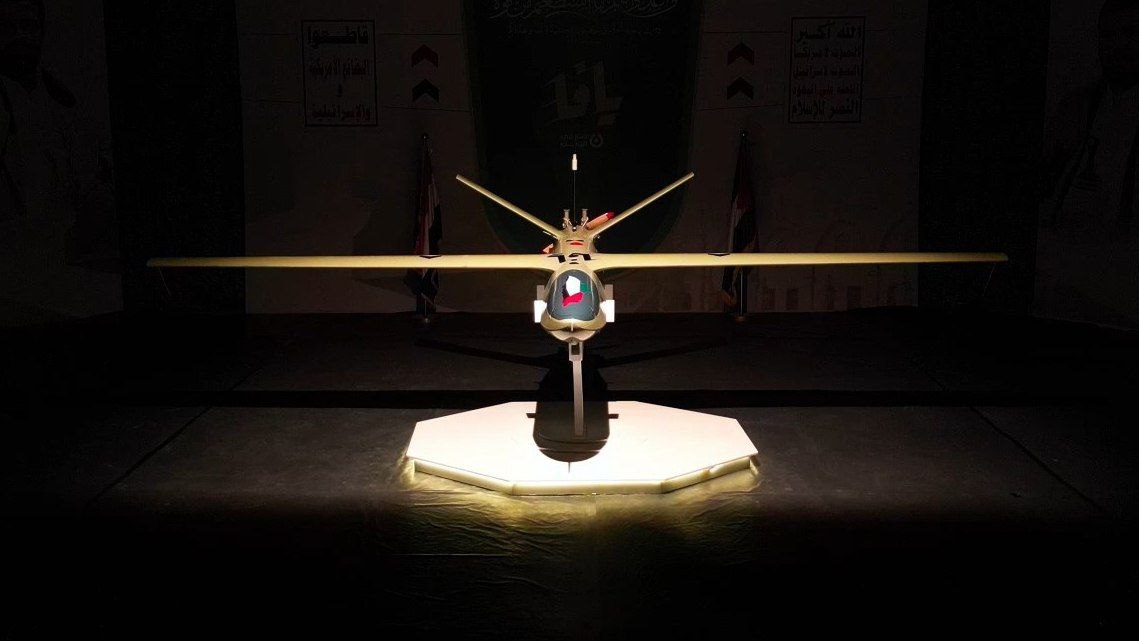
Video of the unveiling of the Yafa suicide drone
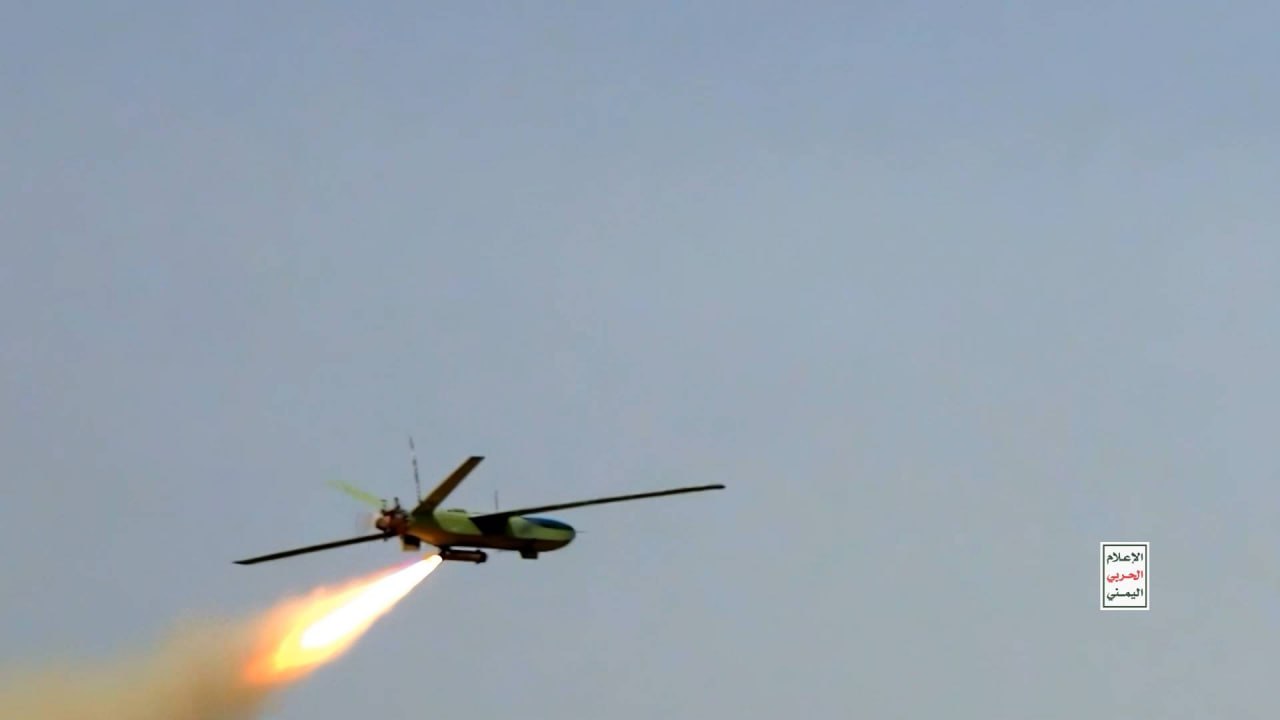
The Yaffa UAV requires a rocket booster to be able to start moving and speed up, like the previous variants of the Samad drone, and after reaching the appropriate speed and altitude, a piston engine begins working.
Yafa drone’s rocket booster
The prototypes of the Samad drone are probably utilize civilian GPS for navigation in the guidance and navigation segment, which naturally allows the UAVs to strike fixed targets, but it cannot be expected to perform appropriately, when it comes to encountering GPS disruptors.
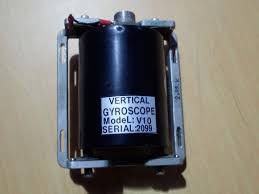
The Yemeni Armed Forces have applied a combination of inertial and GPS guidance to resolve this problem during the overhaul of the Yafa drone. A computer set controls the UAV’s trajectory. The suicide Yafa drone can improve the chances of reaching its target by choosing a more proper route. According to data released by the United States, two types of gyroscopes, the V-9 and V-10, have been installed on Yemeni drones. For instance, the V-10 version has been found among the remnants of Qasef drone. One of the advantages of an inertial conduction system is that it is very hard to be disrupted.
V10 gyroscope
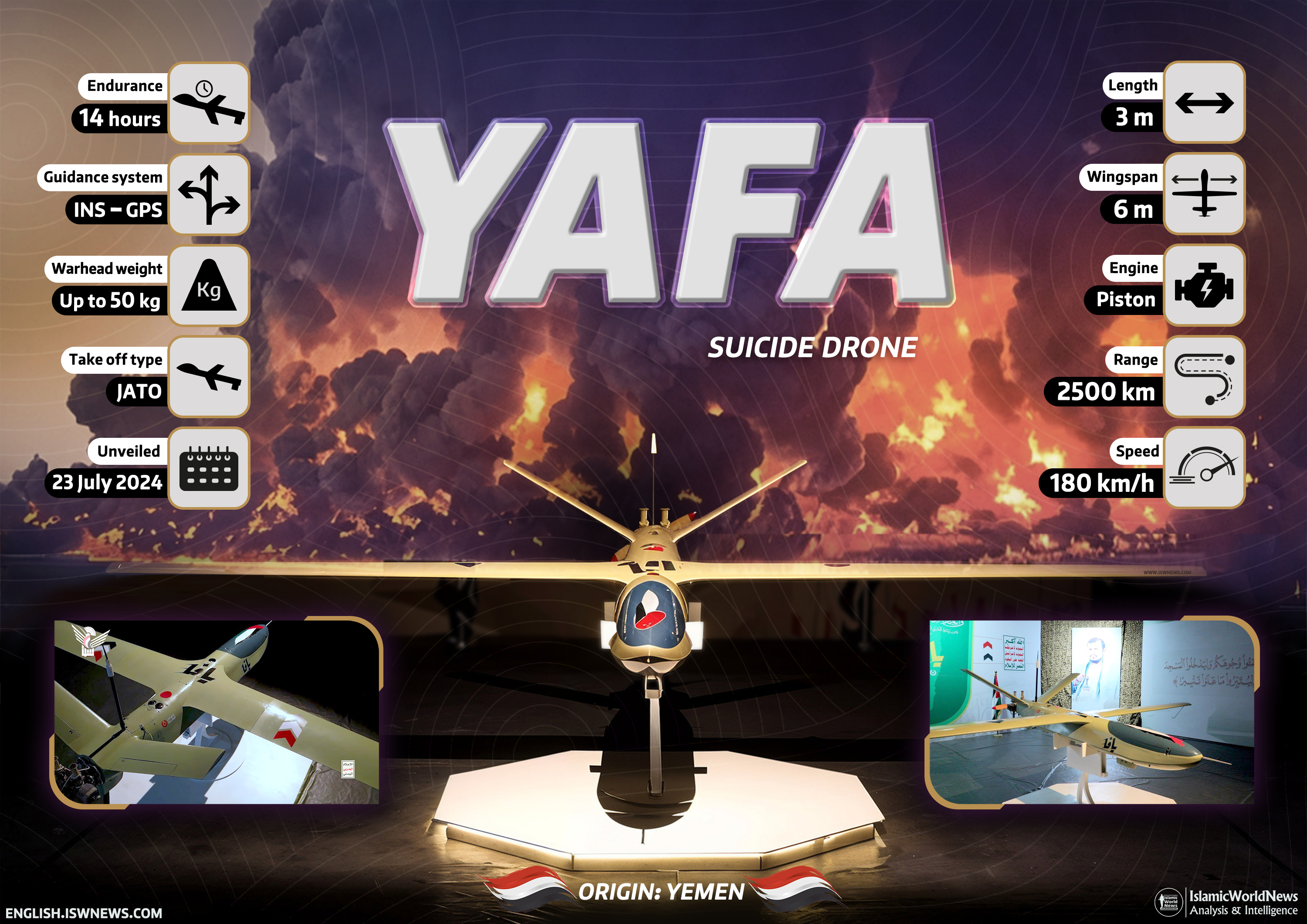
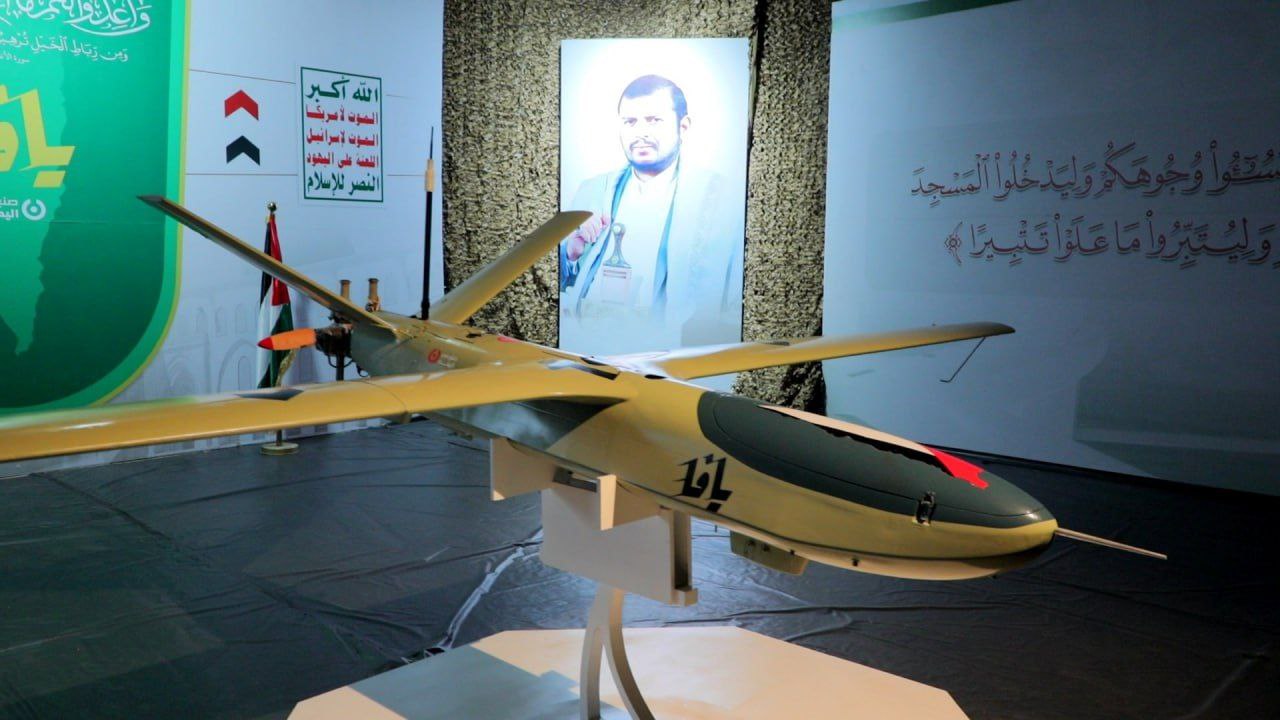
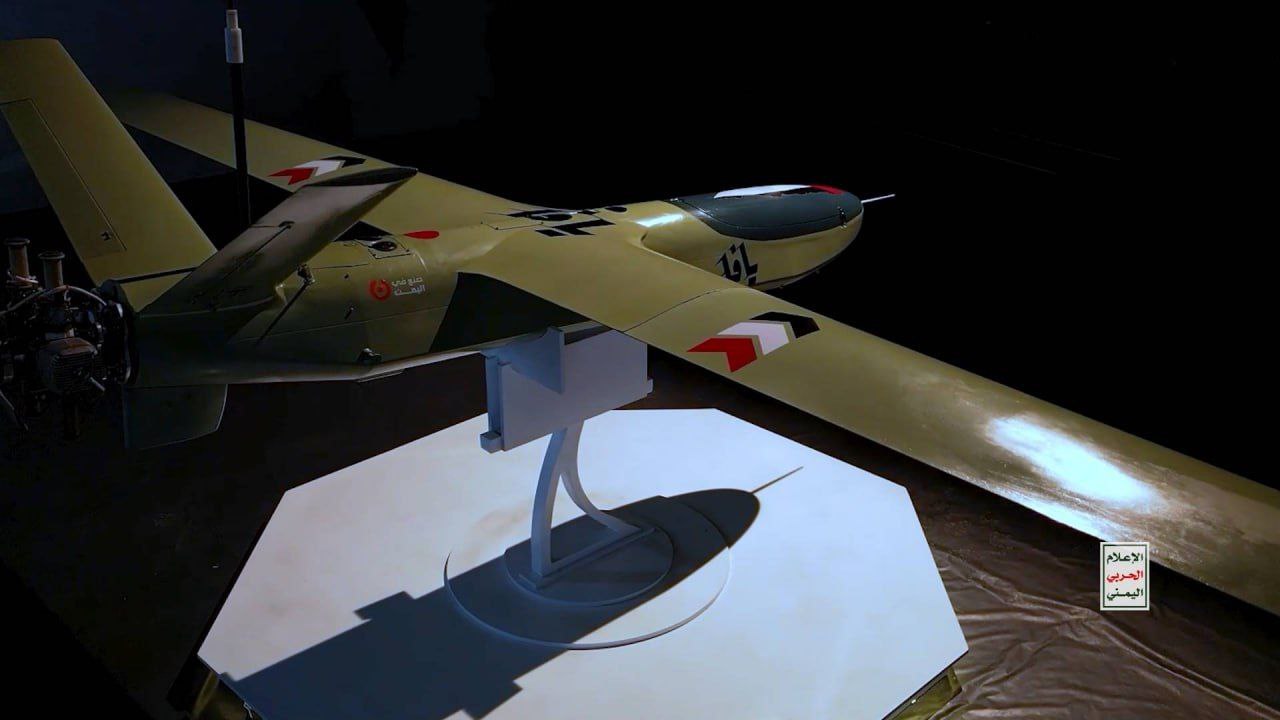
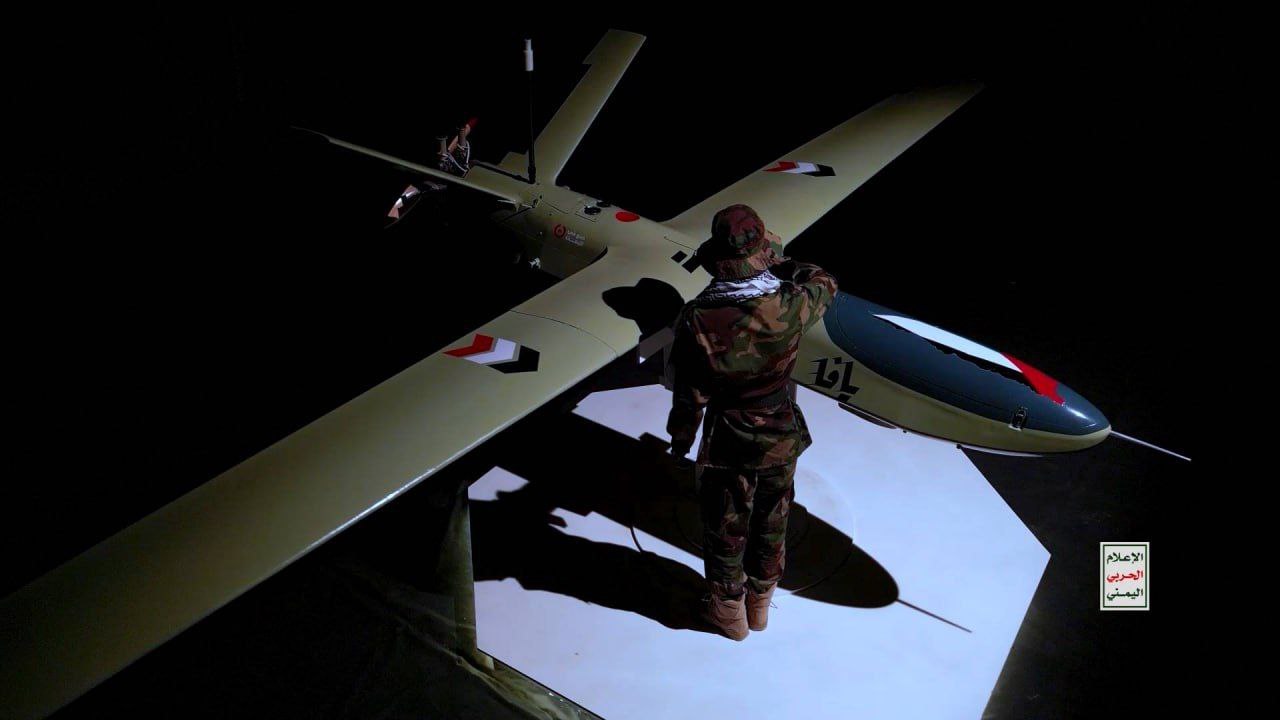
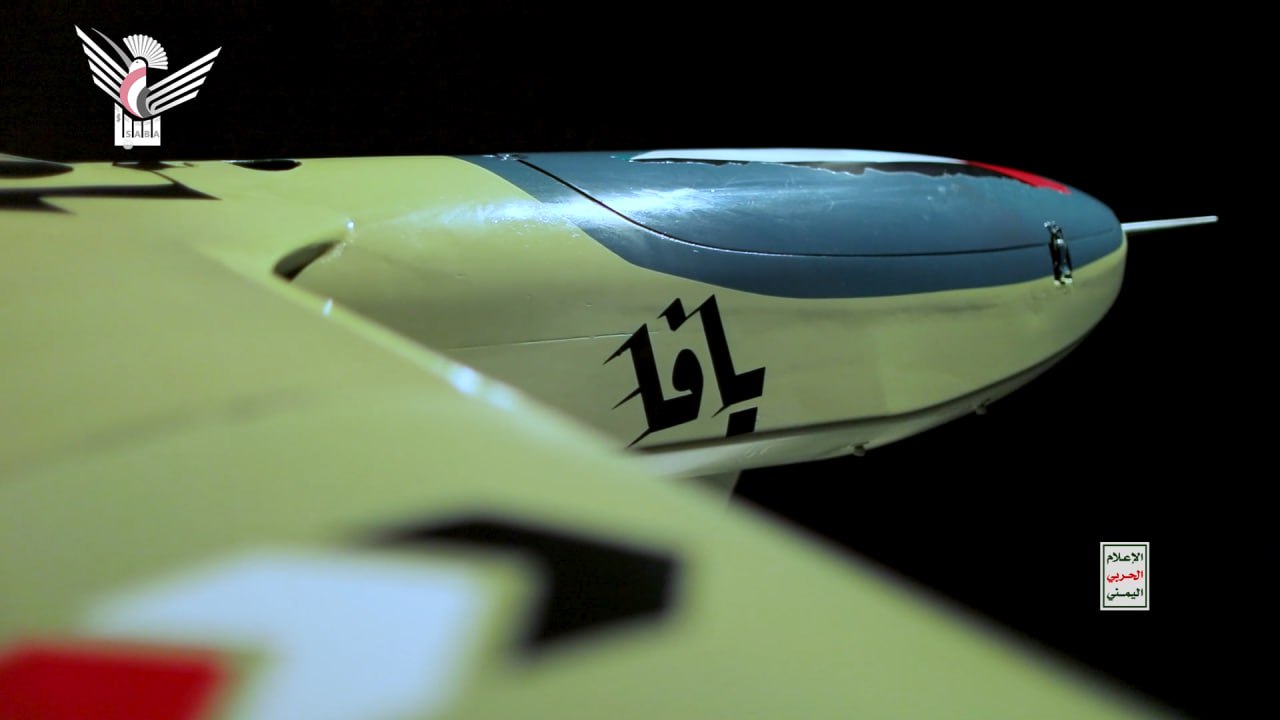
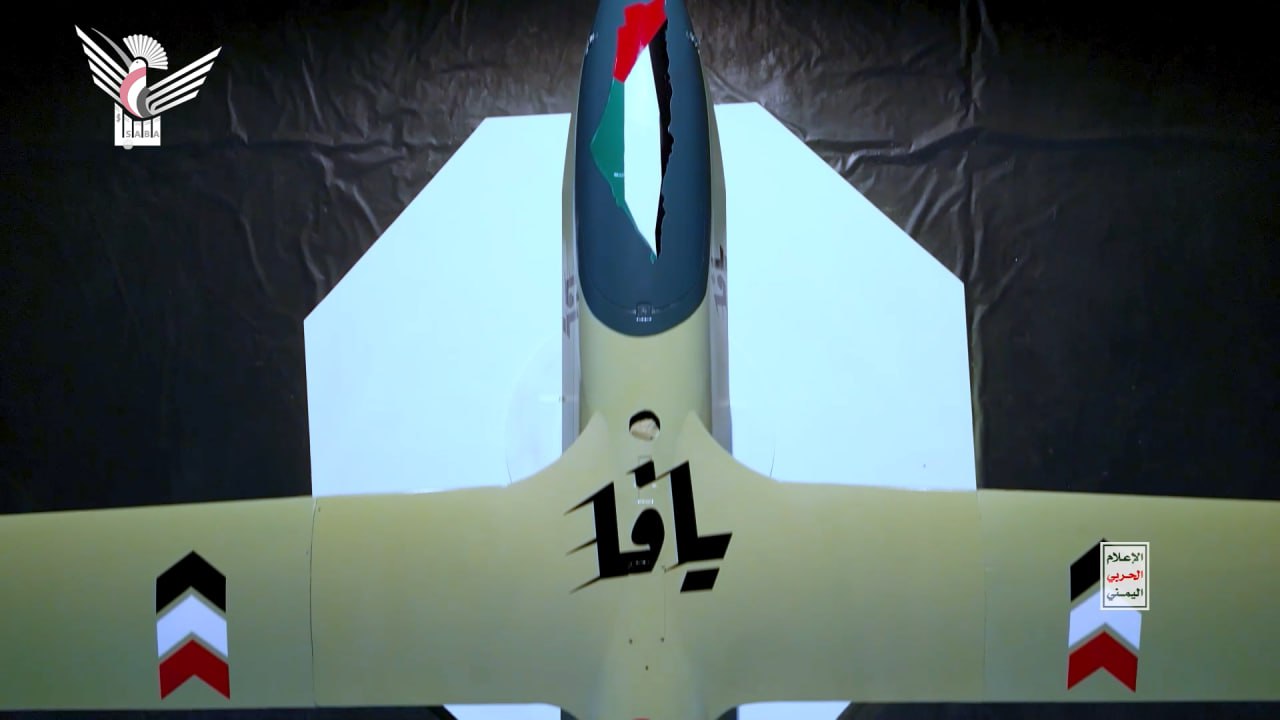
In terms of dimensions, the Yafa UAV is obviously larger than the previous versions so that it can carry more fuel inside its fuselage. More fuel will help Yafa drone to fly a longer range. In accordance with the images of Yaffa drone, the aircraft has a length of 3 meters and a wingspan of about 6 meters. With these features, the range of Yafa drone is perhaps about 2,500 kilometers. This range is consistent with the expected 2,600-kilometer route flown to conduct air strike on Tel Aviv city.
Consistent with the route covered and the type of its engine, the average speed of Yafa UAV is between 140 and 180 kilometers per hour and enjoys a flight duration of 14 hours.
The drone has a high-explosive warhead, which weighs between 20 and 50 kilograms.
Based on the official announcement by the Yemeni authorities, the drone is classified among stealth aircraft, possibly due to the fact that a honeycomb structure is being used inside its fuselage.
On the whole, the Yafa UAV is considered as a long-range suicide drone, which has extended the space of operations of the Yemeni Armed Forces to the city of Tel Aviv as well as the southern half of occupied Palestine. It is also considered a significant breakthrough in terms of the range and guidance compared to the Samad class drone. Given that Israel is a regime, which possesses a powerful defense system and is widely supported by extra-regional powers, this UAV is certainly not an armament that changes the balance of war against the Israeli regime. Nonetheless, the Yafa drone represents a growing trend of cutting-edge modern technologies in the Yemeni army.
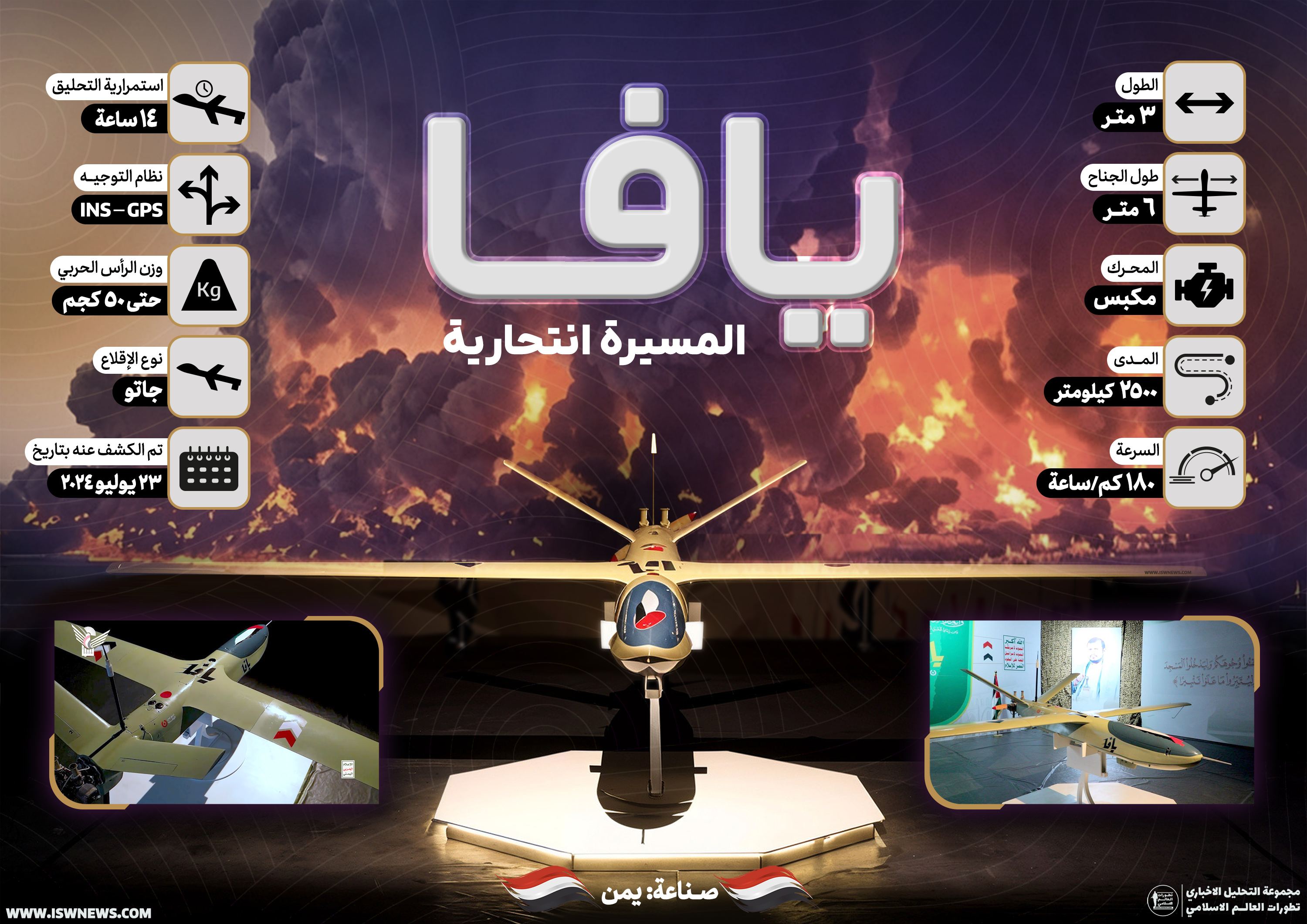
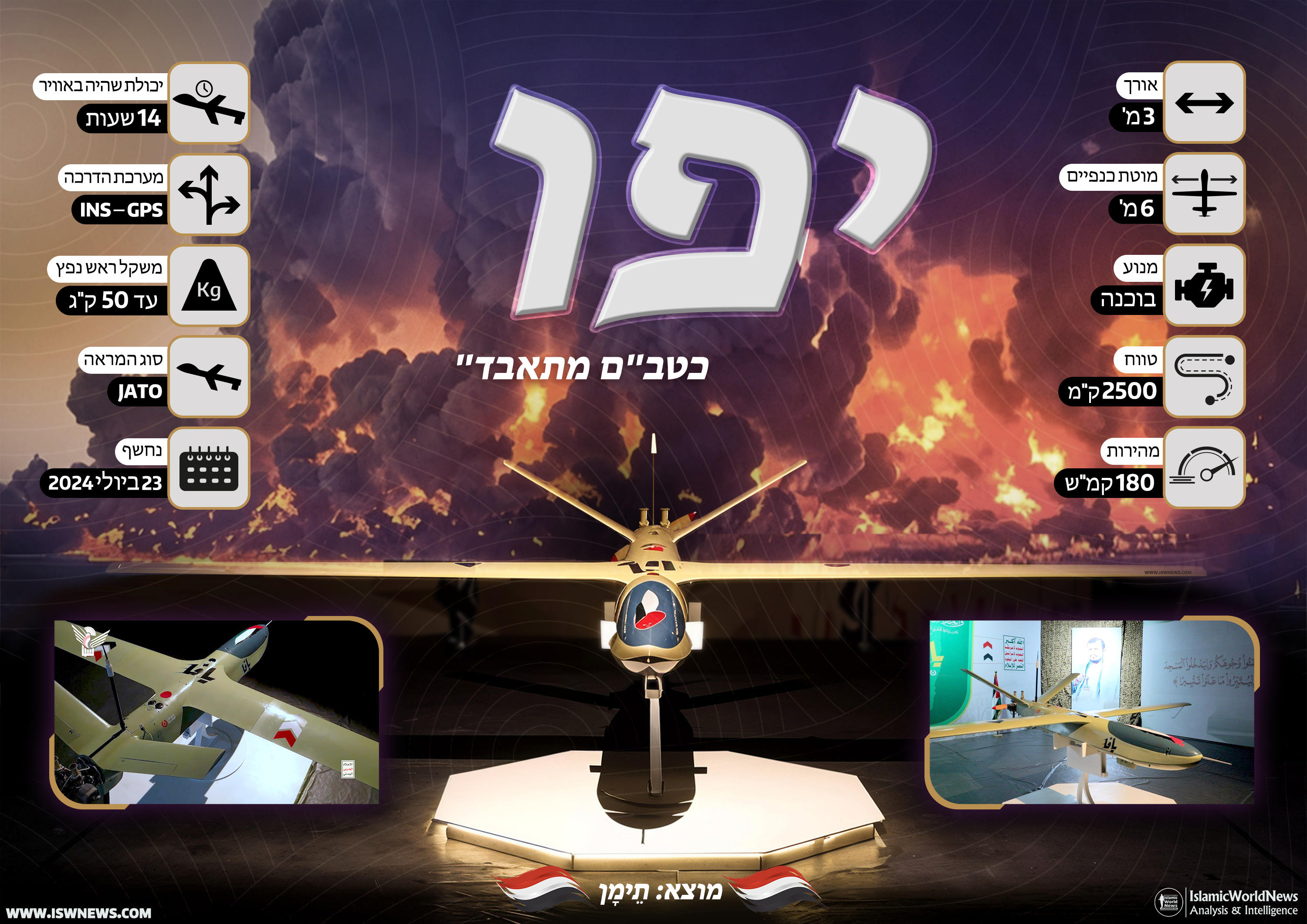
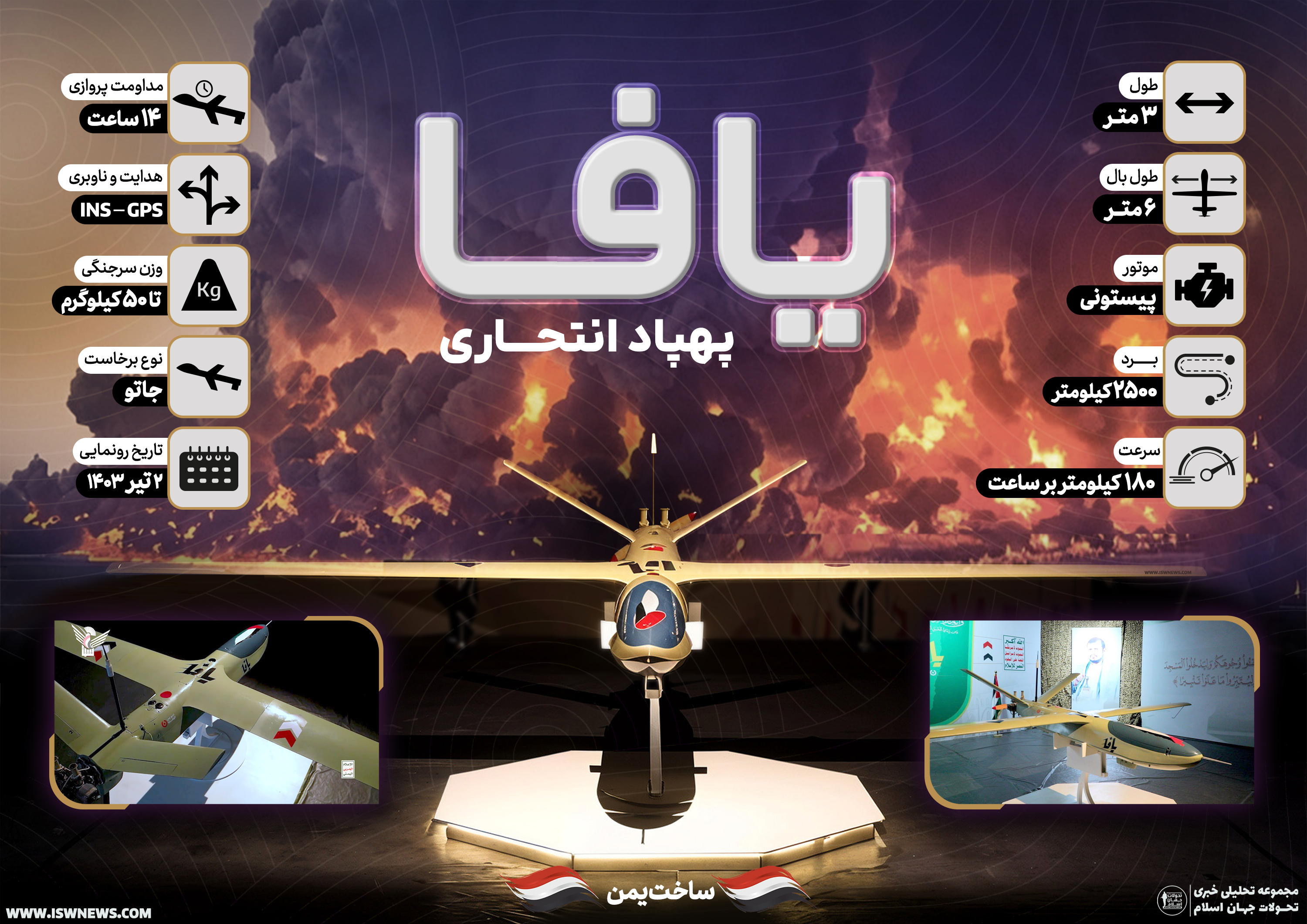
Specifications of the Yafa suicide drone: Type: Suicide Drone Country of Manufacture: Yemen Unveiled: July 23, 2024 Length: 3 m Wingspan: 6 m Engine: Piston Range: 2,500 km Speed: 180 km/h Flight Duration: 14 hours Navigation: INS – GPS – Radio Warhead Weight: Up to 50 kg Takeoff Type: JATO
Yafa suicide drone – click to view full size
More images of Yafa drone:
Click to view full size
The collection of Yaffa suicide drone posters in Arabic, Hebrew, Farsi and Russian languages: