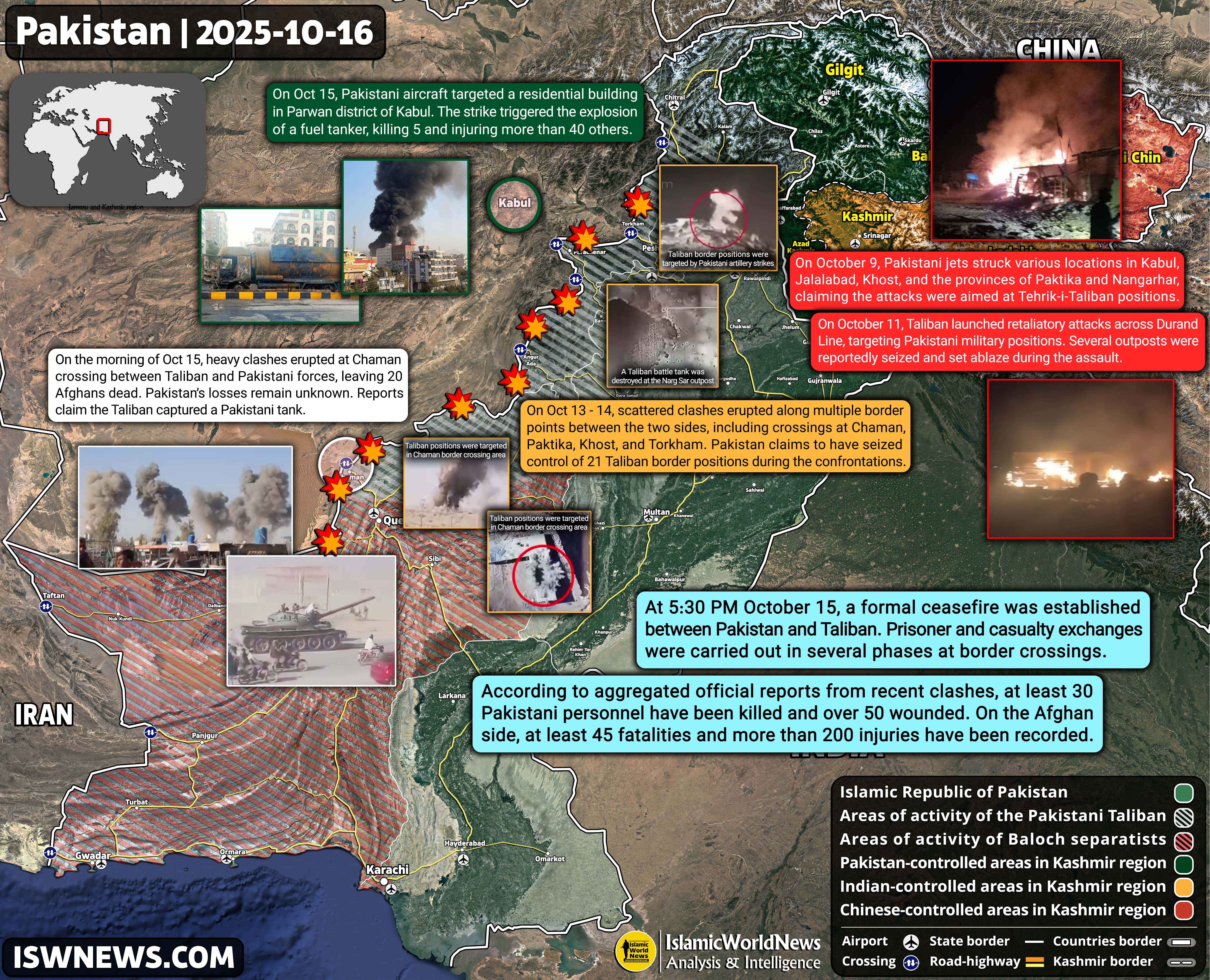
According to official figures, at least 30 Pakistanis were killed and over 50 wounded. On the Afghan side, at least 45 fatalities and more than 200 injuries were reported. In response to the escalation, Pakistan suspended all trade with Afghanistan, and border crossings are now open only for returning Afghan migrants expelled from Pakistan.
A partial ceasefire was established on the evening of October 15, with both sides exchanging prisoners and the bodies of the deceased at various border points.
Pakistan claims the conflict stems from the Taliban’s alleged support for Tehrik-i-Taliban Pakistan (TTP) fighters based in eastern Afghanistan. The Taliban, in turn, accuses Pakistan’s intelligence services of training ISIS-affiliated groups and deploying them for terrorist operations in Afghanistan and across the region, including Russia and Iran. While many disputes exist between the two sides, the central issue driving the conflict is mutual accusations of supporting terrorism.
Afghan Taliban militants targeted four locations in Barmal city of Paktika province, near the Dand Wa Patan, Tri Mangal, and Torkham border crossings in Paktia and Khost provinces, in response to the Pakistani army’s airstrikes.
The fighting concluded after Pakistani army artillery attacks on border areas in eastern Afghanistan, leading to the retreat of Taliban militants.
The Taliban’s defense ministry stated that Taliban forces had attacked the bases and hideouts of ISIS and their supporters (Pakistan) in the southeast, which were the sources of the attacks on Afghanistan, without providing details of the attacks on Pakistani territory.
Clashes on the border areas
Afghan media reported that 19 Pakistani soldiers and three Afghan civilians were killed in the clashes, and two border checkpoints were captured by the Afghan Taliban. The Taliban set fire to Pakistani border guard equipment and left the area after capturing the checkpoints.
The videos and images released by Taliban media are old and unrelated to today’s attacks.
Pakistani media denied these reports, stating that one border guard was killed and seven were wounded. They also claimed that five Taliban militants were killed in an artillery attack by the Pakistani army on Dandpatan town in Paktia province.
Pakistani artillery attack on Dand Wa Patan area
These clashes continue the political tension between the Pakistani government and the Afghan Taliban over the Afghan Taliban’s support for the Tehreek-e-Taliban Pakistan (TTP) and the Taliban’s counterclaims of Pakistan’s support for ISIS. The Taliban claim to have carried out the attacks in response to a Pakistani army airstrike on Barmal in Paktika province on January 5, which killed at least 46 people in Afghanistan and sparked a strong reaction from the Taliban. Pakistan claims to have assassinated senior commanders of the Pakistani Taliban, including Shir Zaman (Mukhlis Yar), Abu Hamza, and Akhtar Mohammad, and destroyed the group’s media center, Omar Media.
Zabihullah Mujahid, spokesman for the Taliban caretaker government in Afghanistan, strongly condemned the Pakistani army airstrikes, emphasizing that the Taliban caretaker government will not allow any party to jeopardize the security of Afghanistan, and these attacks will have dire consequences for Pakistan.
He also pointed to the results of Pakistani fighter jet airstrikes early Monday morning at 3 a.m. local time, noting that Pakistani jets bombed the Lamna area of Barmal district in Paktika province and the Afghan Dubai area in Spera county of Khost province, resulting in the death of six people, including three women and three children in Paktika, and one house was destroyed, while in Khost, one house was demolished and two women lost their lives.
Direction of clashes in Paktika and Khost province – click to view full size
According to the Taliban spokesman, Pakistan claims that the Pakistani forces targeted an individual known as Abdullah Shah (a field commander of the Tehrik-e Taliban Pakistan) in the Khost attack.
Simultaneously with this claim, Abdullah Shah released a video denying reports of his own death in Pakistani airstrikes in eastern Afghanistan and emphasized that he is present in South Waziristan.
The video published by Abdullah Shah, one of the field commanders of Tehreek-e-Taliban Pakistan
Following these attacks, Taliban militants and Pakistani border forces have been engaged in clashes and exchanging artillery fire at the Angoor Adda and Dand Wa Patan border crossings since Monday morning.
This is the 17th border clash between the Taliban militants and Pakistani armed forces since the establishment of the second Taliban caretaker government in Afghanistan. The presence of Tehrik-e Taliban Pakistan (TTP) militants in Afghanistan and the Taliban’s refusal to accept the Durand Line border are among the main reasons for the conflict between the Pakistani government and the Taliban.
The location of the attack by Pakistani fighter jets in Spera area in Khost province
ISWNews Analysis Group: In continuation of the armed conflicts between Takfiris and Shia tribes in Parachinar town, hundreds of armed Taliban militants from Afghanistan as well as other Takfiri groups crossed the border areas of Mirzaki, Mangal Karkin and Mangal Aryon in Dand Aw Patan district of Paktia province to the Shia-populated area of Pewar in the western parts of Parachinar town, the center of Kurram Agency, which is located in Kohat Division of Khyber Pakhtunkhwa province.
Takfiri terrorists, who are mostly militants from groups affiliated to the Taliban both in Afghanistan and Pakistan, besieged the Shia-populated area of Pewar from four sides, and attacked the area twice in less than 12 hours using light and heavy weapons. It seems that they are likely to be Lashkar-e-Jhangvi and al-Qaeda terrorist organizations, with approximately 1,000 to 1,500 armed members.
A number of attacks by Takfiri terrorists on Shia tribes have also been reported in Karkala and Balish Khel regions.
According to local sources, since the onset of the armed clashes between Takfiri groups and Shia tribes, at least 12 people have been killed and 42 others injured.
Parachinar conflicts – click to view in full size
It should be noted that recently the Tehrik-e-Taliban Pakistan (TTP) group denied involvement in the Parachinar clashes and its members’ involvement in this tension in a statement, emphasizing the existence of secret intelligence agencies behind these clashes.
However, close relations between the Tehrik-e-Taliban Pakistan, an umbrella organization of various militant groups operating along the Afghan–Pakistani border has issued a statement, ruling out any involvement of the group and its members in the recent confrontations in Parachinar town.
The TTP underlined that some intelligence agencies have been involved in the armed clashes; however, it denied accusations on the TTP militants’ close ties with the Taliban caretaker government and the dispatching of Taliban militants and other Takfiri groups from Afghanistan to Parachinar town. Despite the denial statement by the Tehrik-e-Taliban group, the likelihood of participation of the terrorist group’s elements in the Parachinar clashes has been increased to the highest possible level.
Pictures of the body of a Shiite child from Parachinar who was martyred as a result of Takfiri attacks in recent days
A picture of the bodies of the Takfiris of Kurram Agency district who were killed in the counter attack of Parachinar Shiites.In their messages, the Takfiris have called Parachinar Shiites terrorists and claim that Shiites have attacked Sunni families!But in fact, they were the initiators of this conflict, and the published images prove the false claim about Shia attacks on Sunni women and children.