Turkish police used water cannons, tear gas, and rubber bullets to disperse the protesters, who numbered at least five thousand.
The Incirlik Air Base is located in the city of Adana that is one of the air bases of the Turkish Armed Forces in the south of the country, and the base has been jointly used by Turkiye, the United States, and NATO since 1951 and it hosts 5,000 American troops and at least 50 B61 nuclear gravity bombs.
Iraqi resistance forces have carried out six attacks against the United States’ positions in Syria and Iraq from the late hours of Sunday night until this morning. These attacks included an attack on Qasrok military base, east of the town of Tel Tamr, in northeastern Syria, another attack on Ain al-Asad air base in western Iraq (first time), an attack on US army positions near Erbil airport in northern Iraq, an attack on Ain al-Asad base (second time), an attack on the Al-Tanf area in southern Syria, and an attack on Ain al-Asad base (third time).
The intensified attacks by the Iraqi resistance fighters against the United States’ positions are unprecedented, and the recent attacks are considered the heaviest and most widespread offensive by the Iraqi resistance against US military bases in Iraq and Syria in recent years.
These series of attacks took place after US Secretary of State Antony Blinken’s visit to the Iraqi capital Baghdad. Iraqi groups had previously announced that the visits of American officials into Iraq would not be welcomed! On Sunday, Antony Blinken arrived in Baghdad under tight security measures and met with the Iraqi Prime Minister Mohammed Shia’ al-Sudani for political talks. On Monday morning, Al-Sudani traveled to Tehran on an urgent trip!
Given al-Sudani’s trip to Tehran, it can be inferred that the Iraqi prime minister is conveying a new message from the United States to Iran.
As mentioned before, the attacks by the resistance groups will increase gradually and incrementally in proportion to the intensity and nature of the conflicts in the region. In addition to this trend, the type of reaction, behavior, and statements of US officials will also have an impact on these attacks. For instance, the recent attacks by the resistance groups on US positions in Iraq and Syria took place after US Secretary of State’s statements in Baghdad and the threats made by the resistance groups. Blinken had stated that we give a very clear message to those who threaten American soldiers and tell them not to do this.
It seems that the solidarity and coordination among the resistance groups in Iraq, Lebanon, Yemen, Palestine, and Syria, as well as the execution of joint attacks in northern Palestine and, on the other hand, in Iraq and Syria, have had a serious impact on United States’ stance towards the Israeli war of aggression against Gaza. The approximate simultaneity, volume, and type of attacks, which have been unprecedented in recent years, indicate that the axis of resistance has put the plan on its agenda to attack US bases in the region with controlled escalation in order to increase pressure on the forces supporting the Israeli regime in the region (i.e. CENTCOM forces) in proportion to the increasing pressures by the Zionist regime against the Gaza Strip.
During the meeting, the head of Hamas’ Political Bureau provided a report on the latest developments in the Gaza Strip and the war crimes committed by the Israeli regime in the besieged area, as well as the situation in the West Bank.
The Supreme Leader of the Islamic Revolution expressed his appreciation for the steadfastness and resilience of the people of Gaza and expressed deep regret over the crimes committed by the Israeli regime with direct support from the United States and certain Western states.
Ayatollah Khamenei also emphasized Iran’s longstanding policy of supporting Palestinian resistance forces that fight Israeli occupiers.
The Leader stressed the need for serious actions by Islamic countries and international organizations, as well as Islamic governments’ comprehensive and practical support for the people of Gaza.
These individuals were Iranian nationals and intended to carry out attacks using suicide drones on Iranian soil and try to create discord between Iran and the Taliban.
It is also said that the Taliban caretaker government will soon transfer the detainees to Iran for interrogation.
The preparation and implementation of such terrorist plots are expected in the current crisis situation that the Israeli regime is facing. It is worth mentioning that Iranian nuclear facilities, military sites, and border areas can be targeted.
Furthermore, since the onset of the Gaza war, Persian-language media outlets in the Israeli occupied territories have repeatedly attempted to provoke terrorist acts in Iranian border provinces such as Sistan and Baluchistan, Kurdistan, as well as trigger political and social disputes, but they have been unsuccessful for various reasons.
Pictures of people arrested in the joint operation of the Ministry of Intelligence of Iran and the Taliban on the border of Afghanistan
Thousands of Indonesian people participated in demonstrations supporting the Palestinians in the city of Jakarta and demanded the trial of the Zionist regime in international courts.
Also, thousands of French people condemned the war crimes of the Zionist regime against the innocent and oppressed people of Gaza by holding a large demonstration in Paris. According to the French police, the number of participants in this demonstration reached almost 20 thousand people.
The Washington DC and the capital cities of European countries, including London and Berlin, were also the scene of public demonstrations in support of Gaza and condemnation of the Zionist occupation regime’s aggression against this strip.
The ISWNEWS’ monitoring the status of helicopter flights in the region’s airspace shows that at least six US fuel tanker planes took off simultaneously over various parts of Saudi Arabia recently.
Despite this volume of flights, it seems that these flights are related to attacks by Yemeni forces on the Israeli regime, and there are two general possibilities in this regard:
1- The monitoring of Yemeni launchers, which are used to launch missiles towards occupied Palestinian territories. 2- A maneuver to coordinate between Israeli and US air forces to retaliate Yemen’s strikes.
It should be noted that these flights began after the crash of the Quds-3 cruise missile in Jordan that was recently launched by the Yemeni army.
The most probable reason for these flights is the continuous monitoring of Saudi Arabia’s airspace to find cruise missiles and suicide drones fired by the Yemeni army.
This monitoring will take place through continuous flights of Saudi and US fighter jets; so, it will increase the possibility of detecting and destroying missiles and drones fired by Yemen.
This action, in addition to happening at the same time as the crash of the Yemeni cruise missile, also provides another possibility for the coalition the United States, Saudi Arabia, and Israel with the opportunity to pave the way for the Israeli air fleet to carry out an attack against Yemen in retaliation of recent missile strikes by the Yemeni army.
Simultaneous flights of several fuel tankers at first glance give the impression that they are a coordinated maneuver for synchronized aerial movements, and however, this volume of fuel tankers seems excessive to cover a particular area where the possibility of missile and suicide drone passage exists.
In any case, these actions indicate the creation of an undeclared coalition between the United States, Saudi Arabia, and Israel to save the Israeli regime.
Before publishing this news, Hezbollah media published images of the interception of an Israeli Hermes 450 drone, but it seems that the wreckage of the downed drone in Nabatieh is more similar to the Israeli Heron 1 drone.
Hermes-450 drone in Lebanon airspace
At the same time as this news, the Israeli army also claimed to shoot down a Hezbollah drone. Some media also attributed the images of Nabatieh to the downing of the Hezbollah drone.
In any case, it seems that Hezbollah’s claim in this case is more correct and can be confirmed.
The wreckage of the Israeli downed drone in Nabatieh areaThe crash site of Israeli drone in the Nabatieh area
The Israeli regime’s army has released a video of tracking and destroying a Yemeni cruise missile by an Israeli F-35 fighter jet.
The cruise missile was heading towards southern occupied Palestine from Yemen on Wednesday, November 1, when it was shot down by an Israeli fighter jet.
According to images released by Yemeni armed forces, this missile is a Quds-3 cruise missile.
The noteworthy point in this video is the blatant cooperation of Egypt, Jordan, and Saudi Arabia with Israel to counter Yemeni army attacks.
The interception and destruction of the Yemeni cruise missile by the Israeli F-35 fighter jet
Undoubtedly, tracking and identifying this missile would not have been possible without the coordination of radar and defense systems of Saudi Arabian or Egyptian armies.
Continuous flights and patrols of Israeli fighter jets in the skies of the northern Red Sea are also not possible without using the airspace of Arab countries such as Saudi Arabia, Jordan, and Egypt.
Therefore, the close relations between the governments of Arab countries with the United States and Israel are not just a claim but a reality.
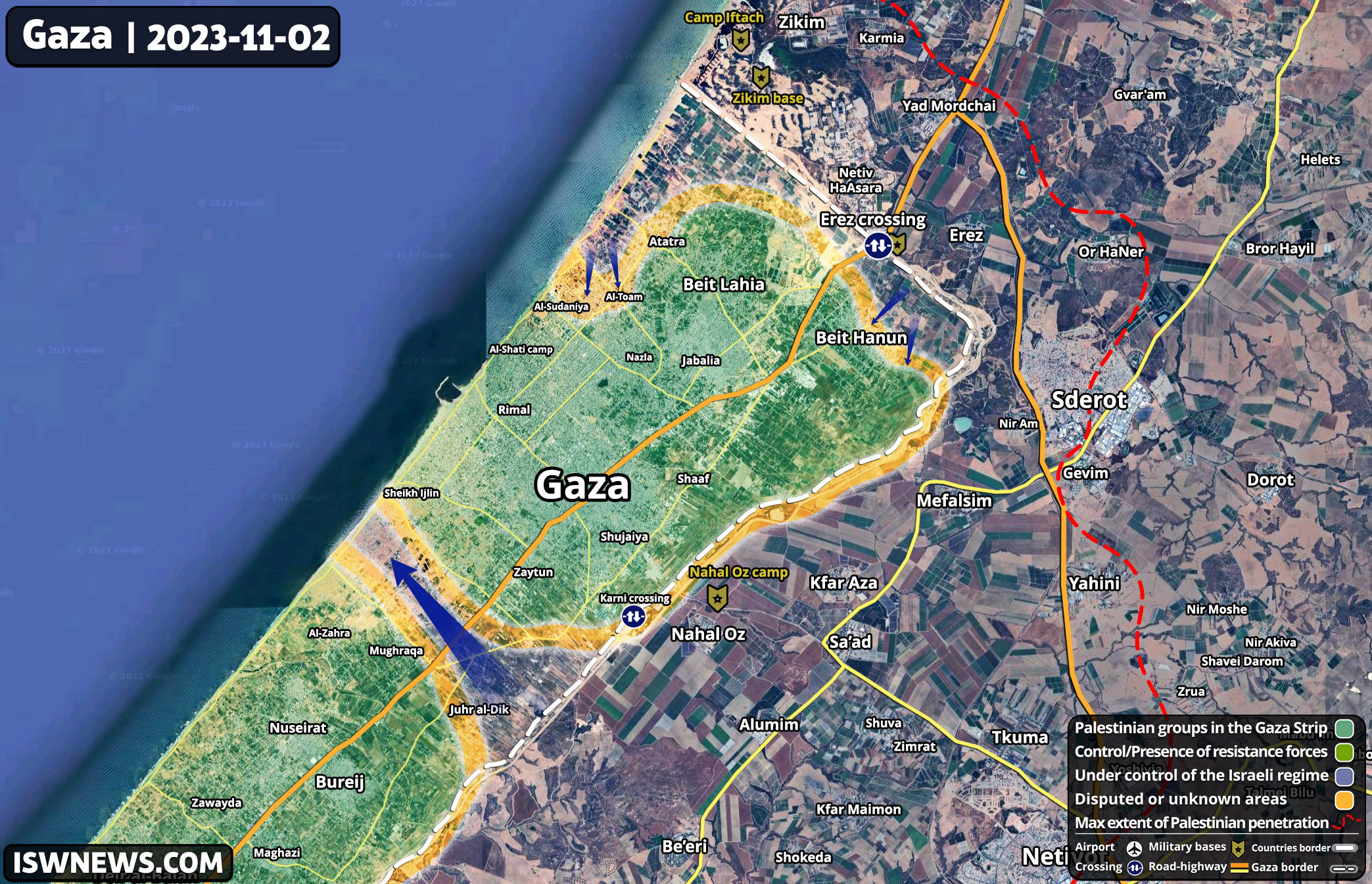
On the 28th and 29th days of the fighting in Palestine, clashes between the Palestinian fighters and the Israeli army forces continued inside the Gaza Strip. During the last two days, there were no special changes or significant advances by the Israeli army. In fact, after the completion of the siege of Gaza City, which took place through the low-density and non-urban areas south of Al-Zaytoun area in the south of Gaza City, now the focus of the conflicts is more towards urban battles; where the army of the Israeli regime is struggling with many difficulties.
The Zionist army is very dependent on heavy air cover and tanks and armored vehicles to avoid human casualties and advance in the urban warfare. This is not a bad tactic, but when the opposing forces are highly prepared in terms of guerilla warfare tactics and fight for their survival with ideological thoughts, the battles will be very difficult. This issue can be seen clearly in the battles of the last two days. By using unique tactics and using tunnels, the Palestinian fighters have always surprised the infantry and armored units of the enemy and inflicted high casualties on Israeli occupying forces. Only in the last 48 hours, 24 Israeli military vehicles, including tanks, personnel carriers and bulldozers, were targeted in the battles of Gaza City. The number of casualties of Israeli forces is also unknown.
Destruction of Israeli equipment and armored vehicles by Palestinian fighters
In the field, urban clashes are currently ongoing in Beit Hanoun, in Al-Tawam, Al-Karamah, Sheikh Rizwan and near Al-Shati camp.
The heavy bombing of different areas of the Gaza Strip continues. The Palestinian Ministry of Health announced that the number of martyrs in Gaza has increased to more than 9,500, of which more than 3,900 are children. Also, more than 30,000 people have been injured.
On the northern front, artillery and missile attacks continue between Hezbollah and Israel, and no specific changes have been made in the front lines. Two days ago, Hezbollah unveiled its suicide drones in this war for the first time. Today, in response to the continued attacks of the Israeli regime’s fighter jets on southern Lebanon, Hezbollah used Burkan heavy rockets for the first time since the beginning of the conflict. Hezbollah targeted the Israeli positions in the Jal al-Alam border base located in the north of Ras al-Naqourah using Burkan rockets.
On Saturday, Yoav Gallant, Minister of War of the Zionist regime, visited the northern borders of occupied Palestine with Lebanon and the headquarters of the 46th division of the Israeli army. During this visit, he stated that Israel is on the defensive in the northern front and does not want to fight in the north and is focusing on Gaza. But he threatened Hezbollah that in case of an all-out war, there is full preparation to respond.
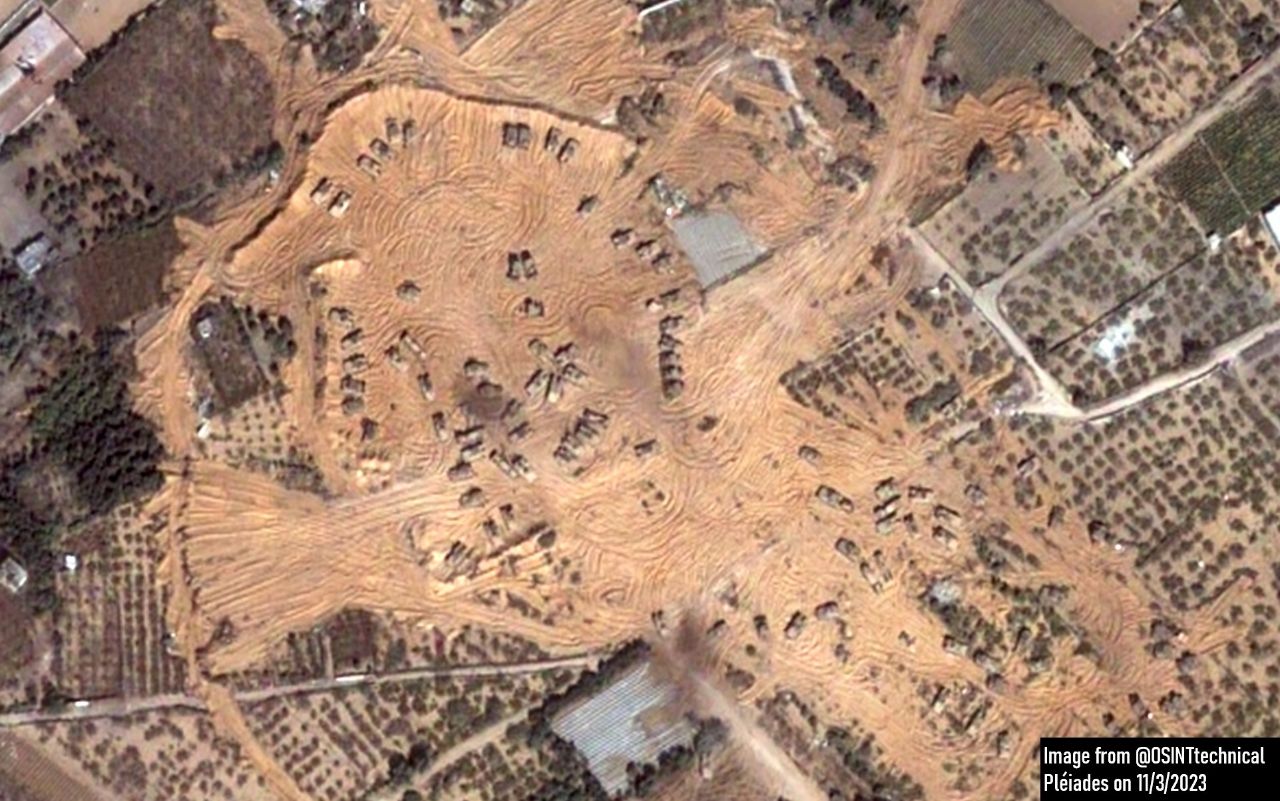
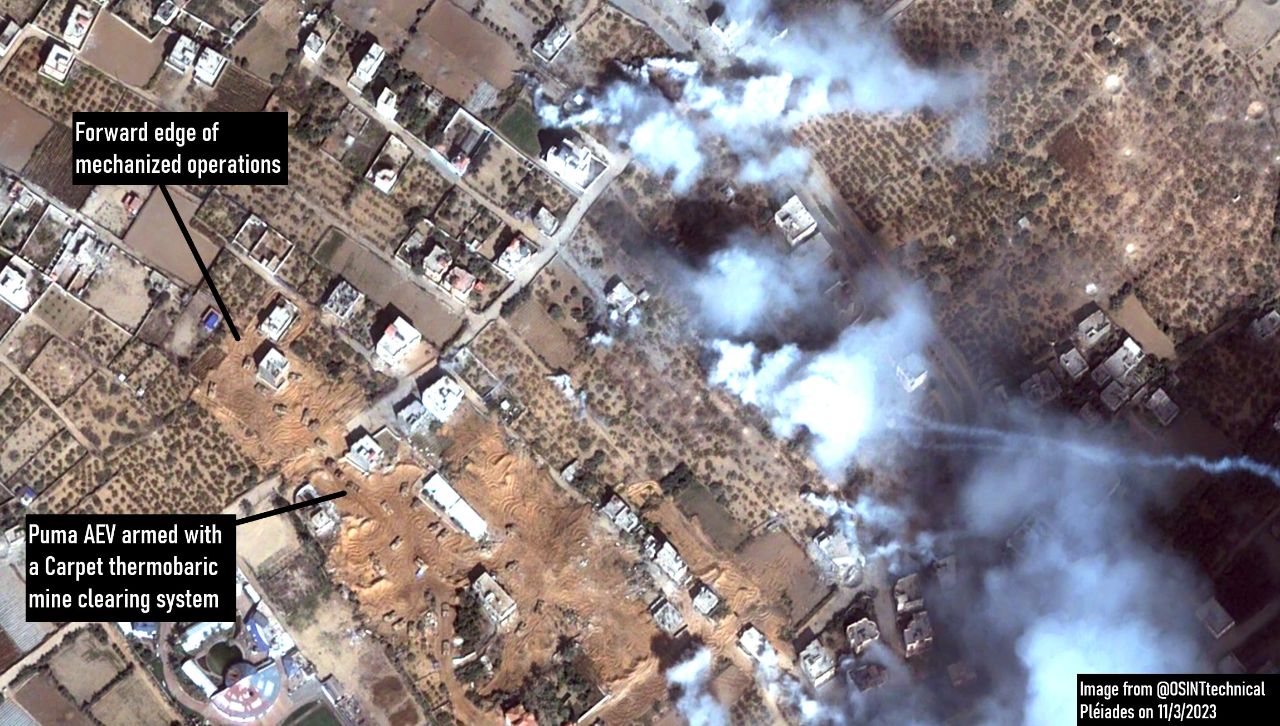
It seems that the Israeli army’s strategy in this area is to first clear the routes of any mines or bombs planted by Palestinian resistance with D-9 bulldozers, and then advance tanks and military vehicles towards the Mediterranean coast.
Additionally, every half-mile, a large circular earthwork is built as a stronghold for tanks and armored vehicles.
Satellite images of the advancing path of the Israeli army and the construction of circular embankments in the central front of the Gaza Strip
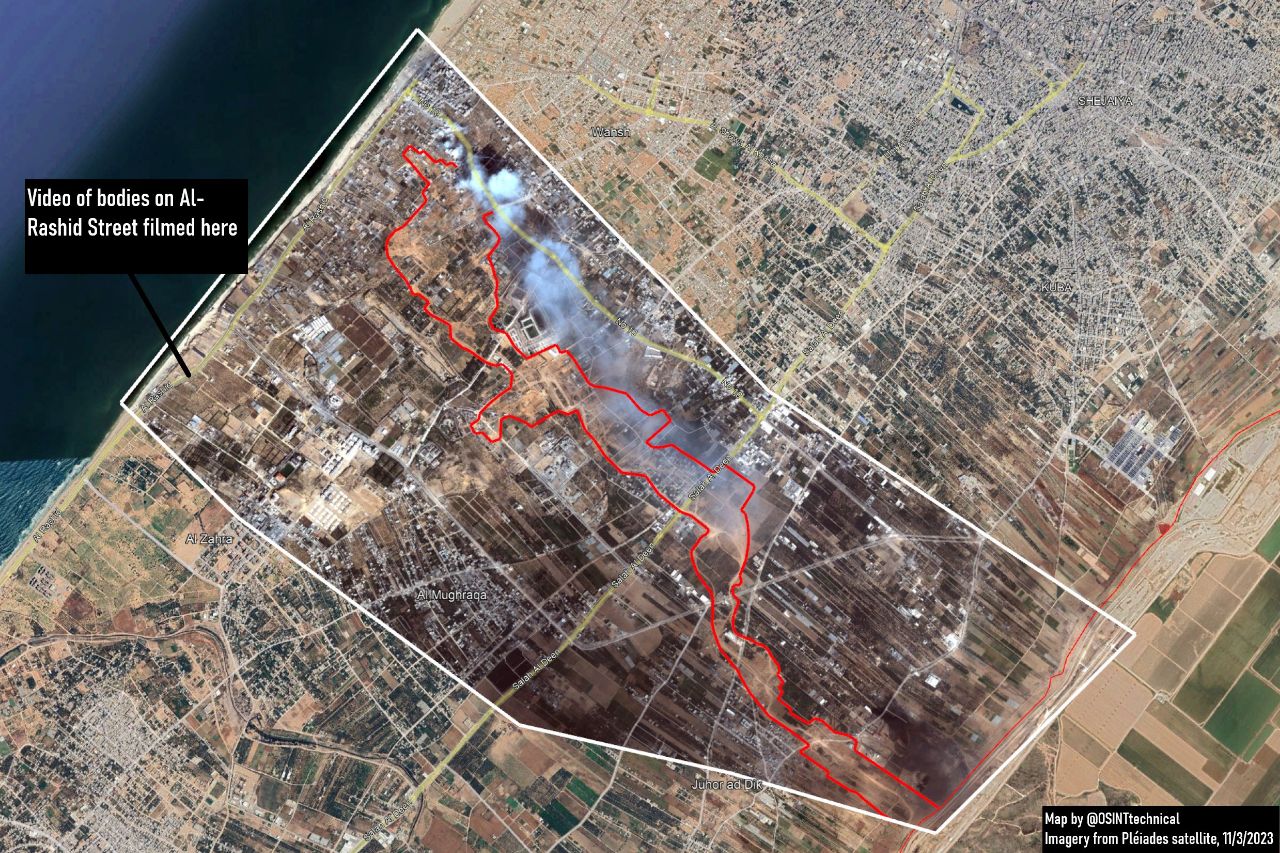
The satellite images also show the Israeli army’s advancement with D-9 bulldozers and armored vehicles towards the coast, as well as the location of the recent massacre of several Palestinian civilians by Israeli soldiers on Al-Rashid Street.
Satellite images of the advance of Israeli bulldozers and armored vehicles, as well as the massacre site of Palestinian civilians in Al-RashidStreet.Video: The killing of Palestinian civilians in Al-Rashid Street by the Israeli army
Overall, Israel’s movement in the central front of Gaza is fragile, and Palestinian resistance can not only launch hit-and-run attacks but also launch a heavy counter-attack from the southern axis of Juhar al-Dik and southern Al-Zaytoun district to besiege Israeli forces in the southeast of Gaza City.
However, this counter-attack requires sufficient forces and weapons, readiness to withstand heavy airstrikes, and diverting the attention of the Israeli army to other fronts, especially the Lebanese front.
Therefore, joint operations with Lebanon’s Hezbollah as well as missile and drone attacks by resistance groups in Iraq and Yemen can pave the way for the implementation of the resistance’s counter-attack in the central and northern fronts of Gaza.
The latest military situation in the central and northern fronts of the Gaza Strip- click to view in full size
On November 3, the Islamic Resistance of Iraq announced an attack on Israeli positions in the area of Umm Al-Rash in the city of Eilat, in the south of Palestine.
The statement said: “In order to help and support the people of Gaza and in response to the crimes committed by the usurping regime against Palestinian civilians, including women, children and the elderly, the fighters of the Islamic resistance of Iraq this morning attacked a point in Umm al-Rash area in the city of Eilat.”
This is the second attack by the Iraqi resistance group on Israeli sites in recent hours. Last night, the Iraqi Islamic resistance attacked one of the Israeli positions near the Dead Sea in east of Palestine.
On the 27th day of fighting in Palestine, clashes between Palestinian fighters and Israeli army continued inside the Gaza Strip. The Zionist regime army continued its advance in the south of Al-Zaytun neighborhood in the south of Gaza City under the heavy air cover and reached Al-Rashid Street on the Gaza shore. Therefore, the southern routes of Gaza City were blocked and the siege of Gaza City was completed.
In the north of Gaza City, clashes continue in Al-Tawam(Toam) and Al-Karamah areas and near Al-Nasr Street. Also, clashes continue around Beit Hanoun. The advances of the Israeli army in these areas are very slow.
In general, most of the Israeli advances have been made in low-density and non-urban areas. The regime’s advances in urban and densely populated areas such as Beit Hanoun and Al-Tawam are carried out with difficulty. Therefore, it must be said that the main war, which is the urban war in Gaza city, will be very costly and harsh for Israel.
In addition to Israel’s ground attacks, the heavy bombardment of various areas of the Gaza Strip continues. The Palestinian Ministry of Health announced that the number of martyrs in Gaza has increased to more than 9257 people, of which more than 3826 are children and 2405 are women. Also, more than 23,516 have been injured.
On the northern front, artillery duels continue between Hezbollah and Israel, and no specific changes have been made in the front lines. An important event in this axis is Hezbollah’s use of suicide drones. For the first time during the last 27 days of fighting, Lebanon’s Hezbollah used two suicide drones to target Israeli positions in southern Lebanon. The use of suicide drones will open another page of battles in the southern fronts of Lebanon.