The regime’s army declared the establishment of a new unit in the occupied Golan Heights region and said that this unit possesses a special expertise in field operations and respond to various threats immediately.
According to the Israeli army, the unit tasked with patrolling the Golan Heights is a regiment composed of highly skilled forces specialized in ground operations and is under the command of the Golani Brigade. This unit is planned to respond to existing threats in this area by gathering intelligence and neutralizing enemy operations as soon as possible.
This this unit’s forces conducted training exercises, including ambush, navigation, etc., in recent days, and finally, after an official ceremony, which was held at Mount Hermon, also known as Jabal El Sheikh, it kicked off its mission in that region.
The Yemeni Armed Forces targeted the heart of occupied Palestine, namely Tel Avi, on September 15 by launching a missile, and the air defense systems of the Israeli regime failed to intercept the Yemeni missile in spite of numerous attempts.
The missile strike dealt a noteworthy shock to the political and military authorities of the Tel Aviv regime, and this issue has its roots in several fundamental factors:
1- The failure of repeated endeavors to intercept the missile: Given the fact of the state of readiness of the regime’s army and their expectations for a Yemeni response to their crimes, as well as the multiple endeavors made by the Israeli army’s air defense systems to intercept, the missile pounded the heart of occupied Palestine. This failure is part of a series of failures that started with an intelligence failure on October 7, 2023 and came to an end with another failure to counter the suicide drones fired by the Lebanese resistance movement Hezbollah that targeted espionage facilities in Galilee mountainous region in northern Israel (according to Al Mayadeen TV channel).
2- The material damage is not the main objective: In this case, the fallouts and material damages are not of great significance and are not the main objective of these strikes; rather, the most important goal is to challenge the air defense systems of the regime and disrupt the balance of power. What happened on Sunday deepens the confidence crisis in the military establishments and air defense systems of the Israeli army, when it comes to countering more severe and serious threats such as potential strikes from Iran and other Islamic resistance factions.
3- The timing of the Yemeni army’s strike was very vital: Firstly, this missile attack happened almost simultaneously with Israeli Prime Minister Benjamin Netanyahu’s announcement regarding the expansion of military operations and confrontations in southern Lebanon, which is indicative of the possibility that a response to any escalation of tensions in the Arab country could lead to an all-out warfare on several fronts within the framework of the strategy called the “Unification of the Arenas.” Secondly, the missile strike coincided with the departure of the United States’ aircraft carrier Theodore Roosevelt from the west Asia region, indicating that the timing was not unplanned but carefully chosen.
4- The crisis of trusting in the Israeli regime’s cabinet: The incumbent cabinet finds itself in a very embarrassing situation in front of the public opinion. The level of trust among the Israeli settlers in the political system and military apparatus of the regime is constantly declining, and for this reason, the regime resorted to propagate an account that aligns with the images and documents released, but it could not be effective in lessening the constant stresses of the settlers. The deterioration of security situation within the occupied Palestinian territories reinforces the feeling of insecurity among Israeli settlers in various areas, whether in the northern or southern front, or even in the heart of Tel Aviv and the occupied West Bank. The atmosphere that is taking shape inside the occupied territories is founded on the fact that the continuation of the current circumstances darkens the future for the settlers and fills it with threats from everywhere.
5- The deterrence of the regime has been challenged: Recent developments have raised fundamental questions among the residents of the occupied Palestinian territories concerning deterrence capabilities of the regime. Hezbollah put forward a threat and then implemented it, just as what Iran, Iraq, and Yemen have done in recent weeks and months, and resistance fighters in the Gaza Strip have shocked the regime in multiple occasions. These strikes cause doubts about the deterrence equation, which was raised by Israeli authorities. The issue paves the ground for the possibility that every time the enemy threatens and carries out an attack, the other side feels an obligation to respond to it.
6- The humiliation of Israeli military industries: The Yemeni Armed Forces’ hypersonic missile covered a distance of 2040 kilometers in 11.5 minutes in its journey to reach its target in Tel Aviv. This missile successfully hit its target despite numerous efforts and multiple firings of the Israeli regime’s defense systems, including the Arrow (Hetz) defense system. The embarrassing event may negatively affect the rank of the Israeli regime in the arms export markets, as purchasers may reconsider procuring defense systems from the regime following this failure.
The missile strike by the Yemeni army on the heart of the occupied territories of Palestine is a significant incident in the ongoing war, which creates unprecedented challenges for Israeli officials in terms of public trust and crisis management amidst the lack of cohesion on the internal front.
On September 17, local news sources reported a security incident in the Lebanese capital city Beirut and declared that numerous people were seriously injured during the incident.
Minutes after the incident, similar reports were published from other areas of Lebanon, including the Beqaa Valley, and even in the Syrian capital city of Damascus, indicating that the pager (wireless telecommunications) devices exploded almost at the same time for unknown reasons, injuring numerous people.
The Lebanese National Security Agency announced in a statement that wireless telecommunications devices of various types blew up in some areas of the Arab country, injuring a number of citizens.
Images published by local sources
According to the latest statistics, at least 12 people, including two Lebanese children, were martyred and almost 2,800 others were injured in the deadly incident. Around 200 injured are reported to be in critical condition.
Fatima Jafar Abdallah, a Palestinian child who was murdered by a pager explosion in a house in the town of Sarein, Lebanon.
Iran’s Ambassador to Beirut Mojtaba Amani was also injured in the hand and face as a result of the explosion of the pager of one of his bodyguards. The Iranian envoy is in good condition and is undergoing treatment in Beirut.
At least four people were injured when a pager exploded in a car and were taken to medical centers in the Syrian capital city of Damascus.
Contrary to the allegations propagated by some media outlets, it was not only fighters affiliated with the Lebanese resistance movement Hezbollah who were targeted during the terrorist pager operation in Lebanon. Many of the guards of residential complexes, park rangers, etc. who used pager devices to monitor residential centers as well as environmental preserved areas, were also injured or martyred during the terrorist attack.
The moment a pager explodes
In this context, Hezbollah issued a statement in early hours of the incident, declaring that at around 15:30 Tuesday (local time), a number of message-receiving devices known as pagers, which were used by a number of fighters of different units and institutions of Hezbollah, blew up, in which a young girl and two fighters were martyred and many others were injured.
The competent institutions in the Lebanese resistance movement are now carrying out extensive security and scientific investigations in a bid to find out the causes of the pager blasts at the same time, as well as medical and healthcare staff are also treating the wounded in a number of hospitals in different areas of Lebanon.
Thus far, there has not been details on how the pagers were detonated, but it is obvious that the main culprit in the terrorist incident is the Israeli regime. Initial investigations show that the attack was the result of explosives planted in a great number of pagers. It is conceivable that the stages of the purchase of the pagers was identified by the Tel Aviv regime and sabotage took place before the telecommunications devices reached the hands of Hezbollah fighters.
The Lebanese resistance movement declared in its second statement that following prudently examining all the aspects, data and available information about the brutal aggression that took place on Tuesday evening, Hezbollah holds the Israeli regime fully responsible for this criminal pager attack, which targeted civilians in addition to the military personnel, and led to the martyrdom of several people and the injury of a large number of people; therefore, the traitorous and criminal enemy will definitely be punished for such a brutal aggression.
The US air defense systems reportedly intercepted all drones.
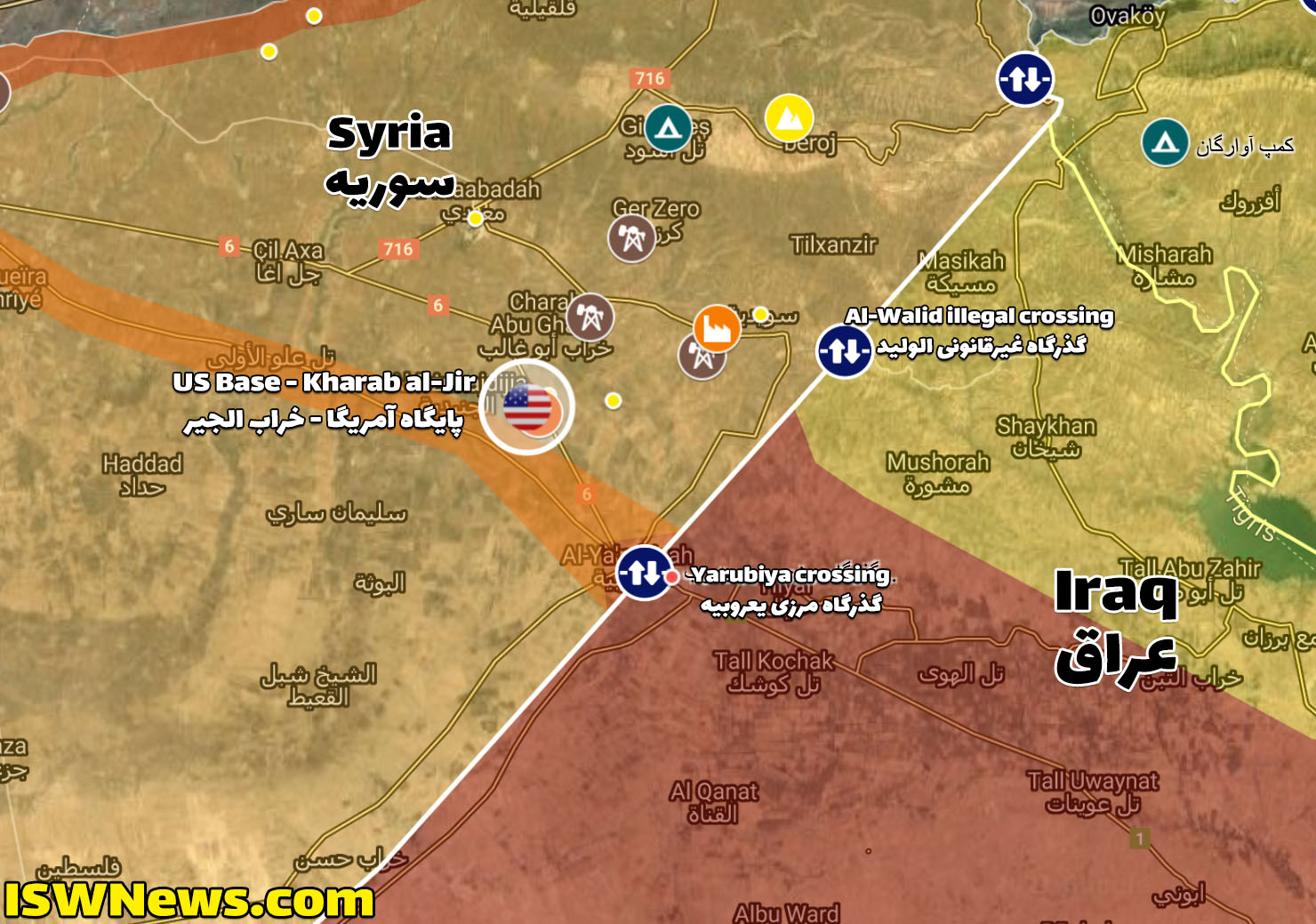
The last attack on this base was on August 10. The attack led to a massive fire in or around the base.
According to investigations made by the ISWNEWS, this is the 17th attack on US military positions at Kharab al-Jir base since the start of the war in the Gaza Strip.
The resistance forces have carried out military operations against the United States and the Israeli regime in response to the genocidal war and siege on Gaza.
The resistance groups emphasized that they will continue these attacks to force the Israeli regime and its staunch ally (the US), which supplies the regime with arms and ammunition, to stop killing innocent people in the besieged strip.
The IRI statement said: “To help and support the people of Gaza and in response to the crimes committed by the usurping regime against Palestinian civilians, including women, children, and the elderly, the fighters of the Iraqi Islamic Resistance attacked Haifa with a suicide drone. The Islamic Resistance emphasizes that the operation to destroy the enemy’s bastions will continue at an increasing pace.”
This is the 144th attack of the Iraqi resistance against the positions of the Israeli regime after the onset of the genocidal war on Gaza.
The Islamic Resistance in Iraq carried out tens of attacks on the Israeli-occupied territories as of April 25, 2024.
The Iraqi resistance group along with other resistance movements in Lebanon and Yemen have called for the end of Israeli aggression against the Gaza Strip and the delivery of aid into the besieged area.
In a statement, Brigadier General Yahya Saree, the spokesman of the Yemeni army announced the destruction of an American MQ-9 drone in the airspace of Dhamar province.
“The American drone was carrying out a hostile mission against Yemen when it was shot down by a surface-to-air missile by the Yemeni army,” he added.
The Yemeni armed forces released a video of the moment a surface-to-air missile hit the US Army’s MQ-9 drone in the sky of Dhamar province.
Brigadier General Yahya Saree emphasized the continuation of the operation in support of Palestinian people and said that these operations will only stop if the aggression and siege of the Palestinian people in the Gaza Strip is stopped.
This is the third MQ-9 drone to be shot down in the past few days. The downed drone is the 10th MQ-9 drone shot down since October 7, and in total, this is the 14th MQ-9 downed during the Yemeni war.
According to what Israelis published, the Yemeni missile landed in the Kfar Daniel area. Kfar Daniel is located 7-8 kilometers southeast of Ben Gurion Airport.
Ben Gurion Airport is the largest Israeli airport, and most of the US weapons aid is delivered to the Zionists at this airport. So it is safe to say that the target of this attack was Ben Gurion Airport.
Kfar Daniel 7-8 kilometers southeast of Ben Gurion Airport.
In a statement, the Yemen’s military spokesman Brigade General Yahya Sarea announced that the group launched a new type of hypersonic ballistic missile at a “military target” close to the city of Tel Aviv in support of the Palestinian enclave of the Gaza Strip, noting that Israeli air defense failed to intercept the missile.
The missile crossed a distance of 2,040 kilometers within 11 minutes and 30 seconds, the spokesman said, adding that the attack “caused a state of fear and panic among the Zionists, as more than two million Zionists headed to shelters for the first time in the history of the Israeli enemy.”
Based on the information stated by Brig. Gen. Saree, the missile traveled at a speed of 10,643 kilometers per hour, or just over Mach 8,6
The area that missile landed in Kfar Daniel near Tel AvivVideo surfaced online showing the impact area
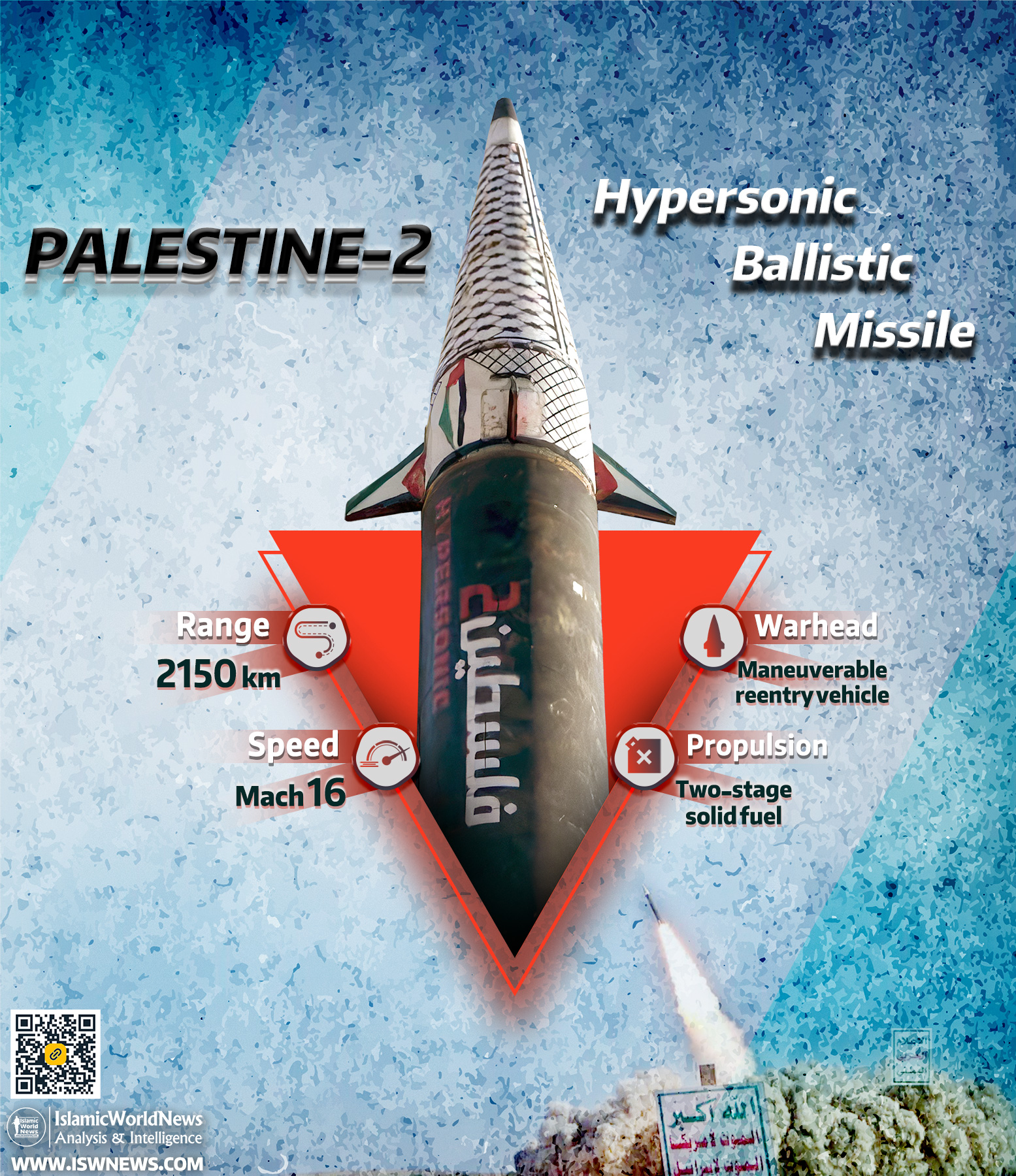
The Yemeni army released the video and pictures of the Palestine-2 missile for the first time, while unveiling this missile, it announced that it used this missile in the attack on Tel Aviv.
According to the information announced by the Yemeni armed forces, the “Palestine 2” missile has a range of 2,150 kilometers and is a two-stage solid fueled missile.
A video of the moment when the Palestine 2 missile was fired towards Tel AvivPalestine-2 missile
A military probe was also launched by Israeli army to ascertain why the Yemeni missile was not intercepted before it reached Israeli airspace, or whether it was in fact intercepted, either fully or partially.
As a result of the initial investigation, the Israeli army announced that one of the Arrow system missiles hit the incoming missile, but it did not destroy the missile completely. The Israeli Air Force officially confirmed that the attempt to intercept the Yemeni missile failed because it did not destroy it completely. The Israeli army denied that the missile was hypersonic.
Since the outbreak of the Israeli aggression on Gaza last October, the Ansar Allah-backed Yemeni army (AKA Houthis) have been waging a military campaign against Israel, targeting merchant vessels linked to the regime and launching direct strikes against the occupied territories using suicide drones and missiles.
Late on July 19, a suicide drone launched by the Yemeni army hit a building near U.S. Embassy office in Tel Aviv, killing a man and wounding several others. In response, Israeli warplanes with the help of US, launched deadly strikes against civilian targets in the western Yemeni city of Al Hudaydah.
Israel will likely respond to the new missile attack in Tel Aviv; However, it is highly unlikely that the strikes will affected the Yemeni army’s capabilities.
Yemen’s missile attack on Tel Aviv is an important warning to Israel: The Arrow anti-ballistic systems and David’s Sling defense systems used a total of more than 20 interceptor missiles to counter the Yemeni hypersonic missile, but failed. Tel Aviv is no longer safe!
According to reports published by US media outlets citing sources in the United States Department of Defense (Pentagon), Yemeni militant groups allied with the US discovered the crash site of one of the MQ-9 drones in Marib Governorate, located in the northeastern part of the Republic of Yemen, and handed over its wreckage to representatives of the United States in the Arab country.
The provincial capital city of Marib is under the control of militant groups from the Al-Islah Party (Yemeni Congregation for Reform) as well as forces loyal to Major General Sagheer Hamoud ِAhmed Aziz. Both groups are under the command of the resigned Yemeni government and the Saudi-led coalition.
It is still unclear which one of these factions have cooperated with the US in this respect, but the major general is in direct contact with American advisors and diplomats in Yemen.
It is worth noting that spokesman for the Yemeni Armed Forces Brigadier General Yahya Saree announced that the Yemeni army succeeded in shooting down two US drones in Yemen last week, one of which fell in Marib Governorate.
This is the second MQ-9 Reaper, which was detected and demolished in the skies over Marib, and the handed-over wreckage is expected to be related to the last one, which was downed in this region.
The Yemeni Armed Forces have so far shot down 13 US MQ-9 UAVs in the airspace of the Arab country.
Commander of the Islamic Revolution Guards Corps (IRGC) Aerospace Force Brigadier General Amir Ali Hajizadeh confirmed that the Chamran-1 satellite was launched into the 550-kilometer orbit with the Qaem-100 space launch vehicle and was placed in orbit round the earth with the help of a three-stage launcher at a speed of 7.5 kilometers per second.
The launch moment of Qaem 100 SLVInjection of Chamran-1 hexagonal satellite into 550 km orbit
The Chamran-1 research satellite was designed and manufactured by the space department of the Iran Electronics Industries (SAIran) in collaboration with the Aerospace Research Institute (ARI) of Iran as well as Iranian knowledge-based private companies active in this field.
The home-grown satellite weighs nearly 60 kilograms, and its main mission is to examine hardware and software systems applied to it in order to validate its orbital maneuvering technology at the desired altitude and stage.
Chamran-1 satellite
The solid-fuel Qaem-100 space launch vehicle, which succeeded in placing the Chamran-1 satellite in orbit during its third orbital operation, had four space-related launches to date as follows:
Suborbital launch without a payload (November 5, 2022) Failed orbital launch of the Nahid-1 satellite (March 4, 2023) Successful orbital launch of the Soraya satellite (January 20, 2024) Successful orbital launch of the Chamran-1 satellite (September 14, 2024)
Palestine-2 hypersonic missile, is a two-stage solid-fueled missile with a speed of Mach 16, and its warhead is capable of maneuvering inside atmosphere.
The Palestine 2 missile is Yemen’s adaptation of the Iranian Kheibar Shekan 2 missile. To enhance its capability to strike deeper into Israeli-occupied territories, Yemen has reduced the missile’s warhead weight and extended its range to 2,150 kilometers.
Palestine-2 missilePalestine-2 missile
In general, the Palestine and Hatem class missiles of the Yemeni army are derived from the Iranian Kheibar Shekan 1 and 2 missiles.
The Hatem 1 and 2 missiles have a three-cone warhead similar to the Iranian Kheibar Shekan-1 missile, and the Palestine 1 and 2 missiles have a single-cone warhead derived from the Iranian Kheibar Shekan-2 missile.
The range of the Palestine-1 missile is 1,800 kilometers, like the Iranian Khaybar Shekan-2. However, the range of the Palestine-2 missile has been slightly increased to about 2,150 kilometers.
Khaybar Shekan 1Khaybar Shekan 2Iranian Khaybar Shekan 1 and 2
As to the military operations of the Kataib Sayyid al-Shuhada, Al-Walai said that the first phase of their assaults in support of the Gaza Strip kicked off with strikes on US bases inside the Iraqi territories, which proved to be effective.
“By God’s grace, the resistance fighters managed to disable much of the US’s military bases in Erbil Governorate and al-Harir town. The second phase of these attacks involved pounding positions in occupied territories of Palestine, during which the fighters targeted power plants and ports in the cities of Ashdod and Haifa. The third stage commenced with joint operations alongside the heroic fighters of Yemen, as noted by Leader of the Ansar Allah movement Sayyid Abdul-Malik al-Houthi”, he said.
Al-Walai also emphasized that arrangement is underway for the implementation of the fourth phase of the attacks, which will involve more coordination to pave the way for operating on multiple fronts.
The secretary-general of the Kataib Sayyid al-Shuhada also highlighted the Iraqi resistance’s participation in the Battle of Promised Conquest, noting that they succeeded in coordinating endeavors across various fronts, and launched missiles and drones at their targets at the same time.
Describing the recent developments in the Red Sea and the Mediterranean Sea as astonishing for the world public opinion, he asserted that the foes are struggling to cope with the fiery front in and around Yemen.
Al-Wala’i voiced pride in serving under the Ansar Allah movement leader, adding that Hamas’ Izz ad-Din al-Qassam spokesman Abu Obaida and the Yemeni Armed Forces’ Spokesman Brigadier General Yahya Saree are considered as the role models for youth and children in Iraq.
The Iraqi commander also admired the massive gatherings of the Yemeni people in support of Palestine, and emphasized that the slogans of the Yemeni demonstrators are a source of encouragement for the fighters on the Islamic resistance front.
It is noteworthy that fighters of the Iraqi resistance groups as well as the Yemeni Armed Forces carried out eight joint assaults against the positions of the Israeli regime’s army in occupied Palestine and the Mediterranean Sea only in one month (June 6 to July 8), which exerted remarkable pressure on the ports of occupied Palestine and Israeli-affiliated vessels in the Mediterranean Sea.
According to local Yemeni sources, divisions of the Dar al-Watan forces, who are affiliated with Saudi Arabia, have started entering the desert of Al-Jawf Governorate in northern Yemen to take control of the border military sites between the war-torn country and Saudi Arabia.
The Yemeni sources also confirmed that the process of replacing Al-Dara’ al-Watan forces with armed members of the Al-Islah Party (the Yemeni Congregation for Reform) is part of a security plot, which also comprises the city of Marib that is the headquarters of the Al-Islah Party.
The plan for deploying Al-Dara’ al-Watan forces in Hadhramaut, Al-Jawf, Marib, and Shabwa governorates reflects the Saudi kingdom’s attempt to dominate Yemen’s oil-rich regions prior to achieving any potential political accord.
Al-Dara’ Al-Watan (Nation Shield) forces are militants, who formed in November 2022 with the support of Saudi Arabia to pursue its plans in Yemen.