Category: West Asia

  • 28 years ago today – Iran Air Flight 655 massacre, US navy murder 290 Iranians including women and children

    28 years ago today – Iran Air Flight 655 massacre, US navy murder 290 Iranians including women and children

    On July 3, 1988, Iran Air Flight 655 (IR655) was shot down by USS Vincennes which led to the loss of life of 290 innocent civilian from six nations including 66 children. There were 38 non-Iranians aboard.

    Flight 655, as a commercial flight, operated by Iran Air that flew on a Tehran-Bandar Abbas-Dubai route. While flying in Iranian airspace over Iran’s territorial waters in the Persian Gulf on its usual flight path, it was destroyed by the guided missile cruiser USS Vincennes.

    This attack ranks tenth among the deadliest disasters in aviation history, the incident retains the highest death toll of any aviation incident in the Persian Gulf and the highest death toll of any incident involving an Airbus aircraft anywhere in the world.


    According to the United States Government, the crew mistakenly identified the Iranian Airbus A300 as an attacking F-14 Tomcat fighter. Contributing to the error was the fact that the aircraft did not respond to several inquiries to change course and did not identify itself clearly as civilian. The Iranian government maintains that Vincennes neglectfully shot down the civilian aircraft. The event produced a great deal of dispute and criticism of the United States. Several analysts have blamed U.S. military commanders and the captain of Vincennes for irresponsible and aggressive behavior in a tense and dangerous environment. The airliner was transmitting an identification friend or foe code for a civilian aircraft, but Captain William C. Rogers III in an interview insisted that he believed the code alone did not mean the aircraft was non-hostile. Captain Rogers described the attack as a self-defense measure to save his ship and the lives of the crew.

    While issuing notes of regret over the loss of human life, the U.S. government has, thus far, neither admitted any wrongdoing or responsibility in this disaster, nor apologized, but continues to blame Iranian hostile actions for the event. The crew of the Vincennes were all awarded combat-action. ​

    More than two decades later, the attack continues to pervade Iranian social psychology and fuel the strategic thinking of its military leadership. Many Iranians remember the event with a bitter sense of vulnerability. A foreign government, the United States, which was not in war with them, used brutal and lethal force against Iranian civilians.

    For those with a longer memory span, it’s hard to dismiss some of these concerns especially when you recall that the irresponsible behavior of the USS Vincennes commanding officer earned him the Legion of Merits, “a military decoration of the United States armed forces that is awarded for exceptionally meritorious conduct in the performance of outstanding services and achievements.” For many Iranians, this is utterly incomprehensible.

  • Behind the Scenes at the Saudi-Qatari Rift

    Behind the Scenes at the Saudi-Qatari Rift

    Saudi Arabia, with the bellicose support of President Trump, has launched a diplomatic and partial economic offensive against the ridiculously small state of Qatar and is dragging its allies, the United Arab Emirates in particular, into a potential major headache.

    You see the de facto capital of the Emirates is Abu Dhabi which uses Qatari natural gas to generate half of its electricity via the Qatar-Abu Dhabi-Oman pipeline. So if Qatar really felt threatened it would pull the plug, and at least for a month or so, challenge the very survival of Abu Dhabi, for how many Emiratis let alone expats
    would be able to last +40c/105f temperatures without electricity?

    The Emirates capital city would have to import Liquified Natural Gas (LNG) which it doesn’t have the infrastructure prepared for as well as convert its electrical generators to LNG from natural gas, something that could take over a month to get up and running, no matter the $Billions the Emirates have to throw at the problem.

    So the Saudis picking a fight with their long time villains, the Qatari’s, could crash the Emirates economy and put a serious strain on the so called “coalition of the willing”, that is those still committed to the quagmire in Yemen and its assorted crimes, another source of strain between the two allies.

    The Emirates hate the Qatari’s, not without reason, and we know that the Emirates foreign legion has been concocting nasty plans against them in league with a pro-Israel PR Hit Squad in the USA. Still, the Emirates are dependent on Qatari gas so the shit could really hit the fan if the young newly crowned Saudi Prince and de facto commander in chief steps over the line and provokes a Qatari response.

    Qatar and Iran, the “snake” that the Saudi’s so infamously wanted the CIA to cut the head off of, share the Pars natural gas field under the Persian gulf waters, the 3rd largest such in the world whose exploitation of has made Qatar the worlds largest natural gas exporter. If Qatar gets into a serious fight with Iran, which is what the Saudis are demanding, than the Qatari economy could hit the skids for Qatar only exports 600k barrels of oil a day, not nearly enough to sustain its international and domestic commitments.

    Reality is the Emirates have much more serious trade relations with Iran than Qatar. Oman on the other hand, has even closer economic and political ties with its ancient fraternal brothers and sisters in the land of the Persians and the Saudi’s aren’t attacking the Omanis, so why the pissing match with Qatar?

    Like I said, this animosity is nothing new just the latest flare up, for back in 2014 the Saudis led a break in diplomatic ties that lasted 8 months, and are now led by a much more hotheaded royal, in his early thirties and up until Trump, it seemed that the USA had abandoned the Saudis in favor of the nuclear deal with Iran, taking regime change off the table and leaving the Arabs on their own.

    These have been scary times for the Arabian peninsula tribes, leading to amongst other actions, the Emirates giving the UN Security Council and its sanctions against Eritrea, in other words the USA, the finger by building its new navy base and airfield in Assab, Eritrea.

    Qatar and the royal family of Saud, both installed by the British after WW1, have been at each others throats for many years now. We know thanks to Wikileaks the Qatari’s were pushing the Americans to engineer a coup against the Saudis while the house of Saud was trying to restore the grandfather of the present Emir, whose father deposed
    his own father in a palace coup and who was forced to abdicate to his son by the Saudis.

    The Saudis can’t militarily attack Qatar, not with the largest US military installation in west Asia and everyone knows it. The so called “economic blockade” of Qatar has failed so far with Turkey stepping in to provide everything Qatar needs.

    True, the Al Jazeera satelite television channel has been a finger in the eye of the Saudis and Emirates but AJ’s main viewer base in Africa, west and south Asia, over a billion people, is via the two main satellite channels, Arabsat and Nilesat. These free channels can be accessed by anyone for as little as $40 for a satellite dish and receiver and a television. Arabsat is owned by the Saudis and Nilesat by Egypt. They kicked the Iranian Arabic channel off just like the Europeans kicked off Iran’s PressTV from their satellite systems. So why is the anti-Qatar lot allowing Al Jazeera to continue to spew its attacks on them via the big two satellite channels they own?

    Why? Its a pissing contest, really, and other than pissing and moaning little of anything in the way of real conflict is going on. Maybe this will change in time but its hard to see the major powers internationally allowing this to get out of hand. The Saudis eventually will to try some face saving “compromise” and Qatar might have to eat some crow, but when all is said and done all of it will amount to little more than a urine stain on the political fabric on the Arabian PeninsulaPeninsulaPeninsulaPeninsula.

    Source:

    http://ahtribune.com/world/north-africa-south-west-asia/saudi-qatar-rift/1748-behind-the-scenes.html

  • Enemies of Islam want to create rifts among Muslims: Ayatollah Khamenei

    Enemies of Islam want to create rifts among Muslims: Ayatollah Khamenei

    Today, we have certain problems within the world of Islam. We are suffering from the bloodshed, and there are deadly confrontations today. Yemen serves as an example. These issues should receive more attention.

    The truth is that today, the Islamic Ummah is suffering from numerous problems. Certain wounds have been and continue to be inflicted upon the body of the Islamic Ummah. The deepest wound is the one caused by discord. Enemies of Islam are trying to create discord among Muslim groups with different methods. They want to create rifts and enmities among them, by means of ethnic and denominational differences, based on geographical disputes of territorial and border issues. Tools for carrying out these methods are available to them [those involved in disputes], and the enemy is, unfortunately, using them. We, officials of Islamic governments, have ignored this measure that the enemy has adopted.

    When I think to myself, I feel that we should be extremely concerned that some American congressman – who is opposed to the very essence of Islam, an enemy to Islamic countries – expresses his “concerns” about the problems of a Sunni community, pitting people against Shi’a. We should be ever more vigilant upon hearing such rhetoric. An enemy, who is opposed to the essence of Islam, has now expressed his support for a certain Islamic group against another! Is this anything other than malevolence, conspiracy and enmity? As it so happens, this behavior unfortunately exists. We should ponder on it; we should understand this ploy.

    All Islamic countries lose from discord, and all of them profit from unity. Unity among Islamic countries, their closeness to one another, and their refusal to use force against one another are merits that can be used to their own advantage; we should understand that these qualities are to the advantage of Islamic countries. This is a divine logic: it is Islamic logic. Unfortunately, this logic does not receive enough attention.

    Today, we have certain problems within the world of Islam. We are suffering from the bloodshed, and there are deadly confrontations today. Yemen serves as an example. These issues should receive more attention. The issues of Syria, the issues of Iraq, the issues of North Africa and, the numerous issues that one witnesses in the world of Islam are all signs of discord and conflict. These conflicts serve as a disadvantage towards Islam; moreover, this is a disadvantage for the entire Islamic Ummah. We should resolve these problem.

  • Trump lacks Syria strategy, risks confrontation with Russia and Iran, analysts say

    Trump lacks Syria strategy, risks confrontation with Russia and Iran, analysts say

    US President Donald Trump has ordered increased military operations in Syria and delegated more authority to his generals despite lacking a comprehensive strategy, an approach that may spark a confrontation with Syria, Iran and Russia, according to US officials and analysts.

    The United States has taken a series of military actions over the past three months against Syrian government forces and its allies, including the shoot-down of a Syrian jet on Sunday.

    In April, Trump ordered cruise missile strikes against a Syrian airfield from which Washington said a deadly chemical weapons attack was launched.

    Analysts say these incidents are tactical and not part of any military strategy in Syria.

    “There isn’t an over-arching US strategy driving this,” said Charles Lister of the Middle East Institute.

    “This is just the result of tactical decisions by a commander on the ground whose only focus is a specific theater in Syria. He is acting to protect his assets … This is purely a series of tactical decisions that are creating a series of very serious strategic consequences.”

    Russia and Iran are both assisting Syrian President Bashar al-Assad to fight Daesh (ISIL) and other terrorist groups wreaking havoc in Syria.

    The larger problem, the officials and analysts said, is that Trump and his national security team have not prepared a long-term political strategy for dealing with Syria.

    “We have never had a coherent Syrian strategy,” said one US official, speaking on condition of anonymity. “We oppose Assad, but our main enemy is ISIS, which also opposes Assad. Our most capable allies are the (Kurdish) peshmerga, but Turkey, who is a NATO ally and host to an airbase that is central to our efforts, considers the Kurds enemies.”

    US General Joseph Dunford, the chairman of the Joint Chiefs of Staff, said Monday the US is working to restore a communications line with Russia intended to avoid mid-air collisions over Syria, after Moscow cut it off following the US downing of the Syrian military jet on Sunday.

    The deconfliction arrangement was first established with Russia in 2015 to avoid unnecessary conflict and miscommunication in the military movements of US-led coalition and Russian forces in Syria.

    The Russian military involvement in Syria began in September 2015 after an official request by the Syrian government for military assistance against terrorist groups.

    Different foreign-backed terrorist groups have been wreaking havoc in Syria since 2011. Over the past few months, Syrian forces have made sweeping gains against Takfiri elements, who have lately increased their acts of violence across the country following a series of defeats on the ground.

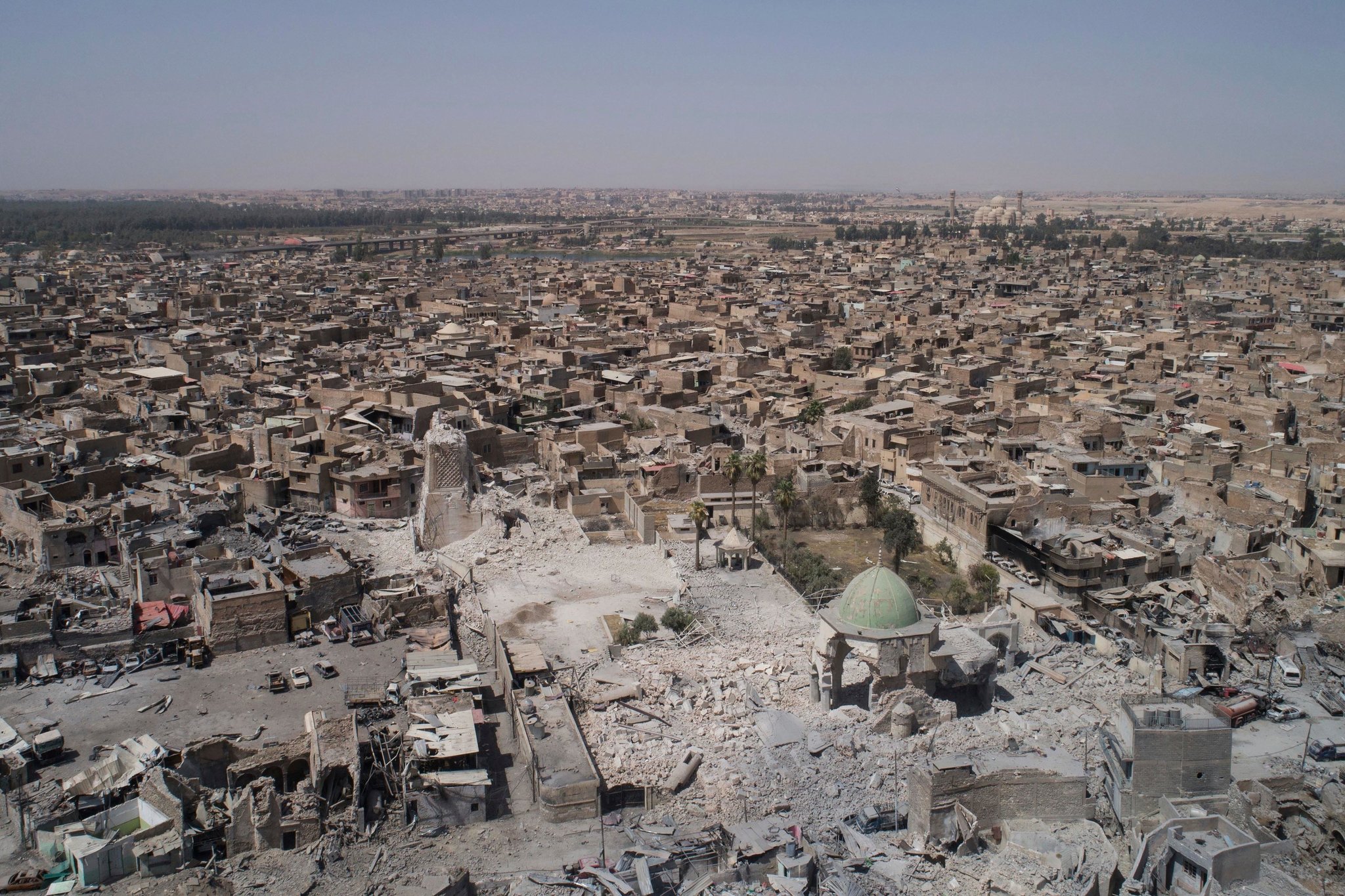
  • Iraq Recaptures Al Nuri Mosque in Mosul, but Only Rubble Remains

    Iraq Recaptures Al Nuri Mosque in Mosul, but Only Rubble Remains

    Prime Minister Haider al-Abadi of Iraq announced the recapture of Al Nuri Grand Mosque in Mosul on Thursday from Islamic State militants, calling it a sign of the end of the extremists’ grip on the region and vowing to chase them out of the country.

    “We are seeing the end of the fake Daesh state, the liberation of Mosul proves that,” Mr. Abadi said on Twitter, using the Arabic acronym for the Islamic State. “We will not relent. Our brave forces will bring victory.”

    Mosul has still not been entirely wrested from Islamic State control despite a complex eight-month battle for the city. But Thursday’s announcement signified a further push to eliminate the group.

    As Iraqi forces claim control of the mosque for the first time since 2014, all that is left is debris. The mosque’s distinctive leaning minaret dominated the skyline of Mosul’s Old City for nearly eight centuries, standing as a symbol of the city’s deeply rooted cultural heritage.

    An Iraqi special forces soldier moved toward the front line near the mosque during the battle against Islamic State militants. CreditFelipe Dana/Associated Press 

    The mosque complex is nearly gone, reduced to a pile of rubble on June 21, after Islamic State militants packed the building with explosives as their grasp on the city continued to slip.

    The iconic 12th century Al Hadba minaret is now just a stump, seen broken nearly to its base in footage released by Iraqi forces who entered the area where the mosque once stood.

    They assessed what remained as they stepped carefully through crumbling walls and climbed over debris that once made up one of the city’s grandest buildings.

    “This is the remains of the minaret, which was blown up by the terrorist gang,” said one official from Iraq’s counterterrorism service in a video released by the group.

    The intricate detailing on the minaret can be seen peeking out over crumbling debris, but its top is gone.

    “And this is the dome of the mosque, which was also blown up by the terrorist gang,” the man says as the camera cuts to a shot of the green dome that now sits precariously atop damaged walls. It is one of the few distinctive features of the building still visible amid the ruin.

    After the city was captured by the Islamic State in 2014, the mosque played a starring role in the group’s propaganda as it grabbed power in the region.

    It was the setting for a rare 2014 public speech by the group’s professed leader, Abu Bakr al-Baghdadi, in which he declared a caliphate and asserted control over Mosul. It was the last time he was seen publicly.

    The group’s notorious black flag has been flying from the top of the Al Hadba minaret since that summer.

    An Islamic State flag on top of Al Hadba minaret in March. CreditKhalid Al-Mousily/Reuters 

    Before the Islamic State seized control, the mosque was long a valued landmark the country sought to preserve.

    In 2012, Unesco identified the mosque’s minaret for assessment and preservation, after fears that its teetering posture could lead to collapse if measures were not taken. The local governorate had planned to work alongside local officials to ensure its survival. Last week, the director general of Unesco, Irina Bokova, lamented the loss of the building.

    “Al Hadba minaret and Al Nuri Mosque in Mosul were among the most iconic sites in the city, and stood as a symbol of identity, resilience and belonging,” Ms. Bokova said in a statement. “This new destruction deepens the wounds of a society already affected by an unprecedented humanitarian tragedy.”

    The Islamic State, also known as ISIS or ISIL, has been under an intensifying assault in Mosul and across Iraq’s western border with Syria, where the extremist group is losing its grip on Raqqa, its de facto capital for the past three years. Tens of thousands of civilians remain trapped in both cities.

    Unicef said on Thursday that thousands of children in western Mosul are stuck there because of the fighting.

    “Boys and girls who have managed to escape show signs of moderate malnutrition and carry psychosocial scars of the conflict,” Peter Hawkins, the Unicef representative in Iraq, said in a statement.

    Aid groups that have been helping displaced civilians in Syria and Iraq expressed strong caution about the Iraqi prime minister’s victorious proclamation. They emphasized that the fighting in Mosul was by no means over.

    The International Rescue Committee, which responds to the most urgent humanitarian emergencies in more than 40 countries, said in a statement that as many as 1.5 million Iraqis have been unable to escape Mosul, and that at least 150,000 people, half of them children, still live in other areas of Iraq controlled by the Islamic State.

    “The retaking of Mosul does not mean an automatic end to the suffering of the 1.5 million people that spent more than two years living under harsh ISIS rule,” said Wendy Taeuber, the International Rescue Committee’s Iraq director. “Despite the declaration, ISIS still controls some areas in the Old City of Mosul and ongoing fighting will continue to threaten the lives of civilians.”