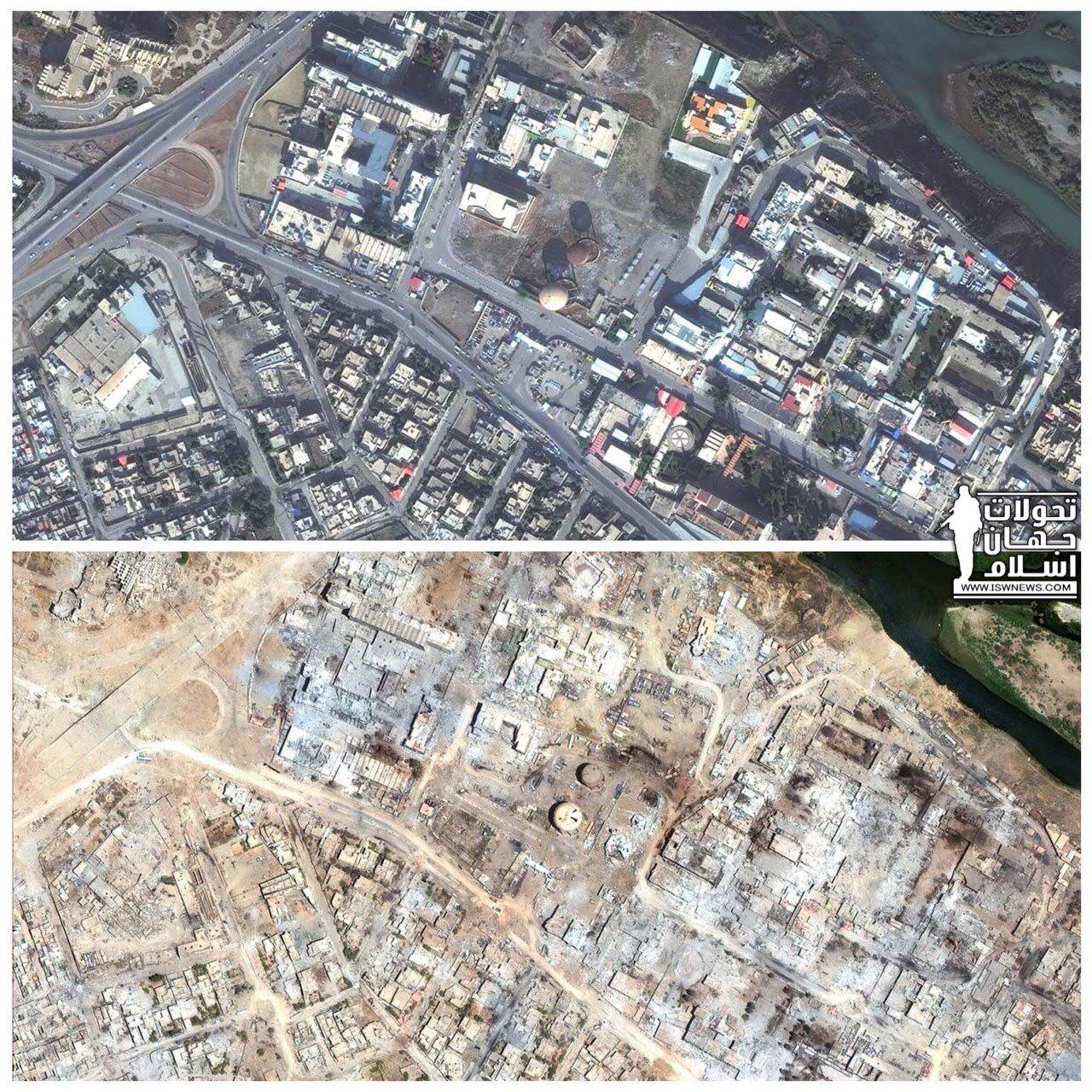
Mediaire link : Download
Category: West Asia
-
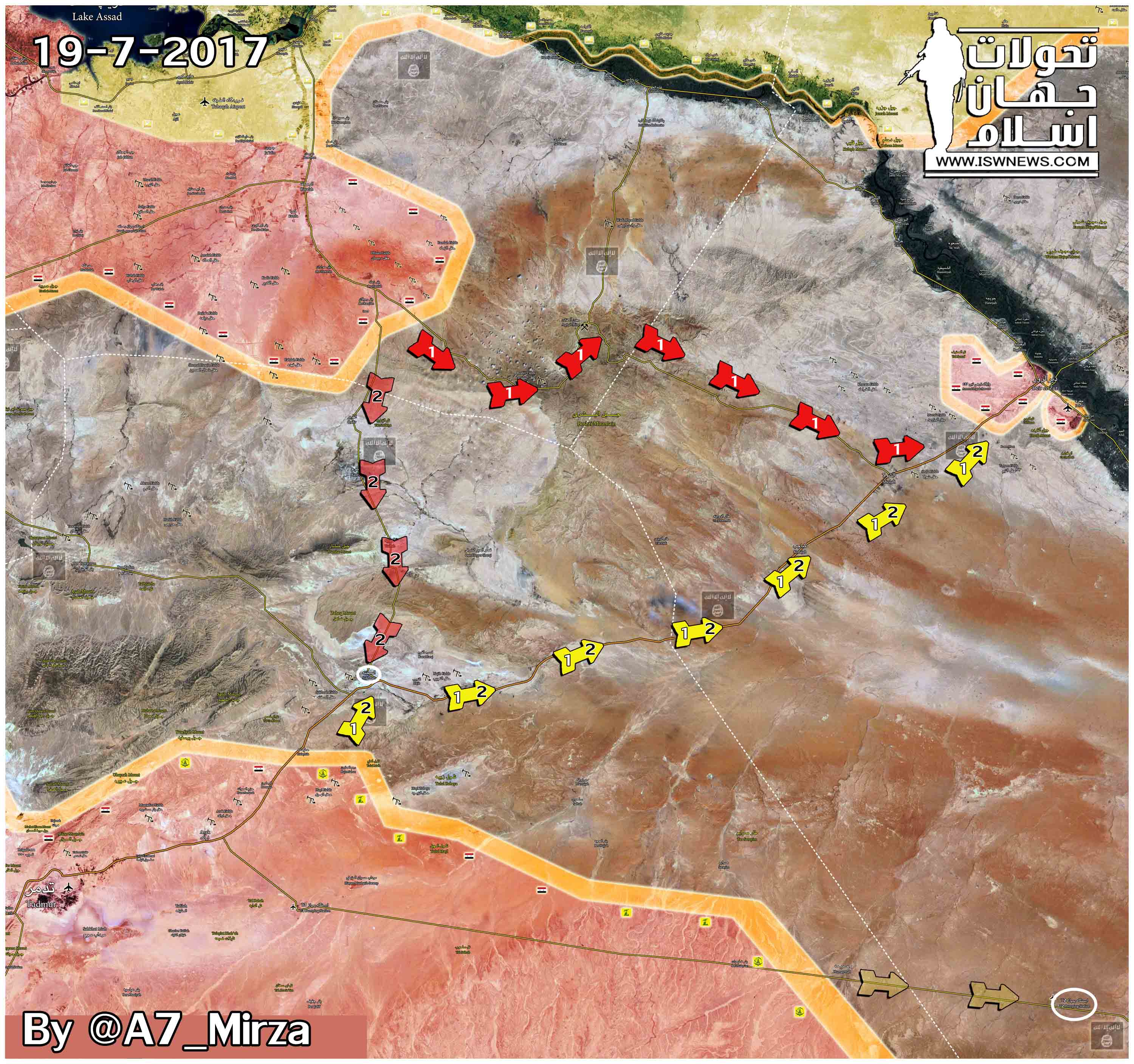
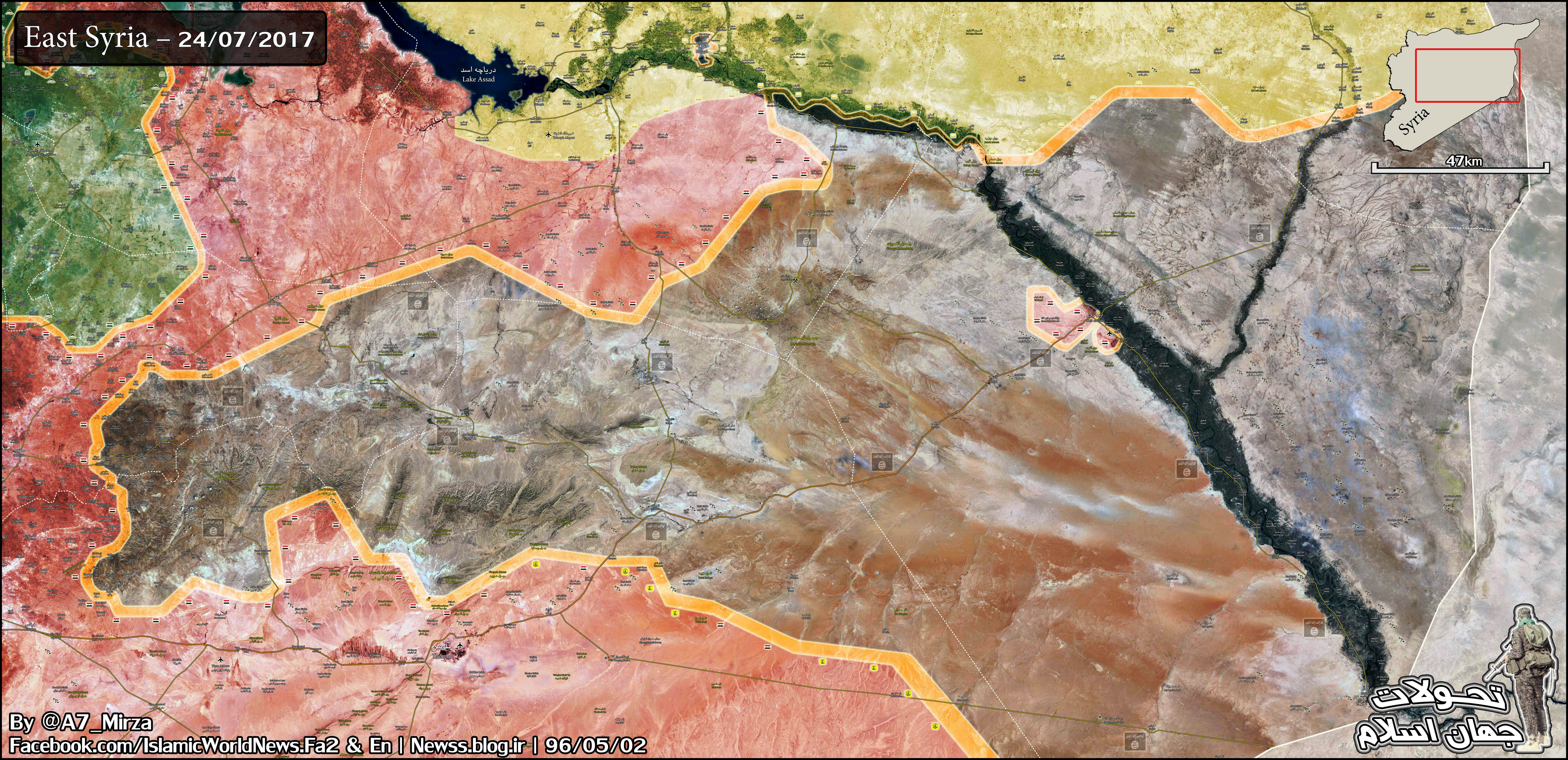
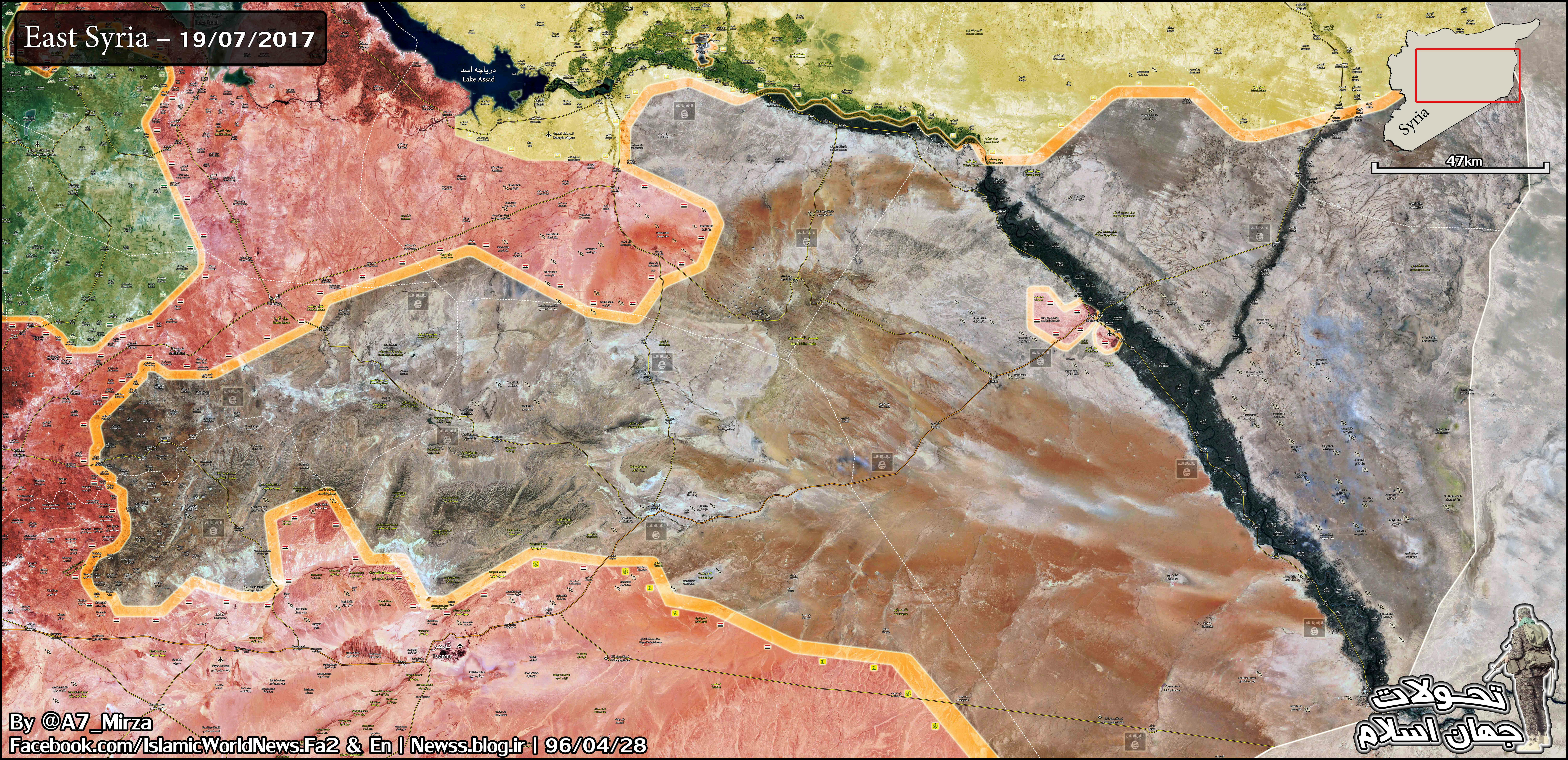
Latest progress by Syrian army in eastern Syria & possible axis
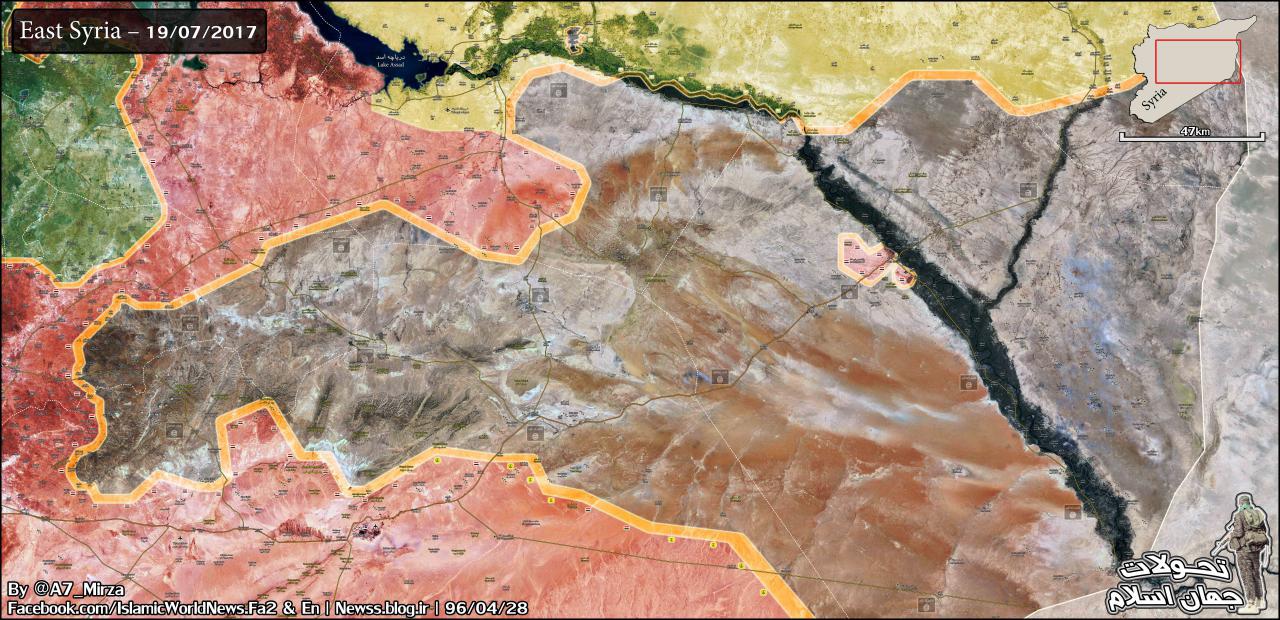
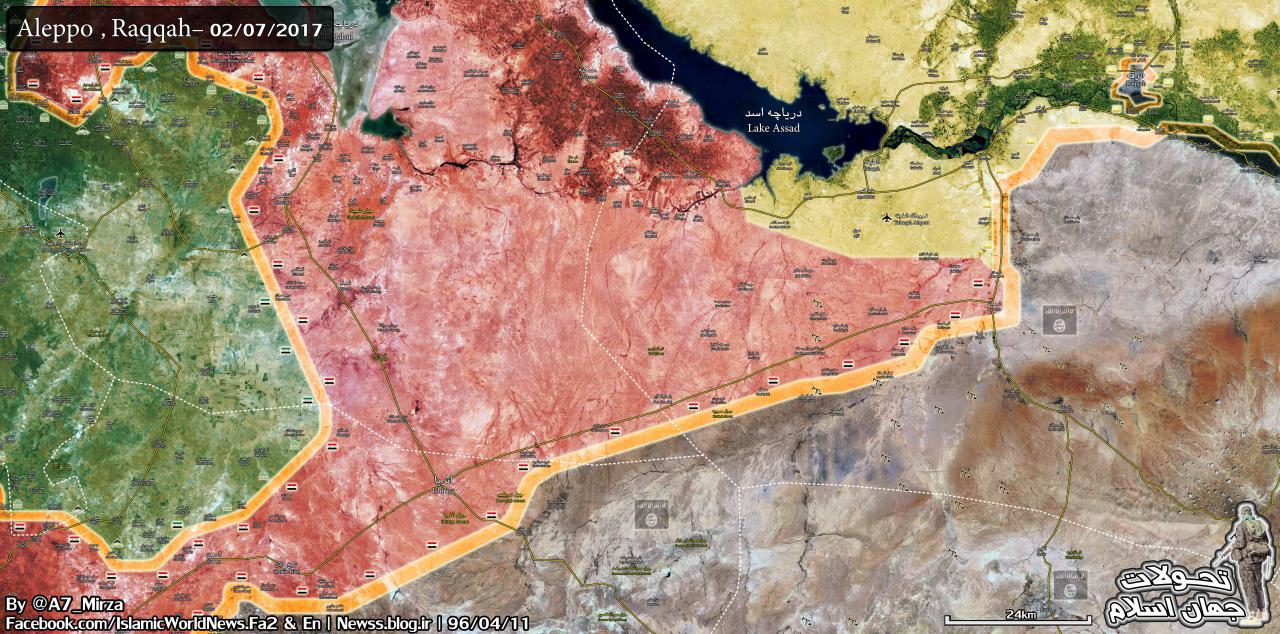
In recent days, the Syrian army leaded by Soheil Hassan, advancing and defeating ISIS defense lines in southern province of #Raqqah
therefore , a large number of oil and gas wells were freed through the last week.
Also Resistance forces are approaching to Al-Sukhnah in #Tadmur–#DeirezZor axis. It is also possible for them to advance towards T2 station in Hamimah axisRegarding the type of advancements, two points can be considered :
– #SAA can approach to Al-Sukhnah from the top
and bottom in parallel with downstream advancements of the Resistance Forces , and surround the large amount of #ISIS in center of Syria!
Of course, considering the suicide nature of ISIS behavior, this move has its own advantages and disadvantages that are not included in this article.– SAA can continue its advances in southern Raqqah province & reach to Deir ez Zur , meantime resistance forces will advance towards Deir ez Zur along the highway.
Remember these two, in the coming weeks, we will say more about this
-
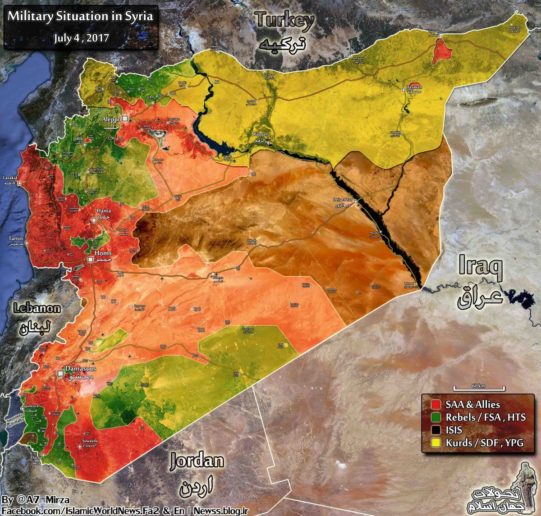
Syrian Army is on the verge of retaking central Syria
The Syrian Arab Army’s (SAA) recent advances in the Aleppo and Al-Raqqa governorates have paved the way for their forces to wedge the Islamic State (ISIL) terror organization in the central part of the country.
With many units from the Tiger Forces making their way to the key town of Qomhana in the Hama Governorate, the Syrian Arab Army has shifted their attention to this province, as they look to expel both the Islamic State and Al-Qaeda linked rebel factions.
While the northern Hama operations are still on hold, the Syrian Arab Army, alongside the Desert Hawks Brigade (Liwaa Suqour Al-Sahra), is expected to kick-off their offensive in eastern Salamiyah in the coming days.
-
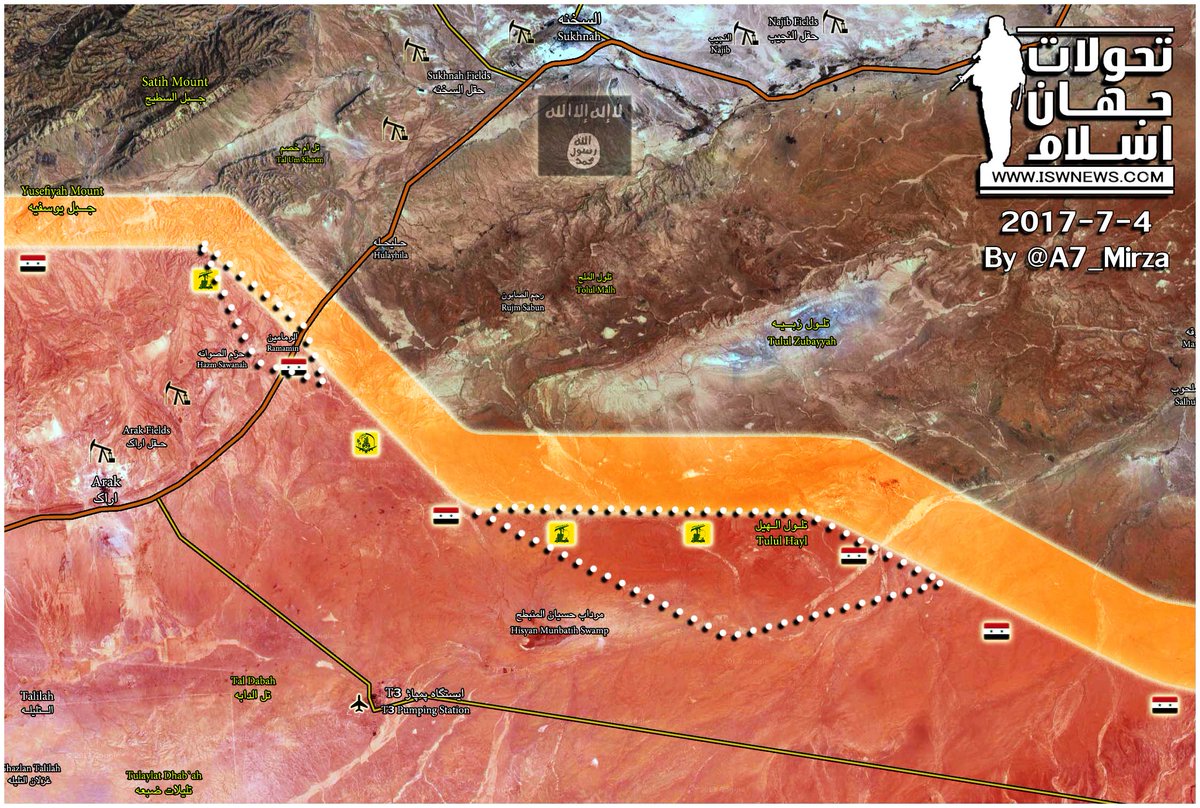
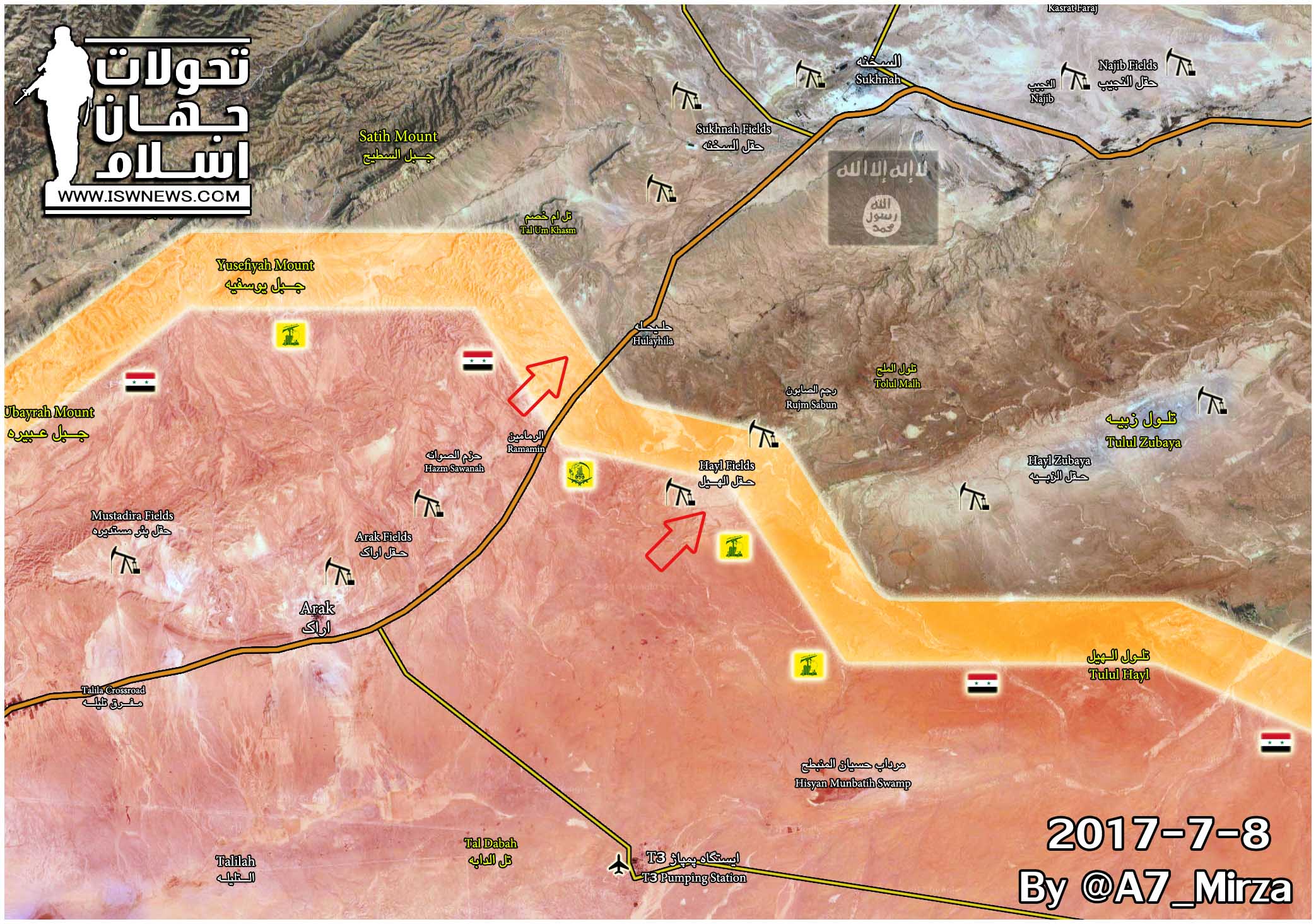
Syrian government forces have liberated the Tulul Hayl area from ISIS
Syrian government forces have liberated the Tulul Hayl area from ISIS and made gains against ISIS near Ramamin in the province of Homs. The Syrian army and its allies, backed up by the Russian Aerospace Forces, are preparing for a major push toward the ISIS-held town of Sukhna at the Palmyra-Deir Ezzor road.
-
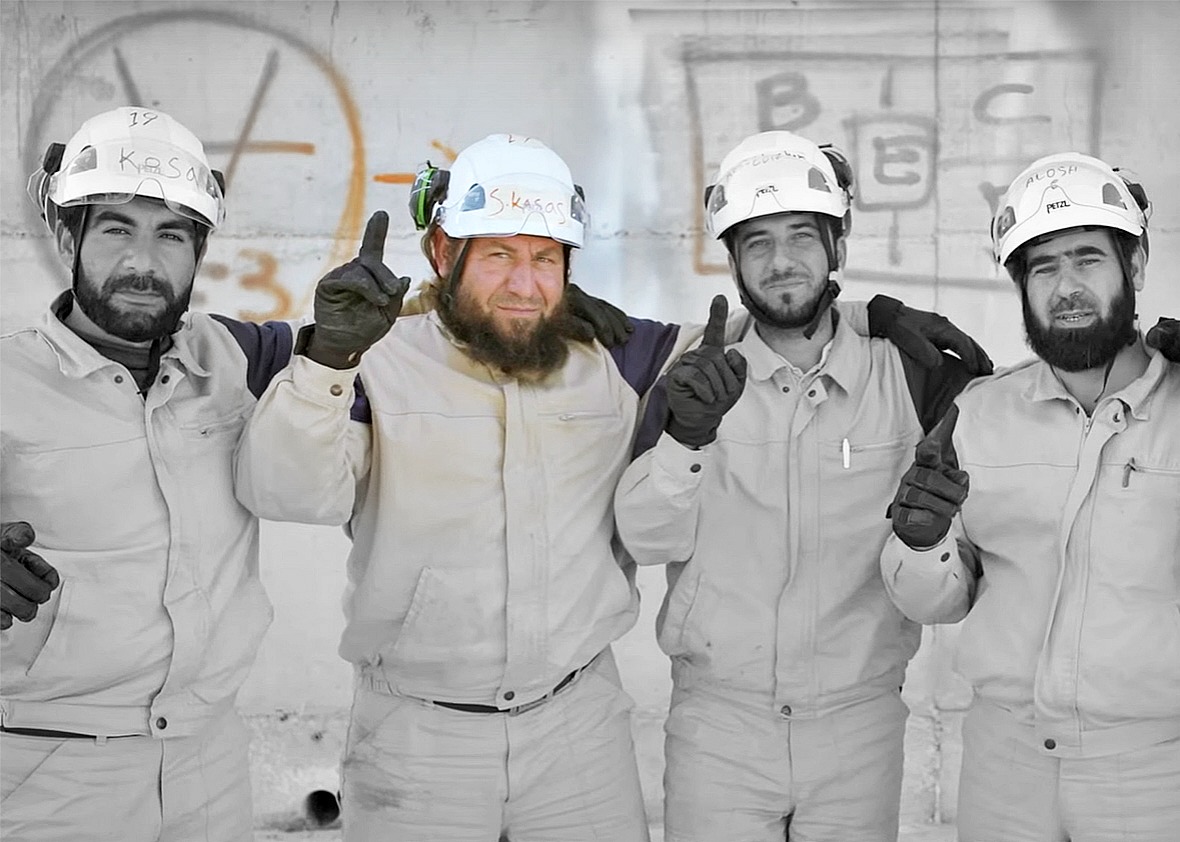
The White Helmets provide military aid
Political discourse is important in media and politics, especially the definitions of the words that we use in discourse.
In Nicaragua v. United States (1984), the International Court of Justice established many principles of international law that apply to the current situation in Syria and I suspect that if this case were tried today with the same judges, it would probably have the same ruling. One aspect aside from the military situation that is quite nuanced is the issue of humanitarian aid.
At issue in Nicaragua was whether humanitarian aid sent to the region during the war was in fact humanitarian aid or soft military aid. What they established was key– they stated that humanitarian aid is defined as aid that follows the general mission of the Red Cross and that is also indiscriminately distributed to civilians in all sides of a conflict. This has remained customary international law and is reflected within the text of the Syrian cessation of hostilities agreement from 2016 which states:
“…humanitarian access should not benefit any particular group over any other, but shall be granted by all sides to all people in need, in full compliance with UNSCR 2254 and international humanitarian law.”
In Nicaragua, the ICJ found that the United States had provided aid to Contra terrorists in soft military aid through USAID, which the Congress deemed to be a neutral agent of humanitarian aid (as per the congressional bill that approved the aid). The problem is that USAID is a subsidiary of the State Department– the Court took this into account in their ruling.
Today, the Syrian White Helmets provide aid within rebel-held areas of Syria. While they may be called independent in a legal sense, they were established under the supervision of a British military contractor and receive funding from various western government agencies including USAID. Sound familiar? While a hypothetical Court may not be able to sufficiently draw the quid pro quo connections to deem the White Helmets an organ of the United States, et al., it is quite evident to anyone who can see what’s going on. If we get past this there is the issue of whether the aid is discriminatory or not. Even within the mainstream it is widely acknowledged that the White Helmets are only operating in rebel-occupied areas of Syria.
Not only are many White Helmet volunteers former (or current) militants, they are hand in hand with militants in an organizational structure and thus could be sufficiently established as an organ of the opposition. Aid distribution from the White Helmets reflects this in every case; if they were a neutral organization, why did they not help the situation in Damascus when millions were facing water insecurity at the hands of rebel groups? Why do they shy away from government-held areas? Because they are not neutral.
If we juxtapose the White Helmets with the Syrian Arab Red Crescent that has been in operation since 1942, that has more than 3 times as many volunteers as the White Helmets, operates all over Syria, is part of the International Federation, and has been accredited by the International Committee of the Red Cross since 1946, then we see that this is an organization that fits the Court’s definition of humanitarian aid. The Red Crescent has even been involved in helping militants relocate, for example in Darayya when militants surrendered to government forces. However, the use of the name “The Syrian Civil Defence” by the White Helmets misleads many in the public arena into believing that they are the only public aid program in Syria and the legitimate one when in fact they are not.
Their goal is to discredit the legitimate government of Syria by framing the government as savage murderers of their own people, and to frame the opposition, with themselves firmly planted in this umbrella, as the saviors of Syria. At this point over 200,000 people have pulled together around 12 million pounds for the Syrian White Helmets which demonstrates the sheer effectiveness of the media discourse surrounding not only this particular organization but of the war in general. However, according to the principles of international law this is not humanitarian aid and violates many of the established agreements to come out of the peace process in Syria.
You can read an extensive two-part analysis on the White Helmets by Max Blumenthal of Alternet here.
Source : Al-Masdar
-
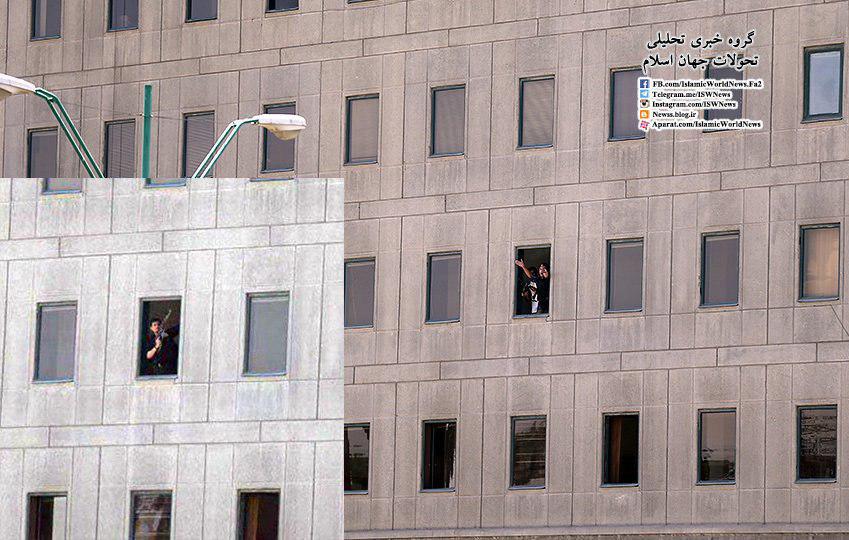
What you didn’t know about Tehran’s terrorist attacks
There’s been much talk recently of the motives behind the terrorist attacks that targeted Iran’s parliament and the shrine of Ayatollah Khomeini in Tehran, and there will be much talk in media outlets on those responsible. Despite the fact that ISIS claimed responsibility for this attack, certain ambiguities still exist regarding the operators behind them.
Looking into the previous instances of ISIS’s terrorist attacks around the world, one would conclude that this is not the work of ISIS. Taking the videos that were circulated of the attackers that had been recorded in the days prior to the attacks into question, none of these were circulated in the name of ISIS, nor did they show its banner. Moreover, on the day of the attack, there were no indicators pointing towards ISIS or its black banner.
Saudi Arabia’s Al-Arabiya TV was the first media outlet to broadcast the video sent by the attackers, and after that, ISIS’s Aamaq broadcast that same video, announcing that ISIS claims responsibility for the attack. In reality, the fact that the attackers spoke Arabic in the video would have one think that they are affiliated with ISIS, and it’s easier to believe that ISIS would be behind it.
The question that comes to mind is, if ISIS was not behind these attacks, then why did it claim responsibility for them? In answering this question it must be said that one of ISIS’s goals has always been to showcase itself, and show its capabilities on the international level, performing terrorist attacks around the world to show that it has the ability to perform such actions all over the world, such as its attacks in European countries and elsewhere. Furthermore, ISIS sees Iran as one of its most important enemies, and had threatened to perform terrorist attacks against it time and time again, always failing to perform any attacks on Iranian soil. It so follows that these latest attacks are the best chance for it to make some political gains without putting up any of the costs.
Another question that comes to mind is: who are the true perpetrators of the Tehran attacks then? The “Ansar al-Islam” organization is a radical Sunni organization, active in Iranian and Iraqi Kurdistan, is anti-Iranian, and has deep religious and ethnic differences with the Shia system ruling Iran. It has arranged a number of operations against the Iranian state in the past, and some informed sources have cited them as being behind the Tehran attacks. We will discuss this group’s role in the management and the execution of the attacks as we go along.
Mullah Krekar is one of the well-known Salafi figures of Halabja in Iraqi Kurdistan. He had been a follower of Osama bin Laden in Afghanistan for a number of years and fought alongside him. Upon his return to Halabja he began spreading Salafi Jihadism in Iraqi Kurdistan, founding Ansar al-Islam, which simultaneously fought against Saddam Hussein and the Taliban and Barzani movements. After 9/11, he added fighting the U.S to his agenda.
Abu Musab al-Zarqawi left Afghanistan, settling in Iranian and Iraqi Kurdistan. The members of Ansar al-Islam, who were mostly Sunni Kurds from Iraq and Iran, were placed under his ideological and intellectual tutelage. This is why this organization considers Al-Zarqawi to be its spiritual leader.
During Zarqawi’s stay in Iraq, especially in August 2003, three months after the fall of Saddam Hussein in Iraq, he planned and led the Najaf attacks which resulted in the assassination of Sayyid Mohammad Baqer al-Hakim, the head of the Shia Supreme Council of Iraq on August 29th, in the shrine of Imam Ali, the first Imam of Twelver Shia Muslims. After the incident, he established “Tanzim al-Jihad fi Bilad al-Rafidayn”, Al-Qaeda’s Iraq branch, which eventually came to form ISIS.
Throughout their period of activity, Ansar al-Islam managed to gain great ideological and intellectual influence among Iranian Kurds, leading to the formation of the “Tawhid and Jihad” group. This group, through its commencement of operations since 2011, managed to impose itself as a serious player among Jihadi groups. Furthermore, being the earliest of Salafi Jihadist groups in Iran, it began to spread the ideas of ISIS when the latter revealed itself, and a number of them have gone to fight in Syria and Iraq with ISIS. The group was active in Western Iran and its neighbor Iraq, and enjoyed financial support from some of the region’s wealthier countries whose politics run counter to Iran’s.
Another matter is that anti-Iran groups, apart from their relations with anti-Iran countries, also possess relations with other anti-Iran groups, and cooperate with one another. One of the oldest of these groups is the MEK, which in the post-revolutionary period had many differences with Ayatollah Khomeini, Iran’s then supreme leader, and began fighting the new rule. This organization, in its efforts to combat the Iranian administration, has relations with all anti-Iranian groups, including Ansar al-Islam, and cooperates with them. The MEK enjoys political and social support from the U.S, as well as financial support from Saudi Arabia.
Some informed sources have said almost 50 members of Ansar al-Islam, all of whom are Iranian, Kurdish Sunni Muslims, operate from a base linked to the MOC operations room in Jordan, under the military and operational tutelage of the MEK, and are now ready to launch wide attacks inside Iranian soil.
These sources have also added that the MEK handled the planning of these latest operations, and that Ansar al-Islam executed them on the anniversary of al-Zarqawi’s death. However, because of Iran’s security forces’ grip on Iranian and Iraqi Kurdistan, and their fears of backlash from Iran, Ansar al-Islam decided it was better to conceal their responsibility for these operations, remaining silent, and letting ISIS claim responsibility for them.
It is noticeable that Saudi Arabia’s king, Iran’s traditional opponent in the region, has supported all radical anti-Iran groups, and even political opposition outside of Iran, such as the MEK, both financially and morally. So much so that Prince Turki al-Faysal, the former head of Saudi Intelligence, in his speech before the MEK’s yearly conference in 2016 in Paris, announced Saudi Arabia’s full support of the organization, as well as all anti-Iran groups.
Saudi Arabia will continue to support these groups in the possibility that Iran, a Shia Islamist country, might be weakened or its system of government changed. Saudi Arabia has accused Iran, on a number of occasions, of supporting terrorism and exporting its revolution to other countries, and interfering in the internal affairs of Arab countries. Mohammad bin Salman, the Saudi Minister of Defense and Deputy Crown Prince, has very recently accused Iran of trying to control the entire region, and threatened to create instability and take the war to within Iranian soil. Meanwhile, refuting Saudi claims, Iran’s minister of defense said that if Saudi Arabia should start a war with Iran, nowhere will remain safe in Saudi Arabia but for Mecca and Medina, which are sacred ground. Taking all these factors into question, are the Tehran attacks also a message that the Middle East will be the arena of a military bout between Iran and Saudi Arabia?
-
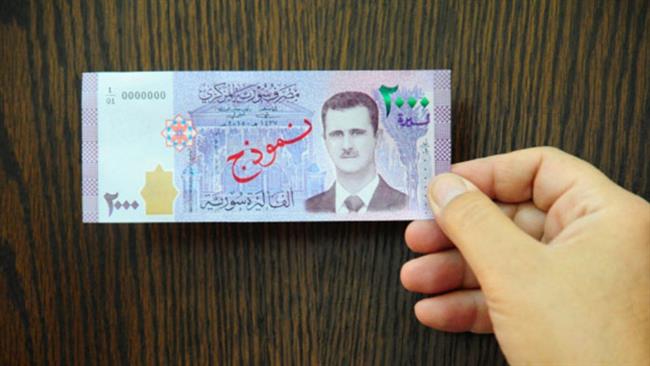
Syria introduces new banknotes featuring President Assad
For first time ever, Syria has introduced a banknote with the face of Syrian President Bashar al-Assad.
The 2,000 Syrian Lira ($3.9) bill went into circulation on Sunday, according to a statement released by the country’s central bank.
This is the first time that Assad’s face has been featured on the country’s currency since he came to power some 17 years ago. In the past, the country’s notes only carried pictures of Bashar’s father Hafez Assad.
The move comes at a time when Syrian forces have been making sweeping gains against different foreign-backed terrorist groups which have been wreaking havoc in Syria since 2011.