Tag: Ahmed al-Sharaa

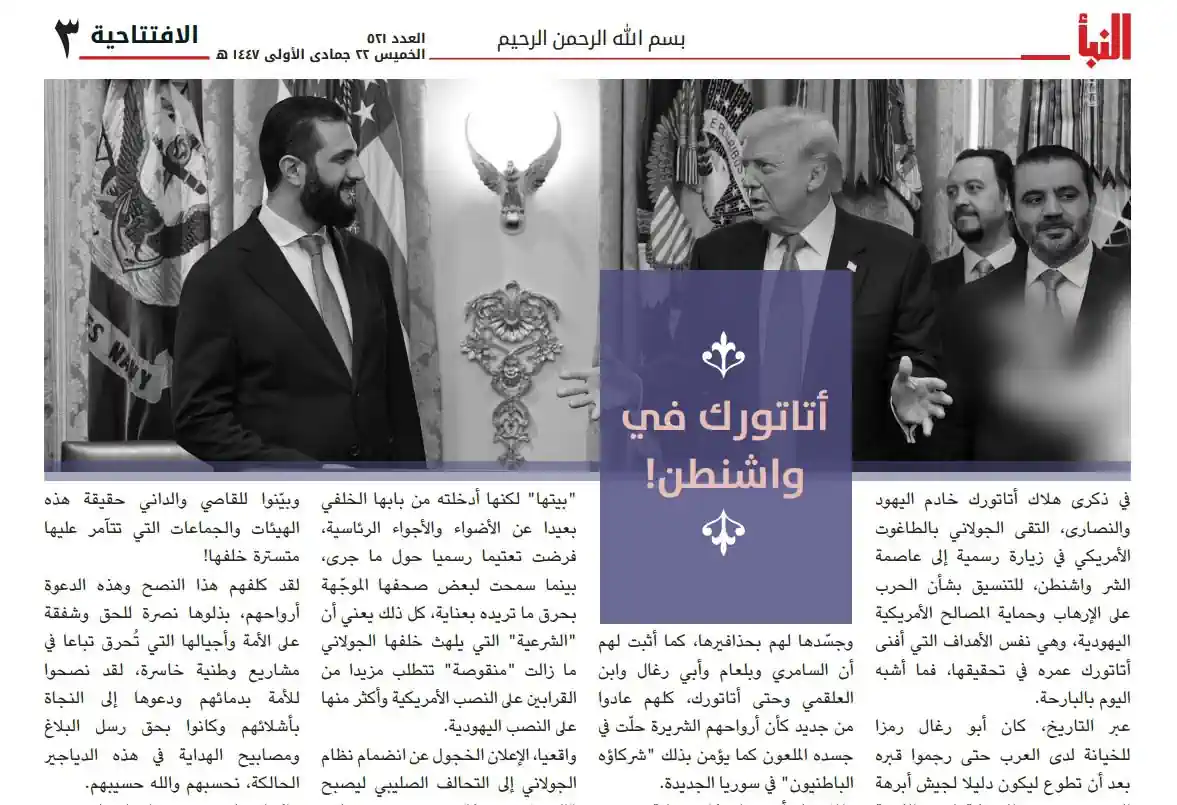
  • ISIS Narrative on Julani’s Trip to the U.S.: “Atatürk in Washington”

    ISIS Narrative on Julani’s Trip to the U.S.: “Atatürk in Washington”

    ISIS in the latest editorial of its al-Naba weekly describes Jolani’s recent trip to Washington as a repeat of the same “betrayal show.” They frame the visit as a direct link between him and the “capital of evil.” In this narrative, Jolani is not seen as a political actor but as a figure resurrected from a history of treachery—an extension of all those whom ISIS associates with a dark past.

    Beginning of the Narrative: Betrayal Returns in a New Form
    ISIS does not view Jolani’s trip to the U.S. as a simple event. For them, it is a continuation of Atatürk’s path—someone who, in their perception, lived and fought to advance Western goals. Thus, Jolani’s visit is symbolically placed alongside Atatürk’s legacy: an act aimed at weakening the Muslim community and serving the interests of America and its allies.

    The comparison is not limited to Atatürk. Jolani is depicted as a new link in a long chain of historical traitors—figures who, in ISIS’s view, paved the way for enemies and served foreign powers. The purpose of these comparisons is to cement Jolani’s image as a “symbol of betrayal” in the minds of their audience.

    Prelude to the Trip: A Path Built Behind the Scenes
    ISIS claims Jolani’s journey was the result of months of consultations and contacts with U.S. officials, portraying him as someone who had to “prove himself” step by step to gain Washington’s trust. Each meeting with American officials is described as offering “new concessions,” ultimately leading to the main encounter with the U.S. president. The narrative paints Jolani as a man who must pay the price of political advancement through security and political actions against others.

    Media Displays: Signs of “New Loyalty”
    ISIS interprets Jolani’s promotional videos—especially those showing him engaged in sports—as staged symbols of “victory displays.” These images are seen as part of a performance to show that each new collaboration with the U.S. translates into fresh political gains. A photo of him alongside American commanders is presented as further evidence that Jolani has now secured a place within Western military and political structures.

    Political Dimensions: From Containing Iran to Rebuilding Syria
    ISIS situates Jolani’s trip within broader regional dynamics. They argue that the U.S. seeks to diminish Iran’s influence in Syria, while Turkey supports Jolani as a more pragmatic alternative for Syria’s future—an actor capable of playing a role in the country’s new political framework. In this context, the lifting of U.S. sanctions on Jolani is interpreted as granting him “semi-legitimacy,” though ISIS insists it is incomplete and will demand further concessions.

    From Hidden Cooperation to Open Partnership
    ISIS asserts that Jolani’s formal alignment with the international anti-terror coalition is merely the public declaration of a partnership that has existed covertly for years. They cite recent security operations by Jolani’s forces—arrests and pursuits of individuals linked to jihadist groups, coinciding with Israeli strikes in southern Syria—as proof. His silence in the face of Israeli attacks is portrayed as evidence that “his weapons are aimed in only one direction.”

    Propaganda Use: Invoking the Legacy of ISIS Leaders
    To reinforce its narrative, ISIS references the words and guidance of its slain leaders, aiming to restore moral and ideological legitimacy. The account honors those who “gave their lives on this path” and calls for the return of former ISIS fighters.

    Final Message: “The End of Jolani’s Path”
    In conclusion, ISIS presents Jolani’s trip as the ultimate symbol of his “complete transformation”—a man who abandoned jihad and entered the service of global powers. For ISIS, this serves as a cautionary tale: an example of how someone once listed as a “terrorist” can become a “partner of the West.”

  • Meeting Between Al-Sharaa and Putin in Moscow

    Meeting Between Al-Sharaa and Putin in Moscow

    Ahmed Al-Sharaa, head of Syria’s interim government, stated:
    “Today, we are in a new Syria, and we are rebuilding our relations with all nations, especially the Russian Federation. We honor all past agreements and this great history, and we strive to redefine and present the nature of these ties in a renewed way. We respect our shared history, and our goal is to strengthen relations based on Syria’s sovereignty, unity, and stability.”

    The Kremlin meeting between Putin and Ahmed Al-Sharaa (Abu Mohammad Al-Jolani) marks a clear effort by Moscow to preserve and redefine its role in Syria’s political landscape following the fall of Bashar al-Assad’s government. Having supported Assad as a strategic ally for years, Russia now seeks to maintain its traditional influence within Syria’s new power structure through pragmatic diplomacy. The revival of the joint cooperation committee signals Russia’s intent to secure long-term economic and security presence in Syria.

    Putin also stressed joint economic projects, food supply support for Syria, and collaboration in energy and infrastructure. This shift indicates Russia’s strategy to transition from direct military involvement to sustainable economic engagement—leveraging its political influence for strategic gains without incurring the costs of past military operations.

  • Russian Delegation Visits Damascus, Begins Ties with New Syrian Government

    Russian Delegation Visits Damascus, Begins Ties with New Syrian Government

    The delegation, led by Mikhail Bogdanov, Deputy Foreign Minister of Russia, and Alexander Lavrentiev, Putin’s special envoy for Syria, met with Abu Muhammad al-Julani, the leader of Hayat Tahrir al-Sham in Damascus on January 28.

    During the meeting, Al-Julani requested that the Russian delegation restore the lost trust by paying compensation and participating in the reconstruction of Syria.

    For many years, Russia has been considered a supporter and partner in the leadership of Syria during the Assad family’s rule. During the Syrian war, Russia, along with Iran, played a significant role in changing the battle’s equation in favor of the central government. Russian airstrikes were a key factor in the militants’ defeat, and Russian military support inflicted significant losses on the militants. It appears that the new Syrian government has come to terms with Russia’s past support for Bashar al-Assad and attacks on militants, recognizing Moscow’s international influence and role in addressing future challenges.

    Simultaneously with the presence of the high-ranking Russian delegation in Damascus, the Russian newspaper Tass, citing the Turkish newspaper Sabah, considered five possible scenarios for Syria’s future:

    • The creation of the Syrian Democratic Republic by a coalition of opposition parties with ideological differences.
    • The creation of the Islamic Republic of Syria by Hayat Tahrir al-Sham (formerly Jabhat al-Nusra) and other terrorist groups.
    • The creation of an anti-Shiite state under the support and control of the Zionist regime.
    • The creation of a federal Syrian republic with regional and state governments under US supervision.
    • The division and disintegration of Syria.

    Syria is currently facing numerous intra-group and ideological differences, as well as economic, social, and security problems. The new Syrian government has not reached an agreement with the Syrian Democratic Forces, and the areas under SDF control remain outside the Damascus government’s control. Areas in southern Syria are also occupied by the Israeli army, and no specific time for the Zionist withdrawal from these areas has been announced, putting Syria at risk of disintegration.

    While none of the above scenarios can be definitively predicted for Syria’s future, it is evident that Al-Julani is seeking to form a seemingly Islamic government with a strong presence of Tahrir al-Sham elements. This possibility has become stronger given recent appointments and actions.

  • First Official Talks Between SDF and Al-Julani

    First Official Talks Between SDF and Al-Julani

    The discussions during this meeting primarily focused on military and security issues. The SDF delegation and al-Julani addressed topics such as the future of northern Syria, security interaction between the SDF and the Syrian transitional government, and areas under Kurdish control in Aleppo.

    Media outlets associated with the SDF characterized the meeting as positive, indicating that such discussions are expected to increase in the coming weeks.

    This marked the first meeting between SDF forces and al-Julani in Damascus. Based on al-Julani’s recent statements, it appears he aims to integrate the Syrian Democratic Forces into the Syrian Ministry of Defense through negotiations. This effort is intended to prevent arbitrary actions, take control of the Kurdish forces, and resolve conflicts in northern Syria.

  • Ukrainian Delegation Visits Damascus; 500 Tons of Wheat Flour Sent to Syria

    Ukrainian Delegation Visits Damascus; 500 Tons of Wheat Flour Sent to Syria

    During the meeting, Sybiha conveyed the support of the President of Ukraine to al-Julani. He stated that Ukraine seeks cooperation with the Syrian government in various fields and criticized Russia and the Assad regime for their crimes against the Syrian people. Sybiha expressed hope for significant progress in relations between Ukraine and Syria.

    According to Sybiha, 500 tons of Ukrainian wheat flour will enter Syria in the coming days, enhancing mutual cooperation between Kiev and Damascus.

    Ukraine is known to support Tahrir al-Sham militants. Since the war between Russia and Ukraine began, the Kiev Security Service has provided weapons, training, and intelligence assistance to Hayat Tahrir al-Sham, in coordination with the United States, aiming to open a new front against Russia in Syria. Recently, there have been reports of Ukrainians in Syria conducting training and equipping Tahrir al-Sham with drones and suicide quadcopters (FPVs).

  • The First Iraqi Official Met With Leader of Tahrir al-Sham in Syria

    The First Iraqi Official Met With Leader of Tahrir al-Sham in Syria

    The meeting focused on developments in Syria and the necessary measures for ensuring security and stability along the Iraqi-Syrian border.

    It is noteworthy that Abu Muhammad al-Julani was sentenced to death by an Iraqi court many years ago for his involvement in various terrorist activities in Iraq; however, Iraqi officials have now chosen to engage with him.

    Al-Julani joined al-Qaeda in Iraq in 2003, just weeks before the U.S. invasion of Iraq, and quickly rose through the ranks of the organization. He was arrested by U.S. forces in 2006 and spent more than five years in prison. Al-Julani’s release from prison occurred in 2011, only by chance!! coinciding with the onset of the Syrian war, he formed the terrorist grou Jabhat al-Nusra, the Syrian branch of al-Qaeda after reaching an agreement with Abu Bakr al-Baghdadi.