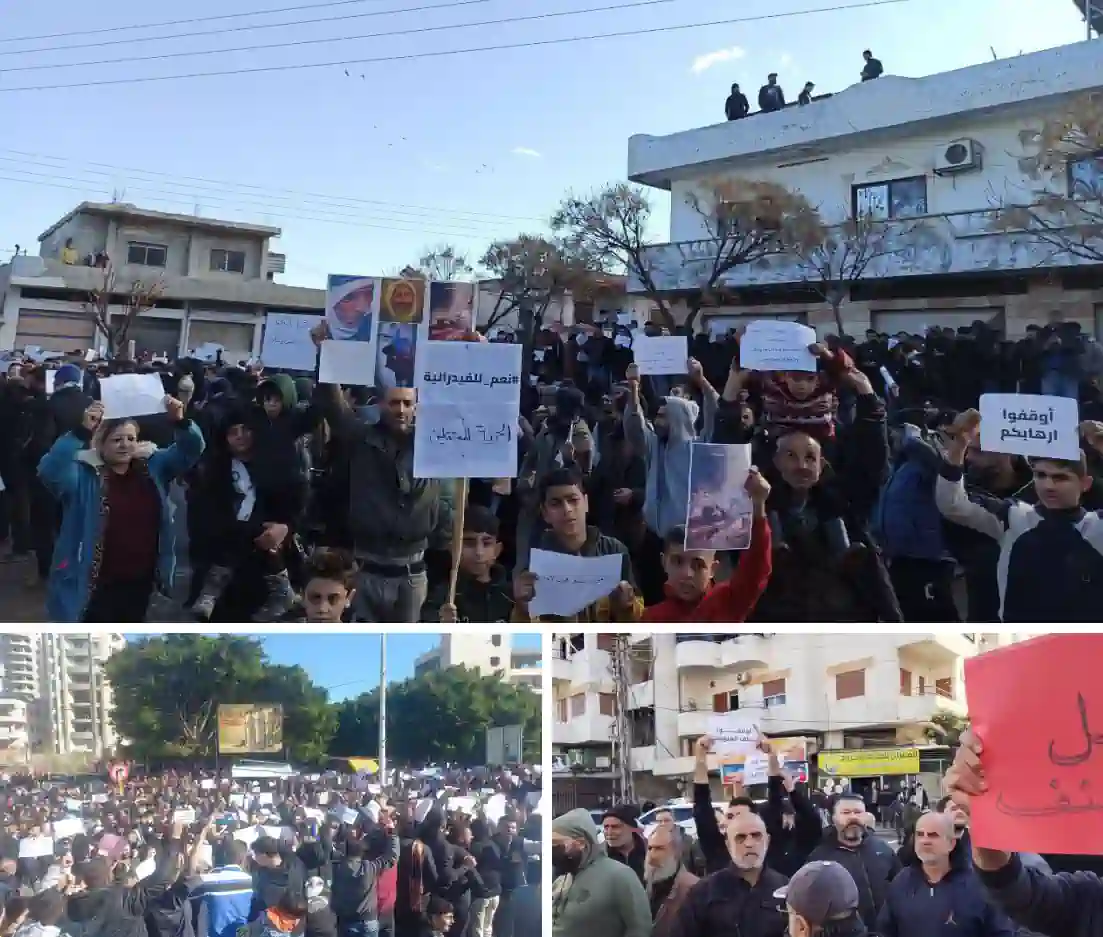
Witnesses say the attackers used live ammunition and melee weapons, with many of the wounded rushed to medical centers. Local sources warn that tensions are escalating and the security situation remains unstable.
Clashes between Alawite protesters and al‑Joulani’s forces have spread sporadically across Hama, Homs, Tartus, and Latakia provinces. Armored vehicles have been deployed in central Latakia to contain gatherings.
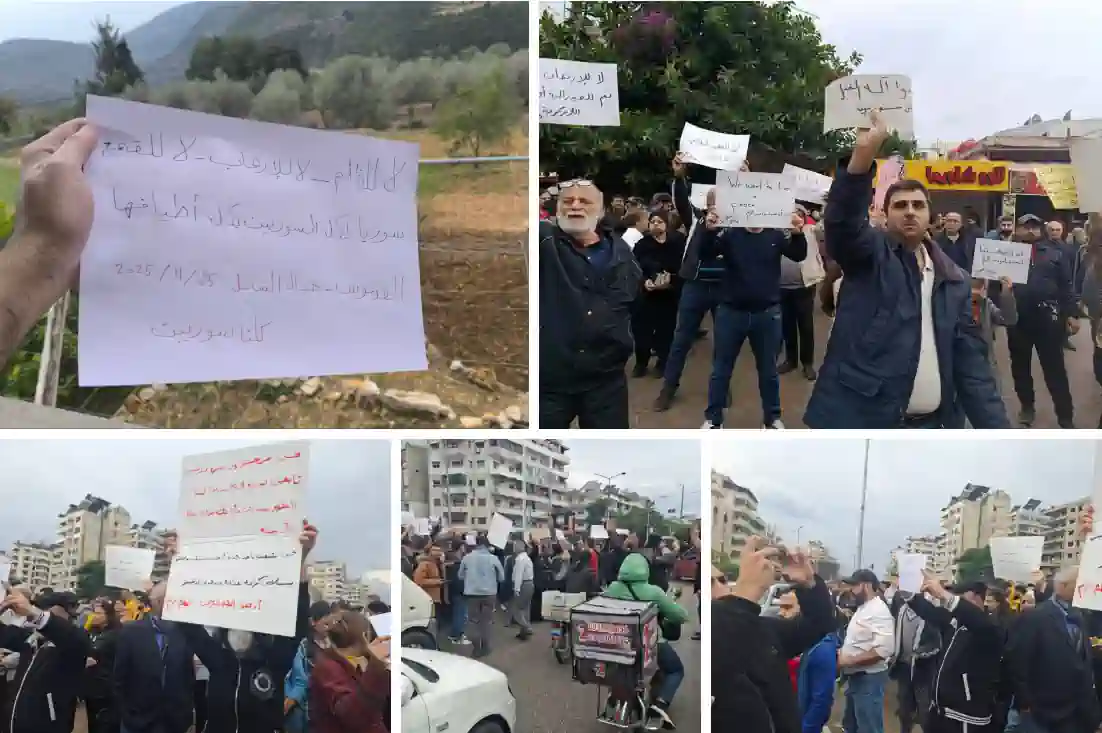
The protests began yesterday following a call by Sheikh Ghazal, with demonstrators denouncing repression, discrimination, and denial of civil rights. Rallies were held in Jableh and al‑Qardaha (Latakia), al‑Daliyeh and Salhab (Hama), Tartus, Safita, Banias, and al‑Sheikh Badr (Tartus). While protesters declared the gatherings peaceful, footage shows violent clashes and assaults by al‑Joulani’s forces.
Sheikh Ghazal stressed that what is happening now amounts to an organized genocide against the Alawites, carried out openly before the eyes of the world. He clarified that the Alawites are not seeking “civil war,” but rather demand political federalism within Syria.
In response to this call, residents of Jableh and al‑Qardaha (Latakia province), al‑Daliyeh and Salhab (Hama province), Tartus, Safita, Banias, and al‑Sheikh Badr (Tartus province) took to the streets. Videos circulating on social media show that security forces of the al‑Joulani government opened fire on protesters in some areas, injuring several people who were later transferred to Tishreen Hospital in Latakia.
Protesters chanted slogans such as “No to terrorism” and “United Syria,” demanding the release of detainees, an end to kidnappings and killings, and the implementation of a decentralized system of governance. They stressed that their demands are purely humanitarian and social, aimed at achieving peace and coexistence in Syria.
Reports indicate that al-Julani’s security forces used live ammunition to disperse demonstrators in some areas, leaving several Alawites injured in the shootings.
Demonstrations erupted in the provinces of Latakia, Tartus, Homs, Hama, and Damascus, where members of militant groups clashed with protesters and opened fire.
During the protests, demonstrators chanted: “Ya Ali, or Labaik al-Khasibi.”
Alawite demonstration in SyriaAlawite demonstration in SyriaAlawite demonstration in Syria
These demonstrations occur amidst ongoing blind assassinations, attacks on churches, and sacred sites of Christians and other ethnic and religious groups. The transitional government of Turkey-affiliated terrorist groups has not yet managed to establish security and sovereignty in Syria.
In another incident in the same day, 14 HTS affiliated militants were killed in an ambush in Tartus province.
Unknown gunmen ambush Tahrir al-Sham militants in Tartous
The Ministry of Interior of the Syrian transitional government announced that 14 militants affiliated with the government were killed and 10 others were injured in clashes in Tartus province yesterday.
Most of these militants were from terrorist groups, including Tahrir al-Sham, who had been deployed to Tartus to suppress Alawite protests. However, they were ambushed and killed by former Syrian army forces.
Pictures of the deaths of Tahrir al-Sham militants in Tartous
Officials from the Syrian transitional government and local media have accused Iran of being involved in the unrest. Asad Hassan Al-Shaibani, the Minister of the Syrian transitional government, stated in his first address, “Iran must respect the will of the Syrian people, their sovereignty, and security. We warn them against spreading chaos in Syria and hold them responsible for the consequences of their recent statements.”
Typically, the initial statement from a newly elected government’s foreign policy apparatus should focus on issues like territorial integrity, the participation of diverse groups, and the assistance of international organizations and neighboring countries in establishing the government. However, the Turkish-backed government has meaningfully dedicated its first statement to Iran!
Mr. Asad Al-Shaibani has so far had no opinion on the occupation and exploitation of eastern Syria’s resources by the United States, Israeli airstrikes on strategic infrastructure, the occupation of southern Syria, the presence of multinational terrorists from Uyghurs to Chechens and Tajiks, and numerous other security and economic issues.
The operation, dubbed “Eren-7 Mercan-Munsuz”, is being carried out to clear areas of Tunceli province in eastern Anatolia, with 1,062 troops.
The province is divided into Pulumur, Ovacik, Nazimiye, Hozat, Cemisgezek, Pertek, Mazgirt and Tunceli Merkezi districts, and the Kurds of Kurmanji and Zazaki call this province Dersim (Silver Gate), while the Turkish government uses Tunceli (Bronze fist) to name it.
Map of Tunceli – Dersim province
It is worth mentioning that during the “Dersim genocide” which took place in two stages from March 20 to November 1937 and January 2 to December 1938, the Turkish army carried out a large-scale massacre to suppress the Alawites uprising of the Zaza people. According to Kurdish sources, 65,000 to 70,000 people, and according to Turkish officials, 12,000 people have been killed in air and ground attacks by the Turkish army in this region, and tens of thousands have been deported to central Turkey.
The Turkish government’s plan to integrate ethnic groups and deny the identity of ethnic minorities has sparked major uprisings in the country, and the Turkish military has committed war crimes to suppress these movements. This issue has also caused the liberation movements in the Kurdish and Zaza areas in the east of the country to have a lot of supporters. A large number of people in these areas have joined or assisted the paramilitary forces of the Kurdistan Workers’ Party.
The Zaza people are originally Deylam, and the Zaza language, in addition to being similar to Kurdish, is closely related to the Mazani, Gilaki, and Talshi Iranian languages. The exact number of Zaza people is not known, but their population in Turkey is estimated at about 4 million.
Also, most of the followers of Alawite religion, which include Anatolian Turks, Azeris, Tatars, Kurds, Zazas and Turkmen; are living in Turkey and Syria and a few in Lebanon. According to the fatwa of Imam Khomeini, the Alawites are a branch of the Twelver Shiite religion.
Twenty-five million people, or 30 percent of Turkey’s 83 million people, are Alawites, concentrated by the Alawite and Zaza populations in Turkey’s Tunceli province. It can be argued that given the Turkish military background in the region, ethnic and religious motives are high in recent operations.