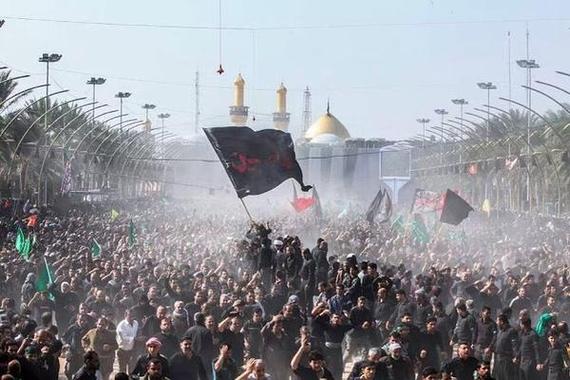
The Arabic word ‘Arbaeen’ (pronounced Arr-ba-een) translates to forty (ie fortieth day). The traditional period of mourning in Islamic culture is forty days. As such, millions of people around the world mark the Day of Arbaeen by remembering the story of Hussain, his family and his companions.
– After several centuries of martyrdom of Imam Hussain, there are still people who affirm the complaint of oppressed and come to the field.
– Baalbek was a route for captives of Ashura and Baalbek people helped the captives caravan and after many years they proved they are still active in the war between truth and falsehood.
– Some politicians in Lebanon do not accept their responsibility over the situation and accuse others.
– Economic situation of Lebanon right now was not shaped in an hour or a day or a month but result of several reasons that accumulated several years and all those who had a position in the last 30 years or have position right now should accept their responsibilities and help to solve the current situation; resigning is the easiest way out of it but they should stay and do their tasks.
– There are two major threats for Lebanon; first is the economic collapse the second is people’s protest that might erupts due to wrong doings.
– The most important result we can draw from the protests in these two days is that people won’t accept new taxes and costs and most of Lebanese are poor.
– The issue is not who is the head of the government but the way the country is managed. When people decide something, politicians should obey.
– This is not right for the government to change the new costs and taxes.
– Recent decisions only hurt low income class and doesn’t affect rich people, Lebanese only accept it, if it affects everyone.
– We face the criticise that people do not trust politicians. We do not support resignation of current government and the reason is that it is not possible the new government to start in a year or even few years.
– Some talk about firing the current government and form a technocrat government, I should say a technocrat government does not survive for even two weeks, anyone who supports such a government, will be the first to demand its resignation.
– An early parliament election is not useful, same parliament will be elected. If the current government cannot solve the issues, no other government can.
– Hezbollah did not plan protests against banks, as they said.
– We heard your painful voice and your message relayed to the government loud and clear, government should act upon.
– Hezbollah respects your scream and protests.
– These protests were public rage. The importance of this movement was because no party, organization or embassy was behind it and it was honest.
– If the time comes that Hezbollah comes to streets, you’ll see us and everything will change, if it’s necessary to come to the street to object the new taxes and costs, we come and until the goals are not met we stay.
– in the current situation all departments of the government should collaborate and do not avoid their responsibilities. Anyone who avoid their task should be convicted.
– Some political groups trying to confront the president and force him to leave, I should tell them that you are wasting everyone’s time and you can’t do this.
– We support our people and nation in Hezbollah and won’t allow anyone to out the country in harm and we announce our allegiance to the way of truth, our nation and people and won’t leave oppressed alone and we warn the protesters to not let any party or group to abuse their movement.
Hussain ibn Ali was a 7th century revolutionary leader who made a stand against Yazid ibn Muawiyah. Yazid was a tyrannical ruler who had illegally usurped power and was violating the basic rights and dignity of the people. Yazid wanted Hussain to pay allegiance to him, to lend credibility to his own corrupt rule. However Hussain refused to do so, based on his moral values and principles, and was killed by an army of over 30,000 whilst standing with a small number of 72.
After the Battle of Karbala, the forces of Yazid took the women and children of Hussain’s family as captive. They were paraded in chains through the streets of Kufa (Iraq) and Damascus (Syria) – where they were abused by crowds until eventually presented to Yazid and placed in prison.
Though Hussain has died, his movement still continued through his sister Zainab, and son Zain Al-Abideen. Hussain’s sister and his son defied Yazid in his own courtyard through famous sermons which unnerved even his closest allies. Eventually, Yazid had no choice but to free the captives as word spread across the region of the crime he had committed against Hussain ibn Ali and his family.
It is said that the Day of Arbaeen is the day on which Hussain’s family returned to the land of Karbala, to properly bid farewell to the fallen heroes and finally grieve for their loved ones.
The Day of Arbaeen, today
Today, almost 1400 years later, the Day of Arbaeen is mourned by millions of people around the world. It is marked as a day to pay tribute to the sacrifice of Hussain for social justice. Typically, on this day people organise large marches in cities across the world to symbolise the eternal nature of Hussain’s revolution and to show they stand for social justice, honour and peace.
In recent years – after the fall of the Saddam regime – a tradition of walking 80km from Najaf (the resting place of Hussain ibn Ali’s father) to Karbala has been reignited. Every year since, the number has been rising steadily from 17 million pilgrims to at least 25 million. People from all walks of life and all corners of the globe make the journey, despite the imminent threat of terrorists who have vowed to attack the pilgrims.
Along the 80km stretch from Najaf to Karbala volunteers distribute free food and drinks to those undertaking the pilgrimage, as well as offering places to relax, wash and sleep. Arbaeen Day is now the largest annual peaceful gathering in the world, with numbers set to increase significantly every year.
Not only does the congregation exceed the number of visitors to Mecca (by a factor of five, in fact), it is more significant than Kumbh Mela, since the latter is only held every third year. In short, Arbaeen dwarfs every other rally on the planet, reaching twenty million last year. That is a staggering %60 of Iraq’s entire population, and it is growing year after year.
Above all, Arbaeen is unique because it takes place against the backdrop of chaotic and dangerous geopolitical scenes. Daesh (aka ‘Islamic State’) sees the Shia as their mortal enemy, so nothing infuriates the terror group more than the sight of Shia pilgrims gathering for their greatest show of faith.
There’s another peculiar feature of Arbaeen. While it is a distinctively Shia spiritual exercise, Sunnis, even Christians, Yazidis, Zoroastrians, and Sabians partake in both the pilgrimage as well as serving of devotees. This is remarkable given the exclusive nature of religious rituals, and it could only mean one thing: people regardless of color or creed see Hussein as a universal, borderless, and meta-religious symbol of freedom and compassion.
Why you have never heard of it probably has to do with the fact that the press is concerned more with negative, gory, and sensationalized tabloids, than with positive, inspiring narratives, particularly when it comes to Islam. If a few hundred anti-immigration protestors take to the streets in London and they will make headlines.. The same level of airtime is awarded to a pro-democracy march in Hong Kong or an anti-Putin rally in Russia.. But a gathering of twenty million in obstreperous defiance of terror and injustice somehow fails even to make it into the TV news ticker! An unofficial media embargo is imposed on the gargantuan event despite the story having all the critical elements of an eye-catching feature; the staggering numbers, the political significance, the revolutionary message, the tense backdrop, as well as originality.. But when such a story does make it through the editorial axe of major news outlets, it creates shockwaves and touches the most random people.
Among the countless individuals inspired by it, is a young Australian man I met several years ago who had converted to Islam. Evidently, no one takes such a life-altering decision lightly, so upon inquiry he told me it all started in 2003. One evening, as he was watching the news only to be drawn by scenes of millions streaming towards a holy city known as Karbala, chanting the name of a man he had never heard of: “Hussein”. For the first time in decades, in a globally televised event, the world had caught an glimpse into previously suppressed religious fervor in Iraq.
With the Sunni Ba’athist regime toppled, Western viewers were eager to see how Iraqis would respond to a new era free from dictatorship persecution. The ‘Republic of Fear’ had crumbled and the genie had irreversibly escaped from the bottle. “Where is Karbala, and why is everyone heading in its direction?” he recalls asking himself. “Who is this Hussein who motivates people to defy all the odds and come out to mourn his death fourteen centuries after the fact?”
What he witnessed in that 60-second report was especially moving because the imagery was unlike any he had ever seen. A fervent sense of connection turned human pilgrims into iron filings, swarming together other as they drew closer to what could only be described as Hussein’s irresistible magnetic field. “If you want to see a living, breathing, lively religion, come to Karbala” he said.
How could a man who was killed 1396 years ago be so alive and have such a palpable presence today that he makes millions take up his cause, and view his plight as their own? People are unlikely to be drawn into a dispute (much less one that transpired in ancient times) unless they have a personal interest in the matter. On the other hand, if you felt someone was engaged in a fight over your right to freedom, your prerogative to be treated justly, and your entitlement to a life of dignity, you would feel you had a vested interest and would empathize with him to the point where conversion to his beliefs is not a far-fetched possibility.
The Ultimate Tragedy
Hussein, grandson of the Prophet Muhammad, is revered by Muslims as the “Prince of Martyrs”. He was killed in Karbala on a day which became known as Ashura, the tenth day of the Islamic month of Muharram, having refused to pledge allegiance to the corrupt and tyrannical caliph, Yazid.
Shia Muslims have since mourned the death of Hussein, in particular on the days of Ashura, then, forty days later, on Arbaeen. Forty days is the usual length of mourning in many Muslim traditions. This year, Arba’een falls on Friday 12 December.
Long Trek
I travelled to Karbala, my own ancestral home, to find out for myself why the city is so intoxicating. What I witnessed proved to me that even the widest-angle camera lens is too narrow to capture the spirit of this tumultuous, yet peaceful gathering.
An avalanche of men, women and children, but most visibly black-veiled women, fill the eye from one end of the horizon to the other.The crowds were so huge that they caused a blockade for hundreds of miles.
The 425 mile distance between the southern port city of Basra and Karbala is a long journey by car, but it’s unimaginably arduous on foot. It takes pilgrims a full two weeks to complete the walk. People of all age groups trudge in the scorching sun during the day and in bone-chilling cold at night. They travel across rough terrain, down uneven roads, through terrorist strongholds, and dangerous marshlands. Without even the most basic amenities or travel gear, the pilgrims carry little besides their burning love for “The Master” Hussein. Flags and banners remind them, and the world, of the purpose of their journey:
O self, you are worthless after Hussein.My life and death are one and the same,
So be it if they call me insane!
The message recalls an epic recited by Abbas, Hussein’s half-brother and trusted lieutenant, who was also killed in the Battle of Karbala in 680AD while trying to fetch water for his parched nieces and nephews. With security being in the detrimental state that makes Iraq the number one headline in the world, no one doubts that this statement is genuine in every sense.
Free lunch.. And dinner, and breakfast!
One part of the pilgrimage which will leave every visitor perplexed is the sight of thousands of tents with makeshift kitchens set up by local villagers who live around the pilgrims’ path. The tents (called ‘mawkeb’) are places where pilgrims get practically everything they need. From fresh meals to eat and a space to rest, to free international phone calls to assure concerned relatives, to baby diapers, to practically every other amenity, free of charge. In fact, pilgrims do not need to carry anything on the 400 mile journey except the clothes they wear.
More intriguing is how pilgrims are invited for food and drink. Mawkeb organizers intercept the pilgrims’ path to plead with them to accept their offerings, which often includes a full suite of services fit for kings: first you can a foot massage, then you are offered a delicious hot meal, then you are invited to rest while your clothes are washed, ironed, then returned to you after a nap. All complimentary, of course.
For some perspective, consider this: In the aftermath of the Haiti earthquake, and with worldwide sympathy and support, the UN World Food Programme announced delivery of half a million meals at the height of its relief efforts.. The United States military, launched Operation Unified Response, bringing together the massive resources of various federal agencies and announced that within five months of the humanitarian catastrophe, 4.9 million meals had been delivered to Haitians. Now compare that with over 50 million meals per day during Arbaeen, equating to about 700 million meals for the duration of the pilgrimage, all financed not by the United Nations or international charities, but by poor laborers and farmers who starve to feed the pilgrims and save up all year round so that visitors are satisfied. Everything, including security is provided mostly by volunteer fighters who have one eye on Daesh, and another on protecting the pilgrim’s path. “To know what Islam teaches,” says one Mawkeb organizer, “don’t look at the actions of a few hundred barbaric terrorists, but the selfless sacrifices exhibited by millions of Arbaeen pilgrims.”
In fact, Arbaeen should be listed in the Guinness Book of World Records in several categories: biggest annual gathering, longest continuous dining table, largest number of people fed for free, largest group of volunteers serving a single event, all under the imminent threat of suicide bombings.
Unmatched Devotion
Just looking at the multitudes leaves you breathless. What adds to the spectacle is that, as the security conditions worsen, even more people are motivated to challenge the terrorist threats and march in defiance. Thus, the pilgrimage isn’t a mere religious exercise, but a bold statement of resistance. Videos have been posted online showing how a suicide bomber blows himself up in the midst of the pilgrims, only to have the crowds turn out in even greater numbers, chanting in unison:
If they sever our legs and hands,We shall crawl to the Holy Lands!
The horrific bomb blasts which occur year-round, mostly targeting Shia pilgrims and taking countless lives, illustrate the dangers facing Shias living in Iraq, and the insecurity that continues to plague the country. Yet the imminent threat of death doesn’t seem to deter people – young and old, Iraqis and foreigners – from making the dangerous journey to the holy city.
It isn’t easy for an outsider to understand what inspires the pilgrims. You see women carrying children in their arms, old men in wheelchairs, people on crutches, and blind seniors holding walking sticks. I met a father who had travelled all the way from Basra with his disabled boy. The 12-year-old had cerebral palsy and could not walk unassisted. So for a part of the trek the father put the boy’s feet on top of his and held him by the armpits as they walked. It is the kind of story out of which Oscar-winning films are made, but it seems Hollywood is more concerned with comic heroes and with real life heroes whose superpower is their courage and commitment.
Golden Dome of Hussein
Visitors to the shrine of Hussein and his brother Abbas are not driven by emotion alone. They cry be reminded of the atrocious nature of his death, in doing so, they reaffirm their pledge to his ideals.
The first thing that pilgrims do upon reaching his shrine is recite the Ziyara, a sacred text which summarizes the status of Hussein. In it, they begin the address by calling Hussein the “inheritor” of Adam, Noah, Abraham, Moses and Jesus. There is something profound in making this proclamation. It shows that Hussein’s message of truth, justice, and love for the oppressed is viewed as an inseparable extension of all divinely-appointed prophets.
People go to Karbala not to marvel at the city’s landscape – lush with date palms, or to admire the mausoleum’s physical beauty, or to shop, be entertained, or to visit ancient historical sites. They go to cry. To mourn and experience the angelic aura of Hussein. They enter the sacred shrine weeping and lamenting the greatest act of sacrifice ever seen.
It is as though every person has established a personal relationship with the man they have never seen. They talk to him and call out his name; they grip the housing of his tomb; they kiss the floor leading into the shrine; they touch its walls and doors in the same manner one touches the face of a long-lost friend. It is a picturesque vista of epic proportions. What motivates these people is something that requires an understanding of the character and status of Imam Hussein and the spiritual relationship that those who have come to know him have developed with his living legend.
If the world understood Hussein, his message, and his sacrifice, they would begin to understand the ancient roots of Daesh and its credo of death and destruction. It was centuries ago in Karbala that humanity witnessed the genesis of senseless monstrosities, epitomized in the murderers of Hussein. It was pitch black darkness v. Absolute shining light, an exhibition of vice v. a festival of virtue, hence the potent specter of Hussein today. His presence is primordially woven into every facet of their lives. His legend encourages, inspires, and champions change for the better, and no amount of media blackout can extinguish its light.
“Who is this Hussein”? For hundreds of millions of his followers, a question this profound, which can cause people to relinquish their religion for another, can be answered only when you have marched to the shrine of Hussein on foot.