Tag: Bab al-Mandeb

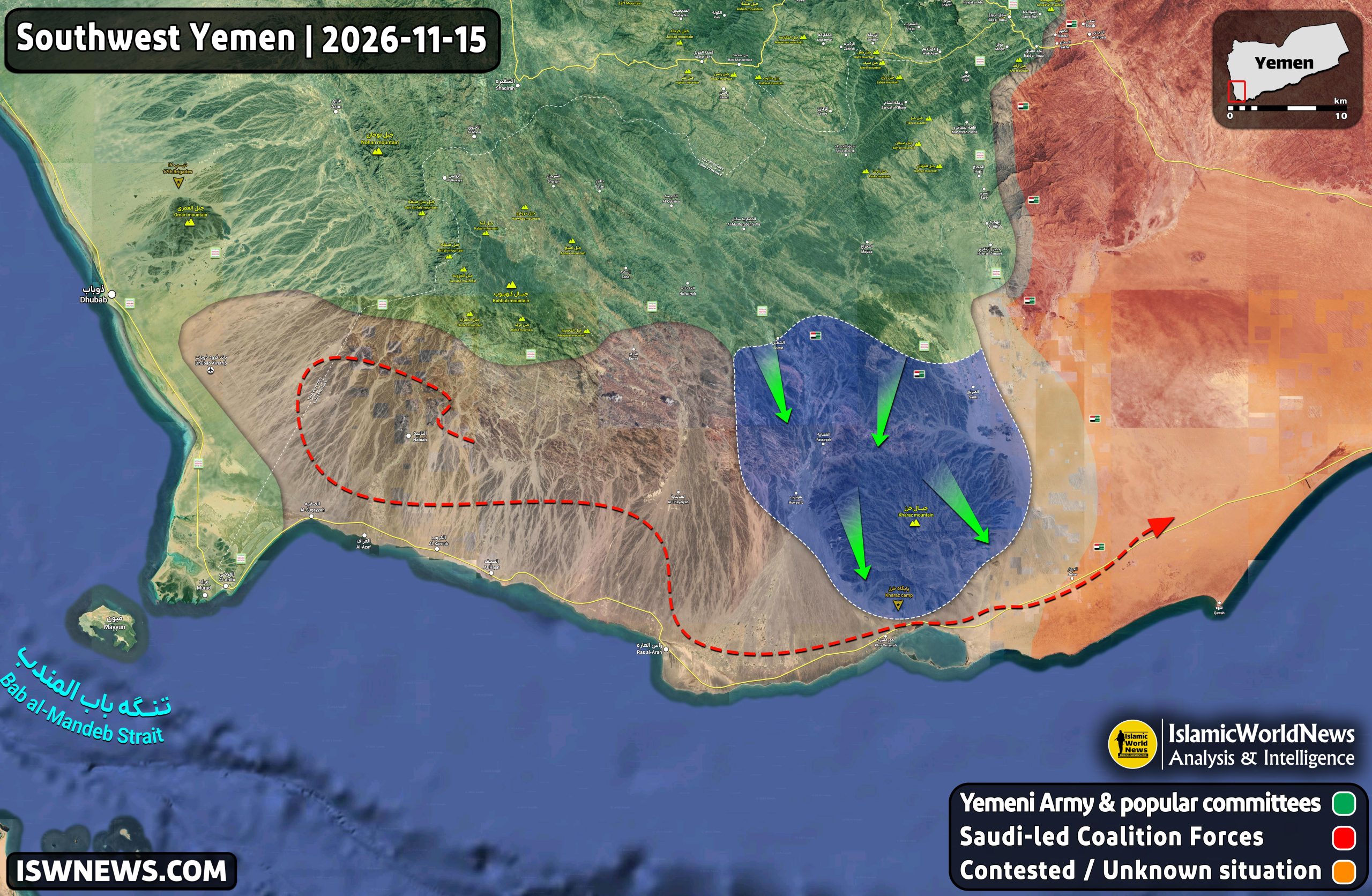
  • Latest field situation map in southwestern Yemen

    Latest field situation map in southwestern Yemen

    Yemeni forces have not yet entered the Khawr Umayrah settlement, but they are deployed around it and on the Kharaz heights and can target the coastal road with anti-armor missiles and artillery munitions. Therefore, Saudi coalition forces in Ras al-Arah and on the eastern front of the Bab al-Mandab Strait have officially been encircled.

    In recent days, Ansarallah forces had repeatedly cut the aforementioned road with guerrilla attacks and hit-and-run tactics, but since yesterday this route has been completely cut off. It should be noted that a number of Saudi coalition forces fled toward Aden in recent days from the areas that were being besieged. However, after the encirclement was completed, a significant number of forces have been trapped in the Yemeni Army’s siege. No final decision has yet been made regarding the fate of these forces. It is possible that the coalition forces will withdraw from the area with the Yemeni Army’s permission, or there is the possibility of their complete capture.

    Click to view full size image
  • The Crossroads of Asia and Africa Under Bin Zayed’s Grip

    The Crossroads of Asia and Africa Under Bin Zayed’s Grip

    Introduction

    In recent decades, under Crown Prince and Abu Dhabi ruler Mohammed bin Zayed, the UAE has pursued an assertive and expansionist strategy aimed at extending its political, economic, and military reach from the Gulf to the Horn of Africa. Bin Zayed, a member of the influential Al Nahyan family, is a staunch opponent of political Islam and a strategic ally of the United States. Washington, in turn, has relied on the UAE in its regional policies, particularly in countering Islamist groups and managing crises.

    The UAE’s population is estimated at around 10 million, of which only one million are citizens; the majority are foreign workers. This demographic reality, combined with oil wealth and vast financial resources, has enabled a foreign policy rooted in economic power and regional networking. Exploiting instability and deep divisions in countries such as Ethiopia, Somalia, Sudan, Yemen, and Libya, the UAE has exerted significant influence over local actors—an influence that would have been impossible in the presence of strong, centralized governments.

    Abu Dhabi’s Role in the Horn of Africa Balance

    The UAE’s military interventions in Libya and Sudan exemplify this approach. In these cases, Abu Dhabi backed forces and groups that countered the influence of rivals like Turkey and Qatar. Over the past decade, Emirati foreign policy has relied on exploiting weak state structures, proxy military networks, and financial capacity—a strategy built on “transactional diplomacy” and “targeted interventionism.”

    Internationally, this policy emerged as the U.S. retreated from its role as global liberal hegemon and scaled back military interventions. Between 2009 and 2011, Bin Zayed recognized that the resulting power vacuum in West Asia and the Horn of Africa offered an unprecedented opportunity for his country to assert itself. Aware of the UAE’s demographic and military limitations but financial and logistical strength, he sought to elevate its geopolitical standing through proactive engagement in surrounding regions.

    The outcome was the launch of a hegemonic and expansionist project spanning both sides of the Red Sea—from the Gulf of Aden to the coasts of Sudan and Eritrea. Through massive investments in ports, infrastructure, and logistics networks across Africa, the UAE became one of the continent’s largest port investors. This economic strategy, combined with military and intelligence activities, enabled Abu Dhabi to build a “transnational empire” blending hard and soft power. Additionally, through informal gold trade networks, the UAE has extracted enormous financial gains from Africa, including the smuggling of roughly 400 tons of gold annually. These economic interests are closely tied to Emirati‑linked companies and institutions active in Africa’s port, security, and financial sectors.

    Socotra: UAE’s Expanding Maritime Influence

    Gradual Entrenchment in Socotra

    The UAE’s approach in Socotra illustrates its strategy of incremental influence and consolidation of geostrategic presence. Following the devastation caused by Cyclone Chapala in 2015, Abu Dhabi deployed relief and engineering teams, establishing itself as a humanitarian actor. This foothold soon evolved into the construction of strategic infrastructure, port facilities, and a limited military presence. Over time, Socotra—ecologically and geostrategically significant—became integrated into the UAE’s maritime influence network stretching across the Persian Gulf, the Arabian Sea, and the Red Sea.

    Overall, Emirati foreign policy over the past two decades has combined geopolitical ambition, targeted economic investment, and exploitation of regional instability. Backed by financial resources and international legitimacy, the UAE has achieved influence far beyond its demographic and military weight, extending from the Gulf to the Horn of Africa and reshaping the security architecture around the Red Sea.

    Abd al‑Kuri: A Strategic Outpost

    Located west of Socotra, Abd al‑Kuri island—home to about 500 residents—sits at the mouth of the Gulf of Aden and the Indian Ocean shipping lanes. Its position makes it a vital observation point for vessels entering the Gulf of Aden, and in recent years it has been transformed into a military and logistical hub.

    In November of that year, U.S. Central Command conducted a Red Sea naval exercise with Bahrain, the UAE, and Israel—the first joint drill among Abraham Accords signatories. This marked the beginning of overt military cooperation between Abu Dhabi and Tel Aviv. Defense ties accelerated: Israel’s Elbit Systems signed contracts to supply defense systems to the UAE Air Force, deployed early‑warning radar in Emirati territory, and in February 2023 unveiled a joint unmanned vessel capable of mine detection. By October 2023, construction began on a 2.4‑km runway in Abd al‑Kuri, later expanded into a full military airfield.

    Satellite imagery in March 2024 revealed the phrase “I love the UAE” etched into nearby sand dunes—a symbolic marker of entrenched Emirati presence. By March 2025, the runway was completed, capable of hosting medium and heavy military cargo aircraft such as U.S. C‑130 Hercules, Russian Il‑76 transports, and advanced drones like Israel’s Hermes‑900. Concurrently, the UAE’s state defense conglomerate EDGE Group entered talks with Elbit Systems to expand its drone fleet, underscoring growing synergy between Emirati investment and Israeli technology. Abd al‑Kuri thus emerged not merely as a small island but as a pivotal node in Abu Dhabi’s geostrategic plan to control maritime routes across Bab al‑Mandeb, in coordination with both Washington and Tel Aviv.

    Storm Gathering at Bab al‑Mandeb

    Parallel to developments in Abd al‑Kuri, extensive activity began on Samhah, the smallest inhabited island of the Socotra archipelago. From 2024 to mid‑2025, the UAE built a runway, paved roads, and support facilities. Given the island’s rugged terrain, the airstrip is suited for surveillance missions and limited reconnaissance flights rather than heavy transport. It is optimized for advanced drones like the Hermes‑900, enabling electronic monitoring and maritime patrols. Samhah’s location between the Gulf of Aden and the Arabian Sea makes it ideal for overseeing a chokepoint through which roughly 12% of global trade passes.

    Satellite images from March–April 2025 showed a temporary sand barrier on the island’s western side, likely for drainage and construction support—typical of isolated military projects. During this period, the Yang Star, a Comoros‑flagged landing craft, anchored off Samhah, ferrying engineering equipment and materials between Socotra, Abd al‑Kuri, and Yemeni ports. Other vessels, including Takreem and Mabrouka‑2, regularly connected Socotra, Yemeni coasts, Abd al‑Kuri, and Bosaso in northern Somalia, forming the logistical backbone of the UAE’s maritime influence network in the southern Arabian Sea and Bab al‑Mandeb.

    Mayun: The Critical Node

    While Socotra, Abd al‑Kuri, and Samhah are key points in this network, Mayun (historically Perim) is strategically the most vital. This volcanic island lies at the center of Bab al‑Mandeb, a strait notorious for treacherous currents and reefs, earning the name “Gate of Tears.” It separates Yemen from Eritrea and Djibouti—both hosts to U.S. and Western military bases. Mayun’s strategic importance dates back centuries, serving as a control point for maritime trade even before the Suez Canal opened in 1869.

    In early 2021, reports surfaced of a “mysterious airbase” under construction on Mayun, with no state claiming responsibility. Analysts noted that whoever controls it gains leverage over Bab al‑Mandeb, enabling air operations into Yemen and naval missions across the Red Sea, Gulf of Aden, and East African coasts. Satellite imagery from 2023–2025 showed a 1.85‑km runway along the island’s western shore, surfaced for medium aircraft, large drones, and reconnaissance planes. While little changed in 2023–2024, 2025 images revealed resurfacing and leveling—signs of reactivation and preparation for new missions.

    This evolving network—from Socotra to Mayun—illustrates how the UAE, through incremental infrastructure projects, military cooperation, and logistical integration, has built a layered maritime presence across one of the world’s most strategic chokepoints. It reflects Abu Dhabi’s ambition to secure influence over global trade routes and embed itself in the security architecture of the Red Sea and Arabian Sea.

    UAE’s Power Play Amid Crisis

    The series of moves in the islands of Samhah, Abd al‑Kuri, and Mayun reflects the emergence of an integrated military‑maritime chain along Yemen’s vital southern sea lanes. The United Arab Emirates, leveraging investment, military technology, and newly forged security ties with Israel and Western partners, is consolidating this network to exert stronger control over trade and military routes in the Gulf of Aden and the Red Sea.

    In this context, recent satellite imagery analysis of the Bosaso base in northern Somalia shows that the UAE has deployed critical infrastructure for maritime surveillance and control. At the northern end of the base, a phased‑array radar system has been identified, most likely the GM‑403 model by France’s Thales, with an effective range of over 400 km and the ability to track more than a thousand aerial targets simultaneously—including drones, fighter jets, cruise missiles, and artillery shells. However, intelligence reports and local sources also suggest the possible deployment of the EL/M‑2084 radar system by Israel’s IAI/ELTA, the same system used in the “Iron Dome” air defense network.

    Given the informal security cooperation between Abu Dhabi and Tel Aviv after the Abraham Accords, this possibility is far from unlikely. Geopolitically, the installation of such a system in Bosaso enables the UAE to maintain continuous surveillance over maritime and aerial movements across the Gulf of Aden, Bab al‑Mandeb Strait, and the southern entrance to the Red Sea—an area through which a vital share of global energy and trade flows from East Asia to Europe.

    This development positions Bosaso as a key link in the UAE’s chain of bases in the Horn of Africa and Yemeni islands—including Socotra, Abd al‑Kuri, Samhah, and Mayun. The Bosaso radar thus functions not only as part of a multilayered regional monitoring system but also as the intelligence backbone of Abu Dhabi’s broader plan to control maritime routes across southern Arabia and eastern Africa. This strategy carries a dual nature: on one hand serving “counter‑terrorism and maritime security,” and on the other consolidating Abu Dhabi’s geostrategic dominance in competition with Iran, Turkey, and Qatar in the security landscape of the Arabian Sea and Red Sea.

  • Naval Operations By Yemeni Armed Forces Against Israeli Interests In Red Sea, Bab Al-Mandab Strait

    Naval Operations By Yemeni Armed Forces Against Israeli Interests In Red Sea, Bab Al-Mandab Strait

    The statistics and details of the naval operations by the Yemeni armed forces against Israeli interests in the Red Sea and the Bab al-Mandab Strait are as follows:

    1- Seizure of GALAXY LEADER vehicle carrier – November 19 – west of Hudaydah
    2- Attack or rerouting of a ZIM container ship – November 25 – near Hanish Island
    3- Missile attack on CENTRAL PARK oil tanker (US claim and Ansar Allah’s denial) – November 26 – Southwest of Aden
    4- Missile attack on UNITY EXPLORER bulk carrier and drone attack on NUMBER 9 container ship – December 3 – Bab al-Mandab strait
    5- Rerouting of two unknown ships after receiving warnings – December 8 – Red Sea
    6- Missile attack on Norwegian STRINDA oil tanker – December 12 – north of Bab al-Mandab
    7- Missile attack on two unknown commercial ships (claimed by the US and Britain) – December 13 – Bab al-Mandab Strait and west of Hudaydah
    8- Drone attack on MAERSK GIBRALTAR container ship – December 14 – north of Bab al-Mandab
    9- Missile attack on MSC ALANYA and MSC PALATIUM III container ships – December 15 – west of Al-Mukha
    10- Drone attack on SWAN ATLANTIC oil tanker and MSC CLARA container ship – December 18 – Bab Al-Mandab Strait

    Among the outcomes of these operations against Israeli shipping, there are significant financial losses inflicted on Israeli companies and economic ministries, a reduction in the activity of Israeli ports, and the halt of Israeli ships’ passage through the Red Sea, among many other consequences. These attacks have also led to the suspension of cooperation with the Israeli regime by at least seven major shipping companies, which is of great importance.

    The Bab al-Mandab Strait and the Red Sea are vital economic arteries, which the Ansar Allah movement and the Yemeni army have managed to control through their resistance and precise attacks. Yemen’s role in the resistance axis against the Israeli regime and its Western allies has become prominent to a certain extent, to the point where Western media have claimed that US officials have proposed halting the Yemeni forces’ attacks in exchange for achieving a ceasefire in the Gaza Strip and sending humanitarian aid through mediating countries.

    Click to view full size
  • Bab Al-Mandab Turns Into Main Front Of Maritime Clashes Between Ansar Allah Movement, Saudi-Led Coalition

    Bab Al-Mandab Turns Into Main Front Of Maritime Clashes Between Ansar Allah Movement, Saudi-Led Coalition

    According to the plan, militant forces affiliated to Tareq Saleh, a Yemeni military commander and the nephew of the late President Ali Abdullah Saleh, will control the coastal areas from Hays city to Bab al-Mandab Strait, as well as the Southern Transitional Council (STC) forces will control the coastal regions from Ras al-Ara area to Aden governorate. The implementation of this plan faces problems, because tribes such as al-Sabiha tribes in Lahij Governorate, southern Yemen, want their share and try to control this region.

    The seventh brigade of Amaliqa forces as well as groups of Al-Sabihah tribal militants prevented Tareq Saleh’s forces from constructing a base and settling in the Bab al-Mandab coastal strip, located in southwestern Taizs Governorate, on July 28.

    The tension was accompanied by a halt in the movement of Tariq Saleh’s forces near Dhubab town, and al-Sabiha tribes warned Tareq’s forces against any military movement towards Bab al-Mandab. After this event, Tareq Saleh ordered more forces to be sent to Dhubab town, but eventually, due to resistance from al-Sabihah tribes, he was forced to retreat from Dhubab towards Mocha.  

    Al-Sabiha tribes claim that the southwestern lands of Taizz Governorate belong to these tribes and Tareq Saleh’s forces must also retreat from their other positions. They did not stop at this condition and demanded that their militants be officially recognized within the framework of the Saudi-led coalition forces and also Abu Dhiyab al-Alkami return to his position in command of support for national resistance forces (under Tareq Saleh’s command) and also hand over the killers of a soldier named Saadan Ali Saeed.

    Tariq Saleh, on July 30, in his first reaction to the clash with al-Sabiha tribes in Bab al-Mandab, published a statement entitled leadership statement of national resistance forces. Saleh considered Bab al-Mandab within his operational space in this statement and referred to a plan that has been approved in joint operations with the participation of Abdul Rahman Abu Zaraa Al Muharrami, commander of Amaliqah forces. He also considered establishing himself in all areas of Taizz Governorate and securing international navigation routes as part of his duties.

    Following this escalation, Tareq Saleh’s adviser Nabil Al-Sufi announced in a tweet that the plan to establish joint forces (under Tareq Saleh’s command) was designed by the United Arab Emirates and includes the area from Hays in the south of Al-Hudaydah Governorate to Bab al-Mandab. Also, the Southern Transitional Council forces will protect the coastal areas from Ras al-Ara region to Aden to ensure the security of Bab al-Mandab Strait. In addition, Djibouti’s armed forces will be stationed on the other side of the strait.

    In this regard, some local sources reported that the Southern Transitional Council forces transferred control of al-Ardhi region in Bab al-Mandab to Tareq Saleh’s forces on July 31.

    Based on the circumstances on the ground, this plan can be considered as part of the US-led coalition’s deployment to support a future naval war with the Ansar Allah movement. In recent months, the Ansar Allah movement has strengthened its naval force with the support of Iran and other resistance groups and has armed its forces with various missiles and speed boats.

    The tension between al-Sabiha tribes and Tareq Saleh’s forces can also be considered as a sabotage by some Saudi officials to disrupt the United Arab Emirates’ plan, as they are not interested in resuming hostilities with the Ansar Allah movement and are not willing to completely surrender southwestern Yemeni coasts to the United Arab Emirate. Therefore, they play a role with the card of al-Sabiha tribes in this axis.

    Altogether, the conflicts in the Red Sea and the vital Bab al-Mandab Strait seem to be important issues, which have been raised since the early years of the Yemen war and they have turned into more serious topics with the permanent deployment of the United States’ naval coalition or Combined Task Force 153 to the waters of the region.

    The US and Israel resort to sabotaging the Yemen peace process and destroying relations between Iran and Saudi Arabia in order to send Saudi Arabia back to war with the Ansar Allah movement. Despite avoiding re-engagement in Yemen, the Saudi authorities continue to show inflexible reactions in negotiations as well as military deployment in a bid to maintain their positions! However, such an attitude is expected to weaken the efforts to find a political solution in line with achieving peace in Yemen.

    Military situation in southern Yemen – click to view full size
  • Yemen: Who occupied the Mayyun island?

    Yemen: Who occupied the Mayyun island?

    The Associated Press recently reported on the construction of an air base on Mayyun Island off the southwestern coast of Yemen, attributing the construction to the UAE. The report cites the movement of trucks and heavy engineering machinery that are building a 1.85-kilometer runway.

    Earlier, the Jerusalem Post also reported on January 11, 2021, that the construction of the US-Israeli base on Mayun Island had begun.

    Prior to the move, the UAE had built a 5-kilometer runway on the island and completed some of the base’s facilities, which were halted in 2019 due to the withdrawal of UAE troops from direct involvement in the Yemeni war.

    Mayyun or Prim Island is a volcanic and Yemeni island that divides the Bab al-Mandeb Strait, the entrance to the Red Sea, into two channels: the eastern channel called “Alexander’s Strait” with a width of 3 km and the western channel called “Dact-el-Mayun” with a width of 25 km. It plays a crucial role in controlling maritime traffic in the world. Mayyun Island used to be under the control of the UAE, and now the United States and Israel are plotting to take control of it.

    Bab al-Mandeb
  • The United States and Israel will occupy an important Yemeni island

    The United States and Israel will occupy an important Yemeni island

    The Jerusalem Post reported on the construction of a US-Israeli military base on Mayyun (Perim) Island off the southwestern coast of Yemen and the strategic Bab al-Mandeb Strait.

    Mayyun (Perim) Island is a Yemeni volcanic island that divides the entrance to the Red Sea into two eastern parts called “Alexander’s Strait” with a width of 3 km and a western part called “Dact-el-Mayun” with a width of 25 km and plays a very important role in controls maritime transit in the world. Mayyun was previously controlled by the UAE, and now the United States and Israel are plotting to take control of it.

  • Everything About Yemen West Coast Battle

    Everything About Yemen West Coast Battle

    If we take a look at the evolutions of Yemen from Spring (March), we see Saudi Coalition is following three goals:
    1. In west coast of Yemen (north of Hajjah and south of al Hudaydah)
    2. East of Sanaa until south of Baydha
    3. East, north and west of Sa’adah (axes such as Taiz and Jawf and we will address the details of the battlefield in this axis)


    In summary, Saudi Coalition (with leadership of Saudi Arabia and UAE) want their benefits and opposing Iran influence, i.e., AnsarAllah movement.

    To achieve it, occupying Sanaa and Sa’adah is considered the end of Iran influence in Yemen and a secure region according to their standards and supporting Mansoor Hadi and his forces are a mean to help with it.

    Emirates seeks their benefits through supporting Southerners.

    Other elements such as al Qaeda, ISIS and Saleh fans are useful for the Saudi Coalition as long as they fight with AnsarAllah.


    As mentioned before the goal of west coast battle is to cut AnsarAllah’s access to sea with two main axes:
    1. South of al Hudaydah
    2. North of Hajjah


    1. South of al Hudaydah axis: (Purple arrow)
    Al Hudaydah operation was started by leadership of Emirates in west coast using three streams (militia following Tariq Saleh, Southern and local forces) which was defeated by AnsarAllah by opening numerous fronts along coastal strip and dummy attacks to drain their energy.

    After that Saudi using Mansoor Hadi’s forces in addition to current forces continued the operation with more strength.

    Occupying Bab al Mandeb-Zobab-Mocha-Khukha-Hays; was paved in a slow pace operation by Saudi Coalition and “Fazah-Majilis-Tuhayta” and some other points are added to the list.
    (We explained al Hudaydah operation aspect by Saudi Coalition also in this article:
    Discussion on Aspects of the Saudi Coalition Operation in al-Hudaydah).

    2. North of Hajjah axis: (Red arrow)

    In north of Hajjah, after fall of Midi and Hayran and northern borders, Haradh is almost under siege and Saudi Coalition arrow of attacks pointing Abas.

    According to the goal of cutting AnsarAllah’s access to sea, the Coalition forces are going to in three directions after occupying Midi and Hayran:

    1. To Haradh, 2. To Abas and then Ma’ras and then Zaydiyah and Zahra. 3. To Lahiya and then in coastal strip and finally reaching al Hudaydah.


    Conclusion:

    The joining point of the two operations is al Hudaydah city and the outcome is to cut AnsarAllah’s access to sea, thus AnsarAllah will resist with its highest power.

    Saudi Coalition attack from north which is Hajjah can shake AnsarAllah’s defense in al Hudaydah for several reasons and on the other side, AnsarAllah is trying to make the war longer and by using heat defense is trying to drain the Coalition budget and power, which is supported by US and Israel design and Emirates and Saudi money and company of hired governments.


    Download HD Map

  • Latest Updates on Yemen 26 July 2018; Bab al-Mandeb Strait Under Fire of AnsarAllah

    Latest Updates on Yemen 26 July 2018; Bab al-Mandeb Strait Under Fire of AnsarAllah

    1. Ansarallah airforce and Yemeni Army, have targeted two of Saudi-led coalition’s military ships in western coasts of Ad-Durayhimi.

    The Saudi-led Coalition confirms this attack and claimed that these ships were oil tankers. However, Ansarallah say that they were military, carrying armaments.

    In this current situation of the region, the effective threats of the Coalition & resistance groups in economic straits of the world, have great impact on the making of the future and the extent of the battle.

    Following up this attack against Coalition, Saudi Arabia have stopped its oil tankers, until the security of Red Sea is assured.


    2. Ansarallah’s drone attacked the Saudi-led coalition forces in Nate` of Al-Bayda province.


    3. Al-Hudaydah

    The UAE-backed forces want to capture Zubayd, and in the past two days they increased their attacks from west and southwest towards this town, but for now their attacks are repelled by Ansarallah & Popular movement committees.
    Maghris and Madmin and Jabilah are still under the control of Ansarallah, and the attacks on Fazah continues (the above pictures are about these attacks)

  • Latest Updates on Yemen 21 June 2018; Iranian Navy Dispatches Warships To Bab al-Mandeb

    Latest Updates on Yemen 21 June 2018; Iranian Navy Dispatches Warships To Bab al-Mandeb

    1. According to Saudi-led coalition claim, final positions of the army and Ansarallah have fallen in Nu’man district, from governorate of Al-Bayda.
    With the fall of Aqabat alQoanda` region, in northern Al-Bayda, Nu’man district is now in the hands of Saudi-led coalition. With the fall of Nu’man, two district of Almalajam & Nate’ will also go under heavy attacks.


    2. Al-Hudaydah:

    Today’s clashes in past days lines, namely south and east of airfield, sporadically continues, and also west side (main building of airfield), north side and airdefense base is under control of Ansarallah.
    (After that Ansarallah’s officals and spokeman denied the fall of Al-Hudayda airfield, now videos and pictures that are out, shows us the true nature of these clashes)


    Destroying the armored vehicles of the Coalition on the Western shores by Ansarallah


    Today attacks, by UAE-Backed forces with the aim of advancing in west side of airfield ( airfield’s square and alKornish region ), is stopped and so the coalition forces retreated to Al-Manzar.

    Also there is no changes for situation of other fronts in southern Al-Hudayda (Ad-Durayhimi and Al-Jah). And because of constant attacks by Ansarallah, coastal road is still blocked.
    Also an UAE drone was downed in airfield’s sky by Ansarallah (picture down below)


    3. A coalition drone was downed in Al-Dhaher District, north of Saada Governorate.


    4. New comments of Martin Griffiths, UN’s special envoy for Yemen:

    I will continue negotiating with all parties, so that i stop the war in Al-Hudayda from continuation. My priority is to stop the war in Al-Hudayda and going back to political negotiations. The constructive participation of Ansarallah’s leader in Sana’a inspired me, and i am waiting for my meetings with President (resigned) Mansour Hadi and his government. I repeat the UN’s obligation for attaining a political agreement in Yemen. I welcome the obligation and parties tendency for joining the internal political process of Yemen (which UN Facilitates it).


    5. Islamic Republic of Iran Army, dispatched its naval squadron & “Khark” helicopter carrier to Yemen seas.

    Khark helicopter carrier after 4 years of repair, alongside with Iran’s 54th Naval Squadron of IRI Navy, was sent to the region in order to keep the security of open waters of Aden Gulf, northern Indian ocean, and Bab-el-Mandeb strait.

    (With regards to nature of this missions, despite what is being said in western medias, it doesn’t seem that Iran has any plan for military intervention in Yemen. However, this action is not without influence security of Iranian ships which are under threats of Saudi-led coalition in these regions.)