Friday 4 September 2026

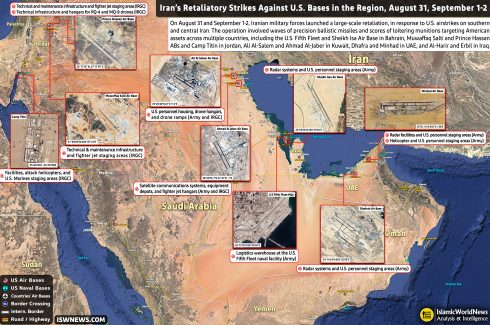
Iran’s Retaliatory Strikes Against U.S. Bases in the Region, August 31, September 1-2

Iranian military forces launched a large-scale retaliation on the morning of August 31, the evening of September 1, and the early morning of September 2, in response to U.S. airstrikes on southern and central Iran. The operation involved waves of precision ballistic missiles and scores of loitering munitions targeting American assets across multiple countries, including the U.S. Fifth Fleet and Sheikh Isa Air Base in Bahrain, Muwaffaq Salti and Prince Hassan Air Bases and Camp Titin in Jordan, Ali Al-Salem and Ahmad Al-Jaber in Kuwait, Al-Dhafra and Al-Minhad in the UAE, and Al-Harir and Erbil in Iraq.
Saturday 8 August 2026

Security Reconfiguration of the Persian Gulf Cooperation Council

The recent war deepened the internal rifts within the Persian Gulf Cooperation Council (GCC), revealing that its member states hold divergent approaches toward Iran, the United States, and the Zionist regime. Simultaneously, the vulnerability of the Strait of Hormuz and energy infrastructure exposed the limitations of the U.S. security umbrella. Consequently, the future of the Persian Gulf will be shaped less by strategic integration and more by rivalries, divergences, and individual states’ efforts to secure their interests through different pathways.

Tuesday 30 June 2026

From Classical Confrontation to Geoeconomic Deadlock; Dissecting the Second Phase of the Iran-U.S. War

Recent developments in West Asia signal a transition from traditional confrontations to multi-layered rivalries unfolding across strategic energy chokepoints, where straits such as Hormuz and Bab al-Mandab have become focal arenas for the projection of power and pressure. Within this framework, the scenario of a U.S.-led naval blockade of Iran—employed as a tool for maximum pressure—alongside the possibility of a return to direct conflict between the two sides, has reinforced the prospect of escalating tensions. At the same time, Europe’s growing skepticism toward Washington’s unilateral approaches has cast uncertainty over the future of NATO cohesion. On another level, the involvement of Tehran-aligned actors such as the Houthis (Ansarallah) in Bab al-Mandab has highlighted the potential for expanding the maritime theater of competition and enabling Iran to leverage this asset indirectly. Taken together, these developments indicate that regional maritime security is increasingly becoming the primary arena for redefining the balance of power. Accordingly, this study aims to assess the feasibility, consequences, and sustainability of these scenarios, while elucidating their impact on the regional balance of power and the international security order.

Saturday 27 June 2026

Maven in the Iran War

The Ramadan War demonstrated that artificial intelligence and systems like “Maven” have been moved to the center of U.S. military operations, aggregating field data to dramatically accelerate targeting and decision-making. At the same time, Silicon Valley’s role in modern warfare has become more prominent, with parts of the military’s intelligence and operational infrastructure being outsourced to technology companies. This transformation, alongside increased efficiency, has raised questions about targeting accuracy, civilian casualties, and the dependence of national security on private-sector actors.

Tuesday 21 May 2019

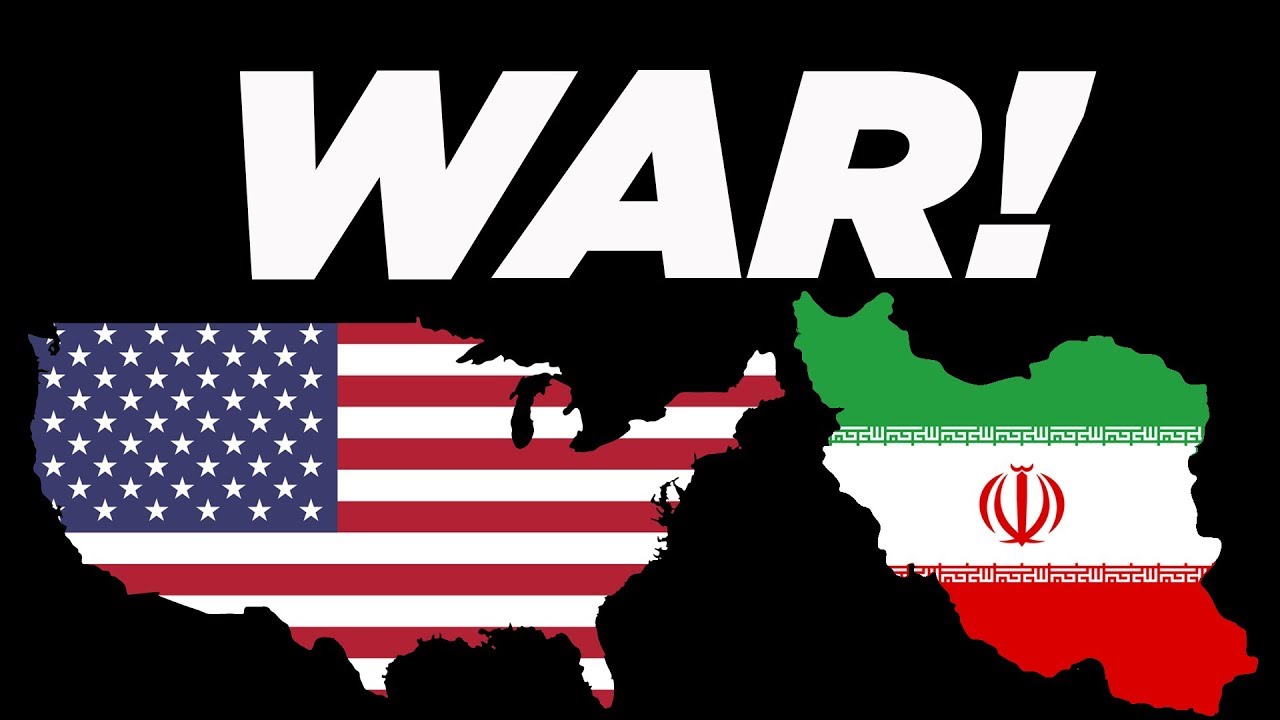
War with Iran?!

“They are not Iranians, they are Persians!”