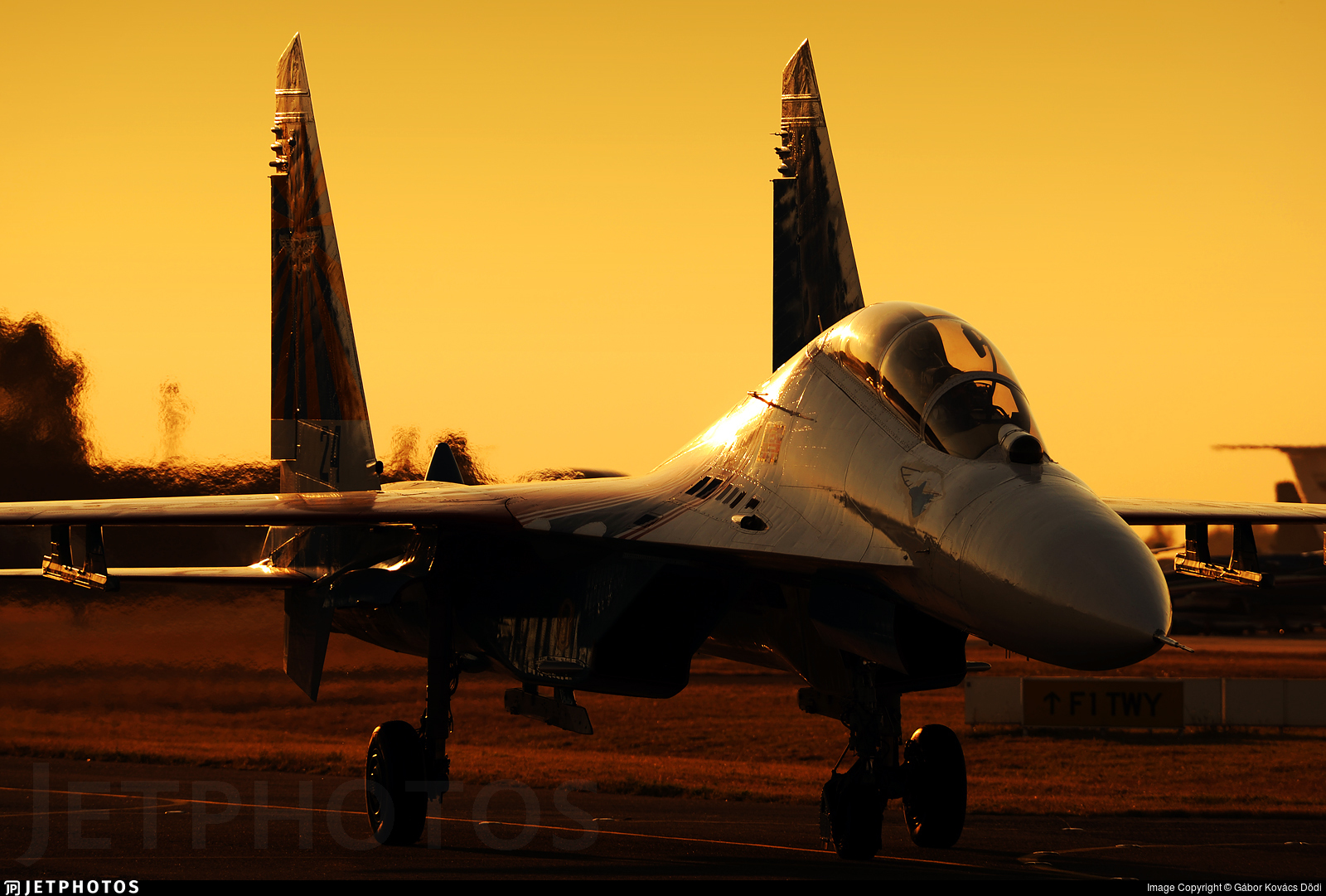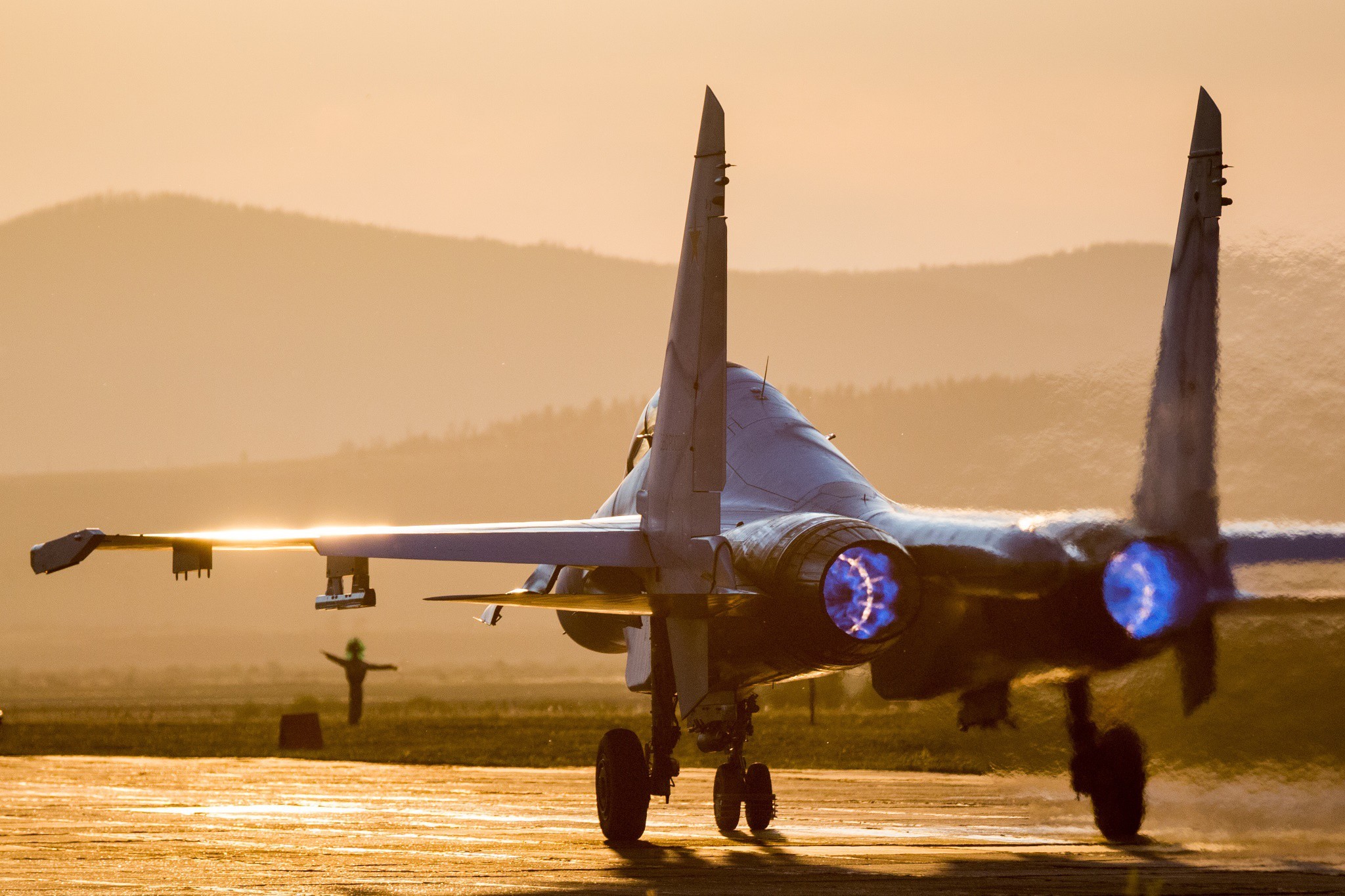
Tag: Russian warplanes

  • Military Knowledge: Sukhoi Su-30 Multirole Fighter; The Versatile Backbone of Russian and Allied Air Forces

    Military Knowledge: Sukhoi Su-30 Multirole Fighter; The Versatile Backbone of Russian and Allied Air Forces

    Design and Development History of the Su-30

    The Su-30 project was initiated in the late 1980s by the Sukhoi Aerospace Corporation. The main goal behind designing this fighter was to create an upgraded version of the Su-27 that could not only perform air interception missions but also take part in offensive operations against ground and naval targets. While Su-27 fighters had a decent operational range, the Soviet military was seeking a fighter with extended reach to ensure full coverage of Soviet territory. Thus, the development of the Su-27PU began in 1986, which was considered a more advanced version of the Su-27 and capable of serving both as an interceptor and airborne command post.

    The twin-seat Su-27UB was chosen as the design base for the Su-27PU due to its two-seat configuration. The first prototype of this fighter flew on June 6, 1987, and after successful testing, construction of two additional versions commenced. The first full-scale version of the Su-27PU flew on December 31, 1989, at the Irkut facility, and the first of three pre-production models flew on April 14, 1992, officially entering operational service with the Russian Air Force.

    Between 1994 and 1996, the first batch of this fighter, consisting of five units, was delivered to the Russian Ministry of Defense, which in the same year renamed the aircraft from Su-27PU to Su-30.

    As mentioned earlier, the Su-30 is built on the Su-27 platform and has been transformed into a multirole fighter by adding a two-seat cockpit, advanced avionics systems, aerial refueling capability, and upgraded flight control systems. Its design includes an aerodynamic airframe with movable control surfaces, large air intakes, and twin vertical stabilizers. Production of this fighter has been carried out by Irkut and KnAAPO, and its export variants have been developed in collaboration with purchasing countries. It is worth noting that both companies are subsidiaries of Sukhoi. The internal design of this aircraft incorporates digital fly-by-wire flight controls, threat warning systems, electronic warfare capabilities, and secure communications, enhancing its operational performance in complex environments.

    Dimensions and Aerodynamic Features of the Su-30

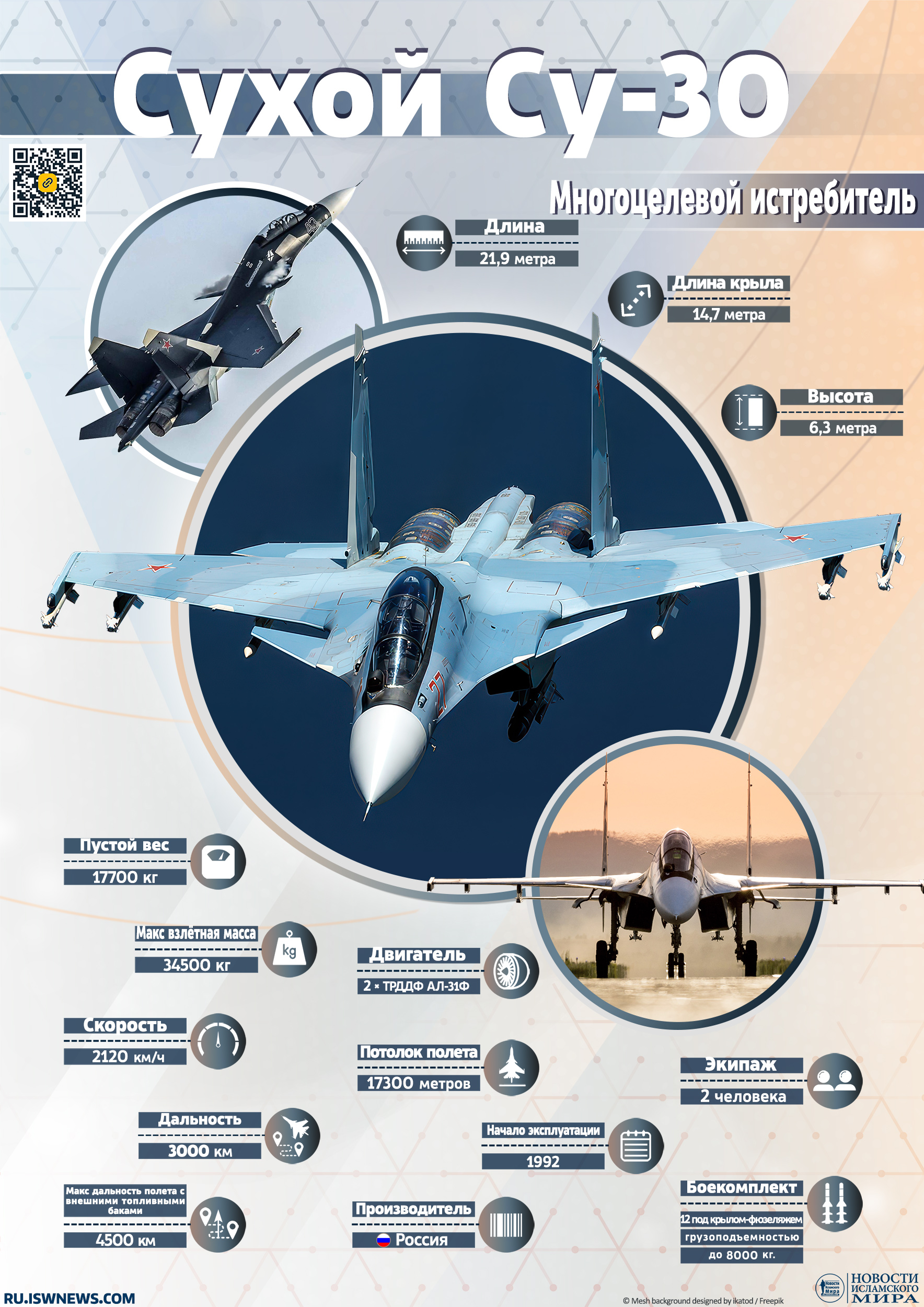
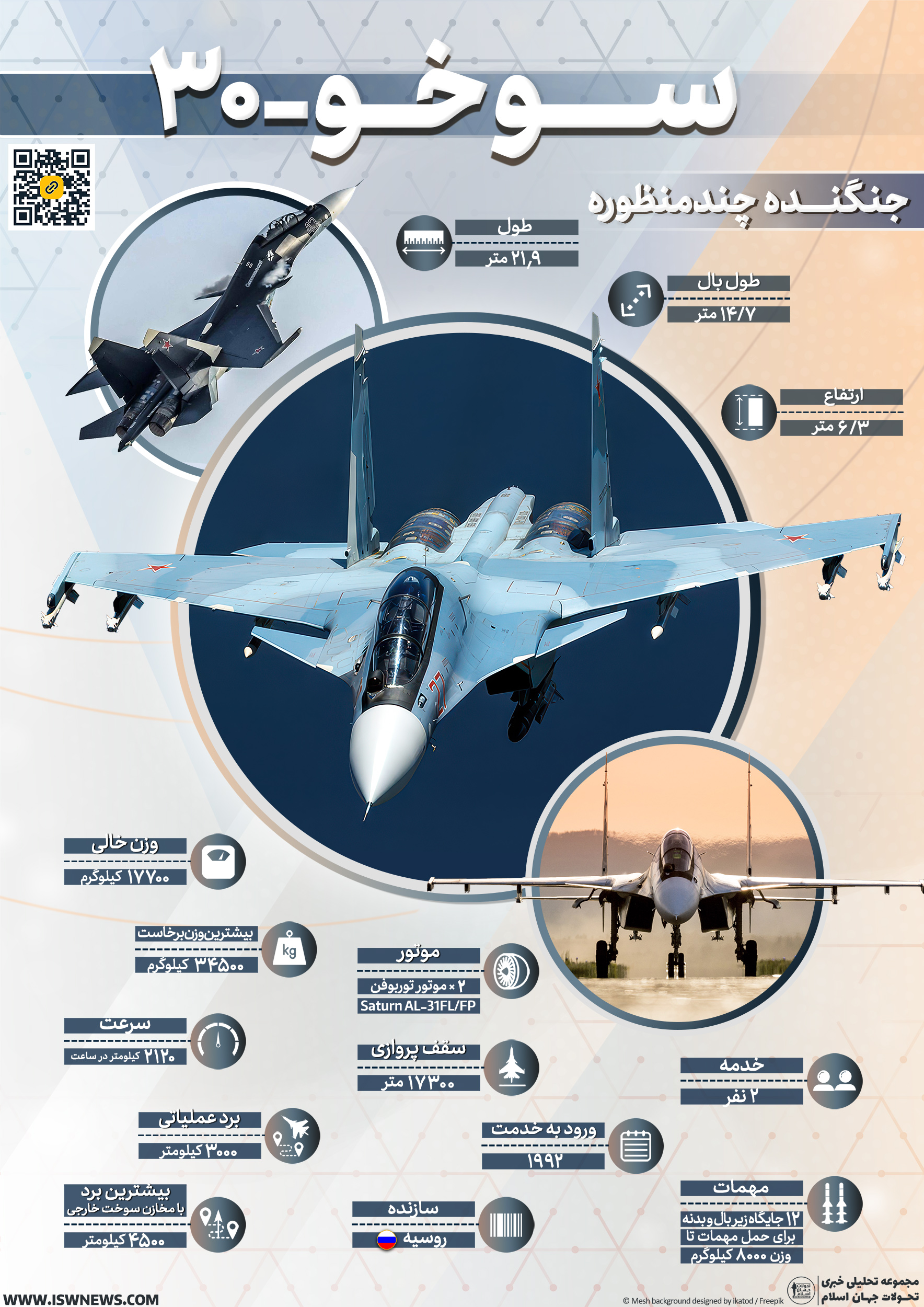
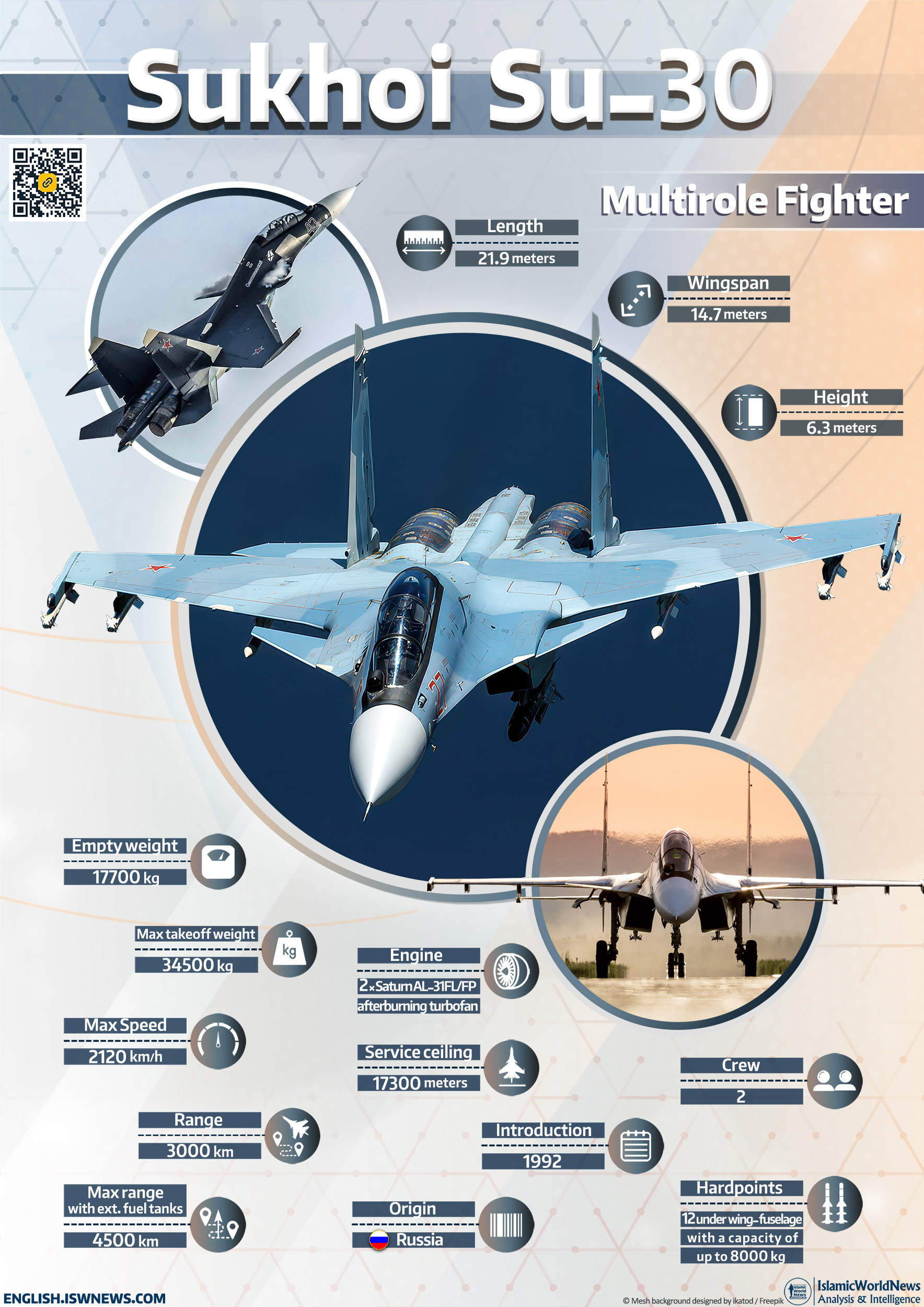
    The Su-30 has a length of 21.9 meters, a wingspan of 14.7 meters, and a height of 6.36 meters. Its empty weight is approximately 17,700 kilograms, and its maximum takeoff weight reaches up to 34,500 kilograms. The aerodynamic design of this fighter—with large wings, movable control surfaces, twin vertical stabilizers, and thrust-vectoring engine nozzles—enables it to perform a wide range of complex and high-intensity aerial maneuvers such as the “Cobra,” “Tail Slide,” and “Flat Spin.”

    Su-30 fighter jet performs the Cobra maneuver, a favorite maneuver of Russian fighters

    The digital flight control system enhances stability and precision during maneuvers, ensuring reliable performance at high altitudes and high speeds. These features have granted the Su-30 a significant edge in aerial combat, making it exceptionally maneuverable in dogfight scenarios.

    Engine and Propulsion System of the Su-30

    The Su-30 is powered by two Saturn AL-31FL/FP turbofan engines, each capable of generating 12,500 kilograms of thrust. These engines are equipped with thrust-vectoring nozzles, which significantly enhance the aircraft’s maneuverability. The fighter can reach a maximum speed of approximately Mach 2 (2,120 kilometers per hour), and its service ceiling is 17,300 meters.

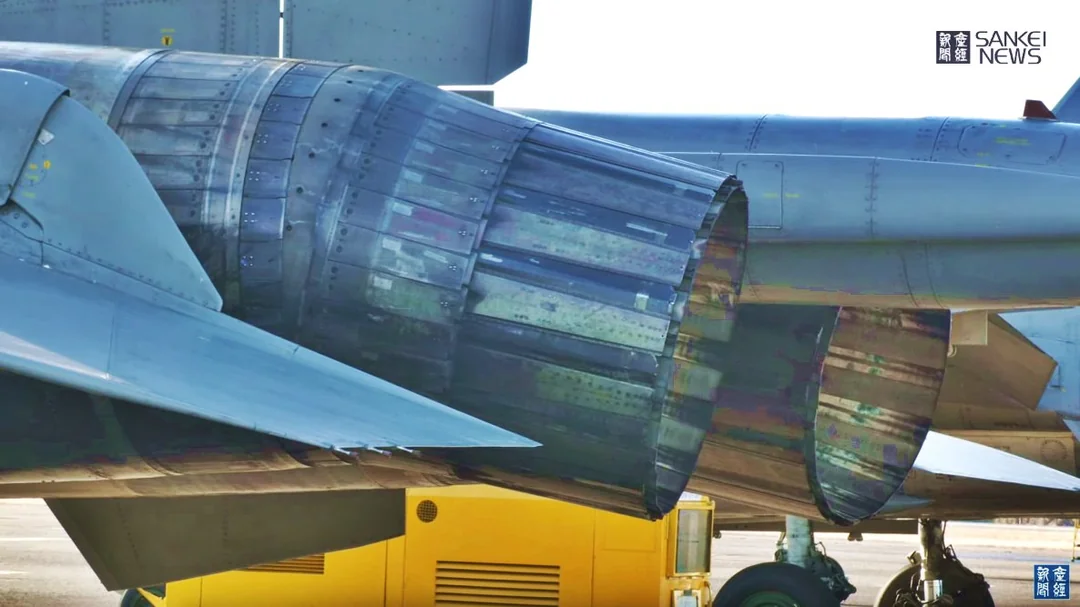
    Saturn AL-31F turbofan engine

    The Su-30 has a climb rate of approximately 230 meters per second and is capable of flying in harsh conditions and undertaking long-duration missions. Its engines, known for high reliability and ease of maintenance, play a crucial role in the aircraft’s operational success.

    Internal and External Fuel Tanks and Maximum Range of the Su-30

    The Su-30 is equipped with standard internal fuel tanks holding approximately 9,640 liters, integrated within the fuselage and wings. These tanks are sufficient for medium-range missions, but for long-range operations or extended patrols, the aircraft is also designed to carry external fuel tanks.

    This fighter can mount up to three external fuel tanks on pylons beneath the wings and fuselage. Each external tank typically holds around 1,200 liters. With these additional tanks, the aircraft’s operational range increases significantly. Moreover, advanced variants such as the Su-30MKI and Su-30SM are fitted with aerial refueling systems, allowing them to receive fuel mid-flight from tanker aircraft. This capability is especially critical for long-duration missions and operations in remote areas.

    The flight range of the Su-30 varies depending on configuration and mission profile. Under standard conditions using only internal fuel, it can fly up to approximately 3,000 kilometers. With external tanks added, this range extends to around 4,500 kilometers. In ferry mode, with aerial refueling, the range can exceed 5,200 kilometers. These figures demonstrate the Su-30’s ability to participate in long-distance missions or maritime patrols without relying on nearby bases.

    Radar and Detection Systems of the Su-30

    The Su-30 fighter, across its various versions, is equipped with two advanced radar systems that play a critical role in enhancing combat capability, target detection, and weapon guidance. These two radars are the N011M Bars and the Irbis-E, installed respectively in the standard and upgraded variants of the aircraft.

    N011M Bars Radar – Fourth-Generation Passive Phased Array Radar

    The N011M Bars is a pulse-Doppler radar with a Passive Electronically Scanned Array (PESA) configuration. It is deployed in models such as the Su-30SM (Russia), Su-30SME, Su-30MKI (India), Su-30MKM (Malaysia), and Su-30MKA (Algeria). This radar can detect large aerial targets at distances of up to 350 kilometers, track up to 15 targets simultaneously, and engage 4 targets at once. Its capabilities include ground and sea target detection, surface mapping, digital terrain imaging, and guidance for precision weapons.
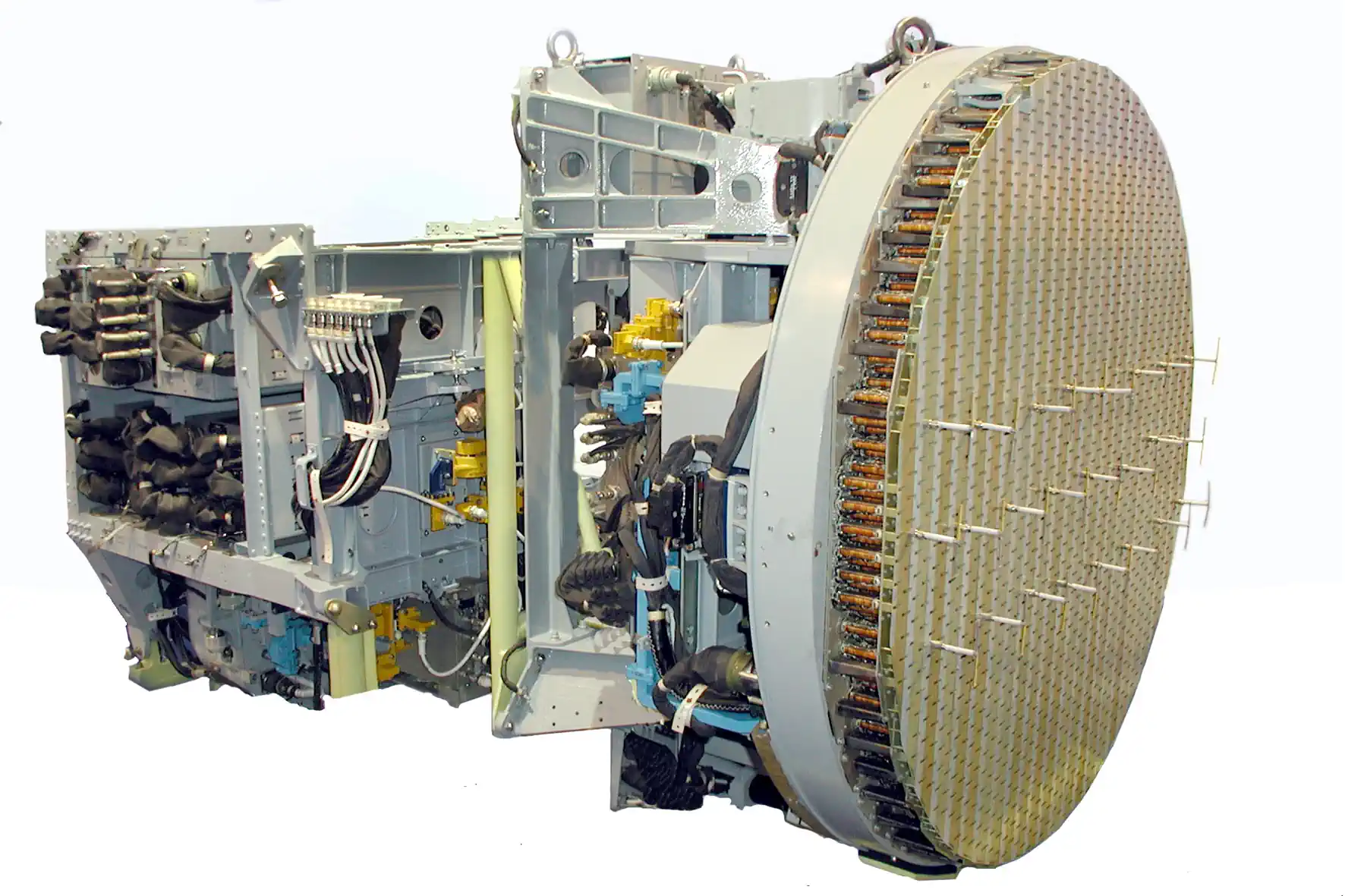
    N011 Bars radar

    The Bars radar is integrated with the fighter’s avionics systems and is capable of countering electronic warfare threats. It is engineered to deliver stable and reliable performance during combined air-to-air and air-to-surface missions. Additionally, by supporting medium- and long-range missiles such as the R-77 and Kh-31, it plays a vital role in enhancing the accuracy and effectiveness of the aircraft’s weapon systems.

    Irbis-E Radar – A Leap Toward 4.5-Generation Capabilities

    The Irbis-E radar is an upgraded member of the Bars family and is installed in advanced Su-30 variants such as the Su-30SM2, and most notably in the Su-35 fighter. Like its predecessor, it features a Passive Electronically Scanned Array (PESA), but with higher output power and more advanced processors, delivering significantly enhanced performance. The Irbis-E can detect aerial targets at ranges up to 400 kilometers and is capable of tracking up to 30 targets simultaneously while engaging 8 of them at once.
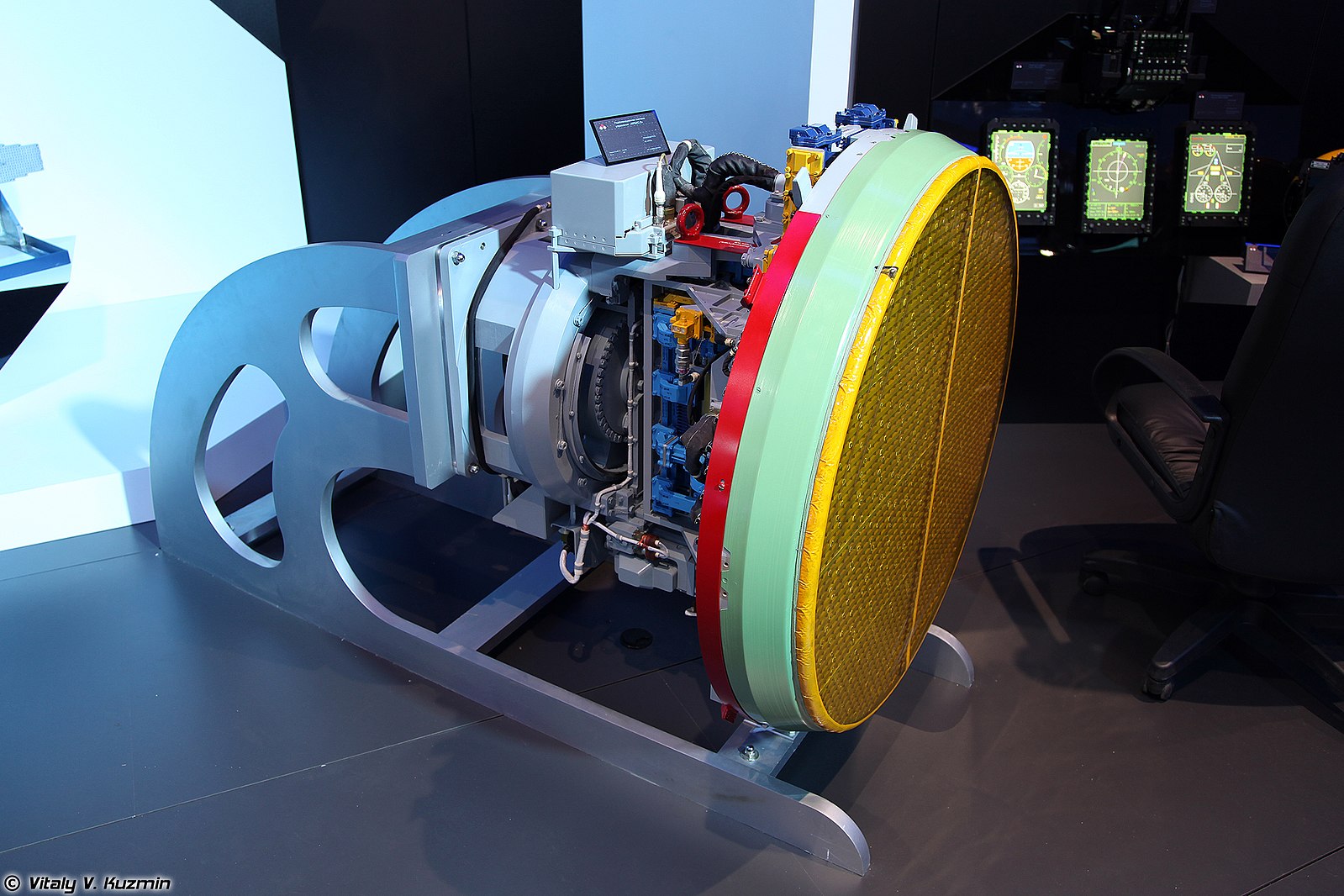
    Irbis-E radar

    One of the standout features of the Irbis-E radar is its ability to detect low radar cross-section (RCS) targets such as drones, cruise missiles, and stealth aircraft. It maintains stable performance in complex environments with multiple threats and integrates seamlessly with electronic warfare systems and secure communications. Its capabilities in guiding advanced weaponry, precise terrain mapping, and resistance to electronic interference make the Irbis-E one of the most powerful radars installed on 4.5-generation fighters.

    OLS-30 Infrared Search and Track System (IRST)

    Mounted on the front-right section of the Su-30’s windshield is the OLS-30 infrared search and track system. This IRST unit includes a thermal sensor, a laser rangefinder, and a television camera.

    The OLS-30 provides ±60 degrees azimuth coverage with an elevation range of +60 to -10 degrees. It can detect and track enemy aircraft approaching head-on at a distance of 50 kilometers and from the rear at up to 90 kilometers. The laser rangefinder supports targeting for laser-guided weapons up to 3 kilometers for aerial targets and up to 10 kilometers for ground targets.

    Additionally, the OLS-30 features two fields of view: a wide mode (20° × 5°) and a narrow mode (3° × 3°), with the latter optimized for precise targeting in both beyond-visual-range (BVR) and within-visual-range (WVR) air combat.
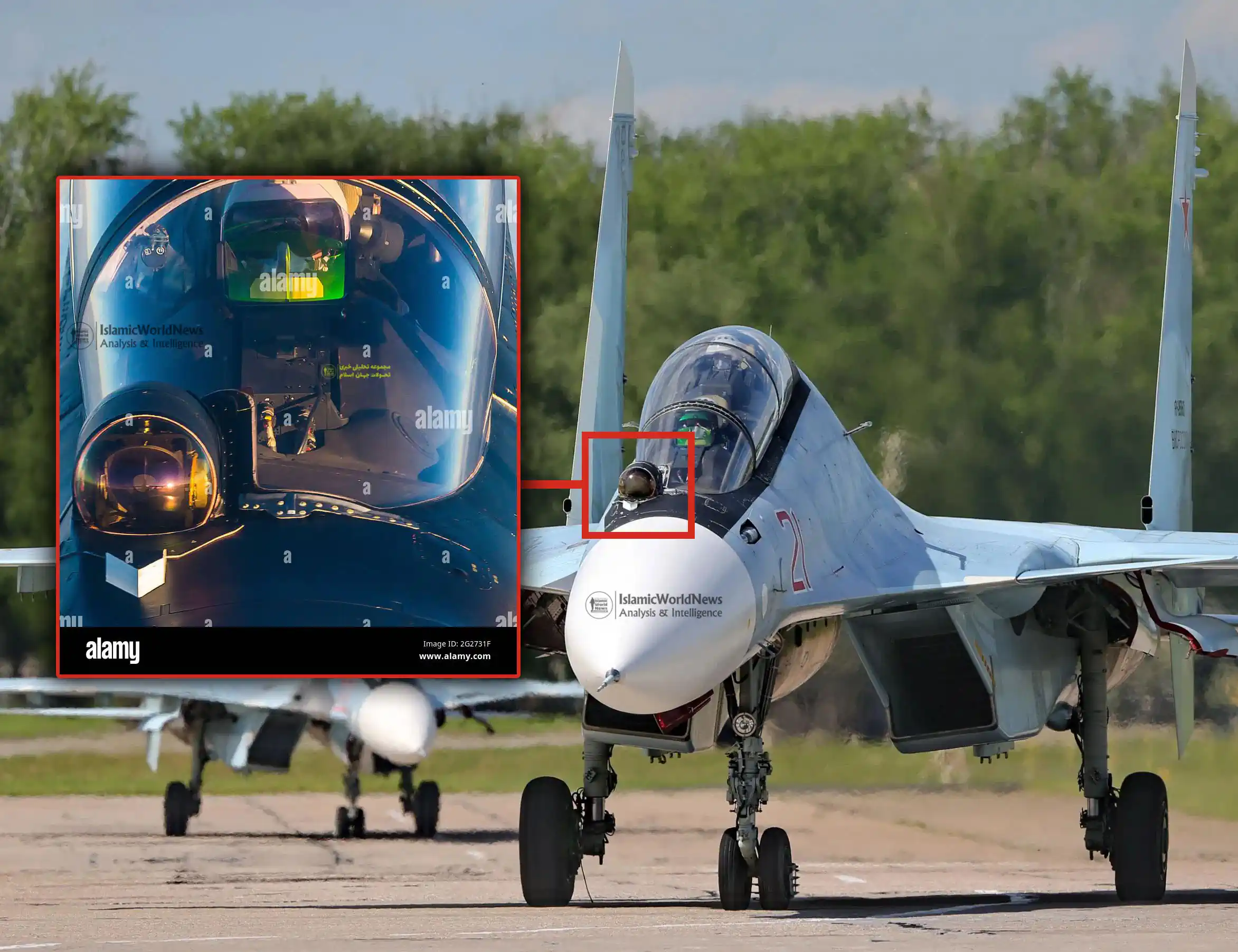
    OLS-30 Infrared Search and Track (IRST) system

    The Su-30 is also equipped with the SPO-150 radar warning receiver system, designed to detect radar lock signals from enemy aircraft and surface-to-air missiles. Working in conjunction with electronic counter-countermeasure (ECCM) systems, this setup provides the Su-30 with a reliable layer of defensive protection against modern electronic threats.

    Avionics and Cockpit of the Su-30

    The Su-30 features a two-seat cockpit accommodating both the pilot and co-pilot. Each position is equipped with K-36DM ejection seats. In advanced variants such as the Su-30MKI and Su-30SM, the cockpit includes multiple color LCD multifunction displays (MFDs) that simultaneously present flight data, weapon status, digital maps, and radar information..
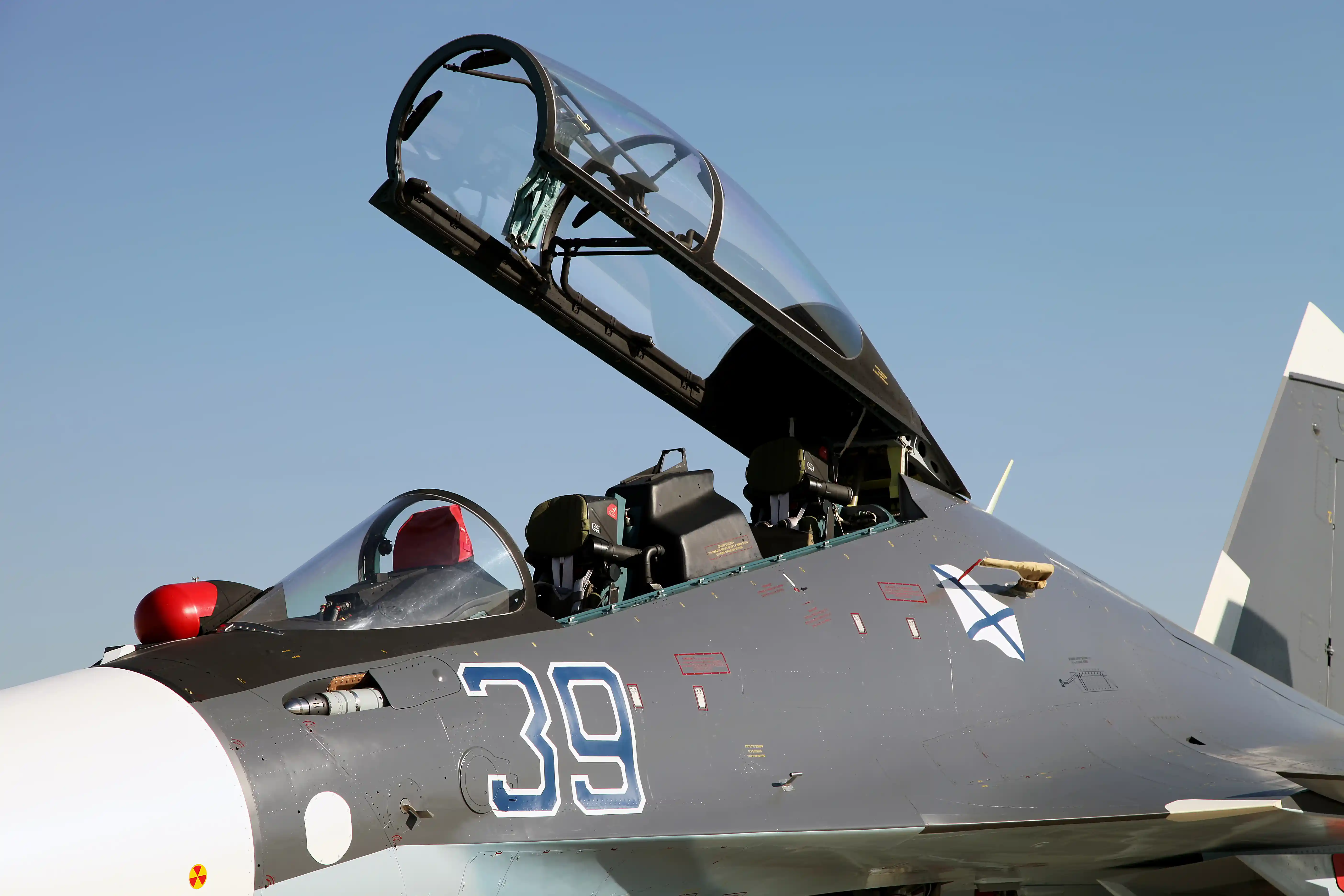
    Su-30SM at MAKS 2015

    The Head-Up Display (HUD) is mounted in front of the pilot and presents critical flight information—such as speed, altitude, angle of attack, target status, and flight path—without requiring the pilot to look down. This HUD is designed for round-the-clock use and remains effective under various weather conditions.
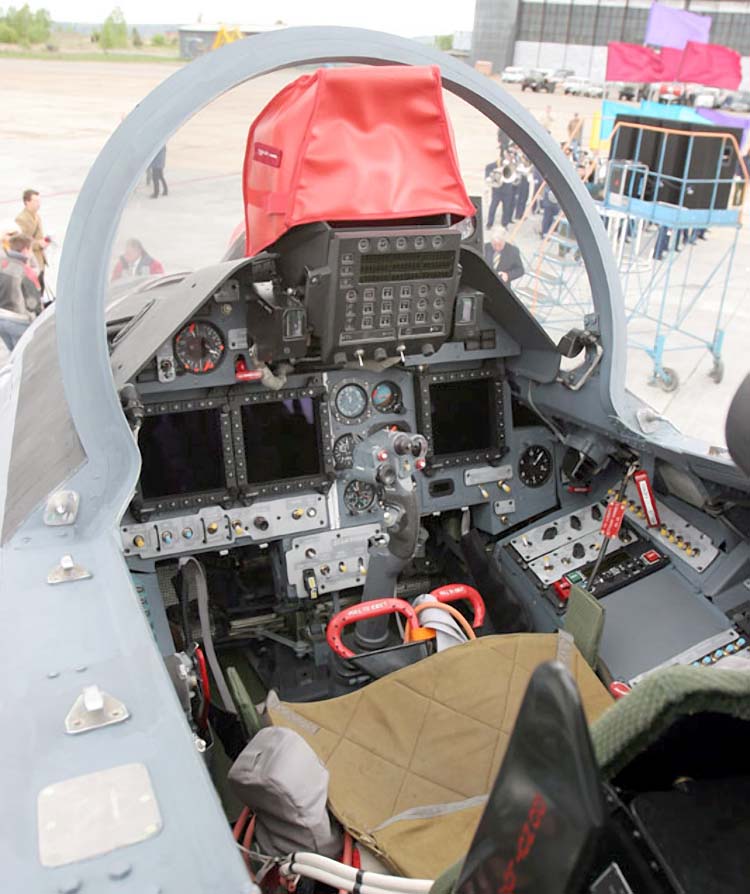
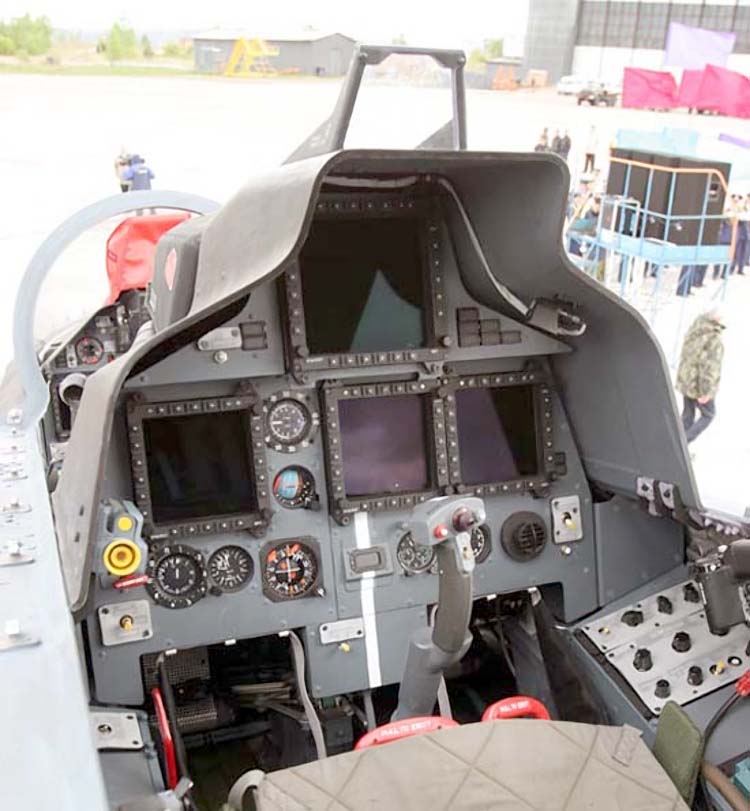
    The Su-30’s avionics suite includes satellite navigation systems (GLONASS and GPS), secure communications, and precision weapon guidance capabilities. In certain variants, an optical targeting system (IRST) is also installed, which uses infrared sensors to detect targets without emitting radar signals. This feature is particularly effective in stealth operations and counter-electronic warfare scenarios.

    In terms of communications, the aircraft is equipped with encrypted VHF/UHF radios, enabling secure links with ground stations and other aircraft. It also features tactical data transmission systems. Some versions, such as the Su-30MKI, are fitted with data links that allow real-time information sharing with other aircraft and drones, supporting network-centric warfare operations.

    Weapons Stations and Armament of the Su-30

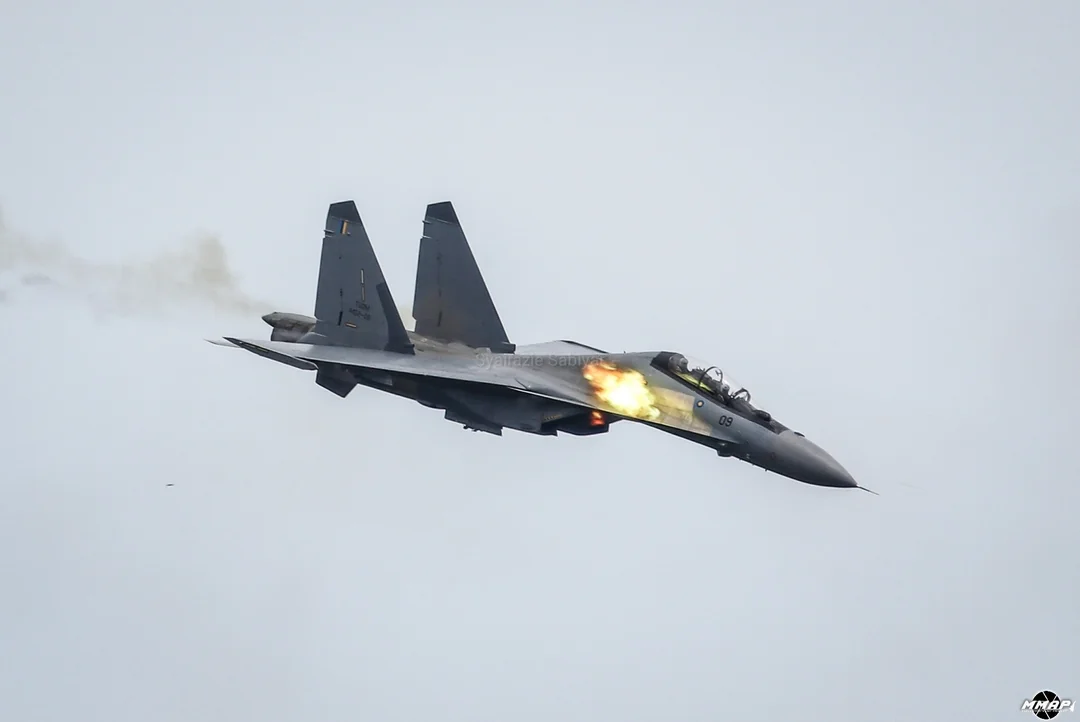
    The Su-30 is equipped with 12 external hardpoints capable of carrying up to 8,000 kilograms of ordnance. This multirole fighter can deploy a wide range of weaponry, including air-to-air missiles such as the R-77 and R-73, air-to-surface missiles like the Kh-29, Kh-31, and Kh-59, as well as guided and unguided bombs, auxiliary fuel tanks, reconnaissance pods, and electronic warfare equipment. In line with standard Sukhoi fighter configurations, the Su-30 is also fitted with a 30mm GSh-30-1 autocannon mounted on the right side of the fuselage near the cockpit.
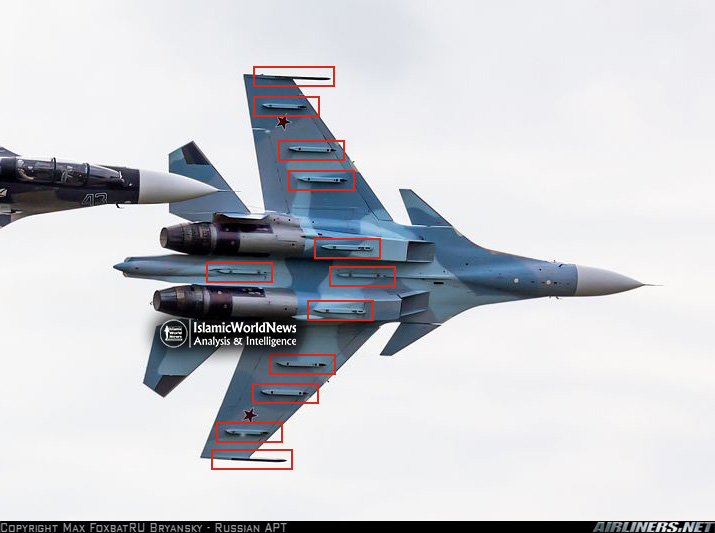
    12 external Su-30 hardpoints with a weapons carrying capacity of up to 8,000 kg
    A Royal Malaysian Air Force SU-30MKM fighter jet fires a 30mm GSh-30-1 cannon during the “Ababil 2021” military exercise (Photo by Syairazie Sabiyar)

    Variants of the Su-30

    The Su-30, considered the second generation of the Flanker family following the Su-27, has been produced in multiple variants, each tailored to meet specific operational requirements. The Su-30MKI variant, developed for India, features French and Israeli avionics, thrust-vectoring engines, and compatibility with Western systems. The Su-30MKK, designed for China, incorporates indigenous systems and is capable of deploying Chinese munitions. The Su-30MKM, built for Malaysia, includes Western avionics and advanced electronic warfare systems. Similarly, the Su-30MKA for Algeria shares many features with the MKI.

    It is worth noting that all variants bearing the “MK” suffix are export-oriented models of the Su-30. The abbreviation “MK” stands for Modernizirovannyi Kommercheskiy, meaning “Modern Commercial.”

    The Su-30SM variant was specifically developed for the Russian military and is equipped with the Bars-R radar and AL-31FP engines, enabling it to perform combined mission profiles. This diversity of configurations highlights the Su-30 platform’s high adaptability to a wide range of operational demands.

    Below we will introduce the different models of this fighter in more detail.

    Early Versions of the Su-30 Fighter:

    1- Su-30 (Su-27PU): This variant is a modernized version of the Su-27UB, with only five units produced. It was specifically used by Russian air defense forces.

    Su-27PU

    2- Su-30MK Variant: An export-oriented version of the Su-30M, first introduced in 1993. Export models featured navigation and communication systems developed by India’s HAL corporation.
    3- Su-30K Variant: An export version of the Su-30, purchased by the Indian Air Force in the late 1990s.
    4- Su-30KI Variant: A proposal by Sukhoi to upgrade older Su-27S fighters. This version was also offered for export to Indonesia, which initially ordered 24 units, but the acquisition was halted in 1997 due to the Asian financial crisis.
    5- Su-30KN Variant: An upgrade program for Su-27UB, Su-30, and Su-30K aircraft. Although the project was canceled in Russia, it later evolved into the Su-30M2. Belarus upgraded Indian Su-30K fighters to the Su-30KN standard.

    Sukhoi Su-30MK

    6- Su-30MKI Variant: This export version was developed for India in collaboration with Hindustan Aeronautics Limited (HAL). It is the first member of the Su-30 family to feature thrust-vectoring engines. Additionally, it is equipped with electronic systems jointly produced by Russia, India, France, and Israel.
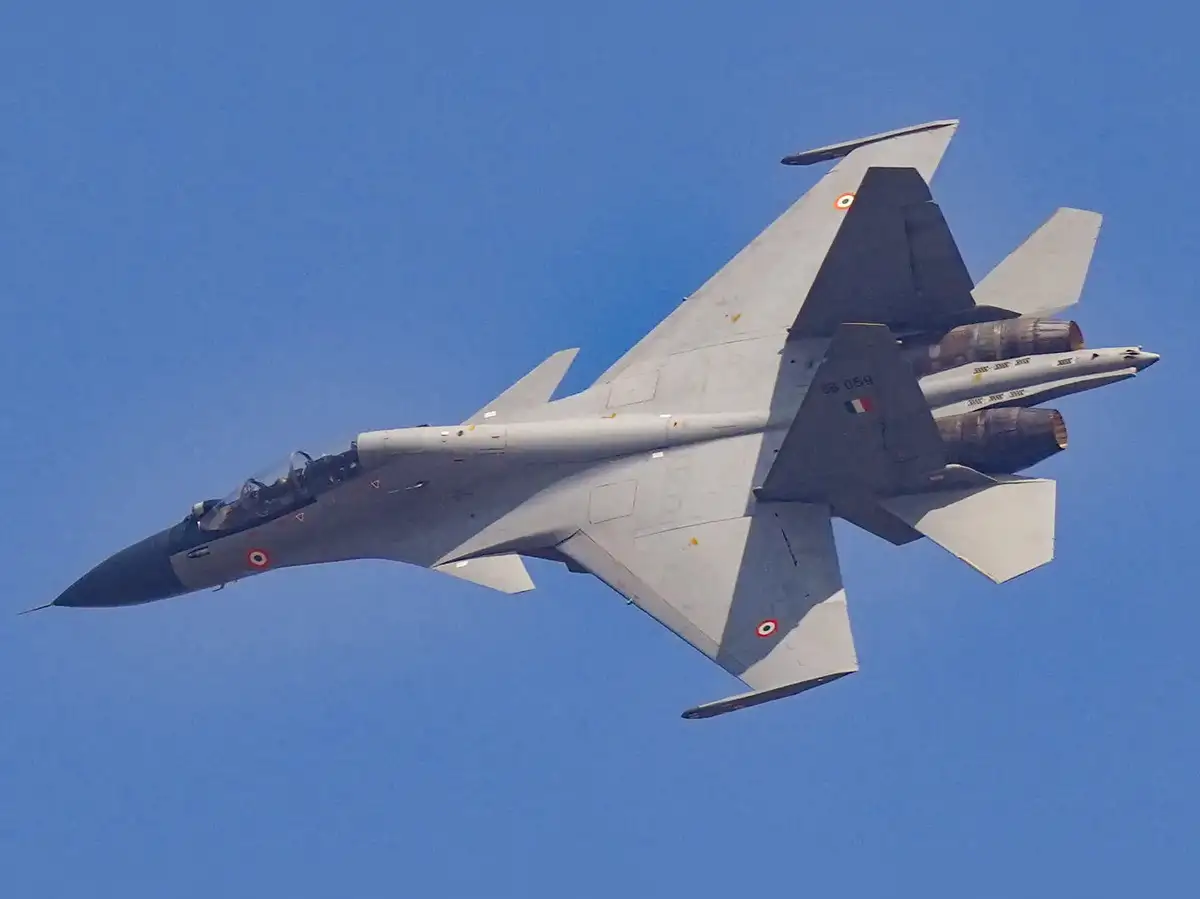
    Su-30MKI

    7- Su-30MKA Variant: An export version developed for Algeria, equipped with Russian and French electronic systems.
    8- Su-30MKM Variant: A Russian/Indian derivative of the Su-30MKI, custom-built for the Royal Malaysian Air Force. This variant features thrust-vectoring engines, helmet-mounted displays, French-made laser guidance systems, South African laser warning sensors, a Russian phased-array radar, and advanced electronic warfare systems.

    9- Su-30SM Variant: A specialized model of the Su-30MKI, manufactured by Irkut for the Russian Air Force and designated by NATO as Flanker-H. Classified as a 4+ generation fighter, the Su-30SM is equipped with upgraded radar systems, advanced radio communications, IFF (Identification Friend or Foe) systems, modern ejection seats, updated weaponry, and new electronic systems. It uses the N011M Bars radar with a detection range of up to 400 kilometers. Additionally, each wingtip can be fitted with SAP-518 electronic warfare pods.

    10- Su-30SM1/SMD Variant: An upgrade program for Russia’s Su-30SM fighters, featuring the N035 Irbis radar and AL-41F1S engines—both originally developed for the Su-35. This radar can detect an F-15 from distances exceeding 300 kilometers. The upgraded aircraft are capable of carrying and launching a wide array of modern bombs and missiles.

    11- Su-30MK2V Variant: A modified version of the Su-30MK2 designed specifically for Vietnam.
    12- Su-30SME Variant: An export version of the Su-30SM, first unveiled at the Singapore Airshow in 2016.
    13- Su-30MKK Variant: An export model developed for China, also known by its NATO designation Flanker-G.
    14- Su-30MK2 Variant: A more advanced version of China’s Su-30MKK, exported to countries like Indonesia and Uganda, featuring upgraded weapons and systems.
    15- Su-30MKV Variant: An export version of the Su-30MK2 tailored for Venezuela.

    16- Su-30M2 Variant: A derivative of the Su-30MK2, produced by the KnAAPO plant for the Russian Air Force. The first order was placed in 2009, and twenty units were delivered in 2012. Most of these aircraft are primarily used as training platforms.

    17- Su-30MK3 Variant: A proposed model equipped with the Zhuk-MSF radar system.

    Export Market and Operators of the Su-30

    The Su-30 has been exported to 14 countries and remains in active service. Nations operating this fighter include India, China, Algeria, Malaysia, Venezuela, Vietnam, Armenia, Belarus, Indonesia, Kazakhstan, Angola, Uganda, Ethiopia, and Myanmar. Among these, India is the largest operator, with 272 units in service. Following India, Russia operates around 134 aircraft, China has 97 units, and Algeria possesses 59 aircraft. The estimated export price per unit is approximately $47 million.

    It is reported that the Su-30 has also been offered to Iran’s armed forces. Speculation about its potential delivery to Iran intensified following the 12-day conflict between Israel and Iran, though no official confirmation has been made.

    Key Features of the Su-30 and Its Complementary Role with the Su-35

    One of the Su-30’s most notable attributes is its high maneuverability, enabled by thrust-vectoring engines, which give it a significant edge in close-range aerial combat. Its ability to perform air-to-surface missions, reconnaissance, close air support, and long-range interception makes it a truly multirole fighter.

    Read more: Military Knowledge: Sukhoi Su-35 Multirole Fighter Jet

    Alongside the more advanced Su-35, the Su-30 serves as a complementary platform. While the Su-35 is designed for air superiority with a more powerful radar and advanced avionics, the Su-30 excels in flexible multirole operations, including support and combined missions. Together, these aircraft can significantly strengthen the defensive capabilities of countries that operate both models.

    Thanks to its upgrade potential and adaptability to various systems, the Su-30 remains a top choice for nations seeking to enhance their air power. Paired with advanced fighters like the Su-35, it plays a strategic role in modern air defense structures.

    Su-30 Fighter Specifications

    Type: Multirole fighter
    Origin: Russia
    Design Bureau: Sukhoi
    Manufacturers: KnAAPO / Irkut Corporation
    First Flight: December 31, 1989
    Production Period: 1992 to present
    Total Units Built: Over 630
    Crew: 2
    Length: 21.935 meters
    Wingspan: 14.7 meters
    Height: 6.36 meters
    Empty Weight: 17,700 kg
    Maximum Takeoff Weight: 34,500 kg
    Engine Type: Two Saturn AL-31FL/FP afterburning turbofan engines
    Maximum Speed: 2,120 km/h
    Combat Radius: 3,000 km
    Service Ceiling: 17,300 meters

    Armament Capabilities of the Su-30:

    • Cannon: 30mm GSh-30-1 autocannon
    • External Hardpoints: 12 stations with a total payload capacity of up to 8,000 kg

    Compatible Bomb Types:

    • Cluster bombs: SPBE-D, RBK-500
    • General-purpose bombs: ODAB-500PM, OFAB-250-270, OFAB-100-120
    • High-explosive bombs: FAB-500T, BETAB-500
    • Precision-guided bombs: KAB-500OD, KAB-500KR, KAB-1500L, KAB-1500KR

    Compatible Rocket Types:

    • 80mm S-8 rockets (range: 1–4.5 km)
    • 122mm S-13 rockets (range: 1–4 km)
    • 340mm S-25 rockets (range: up to 3 km)

    Compatible Missile Types:

    • Air-to-Air Missiles:
      • All variants of the medium-range Vympel R-27 (range: 40–170 km)
      • Short-range Vympel R-73E (range: 30 km)
      • Medium-range Vympel NPO R-77 (range: 80–200 km) (Note: The stated ranges represent maximum engagement distances, not guaranteed hit ranges.)
    • Air-to-Surface Missiles:
      • Kh-29T/L (range: 10–12 km)
      • Kh-59M/ME (range: up to 200 km)
    • Anti-Radiation Missile:
      • Kh-31P (range: 110 km)
    • Anti-Ship Missile:
      • Kh-31A (range: 25–105 km)

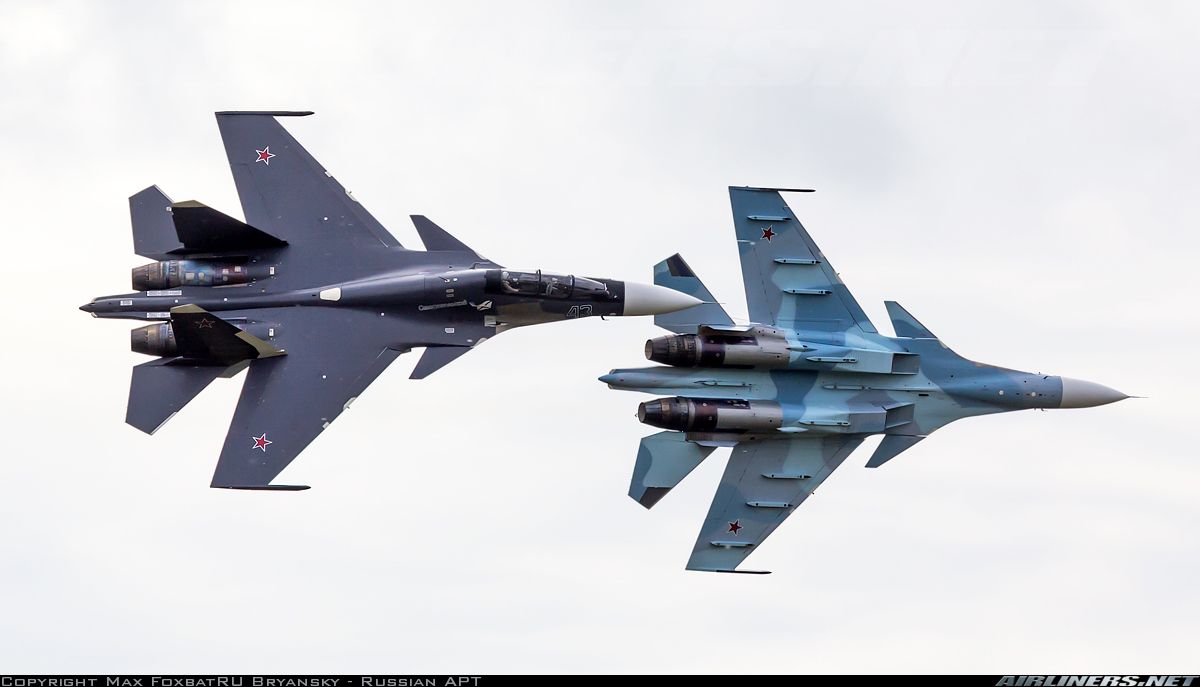
    More pictures of the Su-30
    Source:
    Wikipedia: Sukhoi Su-30 | Defense Feeds: Sukhoi Su-30 Overview | AeroCorner: Su-30MK Specs & Details | AusAirPower: Flanker Series Analysis | GlobalSecurity: Su-30 Profile | Milavia: Su-30 Fighter Overview | Vectorsite Archive: Su-27/30 Technical History | A look at Russia’s enhanced Sukhoi Su-30SM2
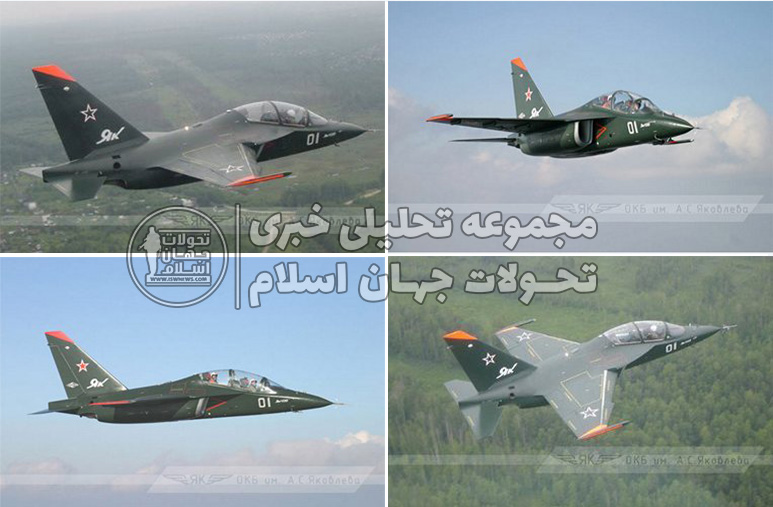
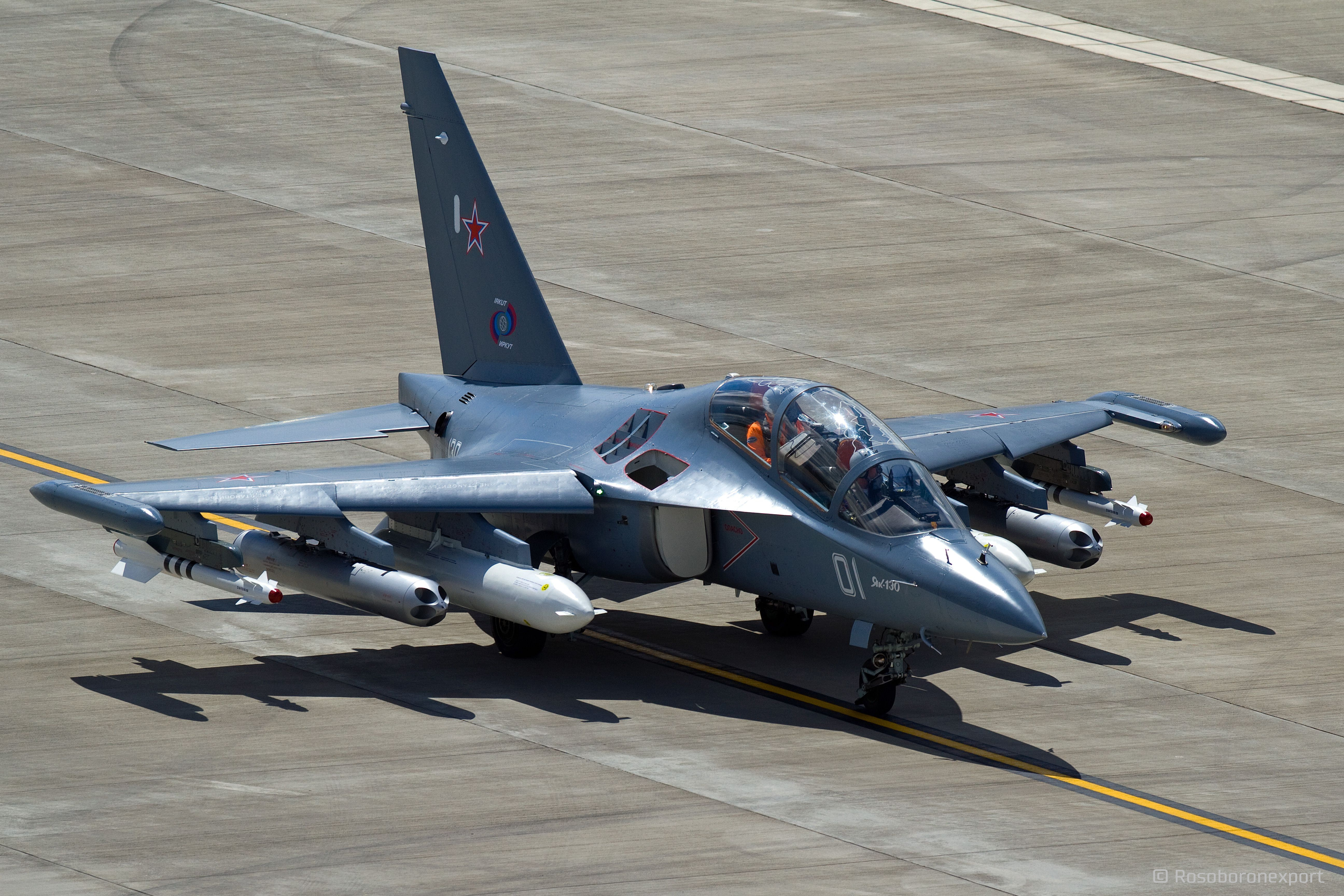
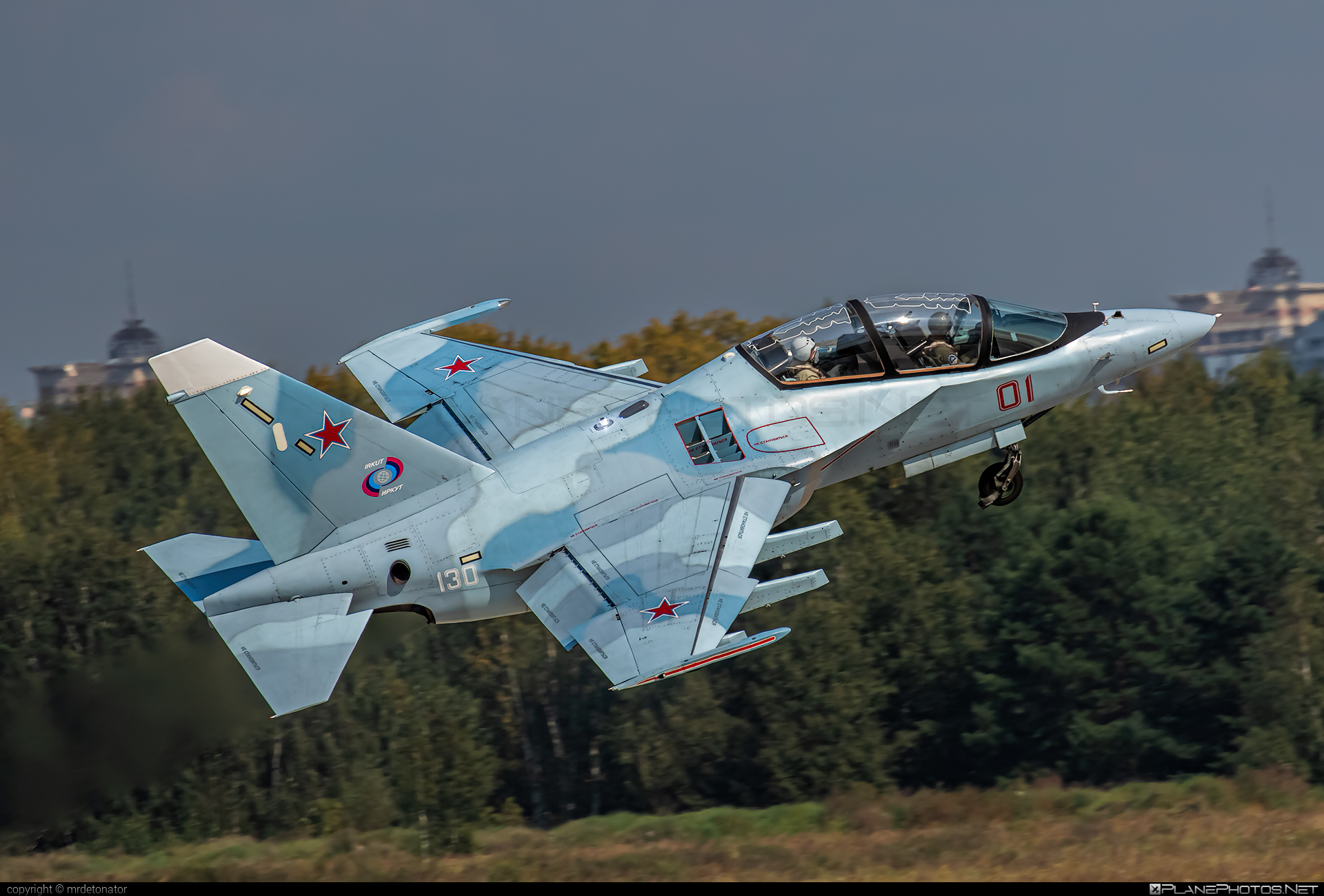
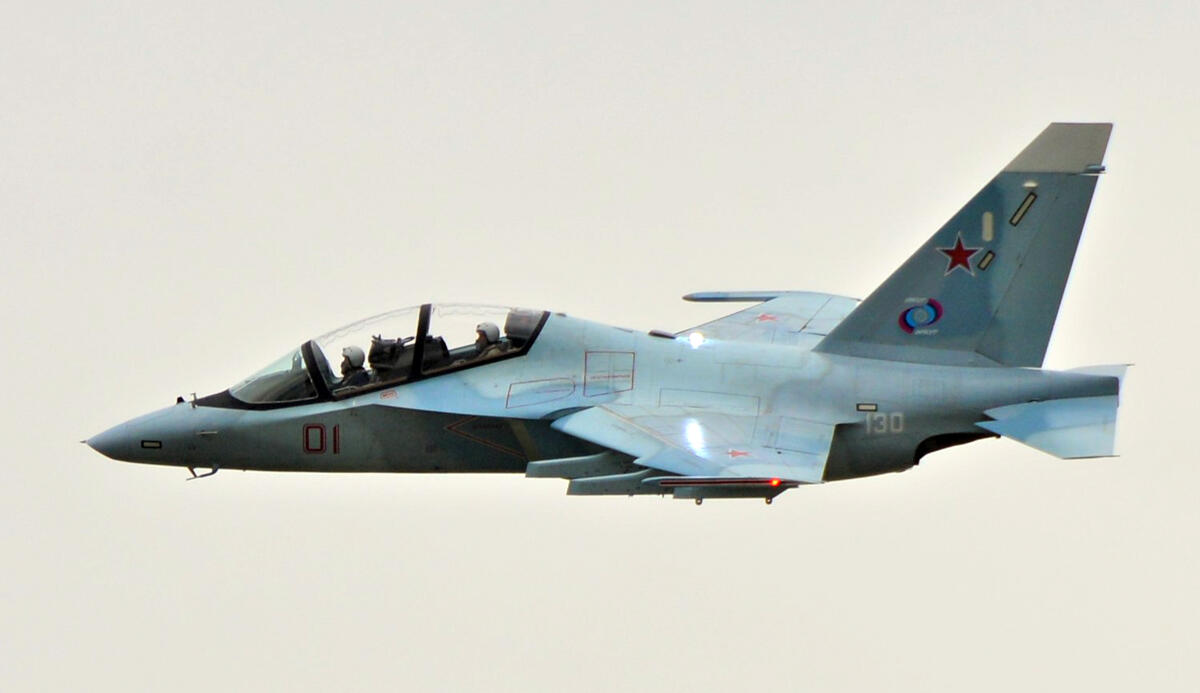
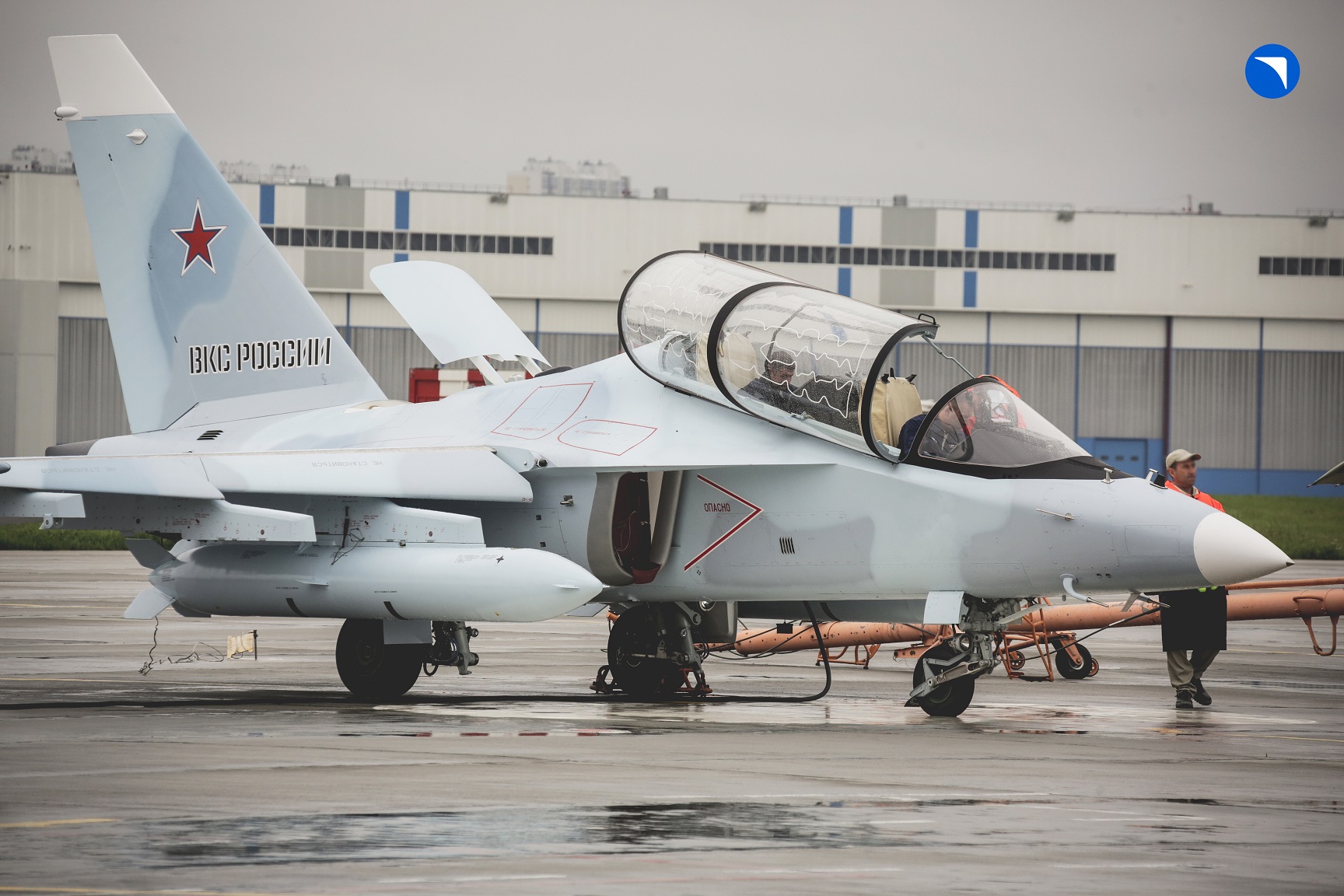
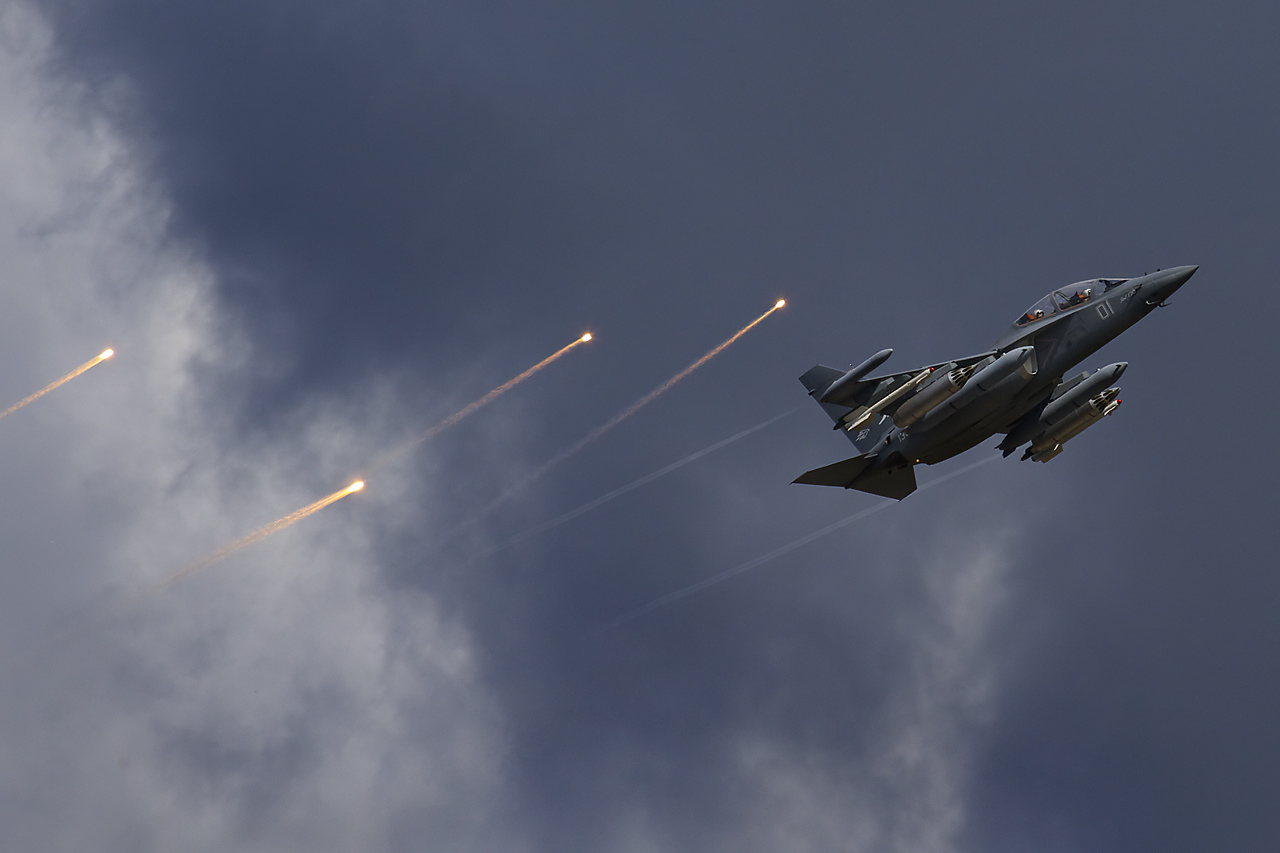
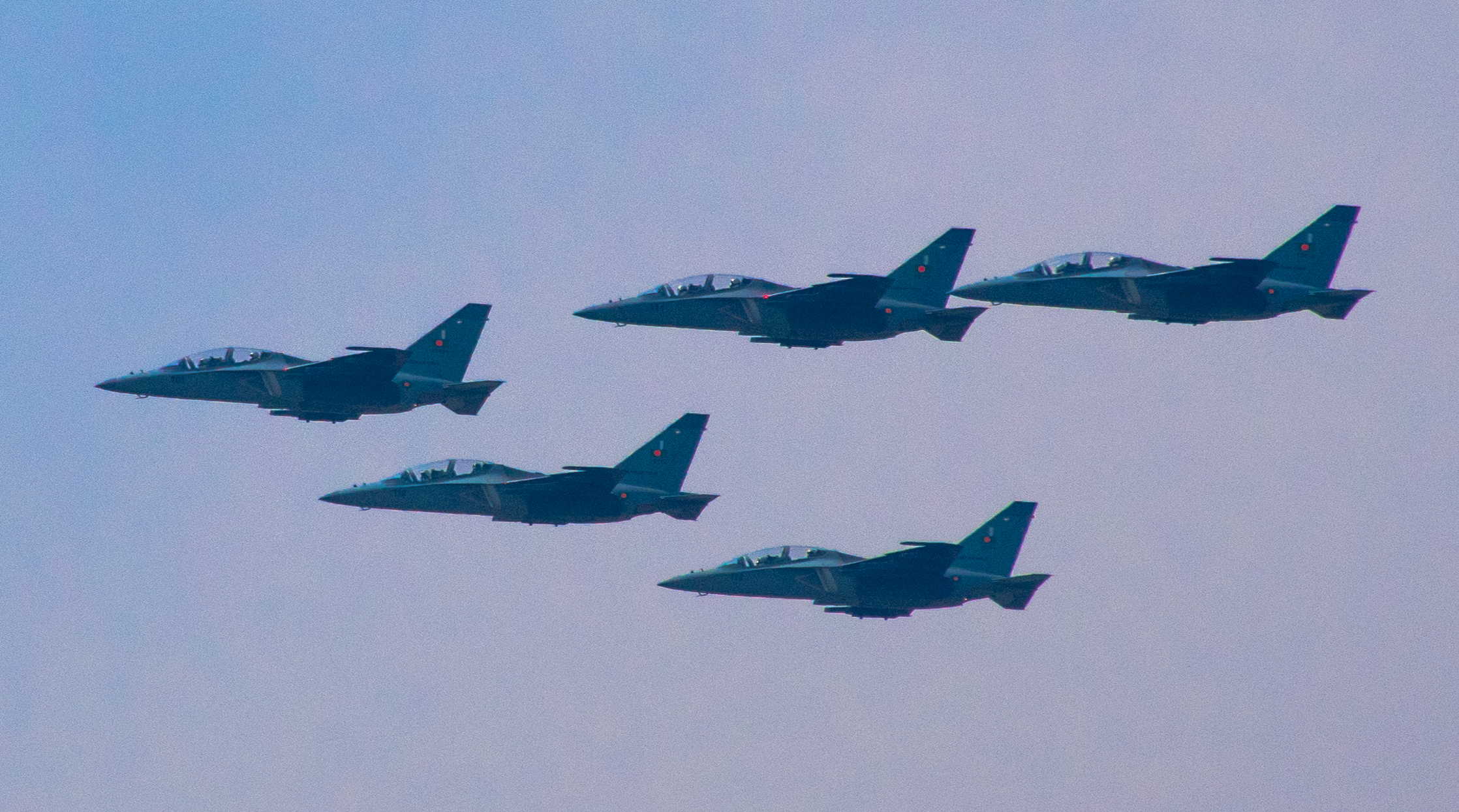
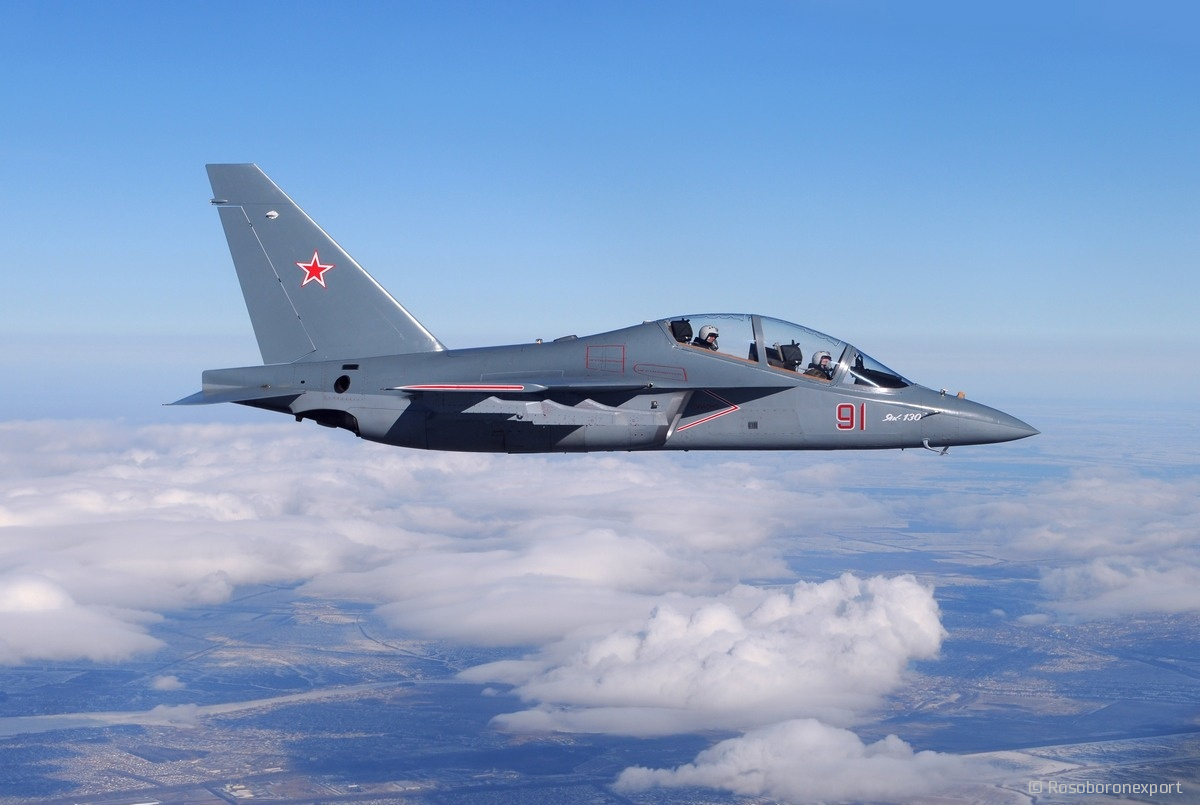
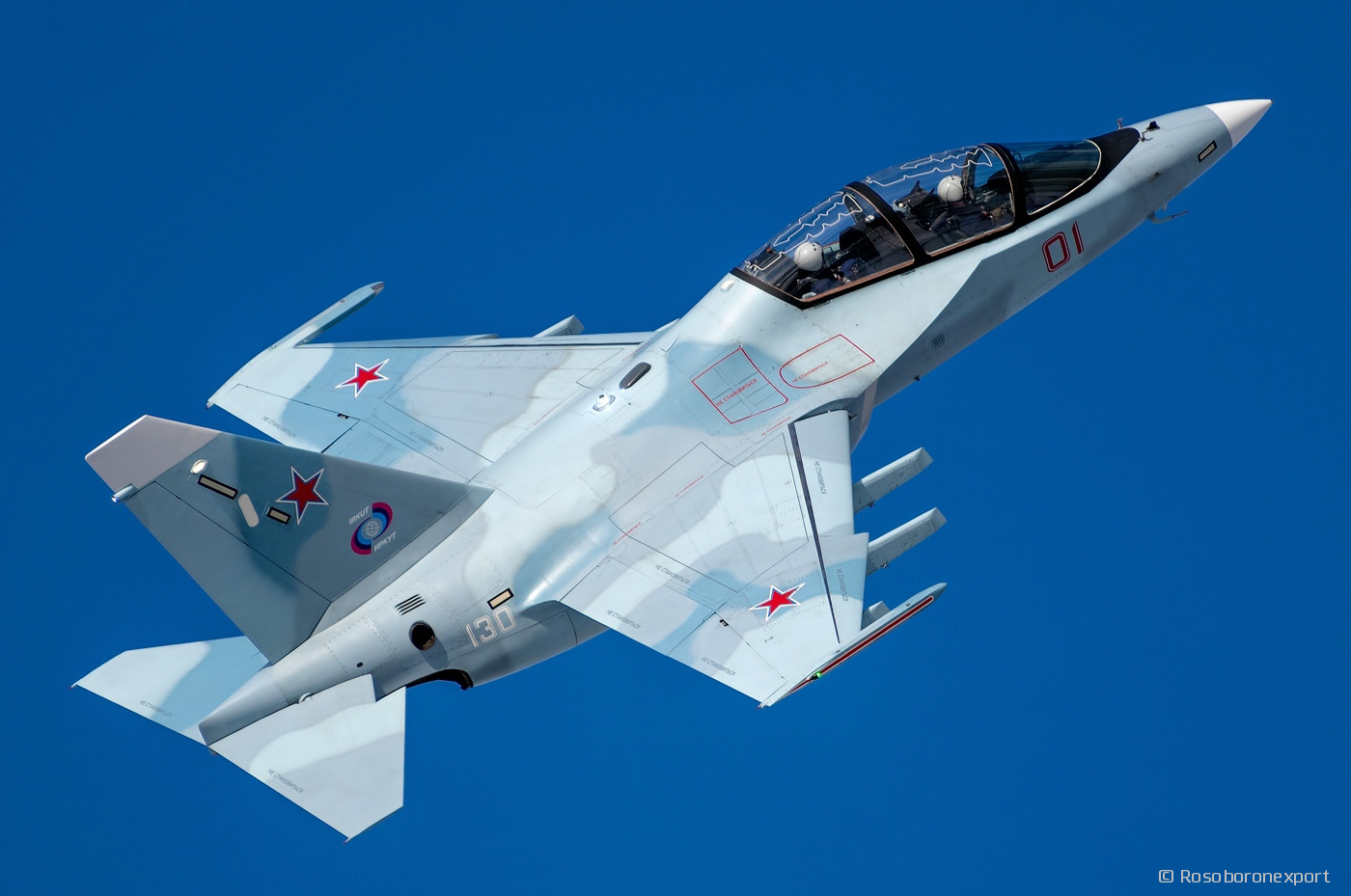
  • Military Knowledge: Yak-130 Fighter Trainer

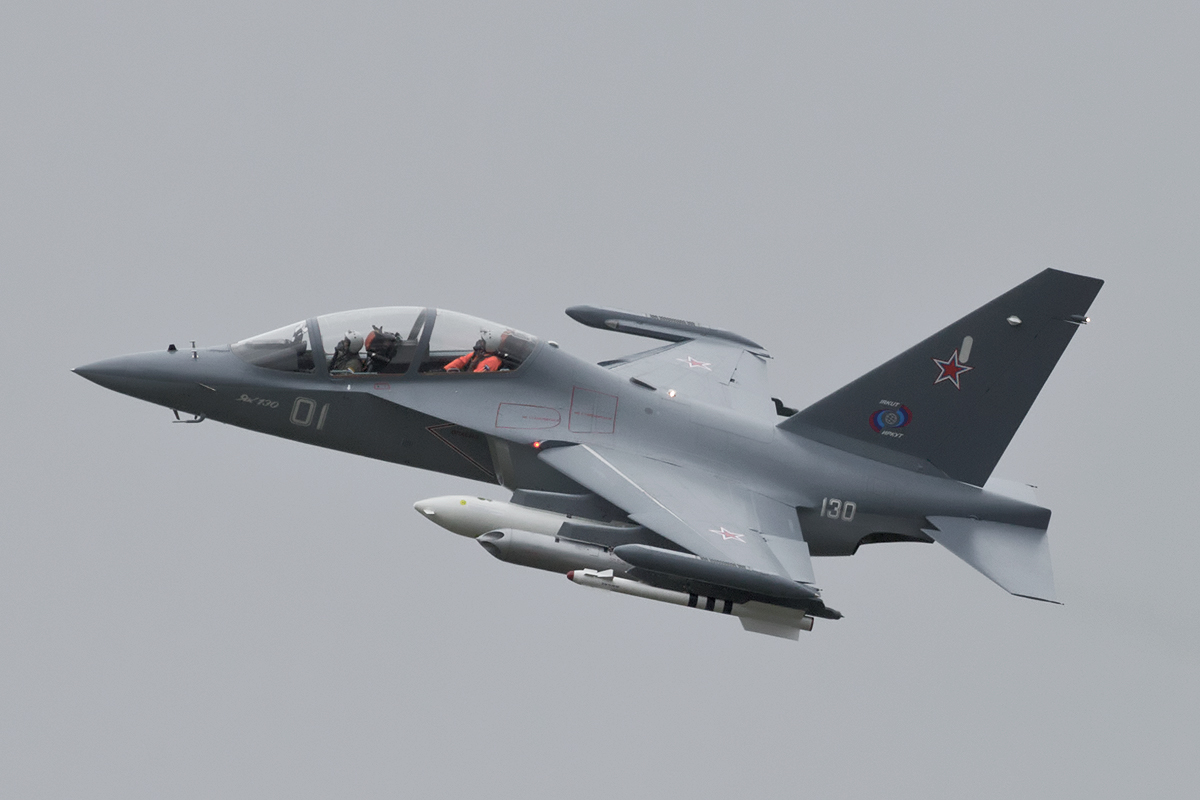
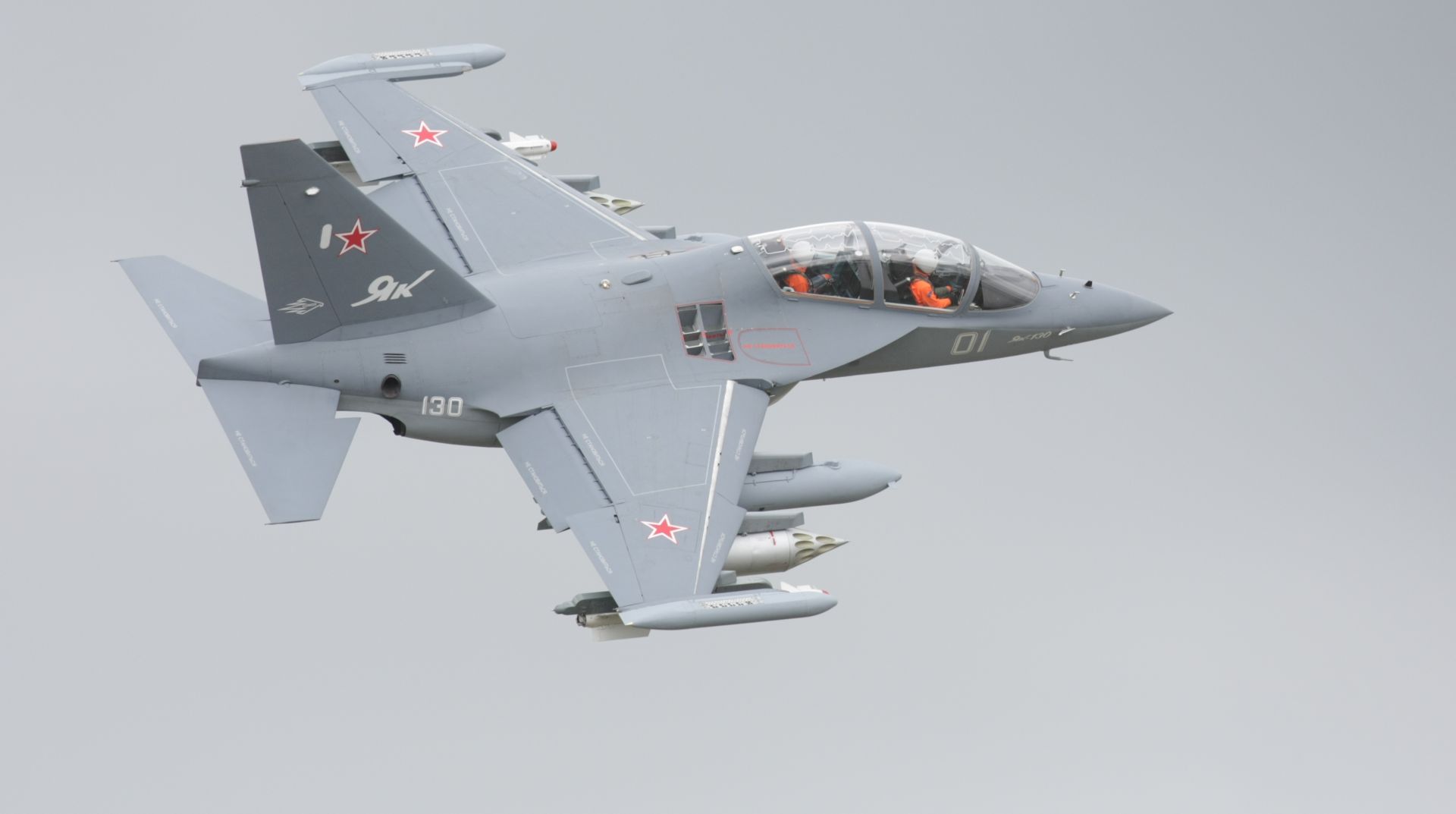
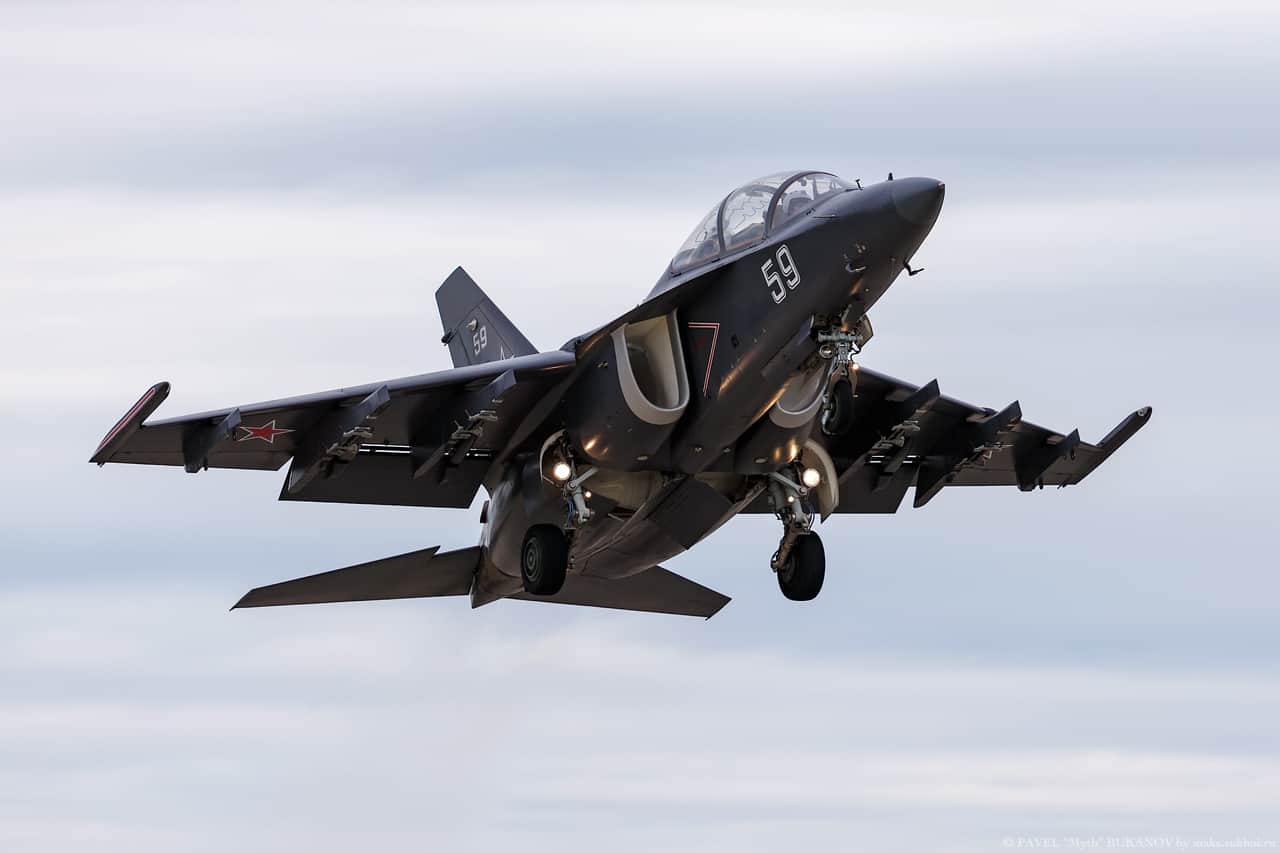
    Military Knowledge: Yak-130 Fighter Trainer

    History:
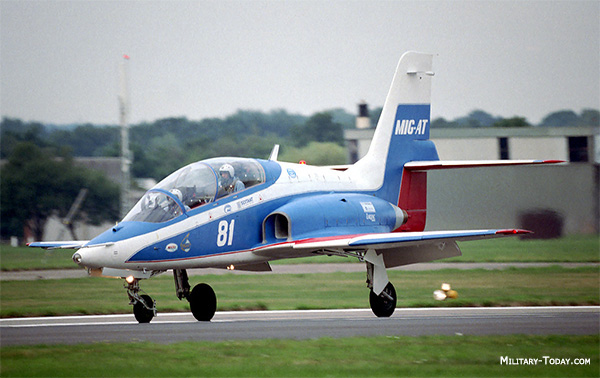
    The Soviets were looking for a new trainer fighter to replace the Aero L-29 Delfín and Aero L-39 Albatros trainer jets. The Soviet Air Force, after reviewing the five submitted designs of Sukhoi S-54, Myasishchev M-200, Mikoyan MiG-AT, and Yakovlev Yak-UTS, in 1991, selected two MiG-AT and Yak-UTS designs for prototype production and competition.

    The development of Yak-UTS began in 1991, but with the collapse of the Soviet Union on December 25, 1991, there were not enough funds to continue the work, so in 1993, the Yakovlev company agreed with the Italian company Aermacchi to jointly develop this aircraft.

    Aermacchi was responsible for the financial and technical support of the project and the name of the project was changed from Yak-UTS to Yak/AEM-130. The first prototype of this training fighter was built by the Sokol company (manufacturer of MiG fighters) named Yak-130D and unveiled in June 1995. Yakovlev company managed to make the first flight of this fighter from Zhukovsky airport on April 25, 1996, piloted by Andrey Sinitsyn.

    In 1996, it was reported that the development of the fighter and the construction of four prototypes cost 500 million dollars.

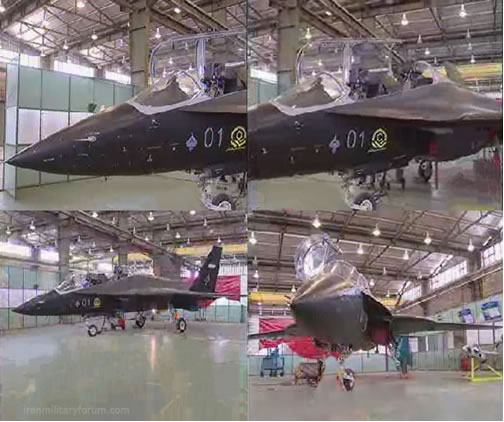
    Iran also unofficially participated in this plan in 1998. Iran proposed a fighter named Shafaq. But due to the continuous efforts of America to prevent Iran from being equipped with fighter jets, Russia soon removed Iran from the plan under the US pressure. But the fruit of Iran’s short-term cooperation with Russia in this field led to the unveiling of the Shafaq project in 2007. The overall design of the Shafaq fighter jet was similar to the Yak 130, but it used a V-shaped tail with modified wings.

    Shafaq fighter which was presented as a mock-up

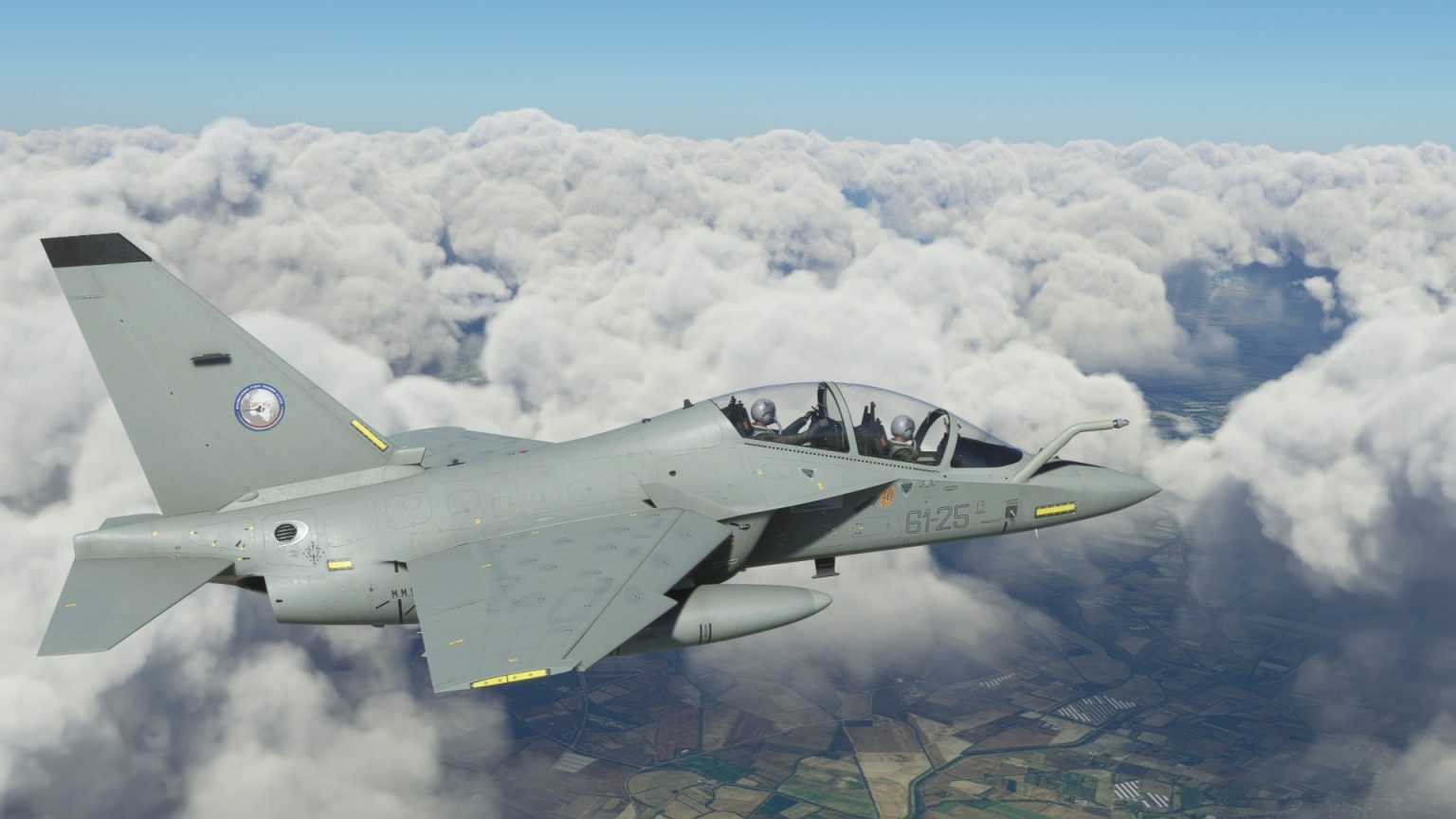
    In 2000, following political pressure from the United States, the Aermacchi partnership also ended with Russia and Alenia Aermacchi continued the M-346 Master design with a Ukrainian engine. This new design made its first flight in 2004. This fighter jet was used by the Air Force of Italy, Israel, Singapore, Greece, Turkmenistan and Poland.

    The Alenia Aermacchi’s M-346 Master fighter jet; very similar to Yak-130

    The Yak-130 production line at the Sokol Aircraft Plant in Nizhny Novgorod, known as Naz Sokol, has been active since 2003, and its first production was numbered in April 2004. The trials of entering the service of this fighter began in 2005 and ended before the delivery of the first flight group in 2009. This fighter entered the service of the Air Force of Russian Federation in July 2009 at the Military Pilot Training Academy in Krasnodar and was exhibited at the MAKS 2009 air show.

    Design:
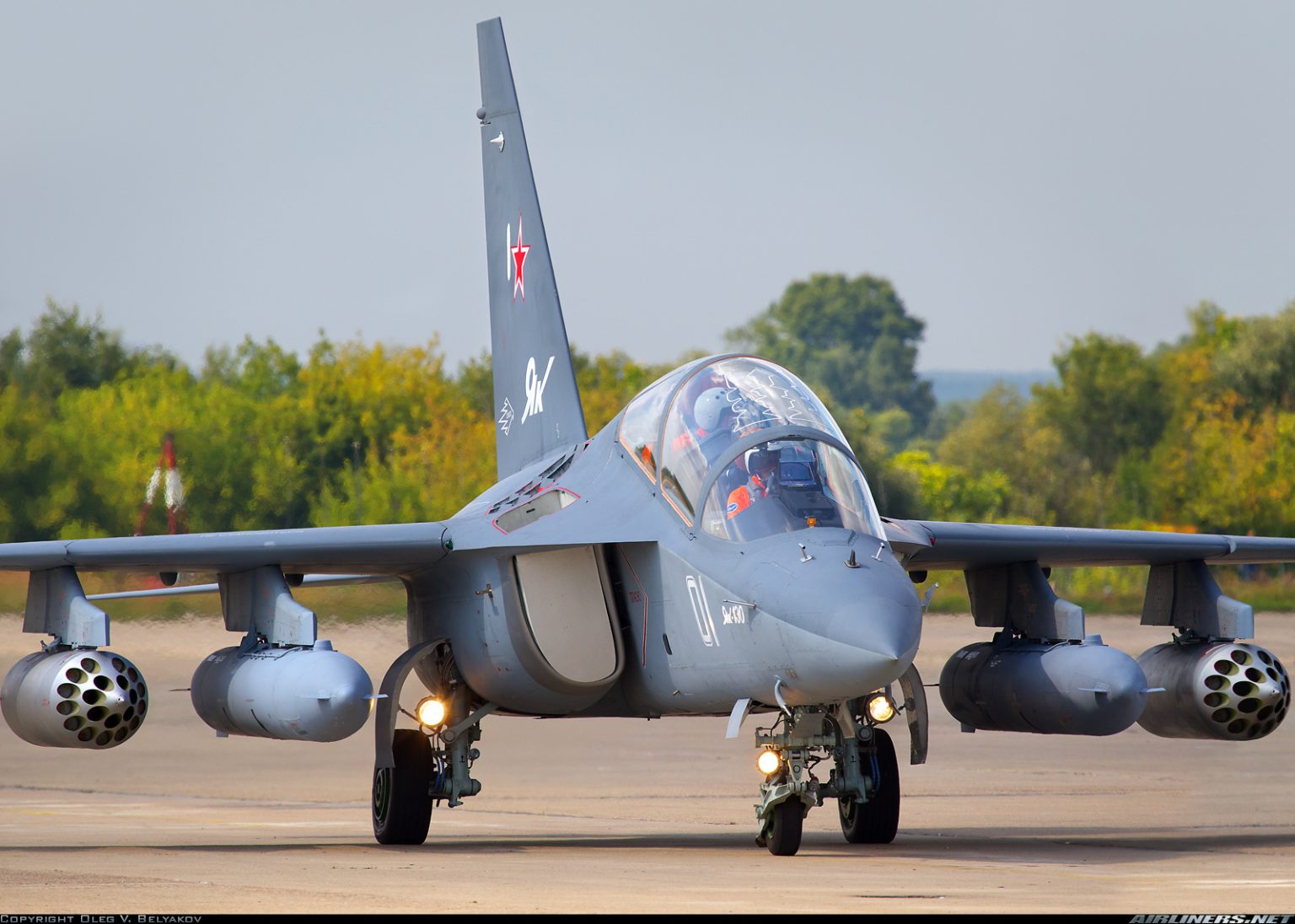
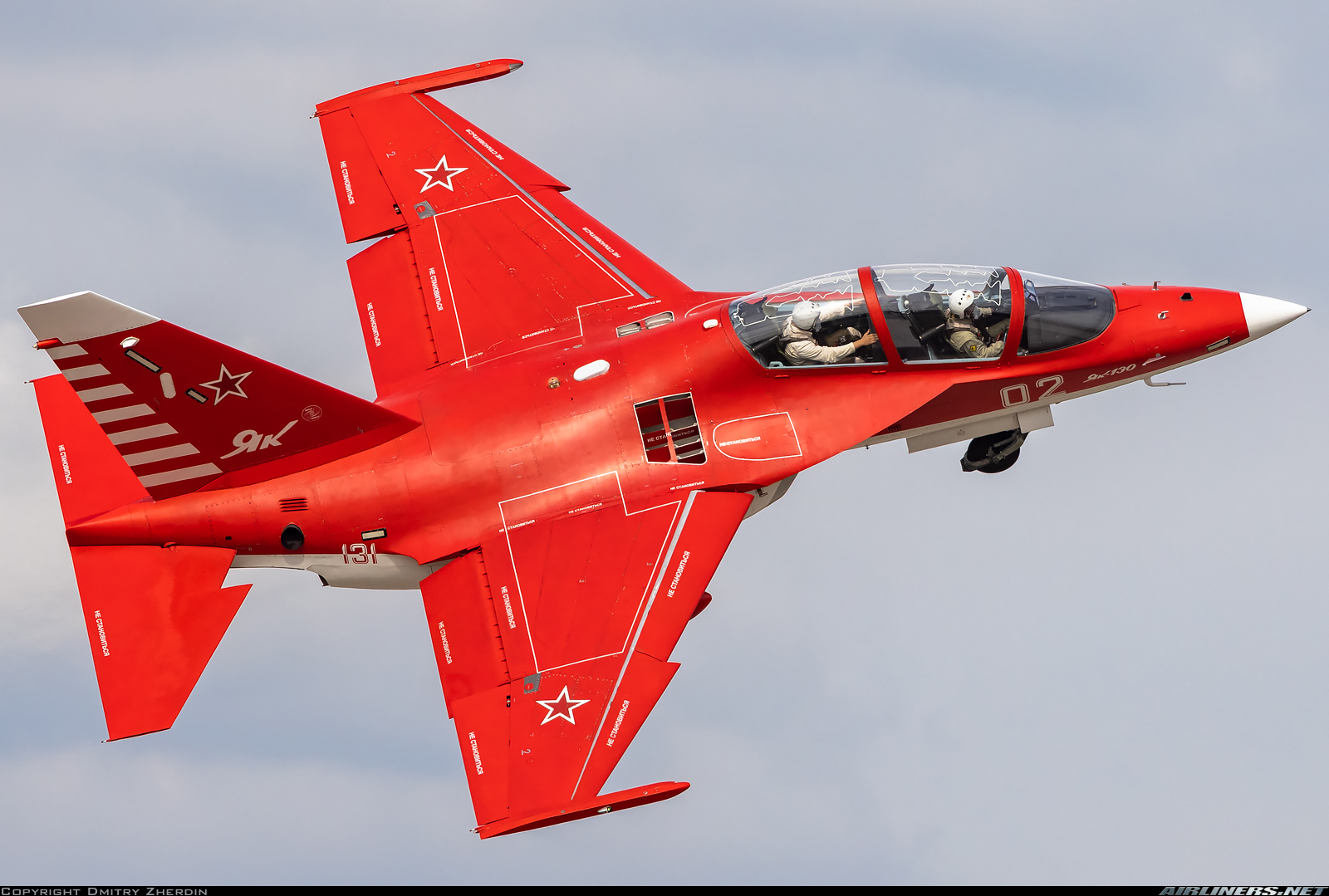
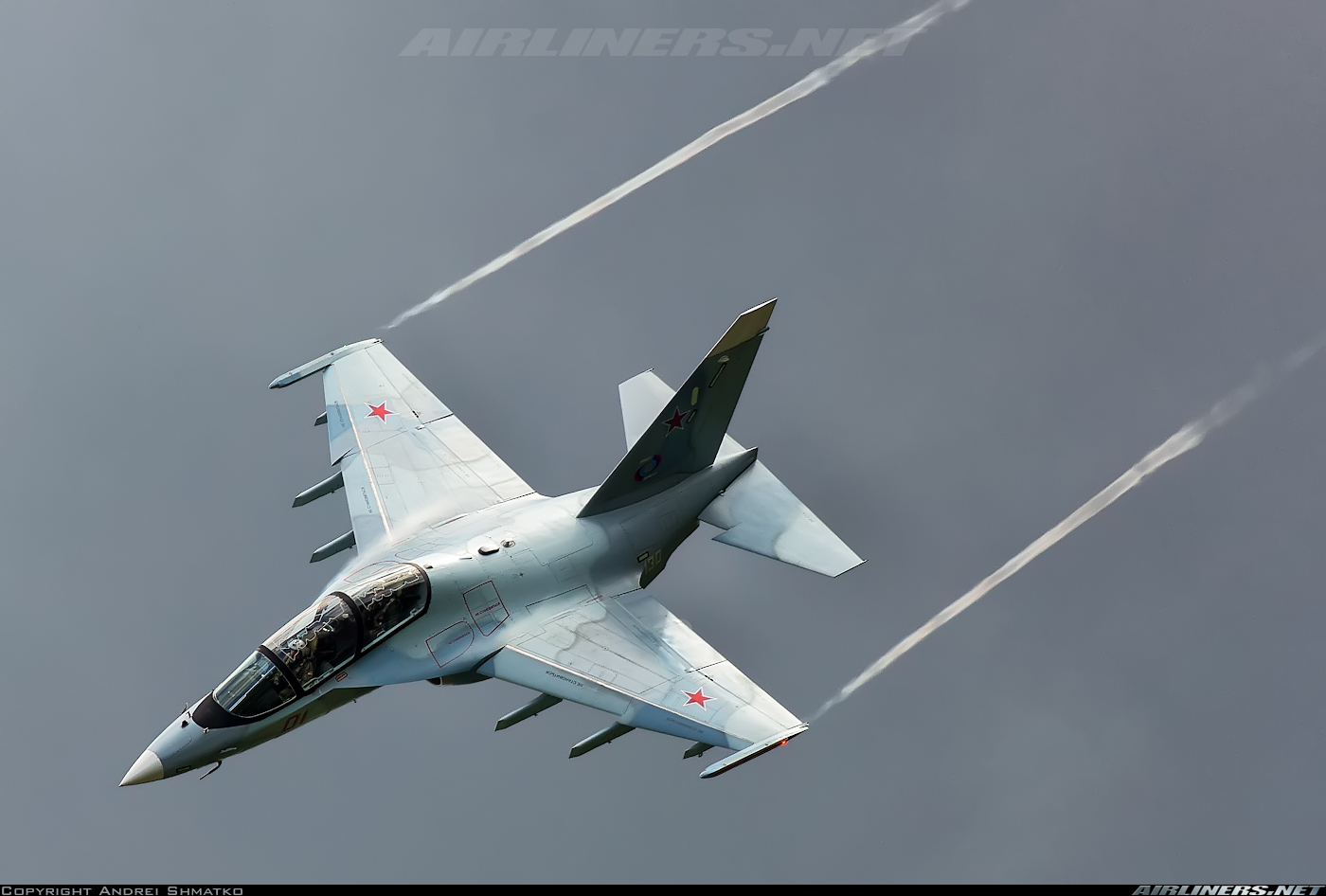
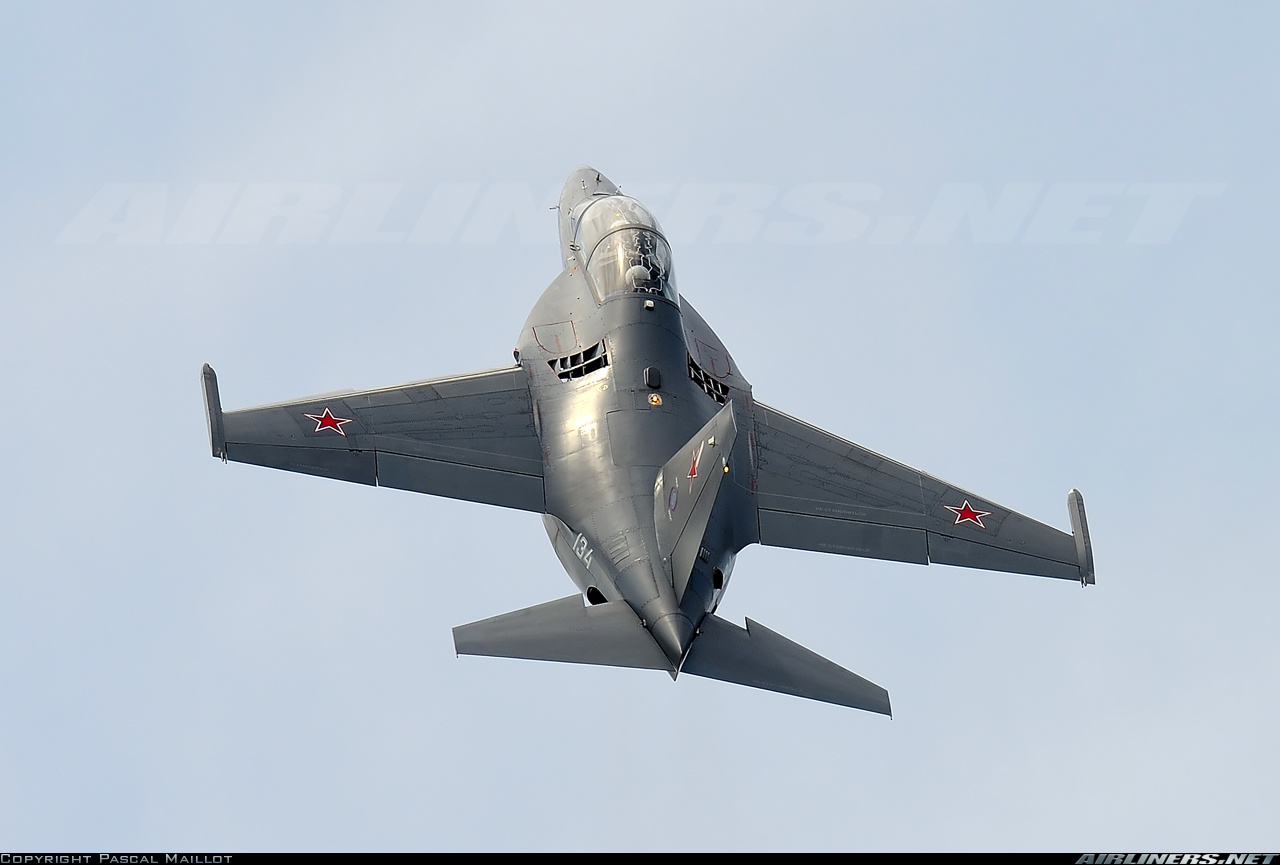
    The Yak-130 trainer uses a classic swept-wing design. This fighter is made of light alloy with carbon fiber surfaces and uses Kevlar protection for the engines, cockpit and fighter compartment.
    The use of Fowler flaps has helped a lot in reducing drag and increasing the maneuverability of the fighter. This fighter is also optimized for landing and takeoff from short or unprepared runways. Yak-130 uses a wireless flight control system, flight safety system and automatic flight control system.
    The Yak-130 fighter uses an air brake located on the fuselage and near the vertical tail. This device helps this training fighter to land on short runways.

    Yak-130 air brake

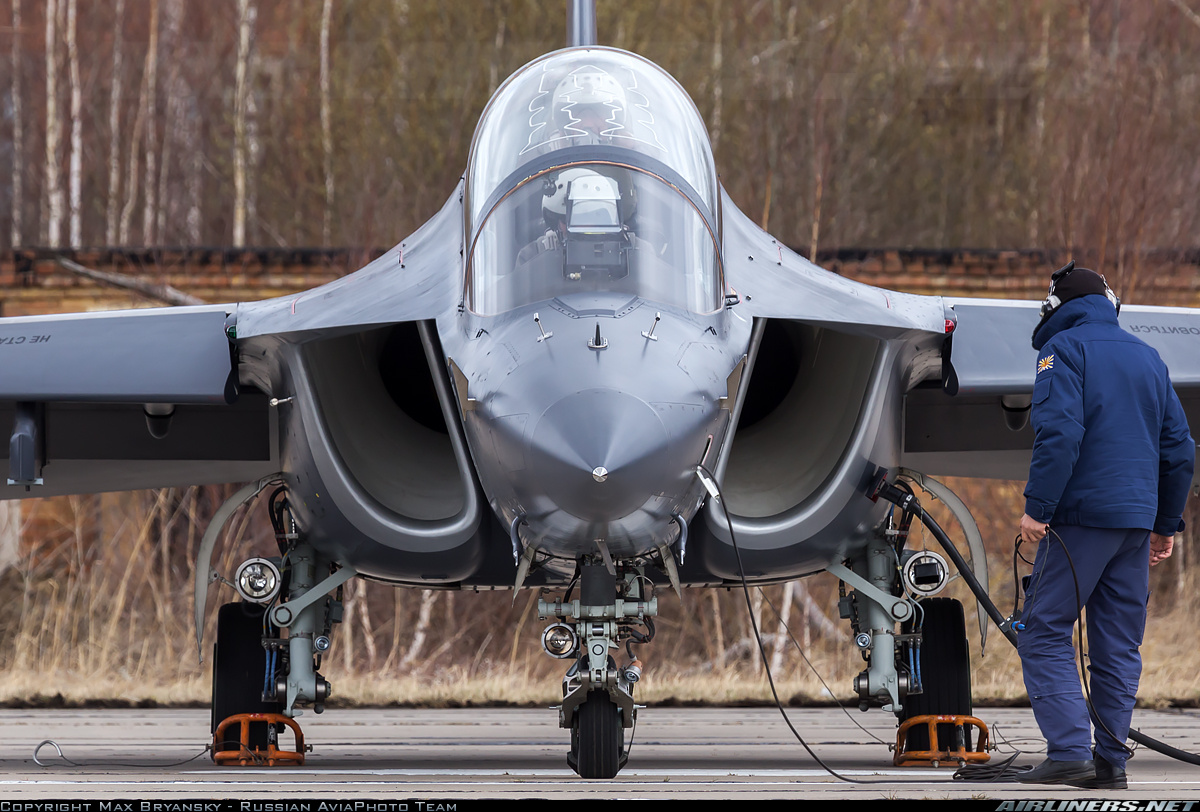
    In the Yak-130 fighter, it is possible to close the main air intake and open the upper air intake to prevent Foreign Object Damage (FOD). This hatch ensures the safety of the fighter taking off from the runways.

    A view of the closed air intake. The upper air intake is open.

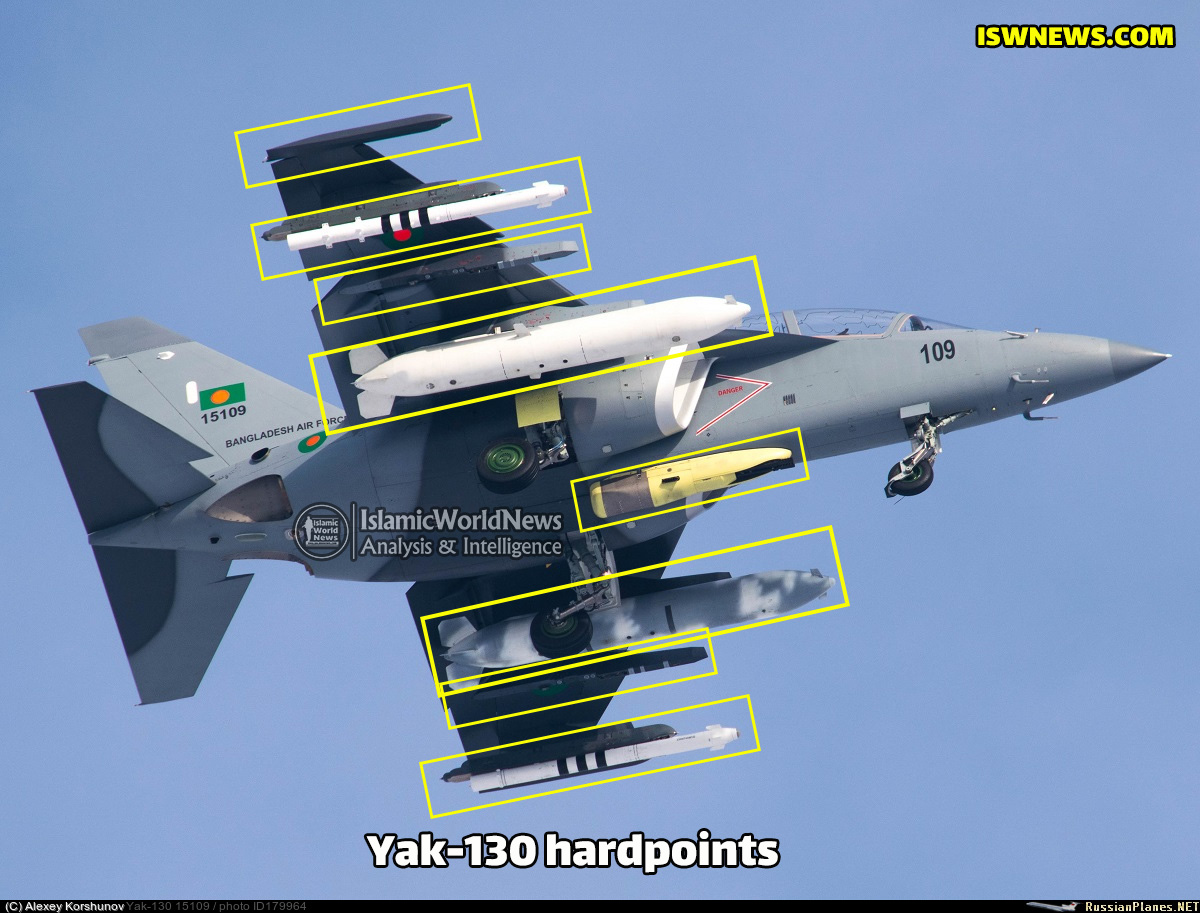
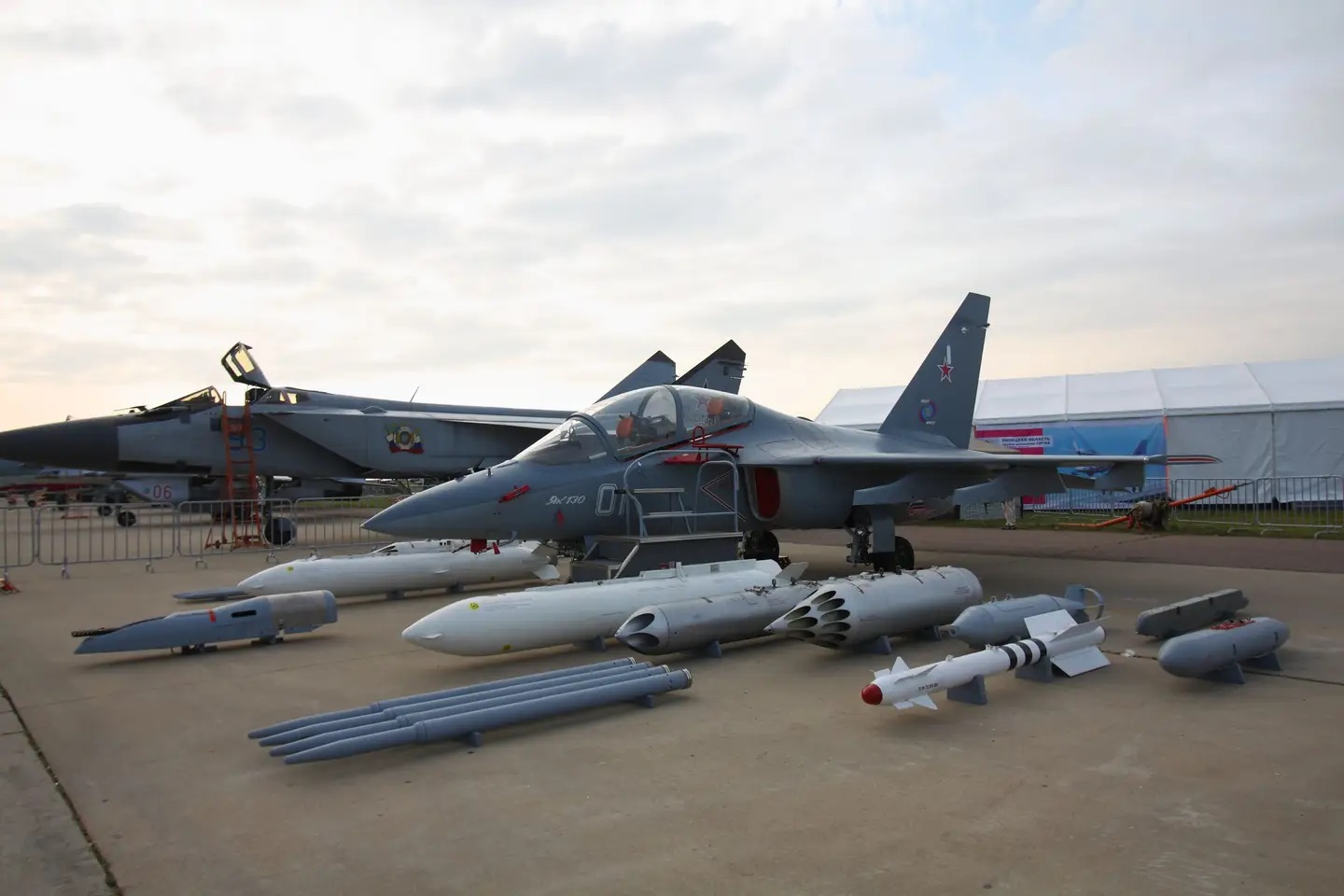
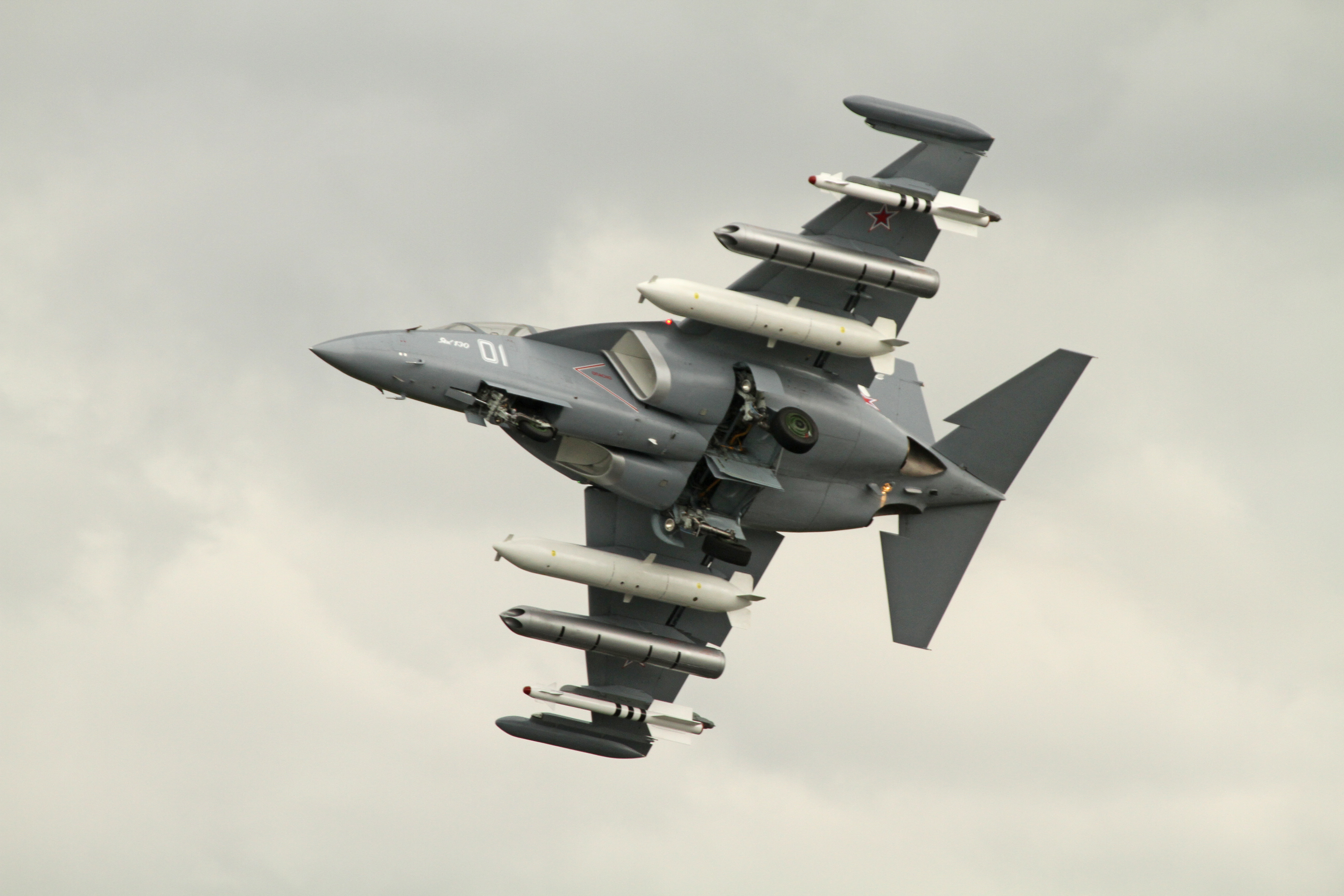
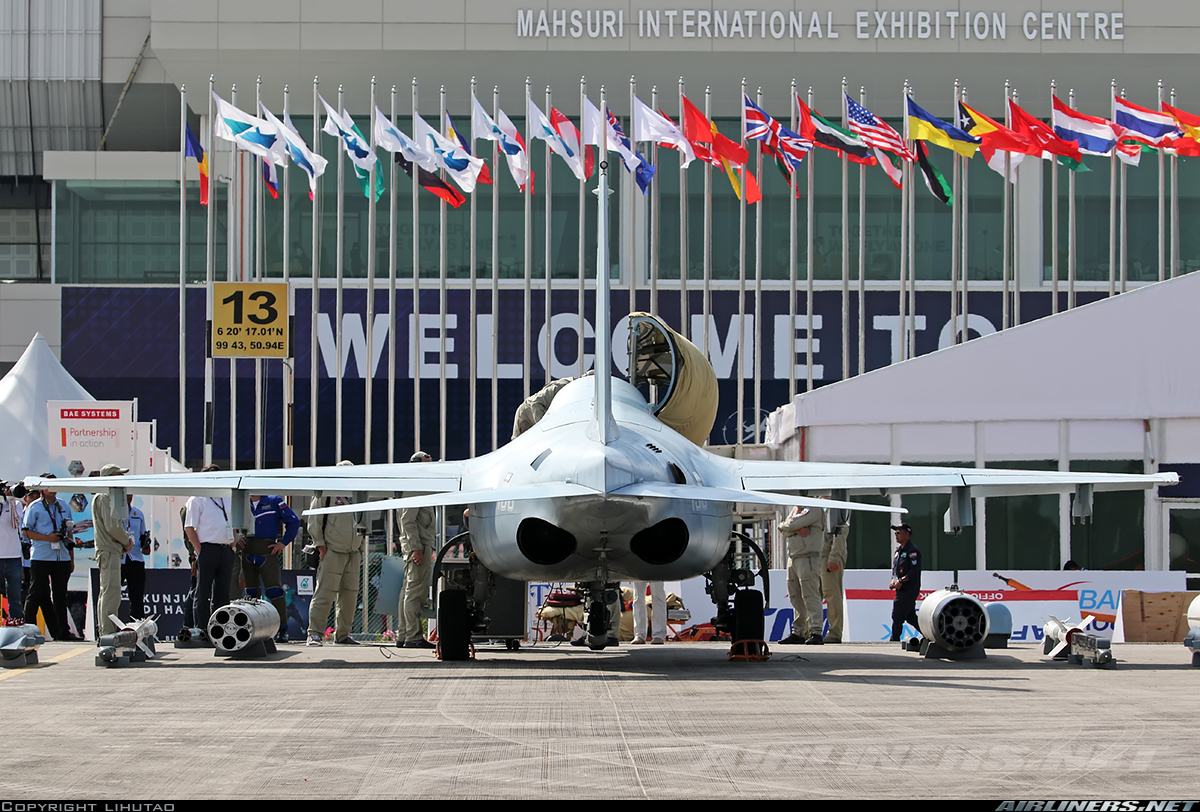
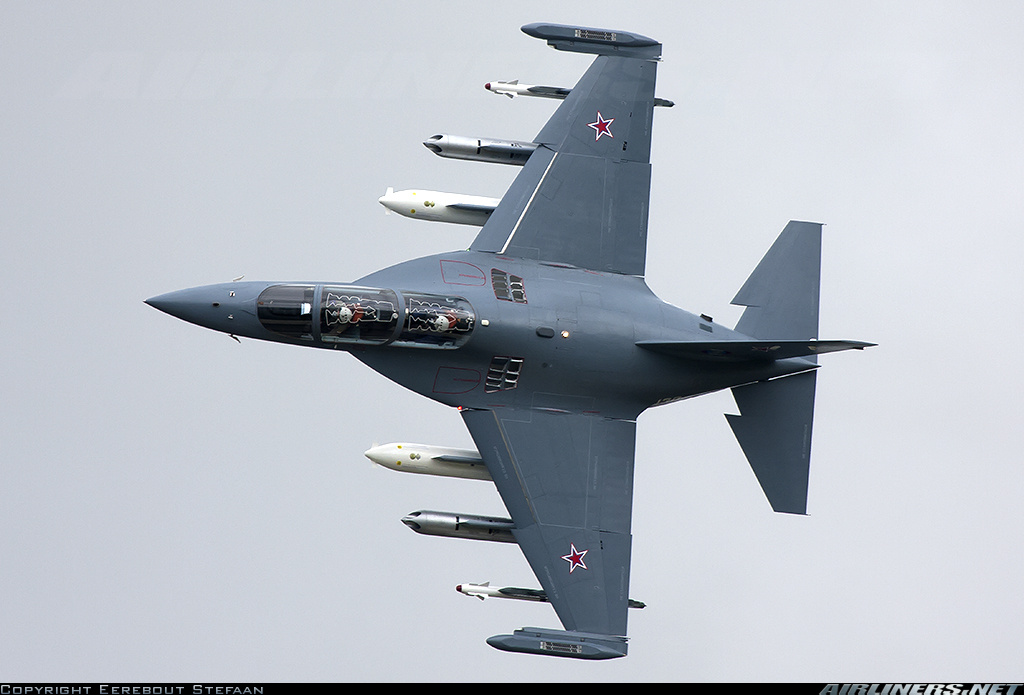
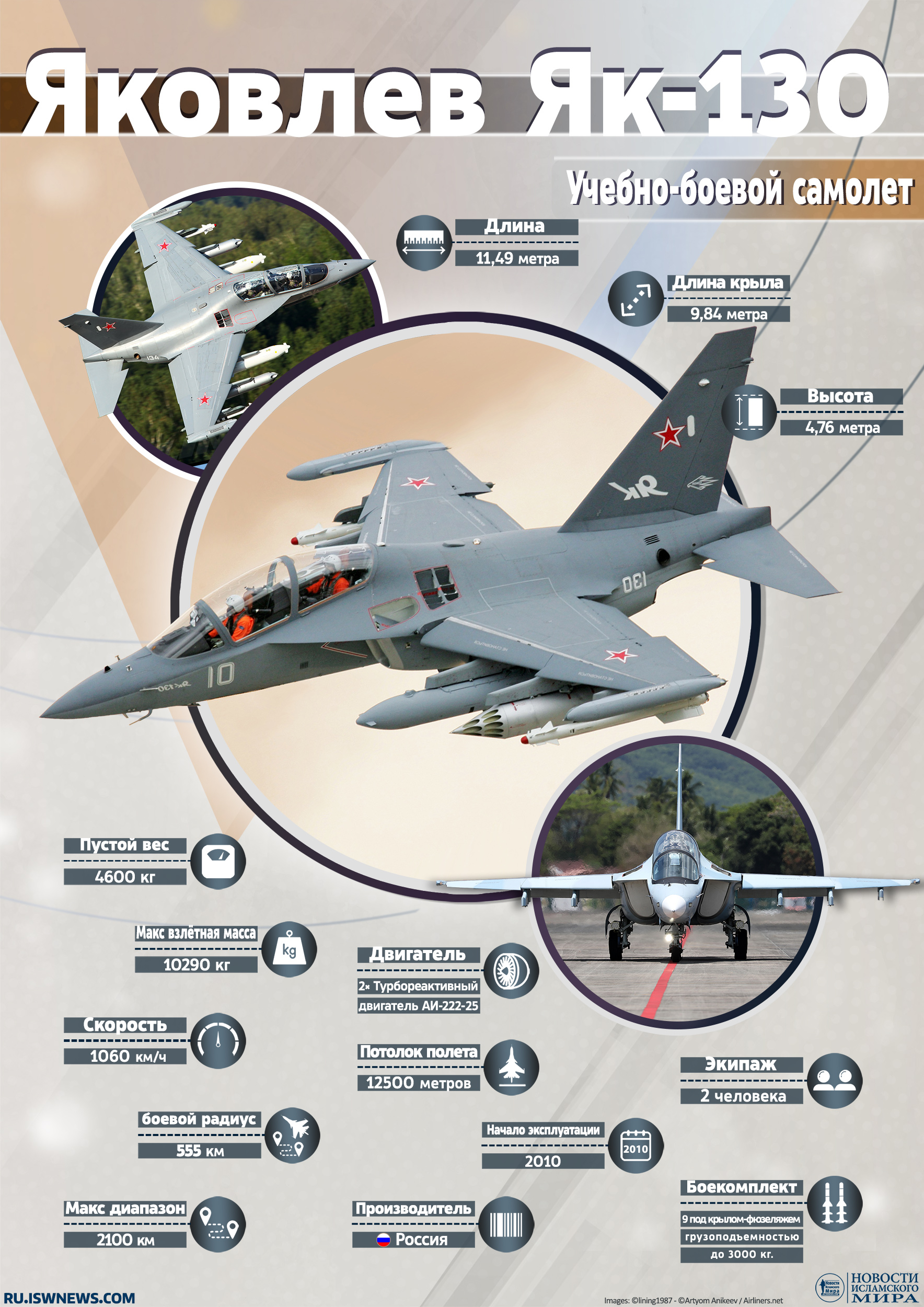
    Yak-130 uses 9 hardpoints to carry weapons up to 3000 kg. Two weapon hardpoints are placed on the tips of the wings and six hardpoints are placed under the two wings and one hardpoint is placed under the fuselage. The fuselage hardpoint cannot host large equipment because it is placed between the landing gear hatches.

    Yak-130 hardpoints

    In export versions of Yak-130, the flight control system ‘Avionica’ is used. This flight control system belonging to the American company Avionica and is used in fighters such as F15, F16, F18, Mirage 2000, Typhoon, Rafale and F35, and even in the export versions of Sukhoi 27, Sukhoi 30 and MiG 29.

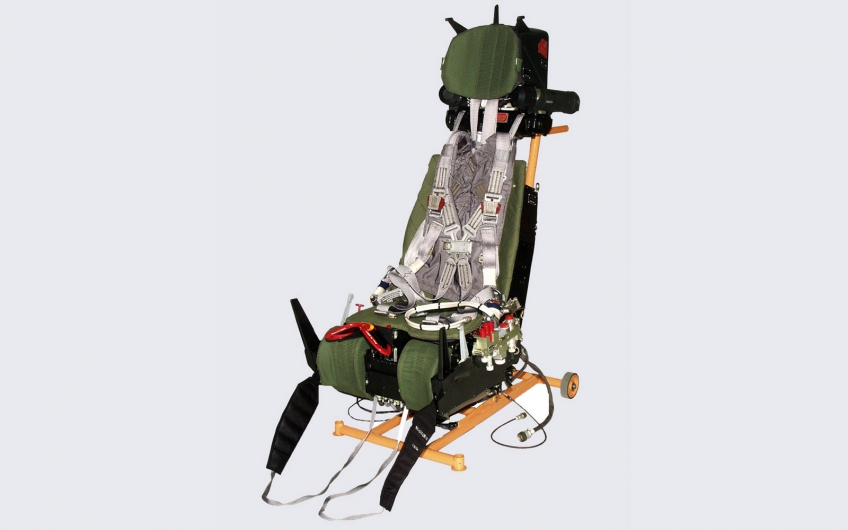
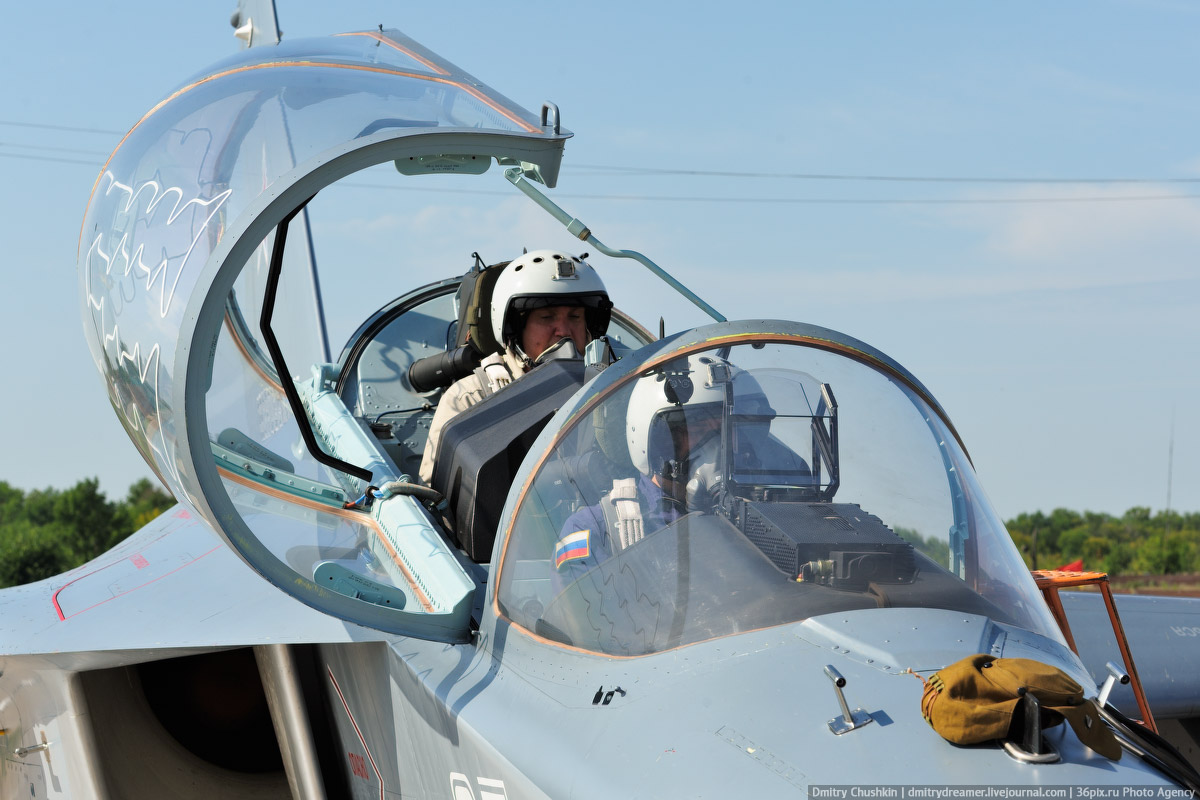
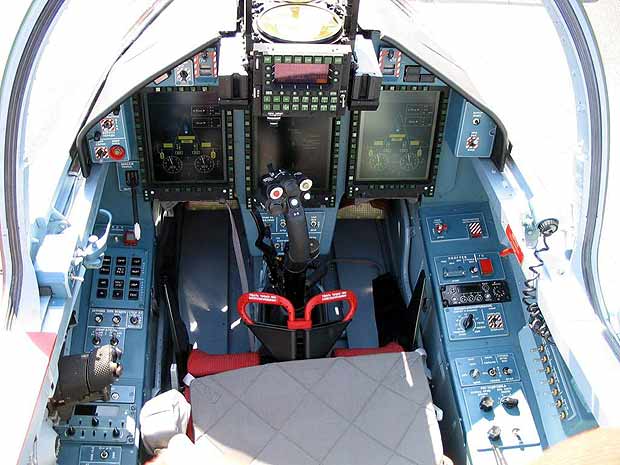
    Yak-130 is equipped with zero-zero K-36LT3.5 seats manufactured by NPO Zvezda. Pilots have 360 degree vision. The front cabin has a visibility of -16 degrees and the rear cabin has a visibility of -6 degrees.

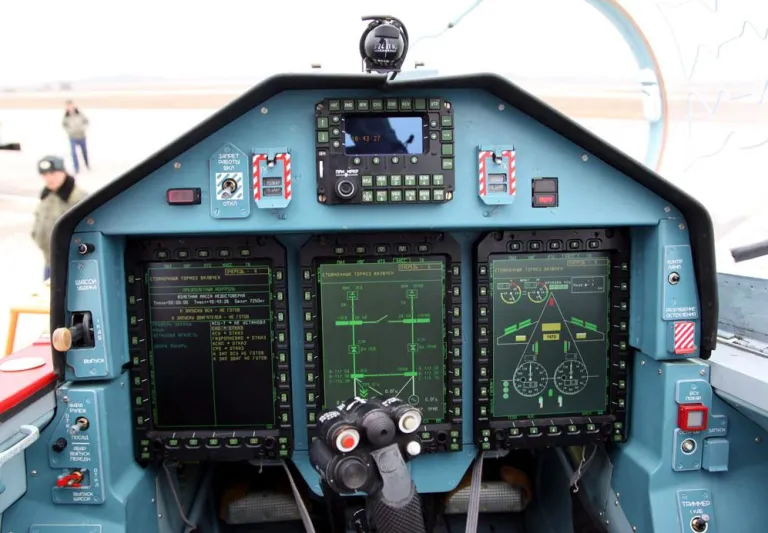
    The all-digital Yak-130 avionics cockpit passes the Mil Standard 1553 defined by the United States of America and can be adapted to customer needs. This all-glass cabin allows both pilots to use a night vision camera and is equipped with three color liquid crystal displays measuring 24.15 cm by 20.32 cm. A Head Up Display (HUD) is used in the front cabin of the Yak 130 so that the pilot can see the target and flight information by looking at it.
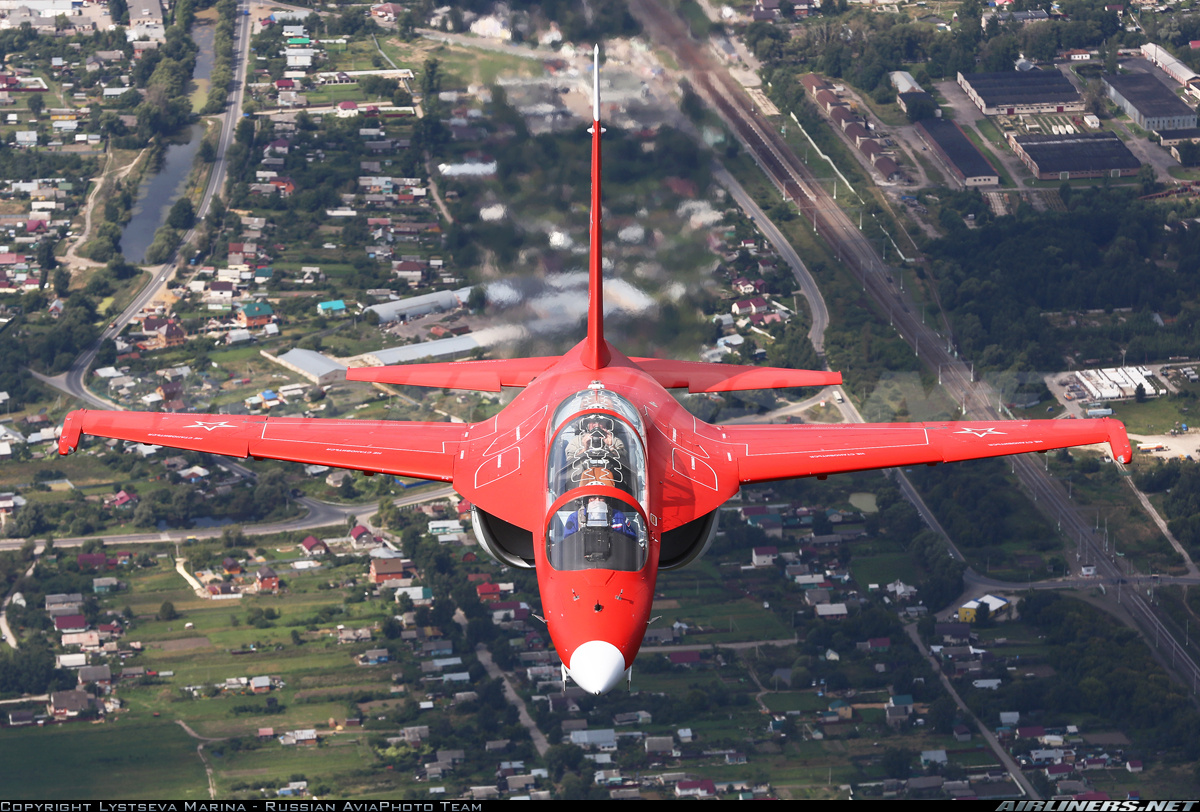
    The pilot’s helmet in the front cabin is equipped with a special display for determining the target, and the cabin is also equipped with an audio warning system and an internal and external communication system, produced by Popov Plant.

    This training fighter jet provides the possibility of choosing the type of training flight and simulating the tactics of combat aircraft for easier training of pilots. Yak-130 supports the navigation system including laser gyroscope and global positioning system of Russian GLONASS and American GPS.

    The internal fuel tanks of the Yak-130 fighter include one tank in the body and two tanks under the wing. This fighter can carry fuel tanks under the wings on hardpoints close to the body. External fuel tanks have a capacity of 450 liters each, which brings the total portable fuel to 2650 liters. The possibility of aerial refueling is also available for this fighter, but it is installed on it as a custom.

    Armament:
    The advanced architecture of the Yak-130 avionics complex allows a wide range of Western weapons to be compatible with it. Western air-to-air weapons such as the AIM-9L Sidewinder and Magic 2 or weapons such as the AGM-65 Maverick are examples of these weapons.

    Yak-130 uses eastern weapons such as Vikhr laser guided missile, R73 infrared air-to-air missile, Kh-25 ML air-to-surface missile, KAB series free-falling bombs weighing up to 500 kg, S8 rockets and cluster bombs.

    This fighter does not have a cannon by default and uses a GSh-23 pod instead, which is usually installed in the fuselage hardpoint.

    Image of Yak 130 ammunition – click to view in full size

    Yak-130 radar:
    The Yak 130 combat training fighter uses a radar with a power of 8 to 12.5 GHz called BARS-130 produced by NIIP Zhukovsky.
    This radar is capable of detecting air targets with a cross section of 5 square meters at a distance of 85 km and locking at a distance of 65 km. In addition, it has the ability to identify friend from enemy (IFF), air combat, detect sea and land targets, and also synthetic-aperture radar (SAR).

    Engine:
    Yak-130 in the prototype used the DV-2 engine produced by the Slovakian Povazske Strojarne company belonging to the Slovak Republic with a power of 2200 kg (21.58KN). In later examples, the Yak 130 fighter used the Al-222-25 engine with a power of 2,520 kg of force (24.7KN) made by the Ukrainian company Motor Sich, Zaporozh’e Progress Design Bureau and the Russian company Moscow Salyut Motor Building Production Enterprise.

    The Al-222-25 engine was also used by the Italian fighter M-346 Master.

    Russia produces Al-222-25 engine named RD-35M with 28.45KN power.
    Today, DV-2S engine with 24.5KN power is also produced, which is used for export purposes in the production of Yak 130.

    Exports:
    Algeria, as the first customer of this fighter, placed an order for 16 of them in 2006, and succeeded in receiving these fighters in 2011.

    In 2010, Libya ordered 6 aircraft and Vietnam ordered 8 Yak 130 training fighters. In December 2012, Belarus managed to purchase four Yak-130 fighter jets, which it received in 2015. The Belarusian Air Force received four more in 2016 and four more in May 2019.

    The Myanmar Air Force received three Yak-130 training fighters in late 2016. The country took delivery of another 6 planes in December 2019. Algeria is the user of 16 Yak 130 training fighters.

    Syria also bought 36 Yak 130, which should have been delivered to this country by the end of 2016. But this was postponed due to the war in this country.

    In 2019, Vietnam signed a $350 million contract to purchase 12 Yak 130s, which were delivered to Vietnam in November 2021.

    On December 2, 2023, Iran received two Yak 130 fighters. The number ordered by Iran is not known. According to reports related to the purchase of Sukhoi 35 fighter by Iran, the Yak 130 can be considered as a training fighter for Sukhoi 35.

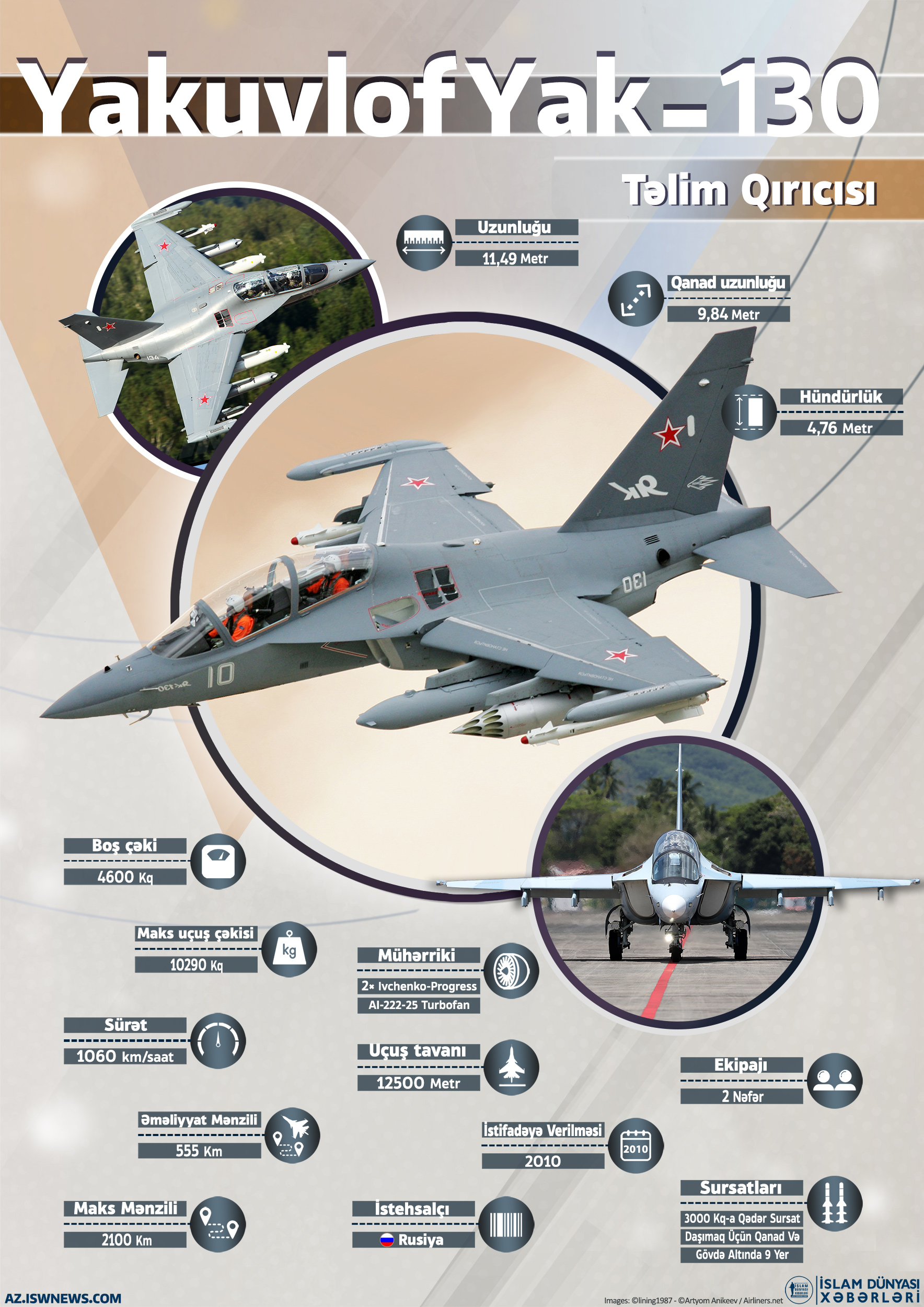
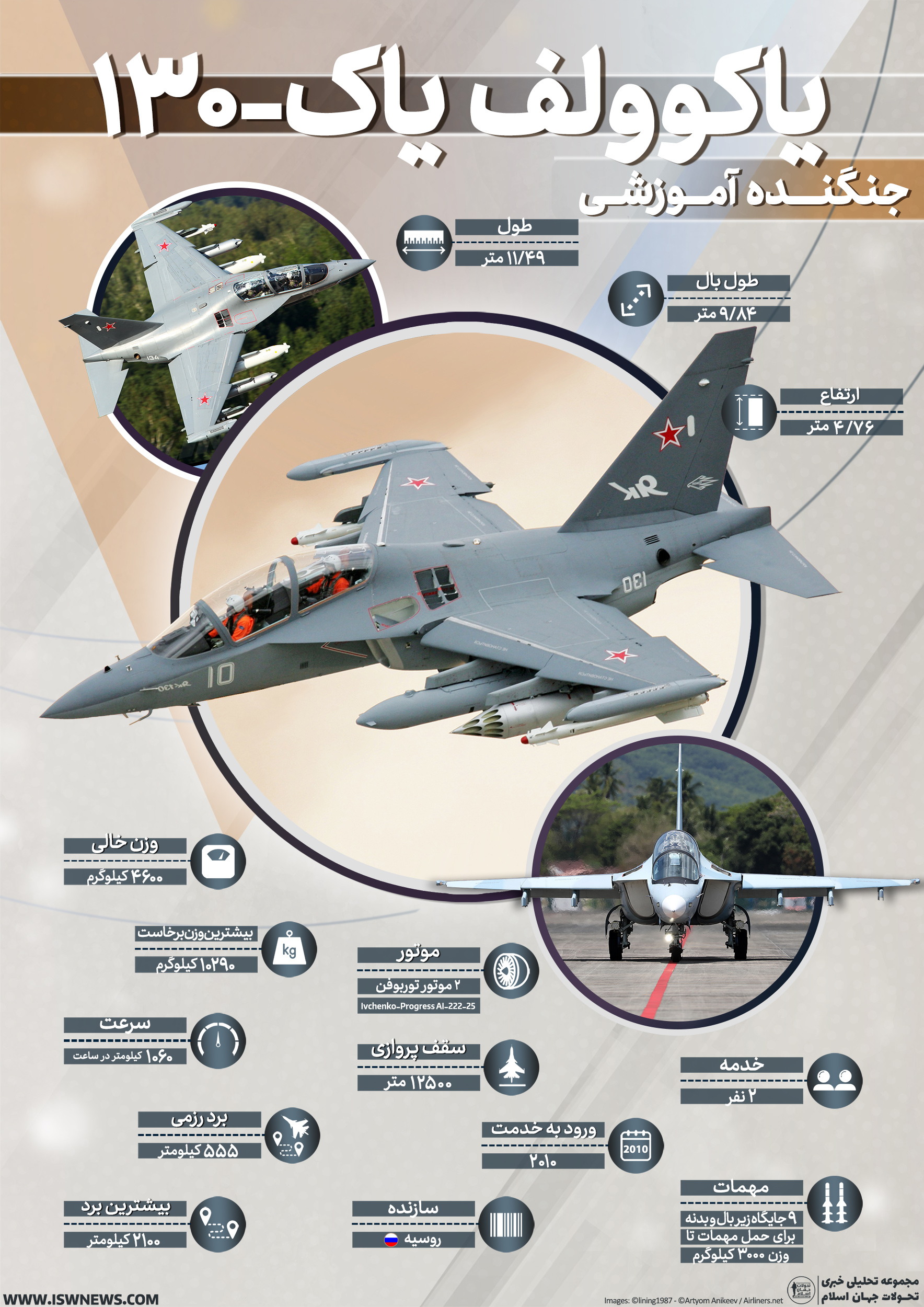
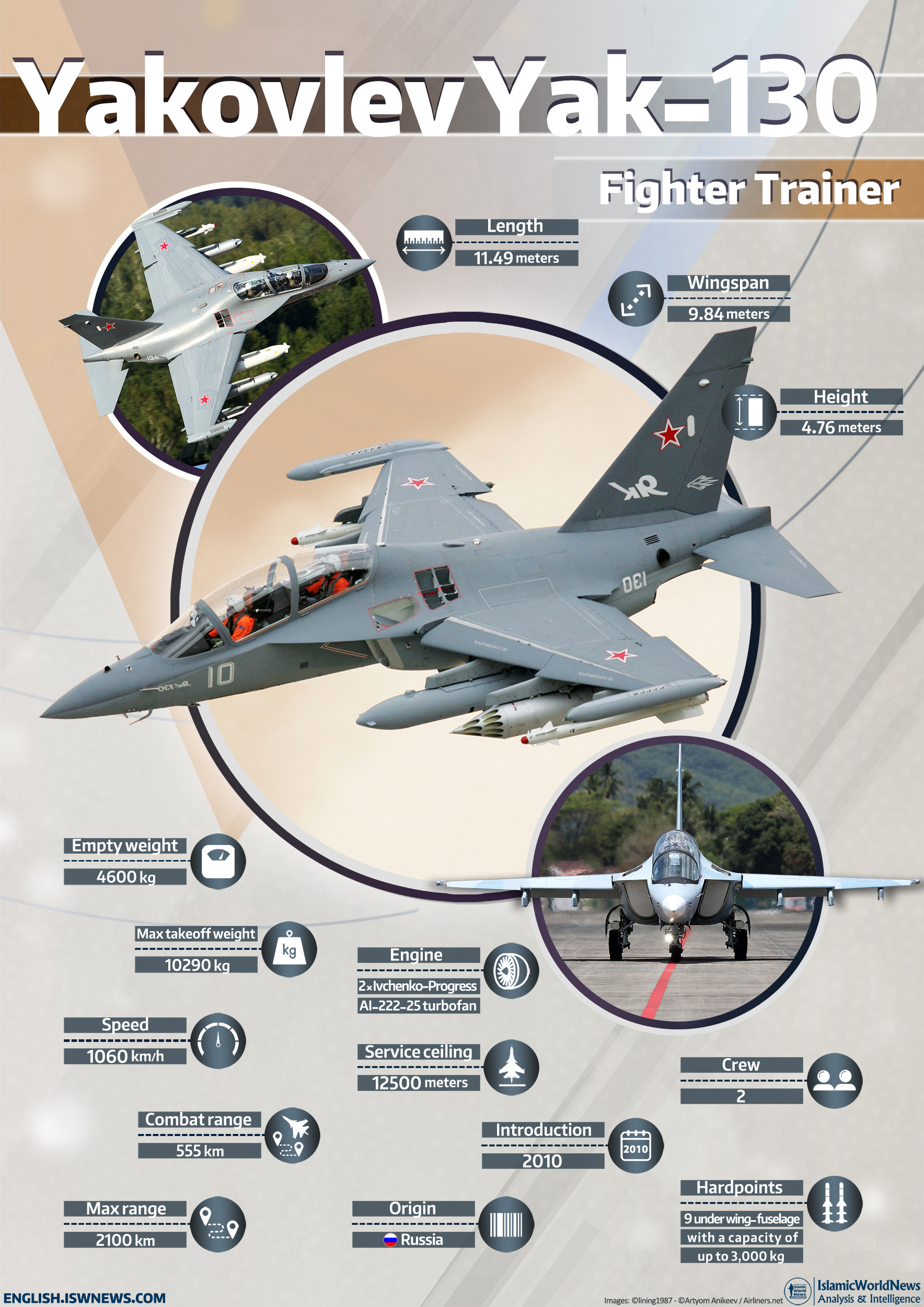
    Specifications of Yak-130 combat training fighter:
    Role: Fighter trainer an light combat aircraft
    Producer: Yakovlev
    Origin: Russia
    First flight: 1996
    Entered service: 2010
    Crew: 2 pilots
    Length: 11.49 meters
    Wingspan: 9.84 meters
    Height: 4.76 meters
    Wing cross section: 23.52 square meters
    Empty weight: 4600 kg
    Gross weight: 7250 kg
    Maximum take-off weight: 10290 kg
    Engine: 2× Ivchenko-Progress AI-222-25 turbofan engines, 24.52 kN (5,510 lbf) thrust each
    Maximum speed: 1060 km/h
    Cruise speed: 887 km/h
    Maximum range: 2100 km
    Operational range: 555 km
    Flight ceiling: 12500 km
    g limits: +8.0 −3.0
    Rate of climb: 65 m/s
    Trust to weight ratio: 0.7
    Armament:
    Hardpoints: 9 (1 on each wingtip, 3 under each wing, and 1 under the fuselage) with a capacity of up to 3,000 kg (6,614 lb), with provisions to carry combinations of:
    Rockets: 80mm S-8 rocket, S-25 rocket
    Missiles: R-73 infrared-homing air-to-air missiles
    Bombs: FAB-M62, ZB-500, KAB-500Kr

    Yak-130 combat training fighter – click to view full size

    More pictures of Yak-130 combat training fighter:

    Infographics of “Yak-130 combat training fighter” Persian, Russian, Azeri:

    Sources:
    Yakovlev Yak-130
    Yak-130
    FIRST YAK-130S DELIVERED TO VIETNAM
    The Yakovlev Yak-130

  • Military Knowledge: Sukhoi Su-35 Multirole Fighter Jet

    Military Knowledge: Sukhoi Su-35 Multirole Fighter Jet

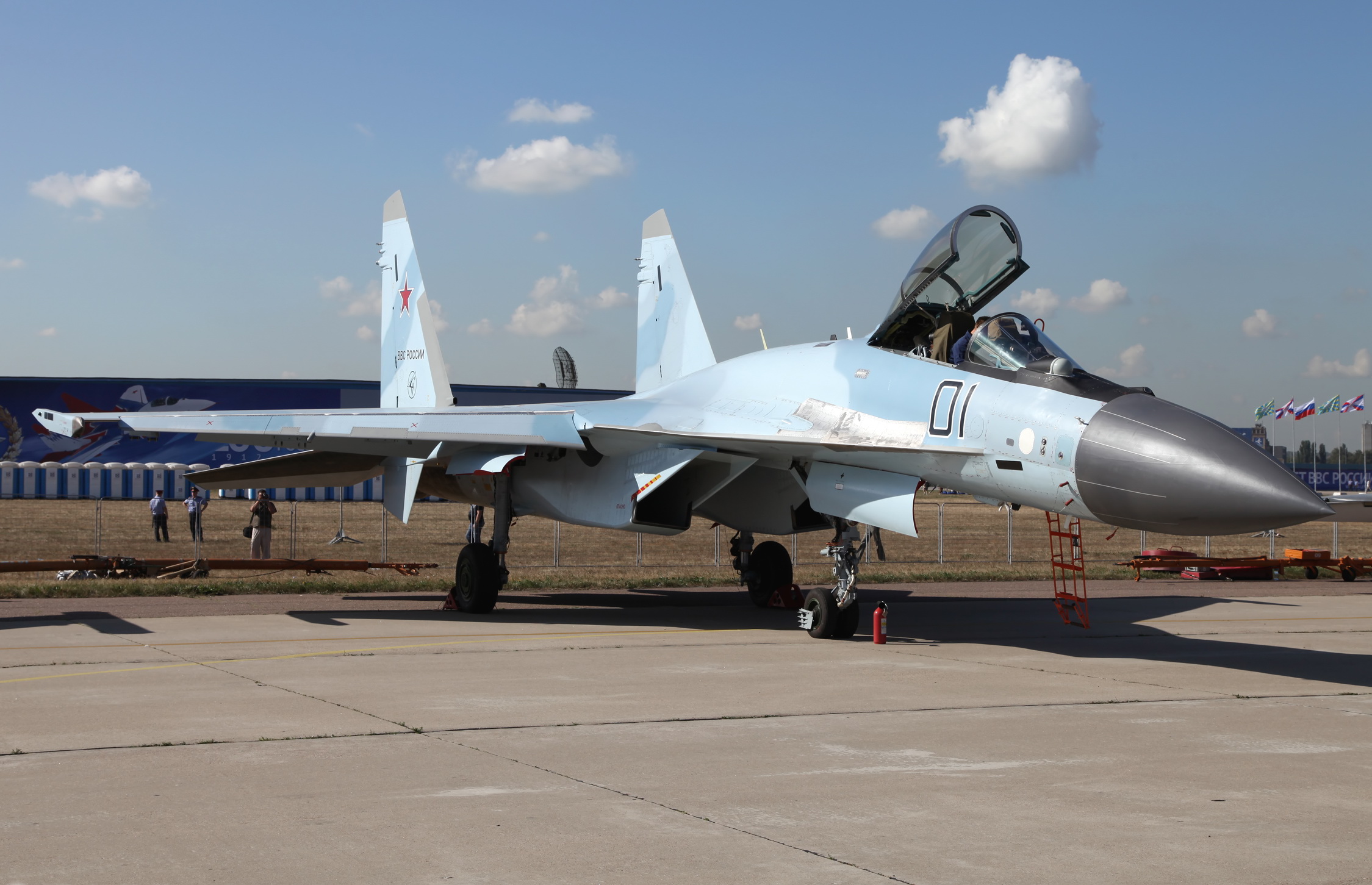
    The upgrade of the Su-35 kicked off from 1980s, when the Russians started developing the Su-27. The fighter jet was introduced as the Su-27 in the first place; in fact, the Russians sought to manufacture a more powerful version of the Su-27 to improve its maneuverability, Avionics (Aviation Electronic), longer range and more powerful engine of the jet. Thus, the first version of the fighter jet conducted the initial flight in June 1988, and then, 15 Su-27 were manufactured prior to the collapse of the Soviet Union.

    Following the downfall of the Soviet Union, the Sukhoi Company changed the name of the fighter jet to Su-35 with the aim of attracting purchasers from the global export markets. In 2003, the company initiated the second big upgrade of the fighters and the first flight of the new version took place in February 2008. The aim was to maintain the Russian Air Force fleet up-to-date in order to fill the gap between the fourth and fifth generations of fighter jets as long as the fifth generation of fighters of Russia’s Sukhoi PAK FA would be ready.

    The Su-35 fighter jet is considered as the “fourth generation ++” of the fighter jets, which was seen as the most powerful and the most advanced fighter of Russian aerial superiority before the fifth generation Su-57 in order to carry out different defensive and offensive missions.

    Performing a combined maneuver of the Sukhoi-35, which is a combination of the three techniques of the Cobra maneuver, the hook maneuver to the left and an additional back, shows off the agility and maneuverability of the Sukhoi-35.

    Read more: Military Knowledge: Sukhoi Su-27 Multirole Fighter Jet

    Design and development of Su-35
    The first design of the Su-35 dates back to early 1980s, at the same time when the Su-27 entered service with the Soviet Army. The final version of the Su-27 is identified with the name T-10S. The operation to upgrade the Su-27M began in 1982 and the design was accepted in 1983 with the name T-10M.

    The design of the Su-27M is widely similar to the Su-27; however, when it comes to manufacturing the fuselage of the Su-27M, they used small canards in the fighter jet cabin, which is located slightly ahead of main wings. The usage of canards gives the fighter jet an opportunity to carry out maneuvers of higher intensity, while it does not need any revamp and amplification of the key structure.
    The other transformations to the version comprise longer tail fins, aerial refueling system as well as larger wheels on the front of fuselage of the fighter jet. Other than the abovementioned issues, one of the distinguishing features of the fighter jet is the usage of an up-to-date fire control system.

    The extra powerful turbofan engines and the usage of lightweight composite materials as well as aluminum and lithium alloys are among other features applied in the fighter jet.

    The radar installed on the fighter jet is multi-purpose and able to spot targets on the ground.

    When the N011 Bars radar was installed on the Su-27M for the first time, it transformed the fighter jet from an air defense jet to a multirole fighter. Contrary to the N001 Myech radar, the N011 Bars radar is being installed on the Su-27 and is capable of detecting 10 targets as well as at the same time directing two missiles against merely one target; furthermore, the radar, which is installed on the Su-27M, can detect 15 targets and is capable of engaging with six targets.

    N011 Bars radar

    The Russians installed radar named N012 on the back of the fighter plus the main radar in order to detect missiles fired at the fighter jet. The design was applied on the Su-27M first, and the fighter jet is the first combat plane to be equipped with this sort of capability. In succeeding designs, the radar was detached from the rear of the Su-35 fighter, and the existing Sukhoi-35 fighters do not possess such radars; however, the fighters were equipped with the electronic warfare and jamming systems in the rear section.

    Test and operation of Su-35
    The Sukhoi Company kicked off manufacturing the first aircraft called the T10M-1 in 1987 that was alike in appearance to the T-10S. Sukhoi’s chief pilot Oleg Tsoi carried out the first flight of the aircraft on June 28, 1988.

    Following the manufacturing of two prototypes, the design of the fighter jet was handed over to Russia’s Far East region to be manufactured at the KnAAPO factory. The first real edition of the fighter jet is identified as T10M-3. Actually, the version is the first original edition of Su-27M, which was manufactured by KnAAPO and the aircraft made its first flight in April 1992. At that time, the Soviet Union collapsed and political developments caused delay of the manufacture of the fighter jet, and they manufactured merely two test editions and nine main versions of the fighter until 1995.

    The Su-27M (T10M-3) design was first shown to the public at the Farnborough Airshow in 1992. A third prototype, the T10M-3, was unveiled at the Dubai Air Show in 1993, at which time Sukhoi renamed the fighter to Su-35. The Sukhoi-35 made several air shows over the next few years, including at the MAKS Airshow in 1993 and 1995, as well as the ILA Berlin Air Show in 1994.

    During the Su-35’s flight test and test programs, it was found that the aircraft did not have good control during the cobra and tailslide maneuvers. Therefore, the 11th version of the Su-27M with the model number T10M-11 was made by KnAAPO in 1995 exclusively for the installation of an engine equipped with a thrust vectoring nozzle. Finally, this change ended in the construction of the first and only Su-37 fighter.

    The first and only Sukhoi-37 model

    15 prototypes of the Su-35 fighter (i.e. Su-27M)
    15 prototype versions of Su-27M have been made, which are described in the following order:

    Sukhoi with body number 88

    There is no image of the two prototypes with body numbers 86 and 87.

    Sukhoi with body number 704 was a test bed and there is no picture of it.

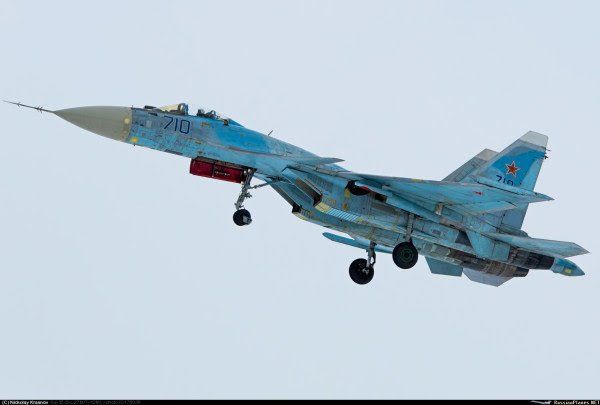
    It should be noted that the tenth version of the Su-27M fighter, named T10M-10, was equipped with AL-41F1S engines to perform tests related to the Sukhoi Su-57 fighter. The picture of Sukhoi with body number 710 above is related to this model.

    Sukhoi with body number 711 – this model was equipped with an engine with thrust vectoring nozzle, which eventually became known as the Su-37 fighter.
    Sukhoi with body number 712 – along with 703 were owned by Russian Knights acrobat team for some time.

    First official version: Su-27M/Su-35
    It is a single-seat version known by the code T-10M. The two initial versions of this model are equipped with a different structure in the front part of the body.

    Second official version: Su-37
    It is a technology proof version and it is actually the 11th version of Su-27M which is equipped with flight control system, new cabin, N011M radar and AL-31FP engines equipped with thrust vectoring nozzle.

    Sukhoi 37 fighter engine equipped with a thrust vectoring nozzle

    Third official version: Su-35UB
    It is a two-seat and training version designed and manufactured by KnAAPO factory. This version is known as T-10UBM-1 and is equipped with the same body as Su-30MKK. Also, the tail fins of this fighter are longer than the Su-27M version. The Su-35UB fighter is equipped with the electronic systems of the Su-30MKK fighter. The engines of this version are of AL-31FP type and are equipped with thrust vectoring nozzle. Although the Su-35UB fighter is a trainer aircraft, it has all the capabilities of a full fighter jet.

    Su-35UB fighter

    Fourth official version: Su-35BM
    It is a single-seat version and a redesign of the Su-27. This version has significant changes in the air intakes, the radar of this version has been updated to the N035 Irbis-E type, and also the engines of this version are AL-41F1S, which is equipped with a thrust vectoring nozzle. Another name of this version is T-10BM.

    Fifth official version: Su-35S
    The Sukhoi-35S is a redesign of the T-10BM design for the Russian Air Force and the main operational version of this fighter. “S” stands for the Russian word Stroyevoy meaning “Combatant”.

    Salient features of Sukhoi-35 fighter
    The AL-41F1S Sukhoi-35 engine is equipped with thrust vectoring nozzle. The Su-35’s thrust vectoring system and integrated thrust and flight control systems allow the aircraft to achieve “super-maneuverability” and enable it to perform post-stall maneuvers at low speeds.
    The AL-41F1S engine gives the Su-35 the ability to maintain supersonic speed without the use of afterburners. According to Carlo Kopp of the Australian Air Power think tank, such a “supercruise” feature allows the Su-35 to engage with the enemy at a higher speed and altitude and increase the range of its long-range missiles by 30 to 40 percent.

    The Su-35 fighter uses the powerful N035 Irbis-E passive electronically scanned array radar. This radar has the ability to detect targets from a distance of 400 km. This radar has the ability to identify 30 targets and can engage with 8 targets simultaneously. In addition to the above, the radar has the ability to identify ground targets by providing high-resolution images using synthetic-aperture radar (SAR) mode.

    N035 Irbis-E radar
    The range and ability of the Sukhoi 35 radar to detect other fighters

    According to some sources, the Su-35 fighter has the ability to identify and destroy the F-15 fighter from a distance of 400 km, the F-16 F/A-18 fighter and the Typhoon from a distance of 300 to 350 km, the F-35 fighter from a distance of 60 and the F-22 fighter from a distance of 35 km. The pulse doppler radar of the F-15 fighter has a range of about 175 km.

    The Su-35 fighter is equipped with the L175M Khibiny-M electronic warfare system to deal with the enemy. The system is designed for radio direction-finding and probing signal source irradiation allowing it to distort reflected signal parameters. This system helps to delay aircraft detection; mask the true subject against false reflections; cause range finding difficulties namely in speed and angular positions; degrading maintenance mode TWS when scanning antenna beam radar; and increase the time and difficulty of capturing an object during real-time active scanning.

    Khibiny-M electronic warfare system installed on the wing tips of Sukhoi-35

    In May 2024, new images of the Sukhoi-35 fighter jet were published, which show that this fighter jet is also equipped with the newer L-420 Khibiny-U electronic countermeasures system.

    Read more: Khibiny Electronic Countermeasures System; Russia’s Secret Technology!

    Su-35 is equipped with an OLS-35 optoelectronic targeting system ahead of the cockpit to provide other forms of tracking including infra-red search and track. OLS-35 comprises a heat-seeker, a laser rangefinder/designator and a TV camera along with new algorithms and advanced software to outperform its predecessor installed on the Su-27/Su-30 aircraft family. The OLS-35 provides a coverage of +/-90 in azimuth and +60/-15 in elevation with a target acquisition range for non-afterburning aerial targets of 50 km facing up to target’s front hemisphere and 90 km facing up to rear hemisphere. The laser rangefinder features a five-meter Circular Error Probable (CEP) and ranges up to 20 km for aerial targets and 30 km for targets on the ground.

    OLS-35 advanced infrared search and track (IRST)

    In the cabin section, while the design of the Su-27M cabin had avionics equipment suitable for a multipurpose fighter, but in the flight tests, the inefficiency of the cabin for the effective use of the fighter’s weapons was determined. Therefore, the cockpit and its systems were redesigned and optimized.
    In the new design, the information management system of aircraft’s avionics suite had been changed so that it now has two digital computers which process information from the flight- and weapons-control systems. The information is then displayed on two 9 in × 12 in (23 cm × 30 cm) multi-function liquid crystal displays, which replaced the smaller multi-function cathode-ray tube displays found on the Su-27M. The pilot can also view critical flight information on the head-up display,[42] and is equipped with Hands On Throttle-And-Stick (HOTAS) controls.

    Su-35S cockpit layout: a head-up display, two multi-function liquid crystal displays, and a control stick with HOTAS controls
    A view of the cabin of an early Sukhoi-35

    Sukhoi-35 is equipped with a GSh-30-1 30 mm automatic cannon in the armament section. This fighter has 12 external hardpoints for loading all types of missiles for air, land and sea targets as well as anti-radar missiles. These hardpoints can also load a variety of guided bombs. The arrangement of 12 Hardpoints is as follows: 2 wingtip rails, and 10 wing and fuselage stations with a capacity of 8,000 kg.

    12 hardpoints of the Sukhoi-35 fighter
    The Su-35’s 30 mm GSh-30-1 automatic cannon

    Su-35 export market
    The Sukhoi-35 fighter to attract export customers in Dubai in 1993 and piloted by Viktor Pugachev engaged in an aerial battle with the Su-30MK fighter. After this, the fighter once again flew in air shows in Berlin, Paris and Moscow and showed its features to the public.

    In the late 1990s and early 2000s, Sukhoi had negotiations with South Korean officials to sell the fighter, but the negotiations were unsuccessful. The company also presented its designs to Brazil, China and the UAE.

    Egypt was one of the main customers of Su-35 and ordered 24 of this aircraft to Russia. But this order was canceled due to US threats. The US had threatened Egypt that if it buys fighters from Russia, it will be subject to US sanctions. Also, Indonesia, which had ordered 11 planes of this fighter, along with Algeria, canceled the order and purchase plans of Sukhoi-35 for similar reasons.

    Currently, Russia with 88 and China with 24 planes are among the main users of this fighter.

    According to Sukhoi’s estimate, this company has the ability to sell 160 of these fighters to Latin American countries, Southeast Asia and the Middle East. The first order of this fighter was made by the Ministry of Defense of Russia in 2009, which was 64 aircraft.

    A video of the taxi, takeoff, flight and performing a number of maneuvers and landings of the Russian Air Force Sukhoi-35

    Sukhoi Su-35 Specifications:
    Role: Multi-role fighter, air superiority fighter
    Manufacturer: Soviet Union/Russia
    Year of manufacture: Su-27M version from 1987 to 1995 and Su-35S version from 2007 until now
    First flight: Su-27M version in 1988 and Su-35S version in 2008
    Length: 21.9 meters
    Wing length: 15.3 meters
    Height: 5.9 meters
    Crew: 1
    Empty weight: 19,000 kg
    Maximum take-off weight: 34.500 kg
    Engine: 2 Saturn AL-41F1S afterburner turbofan engines
    Maximum speed: 2.400 km/h
    Maximum range: 3.600 km
    Flight ceiling: 18,000 meters (59,000 feet)

    Su-35 Armament:
    Guns: 1 × internal 30 mm Gryazev-Shipunov GSh-30-1 autocannon with 150 rounds

    KAB-500KR and KAB-1500KR and GBU-500T and GBU-1000T TV guided bombs
    KAB-500L, KAB-1500L, GBU-500, and GBU-1000 laser guided bombs
    KAB-500OD guided bomb
    KAB-500S-E satellite guided bomb

    S-25 340 mm rocket

    Vympel R-73 short-range air-to-air missile with a range of 30 km
    All versions of the Vympel R-27 medium-range air-to-air missile with a range of 40 to 170 km
    Vympel NPO R-77 medium-range air-to-air missile with a range of 80 to 200 km
    Vympel R-37M air-to-air missile with a range of 400 km
    Kh-29 air-to-surface missile with a range of 10 to 12 km
    3M-14AE surface-to-air missile with a range of 300 km

    Kh-36 cruise missile with a range of 120 km
    Kh-65SE cruise missile with a range of 600 km
    Kh-SD cruise missile with a range of 300 to 1,900 km

    Kh-31A/AD anti-ship missile with a range of 25 to 105 km
    Kh-59 anti-ship missile with a range of 290 km
    Kh-35U anti-ship missile with a range of 300 km
    3M-54AE1 anti-ship missile with a range of 300 km
    Kh-61 anti-ship missile with a range of 300 to 600 km

    Kh-25MP anti-radar missile with a range of 60 km
    Kh-31P anti-radar missile with a range of 110 km
    Kh-58 anti-radar missile with a range of more than 120 km

    Read more:
    Sukhoi Su-30 Multirole Fighter Jet
    Sukhoi Su-33 Multirole Fighter Jet
    Sukhoi Su-34 Multirole Fighter Jet

    Click to view full size

    More images of Su-35:

    Collection of Sukhoi-35 fighter posters in English, Russian, Arabic, Azeri and Kurdish languages:

    Sources:
    Su27flankerfamily
    Russia’s Su-35 Air Defense Fighter Is a Real Killer
    Sukhoi Su-35

    Key.Aero
    Khibiny (electronic countermeasures system)
    OLS-35

  • Military Knowledge: Sukhoi Su-34 Fighter-Bomber

    Military Knowledge: Sukhoi Su-34 Fighter-Bomber

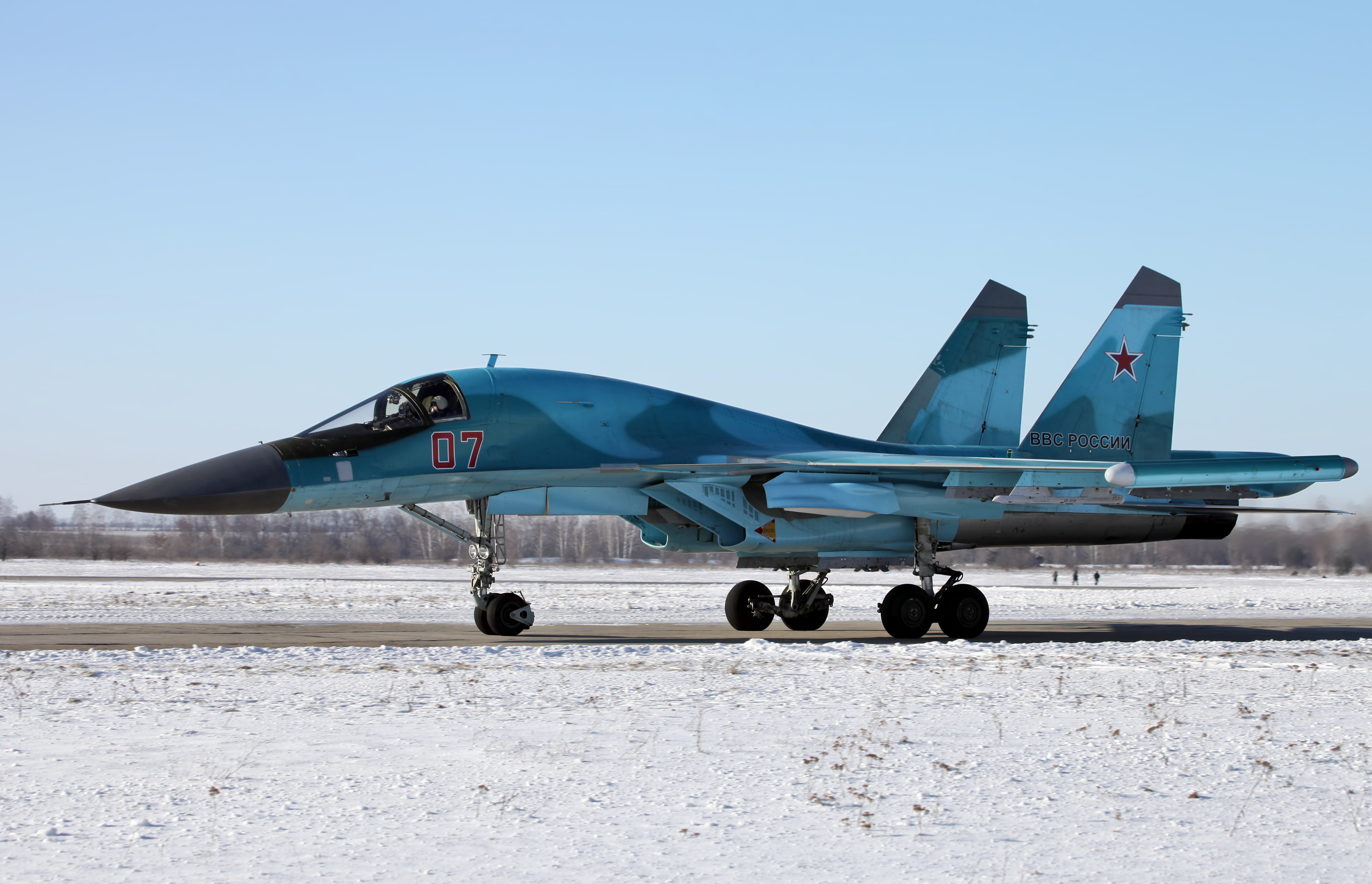
    The Su-34, despite being derived from the Sukhoi Su-27 Flanker, is equipped with a cockpit with two seats next to each other; Due to its different role from other fighters in this family, it does not have the title of Flanker.

    This fighter is primarily designed to attack ground and naval tactical targets and is capable of bombing, attack and air support operations. The fighter is capable of operating in any weather conditions and electronic warfare environments.

    The main purpose of producing the Su-34 fighter is to replace the old Su-24 fighters and Tu-22M3 bombers in the Russian Air Force.

    Su-34 fighter development

    The design and development of the Su-34 fighter has a long history. Sukhoi first began a new design in the mid-1980s to replace the old Su-24 fighters. Next, the Su-27 fighter design was selected, which had a high maneuverability.

    The original design of the Sukhoi 34 was known as the T10KM-2. The T10KM-2 is a Navy-derived version of the Sukhoi Su-27K. The design of the project was known in the Soviet Union as the T-10V, which was introduced in the late 1980s along with the design of the Soviet aircraft carrier Ulyanovsk.

    In 1990, a photo of a prototype fighter landing on a Tbilisi aircraft carrier was released, which Western officials mistakenly identified as a Su-27KU fighter.

    Tbilisi aircraft carrier: Admiral Kuznetsov aircraft carrier was first built under the name Riga, then launched under the name Leonid Brezhnev, then under the name Tbilisi conducted its naval tests and finally, it entered the service under the name of Admiral Kuznetsov.

    Finally, the first flight of the Sukhoi 34 fighter jet was performed on April 13, 1990 by pilot Anatoliy Ivanov.

    This version used a new nose, but the overall structure of the fighter was similar to the Su-27UB.

    In 1992, the Su-27IB (Sukhoi 34 prototype) was unveiled at the MAKS Airshow and refueled from an Il-78 refueling tanker. The aircraft was officially unveiled on February 13, 1992 in Machulishi, Belarus. A year later, the fighter was re-introduced to the public at the MAKS Airshow.

    The first version of this fighter, known as the T10V-2, first flew on September 18, 1993. The initial test version differed in appearance from the original because it was manufactured in Novosibirsk, the production site of the Sukhoi 24 fighter jet.

    The first standard version of the Sukhoi 34 fighter jet flew on December 28, 1994, equipped with the Leninets OKB-designed V004 passive electronically scanned array radar system. This version, because it was different from the original versions, was once again introduced at the 1995 Paris Air Show under the name Su-32FN. This version was designed to serve off the coast of Russia to operate against naval targets. Sukhoi also produced another version called the Su-32MF, but it was canceled due to budget constraints.

    The Russian military currently has two different versions of the Sukhoi 34, one for electronic warfare, equipped with the L700 Tarantul ECM pod, and the other for intelligence, surveillance and reconnaissance operations.

    The modern version of the Sukhoi 34 is known as the Su-34M, which is equipped with a new electro-optical infrared targeting pod, a Kopyo-DL rearward facing radar that can warn the pilots if missiles are approaching, combined with automatic deployment of countermeasures and jamming

    The difference between the two designs of Su-34 and Su-27KUB

    The Su-27IB fighter (prototype Sukhoi 34) and the Su-27KUB, which is a naval training version, are not related to each other and each has a separate design. In appearance, the nose of the Su-27KUB design is quite round, but the nose of the Su-34 (Su-27IB) is like a duck tip.

    Appearance difference between Sukhoi 34 and Sukhoi 27

    Orders and delivery

    The first batch of eight of these fighters was built at the Novosibirsk plant and was ready for delivery in 2004. In 2006, Russia’s defense minister announced the purchase of five Su-34 fighter jets. In late 2008, a contract was signed for the purchase of 32 Sukhoi 34 fighters until 2015.

    According to reports from the Russian Ministry of Defense, by 2015, 70 Sukhoi 34s were to be replaced by 300 Sukhoi 24s, after which the program was canceled and the old Sukhoi 24s were upgraded.

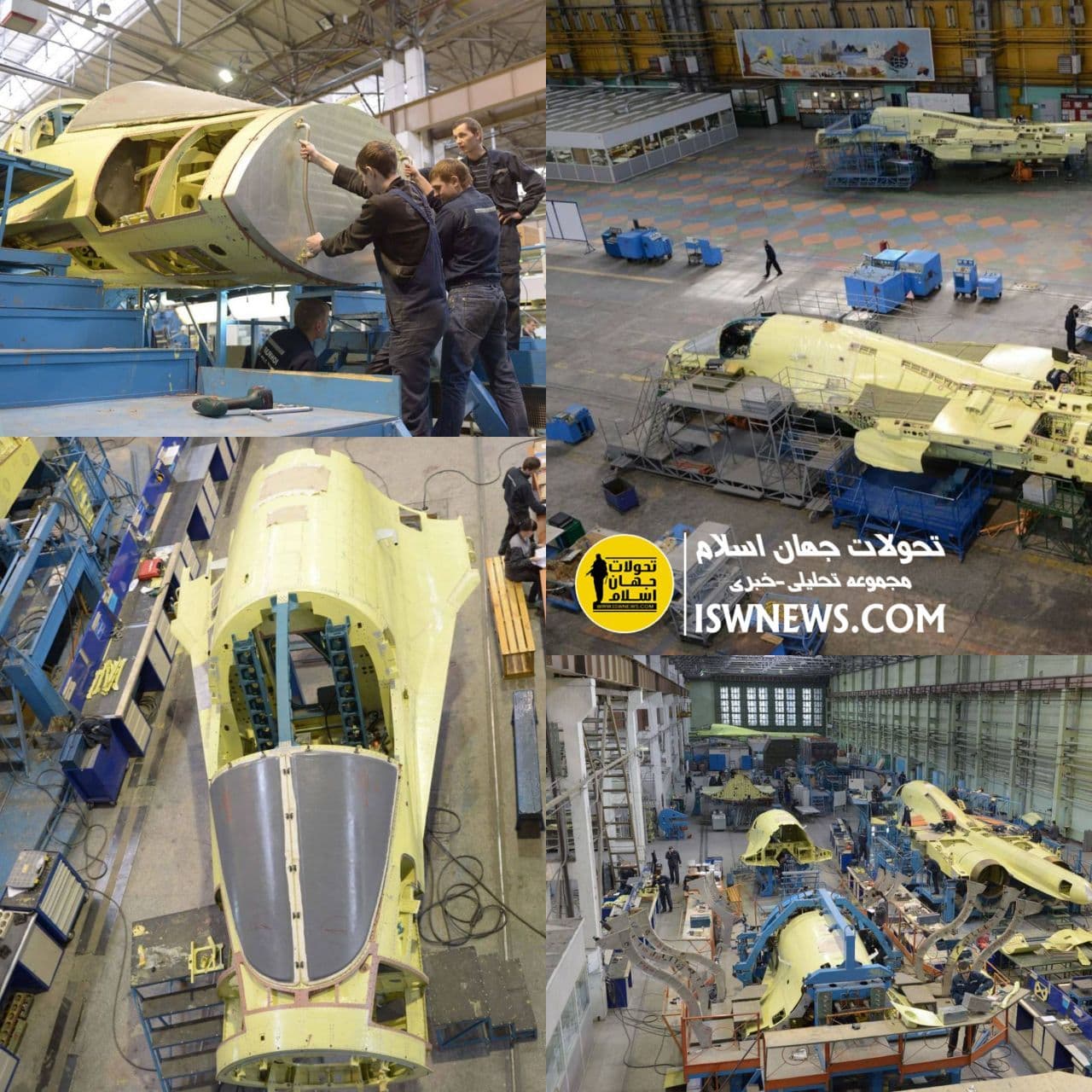
    Production line/assembly of Su-34 fighter

    Su-34 fighter design

    The Sukhoi 34 is similar in structure to the Su-27 and Su-30 in wing, tail and engine nozzles, and similar to the Su-30MKI in the Canards. The engine of this fighter is Saturn AL-31FM1 turbofan, which is also installed on the Su-27SM fighter.

    The operational range of this fighter is 4000 km with one time refueling and it is capable of carrying 8000 kg of all kinds of ammunition and weapons.

    This fighter is also known by the nickname Duckling or Duckbill due to the fact that two pilots are placed next to each other. In the cockpit, the pilot is on the left and the weapons operator is on the right. One of the advantages of this design is that it is not necessary to use duplicate equipment for every pilot.

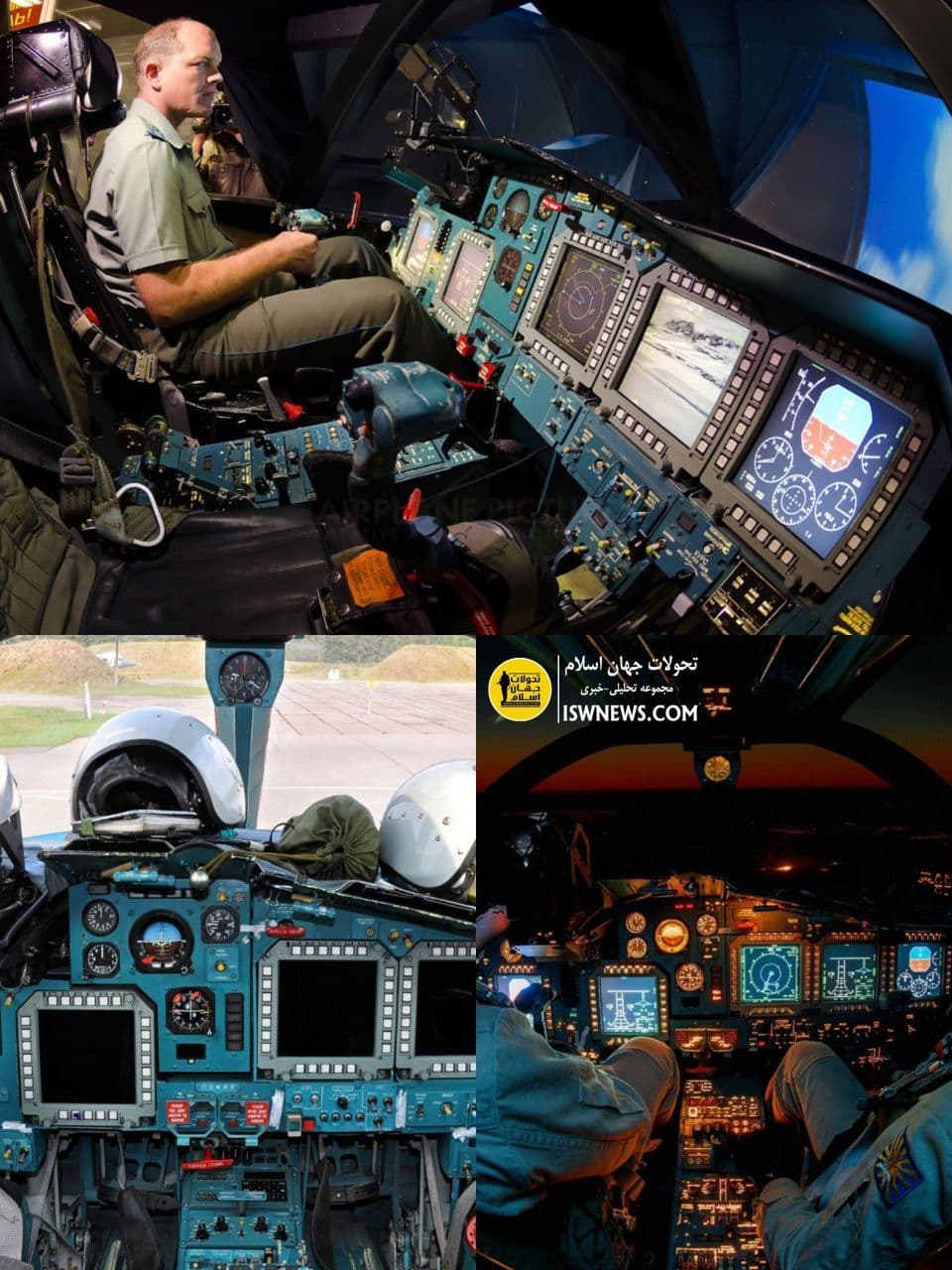
    Su-34 fighter cockpit

    Fighter crews are able to stand and walk inside the cockpit during long missions. Even the size of the cabin is so large that the pilot and operator have the ability to lie down and sleep on the floor. There is also a toilet and a small kitchen behind the crew seats.

    Toilet inside the Su-34 fighter

    The crew enters the fighter through a ladder from under the cockpit. The entire cockpit is covered with 17mm armor to withstand a variety of threats.

    Ladder under the cockpit of the Su-34

    The Su-34 fighter is equipped with the Helmet Mounted Display System (HMDS). HMDS is a device used in aircraft to project information to the pilot’s eyes. It provides the pilot with situation awareness, an enhanced image of the scene and cue weapons systems to the direction their head is pointing.

    Su-34 fighter helmet

    The radar of this fighter is Leninets OKB-designed V004 passive electronically scanned array radar, which has the ability to detect a variety of targets. The detection range of this radar is 200 to 250 km and it has the ability to detect 10 targets simultaneously. It also has the ability to engage with 4 targets simultaneously. In addition to the main radar, a N012 rearward-facing warning radar is used behind the fighter, which has a range of 120 km.

    Video of Su-34 fighter flying, maneuvering, takeoff, landing, firing various missiles, rockets, etc.

    Su-34 fighter-bomber specifications:
    Length: 23.34 m
    Wing length: 14.7 m
    Height: 6.09 m
    Empty weight: 22500 kg
    Gross weight: 45100 kg
    Engine: 2 × Saturn AL-31FM-1 turbofan
    Speed: 2200 km/h
    Range: 1100 km
    Service ceiling: 17,000 meters
    Crew: 2
    Origin: Soviet Union (Russia)
    First flight: 13 April 1990
    Produced: 2006–present
    Hardpoints: 12 × on wing and fuselage with a capacity of 8000 kg

    Su-34 Armament:

    Guns: 1 × 30 mm Gryazev-Shipunov GSh-30-1 autocannon with 180 rounds

    KAB-500KR and KAB-1500KR TV guidance bombs
    KAB-500L and KAB-1500L laser guided bombs
    KAB-500OD guided bombs
    KAB-500S-E satellite guidance bombs
    RBK-500 and SPBE-D cluster bombs
    BETAB-500SHP concrete-piercing bombs
    ODAB-500PM, OFAB-100-120 and OFAB-250-270 free-fall bombs

    80 mm S-8 missiles with a range of 1 to 4.5 km
    122 mm S-13 missiles with a range of 1 to 4 km
    340 mm S-25 rockets

    Vympel R-73 short-range air-to-air missile with a range of 30 km
    All versions of the Vympel R-27 medium-range air-to-air missile with a range of 40 to 170 km
    Vympel NPO R-77 medium-range air-to-air missile with a range of 80 to 200 km

    Kh-29 air-to-surface missile with a range of 10 to 12 km
    Kh-25 air-to-surface missile with a range of 11 to 60 km
    Kh-38 air-to-surface missile with a range of 70 km
    Kh-58 air-to-surface missile with a range of 120 km
    Kh-59 air-to-surface missile with a range of 200 km

    Kh-36 cruise missile with a range of 120 km
    Kh-65SE cruise missile with a range of 600 km
    Kh-SD cruise missile with a range of 300 to 1,900 km

    Kh-31A / AD anti-ship missile with a range of 25 to 105 km
    Kh-41 anti-ship missile with a range of 120 to 240 km
    Kh-35U anti-ship missile with a range of 300 km
    Kh-61 anti-ship missile with a range of 300 to 600 km

    Kh-25MP anti-radar missile with a range of 60 km
    Kh-31P anti-radar missile with a range of 110 km
    Kh-58 anti-radar missile with a range of more than 120 km

    Read more:
    Military Knowledge: Sukhoi Su-27 Multirole Fighter Jet
    Military Knowledge: Sukhoi Su-30 Multirole Fighter Jet
    Military Knowledge: Sukhoi Su-33 Multirole Fighter Jet

    Click to see the full size image

    “Sukhoi Su-34 Fighter-Bomber” collection of posters in Persian, Arabic, Kurdish, Azeri, Russian for Social Media:

    Sources: 1 – 2

  • Military Knowledge: Sukhoi Su-33 Multirole Fighter Jet

    Military Knowledge: Sukhoi Su-33 Multirole Fighter Jet

    Specifications:
    – Carrier-based air superiority fighter and multirole fighter
    – Origin: Soviet Union / Russia
    – Design group: Sukhoi
    – Built by Sukhoi, Komsomolsk-on-Amur Aircraft Production Association
    – First flight: 17 August 1987
    – Produced: 1987–1999
    – Status: In service
    – Number built: Approx. 35
    – Crew: 2-seat, 1-seat
    – Length: 22 meters
    – Wingspan: 14.7 meters
    – Height: 5.93 meters
    – Empty weight: 18400 kg
    – Max takeoff weight: 33000 kg
    – Powerplant: 2 × Saturn AL-31F3 afterburning turbofan engines

    Performance:
    – Maximum speed: 2300 km/h
    – Range: 3000 km
    – Service ceiling: 17000 m
    – Rate of climb: 246 m/s

    Armament:
    – Hardpoints: 12 external pylons with a capacity of up to 6500 kg
    – Cannon: 1 × 30 mm Gryazev-Shipunov GSh-30-1 autocannon with 150 rounds

    – Missiles:
    Air-to-air missiles: R-27R/ER/T/ET and R-73E
    Anti-ship missiles: Kh-31A and Kh-41
    Anti-radiation missiles: Kh-25MP and Kh-31P

    – Rockets:
    S-8KOM/BM/OM
    S-13T/OF
    S-25OFM-PU

    – Bombs:
    RBK-500 cluster bomb

    Click to see the full size image


    The Sukhoi Su-33, NATO reporting name: Flanker-D is an all-weather carrier-based twin-engine air superiority fighter designed by Sukhoi and manufactured by Komsomolsk-on-Amur Aircraft Production Association, derived from the Su-27 and initially known as the Su-27K. The aircraft has been principally designed and developed to meet the requirements of the Russian Navy.

    Compared with the Su-27, the Su-33 has a strengthened undercarriage and structure, folding wings and stabilators, all for carrier operations. The Su-33 has canards and its wings are larger than the Su-27 for increased lift. The Su-33 has upgraded engines and a twin nose wheel, and is air refuelable.

    Su-33 aircraft design
    The aircraft was designed by Russia’s Sukhoi Design Bureau. The design phase began in 1984 and was finalised in 1985. The aircraft is equipped with sports canards to reduce the take-off distance and enhance manoeuvrability, and has power-aided folding wings. The aircraft is also fitted with an air-refuelling probe to increase its range. The wings are fitted with a two-piece, single-slotted flap, an aileron and a larger leading-edge flap to decrease speed when landing.

    Variants
    – Su-27K: Carrier-based version of the Su-27 designed for Project 11435 and Project 1160 aircraft carriers (heavy aircraft cruisers in Soviet classification).
    – Su-27KI: Project of a carrier-based version of the Su-27 designed for Project 11435 and Project 1153 aircraft carriers (heavy aircraft cruisers in Soviet classification).
    – Su-27KPP: Project of a two-seat carrier-based electronic-warfare aircraft. – – Su-27KRS: Project of a two-seat carrier-based reconnaissance and target designation aircraft.
    – Su-27KT/Su-27KTZ: Project of a carrier-based tanker aircraft.
    – Su-27KU: Project of a two-seat carrier-based trainer.
    – Su-27KSH: Project of a carrier-based attack aircraft.
    – Su-28K: Project of a two-seat carrier-based attack aircraft.
    – Su-28KRS: Project of a carrier-based reconnaissance and target designation aircraft based on the Su-28K.
    – Su-29K: Project of a carrier-based interceptor aircraft with a possibility to carry the long-range R-33 air-to-air missiles.
    – Su-33: Designation for the Su-27K after its introduction into service with the Russian Naval Aviation on 31 August 1998.
    – Su-27KUB/Su-33UB: Two-seat training-and-combat version based on the Su-27K and Su-27KU with side-by-side seating for crew of two. One prototype built.

  • Military Knowledge: Sukhoi Su-27 Multirole Fighter Jet

    Military Knowledge: Sukhoi Su-27 Multirole Fighter Jet

    Specifications:
    – Multirole fighter, air superiority fighter
    – Origin: Soviet Union / Russia
    – Manufacturer Sukhoi
    – First flight: 20 May 1977
    – Introduction: 22 June 1985
    – Status: In service
    – Number built: 809 from 1982
    – Length: 21.9 meters
    – Wingspan: 14.7 meters
    – Height: 5.92 meters
    – Empty weight: 16380 kg
    – Max takeoff weight: 30450 kg
    – Powerplant: 2 × Saturn AL-31F afterburning turbofan engines

    Performance:
    – Maximum speed: 2500 km/h
    – Range: 3530 km
    – Service ceiling: 19000 m (62,000 ft)
    – Rate of climb: 300 m/s

    Armament:
    – Hardpoints: 10 external pylons with a capacity of up to 4430 kg
    – Cannon: 1 × 30 mm Gryazev-Shipunov GSh-30-1 autocannon with 150 rounds
    – Missiles:
    6 × R-27R/ER/T/ET/P/EP
    4 × R-73E AAMs
    – Rockets:
    S-8KOM/BM/OM
    S-13T/OF
    S-25OFM-PU
    – Bombs:
    RBK-250 and RBK-500 cluster bombs

    Click to see the full size image