
Washington and Concerns Over Increasing Oil Prices; the Impact of the Oil Price Surge on the Conclusion of the 12-Day War
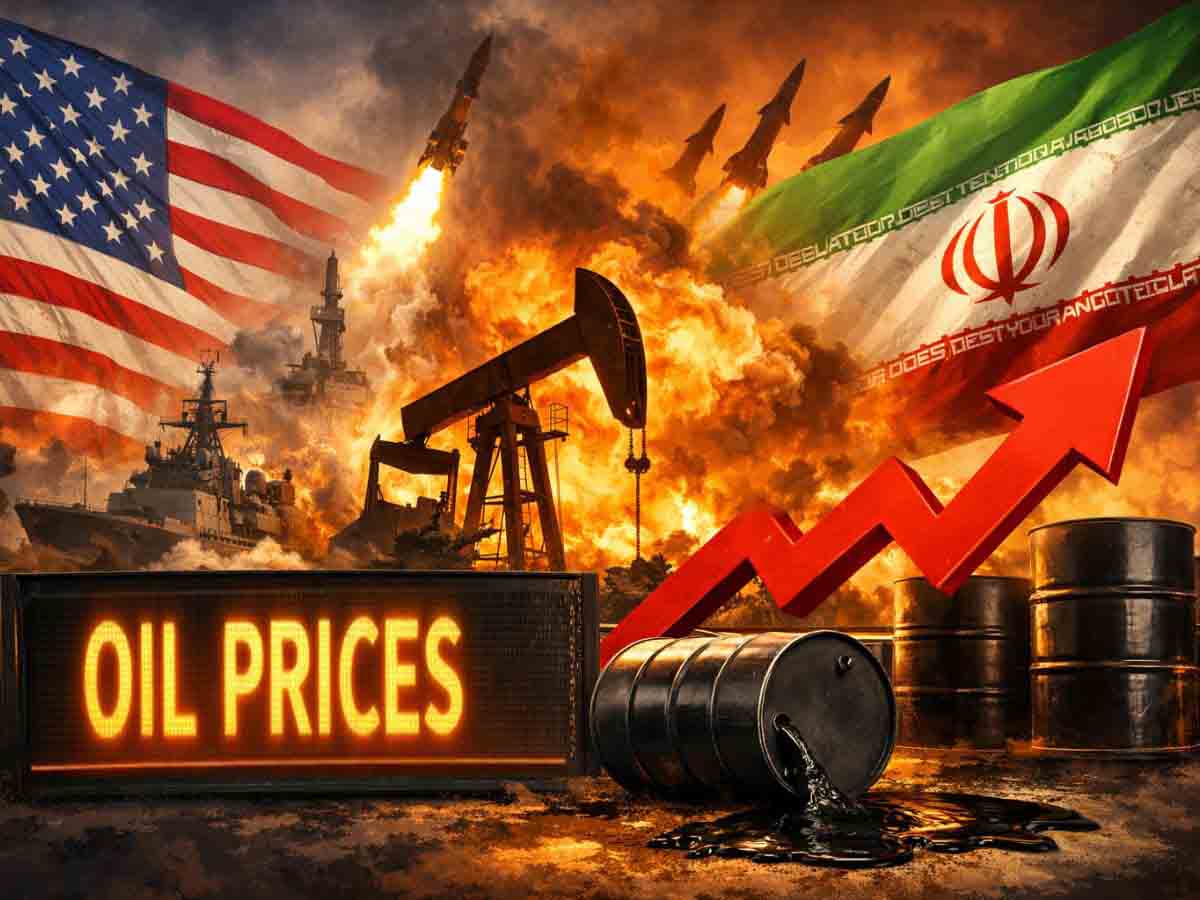
Many analysts view oil price fluctuations in the Persian Gulf as a key factor in the war debate. Some believe that Trump’s worry about the oil shock resulting from the war in Southwest Asia played a major role in halting the conflict and maintaining the ceasefire. Accordingly, this report, drawing on reports and articles from leading think tanks and news outlets worldwide, along with recent developments in the war, will demonstrate that news about conflicts and exchanges of fire between Iran and Israel is largely driven by the risk premium—how the market perceives danger following the first incident that disrupts global trade—and the energy market’s assessment of the potential for escalating tensions. We will also show that this concern has been evident in market analyses and energy reports from the very beginning of the war.
Investigating the claim of a connection between energy prices and the end of the 12-day war
To prove this connection exists, it is important to analyze the media and influential figures’ perspectives on the matter, along with examining various evidence from previous years and the outcomes of similar events. This helps understand why the decision-making apparatus in Washington responded the way it did. Additionally, before the “American-Israeli” attack on Iran, CENTCOM commander Gen. Erik Kurilla outlined a comprehensive plan for several weeks of bombing Iran in front of Trump, yet despite strong backing from the Israeli regime lobby, it was rejected. According to Trump’s first vice president, J.D. Vance, Washington was satisfied with a limited operation and targeted strikes to destroy nuclear facilities, rather than pursuing a full-scale war. Ultimately, however, Tel Aviv decided to proceed with the attacks and convinced Trump to target Iran’s nuclear sites.
- Trump expresses concern about rising oil prices hours before war beginsOn the night of the attack, a well-known Bloomberg journalist tweeted a crucial excerpt from Trump’s conversation with Energy Secretary Chris Wright. Trump had expressed concerns about the increase in oil prices roughly 10 days earlier, citing rising geopolitical risks, and had threatened to “shout out” to the secretary if the trend persisted. During that period, the Republican administration had successfully kept inflation under control.
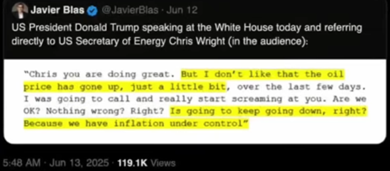
- US President’s oil tweetsTrump’s tweets amid a war with Iran highlight Washington’s sensitivity to oil prices, revealing how Wall Street financial markets remain vulnerable to this key resource, regardless of other structural aspects of the US economy.
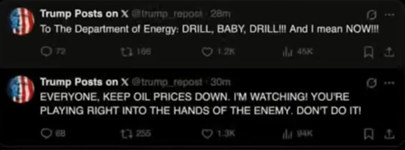
In the first tweet, he orders the Secretary of Energy to drill more oil fields in the U.S. to boost production, and in the second tweet, which came minutes after the first, he warns energy companies against raising oil prices.
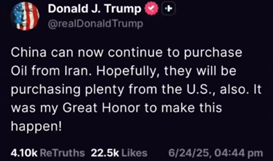
In the third tweet, coinciding with the war’s final moments, Trump confirms China’s ongoing purchase of Iranian oil. His expression of satisfaction aims to stabilize the energy market and consequently minimize fluctuations in oil prices.
- Warning from the world’s leading publications and think tanks
• Oxford Economic Journal article
This article examines how the heightened tension between Tehran and Tel Aviv influences oil prices and global market outlooks. A chart illustrates expected fluctuations in oil prices per barrel. The author forecasts that, in the event of a sudden shutdown of the Strait of Hormuz, oil prices could rise to around $130. Similarly, if Iran’s regime damages its energy infrastructure to halt exports, prices might reach approximately $100. Furthermore, increased sanctions on Iranian oil could reduce exports by up to 100,000 barrels per day, pushing prices to about $80. This increase from the current price of around $75 creates a significant gap with substantial economic implications for the US.
• Deutsche Bank report (German central bank)
On June 13, which marks the start of the war, the German Central Bank released a report on how reducing Iranian oil exports by 50 and 100 percent of their capacity, as well as the (effective) closure of the Strait of Hormuz, would affect rising oil prices.
• Politico’s revelations regarding the war with Ansar Allah
On February 21, 2025, Politico disclosed a confidential conversation between Vance and Trump. During this exchange, Vance expressed concern about rising oil prices and their severe economic impact, amidst pressure from the Zionist AIPAC lobby to counter the war-mongering actions of certain US government officials. This highlights the complex nature of the situation at that time. The report underscores that oil prices can significantly influence international conflicts and disputes.
• World Bank report after the October 7 attack
Immediately after Operation Storm al-Aqsa and its continuation for several days, the World Bank prepared a report in which it presented predictions of how oil production would decline and, as a result, oil prices would rise for world markets. In this text, the situation was assumed to deteriorate to the point that if tensions caused a daily production decrease of 7-8 million barrels of oil, countries would see oil prices increase to $160. The ongoing wars and tensions between the resistance axis and the Zionist regime are so sensitive that this group of reports can be largely attributed to similar conditions. Such a security-economic pattern has been recorded at different points in time as a repeatable chain that can be used to predict energy market events after the start of a major regional war. - Conversations on the fourth day of the Netanyahu cabinet war meetingAccording to the Times of Israel, Ron Dermer, a close ally of Netanyahu for nearly 20 years who also manages relations with the U.S. and Arab nations, opposes calls to bomb Iranian refineries. He stated during that meeting: “If we target civilian infrastructure like refineries, the war will be over before we can attack Fordow and accomplish our goals.”
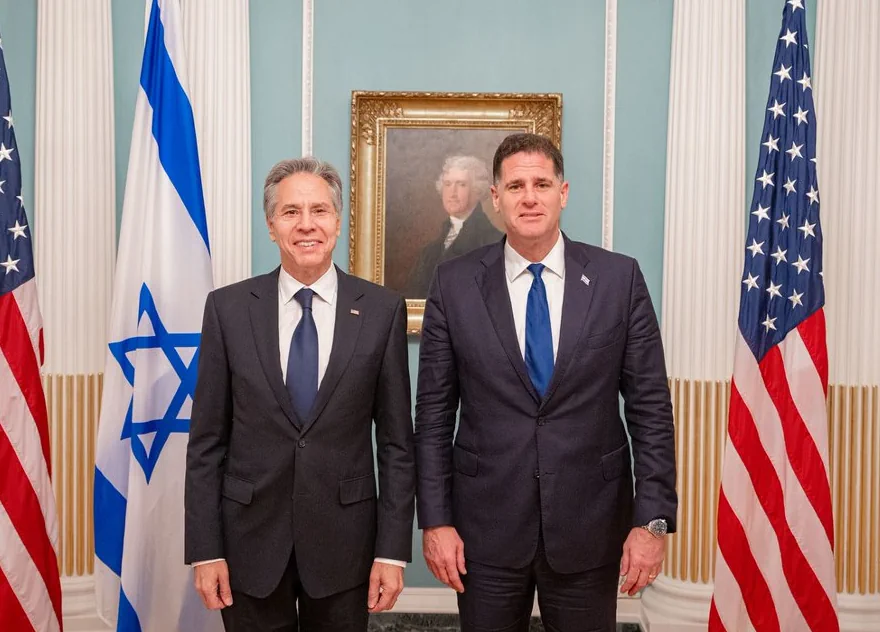
The key question is why the war would end by striking Iran’s oil facilities. Mehdi Kharatian, a recognized Iranian analyst, believes this aggressive move could trigger a dangerous chain reaction in the region. He suggests that Iran might escalate tensions in Southwest Asia’s infrastructure sectors, potentially deterring the United States from fully engaging in the conflict.
- Rising oil prices and Democrats’ troubles ahead of the electionTwo days after “Operation True Promise 2” and during the Republican-Democrat election debates, the Telegraph reported that Biden, then US President, mentioned that the regime was contemplating attacking Iranian oil facilities. Some media labeled this potential move as a “headache for the Democrats.” However, the following day, the Biden administration rejected this idea and instead proposed an alternative or replacement plan.
Final Thoughts
This discussion presents several clear reasons and pieces of evidence supporting the idea that rising oil prices can help end major wars, acting as a pressure tool on U.S. decision-making. High-ranking US officials prioritize global energy stability and supply chain security, actively working to eliminate threats in this sector. Consequently, Iran’s main leverage during the conflict—the “shock of closing the Strait of Hormuz”—did not need to be used. The US is well aware that any existential threat or large-scale attack on Iran would prompt Iran to use this strategic leverage quickly and decisively! Therefore, it is far wiser for the US to consider this fact carefully before attempting any attack on Iran, as Iran has the potential to ignite the region and severely disrupt the global economy.

Comments