Legal Grounds: How the Trump Peace Plan Unintentionally Framed the Gaza Blockade as a War Crime
To grasp the significance of this event, one must consider a key legal point: the Trump peace plan, by promising future access for humanitarian aid to Gaza, implicitly admitted that Gazans are currently deprived of this fundamental right. This undermines Israel’s claim that the blockade is purely a “security measure.” When access to basic aid is denied, the blockade becomes a form of “collective punishment”, which under Article 33 of the Fourth Geneva Convention constitutes a clear “war crime”. The Sumud Flotilla is advancing with this powerful legal foundation.
Three Possible Scenarios Ahead Each with Global Consequences:
1️⃣ Strategic Israeli Withdrawal and Normative Victory In this scenario, Tel Aviv allows the fleet to proceed to avoid confrontation with NATO and mounting global pressure. This would mark a triumph for soft power and global civil society. More than the aid itself, it would shatter the taboo of the blockade, setting a new precedent and delivering a major blow to Israel’s deterrence doctrine.
2️⃣ Military Confrontation and Activation of International Mechanisms This is the most dangerous scenario. If Israeli naval forces attack the fleet and NATO escorts intervene to protect their citizens, a full-blown international crisis could erupt. Immediate consequences may include referral to the UN Security Council under Chapter VII, investigations by the International Criminal Court (ICC), and serious sanctions against Israel. It would test NATO’s cohesion and its commitment to defending its nationals.
3️⃣ Israeli Intervention and Escort Inaction Here, Israel attacks the fleet while NATO warships refrain from direct engagement. This would be a tactical win for Tel Aviv but a strategic defeat for European governments and the entire international legal order. It would expose the fragility of humanitarian principles when confronted with brute force, signaling that realpolitik has overtaken global norms.
Conclusion: The Sumud Flotilla carries more than material aid—it carries a fundamental question for the global order. This event places Israel at a crossroads: maintain deterrence, face international isolation, or risk war. The world’s response in the coming hours will not only determine Gaza’s fate but also shape the future of international relations and the credibility of global institutions for years to come.
According to the EU naval task force operating under Operation Aspides, the missile strike caused a fire onboard and left the vessel in a state of uncontrolled drift. The ship, operated under the Dutch flag, was carrying 19 crew members of Russian, Ukrainian, Filipino, and Sri Lankan nationality. European naval forces responded swiftly, evacuating all crew and transferring them safely to Djibouti.
The Yemeni Armed Forces have issued a statement confirming that the Dutch-flagged cargo vessel MV MINERVAGRACHT was targeted with a cruise missile.
According to the statement, the attack was carried out in response to the ship’s violation of Yemen’s declared ban on maritime traffic to Israeli ports by its operating company. The missile strike severely damaged the vessel, placing it at risk of sinking.
Based on data compiled by the Islamic World News, this marks the 218th military operation by Yemen’s armed forces against vessels linked to Israel, the United States, or the United Kingdom.
Notably, the 217th operation occurred on September 23, approximately 120 nautical miles east of the Port of Aden. While that earlier attack was not officially announced by Yemeni forces, it was referenced by Ansar Allah leader Sayyed Abdul-Malik al-Houthi in his most recent speech.
These operations are parts of Yemen’s expanding campaign to pressure Israel and its allies in response to the ongoing war in Gaza. Yemeni Armed Forces have repeatedly stated that their actions in the Red Sea are a direct reaction to Israeli war crimes, including the killing of civilians, destruction of infrastructure, and forced displacement in Gaza.
The strike on MV MINERVAGRACHT reflects Yemen’s strategic use of maritime operations to challenge regional actors complicit in the siege and bombardment of the Palestinian people.
The attack resulted in the death of a paratrooper from the Israeli Army’s 890th Battalion. Akkad was shot and killed by Israeli security forces at the scene.
Hamas issued a statement praising the operation as a heroic act of resistance, describing it as a response to ongoing genocide in Gaza and Israeli crimes including killings, arrests, settlement expansion, and Judaization efforts in the West Bank and Jerusalem.
According to Israeli sources, this incident brings the total number of military personnel killed since the start of the conflict to 915.
Amir al-Humaiqani, spokesperson for the Humaiqani Resistance Forces, reported that the Saudi-led coalition has ordered the withdrawal of approximately 12,000 reserve fighters, including members of the Islah Party and affiliated factions from the city of Marib. Al-Humaikani criticized the move, calling it a de facto declaration of the end of hostilities with the Houthis!
This withdrawal represents more than half of the armed personnel stationed in Marib, a city currently under the influence of Islah militants, forces loyal to Lt. Gen. Sagheer bin Aziz, and Saudi-backed tribal groups such as the Humaikani clan. The Humaikani tribe, originally from al-Bayda province, had retreated to Marib following failed operations against al-Qaeda and ISIS in the region.
It remains unclear whether the decision is part of a broader strategy to elevate Ahmed, the eldest son of former President Ali Abdullah Saleh, in Marib, or a shift in Saudi policy aimed at consolidating control over occupied areas in Yemen.
Cohen, who has previously voiced strong opposition to the establishment of a Palestinian state, reiterated his stance by declaring that the two-state solution “will never be realized.” He added that Israel will eventually impose sovereignty over the entire West Bank, noting that the only remaining questions are “when and how.”
These remarks come amid repeated warnings from the international community—particularly Arab and Western nations—about the consequences of continued occupation and illegal settlement expansion in the West Bank.
Cohen’s statements underscore the lack of support for a two-state solution even within civilian branches of the Israeli government, casting doubt on the viability of international efforts to resolve the Israeli-Palestinian conflict through political means.
This development comes amid reports that Sweida has become a focal point in recent negotiations between Damascus and Tel Aviv. Back in August 2025, prominent Druze leader Hikmat al-Hijri issued a statement advocating for the creation of an independent Druze region in southern Syria. Following his call, several armed Druze factions set aside internal disputes and formed a “National Guard” under his leadership.
The explicit demand for separation signals a rising tide of self-rule sentiment in Sweida. Its inclusion in Syria-Israel talks underscores the province’s strategic importance, suggesting that security concerns there are not merely domestic but carry regional implications. Israeli officials are reportedly leveraging the Druze issue as a pressure point against Damascus.
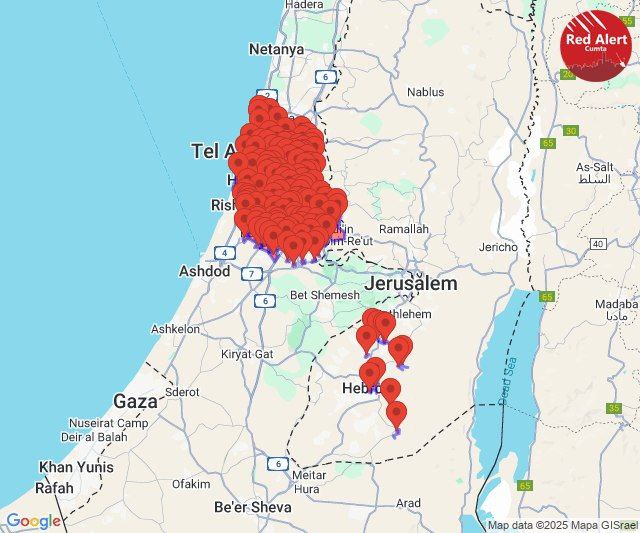
The Yemeni Armed Forces launched a hypersonic ballistic missile early Monday targeting sensitive sites in Tel Aviv. The missile, identified as the Palestine-2 and equipped with a fragmentation warhead, struck its intended targets as part of Yemen’s continued retaliation against Israeli military war crimes and in support of Palestine.
Brigadier General Yahya Saree stated, “The operation successfully hit its objectives, prompting millions of settlers to flee to shelters.”
In a coordinated attack, Yemeni drone units also deployed two suicide UAVs against strategic locations in Eilat (Umm al-Rashrash), marking the 206th and 207th aerial operations by Yemeni forces against Israeli positions in occupied Palestine.
The Qassem Basir is an evolution of the Haj Qassem missile, first revealed in August 2020. That missile, itself a development of the Fateh tactical missile family (Fateh-110, Fateh-313, Zulfaqar), featured a larger diameter—90 cm compared to Zulfaqar’s 68 cm—and extended its range to 1,400 km thanks to a more powerful engine. Its warhead and guidance systems were derived from the Zulfaqar design.
Just a month after Haj Qassem’s debut, Iran showcased the Zulfaqar Basir at the Aerospace National Park. Like the Persian Gulf missile and Fateh-110 upgrades, it incorporated an optical seeker, resulting in a 700 km-range anti-ship ballistic missile. Given the similarities between Zulfaqar and Haj Qassem’s warhead design, experts anticipated a future upgrade—now realized with the Qassem Basir.
Optical Seekers: The Missing Link in Iranian Missile Accuracy
Iranian ballistic missiles traditionally rely on inertial navigation systems (INS) using precision gyroscopes, supplemented by satellite-based GPS for mid-course corrections. While INS alone can achieve sub-10-meter accuracy at short ranges (<500 km), longer-range precision has depended on GPS—an Achilles’ heel in electronic warfare environments.
A clear example is Operation True Promise II, where Iranian missiles penetrated enemy defenses but suffered from degraded accuracy due to GPS signal disruption near the target zone.
The Qassem Basir addresses this vulnerability by eliminating reliance on satellite navigation. It uses INS for mid-course guidance and switches to its onboard optical seeker during the final phase, enabling high-precision targeting even under GPS-denied conditions.
Speed, Maneuverability, and Resilience
With mid-phase speeds exceeding Mach 10 and terminal speeds around Mach 5, combined with a maneuverable warhead, the Qassem Basir is designed to evade advanced Israeli and American missile defense systems. The integration of an optical seeker in the nose cone minimizes terminal-phase error, ensuring the warhead strikes its target with exceptional accuracy.
This innovation marks a strategic shift in Iran’s missile doctrine—enhancing survivability, precision, and independence from vulnerable navigation systems. Whether this represents a permanent solution or a transitional upgrade, it undeniably raises the bar for Iran’s long-range strike capabilities.
Video of the unveiling of the Qassem Basir missile and how it works
However, integrating an optical seeker into ballistic missile warheads presents a significant technical challenge namely, the limitations imposed by high terminal speeds. For instance, missiles like the Persian Gulf and Zulfaqar Basir reach speeds of around Mach 3 before impact. In contrast, more advanced systems like the Haj Qassem missile strike their targets at speeds between Mach 4.5 and 5, even without executing evasive maneuvers.
At such velocities or potentially even higher, the performance of optical seekers can degrade. The intense aerodynamic and thermal stress may interfere with the seeker’s functionality or even damage its protective glass covering. In a recently released video, a completely black screen appears at a distance of 161 kilometers from the target, which could indicate either that the seeker was inactive or that a retractable protective cover was still in place.
The latter explanation seems more plausible, given the extreme reentry speeds involved. Without adequate shielding, the seeker’s optics could be compromised before it has a chance to engage the target. This highlights the delicate balance between precision guidance and survivability in high-speed missile design.
Similarity of the nose of the Qassem Basir missile (left image) with the nose and protective covering of the Fateh Mobin missile (right image)
Will Optical Seekers Ultimately Prove Effective in Iranian Ballistic Missiles?
Iran’s ballistic missiles in the 1,200–1,700 km range have demonstrated the ability to penetrate enemy missile defense systems in large numbers and reach their targets. However, accuracy has occasionally suffered due to reliance on GPS, which is vulnerable to jamming and signal disruption. These missiles typically rely on maneuverable warheads and high terminal speeds to evade interception. Yet, with the introduction of optical seekers such as in the Qassem Basir missile, there appears to be a shift in design priorities.
To protect the seeker and ensure precise targeting, Qassem Basir’s warhead reportedly performs more aggressive maneuvers during the final phase of flight, likely to reduce speed and allow the seeker to lock onto its target without damage. While this upgrade significantly improves accuracy, it introduces a new vulnerability: reduced terminal velocity, which could make the warhead more susceptible to interception in heavily defended zones.
Qassem Basir missile – Click to view full-size image
Despite this trade-off, Qassem Basir represents a cost-effective and accessible solution for enhancing Iran’s missile precision. It may not be ideal as a first-strike weapon against areas protected by dense missile shields, but it could serve effectively as a follow-up missile, launched after enemy defenses are saturated, to strike with high confidence.
According to available reports, this warhead upgrade is being applied to other Iranian ballistic systems as well, marking a major leap in precision capabilities. This evolution not only strengthens Iran’s strategic arsenal but also sends a powerful message to adversaries across land and sea.
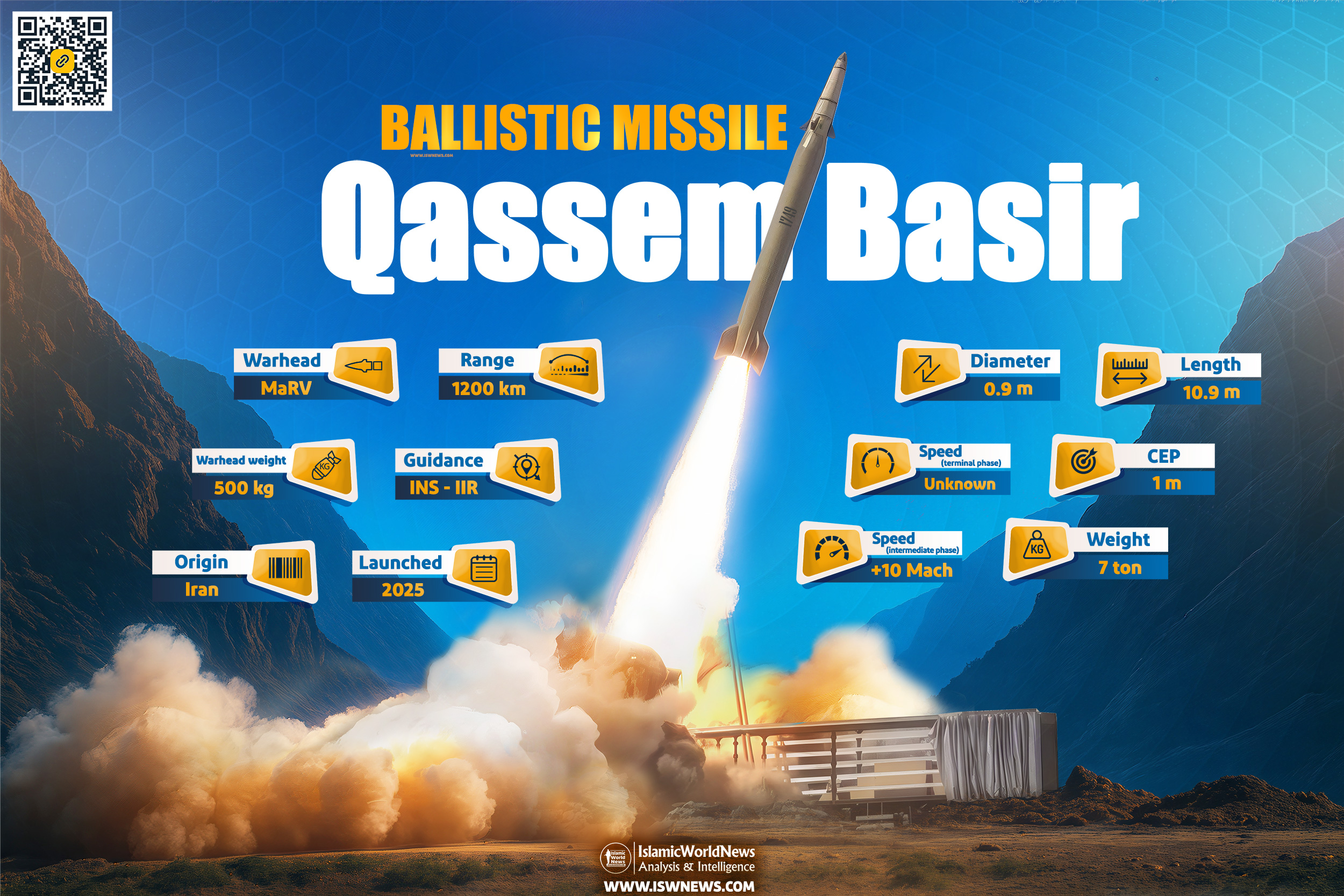
Specifications of Qassem Basir missile:
Type: Ballistic Origin: Iran Manufacturer: Ministry of Defence and Armed Forces Logistics Launched: 2025 Length: 10.9 meters Diameter: 0.9 meters Engine: Single stage Fuel: Solid composite Range: 1200 km Speed in intermediate phase: +10 Mach Speed in terminal phase: Unknown CEP: 1 meter Weight: 7 tons Warhead: Detachable MaRV Warhead weight: 500 kg Guidance: INS – IIR
Qassem Basir missile – Click to view full-size image
Developing a Multi-Layered and Flexible Air Defense System
Iran’s most effective tool to counter Israel’s long-range, multi-axis operations is a dynamic, multi-layered air defense architecture. According to RAND analysis, integrating long-range systems like Bavar-373, S-300, and S-400 with medium and short-range platforms such as Mersad and Oerlikon, alongside mobile point-defense systems like Tor-M1 and Pantsir-S1, creates a dense and responsive network capable of intercepting threats across various altitudes and distances.
The IISS Military Balance 2024 report highlights that such layered defenses prevent adversaries from overwhelming a single tier—whether via low-altitude cruise missiles or high-altitude ballistic strikes. CSIS further emphasizes that combining rapid-response short-range systems with real-time data-driven C4I networks significantly enhances decision-making speed during saturation attacks.
Lessons from Russia’s war in Ukraine, documented by War on the Rocks, show that even advanced systems are vulnerable without mobility. Thus, Iran must prioritize maneuverability, frequent repositioning, and continuous joint training between the Army and IRGC to minimize preemptive detection.
Jane’s Defence Weekly (2020–2024) also notes that mobile point-defense systems and radar stations capable of relocating within 30 minutes can severely disrupt Israeli F-35I mission planning and increase operational costs.
Counterintelligence and Information Warfare
To neutralize Israel’s intelligence advantage—rooted in HUMINT and SIGINT networks—Iran must implement a comprehensive counterintelligence and data security framework. RAND’s study on Israel-Iran conflicts reveals that Israel’s advanced surveillance and human infiltration around military sites enable precision strikes and targeted assassinations. The report recommends isolating Secure C4I centers from open networks to reduce interception risks.
CSIS stresses the importance of indigenous encryption, independent satellite systems, and constant monitoring of command network entry points to block cyber intrusions. FDD’s analysis adds that threat detection must extend beyond technical layers to behavioral monitoring of key personnel. Domestic FCC centers should track anomalies, unauthorized access, and suspicious communication patterns. This should be reinforced with Red Team/Blue Team exercises, allowing forces to simulate real-world responses and patch vulnerabilities before exploitation.
Such measures can erode Israel’s intelligence edge and disrupt hybrid operations before they materialize.
Strengthening and Integrating Cyber Infrastructure
Leading think tanks agree that bolstering cyber infrastructure and fostering coordination between military and intelligence agencies is vital for Iran’s cyber defense. CSIS’s Iran and Cyber Power report recommends forming joint task forces to continuously assess vulnerabilities and synchronize cyber responses. RAND advocates for a policy framework based on continuous updates, regular training, and adoption of cutting-edge technologies to counter complex, preemptive attacks.
CISA underscores the need for early threat detection and rapid response to prevent enemy infiltration and enhance network resilience. This integration not only boosts system durability but also enables swift reactions to emerging threats, protecting critical infrastructure and maintaining operational continuity.
Strategic Dispersion and Engineered Deception
To counter precision and simultaneous strikes, dispersing critical facilities and deploying engineered deception technologies is essential. RAND’s research warns that concentrated installations are highly vulnerable, while geographic dispersion confuses enemy targeting priorities.
War on the Rocks, analyzing Russia’s defense in Ukraine, shows that thermal, radio, and mobile decoys complicate enemy identification and reduce strike success rates. CSIS also highlights the value of electronic deception and mobile structures in air defense networks, which waste enemy resources and neutralize attacks.
These engineered tactics, combined with advanced concealment systems, enhance operational survivability and prevent concentrated enemy assaults—preserving strategic balance amid regional tensions.
Active Diplomacy and Breaking Regional Isolation
Expanding security and technological ties with neighboring states is a cornerstone of Iran’s deterrence strategy. CSIS reports that intelligence-sharing with Gulf countries can create rapid data exchange corridors for timely threat detection. RAND emphasizes that active diplomacy and regional coalitions raise the cost of aggression and improve Iran’s political and operational landscape.
Crisis Group advocates for leveraging modern information technologies and regional security coordination to build trust and reduce tensions. This approach not only strengthens Iran’s national security but also opens avenues for economic and technological cooperation, enhancing resilience against complex threats.
Conclusion
Israel’s strategic power rests on intelligence dominance, long-range air capabilities, cyber assets, and its alliance with the United States. By adopting layered defense systems, reinforcing cyber security, and avoiding over-concentration of assets, Iran can reduce its vulnerabilities and raise the cost of aggression. Continued regional intelligence cooperation and implementation of an “active defense” doctrine are key to maintaining strategic equilibrium in the face of future threats.
After Larijani’s visit to Saudi Arabia, Hezbollah leader Sheikh Qassem sent a message to the Saudi autocracy, which contained a proposal to begin normalizing relations between the parties. According to the Saudi journalist, Saudi Arabia reacted positively to Sheikh Qassem’s proposal.
What’s happening? The starting point of the current amazing political processes was the October 7 event, when Hamas launched a preemptive strike on the Zionist colony. After that, Zionism organized probably the worst genocide in the last hundred years, which continues to this day. After the expansion of aggression towards Lebanon, Syria, Yemen, Iran and Qatar, it became clear that “Israel’s” goal is not just an attempt to destroy the axis of resistance, in a global sense, the Zionists are pursuing a utopian idea – the destruction of the main centers of the Silk Road, which, in their opinion, will easily create an IMEC, within which a special role is assigned to the Zionist colony.
However, any action is met with opposition, which is why China has stepped up secret diplomacy aimed at uniting all participants of the Silk Road in the Middle East region into a single military and political alliance. The 12th air aggression of the Zionists and Americans against Iran, and then the assassination attempts of Hamas leaders in Qatar, became the trigger for the construction of the “Islamic NATO.”
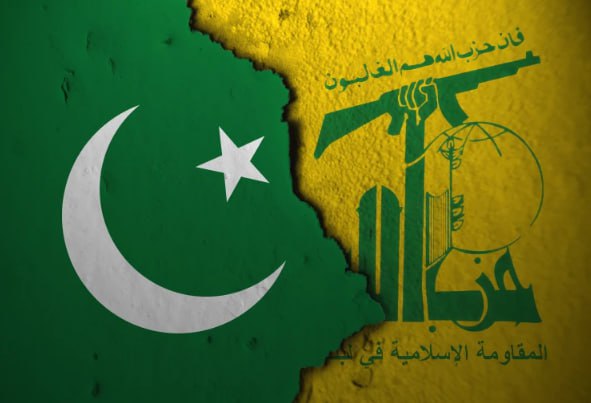
Pakistan, like Turkey, is the mouthpiece of Chinese foreign policy activities in the Middle East. Turkish military bases from Somalia to Syria are designed to ensure the safety of transport links within the framework of the One Belt, One Road project. The intensification of diplomacy in the Saudi direction implies the creation of a single military-political bloc with a demonstration of strength to Zionism and its allies. With the development of Islamabad’s success in including other Arab countries in its alliance (Iraq, Algeria, Egypt are already in line), Turkey and Iran will join the process. The Turks have long initiated something similar in Libya and Somalia, but Pakistan’s nuclear defense is something new for the region.
As for Hezbollah, with the intensity of events, the Islamic Resistance of Lebanon will be able to break out of isolation and become a truly important regional actor. The message from Sheikh Qassem to the Saudis is only the first step, and it also fits into the Chinese strategy for “Muslim reconciliation”. Let me remind you that in the spring of 2023, a trilateral meeting was held between diplomats from Iran, China and Saudi Arabia, so Larijani’s current trip to Riyadh is designed to strengthen what was discussed years earlier. Turkey, Pakistan and Egypt will soon open direct channels of communication with Hezbollah, which will then result in military cooperation. Actually, the Zionists are already worried that the Turks’ activity in Syria is pursuing exactly this goal.
Despite the emerging positive picture, there are a number of problems preventing increased coordination on the anti-Zionist front. For example, the reign of Pharaoh Sisi in Egypt, the existence of the Hashemite monarchy in Jordan and Al-Qaeda in Syria. Among the clans of Saudi Arabia, there are those who prefer to participate in the IMEC project rather than become part of the Silk Road.
Another problem on the way to the emergence of an “Islamic NATO” is the traditional competition in the Arab environment, especially in connection with Saudi ambitions. However, this problem can also be solved, because if there is a prospect of creating a military-political alliance between Turkey, Pakistan, Egypt and Iran, then the Saudis can settle overboard and no one will worry about their absence, especially since the alliance of these four countries already exists within the framework of the “Developing-8” created by the deceased Erbakan. Initially, this Islamic Union was conceived as an independent economic zone, but now they can become a military alliance.
Nevertheless, the problems associated with the Saudis and within the largest autocracy of the Arabian Peninsula will not affect the current dynamics in any way. The region is moving towards an all-out war with the Zionists, a series of military defeats of the occupiers, and the end result will be a mass exodus of the occupiers from Palestine. But it is always worth remembering that it was the long-term Heroism of all members of the Axis of Resistance and their allies since the Islamic Revolution in Iran, who regularly emphasized the importance of the problem of occupied Palestine, that allowed the Chinese to develop plans for the creation of the Silk Road, which became an important argument for the national elites and quasi-elites of the Islamic world in the cause of unification and the need to confront Zionism.
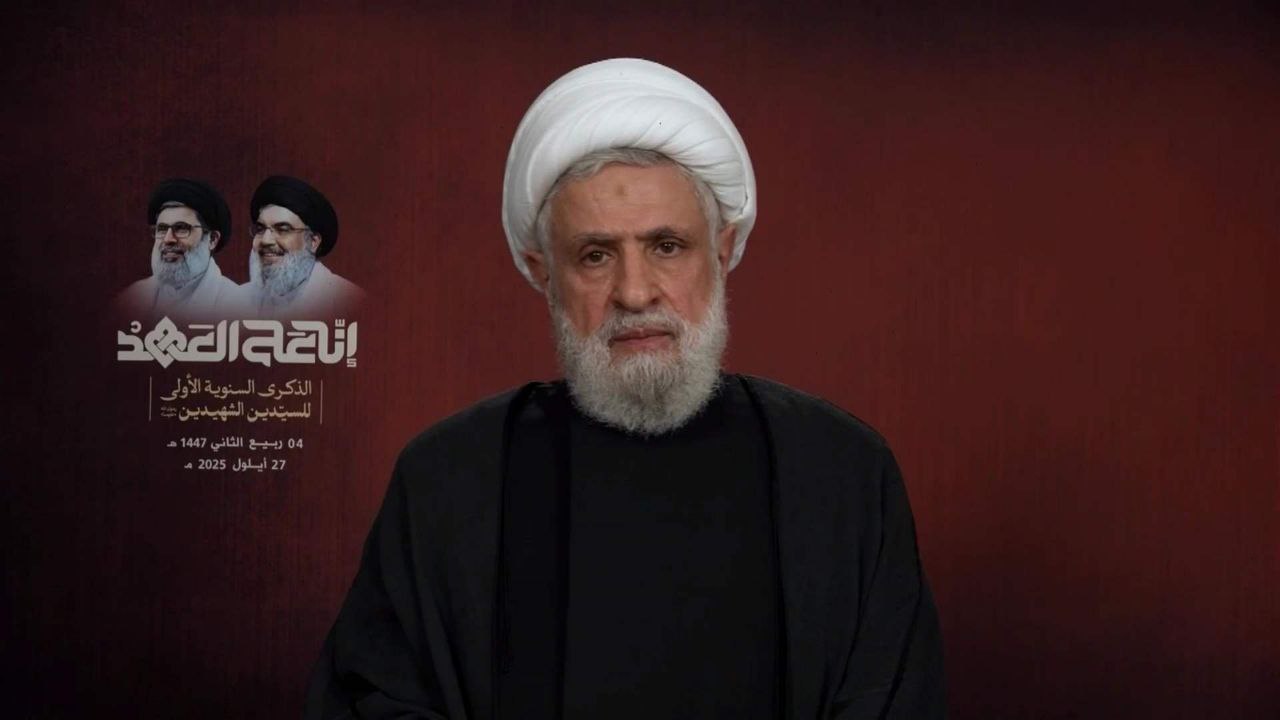
“We will not abandon our weapons or our land,” Qassem declared. “As Sayyed Nasrallah taught us, we will never forsake the path of Hussein (AS).”
The ceremony also honored martyr Haj Ali Karaki, who assumed command after the death of Fouad Shukr and was martyred alongside Sayyed Nasrallah. Sheikh Qassem described the recent conflict as a “global war” waged by Israel with U.S. and European backing, aimed at dismantling the resistance and advancing the vision of a Greater Israel. Despite targeted assassinations and battlefield pressure, he said Hezbollah regained the initiative and halted enemy advances.
“If pager attacks and assassinations of leaders and commanders had occurred along with the war, any army or militia group would have collapsed. But we regained the initiative and stopped the enemy army’s advance on the battlefield”, He said.
Addressing U.S. policy, Sheikh Qassem criticized Tom Barrack’s remarks about disarming Hezbollah and the US refusing to arm the Lebanese army against Israel, “We will not allow the U.S. to dictate Lebanon’s defense strategy,” he said. “Any plan that serves Israel, even if disguised in national colors, will be met with resistance.”
Sheikh Qassem also called on the Lebanese government to allocate resources for reconstruction and reaffirmed support for the Taif Agreement, which emphasizes full liberation of Lebanese territory. He endorsed holding parliamentary elections on schedule and emphasized unity with the Lebanese army against external threats.
“The land watered with the blood of martyrs will never belong to the Zionists,” he said. “To the people of resistance: no one can defeat you. Together, we will expose the failure of the enemy’s project. This anniversary is a testament to our loyalty.”
Upon arrival, Larijani praised Lebanon’s role as a “strong barrier” against Israel, stating that the legacy of martyr Nasrallah has become increasingly evident. He condemned the recent Israeli attack on Doha, calling it a clear sign of the regime’s aggressive nature.
During his visit, Larijani is expected to meet with senior Lebanese officials to discuss bilateral ties and regional developments. Speaking to the media, he emphasized the importance of regional cooperation: “Our hope is for strong, independent governments. In the face of Israeli conspiracies, countries in the region must work together and set aside their differences.”
He also voiced support for Sheikh Naim Qassem’s outreach to Saudi Arabia, describing it as a constructive step for Lebanon’s stability. “Saudi Arabia is a brotherly Muslim nation, and we’ve held consultations. Sheikh Qassem’s initiative is aimed at easing tensions and improving conditions for the Lebanese people.”
Responding to claims of Iran’s continued support for Hezbollah, Larijani dismissed the accusations as politically motivated. “I believe Mr. Barak made that statement out of anger. Hezbollah is strong enough not to depend on external arms.”
Larijani criticized U.S. involvement in Lebanon’s internal affairs, asserting that decisions should be made by the Lebanese themselves. “Would a proud Lebanese citizen accept losing their interests under American pressure? That’s for the people of Lebanon to decide.”
On the possibility of conflict, Larijani warned that Iran is prepared for any scenario. “I don’t think the Israelis would act recklessly. But if they attack Iran, they will receive a firm response.”