This isn’t the first time Israel has made such a request. During earlier talks in Paris, Tel Aviv also pushed for the corridor, which Syria firmly opposed. According to Israel Hayom, deep divisions remain over issues like Israeli control of Mount Hermon and the Golan Heights, as well as security guarantees for the Druze minority allied with Israel.
Previous rounds in Baku, Paris, and London had shown progress, with the U.S. even signaling that a de-escalation deal was within reach. However, the Sweida corridor dispute highlights the persistent strategic challenges facing any agreement.
Suweida, home to a majority Druze population, holds significant security and social importance for Damascus. Accepting Israel’s proposal could undermine Syria’s political legitimacy. Even if the Sweida issue is set aside, core disagreements over the Golan and Mount Hermon remain major obstacles—issues too complex for short-term diplomacy to resolve.
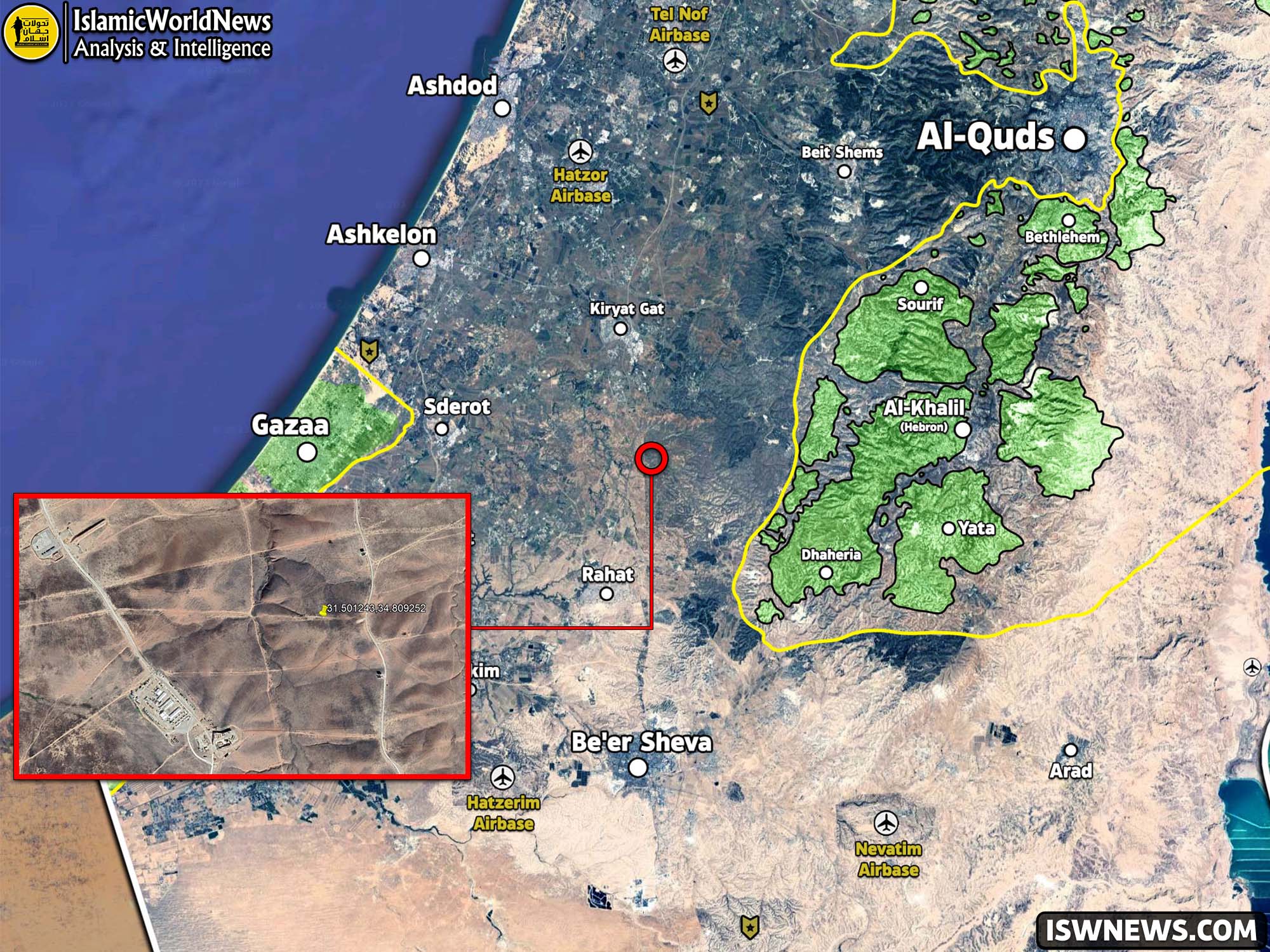
This development came immediately after the 12-day war between Iran and Israel, which exposed serious shortages in Israel’s missile defense inventory. The urgent need for reinforcement led Tel Aviv to publicly seek upgrades. The transfer of THAAD units and expanded support infrastructure suggest a strategic push to deepen defensive layers and reduce vulnerability to missile threats.
THAAD units at coordinates 31.501243, 34.809252 in the western outskirts of Hebro
The site, located at coordinates 31.501243, 34.809252 in the western outskirts of Hebron, lies just 13 kilometers from parts of the West Bank—making it a potential target for Palestinian resistance operations.
Lessons from the recent war and Israel’s tactics against Iran show that low-cost tools like drones and guided anti-armor weapons can significantly disrupt advanced defense systems. During the 12-day Tehran–Tel Aviv conflict, Israeli-linked operatives inside Iran used drones, quadcopters, and precision-guided munitions to strike missile and air defense systems. If Iran replicates such tactics in the occupied territories, the damage from missile strikes could multiply dramatically!
Air defense systems based on kinetic munitions — despite their high interception efficiency — are financially unsustainable in prolonged conflicts due to their reliance on expensive missiles. With the rise of low-cost, high-volume threats such as homemade rockets and commercial drones, now accessible to both state and non-state actors, the strategic balance has shifted against defenders. In such scenarios, the cost of a defensive shot often far exceeds that of the incoming threat — a clear advantage for attackers.
Advancements in directed-energy systems offer a solution to this challenge. In recent years, countries like China, the United States, the United Kingdom, and Western Europe have actively pursued the development of laser and microwave weapons. Simultaneously, nations such as India, Russia, Turkey, Saudi Arabia, and Iran are also striving to acquire similar technologies. The Zionist regime is no exception to this global trend.
Lite Beam, Iron Beam-M (250) and Iron Beam (450) Rafael laser systems at the London Defence Industry Exhibition 2025
Development History of Iron Beam:
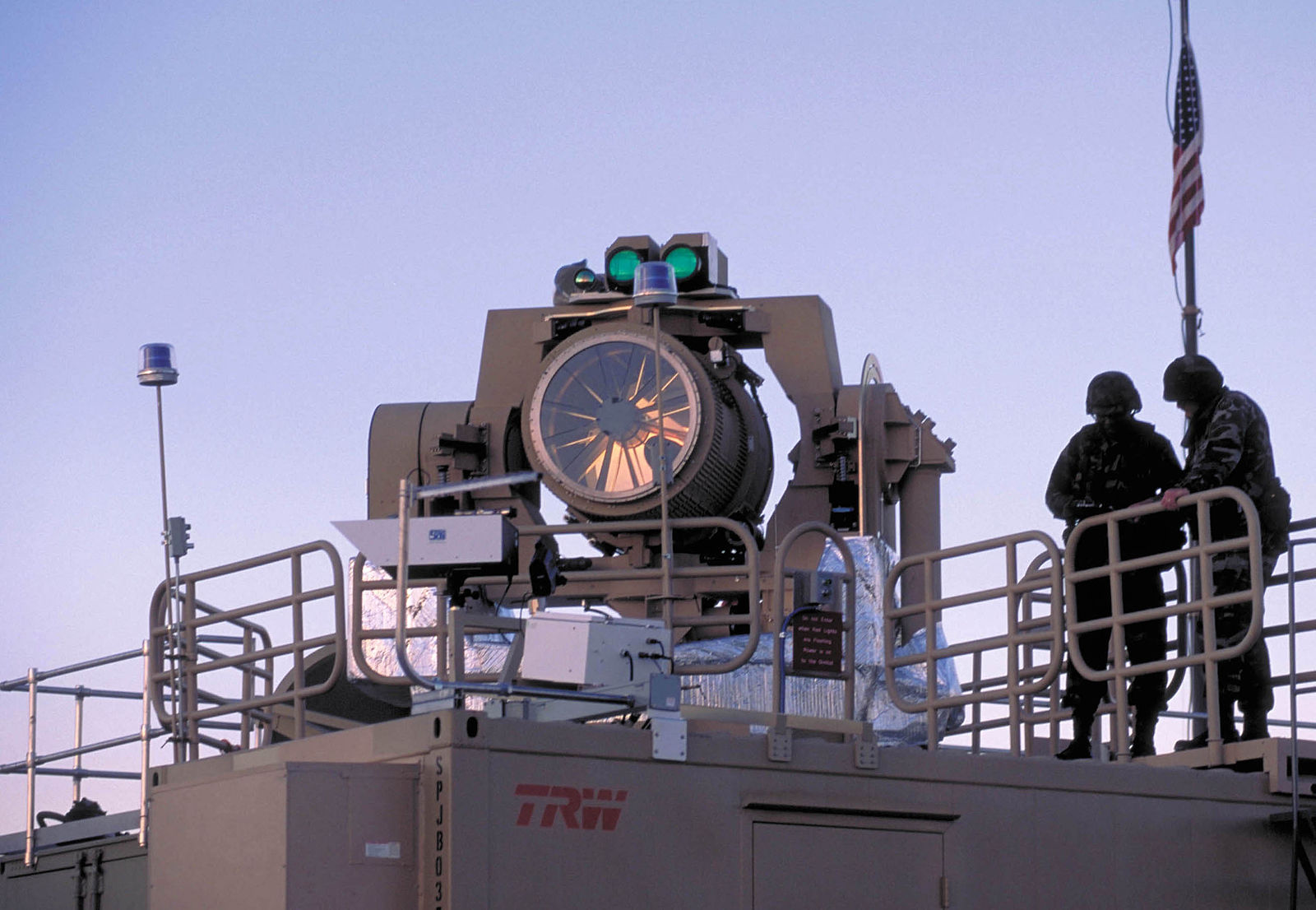
The evolution of “Iron Beam” traces back to a long journey, beginning with a joint U.S.-Israeli project in 1996 focused on tactical high-energy lasers. The program, known as Tactical High-Energy Laser (THEL), was based on chemical laser technology but was ultimately discontinued in 2005 due to high costs and poor battlefield performance.
The current Iron Beam project emerged after 14 years of research and development, overcoming the limitations of earlier technologies. It transitioned from chemical lasers to solid-state fiber lasers, marking a significant technological shift.
Iron Beam-MTactical High-Energy Laser (THEL)Iron Beam-M and THEL laser systems
Iron Beam System (also known as Or Eitan or Magen Or) was publicly unveiled for the first time on February 11, 2014, during the Singapore Airshow. It was introduced as the missing final link in Israel’s multi-layered air defense architecture. The version presented at the time was the initial concept of the system, which is now referred to as Iron Beam-M, or the mobile version. This system was specifically designed to address the tactical and economic limitations of the Iron Dome in countering saturation attacks and low-cost projectiles.
Therefore, Iron Beam is not a replacement for existing systems; rather, it serves as a complementary layer. Its primary mission is to confront short-range and high-volume threats, including rockets, mortars, and drones.
In December 2022, Rafael and Lockheed Martin launched a joint investment initiative to develop, test, and produce a laser weapon system for the U.S. market and international clients. In this project, Rafael serves as the lead contractor and system designer.
The Israeli Ministry of Defense’s Directorate of Defense Research and Development, the Israeli Air Force, and Elbit Systems are key subcontractors involved in the effort. Significant financial backing from the United States has also played a role in advancing the project.
In October 2024, the U.S. allocated over $500 million for the production of Iron Beam systems, as part of a broader $5.2 billion package aimed at strengthening Israel’s air defense capabilities.
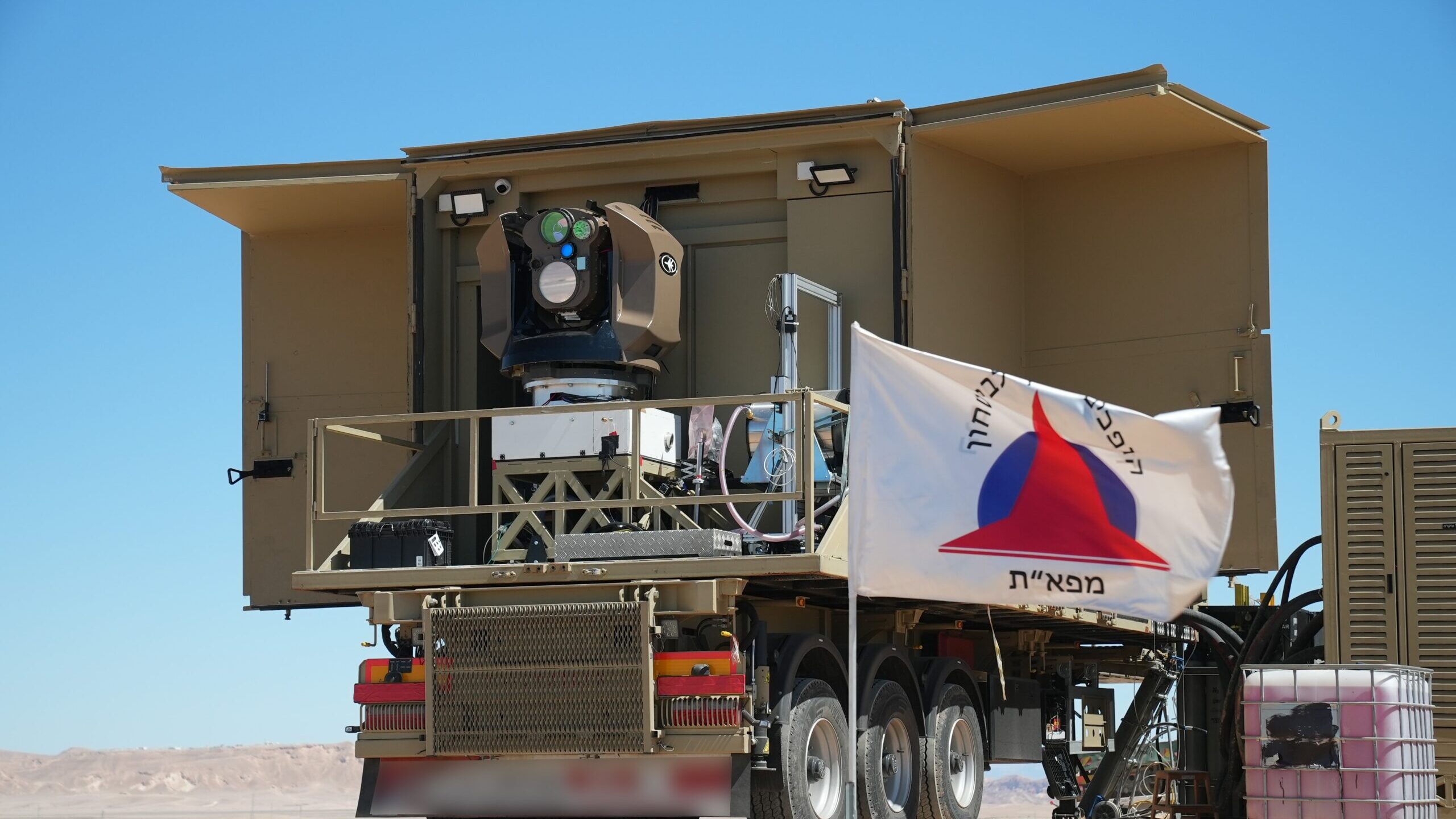
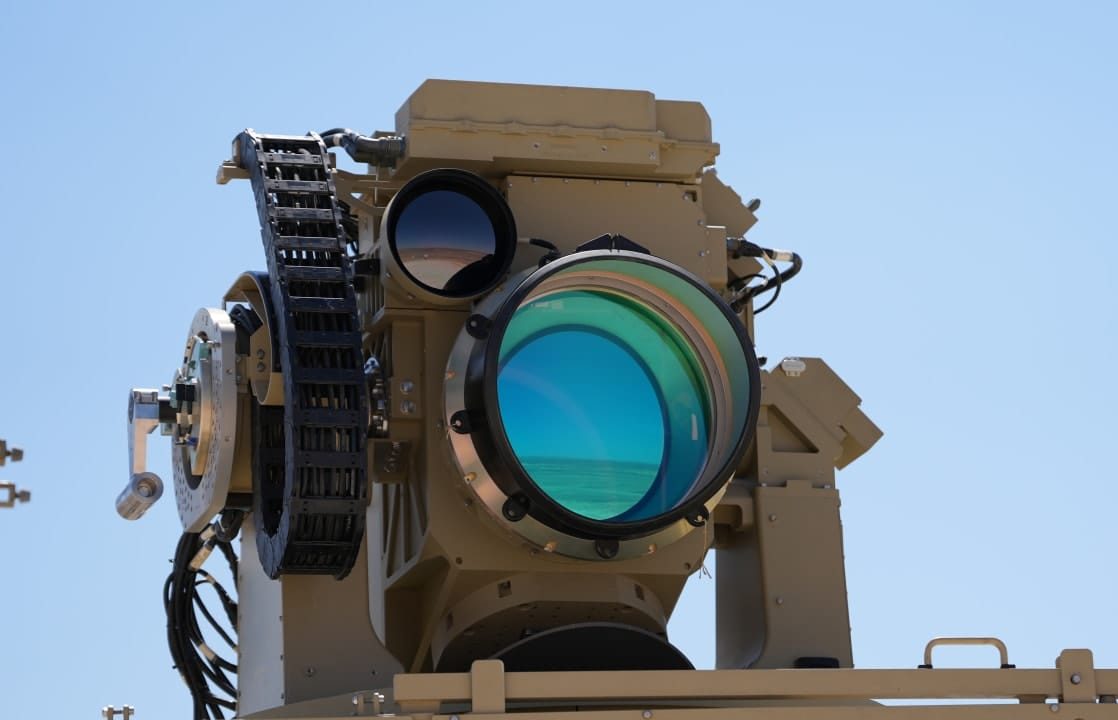
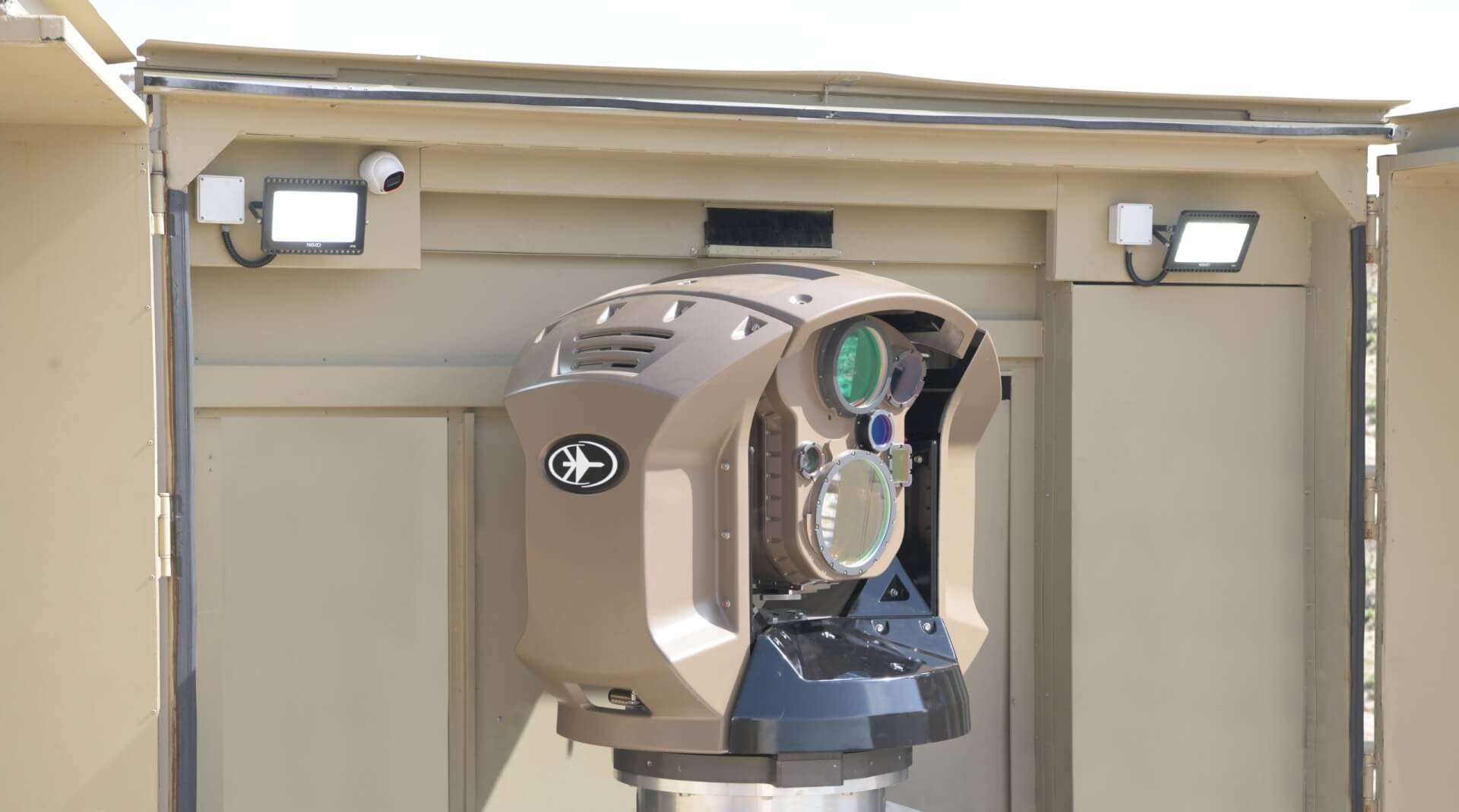
Iron Beam-M 250 system
The core of the Iron Beam system is a solid-state fiber laser that generates high-energy beams. Fiber lasers have gained prominence in recent years due to their efficiency, stability, and scalability to higher output powers.
However, a major technical challenge for directed-energy weapons operating in the atmosphere is beam dispersion and disruption caused by air density, water vapor, and atmospheric turbulence. This atmospheric distortion has historically limited the effectiveness and operational range of earlier laser systems.
To overcome these limitations, Iron Beam employs two key technologies: advanced adaptive optics and intelligent beam combination. In practice, the system directs hundreds of individual beams — each about the diameter of a coin — toward the target. Since each beam is less affected by atmospheric interference on its own, energy loss due to turbulence and instability is minimized.
The system then dynamically monitors and adjusts the trajectory of each beam, allowing the cumulative energy of all beams to converge precisely on a single point on the target.
Iron Beam-M system (the M stands for mobile)
Iron Beam System variants:
The Iron Beam family consists of several variants, each designed for different tactical missions. While all share a core reliance on high-energy laser technology, each version differs in output power, deployment platform, and operational role based on its specific mission.
The most powerful model, known as Iron Beam 450, features a 100-kilowatt-class laser mounted on a ground-based containerized platform. Its primary mission is short-range air defense, with an effective range of approximately 10 kilometers. This is the flagship version of Iron Beam, whose development and final deployment took nearly two decades.
The system officially entered service with the Israeli military in 2025.
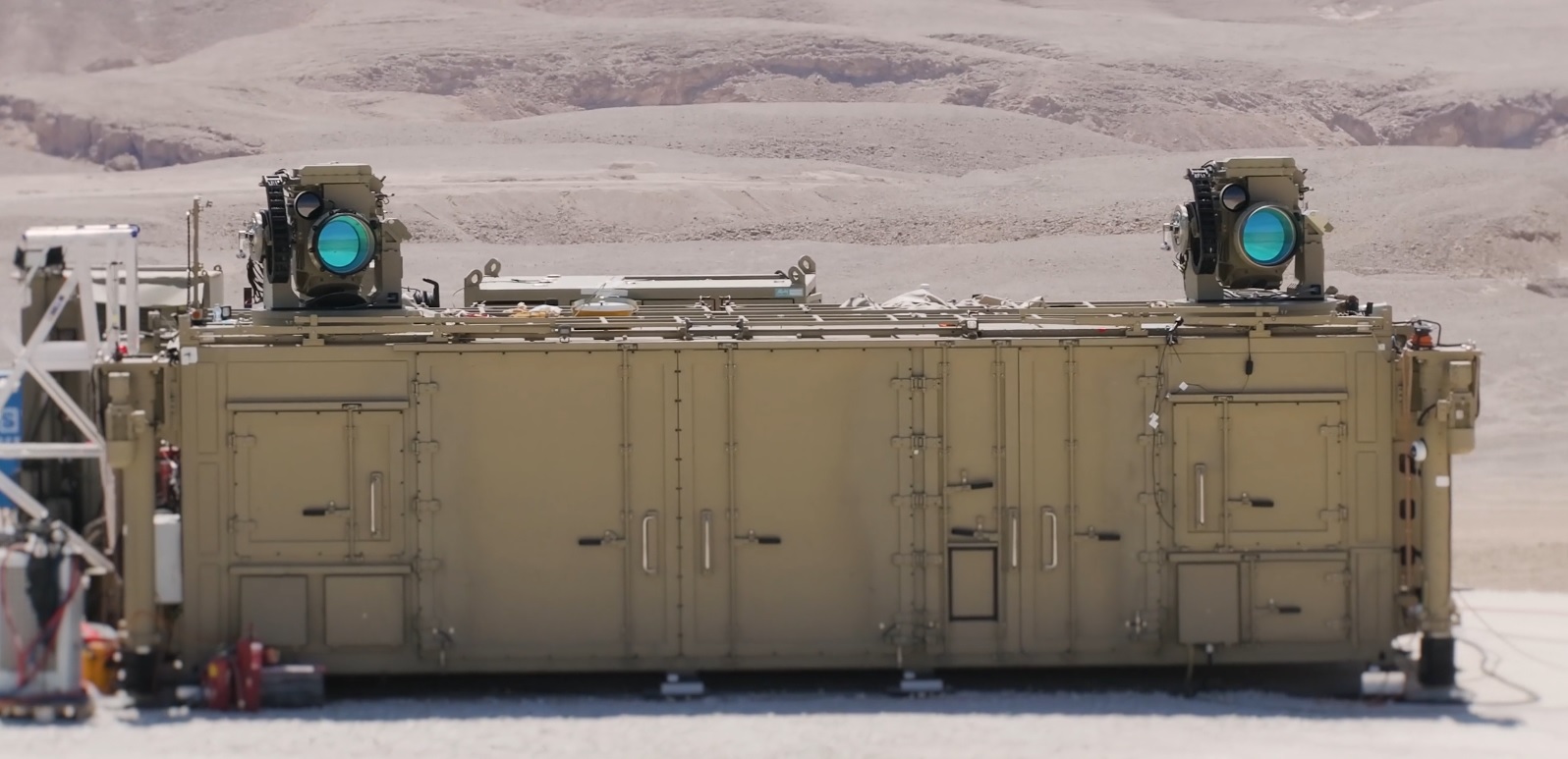
Iron Beam 450 system with 100 kW power
The Israeli Ministry of Defense and Rafael Advanced Defense Systems officially announced the completion of the 15-year development of the Iron Beam 450 project and its entry into active service by releasing a joint video of its field test.
In the published footage, two Iron Beam 450 systems — each with a power output of 100 kilowatts — are shown simultaneously locking onto a single target and successfully intercepting or destroying it. This synchronized targeting capability effectively doubles the system’s operational power for neutralizing threats.
The official video of the Iron Beam 450 system and how it works
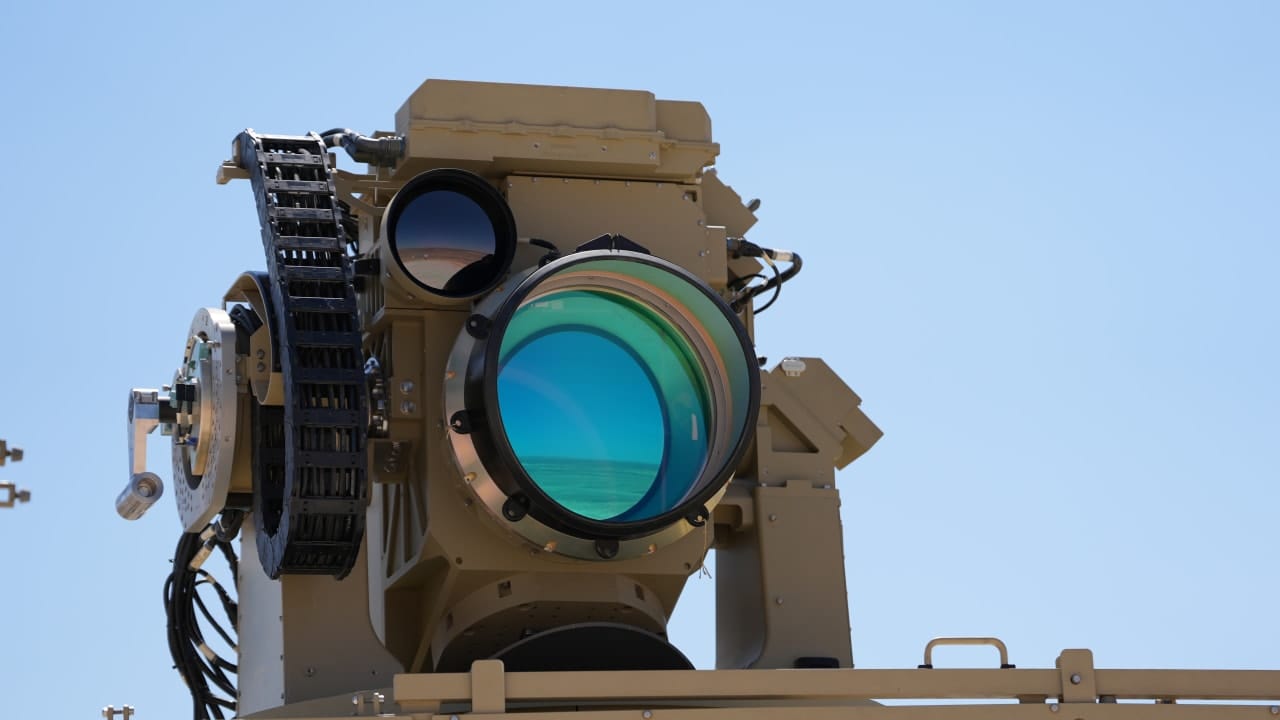
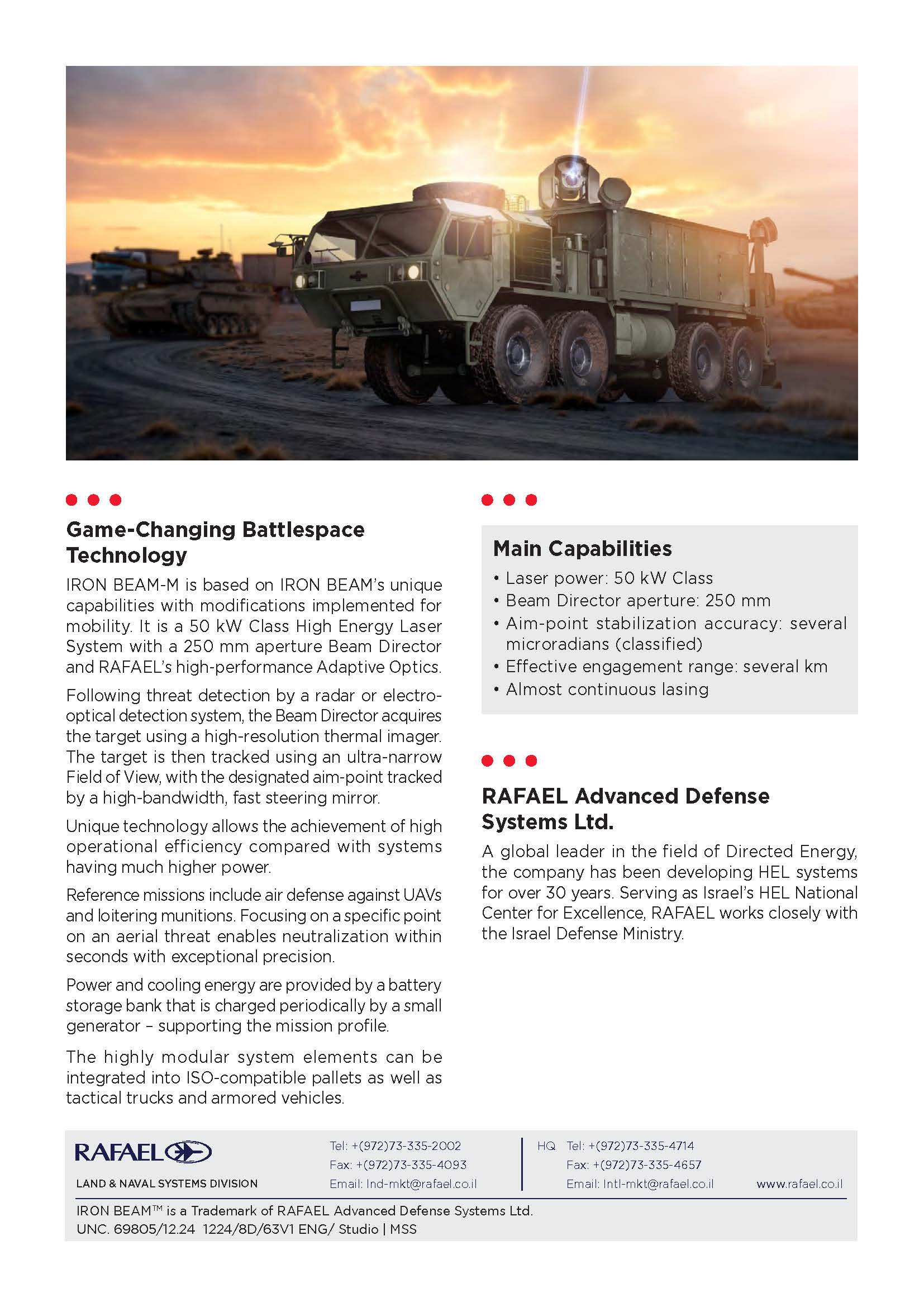
The mobile variant, known as Iron Beam-M, utilizes a 50-kilowatt-class laser mounted on a combat vehicle. It is specifically designed to provide close-range support for maneuvering forces. This version offers defensive coverage over a range of several kilometers.
Iron Beam-M 250 system with 50 kW power
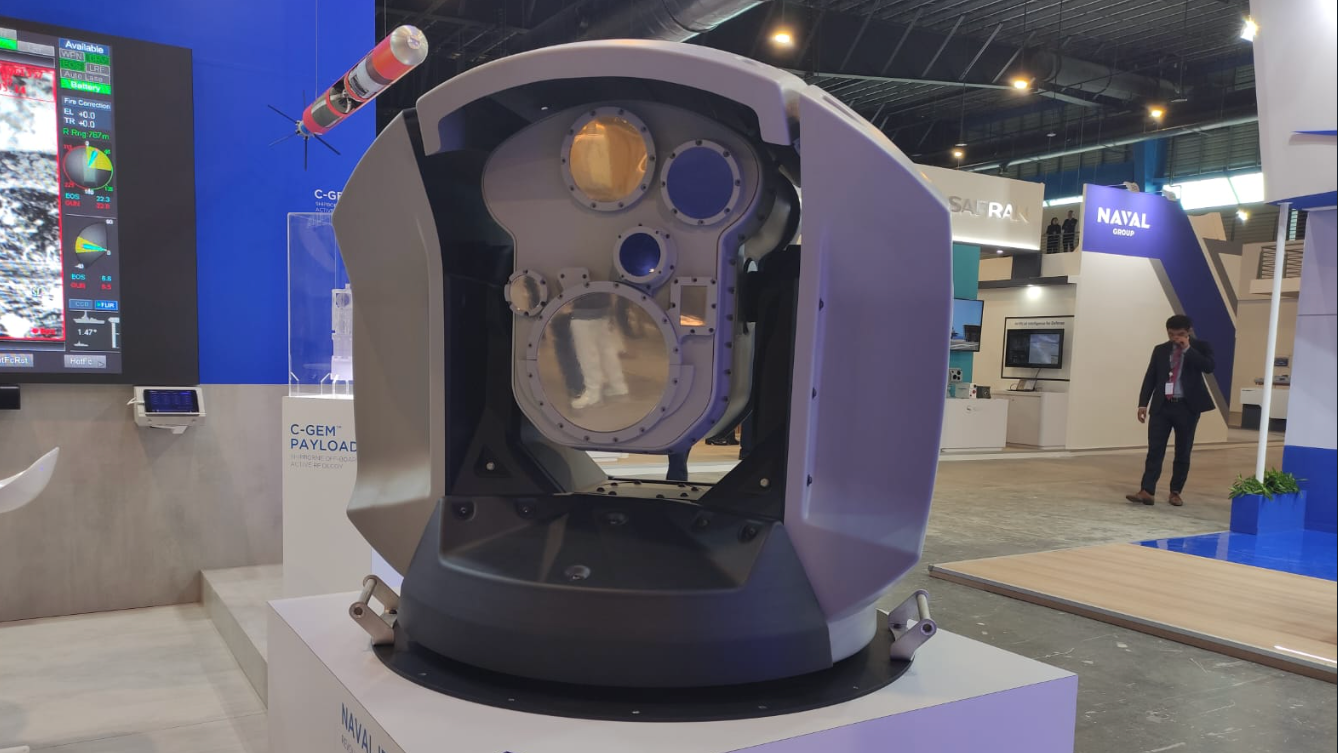
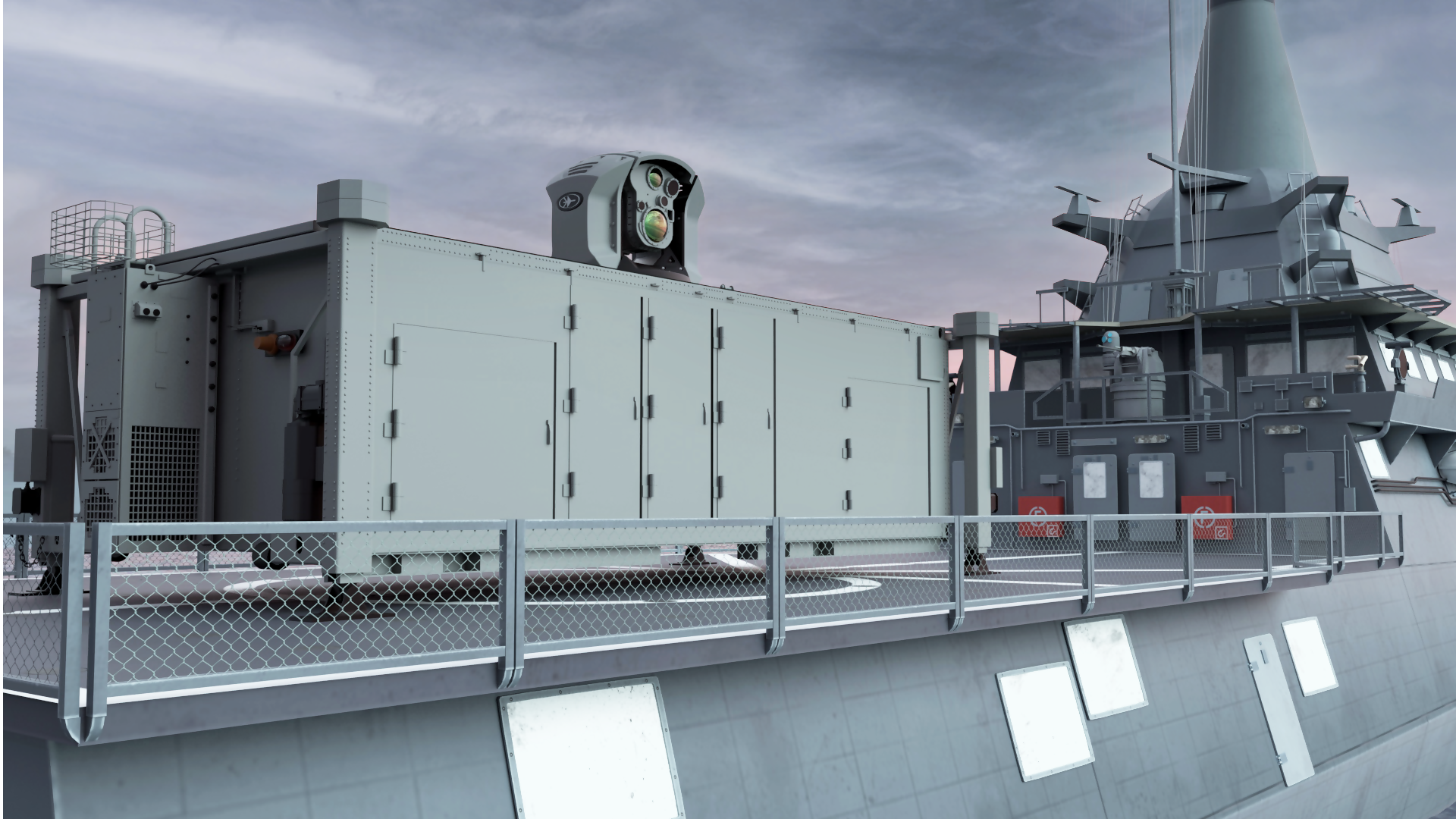
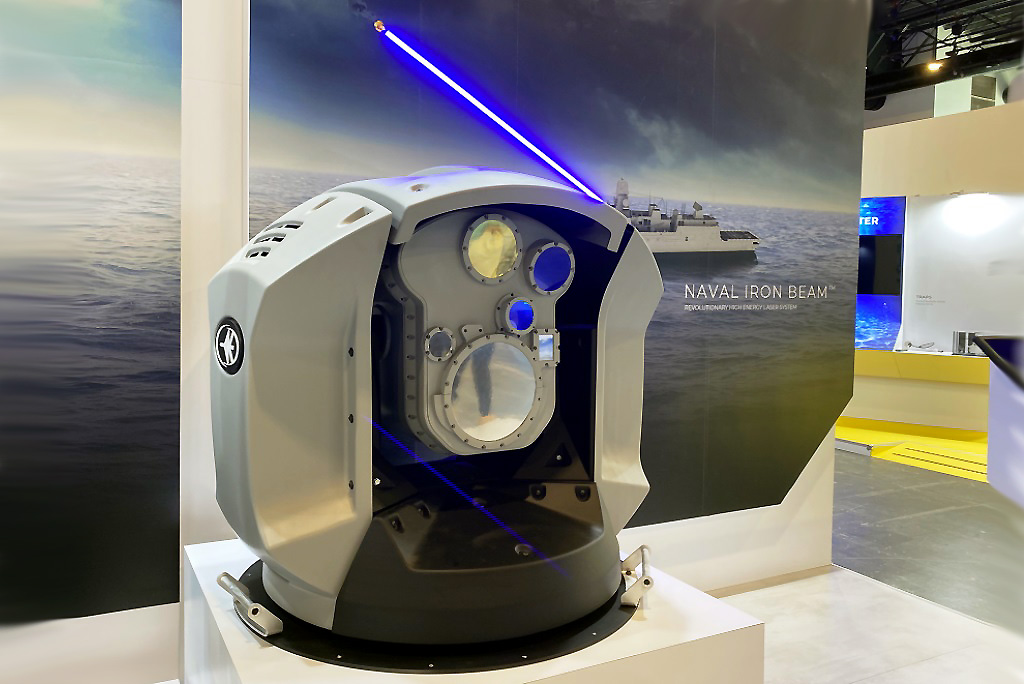
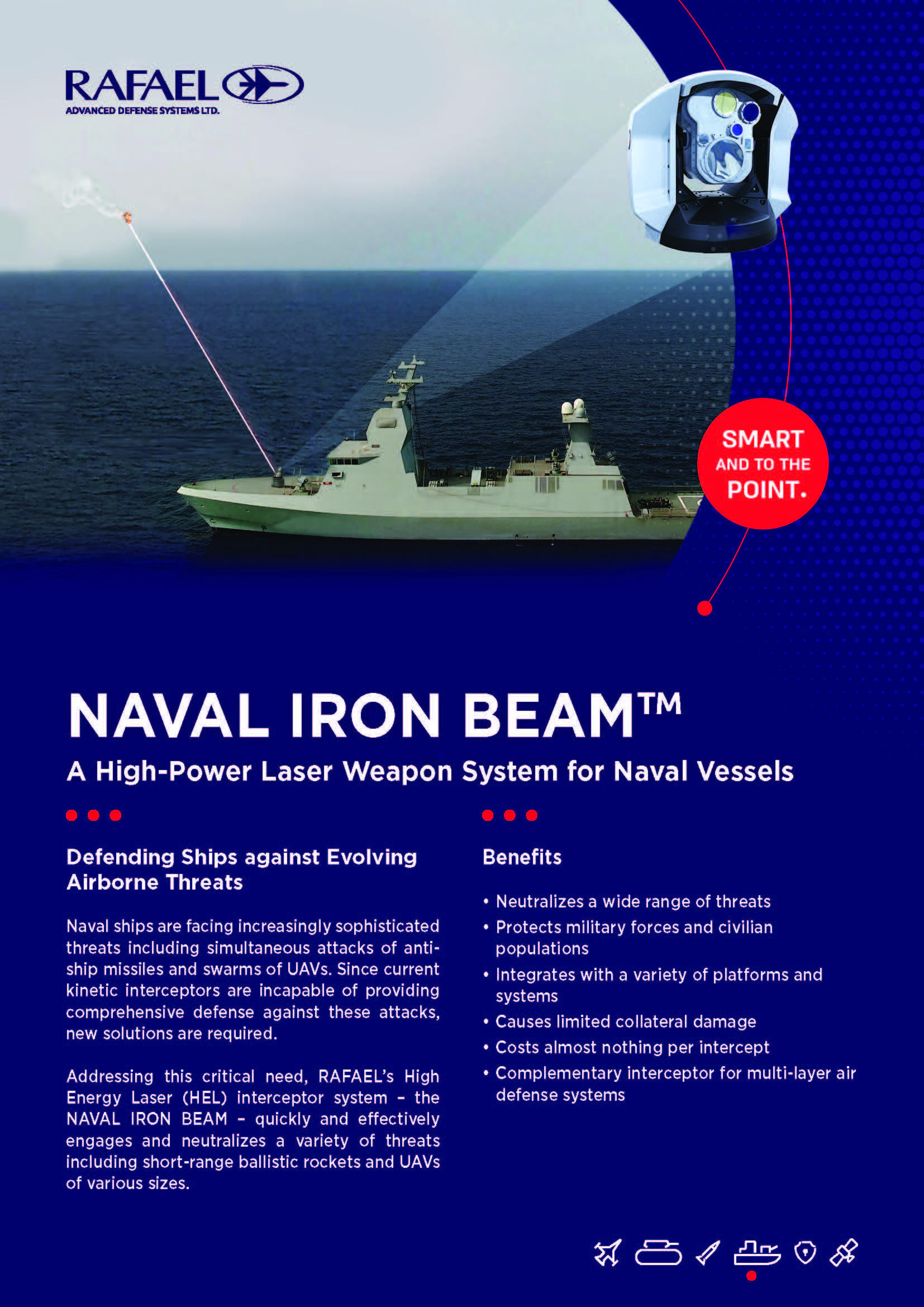
In the naval domain, Naval Iron Beam — the maritime version of the Iron Beam system — features a 100-kilowatt laser mounted on naval vessels. Its role is to counter aerial and missile threats at ranges of several kilometers.
Naval Iron Beam System with 100 kW power
Finally, a lighter version branded as Lite Beam has been introduced, featuring a 10-kilowatt-class laser mounted on a mobile vehicle. Its primary purpose is to counter smaller threats such as short-range drones, with an effective range of approximately 2,000 meters.
Lite Beam system
One of the key operational metrics for laser weapons is “dwell time” — the duration a beam must remain focused on a target to deliver sufficient energy for damage or destruction. For Iron Beam, this process typically takes just a few seconds.
A standard Iron Beam battery usually consists of a defensive radar, a command and control (C2) unit, and two high-energy laser (HEL) systems. These dual emitters can engage a single target simultaneously, enhancing beam precision and stability even under complex combat conditions.
The naval variant of the system also incorporates an array of optical sensors — including thermal, near-infrared, and daylight sensors — to enable accurate tracking and engagement of incoming threats.
Deployment and Operational Record of Iron Beam:
Iron Beam underwent a series of advanced operational tests at the “Shadma” test range in southern Israel. In this field environment, the system successfully intercepted and neutralized a wide spectrum of real-world threats — ranging from rockets and mortars to drones and anti-tank missiles — under scenarios closely resembling actual combat conditions.
Deploying the Iron Beam 450 system for field testing
Reports indicate that a smaller, shorter-range version of the Iron Beam system successfully downed dozens of Hezbollah drones in the skies over northern occupied territories during post–October 7 clashes.
Additionally, Iron Beam was reportedly deployed along the Gaza border in October 2023 to assess its performance against Hamas rocket fire. However, no documented evidence has been released to confirm the system’s operational effectiveness in that scenario.
The alleged downing of a Hezbollah drone that was targeted by a version of Iron Beam last October.
The most prominent advantage of Iron Beam lies in its operational cost-efficiency. Each interception requires only electrical energy, typically costing just a few dollars per shot — with some estimates placing it as low as $3 per engagement. This stands in stark contrast to the cost of firing a Tamir interceptor missile from the Iron Dome system, which ranges between $40,000 and $150,000 per launch.
Despite its clear benefits, Iron Beam — like other laser weapons — faces inherent physical limitations. A key challenge is reduced performance under adverse weather conditions such as heavy clouds, rain, fog, or dust, as the atmosphere can scatter or absorb a significant portion of the laser’s energy.
Moreover, while the per-shot cost is minimal, the initial investment required for purchasing, installing, and deploying an Iron Beam battery is substantial.
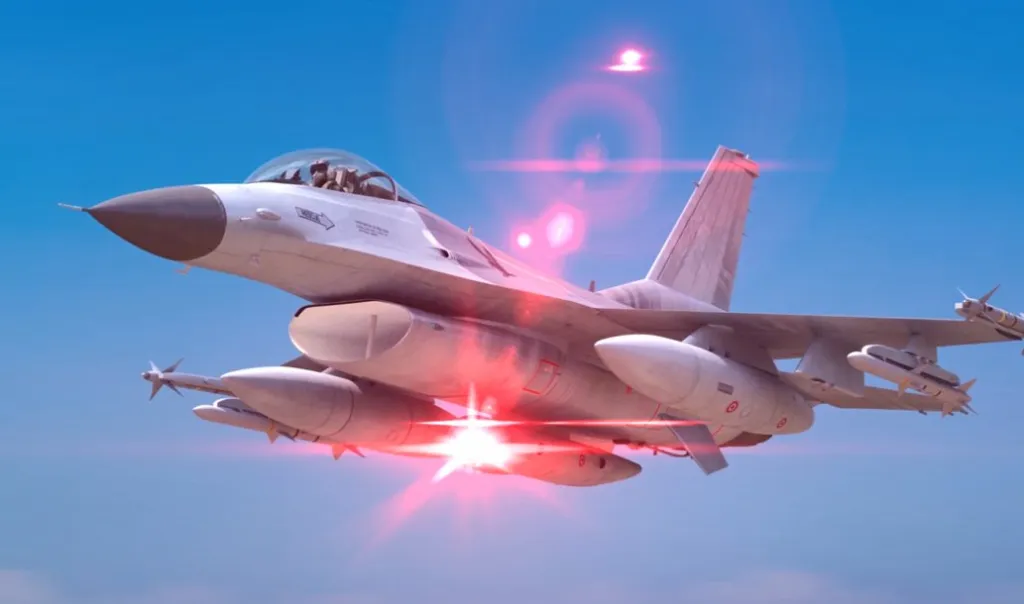
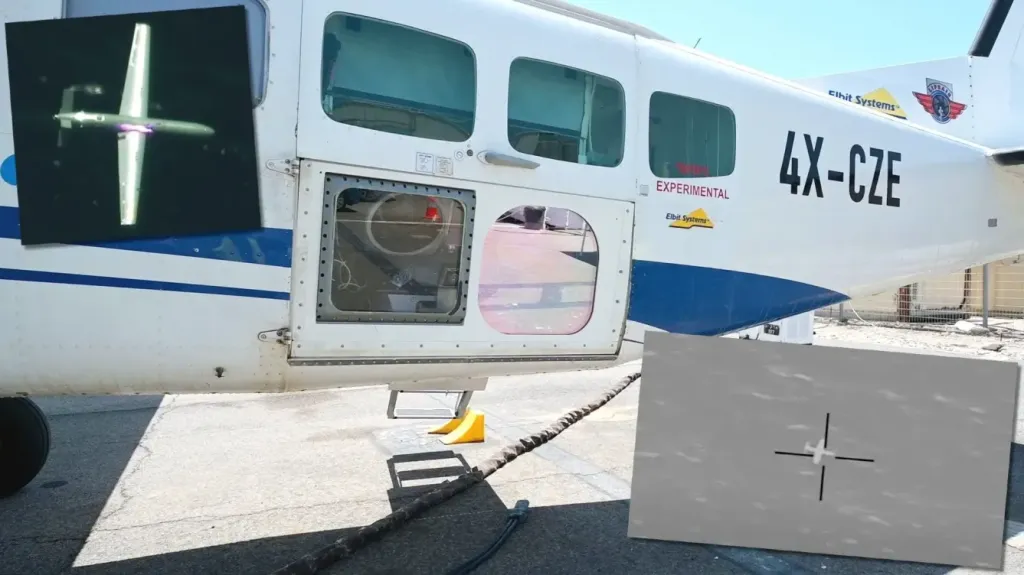
A concept design from Elbit Systems showing an F-16 armed with a pod laser weapon.An experimental Israeli high-power laser system mounted on a Cessna 208 aircraft.
The future path of the Iron Beam System:
Iron Beam is no longer merely a standalone system — it is evolving into a broader technological platform. Rafael has outlined a clear roadmap for future upgrades, including the development of a “Laser Dome” with higher power, extended range, and faster response times, as well as the introduction of mobile (Iron Beam-M), naval (Naval Iron Beam), and airborne variants.
The airborne lasers, currently under development by Elbit Systems, are designed to be mounted on large drones and engage threats from higher altitudes — an advantage that could help mitigate some of the atmospheric limitations faced by ground-based lasers.
Overall, this approach marks the transition of the project from a single-purpose system to a multi-domain ecosystem capable of integration across land, sea, and air operations.
According to a statement by Brigadier General Yahya Saree, the Yemeni drone force carried out a special military operation using two suicide drones targeting two sites in the Umm al-Rashrash area (Eilat port). The operation reportedly succeeded, with Israeli air defense systems failing to intercept the drones.
On September 24, 22 Israeli settlers were injured after a Yemeni suicide drone attacked and hit the port of Eilat. The Israeli regime’s air force also issued a statement confirming that an investigation has been launched into the drone strike on the port city of Eilat.
A Yemeni drone hit near a hotel in Eilat
Another operation was conducted on September 23, involving multiple suicide drones aimed at targets in Eilat port and Be’er Sheva.
Based on data from the Islamic World News, these strikes mark the 203rd and 204th aerial operations by Yemeni armed forces against Zionist regime positions in occupied Palestine.
The facilities built on this island include a camp for Emirati forces, a training center for Tareq Saleh’s troops and fighters from the Southern Transitional Council, a 185-meter dock, an advanced maritime radar, an air defense system, and a helipad.
These installations have recently functioned as an advanced surveillance base against Yemeni armed forces, issuing early warnings to monitor missile and drone launches toward occupied Palestine and targeting ships affiliated with Zionists. The island also has a 2.1 km runway, which is expected to soon receive military cargo and large transport aircraft, possibly even Israeli aircraft.
Israeli-UAE military base in Zuqar island
Israel’s use of this island could pose a serious threat and could serve as a launch point for Israeli drones conducting terrorist operations deep inside Yemen.
Zuqar Island is one of Yemen’s islands in the Red Sea, covering 130 square kilometers and located off the western coast of Al Hudaydah province. Positioned in the middle of the Red Sea, it plays a key role in controlling commercial shipping routes. The island is 29 km from Yemen’s coast, and Yemeni armed forces, operating from Al-Tuhayta, can target it with artillery and destroy the Emirati-Israeli facilities stationed there.
The report claims that Washington’s primary strategy is to negotiate with the Taliban for control of Bagram, though military options are actively being considered.
It further alleges that around 80% of Taliban officials are willing to hand over the base to the U.S., but Taliban leader Mullah Hibatullah Akhundzada and his inner circle oppose the plan. The report speculates that if their stance doesn’t change, the U.S. might consider targeting them for assassination.
Additional reports suggest that communication devices are being confiscated and internet access has been cut in Kandahar, where the Taliban leader resides. Taliban security forces are reportedly constructing underground tunnels to protect him. These developments point to the possibility of a U.S. military intervention against the Taliban.
A summary of the most important points is as follows:
The 12-Day War “The enemy’s primary goal was not merely to target military commanders — that was just a means. They believed that by assassinating military leaders and influential figures, unrest would erupt, especially in Tehran, where their agents would incite chaos and draw people into the streets to act against the Islamic Republic. Their ultimate aim was to destabilize the system, provoke street riots, mobilize factions, and uproot Islam from the country. This plan failed in its early stages. The unity and solidarity of the Iranian people during the 12-day war shattered the enemy’s hopes.”
Nuclear Energy and Negotiations with the U.S. “Under current circumstances — though things may change in 20 or 30 years — negotiating with the U.S. government does not serve our national interests. It brings no benefit and does not remove any harm. On the contrary, such negotiations today pose serious risks to the country, some of which may be irreversible. The American side has already predetermined the outcome: they want talks that end with Iran dismantling its nuclear activities and enrichment. That is not negotiation — it is dictation, it is imposition. Sitting down to negotiate with a party that insists the result must be exactly what they demand — is that really negotiation?!
We have not and will not surrender to pressure — not in this matter (uranium enrichment) nor in any other. The American side is adamant that Iran must abandon enrichment altogether. Previous administrations demanded we limit enrichment or not keep enriched material inside the country — which we also rejected. Now he [Trump] says there should be no enrichment at all. What does that mean? It means erasing a major national achievement — one that took immense effort, cost, and sacrifice. To abandon enrichment is to discard all that. Clearly, a proud nation like Iran will reject such demands outright.”
The UN Special Rapporteur on Human Rights in Palestine condemned the attacks and called for immediate protective measures for the convoy. The Global Sumud Flotilla also issued a statement warning that the Israeli regime is spreading misleading information to justify military strikes against the humanitarian mission.
Israel Drone Attacks Target Global Sumud Flotilla in the MediterraneanIsrael Drone Attacks Target Global Sumud Flotilla in the Mediterranean
This marks the second attack on the Sumud flotilla in recent days. On the morning of September 8, one of its boats was targeted by an unidentified drone near the port of Sidi Bou Said in Tunisia.
Drone strikes on a civilian fleet with a humanitarian purpose represent a clear violation of international law and humanitarian principles. Such actions could be classified as war crimes under UN frameworks. The assault on Al-Sumoud is not merely a military act, it sends a political message aimed at deterring international activists working to break the blockade on Gaza.
Israel’s extensive SIGINT and HUMINT networks, combined with advanced satellite and drone reconnaissance systems, enable real-time tracking of Iran’s military and nuclear movements. According to RAND, the fusion of communication intercepts, satellite imagery, and local human sources provides commanders with a level of clarity that allows for precise analysis and targeting.
The Israeli regime’s SIGINT network includes electronic listening stations in allied countries (such as Iraqi Kurdistan, Azerbaijan, and Gulf states) and signal-intercepting ships in international waters. These assets continuously monitor a wide range of radio, satellite, and phone communications in and around Iran. Using AI-powered data analytics, they identify and geolocate command-and-control nodes, extracting precise coordinates for targeted strikes.
Meanwhile, Mossad and Shin Bet’s HUMINT operations maintain deep infiltration into Iran’s academic and industrial sectors, activating a network of local informants who not only verify SIGINT data but also report hard-to-track details such as traffic patterns at strategic sites. These sources have been recruited and retained over the past decade through financial incentives, emigration support, and psychological operations.
A clear example of this integrated approach was Operation Narnia, in which at least 11 senior Iranian nuclear scientists were targeted in a single night. Official reports indicate targeting precision within 10 meters. The psychological impact not only disrupted Iran’s technical expertise but also fractured internal decision-making and coordination, with full recovery of Iran’s intelligence-operational capacity expected to take considerable time.
Air Power and Long-Range Weaponry
Israel’s F‑35I Adir fighter jets, combining stealth technology with onboard sensor networks, function as more than just aircraft—they serve as airborne command-and-control hubs. These jets are tasked with penetrating air defense networks and, using “Beast Mode,” can carry external weapons after disabling radar systems to increase bombing payloads. Data collected via electronic and infrared sensors is encrypted and transmitted to command centers, guiding F‑15I and F‑16I jets for simultaneous precision strikes.
This networked approach enables highly coordinated SEAD (Suppression of Enemy Air Defenses) and OCA (Offensive Counter-Air) missions. No previous operation against Iran has demonstrated such synchronization.
Additionally, Israel’s long-range offensive layer includes standoff weapons like air-launched Sparrow ballistic missiles and Spice guided bombs, extending operational reach by several hundred kilometers. Simultaneous launches from multiple directions saturate Iran’s S‑300 and S‑400 systems, and when combined with F‑35I support, enable the capture of strategic targets such as uranium enrichment facilities and air defense sites. High-altitude aerial refueling not only prolongs battlefield endurance but also allows for continuous air support loops. According to CSIS experts, this “multi-axis simultaneous operations” model significantly improves penetration into Iran’s defense zones compared to traditional pinpoint strikes.
Electronic and Cyber Warfare
Since Operation Rising Lion, Israel has integrated battlefield and cyber tactics to neutralize Iranian defenses before physical strikes commence.
In the first phase, electronic warfare units deploy systems like IAI’s Scorpius to target S‑300 and S‑400 radar signals, saturating multiple frequency bands and inducing “artificial sleep” in ground receivers. This multi-step process includes active jamming, injecting false data into control systems, and sudden disruptions—rendering even mobile defense stations unable to activate quickly.
Next, Mossad and Unit 8200 cyber teams infiltrate air defense management networks and data centers, issuing fake commands to deactivate radars or reposition antennas. As a result, when F‑35I jets or combat drones enter Iranian airspace, no effective alerts are triggered.
Simultaneously, large-scale cyberattacks target cross-border communication support networks. Internal servers are replaced, root account passwords are rotated, and encrypted traffic is intercepted using known vulnerabilities. The Washington Institute emphasizes that these intrusions are designed to disable logistical support systems and crisis command centers, preventing Iran from mounting a coordinated rapid response.
Ultimately, a hybrid network of cyber and electronic attacks, combined with drone-based cover operations inside Iran, enables the destruction or disabling of defense systems deep within Iranian territory without direct confrontation. This model, blending jamming, cyber infiltration, and stealth explosive drones, represents a new framework for long-range attacks unprecedented in the history of Israeli-Iranian conflict.
Support and Coordination with the United States
At the strategic level, Israel’s formal integration into the U.S. Central Command (USCENTCOM) and close cooperation with the Pentagon have granted its air and naval forces access to extensive logistical and intelligence resources. Following this integration, Israel’s F‑35I jets and other airborne units can refuel and rearm at joint U.S. bases in the region, including B‑52 facilities in Qatar and aircraft carriers in the Persian Gulf. Logistical support—spare parts and specialized personnel—is provided under joint supervision and through coordinated exercises, reducing operational costs by up to 30% and minimizing response time.
Israel’s role within CENTCOM’s unified command structure also facilitates missile and air defense alert sharing. By integrating the U.S. Shared Early Warning system with Israel’s Arrow system at a joint command center, any missile or drone launch in the region is rapidly detected and its coordinates shared with both nations’ commanders. Additionally, joint engineering and cybersecurity teams conduct regular drills to secure military networks and prepare for nuclear threats. This collaboration has created a secure and transparent logistical support system that complicates any offensive action with dual-layered challenges.
On the political-military front, regional affairs officers (FAOs) and joint representatives within CENTCOM have strengthened personal relationships and information exchange among senior commanders. These interactions—through regular visits by CENTCOM leadership to Tel Aviv and the presence of Israeli advisors at U.S. command centers—enable swift and frictionless strategic alignment. The result is a secure logistical and intelligence network that pushes Israel’s offensive-defensive capabilities to saturation levels, forcing adversaries into limited reactive positions.
Special Operations and Targeting Key Commanders
Elite units such as Sayeret Matkal and Shayetet 13 operate within a unified mission architecture, executing psychological and tactical strikes deep inside Iran before the main aerial bombardment begins. According to CSIS, these units use real-time intelligence from fusion centers in Tel Aviv and Washington to infiltrate target facilities via small insertion teams (Fast-Rope Insertion), install field sensors, and transmit precise coordinates to jets and drones for synchronized strikes.
Their methodology centers on “Deep Joint Strike” operations—simultaneous missile bombardment and infiltration teams supported by drones and electronic warfare. These teams identify and eliminate communication keywords and commander gathering points, crippling Iran’s high-level management and response capabilities both logistically and psychologically, making coordinated national reactions virtually impossible.
CSIS recommends continued use of this tactical combination, noting its long-term strategic effectiveness. Iran’s ability to rebuild special operations capacity is hindered by cultural and security complexities, and the psychological deterrence created may pave the way for future successful strikes.
The Geranium-3 is similar to Iran’s Shahed-238 drone and is powered by a mini jet engine. Unlike piston-engine variants, it lacks the signature buzzing sound (!) and travels at noticeably higher speeds.
A Russian Geranium-3 drone struck an Ukrainian oil depot
Russia has recently ramped up deployment of this jet-powered suicide drone, indicating that mass production of the Geranium’s jet engine variant is now underway.
The Geran-3 carries a warhead weighing between 230 to 300 kilograms, with an operational range of approximately 1,000 to 1,200 kilometers—some sources suggest up to 2,000 km. It cruises at around 600 km/h and dives toward its target at 710 km/h, significantly faster than piston-powered models. Overall, it can stay airborne for 1.5 to 2 hours and has a flight ceiling of 9000 meters.
The initiative was unveiled during a summit hosted by the Saudi Foreign Ministry in Riyadh, attended by representatives from over 35 countries—including the U.S., UK, Canada, Australia, China, Japan, the European Union, Gulf Arab states, and Yemen’s exiled government.
British Ambassador to Yemen, Abdo Sharif, explained that the goal of this maritime security partnership is to address serious threats such as smuggling and piracy, while also promoting regional stability and safeguarding global trade routes.
Under the ten-year plan, participating nations will provide financial aid and military equipment to enhance the capabilities of Yemen’s coast guard. Saudi Arabia has taken the lead by pledging $4 million in aid, along with a package of training and military gear for the Yemeni forces.
The initiative, titled “Partnership for Yemen’s Maritime Security,” is being spearheaded by Saudi Ambassador Mohammed Al Jaber and British Ambassador Abdo Sharif. Despite broad international participation in the launch event, substantial military and financial support is unlikely to materialize within the current calendar year. However, growing economic pressure from the naval blockade in the Red Sea and Gulf of Aden may eventually compel the EU and other U.S.-Israeli allies to take more decisive action in Yemen.
Over the past two years, the Red Sea and Gulf of Aden have become focal points for Yemeni armed forces targeting commercial and military vessels linked to Israeli, American, and British interests. These operations—carried out in solidarity with the Palestinian cause—have included more than 215 maritime attacks using ballistic missiles, cruise missiles, drones, and explosive-laden unmanned surface vessels.
According to the brigade’s command, which holds formal responsibility for the area’s security, any presence or cooperation with U.S. forces and affiliated entities is categorically rejected. The 12th Brigade emphasized that all its bases operate under the supervision of the Iraqi Prime Minister’s Office and are legally sanctioned.
This obstruction is seen as a clear signal from resistance factions aiming to curtail U.S. operational reach within Iraq. It conveys a practical message: American presence in zones officially controlled by the PMF will not be tolerated. The brigade’s insistence on its legal mandate seeks to frame the move as a state-sanctioned action, distancing it from any perception of rogue behavior. This is a strategic posture, as resistance groups aim to present themselves as integral components of Iraq’s formal security architecture.
The incident marks a direct field-level confrontation with the United States and could escalate tensions between Washington and Iraqi resistance forces, especially amid recent U.S. moves to blacklist several such groups.
On September 16, the U.S. Department of State issued a statement announcing the addition of four Iraqi resistance groups to its list of Foreign Terrorist Organizations. The designated groups include Harakat al-Nujaba, Kata’ib Sayyid al-Shuhada, Harakat Ansar Allah al-Awfiya, and Kata’ib Imam Ali.