Author: Mirza

  • Military Knowledge: GBU-43/B Massive Ordnance Air Blast

    Military Knowledge: GBU-43/B Massive Ordnance Air Blast

    History of the development of the GBU-43/B MOAB bomb:

    The design of the GBU-43/B MOAB (Massive Ordnance Air Blast) began in mid-2002 at the United States Air Force Research Laboratory. The primary goal of developing this weapon was to provide an efficient replacement for the older BLU-82 bomb.

    The free-fall BLU-82 bomb was initially developed during the Vietnam War to quickly create helicopter landing zones in dense jungles, and was later used in the Gulf War and the Battle of Tora Bora in Afghanistan to destroy fortified positions and instill fear in enemy forces. This bomb lacked a guidance system and was released from the rear of transport aircraft using a parachute. This delivery method severely reduced operational accuracy and forced the carrying aircraft to fly at a relatively close altitude and distance to the target, exposing it to threats.
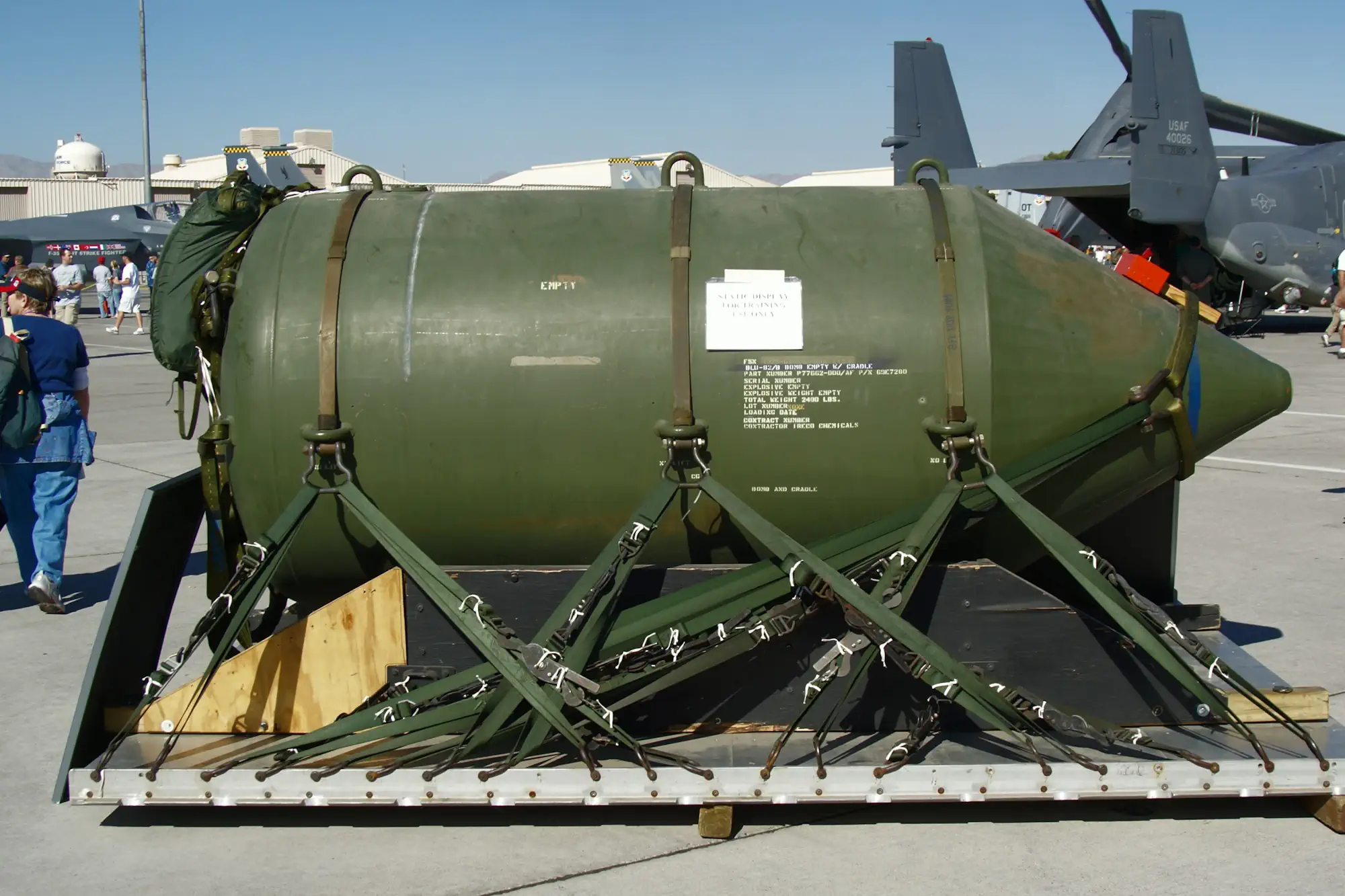
    BLU-82 free-fall bomb

    As the year 2003 and the invasion of Iraq approached, the Pentagon, in the form of an emergency project and within only 9 weeks, put on its agenda the development of a bomb with destructive power similar to the BLU-82, but with the capability of being launched from a safer distance and with satellite guidance.

    The name of this project, MOAB, was also chosen in a way to evoke a direct response to the famous phrase “Mother of All Battles” — a term used by Saddam Hussein during the First Gulf War to describe the battle with the international coalition.

    The simulation and prototype construction process was carried out with the participation of Dynetics. The first test of this bomb took place on March 11, 2003, at Range 70 of the Eglin Test Range. The mushroom cloud resulting from this test was visible from a distance of 32 kilometers and, only 9 days before the start of the military operation, sent a deterrent message to Baghdad.

    With the end of the Iraq War without the use of the MOAB, production of this bomb continued at the McAlester Army Ammunition Plant in the state of Oklahoma. The development goals of this weapon can be examined in two areas: operational and psychological.

    In the operational domain, Pentagon engineers sought to build a munition capable of destroying the mouths and entrances of natural caves in inaccessible areas, creating intense pressure in valleys, blocking tunnels, and clearing dense minefields. These capabilities could provide the basis for the advance of armored and infantry units.

    In the psychological domain, this bomb was considered part of the “shock and awe” doctrine and was intended, by creating a massive explosion sound, ground shaking, and a widespread blast wave, to weaken the morale and resistance capability of enemy forces before direct engagement.

    Video of the GBU-43/B bomb test in 2003

    Technical and engineering specifications of the MOAB:

    The structure of the GBU-43/B bomb consists of two main assemblies: the BLU-120/B warhead and the tail fin and navigation kit assembly, known by the designation KMU-593/B.

    Unlike conventional bombs and heavy penetrators, in which a significant portion of their mass is devoted to thick steel casings, the outer body of the MOAB is made of aluminum sheets with a mass of approximately 1,300 kilograms. This design has brought the ratio of explosive mass to total bomb mass to a remarkable 87 percent.

    The explosive material used in the warhead is the H-6 composition with a weight of approximately 8,500 kilograms. This composition was previously used in the maritime industry for the manufacture of torpedoes and naval mines. The explosive power of H-6 is estimated at about 1.35 to 1.38 times that of TNT. On this basis, the explosive yield of the MOAB is equivalent to approximately 11 tons of TNT, or 46 gigajoules of energy.
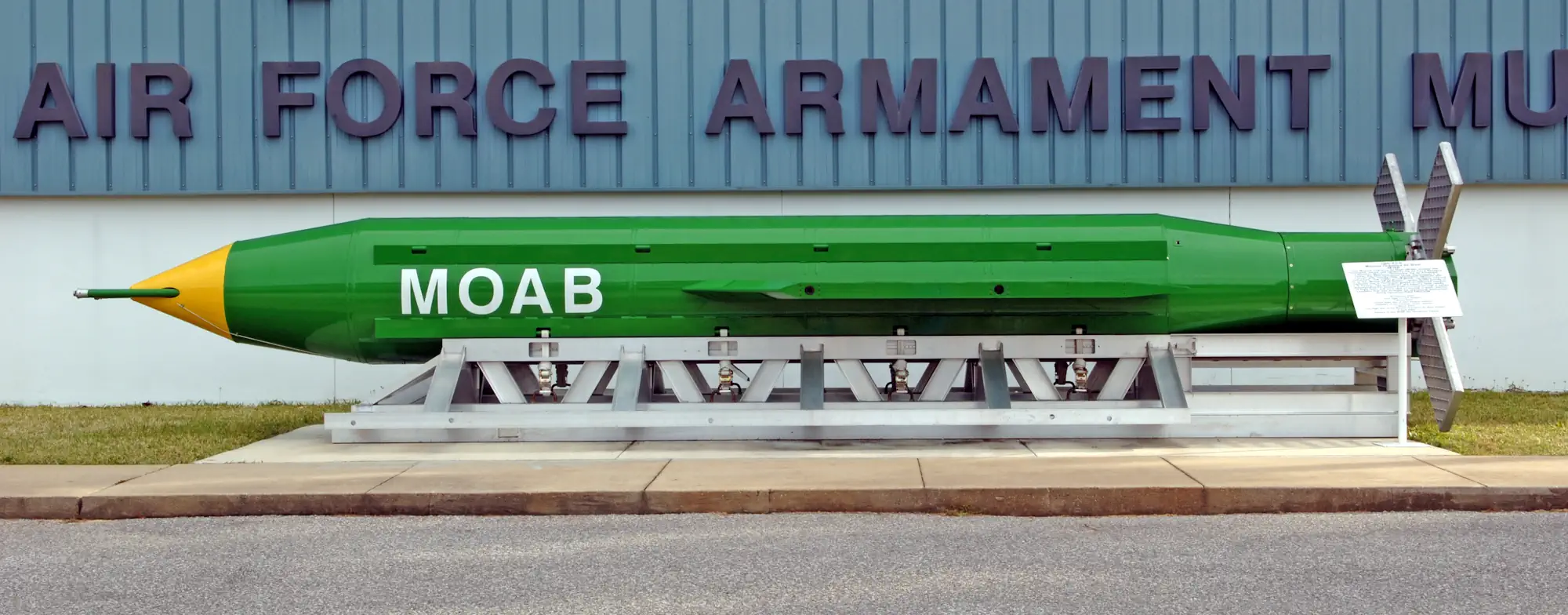
    GBU-43/B bomb

    In some public sources, the MOAB is mistakenly presented as a thermobaric or fuel-air weapon, whereas this bomb lacks a mechanism for dispersing fuel into the air before ignition and, in terms of classification, falls into the category of conventional high-explosive bombs.

    The dimensions of this bomb, including a length of 9.18 meters and a diameter of 1.03 meters, together with a mass of approximately 10 tons, rule out its carriage by conventional strategic bombers such as the B-52 and B-2. Therefore, heavy transport aircraft of the C-130 family, especially special operations variants such as the MC-130E Combat Talon I and MC-130H Combat Talon II, have been considered as the launch platform for this weapon.

    The bomb is placed on a restrained platform in the aircraft’s cargo bay. When launched from the rear ramp, a drogue parachute first opens, guiding the platform and bomb toward the end of the ramp and extracting them from the aircraft. After extraction, the bomb separates from the platform and enters free air.
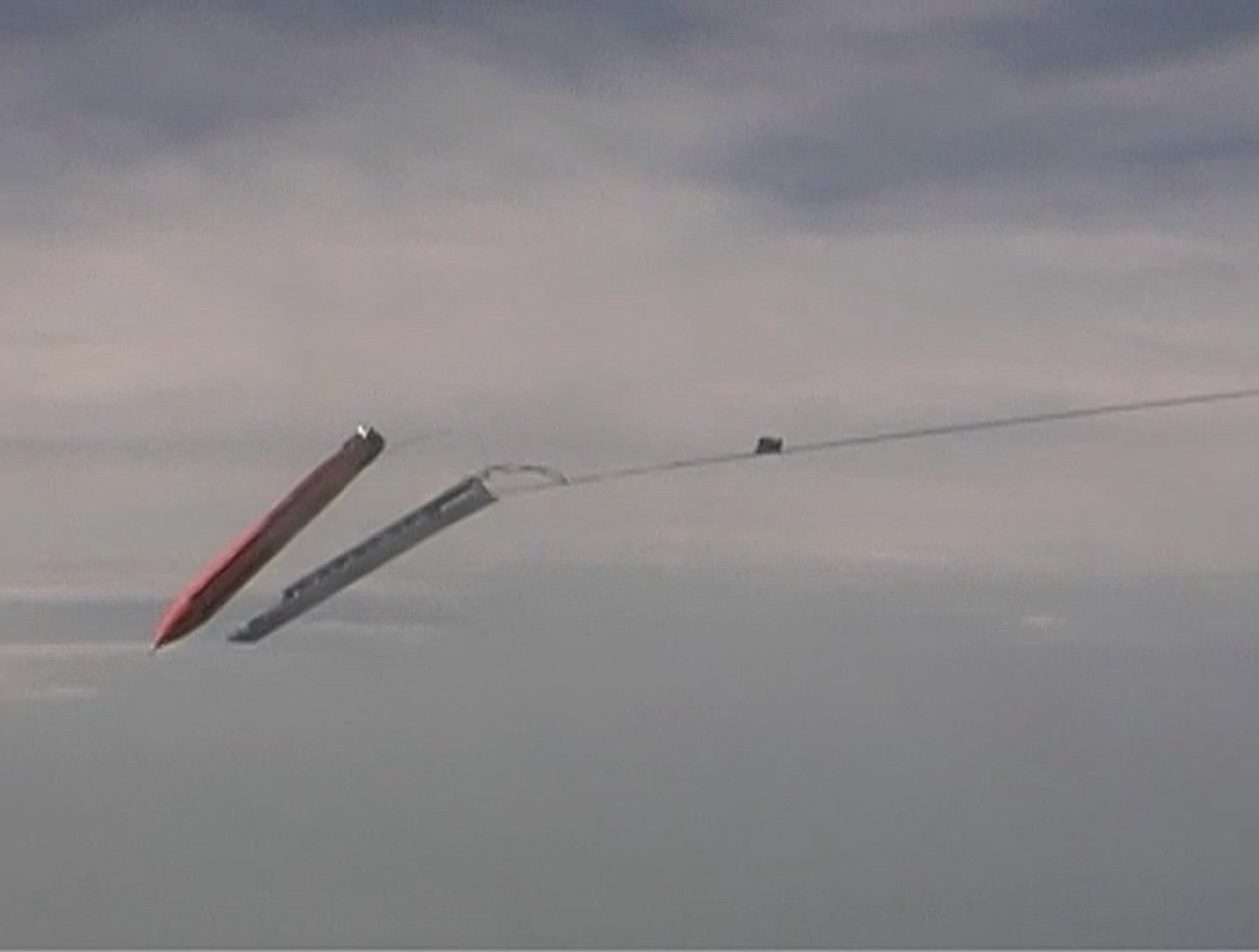
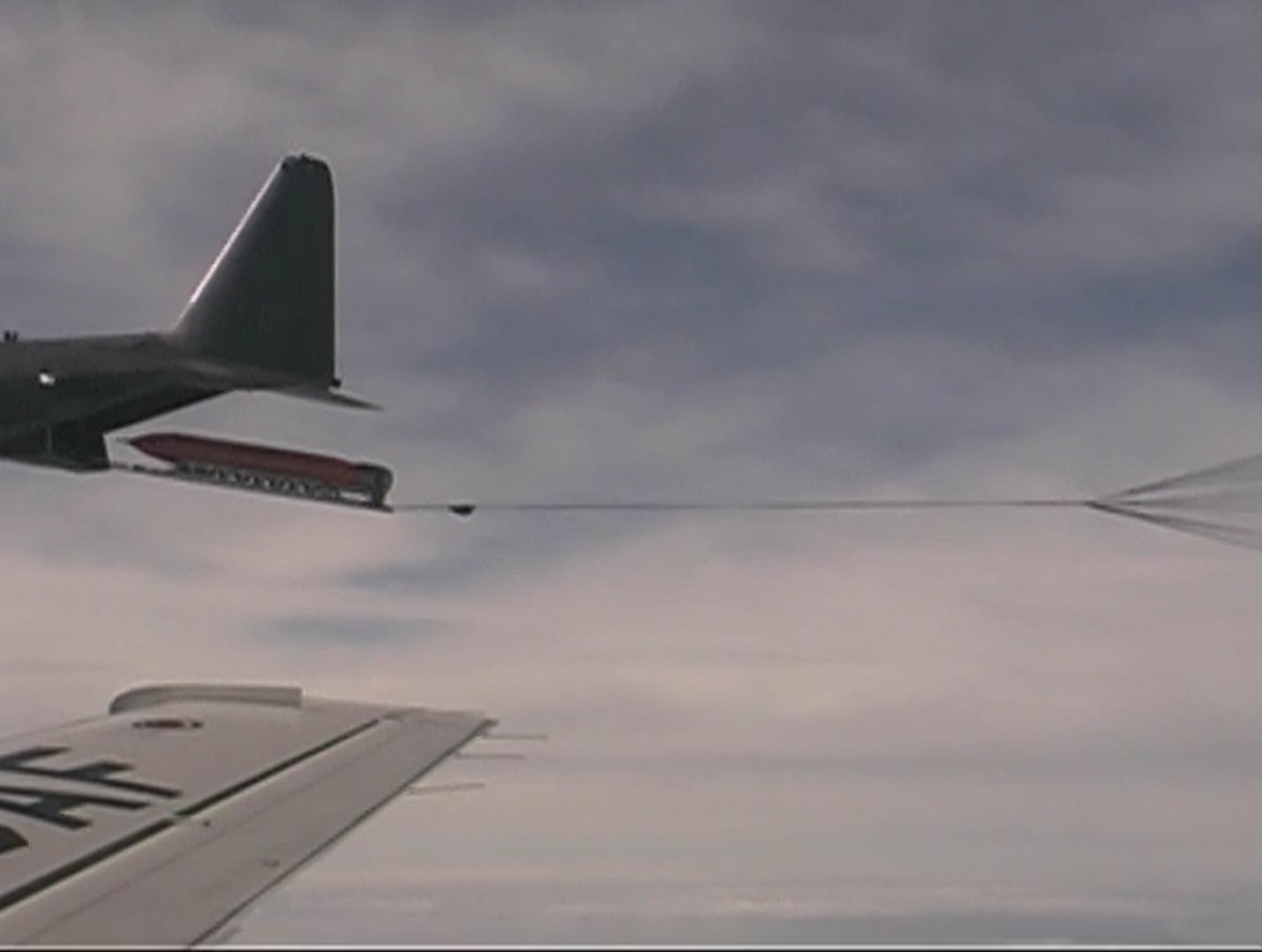
    During the descent, four lattice fins deploy at the rear of the bomb. This assembly, combined with satellite and inertial guidance systems, enables trajectory correction and the guidance of the bomb toward its target, up to a range of approximately 5.5 kilometers.
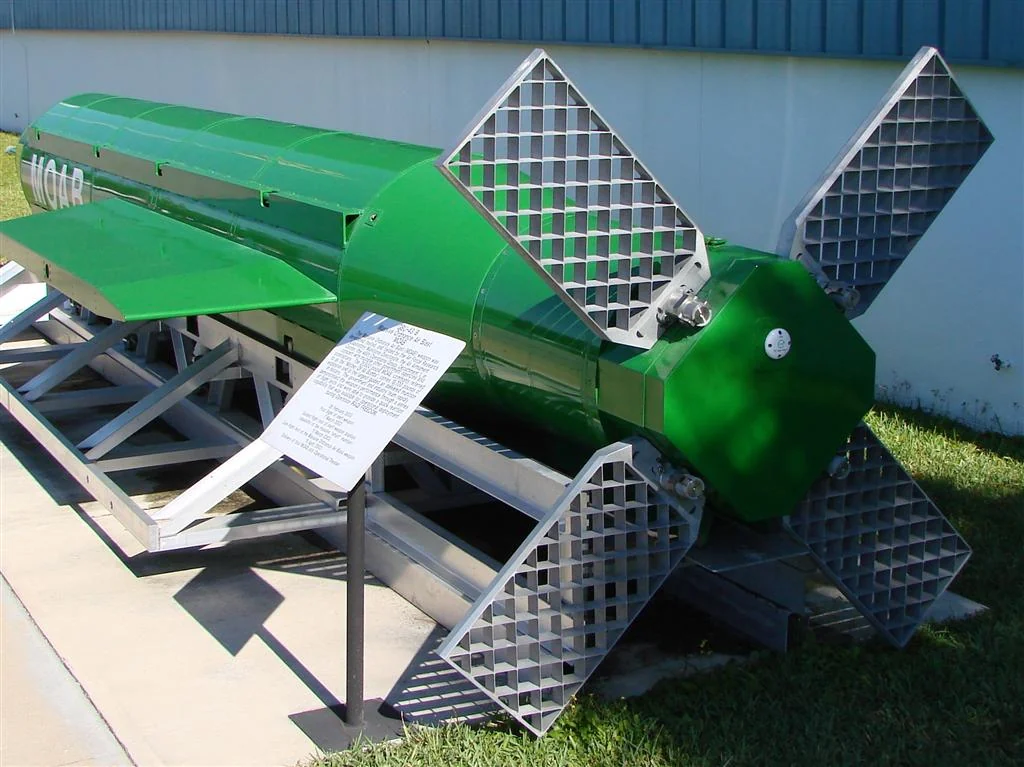
    Four lattice fins at the rear of the bomb

    The detonation mechanism of the MOAB is based on the operation of radar altimeter fuses installed in the nose section. These fuses detonate the bomb at an altitude of approximately 1.8 to 3 meters above ground level, before physical impact with the target. Detonation at this altitude can lead to the formation of a phenomenon known as Mach reflection.
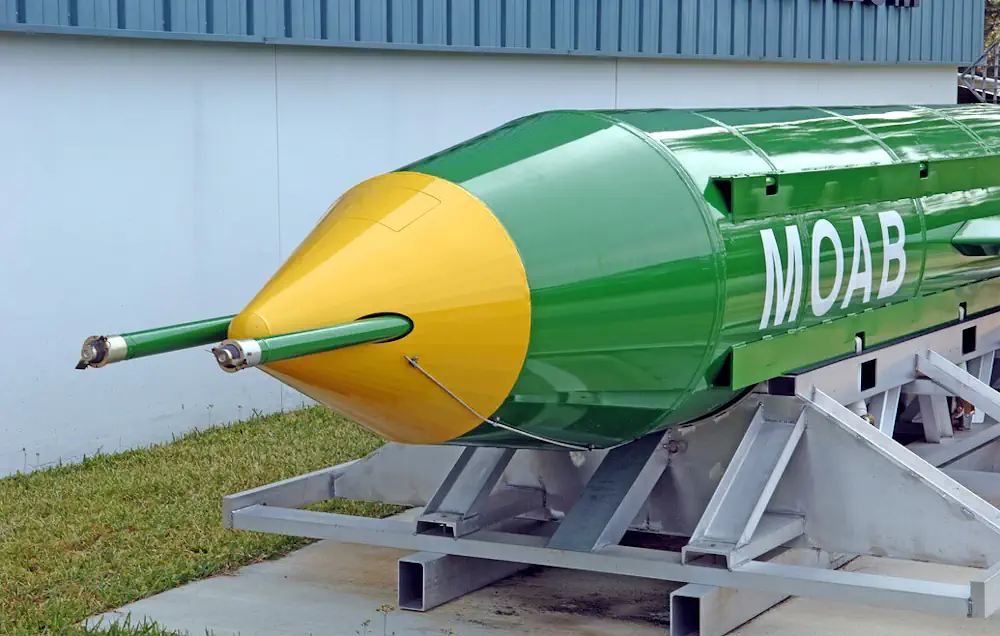
    Nose section of the GBU-43/B bomb

    In this phenomenon, the blast wave reflects off the ground and merges with the initial wave, creating a powerful pressure front. At a distance of approximately 150 to 300 meters from the explosion’s epicenter, this wave can penetrate the entrances of caves, tunnels, and shelters with great force. Furthermore, drastic pressure fluctuations within enclosed spaces can cause severe lung injuries, the destruction of biological tissues, and respiratory impairment for individuals present in these environments.
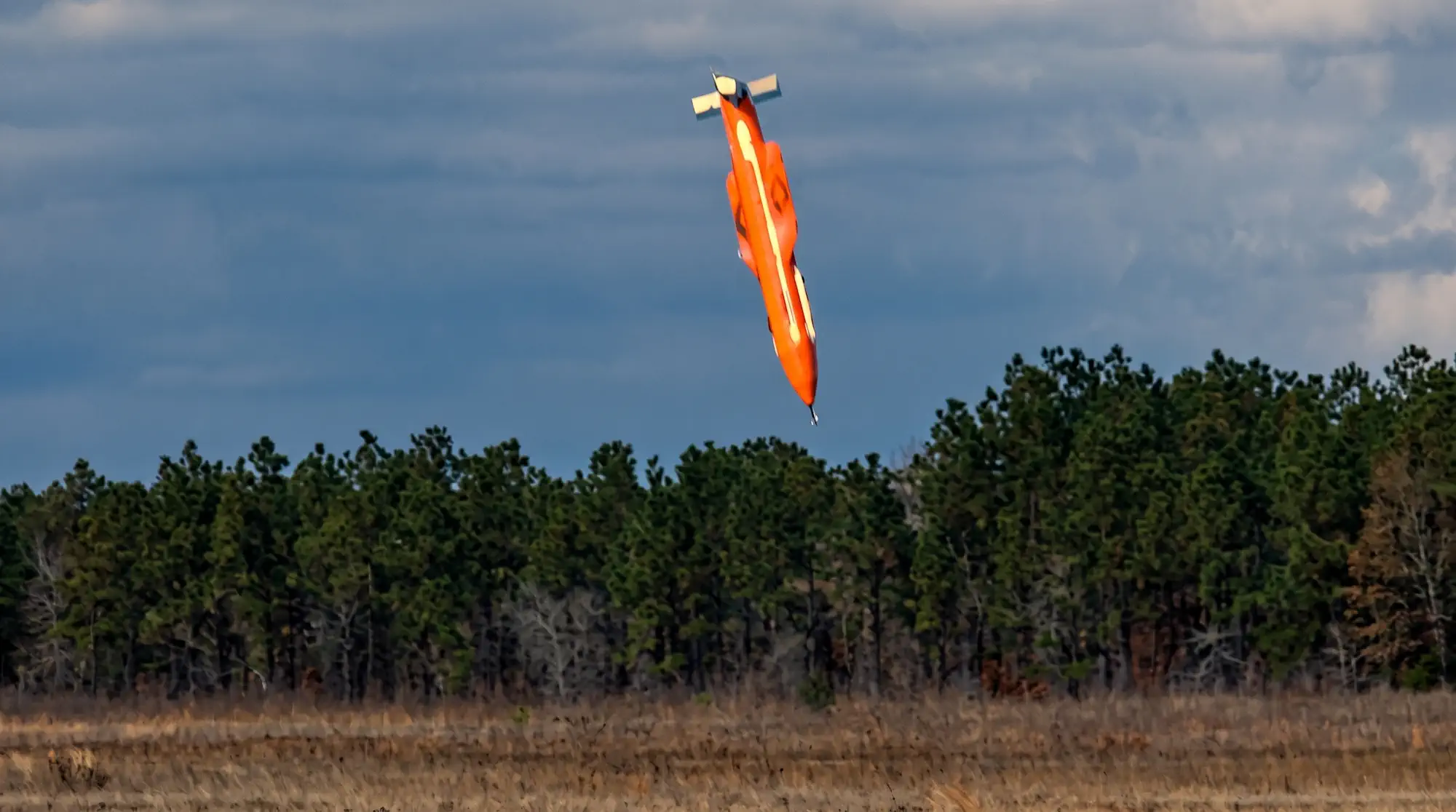
    The GBU-43/B bomb moments before the explosion

    Operational history:

    The only combat use of the GBU-43/B bomb in history was recorded on April 13, 2017. The target area contained a network of underground corridors and military tunnels that had been constructed in the 1980s, concurrently with the Afghan mujahideen war against Soviet forces and with initial support from the U.S. Central Intelligence Agency. ISIS forces had used these natural shelters to establish a defensive network consisting of extensive minefields, improvised explosive traps, and fortified positions.

    In that operation, the bomb was dropped from the rear ramp of a U.S. Air Force MC-130 special operations aircraft over the Momand Valley in Achin District, Nangarhar Province, eastern Afghanistan. Afghan security officials and the Ministry of Defense announced the ISIS death toll from the attack as between 94 and 96 killed.

    It is claimed that the blast wave penetrated the interior of the caves and tunnels and, by destroying the entrances and ventilation systems, disrupted access to this underground network. Additionally, the intensity of the blast wave helped clear minefields adjacent to the target area.

    GBU-43/B bomb used in Afghanistan on April 13, 2017

    Comparison of the MOAB with Tactical Nuclear Weapons:

    The MOAB’s explosive yield of approximately 11 tons of TNT has led some media outlets to place it at the boundary between conventional munitions and nuclear weapons.

    However, the only nuclear weapon with a comparable explosive yield is the U.S. W54 compact nuclear warhead, developed during the Cold War and used in the M-388 launcher system. Depending on its detonator setting, the warhead had a variable yield of between 10 and 20 tons of TNT.

    Despite their comparable explosive yields, the two weapons differ significantly in size and weight. The MOAB requires a structure weighing nearly 10 tons to produce an explosive yield equivalent to 11 tons of TNT. By contrast, the W54 delivered a similar yield in a compact, capsule-shaped package weighing less than 27 kilograms and could be fired from a lightweight rocket launcher. Therefore, the two weapons belong to fundamentally different categories, and their similarities in explosive yield should not be taken as a direct equivalence.

    W54 small nuclear warhead

    Comparison with Russia’s FOAB bomb:

    In 2007, the Joint Staff of the Armed Forces of the Russian Federation, in response to the claims raised about the MOAB bomb, released a video of the test of a bomb designated ATBIP. This weapon immediately became known in international media as the Father of All Bombs (FOAB).

    The FOAB is in fact a thermobaric weapon whose operating principle is based on the dispersal of liquid fuel into the air and its combination with atmospheric oxygen. When the bomb’s casing opens at a specified altitude, the fuel mass spreads in the environment in the form of a vast aerosol cloud and is then ignited using delayed detonators.
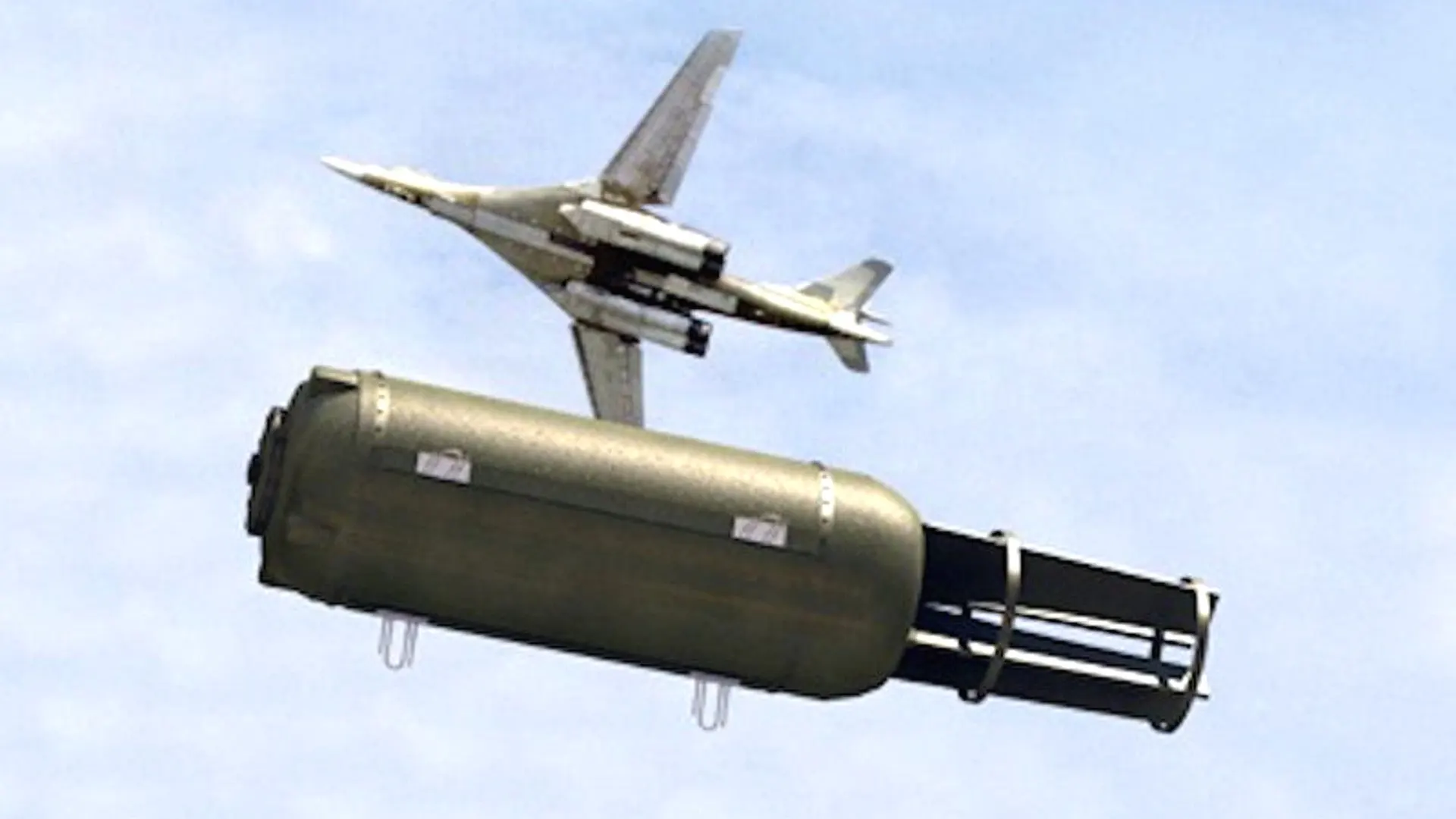
    Russian officials claimed that the FOAB, despite having a lower mass than the MOAB—approximately 7.1 tons versus 9.85 tons—produces an explosive yield equivalent to 44 tons of TNT thanks to nanotechnology and the use of ambient oxygen instead of a solid oxidizer. This figure is about four times the explosive power of the American model. The complete destruction radius of this bomb has also been announced as up to 300 meters.

    Comparison of the MOAB with bunker-buster weapons:

    In turn, a comparison of this bomb with bunker-busting munitions, including the GBU-28 Paveway III and the GBU-57A/B (MOP), is noteworthy.

    This is because these weapons pursue completely different objectives in terms of structural design and materials used. The MOAB bomb has an aluminum and relatively thin casing designed to devote more than 85 percent of the bomb’s total weight to the H-6 explosive compound. As a result, this bomb fundamentally lacks the ability to penetrate soil and concrete and is built to explode in the air. Its casing is also not designed to withstand the severe impact of striking hard surfaces before detonation.

    In contrast, bunker-busting munitions such as the GBU-57 MOP are built to withstand the pressure and mechanical shock of penetrating thick layers of soil, rock, and concrete. Despite weighing approximately 14 tons, this bomb carries less than 2,400 kilograms of explosive material. The bulk of its weight is devoted to a dense, robust steel casing made from special alloys. The elongated structure, reinforced nose, and high mass of this weapon enable it to penetrate into lower layers of the earth by relying on kinetic energy.

    Read more: Military Knowledge: GBU-57 Massive Ordnance Penetrator

    Another important difference concerns the fuse mechanism. The MOAB’s radar proximity fuse detects distance from the ground surface and detonates the bomb before impact; therefore, this weapon is not designed for physical penetration into the ground. In contrast, bunker-busting bombs are equipped with delay fuses that allow detonation after impact and penetration into various layers. These systems can, by calculating the timing and penetration conditions, delay detonation until the bomb reaches the desired depth so that targets buried underground or behind concrete structures are destroyed from within.
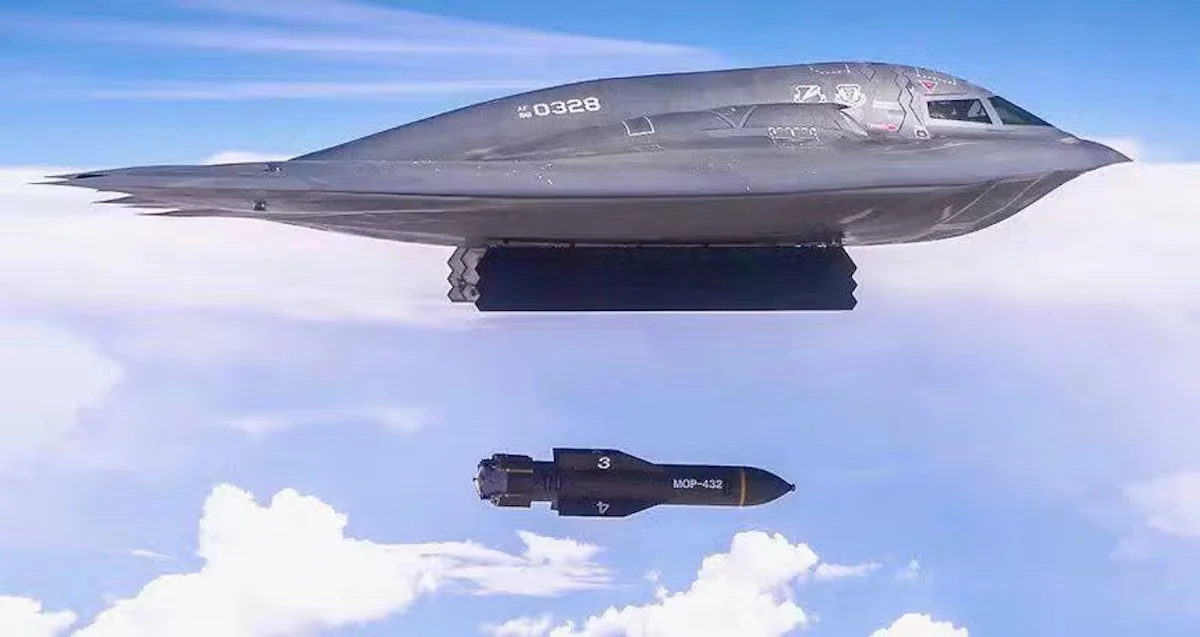
    GBU-57 MOP bomb

    Conclusion

    The use of the GBU-43/B MOAB bomb is highly dependent on specific geographical conditions and operational environments, particularly the absence of effective air defense. Although this weapon is suitable for destroying extensive positions, tunnel networks, and surface fortifications, clearing mined areas, and creating a severe psychological effect in asymmetric warfare, due to the nature of its airburst detonation and its inability to penetrate deep layers of the earth, it cannot serve as a substitute for bunker-busting munitions.

    On the other hand, compared with tactical nuclear weapons, the MOAB, despite possessing considerable mechanical destructive power, lacks the radiological effects of a nuclear explosion. This characteristic allows commanders to benefit from its high destructive capacity without imposing the political and strategic consequences of using a nuclear weapon.

    Overall, the MOAB is a weapon with limited production numbers whose place is defined in operations against inaccessible areas and specific conditions.

    Specifications of the GBU-43/B MOAB bomb:

    Type: Conventional high-explosive guided bomb with airburst fuse
    Origin: United States
    Producer: Dynetics
    Development: Since 2002
    Entered service: 2003
    Length: 9.18 meters
    Diameter: 1.03 meters
    Engine: None (free-fall bomb)
    Range: Approximately 5.5 kilometers (dependent on release altitude)
    Weight: 9,850 kilograms
    Warhead: BLU-120/B
    Explosive weight: Approximately 8,500 kilograms of H-6 type
    Explosive yield: Equivalent to approximately 11 tons of TNT
    Flight path: Free fall, controlled by four grid fins
    Guidance: GPS/INS combined
    Launch platforms: C-130 family transport aircraft (especially MC-130E Combat Talon I and MC-130H Combat Talon II)
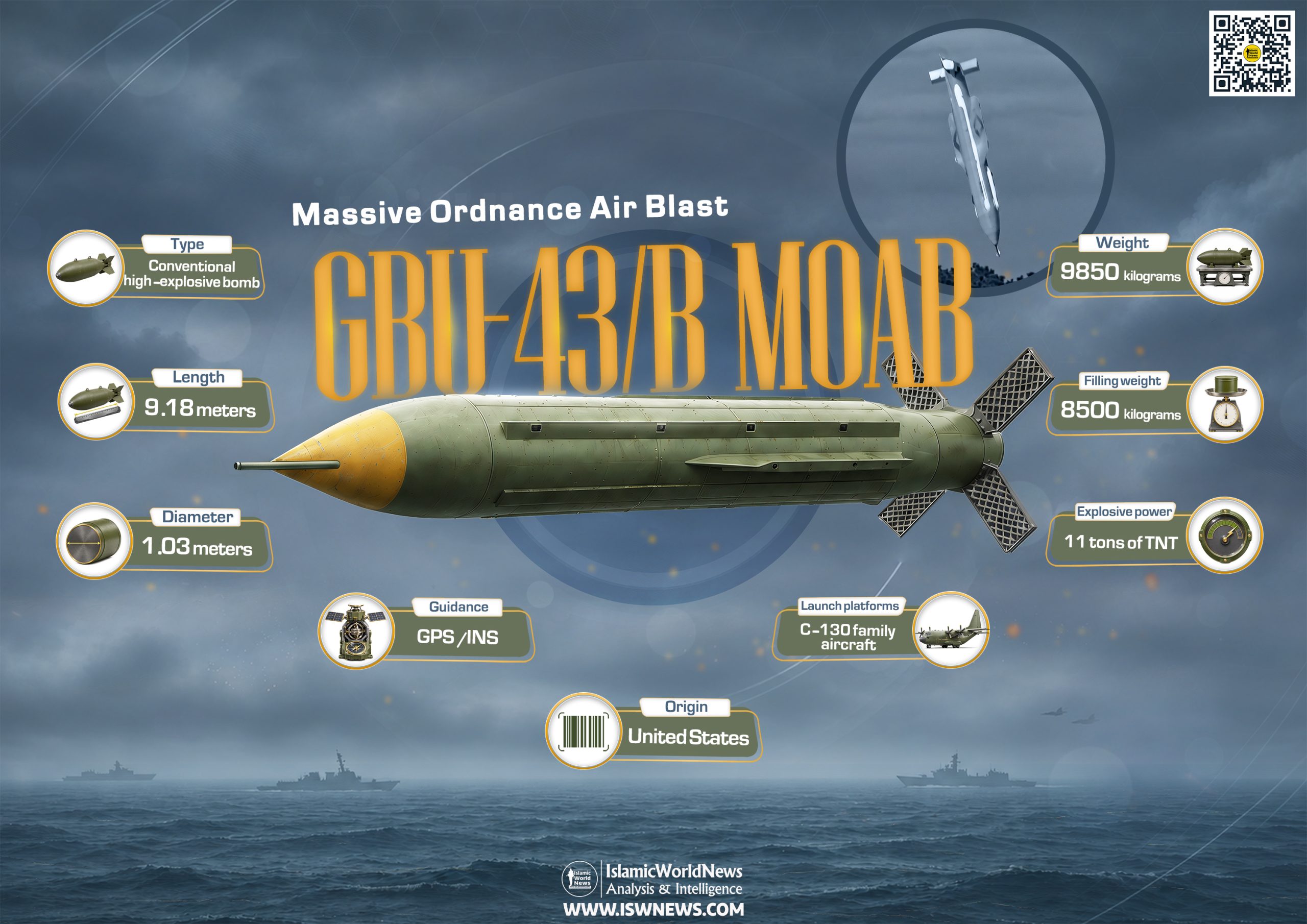
    GBU-43 Bomb | Click to view in a larger size

    Sources:

    GBU-43/B MOAB – Wikipedia | AFRL GBU-43/B MOAB – Designation-Systems.Net | What to Know About the GBU-43/B, ‘Mother of All Bombs’ – DSIAC | Dynetics GBU-43/B MOAB | KÜRE Encyclopedia | What is a GBU-43/B MOAB? – Boot Camp & Military Fitness Institute | GBU-43/B MOAB | Air Force Armament Museum Foundation | MOAB Explained: GBU-43 Mother of All Bombs, Tests & Combat | GBU-43/B MOAB – The Historical Marker Database | MOAB, the “mother of all bombs”: how far its blast reaches, and what | “The Mother of All Bombs”: Understanding the Massive Ordnance Air | Massive Ordnance Air Blast, MOAB – A Perspective | US drops ‘mother of all bombs’ on Islamic State tunnel | AP News | 2017 Nangarhar airstrike – Wikipedia | The US unleashed the ‘mother of all bombs’ onto an ISIS target in | Nuclear weapons compared to Conventional bombs – Reddit | “Lowest yield” atomic weapon possible – Physics Stack Exchange | TIL The smallest nuclear bomb(Davy Crockett) and the biggest non | Father of All Bombs – Wikipedia | GBU-57A/B MOP – Wikipedia | Father of All Bombs Explained: Russia’s FOAB Claims, Specs and | Can anyone verify the claims o
  • Latest field situation map in southwestern Yemen

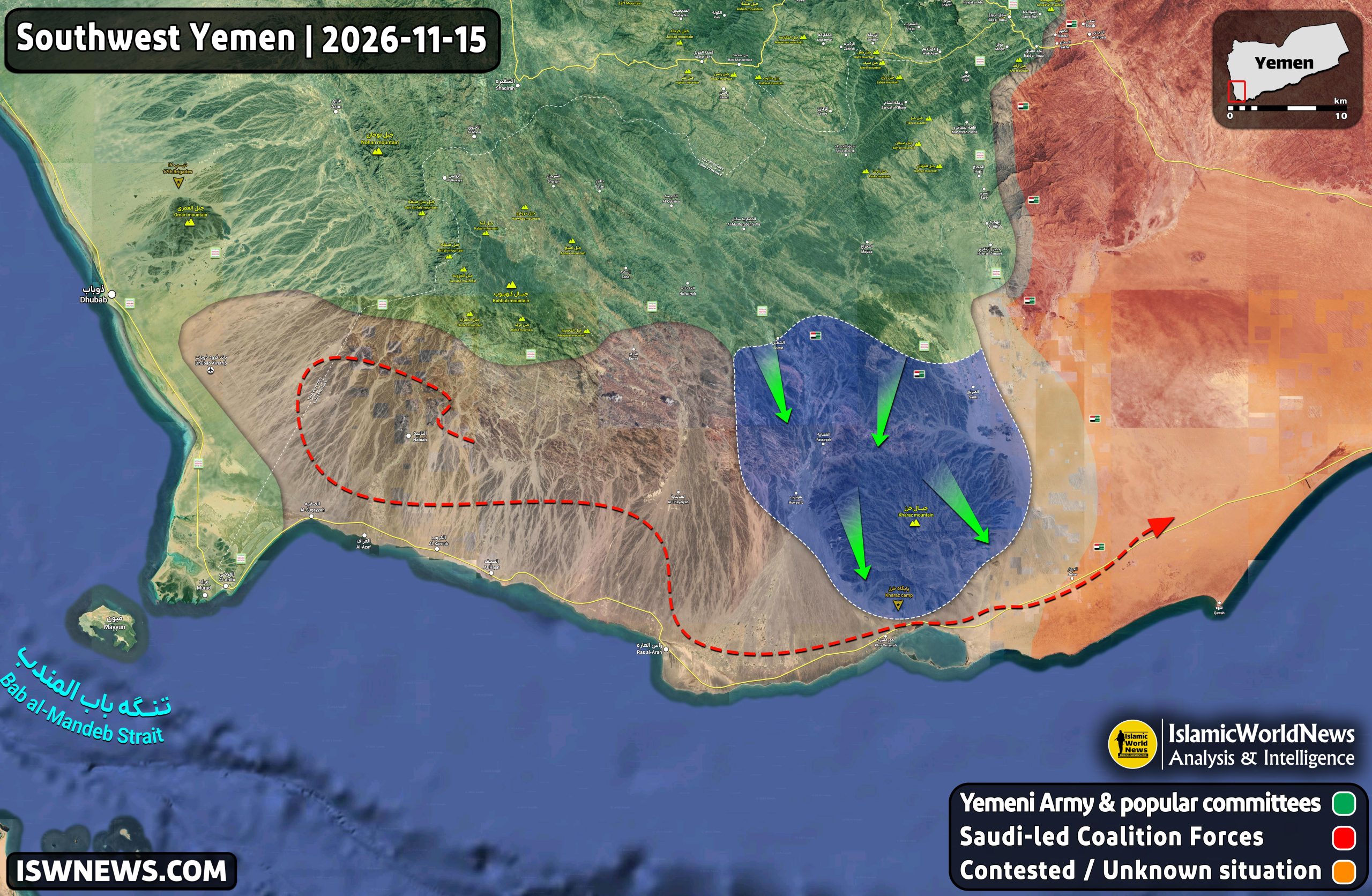
    Latest field situation map in southwestern Yemen

    Yemeni forces have not yet entered the Khawr Umayrah settlement, but they are deployed around it and on the Kharaz heights and can target the coastal road with anti-armor missiles and artillery munitions. Therefore, Saudi coalition forces in Ras al-Arah and on the eastern front of the Bab al-Mandab Strait have officially been encircled.

    In recent days, Ansarallah forces had repeatedly cut the aforementioned road with guerrilla attacks and hit-and-run tactics, but since yesterday this route has been completely cut off. It should be noted that a number of Saudi coalition forces fled toward Aden in recent days from the areas that were being besieged. However, after the encirclement was completed, a significant number of forces have been trapped in the Yemeni Army’s siege. No final decision has yet been made regarding the fate of these forces. It is possible that the coalition forces will withdraw from the area with the Yemeni Army’s permission, or there is the possibility of their complete capture.

    Click to view full size image
  • Military Knowledge: MQ-1C Grey Eagle Drone

    Military Knowledge: MQ-1C Grey Eagle Drone

    The roots of the MQ-1C Gray Eagle development can be traced back to the early 2000s, when the U.S. Army was seeking a replacement for the aging RQ-5 Hunter UAV. At the time, the Army’s primary requirement was a long-endurance reconnaissance-strike platform capable of carrying weapons, which, unlike UAVs operated by the U.S. Air Force, would be directly assigned to and operate in support of Army ground formations. Accordingly, the competition began in 2002. Two main contenders emerged: the Hunter II, developed through a collaboration between IAI and Northrop Grumman, and the Warrior, proposed by General Atomics.

    Ultimately, in August 2005, the U.S. Army officially selected the Warrior as the winner and awarded a $214 million development contract. The project, initially known as “Sky Warrior” and later renamed Gray Eagle, was based on the proven design of the MQ-1 Predator, but underwent extensive modifications to meet the Army’s specific operational and logistical requirements.

    RQ-5 Hunter drone

    From Predator to Gray Eagle – History and Development Philosophy of the MQ-1 UAV Family

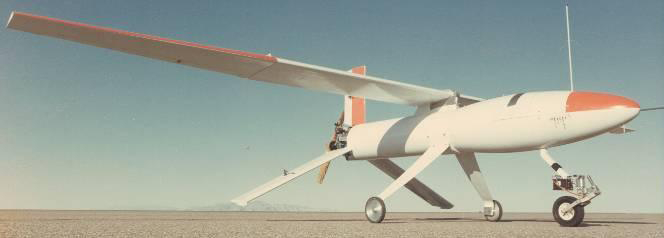
    The rationale behind the development of the MQ-1C Gray Eagle can be traced back to the evolutionary path of the MQ-1 Predator—a journey that began with a relatively simple reconnaissance concept and ultimately led to the emergence of a versatile combat platform. This development process began with the work of Abraham Karem, who, after serving in the Israeli Air Force, immigrated to the United States and founded Leading Systems. In 1981, he developed an early prototype known as the Albatross. The effort continued with support from DARPA, leading to the development of the Amber project between 1984 and 1986. After Congress abruptly terminated funding for the program and the company went bankrupt, General Atomics acquired Karem’s engineering team and continued developing the concept, eventually producing the Gnat-750, which was designed primarily for export.

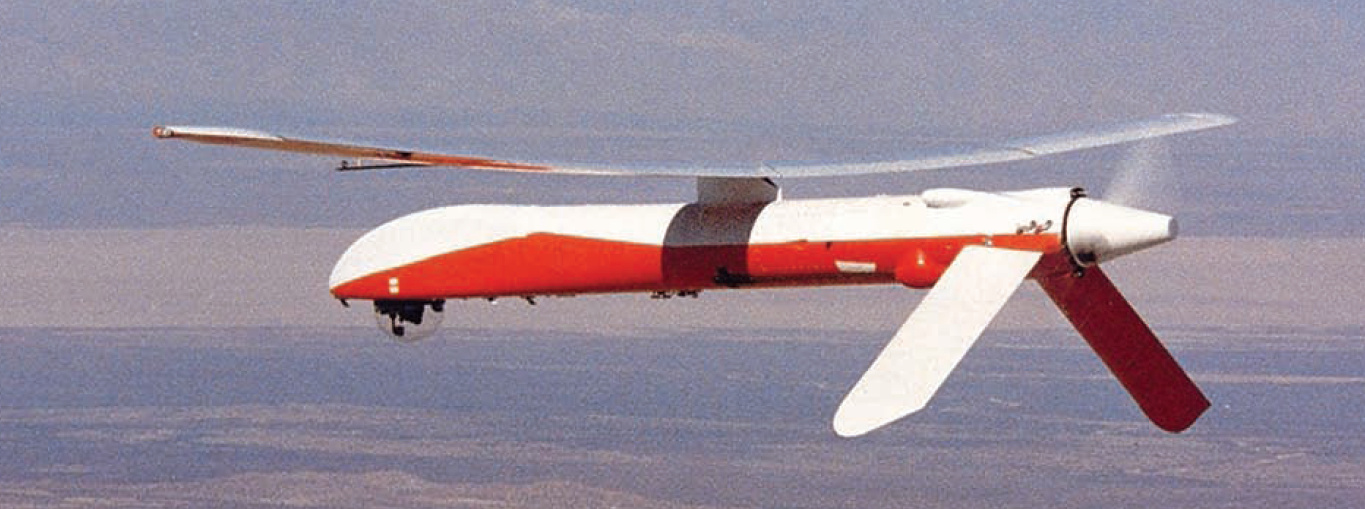
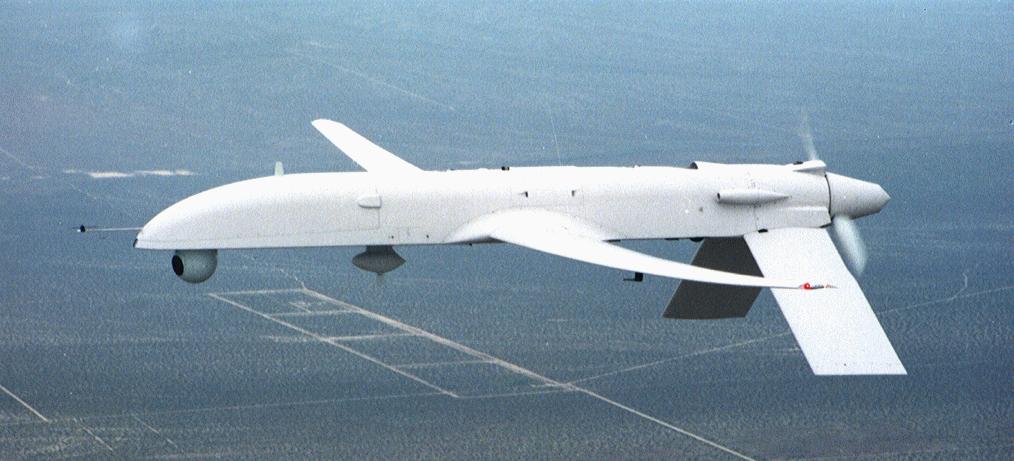
    In the early 1990s, the need for persistent surveillance of the Balkan crisis led the CIA and U.S. Air Force to adopt the UAV. However, its reliance on a line-of-sight data link limited its operational range. To overcome this limitation, the Pentagon awarded General Atomics a contract in January 1994 to develop a MALE (Medium-Altitude Long-Endurance) UAV, resulting in the Predator. By incorporating satellite communications, the aircraft effectively overcame the previous range limitation. The combination of a turbocharged engine, lightweight composite airframe, and multispectral sensors transformed it into a more capable and versatile reconnaissance platform.

    However, the real turning point came when the Predator was armed. The integration of the AGM-114 Hellfire missile transformed the aircraft into the world’s first operational armed combat UAV. This evolution required engineers to overcome complex challenges, including reinforcing the wing structure and managing the thermal and mechanical stresses generated during missile launches. Following this upgrade, the aircraft was redesignated MQ-1 in 2002.

    Arming the Predator introduced a new doctrine in modern warfare, often referred to as the “Predator paradigm.” It was based on persistent surveillance over a target, precision strikes against high-value targets, reduced collateral damage, and the ability to conduct operations remotely without placing aircrews at risk. However, the platform had structural limitations from the outset and was ultimately regarded as an interim solution. The UAV served with the U.S. Air Force from 2002 to 2018, and despite its relatively short service period, it underwent continuous upgrades and generated valuable operational experience that informed the development of subsequent UAV generations.

    The main factor behind its eventual retirement was the parallel development of a larger platform, the MQ-9 Reaper. Compared with the Predator, the Reaper offered roughly five times the payload capacity along with substantially greater engine power. It made its first flight in 2001 and entered service in 2007. With its significant advances and subsequent upgrades, the Reaper remains one of the key platforms underpinning U.S. unmanned aerial capabilities.

    Read more: Military Knowledge: MQ-9 Reaper Drone

    MQ-9 Reaper drone

    At the same time, as the 2000s began, the role of UAVs was becoming firmly established. While the U.S. Air Force was moving toward heavier platforms such as the Reaper, the U.S. Army required a UAV that could be placed directly under the control of field commanders and tailored to the logistical and operational requirements of ground units. This requirement ultimately led to the development of the Gray Eagle—a UAV that may resemble the Predator externally, but in reality represents a major redesign based on a fundamentally different operational philosophy.

    Introduction to the Gray Eagle — Redesigning the Aerodynamics, Electronics, and Propulsion

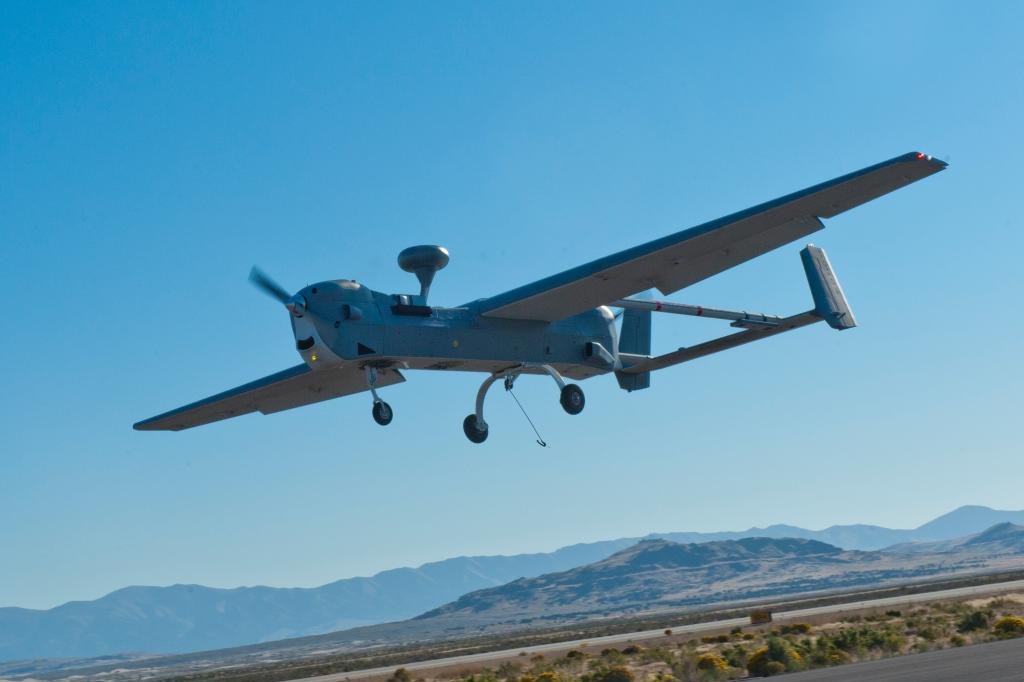
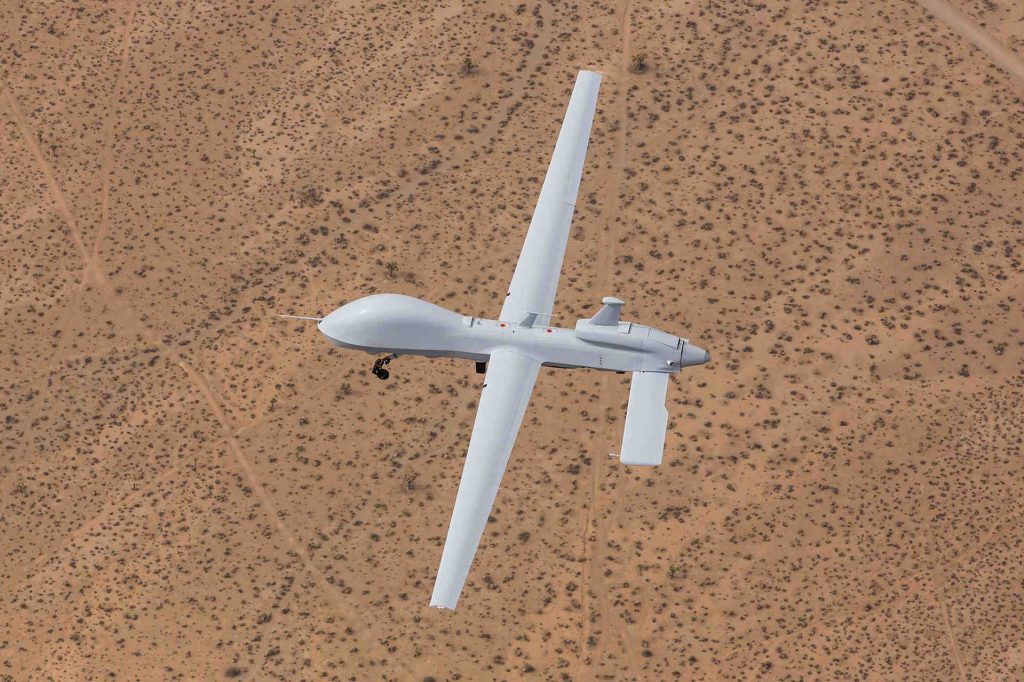
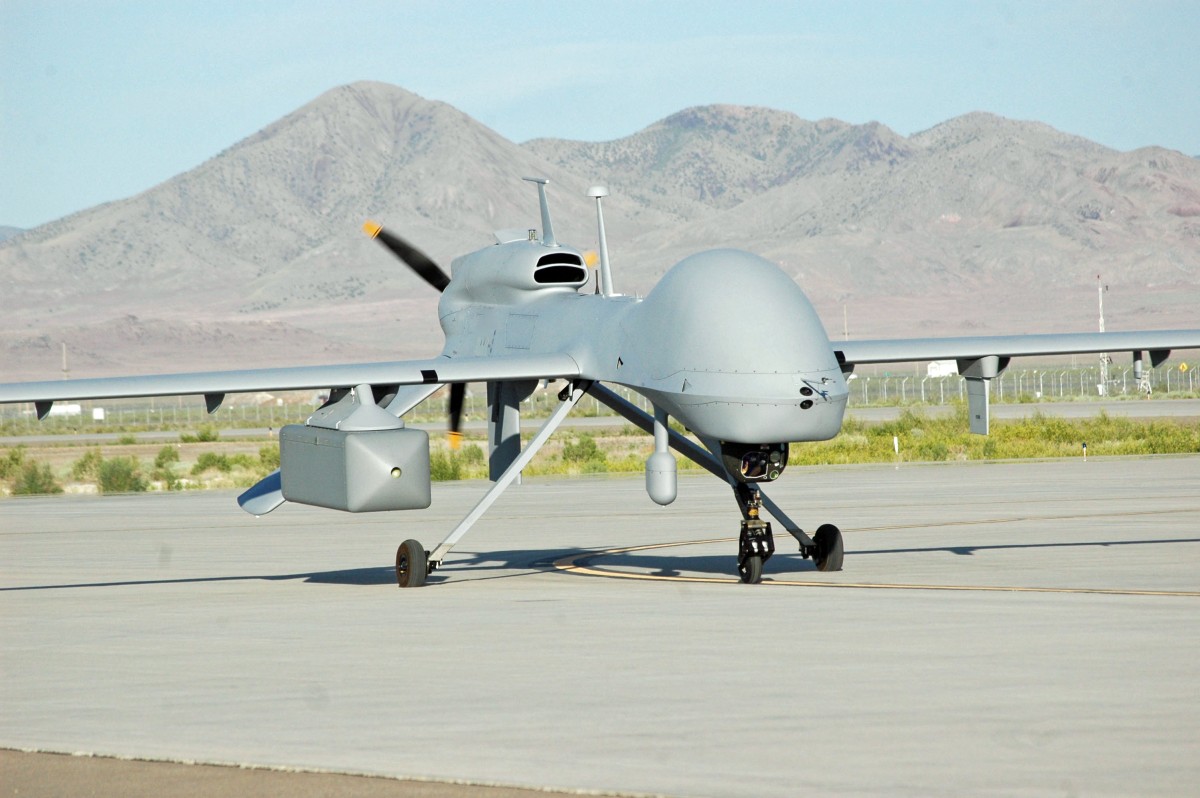
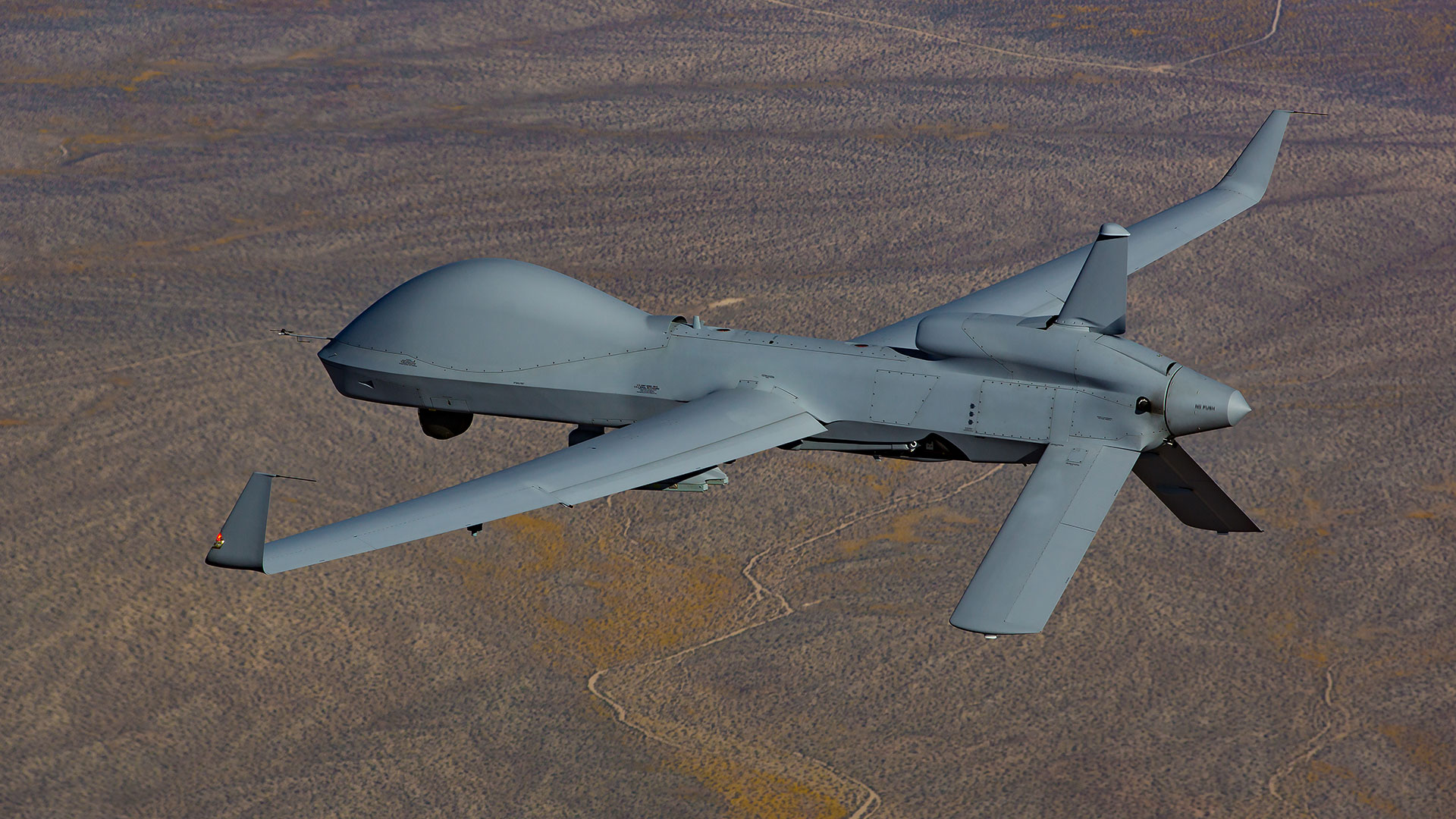
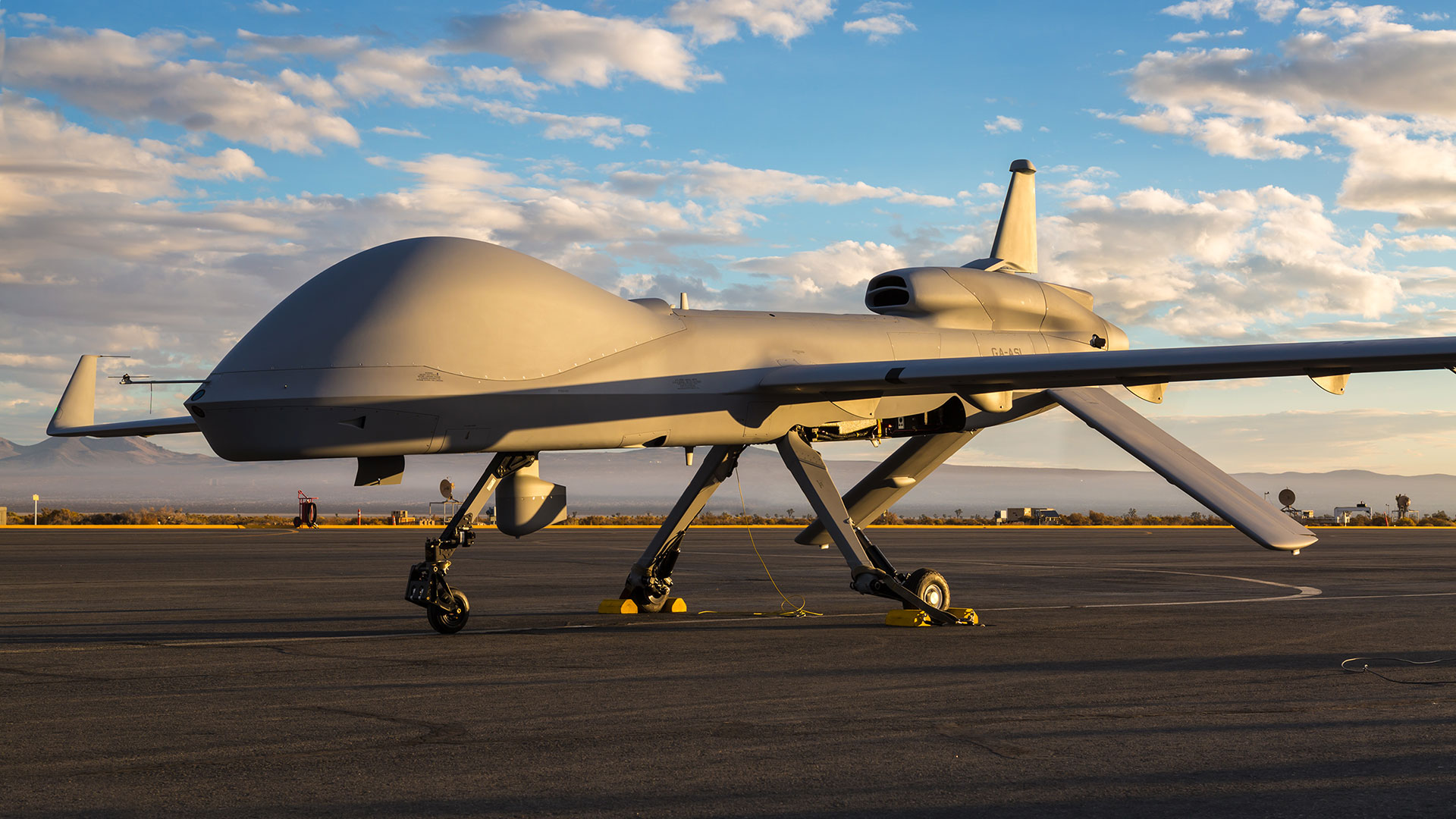
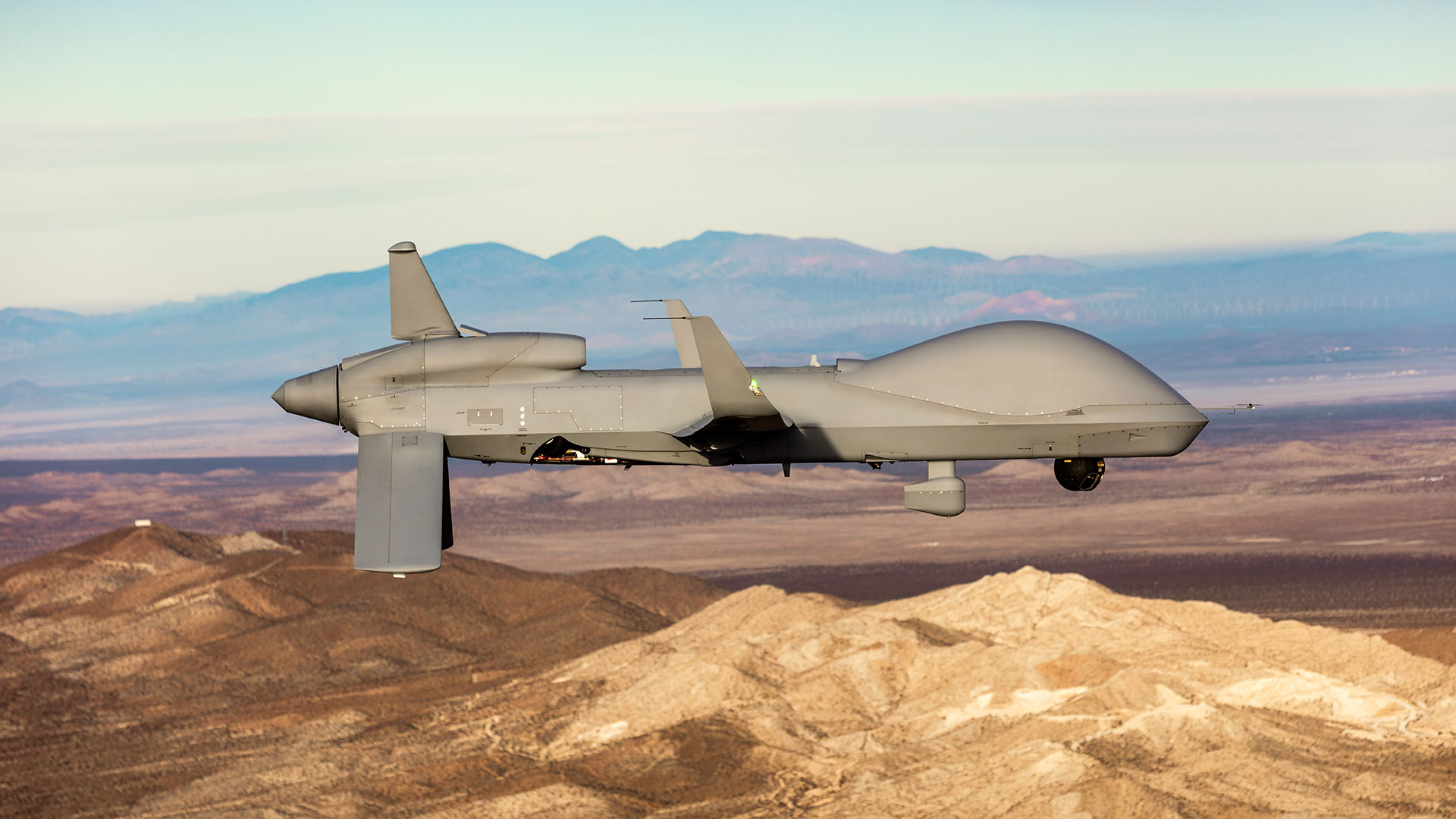
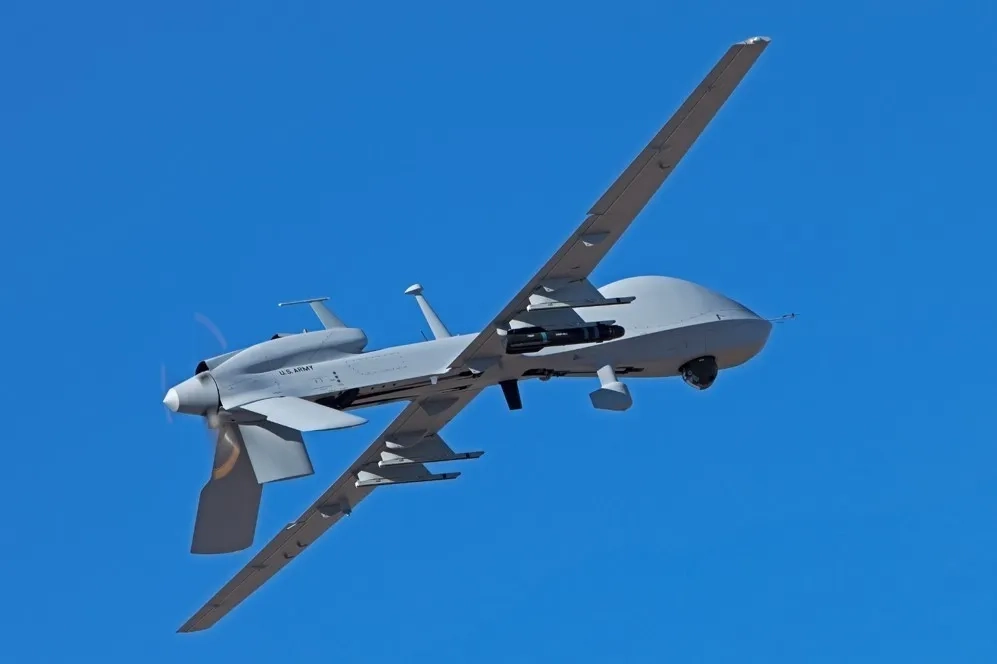
    The Gray Eagle underwent extensive redesign to meet the operational requirements of the U.S. Army, to the extent that it can be regarded as a largely distinct platform. Although it retains a visual resemblance to the Predator, significant engineering differences are evident. Its wingspan was increased to approximately 17 meters, improving the lift-to-drag ratio, enhancing stability at medium altitudes, and reducing fuel consumption.

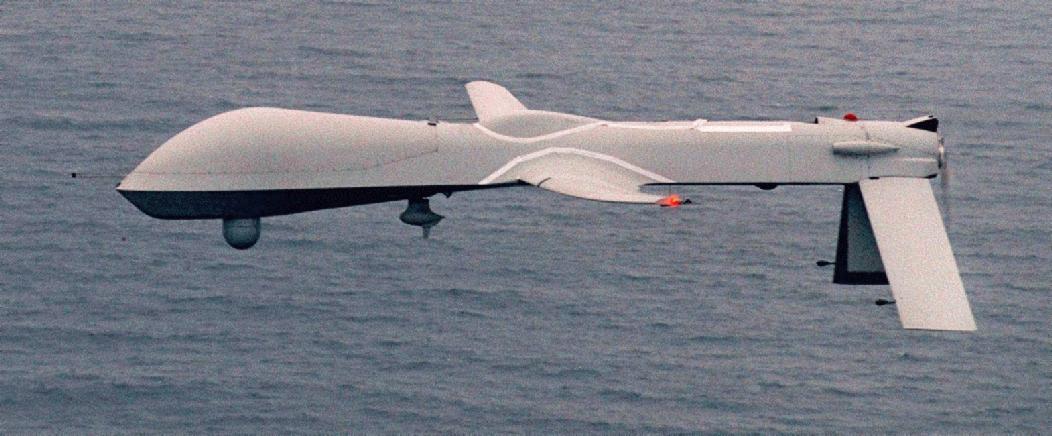
    MQ-1 Grey Eagle

    The airframe was designed with a damage-tolerant approach, while the Extended Range variant incorporates a deep-belly design. This modification increased internal fuel capacity from approximately 575 pounds to around 900 pounds, while also optimizing the center of gravity to accommodate heavier payloads on the central hardpoint.

    One of the most significant advancements was the introduction of an automatic takeoff and landing system. Unlike the Predator, which required a high degree of pilot skill and experienced a significant proportion of accidents during the landing phase, the Gray Eagle can perform both takeoff and landing fully autonomously. The system relies on precise Ku-band radar sensors and had recorded more than 20,000 successful landings by 2013.

    One of the major logistical challenges faced by the U.S. Army on the battlefield is the need to simultaneously supply multiple types of fuel. To address this issue, the Army follows a “single-fuel” doctrine, under which platforms are expected to operate on a common fuel such as JP-8 or diesel. By contrast, the Rotax engines used on earlier UAVs relied on aviation gasoline, which was not part of the Army’s standard battlefield fuel supply chain.

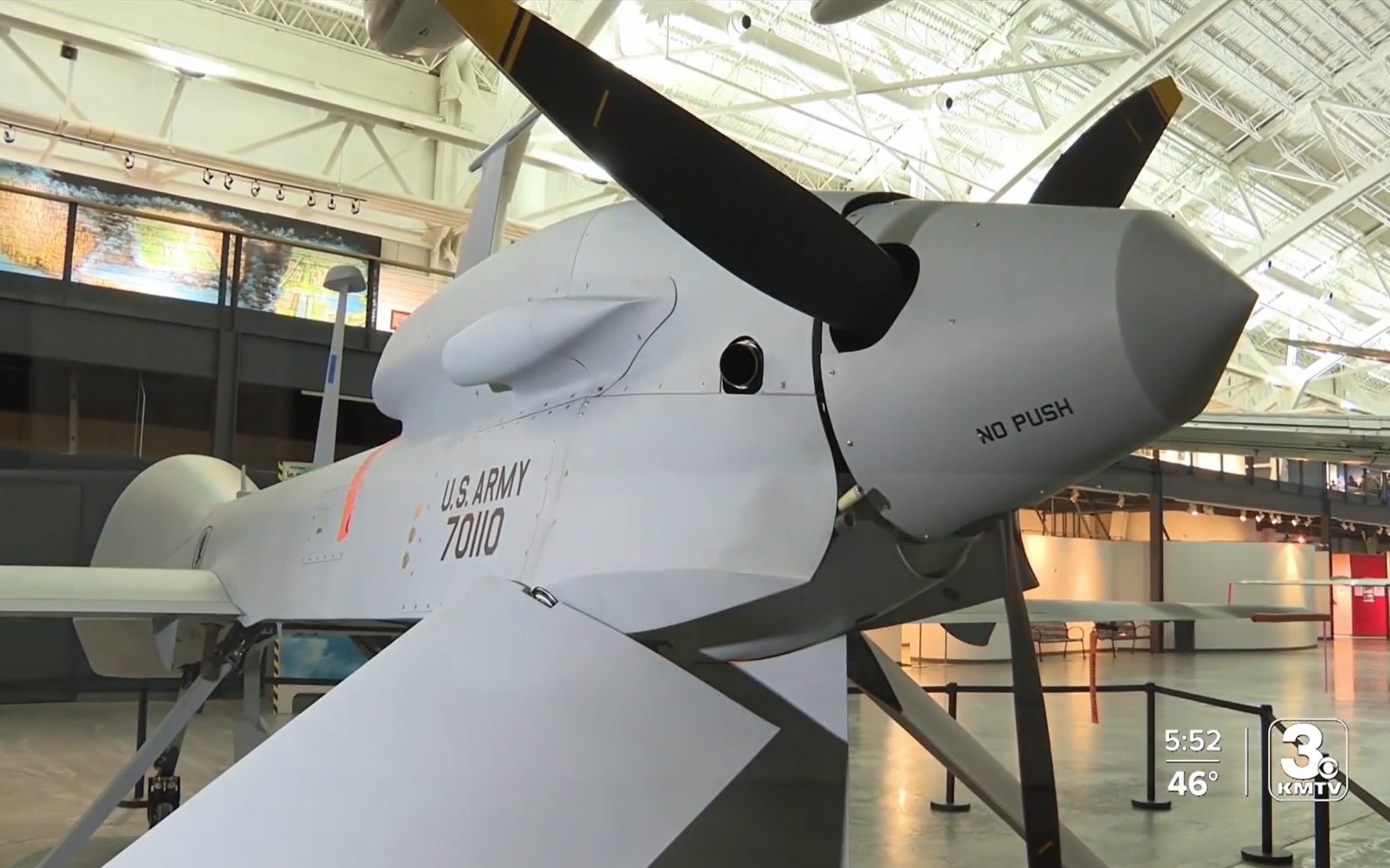
    In response to this limitation, the MQ-1C Gray Eagle was equipped with the Thielert Centurion 1.7 heavy-fuel engine, a 165-horsepower diesel piston engine that used digital engine control to significantly improve fuel efficiency. This approach continued in later variants. In the Extended Range version, the more powerful Lycoming DEL-120, producing 180 horsepower, replaced the earlier engine, providing increased power as well as longer maintenance intervals. The latest 25M variant introduces the HFE 2.0 engine, rated at 200 horsepower, and equipped with dual 7-kilowatt generators to provide electrical power for advanced sensor systems.

    MQ-1C Gray Eagle drone propulsion system

    اThe use of heavy fuel offers more than just a logistical advantage; because of its higher energy density, it also contributes to increased endurance. The standard Gray Eagle can remain airborne for approximately 25 to 30 hours, while the ER variant, equipped with external fuel tanks, can extend endurance to around 50 hours.

    MQ-1C Sensor and Electronic Warfare Capabilities

    The MQ-1C Gray Eagle was designed around the requirement to provide battlefield commanders with accurate, persistent, and real-time intelligence. As a result, its nose section was enlarged compared with the previous generation, creating additional space for advanced systems, including synthetic aperture radar (SAR) and electro-optical targeting systems.

    AN/AAS-52 MTS Electro-Optical System — Mounted beneath the nose is the AN/AAS-52 Multispectral Targeting System (MTS). The system incorporates high-resolution infrared sensors, powerful day cameras, and a laser designator. This combination allows operators to identify and track targets in considerable detail from altitudes of around 25,000 feet. In addition to its surveillance capabilities, the integrated laser designator plays a key role in guiding precision weapons such as AGM-114 Hellfire missiles and laser-guided bombs. The Gray Eagle can also accommodate other multispectral electro-optical imaging systems, including the Raytheon AN/AAS-53 and the DAS-2 pod, mounted beneath the wings.

    Read more: Military Knowledge: Raytheon Multi-Spectral Targeting Systems

    The AN/AAS-53 system under the nose of the MQ-1C UAV.

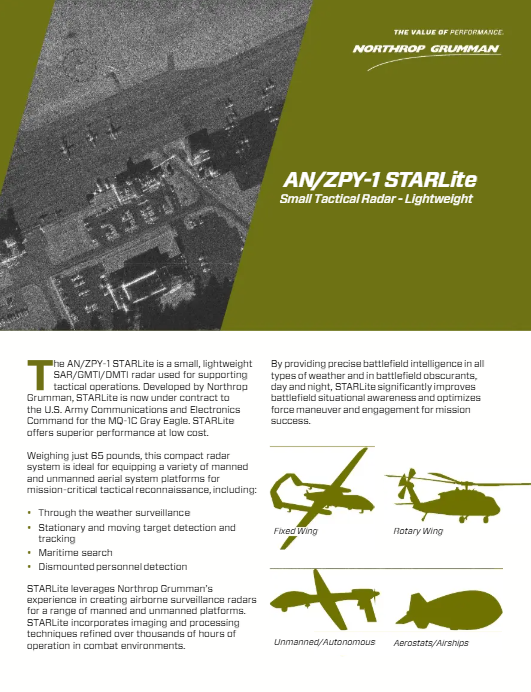
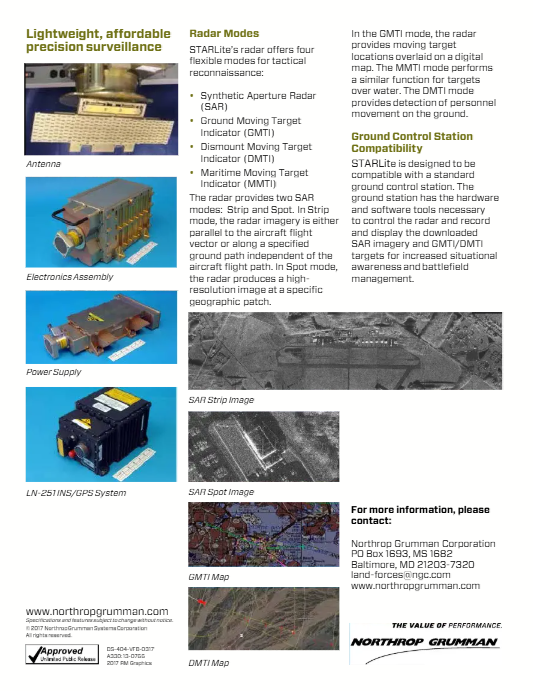
    Synthetic Aperture Radar — The AN/ZPY-1 STARLite radar, developed by Northrop Grumman, is one of the Gray Eagle’s key capabilities for operating in adverse weather and difficult environmental conditions, including cloud cover, fog, smoke, and sandstorms. Mounted within the UAV’s forward radar fairing, the system provides several advanced capabilities:

    • Synthetic Aperture Radar (SAR) Imaging: Generates detailed, high-resolution maps of the ground surface day or night, even under conditions that can limit conventional electro-optical sensors.
    • Ground Moving Target Indicator (GMTI): Detects, identifies, and tracks moving targets such as vehicles, displaying their movements on a digital map.
    • Change Detection: Compares radar imagery collected at different times to identify subtle changes on the ground, such as new tire tracks or disturbed soil, which may indicate potential threats such as improvised explosive devices (IEDs).

    Electronic Warfare

    In addition to its electro-optical systems, the MQ-1C Gray Eagle is also equipped with electronic warfare (EW) capabilities. One of its most important systems is NERO, a variant of the CEASAR system used aboard C-12 aircraft. It enables the UAV to disrupt enemy communications and telecommunications networks, effectively providing an electronic protection layer for ground forces.

    NERO Electronic Warfare System

    MQ-1C Network-Centric Warfare Capabilities

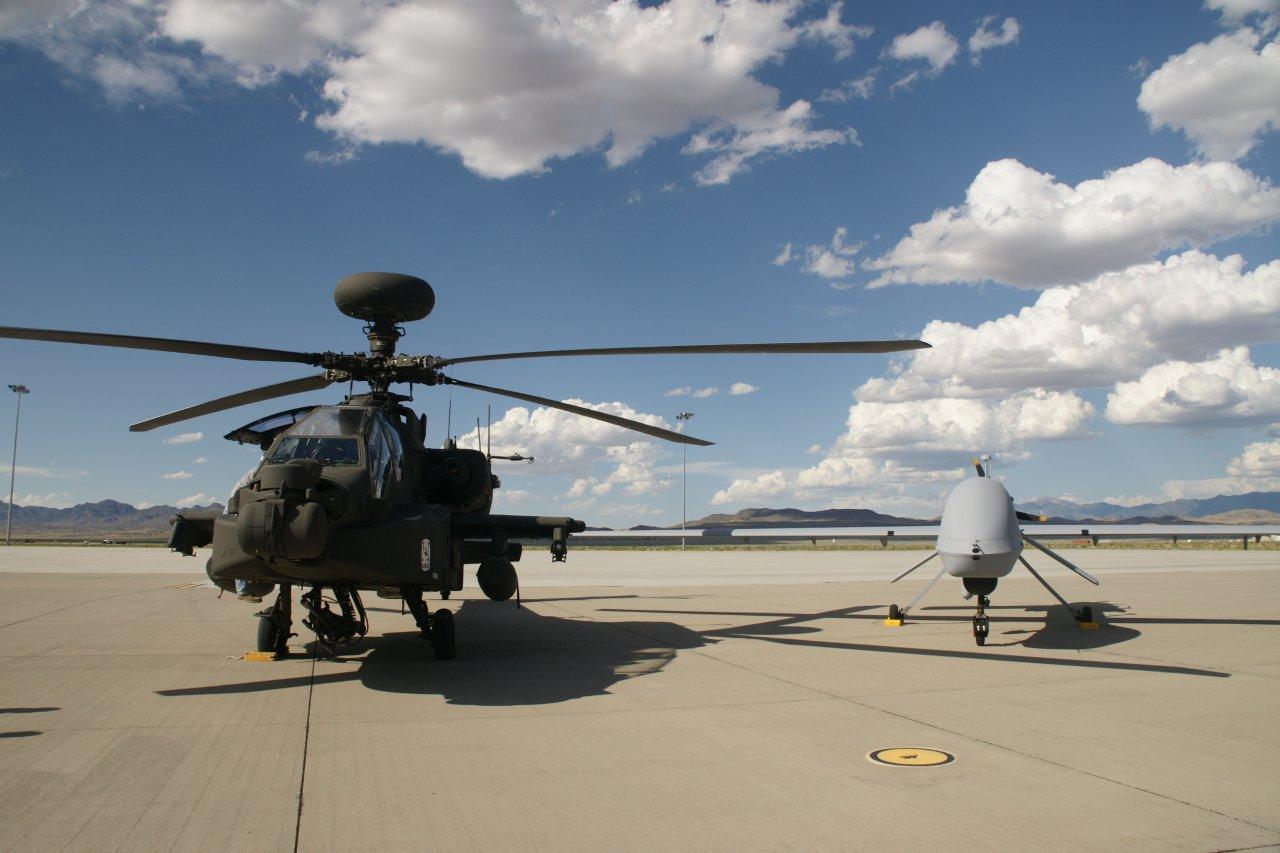
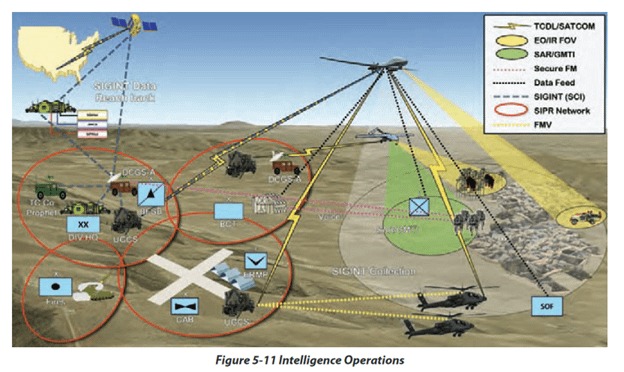
    One of the most advanced applications of the MQ-1C within the U.S. Army is its tactical integration with the AH-64 Apache attack helicopter through the Manned-Unmanned Teaming (MUM-T) concept. Under this doctrine, the UAV serves as an aerial scout, operating ahead of manned platforms. From inside the cockpit, an Apache pilot can receive live imagery from the Gray Eagle’s sensors and, depending on the level of MUM-T integration, control or direct those sensors. This high level of information integration provides helicopter crews with a significantly clearer picture of the battlefield and improves their ability to identify and respond to threats.

    A direct benefit of this cooperation is the increased survivability of manned helicopters. The Gray Eagle can detect targets and enemy air-defense systems from distances beyond the helicopter’s immediate engagement range and can use laser designation to mark targets for weapons carried by the Apache. Field exercises at Dugway Proving Ground demonstrated the potential of combining Apache helicopters and UAVs within a networked architecture to conduct complex target-engagement missions with a high degree of precision.

    مفهوم“Manned-Unmanned Teaming” (MUM-T) is essentially a framework consisting of different levels of interaction between the helicopter and UAV:

    • Level 2: The Apache pilot can only receive live imagery from the Gray Eagle’s sensors.
    • Levels 3 and 4: The pilot can control the UAV’s camera and, at higher levels of integration, can also control its flight path.
    • Level 5: Full control of the UAV, from takeoff to landing, by the helicopter crew. This level remains under advanced development.

    Under this concept, the helicopter can remain concealed behind natural terrain such as mountains or elevated ground, while the Gray Eagle operates within the enemy’s line of sight to conduct reconnaissance. Targeting information is transmitted to the Apache in real time, and when required, a missile can be guided to the target using laser designation provided by the UAV.

    MQ-1C Derived Variants

    As the U.S. Army shifted its focus from counterinsurgency operations toward Large-Scale Combat Operations (LSCO) and potential conflicts with peer adversaries, the operational demand for greater endurance, increased payload capacity, and broader mission flexibility drove the development of new variants of the MQ-1C Gray Eagle.

    MQ-1C Gray Eagle Extended Range (GE-ER): Previously known as the Improved Gray Eagle, this variant was developed to increase endurance and overall operational capability. Its most significant structural modification was a substantial increase in internal fuel capacity.

    The GE-ER is equipped with an upgraded 180-horsepower engine and redesigned wings, allowing it to remain airborne for up to 42 hours continuously. With the addition of external fuel tanks, endurance can reportedly be extended to approximately 50 hours. The variant was designed to support operations at higher echelons, including division- and corps-level formations, while its internal payload capacity was increased to approximately 540 pounds.

    Gray Eagle 25M (Modernized): The most advanced member of the family is the GE-25M, which was designed for multi-domain operations and developed around an open systems architecture. This architecture enables rapid and cost-effective upgrades to the platform’s sensors and software.

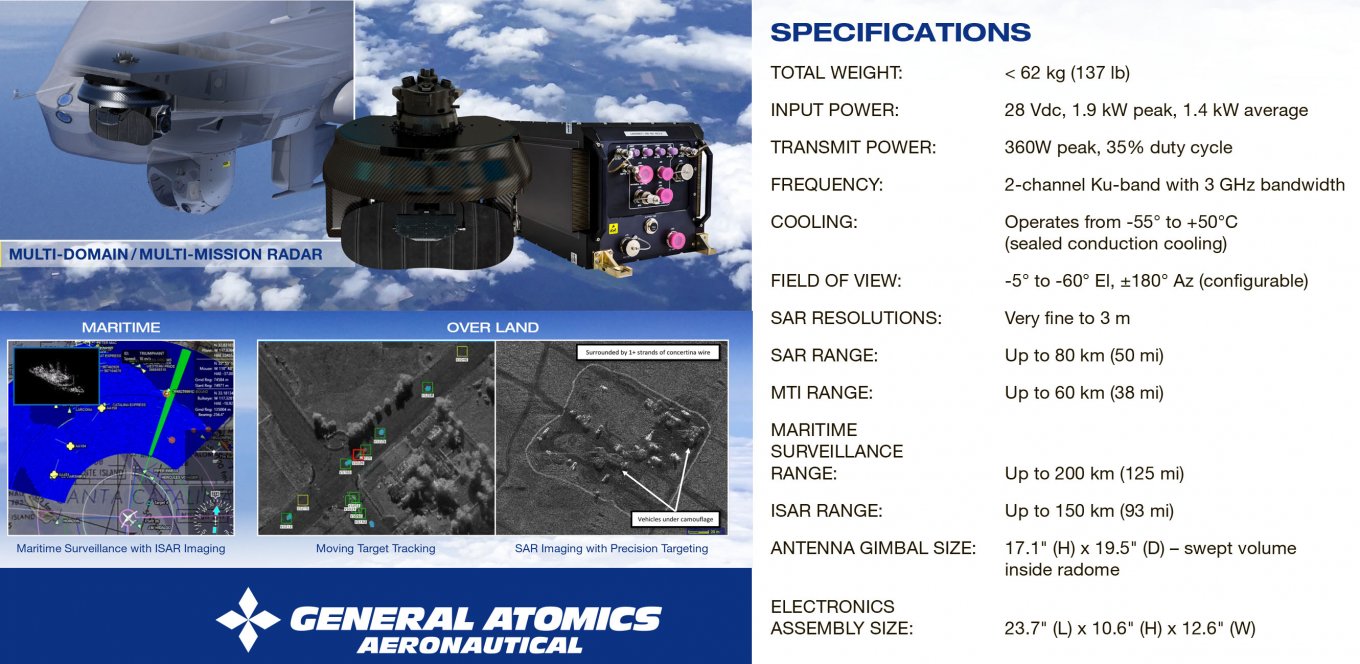
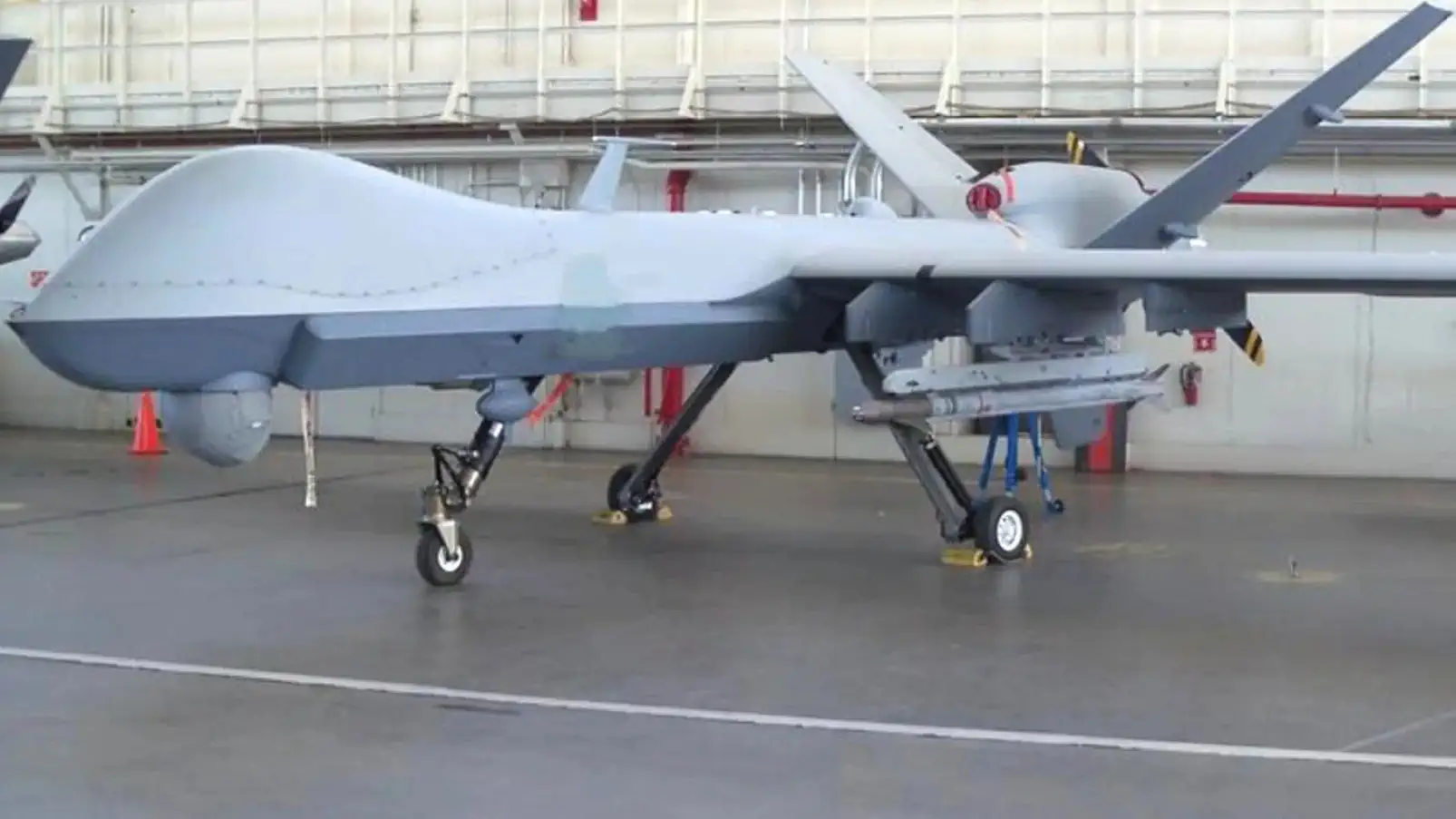
    Key features of this variant include the 200-horsepower HFE 2.0 engine and an upgraded electrical power-generation system; the EagleEye radar, which offers approximately five times greater range and the ability to simultaneously detect and track both ground and maritime targets; advanced Electronic Warfare (EW) systems, including ELINT/COMINT, for detecting, identifying, and geolocating enemy air-defense radars; and increased weapons capacity, allowing the aircraft to carry up to eight AGM-114 Hellfire missiles using dual-rail underwing hardpoints.

    EagleEye Radar Specifications

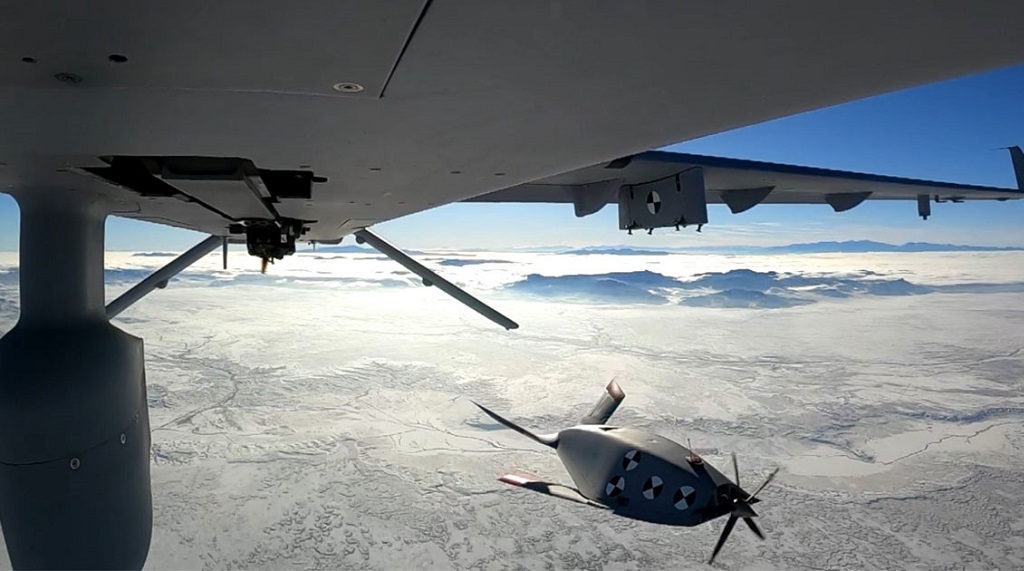
    With the emergence of advanced air-defense systems on modern battlefields, the survivability of relatively slow UAVs such as the Gray Eagle has become increasingly challenging. In response to this threat, the 25M variant has been developed alongside a mothership concept. Under this architecture, the Gray Eagle serves as a “mother ship” for smaller loitering munitions and decoy UAVs. Platforms such as the Eaglet can be launched from beneath its wings and penetrate deep into enemy air-defense networks, where they can either destroy targets through suicide attacks or open the way for the main operation through electronic disruption and reconnaissance.

    Launch of the Eaglet UAV from the MQ-1C

    In the latest upgrades, advanced ELINT systems, installed on the fleet since 2026, enable the Gray Eagle to detect and geolocate enemy radar emissions from very long distances, remaining outside the engagement range of most air-defense systems. This information can then be transmitted in real time to long-range fire systems such as HIMARS, allowing enemy air-defense assets to be engaged before the UAV enters the threat zone.

    Read more: Military Knowledge: M142 HIMARS Multiple Rocket Launcher

    MQ-1C Defensive Capabilities:

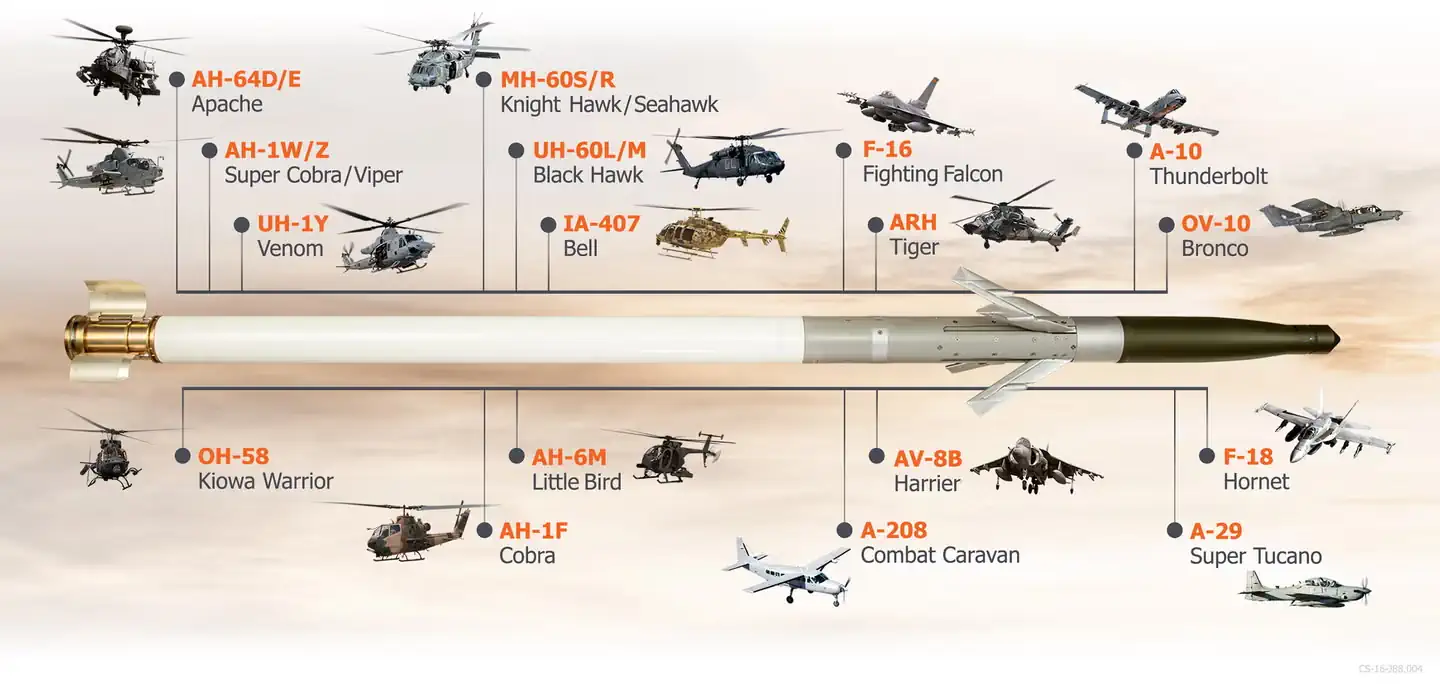
    Despite the U.S. Army’s current decision to halt further procurement, one of the Gray Eagle’s emerging capabilities is the use of air-to-air weapons to engage and destroy UAVs. In particular, the latest generation of the Gray Eagle family incorporates several newly developed capabilities. Lockheed Martin is currently planning to integrate the UAV-mounted synthetic aperture radar with the Hellfire missile. The EagleEye radar can detect and track ground targets at ranges of up to 50 miles (80 km) and maritime targets at up to 124 miles (200 km), although its effectiveness against airborne threats has yet to be established. Nevertheless, with a new active electronically scanned array (AESA) antenna and software currently under development, the radar is expected to achieve greater range and improved performance.

    Within this framework, a specialized version of the Hellfire missile known as the Longbow Hellfire will be employed. Although the AGM-114 Hellfire was originally developed as an air-to-ground weapon and has primarily been used in that role, the Longbow variant uses millimeter-wave guidance, giving it the potential to perform an air-defense role against UAVs.

    MQ-1C drone equipped with a Hellfire missile

    It is worth noting that the US Air Force has successfully integrated the AIM-9X air-to-air missile onto its MQ-9 Reaper drone. This combination achieved its first “kill” during a 2017 exercise. Shortly thereafter, the service announced plans to develop air defense capabilities for unmanned platforms, thereby providing them with significant self-protection. This initiative could also complement developments regarding the MQ-1C. In this context, the use of laser-guided rockets, such as the APKWS, is to be expected.

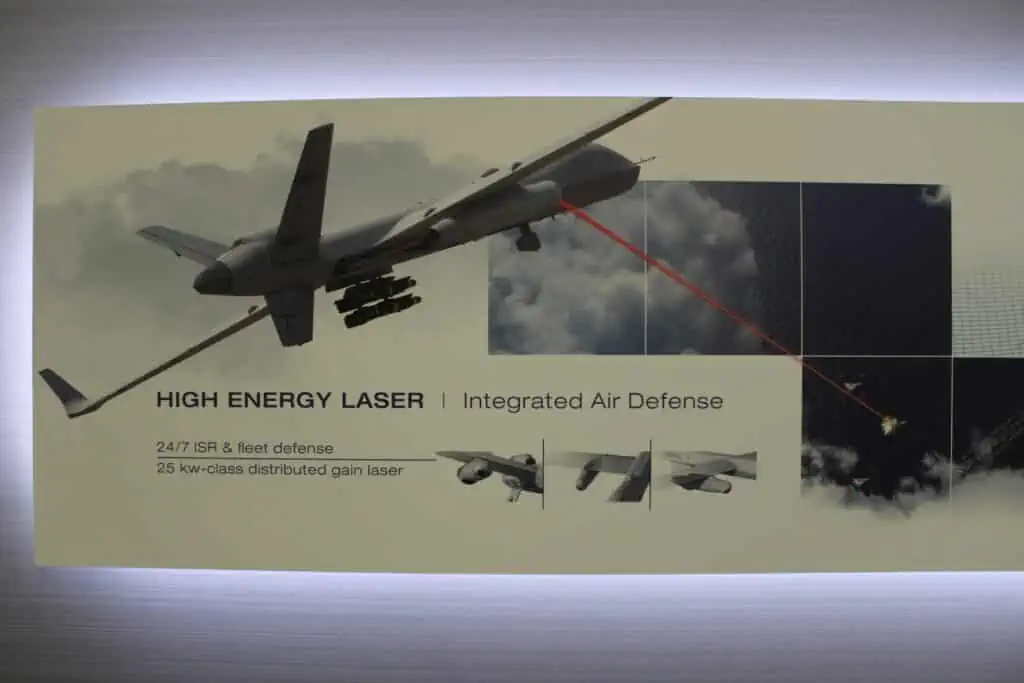
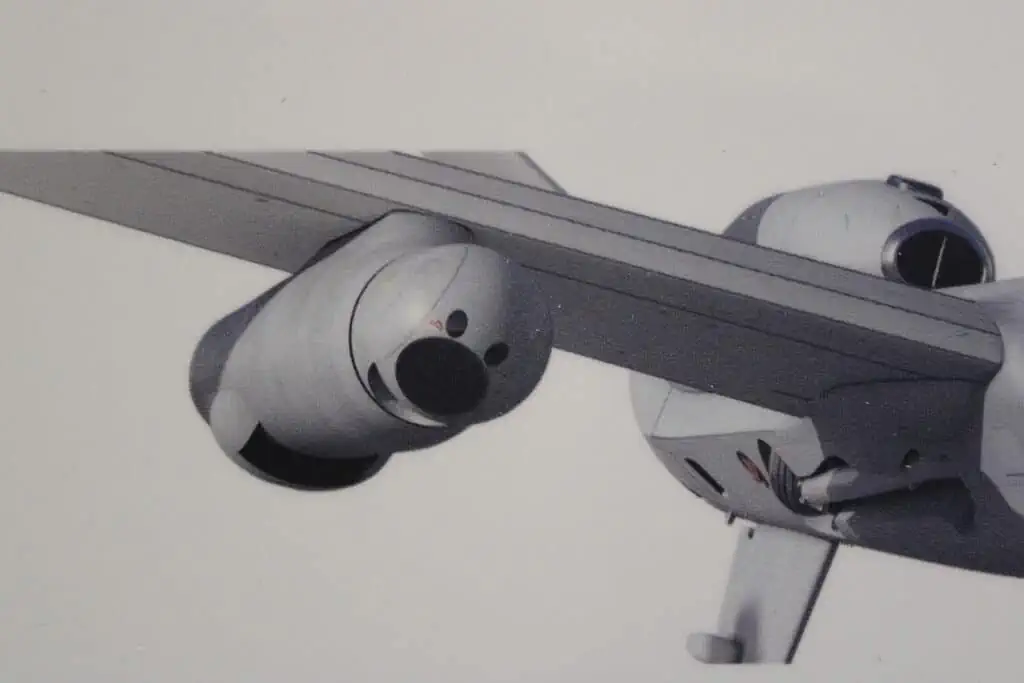
    Meanwhile, the use of laser pods represents another option. This capability—currently under development as a concept—was previously showcased in a graphic at the Air Force Association’s Air Warfare Symposium, featuring the MQ-9B SkyGuardian drone. Notably, GA-ASI is primarily marketing this pod for fleet defense against suicide drones.

    MQ-1C Grey Eagle Specifications:

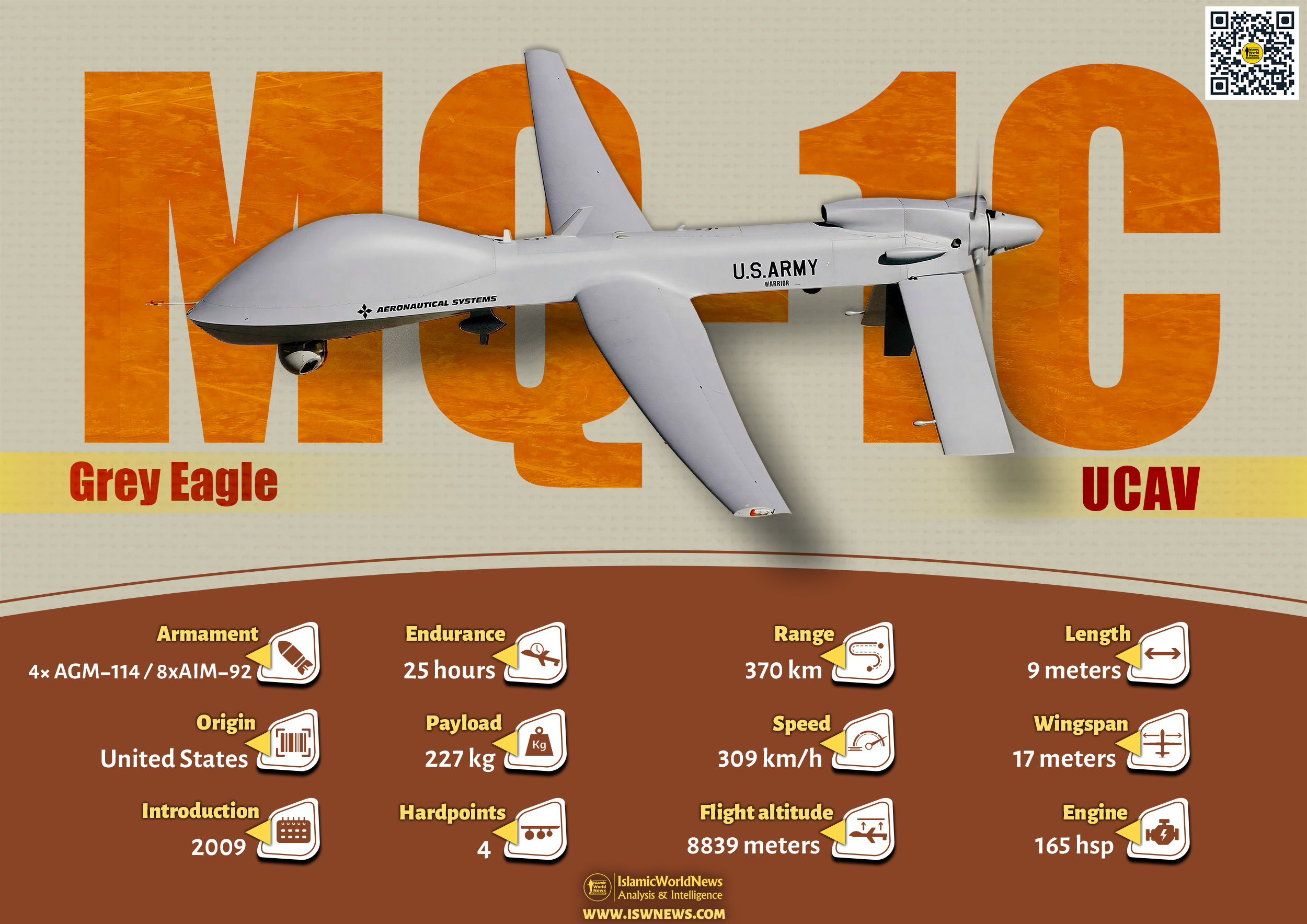
    Type: Reconnaissance-strike UAV
    Country of origin: United States
    Manufacturer: General Atomics
    Introduction: 2009
    Length: 9 m
    Wingspan: 17 m
    Height: 2.1 m
    Engine: One Thielert Centurion 1.7 engine, producing 165 hp
    Range: 370 km
    Maximum speed: 309 km/h
    Service ceiling: 8,839 m (29,000 ft)
    Endurance: 25 hours
    Maximum takeoff weight: 1,633 kg
    Fuel capacity: 261 kg
    Payload: 227 kg
    Hardpoints: 4
    Armament: 4 AGM-114 Hellfire missiles or 8 AIM-92 Stinger rockets

    ER Variant Specifications:

    Wingspan: ~17–18 m
    Length: 9 m
    Engine: 180 hp
    Maximum takeoff weight: 1,905 kg
    Fuel capacity: 408 kg
    Internal payload capacity: 181 kg
    Payload: 227 kg
    Service ceiling: 8,839 m (29,000 ft)
    Endurance: 42 hours
    Maximum speed: 309 km/h

    ER Block 25 Specifications:

    Wingspan: 17 m
    Length: 9 m
    Engine: 200 hp (HFE 2.0)
    Maximum takeoff weight: 1,905 kg
    Fuel capacity: 408 kg
    Internal payload capacity: 181 kg
    Payload: 227 kg
    Service ceiling: 25,000 ft
    Endurance: 40+ hours
    Maximum speed: 309 km/h

    MQ-1C Gray Eagle combat-reconnaissance UAV – click to view in full size
  • Turkey’s Aeroballistic Missile Family

    Turkey’s Aeroballistic Missile Family

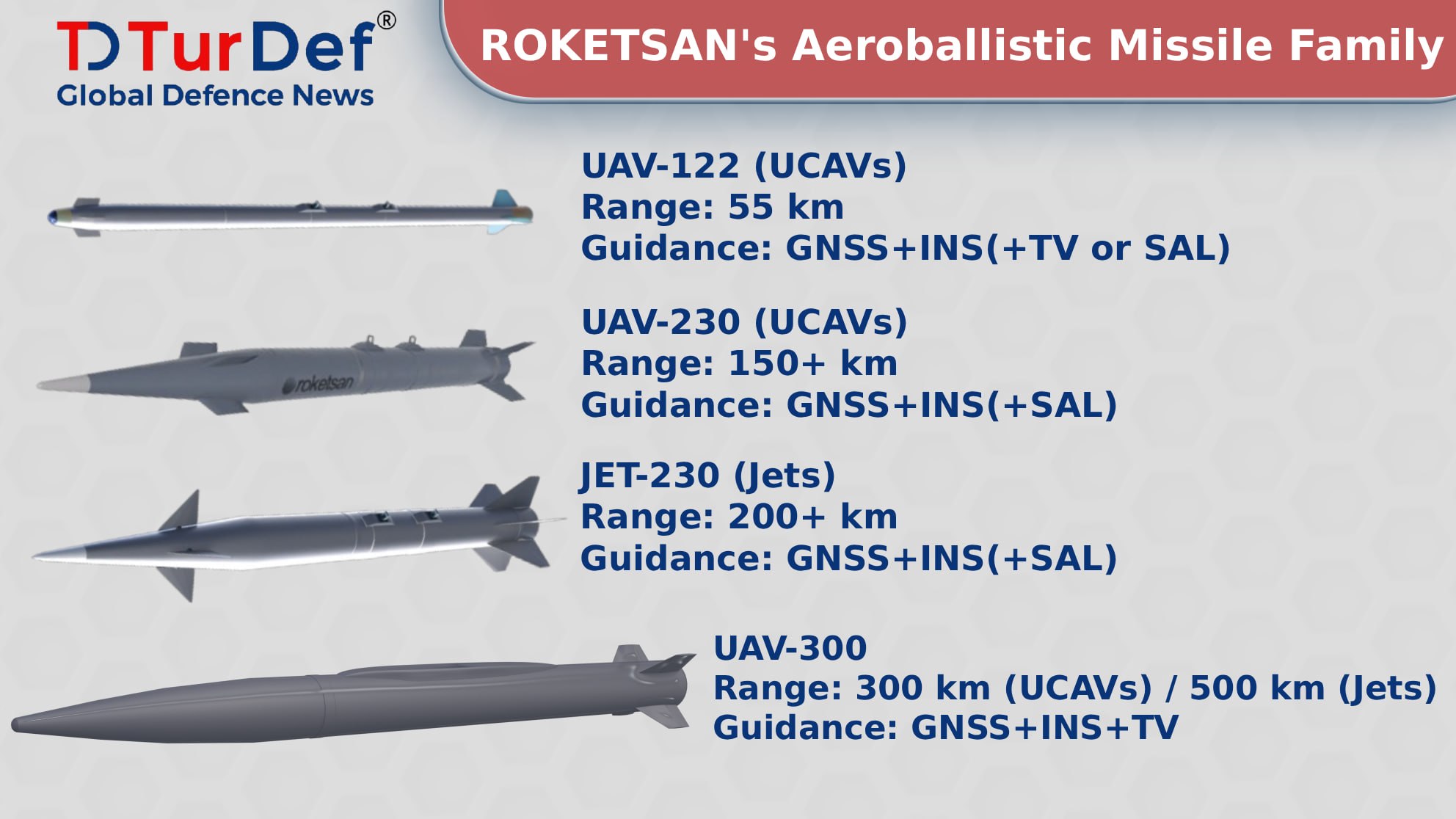
    The UAV-122 model is designed for use from combat drones and has a range of about 55 kilometers. The guidance system of this missile is a combination of inertial satellite navigation, and the possibility of using a TV or semi-active laser imaging seeker has also been mentioned for it.

    The UAV-230 model is considered the next step of this family and is fired from combat drones, with a range of more than 150 kilometers. Its guidance is also based on GNSS+INS, and the possibility of using a semi-active laser seeker has been raised for it.

    The JET-230 version is a variant of the UAV-230 for use from jet fighters, and its range reaches more than 200 kilometers.

    At the highest tier is the UAV-300, whose range varies depending on the launch platform; if fired from combat drones, this missile will have a range of about 300 kilometers, and if fired from jet fighters, up to 500 kilometers.

  • Destruction of a Saudi F-15 fighter jet by the Yemeni army’s air defense

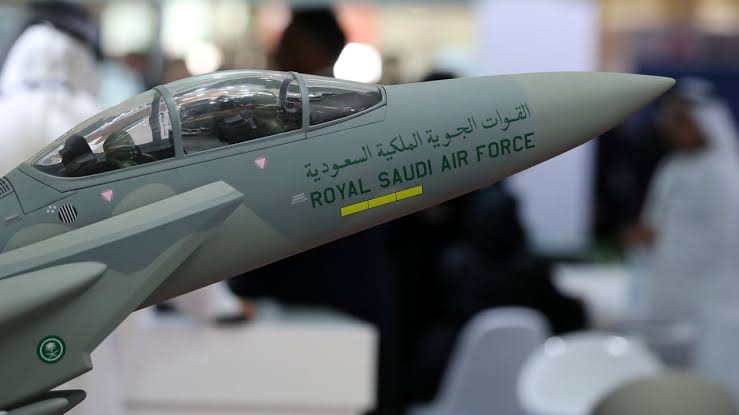
    Destruction of a Saudi F-15 fighter jet by the Yemeni army’s air defense

    Brigadier General Yahya Saree, in a statement on this operation, announced that Saudi fighter jets this week carried out more than 450 airstrikes using F-15 and Typhoon fighter jets from the Khamis Mushait and Taif bases against the areas of Taiz, Lahij, Al-Jawf, Hajjah, Marib, Saada, and Al-Bayda, which led to the martyrdom and wounding of civilians.

    The Yemeni armed forces, in the face of this brutal aggression, succeeded in downing an F-15 fighter jet in the skies over Marib province, which was carrying out hostile operations to support the enemy’s military movements in Taiz and Marib. This fighter jet was downed using a Yemeni surface-to-air missile.

    Also, the Yemeni armed forces, during an air defense operation, targeted two groups of Saudi fighter jets that were searching for the wreckage of the downed fighter jet and drove them away from the skies over Marib.

    Brigadier General Yahya Saree also rejected the false claims of the Saudi regime regarding targeting Mecca, and stated that it is the Saudis who have polluted this holy site with corruption and immorality, and there is no danger from Yemen to the holy sites, because Yemen’s operations only target oil facilities and military bases.

    According to statistics collected by the IWN, this fighter jet is the third F-15 of its kind to be downed during the Yemen war. Therefore, the number of aircraft destroyed by the Saudi-American coalition during the Yemen war has reached 133.

  • Missile and Drone Attack on Sharorah Military Base in Saudi Arabia

    Missile and Drone Attack on Sharorah Military Base in Saudi Arabia

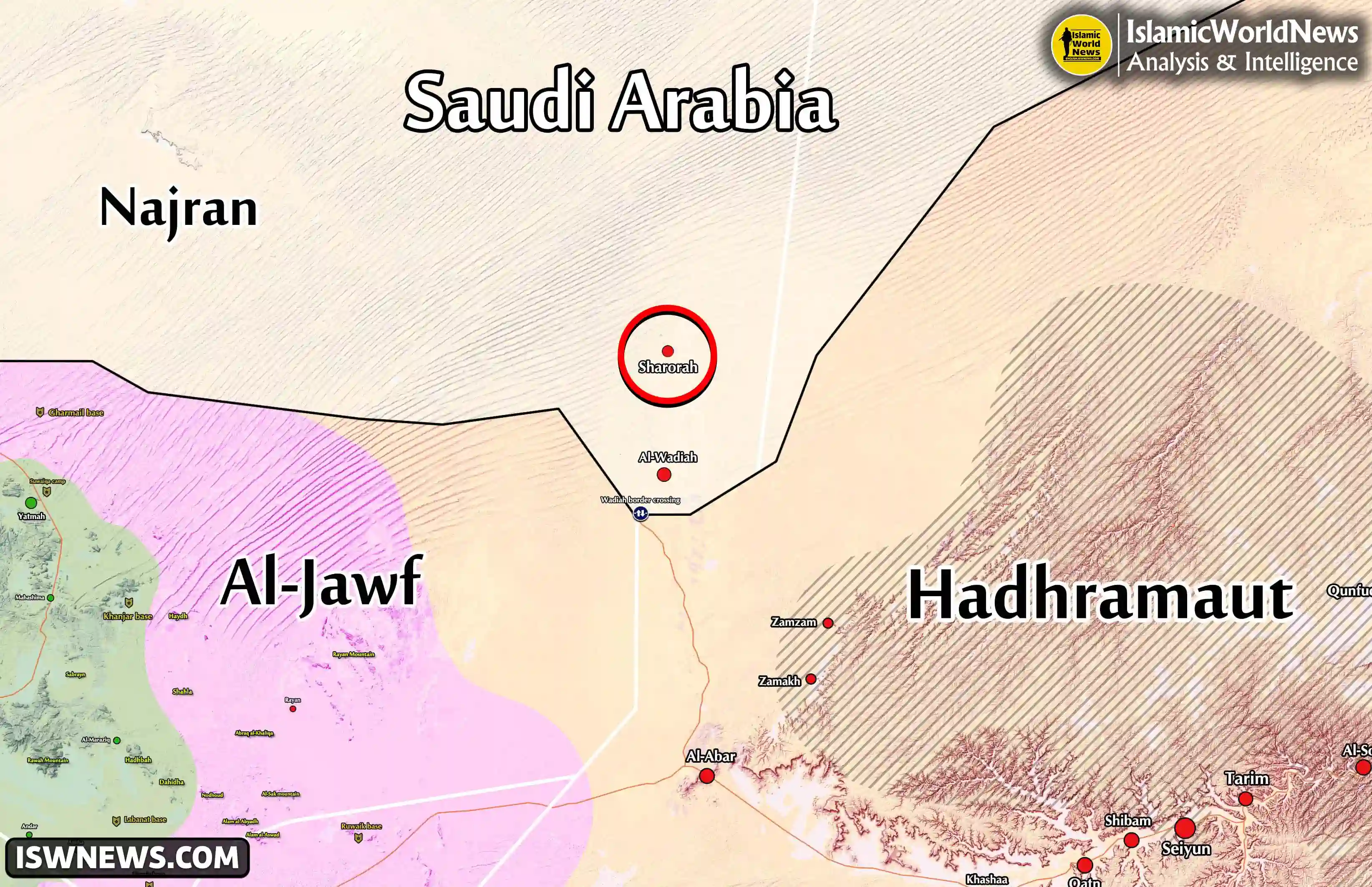
    Yahya Saree, spokesman for the Yemeni armed forces, stated that in this operation, weapons depots and command-and-control rooms that were managing the aggression against Yemen and its people were targeted at the Saudi military base in the Sharorah area with a large volley of ballistic missiles and combat drones, and—thanks to God—the strikes were precise and direct.

    The Al-Wadiah crossing and the Sharorah area north of it, in northern Yemen, constitute the primary land route for logistical supply of Saudi coalition forces in the occupied areas of Yemen. Since the beginning of the conflict, the Yemeni army has, through precise monitoring of coalition force movements and gatherings, delivered accurate and effective blows to the enemy’s rear. These targeted strikes undermine the operational capability of Saudi mercenaries to conduct any offensive operations.

  • The Strategic Bab al-Mandab Strait Has Come Under the Control of the Yemeni Army!

    The Strategic Bab al-Mandab Strait Has Come Under the Control of the Yemeni Army!

    Ansar Allah Yemen has announced that the passage of all vessels—except Saudi vessels—through this waterway is unimpeded. This decision was made within the framework of the “siege for siege” equation, and as long as the oppressive siege by the Saudi kingdom against the Yemeni people continues, the Yemeni army will likewise continue its siege and pressure on Saudi Arabia.

    The latest field reports indicate that Saudi coalition forces, following widespread retreats, have now concentrated along the coastline approximately 40 kilometers east of Bab al-Mandab, around Ras al-Arah. Today, Yemeni armed forces and Ansar Allah struck a gathering of forces at Ras al-Arah with a ballistic missile, resulting in an unspecified number of Saudi coalition forces being killed and wounded in the area.

    On the other hand, Saudi warplanes are heavily bombarding important areas recently liberated by Yemeni armed forces in order to prevent further advances by the Yemeni army. Today, they once again bombed Mount al-Omari near Dhubab, Dhubab town, the Khalid ibn al-Walid base at the Al-Mokha junction, Al-Mokha port, and Al-Khawkhah.

    Click to view full-size image
  • Saudi Arabia’s East-West Pipeline Stations Shut Down Until Further Notice; Riyadh Points Finger at Iraqi Groups!

    Saudi Arabia’s East-West Pipeline Stations Shut Down Until Further Notice; Riyadh Points Finger at Iraqi Groups!

    Newly released satellite imagery of the targeted facilities reveals extensive damage. The damage is so severe that repairs and reopening will require a considerable amount of time. Therefore, the Saudi Energy Ministry’s claim attributing the shutdown to precautionary measures is fundamentally incorrect!

    For example, the imagery you are viewing pertains to Al-Dhukra station and Al-Masba’ah station southeast of Medina. In the image, Al-Masba’ah station has sustained very heavy damage.

    ‼On the other hand, in a surprising move, Saudi Arabia’s Foreign Ministry issued a statement accusing Iraqi groups of attacking the East-West pipeline! In the released statement, it is claimed that the East-West pipelines in the Riyadh and Medina regions were attacked by drones launched from Iraqi territory. It is also claimed that the Saudi kingdom will currently not respond to the attacks by Iraqi groups, in order to give the Iraqi government an opportunity to deal with these groups.

    Regardless of who carried out these attacks, the reality of the matter is that there is no difference between the Yemeni army and Ansar Allah, Iraqi resistance groups, Iran, and others. They all stand together as a single hand on one front, jointly fighting against their enemies. Wherever necessary, tactics change, and each component will carry out its duties as required. It is not acceptable for Saudi Arabia to be a partner and accomplice with America in oppressing the people of Iran and Yemen, and on the other hand, escape this war unscathed! If it diverts the Strait of Hormuz to serve America, then it should expect the missiles and drones of the Resistance—no matter from which direction they come, it makes no difference. The tactics of war have changed!

  • Infographic: Saudi Coalition And US Aircraft Losses In Yemen War

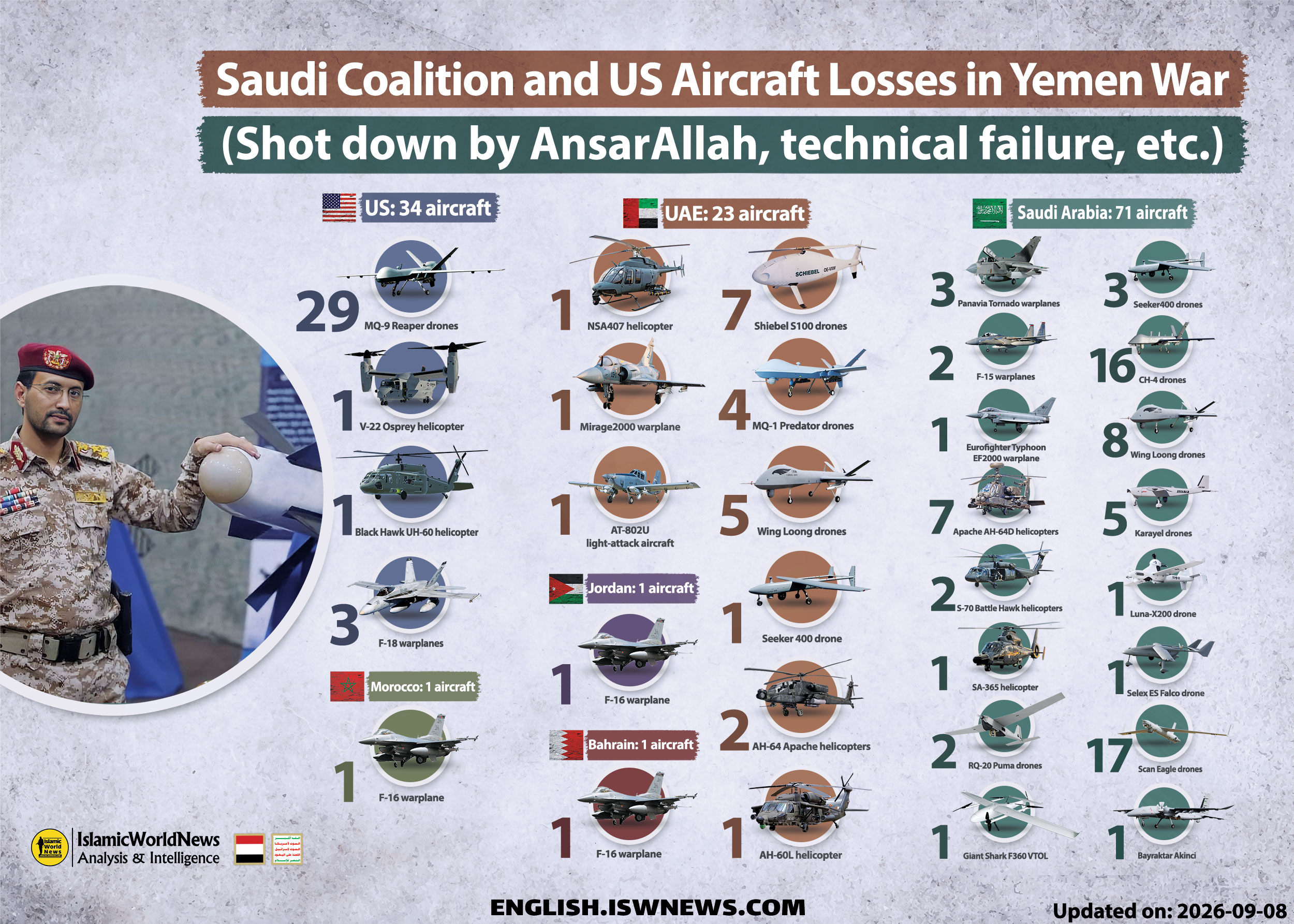
    Infographic: Saudi Coalition And US Aircraft Losses In Yemen War

    The details of the downed aircraft are as follows:

    1- Saudi F-15S fighter jet – March 27, 2015 – Gulf of Aden
    2- Saudi AH-64D helicopter – May 7, 2015 – Al-Baqa’, Saada Governorate
    3- Moroccan F-16C fighter jet – May 10, 2015 – Wadi Nashur, Saada Governorate
    4- Saudi Seeker 400 drone – July 3, 2015 – Al-Baqa’, Saada Governorate
    5- Saudi AH-64D helicopter – August 5, 2015 – Jizan
    6- Saudi AH-64D helicopter – August 21, 2015 – Jizan
    7- UAE Schiebel Camcopter S-100 drone – August 25, 2015 – Mukayras, Abyan Governorate
    8- UAE Schiebel Camcopter S-100 drone – October 25, 2015 – Al-Abdiyah, Ma’rib Governorate
    9- Bahraini F-16C fighter jet – December 30, 2015 – Jizan
    10- UAE MQ-1 Predator drone – January 19, 2016 – Sana’a
    11- Saudi Selex ES Falco drone – February 3, 2016 – Midi, Hajjah Governorate
    12- UAE Schiebel Camcopter S-100 drone – February 27, 2016 – Dhubab, Taiz Governorate
    13- UAE Mirage 2000 fighter jet – March 13, 2016 – Al-Burayqah, Aden
    14- UAE AH-64D helicopter – June 12, 2016 – Gulf of Aden
    15- UAE NSA407 helicopter – June 13, 2016 – Al-Burayqah, Aden
    16- Saudi AH-64D helicopter – July 25, 2016 – Bir al-Maraziq, Al-Jawf Governorate
    17- Saudi Seeker 400 drone – August 16, 2016 – Kataf, Saada Governorate
    18- UAE Wing Loong drone – September 26, 2016 – Khawlan, Sana’a Governorate
    19- Saudi AH-64D helicopter – December 30, 2016 – Najran
    20- U.S. V-22 Osprey helicopter – January 29, 2017 – Al-Bayda Governorate
    21- Saudi SA 365F helicopter – January 30, 2017 – Al-Hudaydah coast (aboard the Al-Madinah vessel)
    22- UAE MQ-1 Predator drone – February 14, 2017 – Al-Munin, Ma’rib Governorate
    23- Jordanian F-16A fighter jet – February 24, 2017 – Najran
    24- Saudi S-70A helicopter – April 18, 2017 – Ma’rib
    25- UAE Schiebel Camcopter S-100 drone – June 21, 2017 – Dhubab, Taiz Governorate
    26- UAE AH-60L helicopter – August 11, 2017 – Wadi Amqin, Shabwah Governorate
    27- Saudi Seeker 400 drone – August 15, 2017 – Al-Baqa’, Saada Governorate
    28- U.S. UH-60M helicopter – August 25, 2017 – Gulf of Aden
    29- UAE AT-802U aircraft – September 11, 2017 – Gulf of Aden
    30- Saudi Eurofighter Typhoon fighter jet – September 13, 2017 – Abyan Governorate
    31- U.S. MQ-9 drone – October 1, 2017 – Sana’a city
    32- UAE AH-64D helicopter – October 17, 2017 – Khabb wa al-Sha’af, Al-Jawf Governorate
    33- Saudi S-70A helicopter – November 5, 2017 – Abha
    34- Saudi Panavia Tornado fighter jet – January 7, 2018 – Kataf, Saada Governorate
    35- Saudi F-15S fighter jet – March 21, 2018 – Saada
    36- Saudi CH-4B drone – July 12, 2018 – Al-Rabu’ah
    37- Saudi Panavia Tornado fighter jet – July 12, 2018 – Asir
    38- Saudi CH-4B drone – August 30, 2018 – Jizan
    39- UAE Schiebel Camcopter S-100 drone – September 2, 2018 – Al-Jah, Al-Hudaydah Governorate
    40- Saudi AH-64D helicopter – September 14, 2018 – Al-Mahrah
    41- UAE Seeker 400 drone – November 26, 2018 – Al-Jubayliyah, Al-Hudaydah Governorate
    42- Saudi CH-4B drone – December 23, 2018 – Saada
    43- U.S. MQ-9 drone – June 6, 2019 – Al-Hudaydah Governorate
    44- Saudi CH-4B drone – April 11, 2019 – Hadramawt Governorate
    45- UAE Wing Loong drone – April 19, 2019 – Saada
    46- UAE MQ-1 Predator drone – May 15, 2019 – Bani Matar, Sana’a Governorate
    47- UAE Schiebel Camcopter S-100 drone – June 2, 2019 – Hays, Al-Hudaydah Governorate
    48- U.S. MQ-9 drone – August 21, 2019 – Dhamar Governorate
    49- U.S. MQ-9 drone – March 23, 2021 – Ma’rib Governorate
    50- UAE Schiebel Camcopter S-100 drone – November 1, 2019 – Ras Isa, Al-Hudaydah Governorate
    51- Saudi AH-64D helicopter – November 29, 2019 – Asir
    52- Saudi Wing Loong drone – November 30, 2019 – Hayran, Hajjah Governorate
    53- Saudi Luna X2000 drone – December 4, 2019 – Baqim, Saada Governorate
    54- Saudi Karayel drone – December 30, 2019 – Al-Salif, Al-Hudaydah Governorate
    55- Saudi CH-4B drone – January 7, 2020 – Khabb wa al-Sha’af, Al-Jawf Governorate
    56- Saudi Panavia Tornado fighter jet – February 14, 2020 – Al-Jawf Governorate
    57- Saudi RQ-20 drone – August 2, 2020 – Haradh District, Hajjah Governorate
    58- Saudi CH-4B drone – December 21, 2020 – Ma’rib Governorate
    59- Saudi Karayel drone – January 6, 2021 – Al-Jawf Governorate
    60- Saudi CH-4B drone – February 12, 2021 – Ma’rib Governorate
    61- Saudi Karayel drone – March 7, 2021 – Al-Jawf Governorate
    62- Saudi CH-4B drone – March 23, 2021 – Sirwah, Ma’rib Governorate
    63- Saudi Wing Loong drone – May 21, 2021 – Najran
    64- U.S. MQ-9 drone – May 23, 2021 – Al-Jawf Governorate
    65- Saudi ScanEagle drone – June 19, 2021 – Ma’rib Governorate
    66- Saudi ScanEagle drone – June 21, 2021 – Ma’rib Governorate
    67- Saudi ScanEagle drone – August 14, 2021 – Madghal, Ma’rib Governorate
    68- Saudi Wing Loong drone – September 13, 2021 – Kataf, Saada Governorate
    69- Saudi ScanEagle drone – September 27, 2021 – Madghal, Ma’rib Governorate
    70- Saudi CH-4 drone – October 6, 2021 – Al-Jubah, Ma’rib Governorate
    71- Saudi RQ-20 drone – October 7, 2021 – Jizan border
    72- Saudi ScanEagle drone – November 9, 2021 – Al-Jubah, Ma’rib Governorate
    73- Saudi ScanEagle drone – November 13, 2021 – Al-Jubah, Ma’rib Governorate
    74- Saudi CH-4 drone – December 1, 2021 – Al-Umashiyah, Amran Governorate
    75- Saudi ScanEagle drone – December 4, 2021 – Al-Jubah, Ma’rib Governorate
    76- Saudi ScanEagle drone – December 8, 2021 – Al-Jubah, Ma’rib Governorate
    77- Saudi CH-4 drone – December 8, 2021 – Al-Wadi, Ma’rib Governorate
    78- Saudi ScanEagle drone – December 10, 2021 – Sirwah, Ma’rib Governorate
    79- Saudi CH-4 drone – December 14, 2021 – Asaylan, Shabwah Governorate
    80- Saudi ScanEagle drone – December 16, 2021 – Al-Wadi, Ma’rib Governorate
    81- Saudi ScanEagle drone – December 25, 2021 – Al-Yatamah, Khabb wa al-Sha’af, Al-Jawf Governorate
    82- UAE Wing Loong drone – January 5, 2022 – Asaylan, Shabwah Governorate
    83- UAE Wing Loong drone – January 11, 2022 – Ain, Shabwah Governorate
    84- Saudi ScanEagle drone – January 29, 2022 – Al-Jubah, Ma’rib Governorate
    85- Saudi CH-4 drone – February 10, 2022 – Haradh, Hajjah Governorate
    86- UAE MQ-1 drone – February 25, 2022 – Al-Jawf Governorate
    87- Saudi ScanEagle drone – February 25, 2022 – Al-Jubah, Ma’rib Governorate
    88- Saudi ScanEagle drone – February 28, 2022 – Haradh, Hajjah Governorate
    89- Saudi ScanEagle drone – March 8, 2022 – Haradh, Hajjah Governorate
    90- Saudi ScanEagle drone – March 29, 2022 – Al-Wadi, Ma’rib Governorate
    91- Saudi CH-4 drone – May 4, 2022 – Haradh, Hajjah Governorate
    92- Saudi Karayel drone – May 21, 2022 – Hayran, Hajjah Governorate
    93- Saudi CH-4 drone – May 23, 2022 – Sana’a Governorate
    94- Saudi Wing Loong drone – May 24, 2022 – Kataf, Saada Governorate
    95- U.S. MQ-9 drone – November 8, 2023 – Al-Hudaydah Governorate
    96- U.S. MQ-9 drone – February 19, 2024 – Northern Al-Hudaydah Governorate
    97- U.S. MQ-9 drone – April 25, 2024 – Saada Governorate
    98- UAE Wing Loong 1 drone – April 29, 2024 – Al-Rawdah District, Shabwah Governorate
    99- U.S. MQ-9 drone – May 16, 2024 – Al-Wadi District, Ma’rib Governorate
    100- U.S. MQ-9 drone – May 21, 2024 – Al-Bayda Governorate
    101- U.S. MQ-9 drone – May 29, 2024 – Ma’rib Governorate
    102- U.S. MQ-9 drone – August 4, 2024 – Saada
    103- U.S. MQ-9 drone – September 7, 2024 – Ma’rib
    104- U.S. MQ-9 drone – September 10, 2024 – Saada
    105- U.S. MQ-9 drone – September 30, 2024 – Saada
    106- U.S. MQ-9 drone – November 8, 2024 – Al-Jawf
    107- U.S. MQ-9 drone – November 28, 2024 – Al-Bayda
    108- U.S. MQ-9 drone – December 2, 2024 – Ma’rib
    109- U.S. F/A-18F fighter jet – December 21, 2024 – Red Sea
    110- U.S. MQ-9 drone – March 3, 2025 – Al-Hudaydah
    111- U.S. MQ-9 drone – March 31, 2025 – Ma’rib
    112- U.S. MQ-9 drone – April 3, 2025 – Al-Hudaydah
    113- Saudi Giant Shark F-360 drone – April 5, 2025 – Saada
    114- U.S. MQ-9 drone – April 9, 2025 – Al-Jawf
    115- U.S. MQ-9 drone – April 13, 2025 – Hajjah
    116- U.S. MQ-9 drone – April 18, 2025 – Sana’a
    117- U.S. MQ-9 drone – April 19, 2025 – Sana’a
    118- U.S. MQ-9 drone – April 22, 2025 – Hajjah
    119- U.S. F/A-18E fighter jet – April 29, 2025 – Northern Red Sea
    120- U.S. F/A-18F fighter jet – May 6, 2025 – Northern Red Sea
    121- U.S. MQ-9 drone – March 3, 2026 – Maraqishah Mountains, Abyan Governorate
    122- U.S. MQ-9 drone – May 17, 2026 – Ma’rib Desert
    123- U.S. MQ-9 drone – May 29, 2026 – North of Ma’rib city
    124- Saudi Wing Loong drone – July 14, 2026 – Al-Bayda Governorate
    125- Saudi Bayraktar Akıncı drone – July 26, 2026 – Al-Jawf Governorate
    126- Saudi Karayel drone – July 29, 2026 – Saada Governorate
    127- Saudi ScanEagle drone – August 23, 2026 – Hajjah Governorate
    128- Saudi Wing Loong drone – September 6, 2026 – Al-Jawf Governorate
    129- Saudi Wing Loong drone – September 6, 2026 – Maqbanah District, Taiz Governorate
    130- Saudi Wing Loong drone – September 7, 2026 – Al-Bayda Governorate
    131- Saudi CH-4 drone – September 7, 2026 – Al-Jawf Governorate

    (Last updated: September 8, 2026)

    Casualties of Saudi and American Coalition Aircraft in the Yemen War
  • Yemeni Armed Forces Destroyed Two More Saudi Drones

    Yemeni Armed Forces Destroyed Two More Saudi Drones

    With these downings, the number of drones destroyed by the Yemeni army during the recent clashes has reached 11 units. This tally includes four Wing Loong drones (Chinese-made), three MQ-9 drones (U.S.-made), one CH-4 drone (Chinese-made), one Karayel drone (Turkish-made), one Akıncı drone (Turkish-made), and one ScanEagle drone (U.S.-made).

    Furthermore, according to estimates by Islamic World News (IWN), the total number of aircraft downed during the Yemen war has reached 131 units, of which 13 are Wing Loong drones and 17 are CH-4 drones.

  • Iran’s Retaliatory Strikes Against U.S. Bases in the Region, August 31, September 1-2

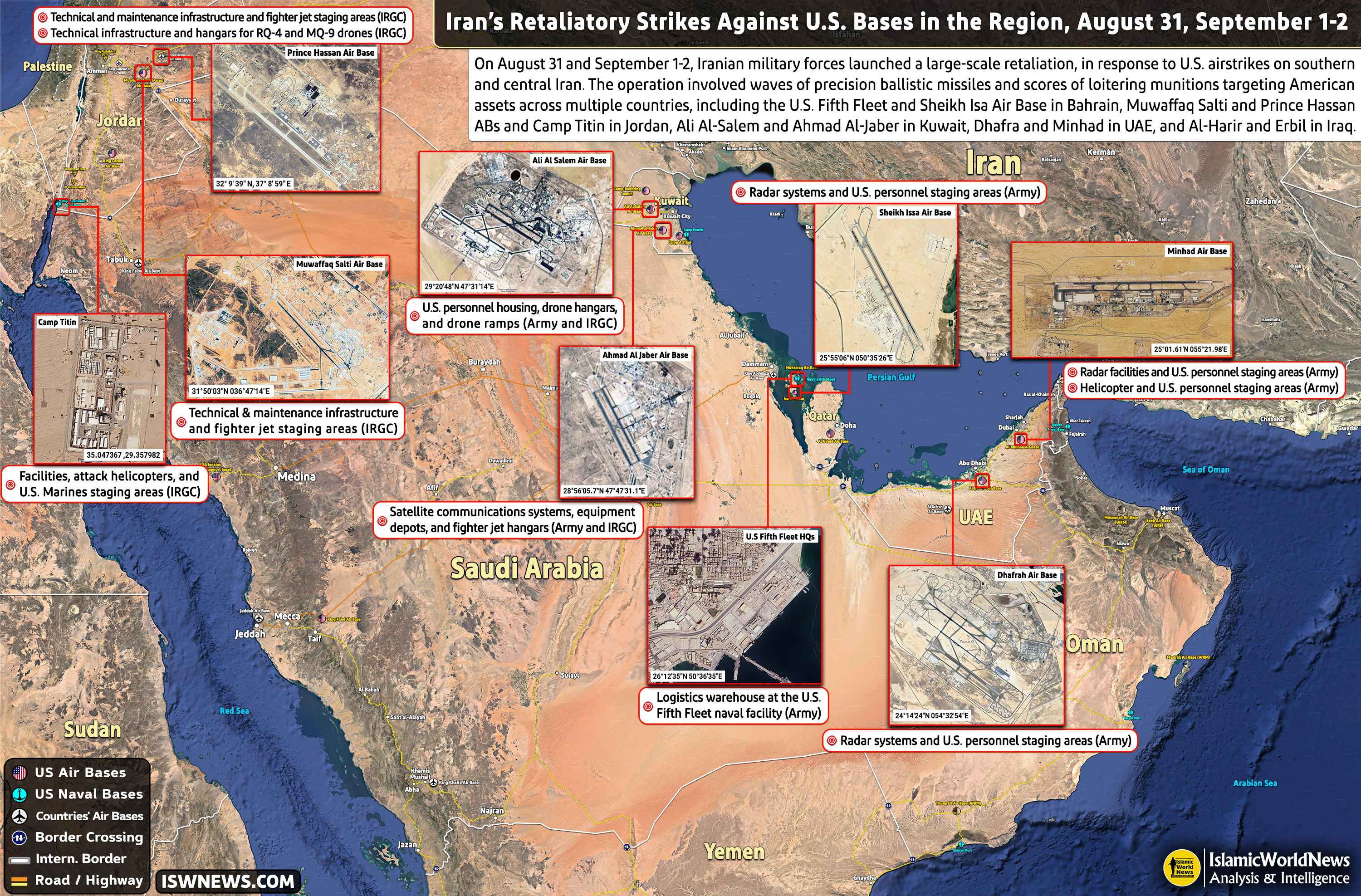
    Iran’s Retaliatory Strikes Against U.S. Bases in the Region, August 31, September 1-2

    Below is a breakdown of the attacks by country:

    Jordan:
    — IRGC strikes on August 31 targeted technical/maintenance facilities and fighter aircraft parking areas at Prince Hassan and Al-Azraq (Muwaffaq Salti) bases.
    — On September 1, the IRGC hit Camp Titin, striking U.S. Marine positions, assault helicopters, and supporting infrastructure.
    — Additional IRGC strikes on September 1–2 focused on Prince Hassan Air Base, destroying technical infrastructure and hangars housing RQ-4 and MQ-9 drones.

    Iraq:
    — On September 2, joint Army and IRGC operations struck U.S. troop positions at Al-Harir Base, as well as technical facilities and a surveillance balloon at the Erbil Airport base.

    UAE:
    — Army strikes on August 31 hit helicopter staging areas and U.S. personnel positions at Al-Minhad Air Base.
    — Army operations on September 1–2 further targeted radar installations and troop facilities at both Al-Dhafra and Al-Minhad Air Bases.

    Bahrain:
    — Army attacks on September 1–2 hit radar infrastructure and U.S. troop positions at Sheikh Isa Air Base, along with a logistics depot serving the U.S. Fifth Fleet’s naval installation.

    Kuwait:
    — Joint Army and IRGC operations on September 1–2 struck satellite communications gear, supply depots, and fighter hangars at Ahmad Al-Jaber Base, as well as personnel housing, drone hangars, and drone ramps at Ali Al-Salem Base.

    Click to see full-size image
  • Security Reconfiguration of the Persian Gulf Cooperation Council

    Security Reconfiguration of the Persian Gulf Cooperation Council

    The Fragile Shadow of Neutrality

    In recent years, GCC countries had adopted a strategy based on neutrality, balancing, and mediation between Iran and the United States. Despite extensive security ties with Washington, they avoided direct involvement in military conflict, with countries like Oman and Qatar playing key mediating roles. However, doubts regarding the effectiveness of the U.S. security umbrella gradually increased—from Washington’s limited response to the 2019 attacks to the erosion of deterrence following the events of 2025, when even the presence of major U.S. bases did not prevent Qatar from being targeted in a Zionist strike. At the same time, Iran framed the presence of these bases as part of the justification for its own attacks. These developments prompted a reassessment of the costs versus benefits of hosting U.S. security assets, and three key divides within the GCC—over trust in the U.S., the role of the Zionist regime, and the approach toward Iran—became entrenched as the main lines of strategic disagreement.

    The Hormuz Shock

    During the war, GCC states found themselves directly at the center of the conflict, with 83% of Iran’s missile and drone strikes directed at them. Regional energy and logistics infrastructure were also targeted, and the Strait of Hormuz was effectively transformed into a geopolitical pressure tool. The war demonstrated that despite economic diversification efforts, the region’s structural dependence on hydrocarbons (approximately 30% of GDP and up to 85% of government revenues) and food imports (85% of food needs) remains intact. Disruption in Hormuz could trigger severe recessions (up to 14% GDP decline in some countries). Politically, GCC unity appeared more fragile than ever; member states’ responses to Iran, the U.S., and the Zionist regime were not uniform, and strategic rifts widened. The outcome has been the coexistence of multiple divergent approaches within a shared crisis: some moved toward limited security cooperation, others toward balancing with Iran, and still others toward closer alignment with the U.S. and the Zionist regime.

    The Future of the Persian Gulf

    In future scenarios for the Persian Gulf following the Iran war, three main trajectories are conceivable: In a pessimistic scenario, the pressure of war pushes GCC countries toward more genuine cooperation—creating practical convergence in areas such as joint air defense, arms production, and the interconnection of economic infrastructure like rail and energy networks—while raising the likelihood of direct confrontation with Iran. In a more probable scenario, cooperation remains confined to crisis management and limited security coordination, with disagreements over the roles of the U.S., the Zionist regime, and Iran—as well as Saudi–Emirati rivalry—preventing strategic integration. In an optimistic scenario, regional rivalries, particularly between Riyadh and Abu Dhabi, intensify, and countries move toward separate strategies toward Iran and the U.S., resulting in increased intra-GCC fragmentation, an arms race, and political divergence. It is likely that the UAE will enter direct conflict; Oman will adopt a strong stance against the regime and a critical posture toward U.S. intervention; Kuwait and Bahrain will passively follow U.S. directives; and Saudi Arabia will maintain neutrality, awaiting the right moment to strike at Iran’s and the UAE’s interests and those of their allies.