Category: West Asia

  • Hariri’s Resignation and More Plans for War

    Hariri’s Resignation and More Plans for War

    As Hariri is a Saudi-US asset, the ‘forced’ resignation seems more like the sacking of a company executive who has not lived up to expectations. Told to step out of office Hariri did what he was told, following through by issuing a Saudi-scripted statement accusing Hezbollah and Iran of sowing discord across the region, and talking of a plot to assassinate him.


    In fact, it was Saudi Arabia sowing discord, by blaming Hezbollah and Iran for Hariri’s resignation, with the apparent aim of throwing Lebanon into chaos. Predictably, Netanyahu jumped in immediately, saying the resignation was a call to the ‘international community’ to take action against Iranian aggression but no-one else bought it, not even Lebanon’s Sunni Muslims. Hezbollah reacted calmly and if anyone came out of it badly it was Saudi Arabia. In the Iranian view the removal of Hariri was a plot cooked up by Trump and Crown Prince Muhammad bin Salman.


    Hariri himself did not return to Lebanon where he could have defied the Saudis and resumed his position but moved on to France, where he was welcomed by President Macron at the Elysee Palace. Soon after talking to Hariri, Macron was on the phone to Trump, discussing the Iranian ‘threat’ and how to deal with it. According to Lebanon’s President Michel Aoun, Hariri told him he would return to Beirut by Independence Day, November 22, marking the end of the French mandate. The Lebanese parties, including Hezbollah, still regard Hariri as the country’s Prime Minister so how all of this plays after Hariri’s return will be interesting to see.


    What lies behind all this?

    What is the connection between Hariri’s resignation (forced or otherwise) and the other events running concurrently in Saudi Arabia, namely the arrest of some of the most powerful figures in the kingdom and the confiscation of their assets, estimated at about $800 billion? One has to assume there is a connection. It seems far too much of a coincidence for there not to be one.


    The claim that the purge of the princes was part of an anti-corruption drive is bunk, seeing that corruption is intrinsic to how the Saudi government operates, domestically and in its foreign policy. If corruption is a cover story, why were these princes removed? Could it be their opposition to Saudi Arabia’s policy failures, in Syria and Yemen, and their opposition to what is now clearly being moved from the drawing board to implementation, a war on Iran, involving the US, Israel and Saudi Arabia? They would hardly be alone in seeing Crown Prince Muhamad bin Salman as reckless, foolhardy and lethally dangerous to the stability of the Saudi kingdom: his accession to the throne they would regard, literally, as a crowning act of folly.


    That another war is on the horizon is clear from all the signals coming out of Israel in the past six months. That not just the US but Saudi Arabia will be part of it is obvious. Intermittently, Israel and Saudi Arabia have been pushing for war on Iran for a decade. With the US refusing to bite, to the extent of launching an open military attack, Syria was chosen as the next best target: if the government in Damascus could be destroyed, the strategic alliance between Iran, Syria and Hezbollah would collapse at its central arch. This plan B was partly foiled by the refusal of the UN Security Council, thanks to the vetoes of Russia and China, to sanction an aerial war on Syria along the lines of the assault on Libya. Plan C had to come into effect, reliance on a war of attrition fought by takfiri proxies organised, financed and armed mainly by the US, Saudi Arabia, Qatar, Israel, Britain and France, and coordinated with the assistance of governments ranging from the Balkans to Central Asia. Seven years later Plan C has now ground to a halt. The ‘axis of reaction’ (the US, Israel and Saudi Arabia) has suffered a crushing defeat at the hands of the ‘axis of resistance’ (Iran, Syria and Hezbollah). Russian intervention has been critical, so the victory is Russia’s as well, and a particular humiliation for the US.


    This does not end the list of defeats suffered by the ‘axis of reaction.’ Another severe blow has been suffered through the collapse of the Kurdish drive for independence in northern Iraq. Both the US and Israel have assiduously cultivated the Kurds for decades, seeing northern Iraq as a new strategic centre for military and intelligence operations across the Middle East. The US and British ‘no fly’ zone and ‘safe haven’ initiatives of 1990/91 were the first steps in the planned breakup of an Iraq that no longer suited imperial purposes. The invasion of 2003 and the imposition of a constitution dictated by the US, weakening the authority of the central government, led to Kurdish autonomy which, in time, would have been expected to end in independence and a new base for US/Israeli operations across the Middle East.

    Even the US was against the referendum called by Masoud Barzani: seeing that it was already getting what it wanted, the referendum would be premature and cause more trouble than it was worth.


    This proved to be the case. Turkey and Iran reacted viscerally, ending flights and closing border crossings: the Iraqi army retook Kirkuk and all the territory conquered by the Peshmerga in 2014. Barzani stepped down as president of the KRG: Jalal Talabani, the head of the Patriotic Union of Kurdistan (PUK), had died only recently, leaving the Kurds leaderless and at each other’s throats over who was responsible for this debacle. Iraq is now being reconstituted as a unitary state. The largely Shia Popular Mobilization Forces (PMF) has developed into a powerful annex to the regular army. Moreover, the government in Baghdad has a close working relationship with the government of the Islamic Republic in Tehran.

    The paradox of these defeats is that they increase to a critical level the danger of a new attack by the ‘axis of reaction’ on the ‘axis of resistance.’ Russia, Iran, Syria and Hezbollah cannot be allowed to get away with these victories. The Israeli chief of staff, Gabi Eisenkot, hardly needed to say, as he did recently, that there is ‘complete agreement between us and the Kingdom of Saudi Arabia’ on the question of Iran’s spreading influence across the Middle East, or ‘control’ of the region as he put it. Unable to impose its will on one of the poorest countries in the world, Yemen, Saudi Arabia would be of little help on the front line in a war against dangerous targets such as Hezbollah and Iran. But it has money and according to Hasan Nasrallah, has offered to pay Israel billions of dollars for a new war on Hezbollah.


    As Israel always has the next war on the drawing board, the central question is ‘when’ rather than ‘if’ it will be launched. In recent months it has held some of the largest-scale land and air exercises in its recent history in preparation for a new war on Hezbollah, including training for fighting in tunnels. It has warned repeatedly over the years that the next time around the ‘Dahiyeh strategy’ will be applied across Lebanon and is busy selling the propaganda package that there really is no Lebanon any more but only a Hezbollah enclave controlled by Iran.

    Dahiyeh, of course, is the largely Shia Beirut suburb and urban HQ of Hezbollah that was pulverised from the air in 2006. Given the huge civilian casualties Israel is willing to inflict in the next war, Iran and Syria would be hard pressed to stay out but the moment they intervene, Israel, the US and Saudi Arabia will have their three primal enemies directly in their line of fire. The refusal of the US to withdraw its forces and dismantle its air bases in Syria now that the Islamic State has been ‘defeated’ (if still being used as an American tool) is probably connected with preparation for the coming conflict.

    Israel’s existential struggle in the Middle East since 1948 has now reached the point of crisis. Israel may think it has all the time it needs to completely engorge the West Bank but it does not have such a luxury on the regional front. If Iran is stronger now than before the wars on Iraq and Syria, it will be even stronger in two or three years’ time. It has a large standing army, fought an extremely destructive war against Iraq (1980-89), has been deeply involved at the planning and combat level in the defence of Syria and has built up a large arsenal of locally developed short and long-range missiles.

    By comparison, Israel has not even fought a regular army since 1973: in 2000 it was driven out of Lebanon by a guerrilla force and when it attempted to retrieve lost ground by launching a new war in 2006 its ground troops proved incapable of taking villages even a few kilometres from the armistice line. Its attacks on Gaza have been onslaughts on a largely defenceless civilian population.

    Given that since 1948 its security/insecurity situation has ultimately been based not on diplomacy but on full spectrum military domination from the possession of nuclear weapons down to conventional warfare, Israel cannot allow the current situation of strengthening enemies to continue. Hostile to any kind of diplomatic settlement that would generate a real peace, Israel must go to war. It says it is much stronger and better prepared than in 2006 but so are Hezbollah and Iran. Hezbollah alone has a large stockpile of missiles able to reach any corner of occupied Palestine: Israel’s Iron Dome anti-missile system will stop some of them but not all.

    If it does go to war Israel is certainly going to suffer civilian casualties unprecedented in its history but the politicians and generals around Netanyahu will argue that its existential situation will demand these sacrifices. The US would come in behind Israel, but Russia could not be expected to sit by while its diplomatic alliances and strategic assets in the Middle East are destroyed. The commentator Abd al Bari Atwan has warned that such a war would be the most destructive in the region’s history, developing into a global conflict, and has raised the question of whether Israel, having started it, could survive it. This is a truly apocalyptic scenario.


    As usual the Palestinians find themselves caught in the middle. Mahmud Abbas is being told to go along with the Trump-Kushner-Israel ‘peace initiative’ or else, even by Saudi Arabia. This would involve Abbas publicly sharing the anti-Iranian, anti-Hezbollah and anti-Shia views of the Saudis at a time he is engaged in a reconciliation process with Hamas, which has refused to take a stand against Hezbollah. Furthermore, several of its senior leaders have recently been in Tehran. For the moment all eyes are on Hariri as he returns to Beirut: how will he explain himself, will he resume his position as Prime Minister and on what terms?


    Source

  • Gen. Soleimani congratulates Ayatollah Khamenei and Muslims on ISIS termination

    Gen. Soleimani congratulates Ayatollah Khamenei and Muslims on ISIS termination

    Following the historic victory of Iraq and Syria’s resistance movement over the sedition of Takfiri terrorism and the end of ISIS’s domination, which was manifested by lowering the flag of this American-Zionist group at Abu Kamal–the last key area in the hands of ISIS–General Soleimani issued an important message to Ayatollah Khamenei.

    The following is the full text of Major-General Soleimani’s message to Ayatollah Khamenei:
    In the Name of God, the Most Beneficent, the Most Merciful

    “Indeed, we have opened for you (Prophet Muhammad) a clear opening.” Quran [1: 48]

    To the dear and brave Leader of the Islamic Revolution, Ayatollah Khamenei:

    Salamun Alaikum (peace and greetings upon you),

    Six years ago, a dangerous plot like the ones at the time of Amir al-Mu’minin (as), which prevented Muslims from truly understanding the pure Islam of Muhammad (pbuh), this time, mixed with the poison of Zionism and arrogance, covered the Islamic world like a devastating storm.
    This devastating and poisonous sedition was created by the enemies of Islam with an aim of initiating widespread war within the Islamic world and a fight among Muslims. The evil movement, under the name of the “Islamic State of Iraq and the Levant,” managed, in the early months, to deceive tens of thousands of Muslim youth from both countries, causing a very dangerous crisis for the influential and crucial countries of the Islamic world: Iraq and Syria.
    They occupied hundreds of thousands of square kilometers of land from these countries along with thousands of villages, towns, and provincial centers; they destroyed thousands of factories, manufactures, and major infrastructure of these countries–including roads, bridges, refineries, wells, gas and oil lines, and power plants; they destroyed or burned important cities with valuable historical monuments and national civilizations by bombing them.
    Although it is not possible to calculate all the damage caused yet, the preliminary investigation estimates damages to be around $500 billion.
    In this event, there were extremely horrendous crimes that could not be shown, which included the following: decapitation of children, skinning men alive before their families, taking young girls and women hostage and raping them, burning people alive and group massacres of hundreds of young people.
    The people of these countries, astounded by this poisonous storm, either became victims of the takfiri criminals or left their homes, displaced throughout other cities and countries.
    In this dark sedition, thousands of mosques and sacred centers of Muslims were destroyed or ruined, and sometimes a mosque along with the Imam and all the people in it were blown up.
    More than 6,000 young people, deceived in the name of defending Islam, blew themselves up by way of suicide bombings, using explosive vehicles at city squares, mosques, schools, even hospitals and public places of Muslims; as a result of these criminal acts, tens of thousands of innocent men, women, and children were martyred.
    All these crimes have been designed and implemented by US leaders and organizations, according to the acknowledgement of the highest-ranking US official who is currently president of the United States; moreover, this scheme is still being modified and implemented by current American leaders.
    What, in addition to the favour of God and the special grace of the great Prophet Muhammad and his honorable household (pbut), led to the defeat of this dark and dangerous conspiracy was the wise leadership and guidance of his Excellency, Ayatollah Sistani, who mobilized all facilities to deal with this toxic storm.
    Certainly, the resistance of the Iraqi and Syrian governments and the perseverance of the armies and youths of these two countries, especially the holy Popular Mobilization Forces (PMF), Al-Hashd Al-Sha’abi, and other Muslim youth from other countries with the prominent presence of Hezbollah led by its great leader, Sayyid Hassan Nasrallah, played an important role in overturning this dangerous event.

    Definitely the valuable role of the nation and the government of the Islamic Republic of Iran–the respected president in particular–the parliament, the Defense Ministry, as well as police, military and security organizations of our country, in supporting the above mentioned states and nations, is admirable.
    This humble person, as a soldier called upon by your eminence to serve on this battlefield, announces the termination of the rule of this vicious cursed entity, following the completion of the liberation operation of Abu Kamal as ISIS’ last fort, bringing down the flag of this US-Zionist made terrorist group, raising the flag of Syria. On behalf of all the commanders and anonymous fighters on the battlefield, the thousands of Iranian, Iraqi, Syrian, Lebanese, Afghan and Pakistani martyred and disabled defenders of the holy shrine–who gave their lives to defend the lives and honor of Muslims and their sanctities–I congratulate and felicitate you and the noble nation of Islamic Iran, as well as the nations of Iraq, Syria, and other Muslims of the world. I prostrate before the Almighty God in gratitude for this great victory.

    “And victory comes only from God, the All-mighty, the All-wise.” Quran [3:126]

    Your son and soldier

    Qasem Soleimani

    Source

  • SDF Made Large Advance In Southeastern Deir Ezzor. ISIS Massacred Again Refugees

    SDF Made Large Advance In Southeastern Deir Ezzor. ISIS Massacred Again Refugees

    Meanwhile, the SDF announced that its fighters were repelling a wide-scale attack of ISIS on their positions southeast of al-Tanak oil field near the Syrian-Iraqi border. The SDF said that its fighters destroyed a BMP-1 armored vehicle and a VBIED during the clashes around al-Tanak.


    The ISIS-linked news agency Amaq announced that ISIS fighters killed 6 fighters of the SDF and destroyed an armored vehicle of the SDF southeast of the Omar oil fields.

    In a related development, the Syrian Arab News Agency (SANA) reported that a VBIED of ISIS targeted a gathering of Syrian refugees between the CONICO gas facility and the Jafra oil field north of Deir Ezzor city. According to SANA, over 20 civilians were killed and 30 other injured in the attack.


    This is the third ISIS attack agaonst the refugees inside the SDF-held areas with VBIEDs. Back on November 4, a VBIED of ISIS killed over 100 refugees in the same area between the CONICO gas facility and the Jafra oil field. On October 12, an ISIS suicide bomber driving a VBIED targeted a gathering of civilians near the Abu Fas area on the al-Hasakah–Deir Ezzor highway killing over 40 civilians.

    The ISIS attacks on the refugees prove that the SDF-held areas are far from being safe, especially that ISIS managed to hit the same position over 30km deep inside the SDF-held areas twice in a single month.


    HD MAP

    Text by SouthFront

  • BBC Confirms the US-led Coalition Is Part of the Problem in Syria Rather than any Solution

    BBC Confirms the US-led Coalition Is Part of the Problem in Syria Rather than any Solution

    The revelations carried in a recent BBC report, concerning a deal that was struck between the US-led coalition that has been engaged in the battle to retake the Syrian city of Raqqa in recent months and the Daesh fighters occupying the city – a deal allowing hundreds of said fighters to be evacuated along with their families and weaponry – could not be more scandalous. More than opportunism, it exposes the oft-proclaimed commitment of Washington and its allies to destroying Daesh as hollow.

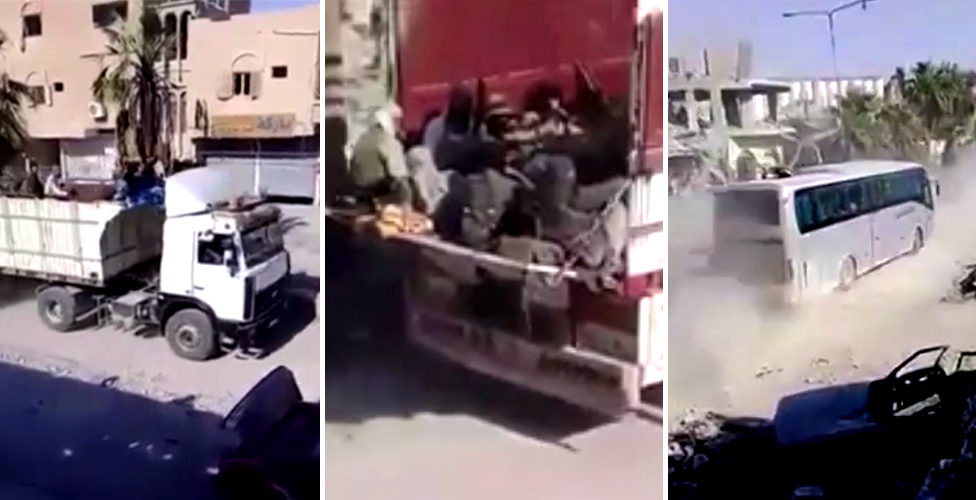
    According to the BBC the deal “enabled many hundreds of IS [Daesh] fighters to escape…At the time, neither the US and British-led coalition, nor the SDF, which it backs, wanted to admit their part.” According to the personal testimony of some of the drivers employed to evacuate the fighters and their families out of Raqqa, “the convoy was six to seven kilometres long. It included almost 50 trucks,13 buses and more than 100 of the Islamic State group’s own vehicles.” We also learn that despite “an agreement to take only personal weapons, IS fighters took everything they could carry. Ten trucks were loaded with weapons and ammunition.”

    No one should be in any doubt when it comes to the gravity of seriousness involved in allowing hundreds of Daesh fighters to escape and fan out across Syria with some, according to the BBC, making it across the border into Turkey. The burning question is whether the deal and subsequent evacuation was undertaken with the express purpose of diverting them to parts of Syria controlled by the Syrian Army and its allies?

    What is certain is that it brings the US-led coalition into disrepute, confirming that it is part of the problem in Syria and wider region rather than any solution. When we add to this sordid picture the recent sentiments of US Secretary of State Rex Tillerson, asserting that there is no future for Assad in Syria, it is clear that regime change in Damascus remains Washington’s overarching objective.

    When it comes to regime change in Syria, exactly who would benefit? Certainly not the Syrian people after the inordinate suffering and sacrifice they have endured in the process of first withstanding then defeating a concerted attempt to destroy the country and its non-sectarian character.

    A dirty war has been waged in Syria these past six year not by Daesh, per say, but by the US, UK, and their Persian Gulf allies. Add to this motley crew Israel’s repeated violations of Syrian airspace and you identify an axis which constitutes a threat to human progress and development such as the world hasn’t seen since the Second World War.

    As for the Syrian Kurds, fighting under the banner of the SDF (Syrian Democratic Forces), they now have a critical role to play when it comes to the trajectory the conflict takes upon the liberation of Raqqa. Indeed upon their next move will depend whether it will be accurate to describe the removal of Daesh from the city as liberation or whether it will be more akin to a re-occupation.

    It has never been more important for the Kurds not to make the mistake of confusing self-determination with treachery. Their part in defeating Daesh has undoubtedly been a courageous one. However with this secret deal to allow hundreds of Daesh militants to leave the city with their weapons and ammunition, it is impossible to avoid pondering if they are now preparing for a post-Daesh confrontation with the Syrian Army, which has just liberated Deir Ezzor 145km southeast of Raqqa.

    The point bears repeating: the presence of US military forces in Syria constitutes a clear violation of international law. It bears repeating when we have key US officials, such as Defense Secretary James Matthis, claiming UN sanction for this presence. As Russia Deputy Foreign Minister Gennady Gatilov pointed out in reponse to the US Defense Secretary’s false claim, “Syria is a sovereign independent state,” going on to remind Mr Matthis that “only the Syrian government can invite armed forces of third countries onto its territory. The UN has no such right,” he went on, before emphasizing that “the fight against terrorism does not give any states or coalitions a free hand to establish their presence on Syrian territory.”

    There is no doubt, surveying the contours of this struggle in Syria, that driving it has been the ongoing attempt not only to destroy Syria’s sovereignty and independence, but to neuter Iran’s independence also. This is why Trump’s recent unhinged and uninformed bellicose statements, directed at Iran, should come as no surprise. What with the purge unleashed by crown Prince Mohammad bin Salman in the Riyadh recently, along with the detention and forced resignation of Lebanon’s Prime Minister Saad Hariri, though the battle for Syria draws to a close, the wider struggle between the axis of sectarianism and regime change – comprising Washington, Saudi Arabia, and Israel – and the axis of resistance to it – comprising Russia, Iran, Syria and Hezbollah .


    Source

  • Last Military Situation in Central and Eastern Syria till November 13, 2017

    Last Military Situation in Central and Eastern Syria till November 13, 2017

    – Liberation of Deir Ezzor city and continuing operation in Hawija Qate

    – The arrival of the Syrian Resistance and the Syrian Army at the east of the T-2 station on the Iraqi-Syrian border.

    – Moving towards al-Bukamal and the siege of this city and the city’s military fall.

    – Continuing advances of the Syrian army and resistance on the north-east front of Hama.

    – Progression of the Syrian army ~30 kilometers south east of Al-Mayadin.

    – The advances of SDF in north of the Euphrates and the occupation of the oil and gas wells of Omar and Tanak

    – The advances of SDF in the southern province of Al-Hassekah and the domination of the important area of “Markadeh”.


    HD Map

  • Saudi Arabia Calls On UN Security Council To Take Action Against Iran

    Saudi Arabia Calls On UN Security Council To Take Action Against Iran

    Riyadh said that it has evidence of the involvement of Iran in missile development and launches towards the Kingdom on November 4 and July 22, 2017.

    The letter said that Saudi-led forces prevented numerous smuggling operations of Iranian weapons to Yemen adding that this is a flagrant violation of Security Council resolution 2216 from 2015 and resolution 2231 from 2016.

    Saudi Arabia affirmed that it will take appropriate action to respond to acts of aggression by the Houthis in order to safeguard the Kingdom’s security in accordance with the United Nations Charter and international laws.


    Translate provided by SouthFront