The Palestinian resistance movement Hamas announced in a statement that Yahya al-Sinwar has been elected as the new head of the movement’s Political Bureau and the successor of the martyr Ismail Haniyeh. He was previously the head of Hamas’ Political Bureau in the Gaza Strip.
Yahya al-Sinwar and martyr Ismail Haniyeh
Who is Yahya al-Sinwar?
Yahya al-Sinwar is a Palestinian military commander who joined the Martyr Izz al-Din al-Qassam Brigades, the military wing of Hamas, since the beginning of the Palestinian Islamic Resistance Movement in Gaza, and in 2005, he assumed the position of commander of the Khan Yunis Brigade.
The Zionist regime considers Yahya al-Sinwar to be the mastermind of many guerrilla operations and have put his name on their terror list. Some sources also claimed that al-Sinwar was the founder of Hamas’ security service, known as al-Majd, which focuses on internal security cases.
Yahya al-Sinwar is one of those who fundamentally believes that it is not possible to defeat Israel unless its mercenaries are identified and destroyed. From the very beginning of his activities, he focused on this goal, and during the era of Sheikh Ahmed Yassin, the Hamas security apparatus was under his management, and a number of infiltrators and spies of the Israeli regime were also identified during this period.
Yahya al-Sinwar
The security apparatus under al-Sinwar’s leadership gradually grew so powerful that as a counterintelligence organization, it gained considerable control over the movements of the Israeli regime and its spies. It was this power and influence of Yahya al-Sinwar that led the Israelis to arrest him very quickly, which led him to spend 23 years of his life in Israeli prisons. It is worth mentioning that he was released unconditionally under the Gilad Shalit contract in 2011 with sentences of more than 430 years in prison.
Michael Koubi, the officer who oversaw al-Sinwar’s interrogation for the Shin Bet in 1989, described him as a man of command and charisma who spoke little and was quick to get angry. He was described as “a leader in and out of prison and a man of discipline.”
Israeli reports confirm that al-Sinwar was fluent in Hebrew, and this ability helped him track and analyze what was happening inside Israel. In fact, he was able to keep a close eye on Israeli society and read newspapers in addition to biographies of Israeli leaders.
After his release, al-Sinwar also succeeded in inflicting the largest military damage on the Israeli regime in the history of its occupation, and it is said that he has survived six failed assassinations in recent years.
A few months ago, the Hebrew-language media quoted a number of released Israeli prisoners as saying: In the first days of captivity, Yahya al-Sinwar, the head of Hamas’ political bureau in Gaza, appeared among the Israeli prisoners and addressed them in Hebrew without an accent: ‘Hello, I am Yahya al-Sinwar, you have the most protection here and nothing will happen to you!’
Local sources reported that an anti-Israel stabbing took place in the Holon city, south of Tel Aviv, on Sunday morning.
After the incident, official sources announced that five people were injured in the Holon city. Minutes later, two Zionist settlers succumbed to injuries. Therefore, the number of Zionist casualties in the attack on the Holon city increased to two dead and three wounded.
Images from the scene of the attack
The Zionist regime’s Channel 12 TV quoted the regime’s police spokesman as saying that the perpetrator of the Holon operation was a young man named Ammar Odeh, 34 years old, a resident of Salfit in the West Bank, who entered the center of occupied Palestine without a permit and was shot dead by the Israeli police.
Ammar Owda
Local sources indicated that Israeli forces closed the main northern entrance to the town of Salfit in the occupied West Bank with an iron gate this morning. According to the Israeli TV channel, another person was involved in the operation and is being wanted.
In the West Bank, the Israeli military reported that its first airstrike targeted a vehicle near Tulkarm.
In this attack, five Palestinians were martyred, including Abdul Jabbar Sabbagh al-Dahruki, one of the commanders of Saraya al-Quds (Tulkarm Battalion) and Haitham al-Balidi, one of the commanders of al-Qassam Brigades in Tulkarm.
Israeli airstrike on a vehicle in Tulkarm
A subsequent airstrike in the same area aimed at another group, which the military alleged had fired at their troops.
This morning, a Palestinian youth was injured by Israeli gunfire near the village of Aroura, north of Ramallah.
Additionally, Israeli forces conducted a raid in the village of Deir Nitham, west of Ramallah, but no arrests were reported following the operation.
Haniyeh’s presence at the ceremony highlighted the close ties between Hamas and Iran, which has been a significant supporter of the Palestinian cause.
Details surrounding the assassination remain still unclear, but sources indicate that it occurred hours after Haniyeh’s participation in the inauguration ceremony in the Iranian capital at 1:45 am July 31.
Haniyeh had been in Tehran to strengthen diplomatic relations and support for Palestinian resistance efforts amid escalating tensions in the region. His participation in Pezeshkian’s inauguration was seen as a gesture of solidarity between Hamas and the Iranian government, showcasing their ongoing collaboration against common adversaries.
The assassination has sparked widespread condemnation from various Palestinian factions and allies, who have called for an immediate investigation. Iranian officials have vowed to uncover the facts behind this heinous act, emphasizing their commitment to supporting the Palestinian struggle.
This incident marks a significant escalation in the already volatile landscape of Middle Eastern politics, raising concerns about potential retaliatory actions from Hamas and its allies.
The Islamic Republic of Iran vowed that Haniyeh’s blood will not go in vain. Lebanon’s Hezbollah, Yemen’s Ansar Allah movement, Iraqi resistance groups plus numerous heads of states and people around the globe reacted to the act of violence, which is blamed on the Israeli regime.
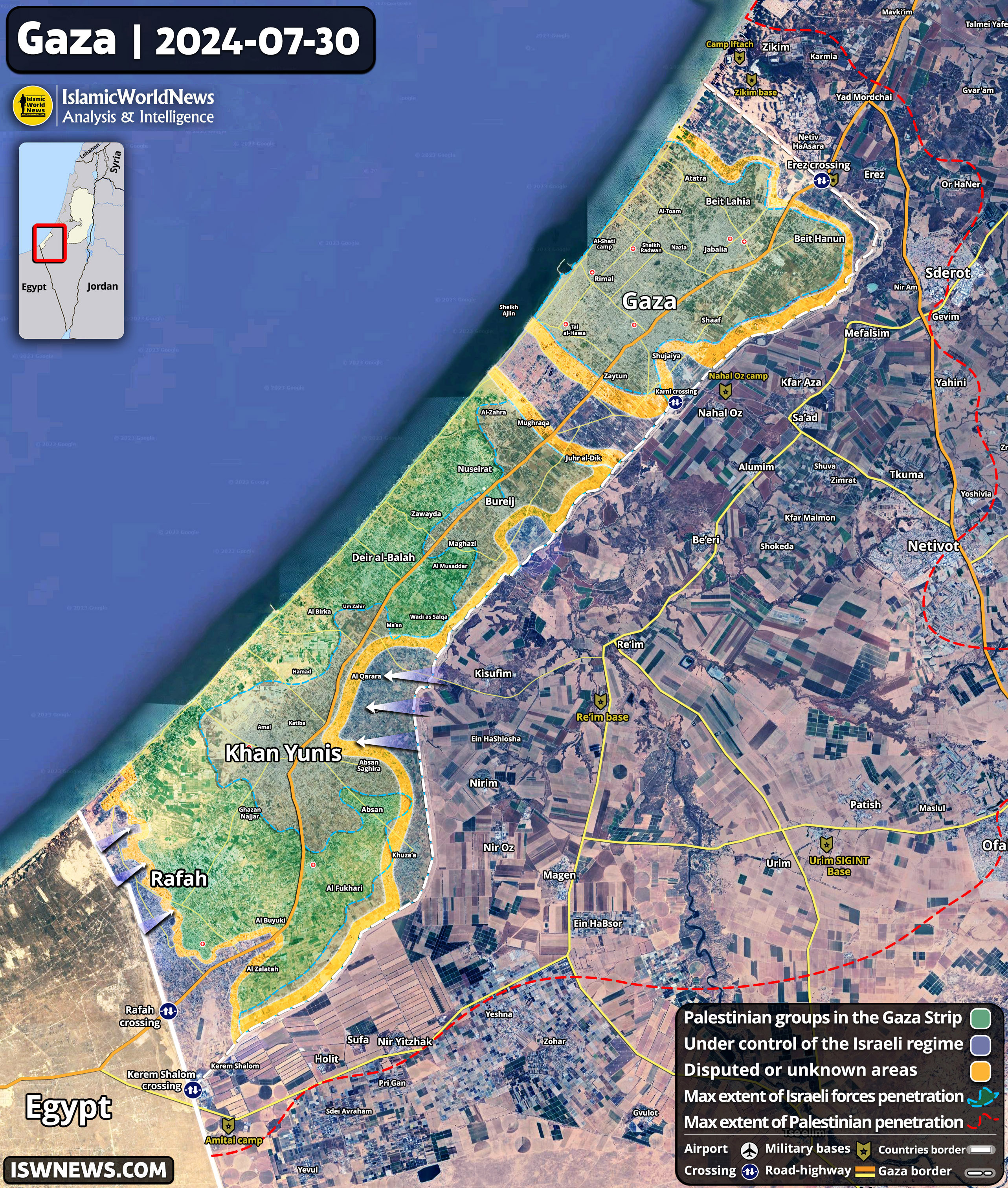
On July 22, the Israeli regime’s military forces launched an operation in Khan Yunis with the aim of preventing the return of the resistance forces to this area.
During the operation, the Israeli military destroyed residential buildings, a cemetery and service facilities using bulldozers and explosives.
According to the Israeli regime’s army, 150 members of the resistance forces were martyred during the operation, several tunnels were destroyed, and some weapons were confiscated. Finally, the Tel Aviv regime’s army announced this morning that the regime’s 98th Paratroopers Division completed its operation in Khan Younis last night.
In this regard, local sources announced that thousands of Palestinians returned to their homes in the city of Khan Yunis on Tuesday after the end of the eight-day operation of the Israeli army.
After the return of the residents and the start of the activities of the Palestinian rescuers, the Gaza media office announced that as a result of the recent operation of the Zionist regime’s army in Khan Younis, at least 255 Palestinians were martyred and more than 300 others were wounded. In addition, 30 people disappeared.
Despite the Israeli army’s withdrawal from Khan Yunis, its forces continue sporadic artillery and air strikes in areas of Khan Yunis and its surrounding areas. In recent hours, the Israeli army has also carried out several reconnaissance operations in the city of Khan Younis, using drones and quadcopters.
The Israeli armed forces are still stationed on the eastern axis of Khan Younis, and it is possible that in the coming weeks, the city of Khan Yunis and its surrounding areas will witness short-term operations by the Israeli regime’s army.
It is worth mentioning that on July 22, local sources reported the advance of the Israeli regime’s army forces on the axis of Abasan Al-Kabira area. During the operation, the Israeli military advanced with air support to the city of Khan Yunis.
On the axis of Rafah, clashes between resistance fighters and Israeli armed forces continue. Clashes and exchanges of fire have been concentrated in the Tal al-Sultan neighborhood of Rafah, and in recent days, the forces of the Izz al-Din Al-Qassam Brigades, Al-Quds Brigades and al-Nasser Salah al-Deen Brigades have organized a series of operations against the Israeli regime’s army on the different axes of the conflict in Rafah, during which several armored vehicles of the Israeli military were destroyed and several Israeli armed forces were killed and wounded.
The Supreme Leader received both Palestinian officials in Tehran on Tuesday morning.
Ayatollah Khamenei addressed the two officials as saying that the Palestinian people and the residents of Gaza currently hold the most significant flag of Islam, and their resistance has paved the way for the spread of the holy religion.
He further stated that the growing inclination towards Islam at this time reflects the honor and strength of the Palestinian nation’s resistance and the people of Gaza.
The Leader also described the people of Gaza and the West Bank as the key contributors to this resistance’s glory, expressing hope that the almighty God will continue to bless the Palestinians and their resistance fighters.
This meeting took place prior to the inauguration of Masoud Pezeshkian, the newly elected Iranian President. Pezeshkian took the oath of office before Parliament at the Iranian parliament in Tehran on Tuesday afternoon.
Pezeshkian is the ninth president of the Islamic Republic following his victory in the July 5 run-off presidential election.
The inauguration ceremony was attended by over 70 foreign dignitaries and covered by 600 domestic and foreign journalists.
While civil society and party activists in the Arab world have chosen the path of rallies, which, in their opinion, is enough to support Palestine, rapid changes are taking place in Europe.
Paradoxically, but the fact remains that the Hamas operation “Flood of al-Aqsa” (Al-Aqsa Storm) did not awaken the Arab peoples from a flawed sleep, but civil society activists of various ideologies in the United States and Europe.
Students in the United States still remain an influential pro-Palestinian force, while in the EU, in addition to the call from major political parties for the need to decolonize Palestine, resistance groups have emerged whose goal is to stop military support for the Zionists.
Intellectual circles also did not stand aside and there is an example of France, where a local political scientist immediately supported the Palestinians, for which he was subjected to pressure from the Zionist lobby.
Of course, against the background of powerful pro-Palestinian activity, the forces of evil, led by the Zionist lobby, are making a variety of efforts to prevent the truth from being heard. Moreover, we must not forget about the allies of Zionism in the camp of the European bureaucracy, which still supports the genocide of the Palestinians.
In general, we see how the Palestinian issue has become the main topic of discussion in European capitals. Personally, I associate what is happening with the recognition of the fact of the collapse of Zionist imperialism and the willingness to rethink the foreign policy vector.
The collective West, in an attempt to preserve the Zionist colony, got bogged down in the Middle East and had no other choice but to reduce its military presence in the Islamic environment to zero.
Moreover, against the background of what is happening in Ukraine, the leading EU countries, Britain and the United States, due to ideological, economic and geopolitical reasons, simply cannot allow Kiev to defeat, but there is still a frozen conflict in Transnistria, a “crisis of democracy” in Georgia and the last “Soviet stronghold” in the person of Belarus. In all these countries, the influence of the Kremlin looms, and in the long term – China, respectively, the titans of Atlanticism do not want to fight with all at once, and even more so to endlessly risk in the name of a lame horse (Zionism). Therefore, the leading Think-tank of the West decided to gradually move away from the alliance with the right-wing Zionists and immerse themselves in the internal affairs of Europe.
In conclusion, I would like to point out that unfortunately, at the moment there is no partisan activity from the majority of EU Muslims by analogy with British left-wing groups, but there is at least political activity (again, only in Britain and partly in France). Over time, Muslims will show more efforts and even get a chance to enter the European Parliament, so it’s worth thinking about the future now, for example, about developing a common ideology and a mechanism for persecuting Zionists around the globe.
The Information Office of the Palestinian Authority in the Gaza Strip announced the latest statistics of martyrs, wounded and damages of the war in the Gaza Strip.
The statistics are as follow:
The Israeli regime committed 3,388 massacres in the Gaza Strip during the 280 days of war.
So far, 48,345 people were martyred and missing in the Gaza Strip.
10,000 people are missing and 38,345 people were martyred and their bodies were taken to hospitals.
16,054 of the martyrs are children.
34 of these children died as a result of starvation.
10,700 of the martyrs are also women.
500 medical staff were killed.
75 people of rescue and relief forces were martyred.
158 journalists were martyred.
The Israeli regime has created 7 mass graves inside the hospitals of the Gaza Strip. The bodies of 520 martyrs were found in these seven mass graves.
159 refugee centers have been attacked by the Israeli regime.
88,295 people have been injured so far.
70% of the victims of this war are women and children.
17,000 children lost their parents or one of them since the beginning of the war.
3,500 children are at risk of death due to malnutrition and lack of medicine.
12,000 wounded need to be sent abroad for treatment.
10,000 cancer patients are struggling with death.
3,000 people suffering from various diseases need to be sent abroad.
1,737,524 were infected with infectious diseases due to displacement.
71,338 people were infected with liver inflammation due to displacement.
About 60,000 pregnant women are at risk due to the lack of medical care.
350,000 people with chronic diseases are at risk due to the lack of medicine.
Since the beginning of the war, 5,000 people have been arrested in the Gaza Strip.
310 of those arrested are from medical and therapeutic staff.
So far, 23 journalists have been arrested.
Two million people were displaced and homeless in the Gaza Strip.
197 government center was completely destroyed.
115 universities and schools have been completely destroyed.
328 other universities and schools were also damaged.
609 mosques have been completely destroyed.
211 other mosques were also damaged.
The occupiers have bombed and destroyed 3 churches.
150,000 residential units are completely destroyed and uninhabitable.
Another 200,000 residential units have also been damaged.
Since the beginning of the war, 80,000 tons of explosives have been dropped on the people of Gaza.
34 hospitals are completely out of service.
66 health and treatment centers are also out of service.
The invaders targeted 161 medical centers.
131 ambulances have also been targeted.
206 historical and ancient places have been targeted and destroyed.
The Israeli regime destroyed 3,030 km of the electricity grid in the Gaza Strip.
The initial direct damage of the war is estimated at 33 billion dollars.
Latest statistic of war in Gaza; day 280 – click to view full size
On Monday morning, after repeated rocket attacks on the south of the occupied territories, the Israeli army called on Palestinians to evacuate areas east of Khan Younis.
The new operation of the Israeli regime’s army in the Khan Yunis and Abasan al-Kabira axis has begun while the regime had withdrawn from Khan Yunis three months ago. Prior to this operation, the southern areas of the Gaza Strip and the city of Rafah witnessed Israeli operations for more than four months.
Clashes continue in the southern Gaza Strip and the Abasan axis. It is not yet clear whether the Israeli army’s operation in Abasan al-Kabira is a limited operation aimed at destroying the resistance cells in the area, or whether the Israeli armed forces will penetrate deep into Khan Yunis again.
It is said that at least 45 Palestinians were martyred and more than 120 others were wounded in today’s airstrikes by the Israeli regime’s army on the city of Khan Younis.
Moreover, confrontations between the occupation forces and Palestinian resistance fighters continue in the city of Rafah located in the southern Gaza Strip. The Israeli regime’s army controls about 70% of the city. However, there is no clear future for the regime army’s operations on this axis, and they are still unable to fully occupy the city after several months of fighting.
Since October 7, 2023, when the Israeli regime kicked off its aggression on the Gaza Strip at least 39,006 people have been martyred and 89,818 injured.
The military situation in Gaza and Rafah has not changed much. Israeli forces have not been able to completely clear Rafah after weeks of fighting. Around 70% of the town is currently under Israeli control.
Fighting continues in the central areas of Rafah, in Tal al-Sultan, around the Saudi project and in the southern areas of the city.
The situation in other parts of the Gaza Strip remains unchanged. Israeli forces are stationed in the central axis of the Gaza Strip, known as the Netzarim axis. In addition, Israeli engineering units are demolishing buildings and clearing areas in the northern and southern parts of the Netzarim axis.
Military situation in the Rafah area
Israeli forces recently destroyed six tunnels belonging to Hamas and Islamic Jihad in the Shujaiyeh area. One of the tunnels destroyed was Islamic Jihad’s main tunnel in Gaza City, which was 2.5 kilometres long and used for command and control operations. In total, at least six kilometres of tunnels were destroyed in Shujaiyeh.
The tunnels and underground facilities used by Palestinian resistance groups pose a significant challenge to the Israeli regime. Despite the Israeli army’s efforts to secure Gaza City and other areas of the Gaza Strip, the extensive network of underground facilities makes this task seem impossible.
Palestinian fighters use these tunnels on a daily basis to launch surprise attacks against Israeli forces and equipment.
Ambush of Palestinian forces against the occupiers in Gaza City
Yesterday, the Israeli army ordered Palestinians in several neighbourhoods of Gaza City to evacuate the area and move to designated humanitarian zones. The zones are located in the al-Mawasi area on the southern coast of the strip, the western districts of Khan Yunis and Deir al-Balah in central Gaza.
Colonel Avichay Adraee, the IDF’s Arabic-speaking spokesman, has published a list of areas for evacuation. Among the areas to be evacuated are the neighbourhoods of Sabra, Rimal, Tal Al-Hawa and Daraj in Gaza City.
The announcement of the Israeli regime army to evacuate a part of Gaza City
These announcements are made as bombardment of civilian targets and infrastructure continues. At least 50 Palestinians have been killed in Israeli attacks over the past 24 hours.
In just one of these attacks, 17 Palestinians were martyred. In this crime, the house of Abu Farih’s family in the Nusairat refugee camp was bombed by Israeli warplanes. 14 of those killed were women and children.
Today, also the fighter jets of the Israeli regime targeted the so-called humanitarian area of Mawasi. In this crime, more than 70 Palestinians were martyred and 290 others were injured. A large number of martyrs and injured are women and children, including children less than two years old.
The video contains heartbreaking scenes
A glimpse of the Israeli regime’s crime in Mawasi, Khan Younes
In recent months, the Israeli army has issued statements calling on civilians to evacuate certain areas. However, these evacuations do not appear to have had a significant impact on the Israeli army’s operations in Gaza. Palestinians return to their homes after some time, and the Israeli army does not actually send troops to the evacuated areas. So these announcements mainly mean more air strikes, more destruction and more casualties in Gaza.
So far, Israeli air strikes have killed at least 38,243 Palestinians and wounded 88,033, most of them women and children.
Yesterday there was a major change in the command of the Israeli army in the West Bank.
Major General Avi Blot took over the Israeli army’s Central Command in a handover ceremony at the unit’s headquarters in Jerusalem, becoming the new general in charge of the West Bank region.
Major General Avi Blot will be replaced by Major General Yehuda Fox, who is retiring from the IDF, ending a 36-year military career.
Major General Avi Blot
Following the 7 October attacks, tensions and conflicts in the West Bank have escalated significantly, leading to dire security conditions. The Israeli army carries out military operations in the area on a daily basis. In a recent incident, 13-year-old Palestinian Ghassan Gharib Zahran was fatally shot by Israeli soldiers in the town of Deir Abu Meshaal, near Ramallah.
The Palestinian Prisoners’ Club announced that the Israeli army has arrested 16 Palestinians in different areas of the West Bank since yesterday. Israel has arrested more than 9,600 Palestinians in the West Bank since the start of the war on Gaza.
The situation on the northern front remains tense: despite repeated Israeli threats to launch military operations into Lebanese territory, no attacks have been carried out. Earlier, Lebanese Hezbollah leader Sayed Hassan Nasrallah warned in a televised speech that any Israeli military operation into Lebanese territory would be met with a strong response from Lebanese resistance groups and Hezbollah. The message seems to have gone down well in Tel Aviv.
However, the Israeli military has stepped up its drone strikes and assassinations against key Hezbollah figures in recent weeks. Israel is attempting to raise the cost of the war for Lebanese Hezbollah by targeting Hezbollah field commanders and key figures with assassination attempts.
On July 9, an Israeli airstrike against a vehicle on the Beirut-Damascus highway, near a checkpoint between Lebanon and Syria killed Yasser Qarnabash, a senior Hezbollah member close to the Seyed Hassan Nasrallah.
Martyr Yasser Qarnabash
On July 3, a senior Hezbollah military commander, Muhammad Na’amah Nasser, was assassinated by Israeli drones in the city of Tyre in southern Lebanon. Na’amah played a major role in the liberation of southern Lebanon in 2006 and in the battles in Syria and Iraq against ISIS and Al-Qaeda terrorist groups. He also led and supervised dozens of operations against the Israeli army during the recent fighting in northern occupied Palestine.
Martyr Muhammad Na’amah Nasser
Alongside targeted assassinations, artillery and airstrikes continue in southern Lebanon.
Israeli warplanes bomb Lebanon’s southern regions and towns on a daily basis. Hezbollah fighters also use heavy rockets, anti-tank missiles and suicide drones to target Israeli positions and bases in northern occupied Palestine.
On July 6, for example, Hezbollah carried out a series of targeted attacks on key Israeli army positions in southern Lebanon. Hezbollah fired dozens of rockets at the Nimra base west of the Sea of Galilee and the Mount Meron air traffic control base. They also targeted Israeli troops in the Birkat Risha area with guided missiles, hit surveillance equipment in the al-Rahib area, and shelled the Bayad Blida and al-Baghdadi areas.
Part of Hezbollah’s operations in northern occupied Palestine
Military operations along the northern borders have led to widespread evacuations of settlements. The Israeli Ministry of Housing and Immigration reports that hundreds of thousands of settlers have left the occupied territories since the start of the war.
According to the latest reports, more than 250,000 Israeli citizens have been displaced by the war, with some 164,000 ordered or recommended to evacuate with government compensation and nearly 150,000 evacuated without being asked.
The number of Israeli refugees increases daily...
According to a report by Israel’s Channel 12, social media has been filled in recent weeks with posts from Israeli settlers to their friends who are considering leaving Israel. The ongoing 10-month war has produced unclear results, prompting some settlers to consider leaving the country.
Channel 12 TV reported that a new survey shows that the number of Israelis who want to emigrate from Israel has increased by two and a half times.
It is worth noting that 500,000 Israelis have left the country since the start of the Gaza conflict.
The disastrous political situation in Tel Aviv, the unfavourable and critical security situation in the West Bank, the war in the Gaza Strip and Israel’s failure to achieve its set goals in the Gaza Strip, the war and tense situation on the northern front and the possibility of a full-scale war with Hezbollah are challenges that have made Israel more vulnerable to collapse than ever before.
All this, together with the massive wave of emigration from Israel, has left the outlook for the political and security situation in the crisis-ridden country in a cloud of uncertainty.
Hamas and Islamic Jihad movements have announced in a statement that head of the Hamas political Bureau Ismail Haniyeh and Secretary-General of Islamic Jihad in Palestine Ziyad al-Nakhala delivered the response of the resistance groups to the proposed ceasefire and prisoner swap initiative in a meeting with the Qatari Prime Minister Sheikh Mohammed bin Abdulrahman bin Jassim Al Thani. They also delivered their response to Egypt.
The statement emphasizes that the resistance groups considered the interests of the Palestinian people, the imperative necessity of a complete cessation of hostilities, and the full withdrawal of occupying forces from Gaza in the response to the proposal.
The statement further asserts that a Palestinian delegation, relying on a sense of national responsibility, expresses readiness for positive engagement to achieve an agreement that would bring an end to the ongoing war.
The two resistance movements said in a joint statement that they are ready to “deal positively to arrive at an agreement” and that their priority is to bring a “complete stop” to the regime’s assault on the besieged area.
Senior Hamas official Osama Hamdan told Lebanon’s Al-Mayadeen television network that the group had “submitted some remarks on the proposal to the mediators.”
A Hamas official also told Reuters that the response reaffirmed any agreement must end the Zionist aggression on Palestinian people, get the occupying forces out, reconstruct Gaza and achieve a serious prisoner swap deal.
The foreign ministries of Qatar and Egypt said in a joint statement that they were examining Hamas’ response and that they would continue their mediation efforts along with the United States until an agreement is reached.
White House National Security Spokesperson John Kirby said the US had also received and was evaluating the response.
US Secretary of State Antony Blinken visits the region to pursue Washington’s plan and discuss Zionist officials.
The Israeli regime’s army’s advancement to the shores of Rafah marks a pivotal moment in the evolving dynamics of the conflict, with implications reverberating across the region.
In Rafah, a city at the heart of the conflict, clashes persist in multiple fronts, spanning the southern, western, and northern axes. Recent confrontations have seen targeted assaults by Israeli forces on vital locations such as Tel al-Sultan and the Saudi Housing in the city’s northern sector. Concurrently, efforts to secure and clear areas in the western part of Rafah are underway, underscoring the intensity of the ongoing military incursion.
The advance of Israeli regime in Rafah and along the border line
Insights from field sources within the Israeli regime shed light on the tactics employed by the Israeli army in Rafah. Despite lacking the requisite strength for a full-scale assault, Israeli forces are employing tactical approaches involving limited raids, strategic retreats, and iterative movements to consolidate control over the region incrementally. This strategy indicates a push by Israeli forces to expand their territorial influence along the coastal perimeters of Rafah.
Reports indicate a significant evacuation of approximately two-thirds of Rafah’s population, highlighting the humanitarian impact of the genocidal war. Furthermore, with around 35% of Rafah falling under Israeli occupation, the plight of civilians in the region is exacerbated, underscoring the urgent need for international intervention and humanitarian assistance.
In a tactical deployment towards Al-Bureij refugee camp in the central axis, the Israeli regime’s army has advanced several kilometers to support military operations aimed at the release of Israeli captives. However, these advancements are deemed temporary, with expectations of Israeli forces withdrawing from these areas in the near term, reflecting the fluid and dynamic nature of the conflict landscape.
The intensifying clashes in Rafah underscore the precarious situation faced by civilians caught in the Israeli plot for the region.
Meanwhile, some reports point out to the fact that discussions regarding the reopening of the Rafah Crossing have hit a roadblock due to Israeli Prime Minister Benjamin Netanyahu’s rejection of involving the Palestinians in overseeing the vital crossing.
The Palestinians Authority (PA) has described the United Nations’ decision to place the Israeli regime on the blacklist for harming children as a proper measure to make the regime accountable.
This move has shed light on the plight of Palestinian children who have long suffered the brunt of Israeli aggression and violations of their basic rights.
The confirmation from the representative of the Israeli regime at the United Nations regarding Guterres’ decision has sparked a wave of condemnation from Israeli officials, underscoring the sensitivity and significance of this development.
The criticism levied by the Israeli representative, in response to the listing, reflects a desperate attempt to deflect attention from the atrocities committed by the Israeli regime, particularly during the Gaza war, where innocent Palestinian children bore the heaviest burden of violence and displacement.
Israeli Prime Minister Benjamin Netanyahu’s dismissal of the UN’s decision and his claim of the Israeli army’s ethical standards only serve to perpetuate the narrative of impunity and disregard for Palestinian lives that has characterized Israel’s actions in the region.
Netanyahu said: “It is the United Nations that is on the blacklist. When the UN joined Hamas supporters, it was placed on the blacklist; the Israeli army is the most ethical army in the world, and no ridiculous decision by the United Nations will change this reality.”
Netanyahu’s rhetoric fails to acknowledge the systemic injustices and human rights violations that Palestinians have endured for decades at the hands of the Israeli military.
For Palestinians and advocates of justice worldwide, Israel’s inclusion in the UN blacklist symbolizes a glimmer of hope for accountability and a recognition of the ongoing humanitarian crisis in Palestine.
The international community must stand firm in holding Israel accountable for its actions and ensuring that the rights of Palestinian children and civilians are safeguarded against further violations and atrocities.
As the voices of the Palestinian people grow louder in their quest for freedom and justice, the listing of Israel on the UN blacklist serves as a reminder of the urgent need for solidarity and action to end the cycle of oppression and violence in Palestine.