Blog

  • Enemies of Islam want to create rifts among Muslims: Ayatollah Khamenei

    Enemies of Islam want to create rifts among Muslims: Ayatollah Khamenei

    Today, we have certain problems within the world of Islam. We are suffering from the bloodshed, and there are deadly confrontations today. Yemen serves as an example. These issues should receive more attention.

    The truth is that today, the Islamic Ummah is suffering from numerous problems. Certain wounds have been and continue to be inflicted upon the body of the Islamic Ummah. The deepest wound is the one caused by discord. Enemies of Islam are trying to create discord among Muslim groups with different methods. They want to create rifts and enmities among them, by means of ethnic and denominational differences, based on geographical disputes of territorial and border issues. Tools for carrying out these methods are available to them [those involved in disputes], and the enemy is, unfortunately, using them. We, officials of Islamic governments, have ignored this measure that the enemy has adopted.

    When I think to myself, I feel that we should be extremely concerned that some American congressman – who is opposed to the very essence of Islam, an enemy to Islamic countries – expresses his “concerns” about the problems of a Sunni community, pitting people against Shi’a. We should be ever more vigilant upon hearing such rhetoric. An enemy, who is opposed to the essence of Islam, has now expressed his support for a certain Islamic group against another! Is this anything other than malevolence, conspiracy and enmity? As it so happens, this behavior unfortunately exists. We should ponder on it; we should understand this ploy.

    All Islamic countries lose from discord, and all of them profit from unity. Unity among Islamic countries, their closeness to one another, and their refusal to use force against one another are merits that can be used to their own advantage; we should understand that these qualities are to the advantage of Islamic countries. This is a divine logic: it is Islamic logic. Unfortunately, this logic does not receive enough attention.

    Today, we have certain problems within the world of Islam. We are suffering from the bloodshed, and there are deadly confrontations today. Yemen serves as an example. These issues should receive more attention. The issues of Syria, the issues of Iraq, the issues of North Africa and, the numerous issues that one witnesses in the world of Islam are all signs of discord and conflict. These conflicts serve as a disadvantage towards Islam; moreover, this is a disadvantage for the entire Islamic Ummah. We should resolve these problem.

  • Trump lacks Syria strategy, risks confrontation with Russia and Iran, analysts say

    Trump lacks Syria strategy, risks confrontation with Russia and Iran, analysts say

    US President Donald Trump has ordered increased military operations in Syria and delegated more authority to his generals despite lacking a comprehensive strategy, an approach that may spark a confrontation with Syria, Iran and Russia, according to US officials and analysts.

    The United States has taken a series of military actions over the past three months against Syrian government forces and its allies, including the shoot-down of a Syrian jet on Sunday.

    In April, Trump ordered cruise missile strikes against a Syrian airfield from which Washington said a deadly chemical weapons attack was launched.

    Analysts say these incidents are tactical and not part of any military strategy in Syria.

    “There isn’t an over-arching US strategy driving this,” said Charles Lister of the Middle East Institute.

    “This is just the result of tactical decisions by a commander on the ground whose only focus is a specific theater in Syria. He is acting to protect his assets … This is purely a series of tactical decisions that are creating a series of very serious strategic consequences.”

    Russia and Iran are both assisting Syrian President Bashar al-Assad to fight Daesh (ISIL) and other terrorist groups wreaking havoc in Syria.

    The larger problem, the officials and analysts said, is that Trump and his national security team have not prepared a long-term political strategy for dealing with Syria.

    “We have never had a coherent Syrian strategy,” said one US official, speaking on condition of anonymity. “We oppose Assad, but our main enemy is ISIS, which also opposes Assad. Our most capable allies are the (Kurdish) peshmerga, but Turkey, who is a NATO ally and host to an airbase that is central to our efforts, considers the Kurds enemies.”

    US General Joseph Dunford, the chairman of the Joint Chiefs of Staff, said Monday the US is working to restore a communications line with Russia intended to avoid mid-air collisions over Syria, after Moscow cut it off following the US downing of the Syrian military jet on Sunday.

    The deconfliction arrangement was first established with Russia in 2015 to avoid unnecessary conflict and miscommunication in the military movements of US-led coalition and Russian forces in Syria.

    The Russian military involvement in Syria began in September 2015 after an official request by the Syrian government for military assistance against terrorist groups.

    Different foreign-backed terrorist groups have been wreaking havoc in Syria since 2011. Over the past few months, Syrian forces have made sweeping gains against Takfiri elements, who have lately increased their acts of violence across the country following a series of defeats on the ground.

  • Iraq Recaptures Al Nuri Mosque in Mosul, but Only Rubble Remains

    Iraq Recaptures Al Nuri Mosque in Mosul, but Only Rubble Remains

    Prime Minister Haider al-Abadi of Iraq announced the recapture of Al Nuri Grand Mosque in Mosul on Thursday from Islamic State militants, calling it a sign of the end of the extremists’ grip on the region and vowing to chase them out of the country.

    “We are seeing the end of the fake Daesh state, the liberation of Mosul proves that,” Mr. Abadi said on Twitter, using the Arabic acronym for the Islamic State. “We will not relent. Our brave forces will bring victory.”

    Mosul has still not been entirely wrested from Islamic State control despite a complex eight-month battle for the city. But Thursday’s announcement signified a further push to eliminate the group.

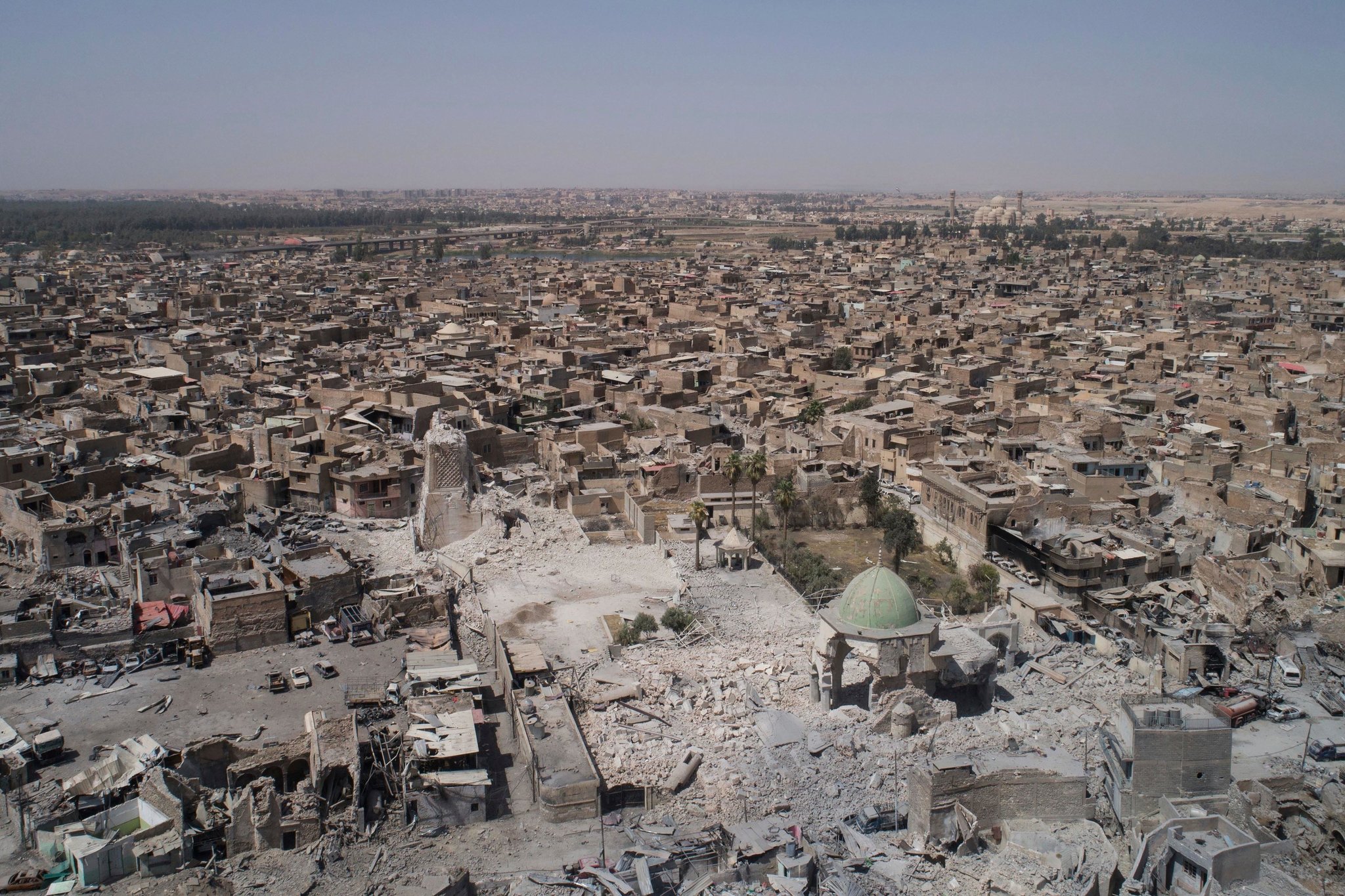
    As Iraqi forces claim control of the mosque for the first time since 2014, all that is left is debris. The mosque’s distinctive leaning minaret dominated the skyline of Mosul’s Old City for nearly eight centuries, standing as a symbol of the city’s deeply rooted cultural heritage.

    An Iraqi special forces soldier moved toward the front line near the mosque during the battle against Islamic State militants. CreditFelipe Dana/Associated Press 

    The mosque complex is nearly gone, reduced to a pile of rubble on June 21, after Islamic State militants packed the building with explosives as their grasp on the city continued to slip.

    The iconic 12th century Al Hadba minaret is now just a stump, seen broken nearly to its base in footage released by Iraqi forces who entered the area where the mosque once stood.

    They assessed what remained as they stepped carefully through crumbling walls and climbed over debris that once made up one of the city’s grandest buildings.

    “This is the remains of the minaret, which was blown up by the terrorist gang,” said one official from Iraq’s counterterrorism service in a video released by the group.

    The intricate detailing on the minaret can be seen peeking out over crumbling debris, but its top is gone.

    “And this is the dome of the mosque, which was also blown up by the terrorist gang,” the man says as the camera cuts to a shot of the green dome that now sits precariously atop damaged walls. It is one of the few distinctive features of the building still visible amid the ruin.

    After the city was captured by the Islamic State in 2014, the mosque played a starring role in the group’s propaganda as it grabbed power in the region.

    It was the setting for a rare 2014 public speech by the group’s professed leader, Abu Bakr al-Baghdadi, in which he declared a caliphate and asserted control over Mosul. It was the last time he was seen publicly.

    The group’s notorious black flag has been flying from the top of the Al Hadba minaret since that summer.

    An Islamic State flag on top of Al Hadba minaret in March. CreditKhalid Al-Mousily/Reuters 

    Before the Islamic State seized control, the mosque was long a valued landmark the country sought to preserve.

    In 2012, Unesco identified the mosque’s minaret for assessment and preservation, after fears that its teetering posture could lead to collapse if measures were not taken. The local governorate had planned to work alongside local officials to ensure its survival. Last week, the director general of Unesco, Irina Bokova, lamented the loss of the building.

    “Al Hadba minaret and Al Nuri Mosque in Mosul were among the most iconic sites in the city, and stood as a symbol of identity, resilience and belonging,” Ms. Bokova said in a statement. “This new destruction deepens the wounds of a society already affected by an unprecedented humanitarian tragedy.”

    The Islamic State, also known as ISIS or ISIL, has been under an intensifying assault in Mosul and across Iraq’s western border with Syria, where the extremist group is losing its grip on Raqqa, its de facto capital for the past three years. Tens of thousands of civilians remain trapped in both cities.

    Unicef said on Thursday that thousands of children in western Mosul are stuck there because of the fighting.

    “Boys and girls who have managed to escape show signs of moderate malnutrition and carry psychosocial scars of the conflict,” Peter Hawkins, the Unicef representative in Iraq, said in a statement.

    Aid groups that have been helping displaced civilians in Syria and Iraq expressed strong caution about the Iraqi prime minister’s victorious proclamation. They emphasized that the fighting in Mosul was by no means over.

    The International Rescue Committee, which responds to the most urgent humanitarian emergencies in more than 40 countries, said in a statement that as many as 1.5 million Iraqis have been unable to escape Mosul, and that at least 150,000 people, half of them children, still live in other areas of Iraq controlled by the Islamic State.

    “The retaking of Mosul does not mean an automatic end to the suffering of the 1.5 million people that spent more than two years living under harsh ISIS rule,” said Wendy Taeuber, the International Rescue Committee’s Iraq director. “Despite the declaration, ISIS still controls some areas in the Old City of Mosul and ongoing fighting will continue to threaten the lives of civilians.”

  • Myanmar to deny entry to UN staffers investigating plight of Rohingya Muslims

    Myanmar to deny entry to UN staffers investigating plight of Rohingya Muslims

    Myanmar says it will refuse entry to the members of a United Nations fact-finding mission tasked with investigating allegations of crimes by Myanmar’s security forces against Rohingya Muslims.

    Kyaw Zeya, a permanent secretary at Myanmar’s Ministry of Foreign Affairs, said the government would not grant visas to the UN staffers.

    “If they are going to send someone with regards to the fact-finding mission, then there’s no reason for us to let them come,” he said. “Our missions worldwide are advised accordingly.”

    The government in the capital, Naypyidaw, which is practically led by Aung San Suu Kyi, had already said it would not cooperate with a UN mission in the country.

    The United Nations Human Rights Council agreed in March to send an international fact-finding mission to Myanmar and called on Suu Kyi to “fully cooperate.” During a trip to Sweden this month, however, she claimed that the UN mission “would have created greater hostility between the different communities.”

  • Four killed in bomb blast in northwestern Pakistan

    Four killed in bomb blast in northwestern Pakistan

    At least four people lost their lives after a bomb, concealed in a plastic bag, went off in a semi-autonomous tribal area in northwestern Pakistan, near the Afghan border, officials say.

    The incident occurred in Khyber Agency, one of the seven tribal areas in Pakistan’s Federally Administered Tribal Areas (FATA), on Saturday, when security personnel spotted a suspicious plastic bag left unattended near a security checkpoint.

    “As the security officials were inspecting the plastic bag, the bomb concealed in it went off, killing a solider, two paramilitary troops and a civilian,’ a local administration official said on condition of anonymity. Other local security officials also confirmed the incident.

    No individual or group has claimed responsibility for the deadly bomb attack.

    Pakistani troops have for over a decade been battling militants in FATA to curb insurgencies by the Takfiri terrorist groups of Taliban and al-Qaeda.

    The army has managed to reduce violence across the Asian country in recent years following a series of counter-terrorism operations conducted against militants, but every so often remnants of the terror groups carry out periodic bloody attacks, both against people and the armed forces, particularly in the northwest.

    Back in June 2014, the army launched a full-scale offensive in mountainous North Waziristan, part of which constitutes FATA, aimed at wiping out militant bases in the highly volatile tribal region. Thousands of people lost their lives in an insurgency that began there a decade earlier.

  • Qatar: ‘Neighbors’ leading economic siege hacked our news agency

    Qatar: ‘Neighbors’ leading economic siege hacked our news agency

    Qatar says it has evidence showing the same “neighboring” countries that are leading a boycott campaign against Doha had a hand in the alleged hacking of its state news agency, an incident that triggered an unprecedented diplomatic crisis in the Persian Gulf region.

    Attorney General Ali bin Fetais al-Marri Ali bin Fetais al-Marri told a press conference in Doha on Tuesday that the hacking incident originated in “neighboring countries,” without naming them.

    “We have evidence to show that iPhones originating from the countries laying siege to us have been used in this hacking. We have enough evidence to point the finger of blame at these countries,” Marri said.

    Last month, the Qatar News Agency (QNA) released comments attributed to Emir Sheikh Tamim bin Hamad Al Thani, describing Iran as an “Islamic power,” praising the Palestinian resistance movement Hamas and criticizing US President Donald Trump.

    Qatar said hackers had broken into the QNA website and published the fake news, but the denial did not convince the Riyadh regime and its Persian Gulf Arab allies.

    Elsewhere in his remarks, the Qatari attorney general said it was “very soon” to give specific phone numbers for those he said were responsible for the hacking.

    He also noted that Qatari investigators had traced the internet service providers used to the Saudi-led allied countries.

    “We have sent the information to the countries concerned and we are awaiting their response,” Marri pointed out, adding, “As far as we are concerned, the case is very clear.”