Tag: Al Udeid Air Base

  • New U.S.–Israeli Military Posture Against Iran Echoes the 12-Day War Model

    New U.S.–Israeli Military Posture Against Iran Echoes the 12-Day War Model

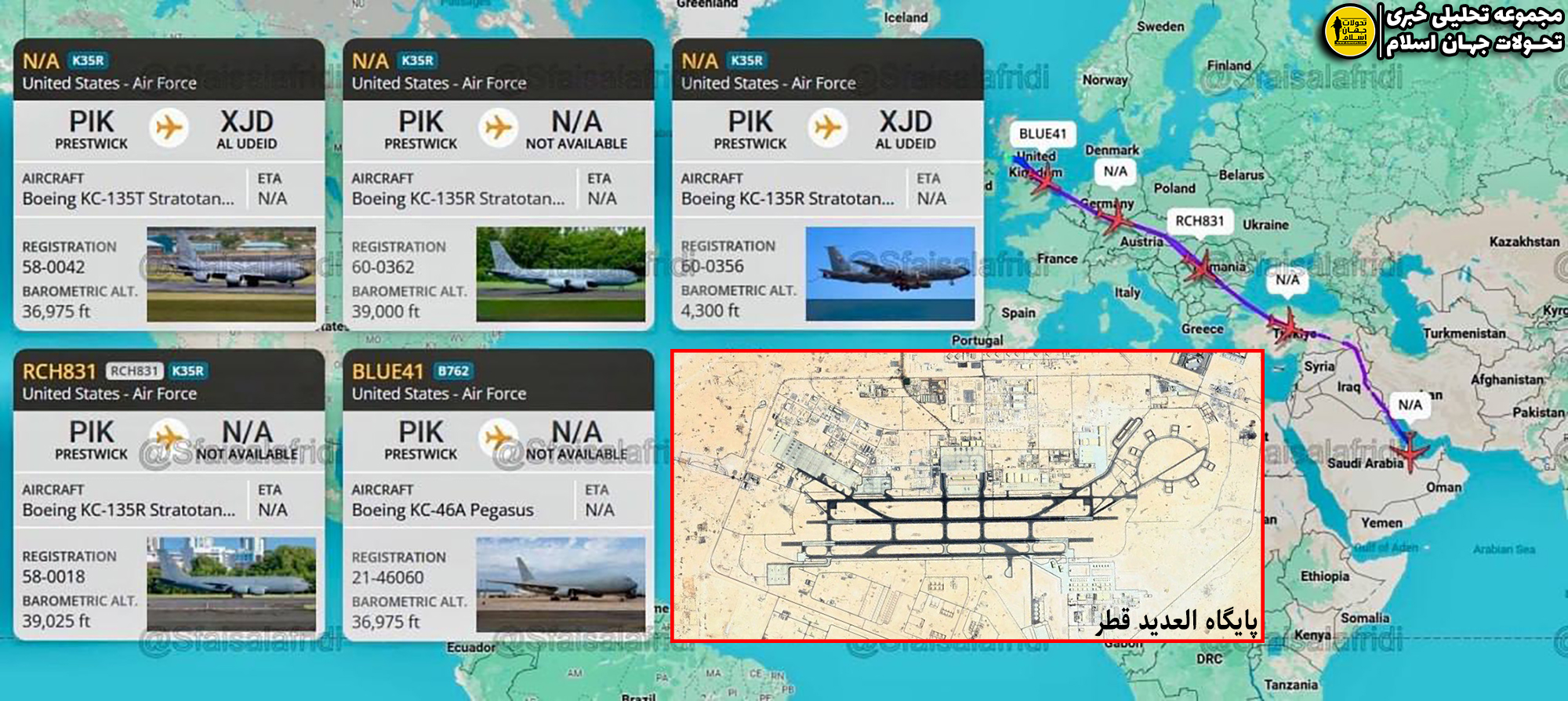
    A central focus of these maneuvers is logistical and operational support for Israeli fighter jets. During the previous 12-day war between Iran and Israel, American tankers played a crucial role in refueling Israeli aircraft over Iraq and Syria, particularly in the airspace above Syria’s Deir ez-Zor province. Now, with at least 30 Boeing KC-46 Pegasus and KC-135 Stratotanker aircraft reportedly in the region, aerial refueling operations could take place even closer to Iran’s borders.

    Although the issue of Israeli jets entering Iraqi airspace was discussed in a recent meeting between Iraq’s National Security Advisor Qasim al-Araji and Iranian military intelligence chief General Mirahmadi, the current U.S. deployment suggests refueling may occur near the Iran–Iraq border regardless.

    If Iran’s air defense systems are suppressed or rendered ineffective, eastern Iran could become vulnerable to Israeli airstrikes. Refueled near the border, Israeli jets could target strategic sites deep inside Iran. There’s also a growing possibility of direct U.S. involvement, with American fighter jets and refueling support contributing to future operations. In such a case, a division of roles may emerge—with Israel attacking from the west and the U.S. from the south.

    Another critical element is the ongoing surveillance by the U.S. Navy’s MQ-4C Triton drone over the Persian Gulf. These flights aim to gather real-time intelligence on Iranian military movements and air defense activity in the south. The Triton conducts radar and visual reconnaissance over Iran’s coastal zones, complementing broader strategic monitoring.

    Overall, these developments suggest a shift toward a new phase of hybrid pressure against Iran—reminiscent of Western preparations prior to the 12-day war. While the exact timing of any escalation remains uncertain, the scale of U.S. deployments and the influx of weaponry into Israeli territory indicate that a new round of conflict may be inevitable.

  • US transfer troops to Jordan

    US transfer troops to Jordan

    Last month the White House reported to move the troops and equipment slowly to Jordan. It started by Joe Biden presidency which reformed the military and political priorities of USA in the realm of CENTCOM responsibility.

    The redistribution of the troops are as follows,
    1- Qatar: US Army closed As Sayliyah Army Base and Falcon warehouse and transfered them to Jordan in June. US will probably keep Al Udeid Air Base in Qatar.
    2- Afghanistan: All for the US troops and equipment to evacuate Afghanistan, some of which will go to the neighbors of Afghanistan such as Tajikistan, Pakistan, Turkmenistan and Jordan. Two thousand American troops transfered from Afghanistan to Jordan.
    3 Kuwait, Saudi Arabia, UAE: The transfer of American troops and equipment to Jordan. After call between Lloyd Austin, US DoD, with Mohammad Bin Salman, Saudi crown prince, it was agreed that US transfer eight Patriot SAMs from Iraq, Kuwait and Jordan and one THAAD SAM from Saudi Arabia.

    Why US is transferring the troops to Jordan?

    On 31th January Jordan and USA signed a defense treatment. Jordan government approved it on 17 February. It includes 19 sections that allows US soldiers to carry weapons in Jordan and allows US aerial and naval crew to enter Jordan without visa.

    The agreement was criticized by some members of the Jordanian parliament and political and legal experts, with many expressing concern that the agreement was a sign of colonialism and a violation of Jordanian sovereignty and was unconstitutional because it was passed without parliamentary approval by the government.

    One of the reasons for this transfer is to keep them out of Iran’s missiles and its proxies reaches, according to American analysts. According to US DoD, Jordan is a strategic friend of US in security in the region and cooperates with American coalition against ISIS, Al Qaeda and other terrorist groups. According to this agreement, American forces control 12 bases for 15 Years, from which 4 are used jointly by Jordan for training and other purposes.

    Under the agreement, some Jordanian bases will also be used by US forces. Accordingly, Muwaffaq Salti Air Base will become the main base and headquarters of US drones in West Asia.
    t was also decided that the US military would operate at the Jordanian Air Force Main Training Center (Amman Training Center) in the Jordanian capital, Al-Hamimah Naval Base, Jordanian Air Force Command Center (King Abdullah II Air Base), Aqaba Naval Base، Jordanian military training base in al-Quwara, King Abdullah’s base to train Jordanian special forces, Prince Hassan Air Base, Prince Faisal Air Base, Al-Tatan Training Barracks and 15 border bases with Iraq and Syria.

    Al-Tanf’s US base on the Iraqi-Syrian border is expected to be strengthened after the large-scale deployment of US troops in Jordan.

    This extensive shift of power in west of Asia shows that Jordan is to be used as US main HQ to fight with the resistance axis and keep Israel safe by opposing Iran’s activities! This is not in favor of Islamic Republic and states of the region were warned numerous times by Iran.

  • Will Middle East Region’s Incidents Spark The Third World War? Part Three

    Will Middle East Region’s Incidents Spark The Third World War? Part Three


    Will Middle East Region’s Incidents Spark The Third World War? Part Two


    US drone shoot down over Iran’s airspace was an inflection point in Iran-USA relations which influences US credit, Trump’s political life and the region’s disputes.
    Iran’s military power and its officials’ seriousness in handling threats was an end to US supremacy and Trump’s rhetoric and caused a vertigo in US policy in confronting Resistance axis.
    Trump won the power by questioning US interferences in wars of Syria, Iraq and Afghanistan, with slogan of “make America great again”. Tension with Iran and mulit-billion dollars arm deals with Saudi and UAE brought a lot of pressure on him, recently.
    US passiveness on the other hand made its local allies specially Israel, Saudi Arabia and UAE to panic and their media uproar against Iran like calling Iran axis of evil, was destroyed by Global Hawk shoot down.
     
    To investigate more, we mention some points:
    1. USA attacks Iran under miscalculation:
    Considering Saddam attacking Iran, the threat of war against Iran is always alive. Trump to win the reelection, might miscalculate and perform an assault against Iran which naturally makes Iran to react. This kind of war usually escalates step by step. One actions follows by a reaction.
    Iran’s answer could be as follows:
    A) Iran using simple military equipment can close Strait of Hormuz on Americans. Naval war causes oil war.
    B) 14,000 US soldiers in Afghanistan, 5,000 others in Iraq. Indeed they won’t be safe from Iran’s allies retaliation.
    Ansar Allah has control over the Red Sea and Strait of Bab al-Mandab.
    Hezbollah and other Resistance groups are at the gates of occupied Golan and south of Lebanon. they are waiting for Iran to act in Occupied Lands.
    C) Al Udeid Airbase in Qatar, 5th Fleet in Bahrain, Dhafrah Airbase in UAE, Al Salem base in Kuwait are among valuable targets within Iran’s missile range.
     
    2. USA presses Iran to negotiate and withdraw from military operation:
    As apparent from US officials, assaulting Iran is delayed for now and economical pressure is continuing until negotiations.
    Economical war and pressure against Iran until Iran reaches deterrence, similar to military field, will be effective.
     
    3. USA retreats from its stances and stimulates another party to assault Iran:
    This is the most sophisticated plan US presidents have performed so far. Seems to receive the order from the highest rank officials. Equipping Israel and Saudi Arabia by Europe and USA in recent years have increased significantly in recent years and in previous articles were addressed. Mujahedeen activities in Iran, separatist activities in Sistan and Baluchestan and Kurdistan provinces are predictable, since does not involve any loss for the West.
     
    In total we should say that confronting Iran is expensive which deters sides from doing it even a super power like USA.
    With a swinging relationship between Iran and USA over the history, from coup against Dr. Mosaddegh’s administration to shooting down Iran’s civil aircraft over Persian Gulf; by shooting down US ~180 million dollar drone, Iran slapped the West to remind them of its military power.