Tag: Boeing

  • Military Knowledge: B-52 Strategic Bomber

    Military Knowledge: B-52 Strategic Bomber

    Basic introduction to the B-52:

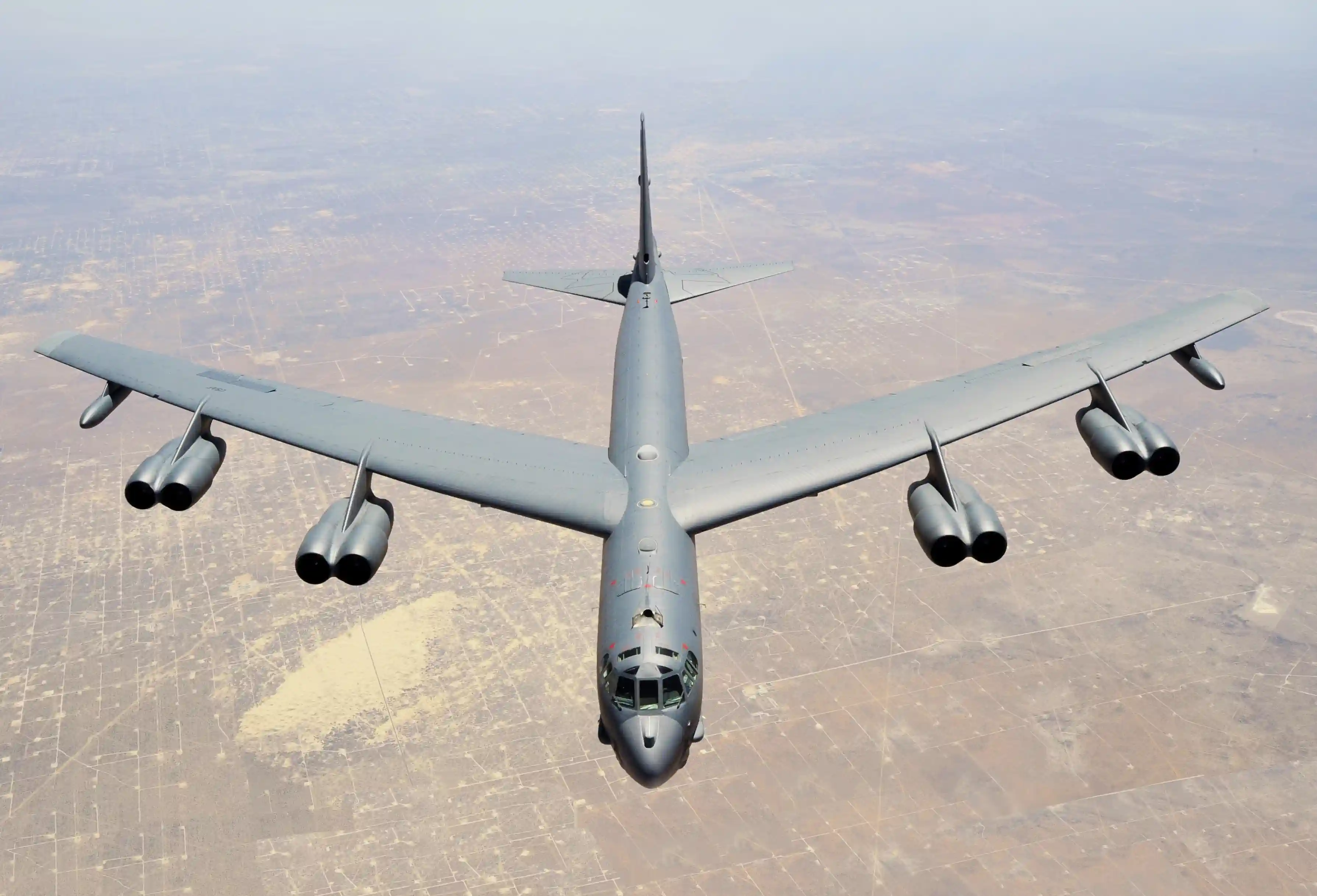
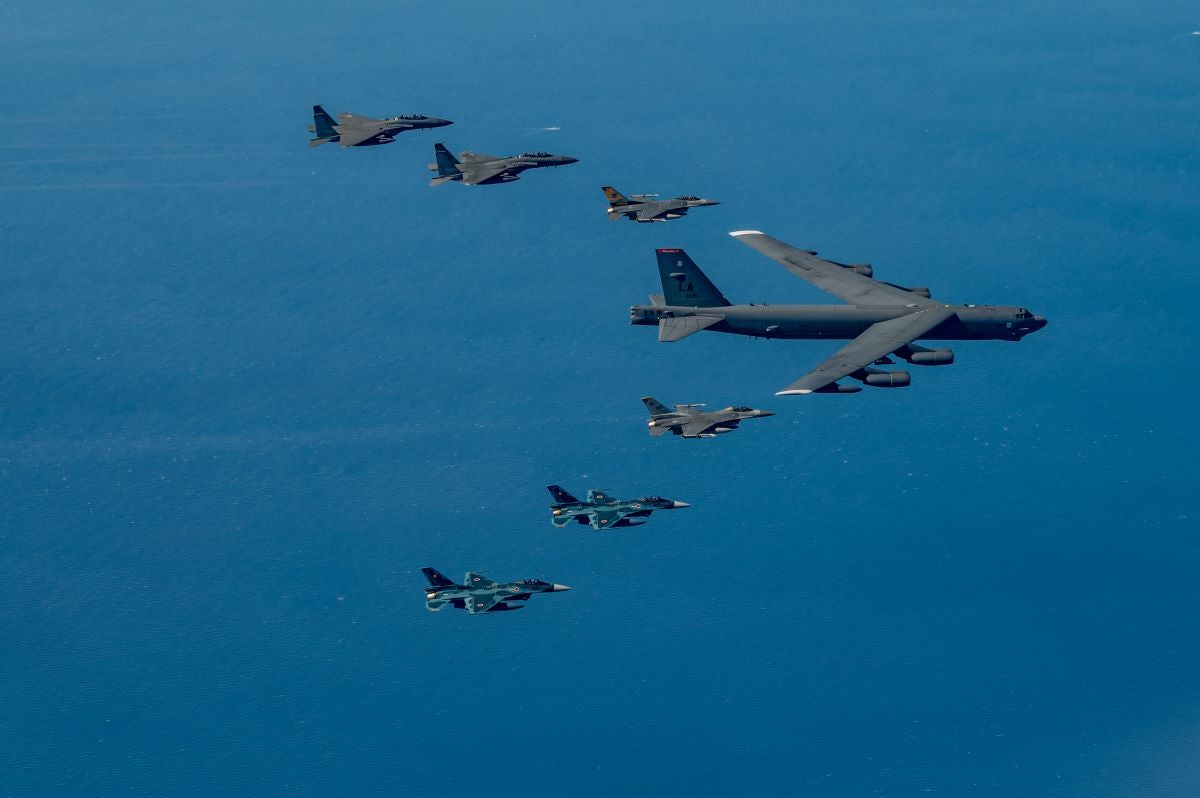
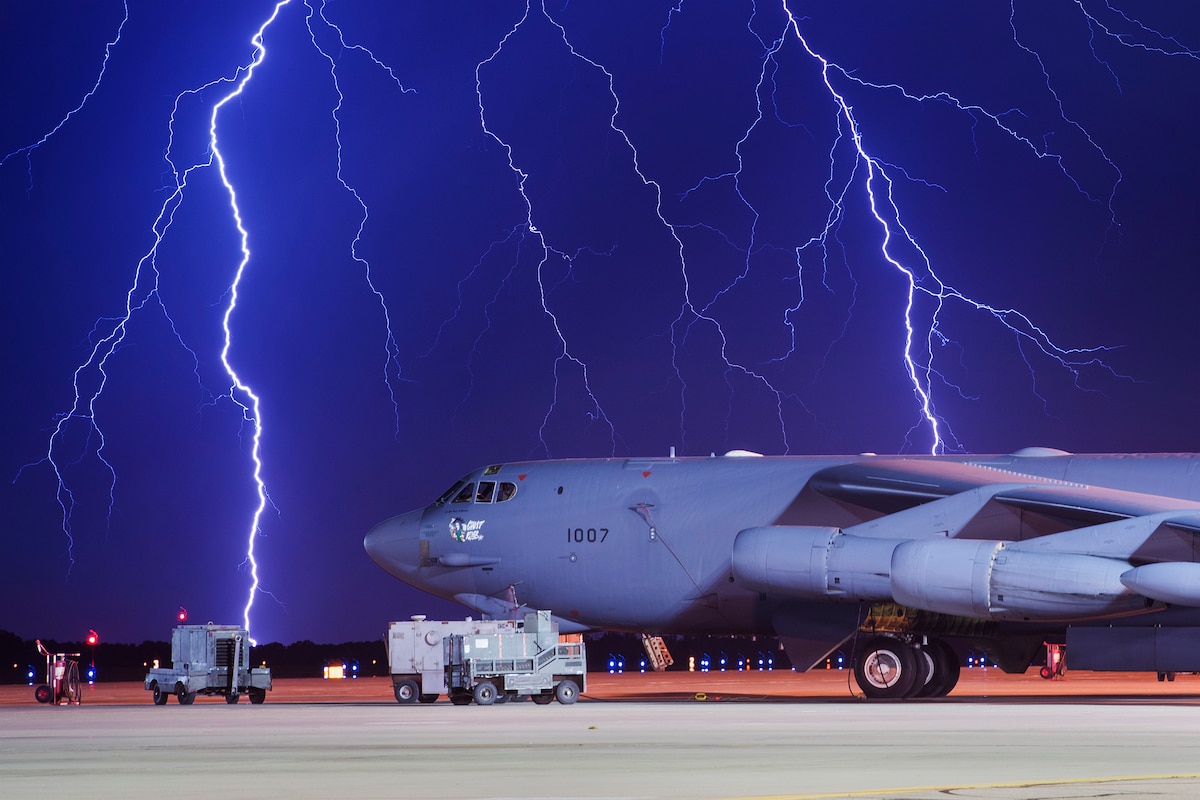
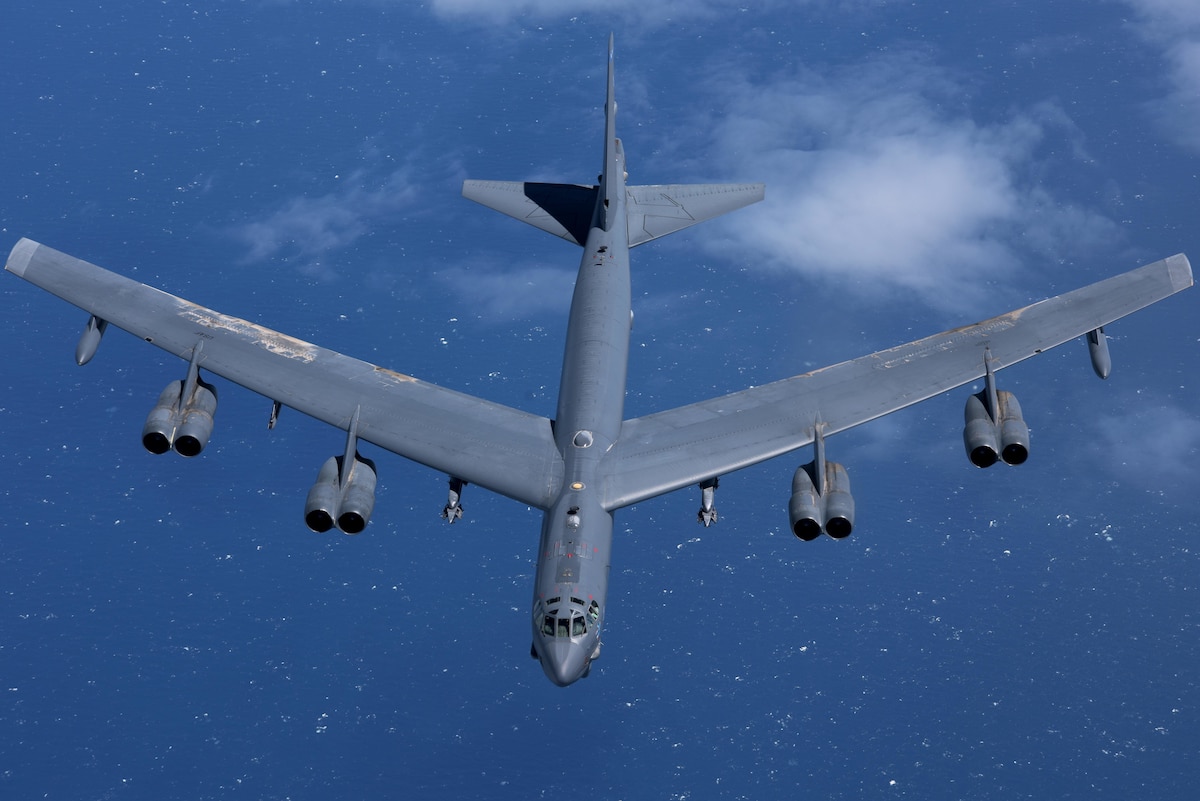
    For more than sixty years, the B-52 has been the backbone of America’s strategic bomber force. It is an aircraft capable of carrying and delivering the most diverse array of weapons in the US arsenal, including free-fall bombs, cluster munitions, and precision-guided munitions. With modern upgrades, the B-52 is able to carry all of the weaponry developed by the US Air Force and continues to play a significant role in the nation’s defense strategy in the 21st century.
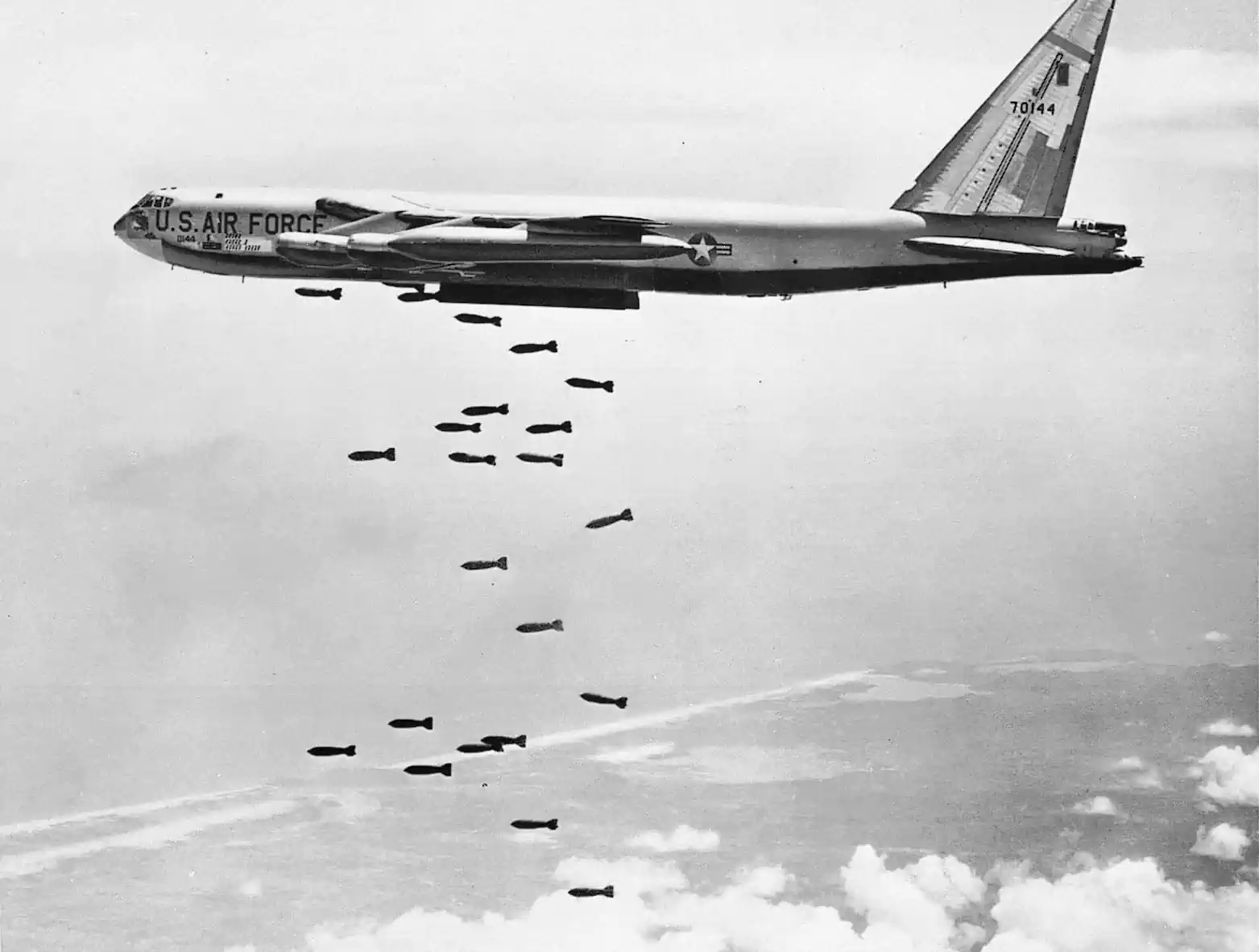
    B-52 dropping bombs during the Vietnam War

    The flexibility of the B-52’s design is one of its standout features. Over time, the aircraft has undergone numerous changes and upgrades based on shifting military requirements. The B-52 has transitioned from its original role as a nuclear deterrent to a multi-role conventional bomber.

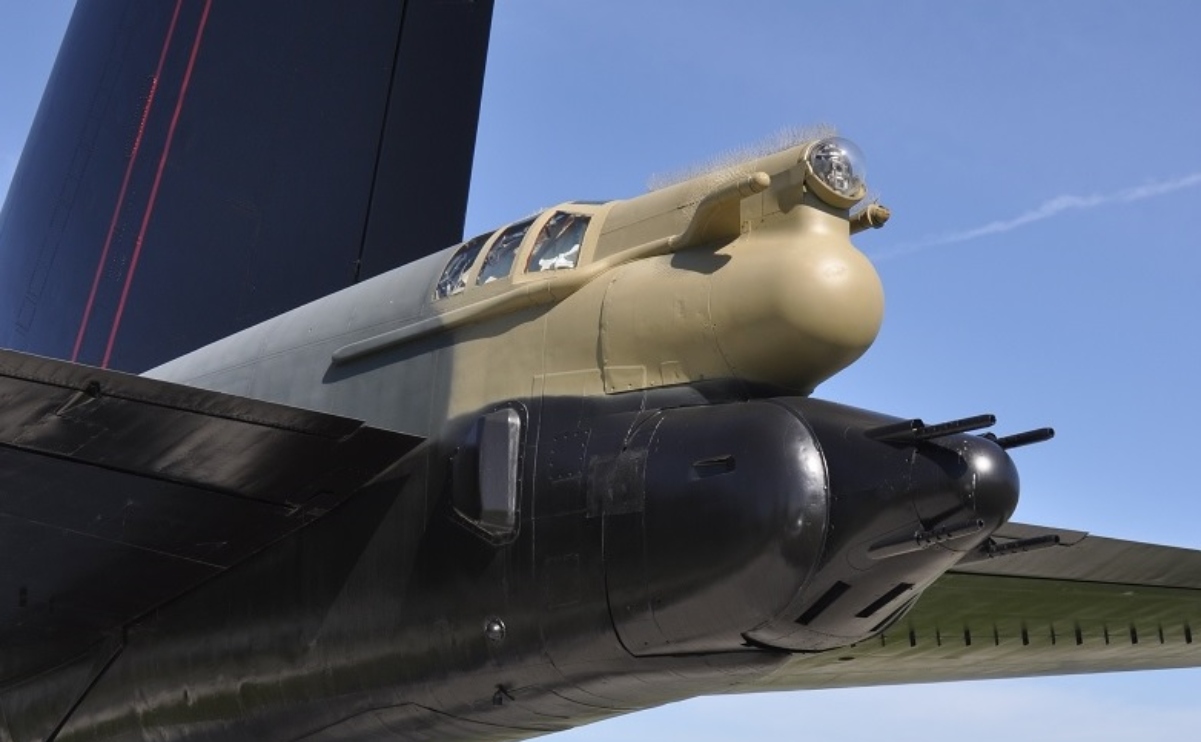
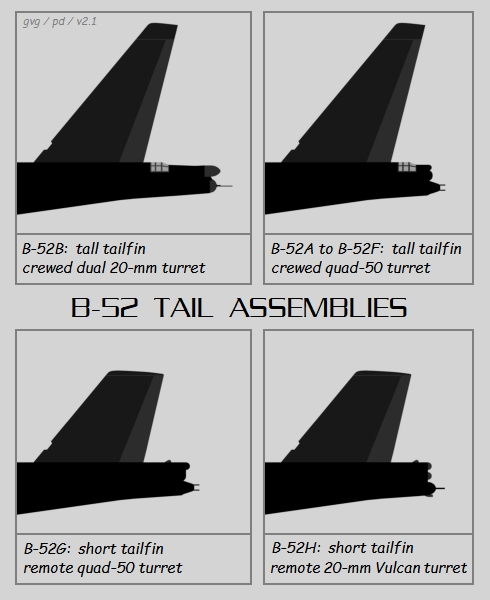
    For example, in early models, the tail gunner was stationed in the traditional location at the rear of the aircraft, operating with visual and radar targeting systems. In later models, the gunner’s position was moved to the front of the fuselage, and targeting operations were carried out solely by radar. However, since 1991, the tail gun has been removed from all operational B-52s.
    Design and production history of the B-52:

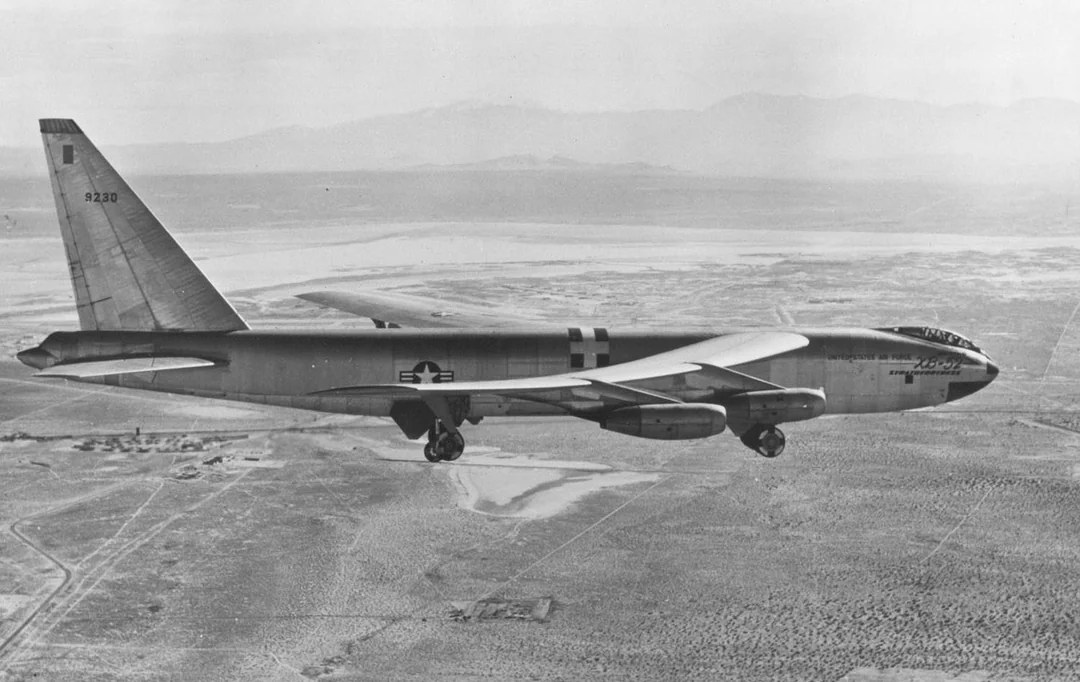
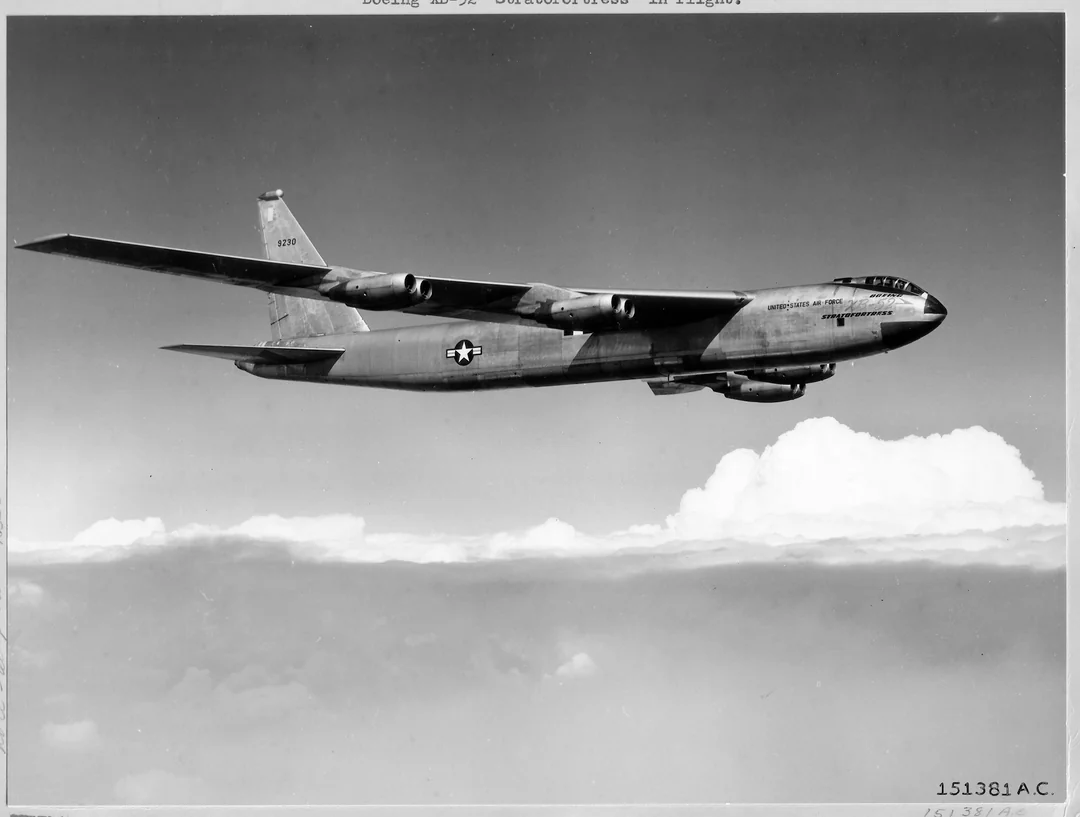
    The development of the B-52 began in the early 1940s with the experimental prototype XB-52 — an initiative by Boeing in response to the Air Force’s request for a new bomber design. In November 1945, the Air Force specified the desired performance characteristics for a modern strategic bomber; an aircraft capable of carrying out strategic missions independently, without relying on forward or intermediate bases under the control of other nations.
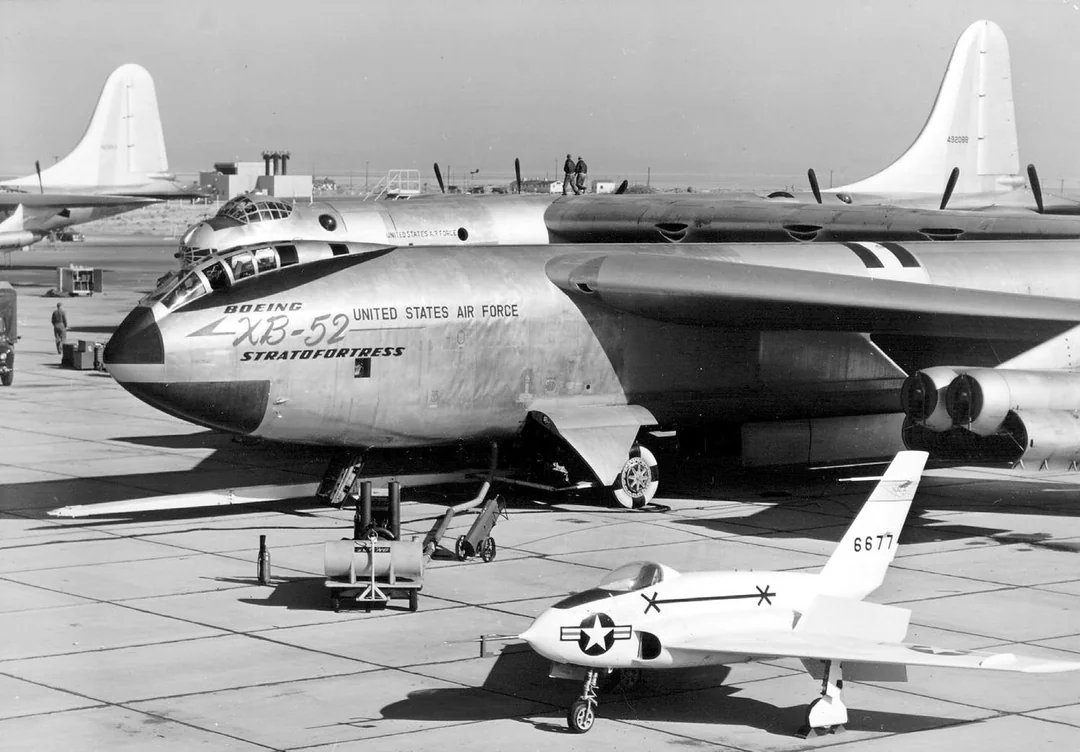
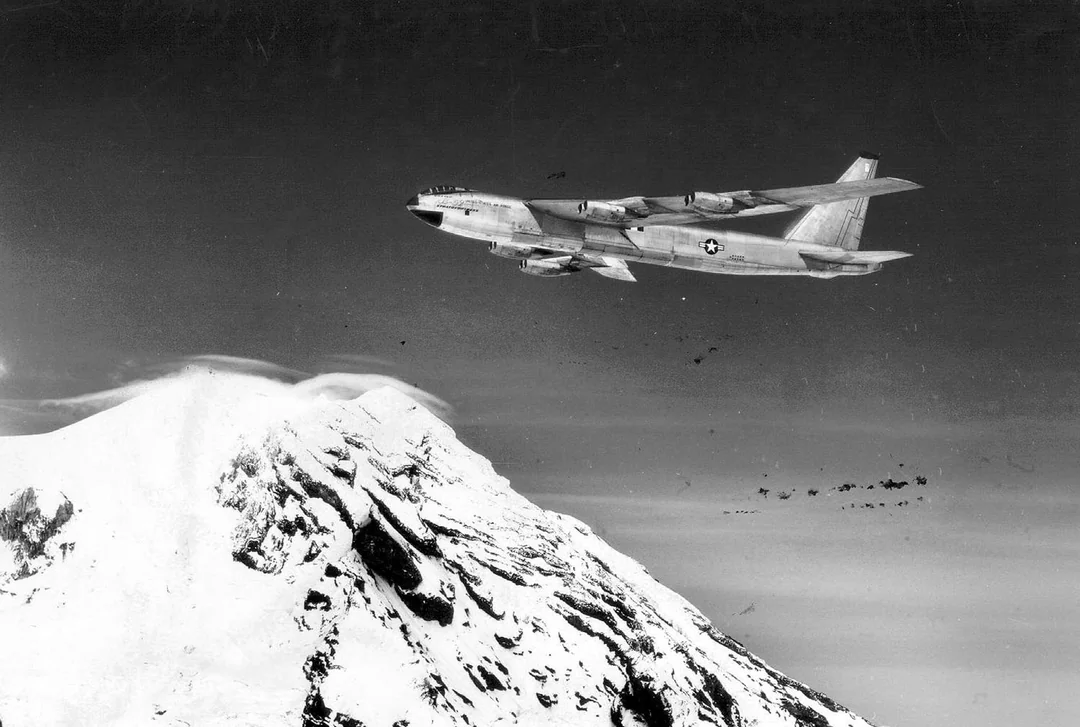
    Then, on February 13, 1946, the US Air Force issued an invitation for prototype proposals, asking manufacturers to submit their designs based on various specifications.

    On June 5, 1946, Boeing’s Model 462, an aircraft with straight wings and six turboprop engines, was selected as the winner. On June 28, 1946, a $1.7 million contract was awarded to Boeing to build the full XB-52 prototype and conduct preliminary tests. However, concerns were raised within the Air Force regarding the aircraft’s size and its compliance with design requirements. In response, Boeing offered two models: the Model 464-16 for nuclear missions and the Model 464-17 for conventional bombing. To reduce costs, the Air Force selected the Model 464-17, which had secondary adaptability for nuclear strikes. Later, Boeing was instructed to explore technological advancements including aerial refueling, increased speed, extended range, and other capabilities.

    Government concerns over the high fuel consumption of jet engines led Boeing to continue using the Model 464-35 with turboprop engines as the basis for the XB-52. Subsequently, Boeing designed the larger Model 464-67 and proposed that later modifications in production could further improve it.
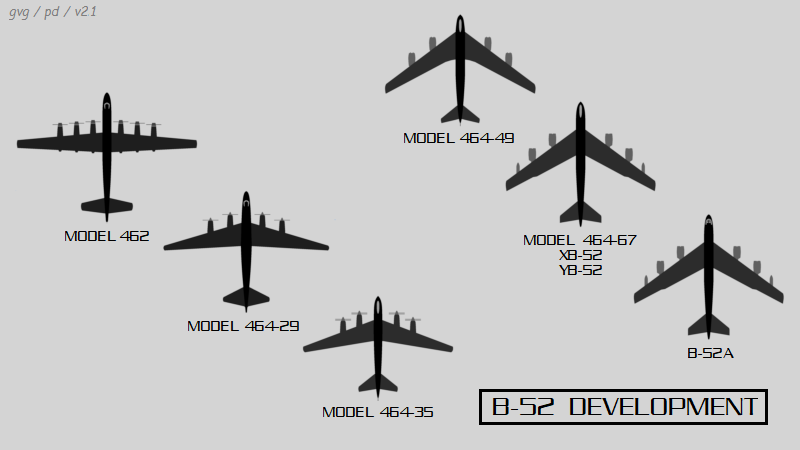
    B-52 concept development

    Ultimately, on February 14, 1951, Boeing received a production contract for 13 B-52A aircraft and 17 detachable reconnaissance pods. The last major design change involved switching from the old tandem two-seat cockpit to a side-by-side seating arrangement, which increased the co-pilot’s effectiveness and reduced crew fatigue. The first XB-52 prototype flew on April 15, 1952. This flight marked the first step in an intensive phase of testing and development. The aircraft demonstrated impressive performance and range, meeting the requirements of the US Air Force.

    B-52 Model A

    B-52 Variants:

    The initial production variant, known as the B-52A, entered service in the mid-1950s. Subsequently, a series of variants and modifications were introduced, including the B-52B, B-52C, B-52D, B-52E, B-52F, B-52G, and B-52H, each incorporating improvements in engines, avionics, and armaments. This extensive production effort involved over 5,000 companies, with subcontractors fabricating 41 percent of the airframe.

    The Seattle plant built 101 D models, while Wichita produced 69. Both plants continued production of the B-52E — 42 built in Seattle and 58 in Wichita — along with the B-52F (44 from Seattle and 45 from Wichita). Production finally ended in 1963 with the B-52H, for a total of 742 aircraft built, in addition to the two original prototypes.

    The B-52C variant was generally very similar to the B-52B, with the same engines and nearly identical avionics. The most noticeable external difference of the B-52C compared to the B-52B was the installation of a large external fuel tank under each wing. Additionally, the water injection tank at the rear of the fuselage was removed, and a water injection tank was placed in the wing root of each wing.

    The B-52D variant was almost identical to the B-52C, using the same fire control system that was used on the last B-52C. The only significant difference was the complete removal of the reconnaissance pod capability.

    The B-52E variant was externally almost identical to the B-52D, but by this time, Soviet air defense had reached a level of sophistication that made high-altitude bombing no longer considered practical or safe; therefore, the Strategic Air Command (SAC) adopted low-level penetration tactics. To support this new mission, the B-52E was equipped with a range of modern systems, the most important of which was the AN/ASQ-38 integrated navigation and bombing system built by IBM. This system included the Raytheon AN/ASB-4 navigation and bombing radar and the GPL AN/APN-89 doppler ground speed/altitude indicator.

    The B-52F variant was also very close in appearance and structure to the B-52E, with the major difference being that it was equipped with improved J57-43W engines.

    The B-52G variant is the most produced variant of the family. This model is distinguished by a significant increase in internal fuel tank capacity.

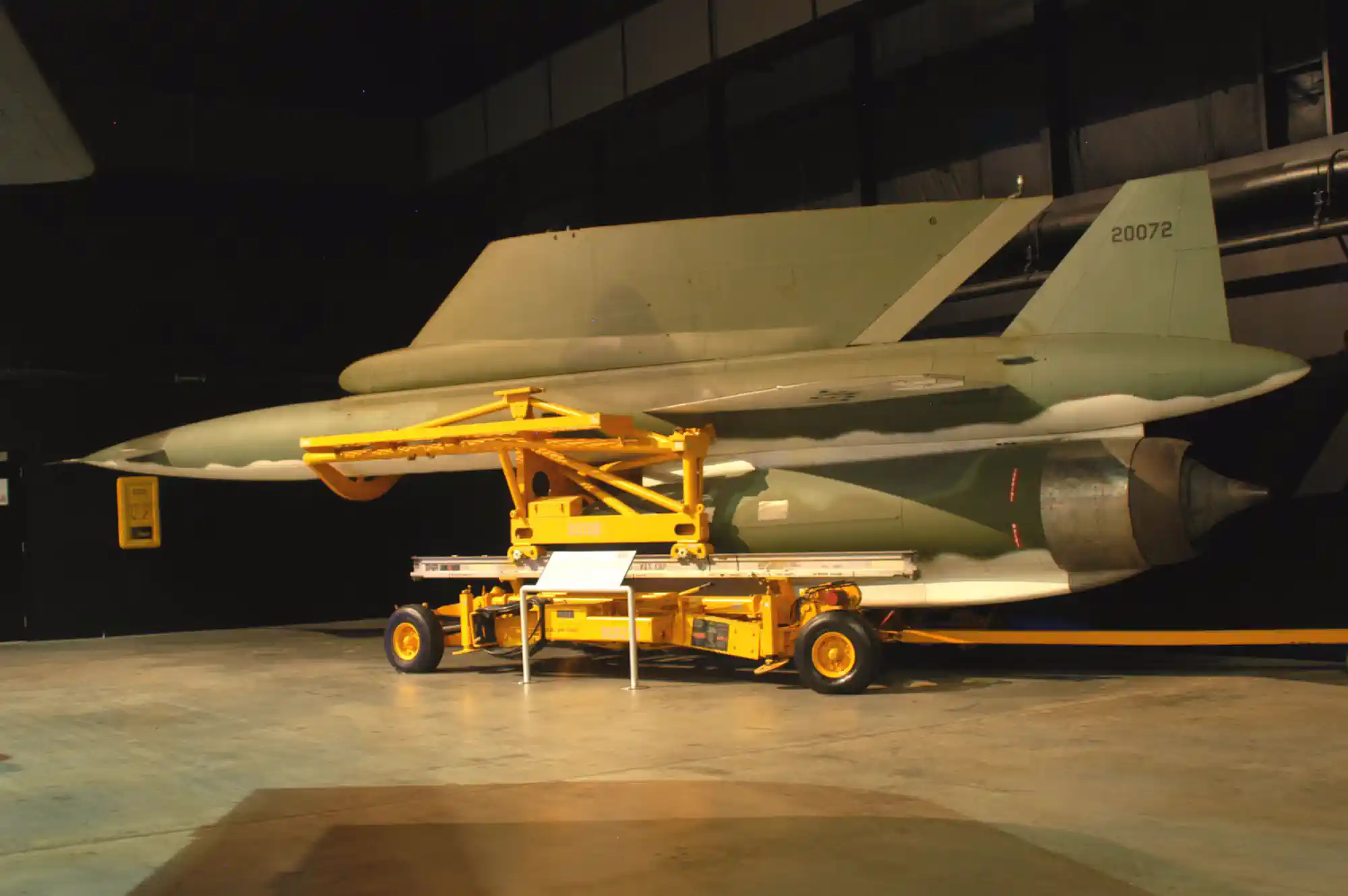
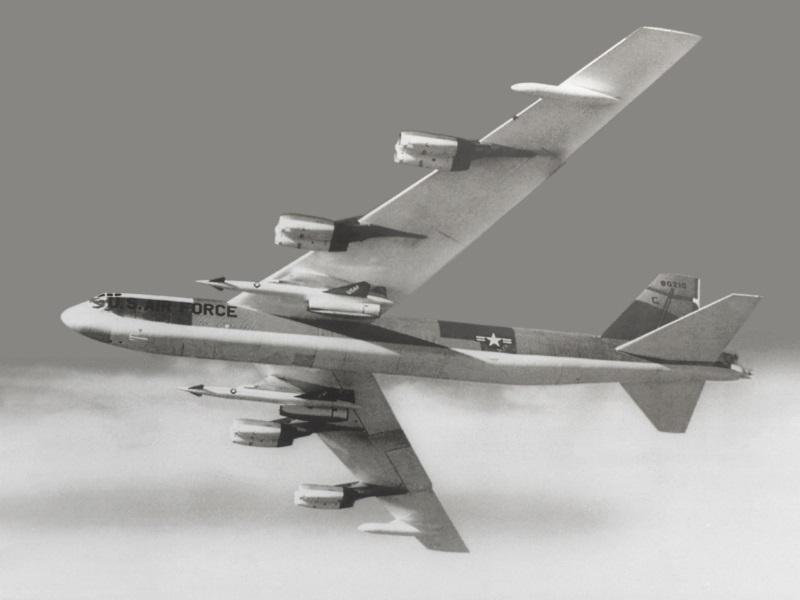
    The United States Air Force expected that after the B-52, it would bring into service the North American B-70 Valkyrie supersonic bomber; therefore, the B-52G was intended to be the final production model. However, in practice, only two XB-70s were built, and they were used only as test aircraft. On the other hand, the Air Force was interested in the GAM-87 Skybolt air-launched ballistic missile, and for this reason awarded Boeing a contract to build the final B-52 variant, the B-52H, as a launch platform for Skybolt. The B-52H was to carry four Skybolts — two on each underwing pylon. However, the Skybolt project was canceled in December 1962, and the B-52H never operationally carried the missile.

    Configuration and Aerodynamic Design of the B-52:

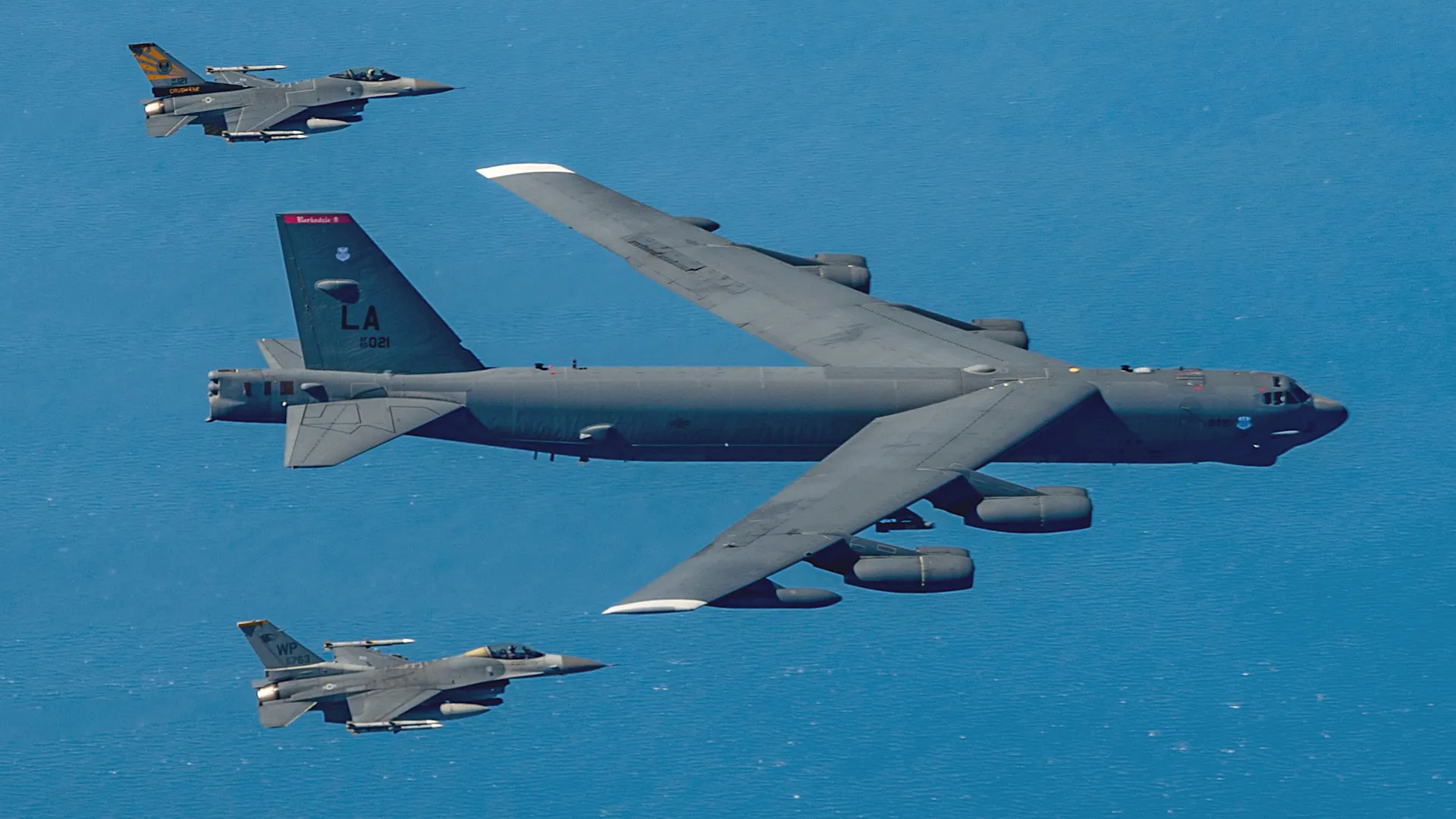
    The defining design feature of the B-52 is its swept-back wings. This configuration offers several advantages, including improved performance at high speeds, reduced drag, and increased fuel efficiency. Furthermore, the swept-back wings play a critical role in enhancing the aircraft’s stability and maneuverability. Officially, the B-52’s service ceiling is recorded as 50,000 feet (15,000 meters); however, operational experience indicates that reaching this altitude presents considerable challenges when the aircraft is fully loaded with bombs.

    According to various sources, the optimal altitude for a combat mission was around 43,000 feet (13,000 meters), since exceeding this height would quickly reduce the aircraft’s range. Therefore, during operations, the ability to achieve maximum range and altitude depended entirely on the skill and effort of the B-52’s crew. Taking all these factors into account, the B-52’s design incorporates high aspect ratio wings—meaning the wings are long and relatively narrow. This design increases lift and efficiency, allowing the carriage of heavy loads over long distances. Additionally, fuel tanks are housed inside the wings to extend the flight range.
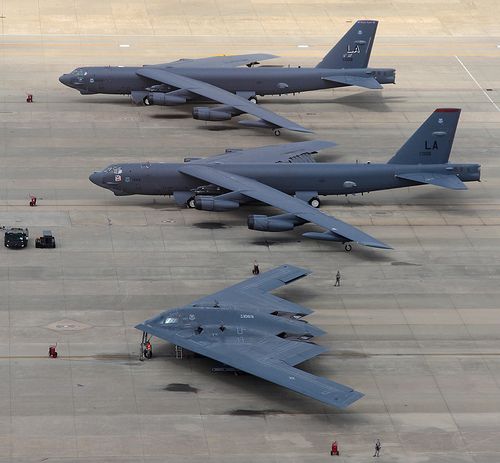
    B-52 bomber next to B-2 stealth bomber

    Propulsion System of the B-52:

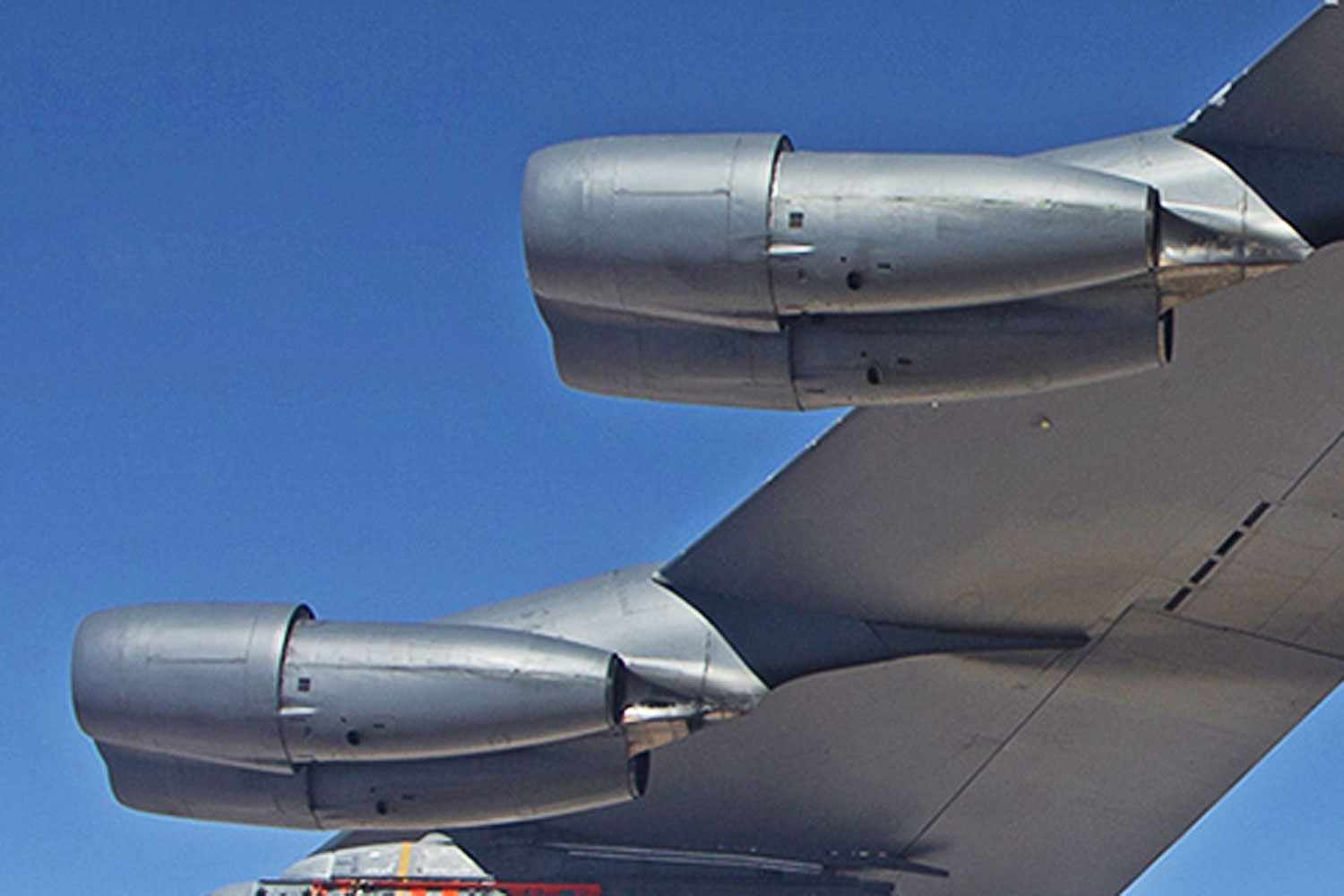
    Starting in mid-1961, deliveries of the B-52H to the U.S. Air Force began—a version equipped with Pratt & Whitney TF33-P-3 turbofan engines featuring cleaner combustion and reduced noise, each producing 17,100 pounds of thrust. This redundancy allows the aircraft to continue flying even if some engines fail, enhancing its survivability on long-range missions. The engines are mounted in pairs beneath each wing. The B-52’s eight engines are housed in coupled nacelles and suspended from four pylons below and ahead of the wing’s leading edge.

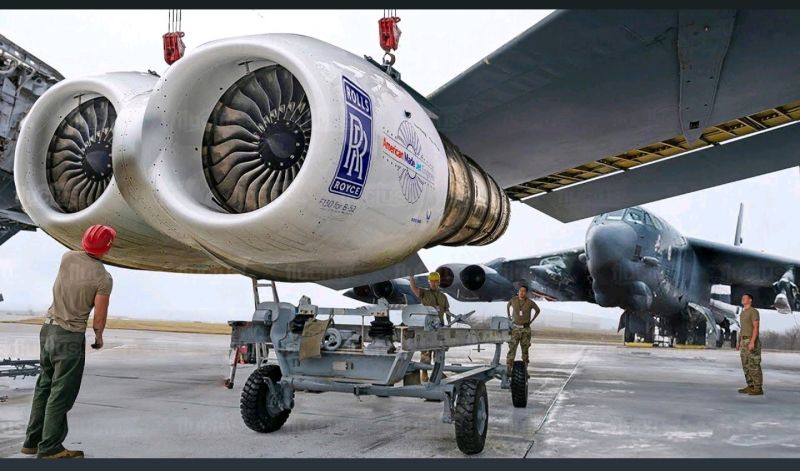
    The engine upgrade program has been a major step in recent decades. On April 23, 2020, the U.S. Air Force issued a request for proposals to purchase 608 commercial engines along with spare parts and support equipment. Then, on September 24, 2021, the Air Force selected Rolls-Royce’s F130 engine as the winner, unveiling a procurement plan for 650 engines—including 608 direct replacements and 42 spares—at a total cost of $2.6 billion. Under this upgrade, B-52H aircraft equipped with Rolls-Royce F130 engines will be re-designated as the B-52J.


    Avionics and Radar of the B-52:

    Throughout its history, the B-52 has been continuously modernized, incorporating advanced avionics and radar systems that have dramatically enhanced its capabilities in navigation, communications, and precision strike missions. These upgrades have played a crucial role in maintaining the B-52’s effectiveness in contemporary combat.

    To improve the aircraft’s low-altitude performance, the AN/ASQ-151 Electro-Optical Viewing System (EVS) was installed between 1972 and 1976. This system included a Low-Light Level Television (LLLTV) camera and a Forward-Looking Infrared (FLIR) system, housed in fairings beneath the nose of the B-52G and B-52H.
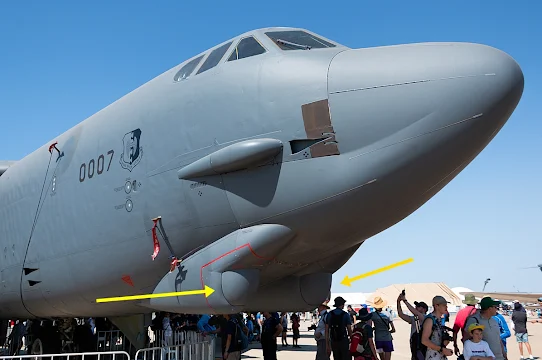
    AN/ASQ-151 Electro-Optical system

    In the 1980s, GPS technology was added to the B-52 to enhance its navigation capabilities. Additionally, the IBM AP-101 was installed as the B-52’s main computer. In 2007, the installation of the LITENING targeting pod greatly improved the aircraft’s ground targeting ability, enabling the use of various munitions. This system included laser guidance, a high-resolution Forward-Looking Infrared (FLIR) sensor, and a CCD camera for target imaging.
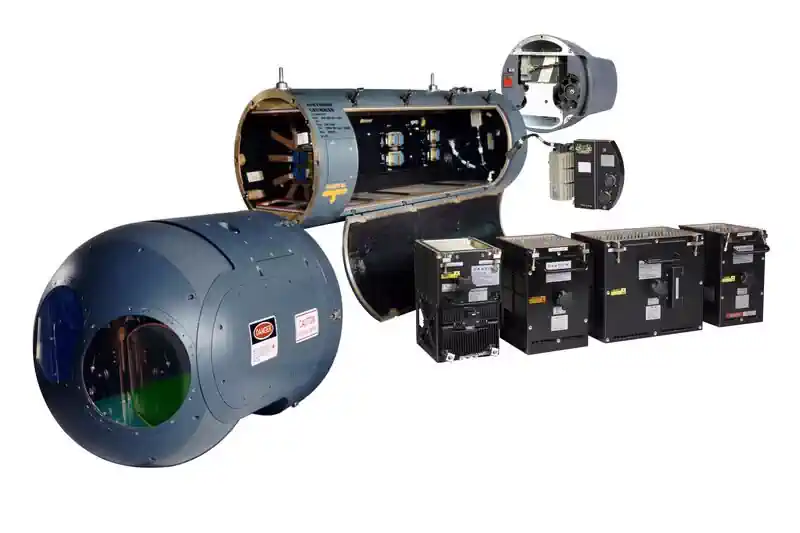
    LITENING targeting pod system

    The B-52 is also now equipped with the advanced APG-79B4 Active Electronically Scanned Array radar, replacing its older mechanical arrays.
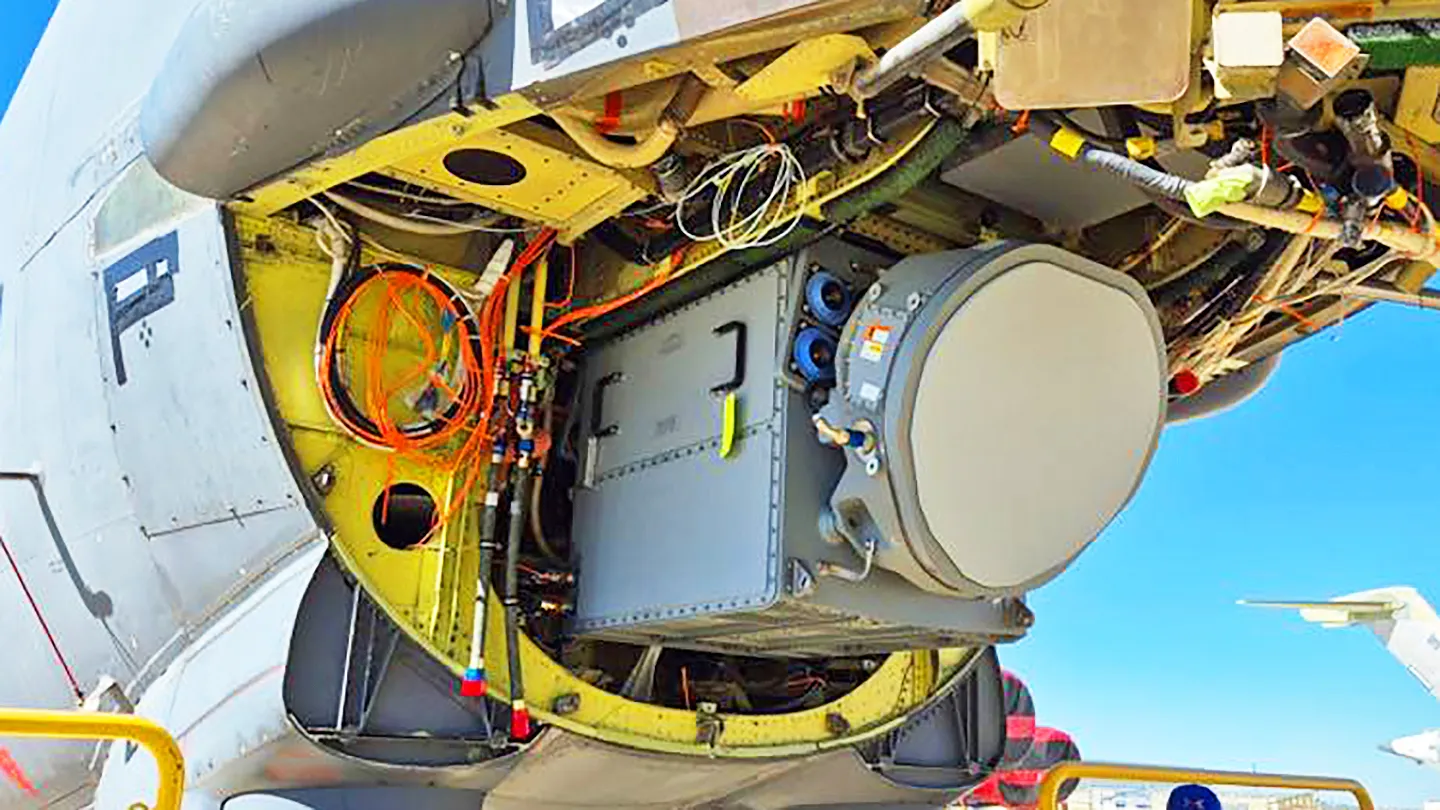
    APG-79B4 Active Electronically Scanned Array radar

    Armament of the B-52:

    The B-52’s internal bomb bay has the capability to carry a wide range of nuclear and conventional munitions. This flexibility in carrying various types of weapons has made it a highly adaptable platform for diverse missions.
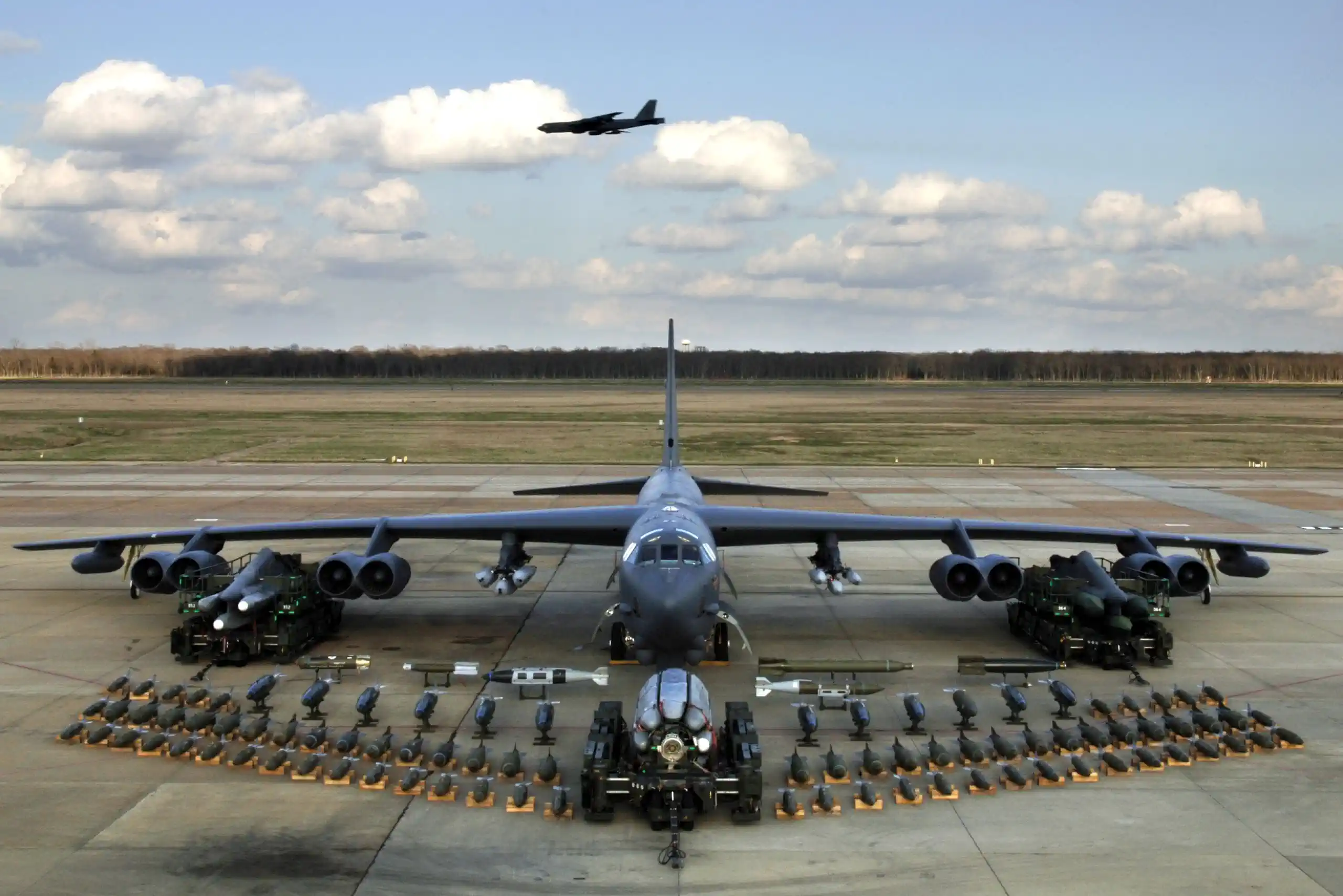
    Types of ammunition carried by the B-52H

    Since the 1980s, B-52H aircraft have undergone a series of modifications enabling the use of Harpoon missiles, a wide variety of cruise missiles, laser- and satellite-guided bombs, as well as unguided munitions. The Conventional Enhancement Modification (CEM) program also significantly improved the B-52H’s comprehensive conventional weapons capabilities. This program modified the underwing weapon pylons to resemble those of conventional-armed B-52G models, simplifying the integration of Harpoon and Popeye missiles.

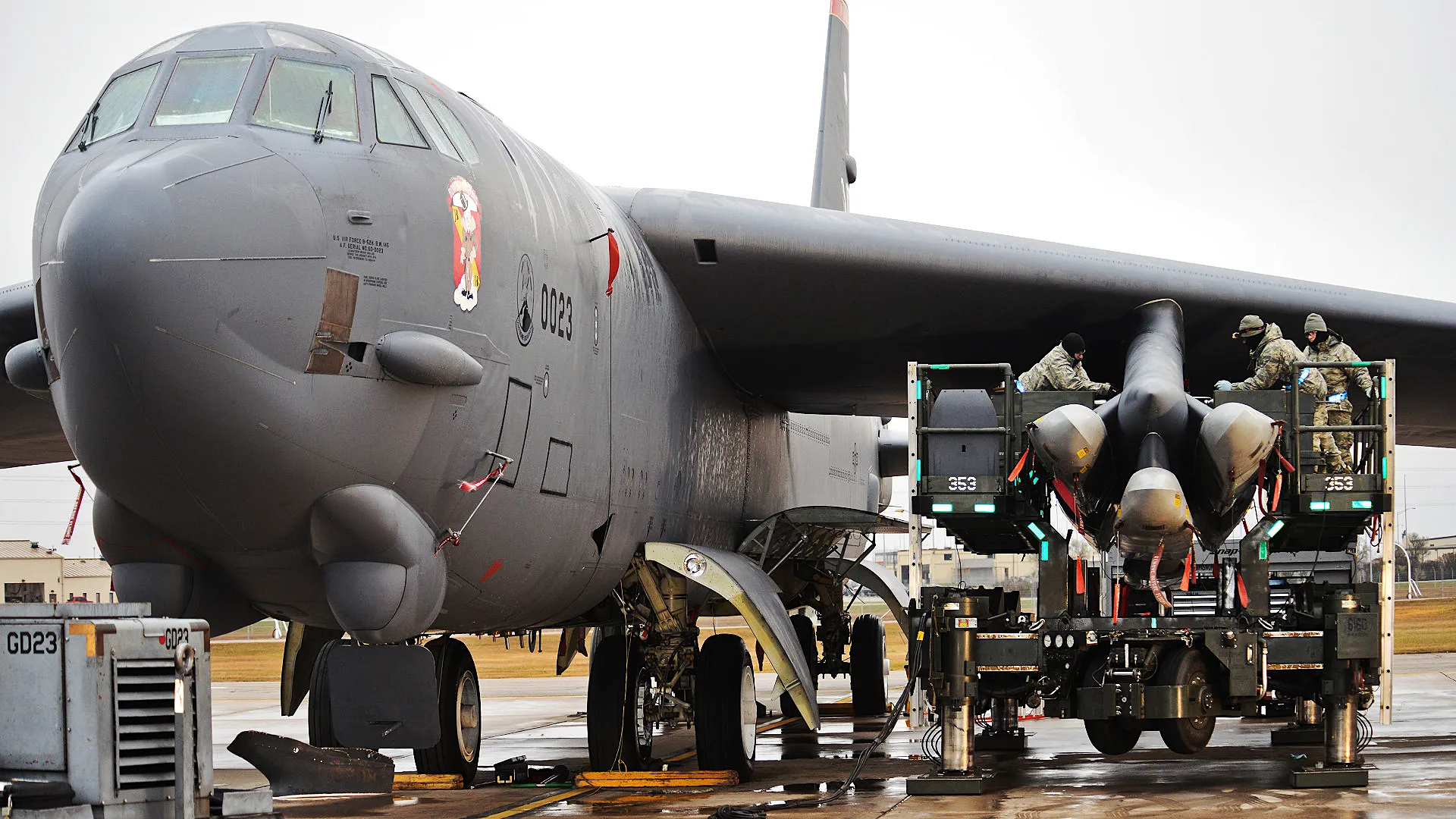
    In the nuclear role, the aircraft can externally carry up to 12 AGM-86B ALCM nuclear cruise missiles while simultaneously housing an additional 8 cruise missiles or nuclear free-fall munitions in the internal bay. In upgraded versions, the ability to carry 12 AGM-158 JASSM missiles on external pylons has been provided, while the internal bay can also host 8 JASSM-ER missiles, MALD decoys, or MALD-J electronic warfare variants.
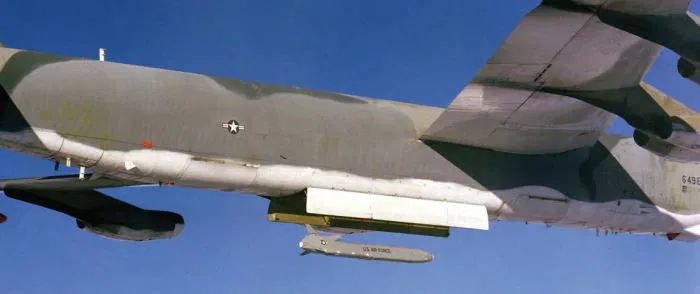
    AGM-86B air-launched cruise missile launched from the internal bay of a B-52 bomber
    Loading an AGM-86B air-launched cruise missile under the wing of a B-52

    In the conventional armament domain, the B-52 is equipped with a wide range of air-launched munitions, including AGM-86C/D CALCM conventional cruise missiles, Mk 62 naval mines, Mk 82 and Mk 84 free-fall bombs, CBU-87 and CBU-89 cluster bombs, CBU-103, CBU-104, and CBU-105 WCMD guided munitions, GBU-31 and GBU-38 JDAM satellite-guided bombs, AGM-158A JASSM long-range cruise missiles, and GBU-10, GBU-12, and GBU-28 laser-guided bombs.

    This diversity transforms the aircraft into a multi-role strategic platform capable of executing everything from nuclear deterrence to long-range conventional precision strikes within a single operational framework.
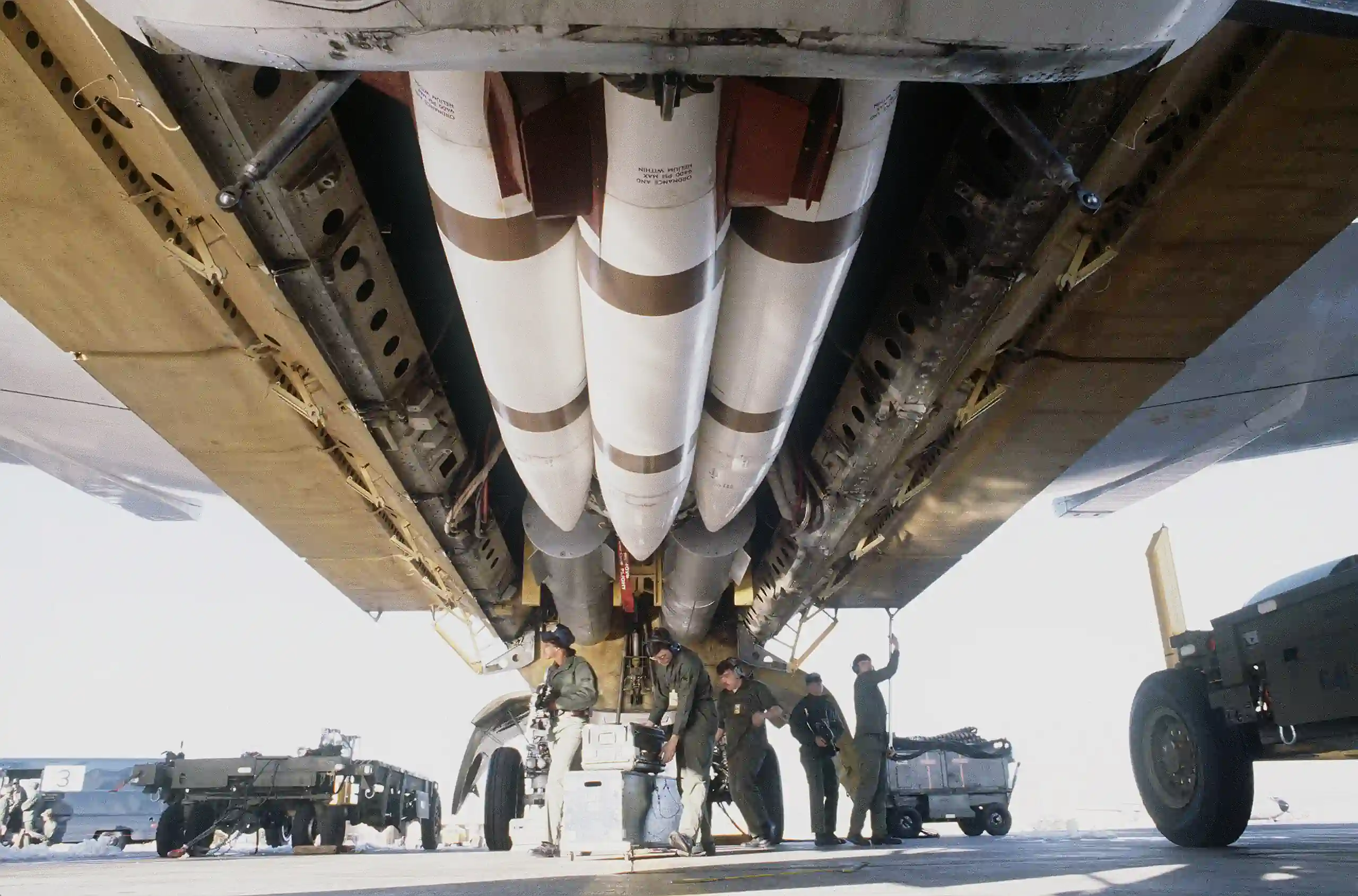
    AGM-69 short-range missiles and Mark 28 thermonuclear bombs (in the background) in the bomb bay of the 52H.

    Operational History of the B-52:

    The B-52A prototype made its first flight in 1954, and the B model entered service in 1955. A total of 744 B-52s were built, with the last one—a B-52H—delivered in October 1962.

    The first B-52 bomber to officially enter operational service was an RB-52B, handed over to the 93rd Bomb Wing at Castle Air Force Base, California, on June 29, 1955.

    On May 21, 1956, a B-52B flying from Eniwetok Island in the Pacific Ocean conducted the first airborne drop of an American hydrogen bomb during the CHEROKEE test. This marked the first time a B-52 had released an actual nuclear bomb. The weapon used was the Mark 15, nicknamed “Zombie,” with an explosive yield of nearly four megatons, dropped over Bikini Atoll. Due to a procedural error, the bomb detonated 30 seconds early, exposing the B-52 and other participating aircraft to the blast waves—yet they survived.

    These aircraft continued conducting live nuclear drop tests until 1963, when the United States signed the Limited Test Ban Treaty, which prohibited atmospheric nuclear tests to reduce radioactive fallout into the environment.

    On January 16, 1957, three B-52Bs under Project POWER FLITE completed an unrefueled around-the-world flight using aerial refueling, lasting 45 hours and 19 minutes. This historic mission marked the first non-stop circumnavigation by a jet aircraft.

    The first of 102 B-52Hs was delivered to the Strategic Air Command in May 1961. The H model can carry up to 20 air-launched cruise missiles. Additionally, the B-52H has the capability to carry conventional cruise missiles—weapons that entered the operational scene starting in the 1990s with Operation Desert Storm and continued their path through Operation Inherent Resolve against ISIS in 2016.

    The versatility of the B-52 was fully evident during Operation Desert Storm and NATO strikes against Yugoslavia. B-52s targeted large troop concentrations, fixed installations, and bunkers, severely degrading the morale of the Iraqi Republican Guard. On September 2–3, 1996, two B-52Hs struck Baghdad’s power and communication facilities with 13 AGM-86C missiles, an operation that was part of Operation Desert Strike and, at the time, the longest combat flight ever—a 34‑hour mission covering 16,000 miles round trip from Barksdale Air Force Base in Louisiana.

    In 2001, the B-52 contributed to the success of Operation Enduring Freedom during the invasion of Afghanistan, providing close air support via precision-guided munitions while loitering high above the battlefield. The aircraft also played a role in the Second Gulf War, launching approximately 100 CALCM missiles in a single night mission on March 21, 2003.

    In 2016, after a decade-long absence, the B-52 re-entered the U.S. Central Command’s area of responsibility. These aircraft conducted about 1,800 combat missions against ISIS forces in Syria and Iraq.

    Currently, only the H model remains in the Air Force inventory, assigned to the 5th Bomb Wing at Minot Air Force Base, North Dakota, and the 2nd Bomb Wing at Barksdale Air Force Base, Louisiana, operating under the Air Force Global Strike Command. The aircraft is also assigned to the 307th Bomb Wing under the Air Force Reserve Command at Barksdale Air Force Base.

    Future Path of the B-52:

    The future regarding the complete retirement of the B-52 bomber remains uncertain, but under current planning, the aircraft will continue flying until 2055. If this goal is achieved, it will set an unprecedented record in military aviation history: one hundred years of continuous service.

    On May 5, 2025, the U.S. Air Force officially launched the extensive and ambitious B-52J project as the most comprehensive modernization program in the history of the B-52 Stratofortress strategic bomber. This long-range, subsonic bomber, which has served on the front lines since the 1950s, is now slated—under the B-52J program—to upgrade all 76 remaining B-52Hs built in 1961 and 1962 to an entirely new standard, enabling the aircraft to maintain effective operational capability at least until the mid-2050s.

    According to the announced schedule, the first flight of the B-52J prototype will take place around 2028, with initial operational capability targeted for 2033.

    The core of this modernization program is replacing the aging Pratt & Whitney TF33 engines with modern Rolls-Royce F130 turbofan engines. Derived from the successful BR725 commercial engine family, this powerplant is being tested on the B-52 in a twin-pod configuration. Initial sea-level testing is underway at NASA’s Stennis Space Center, while high-altitude engine tests have been scheduled at the Arnold Engineering Development Complex. Rolls-Royce is set to manufacture more than 600 engines at its Indianapolis plant.
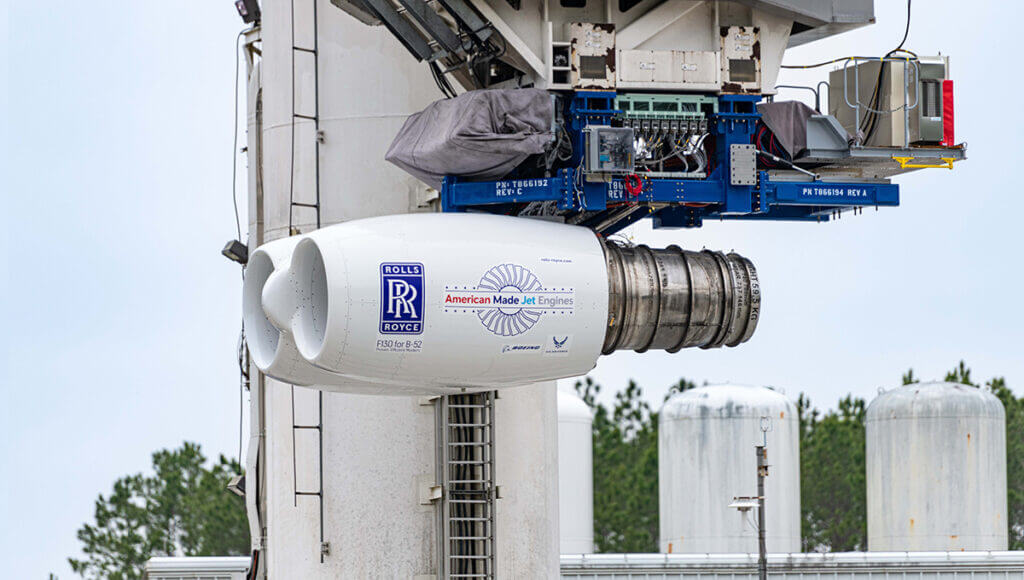
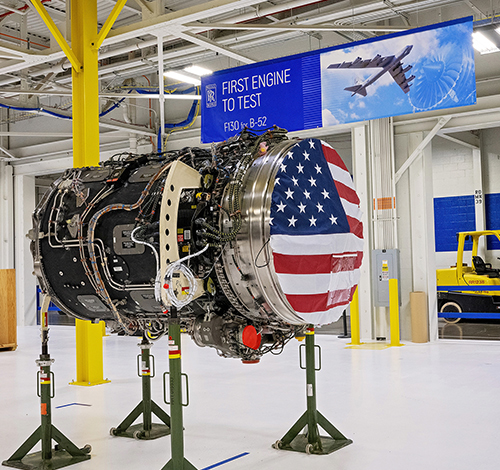
    The F130 engine, with approximately 30% greater fuel efficiency, significantly increases the current range of about 8,800 nautical miles (14,080 km), drastically reduces maintenance costs, eliminates the need for heavy overhauls, dramatically improves reliability, and—most importantly—substantially lowers the operational stress on the aircraft’s sixty-plus-year-old airframes.

    However, the modernization is not limited to the engines. Boeing is implementing a comprehensive set of structural and system changes in this project, including the following:

    • Design and installation of new engine pylons
    • Redesign and complete replacement of the aircraft’s internal wiring
    • Installation of an entirely new digital core
    • Advanced avionics suite
    • Modern satellite navigation
    • Updated communication tools including Link 16
    • A fully digital cockpit with large displays and improved user interfaces

    In the sensors domain, the advanced AN/APG-79 AESA radar—similar to that of the F/A-18E/F Super Hornet—will replace the old radar. This radar provides far superior search, ground mapping, precise targeting, and electronic warfare capabilities, while offering much improved situational awareness in threat environments.
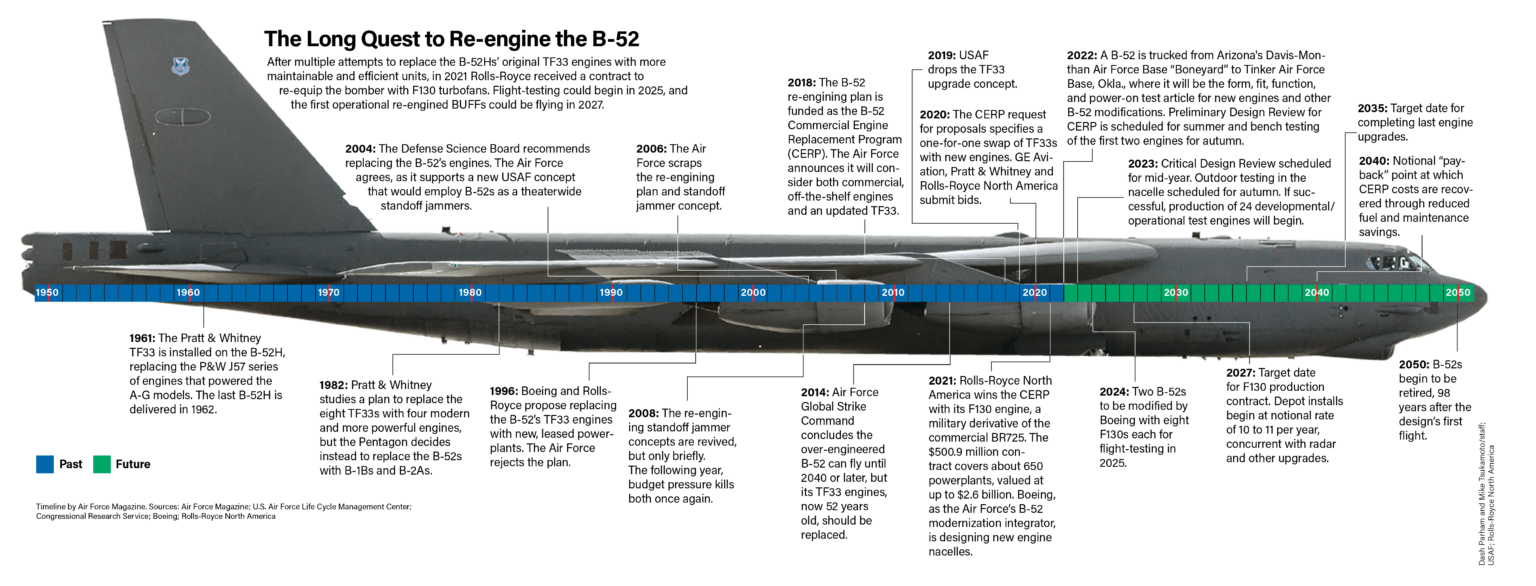
    B-52 redesign over time

    Alongside this, the integration of the advanced AN/ALQ-249(V)1 jammer significantly enhances the aircraft’s defensive capability against radars and guided missiles. With these changes, although the B-52J will never become a stealth platform, it will gain a much greater ability to conduct long-range operations in high-threat environments.
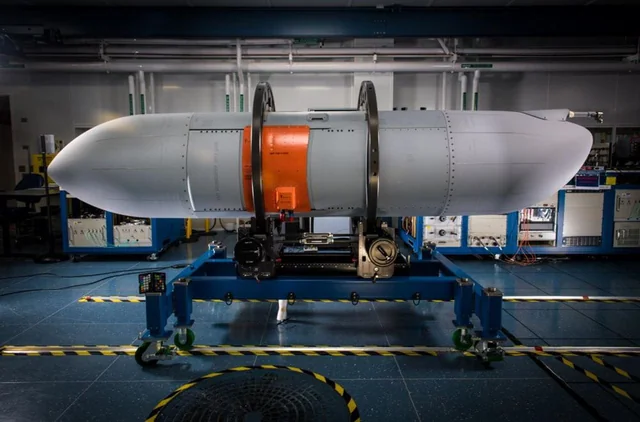
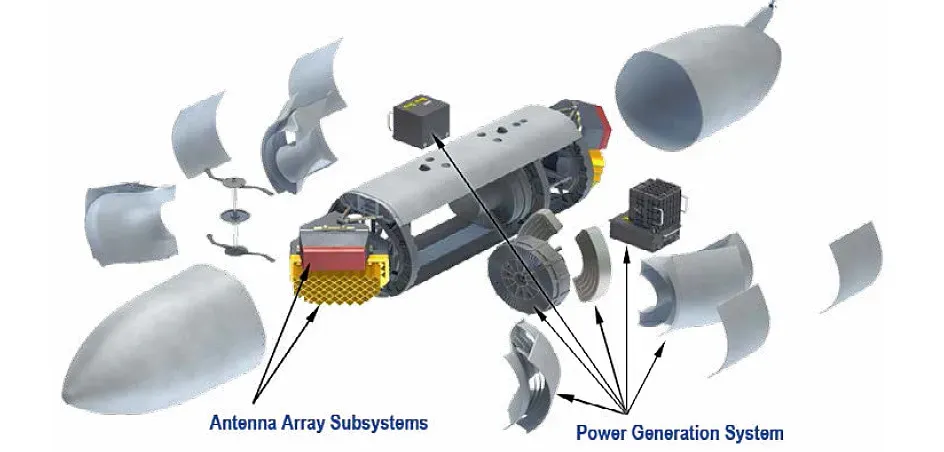
    With a weapons payload capacity of 70,000 pounds (approximately 31,750 kg), the B-52J will remain the most diverse and heaviest ordnance-carrying option among the U.S. Air Force’s strategic bombers.

    This bomber is also preparing for the era of hypersonic weapons. Following the cancellation of the AGM-183 ARRW program, the main focus has shifted to the Hypersonic Attack Cruise Missile (HACM)—a scramjet-powered missile expected to reach operational capability by the end of fiscal year 2027. At the same time, dedicated carriage racks for mounting multiple hypersonic missiles on a single mission are being developed.

    On a longer-term horizon, the B-52J will likely also be capable of launching and directing Collaborative Combat Aircraft (CCA) drones, thereby expanding its role from a mere bomber to a multi-role command-and-control platform in future aerial battles.

    The total program cost is estimated at approximately $2.56 billion—a figure that has drawn criticism from some quarters, who argue that these resources would be better directed toward greater production of the B-21 Raider or other next-generation platforms. However, given that the total number of B-21s will ultimately be just over 100, a dual mix of stealth and non-stealth bombers will still be necessary for decades to come. In this equation, the B-52J will serve as a powerful, more cost-effective, and highly flexible complement alongside the B-21, maintaining its key role in America’s strategic deterrence for a long time to come.

    Specifications of the B-52 Stratofortress Bomber:

    Role: Long-range strategic bomber
    Origin: United States
    Manufacturer: Boeing
    Entry into service: 1955
    Crew: 5
    Length: 48.5 m
    Wingspan: 56.4 m
    Height: 12.4 m
    Engines: 8 × Pratt & Whitney TF33-P-3/103 turbofan engines
    Combat range: 14,200 km
    Ferry range: 16,327 km
    Speed: 1,050 km/h
    Service ceiling: 15,000 m
    Empty weight: ~ 83 tonnes
    Takeoff weight: ~ 220 tonnes
    Payload: over 31 tonnes

    Armament:
    1 × 20 mm M61 Vulcan cannon
    Free-fall bombs
    Precision-guided bombs (JDAM)
    Cruise missiles (AGM‑86 / AGM‑158)
    Nuclear weapons

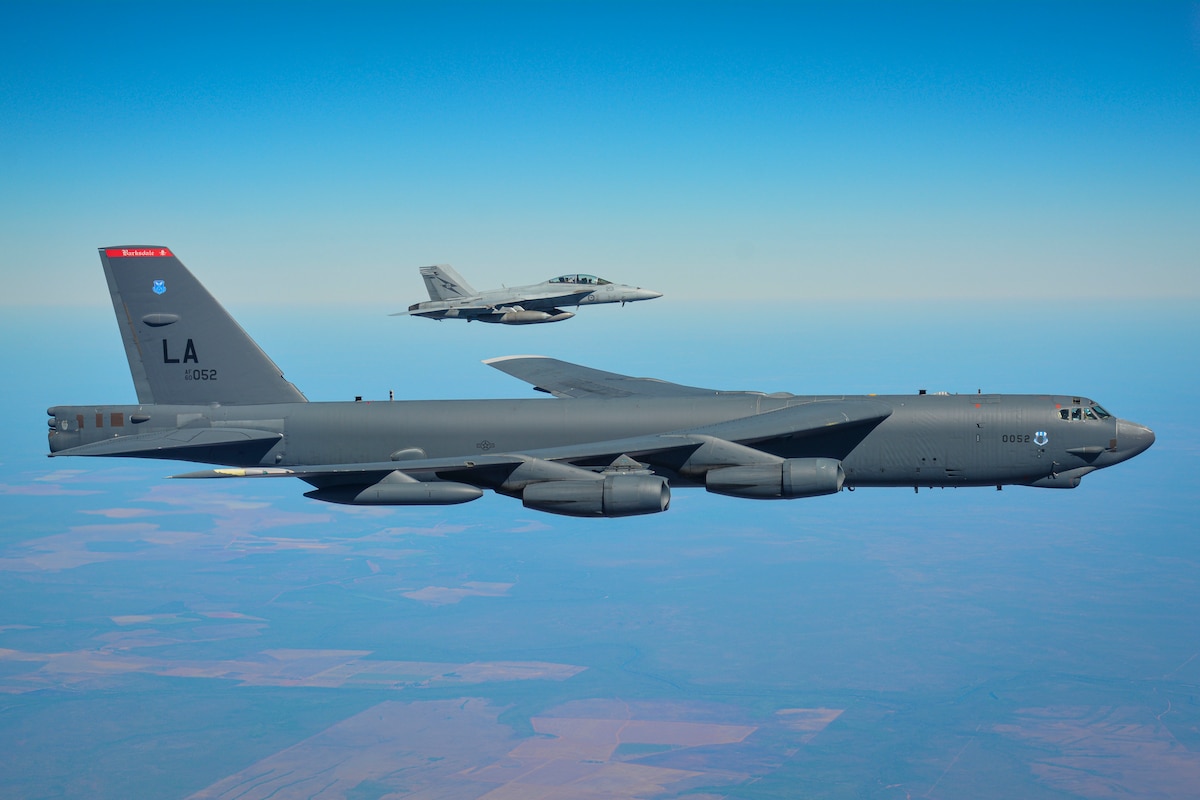
    More images of the B-52 bomber:
  • Military Knowledge: GBU-57 Massive Ordnance Penetrator

    Military Knowledge: GBU-57 Massive Ordnance Penetrator

    Introduction and Development History of the GBU-57 MOP:

    As a heavy-duty penetrator bomb, the GBU-57 MOP (Massive Ordnance Penetrator) can target and destroy heavily fortified underground facilities like bunkers, command centers, and weapons depots. Designed for daytime or nighttime attacks on targets deep underground, as well as for deterring enemies with buried infrastructure, the bomb is built for planned strikes.

    The GBU-57 MOP project started in the early 2000s, a joint effort by Northrop Grumman and Lockheed Martin. However, due to financial and technical hurdles, the initial attempt was halted. After the US invasion of Iraq in 2003, an analysis of bunker-busting bombs used showed they lacked the penetration power to take out fortified targets.

    This sparked renewed interest in developing a larger bunker-busting bomb, and the MOP project was launched by the Defense Threat Reduction Agency (DTRA) to meet a long-standing Air Force need. The concept of “Big BLU” – large penetrating and explosive bombs like MOP and MOAB – was also proposed.
    In the end, Boeing won the contract to design and produce the bomb.

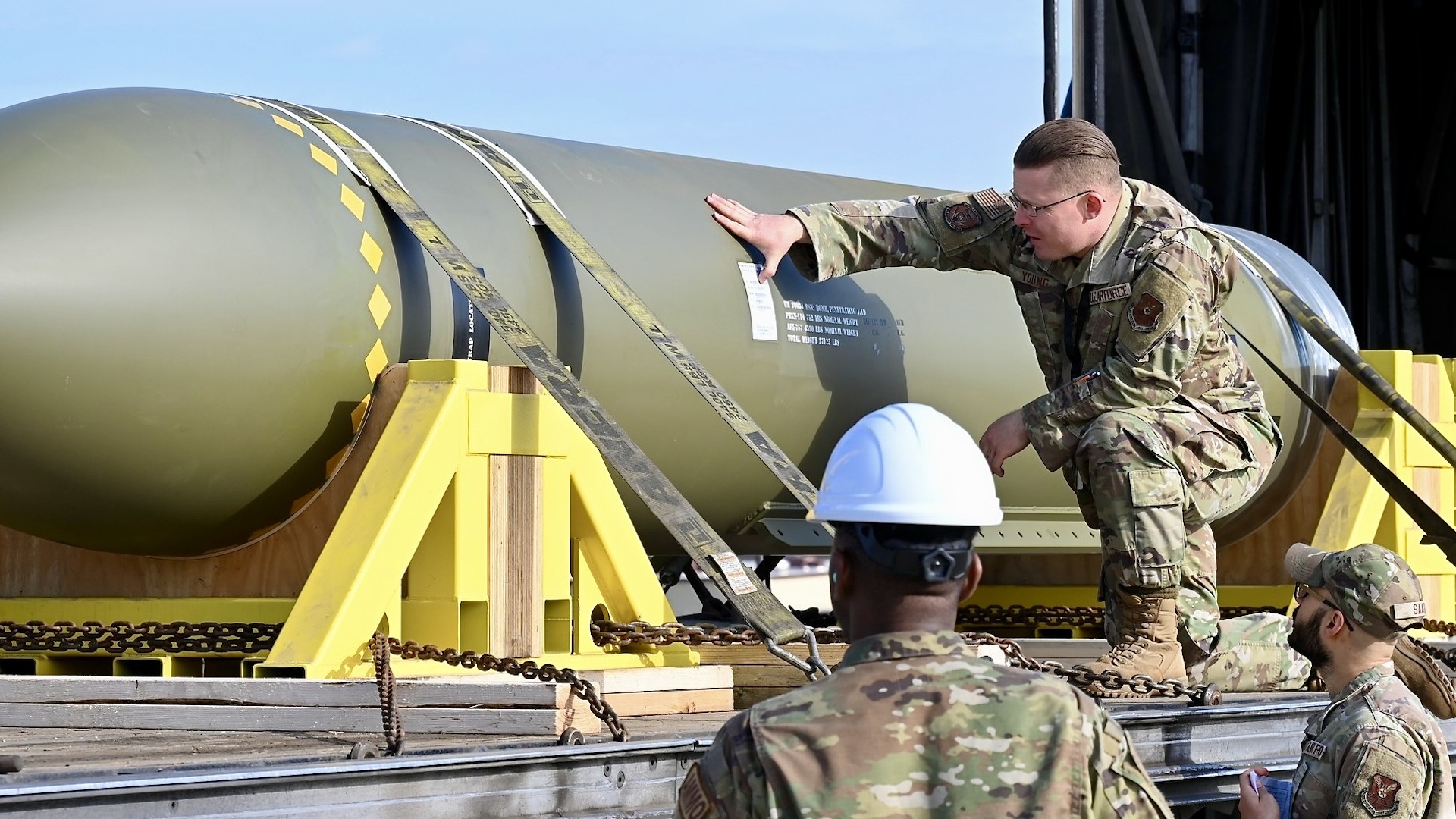
    Boeing and US Army weapons specialists stand in front of a mock-up of the MOP bomb at Whiteman Air Force Base

    The first static detonation test of the bomb was conducted in 2007 at the White Sands Missile Range. Flight tests of the weapon were conducted from 2008 to 2010, including launches from B-52 and B-2 bombers. In February 2010, the project was transferred to the Air Force, and the first deliveries of operational units of the bomb began in September 2011.

    B-2 bomber releases and tests GBU-57 MOP bomb

    Read more: Military Knowledge: B-2 Spirit Bomber

    Technical Specifications of the GBU-57 MOP Bomb:

    The estimated weight of the GBU-57 Massive Ordnance Penetrator (MOP) is between 12,300 and 13,600 kilograms, depending on various sources. The bomb measures approximately 6.2 meters in length and about 0.8 meters in diameter. To put this into perspective, its weight is comparable to that of two adult African elephants, highlighting its significant scale.

    The warhead of this bomb is composed of a mixture of AFX-757 and PBXN-114 explosives. The total weight of the warhead ranges from 2,400 to 2,600 kilograms, which includes around 2,080 kilograms of AFX-757 and 341 kilograms of PBXN-114. The body of the warhead is made from a high-performance steel alloy, designed to maintain its integrity upon impact. This construction enables the bomb to deliver a substantial explosive payload while preserving the penetrator’s structure during impact. The bomb’s considerable weight and specialized alloy are crucial to its penetration capability, much like driving a steel nail into rock. Most of the bomb’s weight resides in its body.

    The GBU-57 MOP is estimated to penetrate approximately 60 meters of reinforced concrete with a strength of 5,000 PSI. It can also penetrate about 40 meters of relatively hard rock and around 8 meters of reinforced concrete with a strength of 10,000 PSI. It is important to note that the reported penetration capabilities of 60 meters are based on preliminary information and prototypes of the bomb, and there is currently no precise information available regarding the ultimate penetration capacity of the latest model.

    Comparison of penetration of the MOP bomb (possibly a prototype) with the BLU-109 and GBU-28 bombs

    The GBU-57 Massive Ordnance Penetrator (MOP) is a precision-guided munition that utilizes a GPS/INS (Global Positioning System/Inertial Navigation System) for enhanced targeting accuracy, achieving precision within a few meters. The bomb features four fixed trapezoidal wings along its midsection and four lattice fins at its tail, which help adjust its trajectory during flight.

    Equipped with a smart fuze (LPSF), the GBU-57 MOP can modify its detonation timing based on the depth and configuration of the underground target. It incorporates void-sensing fuzes that trigger detonation if a large cavity is detected within the bunker. Additionally, the weapon includes a delay fuse, allowing the warhead to survive the initial impact upon penetrating the target before it detonates.

    In comparison to BLU-109, the MOP bomb possesses over ten times the explosive power and significantly greater penetration capabilities. The BLU-109 weighs only 910 kg and has a much shallower penetration depth.

    Comparison of penetration of the MOP bomb (probably a prototype) with the BLU-109 and GBU-28 bombs

    Variants of GBU-57:

    The GBU-57 has undergone numerous upgrades and modifications over the years, resulting in a variety of variants. These upgrades have included improvements to the fuze system, advanced guidance systems, and increased penetration capabilities, currently spanning seven generations. Common variants of this bomb use the BLU-127A/B, BLU-127B/B, and BLU-127C/B warheads, respectively.

    GBU-57/B: This version is equipped with the BLU-127/B warhead. The United States Air Force has addressed an integration issue that existed with the original version of the bomb on the B-2 Spirit stealth bomber. A new smart fuse has also been tested to enhance its effectiveness in situations where the depth or precise location of a buried target is uncertain.

    GBU-57A/B: This version uses the BLU-127A/B warhead.

    GBU-57B/B: This model is equipped with the BLU-127B/B warhead.

    GBU-57C/B: The specific upgrades made by Boeing to this version are not detailed in the available sources.

    GBU-57D/B: Information about the modifications made by Boeing to this version is also unclear, but it is believed that its fuse and primer have been upgraded.

    GBU-57E/B: This version has been part of the operational inventory since at least 2016 and is equipped with the BLU-127C/B warhead. It has improved capabilities for penetrating concrete structures compared to earlier models. It can be reasonably assumed to have greater penetration power than the 2007 models, which could penetrate to a depth of 60 meters. The BLU-127C/B warhead features a booster in its front section, although its exact function remains unknown. Currently, the US Air Force does not have a newer version of the GBU-57E/B in operational use.

    GBU-57F/B: This model is described as the latest version, but little is known about its exact capabilities.

    Overall, the US is working to boost the effectiveness of this bomb by continually upgrading it. As noted, the 60-meter penetration power is from the early models, and there’s no information available on the bomb’s penetration after receiving later upgrades. Additionally, the US is reportedly developing a version of this bomb with similar characteristics to the GBU-57, but lighter in weight, to enable its use in fighter jets.

    Production numbers and costs of the GBU-57:

    Developing the GBU-57 MOP weapon is expected to cost around $400 to $500 million. Each unit’s production cost is estimated to be roughly $3.5 million, with upgraded versions likely to be even more expensive. Although the exact number of MOP bombs produced is classified, estimates suggest a relatively small stockpile – about 20 by 2015, with potential for increased production.

    GBU-57 MOP specifications:

    Type: bunker buster bomb
    Origin: U.S.
    Manufacturer: Boeing
    Length: 6.2 m
    Diameter: 80 cm
    Total bomb weight: around 12.5 tons
    Warhead weight: around 2.5 tons
    Penetration: 61 m
    Guidance: GPS/INS

    GBU-57 bomb MOP

    Sources:
    GBU-57A/B_MOP – MOP – massive-gbu-57ab-mop-was-built-war-china – what-aircraft-carry-us-air-force-30000-pound-massive-ordnance-penetrator – gbu-57-massive-ordnance-penetrator
    the-evolution-and-strategic-imperative-of-the-gbu-57 – massive-ordnance-penetrator – mop – our-best-look-yet-at-the-massive-ordnance-penetrator – mopping-up-the-usas-30000-pound-bomb

  • Military Knowledge: GBU-57 MOP

    Military Knowledge: GBU-57 MOP

    Introduction and Development History of the GBU-57 MOP:

    As a heavy-duty penetrator bomb, the GBU-57 MOP (Massive Ordnance Penetrator) can target and destroy heavily fortified underground facilities like bunkers, command centers, and weapons depots. Designed for daytime or nighttime attacks on targets deep underground, as well as for deterring enemies with buried infrastructure, the bomb is built for planned strikes.

    The GBU-57 MOP project started in the early 2000s, a joint effort by Northrop Grumman and Lockheed Martin. However, due to financial and technical hurdles, the initial attempt was halted. After the US invasion of Iraq in 2003, an analysis of bunker-busting bombs used showed they lacked the penetration power to take out fortified targets.

    This sparked renewed interest in developing a larger bunker-busting bomb, and the MOP project was launched by the Defense Threat Reduction Agency (DTRA) to meet a long-standing Air Force need. The concept of “Big BLU” – large penetrating and explosive bombs like MOP and MOAB – was also proposed.
    In the end, Boeing won the contract to design and produce the bomb.

    Boeing and US Army weapons specialists stand in front of a mock-up of the MOP bomb at Whiteman Air Force Base

    The first static detonation test of the bomb was conducted in 2007 at the White Sands Missile Range. Flight tests of the weapon were conducted from 2008 to 2010, including launches from B-52 and B-2 bombers. In February 2010, the project was transferred to the Air Force, and the first deliveries of operational units of the bomb began in September 2011.

    B-2 bomber releases and tests GBU-57 MOP bomb

    Read more: Military Knowledge: B-2 Spirit Bomber

    Technical Specifications of the GBU-57 MOP Bomb:

    The estimated weight of the GBU-57 Massive Ordnance Penetrator (MOP) is between 12,300 and 13,600 kilograms, depending on various sources. The bomb measures approximately 6.2 meters in length and about 0.8 meters in diameter. To put this into perspective, its weight is comparable to that of two adult African elephants, highlighting its significant scale.

    The warhead of this bomb is composed of a mixture of AFX-757 and PBXN-114 explosives. The total weight of the warhead ranges from 2,400 to 2,600 kilograms, which includes around 2,080 kilograms of AFX-757 and 341 kilograms of PBXN-114. The body of the warhead is made from a high-performance steel alloy, designed to maintain its integrity upon impact. This construction enables the bomb to deliver a substantial explosive payload while preserving the penetrator’s structure during impact. The bomb’s considerable weight and specialized alloy are crucial to its penetration capability, much like driving a steel nail into rock. Most of the bomb’s weight resides in its body.

    The GBU-57 MOP is estimated to penetrate approximately 60 meters of reinforced concrete with a strength of 5,000 PSI. It can also penetrate about 40 meters of relatively hard rock and around 8 meters of reinforced concrete with a strength of 10,000 PSI. It is important to note that the reported penetration capabilities of 60 meters are based on preliminary information and prototypes of the bomb, and there is currently no precise information available regarding the ultimate penetration capacity of the latest model.

    Comparison of penetration of the MOP bomb (possibly a prototype) with the BLU-109 and GBU-28 bombs

    The GBU-57 Massive Ordnance Penetrator (MOP) is a precision-guided munition that utilizes a GPS/INS (Global Positioning System/Inertial Navigation System) for enhanced targeting accuracy, achieving precision within a few meters. The bomb features four fixed trapezoidal wings along its midsection and four lattice fins at its tail, which help adjust its trajectory during flight.

    Equipped with a smart fuze (LPSF), the GBU-57 MOP can modify its detonation timing based on the depth and configuration of the underground target. It incorporates void-sensing fuzes that trigger detonation if a large cavity is detected within the bunker. Additionally, the weapon includes a delay fuse, allowing the warhead to survive the initial impact upon penetrating the target before it detonates.

    In comparison to BLU-109, the MOP bomb possesses over ten times the explosive power and significantly greater penetration capabilities. The BLU-109 weighs only 910 kg and has a much shallower penetration depth.

    Comparison of penetration of the MOP bomb (probably a prototype) with the BLU-109 and GBU-28 bombs

    Variants of GBU-57:

    The GBU-57 has undergone numerous upgrades and modifications over the years, resulting in a variety of variants. These upgrades have included improvements to the fuze system, advanced guidance systems, and increased penetration capabilities, currently spanning seven generations. Common variants of this bomb use the BLU-127A/B, BLU-127B/B, and BLU-127C/B warheads, respectively.

    GBU-57/B: This version is equipped with the BLU-127/B warhead. The United States Air Force has addressed an integration issue that existed with the original version of the bomb on the B-2 Spirit stealth bomber. A new smart fuse has also been tested to enhance its effectiveness in situations where the depth or precise location of a buried target is uncertain.

    GBU-57A/B: This version uses the BLU-127A/B warhead.

    GBU-57B/B: This model is equipped with the BLU-127B/B warhead.

    GBU-57C/B: The specific upgrades made by Boeing to this version are not detailed in the available sources.

    GBU-57D/B: Information about the modifications made by Boeing to this version is also unclear, but it is believed that its fuse and primer have been upgraded.

    GBU-57E/B: This version has been part of the operational inventory since at least 2016 and is equipped with the BLU-127C/B warhead. It has improved capabilities for penetrating concrete structures compared to earlier models. It can be reasonably assumed to have greater penetration power than the 2007 models, which could penetrate to a depth of 60 meters. The BLU-127C/B warhead features a booster in its front section, although its exact function remains unknown. Currently, the US Air Force does not have a newer version of the GBU-57E/B in operational use.

    GBU-57F/B: This model is described as the latest version, but little is known about its exact capabilities.

    Overall, the US is working to boost the effectiveness of this bomb by continually upgrading it. As noted, the 60-meter penetration power is from the early models, and there’s no information available on the bomb’s penetration after receiving later upgrades. Additionally, the US is reportedly developing a version of this bomb with similar characteristics to the GBU-57, but lighter in weight, to enable its use in fighter jets.

    Production numbers and costs of the GBU-57:

    Developing the GBU-57 MOP weapon is expected to cost around $400 to $500 million. Each unit’s production cost is estimated to be roughly $3.5 million, with upgraded versions likely to be even more expensive. Although the exact number of MOP bombs produced is classified, estimates suggest a relatively small stockpile – about 20 by 2015, with potential for increased production.

    GBU-57 MOP specifications:

    Type: bunker buster bomb
    Origin: U.S.
    Manufacturer: Boeing
    Length: 6.2 m
    Diameter: 80 cm
    Total bomb weight: around 12.5 tons
    Warhead weight: around 2.5 tons
    Penetration: 61 m
    Guidance: GPS/INS

    GBU-57 bomb MOP

    Sources:
    GBU-57A/B_MOP – MOP – massive-gbu-57ab-mop-was-built-war-china – what-aircraft-carry-us-air-force-30000-pound-massive-ordnance-penetrator – gbu-57-massive-ordnance-penetrator
    the-evolution-and-strategic-imperative-of-the-gbu-57 – massive-ordnance-penetrator – mop – our-best-look-yet-at-the-massive-ordnance-penetrator – mopping-up-the-usas-30000-pound-bomb

  • Military Knowledge: AH-64 Apache Attack Helicopter

    Military Knowledge: AH-64 Apache Attack Helicopter

    History:
    In the Advanced Attack Helicopter (AAH) program, the United States Department of Defense wanted a helicopter with more firepower, performance and range than the AH1-Cobra, and the new helicopter should also be able to fly at a very low altitude (nap-of-the-earth). -NoE) as well. So the Apache helicopter was developed to replace the AH-1 Cobra helicopter.

    Proposals were submitted by Bell, Boeing Vertol/Grumman team, Hughes, Lockheed, and Sikorsky. In July 1973, the U.S. Department of Defense selected finalists Bell and Hughes Aircraft’s Toolco Aircraft Division (later Hughes Helicopters).

    Each company built prototype helicopters and went through a flight test program. Hughes’ Model 77/YAH-64A prototype first flew on 30 September 1975, while Bell’s Model 409/YAH-63A prototype first flew on 1 October 1975. After evaluating the test results, the Army selected Hughes’ YAH-64A over Bell’s YAH-63A in 1976. Reasons for selecting the YAH-64A included its more damage tolerant four-blade main rotor and the instability of the YAH-63’s tricycle landing gear arrangement.

    The AH-64A then entered phase 2 of the AAH program under which three pre-production AH-64s would be built, additionally, the two YAH-64A flight prototypes and the ground test unit were upgraded to the same standard. Weapons and sensor systems were integrated and tested during this time, including the laser-guided AGM-114 Hellfire missile. Development of the Hellfire missile had begun in 1974, originally known by the name of Helicopter Launched, Fire and Forget Missile (‘Hellfire’ being a shortened acronym), for the purpose of arming helicopter platforms with an effective anti-tank missile.

    In 1981, three pre-production AH-64As were handed over to the U.S. Army for Operational Test II. The Army testing was successful, but afterward it was decided to upgrade to the more powerful T700-GE-701 version of engine, rated at 1,690 shp (1,260 kW). The AH-64 was named the Apache in late 1981, following the tradition of naming Army helicopters after Native American tribes. It was approved for full-scale production in 1982. In 1983, the first production helicopter was rolled out at Hughes Helicopter’s facility at Mesa, Arizona.

    YAH-64A equipped with a Hellfire missile

    Hughes Helicopters was purchased by McDonnell Douglas for $470 million in 1984. The helicopter unit later became part of The Boeing Company with the merger of Boeing and McDonnell Douglas in August 1997. Today, MD Helicopters, a subsidiary of Boeing, is responsible for the production of AH-64 Apache helicopters.

    Since 1984, some aerospace companies such as AgustaWestland have produced a number of parts for the Apache. Teledyne Ryan Aeronautical was the manufacturer of the Apache fuselage, which was handed over to Korea Aerospace Industries in 2004. This change in fuselage manufacturer led to a long legal dispute between Teledyne Ryan and Boeing.

    Design:
    The AH-64 Apache has a four-blade main rotor and a four-blade tail rotor. The crew sits in tandem, with the pilot sitting behind and above the co-pilot/gunner. Both crew members are capable of flying the aircraft and performing methods of weapon engagements independently.

    The AH-64 is powered by two General Electric T700 turboshaft engines with high-mounted exhausts on either side of the fuselage. Various models of engines have been used on the Apache; those in British service use engines from Rolls-Royce. In 2004, General Electric Aviation began producing more powerful T700-GE-701D engines, rated at 2,000 shp (1,500 kW) for AH-64Ds.

    The crew compartment and rotor blades are designed to sustain a hit from 23 mm (0.91 in) rounds. The airframe includes some 2,500 lb (1,100 kg) of protection and has a self-sealing fuel system to protect against ballistic projectiles. This compartment also incorporates a transparent blast shield between the pilot and gunner seats so that at least one crew member can survive in the event of a direct hit, but the canopy and windows are otherwise unrated against ballistic threats.

    The aircraft was designed to meet the crashworthiness requirements of MIL-STD-1290, which specifies minimum requirement for crash impact energy attenuation to minimize crew injuries and fatalities. This was achieved through incorporation of increased structural strength, crashworthy landing gear, seats and fuel system.

    On a standard day, when temperatures are 59 °F (15 °C), the AH-64 has a vertical rate of climb of 1,775 feet per minute (541 m/min), and a service ceiling of 21,000 feet (6,400 m). However, on a hot day, when temperatures are 70 °F (21 °C), its vertical rate of climb is reduced to 1,595 fpm (486 m/min), and service ceiling is reduced to 19,400 feet (5,900 m) due to less dense air.

    One of the revolutionary features of the Apache was its helmet mounted display, the Integrated Helmet and Display Sighting System (IHADSS); among its capabilities, either the pilot or gunner can slave the helicopter’s 30 mm automatic M230 Chain Gun to their helmet, making the gun track head movements to point where they look.

    The M230E1 can be alternatively fixed to a locked forward firing position, or controlled via the Target Acquisition and Designation System (TADS). On more modern AH-64s, the TADS/PNVS has been replaced by Lockheed Martin’s Arrowhead (MTADS) targeting system.

    British Apache pilot with IHADSS

    U.S. Army engagement training is performed under the Aerial Weapons Scoring System Integration with Longbow Apache Tactical Engagement Simulation System (AWSS-LBA TESS), using live 30 mm and rocket ammunition as well as simulated Hellfire missiles. The Smart Onboard Data Interface Module (SMODIM) transmits Apache data to an AWSS ground station for gunnery evaluation.

    The gunner’s position in the AH-64D Longbow Apache.

    The AH-64’s standard of performance for aerial gunnery is to achieve at least 1 hit for every 30 shots fired at a wheeled vehicle at a range of 800–1,200 m (870–1,310 yd). British Apache pilot with IHADSS The AH-64 was designed to perform in front-line environments, and to operate at night or day and during adverse weather conditions.

    Various sensors and onboard avionics allows the Apache to perform in these conditions; such systems include the Target Acquisition and Designation System, Pilot Night Vision System (TADS/PNVS), passive infrared countermeasures, GPS, and the IHADSS.

    Additional avionics and sensor improvements includes an extended-range radar capable of detecting small ships in littoral environments, software adaptions to handle maritime targets, and adding Link 16 data-links for better communications with friendly assets.

    Variants:

    AH-64A:
    The AH-64A is the original production attack helicopter. The crew sit in tandem in an armored compartment. It is powered by two GE T700 turboshaft engines. The A-model was equipped with the −701 engine version until 1990 when the engines were switched to the more powerful −701C version.
    U.S. Army AH-64As are being converted to AH-64Ds. The service’s last AH-64A was taken out of service in July 2012 before conversion at Boeing’s facility in Mesa, Arizona. On 25 September 2012, Boeing received a $136.8M contract to remanufacture the last 16 AH-64As into the AH-64D Block II version and this was planned to be completed by December 2013.

    AH-64B:
    In 1991, after Operation Desert Storm, the AH-64B was a proposed upgrade to 254 AH-64As. The upgrade would have included new rotor blades, a Global Positioning System (GPS), improved navigation systems and new radios. U.S. Congress approved $82M to begin the Apache B upgrade. The B program was canceled in 1992. The radio, navigation, and GPS modifications were later installed on most AH-64As via other upgrades.

    AH-64C:
    Additional funding from Congress in late 1991 resulted in a program to upgrade AH-64As to an AH-64B+ version. More funding changed the plan to upgrade to AH-64C, which would include all of the changes to be included in the AH-64D except for mast-mounted radar and newer −700C engine versions. However, the C designation was dropped after 1993. With AH-64As receiving the newer engine from 1990, the only difference between the AH-64C and the AH-64D was the radar, which could be moved from one aircraft to another; thus the decision was made to simply designate both versions as AH-64D.

    AH-64D Apache Longbow:
    The AH-64D Apache Longbow is equipped with a glass cockpit and advanced sensors, the most noticeable of which being the AN/APG-78 Longbow millimeter-wave fire-control radar (FCR) target acquisition system and the Radar Frequency Interferometer (RFI), housed in a dome located above the main rotor.

    AN/APG-78 fire control radar mounted on the main rotor of an Apache helicopter

    The radome’s raised position enables target detection while the helicopter is behind obstacles (e.g. terrain, trees or buildings). The AN/APG-78 is capable of simultaneously tracking up to 128 targets and engaging up to 16 at once; an attack can be initiated within 30 seconds. A radio modem integrated with the sensor suite allows data to be shared with ground units and other Apaches, allowing them to fire on targets detected by a single helicopter.

    The aircraft is powered by a pair of uprated T700-GE-701C engines. The forward fuselage was expanded to accommodate new systems to improve survivability, navigation, and ‘tactical internet’ communications capabilities. In February 2003, the first Block II Apache was delivered to the U.S. Army, featuring digital communications upgrades. The Japanese Apache AH-64DJP variant is based on the AH-64D; it can be equipped with the AIM-92 Stinger air-to-air missiles for self-defense.

    Interior view of the AH-64D Apache Longbow helicopter and its radar screen

    AH-64E:
    Formerly known as AH-64D Block III, in 2012, it was redesignated as AH-64E Guardian. It has improved digital connectivity, the Joint Tactical Information Distribution System, more powerful T700-GE-701D engines with upgraded face gear transmission to handle more power, capability to control unmanned aerial vehicles (UAVs), full IFR capability, and improved landing gear. New composite rotor blades, which completed testing in 2004, increase cruise speed, climb rate, and payload capacity. Deliveries began in November 2011. Full-rate production was approved on 24 October 2012, 634 AH-64Ds will be upgraded into AH-64Es.

    Changes in production lots 4 through 6 include a cognitive decision aiding system and new self-diagnostic abilities. The updated Longbow radar has an oversea capacity, potentially enabling naval strikes; an AESA radar is under consideration. It will have a L-3 Communications MUMT-X datalink in place of two older counterparts, communicating on C, D, L, and Ku frequency bands to transmit and receive data and video with all Army UAVs. Lots 5 and 6 will have Link 16 data-links. The AH-64E is to be fit for maritime use. The U.S. Army expressed interest in extended-range fuel tanks for greater endurance. As of April 2020, 500 AH-64Es have been delivered.

    AH-64F:
    In 2014, Boeing conceptualized an Apache upgrade prior to the introduction of the U.S. Army’s anticipated attack version of the Future Vertical Lift (FVL) aircraft, forecast to replace the Apache by 2040. The conceptual AH-64F would have greater speed via a new 3,000 shp turboshaft engine from the Improved Turbine Engine Program, retractable landing gear, stub wings to offload lift from the main rotor during cruise, and a tail rotor that can articulate 90 degrees to provide forward thrust. In October 2016, the Army revealed they would not pursue another Apache upgrade to focus on funding FVL; the Army will continue buying the Apache through the 2020s until Boeing’s production line ends in 2026, then FVL is slated to come online in 2030.
    In 2014, Boeing conceptualized an Apache upgrade prior to the introduction of the U.S. Army’s anticipated attack version of the Future Vertical Lift (FVL) aircraft, forecast to replace the Apache by 2040. The conceptual AH-64F would have greater speed via a new 3,000 shp turboshaft engine from the Improved Turbine Engine Program, retractable landing gear, stub wings to offload lift from the main rotor during cruise, and a tail rotor that can articulate 90 degrees to provide forward thrust. In October 2016, the Army revealed they would not pursue another Apache upgrade to focus on funding FVL; the Army will continue buying the Apache through the 2020s until Boeing’s production line ends in 2026, then FVL is slated to come online in 2030.

    Compound Apache:
    In October 2018, Boeing began testing the AH-64E Block 2 Compound, a compound helicopter design which added a larger fixed wing and a pusher propeller to the Apache airframe to provide additional lift and thrust, respectively. In addition, the engine exhaust was redirected downwards. Collectively, the modifications were anticipated to improve speed to 185 kn (343 km/h; 213 mph), range to 460 nmi (850 km; 530 mi), payload to 5,900 lb (2,700 kg), and fuel economy. A 30% scale model completed wind tunnel testing in January 2019. The Compound Apache has been pitched as an interim replacement for the Apache before its replacement under the Future Vertical Lift program.

    Sea Apache:
    During the 1980s naval versions of the AH-64A for the United States Marine Corps and Navy were examined. Multiple concepts were studied with altered landing gear arrangements, improved avionics and weapons. The USMC conducted a two-week evaluation of the Apache in September 1981, including shipboard operation tests. Funding for a naval version was not provided; the USMC continued to use the AH-1.

    The Canadian Forces Maritime Command also examined naval Apaches. In 2004, British Army AgustaWestland Apaches were deployed upon the Royal Navy’s HMS Ocean, a Landing Platform Helicopter, for suitability testing; there was U.S. interest in the trials. During the 2011 military intervention in Libya, the British Army extensively used Apaches from HMS Ocean. In 2013, US AH-64Ds were tested on several U.S. Navy ships.

    Deployment and flight of the AH-64D helicopter from the helicopter carrier HMS Ocean

    Export Apaches:
    Several models have been derived from the AH-64A, AH-64D and AH-64E for export. The British-built AgustaWestland Apache (assembled from kits purchased from Boeing) is based on the AH-64D Block I with several different systems, including more powerful engines, folding rotor blades, and other modifications for operation from Royal Navy vessels.

    A picture of an AgustaWestland Apache on the landing pad of the helicopter carrier HMS Ocean

    Specifications of AH-64E Guardian helicopter:
    Role: Attack helicopter
    In service: since 1986
    Origin: USA
    Manufacturer: Boeing Defense, Space & Security
    Crew: 2
    Length: 14.68 meters
    Height: 4.72 meters
    Rotor diameter: 14.63 meters
    Engine: 2 General Electric T700-GE-701
    Speed: 279 km/h
    Ascent rate: 853 meters per minute
    Weight: 6838 kg
    Maximum take-off weight: 10432 kg
    Combat range: 480 km
    Maximum range: 1896 km
    Flight ceiling: 6096 meters
    Armament:
    1× 30mm M230 Chain Gun with 1,200 rounds
    4× hardpoints under the wings

    AH-64 Apache helicopter – click to view full size

    More pictures of the Apache attack helicopter:

    Infographics of Apache AH-64 attack helicopter in Arabic, Russian, Persian, Azeri and Kurdish:

    Sources:
    Boeing AH-64 Apache
    AH-64 Apache – Boeing
    ah64 apache attack helicopters

  • Military Knowledge: Ground Launched Small Diameter Bomb

    Military Knowledge: Ground Launched Small Diameter Bomb

    The Ground Launched Small Diameter Bomb (GLSDB) is a weapon developed by Boeing and the Saab Group to allow Boeing’s GBU-39 Small Diameter Bomb (SDB), originally developed for use by aircraft, to be ground-launched from a variety of launchers and configurations. It combines the SDB with the M26 rocket, enabling it to be launched from ground-based missile systems such as the M270 Multiple Launch Rocket System and M142 HIMARS. It can also be fired from its own launch container, allowing it to be fired from sea.

    In 2014, the two companies Saab and Boeing signed a contract to design and produce a new weapon with the aim of being cheap and available, by developing an “inter-stage adapter” to connect the SDB to an M26 rocket. Also providing expertise are two Norwegian companies, Nammo for booster rocket and Nordic Shelter for launchers.

    The Norwegian company Nordic Shelter, which specializes in the construction of shelters, hospitals and other mobile devices in the form of 10- and 20-foot containers, has participated in the manufacture of a special launcher for GLSDB, which is placed inside a 20-foot container.

    Twelve M26 rockets at a time can be launched from M270A MLRS, six at a time from HIMARS. By using a special container launcher, the possibility of deception becomes easier and makes locating and targeting more difficult for the enemy. This special launcher carries and fires 6 rockets.

    Graphic design of GLSDB and three types of HIMARS launcher, M26 (MLRS) and special container launcher

    In a 2017 demonstration, the GLSDB engaged a moving target at a distance of 100 km. The SDB and rocket motor separated at altitude and the bomb used a semi-active laser (SAL) seeker to track and engage the target. A 2019 test extended this range to 130 km against a target at sea. The laser-guided SDB had previously been tested successfully using targets travelling at 80 km/h.

    The mass production of this weapon has started in 2023, and Taiwan, as the only buyer of this system, has postponed receiving its order at the request of the United States to meet Ukraine’s need for this weapon. On June 22, Laura Cooper, the deputy assistant secretary of defense for Russian, Ukrainian and Eurasian affairs, told Congress that despite development and production problems, the weapon would be available sooner than the fall of 2023.

    M26 rocket:
    M26 is a MLRS rocket with a cluster warhead. The M26 and M28 rockets have been produced since 1980 and were the only rockets available for the M270 system until 2005. The production of the M26 rocket has been stopped since 2001, and its last operational use dates back to the invasion of Iraq in 2003. In accordance with George W. Bush’s directive to destroy 1% of unused US cluster munitions, the US military in 2007 earmarked separate funds for the creation of special facilities for the destruction of MLRS rockets and ATACM missiles at the Anniston Defense Ammunition Center in Alabama and at the Letterkenny Ammunition Center in Pennsylvania. The Army requested $109 million to destroy 98,904 M26 MLRS rockets between 2007 and 2012. There are reports that the project was stopped in 2010. That is, before Trump’s order in 2017 to stop the destruction of cluster munitions, it is not clear how many of the 506,718 M26 rockets in 2001 are left today.

    GBU-39/B small diameter bomb (SDB I):
    The GBU-39/B (SDB I) small-diameter bomb is a 110 kg precision-guided bomb designed to provide the aircraft with the ability to attack with a greater number of precision-guided bombs. The first type of this bomb, which is produced by Boeing, entered service for the first time in 2006, and the second type is produced by Raytheon. This bomb contains 16 kilograms of explosives and has the ability to penetrate one meter of reinforced concrete that is one meter deep in the ground.
    The accuracy of this bomb is one meter and it is possible to connect to link 16 and use network-based warfare facilities. The first type of US small diameter bombs are widely available today and are being replaced by newer models. As a result, the parts needed to produce GLSDB are widely available.

    The M26 rocket and the SDB I bomb are connected to each other using an inter-stage adapter. The way the GLSDB bomb works is that after firing, the rocket brings the SDB up to a sufficient altitude and speed, the SDB separates from the rocket and the wings open, allowing the bomb to glide towards its target. Unlike conventional rockets, this bomb did not go through the ballistic path and it is possible to change the path after the separation of the SDB; Although it reduces its range.

    Components of the GLSDB bomb

    Unlike traditional artillery weapons, the GLSDB offers 360-degree coverage for high and low angles of attack, flying around terrain to hit targets on the back of mountains, or circling back around to a target behind the launch vehicle. The GLSDB has a range of 150 km, or can hit targets 70 km behind the launch vehicle. This weapon can be configured to detonate before hitting the ground to cause more casualties. Or detonate with a delay after impact to penetrate deep (such as trenches). The type of guidance of this bomb is GPS, which makes its accuracy up to one meter, and it is also very resistant to jamming of electronic warfare.

    Video of how the GLSDB bomb works

    Although the exact price of GLSDB has not been announced, each SDB bomb costs about 40,000 dollars for the US Army, and the M26 rocket is also an obsolete inventory in the US Army. Also, some money must be spent on the inter-stage adapter, developing a launcher-container, and other costs of developing and producing GLSDB by Boeing and SAAB. By comparison, the cost of an M31 missile, a variant of the GMLRS, is estimated to be only $500,000, although this may be the “export price” which is always higher than what it would cost the US military. According to US Army budget projections in 2023, the price will be around $168,000 per GMLRS. which has two examples of 70 and 150 km. It seems that every GLSDB unit has a lower price than this model.

    Part of the FY 2023 US military presidential budget briefing book on GMLRS rockets projected to be more expensive than GLSDB

    The purpose in developing the weapons was to offer poorer countries the strike capacity of more expensive and advanced air forces. Jim Leary, director of global sales for Boeing, told reporters in 2019: “It really fits across a broader customer set because we’re taking an existing capability, maximizing it and creating an opportunity [for countries] that don’t have the ability to have a robust air force.”

    Specifications of the GLSDB:
    Range: 150 km
    Warhead: Fragmentation multipurpose warhead
    Warhead weight: 93 kg, Explosive fill: 16 kg
    Accuracy: 1 meter CEP
    Guidance: GPS and laser
    Launch platform: M270 MLRS and M142 HIMARS Or can be launched from its own launch container
    Designer: Boeing and Saab Group

    Source:
    United States Cluster Munition Ban Policy
    Boeing, Saab Unveil Ground Launched SDB
    Ground-Launched Small Diameter Bomb (GLSDB)
    Ukraine to receive first GLSDB missiles no earlier than autumn – Pentagon
    Ground Launched Small Diameter Bomb
    Ground-Launched Small Diameter Bomb