
Military Knowledge: B-52 Strategic Bomber

The Boeing B-52, nicknamed the Stratofortress and often referred to by the moniker “Buff,” is a long-range, subsonic strategic bomber that has maintained its central position in the United States Air Force since the 1950s. Designed for the dual missions of nuclear deterrence and conventional strikes, it has played a key role in American military history. As of 2025, the aircraft has logged 70 years of operational service, and it is expected to retain its status for at least three more decades. This article will examine this strategic bomber.
Basic introduction to the B-52:
For more than sixty years, the B-52 has been the backbone of America’s strategic bomber force. It is an aircraft capable of carrying and delivering the most diverse array of weapons in the US arsenal, including free-fall bombs, cluster munitions, and precision-guided munitions. With modern upgrades, the B-52 is able to carry all of the weaponry developed by the US Air Force and continues to play a significant role in the nation’s defense strategy in the 21st century.
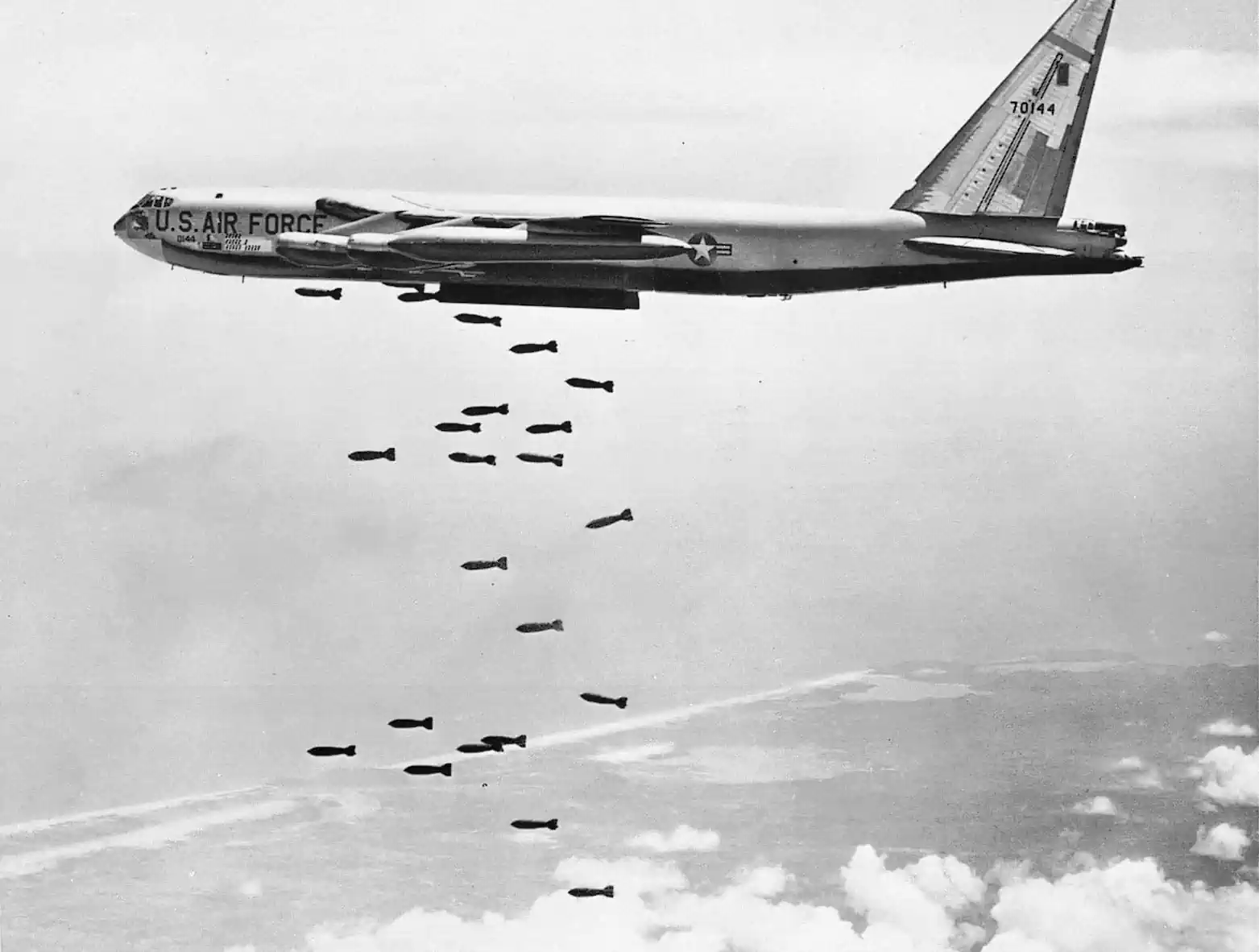
The flexibility of the B-52’s design is one of its standout features. Over time, the aircraft has undergone numerous changes and upgrades based on shifting military requirements. The B-52 has transitioned from its original role as a nuclear deterrent to a multi-role conventional bomber.
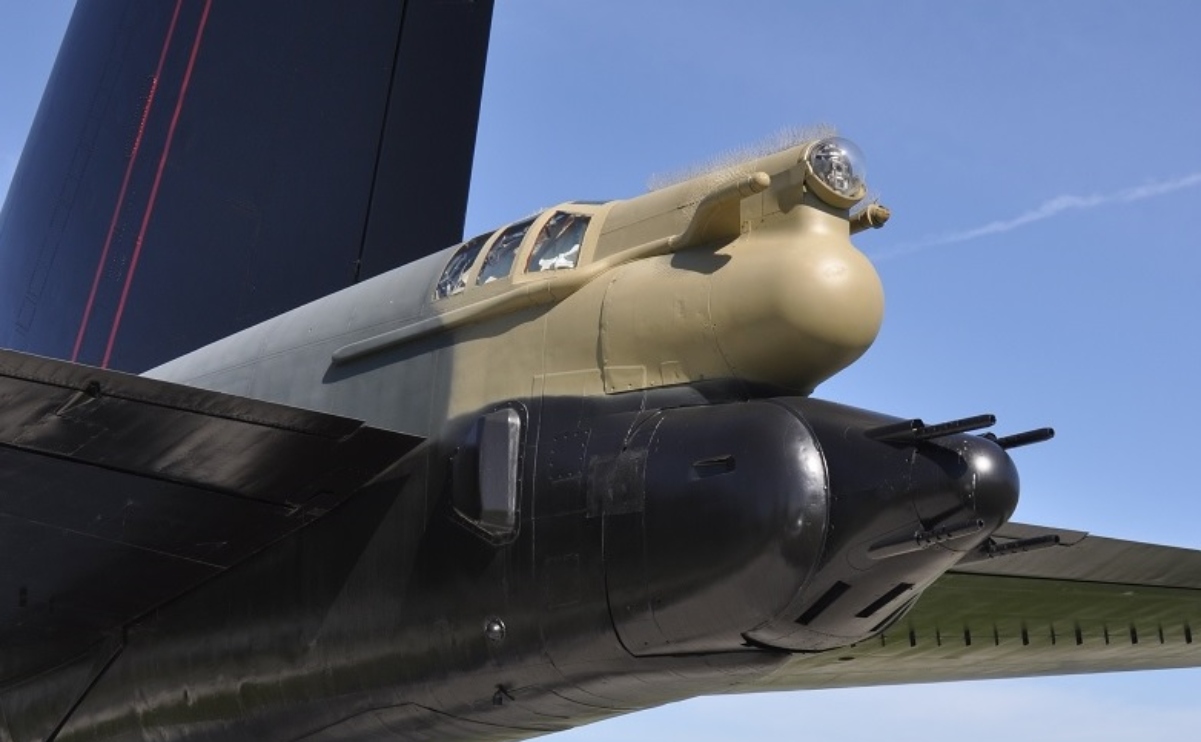
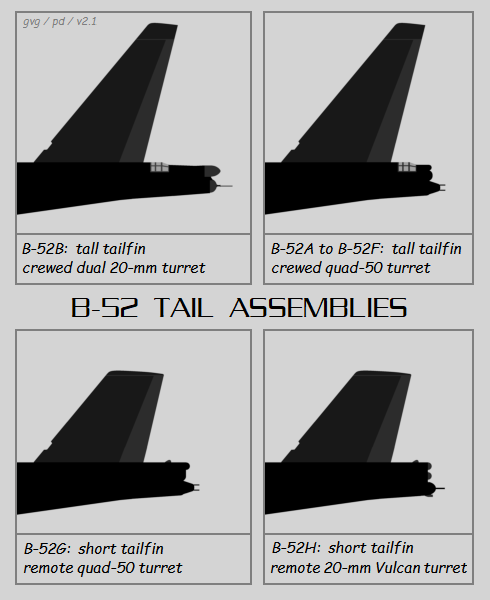
For example, in early models, the tail gunner was stationed in the traditional location at the rear of the aircraft, operating with visual and radar targeting systems. In later models, the gunner’s position was moved to the front of the fuselage, and targeting operations were carried out solely by radar. However, since 1991, the tail gun has been removed from all operational B-52s.
Design and production history of the B-52:
The development of the B-52 began in the early 1940s with the experimental prototype XB-52 — an initiative by Boeing in response to the Air Force’s request for a new bomber design. In November 1945, the Air Force specified the desired performance characteristics for a modern strategic bomber; an aircraft capable of carrying out strategic missions independently, without relying on forward or intermediate bases under the control of other nations.
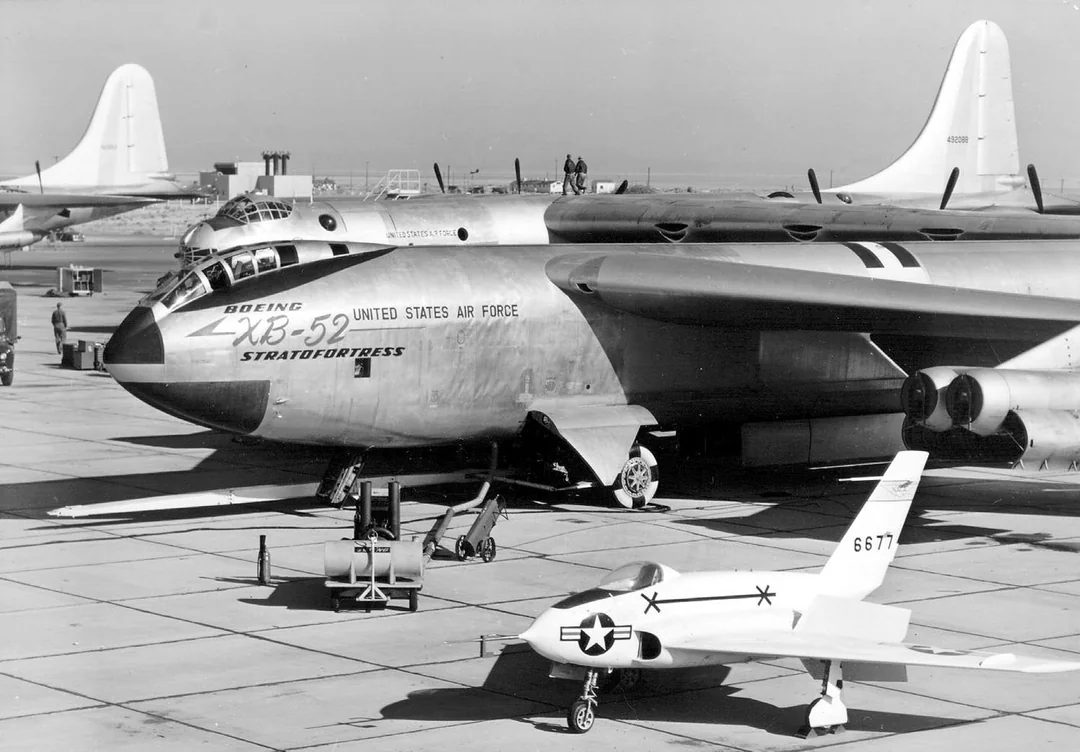
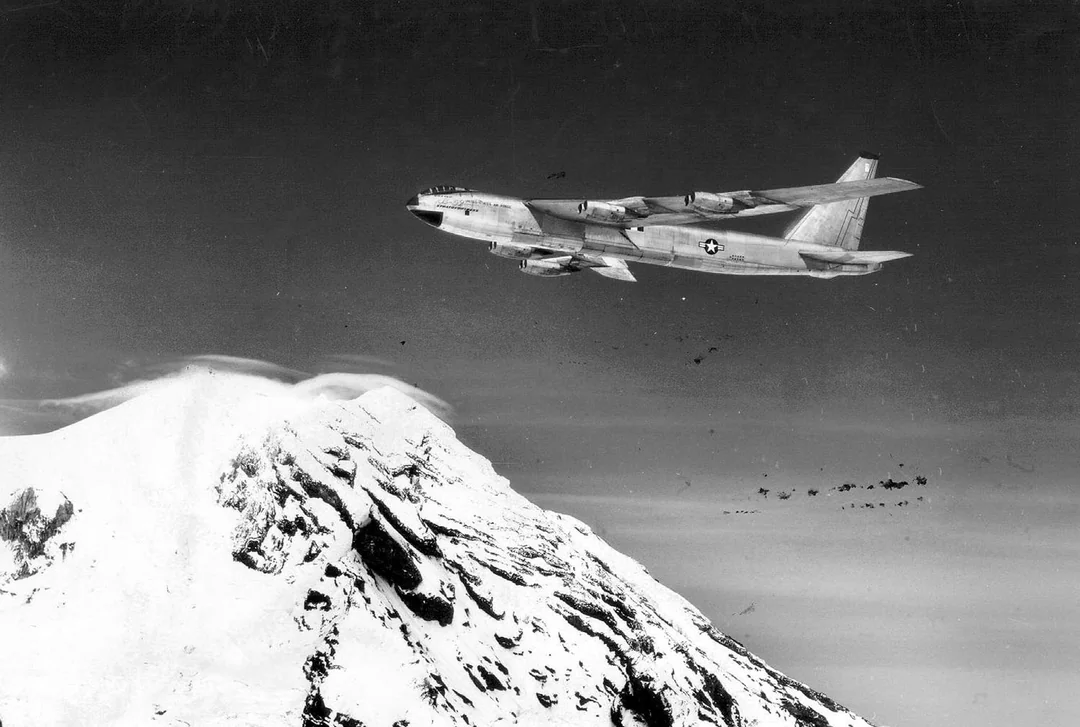
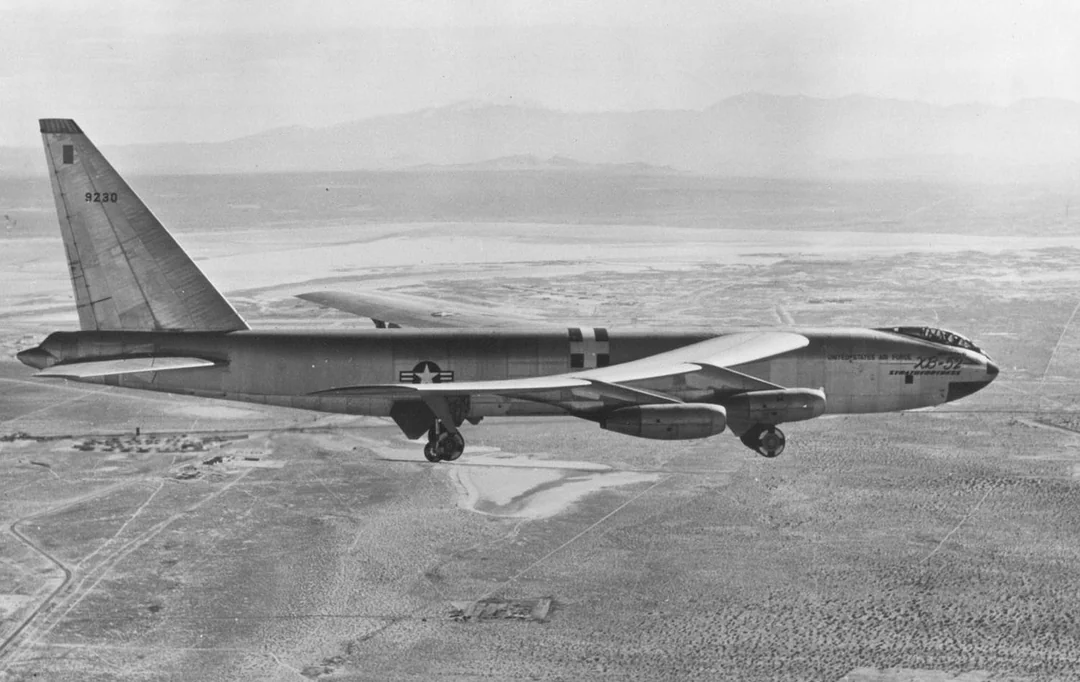
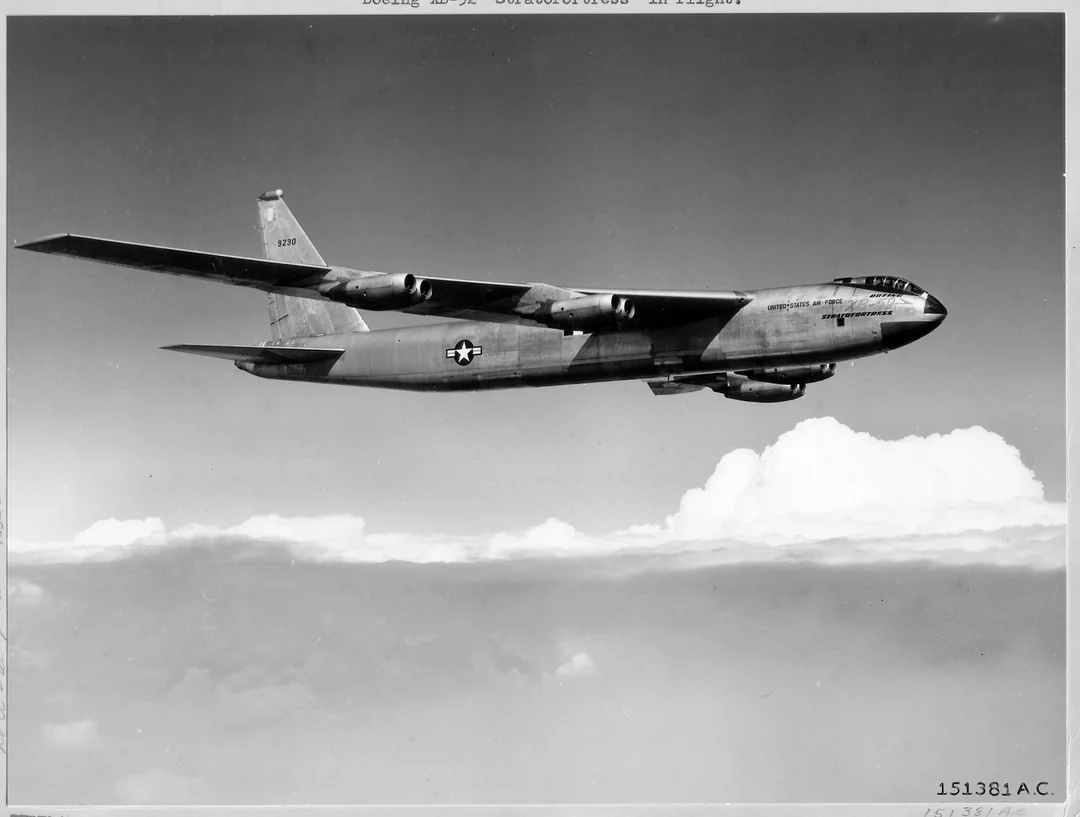
Then, on February 13, 1946, the US Air Force issued an invitation for prototype proposals, asking manufacturers to submit their designs based on various specifications.
On June 5, 1946, Boeing’s Model 462, an aircraft with straight wings and six turboprop engines, was selected as the winner. On June 28, 1946, a $1.7 million contract was awarded to Boeing to build the full XB-52 prototype and conduct preliminary tests. However, concerns were raised within the Air Force regarding the aircraft’s size and its compliance with design requirements. In response, Boeing offered two models: the Model 464-16 for nuclear missions and the Model 464-17 for conventional bombing. To reduce costs, the Air Force selected the Model 464-17, which had secondary adaptability for nuclear strikes. Later, Boeing was instructed to explore technological advancements including aerial refueling, increased speed, extended range, and other capabilities.
Government concerns over the high fuel consumption of jet engines led Boeing to continue using the Model 464-35 with turboprop engines as the basis for the XB-52. Subsequently, Boeing designed the larger Model 464-67 and proposed that later modifications in production could further improve it.
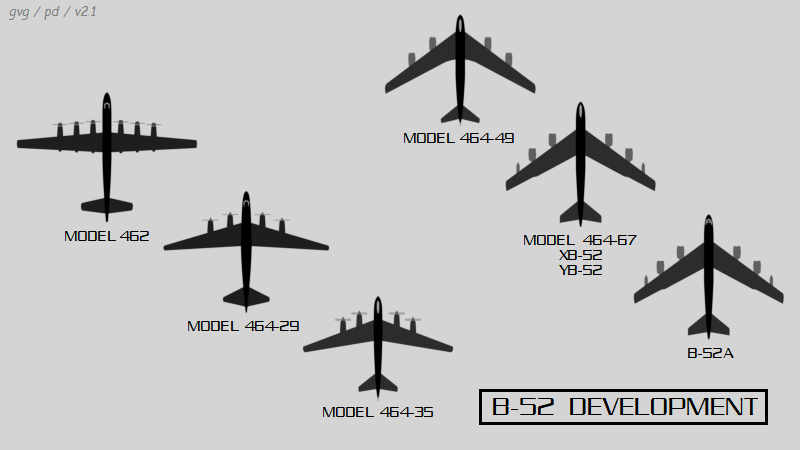
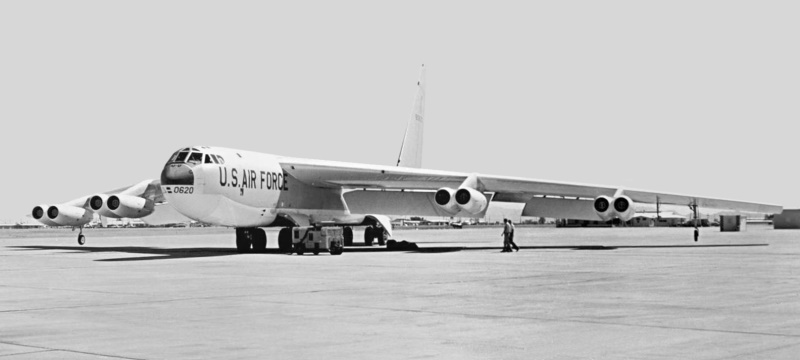
Ultimately, on February 14, 1951, Boeing received a production contract for 13 B-52A aircraft and 17 detachable reconnaissance pods. The last major design change involved switching from the old tandem two-seat cockpit to a side-by-side seating arrangement, which increased the co-pilot’s effectiveness and reduced crew fatigue. The first XB-52 prototype flew on April 15, 1952. This flight marked the first step in an intensive phase of testing and development. The aircraft demonstrated impressive performance and range, meeting the requirements of the US Air Force.
B-52 Variants:
The initial production variant, known as the B-52A, entered service in the mid-1950s. Subsequently, a series of variants and modifications were introduced, including the B-52B, B-52C, B-52D, B-52E, B-52F, B-52G, and B-52H, each incorporating improvements in engines, avionics, and armaments. This extensive production effort involved over 5,000 companies, with subcontractors fabricating 41 percent of the airframe.
The Seattle plant built 101 D models, while Wichita produced 69. Both plants continued production of the B-52E — 42 built in Seattle and 58 in Wichita — along with the B-52F (44 from Seattle and 45 from Wichita). Production finally ended in 1963 with the B-52H, for a total of 742 aircraft built, in addition to the two original prototypes.
The B-52C variant was generally very similar to the B-52B, with the same engines and nearly identical avionics. The most noticeable external difference of the B-52C compared to the B-52B was the installation of a large external fuel tank under each wing. Additionally, the water injection tank at the rear of the fuselage was removed, and a water injection tank was placed in the wing root of each wing.
The B-52D variant was almost identical to the B-52C, using the same fire control system that was used on the last B-52C. The only significant difference was the complete removal of the reconnaissance pod capability.
The B-52E variant was externally almost identical to the B-52D, but by this time, Soviet air defense had reached a level of sophistication that made high-altitude bombing no longer considered practical or safe; therefore, the Strategic Air Command (SAC) adopted low-level penetration tactics. To support this new mission, the B-52E was equipped with a range of modern systems, the most important of which was the AN/ASQ-38 integrated navigation and bombing system built by IBM. This system included the Raytheon AN/ASB-4 navigation and bombing radar and the GPL AN/APN-89 doppler ground speed/altitude indicator.
The B-52F variant was also very close in appearance and structure to the B-52E, with the major difference being that it was equipped with improved J57-43W engines.
The B-52G variant is the most produced variant of the family. This model is distinguished by a significant increase in internal fuel tank capacity.
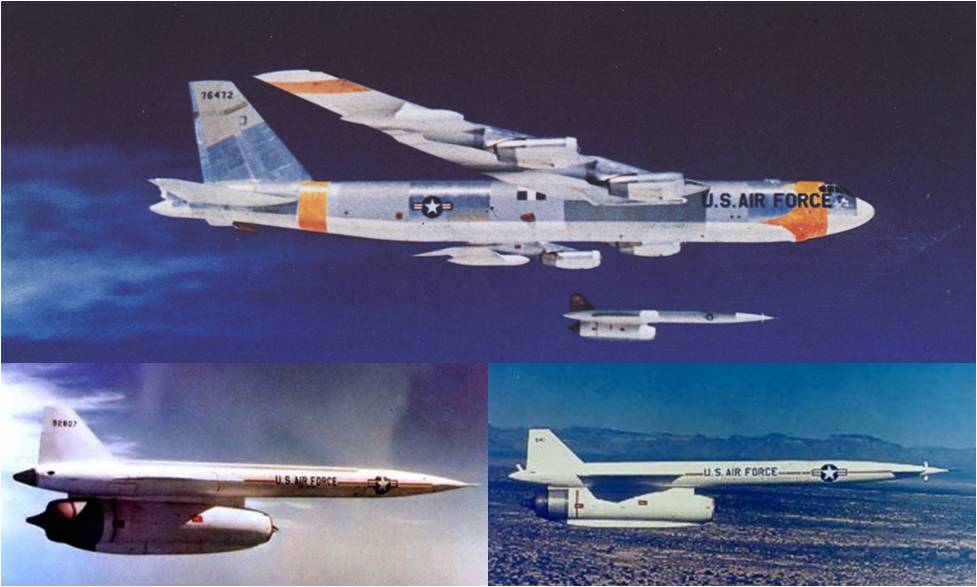
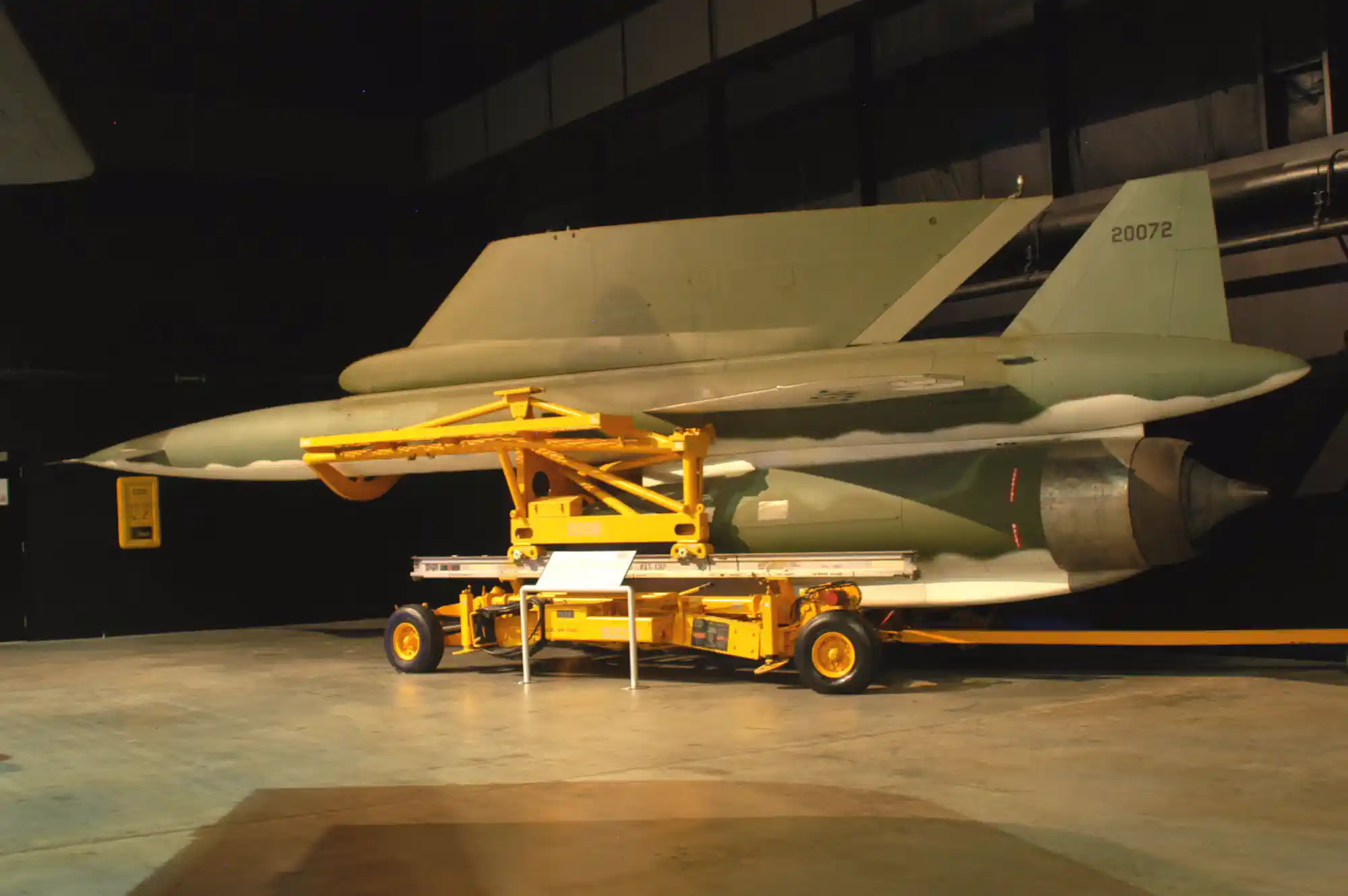
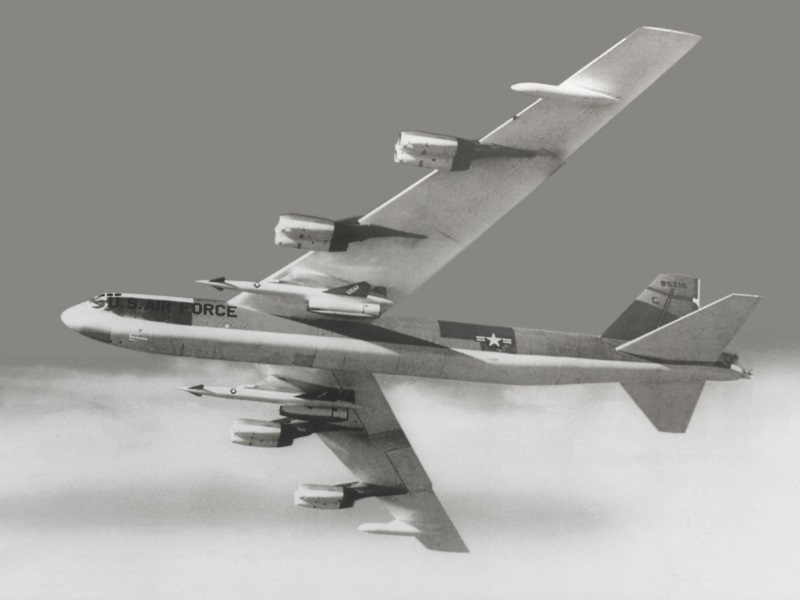
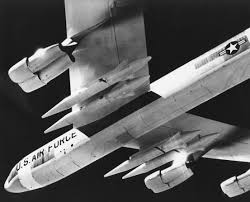
The United States Air Force expected that after the B-52, it would bring into service the North American B-70 Valkyrie supersonic bomber; therefore, the B-52G was intended to be the final production model. However, in practice, only two XB-70s were built, and they were used only as test aircraft. On the other hand, the Air Force was interested in the GAM-87 Skybolt air-launched ballistic missile, and for this reason awarded Boeing a contract to build the final B-52 variant, the B-52H, as a launch platform for Skybolt. The B-52H was to carry four Skybolts — two on each underwing pylon. However, the Skybolt project was canceled in December 1962, and the B-52H never operationally carried the missile.
Configuration and Aerodynamic Design of the B-52:
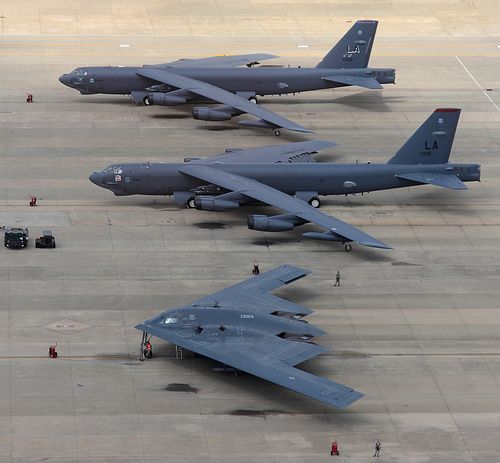
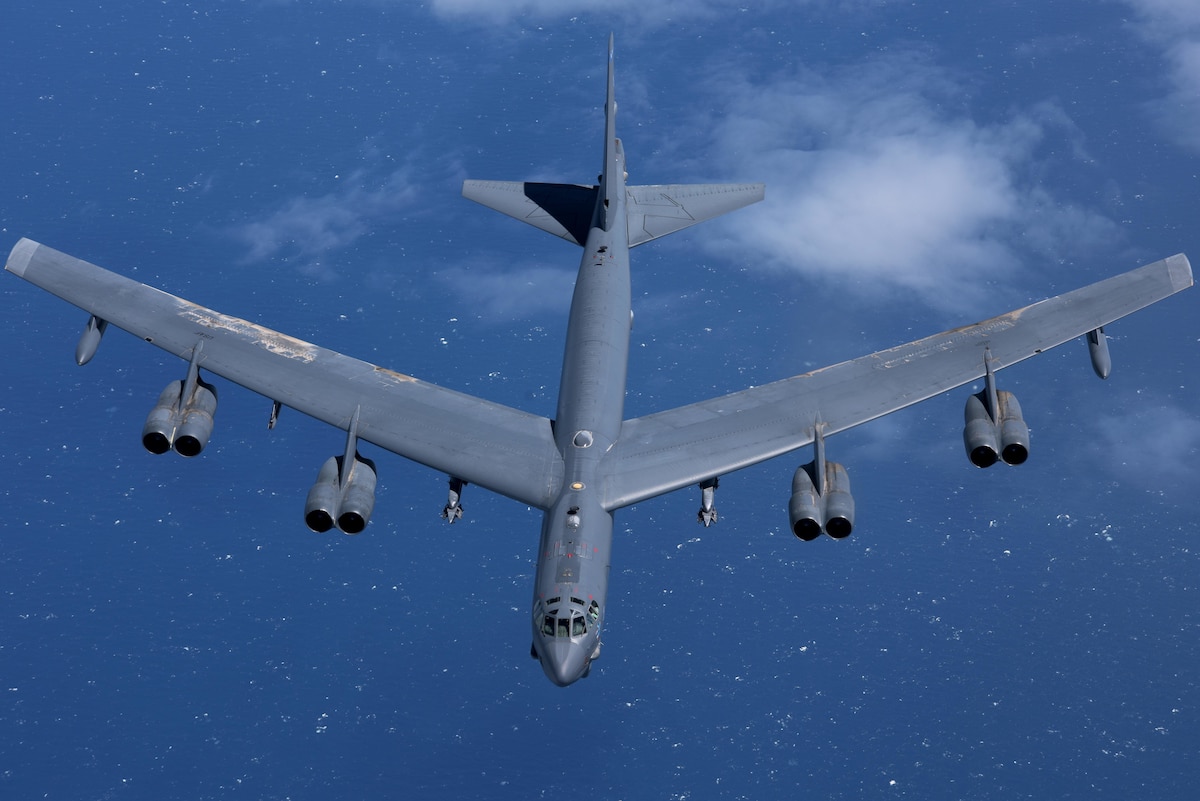
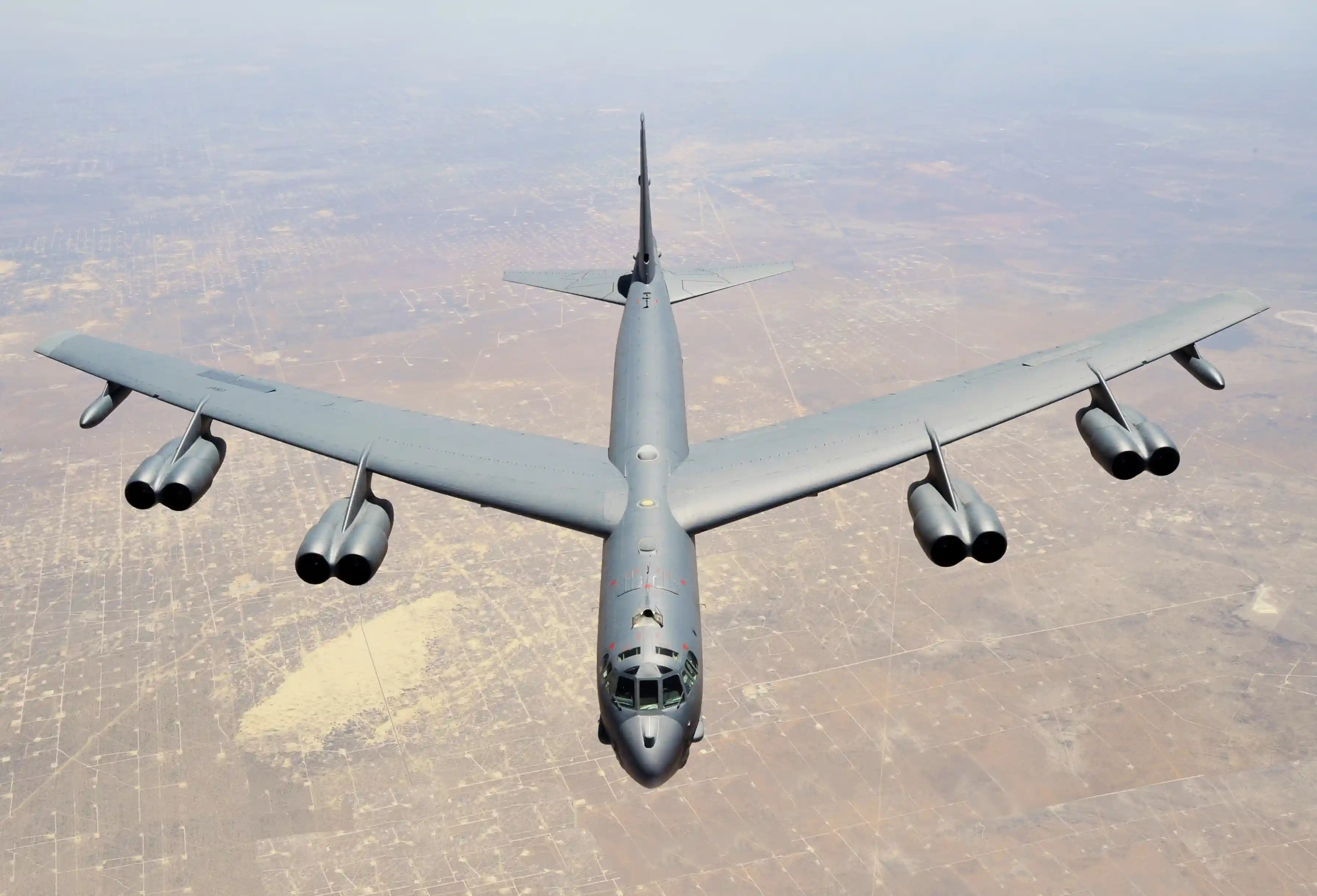
The defining design feature of the B-52 is its swept-back wings. This configuration offers several advantages, including improved performance at high speeds, reduced drag, and increased fuel efficiency. Furthermore, the swept-back wings play a critical role in enhancing the aircraft’s stability and maneuverability. Officially, the B-52’s service ceiling is recorded as 50,000 feet (15,000 meters); however, operational experience indicates that reaching this altitude presents considerable challenges when the aircraft is fully loaded with bombs.
According to various sources, the optimal altitude for a combat mission was around 43,000 feet (13,000 meters), since exceeding this height would quickly reduce the aircraft’s range. Therefore, during operations, the ability to achieve maximum range and altitude depended entirely on the skill and effort of the B-52’s crew. Taking all these factors into account, the B-52’s design incorporates high aspect ratio wings—meaning the wings are long and relatively narrow. This design increases lift and efficiency, allowing the carriage of heavy loads over long distances. Additionally, fuel tanks are housed inside the wings to extend the flight range.
Propulsion System of the B-52:
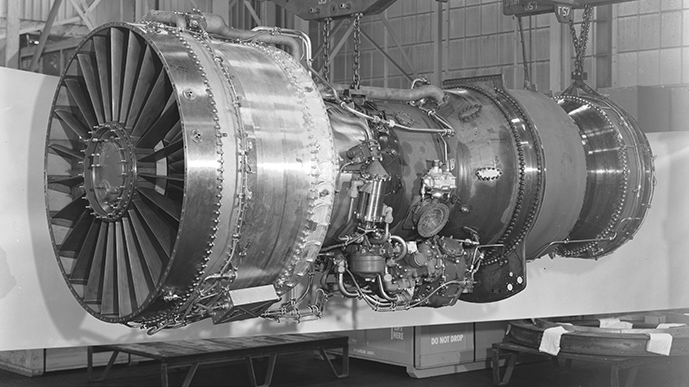
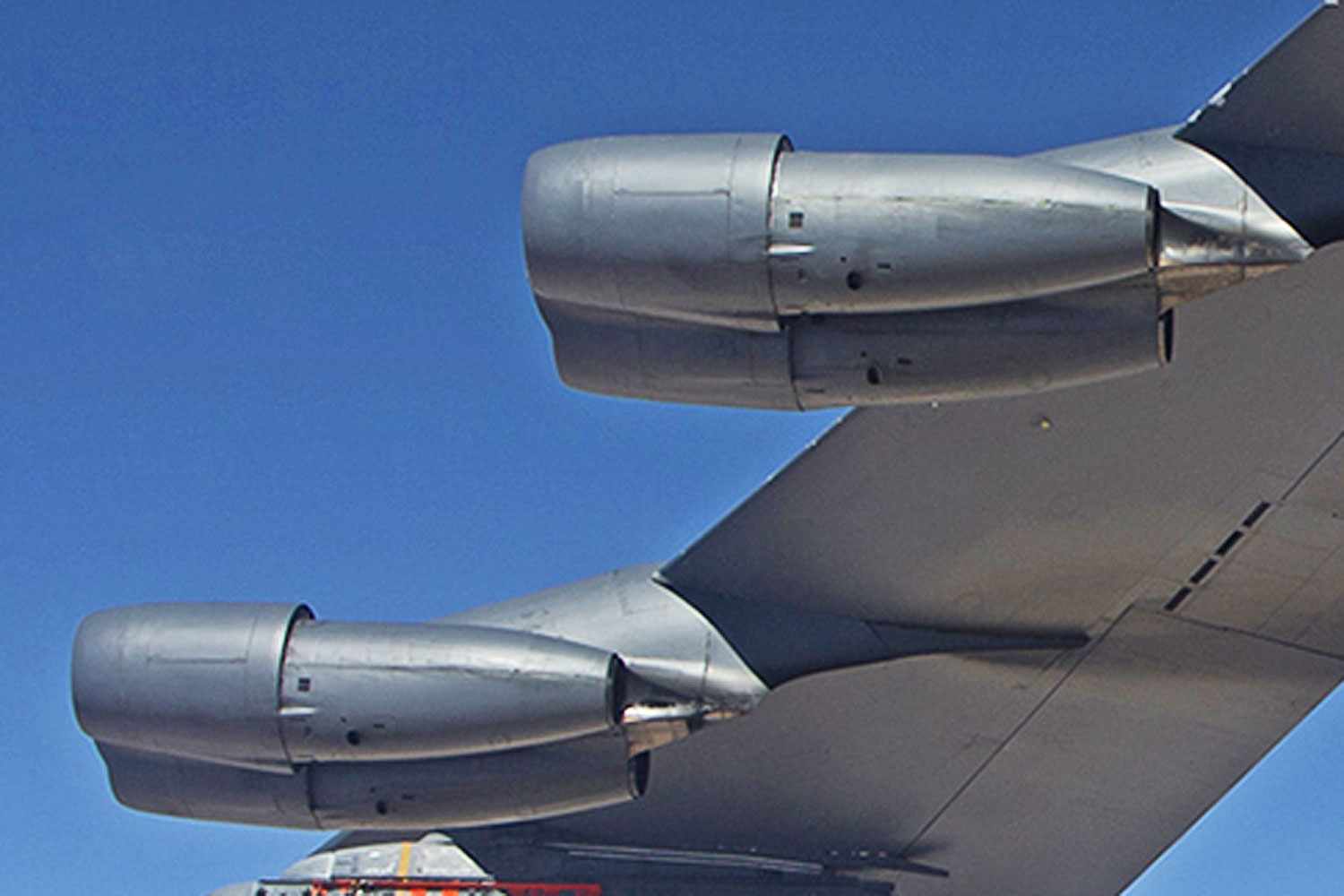
Starting in mid-1961, deliveries of the B-52H to the U.S. Air Force began—a version equipped with Pratt & Whitney TF33-P-3 turbofan engines featuring cleaner combustion and reduced noise, each producing 17,100 pounds of thrust. This redundancy allows the aircraft to continue flying even if some engines fail, enhancing its survivability on long-range missions. The engines are mounted in pairs beneath each wing. The B-52’s eight engines are housed in coupled nacelles and suspended from four pylons below and ahead of the wing’s leading edge.
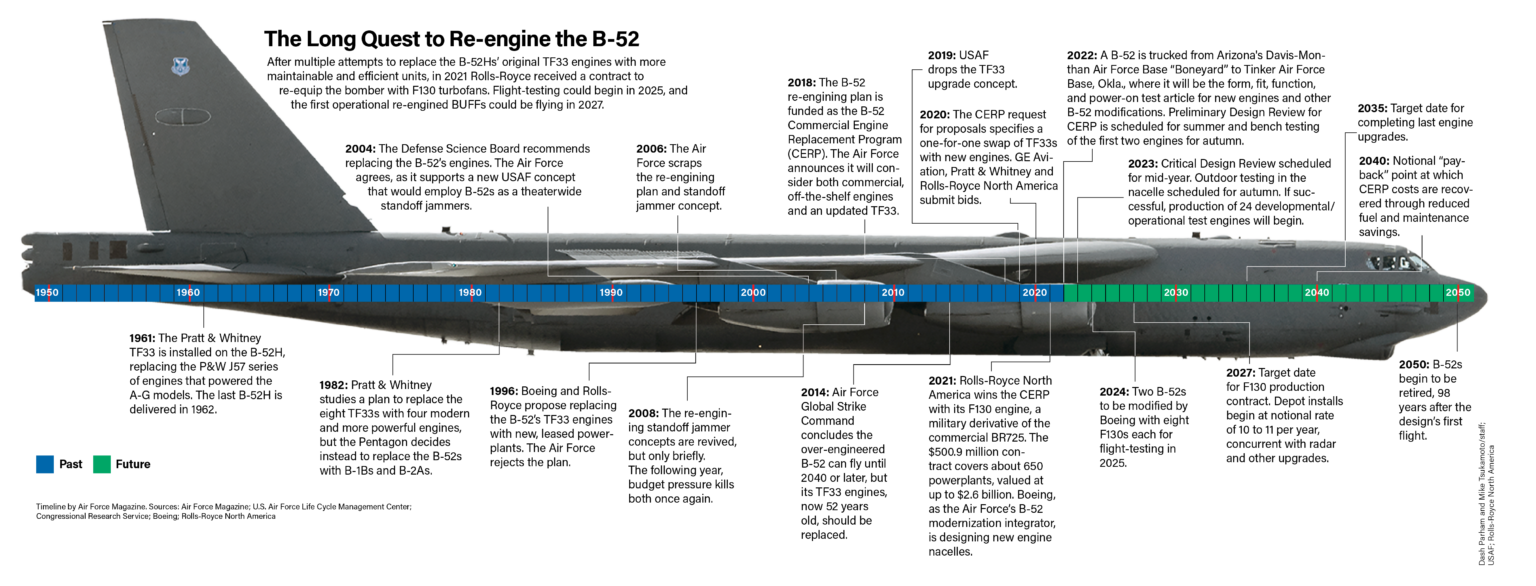
The engine upgrade program has been a major step in recent decades. On April 23, 2020, the U.S. Air Force issued a request for proposals to purchase 608 commercial engines along with spare parts and support equipment. Then, on September 24, 2021, the Air Force selected Rolls-Royce’s F130 engine as the winner, unveiling a procurement plan for 650 engines—including 608 direct replacements and 42 spares—at a total cost of $2.6 billion. Under this upgrade, B-52H aircraft equipped with Rolls-Royce F130 engines will be re-designated as the B-52J.

Avionics and Radar of the B-52:
Throughout its history, the B-52 has been continuously modernized, incorporating advanced avionics and radar systems that have dramatically enhanced its capabilities in navigation, communications, and precision strike missions. These upgrades have played a crucial role in maintaining the B-52’s effectiveness in contemporary combat.
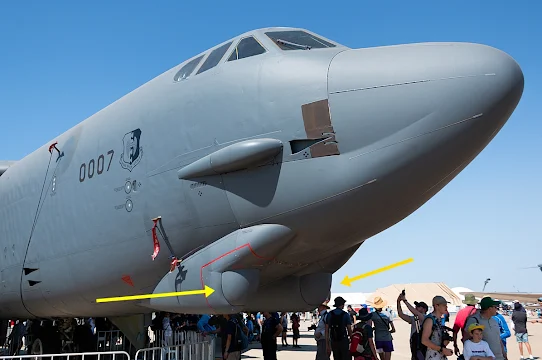
To improve the aircraft’s low-altitude performance, the AN/ASQ-151 Electro-Optical Viewing System (EVS) was installed between 1972 and 1976. This system included a Low-Light Level Television (LLLTV) camera and a Forward-Looking Infrared (FLIR) system, housed in fairings beneath the nose of the B-52G and B-52H.
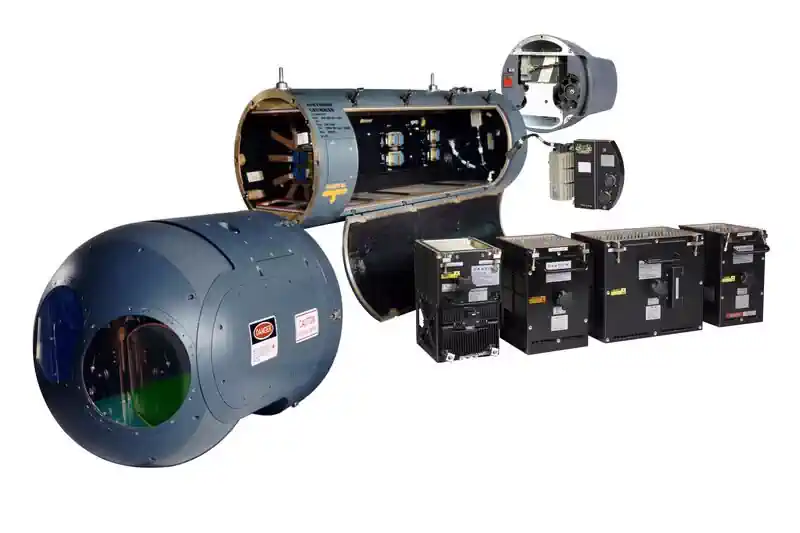
In the 1980s, GPS technology was added to the B-52 to enhance its navigation capabilities. Additionally, the IBM AP-101 was installed as the B-52’s main computer. In 2007, the installation of the LITENING targeting pod greatly improved the aircraft’s ground targeting ability, enabling the use of various munitions. This system included laser guidance, a high-resolution Forward-Looking Infrared (FLIR) sensor, and a CCD camera for target imaging.
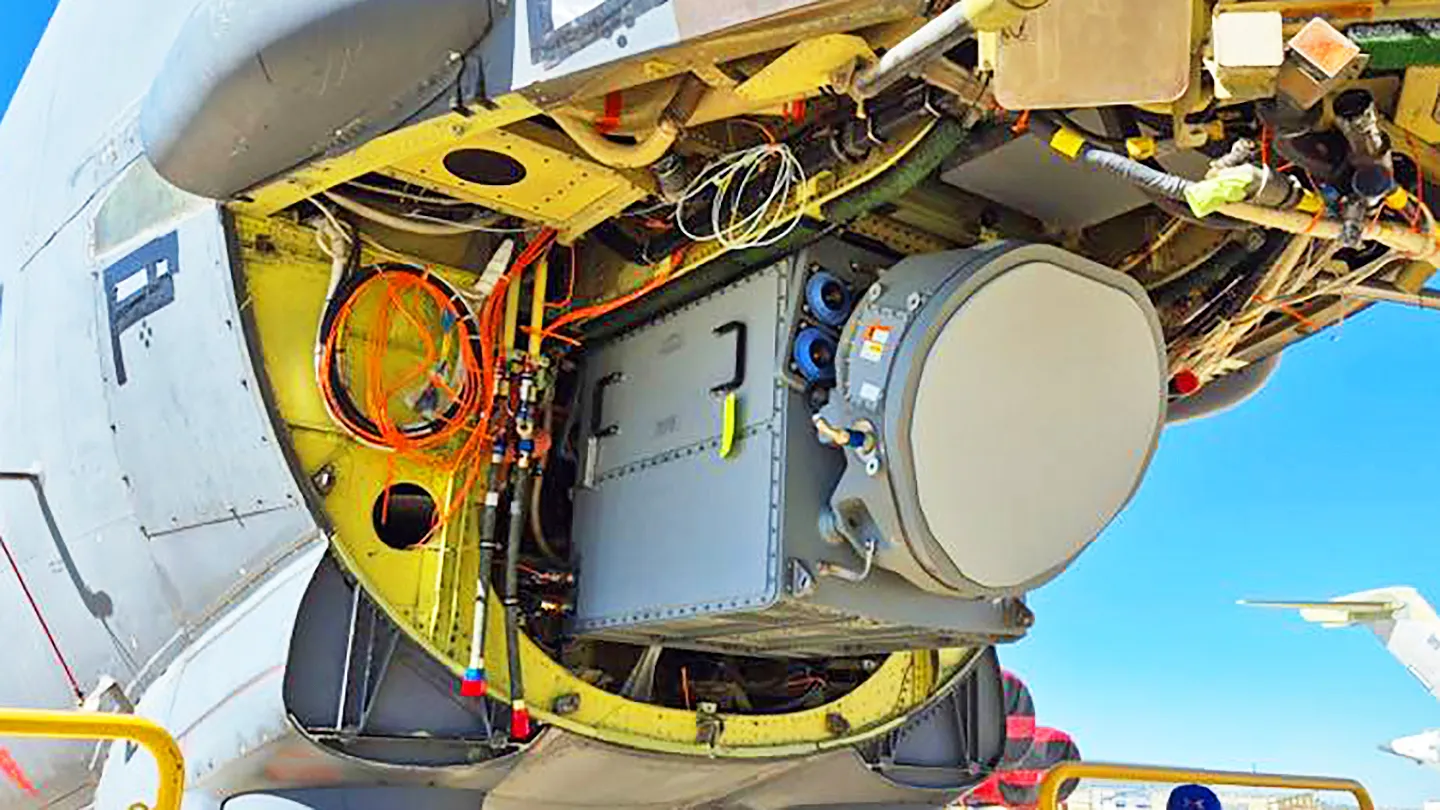
The B-52 is also now equipped with the advanced APG-79B4 Active Electronically Scanned Array radar, replacing its older mechanical arrays.
Armament of the B-52:
The B-52’s internal bomb bay has the capability to carry a wide range of nuclear and conventional munitions. This flexibility in carrying various types of weapons has made it a highly adaptable platform for diverse missions.
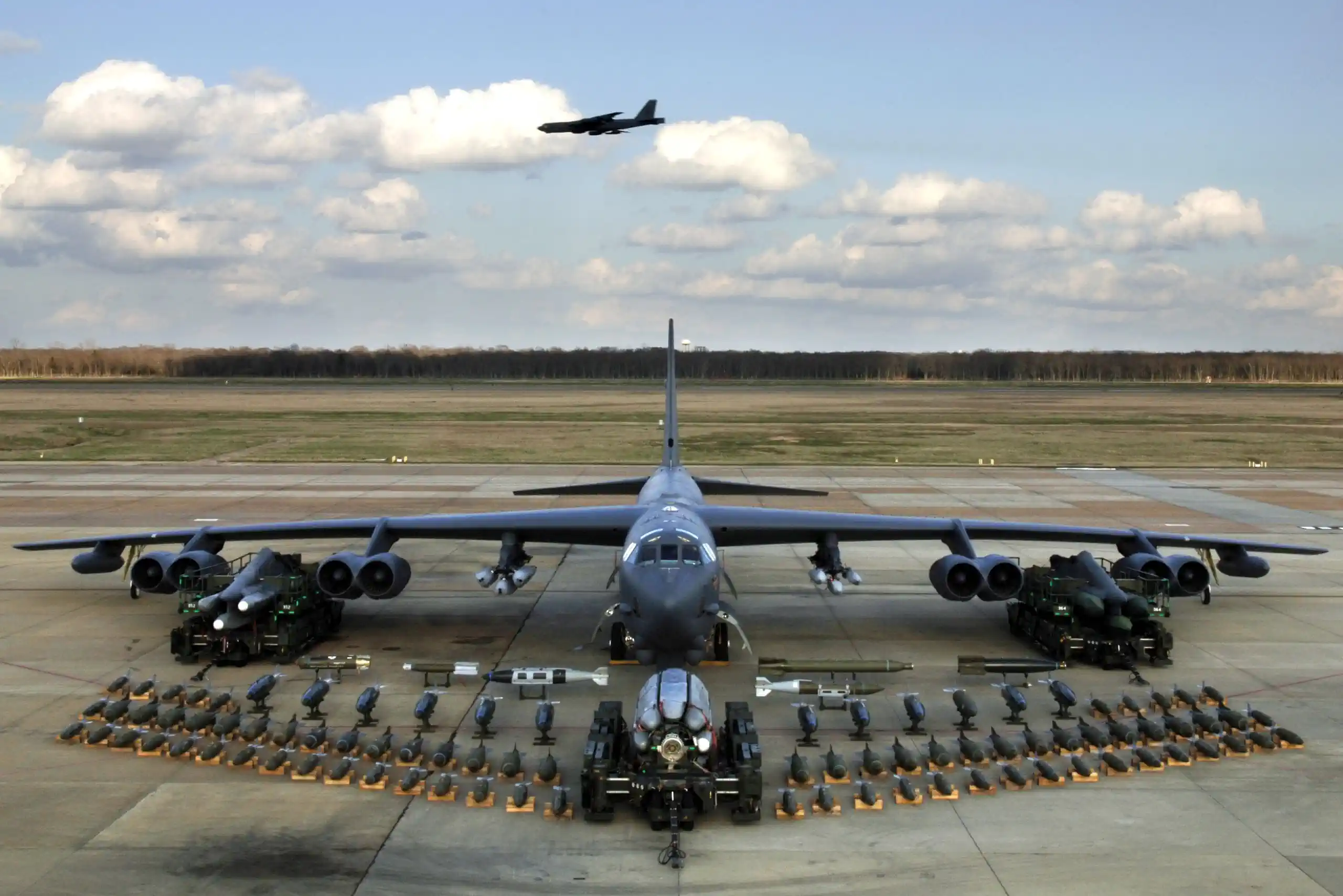
Since the 1980s, B-52H aircraft have undergone a series of modifications enabling the use of Harpoon missiles, a wide variety of cruise missiles, laser- and satellite-guided bombs, as well as unguided munitions. The Conventional Enhancement Modification (CEM) program also significantly improved the B-52H’s comprehensive conventional weapons capabilities. This program modified the underwing weapon pylons to resemble those of conventional-armed B-52G models, simplifying the integration of Harpoon and Popeye missiles.
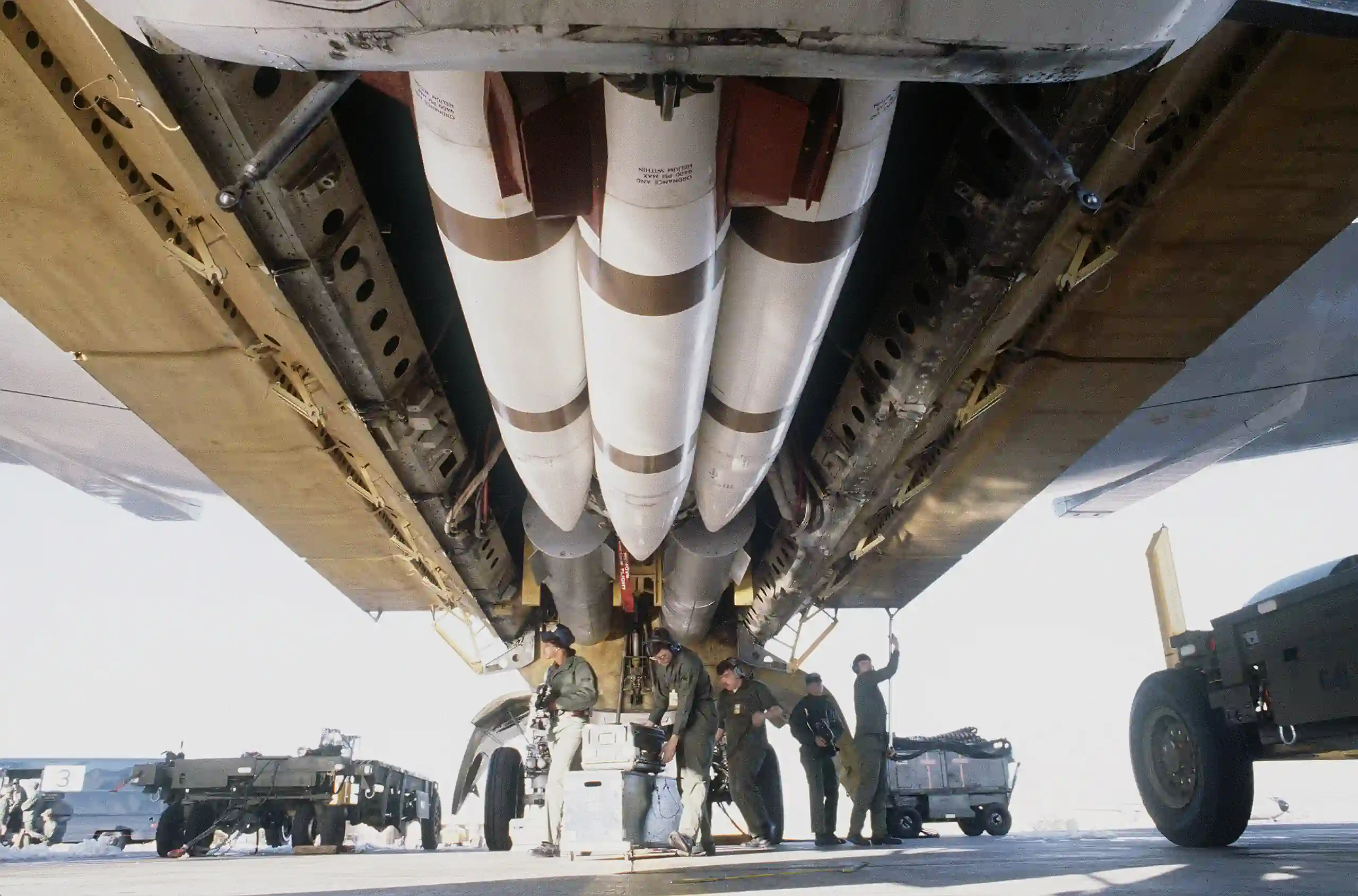
In the nuclear role, the aircraft can externally carry up to 12 AGM-86B ALCM nuclear cruise missiles while simultaneously housing an additional 8 cruise missiles or nuclear free-fall munitions in the internal bay. In upgraded versions, the ability to carry 12 AGM-158 JASSM missiles on external pylons has been provided, while the internal bay can also host 8 JASSM-ER missiles, MALD decoys, or MALD-J electronic warfare variants.
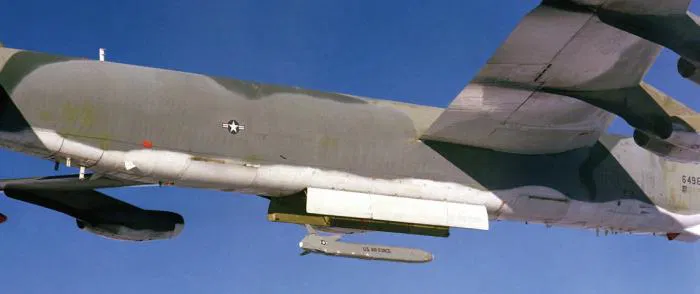
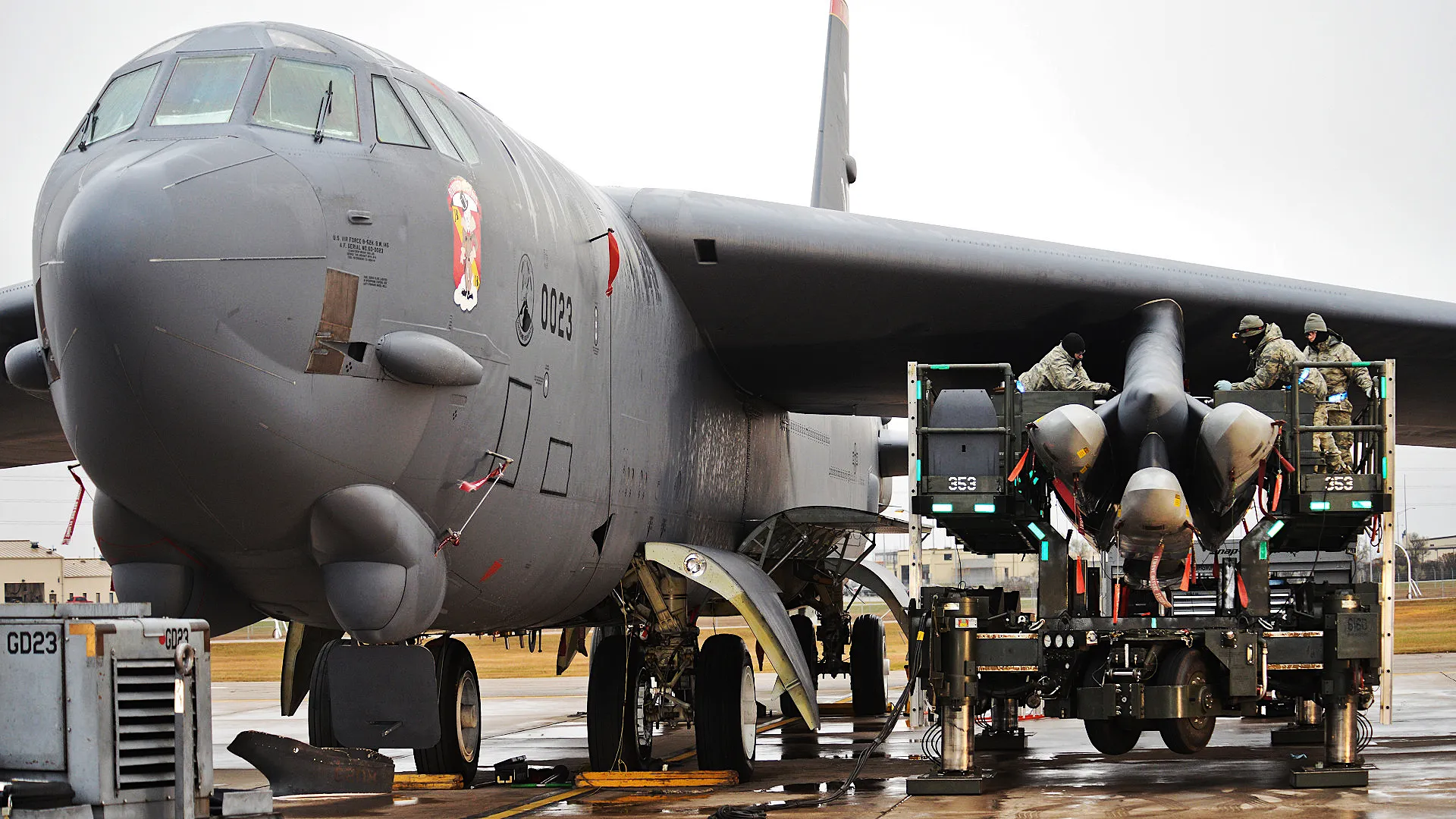
In the conventional armament domain, the B-52 is equipped with a wide range of air-launched munitions, including AGM-86C/D CALCM conventional cruise missiles, Mk 62 naval mines, Mk 82 and Mk 84 free-fall bombs, CBU-87 and CBU-89 cluster bombs, CBU-103, CBU-104, and CBU-105 WCMD guided munitions, GBU-31 and GBU-38 JDAM satellite-guided bombs, AGM-158A JASSM long-range cruise missiles, and GBU-10, GBU-12, and GBU-28 laser-guided bombs.
This diversity transforms the aircraft into a multi-role strategic platform capable of executing everything from nuclear deterrence to long-range conventional precision strikes within a single operational framework.
Operational History of the B-52:
The B-52A prototype made its first flight in 1954, and the B model entered service in 1955. A total of 744 B-52s were built, with the last one—a B-52H—delivered in October 1962.
The first B-52 bomber to officially enter operational service was an RB-52B, handed over to the 93rd Bomb Wing at Castle Air Force Base, California, on June 29, 1955.
On May 21, 1956, a B-52B flying from Eniwetok Island in the Pacific Ocean conducted the first airborne drop of an American hydrogen bomb during the CHEROKEE test. This marked the first time a B-52 had released an actual nuclear bomb. The weapon used was the Mark 15, nicknamed “Zombie,” with an explosive yield of nearly four megatons, dropped over Bikini Atoll. Due to a procedural error, the bomb detonated 30 seconds early, exposing the B-52 and other participating aircraft to the blast waves—yet they survived.
These aircraft continued conducting live nuclear drop tests until 1963, when the United States signed the Limited Test Ban Treaty, which prohibited atmospheric nuclear tests to reduce radioactive fallout into the environment.
On January 16, 1957, three B-52Bs under Project POWER FLITE completed an unrefueled around-the-world flight using aerial refueling, lasting 45 hours and 19 minutes. This historic mission marked the first non-stop circumnavigation by a jet aircraft.
The first of 102 B-52Hs was delivered to the Strategic Air Command in May 1961. The H model can carry up to 20 air-launched cruise missiles. Additionally, the B-52H has the capability to carry conventional cruise missiles—weapons that entered the operational scene starting in the 1990s with Operation Desert Storm and continued their path through Operation Inherent Resolve against ISIS in 2016.
The versatility of the B-52 was fully evident during Operation Desert Storm and NATO strikes against Yugoslavia. B-52s targeted large troop concentrations, fixed installations, and bunkers, severely degrading the morale of the Iraqi Republican Guard. On September 2–3, 1996, two B-52Hs struck Baghdad’s power and communication facilities with 13 AGM-86C missiles, an operation that was part of Operation Desert Strike and, at the time, the longest combat flight ever—a 34‑hour mission covering 16,000 miles round trip from Barksdale Air Force Base in Louisiana.
In 2001, the B-52 contributed to the success of Operation Enduring Freedom during the invasion of Afghanistan, providing close air support via precision-guided munitions while loitering high above the battlefield. The aircraft also played a role in the Second Gulf War, launching approximately 100 CALCM missiles in a single night mission on March 21, 2003.
In 2016, after a decade-long absence, the B-52 re-entered the U.S. Central Command’s area of responsibility. These aircraft conducted about 1,800 combat missions against ISIS forces in Syria and Iraq.
Currently, only the H model remains in the Air Force inventory, assigned to the 5th Bomb Wing at Minot Air Force Base, North Dakota, and the 2nd Bomb Wing at Barksdale Air Force Base, Louisiana, operating under the Air Force Global Strike Command. The aircraft is also assigned to the 307th Bomb Wing under the Air Force Reserve Command at Barksdale Air Force Base.
Future Path of the B-52:
The future regarding the complete retirement of the B-52 bomber remains uncertain, but under current planning, the aircraft will continue flying until 2055. If this goal is achieved, it will set an unprecedented record in military aviation history: one hundred years of continuous service.
On May 5, 2025, the U.S. Air Force officially launched the extensive and ambitious B-52J project as the most comprehensive modernization program in the history of the B-52 Stratofortress strategic bomber. This long-range, subsonic bomber, which has served on the front lines since the 1950s, is now slated—under the B-52J program—to upgrade all 76 remaining B-52Hs built in 1961 and 1962 to an entirely new standard, enabling the aircraft to maintain effective operational capability at least until the mid-2050s.
According to the announced schedule, the first flight of the B-52J prototype will take place around 2028, with initial operational capability targeted for 2033.
The core of this modernization program is replacing the aging Pratt & Whitney TF33 engines with modern Rolls-Royce F130 turbofan engines. Derived from the successful BR725 commercial engine family, this powerplant is being tested on the B-52 in a twin-pod configuration. Initial sea-level testing is underway at NASA’s Stennis Space Center, while high-altitude engine tests have been scheduled at the Arnold Engineering Development Complex. Rolls-Royce is set to manufacture more than 600 engines at its Indianapolis plant.
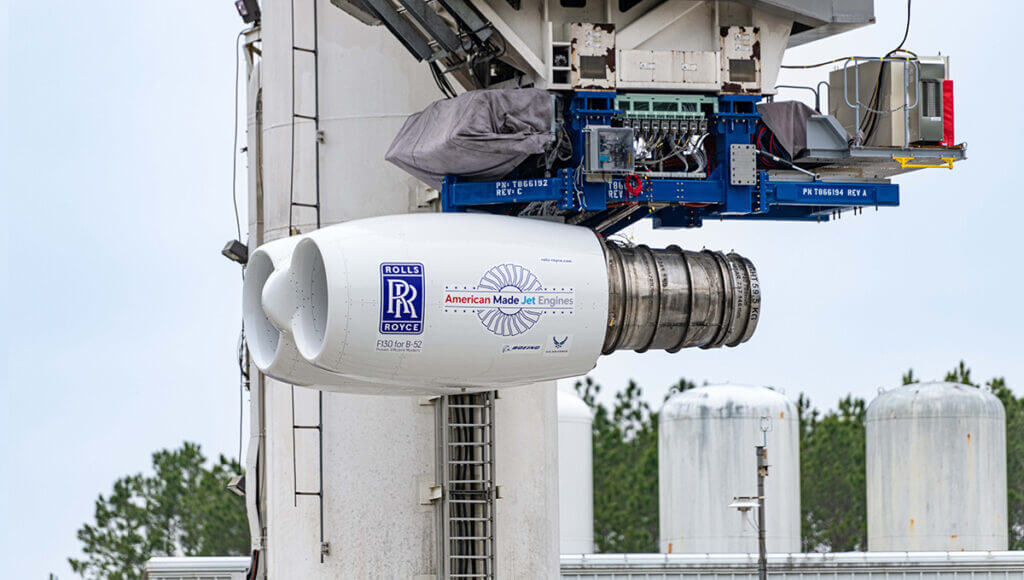
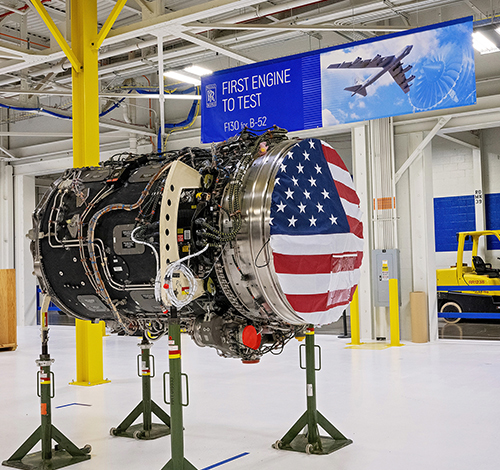
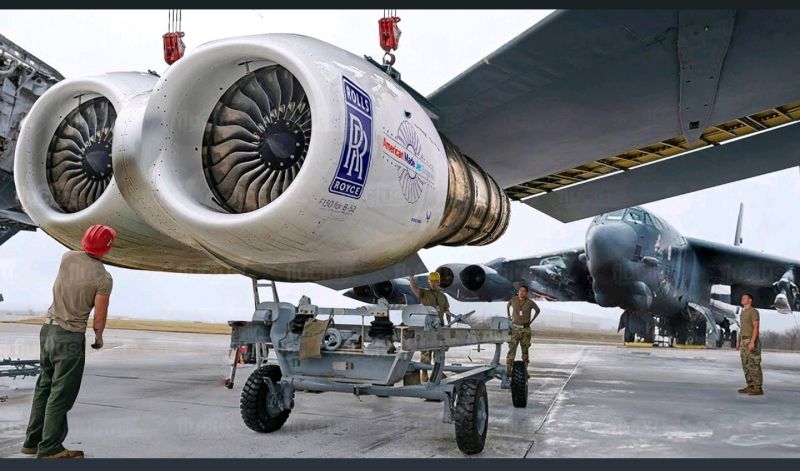
The F130 engine, with approximately 30% greater fuel efficiency, significantly increases the current range of about 8,800 nautical miles (14,080 km), drastically reduces maintenance costs, eliminates the need for heavy overhauls, dramatically improves reliability, and—most importantly—substantially lowers the operational stress on the aircraft’s sixty-plus-year-old airframes.
However, the modernization is not limited to the engines. Boeing is implementing a comprehensive set of structural and system changes in this project, including the following:
- Design and installation of new engine pylons
- Redesign and complete replacement of the aircraft’s internal wiring
- Installation of an entirely new digital core
- Advanced avionics suite
- Modern satellite navigation
- Updated communication tools including Link 16
- A fully digital cockpit with large displays and improved user interfaces
In the sensors domain, the advanced AN/APG-79 AESA radar—similar to that of the F/A-18E/F Super Hornet—will replace the old radar. This radar provides far superior search, ground mapping, precise targeting, and electronic warfare capabilities, while offering much improved situational awareness in threat environments.
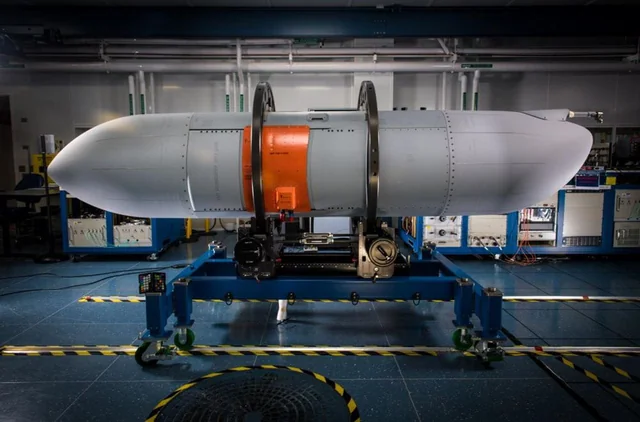
Alongside this, the integration of the advanced AN/ALQ-249(V)1 jammer significantly enhances the aircraft’s defensive capability against radars and guided missiles. With these changes, although the B-52J will never become a stealth platform, it will gain a much greater ability to conduct long-range operations in high-threat environments.
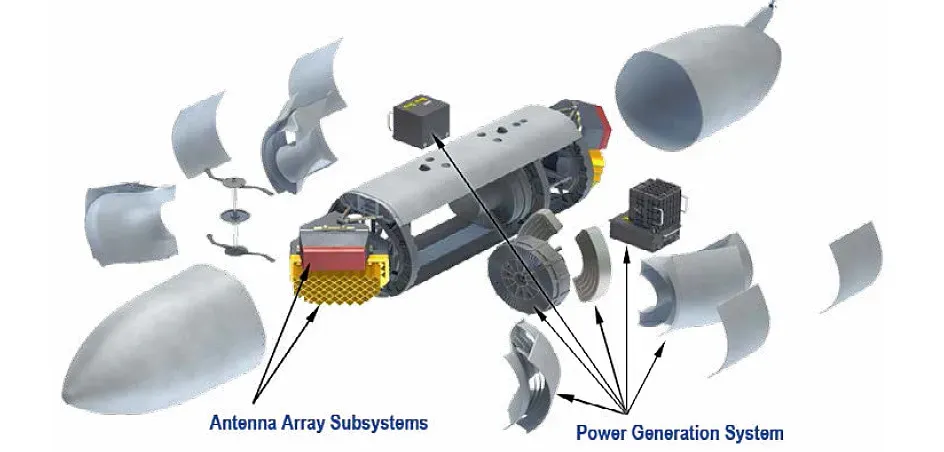
With a weapons payload capacity of 70,000 pounds (approximately 31,750 kg), the B-52J will remain the most diverse and heaviest ordnance-carrying option among the U.S. Air Force’s strategic bombers.
This bomber is also preparing for the era of hypersonic weapons. Following the cancellation of the AGM-183 ARRW program, the main focus has shifted to the Hypersonic Attack Cruise Missile (HACM)—a scramjet-powered missile expected to reach operational capability by the end of fiscal year 2027. At the same time, dedicated carriage racks for mounting multiple hypersonic missiles on a single mission are being developed.
On a longer-term horizon, the B-52J will likely also be capable of launching and directing Collaborative Combat Aircraft (CCA) drones, thereby expanding its role from a mere bomber to a multi-role command-and-control platform in future aerial battles.
The total program cost is estimated at approximately $2.56 billion—a figure that has drawn criticism from some quarters, who argue that these resources would be better directed toward greater production of the B-21 Raider or other next-generation platforms. However, given that the total number of B-21s will ultimately be just over 100, a dual mix of stealth and non-stealth bombers will still be necessary for decades to come. In this equation, the B-52J will serve as a powerful, more cost-effective, and highly flexible complement alongside the B-21, maintaining its key role in America’s strategic deterrence for a long time to come.
Specifications of the B-52 Stratofortress Bomber:
Role: Long-range strategic bomber
Origin: United States
Manufacturer: Boeing
Entry into service: 1955
Crew: 5
Length: 48.5 m
Wingspan: 56.4 m
Height: 12.4 m
Engines: 8 × Pratt & Whitney TF33-P-3/103 turbofan engines
Combat range: 14,200 km
Ferry range: 16,327 km
Speed: 1,050 km/h
Service ceiling: 15,000 m
Empty weight: ~ 83 tonnes
Takeoff weight: ~ 220 tonnes
Payload: over 31 tonnes
Armament:
1 × 20 mm M61 Vulcan cannon
Free-fall bombs
Precision-guided bombs (JDAM)
Cruise missiles (AGM‑86 / AGM‑158)
Nuclear weapons


More images of the B-52 bomber:
Comments