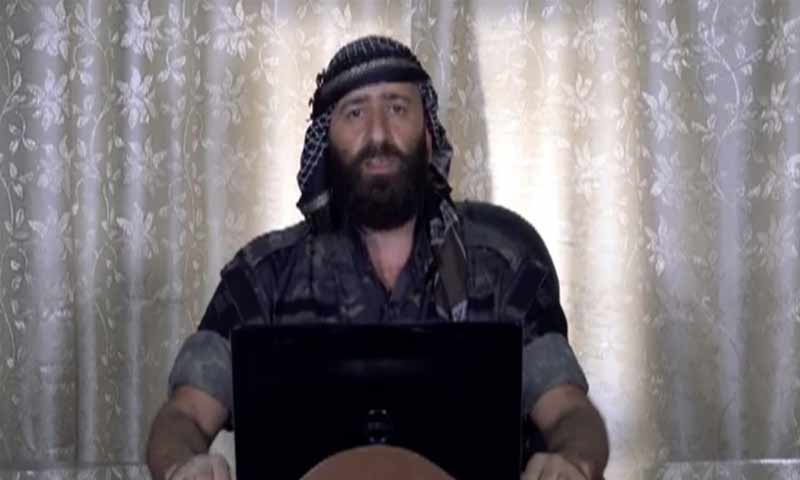
Ahmed al-Audeh announced the formation of a new army in south of Syria in a funeral ceremony on June 23, following the killing of a number of the Fifth corps (former militants) members, by a roadside bomb. He said: “Soon, Houran will have one body and one army. This is not just for the defense of Houran, but rather it will be the most powerful tool for defending Syria.”
These strange remarks are said in the situation while the Fifth Corps is a part of the Syrian Army, and the southern parts of Syria is completely under the control of the Syrian Army, and speaking about the formation of a new army can be considered as a rebellion.
But what is Ahmed al-Audeh military background?
Al-Audeh started his military activity as a Syrian opposition figure and lost three of his brothers during the years of fighting against the Syrian government. Although, he changed his stances against the militant groups several times and finally, joined to the Syrian army.
His most prominent stance changing was when he fired the Syrian Army forces from his hometown Busra al-Shaam town on Marcc 2015, as commander of Shabab Ahl al-Sunnah group Jibhat with help of al-Nusra and the al-Muthanna movement. But later he turned against Jibhat al-Nusrah and al-Muthanna and expelled them from the town.
Also, Ahmed al-Audeh was succeeded to strengthen and stabilize his position in south of Syria, by connecting with the “MOC” room. Military Operations Center “MOC” is a commanding headquarter in Amman, capital of Jordan, that was established in 2013 and 2014 by the US, France, Britain, Jordan and some of Persian Gulf states, such as the United Arab Emirates, for planning and managing the armed groups in Syria and specially in south of Syria.
In 2016, a coup took place among al-Audeh affiliated armed groups and his armaments and heavy weapons were controlled by his opponents and he escaped to outside of Basra al-Shaam. But with the support of the Southern Front militants, he returned and took the Basra al-Shaam under his control again.
His return had not so much stability and in 2017, a clash was started between the two main groups in the eastern region of Daraa, Shabab al-Sunnah and al-Yarmouk, that was leading by Bashar al-Za’bi and led to heavy casualties for the both sides.
After the Syrian army took the regions of al-Lajah and Busr al-Harir under its control and approached to Busr al-Shaam region during its large-scale operation for liberating the south of Syria in mid of 2018, the negotiations were started with Ahmed al-Audeh in Busra al-Shaam city and under supervision of Russian deligation; and finally, after the Syrian army entering to Busra al-Shaam, the peace agreement was reached with Ahmed al-Audeh. According to the agreement, the Syrian army entered the southern cities and regions, and the armed groups accepted the government control on the southern regions of Syria. Al-Audeh also surrendered his heavy weapons to the army and joined the Fifth Corps that is under supervision of Russia and the Syrian army command handed him the commanding of the Fifth Corps in the southern region.
It’s worth mentioning that Ahmed al-Audeh that has a degree in English literature, has always acted as a mediator between the oppositions and the Syrian army, after joining the Fifth Corps of the Syrian army; and in various times, when the tensions have been increased between Syrian army and compromise regions, he has entered and calm the situation down.
I’d like to thank readers for their confidence and support. Thanks to your support we can continue to perform our duty on reporting the important events in the region. So If you like our contents, please don’t feel embarrassed to contribute and help our project, for as little as 1 Dollar. Your contribution, however small, will help ensure our project continuity. Thank you.
The most important changes in the past 78 days are as follows :
South of Syria
The most important changes in battlefield of Syria in the past 78 days is indeed, complete liberation of south of Syria from terrorists of different groups.
Daraa province and specially Daraa city was considered the symbol of revolution by militia; where the evolution started and sparked a war that continued for seven years so far. The complete reclaim of Daraa and Quneitra provinces in south of Syria means an end or at least near end of this war.
It is good to know that more than 20 different terrorist groups occupied southern part of Syria during this seven years and each of these groups were connected to a tyrant of the Middle East or neighboring states such as Jordan or Zionist Occupiers and were supported by military or intelligence.
“ISIS, al Nusrah Front, Jaish al Islam, Jaish Yarmouk, Jaish al Hur, Ahrar al Sham, Liwa al `Izz, Syrian Revolutionaries Front, al-Harrah Martyrs’ Brigades Front, Um al Ousaj Martyrs’ Brigades, Kafr Shams Fidayiah Brigades, Mujahidi Samlin, Al-Nasser Salah al-Deen Brigades, Bani Umayya Brigades, Ababil Houran, Ahrar Jasem, Nazehin Brigades, Yarmouk Martyrs, Jaish al Hurr(Ashaer), Daraa Martyrs’ Brigades, Jaish al Awwal, Sabtin Brigades, Forsan al Golan” are names of main groups, who were active in Daraa and Quneitra provinces and purging these groups was Syrian Government’s top priority to reclaim its soil.
However Syrian and Russian artillery and warplanes attacked rebels’ positions in the region from several days before, ground advances starts on 22 June.
Lajat region reclaimed in only four days from rebels and different militant groups in south of Syria accused each other of betrayal and agreement with the government.
On the other hand, USA and Jordan after negotiation with Russia, stopped supporting terrorists of southern lands and claimed that they do not support them against Syrian Army’s operation.
Militia of south of Syria who were once relying on their western lords and allies, received the answer of their trust and were left alone by the same supporters that convinced more groups to negotiate and surrender.
Syrian Army and allies conducted military operation and negotiation at the same time. With more advances in Daraa province, militia’s defense broke and more villages demanded to negotiate and reject rebels.
Maybe before the start of the operation in south of Syria, no one could imagine that Daraa would be liberated by negotiations; but as the siege became tighter, militia present in southern part of city had no choice other than surrendering and evacuating the city.
Therefore, by national reconciliations in Daraa province, with entrance of Syrian Army to militia inhabited of Daraa and raising Syrian flag in Daraa al- Balad neighborhood, Daraa city is liberated from rebels after seven years.
In between, the important reclaimed regions by reconciliations are Busr al Sham, Ibta`, Dael, Tafas, Nawa, Jasem, Inkhil, Kafr Shams, Harrah.
Liberation of important and strategic height of Harrah was the key to enter occupied lands in Quneitra province for Syrian Army. Tal al Harrah and the radar base on it is the most important height in west of Daraa province which has overlook on Quneitra and Houran plains and also parts of occupied Golan.
Militia knowing the importance, resisted more in this region that others but eventually after several days of heavy fire on the height, militia were forced to retreat from Tal al Harrah.
With liberation of Tal al Harrah, way is paved for Syrian Army and militia present in Quneitra province by accepting the agreement and surrendering, put their weapon down and evacuated Quneitra province.
After that, the story of militia in south of Syria was practically over and now Syrian Army is focusing on the last occupied region in southwest of Daraa province, the lands occupied by ISIS.
Although Syrian oppositions and many others counted on ISIS to confront Syrian Army, but ISIS terrorists like other militants were defeated very soon.
Unlike predictions, ISIS defense line in southwest of Daraa province and Tasil town collapsed very quickly and Syrian Army and its allies could force terrorists to retreat from strategic height Jamou` and Tasil town due to fear being surrounded by using correct tactics and attacking from all aspects.
Syrian Army could clean Yarmouk Basin from ISIS completely in 12 days.
So all the southern part of Syria was liberated by Syrian Army and allies in 41 days from 22 June to 1 August.
It is noteworthy that due to reconciliations, during eight stages, about 10 thousand militia and their families transported from Daraa and Quneitra provinces to north of Syria and Idlib province.
Evolution of liberating Daraa and Quneitra provinces during a 41 days period
Another change in battlefield is the increase in ISIS cores’ activities in deserts of Suwayda and Damascus.
As mentioned earlier, these areas were reclaimed by Syrian Army before but during the agreement with ISIS to evacuate Yarmouk Camp in Damascus and transporting them to deserts of east of Suwayda, it seems that the Army’s previous claim regarding clearing these lands was not accurate or those lands were not cleared and stabilized properly or at least after the operation ISIS could infiltrate there.
In any case, the operation to clear the deserts of east of Suwayda has begun and it is expected these lands be clear once forever from ISIS terrorists.
Northwest of Syria
According to the agreement between Iran, Russia and Turkey, towns Fuah and Kafraya in Idlib province during a three days period from 18 to 20 June were evacuated completely.
The population of xxx and xxx before Syrian war was about 40 thousand people and during the siege in March 2015, with occupation of Idlib city by militia of xxx group, the population reduced to 25 thousand.
During these years, oppressed inhabitants of Fuah and Kafraya were hit by terrorist sharpshooters and occasional bombing by them. According to the census released by central media of Hezbullah, abour 1,900 of inhabitants during bombing by terrorists are martyred and more than 3,500 wounded.
During these three years, the towns were attacked several times and in one of them, terrorists of Jaish al Fath and Jund al Aqsa used 11 suicide bombing cars to break the defense lines but every time they were defeated by high defense of towns.
Evacuation of Fuah and Kafraya is important in terms of:
First, after significant achievements of the Army in south of Syria, enemy’s activities increased around the towns and there were rumors of retaliation attacks to the towns.
Second, Syrian Army’s next operation will be in Idlib province and the presence of people under siege in Fuah and Kafraya could be a weak point for Syrian Army and Moghawemat, so the evacuation had to be done as soon as possible.
It is noteworthy that during the last step of evacuation about 6,800 of inhabitants evacuated.
The most important change in east of Syria is vast advances of Syrian Democratic Force (SDF) in southeast deserts of Hasakah province and east of Deir Ezzor province.
The second stage of operation “Island Storm” started officially on 4 June with support of US Coalition in east of Syria against ISIS.
Regions between southeast of Hasakah and east of Deir Ezzor due to uneven terrain are safe place for ISIS terrorists; however, SDF with intelligence and military support of Iraqi forces and US Coalition, could detect key positions of terrorists and capture them thus force them to retreat step by step.
Finally in 4 August, SDF in a statement claim to clear all the deserts of east of Deir al Zur and the border with Iraq from ISIS terrorists.