Tag: Israel

  • A Ceasefire In Southern Lebanon Appears Imminent

    A Ceasefire In Southern Lebanon Appears Imminent

    Amos Hochstein, the U.S. President’s special envoy to Lebanon, proposed a ceasefire plan that was approved by Hezbollah last week and announced to Lebanese government officials. Hochstein then traveled to Tel Aviv to brief Israeli officials on the proposal.

    The Israeli cabinet is currently reviewing the ceasefire plan, with meetings to discuss the proposal starting this afternoon. The cabinet will vote to either approve or reject the plan, and Israel’s response to the ceasefire proposal is expected to be announced in Prime Minister Netanyahu’s upcoming speech.

    The Lebanese government will also hold a meeting tomorrow morning to approve the ceasefire agreement.

    The details of the agreement have yet to be disclosed, but recent discussions have centered around a 60-day, phased agreement that could be expanded in future rounds. Key topics in the negotiations have included:

    1- Israel has demanded freedom of action in Lebanon, citing the ineffectiveness of Resolution 1701 in securing the northern borders. The Lebanese side, however, rejected this demand during discussions with Hochstein, considering it a violation of Resolution 1701. This point was the main source of contention in the negotiations.

    2- Lebanon has requested the international community to establish a permanent land border along the Blue Line in southern Lebanon to prevent contact between Lebanese and Israeli forces. Lebanese officials have voiced concerns about deploying multinational forces for the ceasefire monitoring mission in Lebanon, preferring the presence of forces from an Arab country. On the other hand, Israel favors the deployment of forces from Western countries, and some progress has been made with the involvement of French and Italian forces.

    3- The return of Lebanese refugees is contingent upon Israel’s withdrawal from Lebanese territory. Israel, however, does not accept this clause, arguing it lacks meaning without the return of displaced Zionists to settlements in northern occupied Palestine. Consequently, Israel has requested to remain in Lebanese territory for 60 days following the ceasefire’s implementation to ensure the peace process, a condition opposed by the Lebanese side. Nonetheless, Zionist media claim that Lebanon has agreed to this clause.

    4- The release of Lebanese prisoners has been a significant topic of discussion. If Israel does not agree to release them, it could lead to the abduction of Israeli soldiers and a resurgence of conflict.

    Although Hezbollah and Hamas leaders back the ceasefire agreement in southern Lebanon and northern occupied Palestine (Israel), there is discontent in both Lebanon and Palestine. Opponents, referencing Sayyed Hassan Nasrallah, argue that any ceasefire in Lebanon should also include a ceasefire in the Gaza Strip.

    In Israel, Internal Security Minister Itamar Ben-Gvir and Finance Minister Bezalel Smotrich have been vocal in their opposition to the ceasefire agreement. However, it seems that the majority of the Israeli cabinet members are leaning towards voting in favor of the ceasefire plan.

    Hezbollah utilized all its resources to support the Gaza Strip during the 14-month conflict with the Zionist regime, significantly engaging Israel’s military forces and alleviating pressure on Gaza. Despite these efforts, the war persisted. Resistance axis leaders believe that extending the conflict in southern Lebanon under the present conditions is not advisable. They view a ceasefire on this front as a beneficial move for the entire resistance axis.

  • UAE And Israel To Establish Milirary Base In Northern Somalia

    UAE And Israel To Establish Milirary Base In Northern Somalia

    Reports indicate that the United Arab Emirates has successfully negotiated and reached an agreement with Somaliland authorities to build a port and an airport in the coastal city of Berbera. Additionally, they plan to establish a military base in the region. The UAE is set to invest $440 million in this project, and the Berbera military base will be under their control.

    Given Yemen’s support for Palestinian resistance against the Zionist regime, it is likely that the Berbera base will be used for military operations against Yemen. The base’s location could facilitate airstrikes against Yemen by Israel.

    The UAE-Israel military cooperation against Yemen is expanding, as they have previously established several military and intelligence bases in the Socotra archipelago before Somaliland.

    Click to view full size
  • Iraq Calls For International Pressure On Israel To Prevent Israeli Aggression

    Iraq Calls For International Pressure On Israel To Prevent Israeli Aggression

    Following Washington’s warning to Baghdad on the imminent possibility of the Israeli regime’s military attacks on Iraq in response to the retaliatory actions of resistance groups in this Arab country, Prime Minister of Iraq Mohammed Shia’ Al-Sudani issued a decree, calling on Iraqi security forces to increase the level of their readiness.

    Al-Sudani has instructed the Iraqi armed forces and all security organizations to prevent any military activities outside the framework of the army’s regulations.

    In recent days, the Ministry of Foreign Affairs of the Republic of Iraq also sent letters to the United Nations Security Council, UN Secretary-General Antonio Guterres, the Arab League, and the Organization of Islamic Cooperation (OIC) to urge them to put pressure on the Israeli regime concerning its potential attacks on Iraq.

    The attacks by the Islamic Resistance in Iraq (an umbrella group of anti-terror fighters) against the Israeli regime’s military and security positions have been suspended since November 21. It appears that senior Iraqi government officials, with the mediation of commanders and figures close to the Resistance Axis, have convinced Iraqi resistance fighters to suspend or reduce retaliatory strikes on the Israeli regime, at least for a short period.

  • Israeli Military Attacks Border Crossing Between Syria, Lebanon

    Israeli Military Attacks Border Crossing Between Syria, Lebanon

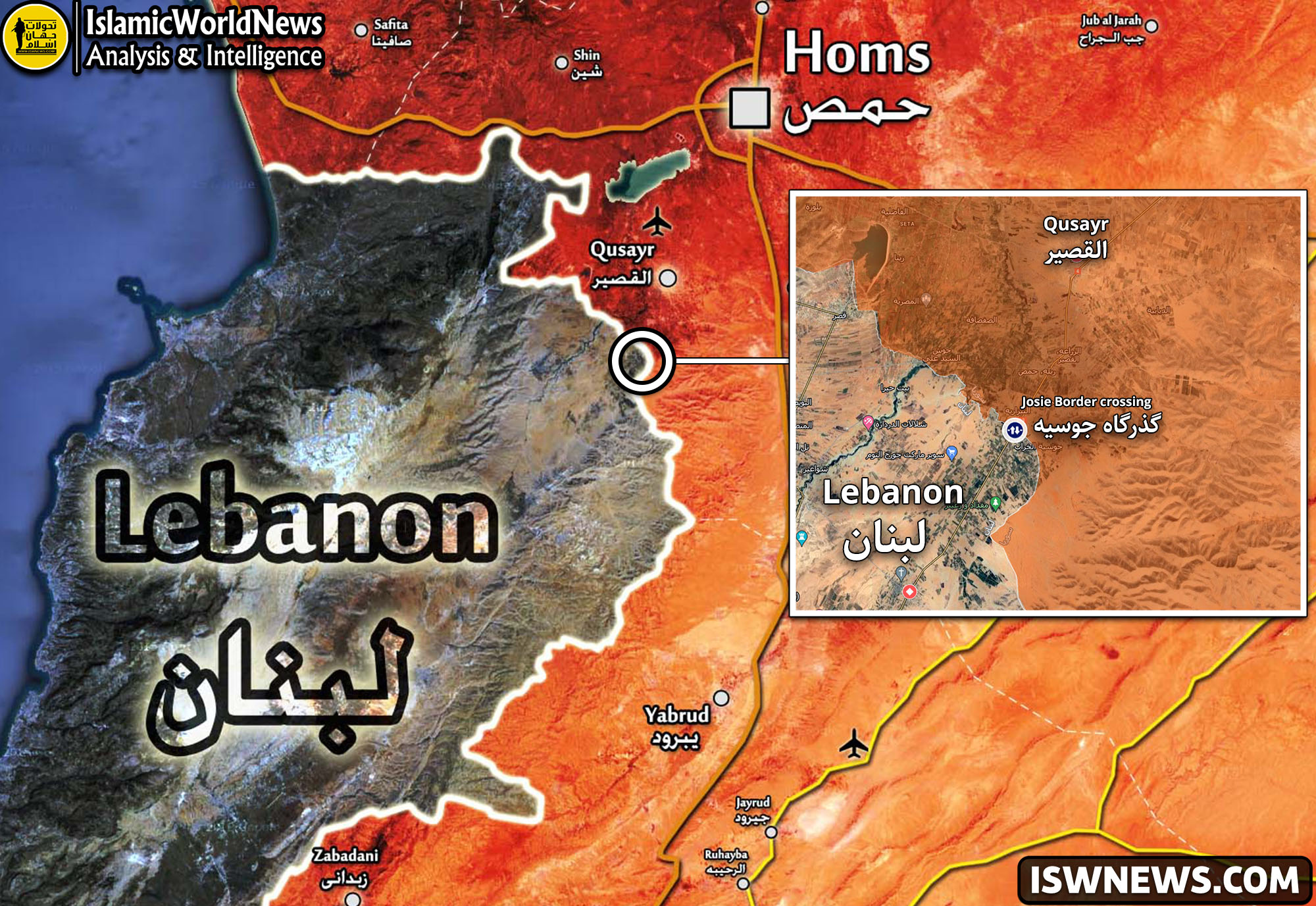
    The air strike did not result in any casualties in that area.

    Ali Hamiyeh, Minister of Public Works and Transport in Lebanon, stated that some targets were hit by the airstrike of the Israeli regime’s army in the Jusiyah al-Amar border crossing in Syrian territory.

    In recent years, the Israeli regime’s army has repeatedly violated Syria’s territorial integrity with airstrikes. Most of the Israeli regime’s illegal strikes in the past year, allegedly aimed at assassinating senior resistance commanders and destroying Syrian army’s facilities and ammunition depots. During these strikes, hundreds of civilians and SAA servicemen were martyred and injured.

    Following the onset of Operation Al-Aqsa Storm by the Palestinian resistance movement Hamas, Israeli airstrikes against various regions in Syria, especially Damascus and Homs governorates, have increased.

  • Israeli Military Abducts A Syrian Shepherd!

    Israeli Military Abducts A Syrian Shepherd!

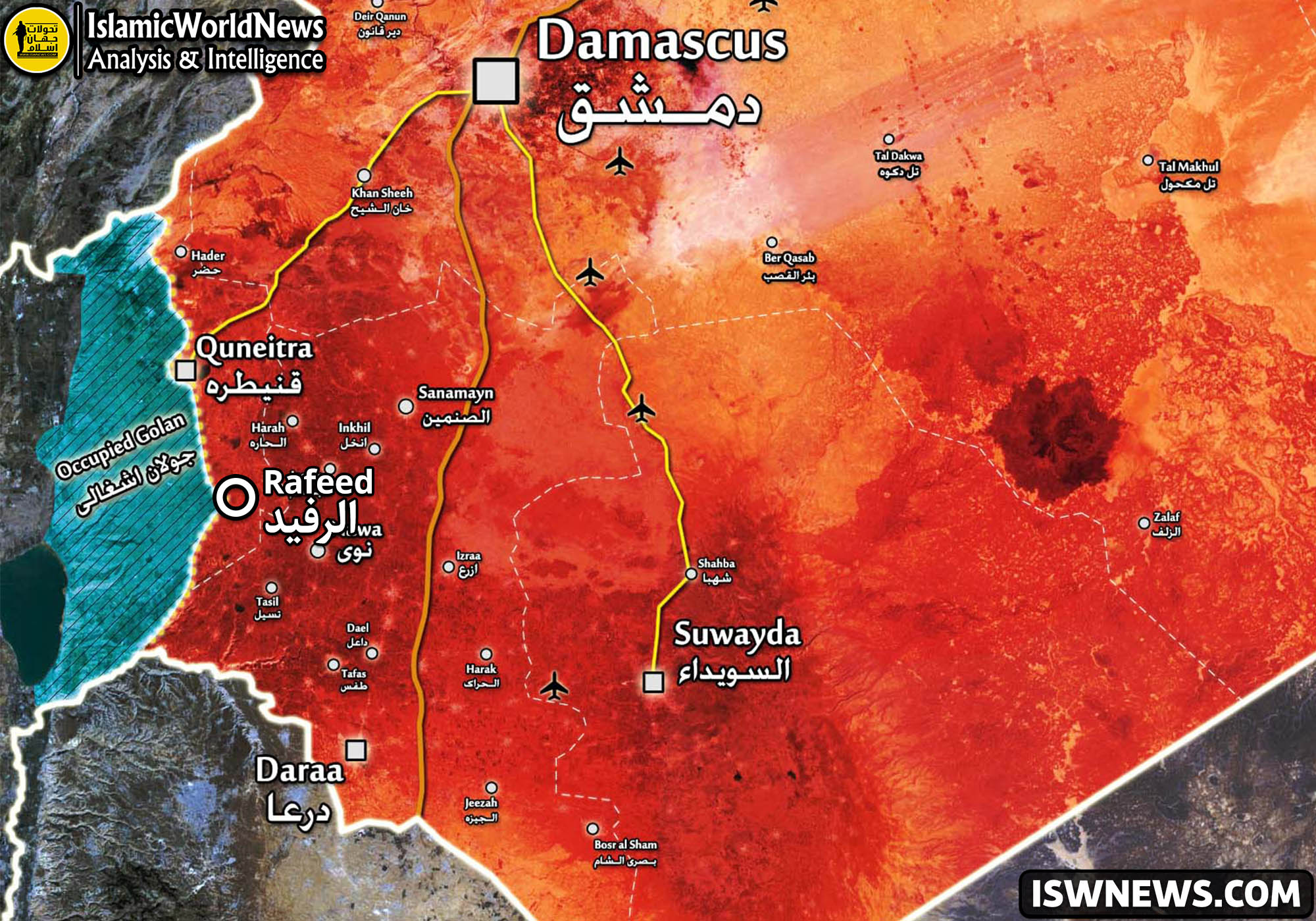
    On November 21, the Israeli regime’s forces entered the village of Al Rafeed in southern al-Quneitra and detained a civilian from the southern region of Syria.

    Local sources reported that the civilian, named Mahmoud Hilal Al-Fenish, is a resident of Al Rafeed village. He was engaged in shepherding in the village when he was abducted by Israeli military forces.

    Al Rafeed village is located in the buffer zone between the Alpha and Bravo lines, which separates Syrian forces in the Golan Heights from the Israeli military. The Alpha Line and the Bravo Line were set in the Israeli-Syrian Agreement on Disengagement in 1974 to separate the two warring sides.

    As of now, the Israeli regime’s army has not issued a statement regarding this abduction, and Syrian authorities have also not reacted to the news.

    It is noteworthy that on November 3, the regime’s army announced that commandos from the Egoz Unit of the 210th Brigade had abducted a Syrian named Ali Suleiman Al-Assi in southern Syria on charges of connections with Iran.

    New satellite images indicate that the Israeli regime’s army has begun a construction project along the Alpha line, which separates the occupied Golan Heights from Syria.

    These actions, alongside the abduction of Syrian citizens, indicate a significant intensification of Israeli military activities in the occupied Golan Hights region and border areas compared to the past, which is remarkable.

  • Latest Updates On Southern Lebanon (Map)

    Latest Updates On Southern Lebanon (Map)

    Latest updates on Naqoura front:
    After taking control of the villages of Shamaa, Tayrharfa, and Ulama al-Shaab, Israeli forces have concentrated their attacks on the town of al-Naqoura and al-Bayyada.

    The current Israeli ground offensive is being conducted along three main axes: towards al-Bayyada and Majdal Zoun, in the Jejim area, and east of al-Naqoura. Additionally, the Italian UNIFIL forces reported that two rockets struck their base in Shamaa, resulting in injuries to four Italian soldiers.

    Naqoura front

    Latest updates on Khiam front:
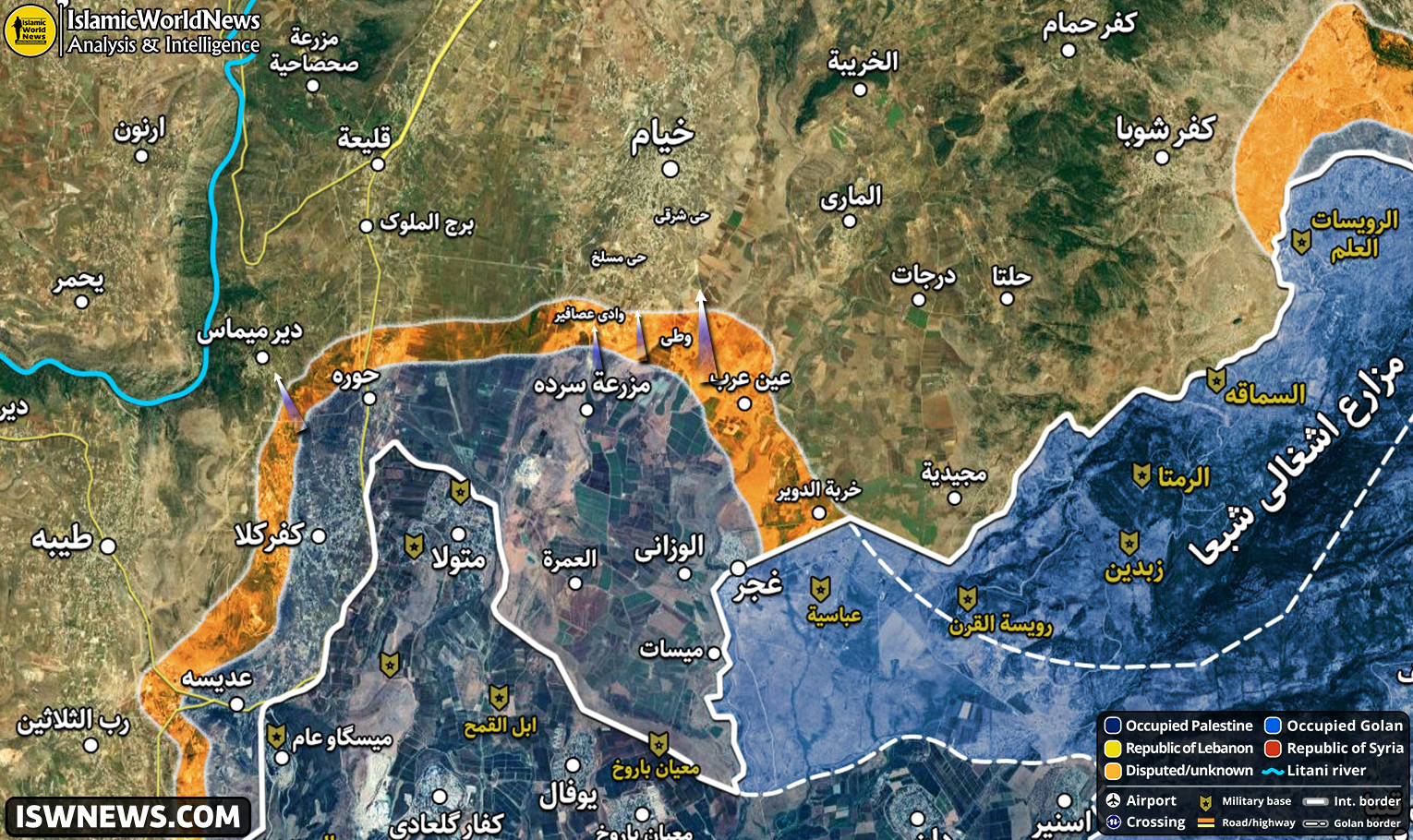
    Israeli forces have entered the southern and eastern neighborhoods of Khiam, where heavy fighting is ongoing.

    After bombarding the Al-Khardali road, which connects Marjayoun and Nabatieh, Israeli forces moved into the Christian village of Deir Mimas without encountering resistance and established a checkpoint in the area.

    In an incident involving a convoy from UNIFIL and the Lebanese army, Israel allowed only UNIFIL forces to use the road, forcing the Lebanese army to return to Nabatieh.

    Additionally, Israeli artillery is heavily shelling residential areas in the villages of Arnoun and Yohmor, located to the northwest and west of Deir Mimas.

    Khiam front

    The Israeli army’s invasion of Lebanon intensified after the assassination of Hezbollah’s Secretary-General, Sayyed Hassan Nasrallah. Since October 1, ground operations have been underway along the southern borders.

    These assaults have so far resulted in the martyrdom of 3,670 Lebanese civilians and injuries to 15,413 others, as well as the martyrdom of over 500 Hezbollah fighters. On the other side, over 100 Israeli troops have been killed in Hezbollah’s retaliatory strikes in northern occupied Palestine.

  • 86 Syrians Murdered By Israel Strikes In Tadmur

    86 Syrians Murdered By Israel Strikes In Tadmur

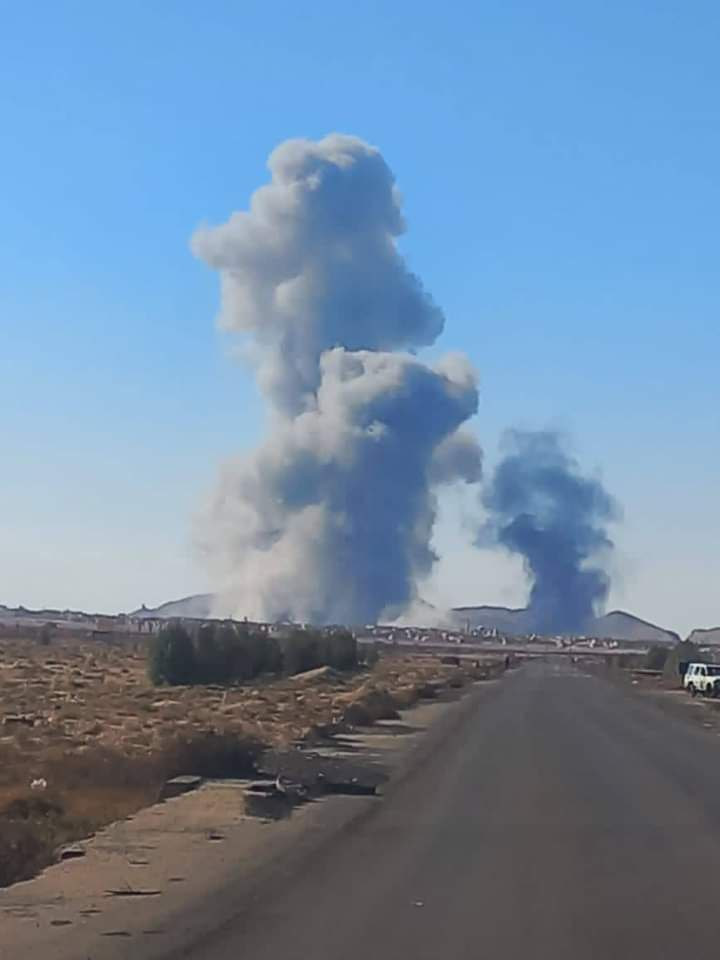
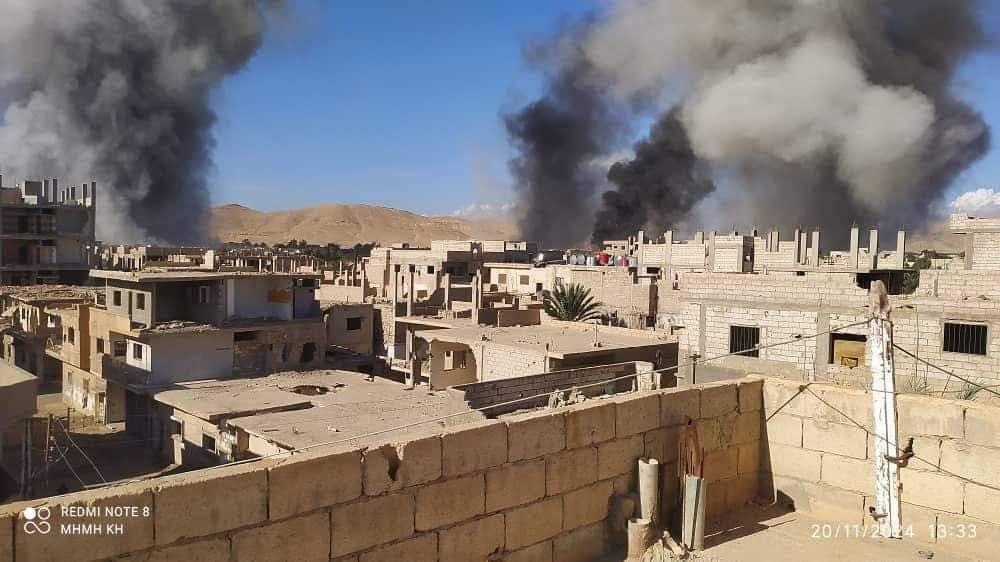
    A Syrian military source said, “at around 13:30 (local time) on Wednesday, the Israeli regime targeted a number of residential buildings in the city of Tadmur from the Al-Tanf area. This attack resulted in the martyrdom of 36 people, the injury of more than 50 others and the occurrence of material damages.”

    Investigations show that the Israeli fighter jets fired several missiles towards Palmyra by flying over the Jordanian sky and using the airspace of the US-occupied Al-Tanf region.

    In the past, the Zionist regime had repeatedly used the US-occupied area in al-Tanf to attack Syria and the axis of resistance.

    Israeli strikes in Tadmur

    The al-Tanf region in the southeast of Syria has been occupied by American forces for years, and the Syrian army and resistance forces are not allowed to approach the 55-kilometer radius of this area.

    Al-Tanf Base; Joint Headquarters of Terrorists!

    In recent years, the Israeli regime’s army has repeatedly violated Syria’s territorial integrity with airstrikes. Most of the Israeli regime’s illegal strikes in the past year, allegedly aimed at assassinating senior resistance commanders and destroying Syrian army’s facilities and ammunition depots. During these strikes, hundreds of civilians and SAA servicemen were martyred and injured.

    Following the onset of Operation Al-Aqsa Storm by the Palestinian resistance movement Hamas, Israeli airstrikes against various regions in Syria, especially Damascus and Homs governorates, have increased.

  • Israel Urges United Nations Security Council To Put Pressure On Baghdad; Will Tel Aviv Take Direct Action Against Iraq?

    Israel Urges United Nations Security Council To Put Pressure On Baghdad; Will Tel Aviv Take Direct Action Against Iraq?

    On November 18, the Israeli foreign minister asked the UN Security Council to exert pressure on the government in Baghdad to stop the strikes by the Islamic Resistance in Iraq, an umbrella group of anti-terror combatants, against the Israeli regime’s positions.

    Sa’ar claimed: “This evening I sent a letter to the president of the UN Security Council in which I called for immediate action regarding the activity of the pro-Iranian militias in Iraq, whose territory is being used to attack Israel.”

    He added that Iraq “is responsible under international law to prevent the use of its territory as a base for attacks against other nations.”

    Israel would take “all necessary measures to protect itself and its citizens,” the minister warned.

    Simultaneously with the sending of the Israeli foreign minister’s letter to the UN Security Council, the Hebrew newspaper Maariv alleged that the Israeli regime has prepared a new plan to strike at the groups supported by the Islamic Republic of Iran in Iraq, including the assassination of leaders and attacks on their infrastructure and facilities of the resistance groups.

    This Israeli newspaper claimed: This plan will be implemented if attacks from Iraq against Israel escalate. Tel Aviv has sent clear messages, and the Iraqi government is trying to de-escalate tensions.

    Iraqi resistance groups have carried out hundreds of rocket and drone attacks against the Israeli regime and their supporting forces, namely the US terrorist forces (CENTCOM) in Iraq and Syria, after the onset of Operation of Al-Aqsa Storm on October 7, aimed at supporting the resistance in Palestine and Lebanon and also increasing pressure on the Tel Aviv regime.

    In response to the attacks of the Iraqi resistance, the axis of evil (Israel and its supporters) carried out multiple attacks against the positions and forces of the resistance in Syria and Iraq, in which several Iraqi fighters were martyred. Some of these attacks were carried out by the terrorist US army in Iraq, and others by the Israeli regime’s army in the Israeli-occupied Golan Hights of Syria against Iraqi resistance groups.

    The Islamic Resistance in Iraq, along with other resistance groups in Lebanon and Yemen, is calling for an end to the Israeli regime’s aggression against the Gaza Strip and for international aid to be sent to the besieged area. Iraqis and other members of the resistance axis have stated that as long as the Israeli regime’s aggressions against the Gaza Strip continue, missile and drone attacks against the Tel Aviv regime will persist.

    Given the ongoing actions and daily attacks of the Iraqi resistance against the Israeli regime, it is likely that the regime’s army, with the support of the terrorist US army in Iraq, Syria, and Jordan, will arrange a series of military actions including simultaneous airstrikes against the positions and the assassination of commanders of the Iraqi resistance groups; therefore, it is necessary for the Iraqi resistance to carry out targeted attacks against the Israeli regime, while issuing a serious warning, to remind this regime that any action against Iraq and the commanders of the resistance will face a crushing response.

  • Israel’s Operations In Northern Gaza; Clashes Continue In Beit Lahia, Jabalia (Map)

    Israel’s Operations In Northern Gaza; Clashes Continue In Beit Lahia, Jabalia (Map)

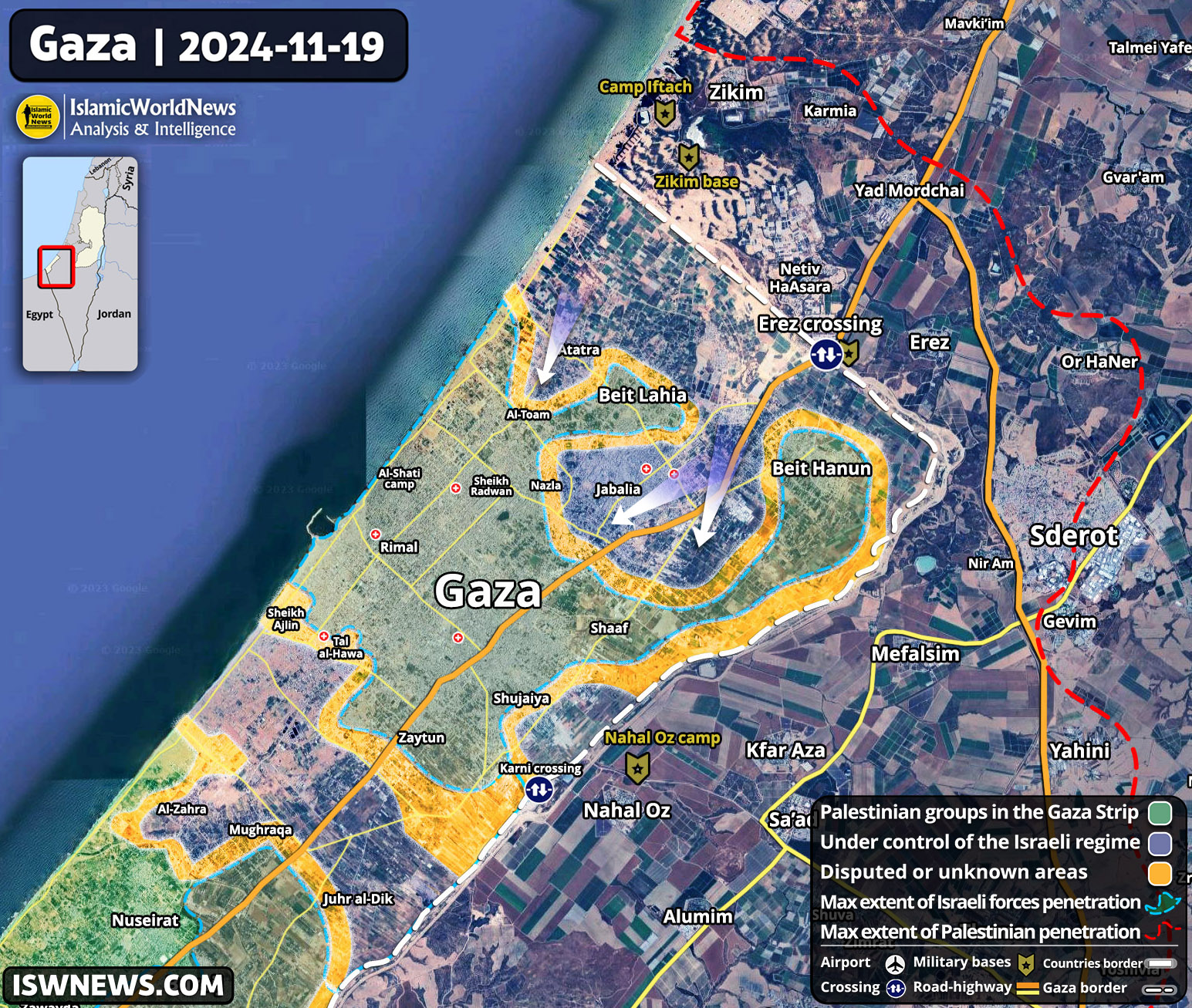
    The Israeli regime’s army has begun a series of operations in northern Gaza following a new announcement for operations in these areas since October.

    The Israeli regime’s troops, supported by artillery and under heavy air attacks, have begun their advances towards some areas in northern Gaza and in the first step of the operation occupied Kamal Adwan Hospital and its surrounding areas.

    The Israeli army has Gradually expanded the scope of its military operations and dispatched its forces to the southern and eastern areas of the city of Jabalia. Advancing in the mentioned fronts, Israeli military forces have exploded and completely destroyed Palestinian homes with the aim of forcibly relocating them to the central and southern Gaza Strip. After the presence of Israeli troops in the south and east of Jabalia, the Israeli regime’s army focused on the western and northwestern areas of Jabalia. 

    Videos released by the Izz al-Din Al-Qassam Brigades, the military wing of the Palestinian resistance movement Hamas, show that clashes are currently taking place around Al-Saftawi Square and Al-Bahr Street in eastern Jabalia.

    Latest military situation in the northern Gaza Strip – click to view full size

    In recent days, Al-Qassam fighters targeted several Israeli army personnel, bulldozers, and tanks in the western fronts of Jabalia. Videos of some of these operations have also been released.

    In the Beit Lahia front, clashes continue in the eastern and northern fronts. Over the past four days, Al-Qassam forces have targeted at least 11 Israeli troops, 2 Merkava tanks, one armored personnel carrier, and one bulldozer of the Israeli regime’s army in the outskirts of Beit Lahia. The Israeli military is trying to clear the path for ground forces to advance in this front through heavy air attacks.

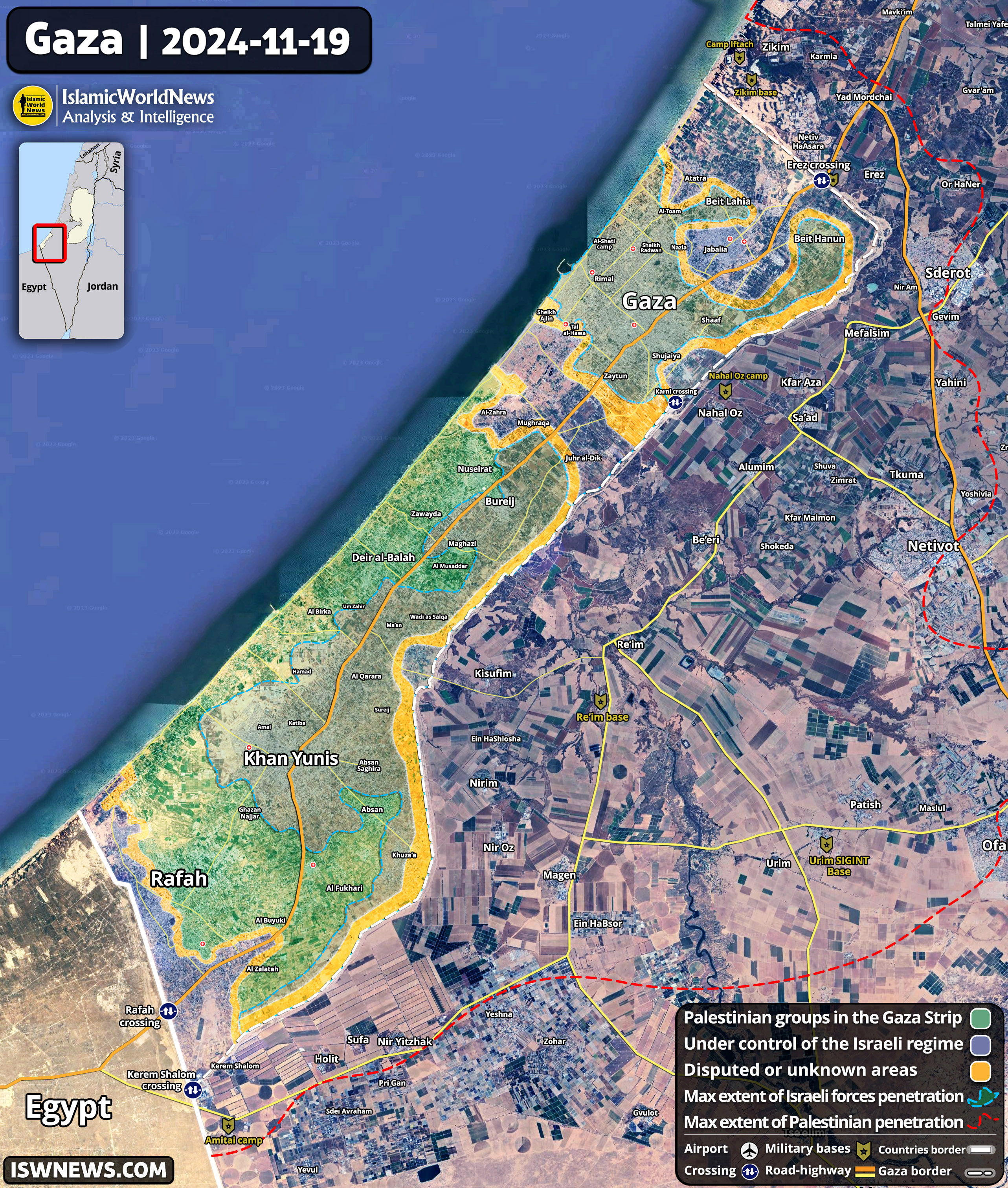
    Following the recent military operations in northern Gaza, it seems that the Israeli regime’s army intends to expand the so-called buffer zone at the Gaza border to the middle of Gaza City. Previously, this buffer zone was located several kilometers from the Gaza border. The expansion of the buffer zone into the depth of the Gaza Strip effectively facilitates its permanent occupation by the regime’s forces.

    The Israeli regime’s army has launched a large-scale invasion of the Gaza Strip since the evening of October 27, 2023. Since the onset of the Israeli operations in Gaza, 43,922 Palestinians have been martyred and 103,898 others have been injured. On the other hand, the number of casualties reported by the Israeli regime since the initiation of the ground assault on the Gaza Strip has reached 379 military personnel.

    Latest military situation in the Gaza Strip – click to view full size
  • Latest Updates On Khiam Front (Map)

    Latest Updates On Khiam Front (Map)

    Israeli armored convoys and infantry units are currently attacking the south and east of Khiam, particularly through the Sardeh Farms and Wati al-Khiam areas. Hezbollah is actively targeting Israeli tank movements and troop concentrations in these regions with rocket strikes, effectively preventing a serious assault on Khiam.

    It appears challenging for the Israeli army to make progress from the south. The nearby villages of Qaliyeh, Burj Al-Maluk, and Deir Mimas are Christian settlements, raising the possibility that the Israeli army may move into these areas to encircle Khiam. Consequently, the likelihood of a scenario similar to the one in Rmaych cannot be ruled out

  • Israeli Military Forces Increase Activities in Occupied Golan; Constructing Fortifications At Alpha Line

    Israeli Military Forces Increase Activities in Occupied Golan; Constructing Fortifications At Alpha Line

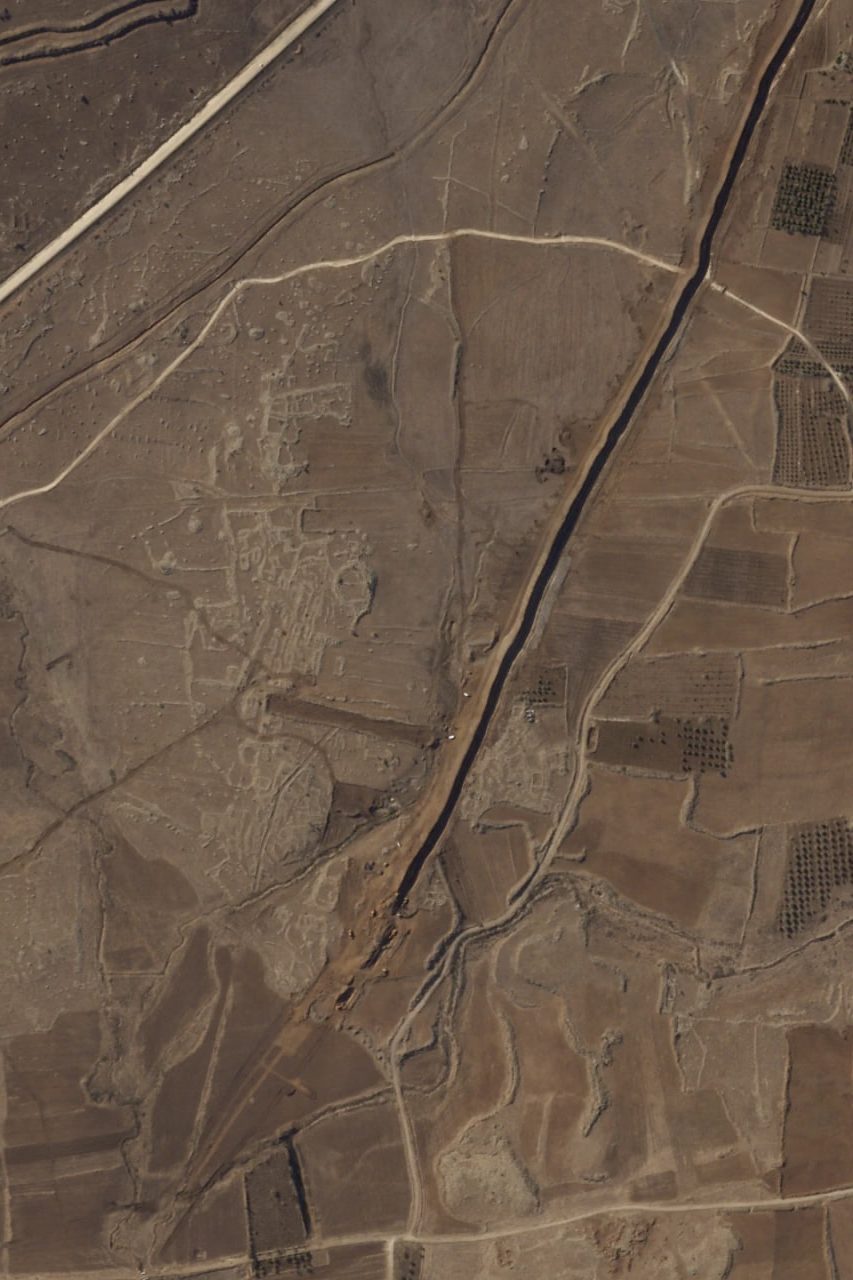
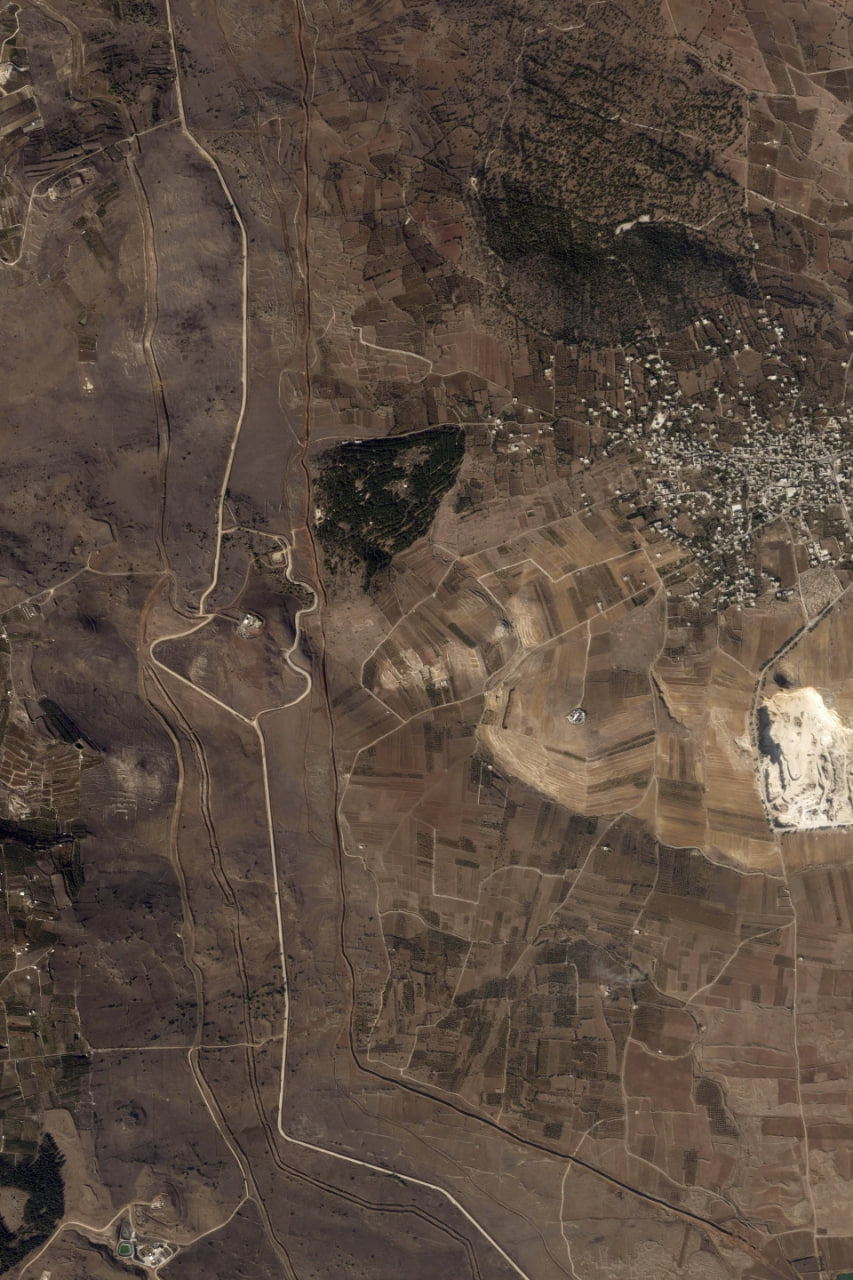
    Recent satellite images indicate that the Israeli regime’s army has initiated a construction project along the Alpha Line, which separates the occupied Golan Heights from Syria and is under UN oversight.

    According to these satellite images, the construction of over seven and a half kilometers of road has begun in the southeast of the town of Majdal Shams, parallel to the Alpha Line, with embankments built on both sides of the road. Additionally, one side has been fenced off, and the asphalt paving procedure on part of this road has been completed.

    A video released by an Israeli military source in recent days shows that the regime’s forces have approached the Alpha Line by crossing the fences. This video was released simultaneous with the new construction project of the Tel Aviv regime in the occupied Golan.

    Israeli forces near the Alpha line

    It is noteworthy that the buffer zone between the Alpha Line and the second demarcation, known as the Bravo Line, which marks the limit of where the Syrian military can operate, is the area separating Syrian forces in the Golan from the troops of the Israeli regime.

    UN peacekeeping forces have two permanent bases, 44 temporary posts, and 11 observation points in the occupied Golan region and its surroundings.

    Following the commencement of constructions by the Israeli regime, Spokesman for the UN peacekeeping forces Nick Birnback stated in an interview with the Associated Press that Israeli forces have entered this demilitarized zone during the project, which constitutes a violation of the ceasefire laws governing the area.

    The new project of the Israeli regime has been seriously underway since late September. On October 15, the Israeli regime’s forces cleared some minefields and established new barriers in the Golan Heights and border areas with Syria. On October 11, sources close to the armed groups claimed that Israeli troops, supported by several armored vehicles, entered the town of Kudna in the Quneitra Governorate of Syria; however, a field source to IWN denied this report, stating that Israeli military forces had not entered Syrian territory and were attempting to provoke Syrian forces.

    What is evident is that the activities of the Israeli regime’s army in the occupied Golan Heights and border areas with Syria have significantly increased in recent weeks compared to the past. These provocations, alongside ground operations by the Israeli military forces in southern Lebanon, have fueled speculation about the initiation of ground operations in southern Syria.

    Following the rise of tensions in the occupied Golan Hights, Russian military forces have also taken steps to reduce tensions, recently establishing an observation tower in the al al-Ahmar al-Gharbi hill south of the town of Kudna in Quneitra Governorate. The Russians also increase the number of their military posts in the zone between Syria and the Israeli-occupied territories to eight.

    An interesting point is the reason behind the Israeli regime’s actions, particularly the reinforcement of fortifications, including fencing and embankments at the Alpha Line in the occupied Golan. Given the fact that the Israeli regime’s claims of the presence of resistance forces in southern Syria and the potential for ground conflicts, it appears that the regime’s army is proactively strengthening its defensive positions to enhance its capabilities against possible attacks and ground confrontations in this region. Nevertheless, the extensive actions of the Tel Aviv regime in the occupied Golan Hights in recent weeks may have various apparent and hidden reasons, but what is important is that these actions should not be underestimated or taken insignificant; they could be preparations for an aggression against Syria!

    Click to view full size
  • Yemeni Army Carries Out Suicide Drone Attack On Israeli Eilat Port

    Yemeni Army Carries Out Suicide Drone Attack On Israeli Eilat Port

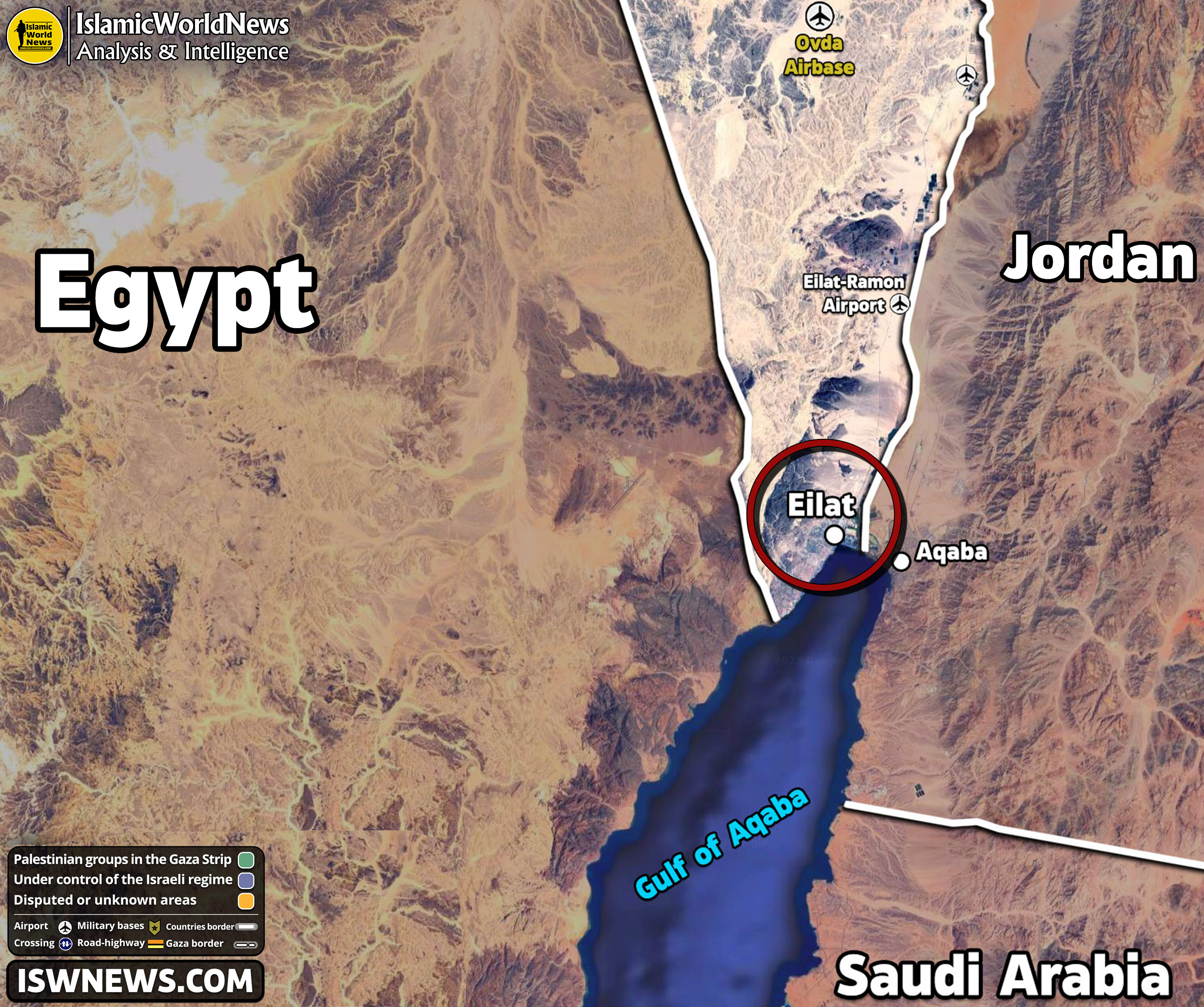
    According to Spokesman of the Yemeni Army Major General Yahya Saree, the Yemeni Armed Forces targeted a vital site at Umm al-Rashrash (Eilat) in southern occupied Palestine.

    The spokesman also stated that this operation has been conducted successfully and it achieved its objectives.

    Just like his previous statements, Major General Saree emphasized that the Yemeni Armed Forces will continue their military operations against the Tel Aviv regime until all assaults by this regime against the Gaza Strip and Lebanon cease.

    Following the blockade imposed by the Yemeni Armed Forces in the Red Sea and the repeated strikes from Islamic Resistance in Iraq, activity at Eilat Port has decreased by more than 85%.

    Local officials at Eilat Port are working to secure financial assistance from leaders of the Israeli regime and the United States in order to prevent the complete bankruptcy of the port.

    The most recent missile attack on this base marked the 37th aerial operation by the Yemeni Armed Forces on occupied Palestinian territory, utilizing ballistic missiles, cruise missiles, and suicide drones.

    The military operations of the Yemeni Armed Forces to support the Palestinian people and resistance in their battle against the Israeli regime kicked off on October 18, 2023, when the Yemeni fighters started targeting the occupied territories of Palestine and making insecure the maritime route from the Gulf of Aden to the Red Sea for the Israeli regime and its main supporters namely the US and the UK.

    This campaign peaked with the seizure of the Israeli ship Galaxy Leader and ongoing missile, Unmanned underwater vehicles (UUV), and suicide drone attacks on over 160 vessels linked to the Tel Aviv regime, leading to a halt in shipping by Israeli companies from the Red Sea route.