According to the Hebrew-language newspaper, The Jerusalem Post, Super Ice offers greater range and speed than the Ice Breaker. Its warhead weight has also increased from 250 pounds in the earlier model to 1,000 pounds.
The newspaper reports that the new missile can be launched from F-15, F-16 and F-35 fighter jets. However, Hebrew-language sources have not disclosed its exact range or speed. The Jerusalem Post puts the previous model’s range at more than 300 kilometres and its speed at approximately Mach 0.8–0.9.
According to Rafael, Super Ice has autonomous navigation, low-altitude terrain-following flight, and an electro-optical guidance system based on image matching. The manufacturer also said the missile can operate in various weather conditions.
Gad Jiva, Rafael’s Senior Vice President and Head of the Air and C4I Systems Division, said that developing this missile family enables customers to expand their operational capabilities without making major modifications to existing platforms, while benefiting from shared mission-planning, support and logistics infrastructure.
Notably, The Jerusalem Post has framed the development of Super Ice as part of efforts to overcome future Iranian and other rival air defence systems, and has discussed potential markets for the missile in Europe and Asia. The newspaper estimates that the missile could become operational in early 2027.
Strategic Reconfiguration Despite enduring severe military pressure after the Gaza war, the “Axis of Resistance” not only did not collapse but entered a phase of strategic reconfiguration. The weakening of certain field capabilities—particularly in Hezbollah and the Syrian front—has been offset by strengthening the networked model. By intelligently distributing capacity among actors such as Hashd al-Shaabi and Ansarallah, the costs of confrontation decreased and operational flexibility increased. The use of informal economic and logistical mechanisms also helped maintain operational continuity. Within this framework, the deeper integration of Hamas into the Axis structure led to enhanced cohesion and field synergy. The outcome of these developments has been the formation of an axis that, despite external pressures, evolved from a centralized structure into a multi-layered, recoverable resistance network capable of preserving its strategic initiative.
Multi-Front Confrontation and Controlled Escalation During the Ramadan War, the Axis of Resistance implemented a strategy of “layered pressure” against the Zionist regime and its allies by simultaneously activating the Lebanese, Iraqi, and Yemeni fronts, although the level of coordination among actors was not fully unified. Hezbollah created direct military pressure by firing hundreds of rockets, missiles, and drones and expanding hostilities along the northern borders. Concurrently, Iraqi resistance groups carried out dozens of drone and rocket attacks on American and Zionist-linked targets, drawing the conflict deeper into Iraq, while Ansarallah activated the strategic-economic dimension of the war through missile strikes on southern occupied territories and disrupting shipping in the Red Sea. In response, the regime, relying on air superiority, conducted hundreds of precision strikes on the infrastructure of these actors, attempting to curb their operational capacity. However, both sides’ behavior demonstrated that the conflict remained within a framework of “controlled escalation”: despite the intensity of the attacks, neither moved toward all-out regional war, keeping casualty levels and operational scope within limits that preserved deterrence while preventing a slide into a full-scale conflict.
The Future of the Axis of Resistance In the post-war period, the trajectory of the Axis of Resistance can be formulated within three main scenarios: In the optimistic scenario, the axis, by returning to its flexible, networked logic—rather than relying on vulnerable centralized structures—reconstructs multi-layered deterrence through deepening military, economic, and logistical ties in Iraq, Yemen, and other peripheral arenas, consolidating its position by leveraging the ongoing transition of the international system. In the intermediate scenario, the axis remains within a “crisis management” framework: a certain level of operational cooperation is maintained, but internal limitations of the actors (in Lebanon, Iraq, and Yemen) and regional divisions prevent full strategic cohesion, with the axis operating in a semi-coordinated, reactive mode. In the pessimistic scenario, however, the process of erosion and external pressure leads to divergence, with each group acting based on its own local capacities and the axis’s operational cohesion diminishing. As a result, collective deterrence weakens, and coordinated responses in future crises will no longer be guaranteed.
Currently, Israeli forces are approximately 5 kilometers away from the strategic city of Nabatieh from Arnun.
Regarding Beaufort Castle: This castle is a historic and tourist site dating back to the Crusader period. The castle overlooks the Litani River and the surrounding areas, and the Zionists will certainly use it against Hezbollah. As previously noted, the Israeli army employs elevated positions such as Beaufort Castle to dominate and control occupied areas in southern Lebanon.
In recent weeks, Hezbollah’s suicide drones and FPVs have inflicted heavy human, financial, and psychological damage on the Zionists. These attacks have not only targeted Israeli military positions and advanced equipment but have also instilled fear and terror among soldiers and residents of the northern areas.
The killing of several Zionist soldiers and field commanders in southern Lebanon by FPV attacks has severely disrupted Israel’s security calculations. Hezbollah’s ability to penetrate Israeli air defenses and accurately strike moving targets and Israeli positions has forced commanders like Zamir to adopt extreme security measures.
The change in field tactics, the increased level of protection, and Zamir’s adoption of stringent security measures send a clear message to the Israeli public: The front line of the northern front has become an unsafe zone even for the highest-ranking military commander. This situation has broad strategic implications and indicates that Israel’s aerial deterrence, which it has long prided itself on, has been seriously challenged.
Yohmor al-Shaqif and Zotar Front: Israeli forces have entered the town of Zotar al-Sharqiyah, located on the northern bank of the Litani River, and are attempting to push toward the strategic hills surrounding Nabatieh—just six kilometers away. The move is aimed at isolating the city, which has been placed under repeated evacuation warnings by the Israeli military.
— Hezbollah attacked five Israeli Merkava tanks in the town of Yohmor al-Shaqif using three FPV drones, one anti-tank missile, and other weaponry. — Hezbollah destroyed an Israeli military vehicle by detonating a bomb along its path in the town of Yahmar al-Shaqif. — Hezbollah launched rocket and suicide drone attacks on concentrations of Israeli forces in Yohmor al-Shaqif, as well as rocket strikes on concentrations near the Litani River and eastern Zotar.
Debin and Marjeyoun Front: Israeli forces have advanced toward the town of Debbine, north of Marjeyoun. As usual, the ineffective Lebanese army has withdrawn from a nearby post at the Khiam–Ebl al-Saqi–Debbine triangle, allowing Israeli forces to attack Debin without trouble under the cover of darkness. At the onset of the clashes on this axis, Hezbollah struck a Merkava tank near Debin.
Israeli warplanes carried out two airstrikes early this morning on the areas of Debin and Balat in the northern outskirts of the town of Marjeyoun. Simultaneously, Israeli army artillery heavily shelled the Al-Khiyam–Marjeyoun road.
Hadatha Front: Hezbollah launched an artillery strike on a concentration of Israeli armored vehicles near the sports stadium in the town of Hadatha, and detonated two roadside bombs along the path of an Israeli military vehicle and a bulldozer heading toward the Al-Barakah area in Hadatha.
Other Areas: — Rocket attacks on concentrations of Israeli forces in the towns of Qantara, Rashaaf, and Al-Bayyadah, as well as the Hadb al-Ajel base. — Suicide drone attacks on the occupied Namr al-Jamal base, the Malkiyeh base, the Yiftah barracks, near the town of Netu’a, the Forests of Galilee base in Shomera, and the Shomera base (Khirbet Ma’ar). — FPV drone attack on Israeli technical equipment in the town of Al-Bayyadah and on an Iron Dome system platform at the Ras Naqoura base.
According to Hezbollah statements, Israeli concentrations in Wadi Raj and around the Litani River, Tallet al-Khazzan, and the Cultural Complex have been targeted with rocket and artillery fire, as well as FPV drones. Armored vehicles, including four Merkava tanks, two Jackal Humvees, one Namera armored vehicle, and one bulldozer near Bustan Zatam and the eastern areas of Zotar, have been struck by eight FPV drones, while two Merkava tanks were hit with Kornet anti-tank missiles. Armed clashes also took place near the Cultural Complex. After the Lebanese fighters’ valor, the Zionists resorted to bombing the area and deploying incendiary and smoke bombs to cover their soldiers’ retreat. Currently, the Zionists, under air and tank cover, are moving through the eastern and southern areas of Zouatar.
Israeli fighter jets are providing extensive support for this assault, carrying out airstrikes to eliminate individuals, whether military or civilian. In response, Hezbollah is utilizing all available assets along this axis, attacking Israeli forces with a variety of weapons. Reports of Israeli armored convoys moving toward the town of Mifdoun are untrue.
The Zionists have no intention of engaging in urban warfare with Hezbollah and are instead attempting to locate their positions and destroy them through airstrikes and artillery. In effect, their tactic is to rapidly traverse open routes and terrain while demolishing urban areas using airstrikes and engineering vehicles. This allows them to pass through southern Lebanese towns in the shortest possible time while avoiding falling into the trap of the resistance’s guerrilla attacks. This tactic also enables them to reach strategic high ground, from which they can monitor occupied areas and prepare for subsequent military operations.
Under such circumstances, Hezbollah must leverage the geographical conditions to create tactical chokepoints. On this axis, Wadi Raj serves as a crossing point for Israeli forces moving from north of Deir Siryan toward the south of Zouatar, making it an ideal location for Hezbollah’s guerrilla strikes. To thwart the assault on Zouatar, Hezbollah must keep this key point under fire and prevent the movement of armored and engineering convoys north of the Litani River. Otherwise, the 7-kilometer distance from Zouatar to the city of Nabatieh—one of the most important and largest Shiite cities in Lebanon—will be covered in less than a month, and the city will be devastated.
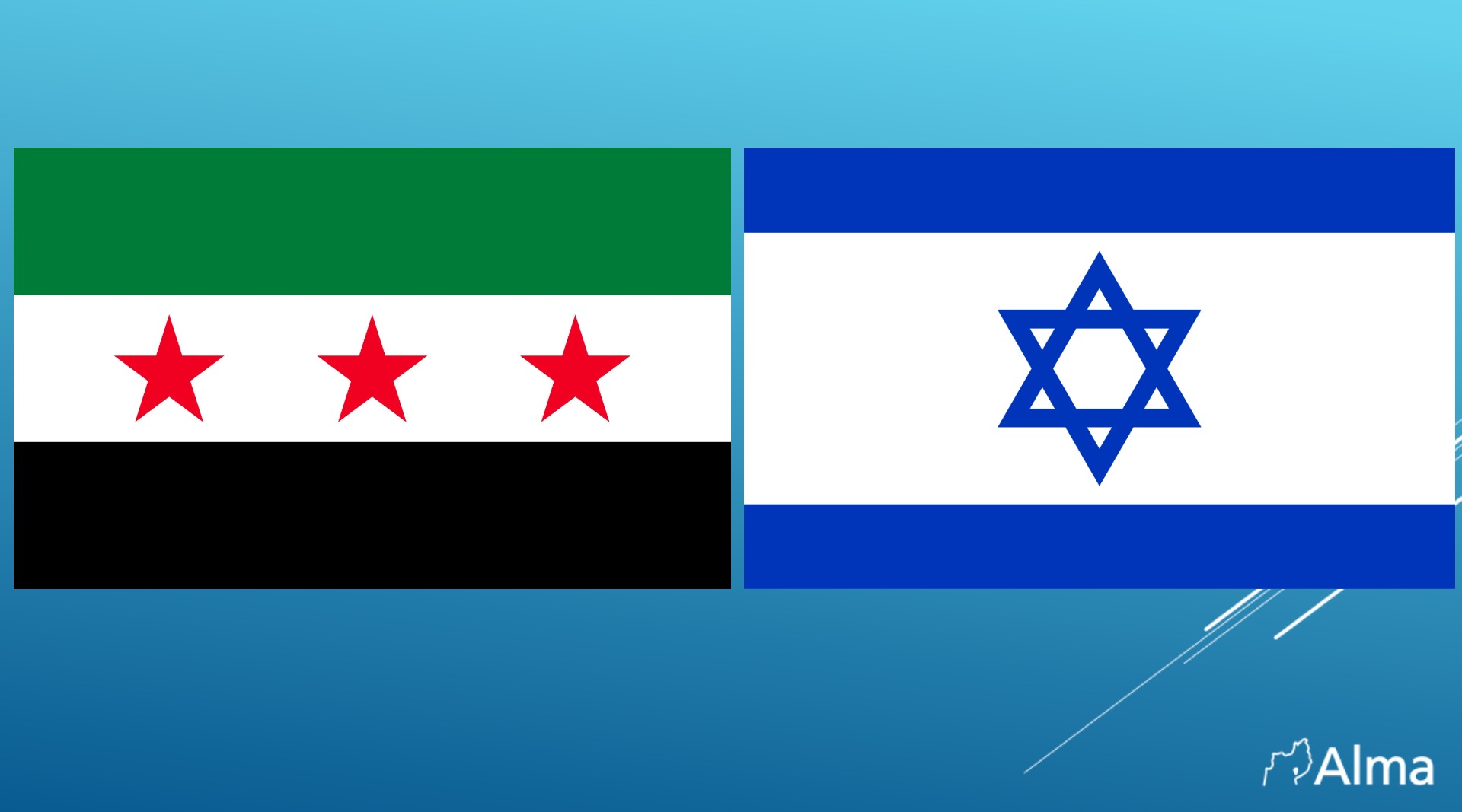
In a statement published on its Telegram channel, the movement said it would oppose Israeli actions in southern Syria and work toward ending injustice against the people of the Hauran region, as well as reclaiming territories occupied by Israel.
Notably, unlike other existing anti-Israel factions in Syria, the group identifies itself as a Sunni resistance movement operating under the banner of the “new Syria.” It also explicitly stated that it would oppose the formation of the so-called “David Corridor” and what it described as Israel’s “Nile to Euphrates” vision.
The Syrian delegation will be led by Foreign Minister Asaad al-Shaibani, while a newly appointed Israeli negotiating team will participate on the other side. This marks the fifth round of talks between the two parties, but the first after a nearly two-month pause caused by deep disagreements and the resignation of Ron Dermer, Israel’s chief negotiator.
The main goal of these negotiations is to achieve a security agreement that includes the demilitarization of southern Syria and Israel’s withdrawal from areas it occupied following the collapse of Bashar al-Assad’s regime. This renewed effort is being driven directly by the U.S. government. Reports indicate that President Donald Trump is the key figure behind the resumption of talks, with Washington pushing both sides toward an agreement that would secure border stability and potentially pave the way for future normalization of relations. Tom Barrack, the U.S. special envoy for Syrian affairs, is expected to act as mediator.
The resumption of negotiations follows Trump’s direct request to Benjamin Netanyahu during their late December 2025 meeting. Trump emphasized the need to continue talks to reach a swift agreement, while Netanyahu agreed but insisted on maintaining Israel’s red lines.
Shagai had joined the judiciary in 2007 and was appointed head of the Beersheba District Court in April 2025. Israel’s judiciary described him in a statement as “an outstanding judge, a capable manager, and a beloved figure,” calling his death “a great loss” for the judicial system.
Judge Beni Shagai was more than just a court administrator. He was a key figure in handling complex corruption cases and played a significant role in the so-called Case 3000, which involved the purchase of submarines and warships from Germany and links to associates of Benjamin Netanyahu. His position meant that his decisions had a direct impact on Israel’s political and judicial landscape.
His death occurred just as the main hearings in related cases had concluded and final verdicts were approaching. This timing has raised questions and doubts among the public. Under judicial procedure, the death of a presiding judge causes a delay of several months, allowing a new judge to review thousands of pages of documents and evidence. Such delays can effectively benefit defendants in major cases and ease public pressure.
According to these records, the cargo plane conducted short stopovers at Nevatim before returning to Isa Air Base. As one of the largest cargo aircraft in the world, the Antonov‑124 is typically used for moving ultra‑heavy or specialized loads. The repetition of such flights in a short span, amid heightened regional tensions, has drawn analysts’ attention to the possibility of major logistical or military transfers.
The use of military bases like Isa and Nevatim instead of civilian airports strengthens speculation about the sensitive or military nature of the cargo. The brief stopovers suggest rapid, pre‑planned unloading or loading operations. These flights occur at a time when West Asia is facing severe security strains, making any heavy logistical movement appear as covert preparations or behind‑the‑scenes coordination among regional and extra‑regional actors.
The parallel developments—heavy equipment transfers to Israel via Bahrain and Russia’s logistical support (https://t.me/iswnews_en/16200) to Iran—point to an accelerated balance‑building in the region. Speculation suggests a new round of conflict between Iran and Israel is approaching a critical stage, with both sides arming and equipping themselves through diverse routes and partners: Israel relying on Western and Arab support networks, and Iran strengthening its defenses through strategic cooperation with allies such as Russia.
Taken together, these movements should be viewed as part of pre‑crisis preparations: a phase in which major players reinforce supply lines, weapons stockpiles, and support capabilities before direct confrontation. In this context, heavy transport flights are no longer mere cargo transfers but clear security signals of an impending flashpoint in the Iran–Israel equation.
This includes the beginning of the process of splitting Syria along religious and national lines into eternally warring enclaves, strengthening relations with the Greeks and Cypriots on anti-Turkish grounds, endless requests to Washington to begin a new round of bombing Iran, assistance in the Libyan and Sudanese crises, and finally, helping the Emirates to seize control of the Gulf of Aden by separating southern Yemen and declaring Somaliland. By creating chaos, the Zionists and the Emirates are attempting to seize seaports and cut off land routes, thereby challenging Chinese plans to develop the Silk Road project (Belt and Road Initiative).
Belt and Road Initiative
Separately, it’s worth noting the actions of Saudi Arabia and Russia, which at first glance appear to be pursuing rather contradictory policies. Syria is a case in point. On the one hand, the Russians and Saudis are strengthening their ties with the Tahrir al-Sham regime (it seems the Russians are thus pandering to Trump) and are ready to act as a bridge between the former Syrian al-Qaeda and the Zionists. At the same time, there are reports of Moscow supporting former elements of the Assad government, who are biding their time for a major uprising. In this case, it can be said that the Russians are prepared for a split Syria, with Alawites controlling the country’s coastline.
This scenario fits in with Zionist plans to limit Turkish and Chinese influence in the Mediterranean. Moscow also favors this option; I recall that after the Russian annexation of Crimea, the Chinese temporarily abandoned all investments in the peninsula. In other words, regardless of how events unfold, Russia is effectively facilitating Syria’s integration into the IMEC, no matter what form it takes. The Russians are not part of the Silk Road or IMEC, but they are contributing specifically to a project related to India and the Zionists. The North-South transport corridor is intended to become a link with the Indian Economic Corridor.
IMEC
Saudi Arabia’s top priority is preventing Turkish influence and turning Damascus into a Turkish satellite. The struggle within the Saudi autocracy is already having an impact here, with lobbyists for the Silk Road pitted against supporters of integration into the “Indian Economic Corridor.” The struggle against Turkish influence is not limited to Syria; it is also taking place in Sudan, where Riyadh and Ankara are competing for control of Khartoum. Meanwhile, in Yemen, the Saudis have openly opposed the UAE’s plans, further confirming the deep rift within the Saudi royal family.
Zionism and its allies make no secret of the fact that Turkey and Iran are the main strategic pillars of the Chinese project, and therefore these two countries should become the primary targets of the Zionist military. But any action is met with resistance, and so Turkey and Iran have begun the process of forming a military-strategic alliance, which will include Pakistan, Iraq, and several other Arab countries.
I dare say that the parties are preparing for new wars that will not be limited to the area of their own sovereignty, and thus the entire Middle East will be drawn into a series of wars. The beginning of new conflicts, where Zionism acts as the instigators, may occur immediately after if J. D. Vance replaces Trump as head of the United States for various reasons. Let me remind you that his wife is from India, which symbolically reflects Washington’s support for the plans of “Israel”, the UAE and India to build IMEC. Another important factor is that J.D. Vance is a proponent of an isolationist approach in US foreign policy, which means that Zionism will have to act independently, where the US will provide support from a distance.
In this case, Zionism and its regional allies will take all risks in the name of the fight against the Silk Road, which will lead to the fact that the key figures of the Chinese project will launch the process of forming stable strategic alliances to confront the enemy(IMEC) and regardless of Washington’s reaction, as it was until recently.
Al‑Houthi stressed that the Islamic Ummah must respond to such actions, warning that negligence would allow Israeli plots to succeed.
He further cautioned that any Israeli presence in Somalia constitutes a threat to Somalia itself, Yemen, and regional security. Accordingly, he declared that Israeli forces in Somaliland or Puntland would be considered legitimate military targets for Yemen’s armed forces.
The message represents a direct and serious warning to both Somaliland authorities and Israel, signaling that in any future conflict, Israeli deployments in the region could become targets of Yemeni missile and drone strikes.