Tag: Israel

  • Explosions Rock Israeli Intelligence Base Off Eritrea

    Explosions Rock Israeli Intelligence Base Off Eritrea

    The cause of these explosions has not yet been determined, but it is possible that the Israeli intelligence base was attacked by drones and missiles by the Yemeni Armed Forces.

    The Dahlak Islands are part of an archipelago off the coast of Eritrea that is uninhabited and the supervision of these islands was ceded to the Israeli regime by former Eritrean President Isaias Afwerki in the 1990s.

    Read more: Attack On Israeli Intelligence Base In Eritrea; An Israeli Officer Was Killed

    Afwerki took this step because of the tension he had with Yemen over the Hanish Islands and called on the Tel Aviv regime to support his government against possible Yemeni attacks on Eritrea.

    Since 2016, the Israeli regime has set up a large database on the Emba Soira Mountains, 135 kilometers south of the Eritrean capital Asmara. With 3,018 meters height, Mount Emba Soira is the highest mountain in Eritrea.

    The purpose of this base is to monitor the Red Sea and maritime traffic, and to have full control over the Bab al-Mandab Strait and intelligence control over the Yemeni coast.

    Undoubtedly, the role of this intelligence base during the recent tension between Israel and Yemen has become more prominent than before, and the recent actions of the Israeli special unit against Yemen are commanded and controlled from this base.

  • Palestinian Man Carries Out Anti-Israel Operation In Tel Aviv; Israeli Strike Kills 5 In Tulkarm

    Palestinian Man Carries Out Anti-Israel Operation In Tel Aviv; Israeli Strike Kills 5 In Tulkarm

    Local sources reported that an anti-Israel stabbing took place in the Holon city, south of Tel Aviv, on Sunday morning.

    After the incident, official sources announced that five people were injured in the Holon city. Minutes later, two Zionist settlers succumbed to injuries. Therefore, the number of Zionist casualties in the attack on the Holon city increased to two dead and three wounded.

    The Zionist regime’s Channel 12 TV quoted the regime’s police spokesman as saying that the perpetrator of the Holon operation was a young man named Ammar Odeh, 34 years old, a resident of Salfit in the West Bank, who entered the center of occupied Palestine without a permit and was shot dead by the Israeli police.

    Ammar Owda

    Local sources indicated that Israeli forces closed the main northern entrance to the town of Salfit in the occupied West Bank with an iron gate this morning. According to the Israeli TV channel, another person was involved in the operation and is being wanted.

    In the West Bank, the Israeli military reported that its first airstrike targeted a vehicle near Tulkarm.

    In this attack, five Palestinians were martyred, including Abdul Jabbar Sabbagh al-Dahruki, one of the commanders of Saraya al-Quds (Tulkarm Battalion) and Haitham al-Balidi, one of the commanders of al-Qassam Brigades in Tulkarm.

    Israeli airstrike on a vehicle in Tulkarm

    A subsequent airstrike in the same area aimed at another group, which the military alleged had fired at their troops.

    This morning, a Palestinian youth was injured by Israeli gunfire near the village of Aroura, north of Ramallah.

    Additionally, Israeli forces conducted a raid in the village of Deir Nitham, west of Ramallah, but no arrests were reported following the operation.

  • Israeli Warplanes Attack Syria-Lebanon Border Areas

    Israeli Warplanes Attack Syria-Lebanon Border Areas

    The Israeli regime’s aircraft have bombed the Lebanese resistance movement Hezbollah’s military bases on Syrian soil in at least three air strikes on July 2.

    These air raids were carried out in the Homs Governorate, and as a result of these direct strikes several ignitions were reported. No casualties have been reported so far.

    Israel airstrike near Qusayr
    Israel airstrike

    A source close to Hezbollah claimed late Friday that Israel conducted air raids on a convoy of trucks entering Lebanon from Syria.

    This incident marks the latest in a series of Israeli airstrikes in the border region.

    Hezbollah’s military chief Fuad Shukr was martyred in the Lebanese capital Beirut in an Israeli air strike and Hamas political leader Ismail Haniyeh was also martyred in the Iranian capital Tehran earlier this week.

    On Friday, the Lebanese resistance movement claimed responsibility for five retaliatory attacks on Israeli military positions in northern occupied Palestine.

    Hezbollah’s Secretary General Sayyed Hassan Nasrallah addressed Shukr’s funeral on Friday, warning that Israel and its supporters should expect a decisive response to the recent assassinations.

    Since the outbreak of hostilities in October, at least 542 individuals have been martyred on the Lebanese side, predominantly fighters but also including 114 civilians. On the Israeli side, army figures indicate that at least 22 soldiers and 25 settlers have been killed.

  • Senior Hezbollah Commander Martyred In Israeli Air Strike

    Senior Hezbollah Commander Martyred In Israeli Air Strike

    According to initial reports in the Israeli media, the attack on southern Beirut was carried out by a combat drone and three missiles were fired at a building. However, the Israeli regime army’s spokesperson said in a statement that the attack was carried out by warplanes.

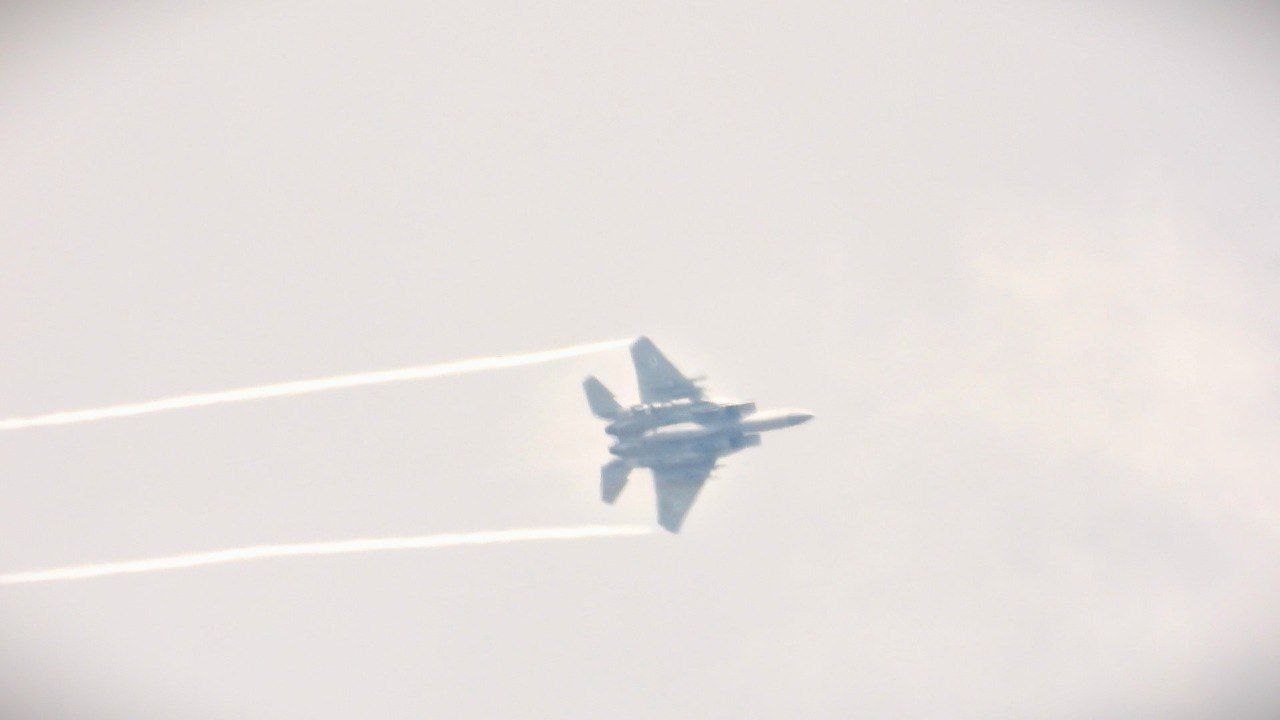
    The Israeli newspaper Yedioth Ahronoth also claimed that the attack was carried out with F-35 fighter jets.

    The target of this terrorist attack was Fouad Shukr, with Jihadi name Haj Mohsen, Hezbollah’s number two and an advisor to Sayyed Hassan Nasrallah.

    Fouad Shukr and Sayyed Hassan Nasrallah

    The latest death toll of attack on southern Beirut is five martyrs, including a woman and two children aged six and ten, and 74 people were wounded.

    Israel’s Channel 14 TV reported that a new assessment in Israel indicates that Fuad Shukr was in the building at the time of the attack and was severely injured and killed.

    Reuters quoted two unidentified security sources as saying that the body of Hezbollah military commander Fuad Shukr has been found in rubble in the southern suburbs of the Lebanese capital Beirut.

    At the same time as the terrorist attack, the cities of Haifa and Tel Aviv spoke of their readiness to face a possible Hezbollah attack. The municipality of the Rishon LeZion settlement on the outskirts of Tel Aviv also announced the reopening of public shelters for fear of a response from Hezbollah.

    In an interview with Kan TV, Rui Sharon said: After the Beirut attack, Israel is in a state of alert as to whether Hezbollah will fire rockets at Tel Aviv, Haifa or just the Galilee.

    Brigadier General Zvika Haimovich, commander of the Israeli army’s reserve forces, also said: We must prepare for more Hezbollah attacks than before. These attacks can reach 100 to 200 or even 300 rockets at a time.

    Hours after the attack, in an official statement, Israeli regime army spokesperson Admiral Daniel Hagari confirmed that the attack by Israeli warplanes in the Beirut suburb led to the martyrdom of Fouad Shukr, alias Haj Mohsen.

    According to the Israeli army’s statement, Shukr is Hezbollah’s most senior military commander and head of the Lebanese resistance’s strategic organization. He is considered the right-hand man of Sayyed Hassan Nasrallah and is the main advisor to the secretary general of Hezbollah in the affairs of planning and managing the war.

    Fouad Shukr has joined Hezbollah since 1985 and in addition to being a member of Hezbollah’s Central Council and Military Council, he has been leading the battles on the southern Lebanese front since October 8.

    The terrorist attack by Israeli drone in the Beirut suburb is the second terrorist act carried out by the regime in the Lebanese capital after the assassination of Saleh al-Arouri, the deputy head of Hamas’ Political Bureau. The terrorist attack allegedly was in response to a rocket hitting a football field in the town of Majdal Shams, killing 12 residents. The Israeli regime claims that the missile is a type of Falaq-1 rocket and belongs to Hezbollah and is made in Iran.

    In the first statement about the Israeli terrorist attack in the Beirut suburb, Hezbollah confirmed the presence of Fouad Shukr at the scene of the attack, stressing that it was waiting for the results of the rescue teams to announce the fate of the great commander in order to make a decision.

    Hezbollah’s initial media statement on the Israeli fighter jets attack in the Beirut suburb is as follows:

    “As it turned out, the Zionist enemy attacked a residential building in one of the neighborhoods of the southern suburbs of Beirut on Tuesday, which led to the martyrdom of a number of citizens, the wounding of a number of others, and the complete destruction of a number of floors of the building.

    At that time, the great commander and fighter, our brother Fouad Shukr (Haj Mohsen), were present in this building.

    After the incident, the rescue teams worked hard but slowly to remove the rubble, and the body of this great and dear commander was found from under the rubble after 20 hours of searching.”

  • Assassination Of Hamas Chief In Iran Capital Following Participation In Pezeshkian’s Inauguration

    Assassination Of Hamas Chief In Iran Capital Following Participation In Pezeshkian’s Inauguration

    Haniyeh’s presence at the ceremony highlighted the close ties between Hamas and Iran, which has been a significant supporter of the Palestinian cause.

    Details surrounding the assassination remain still unclear, but sources indicate that it occurred hours after Haniyeh’s participation in the inauguration ceremony in the Iranian capital at 1:45 am July 31.

    Haniyeh had been in Tehran to strengthen diplomatic relations and support for Palestinian resistance efforts amid escalating tensions in the region. His participation in Pezeshkian’s inauguration was seen as a gesture of solidarity between Hamas and the Iranian government, showcasing their ongoing collaboration against common adversaries.

    The assassination has sparked widespread condemnation from various Palestinian factions and allies, who have called for an immediate investigation. Iranian officials have vowed to uncover the facts behind this heinous act, emphasizing their commitment to supporting the Palestinian struggle.

    This incident marks a significant escalation in the already volatile landscape of Middle Eastern politics, raising concerns about potential retaliatory actions from Hamas and its allies.

    The Islamic Republic of Iran vowed that Haniyeh’s blood will not go in vain. Lebanon’s Hezbollah, Yemen’s Ansar Allah movement, Iraqi resistance groups plus numerous heads of states and people around the globe reacted to the act of violence, which is blamed on the Israeli regime.

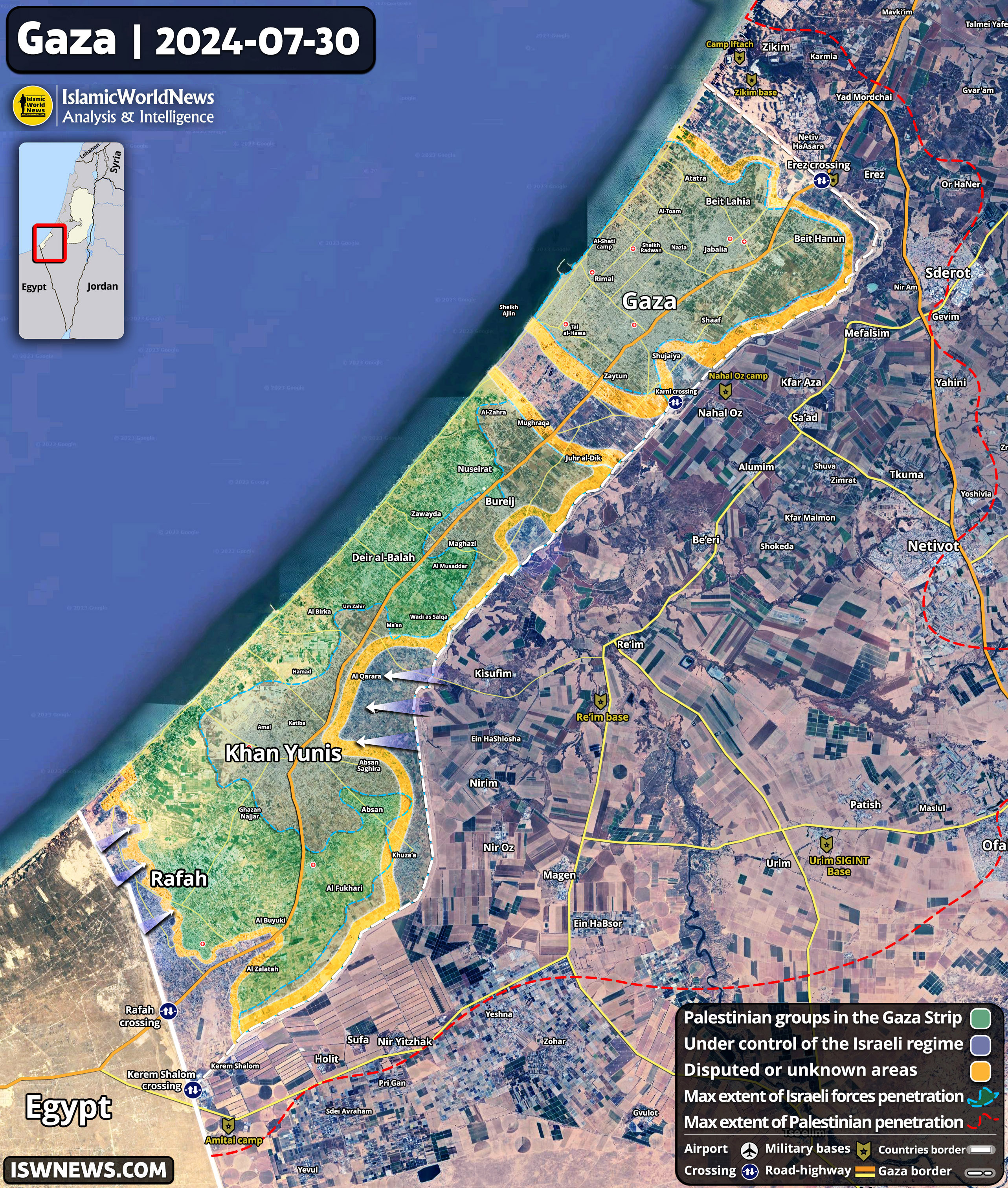
  • End Of Israeli Military’s 8-Day Operation In Khan Yunis (Map)

    End Of Israeli Military’s 8-Day Operation In Khan Yunis (Map)

    On July 22, the Israeli regime’s military forces launched an operation in Khan Yunis with the aim of preventing the return of the resistance forces to this area.

    During the operation, the Israeli military destroyed residential buildings, a cemetery and service facilities using bulldozers and explosives.

    According to the Israeli regime’s army, 150 members of the resistance forces were martyred during the operation, several tunnels were destroyed, and some weapons were confiscated. Finally, the Tel Aviv regime’s army announced this morning that the regime’s 98th Paratroopers Division completed its operation in Khan Younis last night.

    In this regard, local sources announced that thousands of Palestinians returned to their homes in the city of Khan Yunis on Tuesday after the end of the eight-day operation of the Israeli army.

    After the return of the residents and the start of the activities of the Palestinian rescuers, the Gaza media office announced that as a result of the recent operation of the Zionist regime’s army in Khan Younis, at least 255 Palestinians were martyred and more than 300 others were wounded. In addition, 30 people disappeared.

    Despite the Israeli army’s withdrawal from Khan Yunis, its forces continue sporadic artillery and air strikes in areas of Khan Yunis and its surrounding areas. In recent hours, the Israeli army has also carried out several reconnaissance operations in the city of Khan Younis, using drones and quadcopters.

    The Israeli armed forces are still stationed on the eastern axis of Khan Younis, and it is possible that in the coming weeks, the city of Khan Yunis and its surrounding areas will witness short-term operations by the Israeli regime’s army. 

    It is worth mentioning that on July 22, local sources reported the advance of the Israeli regime’s army forces on the axis of Abasan Al-Kabira area. During the operation, the Israeli military advanced with air support to the city of Khan Yunis.

    Read more: Israeli Army Launch New Military Operation In Southern Gaza; Clashes Continue In Absan

    On the axis of Rafah, clashes between resistance fighters and Israeli armed forces continue. Clashes and exchanges of fire have been concentrated in the Tal al-Sultan neighborhood of Rafah, and in recent days, the forces of the Izz al-Din Al-Qassam Brigades, Al-Quds Brigades and al-Nasser Salah al-Deen Brigades have organized a series of operations against the Israeli regime’s army on the different axes of the conflict in Rafah, during which several armored vehicles of the Israeli military were destroyed and several Israeli armed forces were killed and wounded.

    Interactive map of Gaza Strip

    Click to view full size
  • Israel Claims Responsibility for Hitting Hezbollah Commander In Beirut Attack

    Israel Claims Responsibility for Hitting Hezbollah Commander In Beirut Attack

    The attack resulted in a loud blast and a plume of smoke rising above the area, which is a stronghold of the Lebanese resistance movement Hezbollah.

    Lebanon’s state-run national news agency reported that an Israeli air strike targeted the area around Hezbollah’s Shura Council in the Haret Hreik neighborhood of the capital.

    The Israeli military claimed that the targeted strike was aimed at the commander allegedly responsible for the recent deadly attack in Majdal Shams in the Israeli-occupied Golan Heights, as well as the killing of numerous additional Israelis.

    This comes after at least 12 people, including children, were killed in a rocket strike on Majdal Shams last week, an attack which Hezbollah has denied responsibility for, but which Israel blamed on the Lebanese Hezbollah.

    In response to the Israeli strike, a high-ranking Hezbollah official stated earlier that regardless of the nature of Israel’s actions, Hezbollah would respond.

    Israel’s war minister Yoav Gallant also commented on the situation, stating that “Hezbollah crossed the red line” in a social media post following the Israeli military’s claim of responsibility for the strike.

    The Israeli regime’s army did not provide details about how the strike was carried out. The situation remains tense, with both sides making strong statements and threats of further retaliation.

    Aftermath of Israeli airstrike in Beirut

    The National News Agency (NNA), the Lebanese state news agency, reported that a drone carried out the attack by launching three missiles.

    Within a short time, following a report from Hezbollah’s Al Manar TV, the Israeli army confirmed that a loud explosion was heard in the southern suburbs of Beirut.

    This region, heavily populated and a stronghold of the resistance movement, is located in the Lebanese capital.

  • Israel Will Attack Lebanon, But Limited!

    Israel Will Attack Lebanon, But Limited!

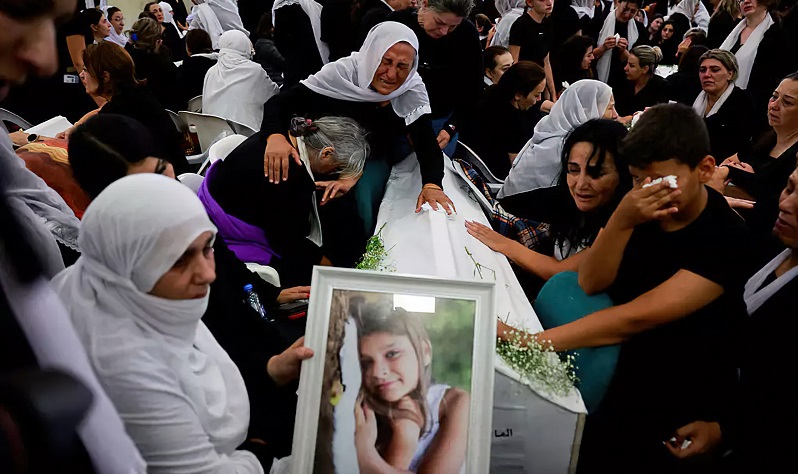
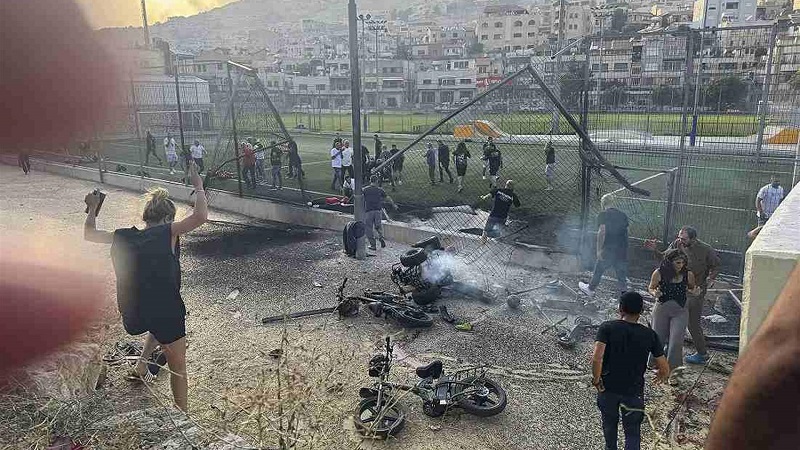
    On July 27, a rocket hit a sports field in the city of Majdal al-Shams in the occupied Golan Heights. As a result of this incident, 14 Druze youths lost their lives and more than 35 others were injured. Immediately after the attack, the Israeli government accused the Lebanese Hezbollah. It claimed that the projectile was fired from inside the Lebanese territory and identified the Lebanese resistance as the cause of this attack.

    On the other hand, Lebanon’s Hezbollah strongly denied this accusation and stated that the Israeli regime’s claims are false and that Hezbollah did not carry out such an attack.

    A rocket hit a sports field in the city of Majdal al-Shams

    Majdal al-Shams in the occupied Golan Heights is situated very close to the UN Alpha line and the areas under the control of the Syrian government. Also, the residents of Majdal al-Shams are Druze, and in general, there are no Israeli military targets in this city.

    Considering these facts, Hezbollah’s rocket attack on Majdal Al-Shams has no rational or military justification; Thus the occurrence of this incident is faced with serious doubts.

    Some experts believe that there is a possibility that this incident is a false flag attack. The Israeli regime is in a tough situation these days and is looking for a way out of these problems.

    The war in the Gaza Strip has been going on for more than 10 months. The Israeli regime’s stated objective to “destroy Hamas and the Palestinian resistance groups” since the start of the war in the Gaza Strip has not been achieved, and there is no clear prospect for the end of the war in the Gaza Strip. Israeli prisoners are still in captivity and the Israeli regime is unable to release them. The Israeli regime’s only accomplishment in the Gaza Strip is destruction, genocide, and the loss of 40,000 Palestinian civilians, mostly women and children.

    Military situation in Gaza Strip

    After the start of Israel’s military invasion of the Gaza Strip, Lebanon’s Hezbollah and the Yemeni army entered the field militarily in support of the Palestinian people.

    On the northern front, daily clashes continue between Hezbollah and the Israeli army. Thousands of Israeli settlers have been displaced and almost all the settlements in the north of occupied Palestine have been evacuated and the level of destruction is high.

    Missile and drone attacks by the Yemeni army against Israeli targets in the occupied territories are carried out on a daily and weekly basis, and their economic interests, i.e. commercial ships in the Red Sea, the Mediterranean and the Gulf of Aden, are under numerous attacks.

    In the West Bank, the security situation is extremely tense after the October 7th attacks and the West Bank is on the brink of explosion!

    In Tel Aviv, anti-government demonstrations continue weekly, the political situation is extremely chaotic, and the Israeli government is on the verge of collapse under internal and external pressures.

    The Israeli regime is literally “under multiple blows”. All the evidence supports the theory that the rocket attack on Majdal al-Shams is fabricated.

    At this stage in the conflict, the Israeli government is in desperate need of a new strategy to escape from its current predicament. The start of a new war against Lebanon is the scenario that Israel needs. With the pretext of a “suspicious attack” in Majdal al-Shams and the beginning of a new war in Lebanon, Israel aims to divert attention from the genocide and its strategic failures in the Gaza Strip and northern front to Lebanese territory.

    In any case, all the speculations indicate that the Israeli regime has decided to attack Lebanon. A meeting of Israel’s National Security Commission was held in Tel Aviv and a decision has been made to carry out a massive attack in Lebanon. According to Israel, all targets have been selected but attacks are limited to strategic targets.

    Yediot Aharonot newspaper stated that the response will be limited but significant, which includes infrastructure or targets related to Hezbollah.

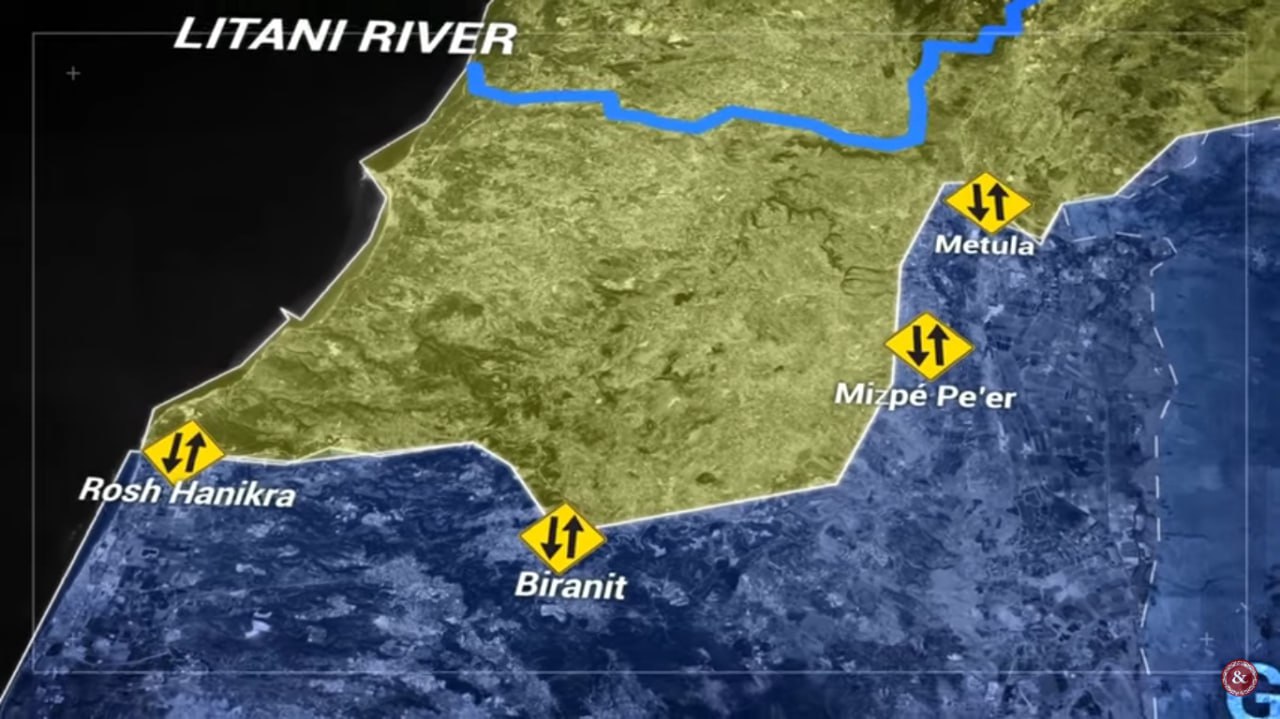
    Some Israeli political and military officials talk about military operations to push Hezbollah back behind the Litani River. But the Israeli regime knows very well that it cannot attack Lebanon by land and has to make do with airstrikes.

    Litani River in South Lebanon

    One of the primary challenges for the Israeli army in conducting a ground invasion of Lebanon is the limited number of passages available for infantry and armored vehicles to enter the country. There are primarily four crossing points for ground forces, many of which are situated in hilly and densely forested areas. The mountainous terrain in southern Lebanon provides Hezbollah with advantageous positions for ambushing the Israeli army.

    The 33-day war is a clear example of what is ahead of the Israeli army. The defeat of the armored and infantry forces of the Israeli army in southern Lebanon will be certain.

    Yesterday, a Lebanese channel, quoting Hebrew channels, stated that Amos Hochstein, the special adviser and special envoy of the US President in Lebanon, informed the Israeli authorities that any attack on Beirut and Dahiya would be countered by Hezbollah’s attack on Ghosh Dan and Jerusalem.

    Lebanon’s Hezbollah has also clearly stated that it will respond to any attack by the Israeli regime on Lebanon with a harsh response.

    The Islamic resistance groups in the region have also supported the Lebanese resistance in separate messages and said that in case of any attack by the Israeli regime on Lebanon, military operations against Israel will be intensified.

    Even according to reports, some Iraqi resistance groups have stated that they will send troops to southern Lebanon if the war starts in Lebanon.

    While diplomatic efforts to prevent war continue, 14 countries have asked their citizens to leave Lebanon or refrain from traveling to it. Lufthansa Airlines and its subsidiaries have suspended flights to/from Beirut until August 5.

    In any case, it seems highly unlikely that the start of a new war in Lebanon will assist the Israeli regime in solving its problems. The Israeli regime’s political and war strategies have not changed over the past decades, but the military and regional conditions of Hezbollah in Lebanon have significantly changed, and they are now much more equipped and capable than before.

    In other words, Israel may be able to start a new war, but the decision to withdraw from it and the consequences of the war will be beyond Israel’s control. Hezbollah is not as besieged as the Palestinian resistance groups in the Gaza Strip and possesses impressive capabilities to surprise Israel. Perhaps, after the start of the new war, Israel may have to make significant concessions to end the conflict, in contrast to its actions in the Gaza Strip and violation of ceasefire agreements.

    Posted in SF

  • Israeli Forces Intercept Drone Targeting Gas Field In Mediterranean Sea (Video)

    Israeli Forces Intercept Drone Targeting Gas Field In Mediterranean Sea (Video)

    According to media reports, the drone attack was carried out at dawn Tuesday from Lebanon.

    This marks the Lebanese resistance movement Hezbollah’s second drone attack in the Mediterranean Sea, with the apparent intention of targeting the Israeli regime’s gas fields in the region.

    Hezbollah drone destroyed over the Mediterranean Economic Zone

    The Israeli regime’s army believes the interception of this drone foiled a potentially devastating attack on the gas field.

    Israeli officials have started carrying out investigations into the incident and are on high alert for any further threats from Hezbollah in the region.

  • Israeli Drone Strikes In Southern Lebanon Leave 5 Injured, 2 Dead

    Israeli Drone Strikes In Southern Lebanon Leave 5 Injured, 2 Dead

    In southern Lebanon on early Monday, Israeli drone strikes killed two people and injured five others, targeting both a car and a motorcycle.

    Lebanon’s official National News Agency reported that the drone first hit a car on the road between the towns of Mays al-Jabal and Chaqra, causing two injuries.

    Aftermath of Israeli airstrike

    A subsequent strike on a motorcycle along the same route near Dubayeh Castle resulted in two fatalities and three additional injuries. A child among the injured is in critical condition, according to the news agency.

    A child severely injured by Israeli airstrikes

    Lebanon’s rescue teams immediately transported the injured to Tebnine Governmental Hospital.

    The Israeli regime’s army has not yet released an official statement regarding the attacks, but they follow a pattern of escalating tensions between Israel and Hezbollah forces in southern Lebanon.

    As the situation develops, the local population is on high alert, fearing potential reprisals and further military action. The international community continues to closely monitor the events in the region, with calls for restraint from both sides amidst growing concerns of an all-out conflict.

  • Objectives, Consequences Of Possible Israeli Attack On Lebanon

    Objectives, Consequences Of Possible Israeli Attack On Lebanon

    Whenever public opinion in the world is focused on a place, the best conditions are provided for the implementation of grand plans, like a magician who draws the minds and senses of the audience to one side with one hand and executes his magic with the other. We are now at a time in history when the West Asia region is prone to great events. The 2024 Olympics in France have attracted the attention of the world and the media, providing the necessary breathing space for the Israeli regime to launch a military attack on Lebanon. A few days have passed since the visit of the prime minister of the Zionist regime to the United States, and speculation is growing about the goals of this trip. From influencing the US presidential elections to receiving financial and military aid, and most importantly, coordinating with the US to launch a military attack on Lebanon’s soil.

    It should be mentioned that in a military battle, more important than the subject of the war itself is the answer to a few basic questions. Questions that determine the beginning, duration, type, level, and end of a war. What is the purpose of the war? What is the way out of the war? What will be the consequences of war for both sides of the conflict? And… If Israel also starts a war against Hezbollah, it will have no choice but to answer these questions. What we are looking for in this article is to provide a general picture of the possible answers to these questions.

    As for the goals of the Israeli regime in this attack, it is certainly not possible to mention a single goal and suffice with that, because basically the realization of the goals is subject to conditions that make it possible to achieve them with ifs and buts. Inevitably, the initiators of conflicts always try to define a range of goals and seek to achieve the maximum of them, and if – for any reason – the maximum goal is not achieved, the other goals are expected to be achieved.

    The most important and maximum objective of the Israeli regime in the fight against Lebanon is the annihilation of the Lebanese Hezbollah. However, it should be noted that this objective cannot be achieved in any way. First, Hezbollah, beyond its military wing, is considered a deep-rooted intellectual and ideological movement in Lebanon, which even beyond the Shia community, has strong supporters in Lebanon among other religions, tribes, sects, etc. As a result, it is not possible to imagine a future for the destruction of a popular and ideological movement by relying on military means.

    From a military perspective, after 10 months of military warfare with its advanced and regular war machine, the Israeli regime has not yet succeeded in destroying the military and combat capabilities of the Palestinian Hamas movement in the Gaza Strip. It is a very small strip that has been surrounded by 360 degrees for many years and is located in a flat geography. The geography that is the most desirable place for the military operations of a well-organized and well-equipped army.

    Now, taking into account the border geography of Lebanon and the Israeli regime, which is mountainous, it can be assumed that the plan of militarily destructing the Hezbollah movement is nothing more than a dream, and the Israeli army will not be able to destroy a tried and tested guerrilla force with all its might. Israel will fight fighters who have decades of experience in a variety of desert, urban and mountainous confrontations, from urban and mountainous battles and the Lebanese plains to later breathtaking fights in the deserts, cities and mountains of Syria.

    Due to its lack of population and lack of geographical depth, the Israeli regime has focused on armor and air power. Both powerful arms of Israel will not be effective in a military conflict with Hezbollah. The Hezbollah movement is equipped with a variety of modern anti-armor weapons, and Israel’s armor in the plains and mountains of Lebanon will be only easy prey, as in the past 10 months, when every movement of the Israeli army in the Lebanese border line has been targeted. The air force of the usurping regime will also not be able to provide effective air support to the armored columns, because there are basically no visible military targets to destroy and bomb in the confrontation against guerrilla groups. From a military point of view, the destruction of Hezbollah is the maximum and at the same time the most unattainable objective for the Israeli regime.

    Another goal of the Israeli regime is to keep Hezbollah fighters away from Israel’s borders so that Israel can reorganize the ordinary lives of its displaced people in the north in light of the decline of the daily attacks on the north of occupied Palestine. This goal has been repeatedly expressed as the demand of the occupying regime, and international and Lebanese officials have been asked to help withdraw Hezbollah fighters to the back of the Litani River. This is not a maximum goal, but it remains to be seen whether it can be achieved or not. From a military point of view, it should be said that the retreat of Hezbollah’s guerrilla forces, which used a vast network of caves, tunnels, concrete positions, etc. is almost impossible. The experience of the world’s great armies proves this, and where the Red Army of the former Soviet Union in Afghanistan and the advanced and large American army in Korea, Vietnam, Afghanistan, and Iraq have been unable to achieve this objective, the small army of Israel will not be able to do so.

    But from another perspective, it is possible to realize this issue. The Israeli regime army’s main strategy is to rely on the destructive capability of the air force’s heavy and ultra-heavy munitions. In the first stage, the Israeli Air Force will brutally bomb all Lebanese military and infrastructure targets. The purpose of this is to increase pressures on the livelihood and lives of the Lebanese people in order to mount pressure of public and political opinion on Hezbollah and to force the Lebanese resistance movement to accept Israel’s conditions. On the other hand, the destruction of Lebanon’s infrastructure, which means the beginning of a period of post-war reconstruction, and naturally, governments that are engaged in providing infrastructure and development funding will not pose a serious threat to their neighbors. If this stage does not lead to the realization of Israel’s demands, in the second stage, the Zionists will start the equation of mass murder. The regime’s goal in killing people is to force the other side to surrender. But now, this equation is not one-sided, and the resistance is capable of implementing both of these methods.

    Addressing the consequences of the conflict is also an important part of the equation of war. On the one hand, Lebanon will be subjected to a heavy Israeli invasion and will certainly suffer a lot of losses. However, according to military analysts, Hezbollah is armed with highly accurate tactical missiles and a vast drone capability that is capable of accurately destroying any target in the small geography of occupied Palestine. As a result, if the Israeli regime starts a war on infrastructure or a genocide, Hezbollah will also be able to target Israel’s public and service infrastructure. Such a war would also be very deadly for Israel. At the same time, if Hezbollah has been able to acquire effective air defense systems in the past years, which is not unexpected, the Israeli regime’s war machine will also be contained in the sky to some extent, which will mean the complete failure of Israel’s military strategy.

    Hezbollah has made the necessary preparations to destroy the armored power of the Israeli regime, as the strength of the Israeli ground forces, and it has sufficient and effective weapons, but the containment of the air force is an undeniable necessity. Targeting Israeli airports does not seem to stop the air force’s activity, as Israel has designed the highway network in such a way that it can be used as an airport, assuming that it is possible to attack airports in future battles. In fact, Israel is a large military garrison. The most effective way for Hezbollah to change the balance of the confrontation is to stop Israeli attacks and force Israel to accept the terms of resistance, which is to strike at Israel’s public and service infrastructure. Concerning targeting military and commercial fleets at sea – Hezbollah is well capable of doing so – and destroying power plants, refineries, silos, and food warehouses, etc. Israel will be under a real siege and will be completely paralyzed.

    It seems that the Israeli regime is muddled about the initiation of war against Lebanon. The regime’s political and war strategies have not changed over the past decades, but the regional and military conditions of Israel’s enemies have undergone a serious change, and the resistance in the region has become highly equipped and capable. Under these conditions, Israel can start a war, but it does not have any plan to get out of it, and it may not achieve its goals, but it would also be forced to accept numerous demands.

  • The Voice Of Palestine Is Getting Louder In The West

    The Voice Of Palestine Is Getting Louder In The West

    While civil society and party activists in the Arab world have chosen the path of rallies, which, in their opinion, is enough to support Palestine, rapid changes are taking place in Europe.

    Paradoxically, but the fact remains that the Hamas operation “Flood of al-Aqsa” (Al-Aqsa Storm) did not awaken the Arab peoples from a flawed sleep, but civil society activists of various ideologies in the United States and Europe.

    Students in the United States still remain an influential pro-Palestinian force, while in the EU, in addition to the call from major political parties for the need to decolonize Palestine, resistance groups have emerged whose goal is to stop military support for the Zionists.

    Intellectual circles also did not stand aside and there is an example of France, where a local political scientist immediately supported the Palestinians, for which he was subjected to pressure from the Zionist lobby.

    Of course, against the background of powerful pro-Palestinian activity, the forces of evil, led by the Zionist lobby, are making a variety of efforts to prevent the truth from being heard. Moreover, we must not forget about the allies of Zionism in the camp of the European bureaucracy, which still supports the genocide of the Palestinians.

    In general, we see how the Palestinian issue has become the main topic of discussion in European capitals. Personally, I associate what is happening with the recognition of the fact of the collapse of Zionist imperialism and the willingness to rethink the foreign policy vector.

    The collective West, in an attempt to preserve the Zionist colony, got bogged down in the Middle East and had no other choice but to reduce its military presence in the Islamic environment to zero.

    Moreover, against the background of what is happening in Ukraine, the leading EU countries, Britain and the United States, due to ideological, economic and geopolitical reasons, simply cannot allow Kiev to defeat, but there is still a frozen conflict in Transnistria, a “crisis of democracy” in Georgia and the last “Soviet stronghold” in the person of Belarus. In all these countries, the influence of the Kremlin looms, and in the long term – China, respectively, the titans of Atlanticism do not want to fight with all at once, and even more so to endlessly risk in the name of a lame horse (Zionism). Therefore, the leading Think-tank of the West decided to gradually move away from the alliance with the right-wing Zionists and immerse themselves in the internal affairs of Europe.

    In conclusion, I would like to point out that unfortunately, at the moment there is no partisan activity from the majority of EU Muslims by analogy with British left-wing groups, but there is at least political activity (again, only in Britain and partly in France). Over time, Muslims will show more efforts and even get a chance to enter the European Parliament, so it’s worth thinking about the future now, for example, about developing a common ideology and a mechanism for persecuting Zionists around the globe.