Tag: Kurdistan region

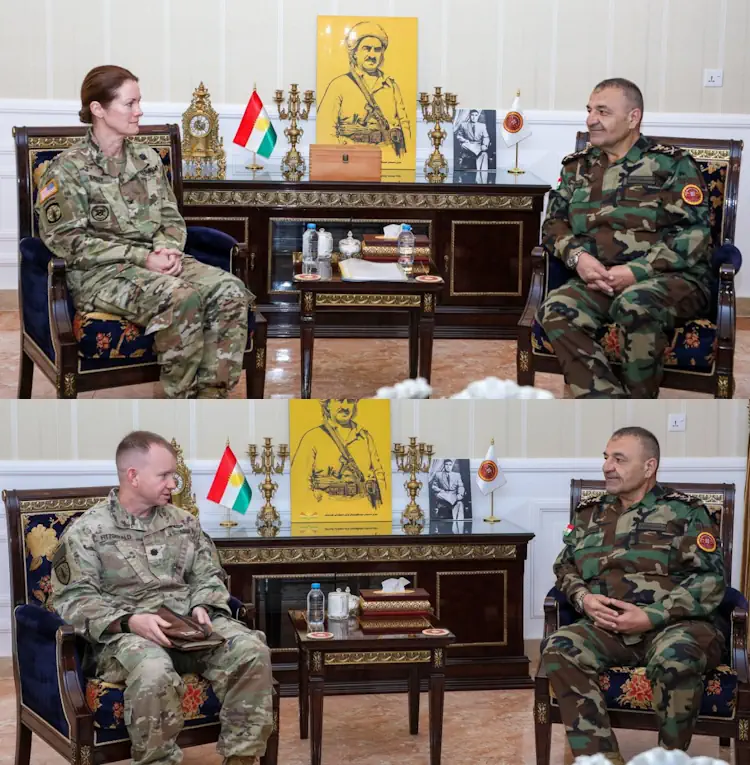
  • Deployment of U.S. Airborne Divisions in Iraqi Kurdistan: A Serious Warning for Iran

    Deployment of U.S. Airborne Divisions in Iraqi Kurdistan: A Serious Warning for Iran

    The significance of this meeting lies in the context of the recent 12‑day war, after which speculation has grown about potential heliborne operations by the U.S. and Israel inside Iran—given the failure to achieve objectives through airstrikes alone.

    American activity in Iraqi Kurdistan has visibly increased, including visits to border areas with Iran and patrols in mountainous regions alongside Peshmerga commanders. Meanwhile, Iran’s armed forces have conducted military exercises in recent weeks to counter infiltration and heliborne operations, testing air defense systems to strengthen rapid response capabilities against threats to vital facilities, strategic infrastructure, and sensitive sites.

    Regional analysts suggest that if long‑range strikes prove insufficient, Washington may consider hybrid options such as limited airborne operations. Although not officially announced, the rise in U.S. heliborne drills and simultaneous Iranian defensive exercises reinforce this speculation. Iran’s anti‑heliborne maneuvers signal preemptive readiness to confront possible threats. Iran’s armed forces have recently conducted military exercises to counter infiltration and heliborne operations, testing air defense systems during these drills.

    The 12‑day war demonstrated that long‑range bombardments, despite their intensity, did not fully destroy Iran’s underground infrastructure. Western analysts argue this limited strategic effect could drive complementary scenarios. In this framework, rapid, surprise airborne operations are examined as theoretical alternatives—not aimed at occupation, but at creating strategic disruption.

    In such scenarios, potential targets could include missile infrastructure, command centers, and even key specialists in sensitive fields—highlighting the strategic weight of airborne units in U.S. military planning.

  • President Of Kurdistan Region Of Iraq Met With Commander Of Islamic Revolution Guards Corps

    President Of Kurdistan Region Of Iraq Met With Commander Of Islamic Revolution Guards Corps

    Nechirvan Barzani, the President of the Kurdistan Region of Iraq, met and held talks with Major General Hossein Salami, the commander-in-chief of the Islamic Revolution Guards Corps, in Tehran on May 7.

    In this meeting, the two sides reviewed the relations between Iran and Iraq, especially the Kurdistan Region, particularly in the security field, and they emphasized the importance of further strengthening coordination and increasing cooperation to maintain security and stability on the borders as well as confront security threats.

    The two sides also held talks on the impacts and consequences of the war in the West Asia region and agreed that regional countries should act to preserve stability in this region.

    It is worth noting that the president of the Kurdistan Region of Iraq arrived in Tehran at the head of a high-ranking delegation three days ago, on May 5. Barzani had met with Leader of Iran’s Islamic Revolution Ayatollah Seyyed Ali Khamenei and President Ebrahim Raisi during this visit to Tehran.

    A picture of Nechirvan Barzani’s meeting with Imam Khamenei, the leader of the Islamic Revolution of Iran
  • US Congress Ratifies Plan To Equip Iraq Kurdistan With Air Defense System

    US Congress Ratifies Plan To Equip Iraq Kurdistan With Air Defense System

    ISWNews Analysis Group – The Armed Services Committee of the US House of Representatives approved the amendment, which was proposed by Dan Bacon, on June 21 during the vote on the “National Defense Authorization Act for Fiscal Year 2024”.

    According to Bacon, the amendment enjoys strong bipartisan support and requires the US government’s attempt to prepare and implement a program to train and equip the Iraqi Kurdistan forces in the face of missile, rocket and drone attacks from Iran.

    In response, Iraqi Member of Parliament Jassim Al-Moussawi stated that providing air defense arms to the Peshmerga forces (Kurdish military forces of the autonomous Kurdistan Region of Iraq) is contrary to international law. The MP noted that any internal party or group in Iraq does not have the right to directly engage in sovereignty matters with other countries without informing and involving the central government. Therefore, the decision to arm the Iraqi Kurdistan region is tantamount to interfering in the country’s internal affairs, he added.

    It is worth mentioning that the US has always opposed the Iraqi army’s access to advanced air defense systems to be able to repel foreign attacks.

    The agreement between the US and Iraq’s Kurdistan region, which was made without informing the Baghdad government, sparked several reactions, and some Iraqi legislators expressed criticism, stating that Washington’s decision is translated into violating Iraq’s independence and undermining its internal security.

  • Are Iran’s armed forces on the brink of a new round of attacks on terrorist groups in Iraqi Kurdistan region?

    Are Iran’s armed forces on the brink of a new round of attacks on terrorist groups in Iraqi Kurdistan region?

    Following recent warnings to Iraqi officials, which were made by Commander of the Islamic Revolution Guards Corps’ ground forces Major General Mohammad Pakpour concerning the terrorist groups based in Iraq, the IRGC’s movements and deployments on the western borders of the Islamic country have been intensified.

    The movements are taking place while Iraq’s National Security Advisor Qasim Al-Araji, heading a security delegation to review actions related to the implementation of the security agreement between Iran and Iraq concerning border security, entered Sulaymaniyah in Iraqi Kurdistan on May 27 and then the Iraqi official held talks with Secretary of Iran’s Supreme National Security Council Major General Ali Akbar Ahmadian two days later during a trip to capital Tehran.

    Read more: Iraqi, Iranian Top Security Advisors Meet In Tehran

    Al-Araji emphasized Iraq’s commitment to the security agreement signed with Iran during his meeting with Ahmadian, stating that he considers Iraq’s security to be Iran’s one and vice versa.

    However, it seems that the deadline that Iran determined for Iraq is coming to an end and the issue may have been underscored in Ahmadian and Al-Araji’s recent meeting.

    A number of video footages as well as images circulated on social media networks show that the Islamic Republic of Iran’s armed forces are transferring artillery arms to the western areas of the country and the issue indicates the imminent occurrence of possible operations by Iran’s armed forces against terrorist groups based in Iraq’s Kurdistan region.

    The Democratic Party of Iranian Kurdistan (HDKA), the Kurdistan Free Life Party (PJAK), the Komala Party of Iranian Kurdistan (Komala), and the Kurdistan Freedom Party (PAK) are among the major separatist and terrorist groups that operate on the eastern borders of Iraqi Kurdistan region, and they have been focusing on raiding Iran’s national security for a long time.

    Read more: Iran’s warning to Iraq: Remove the terrorist groups from the Kurdistan Region!

    It is worth mentioning that Iran’s armed forces pounded hideouts of a terrorist group on the outskirts of Koy Sanjaq in the south of Sulaymaniyah and the heights of Sidakan mountainous area in Iraqi Kurdistan region by the use of missiles and drones on November 14, 2022, when at least two militants of the Democratic Party of Iranian Kurdistan were killed and 10 others were wounded.

    Following the developments, Iran and Iraq reached an agreement regarding the expulsion of the mentioned terrorist groups from the borders of Iraqi Kurdistan region and Baghdad promised to cooperate in this respect.

    Since then, the Iraqi government has tried to take practical steps to fulfill its promises under the agreement; however, the pace of the actions seems to be very slow and insufficient. Thus, if the ongoing trend continues, it is possible that Iran will independently carry out another military operation to cleanse the hideouts of the terrorist groups from the border areas of the Iraqi Kurdistan region.

    Read more:
    Iranian missiles pounds terrorist positions in Kurdistan region!
    Iran missile and drone attacks on terrorist groups in Iraq’s Kurdistan + Video

    The transfer of weapons to the western borders by the Iranian army
    Click to view full size
  • Three rocket attacks on the Khor Mor gas field in 72 hours!

    Three rocket attacks on the Khor Mor gas field in 72 hours!

    The attacks took place on June 22, 24 and 25. According to available information, these attacks did not cause severe damage.

    The Sulaymaniyah Counter-Terrorism Directorate also confirmed the rocket attack, saying that the gas field had been targeted by six rockets.

    Qubad Talabani, the Deputy Prime Minister of the Kurdistan Region, visited the Kormor gas field after the rocket attacks and visited different parts of the complex. “We seek to save the lives of the field staff and work with the Iraqi federal government to prevent the rocket attacks on Kurdistan Regional Government facilities,” he said.

    No group has claimed responsibility for the attacks, but some sources claimed that Iraqi resistance groups were responsible for the rocket attacks. On the other hand, Jafar al-Husseini, a spokesman for the Kataib Hezbollah, blamed groups linked to the Turkish intelligence service for the attacks. He called on the popular mobilization organization (PMU) to identify and detain these individuals and provide them to the Iraqi judiciary.

    The Iraqi Resistance Coordinating Committee also called the attack on some companies in Sulaymaniyah a sabotage by foreign parties hostile to the Iraqi people.

  • Video: The moment that Deputy of Turkish Consulate in Erbil was killed by 3 gunmen.

    Video: The moment that Deputy of Turkish Consulate in Erbil was killed by 3 gunmen.


    So far, 2 gunmen were arrested by Kurdistan region security forces.