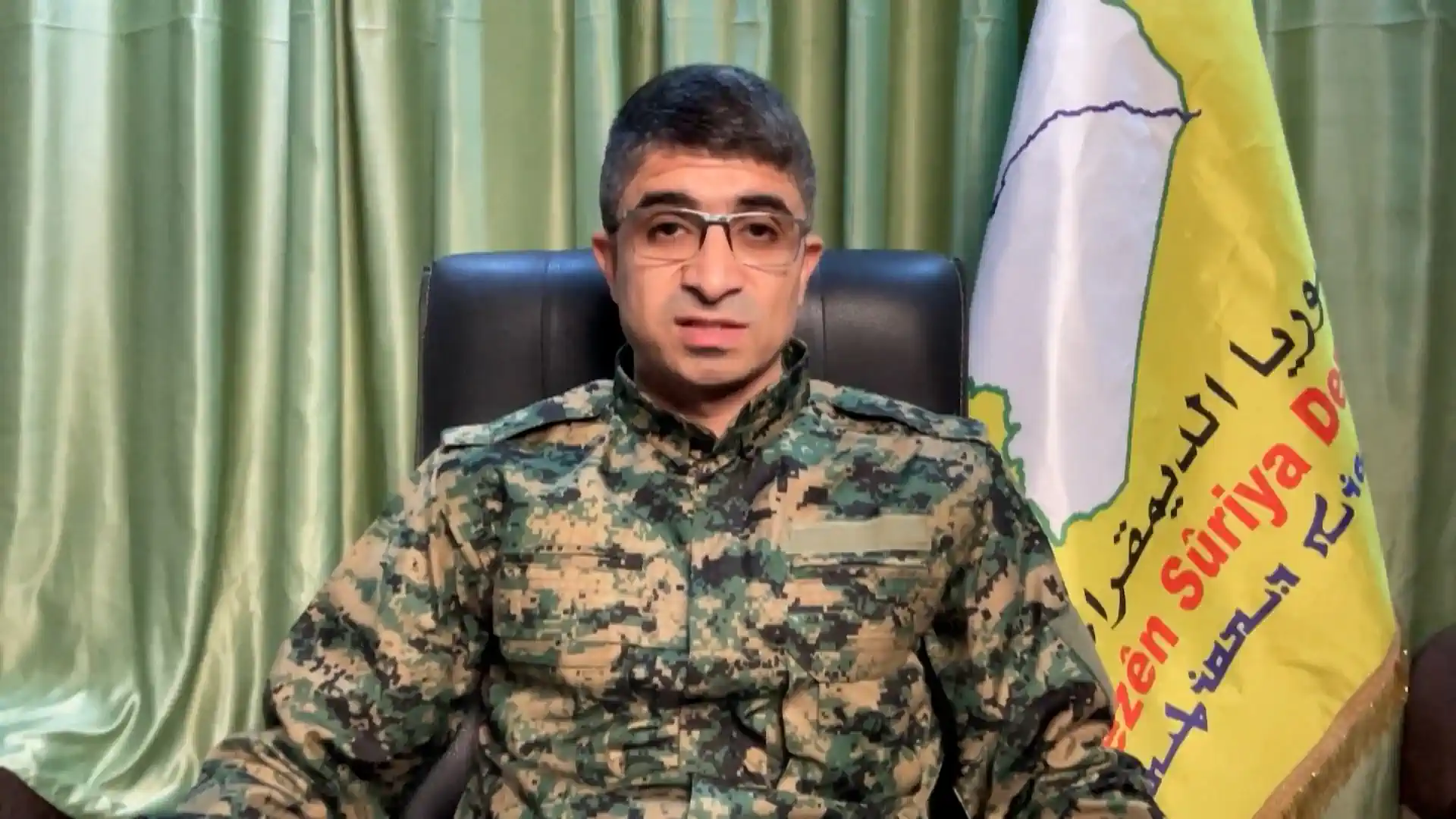
Tag: SDF

  • Talks Between SDF and Damascus to Be Held in Palmyra

    Talks Between SDF and Damascus to Be Held in Palmyra

    Sources close to the Syrian government report that the SDF has expressed initial readiness to withdraw from Raqqa and Deir ez‑Zor, though some commanders remain unwilling to retreat from the contested areas.

    The presence of ISIS detainees in SDF‑controlled territories is cited as the main obstacle to progress in the negotiations.

    Details of the talks will not be made public, as discussions are being held behind closed doors. Given the unresolved challenges, the negotiations are expected to continue until January 4.

  • Thousands of Former Syrian Army Officers Join SDF

    Thousands of Former Syrian Army Officers Join SDF

    This development has not only altered the military and security balance in Syria but also introduced new complexities to the future process of integrating the SDF into the structure of a new Syrian state.

    The report also highlights the frequent flights of Russian helicopters at Qamishli Airport, noting that these flights coincided with the transfer of Assad government officers to Syria’s coastal regions—an indication of emerging indirect coordination between Russia, the SDF, and groups aligned with Assad’s government.

    This strengthens the assumption that Moscow plays a hidden yet active role in this movement. Since its military intervention in Syria, Russia has sought to maintain influence on both sides of the Euphrates equation—supporting Assad’s forces while also engaging with the SDF.

    The primary driver behind this large-scale defection is economic motivation. The stark difference between the salaries of military personnel under Assad’s government and those offered by the SDF demonstrates that eastern Syria has become a hub for attracting economically vulnerable soldiers. Oil revenues from the region provide the financial means to sustain these payments, while former regime forces, seeking livelihood security and distancing themselves from the violence of Julani’s elements, gravitate toward the dominant power in the area.

    This trend underscores that the war economy remains the decisive factor shaping the orientation of armed forces in Syria.

  • SDF Affirms Decade-Long Partnership with U.S. Coalition

    SDF Affirms Decade-Long Partnership with U.S. Coalition

    He emphasized that cooperation between the SDF and the coalition has lasted for nearly a decade; there has been no withdrawal and no compromise, but rather the partnership has been consolidated in a stronger form. He described the continuation of this cooperation as a strategic necessity both domestically and internationally, rooted in mutual trust and sacrifice in the fight against terrorism.

    Shami’s recent remarks about the ongoing presence of the U.S. coalition in Syria are a clear indication of Washington’s entrenched strategy in the north and east of the country. Contrary to some analyses suggesting a gradual American withdrawal, the reality on the ground points to reinforced military bases, increased joint patrols, and continued arms support for the SDF.

    His comments show that, despite political pressure and security threats from Turkey and the Julani-led administration, the SDF still defines itself firmly within the framework of international coalition support.

  • Verbal Agreement Between SDF and Damascus: New Steps Toward National Reconciliation

    Verbal Agreement Between SDF and Damascus: New Steps Toward National Reconciliation

    According to Abdi, these talks led to a verbal agreement on several sensitive issues, including a full ceasefire and the continuation of dialogue. Abdi emphasized that he held separate meetings with Syria’s defense minister and intelligence chief, reaching mutual understanding on certain topics.

    He also announced preliminary coordination regarding the integration of SDF forces into the Syrian army’s structure, noting that Damascus is interested in utilizing the SDF’s experience in security and military affairs. Accordingly, a military committee composed of representatives from the “Internal Security Forces” is expected to be dispatched to Damascus soon to discuss the details of this process.

    On the military front, Abdi revealed that the United States proposed forming a joint force between the SDF and the Syrian army to combat ISIS—a proposal welcomed by Syrian parties. He described this initiative as a unified national step against terrorism.

    Politically, discussions are underway to incorporate the terms of the “March 10 Agreement” into the draft of Syria’s new constitution. Abdi stressed that Raqqa, Deir ez-Zor, and Hasakah will be part of the country’s future governance framework, and withdrawal from these areas is a red line for the SDF.

    On the humanitarian side, he called on residents of Afrin, Ras al-Ayn, and Tal Abyad to prepare for returning to their homes, and emphasized the importance of implementing the April 1 agreement concerning the Sheikh Maqsoud and Ashrafieh neighborhoods in Aleppo.

    These negotiations may represent an initial step toward resolving the crisis between Damascus and the autonomous administration. The emphasis on a “Syrian-Syrian” solution without direct foreign military intervention reflects both sides’ desire to avoid a prolonged conflict. Integrating the SDF into the Syrian army could be a chance for national unity, but also poses practical challenges due to ideological, structural, and political differences between the two sides.

    Overall, recent developments signal the beginning of a new round of talks and a redefinition of the role of non-state actors within Syria’s political-military framework. While much remains before a final agreement is reached, the current verbal understandings could lay the groundwork for lasting peace in northern Syria—provided there is sufficient political will and enforceable guarantees.

  • U.S. Senate Approves $130 Million to Support SDF and Free Syrian Army

    U.S. Senate Approves $130 Million to Support SDF and Free Syrian Army

    The new bill, estimated at around $925 billion, was approved with 77 votes in favor and 20 against. It allocates $65 million for salaries, $15.6 million for training and weapons, $32.4 million for logistical assistance, $15.3 million for maintenance of vehicles and facilities, and $1.5 million for operational services.

    The new funding for the SDF and Free Syrian Army indicates that the United States does not intend to retreat from its policy of support for non-state actors in Syria. The budget approval may be interpreted as a message to Turkey and the Syrian government. Turkey has consistently labeled the SDF as an extension of the PKK and criticized Washington’s military cooperation with the group.

    Direct funding for the SDF and Free Syrian Army reflects America’s effort to strengthen these groups as its allies in Syria. Overall, the Senate’s decision not only signals continued U.S. military presence in Syria but also shows Washington’s intent to maintain—and even expand—its influence in Syria’s political and battlefield dynamics in 2026. This path could bring new challenges for Syria and the broader West Asia region.

  • Tripartite Meeting in Damascus: Al-Jolani Meets SDF Commander and U.S. CENTCOM Commander

    Tripartite Meeting in Damascus: Al-Jolani Meets SDF Commander and U.S. CENTCOM Commander

    A key focus of the meeting was the implementation framework of a recent agreement between al-Jolani’s administration and the Syrian Democratic Forces (SDF), with both sides emphasizing Syria’s territorial integrity and national sovereignty.

    Simultaneously, an SDF delegation led by Mazloum Abdi arrived in Damascus to discuss the political transition process and security challenges in northeastern Syria with senior Syrian officials.

    The concurrent presence of the U.S. envoy and the SDF commander in Damascus signals a coordinated push between Washington and Damascus toward a new political roadmap. This meeting is one of the few high-level meetings between the Syrian presidency, US representatives and the commanders of the Syrian Democratic Forces; this meeting could initiate a new phase of talks between the main actors in the Syrian crisis.

  • Aleppo on Edge: Ceasefire Pauses Armed Clashes

    Aleppo on Edge: Ceasefire Pauses Armed Clashes

    Earlier, the Syrian Army uncovered and destroyed a tunnel between Ashrafiyeh and al-Sabeel neighbourhood, suspected of being used for smuggling weapons or sabotage. In response, Syrian security forces set up checkpoints around the area to prevent further SDF infiltration.

    Read: Clashes Between Syrian Army and SDF in Eastern Aleppo

    Despite heightened security, SDF fighters disguised as civilians attacked government checkpoints, killing one and injuring three. The Syrian Army deployed reinforcements, and SDF retaliated with mortar strikes on parts of Aleppo.

    Sources close to the Jolani-led administration confirm that while fighting has stopped, tensions remain high. Damascus has conditioned talks on the full withdrawal of SDF forces from Ashrafiyeh and Sheikh Maqsoud, the handover of wanted individuals, and restoration of full government control.

    Unofficial reports suggest a possible U.S.-brokered meeting between Syrian officials and SDF representatives to explore integrating SDF units into Syria’s Ministry of Defense and transferring control of eastern Euphrates regions to the central government.

  • Clashes Between Syrian Army and SDF in Eastern Aleppo

    Clashes Between Syrian Army and SDF in Eastern Aleppo

    SDF media claimed residential areas were also shelled, accusing the Syrian Army of destabilizing northern and eastern Syria. In response, Syria’s Defense Ministry denied the allegations, stating it only targeted SDF positions in Hmimeh and Al-Qayta villages and exercised restraint.

    Clashes remain active around Deir Hafer and Tishrin Dam. Reports indicate SDF reinforcements from Hasakah and deployments by pro-Julani forces to contact zones in Aleppo.

    The recent escalation highlights fragile security in northern Syria. The March 10 agreement between Damascus and the SDF aimed to reduce tensions, but ongoing field developments suggest the deal lacks enforcement and trust mechanisms—raising fears that minor skirmishes could spiral into full-blown conflict.

  • Elements of Al-Julani Enter Tishrin Dam; SDF Forces Retreat

    Elements of Al-Julani Enter Tishrin Dam; SDF Forces Retreat

    Local sources report that at the same time Al-Jolani forces entered the Tishrin Dam, a delegation from the American coalition and the SDF also visited the area and met with Syrian commanders before departing.

    In his first statement following the entry of Al-Julani forces, SDF Commander-in-Chief Mazloum Abdi said, “The agreement regarding the Tishrin Dam has two parts. The first part concerns the dam itself. We have agreed with Damascus that the management and personnel of the dam will remain unchanged. The SDF forces will withdraw from the dam and relocate to the eastern areas. Our forces will hand over their positions to Damascus forces, which will act as a buffer between our forces and the Syrian National Army.”

    According to the agreement between the Al-Jolani government and the SDF, the Tishrin Dam has been officially designated as a neutral zone. The gradual reduction of SDF forces and Jaysh al-Watani militants (Syrian National Army – SNA) on both sides of the dam will begin immediately. SNA militants will withdraw from the western outskirts of the dam and be replaced by forces affiliated with Al-Julani. On the eastern side, the dam facilities will be secured by SDF forces.

    It is important to note that the Tishrin Dam has experienced intense clashes between SDF forces and SNA militants over the past four months. These clashes continued even after the agreement reached by SDF Commander-in-Chief Mazloum Abdi and Syrian President Ahmed al-Sharaa aslo known as Abu Muhammad al-Julani. However, the exchange of fire between the two sides has decreased significantly and completely stopped in recent days, following mediation efforts by the United States, Turkey, and Damascus.

  • Agreement Between the Kurds and the Syrian Government: SDF Forces Withdraw from Aleppo

    Agreement Between the Kurds and the Syrian Government: SDF Forces Withdraw from Aleppo

    Following the onset of armed clashes in Aleppo, prior to the collapse of Bashar al-Assad’s government, a contingent of the Syrian Democratic Forces (SDF) was deployed to the Sheikh Maqsoud and Ashrafiyah neighborhoods, where the majority of residents are Kurds.

    After the fall of Assad’s regime and the city’s capture by Tahrir al-Sham and its allies, the SDF maintained their presence in these areas and engaged in ongoing clashes with militant groups. Consequently, Sheikh Maqsoud and Ashrafiyah have experienced numerous armed confrontations in recent months. However, these clashes have significantly decreased following an agreement between Mazloum Abdi and Abu Muhammad al-Julani.

    With tensions lowered and clashes ceased, members of the Civil Council representing Sheikh Maqsoud and Ashrafiyah neighborhoods held a meeting with representatives of the Syrian government. During this meeting, the parties signed an agreement consisting of 14 clauses regarding the status of the aforementioned neighborhoods.

    Image of the agreement between the SDF and the Syrian government

    The provisions of the agreement are as follows:

    1. Neighborhood Status: Sheikh Maqsoud and Ashrafiyah are recognized as part of Aleppo city and are administratively affiliated with it. Ensuring the protection of both neighborhoods is essential for promoting peaceful living.
    2. Temporary Nature: This agreement is temporary and will remain in effect until a permanent arrangement is established by joint committees.
    3. Security Responsibility: The Syrian Ministry of Interior and the Internal Security Forces will be responsible for the protection of these neighborhoods.
    4. Weapon Prohibition: To maintain security and tranquility, carrying weapons within these neighborhoods is prohibited. Only the Internal Security Forces under the oversight of the Syrian Ministry of Interior are authorized to possess weapons.
    5. Public Road Access: All public roads will remain open, and the main checkpoints will be controlled by the Syrian Internal Security Forces until conditions stabilize in these neighborhoods.
    6. Withdrawal of Armed Elements: Armed elements present in Sheikh Maqsoud and Ashrafiyah must withdraw to areas east of the Euphrates River.
    7. Establishment of Security Centers: Two centers affiliated with the Syrian Internal Security Forces will be established in the Sheikh Maqsoud and Ashrafiyah neighborhoods.
    8. Freedom of Movement: Residents of these neighborhoods will be allowed free movement, and no one not involved in crimes against Syrians should be detained.
    9. Coordination Committee: A coordination committee will be created to facilitate movement between Aleppo city and the northern and eastern regions of Syria.
    10. Implementation Committees: Committees will be established in both neighborhoods to oversee the implementation of this agreement.
    11. Civil Institutions Coordination: All civil institutions in these neighborhoods will coordinate with other civil entities. They will assist other institutions and provide services through the two branches of the Sheikh Maqsoud and Ashrafiyah municipalities, without discrimination.
    12. Prisoner Release and Exchange: Prisoners from both sides will be released, and all individuals detained after the liberation of the city will be exchanged.
    13. Representation in Local Governance: Representatives from Sheikh Maqsoud and Ashrafiyah will participate in the Aleppo Governorate Council, the Chamber of Commerce, and all other relevant departments in accordance with existing laws.
    14. Continued Operation of Local Councils: All service, executive, educational, municipal, and local councils in these neighborhoods will continue to function until a permanent agreement is finalized by the joint committees.

    In accordance with the sixth provision of the agreement, the withdrawal of the Syrian Democratic Forces from Sheikh Maqsoud and Ashrafiyah began yesterday, with the SDF leaving the neighborhoods armed. Furthermore, as stipulated in the twelfth clause, a total of 146 prisoners from Sheikh Maqsoud and Ashrafiyah, along with 97 individuals affiliated with the Syrian government, were released by both sides.

  • SDF Rejects New Syrian Government’s Proposals

    SDF Rejects New Syrian Government’s Proposals

    The new government’s proposals for the SDF included “recognizing the cultural rights of the Kurds and incorporating them into the future constitution, facilitating the integration of SDF forces into military and security institutions, and establishing a decentralized administrative system to govern the provinces.”

    Rejecting these proposals, the SDF maintained their conditions, which include “integration into the new Syrian army as an independent unit, retaining their military positions in the areas under their current control, and receiving a share of the revenue from oil fields and wells.”

    The SDF cited several reasons for their stance, including the potential for a large-scale operation by the Turkish army and its militants in northern Syria, as well as the uncertainty surrounding the dissolution of the Turkish-backed Syrian National Army (SNA), as key reasons for their insistence on their conditions.

  • First Official Talks Between SDF and Al-Julani

    First Official Talks Between SDF and Al-Julani

    The discussions during this meeting primarily focused on military and security issues. The SDF delegation and al-Julani addressed topics such as the future of northern Syria, security interaction between the SDF and the Syrian transitional government, and areas under Kurdish control in Aleppo.

    Media outlets associated with the SDF characterized the meeting as positive, indicating that such discussions are expected to increase in the coming weeks.

    This marked the first meeting between SDF forces and al-Julani in Damascus. Based on al-Julani’s recent statements, it appears he aims to integrate the Syrian Democratic Forces into the Syrian Ministry of Defense through negotiations. This effort is intended to prevent arbitrary actions, take control of the Kurdish forces, and resolve conflicts in northern Syria.