
Military Knowledge: R-77 Air-to-Air Missile
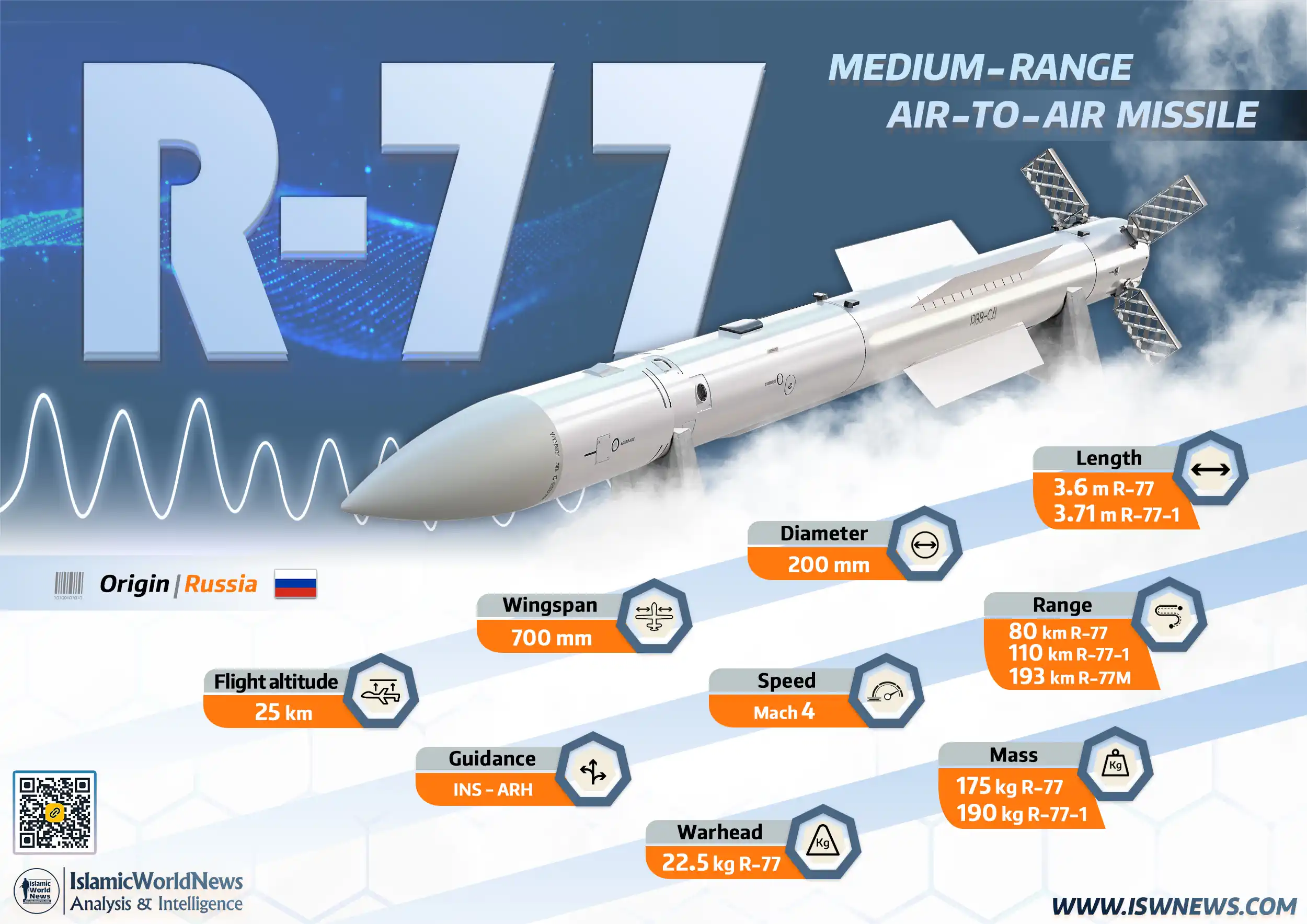
The R-77 air-to-air missile is regarded as one of the most important medium-range weapons of the Russian Aerospace Forces. Featuring a distinctive lattice-fin design, it offers high agility and maneuverability, and in advanced variants such as the R-77M, its range has been extended to 193 kilometers. Equipped with a multifunction active radar, data link, proximity fuse, and fragmentation warhead, the R-77 is considered a true “fire-and-forget” weapon capable of independent target engagement, and today forms part of the armament of Russia’s fifth-generation Su-57 fighter.
History of the R-77 Missile
Development of the active radar-guided R-77 air-to-air missile began in 1982 at the Molnija OKB design bureau in Soviet Ukraine (Ukrainian SSR). Today, the Vympel bureau is recognized as the primary designer of the R-77. The first version, designated izdeliye 170 (product 170), was manufactured at the Artem plant following the dissolution of the Soviet Union in 1991. It was publicly unveiled at the MAKS Airshow in Moscow in 1992, where Western journalists nicknamed it “Amraamski.”
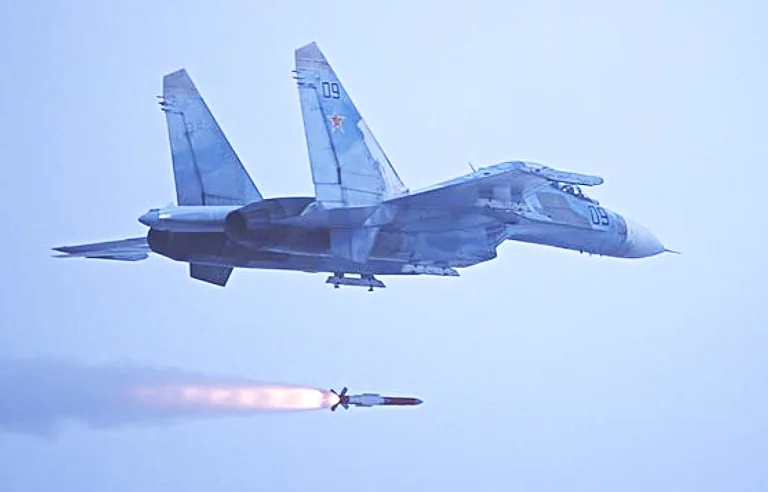
Over time, the R-77 entered service with upgraded Russian fighters such as the Su-27, MiG-29, and MiG-31 within the Aerospace Forces.
The export variant, known as izdeliye 190 or RVV-AE, has a range of 80 kilometers. It was widely marketed abroad, with India and China among the first major buyers, integrating the missile on the Chinese J-11 and Indian Su-30MKK fighters. Other Su-30 operators — including Malaysia, Indonesia, Vietnam, Venezuela, and Algeria — also acquired the RVV-AE. Additionally, Yemen and Syria purchased the missile for use on upgraded MiG-29SE aircraft, with Yemen further modifying the weapon for air defense applications.
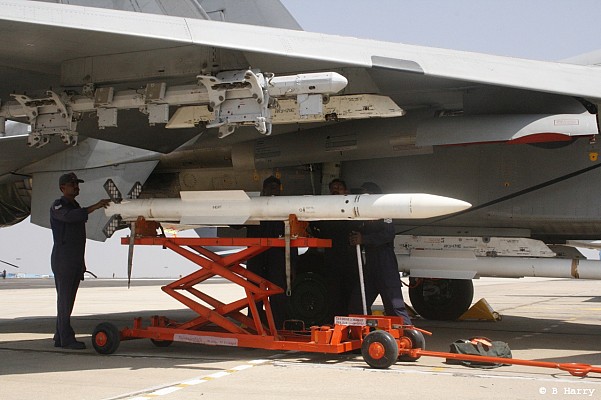
Vympel initiated development of the RVV-AE-PD variant, equipped with a ramjet engine and designed for a range of 120 to 160 kilometers. The company also worked on the R-77M, a longer, heavier, two-stage missile intended to expand the capabilities of the R-77 family. However, during the 1990s, the economic turmoil following the collapse of the Soviet Union left Vympel without sufficient funding, forcing the abandonment of both the RVV-AE-PD and R-77M programs.
The KTRV company, short for “Tactical Missiles Corporation,” was established in 2002 by order of President Vladimir Putin. It became Russia’s first integrated military-industrial structure, consolidating scientific and production resources to develop advanced guided missiles and tactical weapon systems. Since then, the Vympel design bureau has operated under KTRV, tasked with the development, design, and production of air-to-air missiles.
Design of the R-77 Missile
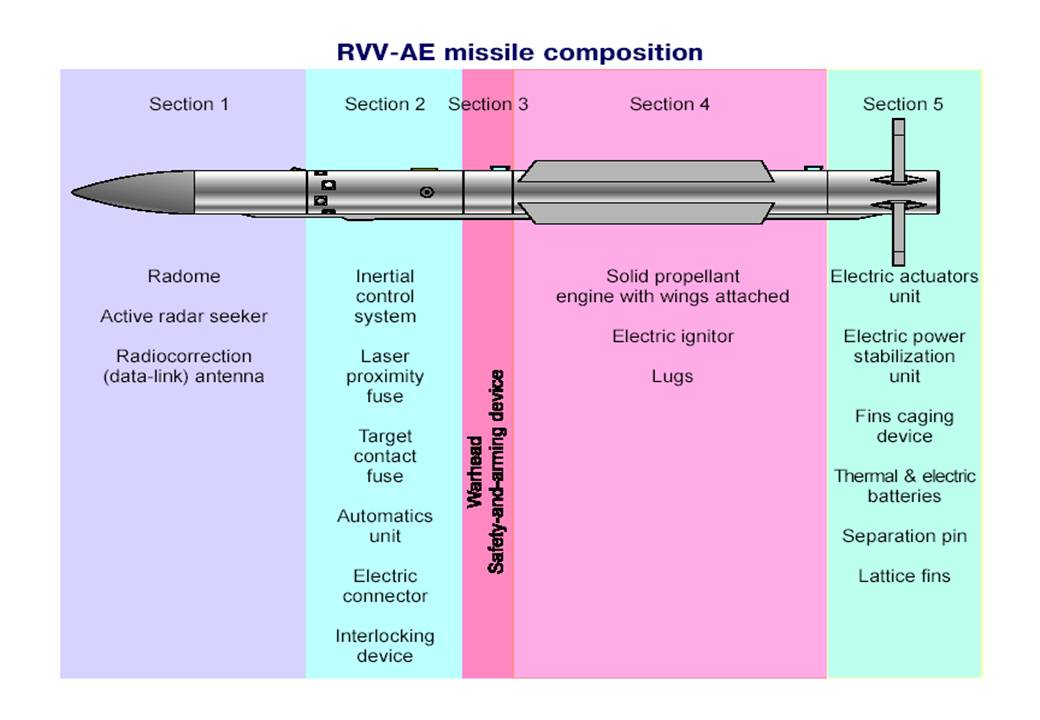
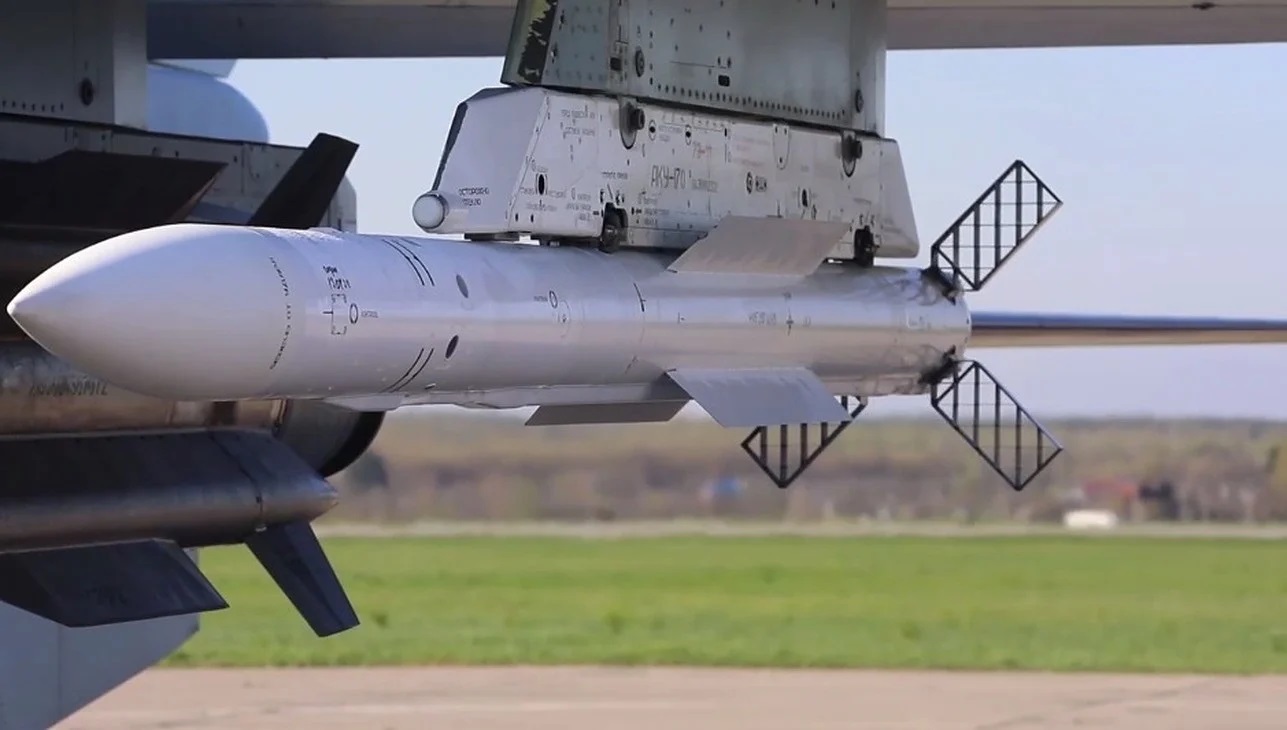
The R-77 is a medium-range, solid-fuel air-to-air missile equipped with an active radar seeker. At the front of the missile is the radar unit, followed by the control section and then the warhead. Behind the warhead lies the fuel compartment and solid-propellant motor. The missile features four mid-body fins for stability and four movable lattice fins at the rear, which serve as control surfaces to provide high maneuverability during flight.
The use of lattice fins gives the missile exceptional agility, allowing it to achieve angles of attack up to 40 degrees. These fins generate minimal drag and, thanks to their stable hinge moment across all speed ranges, altitudes, and angles of attack, they keep airflow steady and controllable. When folded, the fins do not extend beyond the missile’s cross-section, ensuring their span remains narrower than the missile’s wingspan. Their light weight and short length also make it possible to store a greater number of missiles inside the internal bays of next-generation fighters.

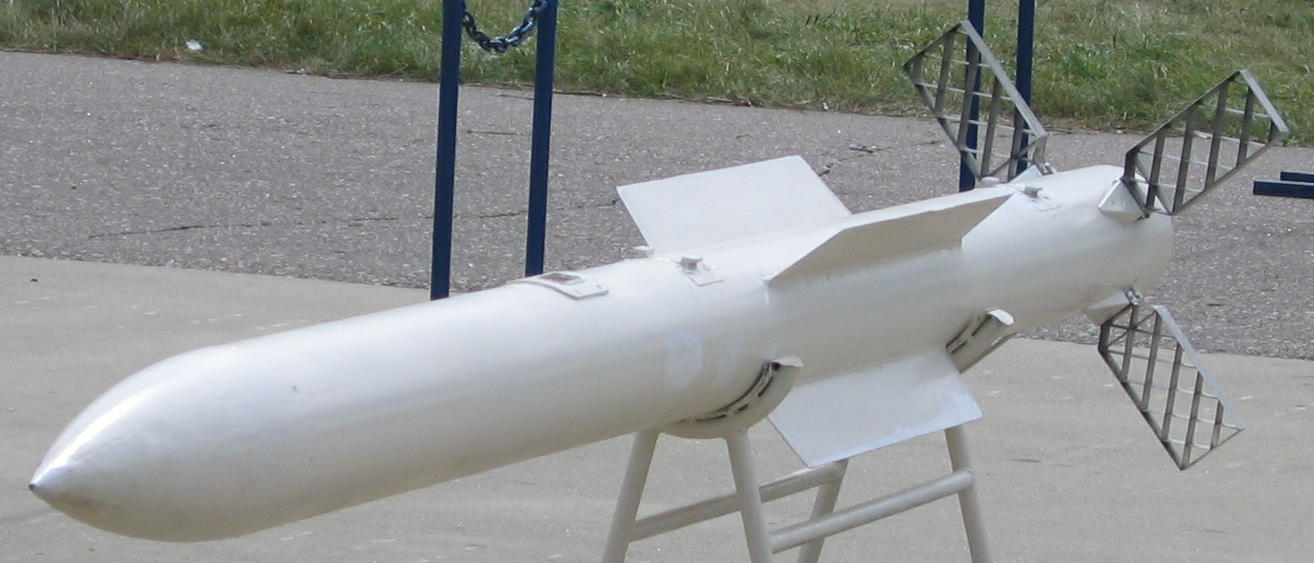
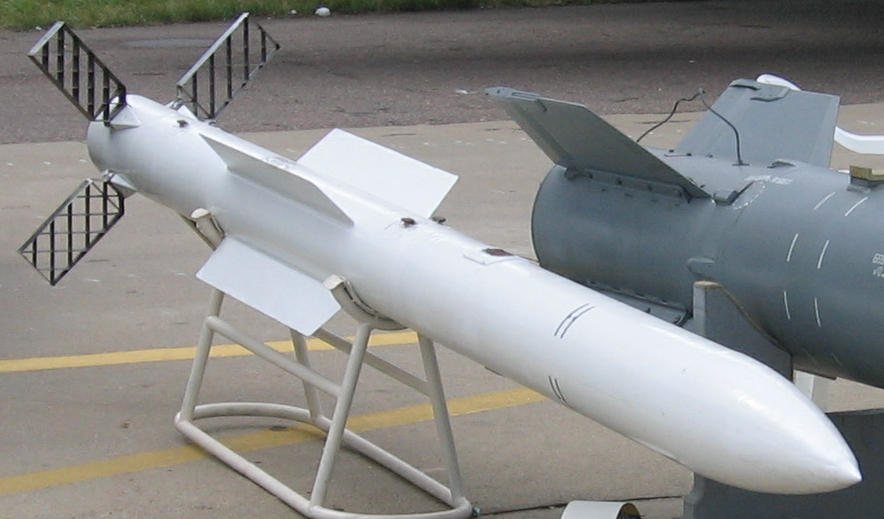
Because of the small chord, the hinge moment is also reduced and shows little dependence on speed, altitude, or angle of attack. The required hinge moment is less than 1.5 kg·m, which has made it possible to employ compact and lightweight electric actuators to control the lattice fins. This design choice not only enhances efficiency but also simplifies integration into modern fighter aircraft systems.
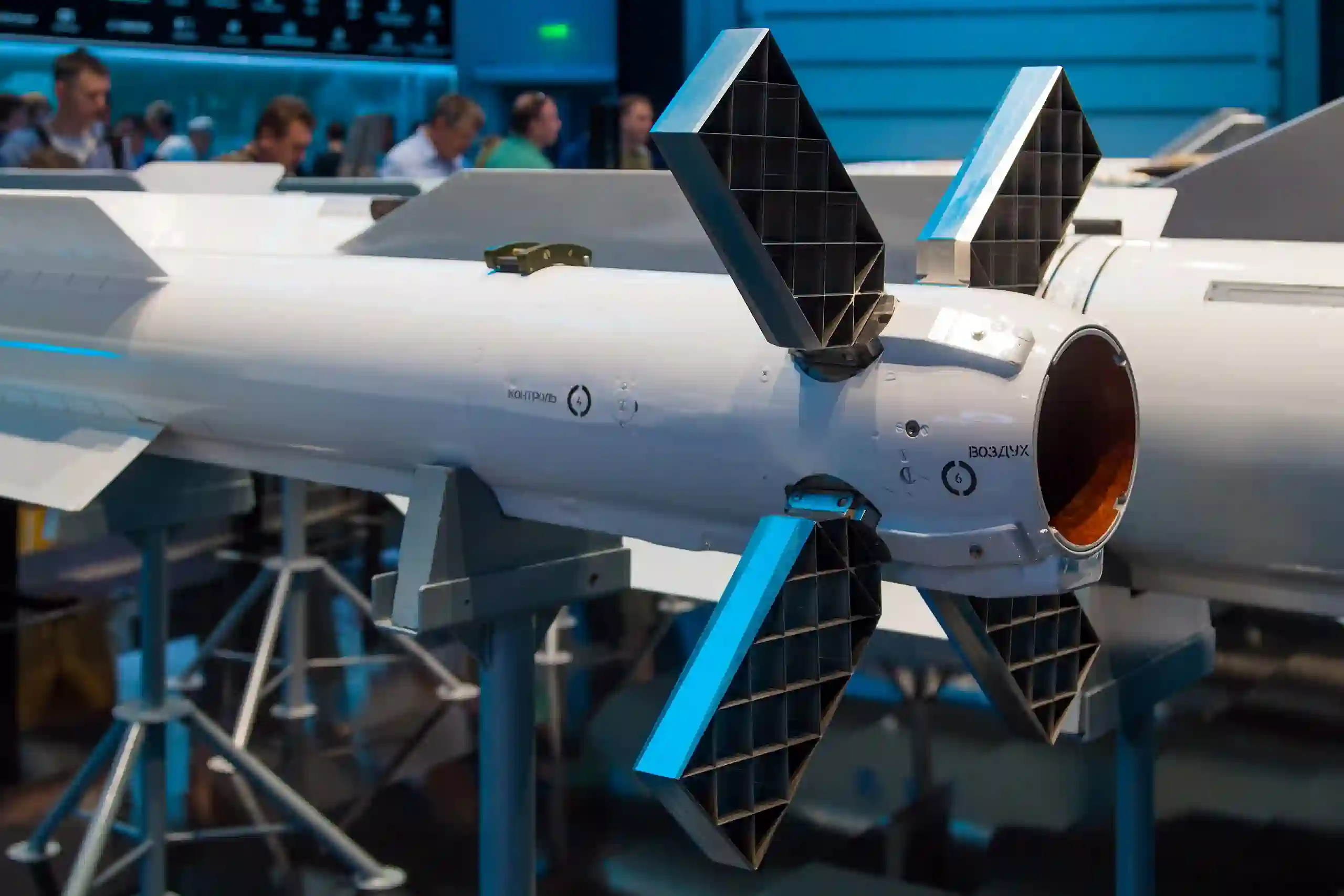
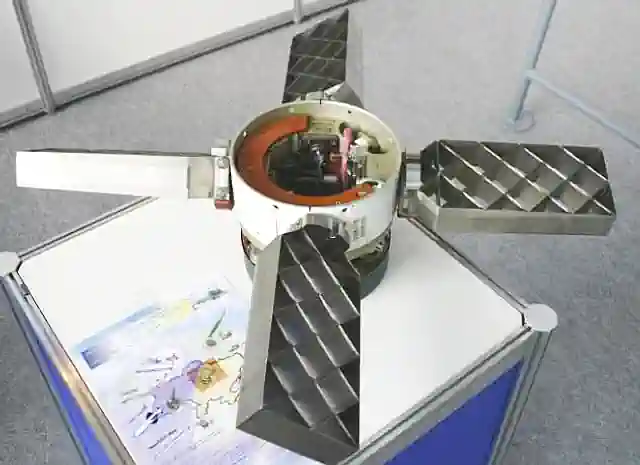
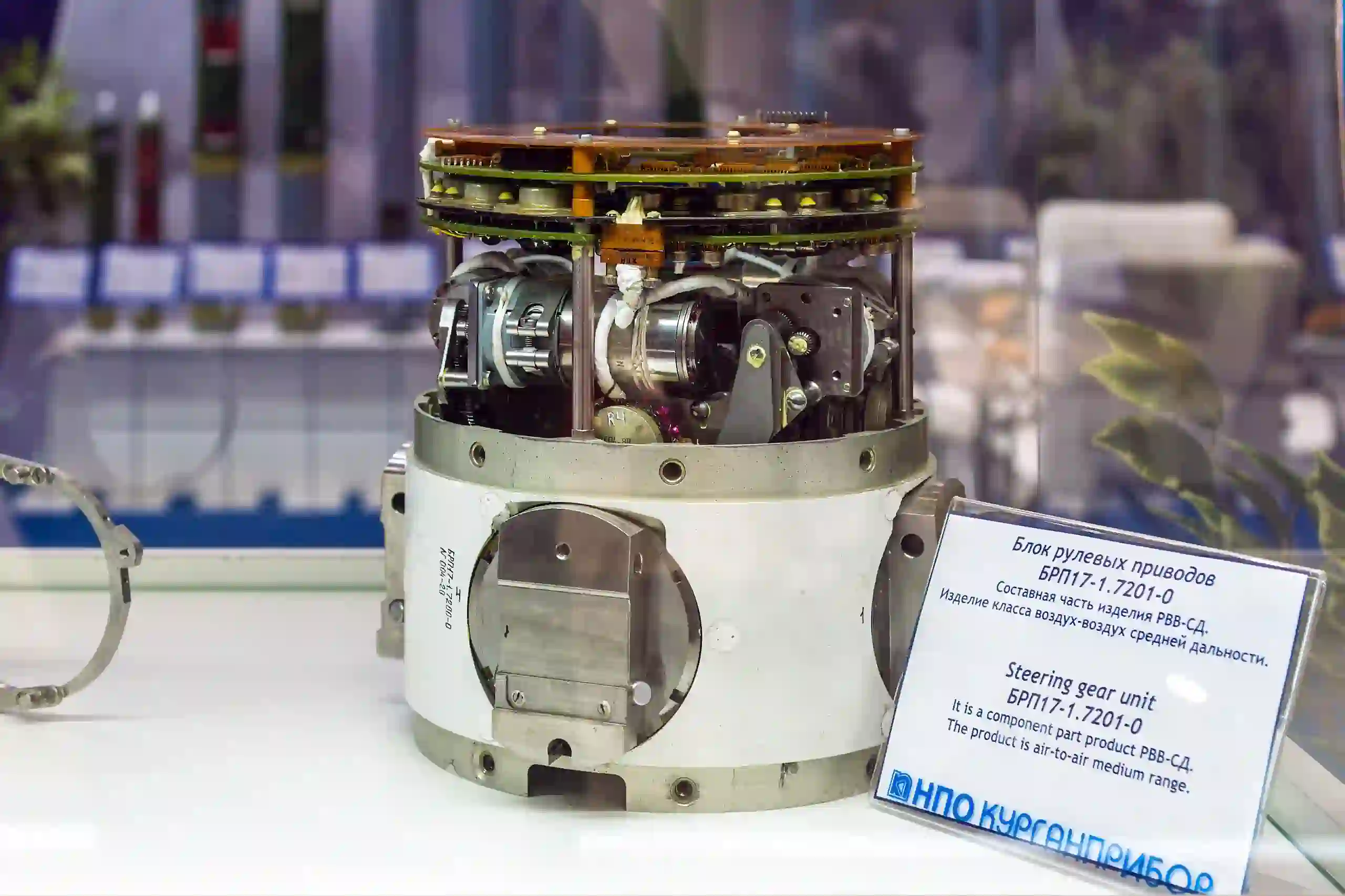
These lattice fins maintain effectiveness at angles of attack up to 40 degrees and possess high structural rigidity, which positively influences flight control quality.
Like any engineering solution, lattice fins also have drawbacks — notably increased aerodynamic drag and a larger radar cross-section. However, their foldable design helps offset these disadvantages, enabling internal carriage of the missile within fighter bays.
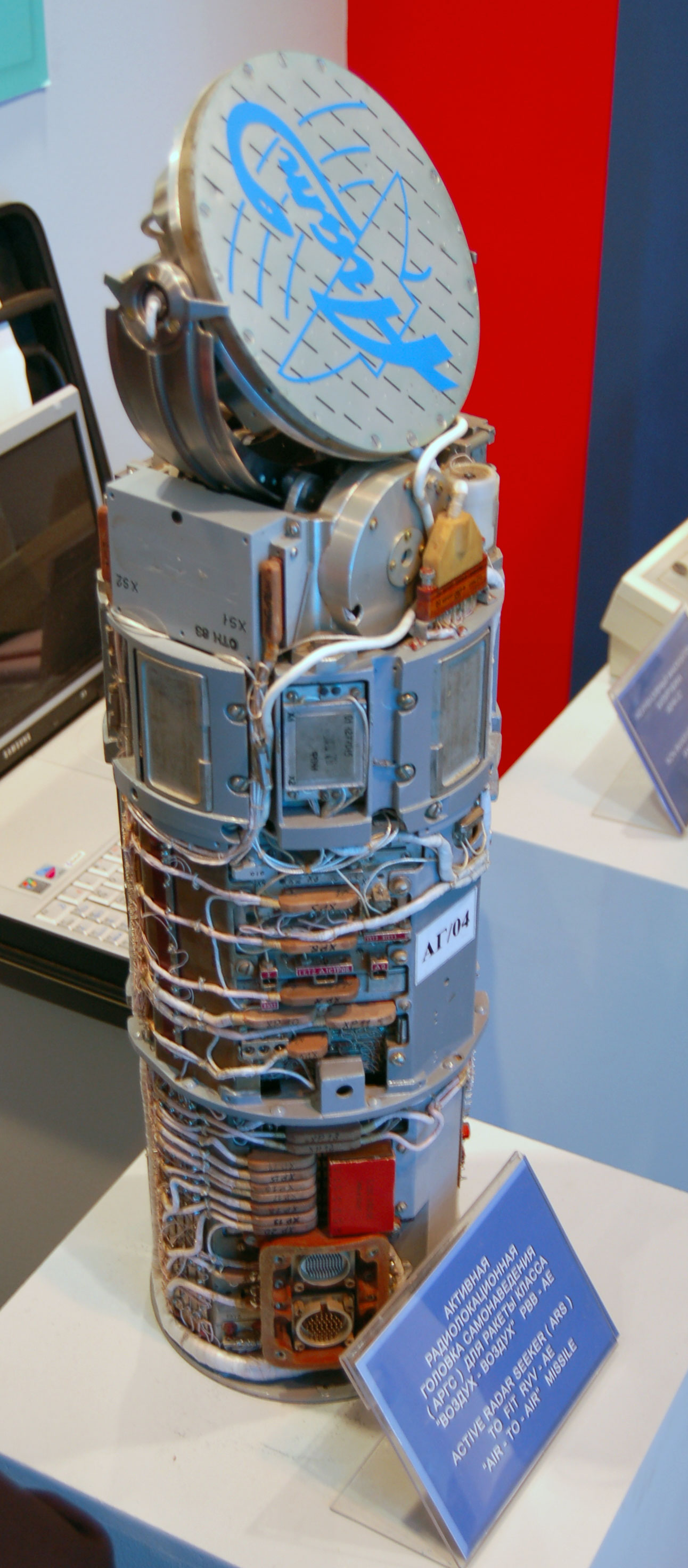
The missile employs a multifunction active Doppler radar seeker developed by OAO Agat. In the terminal attack phase, this seeker can actively engage targets from a distance of 20 kilometers. Guidance is provided by an inertial navigation system, which can be updated via encrypted data links from the launching aircraft. This allows the missile to track and adjust to target movements mid-flight, and once within 20 kilometers, it independently acquires and strikes the target.
The R-77 missile is equipped with a 22 kg high-explosive fragmentation warhead. Its proximity fuse allows detonation near the target, a feature particularly effective against cruise missiles, which present smaller impact surfaces.
Variants of the R-77
R-77 (izdeliye 170) – The standard, baseline version developed during the Soviet era.
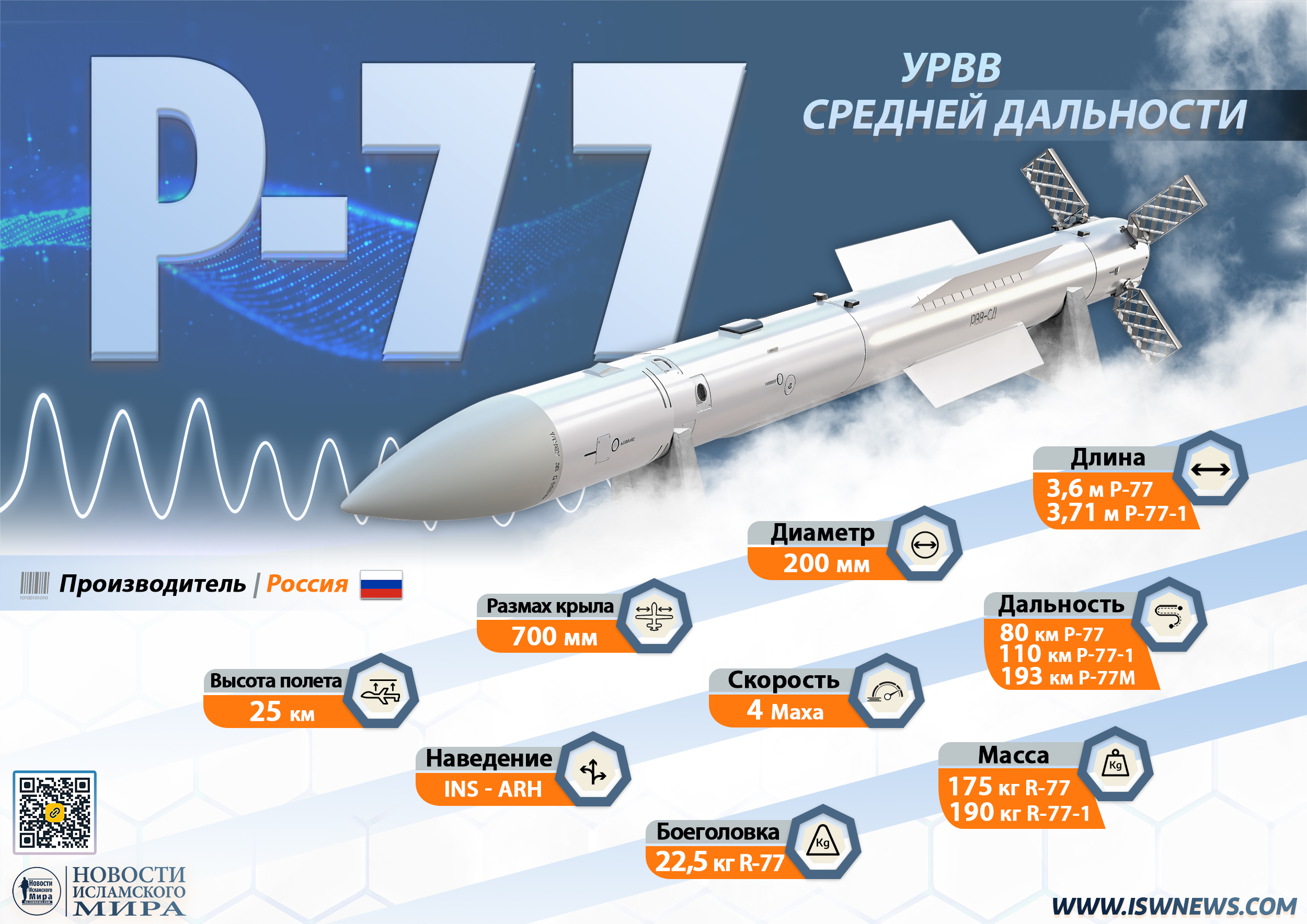
RVV-AE (izdeliye 190) – The export model derived from the R-77, with a shorter range compared to newer versions. It has a maximum range of 80 km and carries a 22.5 kg warhead. The missile can intercept targets flying at speeds up to 3,600 km/h. Guidance relies on an inertial navigation system with mid-course updates via data link, and in the terminal phase it uses active radar homing. This makes it a true “fire-and-forget” weapon.
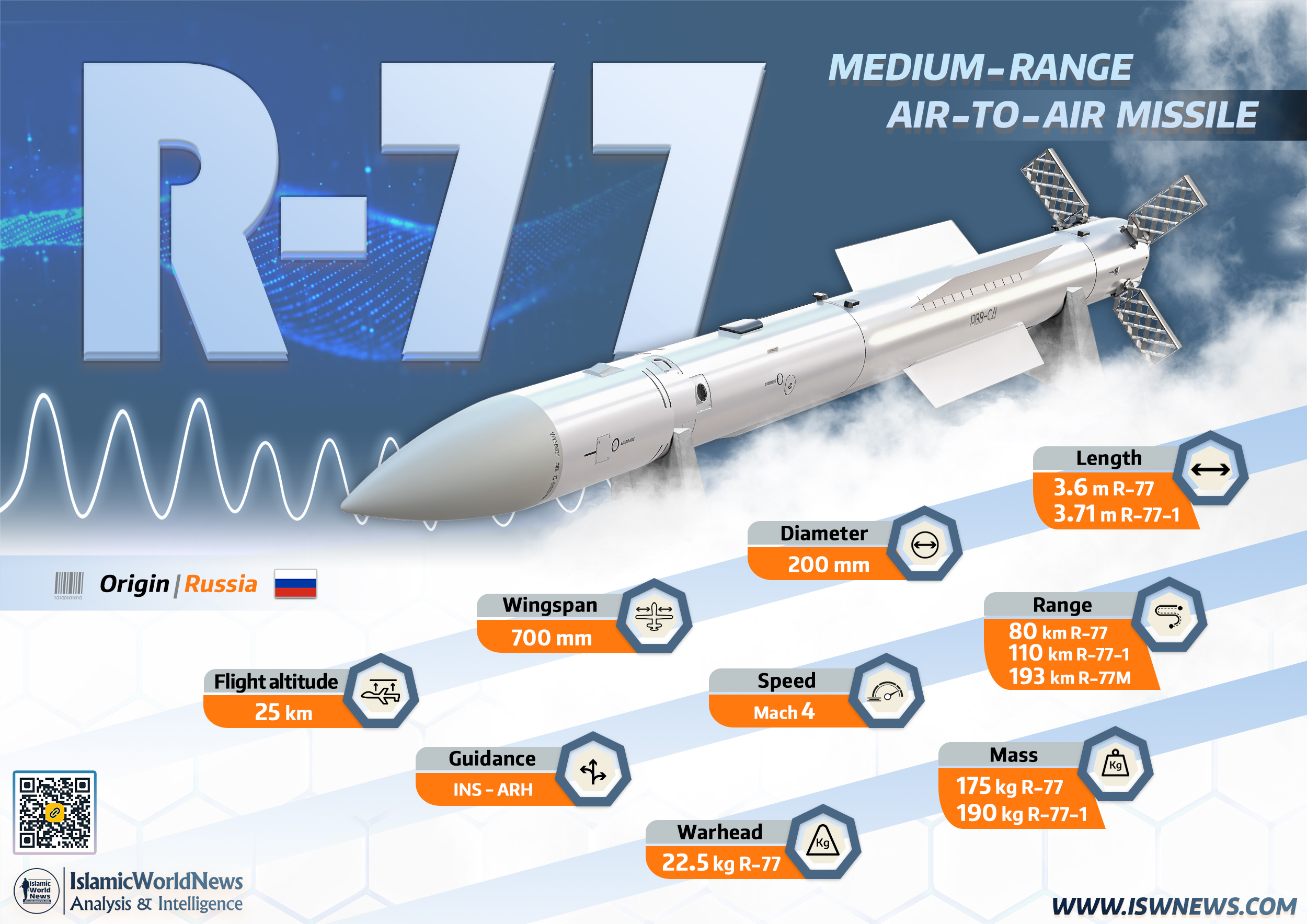
Specifications of the R-77 (RVV-AE) Missile
Type: Active radar-guided air-to-air missile
First unveiled: 1992
Length: 3.6 meters
Diameter: 0.2 meters (20 cm)
Wingspan (mid-body fins): 0.4 meters (40 cm)
Rear fin span: 0.7 meters (70 cm)
Maximum range: 80 kilometers
Engagement altitude: up to 25 kilometers
Missile weight: 175 kilograms
Warhead weight: 22.5 kilograms (high-explosive fragmentation)
Propulsion: Single-pulse solid-fuel rocket motor
Speed: Mach 4
Fuse: Laser proximity fuse
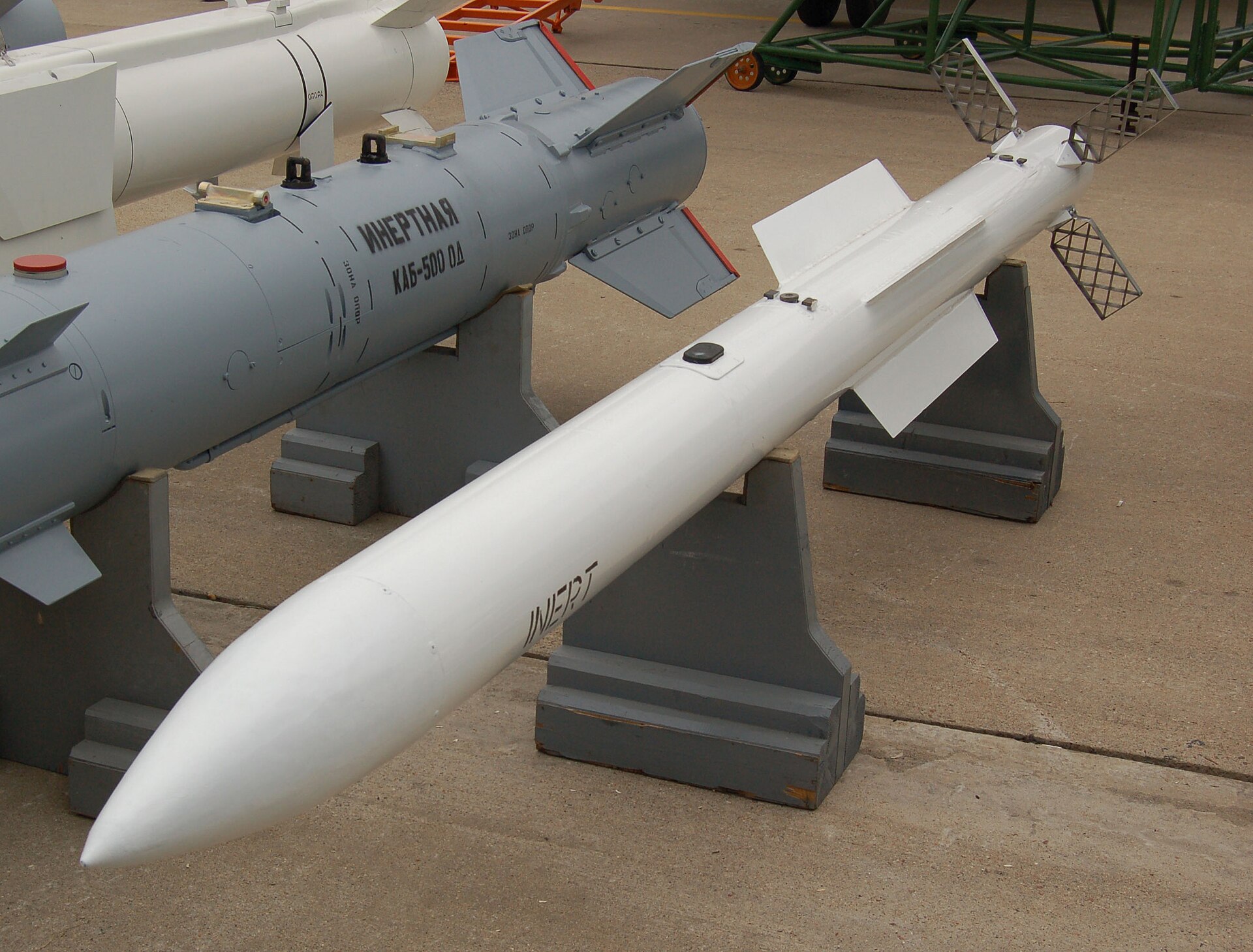
R-77-1 (izdeliye 170-1) – This is the upgraded variant featuring a more aerodynamic nose cone, the active radar seeker 9B-1248, and redesigned control surfaces. Its range has been extended to 110 km, weight increased to 190 kg, and overall length to 3.71 meters. Production began in 2003, with four prototypes introduced in 2005. The R-77-1 was developed for deployment on the Su-35S fighter and Su-34 bomber, and it also forms part of the future armament suite of the fifth-generation Su-57, capable of being mounted on its external hardpoints. The upgraded MiG-31BM can carry up to four R-77-1 missiles.
RVV-SD – This is the export version of the R-77-1, with specifications virtually identical to the original R-77-1.
R-77M (izdeliye 180) – Also known as K-77M, this missile represents a modernized mid-life upgrade for the R-77 family. It has been developed as the primary medium-range weapon for the Su-57 and Su-35S fighters. The R-77M is powered by a dual-pulse rocket motor and equipped with an active electronically scanned array (AESA) radar seeker, specifically the 9B-1103M2. Unlike earlier versions, it replaces lattice fins with conventional rear fins. This design aims to deliver performance comparable to the latest variants of the AIM-120. Many analysts consider it a continuation of the R-77M program that was abandoned in the 1990s due to financial constraints.
The missile’s range is reported to reach 193 kilometers, making it the longest-range member of the R-77 family.
On October 4, 2020, Russia’s Ministry of Defense released a video marking the centenary of the Chkalov State Flight Test Center, which for the first time showed the Su-57 carrying the R-77M.
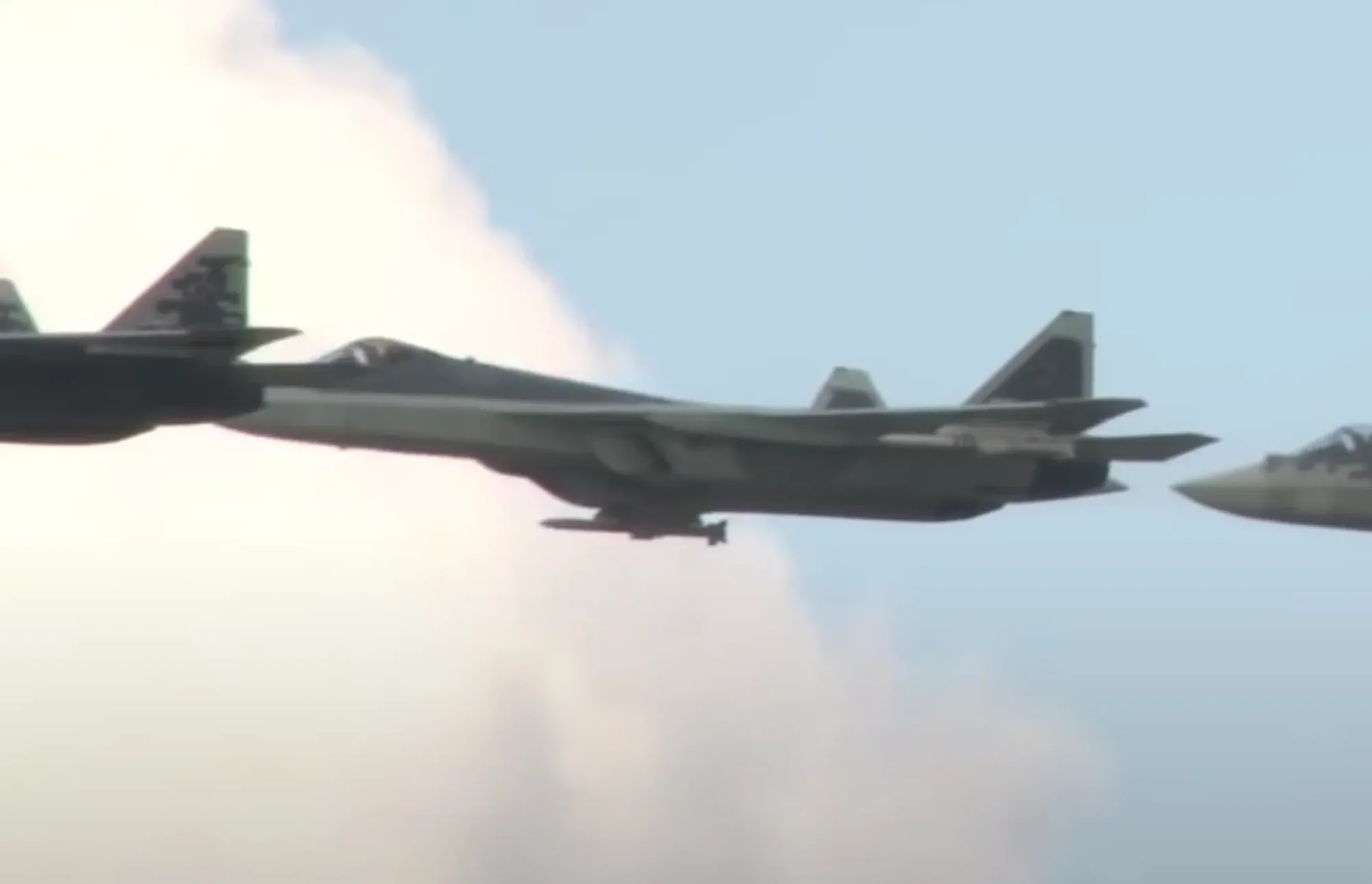
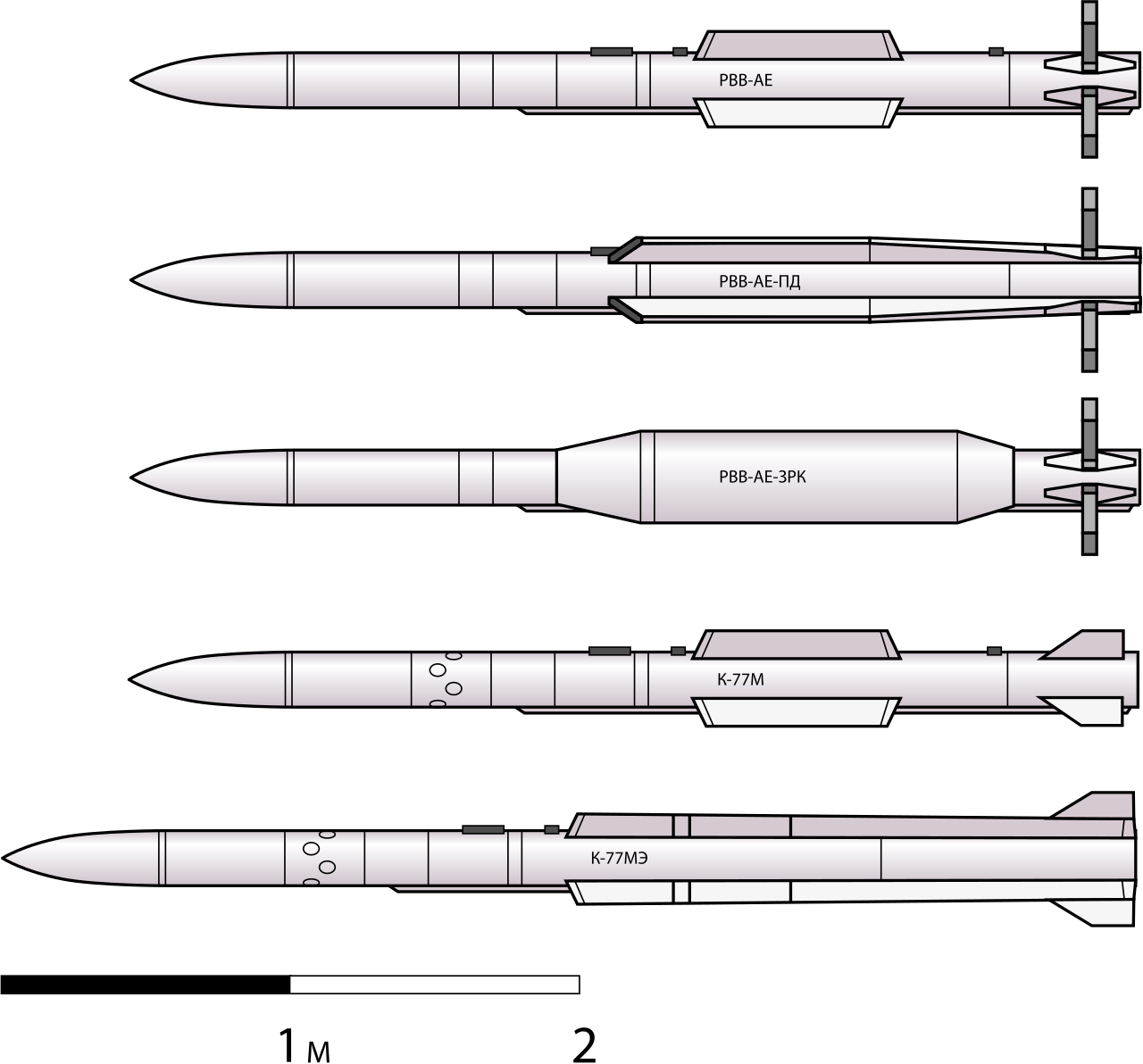
The R-77 missile family has spawned several additional projects, which can be outlined as follows:
R-77P / RVV-PE – A passive radiation homing version of the R-77. In this model, which never entered mass production, the missile relied on the fighter’s radar guidance until the final stage.
R-77T / RVV-TE – An infrared homing variant of the R-77. This version used an infrared seeker in the nose to track heat emissions from aircraft engines and other hot components.
R-77-SRK – A navalized air-defense missile, optimized for launch from ships.
R-77-ZRK / RVV-AE-ZRK – A ground-based air-defense adaptation of the R-77, designed for use in surface-to-air systems.
R-77-PD / RVV-AE-PD – As noted earlier, this ramjet-powered version was developed in the 1990s to achieve a range of 120–160 km. However, financial difficulties after the Soviet collapse halted its progress. Its concept is often compared to the European Meteor missile.
R-77-PD ZRK – A surface-to-air air-defense missile variant of the R-77, also powered by a ramjet engine.
K-77ME (izdeliye 180-BD) – A ramjet-powered derivative of the R-77M, developed specifically for integration with the fifth-generation Su-57 fighter.
Sources:
R-77 | Ракета РВВ-АЕ | R-77 / AA-12 ADDER – Variants | RVV-SD



Comment