Gradual Fragmentation of Syria: Examining the Most Likely Governance Scenario for Syria’s Future
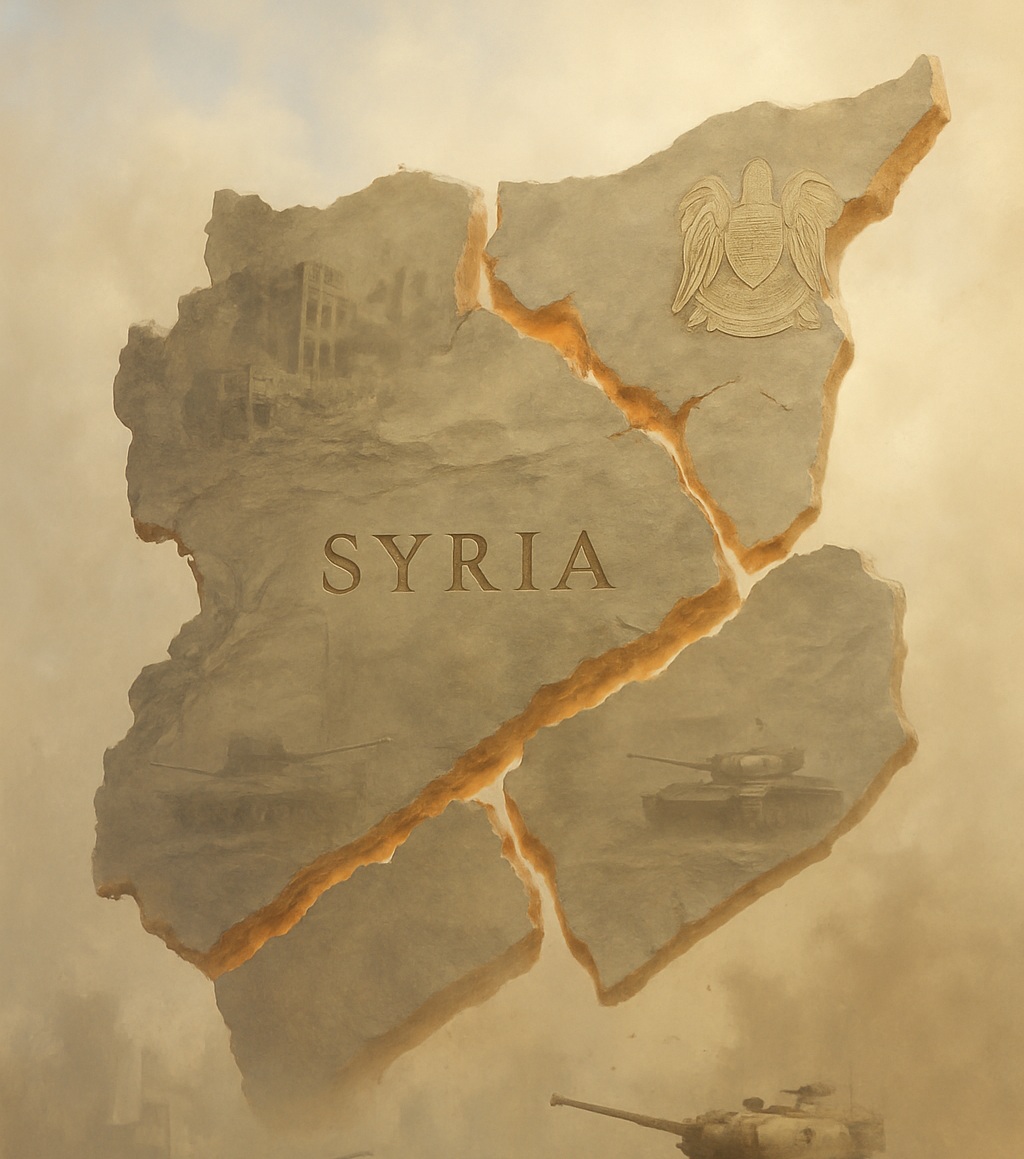
This analysis outlines the “mini-state governance model” as the most probable scenario for Syria’s future. In this model, the state remains legally unified, but in practice, powerful local entities dominate specific regions, effectively holding real power. The central government is compelled to cooperate with these influential local forces. Although this scenario has received limited public attention, it aligns more closely with Syria’s historical context and social fabric.
The “mini-state” model has emerged in several post-Ottoman Arab countries. Yemen, Libya, Lebanon (especially before the recent war), and to a large extent Sudan and Somalia, have all experienced this form of governance. The Trucial States (now the UAE, Qatar, and Bahrain) prior to 1971, and the territory of present-day Saudi Arabia before King Abdulaziz’s wars and the founding of the third Saudi state, are other examples. A diluted version of this model can be seen in present-day Iraq, though it has weakened since the first post-Saddam decade. Syria itself experienced a similar situation between 1946 and 1963.
Preconditions for Mini-State Formation
This situation arises when three conditions are met:
- The central government lacks sufficient hegemony.
- Nation-building efforts are severely disrupted, leading citizens to prioritize other identity factors over national identity.
- Economic resources are no longer monopolized by the state, forcing it to rely on influential actors for funding and security.
If the central government is either in the “state-building phase” or has a system where political competition is institutionalized—especially if public opinion plays a role—this fragmentation intensifies. It’s crucial to distinguish between the legal structure of power and its actual distribution. None of the examples mentioned earlier are legally federal systems.
Key Groups Likely to Form Mini-States
This section identifies powerful domestic actors that may evolve into influential entities, forcing the central government to engage with them. In Arabic political discourse, such groups are said to form a “mini-state” (a state within a state).
A) Kurds
They are the most likely to establish a mini-state, possibly limited to northeastern Syria or areas like northern Hasakah and Ain al-Arab (Kobani). All four conditions mentioned earlier apply strongly to the Kurdish context.
B) Druze
The Druze are the second most likely group to form a mini-state. In broader governance comparisons, the Syrian Democratic Forces (SDF) are pursuing semi-secession, and one of the main Druze factions recently reached an agreement with the central government. Under this deal, the Interior and Justice Ministries in Suwayda province will be staffed exclusively by locals, while Druze groups will retain their weapons. This arrangement lays the groundwork for a mini-state in Suwayda.
C) Alawites
The coastal Alawite community has a moderate chance of forming a mini-state. Despite widespread sensitivity toward this group, internal cohesion, restrained ambitions, effective foreign support, and smart strategy could enable them to establish control over coastal areas.
D) Free Syrian Army (Jaysh Suriya al-Hurra)
This group, formed under direct U.S. guidance in the al-Tanf region, now controls territory from al-Tanf to Qaryatayn and Palmyra. Their strengths include foreign backing and a dual identity—Arab opposition to Assad with some advantages similar to the SDF. Their semi-autonomous presence within the Syrian army structure positions them as a potential mini-state.
E) Daraa
Daraa also has high potential for mini-state formation, but internal divisions among southern factions pose a major challenge. The population is split into four or five groups with serious rivalries, and at least half look to external powers for support. These internal fractures reduce the likelihood of a unified mini-state.
F) Others
Beyond these five, other regions also show potential for mini-state emergence. Due to space constraints, only their names are listed:
- Arab tribes of Deir ez-Zor
- Arab tribes of Raqqa
- Turkmens of northern Aleppo
- Salafists of Idlib
- Smaller minorities
Signs of This Scenario Emerging
What are the indicators of this scenario unfolding in Syria? Both political and security developments offer clues. The clearest sign is Damascus’s concession to Suwayda’s Druze elders, allowing them to control the Interior and Justice Ministries—an arrangement even more extensive than the SDF-Damascus agreement. Another sign is the central government’s efforts to alter the situation in Afrin, which may lead to demographic changes.
On the security front, armed groups in many areas refuse to surrender their weapons or integrate into a unified national army. Continued activity by pro-Assad militias (known as “Shabiha”), casualties inflicted by Tahrir al-Sham, and Damascus’s lack of control over all Syrian territory—effectively dividing the country into three or four zones—are further indicators.
Politically, the most telling signs are how local elites influence governance. In provinces like Daraa and Suwayda, governors are chosen based on local power brokers’ preferences. In Daraa, Deir ez-Zor, Hama, and Aleppo, senior military commanders are appointed by external forces, not the president. Suwayda still lacks a military commander, and in coastal provinces, competition between official ministries and the newly formed “National Reconciliation Committee” is intensifying. In eastern Euphrates regions, no governors or military commanders have been appointed at all.

Comments