
Military Knowledge: Spartak Armored Vehicle – A Look at Iran’s Newest MRAP in Service
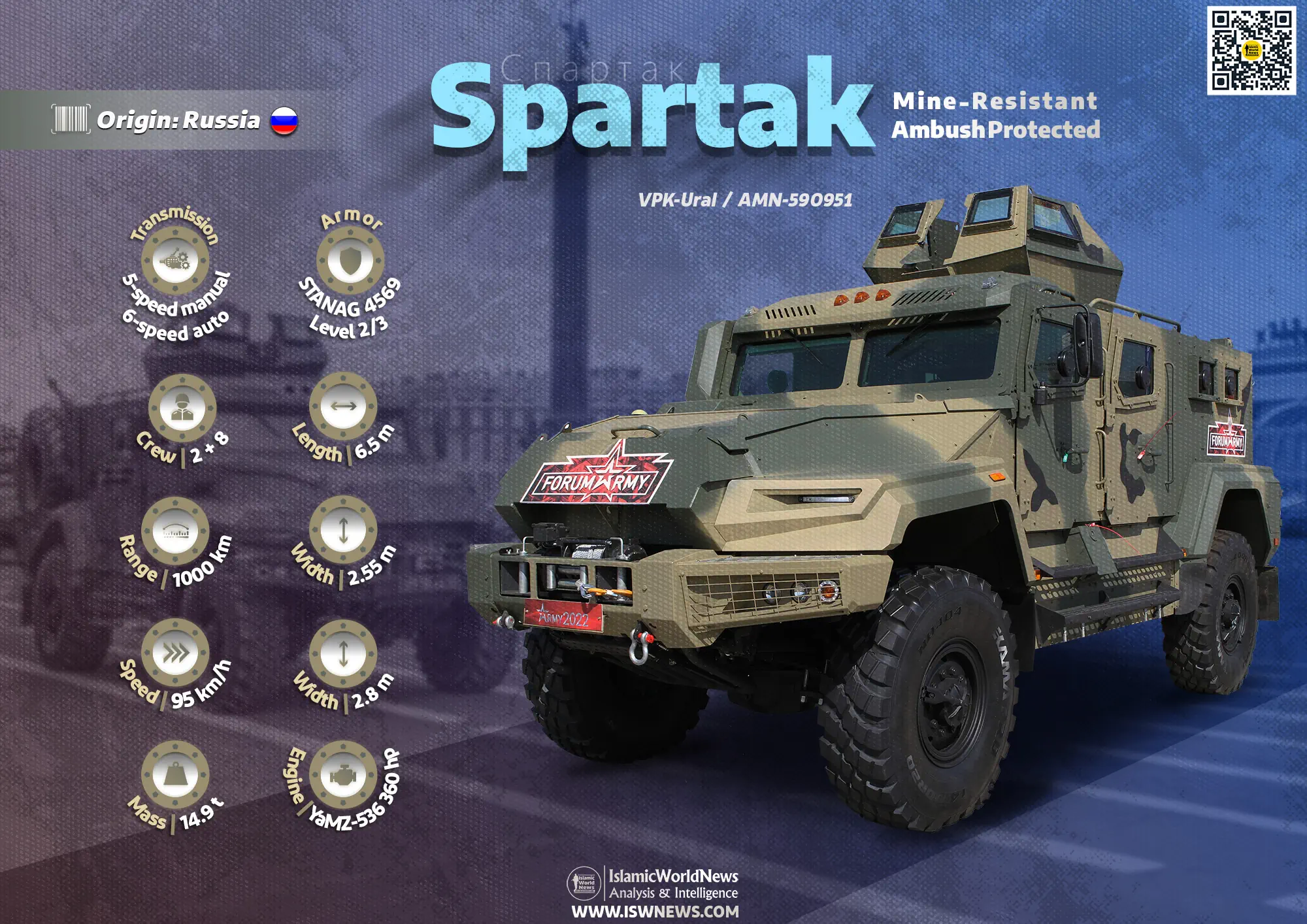
The Spartak (VPK-Ural or AMN-590951) is a Russian-made Mine-Resistant Ambush-Protected (MRAP) vehicle, designed to safeguard personnel against the lethal effects of small arms fire, landmines, and artillery fragments during counterterrorism operations and special missions. This platform has recently been inducted into service with Iran’s armed forces under the Border Guard Command (FARAJA). In this article, we will examine this armored fighting vehicle in detail.
During a ceremony in December 2025 marking the addition of new ground and aerial equipment to FARAJA’s Border Guard Command, a new type of armored vehicle of non-Iranian origin was formally introduced. Further examination revealed that these vehicles are in fact Russian-built Spartak MRAPs.
Speculation suggests that around 20 units of the Spartak MRAP were delivered in the initial phase to FARAJA’s Border Guard, with the possibility of additional vehicles being supplied both to the Border Guard Command and the Army Ground Forces in the future.
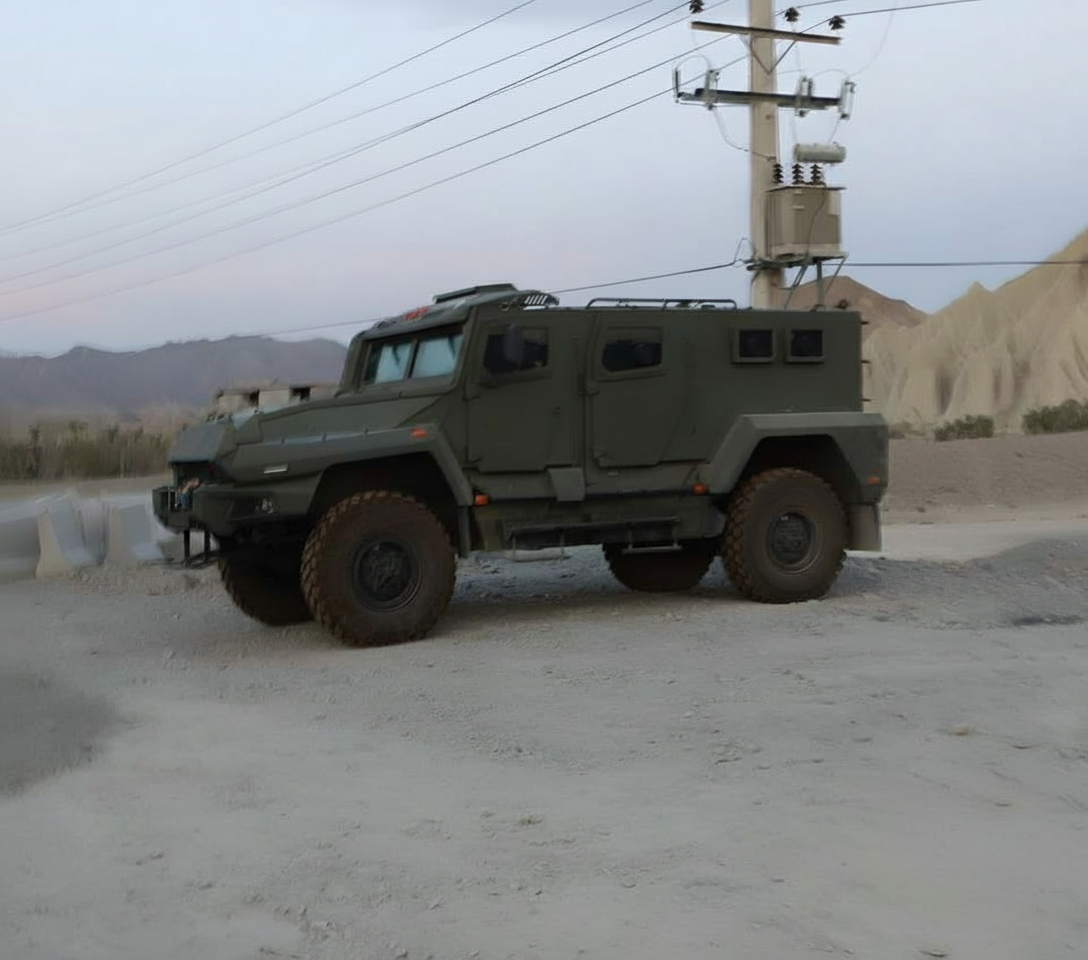
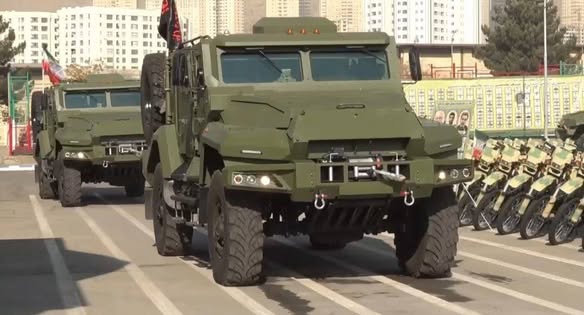
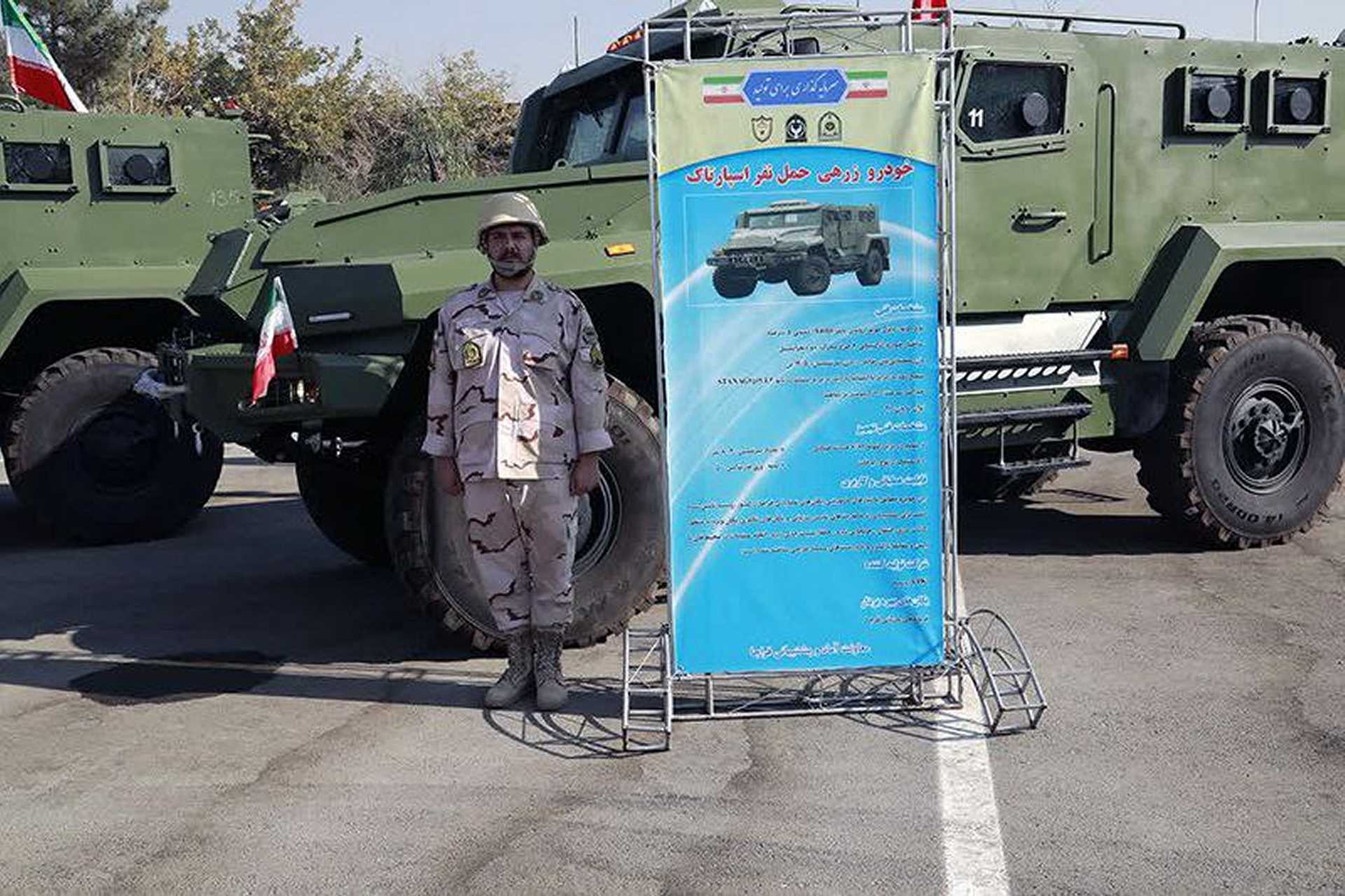
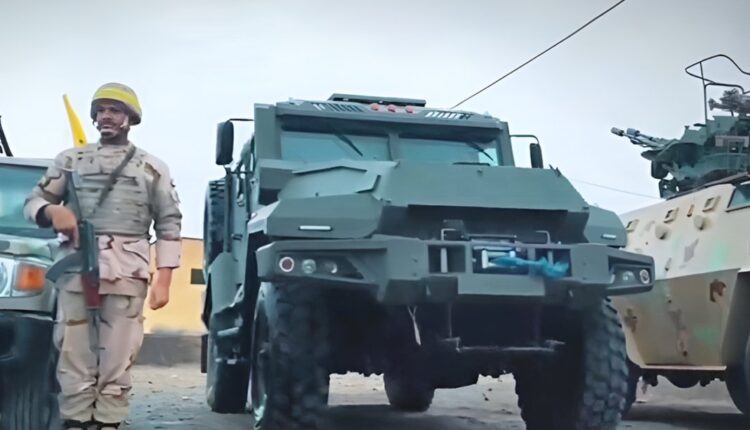
Introduction to the Spartak Mine-Resistant Armored Vehicle
The Spartak, also known as AMN-590951, VPK-Ural, or SBM-59095S, is a Russian 4×4 armored vehicle developed by the Military Industrial Company (VPK). It was first unveiled at the Army-2019 exhibition.
Designed according to MRAP principles, the Spartak features a welded monocoque hull with a V-shaped floor, capable of withstanding blasts equivalent to 6–8 kg of TNT. Its armor includes reinforced frontal and roof sections, able to resist 12.7mm rounds, and with optional add-on armor plates, protection can be increased against 14.5mm rounds
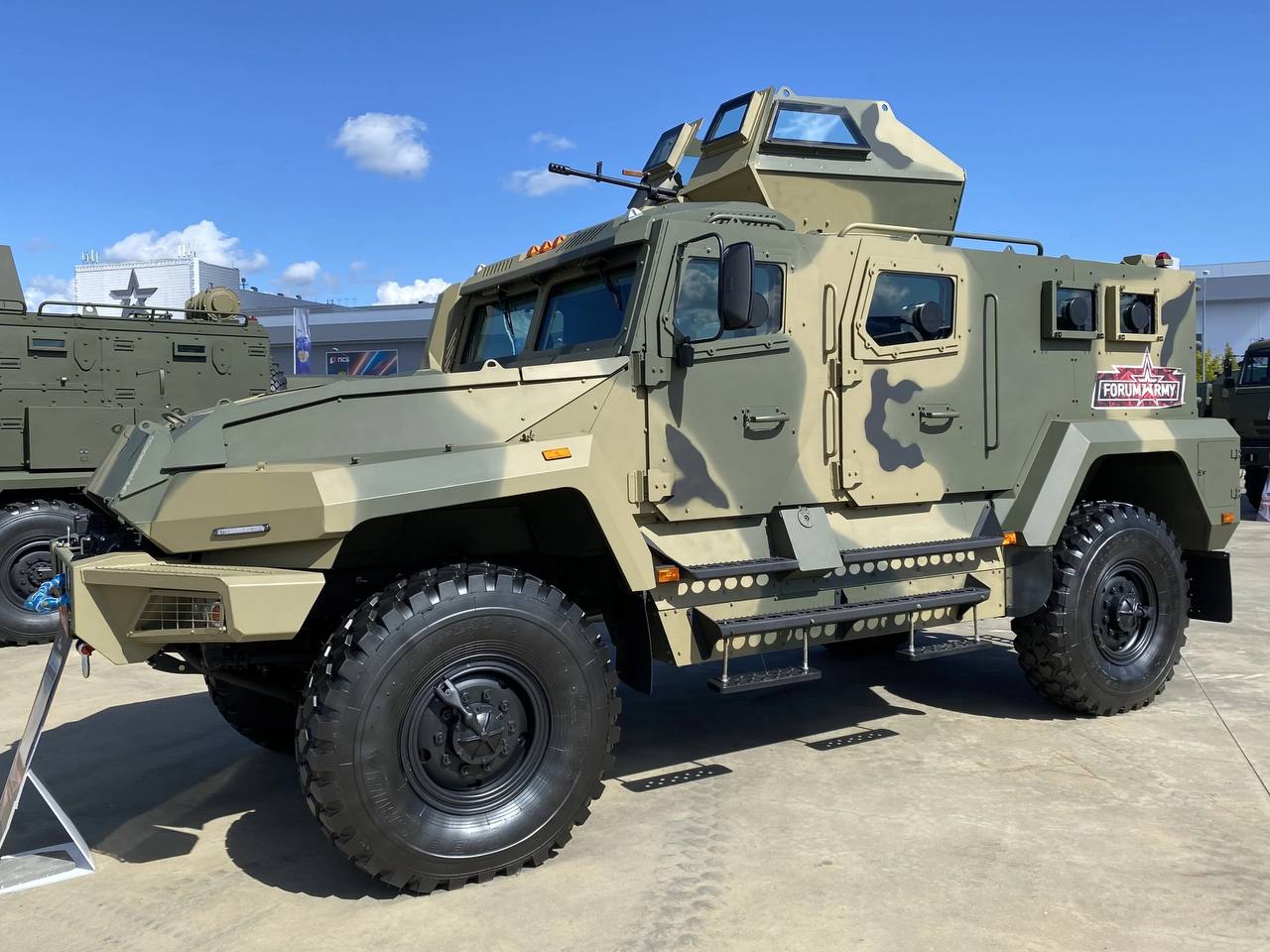
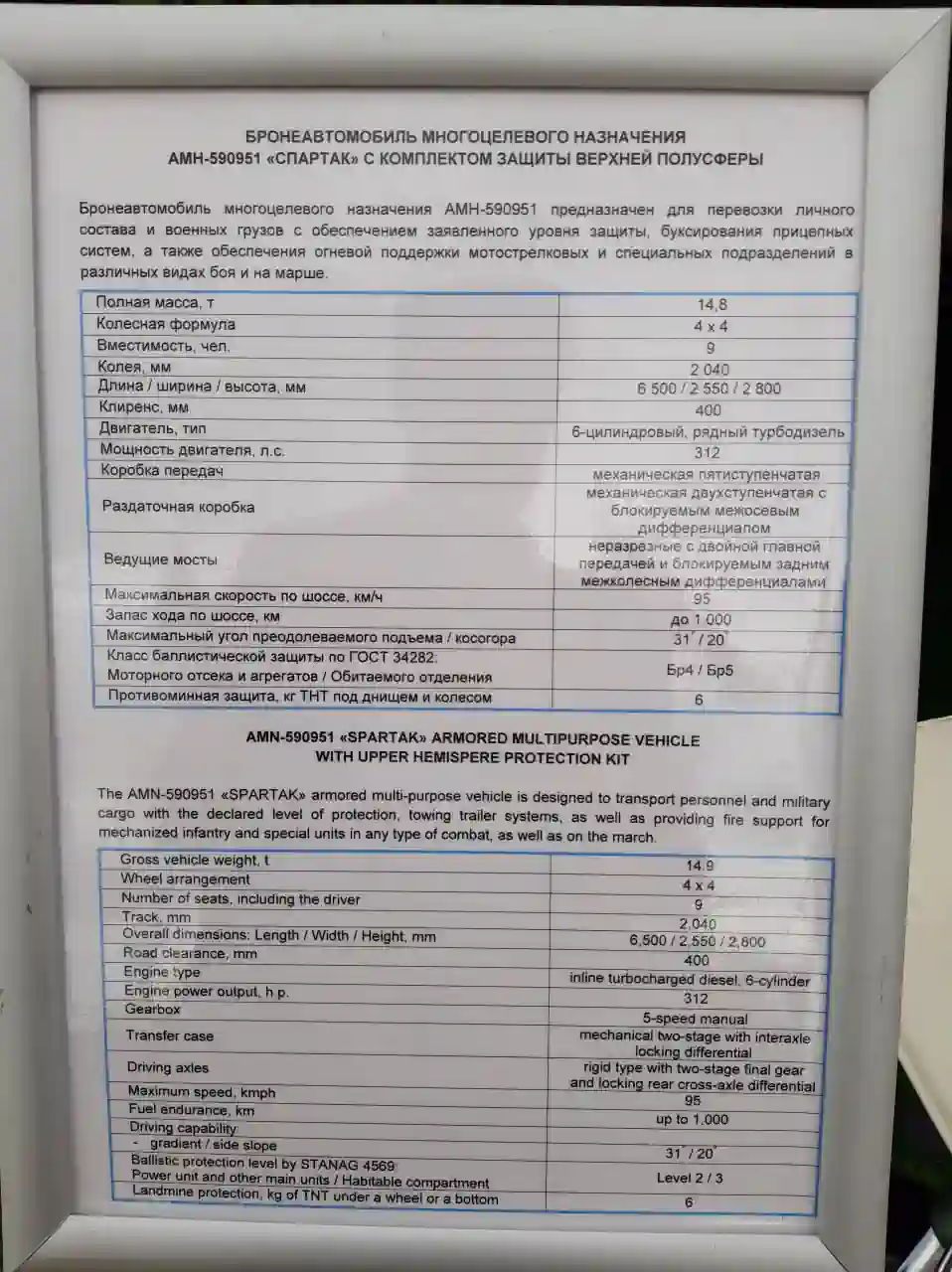
The Spartak platform can be considered a modern redesign of older Russian armored vehicles first introduced in the 2000s. In fact, the Spartak is built on the two-axle Ural-53099 truck chassis, incorporating field-tested components and mass-produced parts from Ural’s multipurpose military vehicles.
This approach significantly reduces the final production cost and operational expenses, while improving maintainability and ease of servicing. Internally, the Spartak is presented as a joint product of the Military-Industrial Company and Ural Industries, positioned to compete with KAMAZ products, such as the Typhoon MRAP.
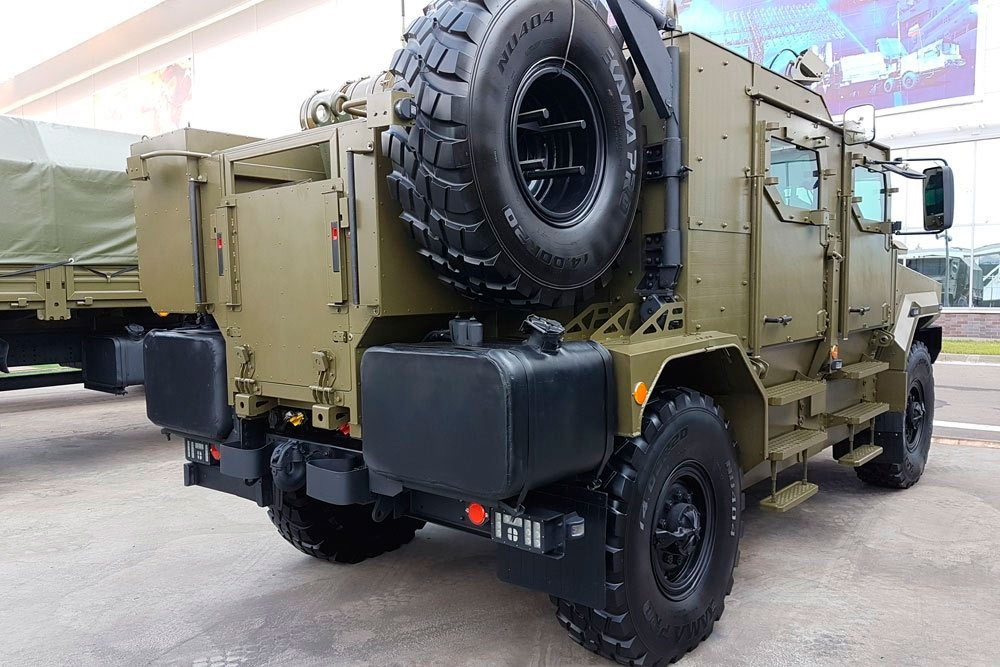
The Spartak is powered by a YaMZ-536 six-cylinder turbocharged diesel engine producing approximately 360 horsepower, paired with either a five-speed manual or a six-speed automatic transmission.
This configuration enables the vehicle to reach road speeds of about 80–100 km/h depending on terrain, and off-road speeds of 40–60 km/h. Its operational range extends to roughly 1,000 kilometers, providing long-distance endurance for missions in diverse environments.
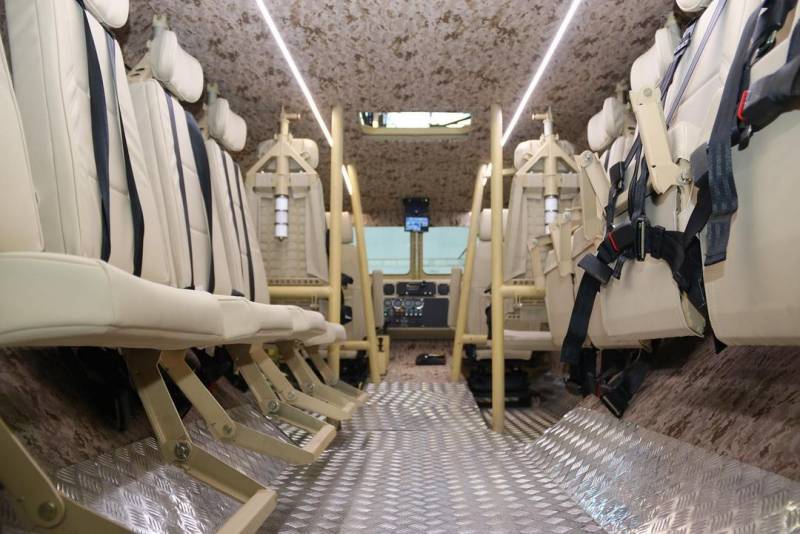
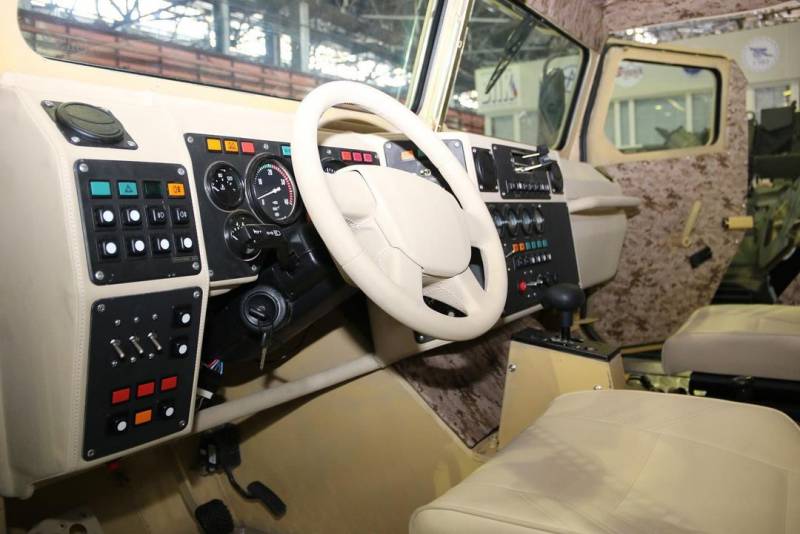
Depending on its internal configuration, the Spartak accommodates two crew members plus up to ten additional personnel. The compartment is fitted with firing ports, bullet-resistant windows, and side and rear access doors.
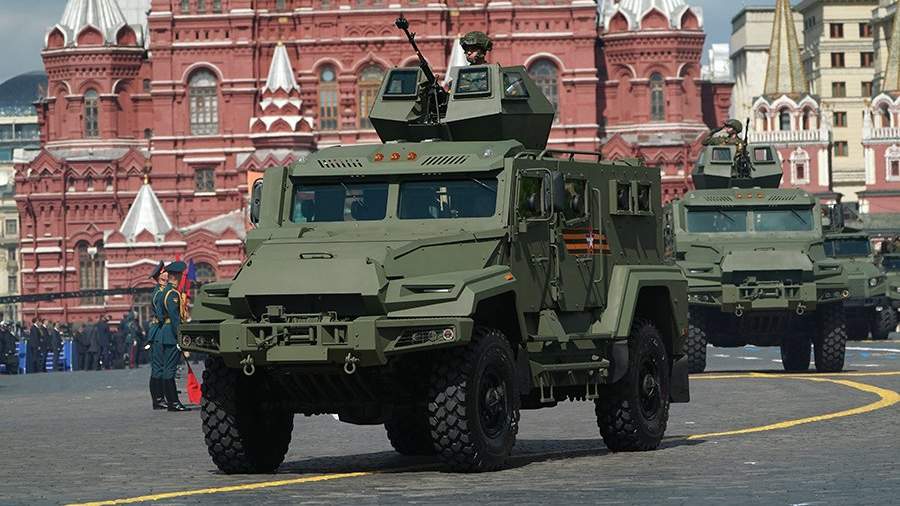
The roof typically hosts an open armored turret, which can be armed with a 12.7mm heavy machine gun, PK or PKP machine guns, or automatic grenade launchers such as the 17AGS, 30AGS, or 40AGS.
Additionally, the manufacturer has announced compatibility with remote-controlled weapon stations (RCWS), allowing the Spartak to integrate modern fire-control solutions.

Survivability Standards and Export Outlook of the Spartak
The key factor in the Spartak’s survivability and its potential for export markets lies in its compliance with NATO standards.
Ballistic Protection: The vehicle’s monocoque armored hull provides STANAG 4569 Level 3 ballistic protection. This level ensures resistance against 7.62mm assault rifle fire and, more importantly, against 12.7mm heavy machine gun rounds. Such capability is critical for operations in environments exposed to intense machine gun fire.
Mine Protection: The hull design incorporates a V-shaped geometry, intended to deflect and disperse blast energy from beneath the vehicle. This configuration achieves STANAG 4569 Level 2a protection (blast under wheel) and Level 2b protection (blast under hull), withstanding explosions equivalent to up to 6 kg of TNT.
Comparison of Spartak with Similar Iranian Models
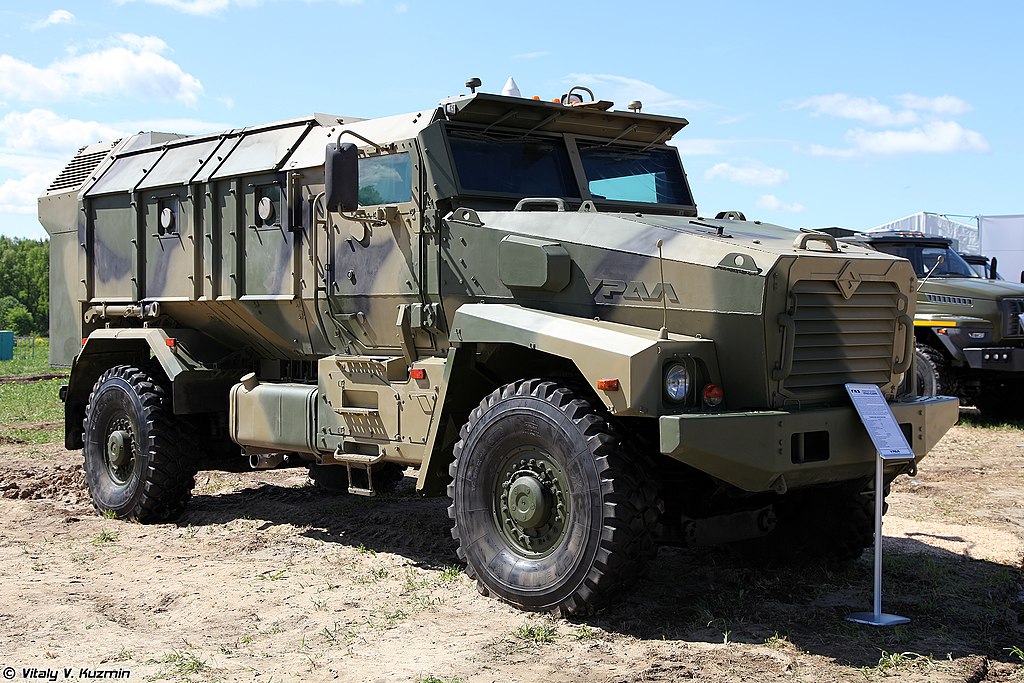
The list of Iranian-produced Mine-Resistant Ambush-Protected (MRAP) vehicles is limited to just two models: Raad and Toofan. These MRAPs are deployed in relatively small numbers across military units. According to available information, the Raad MRAP has only recently been introduced into the combat organization of Iran’s armed forces, marking its entry into active service.
The Toofan MRAP is a 4×4 armored vehicle built on a monocoque V-shaped chassis and powered by a KAMAZ diesel engine delivering 360 horsepower from an eight-cylinder, 3,600 cc configuration. With an empty weight of 12 tons and a combat weight of 14 tons, it measures 7 meters in length, 2.5 meters in width, and 3.1 meters in height. Its protection meets STANAG 4569 Level 3 standards, enabling resistance against 6–8 kg TNT blasts under the hull or wheels, 7.62mm tungsten-core rounds at 30 meters, and 155mm artillery fragments at 60 meters. The vehicle accommodates 10 personnel (two crew and eight troops), reaches a maximum speed of 100 km/h, and offers an operational range of 1,100 km. Mobility features include fording water up to 1.5 meters deep, climbing gradients of 60 percent, and traveling up to 50 km on punctured tires thanks to its run-flat capability.
Read more: Toofan MRAP
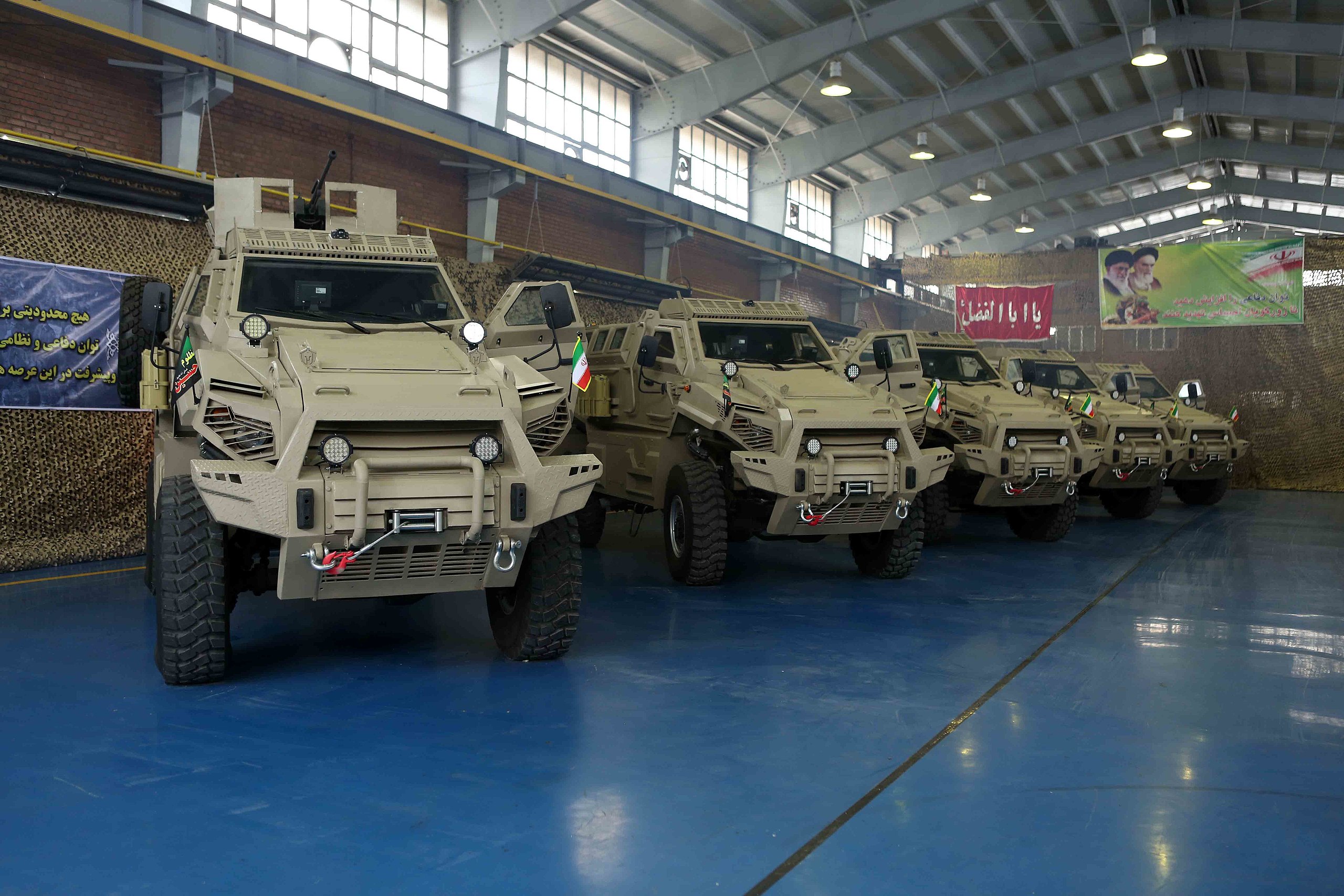
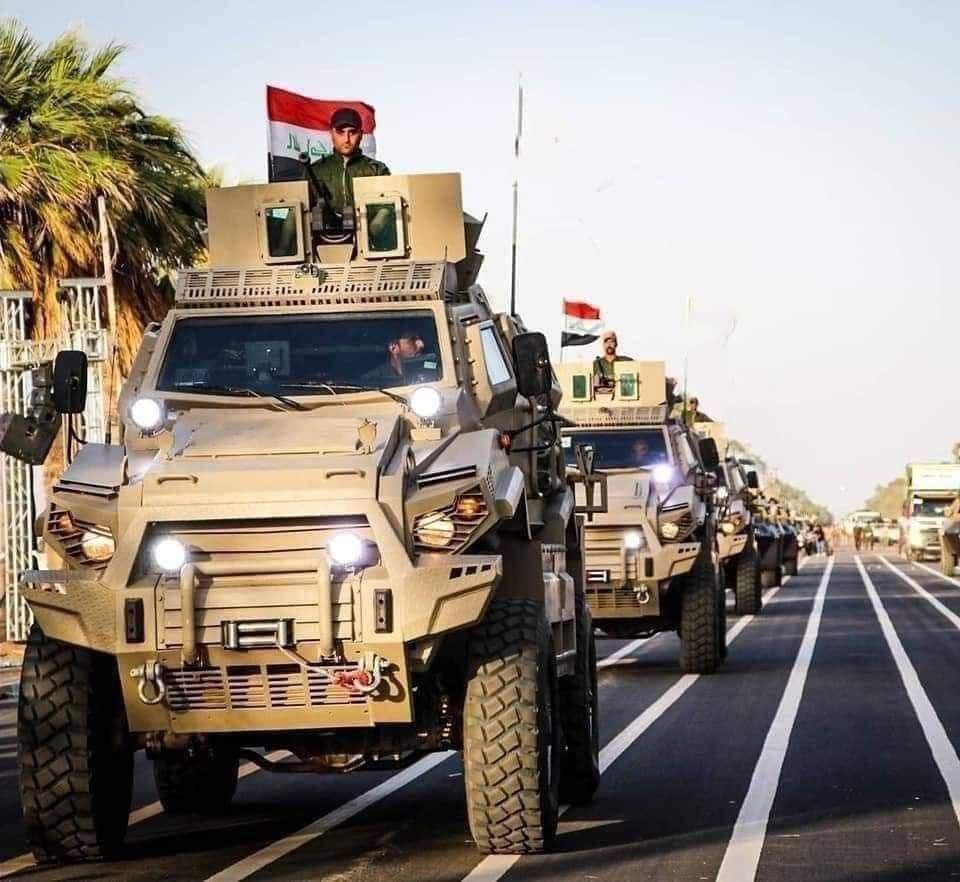
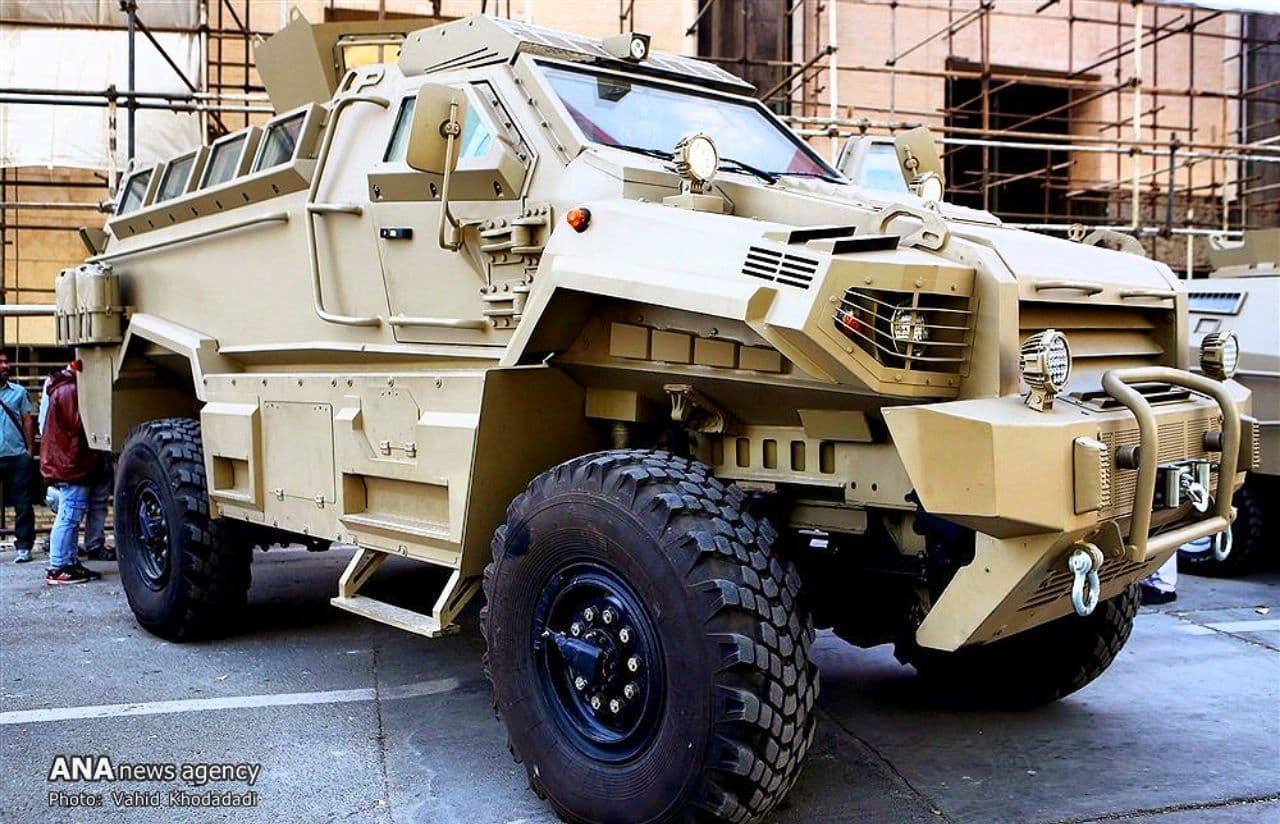
In comparison with the Russian Spartak, both vehicles share a 4×4 chassis design focused on protection and mobility, yet they differ in several aspects of layout and performance. The Spartak is heavier but more compact, making it better suited for urban maneuvering, while the Toofan, with its 7‑meter length, offers greater interior space. In terms of protection, Spartak’s ballistic rating of Br5/Br6A (resistant to 12.7–14.5mm rounds in key areas) appears slightly superior to Toofan’s STANAG 4569 Level 3, though both platforms are designed to withstand 6–8 kg TNT blasts. Their engines are broadly similar, but Toofan delivers higher torque (1,470 Nm) enabling steeper climbs (60% gradient versus Spartak’s 31°). Operational range is nearly identical, with Toofan holding a small edge in water fording capability at 1.5 meters, compared to 1.2 meters for Spartak.
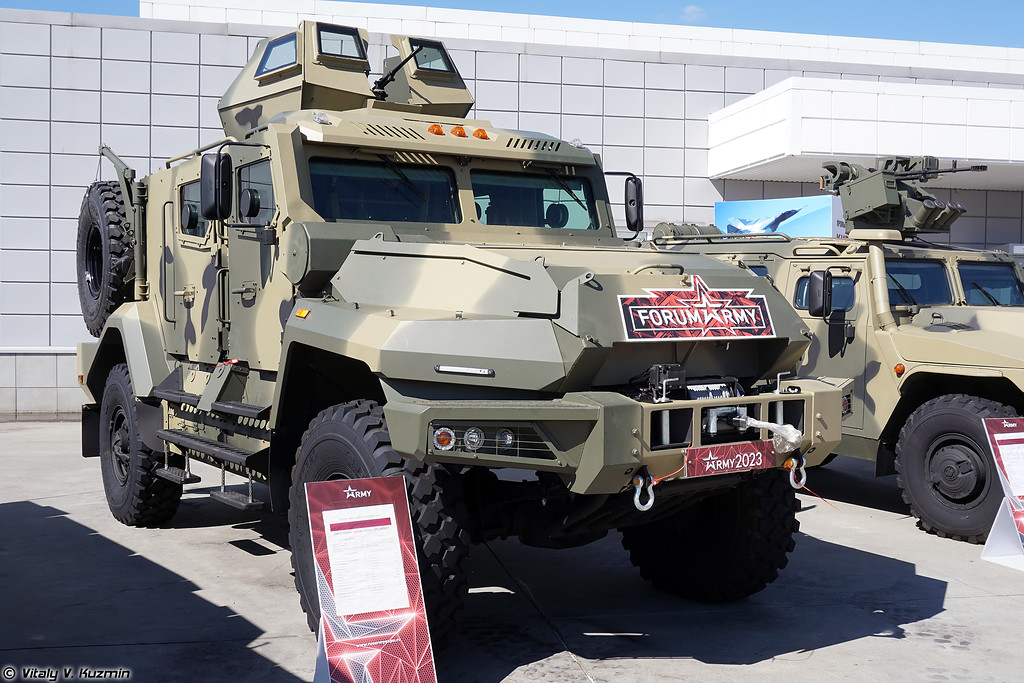
Despite the high degree of similarity between the two platforms, it can be inferred that the domestic assembly of the Toofan MRAP has faced challenges due to reliance on certain components sourced from Turkey and Russia, as well as its dependence on a Canadian-Emirati Streit Group design. These factors appear to have complicated the process of mass production. Consequently, the armed forces opted to procure a similar platform with fewer logistical and supply chain difficulties, ensuring smoother integration into service.
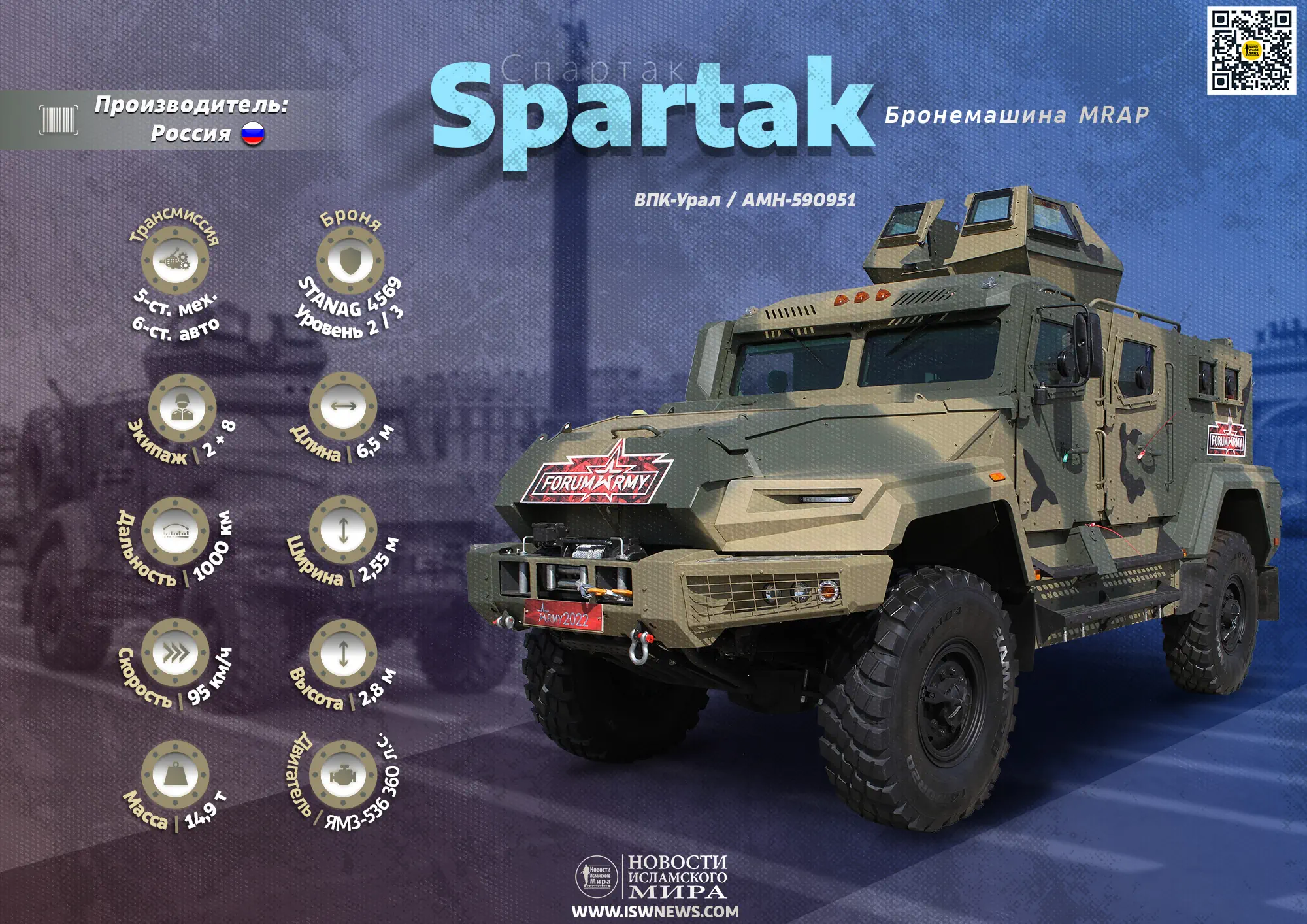
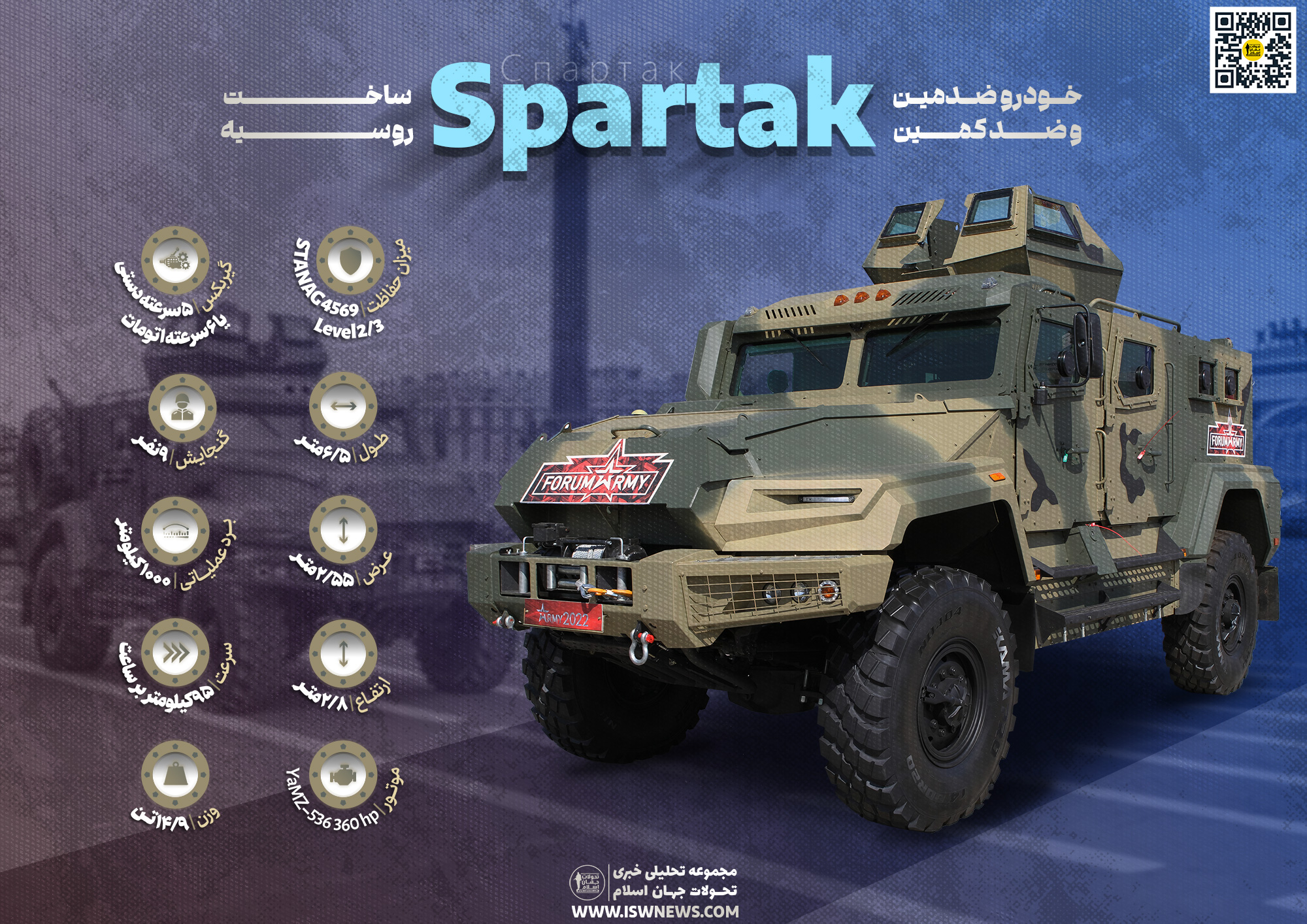
Spartak MRAP specifications:
Origin: Russia
Manufacturer: Military Industrial Company (VPK)
Crew: 10 people
Length: 6.5 m
Width: 2.55 m
Height: 2.8 m
Engine: YaMZ-536 360 hp
Transmission: 5-speed manual or 6-speed automatic
Operational range: 1,000 km
Speed: 95 km/h
Weight: 14.9 tons
Protection level: STANAG 4569 Level 2 / 3

Comments