According to this bill, any cooperation between Iran and the IAEA has been suspended, meaning that IAEA inspectors are no longer permitted to enter Iran.
This suspension will only be lifted if Iran’s Supreme National Security Council meets three conditions:
Ensuring the security of nuclear facilities and nuclear scientists.
Guaranteeing full respect for Iran’s rights as outlined in Article 4 of the Treaty on the Non-Proliferation of Nuclear Weapons, particularly regarding the country’s uranium enrichment.
Westerners must not activate the snapback mechanism outlined in the Joint Comprehensive Plan of Action (JCPOA).
As a result of this action, while Iran has not formally withdrawn from the NPT, it has effectively gained many of the benefits associated with withdrawing from the treaty.
In a joint statement, the Ministry of Foreign Affairs and the Atomic Energy Organization of Iran strongly condemned the actions of the United States and three European countries for passing the resolution at the IAEA Board of Governors. Iran views this action as a political tool aimed at achieving objectives without technical or legal justification.
The statement emphasizes that this political approach to Iran is misguided, especially since Iran has consistently adhered to its commitments and has actively cooperated with the Agency. The Iranian authorities conclude that the policy of engagement and cooperation has proven to be counterproductive.
The West is pursuing its political goals by reviving claims from over 25 years ago, despite the fact that all previous claims were resolved by the Agency’s November 2015 resolution. This is taking place while these countries have remained silent about the weapons of mass destruction program of the Zionist regime and have taken no action regarding threats to attack the peaceful nuclear facilities of member states.
Moreover, the US, UK, and France have not fulfilled their obligations under Article 6 of the Non-Proliferation Treaty concerning nuclear disarmament, and Germany hosts these deadly and inhumane weapons.
As a result of these actions, the credibility and prestige of the International Atomic Energy Agency have been significantly undermined, making the political nature of this international institution more evident than ever.
Introduction and Development History of the GBU-57 MOP:
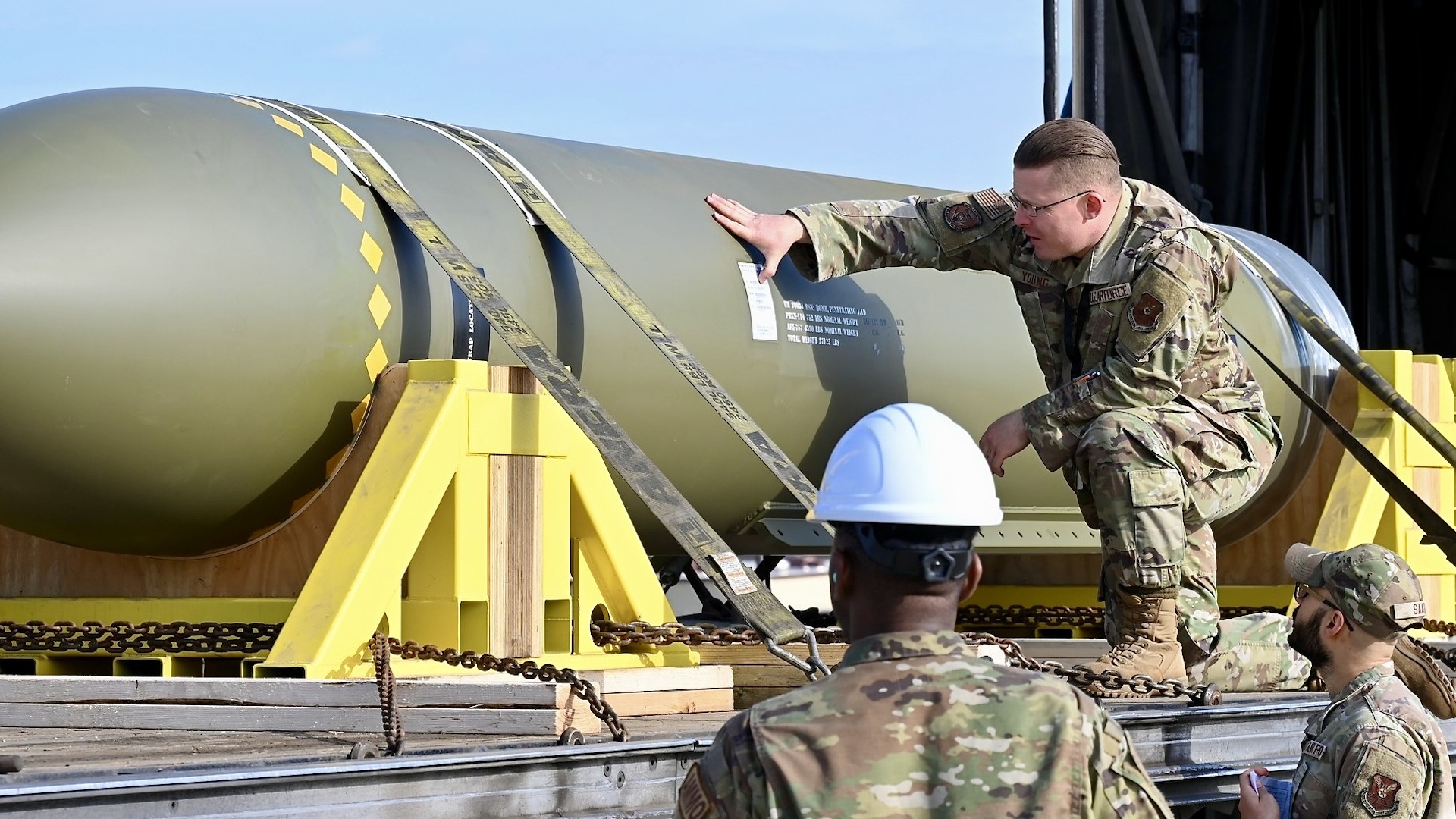
As a heavy-duty penetrator bomb, the GBU-57 MOP (Massive Ordnance Penetrator) can target and destroy heavily fortified underground facilities like bunkers, command centers, and weapons depots. Designed for daytime or nighttime attacks on targets deep underground, as well as for deterring enemies with buried infrastructure, the bomb is built for planned strikes.
The GBU-57 MOP project started in the early 2000s, a joint effort by Northrop Grumman and Lockheed Martin. However, due to financial and technical hurdles, the initial attempt was halted. After the US invasion of Iraq in 2003, an analysis of bunker-busting bombs used showed they lacked the penetration power to take out fortified targets.
This sparked renewed interest in developing a larger bunker-busting bomb, and the MOP project was launched by the Defense Threat Reduction Agency (DTRA) to meet a long-standing Air Force need. The concept of “Big BLU” – large penetrating and explosive bombs like MOP and MOAB – was also proposed. In the end, Boeing won the contract to design and produce the bomb.
Boeing and US Army weapons specialists stand in front of a mock-up of the MOP bomb at Whiteman Air Force Base
The first static detonation test of the bomb was conducted in 2007 at the White Sands Missile Range. Flight tests of the weapon were conducted from 2008 to 2010, including launches from B-52 and B-2 bombers. In February 2010, the project was transferred to the Air Force, and the first deliveries of operational units of the bomb began in September 2011.
MOP test by B-2 bomberMOP test by B-52 bomberGBU-57 MOP bomb testB-2 bomber releases and tests GBU-57 MOP bomb
The estimated weight of the GBU-57 Massive Ordnance Penetrator (MOP) is between 12,300 and 13,600 kilograms, depending on various sources. The bomb measures approximately 6.2 meters in length and about 0.8 meters in diameter. To put this into perspective, its weight is comparable to that of two adult African elephants, highlighting its significant scale.
The warhead of this bomb is composed of a mixture of AFX-757 and PBXN-114 explosives. The total weight of the warhead ranges from 2,400 to 2,600 kilograms, which includes around 2,080 kilograms of AFX-757 and 341 kilograms of PBXN-114. The body of the warhead is made from a high-performance steel alloy, designed to maintain its integrity upon impact. This construction enables the bomb to deliver a substantial explosive payload while preserving the penetrator’s structure during impact. The bomb’s considerable weight and specialized alloy are crucial to its penetration capability, much like driving a steel nail into rock. Most of the bomb’s weight resides in its body.
The GBU-57 MOP is estimated to penetrate approximately 60 meters of reinforced concrete with a strength of 5,000 PSI. It can also penetrate about 40 meters of relatively hard rock and around 8 meters of reinforced concrete with a strength of 10,000 PSI. It is important to note that the reported penetration capabilities of 60 meters are based on preliminary information and prototypes of the bomb, and there is currently no precise information available regarding the ultimate penetration capacity of the latest model.
Comparison of penetration of the MOP bomb (possibly a prototype) with the BLU-109 and GBU-28 bombs
The GBU-57 Massive Ordnance Penetrator (MOP) is a precision-guided munition that utilizes a GPS/INS (Global Positioning System/Inertial Navigation System) for enhanced targeting accuracy, achieving precision within a few meters. The bomb features four fixed trapezoidal wings along its midsection and four lattice fins at its tail, which help adjust its trajectory during flight.
Equipped with a smart fuze (LPSF), the GBU-57 MOP can modify its detonation timing based on the depth and configuration of the underground target. It incorporates void-sensing fuzes that trigger detonation if a large cavity is detected within the bunker. Additionally, the weapon includes a delay fuse, allowing the warhead to survive the initial impact upon penetrating the target before it detonates.
In comparison to BLU-109, the MOP bomb possesses over ten times the explosive power and significantly greater penetration capabilities. The BLU-109 weighs only 910 kg and has a much shallower penetration depth.
Comparison of penetration of the MOP bomb (probably a prototype) with the BLU-109 and GBU-28 bombs
Variants of GBU-57:
The GBU-57 has undergone numerous upgrades and modifications over the years, resulting in a variety of variants. These upgrades have included improvements to the fuze system, advanced guidance systems, and increased penetration capabilities, currently spanning seven generations. Common variants of this bomb use the BLU-127A/B, BLU-127B/B, and BLU-127C/B warheads, respectively.
GBU-57/B: This version is equipped with the BLU-127/B warhead. The United States Air Force has addressed an integration issue that existed with the original version of the bomb on the B-2 Spirit stealth bomber. A new smart fuse has also been tested to enhance its effectiveness in situations where the depth or precise location of a buried target is uncertain.
GBU-57A/B: This version uses the BLU-127A/B warhead.
GBU-57B/B: This model is equipped with the BLU-127B/B warhead.
GBU-57C/B: The specific upgrades made by Boeing to this version are not detailed in the available sources.
GBU-57D/B: Information about the modifications made by Boeing to this version is also unclear, but it is believed that its fuse and primer have been upgraded.
GBU-57E/B: This version has been part of the operational inventory since at least 2016 and is equipped with the BLU-127C/B warhead. It has improved capabilities for penetrating concrete structures compared to earlier models. It can be reasonably assumed to have greater penetration power than the 2007 models, which could penetrate to a depth of 60 meters. The BLU-127C/B warhead features a booster in its front section, although its exact function remains unknown. Currently, the US Air Force does not have a newer version of the GBU-57E/B in operational use.
GBU-57F/B: This model is described as the latest version, but little is known about its exact capabilities.
GBU-57 MOP bomb
Overall, the US is working to boost the effectiveness of this bomb by continually upgrading it. As noted, the 60-meter penetration power is from the early models, and there’s no information available on the bomb’s penetration after receiving later upgrades. Additionally, the US is reportedly developing a version of this bomb with similar characteristics to the GBU-57, but lighter in weight, to enable its use in fighter jets.
Production numbers and costs of the GBU-57:
Developing the GBU-57 MOP weapon is expected to cost around $400 to $500 million. Each unit’s production cost is estimated to be roughly $3.5 million, with upgraded versions likely to be even more expensive. Although the exact number of MOP bombs produced is classified, estimates suggest a relatively small stockpile – about 20 by 2015, with potential for increased production.
GBU-57 MOP specifications:
Type: bunker buster bomb Origin: U.S. Manufacturer: Boeing Length: 6.2 m Diameter: 80 cm Total bomb weight: around 12.5 tons Warhead weight: around 2.5 tons Penetration: 61 m Guidance: GPS/INS
The U.S. Senate has removed Syria from its list of “rogue” countries, which the list includes nations such as Iran, Russia, North Korea, Cuba, and Venezuela. These countries have been accused by the US! of acting against U.S. interests, and other alleged human rights violations.
Syria has been designated as a state sponsor of terrorism since 1979, a label that has led to significant sanctions. These sanctions include a ban on military exports, restrictions on foreign aid, and control over financial transactions.
This recent action appears to be a step towards normalizing relations between Washington and the new Syrian government. Additionally, the U.S. previously lifted sanctions on Syria for six months.
Washington aims to strengthen its political relationship with the al-Julani government and elevate it to the highest level possible, especially in light of the reduced number of U.S. troops in Syria.
The operation to obtain these documents took place some time ago, but the extensive volume of the documents and the need to securely transport them into Iran have delayed the announcement until they were safely delivered to their designated protected locations.
This security breach could intensify political pressure on Netanyahu and the Israeli regime government within the occupied territories.
The details of how this operation was conducted and the process of transferring such a large volume of documents from occupied Palestine to Iran will be interesting!
In addition to these strikes, the Israeli military opened fire on Palestinian refugees gathered around Al-Alam Square in western Rafah, who were waiting to receive American humanitarian aid. This attack resulted in the martyrdom of 27 Palestinians and left more than 90 others injured.
At least 40 Palestinians were martyred and 208 others were injured in today’s savage strikes by the Israeli regime in the Gaza Strip.
Consequently, the total number of fatalities in the Gaza Strip has now surpassed 54,510, while the number of injured individuals has exceeded 124,901.
The Aegis Ballistic Missile Defense System (ABMD) is a component of the AEGIS comprehensive combat system. It is an integrated, sea-based defense system designed to protect US naval fleets from enemy aircraft and cruise missiles. The system employs various types of missiles, including the Standard-2 (SM-2), Standard-3 (SM-3), Standard-6 (SM-6), and Sea Sparrow, alongside Phalanx Close-In Weapon System to counter potential threats.
Additionally, Aegis can launch Tomahawk land-attack cruise missiles. A specific subset of Aegis-equipped vessels operates in key regions, including the Mediterranean Sea, Red Sea, Black Sea, Western Pacific, and Persian Gulf, providing a defensive shield against potential ballistic missile attacks from countries such as Russia, China, North Korea, and Iran.
SM-3 and SM-6 missile replicas
The Aegis anti-ballistic system consists of three main components: sensors, interceptors, and a command and control system.
The main interceptor missile of this system is the RIM-161 Standard Missile 3 (SM-3), which is designed in three versions: Block IA, IB, and IIA. Each version has been improved in range and performance capabilities compared to its predecessor. This missile employs a kinetic warhead to destroy ballistic missile warheads during the midcourse phase of flight, which occurs outside the Earth’s atmosphere. Additionally, the Aegis system utilizes intra-atmospheric missiles such as the SM-2 Block IV and SM-6, designed to intercept missiles in the terminal phase of flight. All of these interceptors are deployed through the Mark 41 Vertical Launch System (VLS).
Mark 41 Vertical Launch System
The primary sensor used in the Aegis system is the AN/SPY-1D radar, which operates in the S-band and provides nearly 360-degree coverage. As technology has advanced, newer Aegis platforms have been equipped with upgraded radars, such as the SPY-6 and SPY-7. Additionally, enhanced Aegis platforms can launch interceptor missiles based on data from long-range sensors, including the THAAD TPY-2 radar, which operates in the X-band.
The anti-ballistic component of the Aegis system is managed by the Aegis comprehensive combat system, which has undergone upgrades over time through hardware and software enhancements known as “Baseline.” The latest version of this system, called Baseline 9, enables a ship to simultaneously conduct air defense and missile defense operations. Previous versions of the software could only support one of these two missions at a time, often requiring Aegis ships to operate in pairs—one ship managing air defense while the other focused on anti-ballistic defense.
An overview of how US missile defense systems intercept threats
Background and history of the development of the Aegis system:
The development of the Aegis system was initially driven by the increasing threat of Soviet anti-ship missiles in the 1960s. The sinking of the Israeli warship Eilat in 1967 by four Soviet-made Styx missiles highlighted the vulnerability of naval assets to new-generation weapons. In the aftermath of World War II, the United States aimed to strengthen its naval fleet, while the Soviet defense strategy relied on utilizing heavy cruise missiles, sometimes equipped with nuclear warheads, launched from smaller vessels or bombers and fighter jets. These missiles, flying at high speeds and close to the water’s surface, made detection and interception extremely difficult.
The United States Navy recognized that existing radar technology was inadequate for tracking and effectively engaging multiple high-speed, near-surface missiles simultaneously. To address this critical gap, the Advanced Missile System (ASMS) program was initiated in 1964, marking the beginning of what would later become known as Aegis. In December 1969, the ASMS program was officially renamed “Aegis,” inspired by the shield of Zeus in Greek mythology.
The Aegis program was later expanded to include the emerging threat of ballistic missiles. In the mid-1980s, the Aegis Anti-Ballistic Missile Defense System (Aegis BMD) program was launched as part of Ronald Reagan’s Strategic Defense Initiative (SDI), informally known as “Star Wars.” This program was developed as a defense measure against potential attacks from long-range ballistic missiles launched by the former Soviet Union.
Initially, the Aegis BMD concept included a space-based railgun system. However, technological limitations prompted the exploration of alternative solutions, leading to the development of anti-ballistic missiles instead. The first successful interception test of the Aegis BMD system occurred in January 2002, marking a significant milestone in its evolution. The experiences gained from the first and second Persian Gulf Wars, alongside the growing proliferation of short- and intermediate-range ballistic missiles by countries like North Korea and Iran in the late 1990s and early 2000s, further emphasized the necessity for a robust sea-based ballistic missile defense capability like Aegis. This evolution transformed Aegis from a purely anti-ship system into one with a crucial anti-ballistic missile capability.
Role of Aegis in the US Navy and the National Missile Defense Program:
As mentioned earlier, the Aegis anti-ballistic system is part of the larger Aegis Combat System. Note that almost all US Navy warships and destroyers are considered Aegis vessels because they’re equipped with the Aegis combat system, which includes sensors, computers, software, displays, and weapon launchers. However, not all these vessels can engage ballistic targets or have received the Aegis BMD upgrade. This article will focus specifically on the Aegis anti-ballistic capabilities.
Ticonderoga-class cruiser
A total of 27 Ticonderoga-class ships were purchased between 1978 and 1988, and entered service between 1983 and 1994. The Navy retired the first five ships of the class, which were technically built to an older standard, by 2005. Retirement of the remaining 22 ships began in 2022 and has now reached nine, with at least five of the class reportedly upgraded to anti-ballistic capabilities.
USS Ticonderoga (CG-47)
Arleigh Burke-class destroyers
The U.S. Navy began purchasing the DDG-51 class in 1985, with a total of 94 ships expected to be purchased by 2024. The first destroyer of the class entered service in 1991, and a total of 74 ships will be operational by the end of 2023. Retirement of the older ships will begin in fiscal year 2028. The DDG-51 design has been updated many times over the years. The first 28 ships are known as Class I/II, the next 34 as Class IIA, and the next ships as Generation III. The third generation of the class will use the new SPY-6 radar instead of the older SPY-1. According to the Missile Defense Agency, by the end of fiscal year 2025, there will be a total of 56 ships of the class with anti-ballistic capabilities. By 2023, that number had increased to 49, increasing to 69 by fiscal year 2030.
USS Arleigh Burke (DDG-51)
The Aegis missile defense system is a key part of the U.S. and allied strategies to defend against ballistic missiles. It’s part of the U.S. National Ballistic Missile Defense System, mainly designed to protect against short- to intermediate-range ballistic missiles, which have a range of around 2,200 miles (3,500 km). However, recent upgrades have also given it the ability to counter intercontinental ballistic missiles, which can travel up to 6,200 miles (10,000 km). That’s why the system gets its own funding from the Department of Defense’s Missile Defense Agency.
US Comprehensive Ballistic Missile Defense Program
The Aegis system, led by the Missile Defense Agency, is integrated with other components of the Ballistic Missile Defense System (BMDS), such as THAAD and Patriot defense systems, through the Command, Control, Battle Management, and Communications (C2BMC) system. This integration enables a coordinated response to missile threats by utilizing the strengths of each system. As a result, Aegis can support other interceptors by providing long-range surveillance and radar data.
In addition to the United States, the Aegis combat system is currently deployed by Australia, Canada, Japan, South Korea, Norway, and Spain, all of which share intelligence data.
First Intercontinental Ballistic Missile Intercept Test by SM-3 Block IIA Missile in 2020 in Hawaiian Sea Area
The video above shows a graphical representation of the first live test of an intercontinental ballistic missile (ICBM) interception. On November 17, 2020, a prototype ICBM was launched from the Ronald Reagan Ballistic Missile Defense Test Site on Kwajalein Atoll in the Marshall Islands, headed toward the Hawaiian Sea. In this test, a destroyer used remote engagement capabilities through the Command and Control Battle Management communications network, as part of a scenario to defend Hawaii. After getting tracking data from the system, the destroyer fired an SM-3 Block IIA missile that successfully hit the target.
Review of the radar and satellite capabilities of the Aegis system:
The Aegis system uses a set of advanced radar systems to detect, track, and engage ballistic missile threats. The main fire control radar for Aegis, the AN/SPY-1, is a Lockheed Martin Advanced Passive Electronically Scanned Array (PESA) radar that operates in the S-band. This powerful radar has four array panels for 360-degree coverage and can search, track, and guide missiles at the same time. Although the official range of the radar is not publicly disclosed, its estimated range is between 310 and 370 kilometers, making it capable of detecting various ballistic, cruise, and air targets.
AN/SPY-1 radar
Originally, Aegis wasn’t built for anti-ballistic missions. Despite policymakers allocating funds to update the system, the SPY-1 radar is still a major weakness in the Aegis chain, limiting interception by standard missiles.
AN/SPY1D(V) radar on the Japanese destroyer GS Ashigara, an Atago-class destroyer.
SPY-1 radar gives interceptors enough accuracy to track targets up to about 370 km. This is enough for the Standard-2 missile, which has a range of around 160 km. However, it’s not enough for Standard-3 anti-ballistic missiles, especially the Block IA/B versions with a range of up to 700 km and the Block IIA with a range of up to 2500 km. The SPY-1 radar also has limitations for the Standard-6, which has an active seeker and can reach a range of about 460 km.
Variants of AN/SPY-1 radar
Raytheon’s AN/SPY-6 radar, also referred to as AMDR, is the next generation of radar for Aegis. This active electronically scanned array (AESA) radar works in both S and X bands, providing significantly more advanced capabilities.
ANSPY-6 radar being assembled at RaytheonVarious AN/SPY-6 radar models
The system comprises two main radars and a Radar Set Controller (RSC) that coordinates these sensors. The S-band radar is responsible for tasks such as searching for and tracking targets, accurately detecting ballistic missile warheads, and communicating with interceptor missiles. In contrast, the X-band radar is designed for near-horizon search, offering more accurate tracking and guidance for short- and medium-range missiles. This radar is reported to be 30 times more sensitive than the SPY-1, allowing it to handle 30 times more targets. Different versions of this radar, varying in dimensions, are used on various vessels, including the new generation of Arleigh Burke destroyers.
AN/SPY-6 System Overview
The AN/SPY-7 radar, manufactured by Lockheed Martin, is another advanced radar being integrated into the Aegis system. This radar is currently installed on some Japanese ships equipped with the Aegis system (ASEV), as well as on the Spanish F-110 ships and the Canadian River-class ships. Additionally, the AN/SPY-7 radar is intended for land-based Aegis systems in the United States, specifically in Hawaii and Alaska, as well as in Japan, where it will be deployed in Yamaguchi and Akita. Overall, the AN/SPY-7 radar is expected to be used on more ships belonging to the United States and its allies in the future.
AN/SPY-7 radar at Clear Space Force Station, Alaska
The land-based version of Aegis is being developed under the name Aegis Ashore. This development began in 2014, with the first site opened in Romania in 2016 as part of the NATO missile defense network in Europe. A second site is scheduled to open in Poland in 2024. Additionally, Japan is developing its own land-based version of Aegis in the prefectures of Yamaguchi and Akita. The United States also has three other land-based Aegis systems located in Guam, Hawaii, and Alaska.
Lockheed Martin’s video of the Aegis land-based prototype explaining that Aegis Ashore uses the same components used in Aegis-equipped destroyers.Aegis land-based version in PolandAegis land-based version in Poland in RomaniaAegis land-based version in HawaiiAEGIS Ashore system
Satellite networks serve as the backbone of the Aegis missile defense system, significantly enhancing its range, accuracy, and speed of response. A crucial component of this network is the Space Tracking and Surveillance System (STSS), which is designed to intercept ballistic missiles during all phases of their flight: from launch (boost phase) through the ascent (midcourse phase) and re-entry into the atmosphere. STSS satellites are capable of detecting and tracking a wide variety of missiles, including short-range, intermediate-range, and intercontinental missiles. The data collected by these satellites is transmitted to Aegis-equipped ships, enabling a critical capability known as Launch on Remote, which substantially extends the effective range of interception.
Overview of the Space Tracking and Surveillance System (STSS) operation
Along with STSS, the Defense Support Program (DSP) and Spaceborne Infrared System (SBIRS) also provide crucial early warning capabilities. By using infrared sensors, these systems pick up the thermal signatures of missile launches early on and transmit valuable data on position and velocity to Aegis and other parts of the US missile defense system.
Review of AEGIS interceptor missiles:
AEGIS Missile Defense System – SM-3 and SM-6 missiles
RIM-161 SM-3 missile
The Standard Missile-3 (SM-3) is the main interceptor used in the Aegis system. The SM-3 program was developed as a variant of the Standard SM-2ER Block IV missile, known as NTW-TBMD. Initial testing took place from 1992 to 1995 as part of Project Terrier/LEAP. The first test flight of the RIM-161A SM-3 occurred in September 1999, and the program achieved its first successful intercept of a ballistic target in January 2002. The Standard Missile officially entered operational service in 2005. Its first combat deployment took place in April 2024, when U.S. Navy warships used the missile to intercept ballistic missiles fired by Iran toward Israel.
The SM-3 missile closely resembles the Standard-2 but has two key differences: first, it employs a solid-fuel booster as a third stage, enabling greater range and altitude engagement; second, it uses a kinetic warhead instead of a conventional high-explosive warhead. The SM-3 family is specifically designed to intercept ballistic missiles outside the atmosphere, at altitudes above 100 km. Because ballistic missiles follow a parabolic flight path, they maintain a relatively constant speed after the boost phase and during the midcourse phase or reentry into the atmosphere, losing the ability to perform complex maneuvers. This characteristic allows anti-ballistic interceptors equipped with heat seekers to detect ballistic warheads and destroy them through direct collision.
The different generations of the Standard-3 missile are as follows:
SM-3 Block IA: Following the prototype, this version was launched to boost reliability, ease of maintenance, and lower costs, marking the first model in this family to go into mass production.
SM-3 Block IB: Set to enter service in 2010, this missile featured a dual-spectral infrared seeker and a new space propulsion system in its warhead. These upgrades boosted the missile’s ability to counter maneuvering warheads, enabling it to defend against intermediate-range ballistic missiles and some medium-to-long-range missiles.
SM-3 Block II: For this version, we increased the fuselage diameter to 530 mm and scaled down the wings to boost speed and range. However, this model never made it into operational use.
SM-3 Block IIA: Co-developed by Raytheon and Mitsubishi Heavy Industries, this system boasted a larger warhead, improved maneuverability, and more advanced sensors. It can also intercept certain intercontinental ballistic missiles (ICBMs) and satellites, and went into service in 2015.
Infographic released by RaytheonInfographic released by the US Missile Defense AgencyThe evolution of different generations of the Standard-3 missile
In terms of operational performance, the Block IA and Block IB versions have an estimated range of between 900 and 1,200 kilometers. The more advanced Block IIA version significantly increases this range to around 2,500 kilometers and even exceeds 5,500 kilometers. Regarding engagement altitude, the Block IA and IB versions can intercept targets at altitudes of up to 500 kilometers, while the Block IIA can operate at altitudes between 900 and 1,050 kilometers, depending on the type of target. Additionally, the terminal speed of the Block IA and IB versions is approximately Mach 8.8, whereas the Block IIA can attain a speed equivalent to Mach 13.2.
How the SM-3 interceptor missile works:
When the Aegis missile defense system detects an incoming ballistic missile, an SM-3 interceptor missile is fired from one of the ships in the engagement zone. The Aerojet MK 72 solid-fuel rocket booster launches the SM-3 from the ship’s Mark 41 vertical launch system. Once launched, the missile communicates with the ship that fired it. After the booster burn is complete, the booster separates, and the Aerojet MK 104 solid-fuel rocket motor takes over propulsion while the missile is in the atmosphere. The rocket continues to receive mid-course guidance information from the launch vessel and is also assisted by GPS data.
The ATK MK 136 solid-fuel third-stage rocket motor ignites after the second stage burns out, propelling the missile (if necessary) into the upper atmosphere and providing pulsed propulsion for the SM-3 until the final 30 seconds before interception.
In the final, fourth stage, the third stage engine separates, and the Lightweight Extra-Atmospheric Projectile (LEAP) kinetic warhead begins to search for the target using targeting data from the launch vehicle. Aerojet’s Tunable Direction and Attitude Control System (TDACS) allows the warhead to maneuver in the final phase of engagement. The kinetic warhead’s sensors identify the target and attempt to locate the most vulnerable part of the target, guiding the warhead to that point. If the kinetic warhead successfully engages the target, it generates 130 megajoules of kinetic energy at the point of impact, equivalent to 31 kilograms of TNT, thereby neutralizing the target.
The accompanying video illustrates the four stages, from launch to the moment of interception and destruction of the target.
How the SM-3 interceptor missile works, from the moment it is launched to the moment it intercepts and destroys the target
RIM-161 SM-3 missile specifications:
Type: Kinetic anti ballistic missile Manufacturer: Raytheon and Aerojet (Block I) and Raytheon and Mitsubishi (Block IIA) Country of manufacture: USA and Japan Entered service: 2014 (Block IB) Length: 6.55 m Wingspan: 1.57 m Diameter: 34.3 cm Block I 53.3 cm Block II Engine: Four-stage solid fuel Range: 900 km Block IA 1200 km Block IB 5500 + km Block IIA Ceiling: 1050 km Block IIA Speed: 8.8 Mach Block IA – IB 13.2 Mach Block IIA Weight: 1.5 tons Warhead: Light extra-atmospheric kinetic warhead for Block I and heavy for Block II Guidance: GPS/INS/SARH/Passive IR homing
SM-3 Block IBmissileSM-3 Block IBmissileSM-3 Block IIAmissileFirst official flight test of the Standard-III Block IIA missile from Point Mugu Naval Area, San Nicolas Island, CaliforniaSM-3 missile
RIM-156 SM-2ER missile
The Block IV (RIM-156A) was the first long-range missile in the Standard family, specifically designed for use with Mk 41 vertical launch systems. It features more advanced guidance and control systems than previous models. This version primarily serves as a final-stage interceptor, which means it intercepts and destroys ballistic missiles during the final phase of their flight within the Earth’s atmosphere. The missile has an estimated engagement range of 185 to 370 km and can reach a maximum engagement altitude of up to 33 km, with a top speed of approximately Mach 3.5.
At the time of the Block IV’s development, older missiles like the RIM-67 could only be launched from inclined deck-mounted launchers due to their large size. These launchers were heavy and bulky, restricting their use to larger vessels such as cruisers. In contrast, the SM-2 Block IV’s compatibility with the Mk 41 Vertical Launch System enabled its deployment on Ticonderoga-class cruisers and Arleigh Burke-class destroyers. Development of the Block IV missile began in July 1987, with the first test conducted at White Sands Missile Range in 1990 and its inaugural sea trial occurring in 1994. Initial limited production of the missile was authorized in 1995.
The RIM-156 was not an overall successful interceptor due to instability in the development program. As a result, the U.S. Navy funded modifications for 75 of the 100 RIM-156 missiles that were produced. Of these, five were used for testing, while about 70 modified SM-2 Block IVs remain in the Aegis fleet, providing temporary defense against anti-ship ballistic missiles. The experiences gained from producing the RIM-156 also contributed to the development of the Standard-3 and Standard-6 missile families.
Additionally, it is important to note that the SM-2 missile is the same type that the U.S. military fired twice on July 3, 1988, at Iran Air Flight IR655, resulting in the tragic loss of all 290 passengers on board, including 66 children under the age of 13.
SM-2ER Block IV missile specifications:
Type: Surface-to-air and anti-ship missile Manufacturer: Raytheon Country of manufacture: United States Length: 6.55 m (with booster) Wingspan: 1.07 m Diameter: 34.3 cm Engine: Two-stage solid fuel Range: 370 km Ceiling: 24.4 km Speed: Mach 3.5 Weight: 1.463 tons Warhead: 64 kg Blast-Frag Guidance: INS/SARH
The ERAM (Standard Extended Range Active Missile), also known as the Standard Missile 6 (SM-6), provides a wide range of multi-mission capabilities, including long-range air defense, terminal ballistic missile defense, and anti-surface attack. The development of the SM-6 addressed a significant gap in long-range air defense following the cancellation of the SM-2ER Block IVA project. Manufactured by Raytheon, the missile utilizes the airframe of the SM-2ER Block IV (RIM-156A) and features an active radar seeker derived from the AIM-120C AMRAAM air-to-air missile.
The SM-6’s development began around 2005, with the first missile being delivered to the United States Navy in April 2011. It achieved initial operational capability in November 2013. In 2016, the SM-6 demonstrated its anti-surface warfare capability, and an air-launched version, the AIM-174B, is anticipated to be introduced in 2024.
The primary purpose of the SM-6 is to counter long-range aerial threats, effectively engaging aircraft, fighters, cruise missiles, and drones at extended ranges. Additionally, the Block IA and IB versions of the missile possess anti-surface warfare capabilities, allowing them to target both surface ships and ground installations. The missile has an official range of 240 miles (approximately 240 km), but in practical scenarios, its range can exceed 250 miles (around 370 km) against ground or sea targets. The air-launched version, the AIM-174B, has an estimated range of 250 miles (approximately 400 km).
The SM-6 can engage targets at altitudes of up to 25 miles (33 km) and at a maximum speed of Mach 3.5. To enable these capabilities, the missile is equipped with a 140-pound (64 kg) high-explosive warhead.
RIM-174 SM-6 missile specifications:
Type: Surface-to-air, anti-ballistic (terminal phase), and anti-ship missile Manufacturer: Raytheon Country of manufacture: United States Entered service: 2013 Length: 6.6 m Wingspan: 1.57 m Diameter: 34 cm Block I 53 cm Block II Engine: Two-stage solid fuel Range: Up to 500 km Ceiling: 34 km Speed: Mach 3.5 Weight: 1.5 tons Warhead: 64 kg Blast-Frag Guidance: GPS/INS/ARH, SARH
SM-6 missile
Overall, the Aegis system serves as the core of the U.S. anti-ballistic defense program, which has two primary objectives. First, it aims to protect the naval fleet and strike groups. Second, it enhances the overall anti-ballistic program by relaying supplementary data to other land-based defense systems. It’s important to note that the Aegis system was initially developed to counter the long-range missiles of North Korea, China, and Russia—countries that have greater access to the oceans and are geographically closer to the United States. Additionally, the technology behind this system has been specifically provided to allied nations neighboring China or Russia.
Al-Julani stated that if there is a clear path to peace, Syria is ready to engage with Israel. He emphasized that both nations share common enemies and can play an important role in regional security. He remarked that the era of endless bombings must end, as no nation can flourish under a sky filled with fear.
In his speech, the Syrian President supported the 1974 resolution agreement with Israel, calling it a suitable framework for mutual restraint and the protection of civilians, especially the Druze community in southern Syria and the Golan Heights.
He continued in the interview by acknowledging the challenges Syria faces, saying, “We have inherited not just ruins, but also wounds, distrust, and fatigue. However, we still have hope.” Al-Julani insisted that a stable Syria is built not through speeches or slogans, but through action.
At the end of his remarks, Al-Julani emphasized that Syria will not be anyone’s pawn; it will serve as a legitimate government. He expressed a desire for America to be a partner in the governance process, fighting corruption, and building institutions based on honesty and integrity.
These comments came as Syria and Israel engaged in several direct talks aimed at reducing tensions and preventing armed conflict in the border areas. This interview indicates a significant shift in Abu Muhammad Al-Julani’s perspective. For years, he had been associated with Wahhabi Takfiri groups that apparently insisted on opposing the U.S. and Israel.
Having rebranded himself as Al-Sharaa and whitewashed by the West, Abu Muhammad Al-Julani now presents himself as a political figure advocating for peace and stability, as if he has forgotten his past and leadership in ISIS and al-Qaeda. It will be interesting to see how Tel Aviv responds to Al-Julani’s statements in the future.
The Zionist military actions have resulted in the complete destruction of several residential buildings in Jabalia and Khan Yunis. The Khuza’a area has been entirely erased!
In just the last 24 hours, at least 60 people have been murdered, and 284 others injured by the Israeli strikes.
Video 1Video 2
The report emphasizes that a large number of victims remain under the rubble and in the streets, and relief forces are unable to treat and rescue them due to the continuous attacks.
Video 3
According to statistics, since the onset of the Zionists’ hostilities against Gaza on October 7, 2023, the total number of martyrs has reached 54,381, and the number of injured has soared to 124,054.
Additionally, since the resumption of attacks on the Gaza Strip on March 18, 2025, 4,117 people have been reported killed, and 12,013 have been injured.
Pro-Baloch separatist media outlets have released images of militants from the Baloch Liberation Army (BLA) attacking and capturing Surab town in Balochistan province.
The BLA taking control of Surab town
The BLA issued a statement claiming that they have taken control of important government facilities, police stations, and several critical sectors in the area. Additionally, BLA militants have established checkpoints along the Quetta-Karachi road and the Surab-Gwadar route, where they are monitoring civilian vehicles.
Surab town, located on the Quetta-Karachi road—Pakistan’s economic and industrial corridor—poses a significant security threat to many regions in the country if it remains disrupted. It is anticipated that the Pakistani army and security forces will take action to regain control of the town in the coming hours.
The Israeli regime confirmed the airstrikes, stating that the attack in Latakia aimed to destroy anti-ship missile depots considered a threat to its naval fleet in the Mediterranean.
Local sources reported that the targets included the headquarters of Brigade 107 in the Jableh area, the Ras Shamra area in northern Latakia, and various sites on the outskirts of Tartus.
First, on May 1, former US Ambassador to Syria during the Obama administration, Robert Ford, told how he met with Ahmed al-Sharaa (aka Muhammad al-Julani) three times between 2023 and 2025, and together with a British NGO, they decided to make an international terrorist a “civilization politician.” Then, former US Special Representative to Syria James Jeffrey from 2018 to 2020, admitted in an interview that “in September 2018, Trump sent a tough message to Assad, Russia and Iran, preventing an imminent attack on Idlib”.
It is worth noting here that both persons did not say a word about the crimes of the former Jabhat Nusra on the Alawite coast and the confrontation with the Druze, which shows how unwilling the Americans are to admit their complicity in the crimes of the Takfiris.
But what conclusion follows from these revelations?
The capture of Damascus by the former Syrian al-Qaeda had been in preparation since March 2023, months after Erdogan’s first statement about his readiness to meet with Assad “in the name of peace in the region.” In fact, throughout that year, Ankara sent positive signals to the then Damascus authorities, which were ignored by Assad. Probably, the trap of the Emirates and Saudis had an effect, who insisted on Syria’s return to the Arab League, and in return Damascus was supposed to limit the influence of the Iranians and avoid rapprochement with the Turks. Then, after a year of training under the leadership of former US Ambassador to Syria Robert Ford, Tahrir al-Sham militants were supposed to become “moderate democrats” in order to legally sit on the throne in Damascus in the future in the eyes of the collective West.
Further, according to Jeffries, we learn that in his first term, Trump defended Idlib in every possible way, where Jabhat Nusra was based, which by that time had changed its name to Tahrir al-Sham. Moreover, if the Iranians and Assad wanted to eliminate the hotbed of terrorism, the Russians immediately capitulated after Pompeo’s call to Lavrov. There are enough reasons for Moscow’s behavior, including long-standing allied relations with the US Republicans, bargaining on the issue of Ukraine* (after all, in his first term, Trump did not touch on the Ukrainian issue at all, and Idlib became a bargaining chip for the Russian Federation), coordination with the Zionists (from the first days of the Syrian conflict, representatives of the “opposition” were a strategic asset for the Zionists).
Interestingly, Jeffries is silent about the Turks in the Idlib situation. We remember that HTS has been on Turkey’s terrorist list all this time, and a couple of years ago, MIT was suspected of trying to poison al-Julani.
In the end, the Trumpists and the British pro-Zionist NGO, by supporting Tahrir al-Sham, simply openly served the Zionists, who saw the jihadists as the main threat to the Assad government and opposition to Iran. The destruction of Syria is necessary for the implementation of Zionist geopolitical projects, such as the Hejaz Railway, where the UAE should replace Syria.
It was not for nothing that I mentioned the Zionist genocide of Palestinians at the beginning of the article, because the overthrow of the Assad regime was directly related to the policy of external expansion of the “Israeli” colony. Despite a number of significant mistakes, Assad’s Syria continued to be an important link within the Axis of Resistance, and now, after the collapse of the Baath regime, Zionism began intensive preparations for the implementation of a step-by-step plan to create a “new Middle East”. The occupation of the Gaza Strip, the blockade of southern Lebanon and a fragmented Syria are the main directions of the Zionists’ external terror on the way to the “Indian economic corridor”.
However, as in the attempts of IDF terrorists to “free” prisoners from captivity of the Palestinian resistance, the Zionists with their plans for the region are suffering defeat.
Why? Two main reasons. 1 – From the point of view of the pagan priests from the castes and communities of the secret elites of the planet, In the new era of the energies of the constellation Aquarius, which began in 2014, the focus of the influence of the Cosmos on the lives of people has shifted to the strip of “Great Eurasia” from Valdai to Altai, and the center of political activity is moving from the North Atlantic (NATO zone) to the Pacific Ocean zone, where the core is the Europe – Eurasia – PRC – USA link. Zionism is becoming a burden for the entire collective West.
2 – {And [remember, O Muhammad], when those who disbelieved plotted against you to restrain you or kill you or evict you (from Makkah). But they plan, and Allaah plans. And Allaah is the best of planners.} [Quran 8:30]