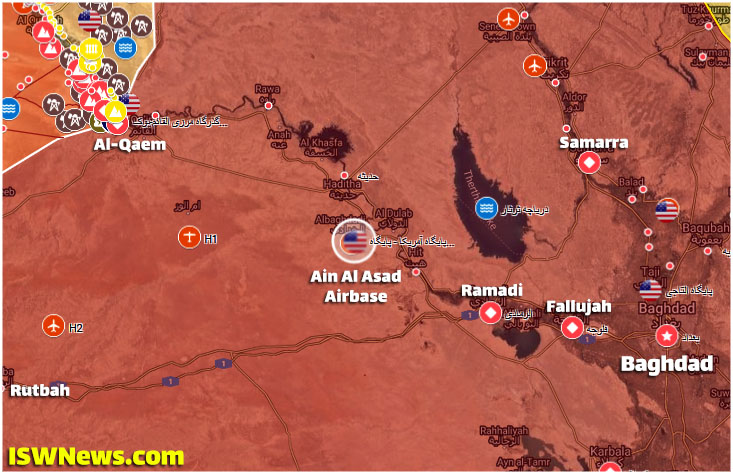
On January 28, the Islamic Resistance in Iraq targeted the positions of the terrorist US army in the Al-Tanf region in the Homs Governorate, located on the border of Syria and Jordan.
Hours after the attack, the US Central Command (CENTCOM) issued a statement confirming the killing of three US soldiers and the injury of 25 others in the drone attack by Iraqi resistance fighters on the US military base in northeastern Jordan.
Reacting to this incident, US President Joe Biden confirmed the deaths of the country’s soldiers in Jordan and announced that three US soldiers were killed and several others were injured in a drone strike on their forces in northeastern Jordan near the Syrian border.
The US President claimed that the attack that led to the killing of three US soldiers was carried out by Iran-backed groups.
While Washington officials have spoken about the drone strike on the US military headquarters in northeastern Jordan, Jordanian officials, including the spokesperson for the government of the country, stated that the American base targeted by the drone attack is located outside the borders of Jordan and no incident occurred on Jordanian soil.
In this regard, it should be noted that American occupying forces are present in three points in Al-Tanf region, Al-Tanf base, Al-Zaqaf military site and Al-Rukban military camp near Al-Rukban refugee camp. The US Al-Rukban military camp is located inside Jordan and about 600 meters from the Syrian border. Today’s attack by the resistance forces, in addition to al-Tanf base, also targeted al-Rukban base, which resulted in the death of three Americans and wounding of 25 others.
This is the first time that the US has confirmed the killing of its soldiers as a result of attacks by Islamic resistance groups on US bases since the start of the war in the Gaza Strip. It is expected that the terrorist US army, in response to this incident, will carry out attacks against the positions of Islamic resistance groups in Iraq and eastern Syria.
The statement from the Islamic Resistance in Iraq states that the parliamentary resolution and popular support for the expulsion of foreign forces, in recent years, due to the United States’ deception, have not led anywhere. The US is seeking to implement its sinister plans in Iraq and the region. The reason Washington has agreed to the Iraqi government’s request to determine the tasks of its forces is due to the recent attacks carried out by the Islamic resistance fighters.
The Islamic Resistance in Iraq emphasized in this statement: We have seen nothing from the US enemy in years of struggle, except deception and coercion, and this country has always tried to buy time to carry out more of its devilish plans. The response of the Islamic resistance to the US is the continuation of jihad operations against foreign presence, and we warn against granting any kind of immunity to any foreign forces under any pretext.
It is worth mentioning that the Iraqi Foreign Ministry announced a few days ago, before the agreement with the US regarding the formation of a joint military committee to assess the danger of the ISIS terrorist group and the end of the US-led coalition mission in Iraq.
The exit of US forces from Iraq and the agreement between the government in Baghdad and the administration in Washington is not a new issue. In the tenure of former Prime Minister Mustafa Al-Kadhimi and in the last round of strategic talks between Baghdad and Washington, it was agreed that the presence of American military forces in Iraq would end by the end of 2021, but the American administration easily violated the agreement!
The Iraqi resistance, due to being completely familiar with the bad faith of the US side and its history of acting contrary to its commitments, has decided to continue its military operations, unless real and positive measures are taken regarding the withdrawal of American forces from Iraq.
On January 16, Brigadier General Yahya Saree, spokesman for the Yemeni armed forces, announced a missile attack on the bulk carrier Zografia. The cargo ship was reportedly en route from Ho Chi Minh Port in Vietnam to the Suez Canal and possibly one of the Israeli regime’s occupied ports, when it was identified about 100 miles northwest of Al-Salif Port in western Yemen and was targeted by the Yemeni army with several anti-ship missiles.
This is not the first or the last instance of the Ansar Allah movement’s missiles and drones hitting Israeli ships and Israel-bound vessels, and in the majority of operations declared by the Yemeni armed forces, the impact of missiles or suicide drones has unequivocally occurred. However, the Zografia ship is the first case where images of the moment of the Ansar Allah movement’s missile impact and its aftermath are released.
Ansar Allah missile hit the Zographia ship in the Red Sea
At first glance, from the video of the moment of impact, it can be seen that one of the Ansar Allah movement’s anti-ship ballistic missiles hits the Zografia ship. The apparent explosion appears to be relatively small, and its damage seems limited. However, a more technical look at the video and the images of the attack’s aftermath reveals that the missile approaches the ship from above at a 45-degree angle and at high speed, striking the midsection of the ship and causing damage up to its hull.
It is difficult to accurately determine the type of missile due to the low quality of the video. Some Western media outlets and analysts, based on the ballistic missile test footage of the Islamic Revolution Guards Corps (IRGC) in the Persian Gulf, have classified the missile as part of the Fateh series of naval ballistic missiles.
The statement from the United States Central Command (CENTCOM) in West Asia has also referred to the type of the missile fired by the Ansar Allah movement as anti-ship ballistic missile. The Ansar Allah movement’s anti-ship ballistic missiles include Tankeel, Aasef, Mohit, and Al-Bahr Al-Ahmar. However, the image of the missile clearly depicts two wings in the middle of the missile, which reinforces speculation about the use of cruise missiles. The Ansar Allah movement’s cruise missiles include the Quds series (Quds Z-0), Sayyad, Sejil, and missiles made by the Soviet Union and China. In general, determining the type of missile from a single image of poor quality is difficult, but the signs of “cruise” marks on the missile is definite, given the existence of wings in the middle of the missile.
The moment Ansar Allah missile hits the target (probably the Sejjil or Quds cruise missile)Ansar Allah cruise missiles (from right to left: Sayyad, Sejjil and Quds z-0)
The naval war between the Ansar Allah movement and the US-led coalition represents a new chapter of asymmetric conflict in the history of naval warfare. Yemen’s goal in these extensive operations, as mentioned in numerous statements from the armed forces, is to halt Israeli shipping and affiliated vessels, so they can use it as a pressure tool to stop the war in the Gaza Strip. Undoubtedly, sinking these ships is not the aim of the leaders of Ansar Allah and the Yemeni government. However, even if such a goal is defined, suitable weapons for it exist in Yemen, and generally, Ansar Allah’s objective is to stop Israeli shipping.
The deployment of more European and American warships signifies the success of the Ansar Allah movement’s operations and the achievement of its goals. Moreover, Israeli and European transportation companies’ efforts to establish a land corridor from Arab countries to the Israeli regime’s occupied territories indicate that they have no hope of reopening the Bab al-Mandab Strait and the Red Sea and are looking for alternative routes to reduce the economic pressure caused by the closure of the Red Sea shipping route.
The Ansar Allah movement faces logistical constraints and the US-UK air attacks to destroy ammunition depots, missile and drone launch systems, as well as limited capability in its air defense systems. However, the Yemeni forces are trying to counter these issues with asymmetric actions, such as heavy and limited attacks on ships and military fleets of the US and the UK. The challenges facing the US and UK fleets include the lack of control over Yemen’s territories and coasts, restrictions on identifying the sources of missile and drone attacks by Yemen, the lack of direct support from regional countries, and the presence of the Iranian military fleet in the region’s waters.
Considering the above issues, it is expected that the Red Sea route will remain closed to the Israeli regime and the United States in the coming months, and the naval forces of the European Union will join the US-led coalition. Reports suggest that the US and the UK intend to conduct ground operations on the western Yemeni coast, which is unlikely to be successful. This plan was previously carried out by the Saudi-led coalition and its failure led to high casualties and eventually the retreat of the United Arab Emirates (UAE) and the Saudi kingdom. Complete occupation of the western coasts of Yemen will not stop the Ansar Allah movement’s missile and drone attacks in the Arabian and Red Seas, as most of these attacks are launched from the Ansar Allah movement’s deep positions, and less than 20% of the attacks are carried out from the coasts of Al Hudaydah and Hajjah governorates.
The latest status of the Zographia ship / This ship has been sent to the Suez Shipyard in Egypt to repair the damage caused by the Ansar Allah missile.
According to the Iraqi Foreign Ministry’s statement, a significant message has been received from the US administration to the Iraqi government, and this message will be delivered to Prime Minister Mohammed Shia’ Al Sudani for further consideration; so, they can adopt next steps in this respect.
Following this meeting, Reuters and CNN, citing some sources, separately reported that the United States and Iraq are on the verge of starting negotiations with the aim of ending the US-led military coalition’s mission and how to replace it with bilateral relations.
According to CNN’s claim, part of these talks focuses on the possibility of whether the US military presence in Iraq would come to an end or not, and that the timing of these talks is not related to recent attacks by resistance groups against US military bases, and the US considers its right to self-defense preserved even during these talks.
On the other hand, a security official of the Kata’ib Hezbollah (Iraqi Hezbollah Brigades) Abu Ali al-Askari, in response to the possibility of negotiations between Washington and Baghdad regarding the presence of US military in Iraq, stated: Our jihadi operations against the American occupiers will continue until the withdrawal of their last soldier from Iraqi soil. Rest assured that this is yet another of the United States’ lies, and we are not fooled.
It is worth mentioning that tensions have recently escalated in Iraq and Syria, and the United States warplanes, in their unsuccessful attempts to reduce attacks on US bases in Iraq and Syria, have carried out air strikes against positions of the Iraqi resistance groups. In the latest of these attacks, US warplanes targeted Popular Mobilization Units (PMU) bases in various areas of Iraq on January 24, resulting in the martyrdom of one Iraqi soldier and the injury of three others.
These US attacks as well as other strikes in recent weeks have caused widespread anger and resentment among various segments of Iraqi society. After the recent attack, Western and regional media outlets published news about the possibility of the withdrawal of US troops and the start of negotiations between Baghdad and Washington. It appears that this propaganda campaign is aimed at diverting public attention from the hostile actions of the US military against Iraqi armed forces.
However, the negotiations between Baghdad and Washington on the withdrawal of US troops from Iraq are not unprecedented. It had been agreed that during the tenure of former Iraqi Prime Minister Mustafa al-Kadhimi and in the latest round of strategic talks between Baghdad and Washington, the presence of US military forces in Iraq would come to an end by the end of 2021; however, in the end no withdrawal operation took place, and the mission of the 2500 troops stationed in Iraq, according to the US announcement, transitioned from combat to advisory status!
Brigadier General Yahya Saree, Spokesman of the Yemeni Armed Forces: A clash occurred today between a number of American destroyers and warships in the Gulf of Aden and Bab al-Mandab while they were protecting two American commercial ships. The result of the clash was as follows:
A direct hit on an American vessel.
Forcing the two American commercial vessels to withdraw and return.
Several of our ballistic missiles struck their targets despite warships’ attempts to intercept them.
The Yemeni military forces used a number of ballistic missiles during more than two-hour clashes.
Yemeni Armed Forces persist with their military operations: enforcing a blockade on Israeli navigation in the Red and Arabian seas until a ceasefire is achieved in Gaza, and the imposed siege is lifted.
The Yemeni Armed Forces affirm that they will take all necessary military procedure within the legitimate right of defense of our country, our people, and our nation, by targeting all hostile American and British targets in the Red and Arab seas.
God is sufficient for us, and He is the best disposer of affairs, the best protector, and the best helper.
According to Hashd al-Shaabi organization, a fighter of this organization named “Ali Anwar Sabih al-Saadi” was martyred in the American attacks and two others were wounded.
Al Jazeera reported, quoting an American official, that the attacks were carried out against the PMU’s Kataeb Hezbollah in response to recent operations against American bases in the region.
After this attack, the U.S. government officially accepted the responsibility of this military operation.
The United States Terrorist Headquarters in West Asia (CENTCOM) announced in a statement: In response to attacks by the Iranian-backed militia group Kataib Hezbollah (KH), including the attack on al-Asad Airbase in western Iraq on Jan. 20, on Jan. 24 at 12:15 a.m. (Iraq time), U.S. CENTCOM forces conducted unilateral airstrikes against three facilities used by Iranian-backed Kataib Hezbollah militia group and other Iran-affiliated groups in Iraq. These strikes targeted KH headquarters, storage, and training locations for rocket, missile, and one-way attack UAV capabilities.
Aftermath of US airstrikes in al-QaimAftermath of US airstrikes in Jurf al-Nasr
Late on January 22, the local sources announced several explosions in Sana’a, the capital city of Yemen, Saada, Taiz, Hajjah and Al-Bayda. An hour later, it became clear that the positions of Yemen’s Ansar Allah movement were the target of a new round of US airstrikes.
According to the Yemeni media, the targeted areas were Sana’a: Al-Hafa base 4 times, Al-Dailami airbase (at Sana’a airport) 4 times, Sarf area 2 times. Taiz: Al-Barah area in the Muqbana district once, Al-Jand area in the Taiziyah district once and Al-Baydha: once in the Radaa district.
However, Brigadier General Yahya Saree, the spokesman of the Yemeni Armed Forces, released a short message about the attacks of the American coalition fighter jets, and said that in the past hours, 18 airstrikes have been carried out against Yemen, 12 of which were in Sana’a province, three in Hudaydah province, two in Taiz province and one attack in al-Bayda province. Brigadier General Saree also emphasized that these attacks will not go unanswered, and the Yemeni army will respond to all American and British attacks.
The US CENTCOM also released a statement explaining the details of the air attack on Yemen.
It is stated in this statement that on January 22 at 23:59 (Yemen time), CENTCOM forces alongside UK Armed Forces, and with the support from Australia, Bahrain, Canada, and the Netherlands, conducted strikes on 8 Houthi (Ansar Allah Movement) targets in the areas under the control of the Houthis in Yemen. These strikes are intended to degrade Ansar Allah’s capability to attack American and British ships in the Red Sea, Bab al-Mandab Strait and the Gulf of Aden.
According to the US claim, the targets that were bombed tonight included missile systems and launchers, air defense systems, radars, and deeply buried weapons storage facilities.
The United States also announced that tonight’s military aggression against Yemen is separate and distinct from the actions carried out by the American naval coalition under the title “Operation Prosperity Guardian” in the Red Sea.
According to IWN research, this is the ninth air attack by the American coalition on Yemen, under the pretext of securing international shipping in the Arabian and Red seas.
In the early hours when the incident occurred, some media outlets, citing US sources, reported that the resistance forces used short-range ballistic missiles to target the Ain al-Asad base, and there were reports of injuries and casualties among US forces.
Several hours after this attack, the US Central Command (CENTCOM) also confirmed reports of a missile attack on Ain al-Asad airbase by issuing a statement. The statement said that around 18:30 (local time), several ballistic missiles and rockets were fired by Iran-backed militia groups towards Ain al-Asad airbase. Most of the missiles were intercepted by the base’s air defense systems, but some of them hit the military base. According to initial assessment, some US personnel suffered traumatic brain injuries and at least one Iraqi soldier was injured.
Therefore, given the confirmation of the missile attack, it can be speculated that the resistance forces used short-range ballistic missiles, including Al-Aqsa 1 and Sarem, which have recently been unveiled by the Iraqi resistance.
This attack was carried out in a hybrid tactic by using rockets and ballistic missiles to yield better result. In this way, by firing a large number of rockets towards Ain al-Asad airbase, the base’s defense systems faced a large number of rockets, increasing the chances of short-range ballistic missiles hitting targets inside the base.
Based on available information, this attack is considered the second major strike on Ain Al Asad airbase in terms of volume and power of the fired projectiles after Iran’s missile attack on the base. Undoubtedly, these types of attacks are several stages higher and more powerful than routine daily attacks on US positions in the region and will greatly increase the casualties and damages.
On January 18, a US Army MQ-9 drone took off from Ali Al Salem Air Base in Kuwait, around 16:00 local time, and flew into Iraqi airspace.
The US Army drone arrived in Miqdadiyah city in Diyala Governorate around 18:30 in the evening and was targeted and shot down by the Islamic Resistance in Iraq at 18:45.
No further details have been disclosed in this regard, and thus far, no official reactions have been shown by Iraqi and US authorities.
The US Navy launched 14 Tomahawk cruise missiles on several positions in Jabal Sam’a west of Saada city, the Takhiya area in the Majaz district in Sa’ada governorate, south of the city of Dhamar, Mafraq al-Haroniah east of al-Salif in al-Hudaydah governorate, the al-Taezia district in Ta’izz governorate, and the al-Suma’a district in al-Bayda governorate.
The Tomahawk missiles were launched from US Navy surface vessels and the USS Florida, a guided missile submarine.
The US terrorist army in West Asia (CENTCOM) claims that in these attacks, it targeted missiles of the Ansar Allah movement that are considered a threat to US merchant vessels and naval forces in the region.
According to US media reports, this is the fourth US air and missile attack on Yemen in the recent conflicts, but according to analysis by the IWN, which is based on field reports, it is the sixth US-led coalition air attack on Yemen. It is worth noting that British fighter jets are also involved in these attacks, and it is likely that other strikes have been carried out by British military forces.